Turkey Tracks: Tami’s Placemats

Turkey Tracks:  December 13, 2010

Tami’s Placemats

Last summer, Tami told me she’d love to make some of the placemats I had made using a simple hand loom and fabric strips.  About two years ago, I took a class at Alewives Fabrics, Damariscotta, Maine, to learn this technique.  The book that contains directions for both the looms and how to weave the rugs is RUGS FROM RAGS, by Country Threads.  I think even I could make one of these looms. 

I have two looms, a placemat size and a rug size that is about 2 feet by 3 feet.  I got the rug-size loom first, and my first project was a rug for our kitchen door.  We had just painted the kitchen a color called “beeswax,” from Benjamin Moore paints.  It’s a warm, soft color in the orange family.  So, I wanted kitchen rugs to have warm colors. 


What I learned with this project is that my muslin inner fabric strips (warp?  woof?) should have been in the color palette, not the ususal off-white muslin suspect.  But, but, let me tell you that this rug washes frequently and gets popped right into the dryer.  It takes on mud, snow, and rain without a fuss, and I love it.  Ditto the 8 placemats and the upper side door rug I made after finishing this first rug.  The placemats and other rug are made from “on-sale” fabrics, and they are not batiks.  They ravel more, and it’s harder to weave them because you have to pay attention to keeping the outer, colored part of the fabric turned out so that the inner, bland side does not show.   

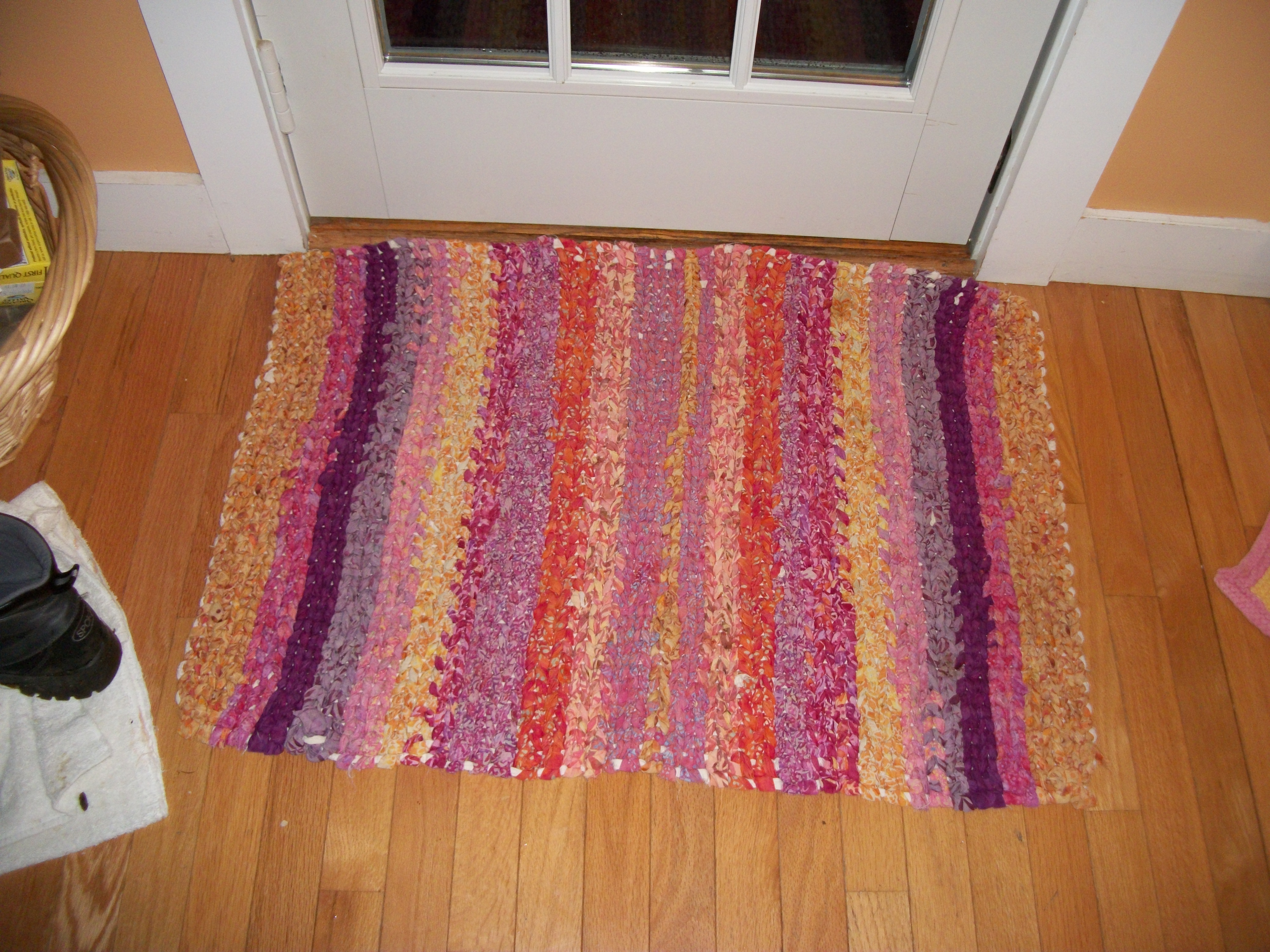
Here’s a picture of the upper side door rug so you can see how different it is.  That’s the door stopper Bryan and Corinne sent to us as a housewarming gift when we moved to Maine.

Here’s a picture of one of the placemats.  Each one is different.  And, I trim off unraveled threads every so often.  Again, they are wearing like iron and get popped into the washer and dryer without a backward glance.

Tami and I left the next morning to pick out fabric for her project.   John, upon hearing of her project, offered to make her a loom.  Meanwhile, after choosing batiks in soft creams and blues (beachy colors she said), she cut her fabric strips and started a placemat on my loom.

Tami and I always get into crafts toward the end of their month in Maine with us, so she did not have time to finish this first placemat and went home with both my loom and the one John made for her.  She did have time to master the technique and finished one of the placemats in short order.  Here it is:


I, meanwhile, made the six napkins with fabric she left with me and mailed them to her.

Tami and Mike, after looking for the kind of home they wanted to buy in Charleston, bought a home in August.  Thus, she was preoccupied with her third move in three years and with some changes to the new home throughout the fall.  (They bought a simple, beautiful home that works to keep them together as a family–along the lines of the “not so big” home idea.)  And now, both of my sons and their families live on Isle of Palms, a barrier island just north of Charleston’s harbor.  They live two blocks from each other and within two blocks of the beautiful Isle of Palms beach. 

Together over Thanksgiving, we finished three placemats, so now Tami has four completed.  She has materials for two more.

Here’s what the loom looks like, with a placemat in progress:

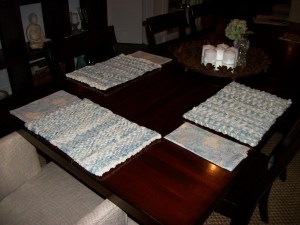
And, here are three placemats with their matching napkins:

Some time this winter I would like to start a rug using an old light green duvet color and some old sheets. 

I warn you:  this craft is addictive.

Turkey Tracks: Tami’s Birthday Socks

Turkey Tracks:  December 13, 2010

Tami’s Birthday Socks

Tami’s birthday is in February.

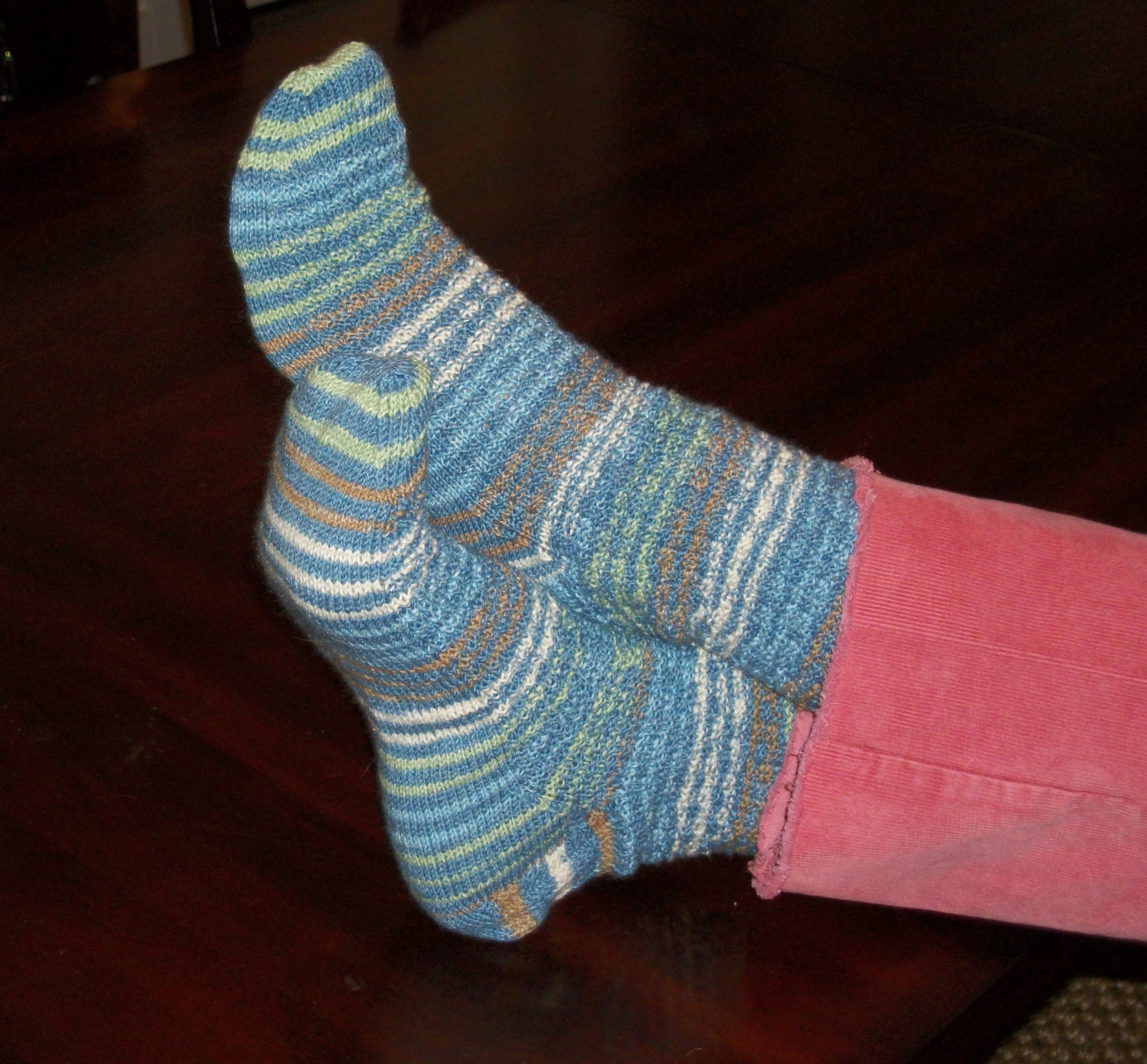
Here are the socks I was making for her.  They are a cotton-wool-nylon blend as all wool is too hot for Charleston, SC.  I finished them in while we were in Charleston over Thanksgiving.

They are the 4-stitch, double moss pattern from Charlene Schurch’s SENSATIONAL KNITTED SOCKS.  I really like the rough nature of this particular double-moss pattern.

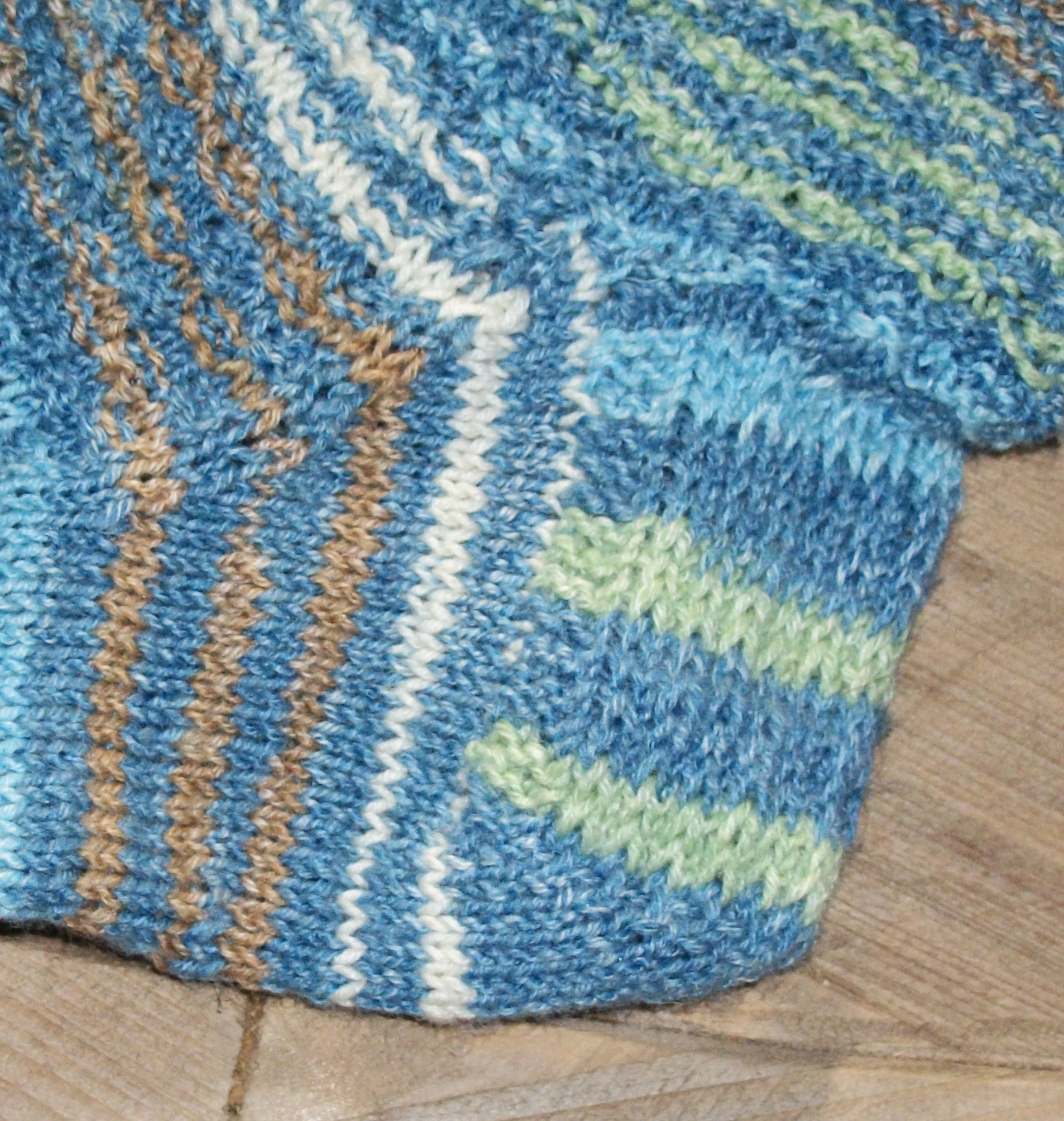
But, I’ve been stuck on the 4-stitch variations for over a year now.  I’m definitely going to try one of the 5-stitch variations next.  One reason I really like the 4-stitch version is the elegant heel treatment with the row of garter stitches along each side of the heel.  Here’s a blow-up picture of what I mean:

Of course I could not resist giving them to her.  And, you can see that the socks fit Tami’s elegant long feet perfectly!  Feet that go with her elegant tall body!

You were right, Barb Melchiskey.  I did have enough yarn.  I had about 20 inches remaining when I was done.  So comforting in the end!!!!

Turkey Tracks: Ailey Sydney Enright

Turkey Tracks:  December 13, 2010

Ailey Sydney Enright

Ailey Sydney Enright came into this world November 25, 2010, Thanksgiving morning in 2010, a few minutes after 5 a.m.

Bryan and Corinne arrived at  the hospital at 4 a.m. and were shocked to discover Corinne was fully dilated.

We were staying with Mike and Tami and the grands, and they called us about 7 a.m.   

Ailey is Gaelic for Helen, Corinne’s beloved grandmother on her mother’s side.  Sydney is for my beloved uncle, Sydney Hoke Bryan of Reynolds, Georgia.  Both Helen and Sydney have been formidable influences in Corinne and Bryan’s lives. 

Ailey looks like a tiny, unfurled rosebud.

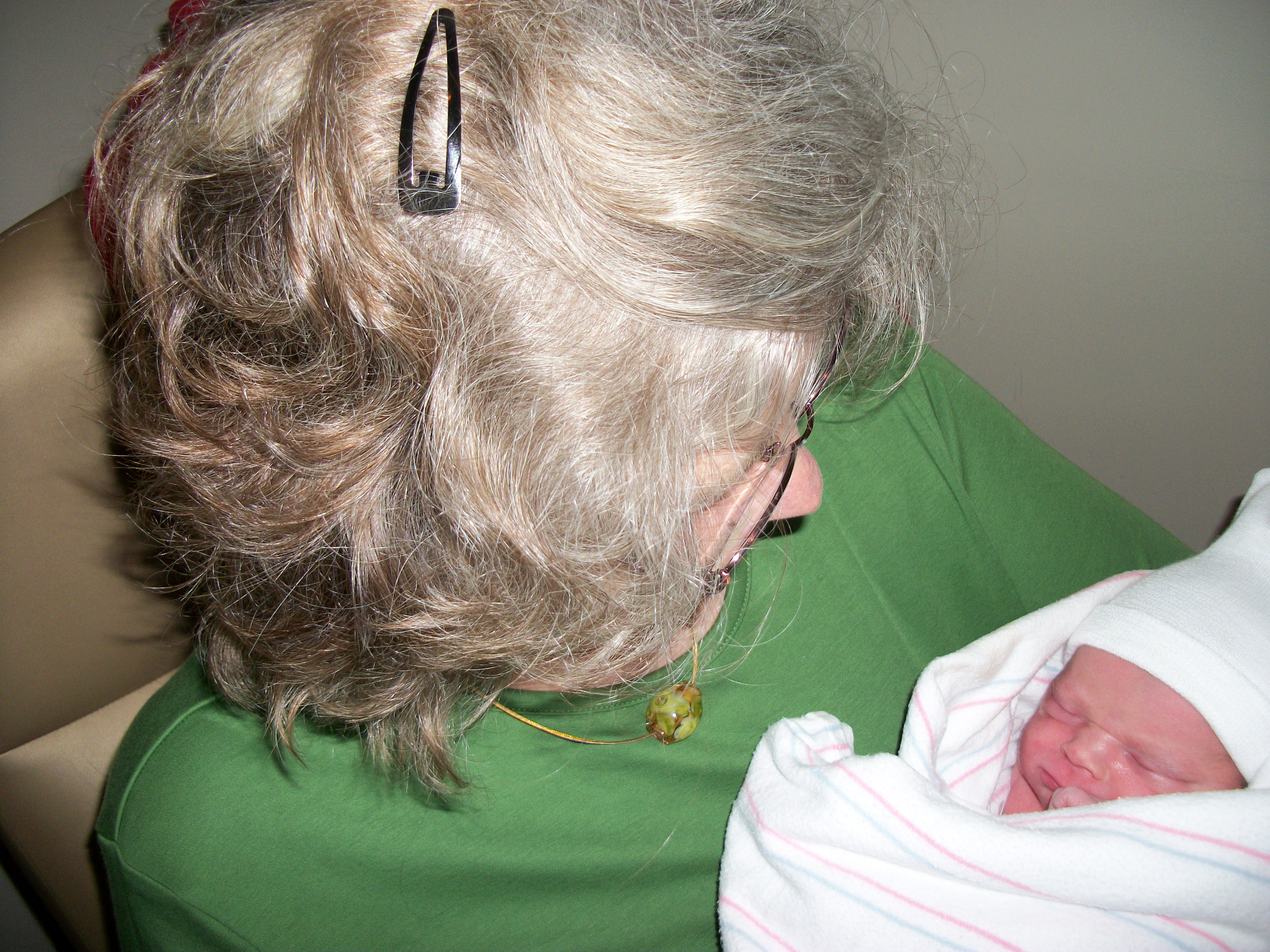
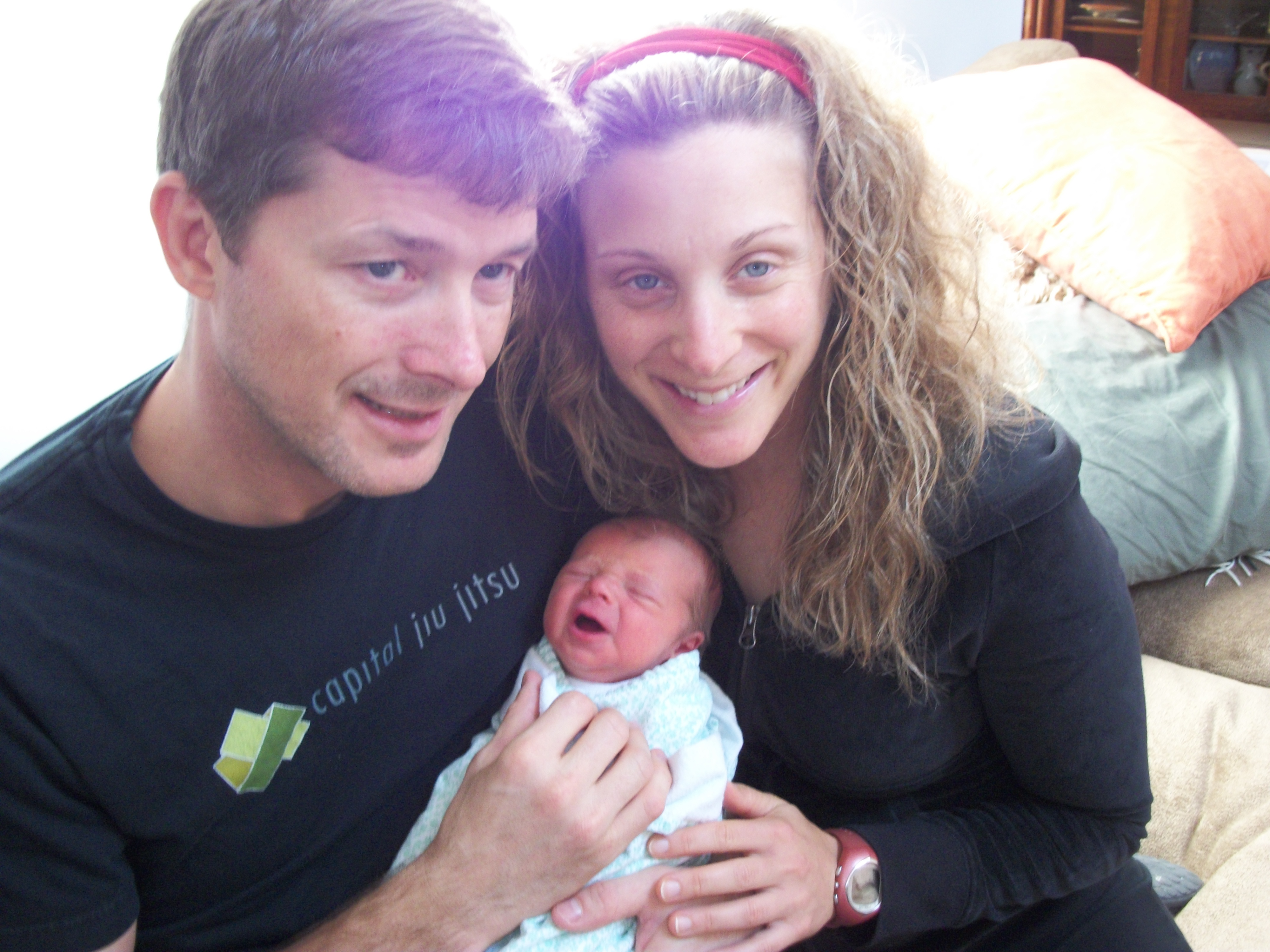
Here’s a picture in the hospital later that morning:

Here’s a picture of the proud parents and their beautiful daughter on the Saturday after Thanksgiving. 

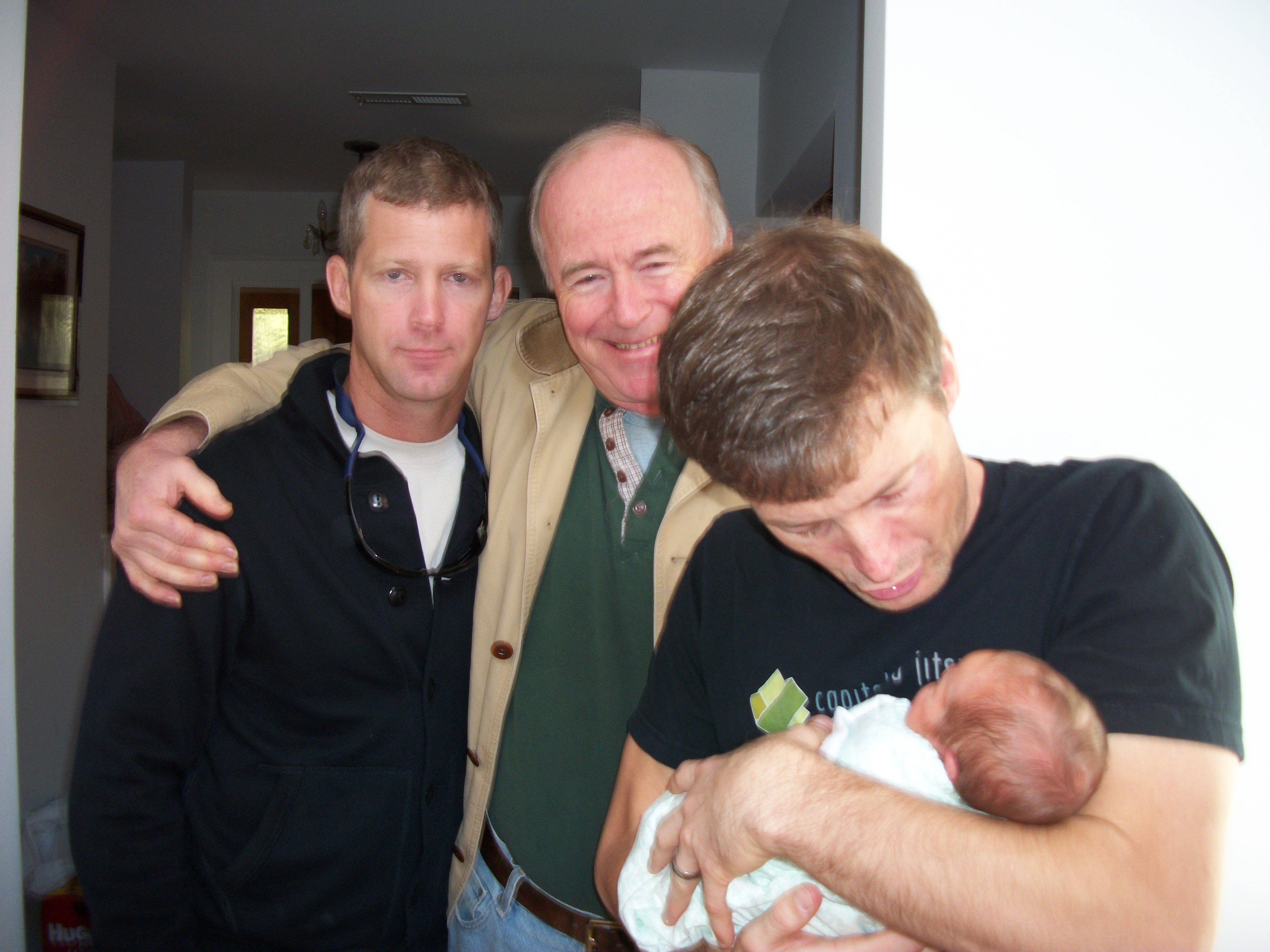
Here’s a picture of my three Enright men with their new daughter/niece/granddaughter.  Because Ailey was born on Thanksgiving, Bryan got that long weekend and the following week off from work.  I think he held Ailey most of that time, which gave Corinne time to rest and recuperate and work on being a new mom who is breast feeding.   Occasionally he’d let each of us hold Ailey, but he’d pace back and forth behind us if she wasn’t completely happy–especially during the time before Corinne’s milk came in and Ailey was hungry and wanted to nurse all the time.  

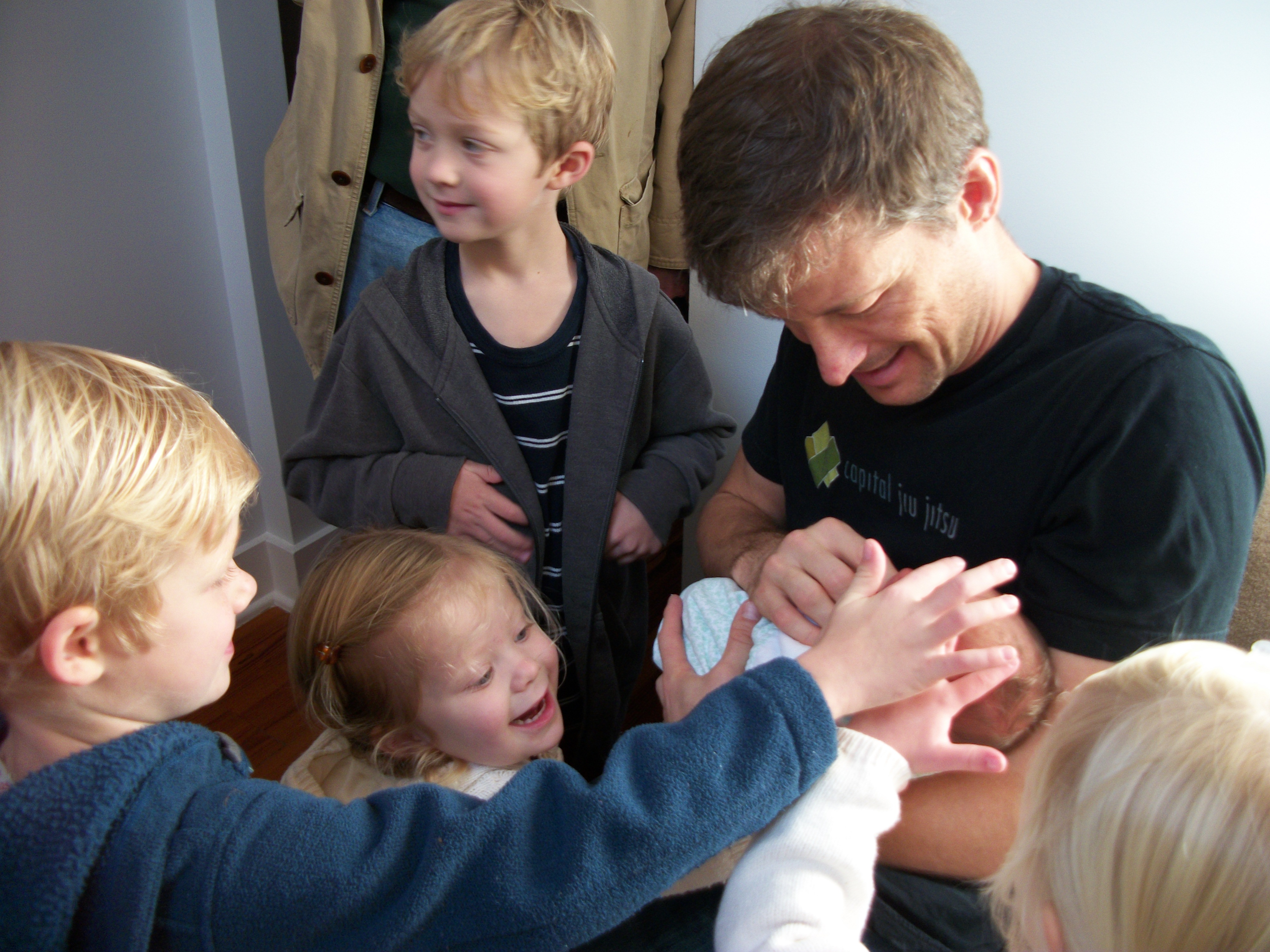
The other grandchildren are completely enchanted with their new cousin.  As is first-time aunt, Tami.   Here’s a picture of the kiddos introduction to Ailey:

And, another:

Corinne and Bryan are going to make excellent parents.  I always knew they would, but it’s nice to see my dreams for them in action.  Like about 25 percent of all couples today, when they decided it was time to have a child, they had trouble.  Corinne quit an engrossing, but killer job in the DC area, and they moved to Charleston and simplified their lives.  They worked with an environmental doctor there, and learned that they had some nutritional imbalances and some serious toxicities (aluminum and mercury).  They set about detoxing and cleaning up their food and cooking habits.  (Aluminum cooking pots, aluminum cans, aluminum foil, too much fish, mercury fillings, etc., are all problems for humans.)  They spent a year getting ready to get pregnant, and when they did, whammo!  Almost right away Corinne conceived.  And, Corinne, because she is so healthy, had a terrific pregnancy, a quick birth, and is now breast-feeding Ailey.  GO CORINNE!

I am so proud of both of them, and of Mike and Tami with their four beautiful children!  Both Tami and Corinne are seriously into learning about and practicing healthy lifestyle choices.  Both are sourcing local, organic, nutrient dense foods in Charleston.  They are the wave of the future!

Turkey Tracks: The Charleston, SC, Farmers’ Market

Turkey Tracks:  December 13, 2010

The Charleston, SC, Farmers’ Market

We flew to Charleston, SC, on November 19th, a Friday.  Son Bryan picked us up at the airport, and daughter-in-law Corinne, who was 9 months pregnant, joined us for lunch.  Bryan and Corinne hosted a gathering for all the family that night, so oldest son Mike, daughter-in-law Tami, and their four children (Bo, Kelly, Talula, and Wilhelmina), and old friends just moved to Charleston, Leighton and Tara Derr-Webb, all came.  We sat on B&C’s  big screened porch and ate Bryan’s beer-can chicken.  Delicious!  The grandchildren have grown so much since last July.

Corinne took us to the Charleston Farmers’ Market early Saturday morning.  This market is ranked as the 5th best in the nation, and it is wonderful.  It sits on two sides of a central downtown green square, which means each leg of the market is nearly a city block long.  Many venders sell on-the-spot freshly cooked food, and the smells from the market are heavenly.  It’s one of my favorite places to go.

We made many purchases for Thanksgiving dinner on the following Thursday.  (We start cooking early in Thanksgiving week.)  I think we go through six or seven dozen eggs while cooking Thanksgiving dinner.  The family dressing alone takes two dozen eggs.  Pies take eggs as well.  And, cornbread.  We were able to get  really good eggs at the market.  And, Corinne was really wanting apple pies, so we loaded up on apples.  And, on greens, particularly kale.  We drank coffee and tea, ate chocolate croissants from a downtown store–a favorite of Corinne’s–and sampled and sampled market offerings.

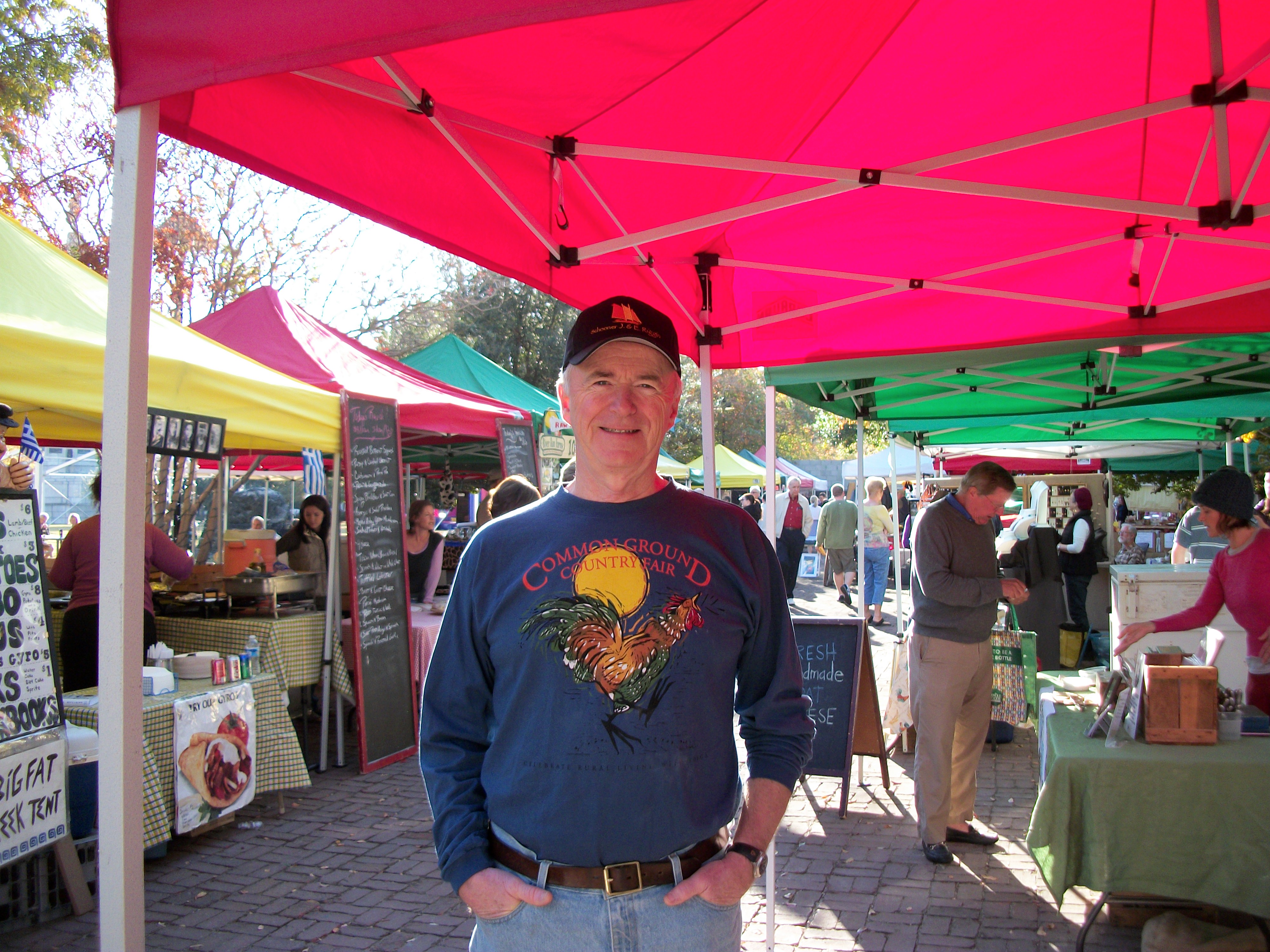
Here’s a nice picture of John at the market:

And, a nice picture of a very pregnant Corinne:

 Ailey Sydney Enright came into this world a few minutes after 5 a.m. on Thanksgiving morning, 2010, on November 25th.

Turkey Tracks: Giovanna’s Shawl

Turkey Tracks:  December 13, 2010

Giovanna’s Shawl

This fall I had the great good fortune to meet Giovanna McCarthy.

Giovanna’s husband, Tom, went to high school with John in Sommerville, MA.  Sometime last year, Tom and John reconnected, and Tom and Giovanna rented a house here in Camden, Maine, for the fall.  They wanted to explore living here, and they bought a home the first week they arrived.   They will move here for good in January 2011, and we are excited about them coming here.  Giovanna has already come to two of Coastal Quilters’ monthly meetings.

Giovanna came to America from Chile as a young woman.  And, Giovanna is a master knitter.  Her hands are always busy with handwork.

Look what she gave me not long ago:

 Here’s a close-up:

 Giovanna used one of the Noro yarns from Japan.  These yarns have the most beautiful colors and fibers.  Noro yarns can be pure wool or blends.  Noros often use a lot of silk and some of the softer animal fibers, like angora.  And, the yars come in various weights.  I made a scarf and matching hat from a silk and wool Noro when I started knitting again here in Maine.   It’s wearing beautifully.  I did a pair of socks, though, that I detest.  I couldn’t match the colors from one sock to the other, and to my eye, they don’t look pretty.  (Friend Amy Fischer loves them though.)  Giovanna, clearly, knows how to use these yarns.  She says this pattern is easy.  Ha!  And, that one works a hole when there is a color change so the colors are even.

I recently bought a book on knitting with Noro yarns that excites me.  There’s a chunky cardigan in it that has my name on it.

This blog will have more on Noro knitting down the road, I’m sure.  And I’m sure there will also be more on Giovanna and her work.

Turkey Tracks: Steve Melchiskey’s Earring Holder

Turkey Tracks:  December 13, 2010

Steve Melchiskey’s Earring Holder

I’m a member of Coastal Quilters, a chapter in the Maine State Pinetree Quilters’ Guild.  CQ is based in Camden, Maine, and it is a lovely group of women.  I treasure knowing each and every one of them.  They are generous to a fault, astonishingly talented, and devoted to this quilting group.  We learn a lot from each other.

Our spouses are no slouches either.  Many of them help us set up our meeting space at the Lion’s Club each month, which involves putting up lots of tables and placing chairs around them.  And, for our annual fundraising auction, one spouse–Steve Melchiskey–made several, very clever, pierced earring holders, using frames and window screen.  I had been searching for something to organize my earrings–especially since I have a new-found passion–making earrings with the help of the staff at Aboca Beads in Damariscotta, Maine, about 40 minutes down the road.

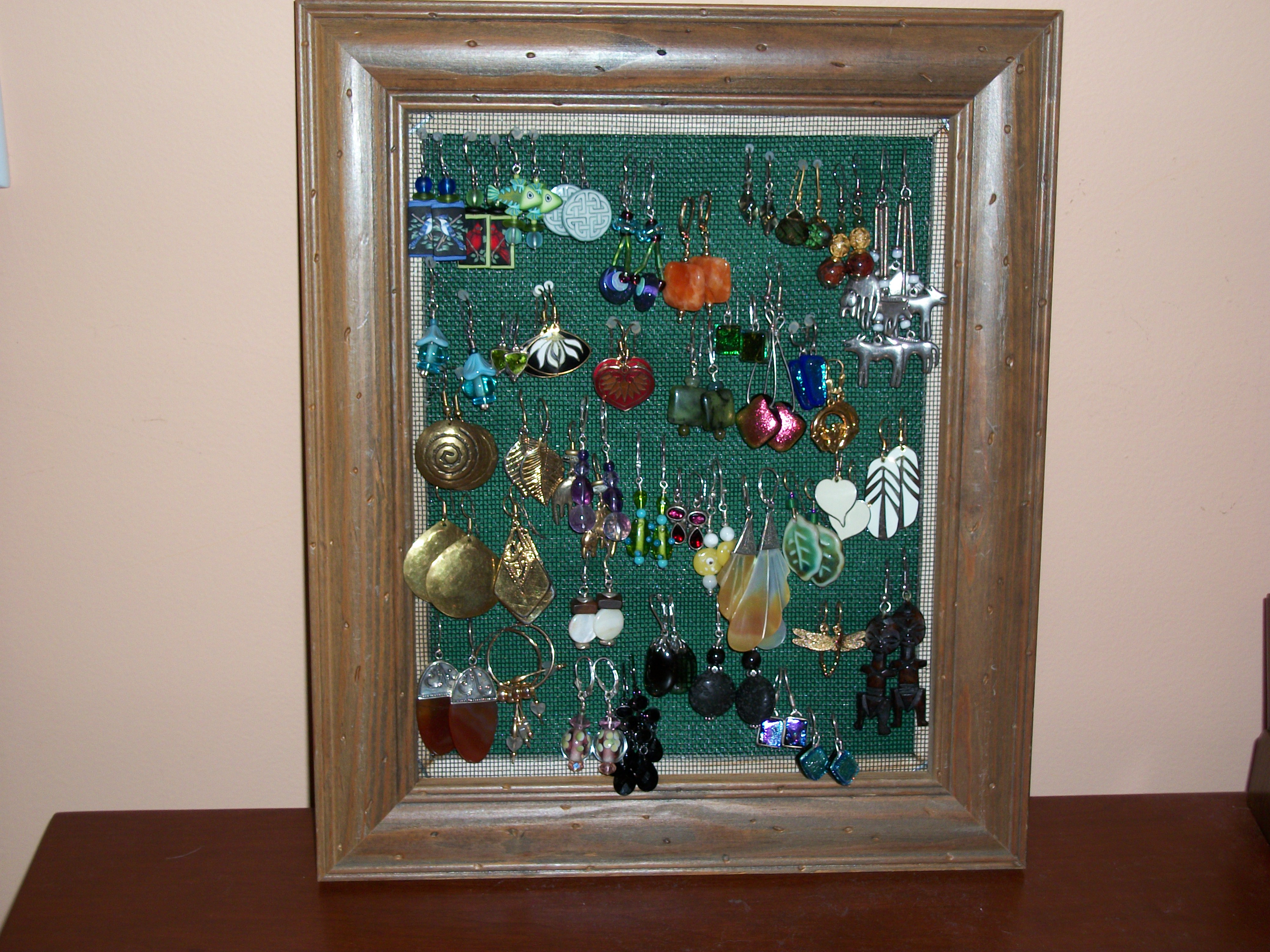
Here’s my terrific earring holder, and my heartfelt thanks to Steve Melchiskey for supporting Coastal Quilters:


Look at all those earrings, both VERY old and new!  The top three on the left are made from folding clay by the most amazing artist who displays at Alewives Fabrics in Damariscotta Mills.  How does she make such intricate pictures????  Some readers will recognize earrings they have given to me.  Some of the earrings I remade from old, outdated earrings, giving them new life.  One of the amber-like ones on the lower left got dropped and cracked.  John glued it for me, and I love it still. 

Turkey Tracks: Big Beautiful Bug, New Granddaughter Quilt

Turkey Tracks:  December 13, 2010

Big Beautiful Bug, New Granddaughter Quilt

Before leaving for Charleston for Thanksgiving, I wanted to complete our new granddaughter’s “welcome to this world” quilt.  She was due the first week of December–maybe even while we were in Charleston.  We were due to return December 6th.

Corinne found what would be the backing fabric when she was here this summer, and we both loved it.  There was a limited amount, however, and all the internet fabric searches in the world did not turn up more of it.   For some odd reason, I never did get a picture of the back of the quilt–and the fabric before I cut some of it up for the front.  Here is a BIG picture of part of the front, and you can see the fussy-cut featured bug fabric, combined with lively, bright prints.

Here is border detail:

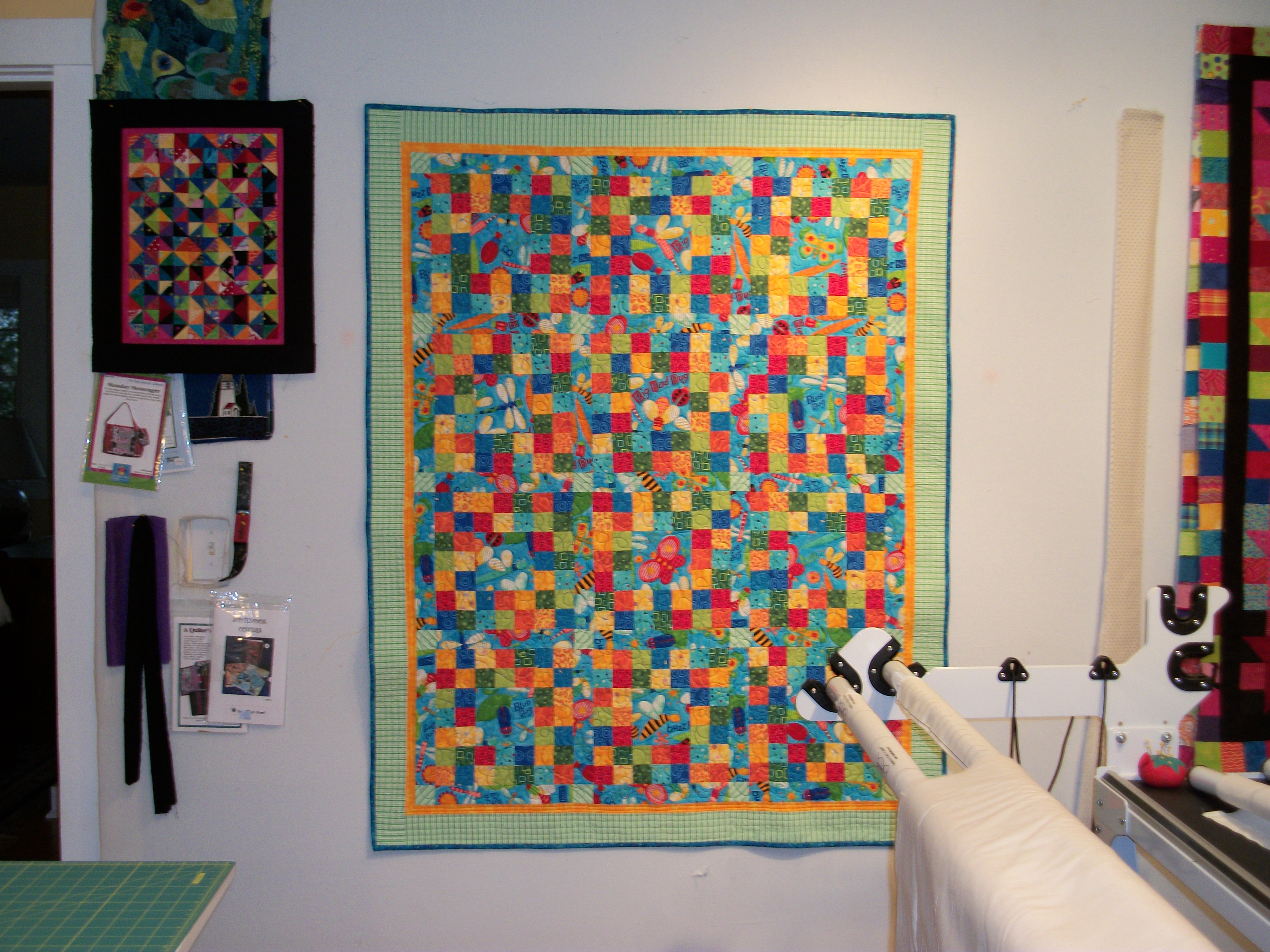
And, here is the finished quilt:

This is a pattern I clearly love.  I’ve used it three times now.  One for my great-niece Fiona Whittle, and once for my daughter-in-law, Tamara Kelly Enright.  Each quilt is uniquely different.

Turkey Tracks: Ask And You Shall Receive: Synchronicity

Turkey Tracks:  November 9, 2010

Explanation:   This entry is out of order.  In the flurry of getting ready to go to Charleston for Thanksgiving with our children and grandchildren, I didn’t publish this draft to the blog.  I wrote it after the November 8 entries about wild yeast breads and cooking with honey. 

Ask And You Shall Receive:  Synchronicity

Have you ever thought or voiced a need for something–some information perhaps–and within a few days it appeared?  This magic is called synchronicity.  Some kind of energy goes out into the world and, like magic, the universe/god/whatever delivers what you need.

So, yesterday I was writing about wild yeast and making my macaroon cookies with honey instead of maple syrup.  This morning I was reading Yes! magazine–the current copy Fall 2010–and ran across a two-page article called “Can You DIY?”   This article talks about how to sweeten with honey, how to capture wild yeast into a bread starter, how to darn a sock, how to save kale seeds (a four-season crop in mild climates), and how to refrigerate without electricity.  There are demonstration pictures, too.   Take a look?   http://www.yesmagazine.org/issues/a-resilient-community/can-you-diy

Yes! magazine can be read on-line, and you are free to use its articles however you wish.  It’s mission is to support its readers in building a just and sustainable world.  The quarterly issues are devoted to specific themes, like, for instance, this Fall 2010 issue:  “Ready For Anything:  Building Resilience Now For Hard Times Ahead.”  This issue features explanations about the Transition Movement, which is growing by leaps and bounds across the world as people are beginning we have to make radical, structural changes in how we are organizing and living our lives.

Turkey Tracks: The Best Eggs

Turkey Tracks:  December 12, 2010

Explanation:

Before Thanksgiving, I went into our local co-op–Good Tern–in Rockland, Maine, where I do the bulk of my weekly grocery shopping.   November, as you may know, is the egg low point of the year.  Since our wheaten Americaunas starting their yearly molt and since the Marans don’t lay in the winter, we’ve had no eggs for some weeks now.   On a shelf in the cooler were eggs from an industrial organic egg factory located in New England and selling eggs all the way into the southern states:  Pete and Gerry’s organic eggs.  These eggs were selling for $6!!! a dozen.  These folks have the most charming, caring stories about their operation in their egg packages–all of which is advertising hype and which is a perfect example of “buyer beware.”

 I tracked down a staff member and protested.  Why were expensive industrial eggs from tortured hens taking up limited space when we have many small local farmers producing superier, unlabeled organic eggs from pastured chickens, trying to make a living?  (One significant problem for many small farmers is the cost of getting and keeping official organic certification.)  The following week, two days before leaving for Charleston to spend Thanksgiving with our children and grandchildren, the manager explained that some members were asking for certified organic eggs and asked me to put in some sweat equity and write a education piece on why industrial organic eggs were not the best buy.  Here’s what I wrote for the coop newsletter, though I’m not sure I made their deadline since I had technical troubles sending messages in Charleston.

Here’s a picture my daughter-in-law Tami took and sent to me of eggs cracked open into a white bowl.  One yolk stands out with its vivid, pumpkin orange color against the other paler yellow yolks.  It’s the difference between a pastured layer and industrial “organic” yolks.

THE BEST EGGS

Choose, first, organic eggs.  But, understand that the term “organic” is no longer a guarantee for a healthy food.  With regard to eggs, within the term “organic,” there are other important factors to consider.

Despite cheerful, wishful advertising to the contrary, all industrial “organic” layer confined animal organizations (CAOs) have some significant problems that impact egg quality:  the health of the layers; the feed; and the indoor, inhumane, unhealthy overcrowding that is inherent within this model.  Commercial layers are units of production only.  They are mass produced in incubators for a system that needs them to lay as many eggs as possible, regardless of the season.  Hens are born with a finite number of eggs, and most hens can lay eggs continuously, except for molting once, for about two years.  Industrial hens are debeaked and forcibly molted by starvation for up to two weeks.

Organic feed does not contain agricultural chemicals and does not use genetically modified products, but those facts are about the only good thing about it.  The quality of commercially produced organic feed is very poor since our government has allowed the organic chicken industry to cut quality to the bone in an effort to reduce production costs.  But, those costs are not necessarily passed on to the consumer.  For instance, Pete and Gerry’s organic eggs—products of a CAO holding 130,000 birds and delivering eggs throughout New England and into the Southern states–are currently selling for about $6 a dozen.  The Country Hen eggs—another massive layer operation– charges $4 for six eggs, or $8 a dozen.  Our local, unlabeled organic eggs are about $4.50 a dozen.

All the commercial chicken feeds, including the organic feeds, are 90 percent corn and 10 percent soy, contain about 20 synthetic chemicals meant to substitute for real ingredients lacking in the mixture, and contain waste products (meal, oil) from other industrial processes.  The corn/soy ratio does not contain enough protein, so our  government allows the addition of a synthetic essential amino acid, methionine.  Highly processed soybean oil added to the mixture is already rancid and can be trans fat laden.  These feeds are mashes or pelletized mashes.

Government organic rules stopped the addition of unspeakable animal by-products into commercial organic chicken feeds, but rather than mandating a healthy protein source or a better grain/legume ratio, it allowed the cheap corn, soy, and methionine mixture.  Corn fattens, and while soy, which must be cooked, can provide protein if given in sufficient quantity, it has a dangerous antinutrient package that American industry has never been able to fully detoxify.  Thus, soy antinutrients slowly poison animals, which does not matter to industry because neither meat chickens or layers live that long.  But, what is all the soy in our industrial animal feeding systems doing to us?

Commercial chicken feeds are throwing off the omega 3 and 6 ratios in both eggs and meat.  Human diets should have a ratio of 1:1, or not more than 1:3.  The standard American diet today is giving most Americans an omega 3 to 6 ratio of 1:20-25.  This boosted omega 6 imbalance is not healthy and is likely part of why so many people have chronic illnesses.  It’s also why producers are claiming their eggs have “more omega 3s.”

Chickens are omnivores, not vegetarians.  To produce an egg with balanced omega 3 to 6 balances, chickens need to eat what they ate before industry, beginning in the 1950s, began to change their diet to allow lucrative industrial operations.  Chickens love green vegetation (grass, clover, greens), and the green matter is what gives a healthy egg its dark orange color.  Chickens like protein from insects and worms, and small flocks have always traditionally been given leftovers from the kitchen, which means chickens also eat meat, dairy, vegetables, and fruits.  Chickens choose grains and legumes only after the above foods are gone, so grain/legume mixtures should be supplements only, offered for free choice, and should include at least five different whole grains.

The Maine Poultry Growers Association (MPGA) says consumers need to know whether or not the layer spends time daily on pasture and that other descriptive terms, like “free range,” are meaningless.  MPGA notes that recent studies from Penn State University “found that eggs from chickens that ate grass and insects contained higher levels of omega-3 fat, and vitamins E, A, and in some cases D.”

In effect, industrial CAOs are a bad match with organic principles.  Chickens confined indoors for their lifetime in a barn containing thousands of other chickens and all their combined daily manure live marginal lives and are breathing in excessive amounts of ammonia.  When raised with industrial methods and fed an industrial diet, they cannot be very healthy.  Without ever getting to the ethics of what occurs in a CAO, it is easy to see that these chickens are not going to lay eggs that bear much resemblance to the eggs that have nurtured humans for centuries.  And, buying these eggs, even if they were reasonably priced with regard to their quality, is only going to perpetuate this soul-killing system.

So, the best egg is going to come from a local farmer whose chickens have access to pasture; are fed a variety of foods, to include organic whole grains; and are allowed to rest and recuperate during the winter season.  Second best eggs would come from a local farmer whose chickens have access to pasture and who are fed a commercial organic feed.  And, third-best eggs would come from a local farmer whose chickens are fed organic feed and who, hopefully, are not housed in small cages.

As consumers, we have to ask our local farmers to pasture their chickens and to feed them wholesome food.   We have to ask our local stores to carry these healthy eggs.  And, we need to understand and respect what chickens need.
Turkey Tracks: An Asset: Easy, Enzyme-Rich Sauerkraut

Turkey Tracks:  November 23, 2010

An  Asset:  Easy, Enzyme-Rich Sauerkraut


I like to have what I think of as “assets” in my kitchen.  If I have a bone broth, for instance, I have the makings of a soup lunch or dinner.  Salt-preserved lemons topped off with olive oil provide a tasty addition to everything from mashed potatoes to salad dressings to drizzles for baked fish.   Apple chutney is great alongside meat or inside an omelet and keeps for a long time.   I keep piima whole cream which operates like crème fraiche or sour cream and which can be used in tea or coffee to add a different kind of zing.  (Piima is a Finnish cultured milk product that is chock full of enzymes.)  Leftovers can be turned around in new ways for easy meals.  And, lacto-fermented vegetables keep for months in the refrigerator and add zip and enzymes to your plate, especially in the winter when local salad greens are scarce in Maine.  

Sally Fallon and Dr. Mary Enig, in Nourishing Traditions, write that the lactobacilli in fermented vegetables enhances digestion and promotes the growth of healthy flora throughout the intestine.  And, lacto-fermented vegetables have antibiotic and anticarciogenic substances.  Plus, eating enzyme-rich food takes pressure off your body to process what you eat.  My favorite lacto-fermented vegetable is sauerkraut.  I put about ¼ cup of sauerkraut on almost every plate we eat in the winter.  People used to lacto-ferment vegetables to preserve them before canning technology arrived.   

Not long ago I dropped the old half-gallon sauerkraut container, and it broke into a million pieces all over the kitchen floor.  It was full of fairly newly made sauerkraut.  So, after I cleaned up the mess, I set about making some more, and in the three days it took to make, we missed having this “asset” around quite a lot.

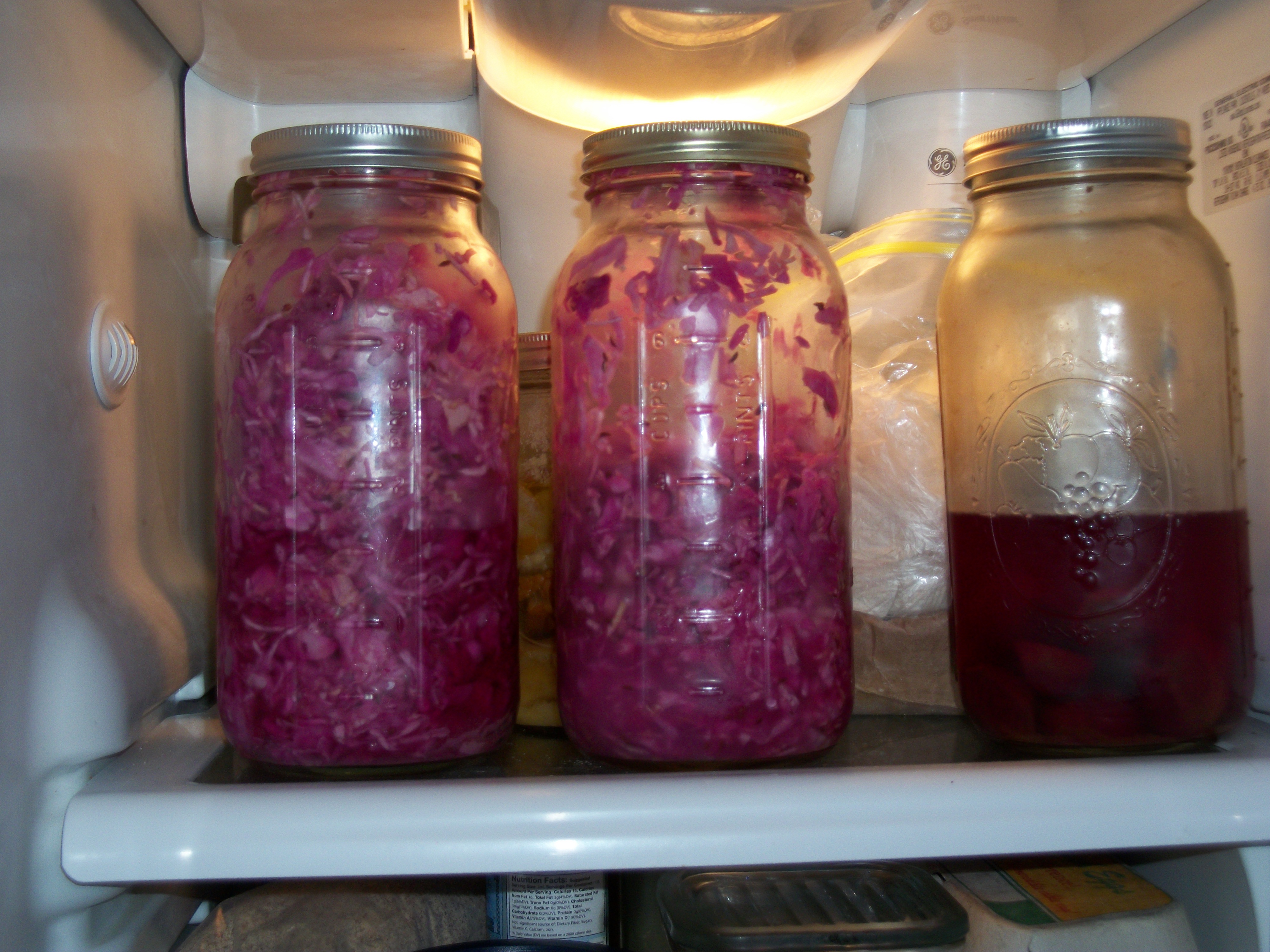
Here’s a picture of the two new half-gallon containers: 


I used a red cabbage and part of a green cabbage.  In a few days, the red cabbage will turn the new sauerkraut a rosy pink.  See?  It will get darker along the way, and it will keep for months, if we don’t eat it first.  That’s beet kvass on the right, another enzyme-rich, healthy product.


Here’s the recipe from Nourishing Traditions:

1 medium cabbage, cored and shredded.  I use the slicer on a food processor.

I Tablespoon caraway seeds

1 Tablespoon sea salt

4 Tablespoons *whey (or use 1 additional Tablespoon of salt).

 *Whey is the clear liquid that can be drained from good yogurt.  Most commercial yogurt now is so full of pectin and seaweed that it will not drain whey.  So, be aware that what you’re paying for isn’t a full-milk product, but a product adulterated with fillers—so the producer makes more money.

 I far prefer the whey to additional salt.  You can drain yogurt by putting a paper towel or two, or a coffee filter, into a colander and setting it over a bowl.  Put yogurt into the paper-covered well of the colander and set it over a deeper bowl.  You can put a plate over it if you like.  The whey drains off, leaving you with a delicious spreadable cheese you can flavor with herbs or drizzle with honey.  Don’t worry; this mixture won’t go bad at room temperature.

 I mix the sauerkraut ingredients in a big bowl and pound it a little with something a bit heavy:  a mallet, the handle end of a big spoon, or a mortar grinder.  When the cabbage starts to release its liquid, pack the cabbage into a clean Mason jar, making sure you leave about an inch of free space.  Keep the mixture at room temperature for about three days, turning it upside down to distribute the liquid once or twice a day.  (Don’t leave it upside down—just mix it up.)  You can eat it most anytime, but it’s best after about three days.  Refrigerate it and ENJOY!