Turkey Tracks: Liam Whittle’s “Teddy Bear Tales” Quilt

Turkey Tracks:  January 9, 2011

Liam Whittle’s “Teddy Bear Tales” Quilt


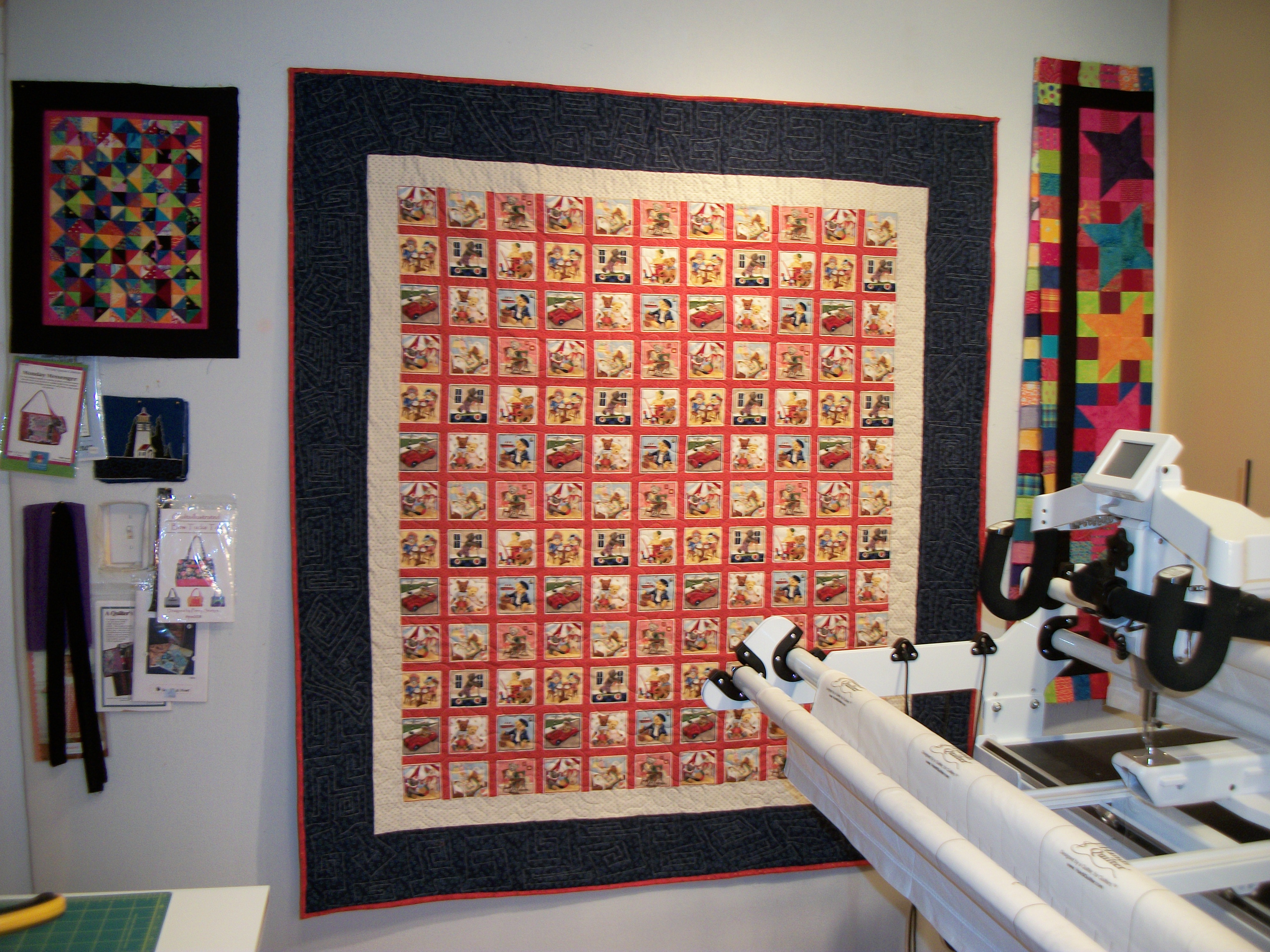
 I fell in love with this quilt panel when I saw it a few years ago.  Maybe it’s because I’ve always loved Teddy Bears.  It told me it wanted to be sent to Liam Whittle, who is just the right age for teddy bears sleeping on his bed.  I made this quilt to be tough, washed, dragged around, and loved to pieces. 

This is the first quilt I’ve quilted on the long-arm.  It came out pretty well.  I just kept to the basics, but the machine is so much fun to work!

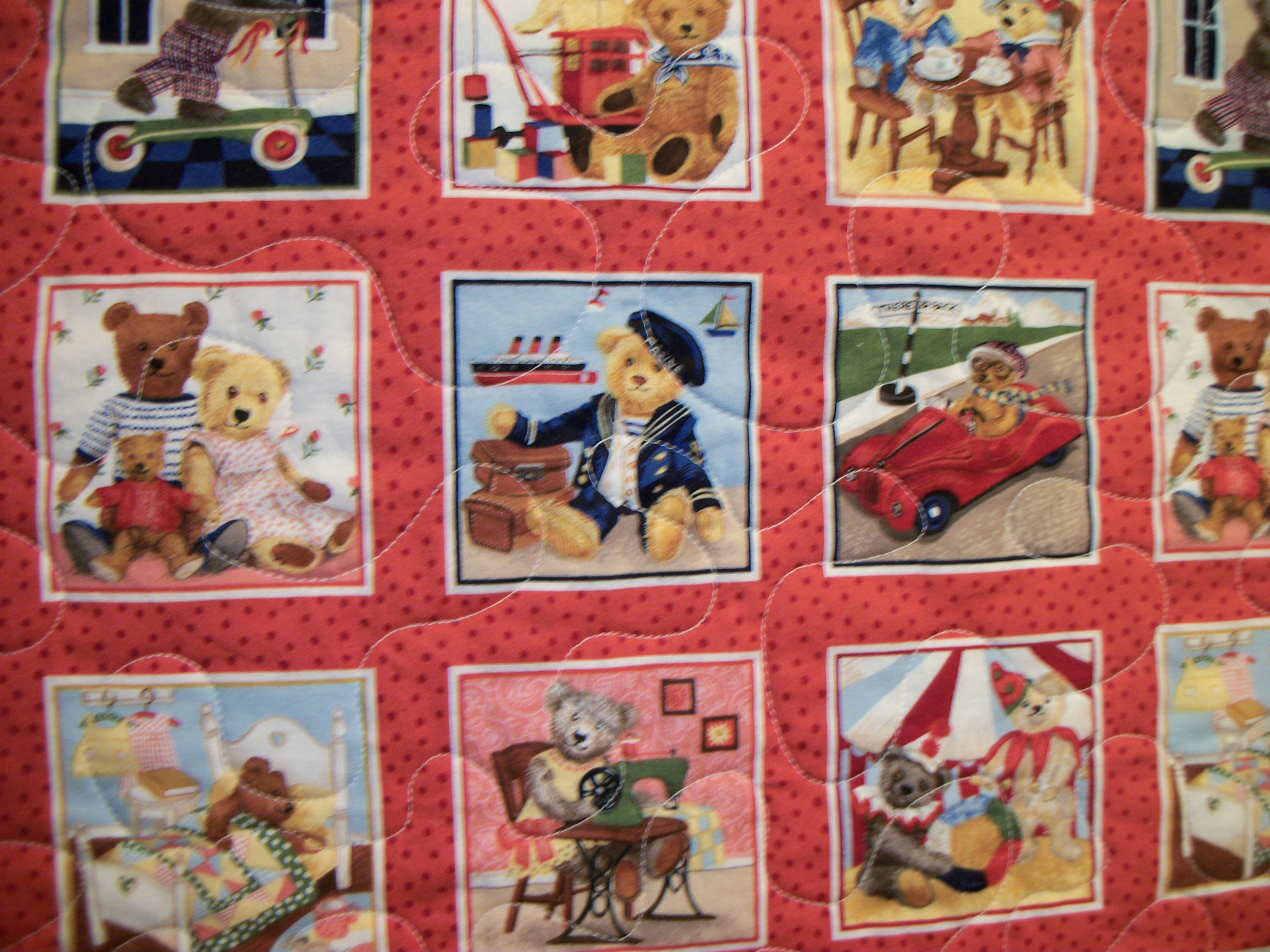
Here’s a detail of the front panel.  I hope Liam and his parents and his sister will make up stories that explain the pictures.

Here’s the backing fabric.  Is it perfect or what?  I really love the childrens’ quilt fabrics available now.

Enjoy, Liam.  Many hugs and kisses and love!  Your Great Aunt Louisa

Turkey Tracks: Ball-band Dishcloth

Turkey Tracks:  January 9, 2011

Ball-Band Dishcloth

I finished the Ball-Band Dishcloths I talked about some time ago as an unfinished project.  I have no idea why they are called “ball band” discloths.  Maybe it’s the pattern…

I used red and green Peaches & Cream cotton for potential Christmas use–though they are looking very pretty on top of my yarn pile at the moment.  I got the pattern from Kay Gardiner and Ann Shayne’s MASON-DIXON QUILTING.  But, as they note, the pattern is on the inside of the label of many of the P&C yarn balls.

Here’s what they look like:

I added the little braided end. It’s easier than weaving in all the loose ends.

These beauties hold up really well.  I have some that are three years old now and going strong.   As Gardiner and Shayne say:  THEY MUST BE USED!!!  Plus, they’re fun to make.

Turkey Tracks: Elaine Gottschall’s Muffins

Turkey Tracks:  January 9, 2011

Elaine Gottschall’s Muffins

Since reading about the 1980 USDA food guide that changed the scientifically recommended guidelines for grains from 2 to 3 servings to 9 to 11 servings AND since realizing that my own food allergy problems are related to gut dysfunction, I censor grains in my diet.  I wrote about this USDA debacle in some of my Mainly Tipping Points essays which I have posted on this blog.  Along the way, other reading showed me a whole new way to get a bread-like product with ground nut “flours.”   

In the 1950s, Elaine Gottschall was, at first, a lay person with a seriously ill child when she discovered Dr. Sidney Haas’s work on gut dysfunction in the 1950s.  She adopted his Specific Carbohydrate Diet, now called the GAPS diet (Gut and Psychology Syndrome), and cured her child.  Dr. Natasha Campbell-McBride, among others, has discovered the connection with gut dysfunction and neurological disorders, like autism, ADD, ADHD, dyspraxia, dyslexia, depression, and schizophrenia, and is having a lot of success helping those impacted.  Dr. Joseph Mercola has a book called the NO GRAIN DIET.   

Anyway, this nut-muffin or nut bread recipe is from Gottschall’s book BREAKING THE VICIOUS CYCLE.  It’s delicious and very filling.   Two of these muffins hold me for hours. 

Use organic nuts if you can.  AND, you REALLY DO NEED paper muffin cups.  (Don’t use foil as it will be aluminum toxic.)  The recipe makes about a dozen muffins–more if you add bulky items like banana.

2 1/2 cups ground nuts.  (You can buy nuts already ground at co-ops and stores specializing in nutrient-dense whole foods.) 

 1/4 cup melted butter, or yogurt, or small amount of fruit juice, or pure apple butter (enough to moisten well)

1/2 cup (or less) honey

1/2 tsp. baking soda

1/8 tsp. salt

3 eggs

Additions:  1/3 cup dried fruit, and/or grated lemon/orange rind, and/or flavoring (almond, vanilla).  Fresh blueberries are nice.  For a banana version, add two mashed, ripe bananas and an extra egg.  For coconut, add dried/unsweetened coconut for part of the flour.

For nut bread, add one extra egg (4 eggs) and put into well-greased 1-quart baking dish.

Mix all together and bake at 375 degrees for 15-20 minutes. 

Gottschall’s book has many good recipes.  But, she wrote it at a time when we did not know how dangerous artificial sweeteners are.  Don’t use them.  Some of my essays cover artificial sweeteners as well. 


Turkey Tracks: Red Fish Quilt In Progress and Copyright Laws

Turkey Tracks:  January 9, 2011

Red Fish Quilt In Progress and Copyright Laws


Two summers ago, I took two quilting classes from Jo Diggs, at our state-wide Pine Tree Quilting Guild (PTQG) annual show.

Jo Diggs is an amazing quilter and an effective, caring teacher.  She cuts fabric free-hand and hand appliques the shapes to make her designs.  She does landscapes, floral compositions, and underwater fish and vegetation.  She relies on fabrics she can buy.  She does not artistically manipulate (paint, stamp) fabric.  You can an idea of the kind of work she does on her web site:  www.jodiggs.com.  But, there is no substitute for seeing her work in person.  And, she will be teaching at the Mid-Atlantic Quilt Show in Norfolk, VA, in February.

Before I took Jo’s class on landscapes, I had been doing landscapes.  I can clearly state that I will never be able to be the kind of artist she is.  Her visions are unique and enormously satisfying.  And I did learn more about method from her.  The fish class, though, was formative.  Prior to this class, I had no idea how to go about creating a picture of fish from inside my own head and with fabric available to me.  I did not know how to “think” a fish by combining various shapes in layers.

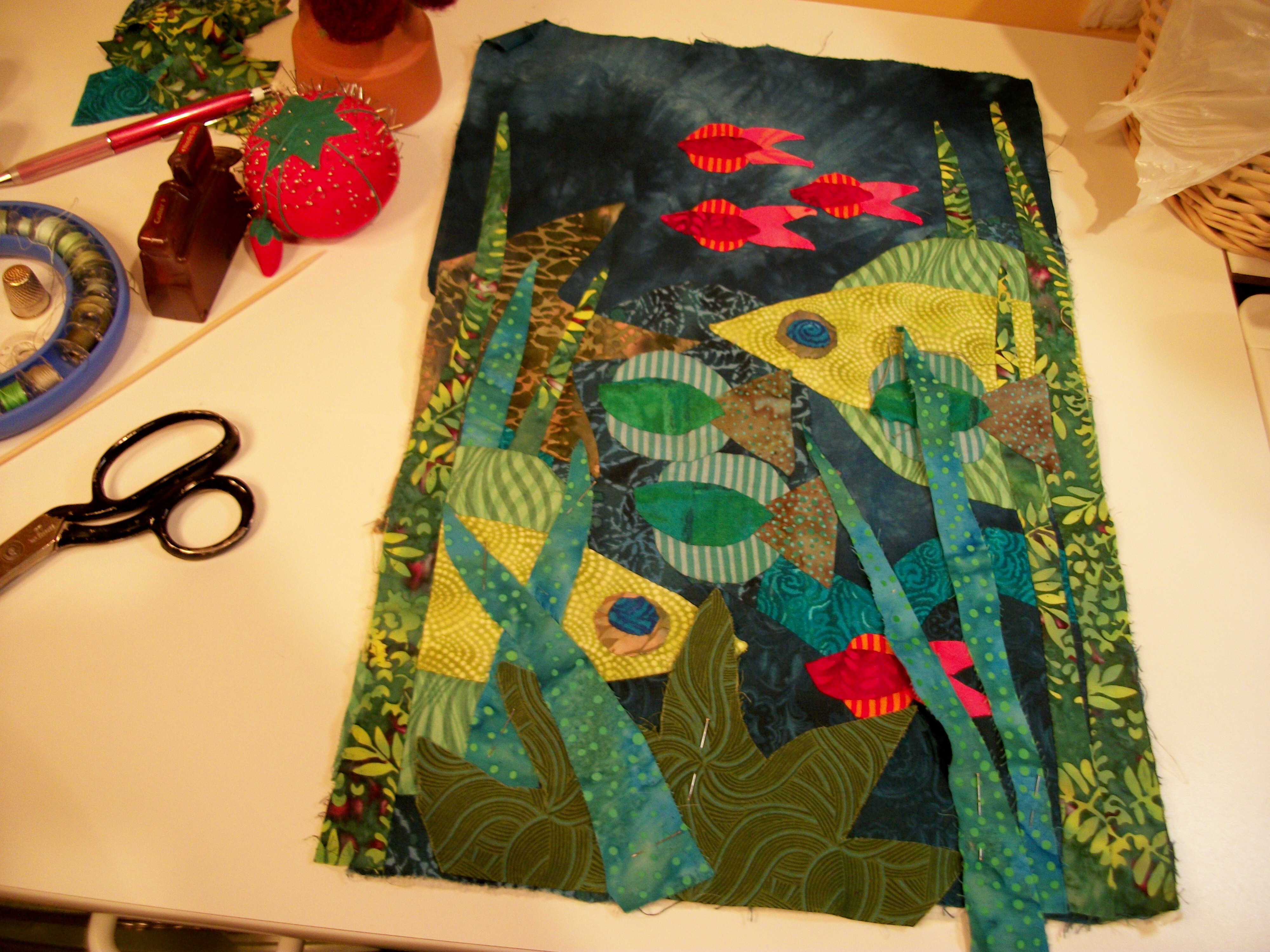
The small quilt top I started stayed pinned to my design wall for 18 months.  I finally picked it up and started hand-sewing just before going to Charleston for Thanksgiving.  Hmmmm, I thought.  Maybe I can do this work.  Last week, I picked up the top again, in the middle of two other quilting projects and three knitting projects, and quickly became obsessed.  Here’s what it looks like so far:

 I’m getting better at the applique as I go along.  My circles have improved immeasurably already.  The fish will all get eyes via embellishment at the second stage.  The large green fish, for instance, will get a button eye.  And, already, some of the foreground has changed.  It does have more depth when you look at it straight on… 

I haven’t a clue how to quilt it, but will figure it out. 

Meanwhile, if this quilt does turn out to be good enough to think about hanging it at the annual Pine Tree show, I will have to get Jo Digg’s permission since it was developed in a class she taught.  Pine Tree recently sent out new protocols for displaying quilts.  If you developed a quilt in a class, made it from a pattern in a magazine or book, or from a pattern you purchased, you have to get the permission of the designer to display the quilt.  I don’t think you can sell such a quilt without getting the permission of the designer either.  Exceptions involve using traditional blocks.  Amy Butler, who designs patterns and fabric, clearly states that if you buy one of her patterns, you may not sell the item to anyone without her permission. 

I’m all for a designer getting credit for his/her work.  I think having to get permission for using a pattern in a published magazine or a book is a bit silly and defeats the purpose of the said magazine or book.  One must give credit, yes, but getting permission is an overload for everyone.  I think selling products made from a published pattern should be ok, too, provided one gives credit to the designer. 

The big problem I have with how to negotiate this terrain with regard to taking classes is deciding where there is a novel, copywrited product and where there is a method to be learned.  No one else can combine fabric in the way Jo Diggs does.  She is an artist and the work she does comes from inside her head.  She can teach me “fish,” but I’ll never create them or put them into a quilt in the way she does.  I could not if I tried.  What she does is unique.  So, did I learn a method from Jo Diggs.  Or am I forever bound to call her for permission whenever I make an applique quilt using anything remotely resembling her fish method?

I don’t know.

But, I can tell you that I’m not likely to take any more classes if these interpretations prevail.  I already refuse to buy Amy Butler’s patterns or fabrics  and would encourage you not to do so as well until she mitigates her legal stance in writing on her patterns.  And, if my little fish quilt turns out ok and if I can reach Jo Diggs without too much trouble and if she gives permission, I might hang it at PTQG.  But if there is any hitch, I will not.  So it will be interesting to see how many quilts PTQG hangs this year.

Clearly this whole terrain has gone over the edge of sanity.  I will be interested to see how much of an impact it has on teachers, books, and quilt shows.


Turkey Tracks: Annie’s First Egg

Turkey Tracks:  January 8, 2011

Annie’s First Egg

Yesterday I was in hurry and rushed down the wooden boardwalk to my car.  The chickens were out, and I walked through them.  When I reached the end of the boardwalk, I was aware that our rooster, Napoleon, or Coq Au Vin, depending upon whether you are talking to John or the grandkids, was chasing me.  Mercy!  He has been so docile all winter, often letting me pet him while he makes all sorts of contented noises.  Here’s a winter picture of the chickens hanging out at a back door.  They are very social and come visiting on the porches often.  Annie is closest to the door.

When I got home, I visited the coop to check food and water levels.    There was a dark brown egg in a depression in a corner, under a lower roost!  It could only be Annie’s since it is the smaller size of a pullet just starting to lay.  Here’s a picture of Annie’s first egg  in the middle of Rose Thomas’s eggs.  (The blue eggs are from her wheaten Americaunas and the light brown ones are from, likely, her Red Sex-Links.)

The fact that Roo chased me suddenly made perfect sense.   One of the hens was laying again!

For those of you who don’t know chickens, when the days grow shorter, hens stop laying and rest.  You can see in the picture of the chickens that Annie’s comb is much redder than the older hens.  Depletion of comb and leg color happens because egg production takes everything out of the hens.  You can keep hens laying by artificially lighting them to extend what they think of is daylight.  We don’t do much lighting,  preferring to let the hens rest.  We only light (using a red light bulb if we can find one) for warmth on the coldest days and nights.  But, our days are already getting longer now.  And, lighting the coop with a white light recentlyfor a few hours at dusk to get it warm while we are waiting for ordered red bulbs to come may be a factor.

In any case, you can see why eggs were so valuable around the winter holidays because they would have to have been saved since about mid-November if one wanted a special cake.  And, you can see why Easter is a celebration involving eggs because eggs would, once again, be plentiful.

Turkey Tracks: Glee!

Turkey Tracks:  January 6, 2011

Glee!

Season 1 of the television show GLEE is available on DVD.

It’s just plain fun to watch it.

So, if you’re looking for some light-hearted viewing, take a look.  Each show features really great music, often accompanied by intricate dance segments and great costumes.  It’s like watching a fairly elaborate staged musical, over and over. 

There is a thin plot progression and some character development , so I’d recommend you watch the episodes in order.  Out-of-control, stereotypical, campy characters are part of the fun.  Often there is some greater message of how to have a more inclusive society or what’s “the right thing to do.” 

The background vocals feature the Tufts glee club, which is what interested John in the first place.

Season 2 releases later this month.

Interesting Information: 2010 in review

The stats helper monkeys at WordPress.com mulled over how this blog did in 2010, and here’s a high level summary of its overall blog health:

Healthy blog!

The Blog-Health-o-Meter™ reads This blog is doing awesome!.

Crunchy numbers

Featured image

A Boeing 747-400 passenger jet can hold 416 passengers. This blog was viewed about 1,500 times in 2010. That’s about 4 full 747s.

In 2010, there were 83 new posts, not bad for the first year! There were 214 pictures uploaded, taking up a total of 387mb. That’s about 4 pictures per week.

The busiest day of the year was April 10th with 32 views. The most popular post that day was Tipping Points 2: Winning the Cancer War.

Where did they come from?

The top referring sites in 2010 were mail.yahoo.com, healthfitnesstherapy.com, slashingtongue.com, en.wordpress.com, and digg.com.

Some visitors came searching, mostly for louisa enright blog, socks, louisa enright, oreo cows, and cow markings.

Attractions in 2010

These are the posts and pages that got the most views in 2010.

1

Tipping Points 2: Winning the Cancer War April 2010

2

Tipping Points 9: Chicken Feed May 2010

3

Turkey Tracks: Hand Projects: Socks and a Rug October 2010
1 comment

4

About April 2010

5

Interesting Information: Cancer Rates, Delmarva Peninsula June 2010

Mainely Tipping Points 22: Consumer Christmas: Just Saying No

Mainely Tipping Points 22:  January 1, 2011

Consumer Christmas:  Just Saying No

About ten years ago, I just said “no” to participating in what I think of now as Consumer Christmas.

After I hit my forties, I began to grow increasingly troubled by how I and my family celebrated Christmas.  It seemed to me as if we were caught up in a cultural vortex that was almost impossible to escape–a whirlpool of unrelenting advertising, shopping, and spending.  I felt as if I were being dragged further under water emotionally with each succeeding year.  

Trying to find the perfect gifts for my loved ones–who in actuality did not need a thing–gifts that showed how powerfully I loved them and how intimately I knew them—was, I began to see, an impossible task.  Early on, I often erred on the side of “more is better” just to make sure I was communicating my love and care sufficiently. 

Then, there was the work and expense of Christmas.  There was the decorating of the home, inside and out.  There was at least one whole day wrapping the presents.  When I think of all that paper now, I want to cry at the heedless waste.  There was all the shopping and cooking for all the special meals and for the cookies and candy to deliver to neighbors.  There was the buying and addressing of the hundred or so Christmas cards, each with a handwritten note.  (Using computer labels and creating Christmas letters to insert are relatively recent events in this forty-five year saga.)  Afterwards, there was the clean-up.  Most years, I also worked full time, or was in school full time, or both.

Most of this Christmas work and emotion falls on women’s shoulders.  I can relate countless conversations stretching over many years where women indicated their frustration with Christmas.  They hated it when the special presents were not received as being perfect, when the desired emotions, therefore, were not communicated.  They hated it when the presents they themselves received showed little knowledge of who they really were or of their desires.  It’s unsettling when one realizes that the street traffic of Christmas—the giving and the receiving–does not seem to be running both ways.  Though, likely, I think now, the giving task is just as impossible for other family members as it is for the woman at the heart of the holiday.  Women hated it, too, when the bills appeared in January, since by then each was fully aware of the excess, of the failures. 

Christmas, early in the industrial era, used to be about giving presents to people in your community who actually did need things, like food, warm clothes, warm bedding, shoes, a book to read, a good job.  Christmas was not about buying things for people who had, already, comforts and privileges.  Christmas was not about people going into debt in order to consume things.    

Now, our national well-being is predicated strongly on how much our corporations sell over the Christmas season.  And, Christmas has eaten away more and more of the fall.  Christmas decorations now routinely appear around Halloween.  And, Thanksgiving weekend is eclipsed by the Friday “early bird” sales that start in the wee hours of the morning and kick off the Christmas season. 

Consumer Christmas has developed since World War II.  It is a creature of a material economy that is selling us dreams that are not necessarily of our own dreaming and that are not necessarily good for us, our communities, our nation, or our world.  The dreams involve buying things advertised as having the power to create happiness.  Annie Leonard’s twenty-minute video, “The Story of Stuff,” available on UTube, details brilliantly the hidden problems.  This system is abusive towards people and the environment.  This system is in crisis because the earth has finite resources and because this system must have a continuation of our consumption patterns to exist.  Sadly, Leonard relates that 99 percent of the total materials passing through this system are trashed within six months.  In other words, only 1 percent of the “stuff” we purchase is being used after six months.

 Just saying “no” was really hard.  My family did not want anything substantially changed.   So, first we tried scaling back by putting monetary limits on gifts.  But, I still felt disturbed.  I began to realize that what was troubling me was the cultural equation measuring love with a gift purchased or made inside a powerful economic dictate that had jettisoned recognition of the needy. 

Worse, Consumer Christmas had confused getting and giving.  I realized I was teaching my children a market idea of Christmas, rather than teaching them about the season itself, about what lay–or used to lay–behind not only Christmas, but behind why most of the other traditions celebrated at this darkest time of the year. 

Sure, I had been giving to my loved ones.  But what was it that I was giving?  Often I had to cruise stores to see what was “in” this year that they might like.  I was giving a sense of entitlement to having “stuff.”  And, I was giving myself the possibility of perfectly showing my love.  In reality, I was spending myself on shopping and wrapping and trying to make things perfect as defined by the material economy.  Meanwhile, my children were not learning about giving and sharing or about noticing who was without and where real neediness existed.  They were learning about getting, about spending, about unwrapping, and about ripping up paper and throwing it into the trash.  Most of all, what they were not getting as they opened individual gifts was the sharing of communal experiences that truly bind relationships together.  

Finally, I announced that I was all done with Consumer Christmas.  For the next few years, my children still sent presents.  Gradually, they quit.  Occasionally, one will send something they know I will especially like, but they are likely to do that at any time of the year.  As, do I.   

The holiday stress of too much work or of failed expectations.is gone.  And, I feel such a sense of freedom.  I now have time to truly appreciate and to be grateful for this quiet, dark, restful time of the year.  I treasure the warmth of being with friends and loved ones, especially around a dinner table or in a room where good food and candlelight is shared.  I love hearing news from old friends, so we–not just me–still send out the hundred or so cards.  And, we each write one side of our shared Christmas letter so our distinct voices are shared.   

Sometimes we buy a living tree that has been raised locally.  To share light in the darkness of this season, we usually put the tree outside on the porch and decorate it and the porch with lights.  Inside, we place candle lights in the windows.  We place locally made wreaths outside.    

I like to think there have been positive outcomes to my just saying “no.”  Two years ago, both of our sons and their families left the hectic Washington, DC., area and moved to Charleston, SC.  Our two daughters-in-law left lucrative, but time-intensive jobs.  The families live now two blocks from each other and two blocks from the beach. 

This year, Mike and Tamara, parents of four of our grandchildren (7, 6, 4, 3 years), put their Christmas tree outside.  The family spent nearly a week decorating it with sand dollars, starfish, flotsam and jetsam from the beach, and strings of cranberries and popcorn for the birds.  The only presents the children received from their parents came in their stockings. 

And, this year, our daughter-in-law Corinne, once out of the rat-race and rested, conceived and gave birth to a beautiful baby daughter at Thanksgiving.  She made time to bake Christmas cookies with her nephews and nieces.