Turkey Tracks: Pie Pumpkins and Pie

Turkey Tracks:  November 13, 2011

Pie Pumpkins and Pie

The best pie pumpkins are long–like a huge salami.  They’re dark green that starts to turn orange in patches–they turn orange when you cook them.

I usually get one from our CSA, Hope’s Edge.  And I buy a few more, roast them, and freeze the meat–for winter pies.  Organic, of course.

Just slice the pumpkins in half, scoop out the seeds, put them on a shallow pan that has some sides–the roasting pumpkins can give off juice–and roast them for at least an hour at 350 degrees.  You’ll know when they are done–they’ll smell delicious and will fork easily.  Let them cool, scoop out the meat, and freeze or make a pie.

It takes about 2 cups of pumpkin to make a 9 or 10-inch pie.  Each of these halves makes about two cups.  Convenient, huh?

My favorite recipe comes from NOURISHING TRADITIONS, by Sally Fallon and Dr. Mary Enig.

Start with a flakey pie crust of your choice.  (Use butter or really good lard–not any of those fake fats like vegetable lards or margarine.)

2 cups pumpkin

3 eggs–if small, use 4 eggs

3/4 cups rapadura–which is dried cane juice.  I also use organic sugar.  The rapadura has a stronger taste, but the pumpkin can take it.

1 tablespoon fresh grated ginger

1 teaspoon cinnamon

1/4 teaspoon each salt, powdered cloves, nutmeg

grated rind of lemon

1 cup piima cream, or creme fraiche–piima is a cultured cream.  You could also use sour cream.

2 tablespoons brandy

Mix everything together well, pour into your pie shell, and bake at 350 degrees for 35-45 minutes.  The time will depend on the size of your eggs and the liquid in your pumpkin.  I used 3 small eggs, and the pie took more like an hour to puff in the middle.  If it takes longer, cover the  pie with some parchment paper to prevent burning.  (Don’t use aluminum foil!  For anything!!)

 This pie is as light as a feather and absolutely delicious.

Serve with REAL whipped cream.

Turkey Tracks: Blueberry Jam

Turkey Tracks:  November 13, 2011

Blueberry Jam

Talula is coming for Christmas.

Talula loves blueberry and blackberry jam.

This year she’s going to get POPOVERS with her homemade jam.

Popovers are dead easy:

Put the following combination of flour, eggs, milk, and salt into a blender, blend it up, and pour the mixture into butter-greased TALL popover forms–filling each 3/4 full.  (If you don’t fill the form 3/4 full, the resulting popover is mostly air inside the crust, rather than having a middle that is still soft and yummy and altogether satisfying.)  I have two popover pans, each with 6 forms.  They look like big muffin tins–only each stands alone since the rising popover needs a lot of space around it.

This recipe is for about 9-10 popovers.  You can halve it, or add to it, for 12 popovers.  If you like cheese popovers, throw some cheese in–about a cup I’d say, for 6 popovers.

4 eggs, 2 cups of AP flour, 2 cups of milk, some salt.

For 12, I’m going to try 6 eggs, 3 cups each of flour and milk, and salt.

Easy, right!

Yes, it’s a white flour-based recipe, but I use really good eggs and our raw milk, so I think it’s ok to have popovers as a special treat.

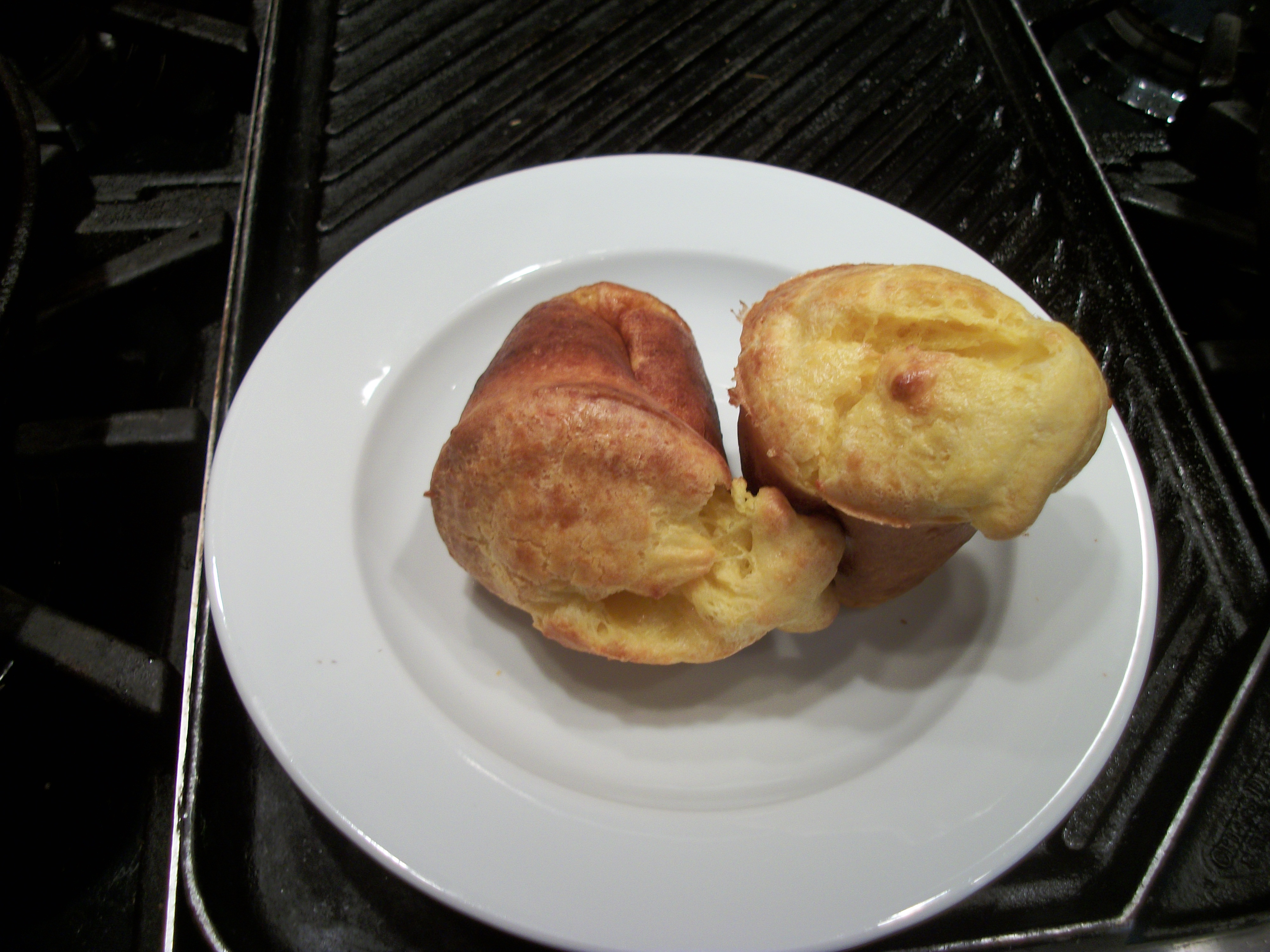
Here’s a picture of cold cheese popovers–which we ate with our dinner after having their mates for breakfast.   They do shrink a bit when cooling.  So, eat them HOT–and 2 of them with butter and jam is a filling breakfast.

As for the blackberry jam–there is one jar to spare before next summer, when there will be one more.  Talula comes in July, and the blackberries are ripe in August, so we have to hoard and parcel out what’s left of the jam on hand–especially since 2010 was very dry and as this year we didn’t get any blackberries as it was the year to cut back the patch and let it grow anew.a

As for blueberry jam, I’m all set for Talula–and her father, mother, brothers, and sister:

Making blueberry jam is easy.

You just fill a heavy pan about 1/2 full of organic berries.  (We have the tiny, very flavorful Maine blueberries–and you can take “wild” out of that title since they are VERY cultivated.)  I use about a cup of sugar to 3-4 cups of berries, and I grate in the rind of one lemon for a batch this size.  Sometimes I add the juice too, but go slow as the mixture can get very lemony.  Taste the jam as you go along–if it isn’t sweet enough, add more sugar.  But, start with less since too much sugar really ruins the whole batch.

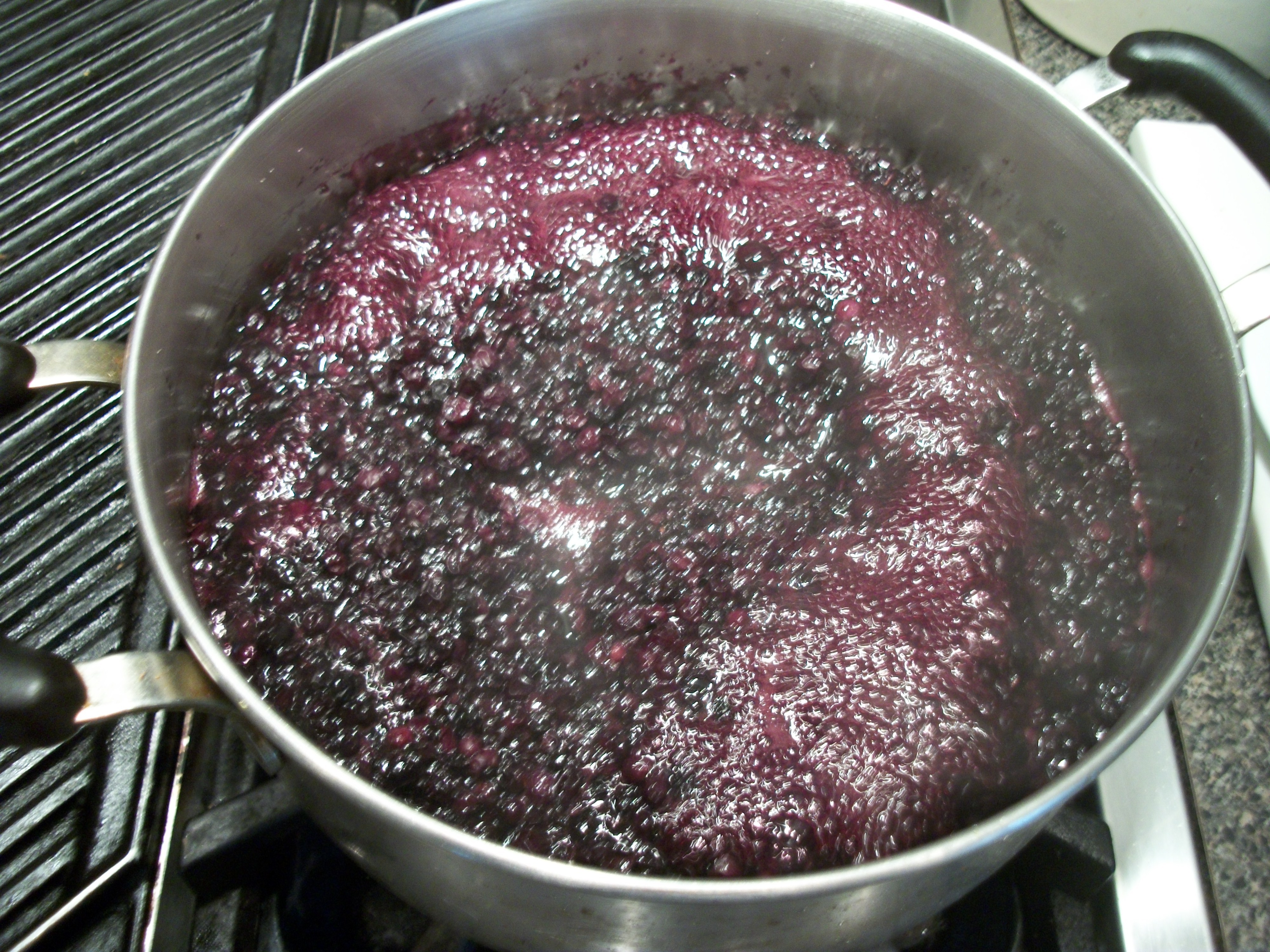
Then, you just cook it down until the juice begins to jell on the spoon you use to stir it with every now and then.  You can see that the mixture is bubbling pretty hard.  Let some of the juice dribble on a plate, let it cool, and you can tell if the juice is starting to thicken up.  You really don’t want blueberry jam to get too thick, so I fall off on the side of a looser jam that isn’t overly cooked to death.   (With blackberries, I am more particular and do use a candy thermometer–but that involves figuring out what the jam point is in your area, which involves how above sea level you are, and so forth.  Any good canning book–like the Ball Canning Book–can walk you through that exercise–and it is a good thing to do.)

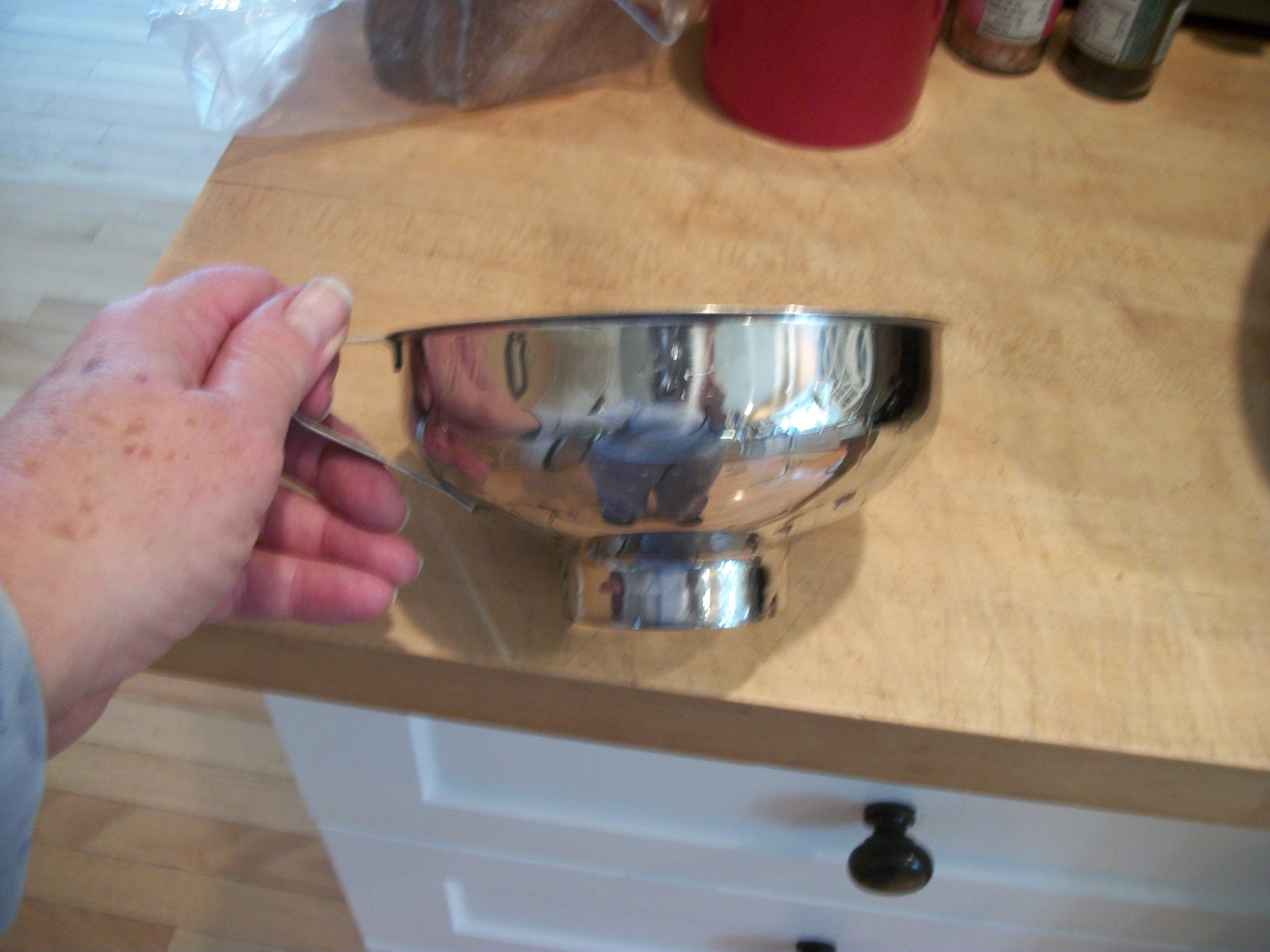
It really helps to have a canning funnel when you start to put the jam into clean Mason jars.  The wide mouth accepts a full ladle of hot jam, and the small bottom keeps it all going into the jar.  Here’s what one looks like:

 O

Once you start to make jams and jellies, it’s hard to go back to the store bought.  Most of them are so full of pectin that they taste like rubber.   If I’m going to eat that sugar, I at least want to have it accompanied by real fruit, not by fillers.

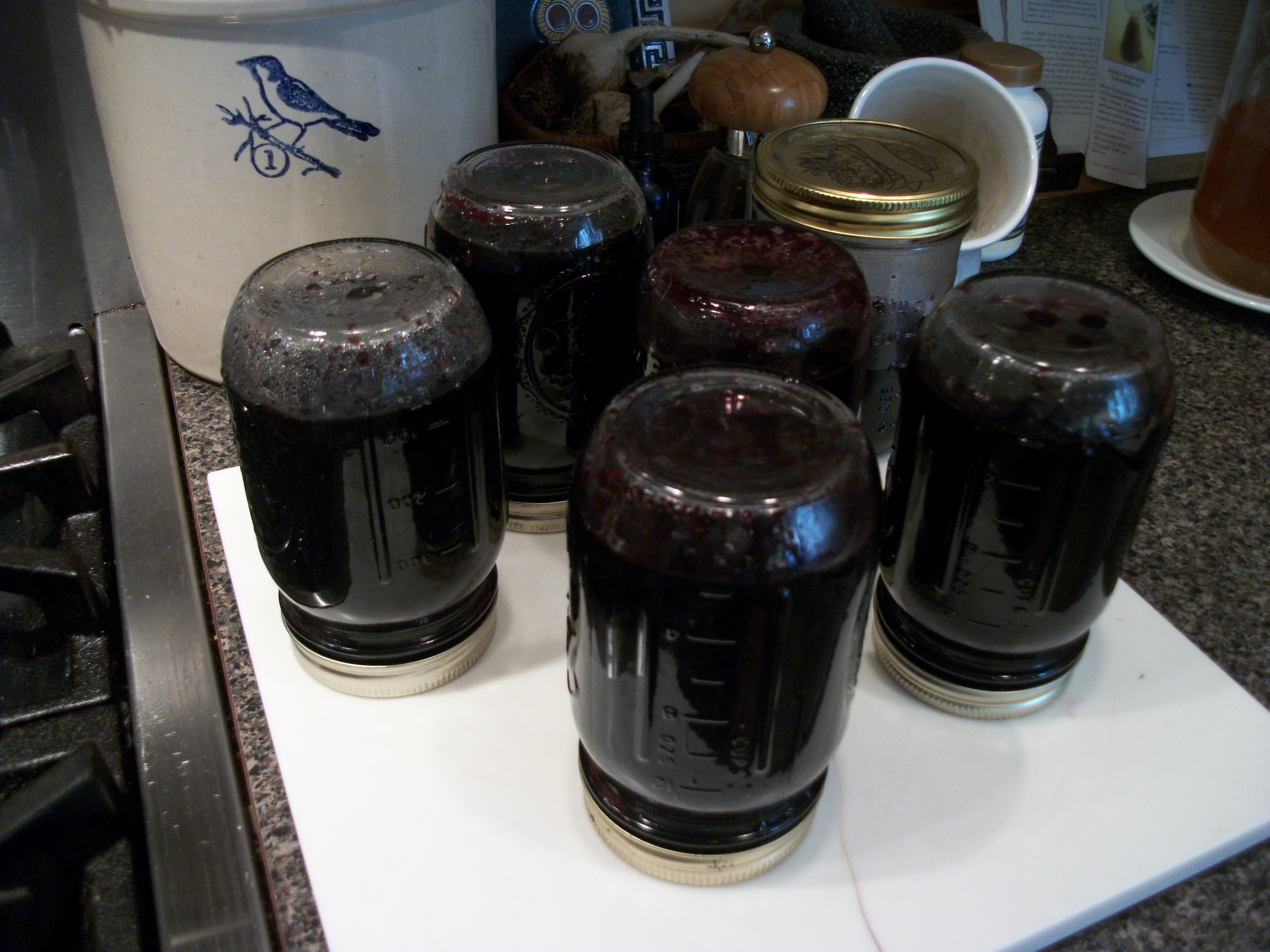
I put the hot jars upside down–which helps the top to form a vacuum–until they cool–as you can see from the picture.

Interesting Information: Fluoride for Breakfast–How’s Your Thyroid

Interesting Information:  November 13, 2011

I am fortunate to have met a new Camden resident:  Dr. Judith Valentine.  Here’s a mini-bio of her experience:

Dr. Judith Valentine is a PhD nutritionist with over 20 years working with doctors and patients in the field of clinical nutrition and wellness. She has lectured at many businesses and governmental agencies including the USDA, NSA, FortMeade, Kaiser Permanente, Whole Foods, Barnes and Noble, and various hospitals and colleges in Maryland, DC, and in Maine. She has written many science-related articles and published a book with CO-author Dr. Janet Cunningham, Weight Solutions: The New Body-Mind-Spirit Approach.  Dr. Valentine lives inCamden,Maine.

Judith knows chemistry in a way that is truly helpful for people like me.  Here’s an essay she’s written on the chemistry of fluoride in relationship to the human body:

Fluoride for Breakfast – How’s Your Thyroid?

In January of this year the federal government proposed that the level of fluoride in drinking water be lowered to 0.7 mg/l, the lower end of the current recommended range of 0.7 to 1.2 mg/l. The Maine CDC will begin related rule-making this year. Some think we should remove fluoride totally from our public water and others feel safe with the new lower levels.

Whenever a health controversy arises, I always go to science. Particularly to unbiased chemists and biochemists not employed by industries directly related to the controversy. Independent experts evaluate the effects of compounds on living systems free from the temptation of the end justifying the means. Too often impartial experts are not sought out when we are struggling to make safe health decisions. In this article I present a pragmatic argument for totally removing fluoride from our drinking water and attempt to show, in understandable terms, how fluoride is harmful to the body.

A strong move was taken as far back as 1998 by hundreds of EPA scientists and professionals who voted unanimously to oppose the fluoridation initiative in California. “Our members’ review of the body of evidence over the last eleven years, including animal and human epidemiology studies, indicates a causal link between fluoride/fluoridation and cancer, genetic damage, neurological impairment, and bone pathology. Of particular concern are recent epidemiology studies linking fluoride exposure to lowered IQ in children.” [emphasis mine]

Although harmful effects of fluoride can occur throughout the body, a straightforward example is its injurious effect on the thyroid. While diagnosed thyroid diseases have been increasing rapidly over time, according to the Colorado Thyroid Disease Prevalence Study in 2000, up to 13 million Americans may have undiagnosed thyroid conditions. The root cause of damage to the thyroid and elsewhere in the body can be found by examining the characteristics of fluoride.

To better understand fluoride, it helps to remember the elemental chart. Perhaps you’ve been trying to forget it since high school or college. In the upper right, you find the so-called halogens. They are listed from top to bottom in this order: fluoride, chlorine, bromine, iodine, and astatine. The order sequences the most aggressive halogen to the least aggressive; fluoride being the strongest and iodine being much weaker.

Fluoride is not essential to the body but iodine is and is found in every cell. Iodine is necessary for healthy cell metabolism (activity) throughout the body and no other molecule can be substituted. The highest concentrations of iodine are found in the thyroid gland. Because iodine is weaker, cell uptake is often displaced at the receptor site by the stronger, very similar fluoride molecule if it is present. This pushing away of iodine leads to diminishing levels and the inevitable progressive failure of the thyroid system so dependent on iodine to function.

Why do we need Iodine? In biochemistry the iodine molecule is utilized to generate vital thyroid-related hormones such as TSH (Thyroid Stimulating Hormone), and T3 and T4 hormones active inside the thyroid gland. Underactive thyroid (hypothyroid) is directly connected to the low production of these hormones due in great part to depleted iodine levels. When considering this, I can’t help but think about the millions on Synthroid; the fourth most prescribed pharmaceutical drug in theUSthis year. What would a small amount of iodine do to help these individuals?

What’s so bad about fluoride?  Fluoride is found in its natural, elemental state or in combination with another compound. Because of its antagonism to iodine, it was discovered that fluoride could be used to treat thyroid hyperfunction (over activity). Experiments were run inEuropein the 1930’s using the fluoride compound, fluorotyrosine, for this purpose. As a result, thyroid function was greatly depressed. However, dosing levels were unpredictable and unfortunately many experienced total thyroid loss. As a result of those experiments, the strong compound was given a new role – as a pesticide.

Here’s why; fluoride’s pesticide effects are formidable because of its activity as an enzyme distorter. Enzymes are complex proteins that are necessary for all biological chemical activity. Enzyme-protein chains are connected by other compounds called amides. Fluoride molecules split and distort amides damaging the enzyme-protein chains. These breakdowns and distortions of vital proteins make them unrecognizable by the immune system which therefore attacks them. An unremitting biochemical alteration such as this within the immune system is one of the reasons we see so many autoimmune disorders today, including autoimmune disruptions of the thyroid.

An argument in support of water fluoridation states that while admitting to its potential harmfulness the dilution of one part per million offsets the potential damage. However, enzyme damage has been shown to occur at extremely low concentrations, even lower than 1ppm.

Unfortunately, fluoride levels build up steadily over time because the body can only eliminate approximately half of total intake. Levels also increase due to its prevalence in water, the air, foods, toothpaste and pesticide residues. The EPA was concerned enough to announce in January, “…the majority of foods will not be fumigated with sulfuryl fluoride beginning this year and all food fumigation…will end in three years.” This is a good start for the younger set, but what about our older community who already experience injurious effects of long term fluoride excess?

Given this article’s example of one of the many deleterious effects of fluoride, why would we want to continuously expose our bodies to additional levels? The precautionary rule would suggest that we eliminate fluoride from our water and consider other already available and safe ways to reach our goal of fewer dental cavities.

A pertinent question was asked by Dr. Barry Durrant-Peatfield in his capacity as medical advisor to theUnited Kingdom when fluoridation was being considered there. “I would like to place a scenario in front of those colleagues who favour fluoridation. A new pill is marketed. Some trials not all together satisfactory, nevertheless, show a striking improvement in dental caries. Unfortunately, it has been found to be thyrotoxic, mutagenic, immunosuppressive, cause arthritis and infertility in comparatively small doses over a relatively short period of time. Do you think it should be marketed?”

If we were to ask the same question in Maine, what would our answer be?

Interesting Information: Fluoride Stays in Damariscotta and Newcastle

Interesting Information:  November 13, 2011

Fluoride Stays in Damariscotta and Newcastle

The citizens of Damariscotta and Newcastle voted–by a very small margin–to keep fluoride in their water system.  Local people conjecture that the overwhelming reason is that local doctors and dentists came out strongly in favor of keeping fluoride.

When reading the letters and the statements of our local health professionals–which have appeared in local papers and which were made at local informational meetings–it’s clear that their reasoning is solidly located in their own, anecdotal, belief systems and in their faith in the positions taken by major health groups, like the national pediatric association–none of which–famously– have done any work of their own in this area.  What has resulted is a host of endorsements–not science.

It’s clear that these health professionals want to do the right thing.  But, it’s also clear that they have not done their own due diligence–and for that lack of personal work–they have a lot for which to answer.

One of the most egregious examples of the above would be that the 2006 EPA-commissioned NRC report–which was critical of fluoridation and which raised countless red warning flags about fluoridation–was quoted by local health officials as if it supported continued fluoridation.  Another example would be that they ignored the ignominious history of how fluoridation started in the first place.  Another would be the almost total lack of study of the impact of fluoride on human bodies–even though 42% of children today have dental fluorosis.  Another would be the numerous studies–often coming from other countries–of harm being done by fluoride.   Another would be that the EPA recently lowered the acceptable levels of fluoride in water and is moving to ban fluorine-based chemicals on foods.  (It probably helped that they were faced with a powerful law suit if they didn’t act.)

Traditionally, our health professionals are people to whom many look for good information, and in this case of fluoridation, these people have let down their communities in a very fundamental way.  Indeed, it’s actions like this one that have resulted in my own pretty much total lack of faith in our current medical system and the people who staff it.  I realize that they, too, are caught in a system that requires them to order tests and drugs that are not needed and that are, too often, harmful. But, the end result is harm–for people who have sworn to “first, do no harm.”