Turkey Tracks: Dog House Chickies Update

Turkey Tracks:  October 20, 2012

Dog House Chickies Update

The Dog House Chickies are now nearly 3 months old and are close to being fully grown.  I closed up the dog house this week and put them into the big coop, where they are having a hard time of it.  As you may know, different coharts of chickens don’t like each other, especially at first, and the older bunch terrorizes the younger bunch.  Also, there is always a chicken who is the lowest on the pecking order, and that chicken takes an almost constant beating from some of the others.  It’s really quilt brutal.

(You can see earlier postings of these chicks by going to the right sidebar and clicking on chickens, under Turkey Tracks.)

Here’s what the three “chicks” look like now:
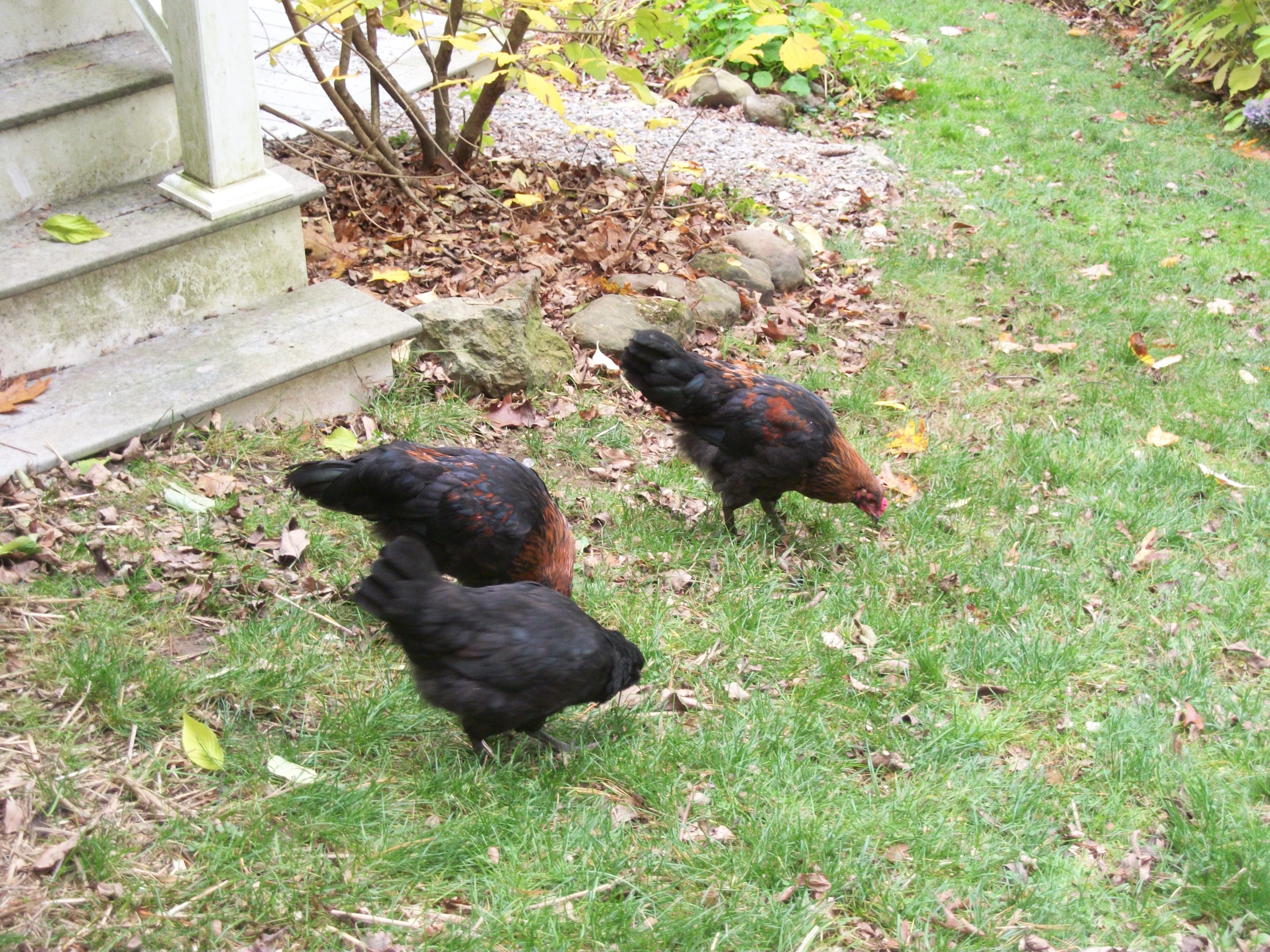
It’s hard to get a picture of all three of them close up as they are mostly wild.  Chickie Mommie (Sally) raised them entirely “on the economy” and taught them how to be safe.  Even when they were still in the dog house, I had to go out each night at dark and capture them in the large viburnum bush where they like to roost and physically put them into the dog house.

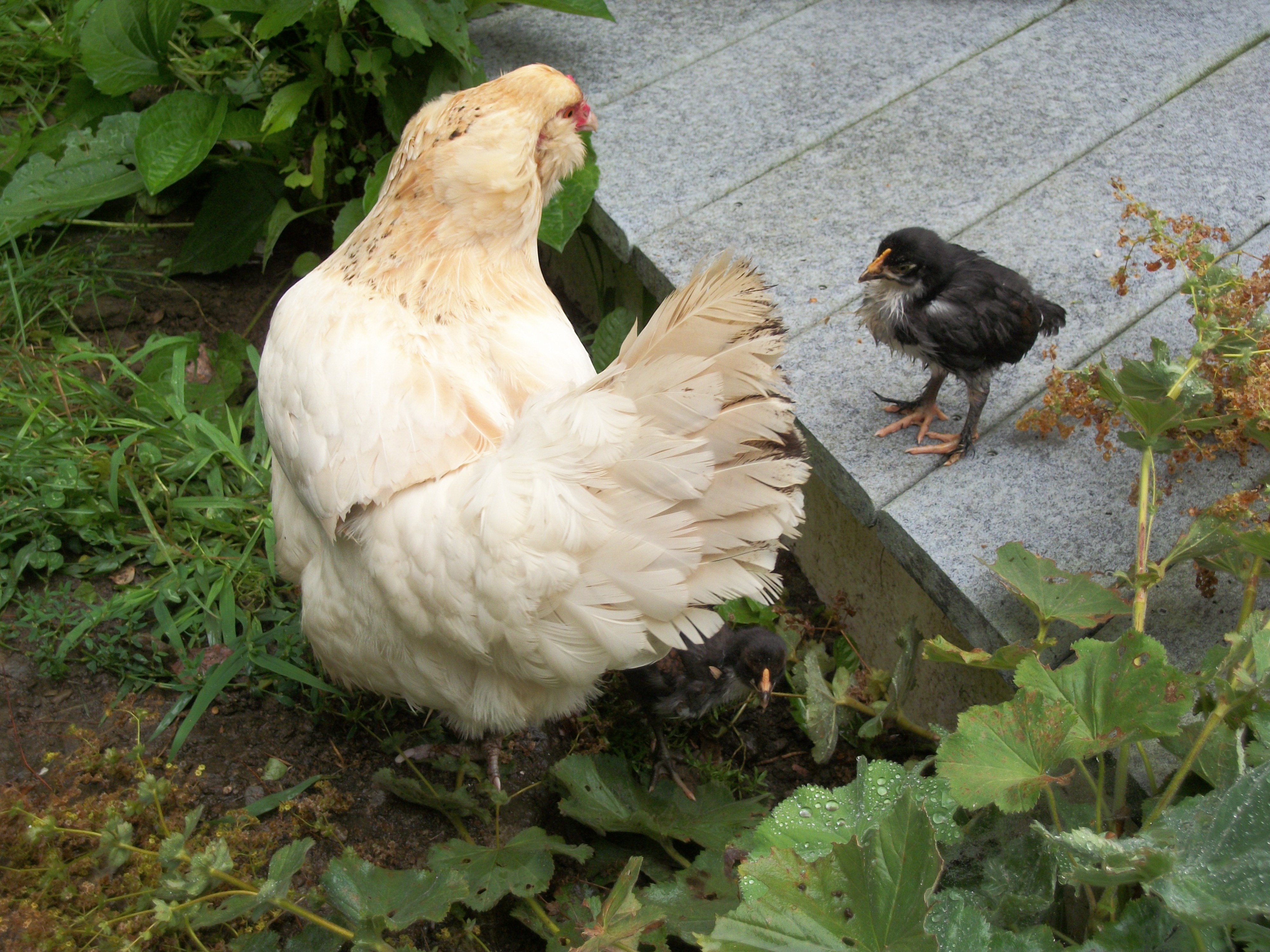
To remind, here’s a pic of Chickie Mommie (Sally) just after she brought her babies out of the dog house.  The chick in the foreground is the full-blooded Copper Black Maran.  See the feathered feet?  Note, too, the chick hiding beneath her body, just under her tail.
Sadly, about two weeks ago, a fox ate two of my chickens:  Annie, a full-blooded Copper Black Maran that I raised from an incubated egg and Chickie Mommie, one of the last two chickens from my original chickens.  She was a Wheaten Americauna and laid beautiful blue eggs.  Now I have one Copper Black Maran hen and one Wheaten Americauna.

I named one of the dog house chickies–Blackbird.  She’s the all-black chicken in the front of the first picture above.  I’m pretty sure she is a she since she’s very docile and acts like a hen.

Here’s a pic of the two mystery chickens:

I can’t tell which one is the Maran–I have to see his/her feathered feet.  The other one is the Americauna/Maran cross.  Both are looking like roosters…   The Maran, in particular, behaves like one.  But, the other  may well be a hen.  Maran roosters  have big combs and waddles, but Americaunas do not.  The highly colored feathers look like roosters.  I’ve never had the courage to upend either one of the two roosters we’ve had (Napolean and Cowboy) to look at their equipment to see if one can tell the sex.  Time will tell…

In any case, no names for these two as we cannot keep a second rooster.  Or, three of them.  Roosters fight, which is why on a farm they…provide meat.

x

Turkey Tracks: Scrappy Knitted Blanket Update

Turkey Tracks:  October 20, 2012

Scrappy Knitted Blanket Update

I last posted an update on the knitted blanket I’m making back in mid July.  You can easily see that and earlier posts on this project by going to the right sidebar and clicking on the knitting category.  Earlier posts contain information about where I got the pattern–another blog–and how my knitting friends supplied me with their leftover yarn when I began to run out of color selections.

Here’s what the blanket looks like now:

The loose ends everywhere are either holding provisional stitches in place–they will be picked up when I do the edge–or are where I bound off the end of a block.  The binding off will get woven in when I finish the edges.  And I’ve adopted a practice of weaving ends in on the back as I finish each block.  That way the weaving in does not seem so daunting a project.

Since I started, I made the blanket wider–which is doable, but not as easy as starting it wide enough to begin with.  I’m now adding another two blocks of width since when Tami (daughter-in-law) was here a few weeks ago I couldn’t work on it because she wrapped herself up in it every night.  (I have a firm position that a heavy–and it is heavy–wool blanket is not appropriate for South Carolina.)  Anyway, Tami thinks it should be wide enough for two people to snuggle beneath it, so I’m now making it a bit wider still.  And, I’ll make it another row or two wider.  Knitting master Giovanna McCarthy is going to help me decide whether or not to crochet an edge or use the straight i-cord edge the designer used.

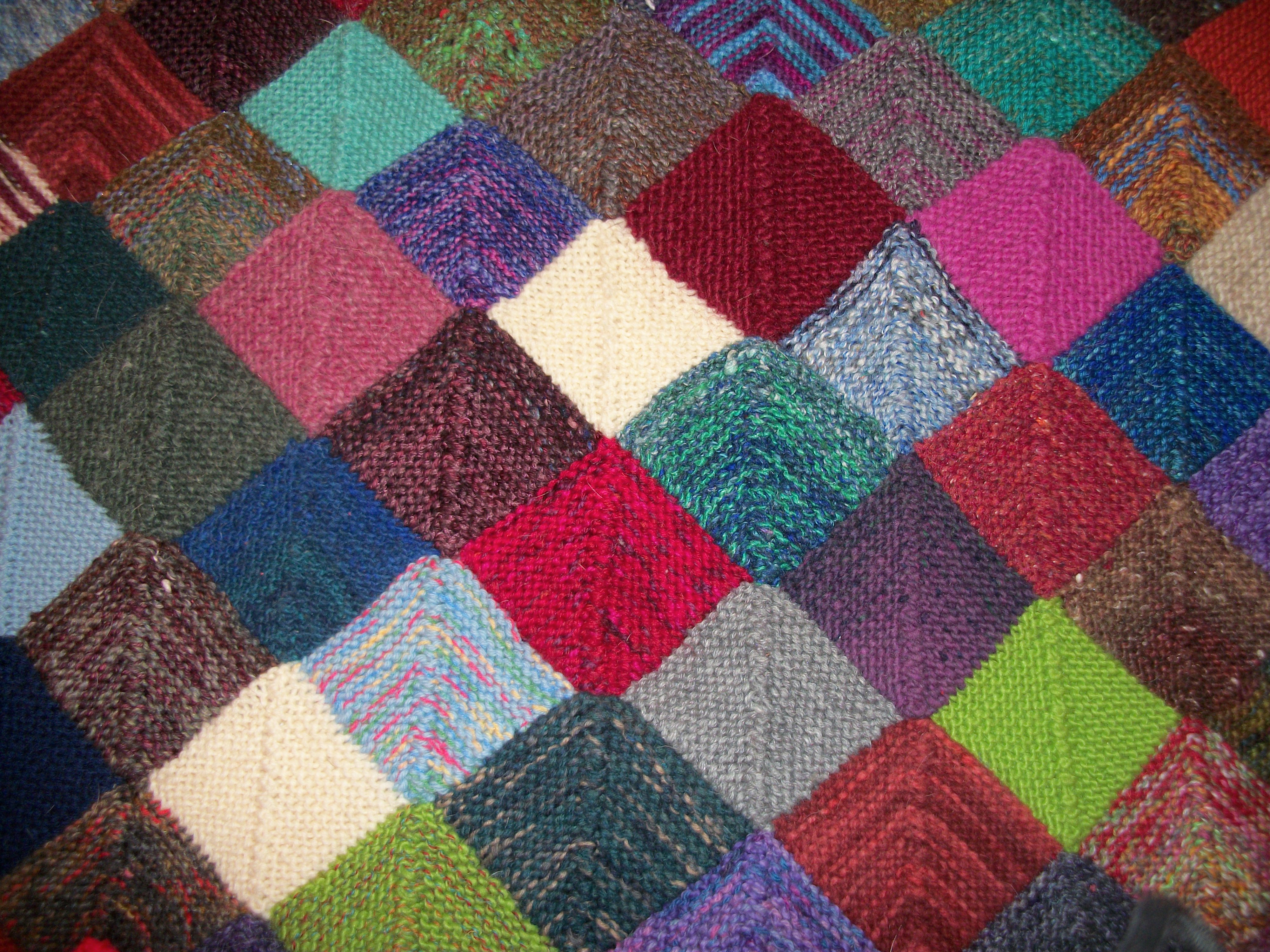
What I love about this project–in addition to the fact that it uses up leftover yarn–is that it looks like a quilt.  Here’s a closeup of the “on-point blocks”:

The “varigated” blocks happen when I combine several thinner yarns to make a thicker one.  And the bar in the middle happens as you decrease stitches in the middle to make the diamond shape.  It takes me about 40 minutes or so to make one block, but the work of it is very soothing, and I absolutely love choosing which colors will sit nicely next to other colors.  I work on it at night while we watch “stories” on television (movies, tv series, etc.)  I don’t think I could have watched the recent political debates (presidential, vice-presidential) without also knitting the blanket.

x

Turkey Tracks: Blue Hubbard Squash

Turkey Tracks:  October 20, 2012

Blue Hubbard Squash

I’ve been fascinated with Blue Hubbard squash for some years now.

Last year, I planted seeds, but nothing came of them.  This year we had a very rainy, cool June, and I planted cucumbers and zucchini about five times before any of the plants really got going.  The zucchini finally produced enough for us to enjoy zucchini on a regular basis.  The cukes finally produced two small fruits in early September.  (Fortunately neighbor Susan McBride had plenty of cukes in her amazing hoop houses at Golden Brook Farm, so I made some of Sandor Ellison Katz’s New York pickles from his WILD FERMENTATION–and they were absolutely delicious.)

And, I kept planting Blue Hubbard squash in the long front bed where I also planted strawberries for next year.  Here’s what the vine looked like in late August–the pic is taken from the upper porch, looking down.

Nice, I thought.  Decorative even.  Lots of blossoms, too, but…  Then I noticed a pale growth underneath the leaves on the lower right, up next to the porch.

It was a BIG fruit.  Still green, still not blue, but a BIG fruit.  I held my breath about frost and left it alone.  I picked it about a week ago and put it into the garage to “sugar off” for a bit.  Squash almost always need to sit for a bit of time after harvest to get really sweet.

Here’s how BIG my Blue Hubbard got:

It’s as big as a chicken.  Bigger even.

Back in the day, folks would cut a hunk out of a Blue Hubbard for dinner and just leave the rest in a cool place for the next meal.  I’m sure I posted a blog on roasting one I bought last year–which is what I will do with this one.  I’ll cut it in half, scoop out the seeds, roast it in the oven (face down), scoop out the flesh and store it in meal-sized portions in the freezer.  It makes a nice pie, too.  The flesh is mellow, nutty, and lovely.

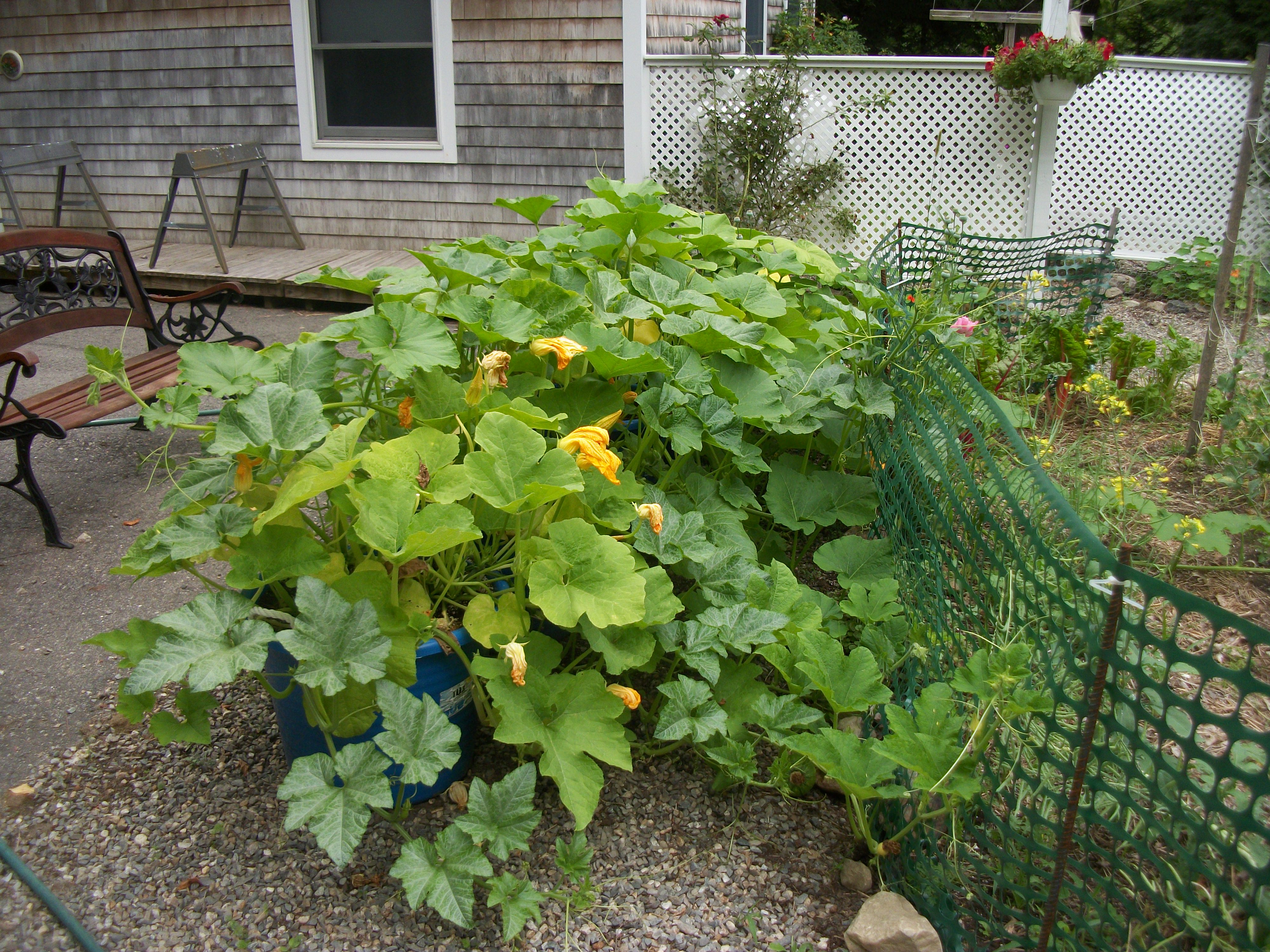
The squash I planted in the blue tubs also did REALLY well this summer.  Here’s a pic from sometime in, probably, July.

We harvested a box full of squash:  two beautiful little pie pumpkins, eight or ten butternuts, a buttercup, five or six delicatas, and an assortment of small blue hubbards that are probably edible.  I’ll plant squash here again.