Turkey Tracks: December 31, 2012
Here’s a bit of humor, sent to me by Lisa Hartley, who also loves Maine, but who lives in Charleston, SC.
Enjoy, and it’s all true!

Turkey Tracks: December 31, 2012
Here’s a bit of humor, sent to me by Lisa Hartley, who also loves Maine, but who lives in Charleston, SC.
Enjoy, and it’s all true!
Turkey Tracks: December 31, 2012
Chickens Start Laying Again
Our chickens stopped laying sometime in October.
That’s ok, because they need a break. By Easter time, most of our hens are laying every day and only slack off as the summer progresses.
The chickens who are a year old molt in the fall. They are the worst-looking, most pitiful little things until they grow in new, glossy, glorious feathers. It takes all their energy and LOTS of protein to grow in new feathers. Besides, laying eggs is an awesome and involved task. They just plain need to rest so I have never put light on them to extend the normal light quotient of the days. I do put a red light if the temperatures drop below zero.
Just before Christmas, chickie Valentine, a Freedom Ranger, laid an egg. Valentines eggs are HUGE.
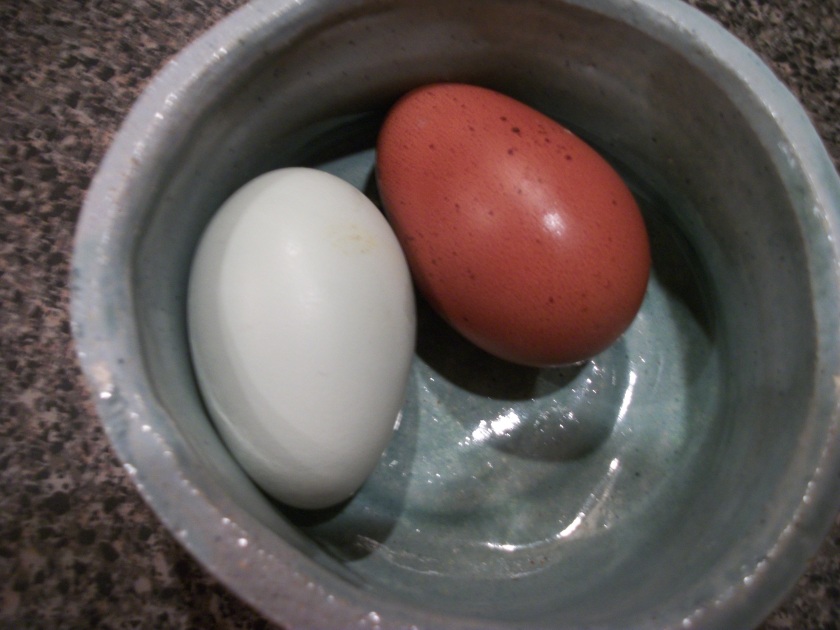
A few days later, Pearl, the younger Wheaten Americauna laid a stunning blue egg–great color and shape. (I know it was Pearl because I saw her making a bed in one of the egg boxes and because Nancy, who is now almost 4 years old, is still growing in feathers.)
And a few days ago, Pearl and Rosie, my only Copper Black Maran female now, gifted us with two eggs.
Aren’t they pretty? That chocolate brown egg is characteristic of the Marans.
Then, we got the big snow, and the chickens are locked into their cage/coop arrangement–which they hate. Even if I opened the coop, they would not come out. Wisely, they know they are sitting ducks in the snow and with all the bare bushes that offer little protection from a swooping bird predator. You will recall that’s how we lost a huge Maran female two winters ago.
This morning I took them some leftover meat and pancakes, with some milk poured over–alongside their normal grain feed. Pearl was investigating egg boxes again. I predict we’ll have another egg before long.
I am a bit surprised as in previous years, the hens didn’t start laying again until the days got longer. I had expected Blackbird, the little hen we let Chickie Sally (eaten by the fox in August) raise this summer, to start laying her first eggs any day now as she is a full five months old. Blackbird is a Wheaten/Maran cross, and she’s solid black with a small comb. She’s beautiful. Her eggs will be an olive green color.
Blackbird is also the low bird on the chicken pecking order, so she’s fairly stressed when she’s locked in with all of the hens. Pearl, the former low bird, chases her endlessly. Rosie, the head chick, is mean to everyone but Valentine, who is twice her size. No one messes with Valentine.
The WordPress.com stats helper monkeys prepared a 2012 annual report for this blog.

Here’s an excerpt:
4,329 films were submitted to the 2012 Cannes Film Festival. This blog had 35,000 views in 2012. If each view were a film, this blog would power 8 Film Festivals
Turkey Tracks: December 30, 2012
Big Snow in Maine
We have at least 2 to 2 1/2 feet of snow on the ground–from two separate storms I think.
The plow/shovel guys have been here three times in three days. By late afternoon yesterday, they had us all plowed and shoveled out. But, it snowed all night, and when I went out to let the chickens out of their coop and to feed them, the snow was almost to my knees again.
This last snow was light and fluffy–the earlier ones were heavy, wet, hard to shovel, and packed down almost right away.
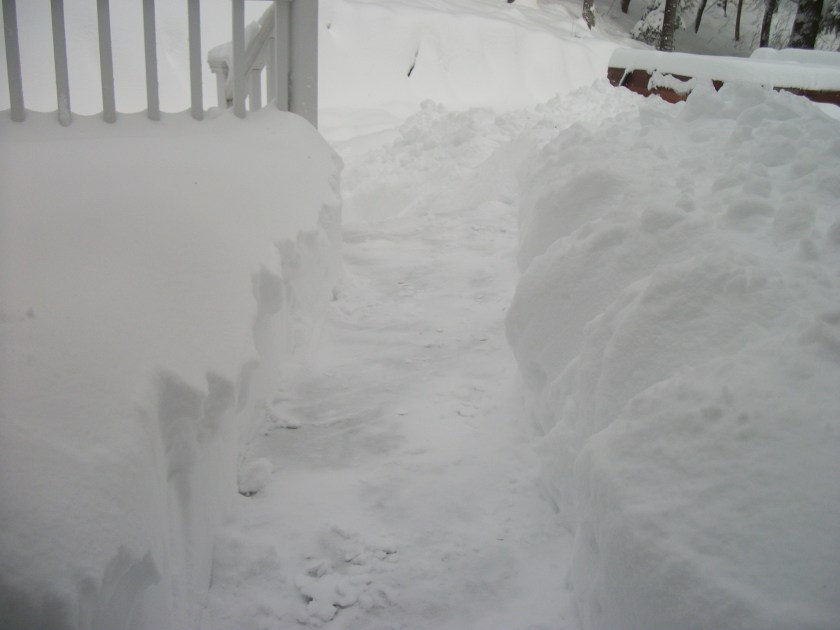
Here’s what our back deck looks like now–I had cleaned the hot tub top yesterday and will have to shovel a path to it and get that snow off the top today–otherwise, as it melts it forms a heavy sheet of ice that is murder to get off:
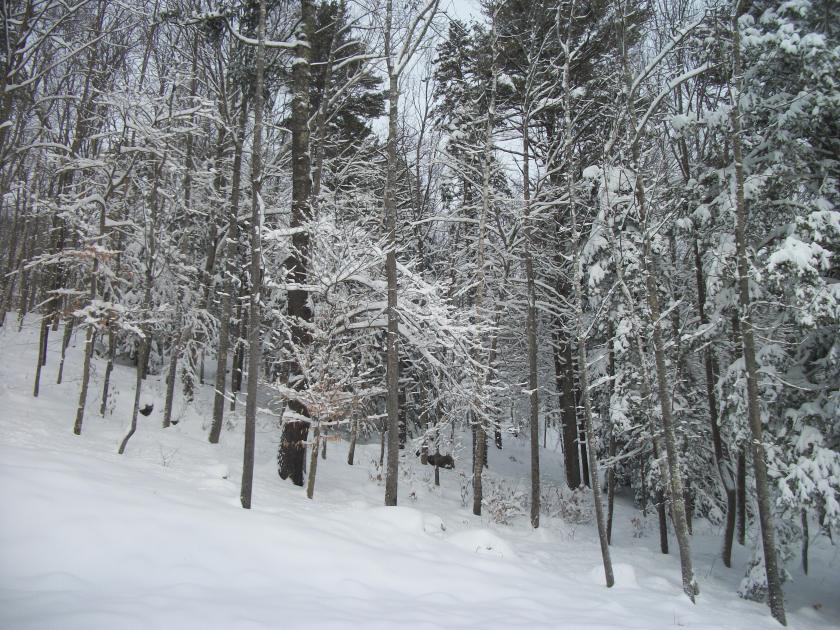
Here are our back woods–coated with snow and looking like they are decorated with spun sugar.
Here’s John’s funky bird house and the blue birdhouse Bryan gave me last year. We hang lots of birdhouses around our woods as the birds go into them for shelter in the cold. Often, the birds will cram themselves into one birdhouse so they can share warmth.

More spun sugar. When the snow falls straight and light–with no wind–you get upright, thin layers of snow on all the surfaces that will hold the snow.
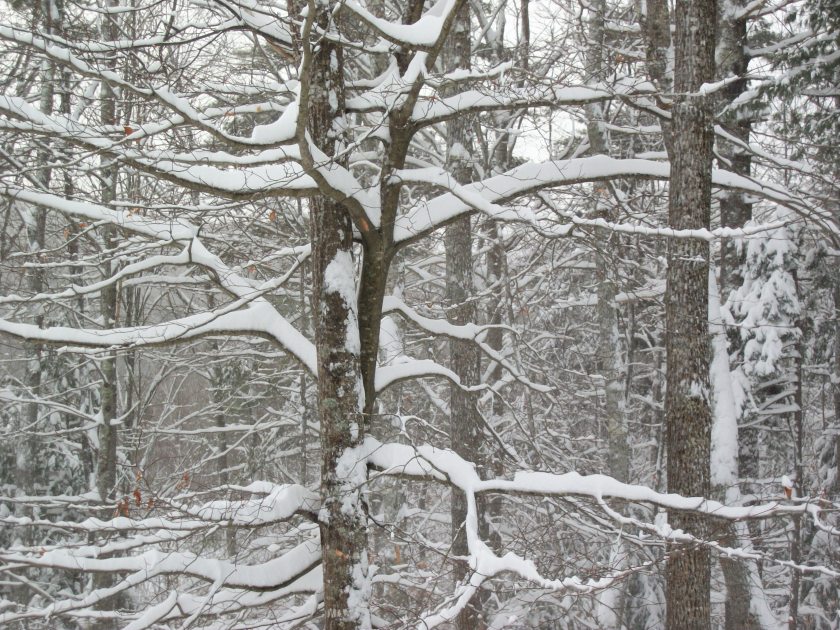
We love WINTER in Maine!
Turkey Tracks: December 29, 2012
Christmas Day Dinner
We’re almost at New Year’s Eve, so I better post about our Christmas dinner feast. Included are some lovely recipes.
As I write, we’ve got a foot of snow on the ground, which makes me so happy. I love winter so much up here in Maine. It’s not just the crisp cold, the brilliant night skies, the full moon that is so bright you can read a book by it, the long nights that lend themselves to quiet reflection and many fun projects, it’s the quiet times one has with friends. Christmas Day Dinner was one of those times.
Over the years, we’ve had many a holiday dinner with Sarah Rheault and various members of her family and/or with Margaret Rauenhorst and Ronald VanHeeswijk. We’ve met at any one of our houses, depending upon what is going on at the moment. This year, the dinner was at our house and Sarah, her son Chrisso (in from Louisiana), and Ronald were present. ( Margaret is in Minnesota with her mother, who has just been moved to a nursing home.)
Sarah and Chrisso brought the most fabulous hors d’oeuvre (salmon, trout, and a whole brie heated and topped with a cranberry sauce). And, Chrisso put together a cheese plate to eat after the salad. Filled with 5 or 6 special cheeses, it was a divine treat over which we lingered for some time. Sarah made her traditional cranberry pudding with a hard sauce for dessert–which we all love. And Chrisso brought a chocolate pound cake that he and his fiance Melanie made back in Louisiana.
For the main course, we had a standing rib roast, scalloped potatoes, kale blanched and reheated in brown butter, and “southern” cornbread, made with no flour in a hot cast-iron skillet coated with melted fat–in this case, butter–in a very hot oven.
I wasn’t sure if John’s sister Maryann would be with us, so when Chrisso said he would be coming, I called Curtis Custom Meats and asked it I could switch my grass-fed 3-rib roast to a 4-rib roast–and they were so lovely and said it would be no trouble at all. When Maryann and I picked it up last Saturday, I could see that it was a HUGE piece of meat. Here it is, alongside some items like the small bowl and the carrot, so you can see what HUGE looks like:

I’ve used a Julia Child recipe for standing rib roasts for a half-dozen years now, and it’s all really simple. Let the meat sit out at room temperature for AT LEAST two hours (especially for a roast this size); heat the oven to 325 degrees; salt, pepper, herb, etc., the outside; put the bone side down and the fat side up; and cook the meat until a meat thermometer hits 120 degrees ON THE SHORT END OF THE ROAST–at least a rib from the end. A roast this size takes about 2 to 2 1/2 hours to cook–depending on how cold the inside is when you start. Let the roast sit on the oven for at least 15-30 minutes to let the juices reassemble themselves. Put a cover on the roast if you think you need to. (Julia cooks this roast so that it is done an hour ahead of when you want to eat it–and she sits the pan over a large pot of hot (not boiling, not even simmering) water. She covers it with the lid of another roasting pan.)
Carving is dead simple–especially if Curtis Custom Means has precut the bones so that they are only attached at the base of the roast and tied all together. You slice off the bones in an arc–releasing the roll of meat. Cut the bones into separate pieces so that anyone who wants to chew one can. Then slice the roll of meat as you like it–into slabs or into thin strips. (I use the leftover bones to make a bone broth the next day.)
Fabulous!
The kale is also dead easy. Rinse the kale in the sink. I used FOUR bunches for 5 to 6 people. Here’s how much I started with:

Put on a big pot of water to boil. Rinse each kale leaf, rip the green from the stalk, and when the water in your pot boils and you’re all done de-stalking the kale, drop the leaves into the water and let it cook for about 5 minutes–or less if your kale is smaller and more tender. This blanching makes the kale sweet. (The chickens get the stalks and delight in eating the bits of green leaf remaining.) Drain off the kale into a colendar, run cold water over it until you can handle it with your bare hands. Squeeze out the water, roughly chop the wilted leaves on a chopping board, and put them into a bowl until you are ready to reheat them in a big dollop of butter (at least 1/2 cup) that you have allowed to just get toasty, light brown in a skillet–a step you do at the last minute.
Here’s what the kale looks like wilted. You can see how much it wilts down:

Scalloped potatoes are also dead easy to cook. You can put them together and mostly cook them and just reheat them while someone is carving the meat.
Start with boiling potatoes (not russets). Peel and slice into thin rounds (under 1/4 inches)–putting the slices into a bowl of water so they don’t brown.

If you’re going to cook ahead, heat the oven to 400 degrees and grease a 2-inch high pan with butter. (I used a square pan this time.) You could also run a cut clove of garlic over the pan before buttering if you feel up to it.
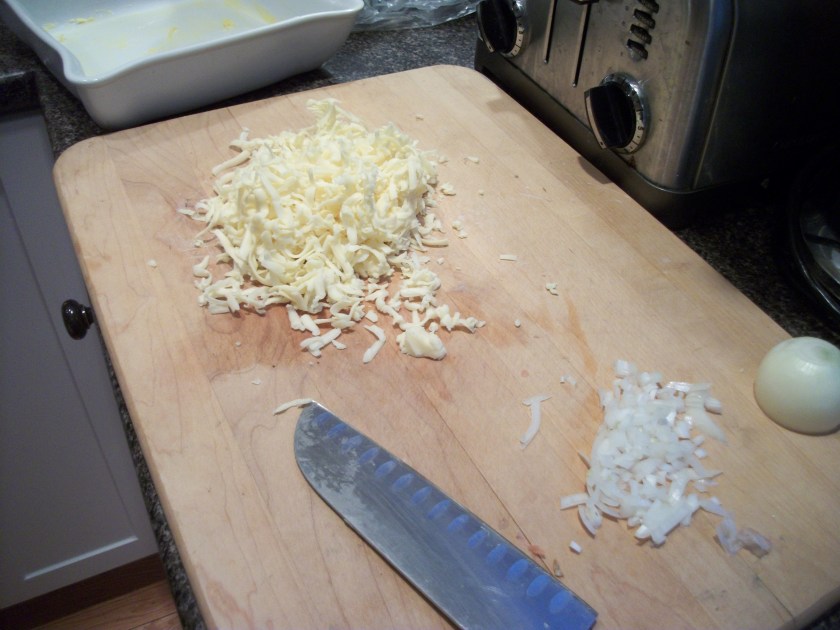
Grate some cheese (good swiss or cheddar) and cut a bit of onion into fine dice:
Drain the potatoes in a colendar and dry them in a towel:

Assemble the dish. Put a layer of potatoes on the bottom. Top with a tiny bit of onion and a handful of cheese. (You could salt each layer lightly if you like–sometimes I forget and just salt the top–the milk you add washes it all together.) Top with more potatoes. If you are cooking ahead, I don’t put cheese on the top. If you are not, put cheese on top. Pour at least a cup of milk over the whole dish. If you heat the milk, the dish will cook faster–say 30 minutes. If not, it takes longer (45 or so–which is why putting the cheese on the top will get too brown.) If cooking ahead, cook until most of the milk is absorbed and the potatoes are softening–remove and let sit on the stove or a counter and dot the top with butter and reheat while someone is carving the meat–about 10 minutes. You’ll know when the dish is cooked–the top will have crispy brown bits and potatoes will be soft and the milk will be gone.
Delicious!!! Reheats well the next day, too.
Here’s the table ready to go–graced with our old, old (now) tablecloth and the Fosteria red glasses I got for my wedding almost 47 years ago now. That’s horseradish cream in the bowl in the center–equal parts of sour cream (I used my fermented piima cream) and horseradish. I also cut this mixture with some fresh raw heavy cream.

This Christmas Day Dinner was about food, friends, and not a lot of fancy decorations. In the background, you can see a tv tray with 3 sprouting amaryllis and some paper white narcissus–which will cheer us in January. This window is the only window that does not have outside roof overhangs and that gets the weak winter sun. My sisters will smile as they will recall our mother and her wintering over of plants in glass jars with dangling roots and dingy water–something I always didn’t like to see in the dining room. But, here they are as we love having their outrageous flowering in the dead of winter.
Sarah is British–and that means she finds us what she calls Christmas “Crackers” for dinner entertainment. Here are a few left in the original box.

Here’s one alone:
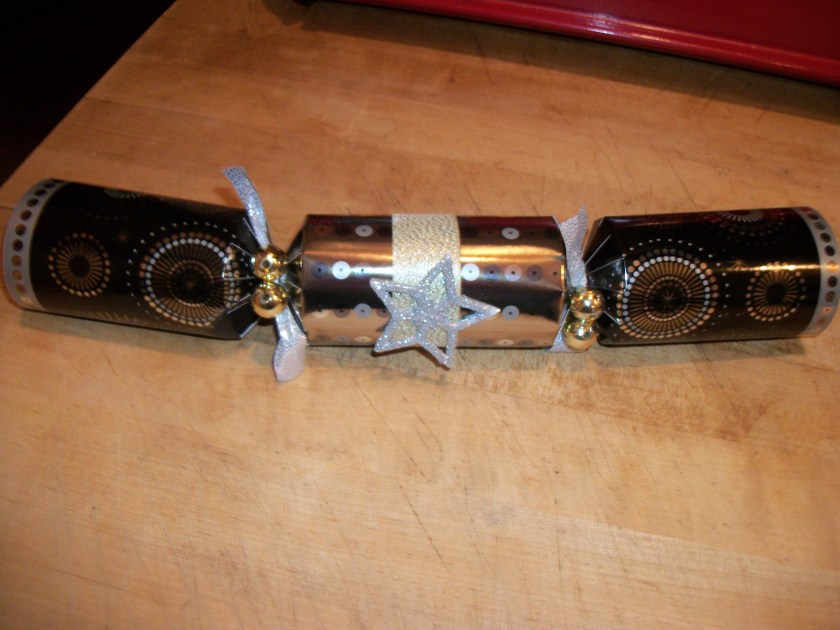
You cross your arms, holding your “cracker” in one hand, and the people on either side of you pull your cracker apart (and it “pops” with a kind of firecracker fire) as you sharply pull one of theirs. Out fall toys, tiny games, a crown, and some fortunes.
Here we are with our crowns on:
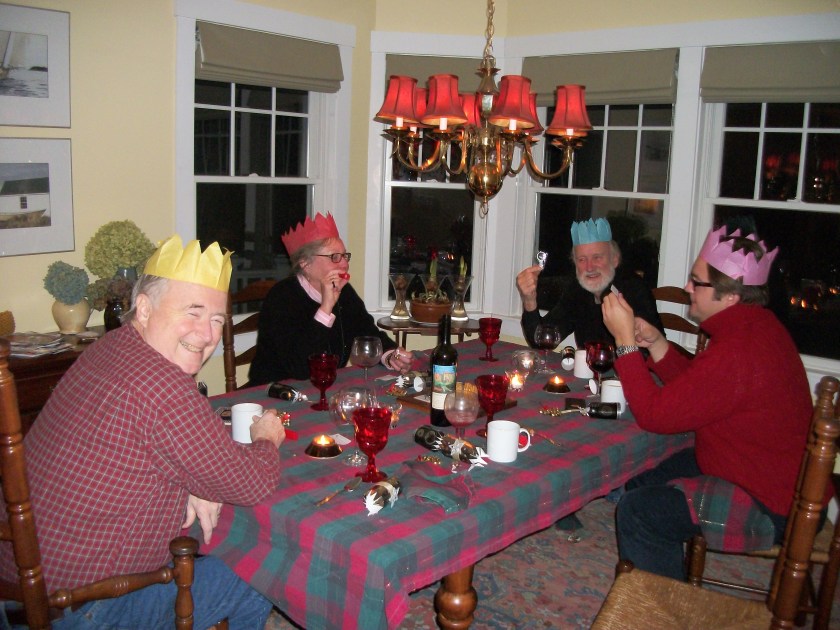
One year I got a miniature deck of cards that I carry with me in my purse in case I get stranded at an airport and want to play solitaire or somesuch game. This year I got a spinning top that spins beautifully.
The fortunes are a lot of fun:
Why do birds fly south in the winter? Because they can’t afford to take the train.
What did the hat say to the scarf? You hang around while I go on ahead.
What is grey and has four legs and a trunk? A mouse going on holiday.
How do you make a band stand? Hide all the chairs.
The fifth one got lost in the merriment.
THANK YOU SARAH AND CHRISSO.
We had such a nice time, and even though we ate and ate, we had a ton of leftovers. So, everyone came back the next night to help us remedy the leftover situation. And, again, we had a lovely evening.
Turkey Tracks: December 26, 2012
Celeriac Cream Soup
How many of you know what a celeriac root is?
I can guarantee you that I did not before I moved to Maine and joined Hope’s Edge, our Community Shared Agriculture (CSA).
Celeriac roots are a very common root, storage vegetable in Europe. They can be peeled and grated raw for a salad, grated and sautéed, braised, or cut up and added to a soup or stew. You can pretty much treat them like a potato or a rutabega, though they are less dense than a potato. Or, they can be the “star” of their own soup. They have a mild celery taste and probably have components that are really good for you. They stored well in my refrigerator–I got them from Hope’s Edge back in October.
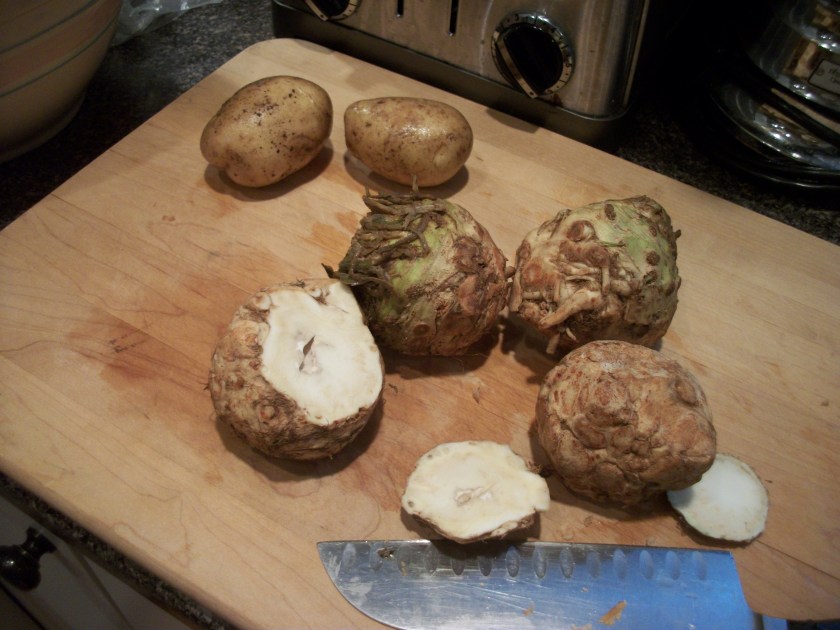
Here’s what a celeriac root vegetable looks like. I put potatoes I needed for the soup in the background so you can see the contrast. I run my knife down the sides to peel them–turning them over to get what I missed at the bottom when I’ve gone all the way around. When you cut open a celeriac, the flesh is white and very dense.
The Farmer John Cookbook had a nice celeriac soup recipe, so I started from there. It’s pretty much the same method that Julia Child teaches for her leek and potato soup.
Leeks or onions–I used onions as I was out of leeks–sweated out in a bit of butter.
I added carrots, some garlic scapes from the freezer, and some actual garlic. I didn’t add extra celery as I wanted to see how “celery” the celeriac is.
Be patient with the sweating out–in a heavy pan, like a Creuset. (If I could have only one pan, it would be a Creuset pot. The next would be a cast iron skillet.) Cook slowly over medium heat. Add sea salt. Stir to keep anything from burning prematurely. When you begin to get bits of caramel browning–throw in the stock. I used my last batch of chicken bone broth–simmered for 2 days in the crock pot and then strained. I don’t strain off any fat as I’m quite sure now that fat does not make you fat and that we all need good sources of fat to be healthy.
Throw in the cut up celeriac–you need 3 to 4 cups for about 8 cups of broth. You could have more or less of either. Throw in, too, two or three peeled potatoes–which will thicken up the soup.
Here’s an interesting addition–about 1/4 to 1/2 cup of almonds–I put a few handfuls in the blender and let it rip until I have a nice powdery nut mix. The almond will also thicken the soup and will add a delicate flavor.
Grate in some fresh nutmeg. Taste for salt and add more if needed.
Let it all cook for 25 minutes or until the celeriac is soft. Here’s what it looked like on the stove–you can see the almond “flour” on the top.

Then, turn it off, let it cool a bit, and “boat motor” it with an immersion blender. When all is smooth, add at least a cup of heavy, preferably raw, cream. Stir, taste for salt and nutmeg, and serve in a bowl. You could put a chunk of butter on the top once the soup is in the bowl. Or, a drizzle of cream or sour cream. It’s really rich.
Here it is finished:
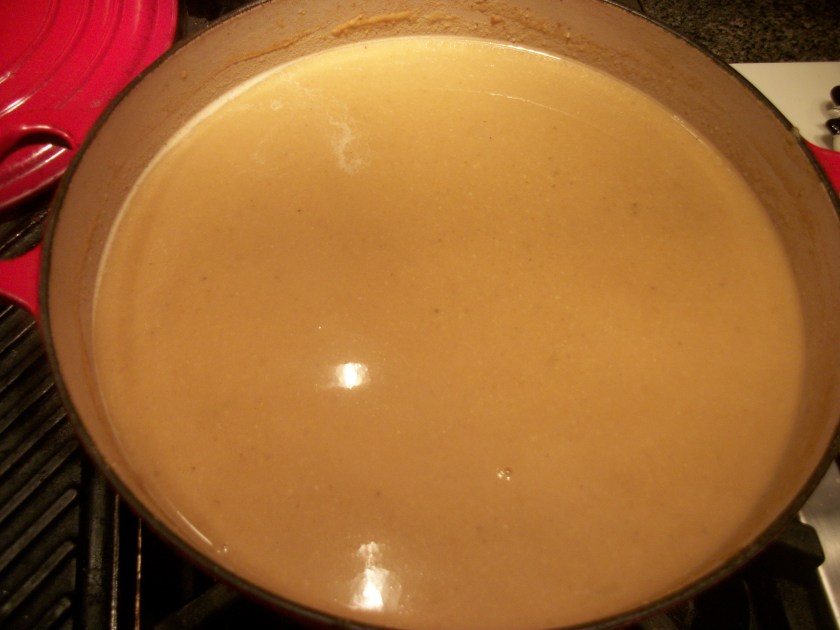
Celeriac cream soup has a delicate, lovely flavor. Enjoy!
Turkey Tracks: December 15, 2012
Highlights From Thanksgiving 2012
Christmas is drawing close to us now.
But, I’m still savoring Thanksgiving.
Here’s one of my cherished moments:
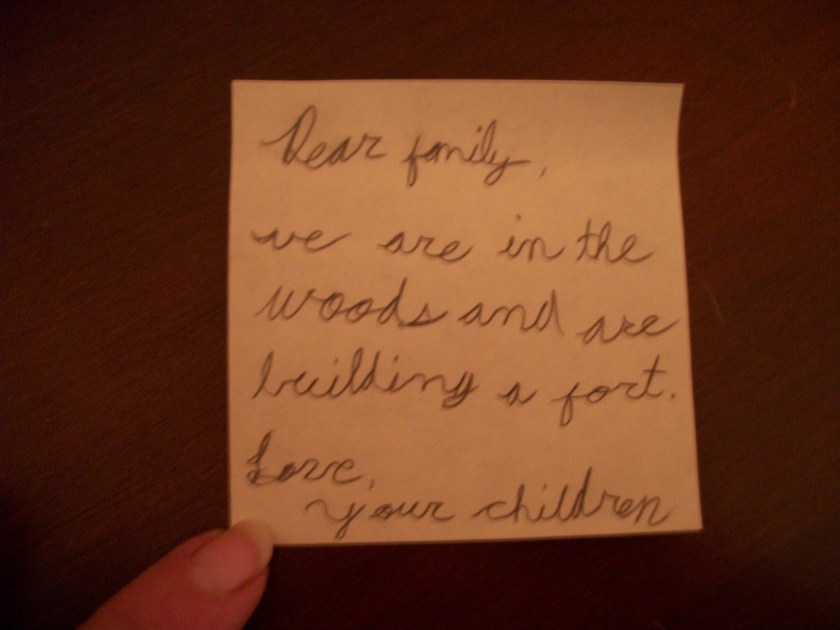
Here’s another:
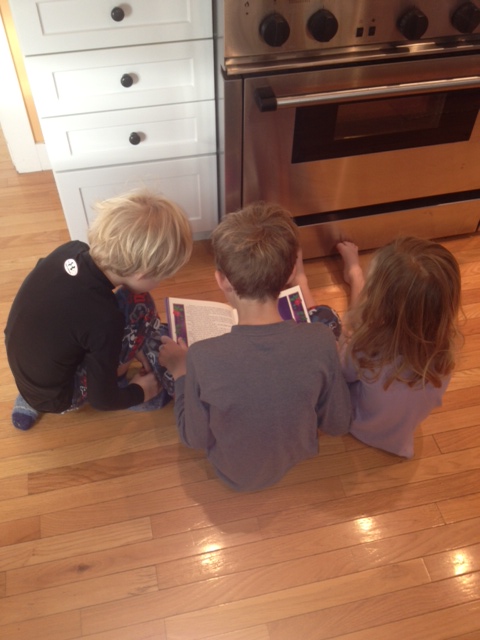
Bo was reading to Kelly and Wilhelmina while waiting for muffins to cook.
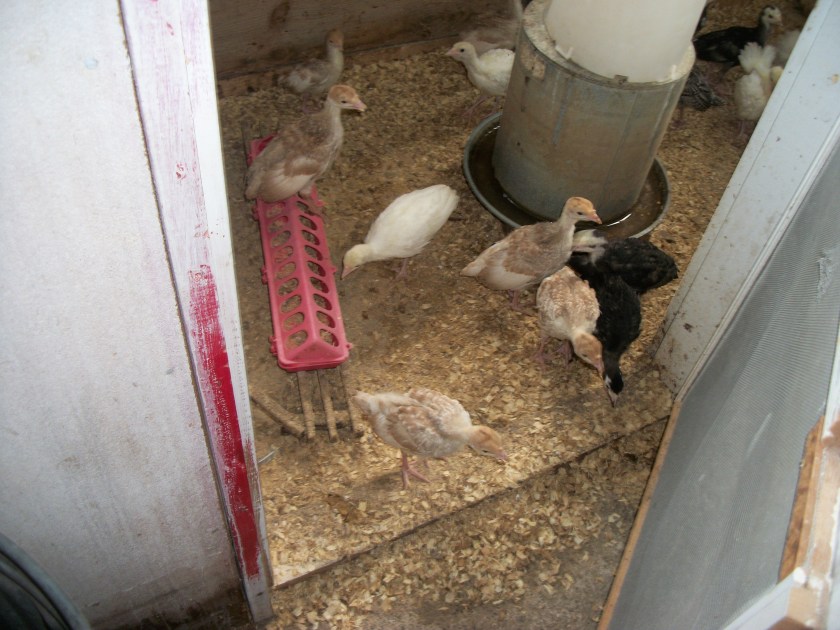
Last summer we visited our neighbors Chris Richmond and Susan McBride Richmond–who had just started raising our Thanksgiving turkey at Golden Brook Farm. I tried to remind the kiddos of this visit, but I don’t think they got it then or at Thanksgiving. Probably there was too much going on the day of the visit to Golden Brook–the Richmond-McBrides have terrific children, some of whom are the same ages as some of our crew, and in addition to friendly children there were barns to explore and new sights to see.
We got in two good hikes before the weather turned too cold for the clothing the children had available. The first, up to the Maiden Cliff area, is one of our favorites. On the way there is a gorgeous stream to cross. Here’s the view–the red in the foreground is a blueberry barren. We live across the lake/river and back to the left on that range of hills.

After the weather turned off really cold (and has since, alarmingly warmed up again so that there is no snow at the Snow Bowl), we had to find all kinds of layers to keep the kiddos warm. Here they are in front of the base of the Rockland Christmas Tree–which is all made of lobster crates and buoys.

Talula has lost a front tooth and is working on losing the other front tooth.
Turkey Tracks: December 14, 2012
Roasting and Cooking the Blue Hubbard Squash
Remember the Blue Hubbard Squash I grew and wrote about back in October?
Well, I roasted it this week.
The temperature had been dropping, and I had the squash stored in the garage so they could keep on “sugaring off.” Temps were low enough that I was afraid that the garlic and the squashes would freeze in the garage–so everything came inside.
John cut last year’s Blue Hubbard, which I bought for about $8, out in the garage–a place of mystery to me. This year I was on my own. And let me tell you, it took the BIG French knife, lots of muscle, and lots of patience. I could only get the knife into one side at once. Eventually, I was able to pry it open.
I scooped out the seeds and pulp and took them out to the chickens, who ooed and ahhed. The smell of the squash was so clean and sweet. The flesh was bright, intense orange.
Each half took up the whole of one of my big baking pans and both filled the whole of the oven. It took about 90 minutes to roast them completely.
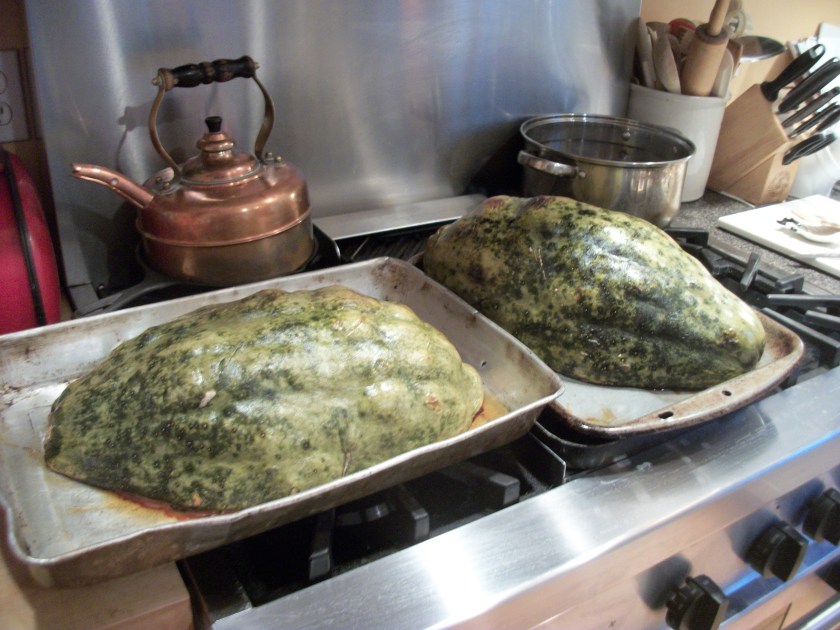
Here are the halves, flipped over and ready to have the roasted flesh scooped out.
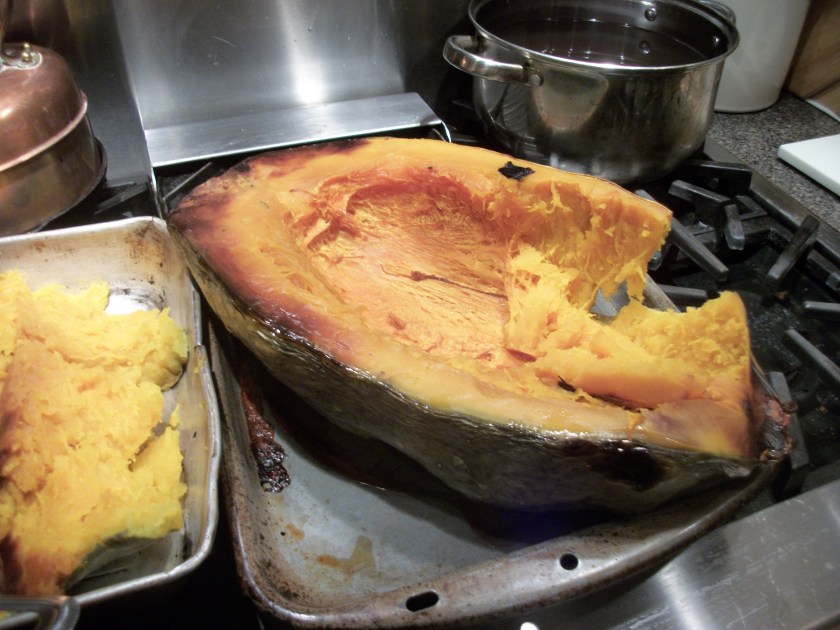
This one squash made an enormous amount of cooked filling. I put serving sizes into plastic bags and froze them–reserving about 4 cups for that night’s dinner–pan fried local ham steak, sauteed baby bok choy (with fresh ginger and our garlic), and the Blue Hubbard squash. (Fall is the traditional time for “putting up” pork raised over the summer–and a pork ham takes a bit of time to smoke, so big ham slices are now filling the local coops.)
I placed the roasted squash for dinner into a saucepan with a cover–added about 1/4 cup of our local raw butter, a big dollop of our local raw heavy cream, a splash of our local maple syrup, a pinch of sea salt, and about a teaspoon of Penzy’s cinnamon. I put the mixture on low heat and went back after a bit to stir it all up. It was smooth and incredibly sweet–I hardly needed the maple syrup in the mixture.
Delicious!
Turkey Tracks: December 14, 2012
BLOG REQUEST: CREAM CARAMEL CAKE
A blog reader recently asked me to post the recipe for the Cream Caramel Cake I pictured in the January 25th entry, 2011, on making French Onion Soup, which included a picture and a discussion of a Cream Caramel Cake I found in Better Homes and Gardens, December 2005. The reader tore out the picture and didn’t get the recipe. I tore out the recipe, but didn’t save the picture. Nevertheless, I feel sure that the cake recipe below is what this reader is asking me to post.
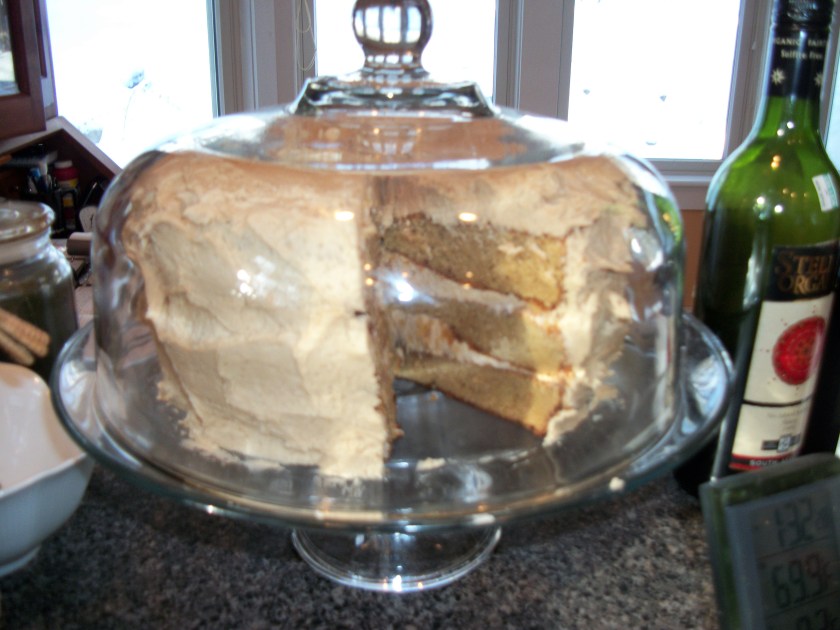
The cake pictured in the magazine was a secret family recipe, so this recipe probably comes close but isn’t exactly what Pat Shelter is really making. I didn’t have mocha syrup on hand, so kind of make one up–you can go back to the original entry to see what I did.
This is a BIG cake–3 LAYERS–with 8 CUPS OF POWDERED SUGAR in the frosting. There’s so much sugar that it makes my teeth hurt just to read the frosting recipe. The cake itself seems to be assembled in a classic manner. Do bring your ingredients to room temperature before starting the cake–or the frosting.
Cake ingredients:
1 cup butter
5 eggs separated
1 cup buttermilk
3 cups sifted cake flour
1 tsp. EACH baking powder and baking soda
pinch of salt
2 1/2 cups sugar
5 Tablespoons total: mocha syrup, coffee liqueur, and Irish cream liqueur–or strongly brewed coffee for all 5 Tablespoons
2 tsps. vanilla extract
1 recipe IRISH CREAM FROSTING (1 cup butter, softened, with electric mixer on medium to high speed until smooth. Gradually add 2 cups of powdered sugar, beating well. Slowly beat in 6 Tablespoons of whatever flavoring from above you have chosen. Beat in 2 Tablespoons of vanilla. Gradually add 6 MORE CUPS POWDERED SUGAR, beating until smooth and of spreading consistency.
1. Allow butter, egg yolks, egg whites, and buttermilk to stand at room temperature for 30 minutes. Meanwhile grease and flour three 9-inch round cake pans; set aside. In a bowl stir together flour, baking powder, baking soda, and salt. Set aside.
2. In a mixing bowl beat butter with an electric mixer on medium to high speed for 30 seconds. Beat in sugar until well combined. Beat in egg yolks one at a time. (Take time on this step.) Beat on high speed for 5 minutes.
3. Alternately add flour mixture and buttermilk to butter mixture, beginning and ending with flour mixture. Beat on low speed after each addition just until combined. In a bowl combine the listed flavorings as desired–or use strong coffee–and gently stir into cake.
4. Thoroughly wash beaters. In a mixing bowl beat egg whites on medium to high speed until stiff peaks form (tips stand straight). Fold 1 cup of the beaten egg white mixture into the egg yolk mixture, fold remaining egg whites into egg yolk mixture.
5. Divide batter among prepared pans. Bake for 20 to 25 minutes or until tops spring back when touched. Cool cakes in pans on wire racks for 10 minutes. Remove cakes from pans; cool thoroughly on racks. DO NOT FROST UNTIL THE CAKE LAYERS ARE TOTALLY COOL.
6. To assemble cake, place one cake layer on a serving plate. Spread top of cake with 3/4 cup of the Irish Cream frosting. Top with a second cake layer. Spread top of cake with 3/4 cup frosting. Top with remaining cake layer. Spread remaining frosting on top and sides of cake.
Mainely Tipping Points 45: December 13, 2012
Part II: How Soy Got Into Our Food Chain
Part II of this series on Soy explores how soy got into the human food chain. As established in Part I, the expert I rely on for soy information is Kaayla T. Daniel, PhD, CCN, the author of THE WHOLE SOY STORY: THE DARK SIDE OF AMERICA’S FAVORITE HEALTH FOOD (2005). Daniel’s credentials show her to be an outstanding nutritionist and her extensive research on soy makes her an expert. All quotes are from this text.
* * *
Soy is a powerhouse in terms of the potent chemicals its beans contain. For instance, soy is one of more than 300 plants that contain phytoestrogens, which stop reproduction. Yet soy is the only one of these plants humans eat. Besides phytoestrogens, soy contains many more powerful chemical components which are dangerous for humans unless they can be mediated in some way first. Indeed, the Food and Drug Administration (FDA) lists soy on its Poisonous Plant Database (31).
It is true, Daniel writes, that the ancient Chinese “valued the soybean as a national treasure” and honored it with the name “ `the yellow jewel.’ “The soybean, though it is not a grain, is one of the Five Sacred Grains, alongside rice, millet, barley, and wheat. But, the ancient Chinese did not eat the soybean. They used it as a green manure to fix nitrogen in the soil (9).
The Chinese began to eat soybeans “no earlier than about 2500 years ago.” They fermented soybeans as they “remain toxic after ordinary cooking….” Fermentation tames the trypsin inhibitor that causes bloating and gas. Miso paste, used to preserve meat and seafood, and soy sauce, the liquid produced in the production of miso, appeared first. Natto appeared around 1000 AD, and tempeh appeared “no earlier than the 1600s.” Thus, “claims that soybeans have been a major part of the Asian diet for more than 3000 years…are simply not true” (9-10).
Soy moved to Japan with the Chinese missionary priests “sometime between 540 and 552 AD.” Japanese miso documentation first appears in 806 and 938 AD. Tofu, which is a precipitated product, not a fermented one, appears about the same time and is called “the meat without the bone.” Tofu “appeared regularly on monastery menus as an aid to spiritual development and sexual abstinence, a dietary strategy validated by recent studies showing that the plant-form of estrogens (called phytoestrogens) in soy can lower testosterone levels” (10-11).
Tofu consumption spread “throughout China, Korea and Southeast Asia.” By 700 AD tofu was “accepted as a meat or fish replacement, at least when pork, seafood and other preferred sources were unaffordable or unavailable.” But, “except in areas of famine, tofu was served as a condiment, consumed in small amounts usually in fish broth, not as a main course.” In truth, Asians, including the Japanese who eat the most soy, don’t eat more than 1.5 percent of their diets in soy. And the Japanese, as has been shown in even recent studies, on average eat only about one tablespoon of soy a day (28). Plus, the types of soy Asians eat are old-fashioned products like miso and tempeh, not commercial soy in products like “soy sausages, soy burgers, chicken-like soy patties, TVP chili, tofu cheesecake, packaged soymilk, or other of the ingenious new soy products that have infiltrated the American marketplace” (12-13).
Soybeans probably came to Indonesia from trade with southern China trade around 1000 AD. The Indonesians appear to have invented soy tempeh (fermented whole soy beans) as the “world’s earliest reference to tempeh manufacture occurs in the Serat Centini, a book published in 1815 on the orders of Sunan Sugih, Crown Prince of Central Java. Indonesian tempeh became “known as food for the poor, even though people of all classes continued to consume it” (13).
Asians “rarely—if ever—baked or boiled soybeans, ground them into flour, or roasted them to make nut-like snacks.” Likely, these practices left diners with “a stomach ache or worse,” unlike the time-honored traditional techniques” for preparing soy. Nor did Asians “press or crush great quantities of soybeans to extract soy oil,” so “they never faced the challenge of finding creative ways to use massive amounts of the leftover protein.” What oil they did extract was used to light lamps, and the leftover protein “served as an excellent fertilizer” (14)
Soy goes west as early as 17th century France, where soy sauce becomes a secret ingredient at court banquets. Ben Franklin sent soybeans to America in 1770, but soy remained “a little-known commodity…for more than a century.” It wasn’t until 1935 when soybeans were grown for food oil that its plantings “equaled those used for crop rotation”—to fix nitrogen in depleted soils (17).
Early western soy proponents were John Harvey Kellogg, the breakfast cereal king; Artemy Alexis Horvath, PhD, who promoted soya flour in academic and popular fronts; Henry Ford, who thought soy plastics would be great in cars and who wore soybean-fiber ties to promote soy as a cloth; Adolf Hitler, who promoted whole-food vegetarianism; and Benito Mussolini, who wanted to make soy flour a “mandatory ingredient in the Italian staple polenta.” By the 1950s and 1960s, the Communist Party in the Soviet Union” pushed soy protein and soy margarines as the solution to low-cost feeding of the masses…” (18-20).
The U.S. soy industry has claimed that Asians, especially the Japanese, eat a lot of soy and have better heart health and fewer cancers that do North Americans. But, as noted above, soy proponents in the west have had to admit that soy consumption in Asia is not as great as they advertised. Further, the famous claims that Okinawans enjoy longevity due to soy-rich vegan diets have been debunked, and Daniel covers this issue thoroughly. As with other Asians, Okinawans do eat small amounts of soy, but their diets include primarily meat, fish, and lard. There seems also to be a genetic factor involved in Okinawan longevity (15-16). And, as Sally Fallon Morell of The Weston A. Price Foundation notes in the introduction, the Japanese, who eat the most soy in Asia, and Asians in general, have higher rates of cancer of the esophagus, stomach, pancreas, and liver than do North Americans (5).
What differs between how soy is viewed in the East and the West is that in the West soy “is a product of the industrial revolution—an opportunity for technologists to develop cheap meat substitutes, to find clever new ways to hide soy in familiar food products, to formulate soy-based pharmaceuticals, and to develop a plant-based, renewable resource that could replace petroleum-based plastics and fuels.” Even today, “very few soybeans are sold for whole food products,” so that “the `good old soys’ of Asia—miso, tempeh and natto—thrive only in niche markets.” The soy industry knows that “the big profits are not to be found in old-fashioned, funny-tasting foreign foods, but from splitting the `yellow jewel’ into two golden commodities—oil and protein” (21-22).
Most soybean oil (97 percent in 1997), which is highly processed, goes into food products—salad and cooking oils, shortening, and margarine. The protein was at first fed to “animals, poultry and, more recently, fish farms.” But now, the soy industry “aggressively markets soy protein as a people feed as well”—so that “soy is now an ingredient in nearly every food sold at supermarkets and health food stores.” And, the soy industry profits from soy waste products, like soy lecithin (used as an emulsifier), “protease inhibitors (digestive distressers sold as cancer preventatives), and isoflavones (plant estrogens promoted as `safe’ hormone therapy, cholesterol reducers, and cancer cures”) (21-23).
The soy industry has “Americanized soy around the globe”—running into trouble “only when Monsanto—the biotech bully boy”—pushed for acceptance of its genetically modified (GM) `Frankenstein’ soybeans” (27). China is “now the world’s largest importer of U.S. soybeans” (30). And, Asia is potentially a “huge market” for American-style imitation soy products (28).
Next: the difference between American industrial soy products and the old-fashioned “good old soys.”
 Louisa Enright's Blog