Books and Interesting Information: Polio and the Polio Vaccine

Books and Interesting Information:  March 9, 2015

Polio and the Polio Vaccine

Somewhere along my journey of learning about vaccines, I asked myself what vaccines might be worth getting.

Polio topped the list.  Along with tetanus maybe.

The other diseases, I thought, would fare rather well being treated with today’s advanced medical abilities–assuming the infected person did not have significant other problems like being malnourished or having another debilitating disease like cancer.  Later I decided that since tetanus has such specific conditions–a puncture wound that cuts off oxygen and allows the tetanus organism to flourish–I would take my chances.  Surely I would know if I had a deep puncture wound and could get a booster if I thought it necessary.

Polio was the scary disease of my childhood.  At one point in the 1950s, my mother left Barksdale Air Force Base in Shreveport, Louisiana, and took us home to her little hometown, Reynolds, Georgia.  The feeling at the time was that urban areas were more dangerous than small towns in the rural south.  And I still remember pictures of people in iron lungs.

Since then, I’ve learned that the subject of polio is not as clear cut as we might believe.

DISSOLVING ILLUSIONS:  DISEASE, VACCINES, AND THE FORGOTTEN HISTORY by Suzanne Humphries and Roman Bystrianyk is reviewed by Martin Michener in the Wise Traditions Fall 2014 issue. Michener has a PhD and teaches biology, ecology, and farming as an adjunct professor.

Dissolving Illusions by Suzanne Humphries & Roman Bystrianyk | Weston A Price.

Reading the review is a really good place to get an idea of what is covered in this important book.

The book covers the history of 14 contagious diseases.  The authors rarely interject opinion:  they just assemble information and let reader’s make up their own minds.  Michener writes that the book is really useful for parents who are trying to educate themselves and for doctors who need to slow down and review the history of vaccines as “cures” for diseases.  Warning:  this book is not an easy read.  For an easier read download Tetyana Obukhanych’s VACCINE ILLUSION.

Michener’s review attempts to highlight the major points he walked away with.  For starters, the describes the incredible intricacy of our immune systems and how little we actually know about how it works.  Or, doesn’t:

It is staggeringly complex, comprising at least fifteen different cell-types that spew dozens of different molecules into the blood to communicate with one another and to do battle. Within each of those cell types sit tens of thousands of genes whose activity can be altered by age, exercise, infection, vaccination status, diet, stress, you name it. . . That’s an awful lot of moving parts. And we don’t know what the vast majority of them do, or should be doing. . . we can’t even be sure how to tell when the immune system’s not working right, let alone why not, because we don’t have good metrics of what a healthy human immune system looks like. Despite billions spent on immune stimulants in super-markets and drugstores last year, we don’t know what—if anything—those really do, or what “immune stimulant” even means.

As for polio–there is a history…one that involves redefining what polio is…which alters statistical data so that the real polio (and pesticide damage) is hidden.  Here’s the Michener section on polio:

Dissolving Illusions next systematically takes us on the long journeys of improving illnesses for polio, whooping cough and measles. Graphs show most of the improving story, as diseases become less infectious and deadly. Approximately 98 percent of this improvement came before the corresponding vaccines were ever available, but that never daunted the enthusiasts from claiming full credit, post hoc, for improved conditions.

The whole polio story takes many particularly devious turns, where much, perhaps most, of the causes for paralysis were initially unrelated to the actual poliomyelitis virus. In 1954, on arrival of the Salk vaccine, the disease was immediately completely re-defined almost out of existence. Early polio medical treatment apparently was far more damaging than the disease, with anesthesia and rigid casts put on children, then allowing the children to scream in pain for up to several days. Through the considerable efforts of Sister Elizabeth Kenny, who administered almost the exact opposite treatments, it was later found and admitted that the early treatment caused the nervous control of their muscles to perish forever. Doctors who employed vitamin C and physical therapy reported zero paralyses.

There are so many causes for “polio” paralysis it would take a page to list them here, but only the virus is now recognized by the redefinition. Figure 12.4 on page 249 was used from Jim West’s article in this journal, “Pesticides and Polio” (http://www.westonaprice.org/health-topics/pesticides-and-polio-a-critique-of-scientificliterature/). From examining the figure, you may realize that much of the paralysis outbreak in the period between 1940 and 1955 was actually due to acute arsenic or DDT exposure from untested pesticides, mostly on farms. After the redefinition, including much more rigorous criteria for the diagnosis of “polio,” pesticide paralysis has continued, but it no longer had any effect on the records of “the new vaccine-cured polio” cases. Outside the U.S.A., where DDT is widely sold and used, any news of human paralysis simply threatens our precious export markets.

The horrible “iron lung” polio cases, rather than being solved by vaccine, were also cleanly swept under the definition rug. On p. 241 of Dissolving Illusions the authors make a rare summarizing statement: “Does the public have any idea that there are hundreds of cases of something that is now called transverse myelitis that would have historically been called polio and is now leaving children permanently dependent on a modern version of the iron lung?” Polio virus continues to infect today, but like the other illnesses has become almost benign.

So, what about pertussis, or whooping cough and vaccines?

One fascinating problem has been identified, described in connection with the problematic vaccination for pertussis (whooping cough). When a youngster first gets the wild infection, B. pertussis, the bacteria attach to bronchial cells and secrete a compound abbreviated as ACT, which fools the immune system into a false truce. After a few weeks of coughing, the system wakes up to the deception and forms a remembered response, which then completely heals the infection. Any future infection is met by this immunity, which typically lasts about thirty years. Enter the vaccine form of the bacterium, sans ACT. The immune system now develops a different, permanent set of responses, minus the knowledge of ACT. Now, every new infection with wild or vaccine-strain pertussis produces the same prolonged ACT phase, and, contrary to the contention of Mr. Bush, you do get fooled again and again. This is called Original Antigen Sin, or OAS, meaning the first time is all you get, to get it right. So what? Pertussis is now a mostly-undiagnosed adult disease, with adult carriers infecting everybody, endemically, instead of a once-will-do-it childhood disease.

I’ve ordered the book out of sheer curiosity and a desire to understand more of this complicated vaccine subject.  Fortunately, my children “get” the vaccine problem now, so while the older grandchildren did get some vaccines, the younger ones have not.  Fortunately, I don’t have to battle with schools about vaccines like my children do.  If Senators Feinstein and Boxer of California have their way though, I may have to battle for my right as an adult to control what goes into my body.  Feinstein and Boxer are spearheading a national vaccine law mandating that adults get boosters in what will be a government-dictated schedule. And that’s how the market increases its market share.

If you need more information on vaccines, at least read this review.
Turkey Tracks: Low Contrast Quilt

Turkey Tracks:  March 9, 2015

Low Contrast Quilt

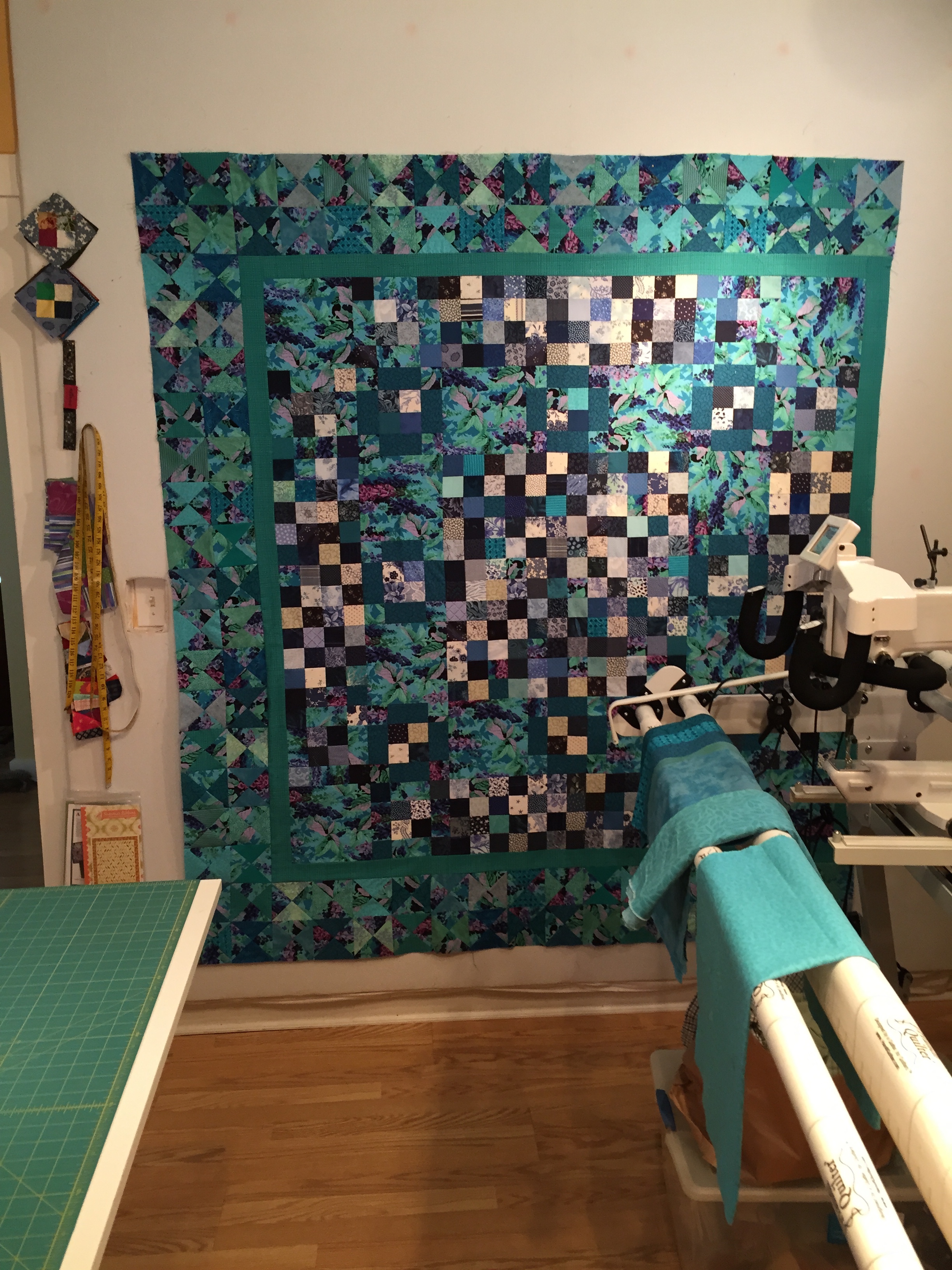
The scrappy low-contrast quilt is coming along.

This quilt is inspired by Kaffe Fasset, who often works low-contrast with lush fabrics, and by Bonnie Hunter’s scrap system.

The little blocks are from the 2 1/2-inch scraps.  I am using a focus fabric I thought would blend with the many shades of the blue blocks.

The right border is almost finished and will go on today.

And, then what?  It’s 76-inches square now, and I may call it a day.  But I’d like it to be a bit bigger–say 10 inches.  I may go out to one more 2-inch border and an outer border of the little squares.  Don’t know yet…

IMG_0212


Here’s a close-up of the outer border blocks:

IMG_0214

I used the Companion Angle Ruler to cut these block pieces–as Bonnie Hunter recommends.  And I LOVED how easy it was and how beautifully the pieces come together.

Turkey Tracks: Wild Turkeys in Spring Video

Turkey Tracks:  March 9, 2015

Wild Turkeys in Spring Video


I know I’ve put up many videos about the wild turkeys and the chickens.

But, it’s spring, and the turkeys have formed a large flock again–and will start mating.  I am encouraged by how many have survived February 2015.  I can’t imagine what they managed to eat–beyond my bits of sunflower seeds.

The chickens are wild with delight to be allowed out of the coop/cage.  This time of year is ALWAYS a risk for them.  You saw the shots of one getting stuck in the snow pack posted yesterday.  Her feet, by the way, seem to be hurt, but not lethally hurt.  And fox is having babies now and will need to feed those babies.  Life is always already risky, isn’t it…


Turkey Tracks: Chicken Stuck in Snow

Turkey Tracks:  March 8, 2015

Chicken Stuck in Snow

Today dawned to be beautiful.  Warm and sunny.  Warm for Maine that is.

It was warm enough for the chickens to agree to come out of their cage/coop.

We are all feeling the rising sap and energy of SPRING, even though the snow pack out here is still about four feet thick.

I dug out the flap to the chicken coop, propped open the coop roof, and out they came to eat the mealy worm and sunflower seed treats.

Back inside, while eating my breakfast and making plans for a run up to Belfast, I saw that the rooster and a few of the hens were up on the upper porch.

When I got back from Belfast, I checked on the flock.

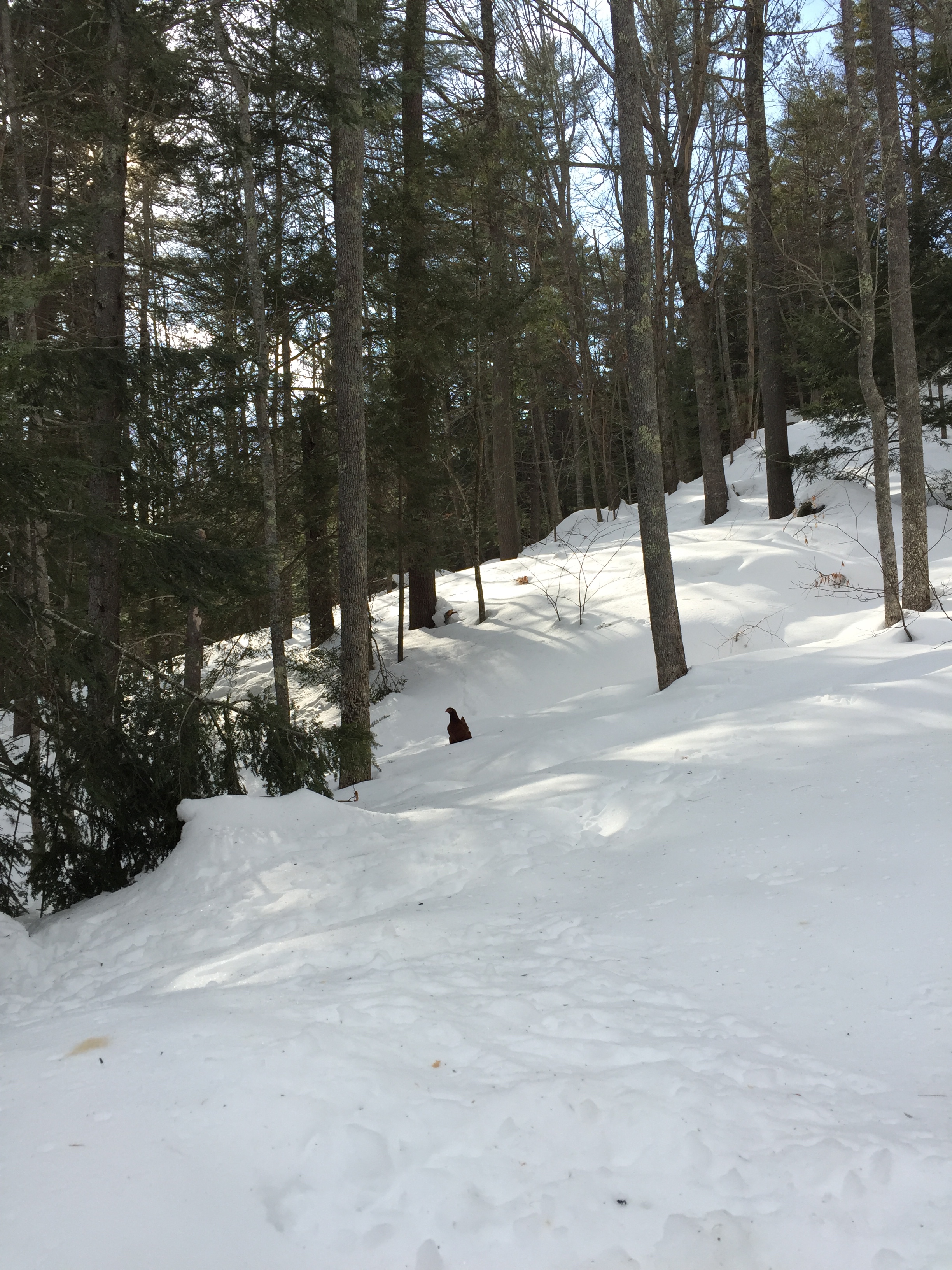
Here’s what I saw up on the hill:

IMG_0206

I called, and she craned her head, but did not move.

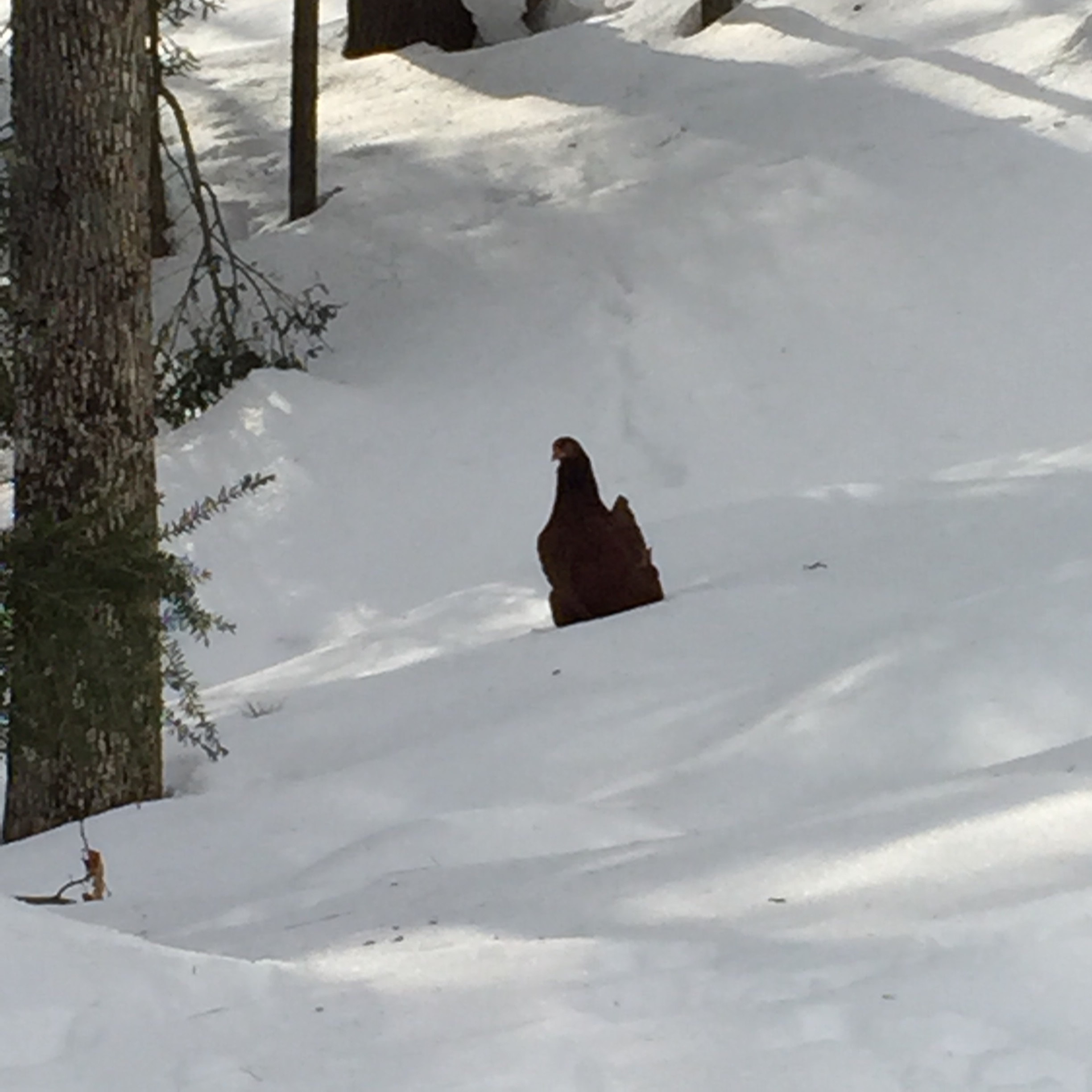
Here’s a closer view:

IMG_0205

Something had spooked her, and she had flown up into the snow pack and gotten herself stuck.

There was nothing to do but go get her.

She is fully exposed and a “sitting duck” chicken waiting for a predator.

Out came the snow shoes:

IMG_0207

I had to fit them to the larger boots I got just before John died.  I figured it out.  Thank heavens I have a good pair.  They were a birthday gift from John in 2004 when we knew we were moving to Maine.

IMG_0210

The chickens, as always, milled about, trying to help.

IMG_0208

(The turkeys have spread the old chicken bedding out over the banks and paths.)

I got to her, after working my way around the large white pine.  I was able to take advantage of the paths the turkeys and the dogs have made in the snow.  And, yes, sister Susan, I took my cell phone.

I poked her with the long end of the ski pole, and she didn’t move.  Yep.   Her feet were stuck.  I climbed the hill to her and picked her up.  She was limp and scared and probably somewhat dehydrated.

She could not walk when I put her on the turkey/dog path–and by this time the rest of the flock had followed me.

Were her feet just numb, or were they frozen or badly frost bitten.  Hens do have a way of going limp when they are scared.

I have no idea how long she had been stuck.

I carried her under my arm back the way I came and put her through the flap to the coop.  She ducked inside, so she could walk.

But, as I stopped at the edge of the porch to take off the snow shoes (they have wicked grippers on the bottom), I saw that she had followed me and that her feet were turning a dark red…

…so I don’t know how badly she might be hurt.

Time will tell.

She was eating.


Turkey Tracks: I’m Hungry for Flowers

Turkey Tracks:  March 7, 2015

I’m Hungry for Flowers

My mind has been imagining the daffodils I planted last fall.

I can’t wait to see them.

Meanwhile, New York blog friend Judith Brill sent me this tantalizing video:  “Dance of the Flowers.”

Each flower is filmed for days and the film is collated for seven minutes to produce the “dance.”

Enjoy!

The Life of flowers (Жизнь цветов) from VOROBYOFF PRODUCTION on Vimeo.

She also sent this cartoon, which amused me to no end.

https://fbcdn-sphotos-f-a.akamaihd.net/hphotos-ak-xfp1/v/t1.0-9/1902846_636812339699134_1415985208_n.jpg?oh=beed2f87b64b93d78fe9c77df3190ee5&oe=5575CDC8&__gda__=1434572647_31baf538a0c9ad10794b2641d3d131a8

Turkey Tracks: Mailboxes and Snowplows

Turkey Tracks:  March 6, 2015

Mailboxes and Snowplows

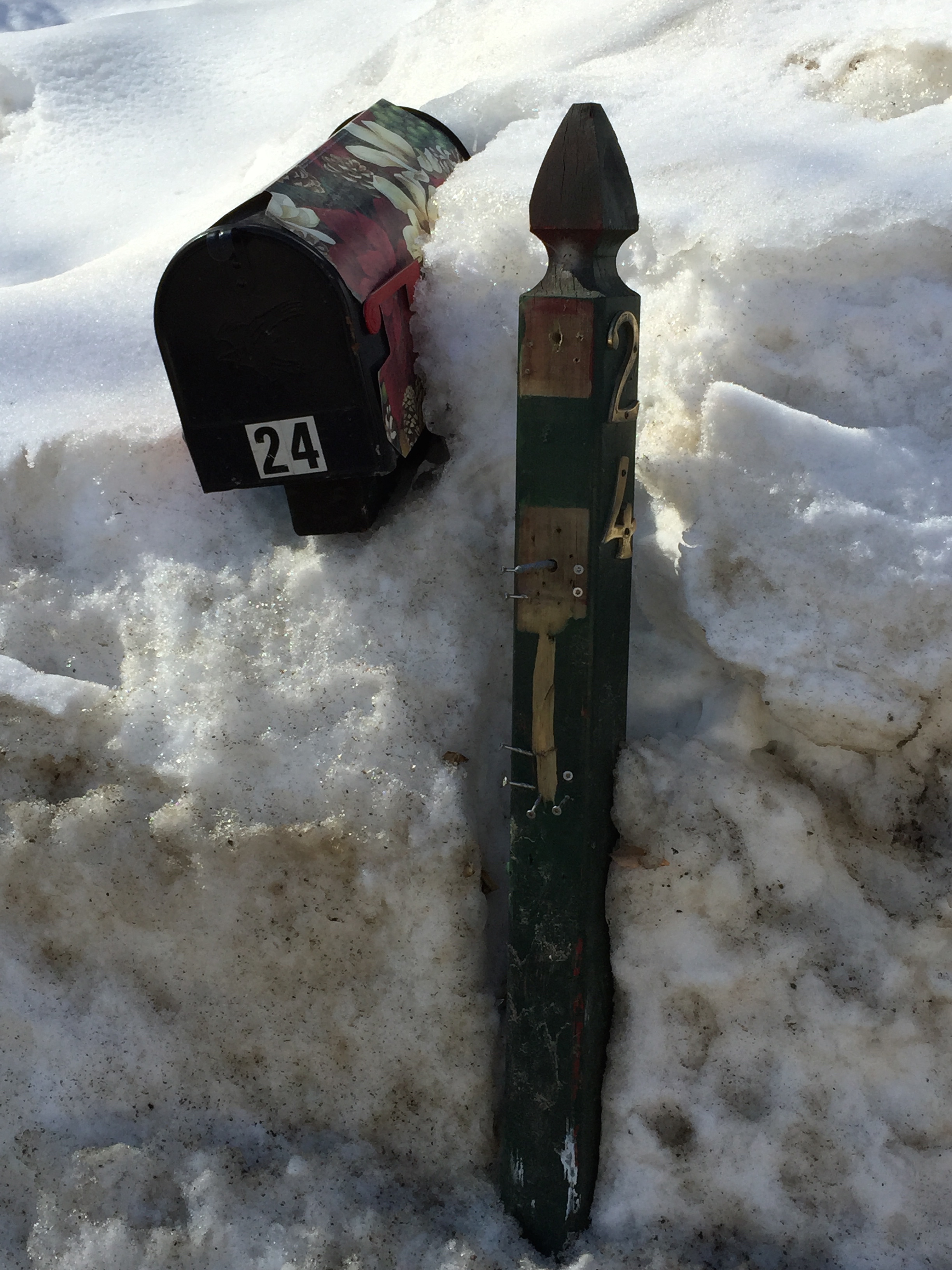
I stopped on the way into the driveway to check for mail and thought you might get a kick out of seeing the “problem” of snow plows and mailboxes in Maine in deep snow.

Here you can see how thoroughly shorn my mailbox is from its post.

IMG_0200


Most folks do exactly what I did:  stick the mailbox into the snow bank as best as one can until the snow season is over and the snow bank is gone.

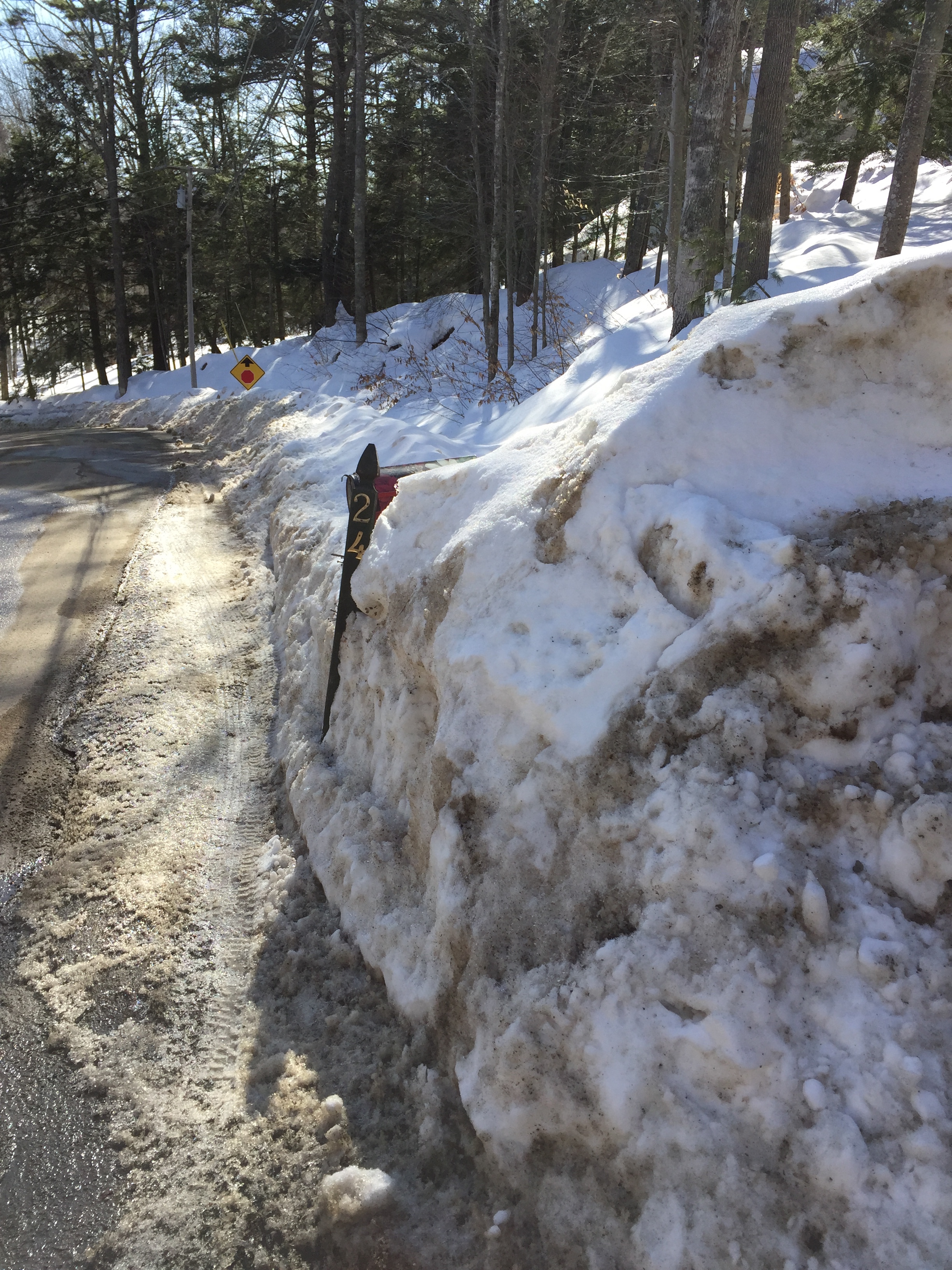
Here’s a picture that shows you how vulnerable the mailbox is to the plows when they are dealing with a lot of snow on the side of the road:

IMG_0202

You can see how far out into what is left of the road the mailbox would be.  I put up several reflective markers, but with all the snow we’ve had, the plow drivers are tired and often are coming down a very steep, curving hill with a load of snow in front.

Stephen Pennoyer tells me “come spring” we’re going to replace this box with one that will swing to the side with the plow’s movement.

Turkey Tracks: Snow Damage

Turkey Tracks:  March 2, 2015

Snow Damage

Camden, Maine, February 2015

I was coming back from Rockland the other day and saw this house caved in.

At first I thought it was fire damage.

But, no, the weight of snow on the roof caved in the roof.

I have no idea how sturdy the building was to begin with, but, the picture makes a good metaphor of the damage inflicted on this part of the country this winter of 2015.

IMG_0198


Interesting Information: Free Viewing of BOUGHT Movie Through March 6th

March 2, 2015

Free Viewing of BOUGHT Movie Through March 6th

I spent a chunk of this morning slowing down enough to watch this documentary.

It’s excellent.

I wish I had watched and posted sooner as the free viewing is coming to an end.

As an American citizen, you owe it to yourself and to your country to watch this movie.  What it is mostly about is the loss of our Democracy–through the power industry has acquired to control us.  Part of this control is done through the control of information, through the misuse and abuse of science, through the colonization of our government and our legal system, through advertising campaigns meant to influence us, through the loss of our media as any meaningful entity that informs us, through the creation of mob hysteria around false issues…

We are now losing the ability to control our own bodies and what goes into them.  The individual control of a person’s body is the most basic cornerstone of freedom.   Our bodies have been “bought” to an astonishing degree–and industry is using its full power now to use the courts to enslave us further.  Industry is now using our laws and court systems to get what it wants–which is more and more money.

We have to “wake up” now.  We have to do it for ourselves and for our children.  We have to start asking questions and to insist that those we trust with our well being start asking questions too.

We have to get the money out of the system…

Free Viewing of Bought Movie.

Interesting Information: Why So Much Snow and Cold in New England in 2015 Winter?

Interesting Information:  March 1, 2015

Why So Much Snow and Cold in New England in 2015 Winter?

According to NOAA and NASA, 2014 was Earth’s warmest year since the government started keeping statistics back in 1880.

Here in Camden, Maine, we’ve had bitter, bitter cold (way below zero, especially at night) for most of February and seven feet plus feet of snow out where I live.  There’s a good three or more feet still on my roof–with more coming in tonight.  (I was actually a little shocked when I went into town the other day and saw how little roof snow most people had.  I know some had snow removed, but everybody didn’t.  I am a little west of Camden and in a higher elevation than Camden town.)  We’ve had snow every few days for the past six weeks–until these past three days.

Why, with global warming, is there so much cold and snow?  Why is this February 2015 the coldest in Maine’s history since they started keeping records?

The snow part is easy.  Melting polar caps and warming oceans have put much more moisture into the weather system.  We’ve been getting the equivalent of this winter’s snow in rain in the summer and fall for the past 2 years.  The potato crop has failed for several years now at Hope’s Edge, my CSA.  It’s just been too cold and too rainy.  Last summer, which was very cool, I could not grow warm weather crops like cucumbers, zucchini, and big tomatoes.  (Tom at Hope’s Edge has a bumper crop of tomatoes grown in his hoop houses.)

But why is Maine getting this moisture while other parts of the United States are experiencing drought conditions?  And what about the cold?

I got my answer with this little video from Earth Now, which I watched after cousin Marcia Davenport put up a video on Facebook that pitted “the senator with the snowball” (Oklahoma) with “the senator with the facts” (Rhode Island I think) who referenced Earth Now.  It’s pretty hard to argue with a satellite photo of the Arctic polar cap in 1980 versus photos of what remains now.  The shrinking in the ice caps has caused the jet stream to perform differently, which is driving the very cold air down into New England for extended periods.  It’s called “artic amplification.”

(And, yes, I’m aware that the Antarctic ice cap has once again expanded, but a crew of scientists from Australia just returned from measuring it, and that ice is very thin.  There are and will be fluctuations in the effects of global warming.)

Feature Stories | EarthNow.

Here’s the url to EarthNow…it’s a fabulous site.  Explore and take a look at some of the excellent short videos.

http://sphere.ssec.wisc.edu

And, here’s a local piece in this week’s Free Press by Melissa Waterman, “Oh No, The Snow!”

http://www.freepressonline.com/main.asp?SectionID=50&SubSectionID=72&ArticleID=37335

These levels of snow have been destructive and extraordinarily expensive.  You will be shocked at what my bills for plowing/shoveling/roof snow removal/and driveway grit are going to be.  And I will have increased heating bills on top of that.  Friends have lost farm buildings and hoop houses.  And most friends have had to have snow taken off their roofs–which is dangerous and expensive.  Many cannot afford the plowing/shoveling costs.  At least one house I know has burned to the ground because the absentee owners didn’t plow out the driveway, and the fire trucks could not get to it.  And not a night goes by that we don’t have pictures on the local news about roofs caving in.

Here’s the url to the Senate floor discussion of climate warming if you missed it:

Addicting Info – Dem Slams Climate Denying Colleague: You Can Believe Experts Or ‘Senator With Snowball’ (VIDEO).