Quilting Information: Watch Bonnie Hunter’s THE QUILT SHOW free until May 25th.

Quilting Information:  May 21, 2014

Watch Bonnie Hunter’s THE QUILT SHOW for Free Until May 25th

It’s EASY!


You can watch Bonnie Hunter’s episode (#1410) on THE QUILT SHOW for free—until May 25th.  This program is hosted by Alex Anderson and Ricky Tims.

Go to http://thequiltshow.

Sign up as a “basic” member—which is free.

Then you can click on Bonnie’s show, #1410.  When I did the sign-up, Bonnie’s episode was a button on the right side of the page showing Bonnie’s face.

It’s an engaging show, and I learned more about Bonnie’s methods.

Enjoy!

Louisa


Here’s the url to Bonnie’s blog post:


Quiltville’s Quips & Snips!!: Free to my Readers: Watch my Episode, #1410.

Turkey Tracks: Honeycomb Hand-Sewing Project

Turkey Tracks:  May 21, 2014

Honeycomb Hand-Sewing Project


Well, isn’t this fun?

IMG_0279

This piece will be finished when I complete the circle of white English Paper Piecing templates–which I bought from Alewives Quilting in Damariscotta, Maine.

Lucy Boston pioneered this “honeycomb” quilting.  A “honeycomb” is a hexagon, but with an elongated top and bottom side.

Here’s the “how to” and inspirational book by Linda Franz.

IMG_0278

And here’s some ideas of how the honeycombs can be combined.  Lucy Boston used combinations of 24 honeycombs ringed by 24 white honeycombs.  I started with the top left version.

IMG_0276


I’m probably only going to do four of these in shades of red and green and link them into a four-patch.  Or, as a banner.

The “blocks” are joined by a series of squared.  And if one wanted to make something bigger that gets squared off, one needs a series of templates that will “square off” the blocks.  You can order those or make them yourself as the patterns are in the book.

I am joining the pieces with the method Leah Day demonstrated on a utube video.  I posted that link on this blog earlier, but you can google Leah Day and “English Paper Piecing” for the series of three videos.  I like this method because it does not show the whip-stitch stitches on the front.

Interesting Information: Importance of Microbial Diversity in Gut Health and Disease

Interesting Information:  May 16, 2014

Importance of Microbial Diversity in Gut Health and Disease

Mercola posted an important article on the importance of microbial diversity for human health this past week.

Here’s how the article begins:

Our gastrointestinal tract is now considered one of the most complex microbial ecosystems on Earth. You may have a basic awareness that the microbes in your gut affect your digestion. But their influence extends far beyond that to your brain, heart, skin, mood, weight… and the list goes on and on.

Here’s the url:  Importance of Microbial Diversity in Gut Health and Disease.

Did you know that in addition gut flora and fauna, we also carry a load of viruses that work to keep us healthy?

I didn’t.  That’s a new one for me to learn.

And the state of our individual guts has a lot to do with how we respond to cancer.  Or, not–in that if our gut is balanced, our immune system is strong, and we stay healthy.

Here’s another quote:

All these intestinal microflora are part of your immune system and about 80 percent of it originates in your gut. Researchers have discovered that microbes of all kinds play instrumental roles in the functioning of your body. For example, beneficial bacteria, also known as probiotics, have been shown to:

For all of these reasons, and more, I recommend a diet rich in whole, unprocessed foods along with cultured or fermented foods. If, for whatever reason you are not consuming fermented foods at least a few times a week, it’s wise to consider supplementation.

Mercola’s recommendations for promoting gut health:

All of this information should really drive home the point that optimizing your gut flora is of critical importance for disease prevention, including cancer prevention. Reseeding your gut with beneficial bacteria is essential for maintaining proper balance here. As mentioned, beneficial bacteria help keep pathogenic microbes and fungi in check; preventing them from taking over. In light of this, here are my recommendations for optimizing your gut bacteria.

      • Fermented foods are the best route to optimal digestive health, as long as you eat the traditionally made, unpasteurized versions. Healthy choices include lassi (an Indian yoghurt drink, traditionally enjoyed before dinner), fermented grass-fed organic milk such as kefir, various pickled fermentations of cabbage, turnips, eggplant, cucumbers, onions, squash, and carrots, and natto (fermented soy). Some of the beneficial bacteria found in fermented foods are also excellent chelators of heavy metals and pesticides, which will also have a beneficial health effect by reducing your toxic load.
      • Fermented vegetables are an excellent way to supply beneficial bacteria back into our gut. And, unlike some other fermented foods, they tend to be palatable, if not downright delicious, to most people. As an added bonus, they can also a great source of vitamin K2 if you ferment your own using the proper starter culture. We had samples of high-quality, fermented organic vegetables made with our specific starter culture tested, and a typical serving (about two to three ounces) contained not only 10 trillion beneficial bacteria, but it also had 500 mcg of vitamin K2, which we now know is a vital co-nutrient to both vitamin D and calcium. Most high-quality probiotics supplements will only supply you with a fraction of the beneficial bacteria found in such homemade fermented veggies, so it’s your most economical route to optimal gut health as well.
    • Probiotic supplement. Although I’m not a major proponent of taking many supplements (as I believe the majority of your nutrients need to come from food), probiotics is an exception if you don’t eat fermented foods on a regular basis.

In addition to knowing what to add to your diet and lifestyle, it’s equally important to know what to avoid, and these include:

Antibiotics, unless absolutely necessary (and when you do, make sure to reseed your gut with fermented foods and/or a probiotic supplement)

Conventionally-raised meats and other animal products, as CAFO animals are routinely fed low-dose antibiotics, plus genetically engineered grains, which have also been implicated in the destruction of gut flora

Processed foods (as the excessive sugars, along with otherwise “dead” nutrients, feed pathogenic bacteria)

Chlorinated and/or fluoridated water

Antibacterial soap

Agricultural chemicals, glyphosate (Roundup) in particular

Do take a moment and read the entire article.  It’s an important one.


Turkey Tracks: Beaver Dam 2014

Turkey Tracks:  May 16, 2014

Beaver Dam 2014

Camden, Maine


I put up a video of the beaver dam just below my house about a year ago.

Here’s a little video showing how this dam has developed over the past year.  What used to be a stream is now forming into a small pond.


Also, the fall after we moved to Maine in June 2004, I planted a lot of daffodils around the property.  They have done the best in the little postage stamp meadow below my house.  They are naturalizing so nicely.  This year was the best yet.  (Clearly the camera focused on the trees, but you get the idea here anyway.)

100_3917

Turkey Tracks: Quilts For Twins

Turkey Tracks:  May 12, 2014

Quilts For Twins

First, these two quilts are meant to be loved, dragged around, put on the floor for tummy time, and washed.

AND, both of these quilts are made from what is now a “deep” stash of fabrics–so each has many pieces of fabric that have gone into other family quilts–which forms a lovely linkage I think.  So, those of you who have been recipients of one of my quilts, look to see if some of your fabric has been used in these two baby quilts.


Mister’s:

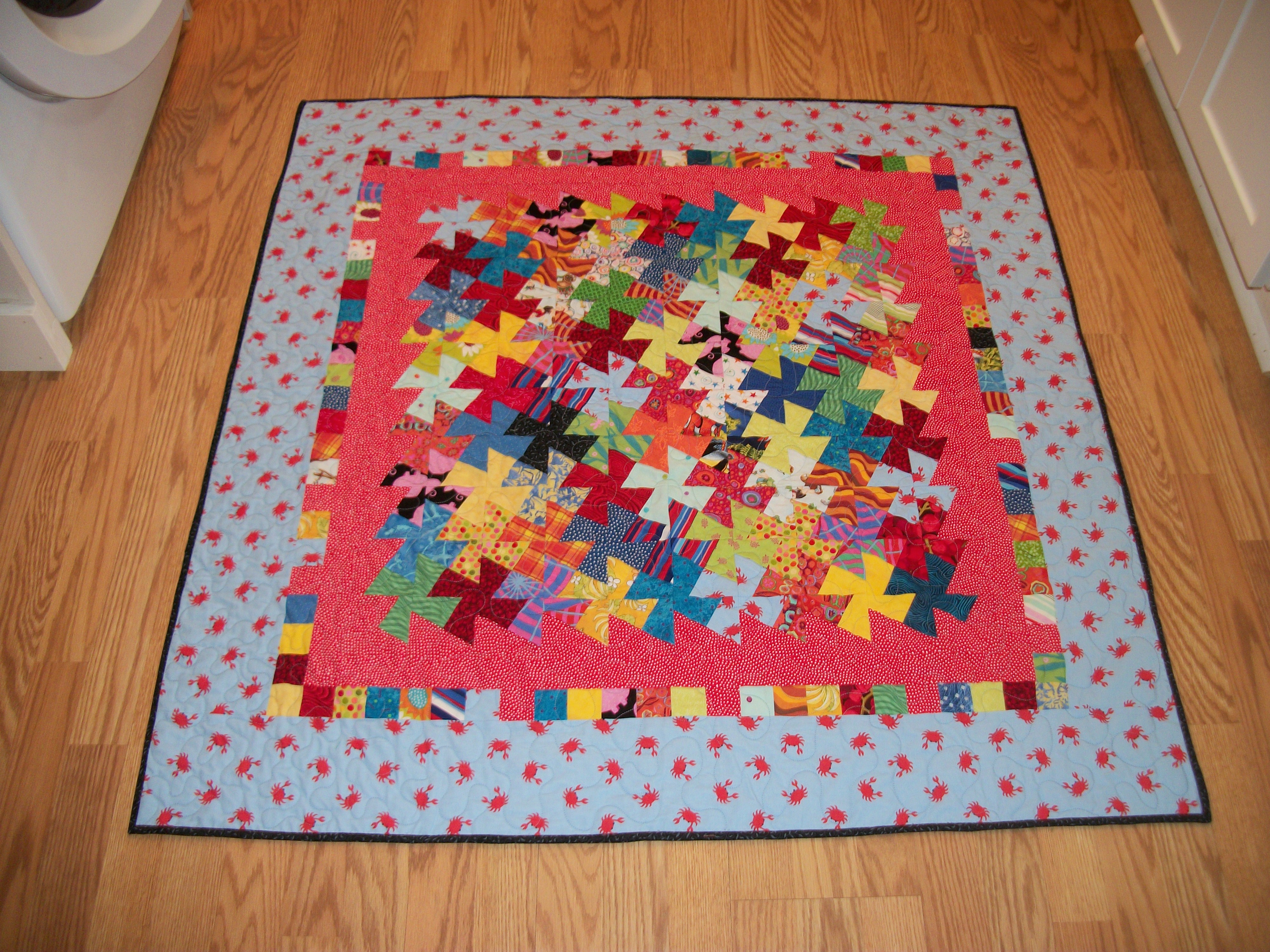
I made “Mister’s Twister” for the boy twin using a “Lil’ Twister” ruler brought home from the Mid-Atlantic Quilt Show in Norfolk, Virginia, I attended last March.

What a fun project!

One starts this project with a grid of 5-inch squares surrounded by a 3-inch border.  One positions the ruler (which is a square with intersecting lines) over the place where the square blocks all four join (or over where a block joins with the border) and then cuts out the template square.  Inside the new square are parts of four adjacent “twisters.”  One sews this first line of blocks together and then proceeds to the next line of intersections and cuts those outs.  As you sew the rows together, the twisters start to emerge.  (I posted an earlier blog on the Lil Twister ruler with links to some cool internet sites.)

100_3854


Leftover pieces of the grid–which now has big holes in it) can be squared up to use as a border–which you can see I did:

100_3843

I really like the way the black binding is working with this quilt.

Here’s a picture of the backing:

100_3850

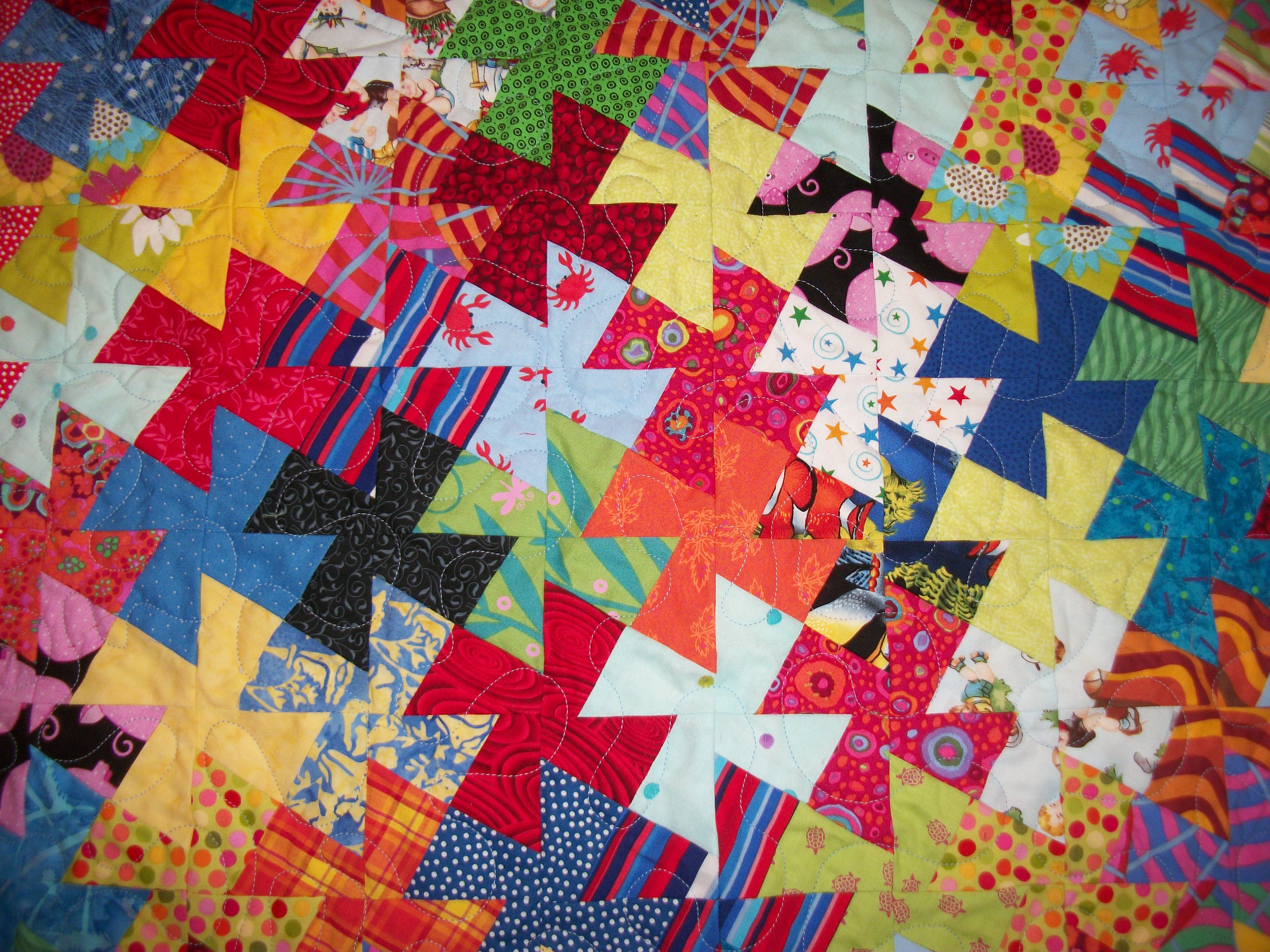
And a picture of the wild and colorful twisters:

100_3855

I quilted with a blue thread–free hand large, big curves.

The Lil Twister ruler comes in tiny, tiny and in sizes that use 5-inch blocks and 10-inch blocks.  You can easily order any of these rulers on-line.


Sister’s:

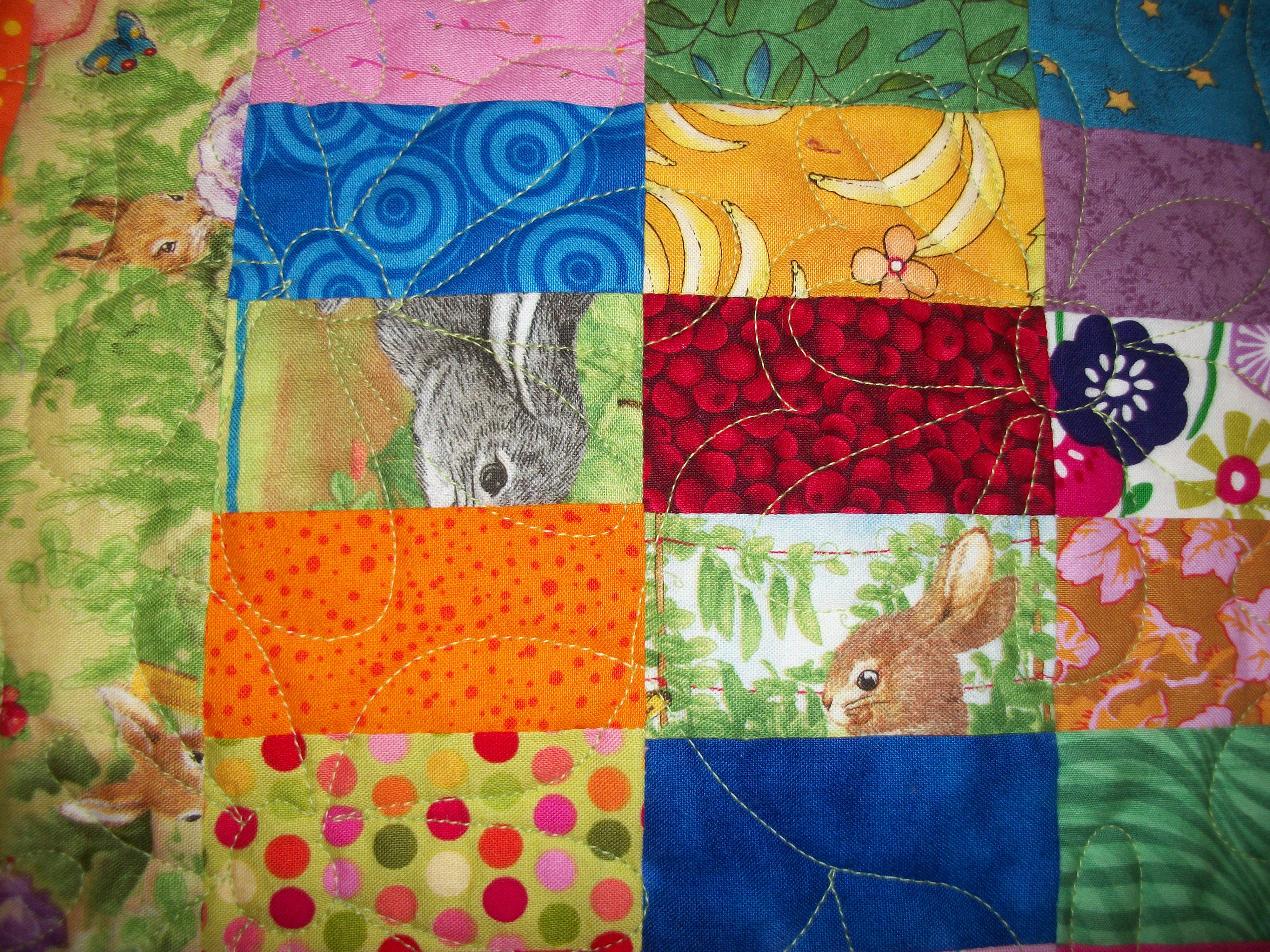
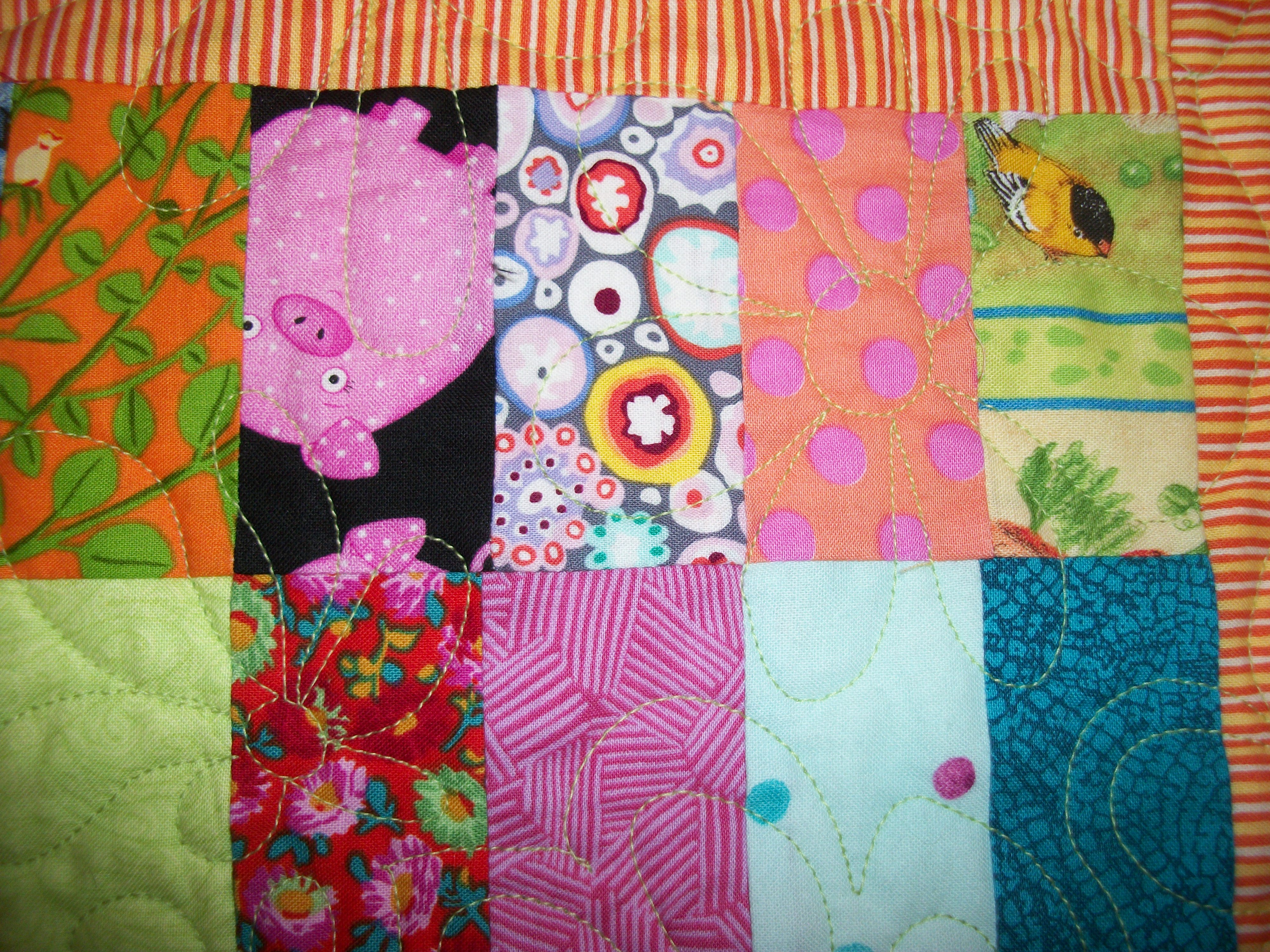
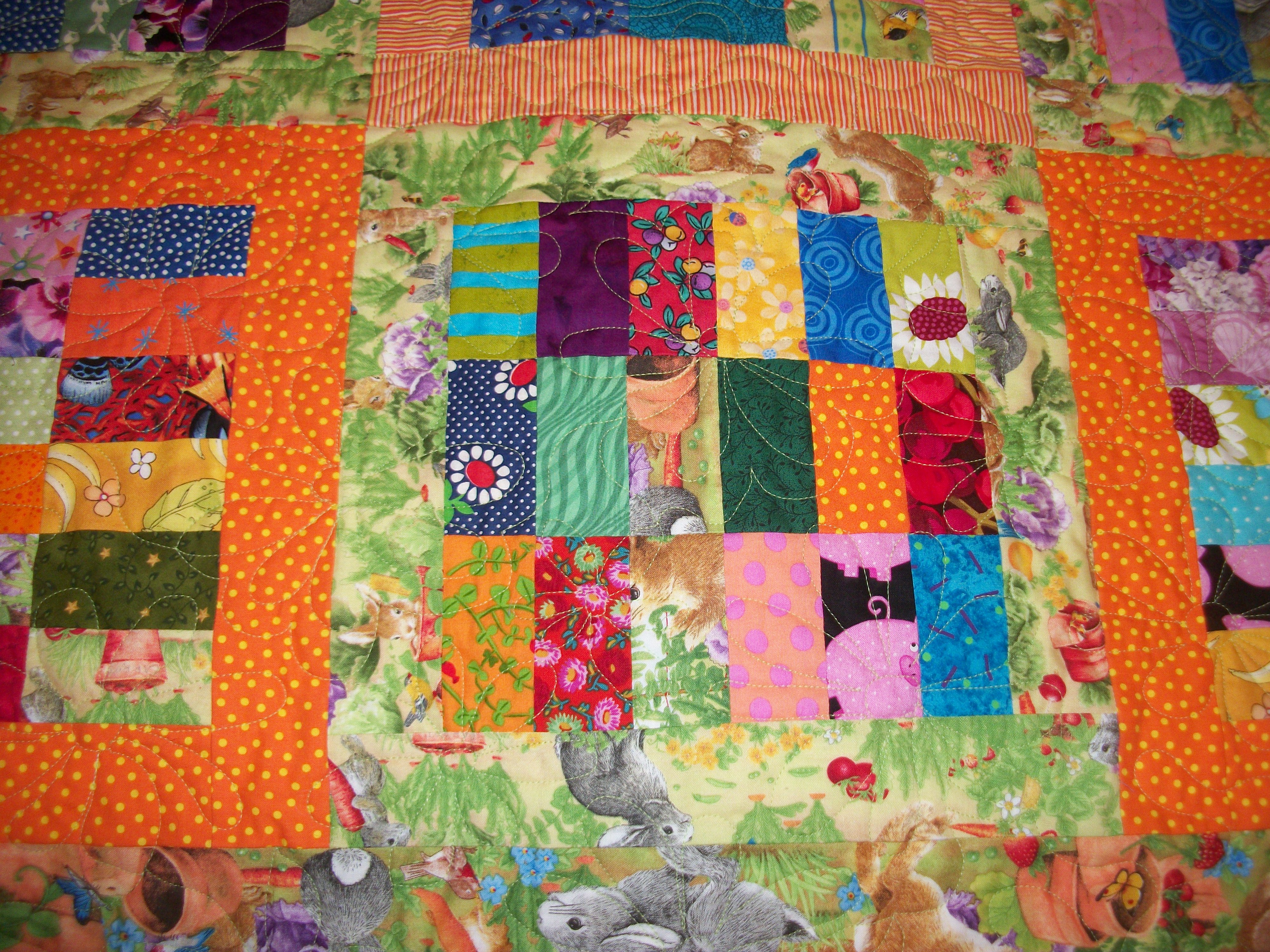
The girl twin’s quilt is “Sister’s Critters,” and for it, I chose the brightest of my 2 by 3 1/2-inch squares.

100_3857


I mixed in squares that had critters other than the focus fabric with its bunnies–along with more bunnies:


100_3865

I quilted free-hand with a pale green thread (which works on both the back and front), using a big daisy pattern.

100_3867

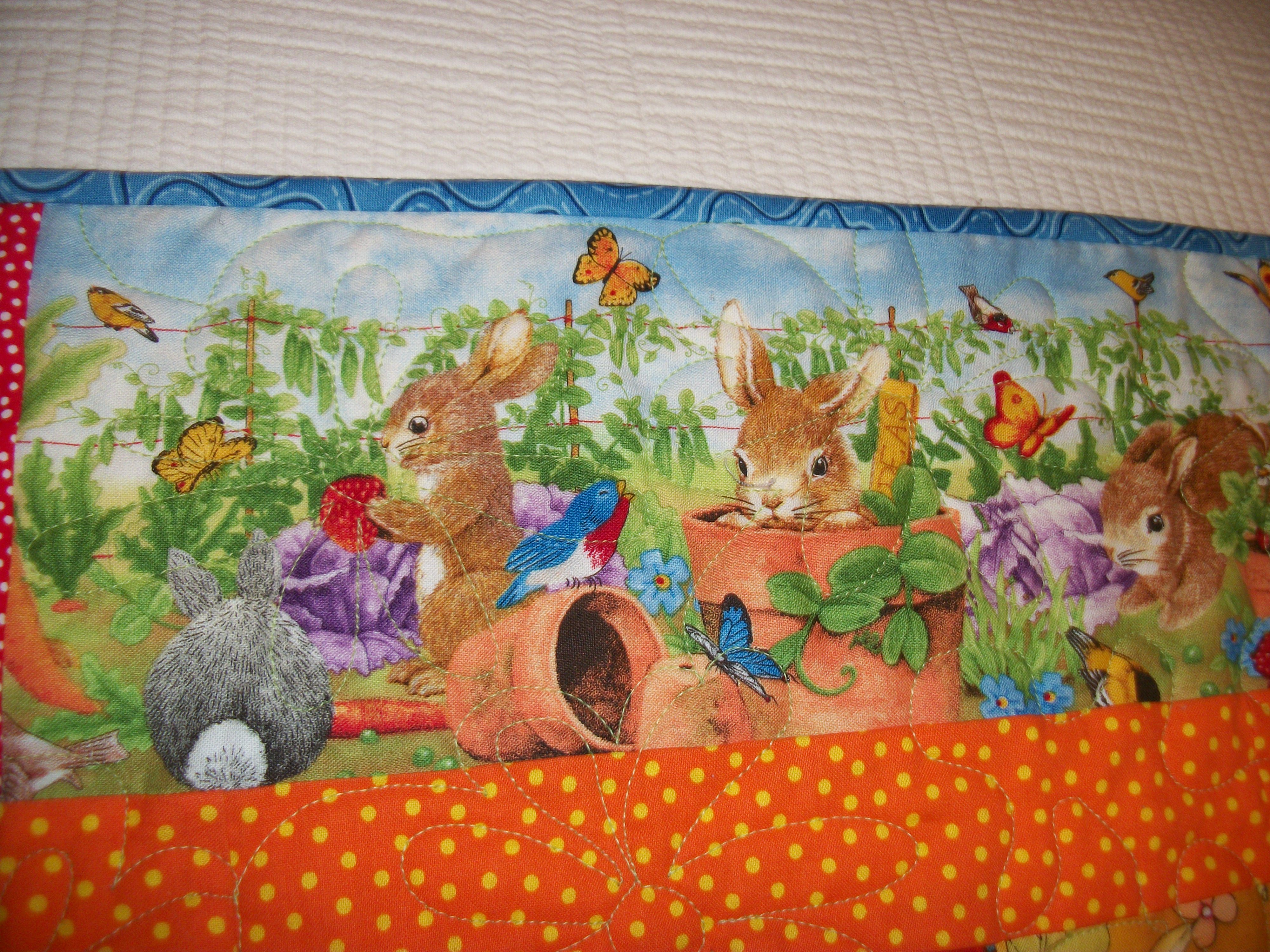
Here is a close-up of the bunny focus fabric:

100_3864

I had enough of this fabric suite left to do the backing:

100_3863

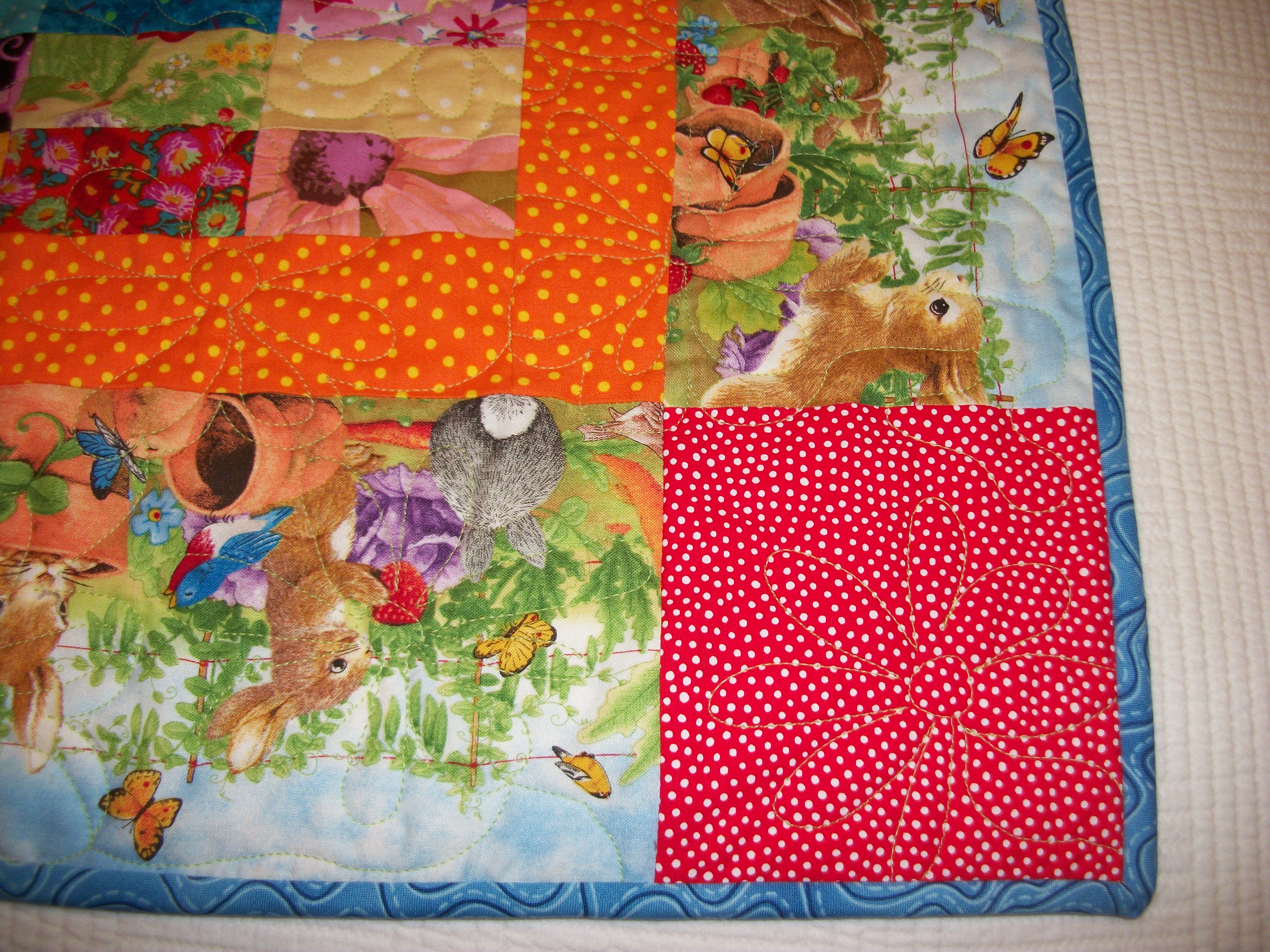
And I used fabric from Mister’s quilt for the corner blocks:

100_3862


I had quite a time choosing the binding, but in the end, chose the blue, and I think that works really well, especially with the blue sky that runs around the edge of the quilt.

Here’s a close-up view of some of the big blocks:

100_3861

So, these quilts go in the mail today, and I will post this blog post when I know the quilts have landed at their new home.

PS:  Heard from the new mamma-to-be any minute now.  The quilts have arrived.

Books, Documentaries, Reviews: David Perlmutter, MD, with Kristin Loberg: Grain Brain

Books, Documentaries, Reviews:  May 15, 2014

Sylvia Onusic’s Review

of

David Perlmutter, MD, with Kristin Loberg

Grain Brain


First, Dr. Sylvia Onusic is a Board Certified and licensed nutritionist AND has a PhD in Public Health education.

Dr. Onusic reviewed Perlmutter and Loberg’s book Grain Brain in the Winter 2013 Wise Traditions, the journal of the Weston A. Price Foundation:  Grain Brain – Weston A Price Foundation.

Dr. Onusic gives the book a qualified “thumbs up,” and in the review surfaces the problems she finds within its pages–such as not addressing “the importance and role of healthy carbohydrates in the diet, especially those prepared in ways which enhance their nutrient absorption by soaking and fermenting.”  Or, addressing that “old forms of wheat such as spelt and kamut do not contain the high levels of gluten that modern hybrids do” and that fermenting grains can make them acceptable to those with gluten sensitivities.  Or, the importance of raw milk and its products.  Or, that he claims that DHA (docosahexaenoic acid) made from algae is a “source equal in value to cod liver oil.”  But DHA from algae is man-made, while cod liver oil is a natural source of DHA.  Additionally, algae DHA has a record of causing digestive upsets.  ANd he neglects to explain that while vitamin D is important, it needs to be used with vitamins A and K, as “all three are needed together.  (Cod liver oil contains all three.)

I was intrigued with the discussion of specific foods that “cross-react” with gluten (producing the same reaction).  They include coffee, chocolate, and non-gluten containing grains.  PEG, polyethylene glycol, found in many personal care products is also cross-reactive with gluten.  PEG is found in the gallon of bowel prep used for a colonoscopy and can cause “inflammation which shows up in the test results.”

Also interesting:  “Modern foods contain up to forty times more gluten than traditional grains, and modern gluten can be addictive.”

But, she also says the following:

Grain Brain is a good read packed with a great deal of knowledge related to reviews of the latest research in current nutrient brain-related issues, as well as good detail on gluten sensitivity, celiac disease, testing, cholesterol and fats, and hormones related to inflammation and obesity.  The book continues to enjoy phenomenal success on a number of New York Times best seller lists.

Caesareans and Breast Feeding and food sensitivities:

Research shows that babies born through caesarean section have a higher risk of developing ADHD because they miss out on the probiotic inoculation that babies normally receive when passing through the birth canal.  Breastfeeding is also important in that it may dampen later immune response to gluten and the development of food sensitivities.

Gluten sensitivity can be tested for at Cyrex Labs or Entero Labs.  (I used Entero.)


Books, Documentaries, Reviews: Elizabeth Gilbert’s THE SIGNATURE OF ALL THINGS

Books, Documentaries, Reviews:  April 15, 2014

The Signature of All Things

Elizabeth Gilbert

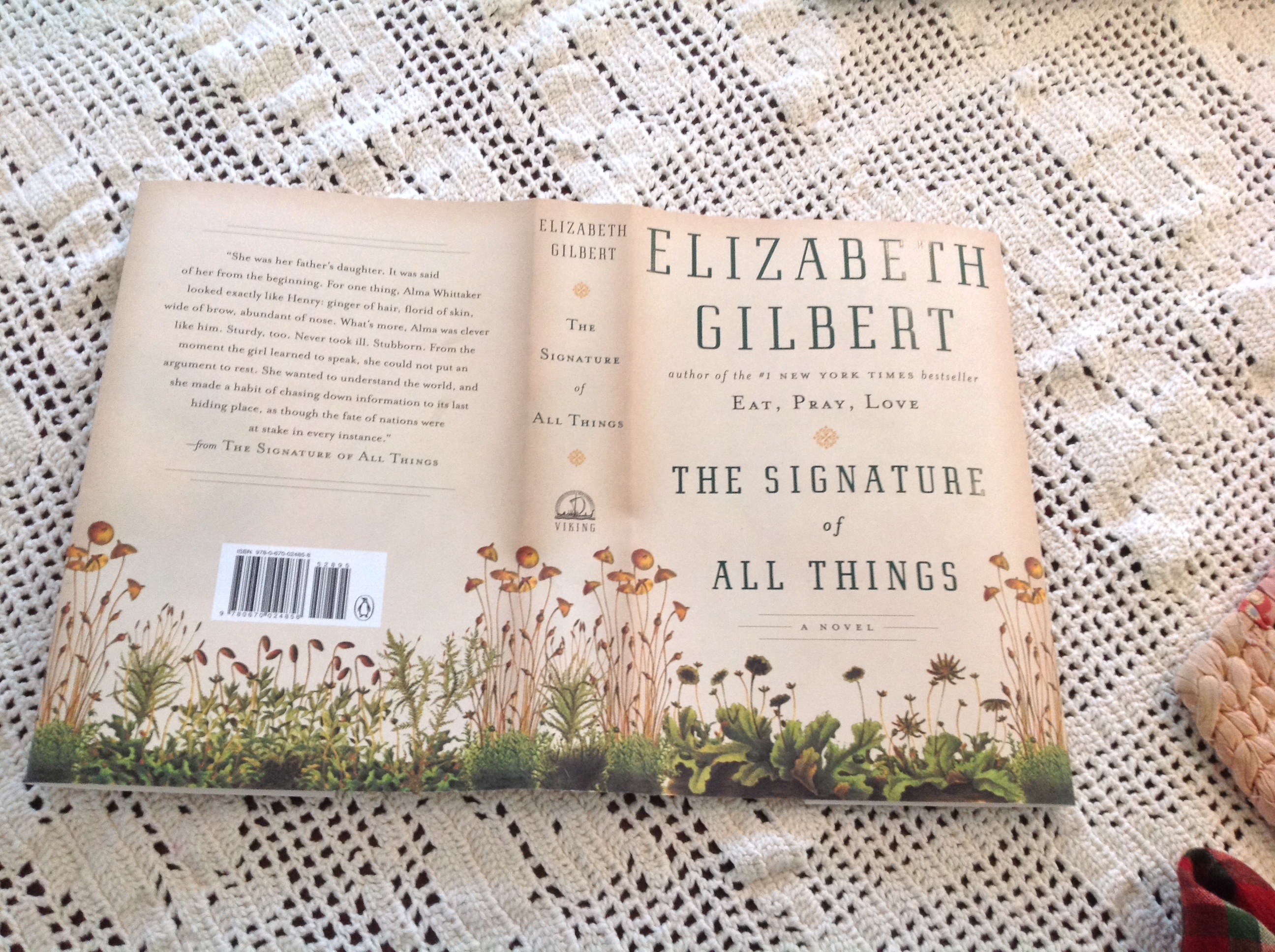
I am so enjoying reading Elizabeth Gilbert’s The Signature of All Things.

IMG_0273


Our book club met yesterday, and three of us out of six just started this book.  But ALL of us were enjoying it or had finished it and liked it a lot.

Only one of the six liked Gilbert’s Eat, Pray, Love.  I didn’t read it, but saw the movie and thought it pretty…lame.

Many of us were afraid this new novel would also be…lame, so we were delighted to realized that Gilbert is a strong writer who, here, is weaving a compelling, interesting story.

The novel takes place from 1800 forward–in that era when western men scattered across the globe to discover its treasures.  In this case, the treasures are plants of all types.  And, fortunes are made on the medicinal plants, for instance.

I’m only about 100 pages into the 500-page novel, but look forward each night to a session of reading.


Turkey Tracks: House Projects

Turkey Tracks:  May 12, 2014

House Projects


With spring, I’ve sprung into house projects–with a lot of really good, cheerful, help.

First, Stephen Pennoyer replaced the rainguard over the front door.  Isn’t it nice?

It’s pitched to run rain off into the garden.

I would be way too embarrassed to show you what lived there before now…

100_3880


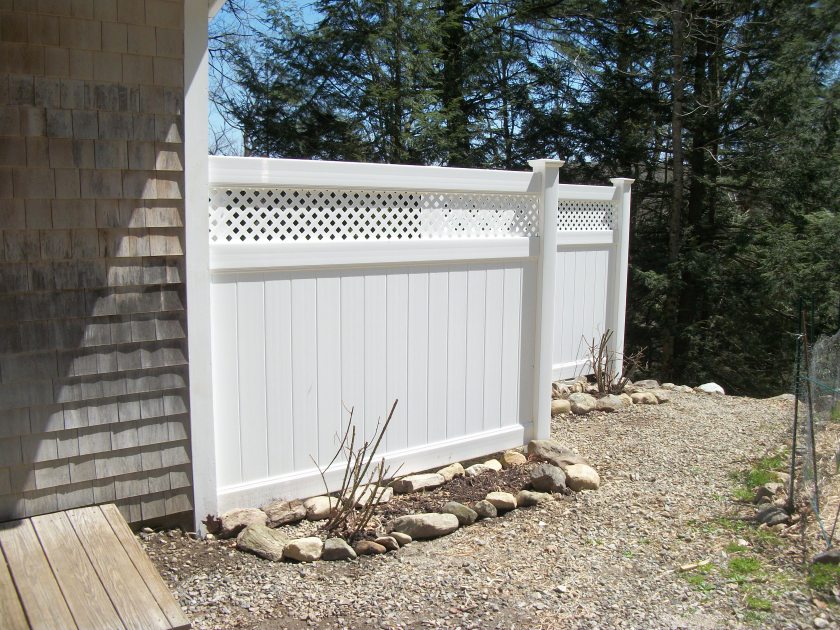
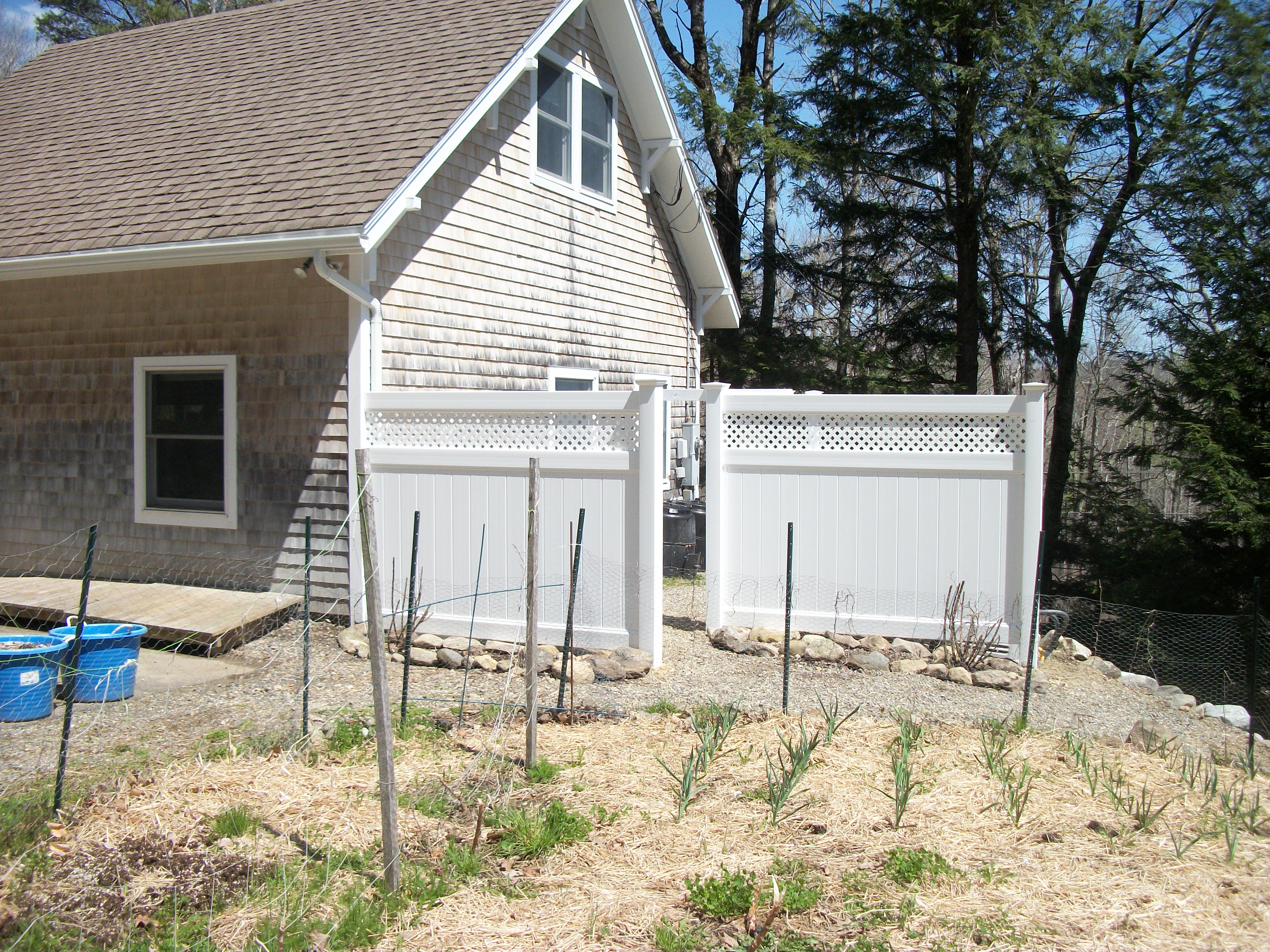
Stephen has now finished the new fence panels that hide the propane tanks and generator.  (See the garlic up in the garden?  And the strawberries?)  And you can also see the new gutter coming down the back of the fence panel next to the garage.

100_3892

And another view:

100_3889

Busily coming up in these little gardens are the white lily bulbs that Bellevue High School friend (class of 1963) Kay Rood sent me when John died.  I planted them last year, but they didn’t “take.”  Now, here they are like a lovely spring surprise.

Stephen also rebuilt the clothes line–and I had clothes on it yesterday!

100_3891

Stephen had to dig through all of this rock–and he dug down about 4 feet or so–to install concrete that will hold these new fences and the clothes line steady through winter ice and spring heaving.

He also dug a long trench between the generator and the back post of the clothes line to sink the new gutter that’s on the drive side of the garage–our effort to redirect water away from the garage floor.  (I had real flooding issues this spring when it rained and the ground was frozen.)

Now I have to get the generator rebalanced–it’s looking a bit tilty.  That generator runs all the power in my house when we lose electricity–and has made life pleasant many times and saved me this winter when it was so cold and an ice storm took out all power and cable here for days and days, including Christmas Day.

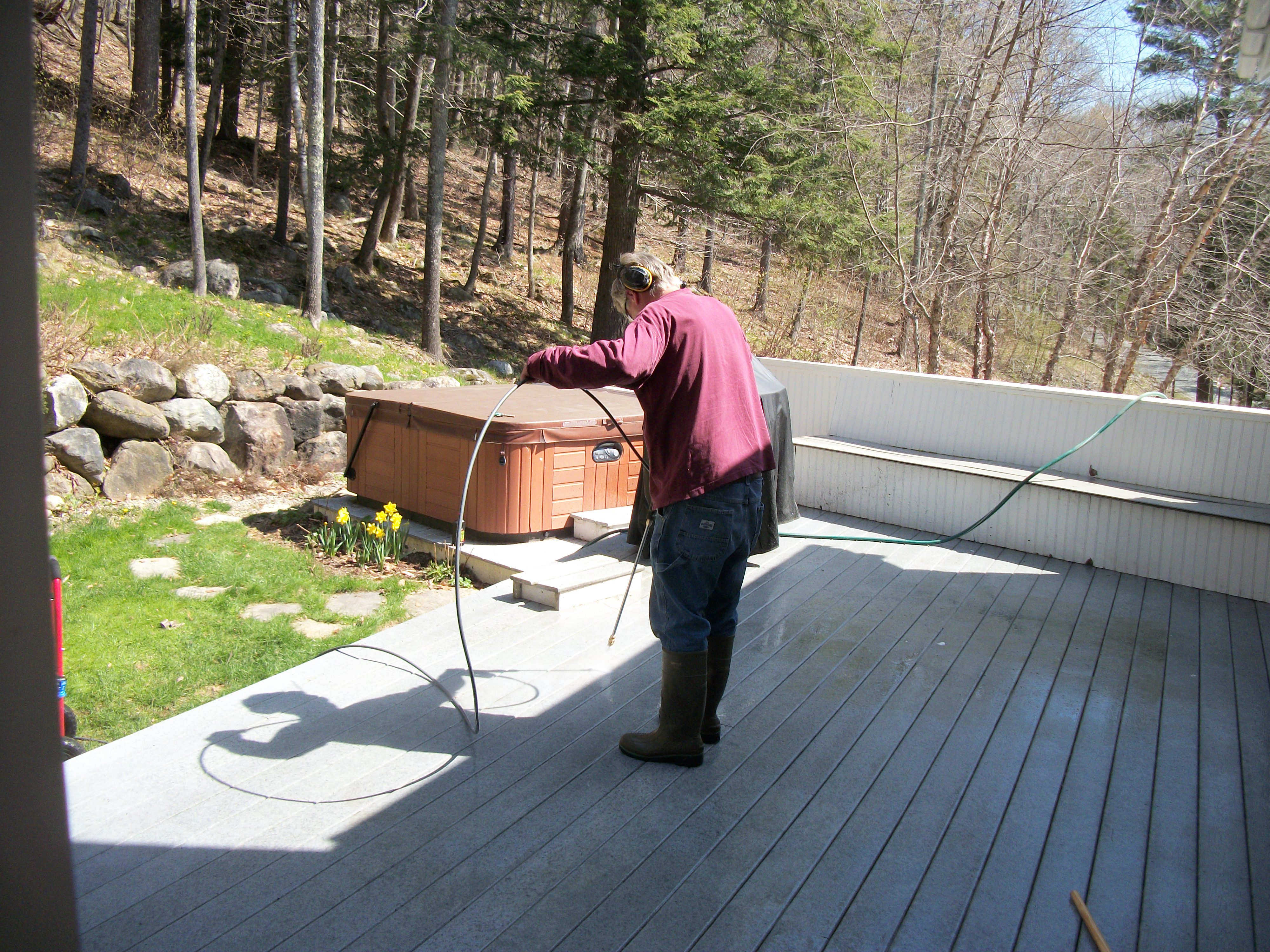
Stephen bought a power washer and kindly power washed all my moldy decks and rails and trim.  This whole house is shiny clean outside at the moment.

100_3895

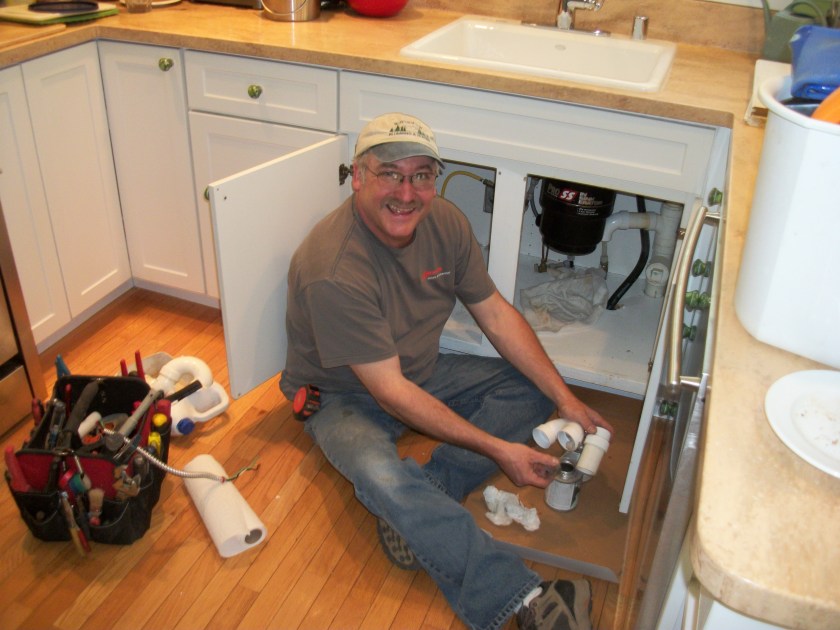
Plumber Ben Larner was also here installing the new sink.  We first discussed this project back in the fall of last year.
100_3893

And now, here’s the new real cast-iron sink and faucet.  (The old sink was a composite porcelain–not cast iron–and was badly chipped.)

100_3899

Meanwhile, I made a dump run to take all the old lumber from the fence panels and the clothes line–where the nicest Camden, Maine, dump employee unloaded the whole lot for me.  That part of the dump was ankle deep in mud, and I had on “good” shoes.  I had determined I’d have to go home and put on boots when he said “No, back her up right here, and I’ll take care of it all.”   LOVE MAINE!
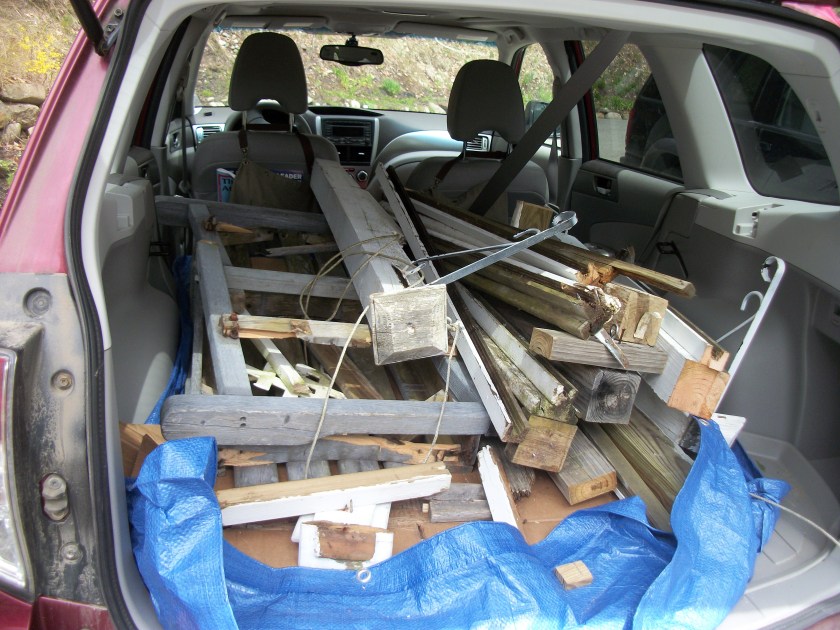
 

100_3874


Penny is on the front seat, sucking her blanket and waiting to “go in the car””

Meanwhile, I have installed the temporary chicken fence I use in the summers AND extended it’s height up to about 6 feet.  The whole thing is held together by those plastic ties where you slip one end into the apparatus on the other and pull it tight.  Once on, those ties have to be cut off, so dismantling all in the fall will be…fun.  The chickens are staying put, which means I am winning this round and fox can’t get them.

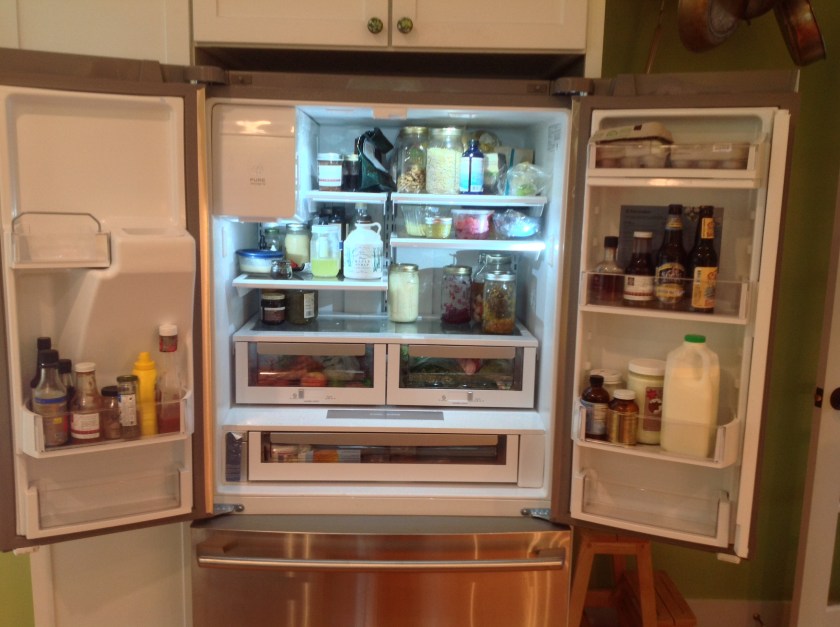
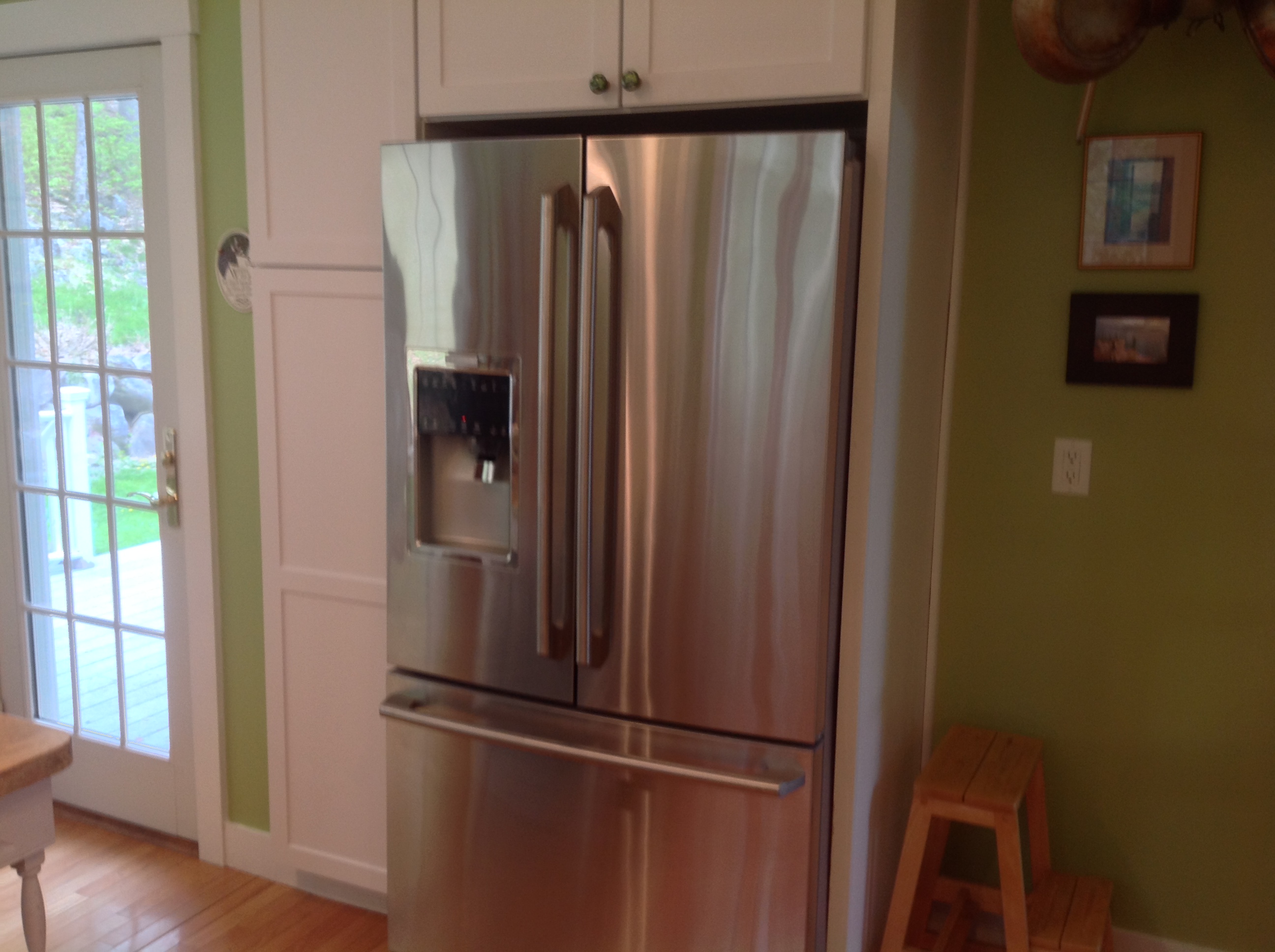
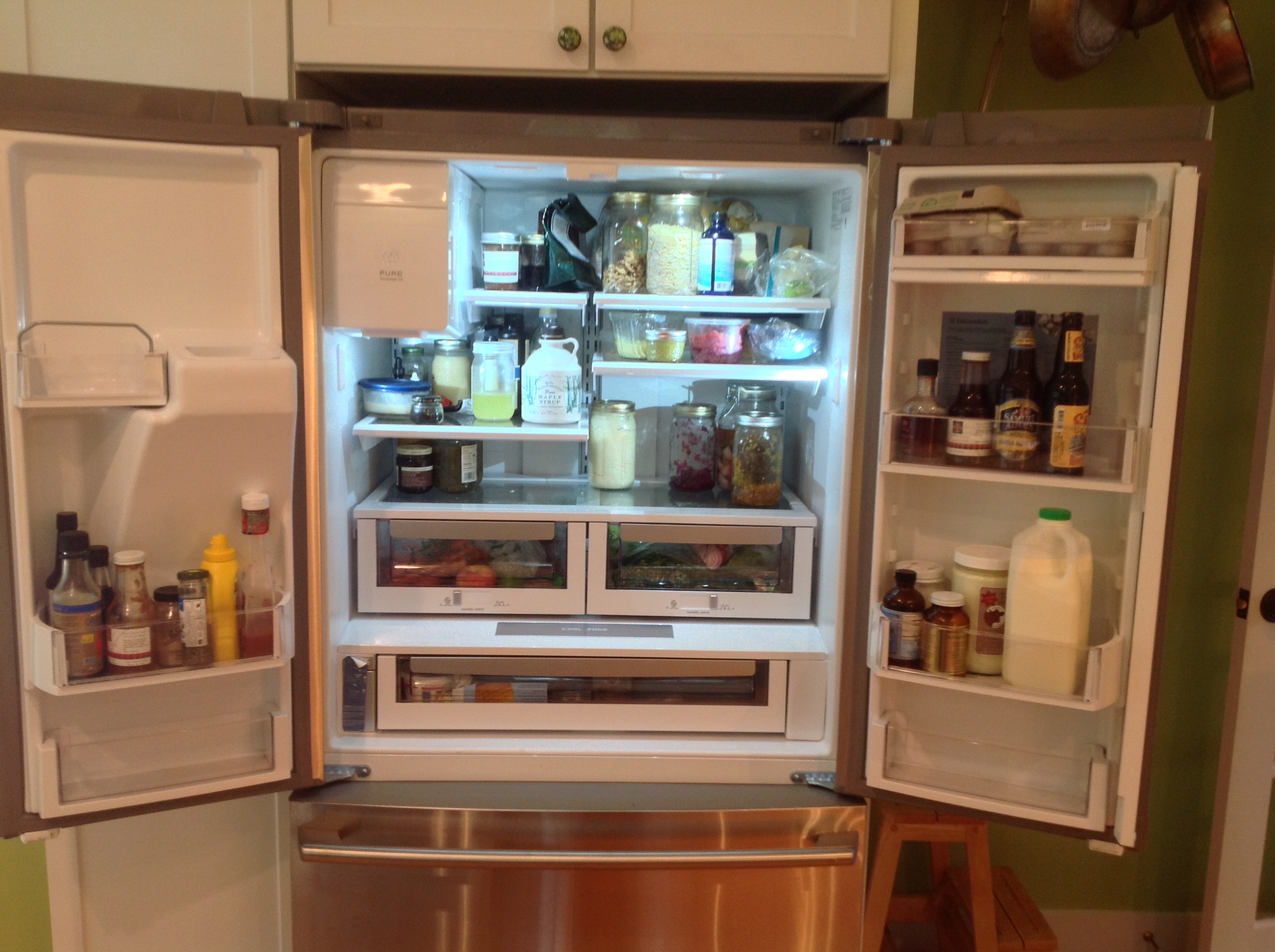
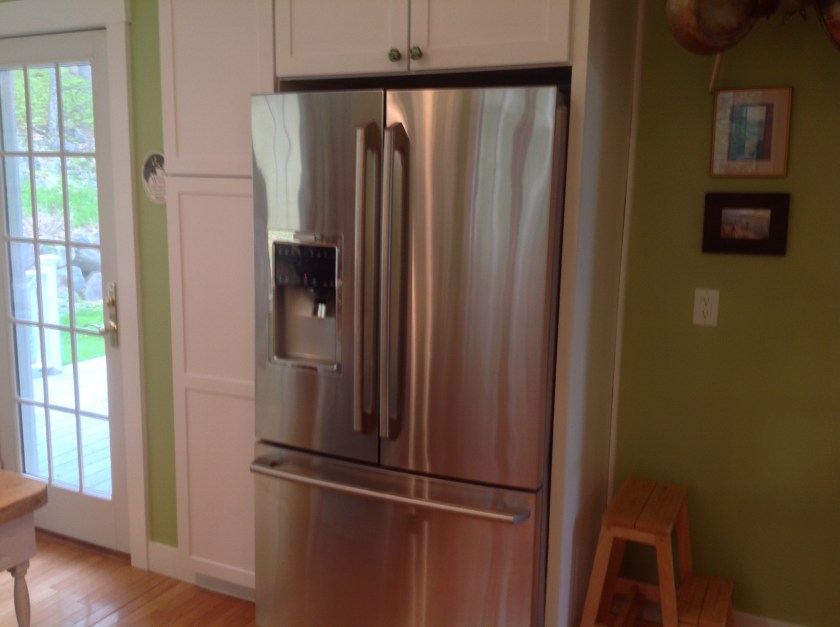
The refrigerator went belly up last week.  The new one is being installed as I write, and I am glad as it’s a long trip to the garage every time I want a slice of lime for a cup of tea, not to mention any serious cooking.  The good news is that the new refrigerator is gorgeous–French doors and a slide out freezer drawer below.  I HATED the side-by-side GE Profile–it had to be designed by someone who never cooks or stores food.

Here’s a frig for someone who cooks, puts up food, and has a lot of visitors:
IMG_0270


Look at the amazing inside:

IMG_0271

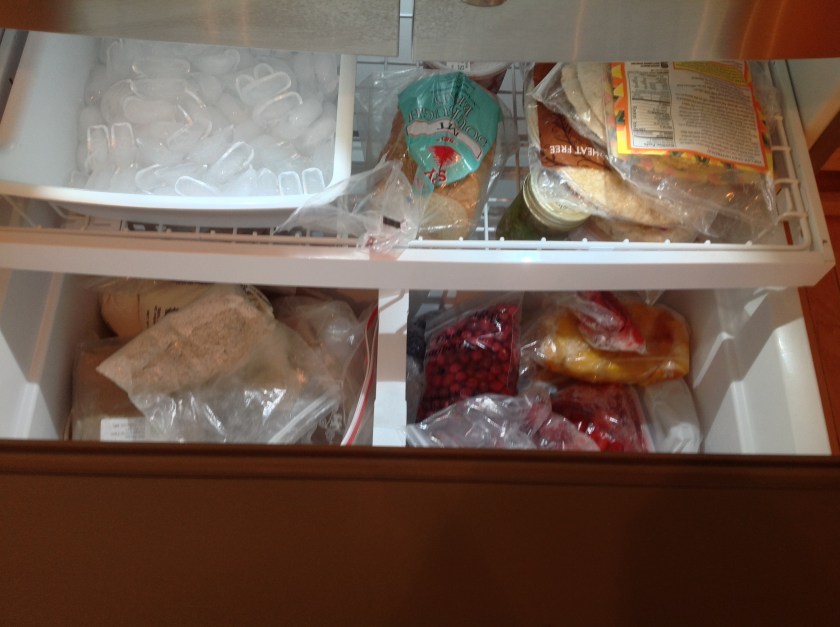
It has two icemakers.  One in the fresh food section that is attached to the controls on the front of the door–for cubes or crushed.  And one in the freezer for heavy-duty use–such as I have in the summer.
 

IMG_0272


As hard as it was to absorb the sticker price, I feel like I’ve died and gone to refrigerator heaven.

And, look at what got its borders on and is ready to load onto Lucy the Longarm:

IMG_0265

I think I should have made the borders 9 inches–as called for.  I did 6 inches.

The backing fabric is cut, matched, and ready to be ironed and sewn together.

This quilting project from Material Obsession 2 has been so much fun and has provided many lovely hours of hand-sewing at night.  For me, it’s all about the work of the hands…


And, now, the grass is dry, so the lawn will get its first MOW.  And the black flies will try to feast on me.  I’m not swelling up much this year, so it must be true that one builds up a certain immunity over time.

Turkey Tracks: Balance: A Philosophy of the Nourished Kitchen

Turkey Tracks:  May 5, 2014

Balanced:  A Philosophy of the Nourished Kitchen


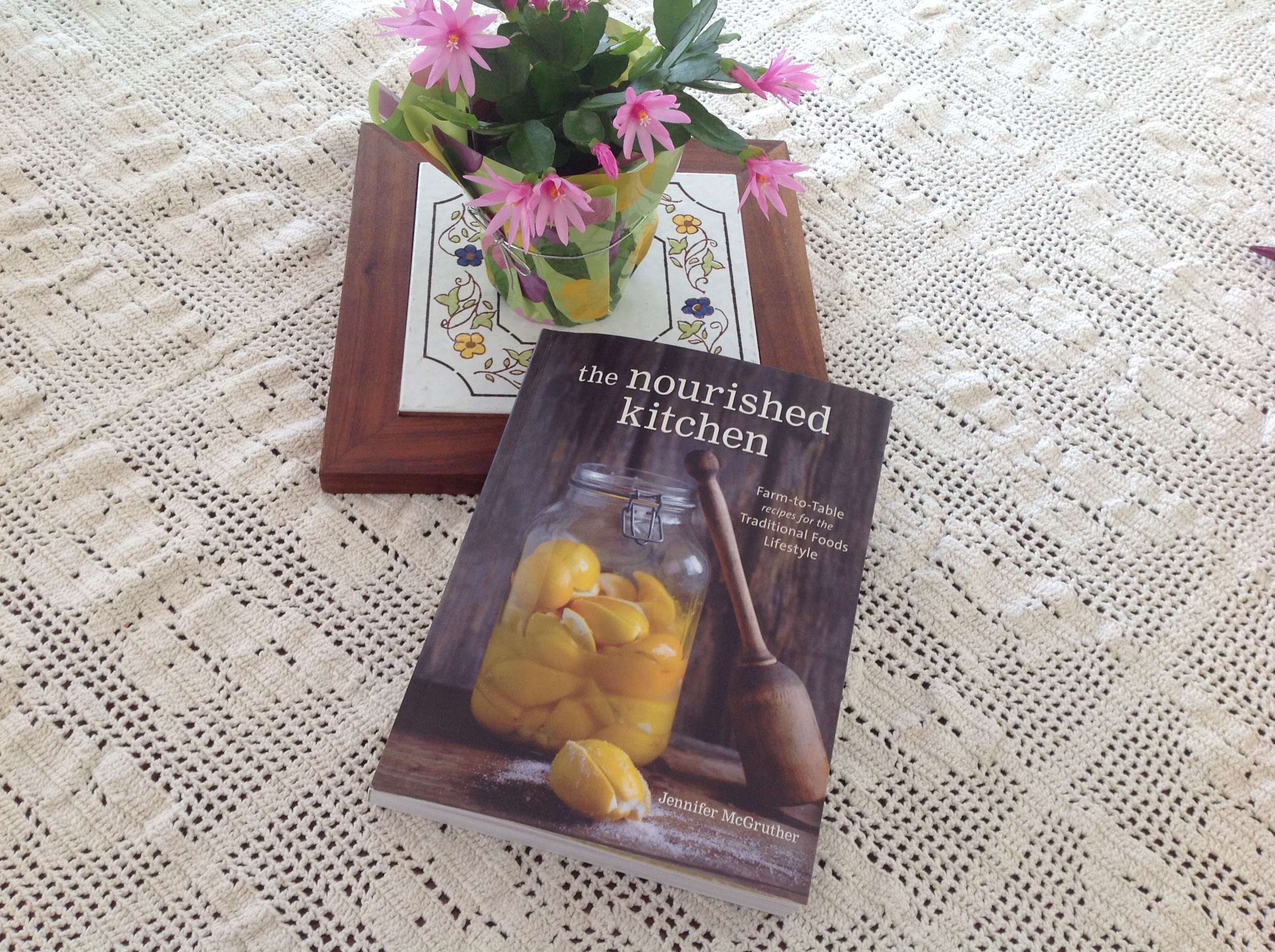
Here’s another quote I like from The Nourished Kitchen by Jennifer McGruther:

IMG_0255

Balanced:

There’s a deeply pervasive disconnect in the collective relationship with food that persists in American culture:  We often view healthy eating as synonymous with restrictive eating, and we likewise view joyful eating as a guilty pleasure, something that begs for strict limits.  I believe that real food allows us both the gift of nourishment, and the gift of pleasure, without unnecessary restrictions.  Eating a diet of traditional foods helps us to develop a positive relationship with our food, not one born out of guilt and denial; rather, the traditional foods movement teaches us to purchase, prepare, and enjoy our food with intention.

Real, traditionally prepared foods offer nuanced flavors, subtle differences in texture or aromas that change continuously as the seasons of the year wax and want.  Enjoy meats and fish.  Relish grains, breads, and pulses.  Take pleasure in good fat and take a mindful approach to sweets.  The multidimensional flavors of traditionally prepared real foods bring a complexity of different notes and textures to your tongue, and even a small amount of concentrated foods like butter from the raw cream of grass-fed cows, or a lovely single varietal honey will bring deep satisfaction that is otherwise missing from industrialized foods with their single notes, cloying sweetness, or overt saltiness (3-4).

Note that McGruther works with ancient grains and fermented sourdough breads.  The former do not have the gluten content of today’s wheat and the latter mitigates further the impact of gluten and the phytates in grains.  So, if you do not have a gluten-intolerant gene, like me, McGruther’s bread recipes are wonderful.


Turkey Tracks: The Traditional Food Movement Defined

Turkey Tracks:  May

The Traditional Food Movement Defined


Here’s another quote from Jennifer McGruther in her new cookbook, The Nourished Kitchen:

IMG_0255


A Traditional Foods Movement:

Traditional foods are the foods of our great-great grandmothers–the foods of gardens and of farms.  They represent a system of balance, emphasizing the value of meat and milk, grain and bean, vegetables and fruits.

There is a movement afoot to restore this way of eating The movement honors the connection between the foods that we eat, how we prepare these foods, and where they come from.  In this way, the traditional foods movement celebrates the connection between the farm that produces the food, the cook who prepares it, and the individuals who eat it.  Traditional foods is a system of connection, emphasizing support for time-honored ways in farming, cooking, and eating, and finding a place for fat and lean, animal and vegetable, raw and cooked.

Where other diets and philosophies of eating emphasize good and bad, black and white, a message of balance exists within the traditional foods movement.  Unlike vegan and vegetarian diets, which restrict animal foods, the traditional foods movement emphasizes their importance while encouraging the purchase of locally produced meats, milks, cheeses, and fats from grass-fed and pasture-raised animals.  Where the Paleo diet restricts grain, pulses, and dairy, the traditional foods movement embraces them, focusing not only on how the food is produced, but also on how it is prepared to maximize the nutrients it contains.  While the raw foods movement restricts cooked foods, the traditional foods movement embraces the, honoring the place of cooking as one of balance in partnership with raw foods, and fermented foods, too.

Emphasizing whole and minimally processed foods, the traditional foods movement calls you back to the kitchen, to real home cooking, and offers you an opportunity to weave the connections between the food on your table, the time you take to prepare it, and the farms that produce it (1-2)

AND:

Join a CSA.  Hold a community supper featuring wholesome, local foods.  Celebrate the beauty of your foodshed, and support local farmers practicing sustainable agriculture.  Support nutritional advocacy groups like the Weston A. Price Foundation and the Savory Institute, as well as the work of farmer and consumer rights organizations like the Farm-to-Consumer Legal Defense Fund (5)

I am old enough that I can tell you that the generation referenced here is not my great, great, but my grandparents.  I remember these food practices well, especially from my rural Georgia grandparents, as well as the fact that few were sick, cancer and heart disease were rare, and food allergies were not rampant like today.  Both my grandmothers lived long, fruitful lives.  They ate traditional foods.


IMG_0259