Interesting Information: Can This Really Be True?

Interesting Information:  November 18, 2013

Can This Really Be True?

Health officials recommend giving new-born babies a hepatitis B vaccine, followed by two more shots before 18 months of age.

Why? Since hepatitis B is NOT a childhood disease and not a common threat to newborn babies?

I stumbled on an answer in the July/August 2013 issue of Well Being Journal (page 47).  The story is from a March 26, 2013, posting on the Mercola web site:  “Teens Susceptible to Hepatitis B Infection Despite Vaccination as Infants.

First, hepatitis B is a “primarily blood-transmitted adult disease associated with risky lifestyle choices such as unprotected sex with multiple partners and intravenous drug use involving sharing needles.”

IN FACT, this article states “according to the National Vaccine Information Center (NVIC):

`The primary reason that the CDC recommended hepatitis B vaccination for all newborns in the United States in 1991 is because public health officials and doctors could not persuade adults in high risk groups (primarily IV drug abusers and persons with multiple sexual partners) to get the vaccine.’

“But now,” the article continues, “new research has shown that by the time a child reaches his or her teenage years–the time when acquiring a hepatitis B infection may be more likely–the protection from the childhood vaccine may have long since waned.”

And that’s one of the dirty secrets about vaccines:  they don’t last.  So you’ll need to use more boosters along the way, with more junk injected into a body by its back door (a puncture wound).

So let’s be clear.  Our public health officials are choosing to put heavy metals and adjuvants like formaldehyde into newborn, fragile babies WHEN THEY KNOW THEY DON’T LAST.

No wonder 1 out 6 children today have neurological issues.

This practice is NOT about science or health–it’s about drug companies and self-interested doctors making more money.  And their vehicle is the “standards of care” that ensures that doctors have to suggest such a practice as this one or lose their licenses.

This is how industry works if it is not fettered to morals and ethics.

Vaccines are NOT safe for everyone.  They may not be safe for anyone, given their components.  But who know, since few are doing the science to justify them and the science that is showing they are not safe is being ignored.

A tiny newborn–not fully formed, needing adult protection and nourishment, struggling to get some purchase in this life…

Shame, shame, shame…

Do your research on this issue folks…
Turkey Tracks: Leah Day’s Video: Sewing Hexies

Turkey Tracks:  November 18, 2013

Leah Day’s Video

Hand Piecing Hexies

The post previous to this one discusses sewing hexies at some length–and gives some current texts.

But, Leah Day’s weekly post this week consisted of terrific videos on how to design and piece hexies.

And, you should be aware that the old whip-stitching method has been, thankfully, replaced by a better method.

The Free Motion Quilting Project: 73. English Paper Piecing Part 2: Turning Hexagon Edges.

Enjoy!

PS:  If you are a quilter and have not signed up for Leah Day’s blog, you might seriously want to consider doing so.

Turkey Tracks: I’m Obsessed: Hand Sewing

Turkey Tracks:  November 18, 2013

I’m Obsessed

with

Hand Sewing

It’s official.

I’m obsessed with hand sewing.  I have one project going and two more planned.  And I can’t wait for dark to fall so I can settle in and hand sew while watching something fun on the television.  Though just at the moment I’m hand-quilting the clam shell quilt which is, as yet, nameless, but not homeless.  And, I’m putting the binding on the Winding Ways/Wheels of Mystery quilt which I’m naming “Earth.”

I think my obsession all started with Bonnie Hunter’s numerous posts on her hexie projects.  Hexies are all the rage in quilting these days, which I’m sure most quilters know.  And these projects are NOT your grandmother’s flower garden variety.

Or, maybe it was seeing the gorgeous quilt that Rhea Butler of Alewives quilting, in Damariscotta Mills, Maine, from Kathy Doughty and Sarah Fielke’s MATERIAL OBSESSION 2 book.  (Those gals are from Australia, the home of fantastic quilting.)

I did a hexie project a while back–a challenge to depict a grocery store product–I chose Green Hive Honey, a local raw, unheated honey.  That quilt was called “A Thousand Flowers” since that’s what it takes to make a ridiculously small bit of raw honey.  (You can search for it elsewhere on the blog.)  I found sewing the hexies tedious–especially the whip stitching that joined them.  And the stitches showed in a way I didn’t like.

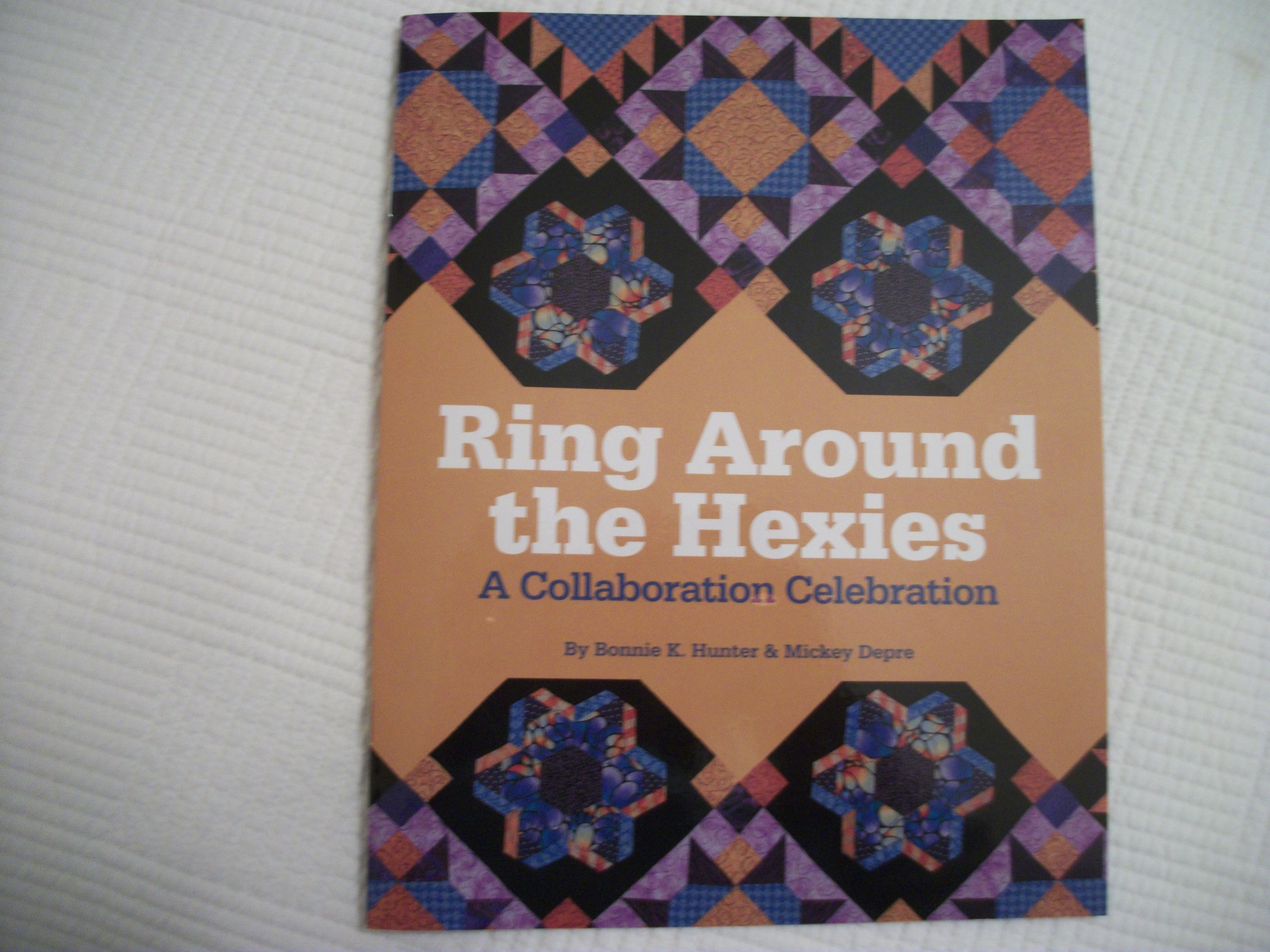
BUT, But, But!  There is a better way to do this whole process.  And I began to discover that only recently with Micky Dupre and Bonnie Hunter’s book, RING AROUND THE HEXIES:  A Collaboration Celebration.

Hexie blocks

You can English Paper Piece the hexies and then the way you join them is NOT with whip stitching.  I’m posting a video from Leah Davis that’s a close-up of her hands piecing hexies in the “new” way in a separate post.  (Ask and you shall receive from the universe.)

So, Bonnie makes a pieced quilt, leaving, in the above case, blank black squares on-point.  Micky pieces a hexie formation–and she manipulates the hexies to get interesting color changes–and appliques her arrangement onto the quilt.  They are beautiful.  The resulting quilt is beautiful.

But, I think my own obsession stemmed from Rhea Butler’s quilt from MATERIAL OBSESSIONS–hanging in Alewives.  And somehow I did not take a picture of the whole quilt.

Kite Block book

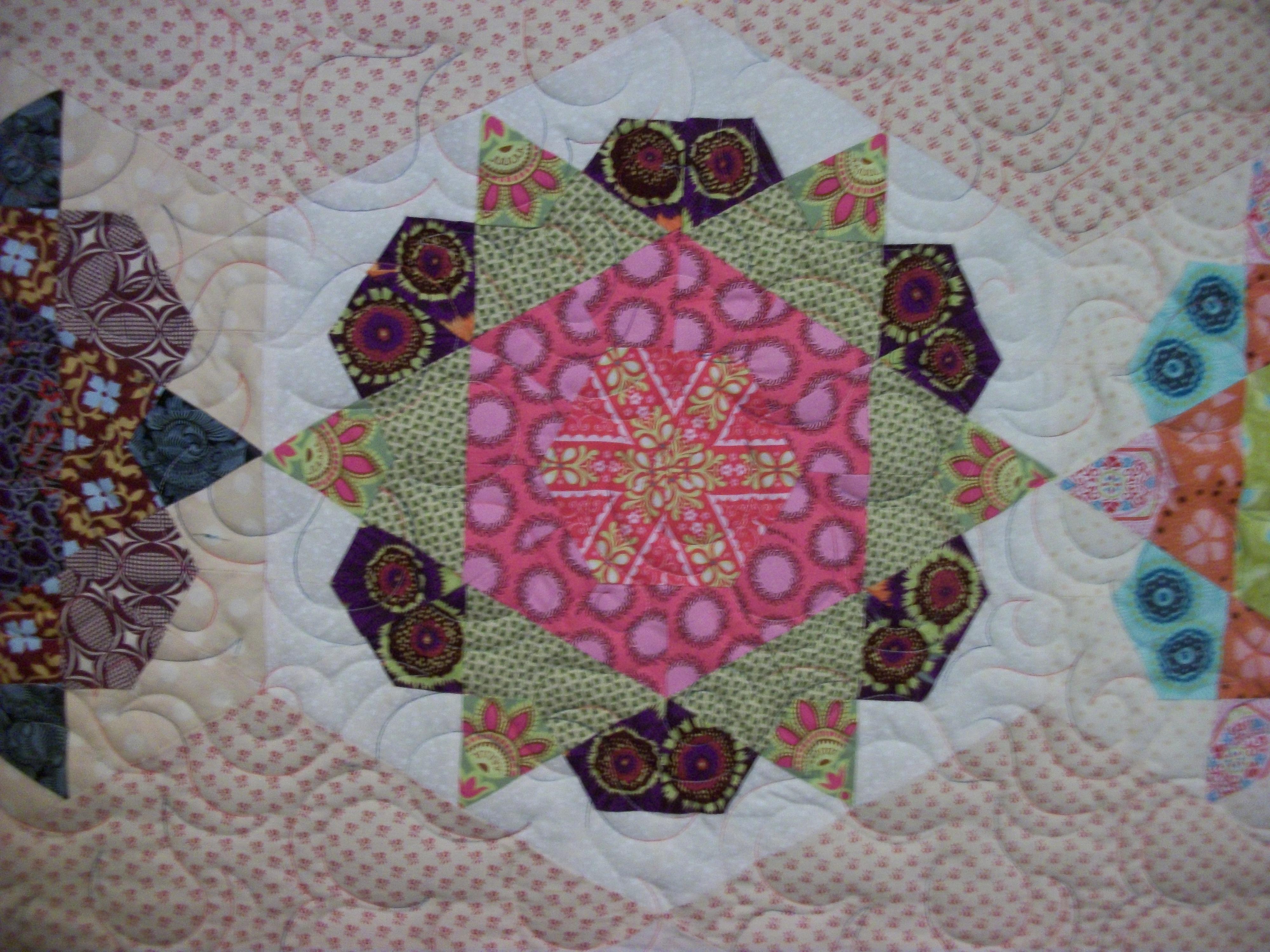
That quilt is made of large hexies–all constructed from a kite-shape (a quadrilateral) that when combined forms a hexie.

Here are some examples of those bigger blocks.  You can see the “kite” in the dark, outer prints with circles–it takes two “kites” to form that dark patch.  The outer neutral fabric is also made of the “kite” shape.  The red dotted fabric is used to link a line of blocks together–it’s a large diamond shape.

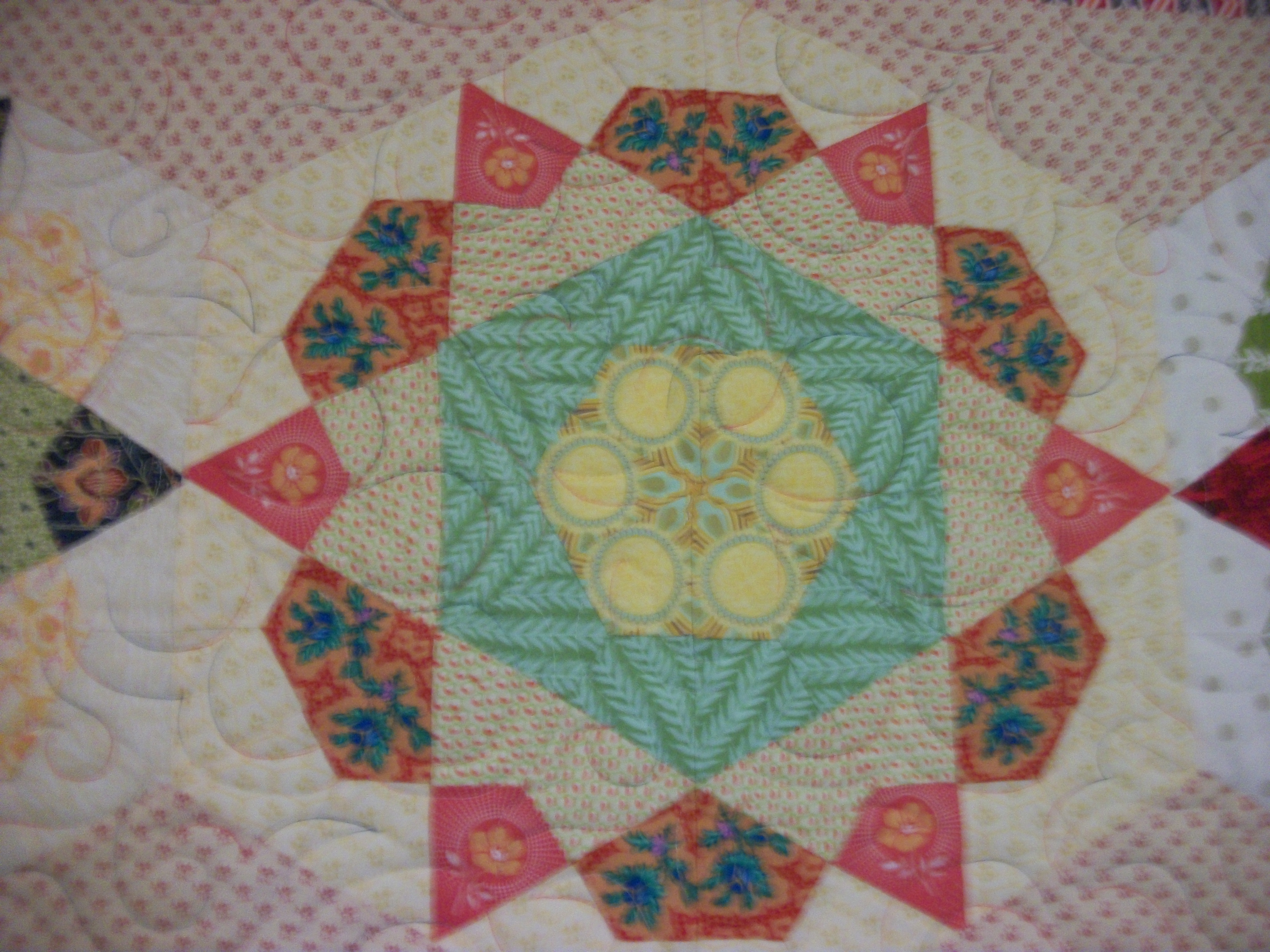
Kite Template block

And, here hyou can see the kite shape a bit better:

Kite block 2

These big hexies are joined with interesting geometric shapes and lavish, BIG borders from contemporary fabrics.

Here’s fabric for my first try at these blocks–and you can see the kite template.  The dark fabric will be used on the outer ring.  I suspect the peach fabric will form the inner ring.

Kite Block fabrics

I was going to do these by hand, but Rhea says they sew well on the machine, too.  So, I’ll play around.

BUT, if I’m not going to hand-sew these, what is going to occupy my fingers?

This project I suspect:

Take a hexie and pull out the sides, and you get a “honeycomb” hexie.  And back in the day in England, a woman named Lucy Boston used that shape to construct the most amazing quilts.  Rhea Butler was already playing with this honeycomb hexie when I saw her last.

Here’s the book, done by Linda Franz, and a packet of honeycomb papers.  One varies the block by varying the fabric color within the block.

Honeycomb blocks

Whatever I do I’ll pull from the stash.

So, on to Leah Day’s excellent video.

Books, Documentaries, Reviews: New Books In The Mail

Books, Documentaries, Reviews:  November 14, 2013

New Books In The Mail

Look what came in yesterday’s mail?

Books

And Stephen Kinzer’s THE BROTHERS, about the Allan and Foster Dulles, rolled in a day later.

I’ve never read Donna Tartt’s work, but listened to a really great review about this author and this novel.  It’s a big sprawling thing.

And, Jill Lepore’s work on Jane Franklin is also all over the media and is being reviewed really well.  I love it when women’s voices from the past get reclaimed and surfaced.

It’s going to be a good winter of reading.

Turkey Tracks: Jo Diggs Visits Coastal Quilters

Turkey Tracks:  November 14, 2013

Jo Diggs Visits Coastal Quilters

Jo Diggs, of Portland, Maine, visited Coastal Quilters for our November 9th meeting.

We are so lucky to have so many nationally recognized quilters here in Maine, and Jo Diggs is a bright star among that number.   To top it off, Jo is funny, clever, gracious–a lovely, lovely lady.

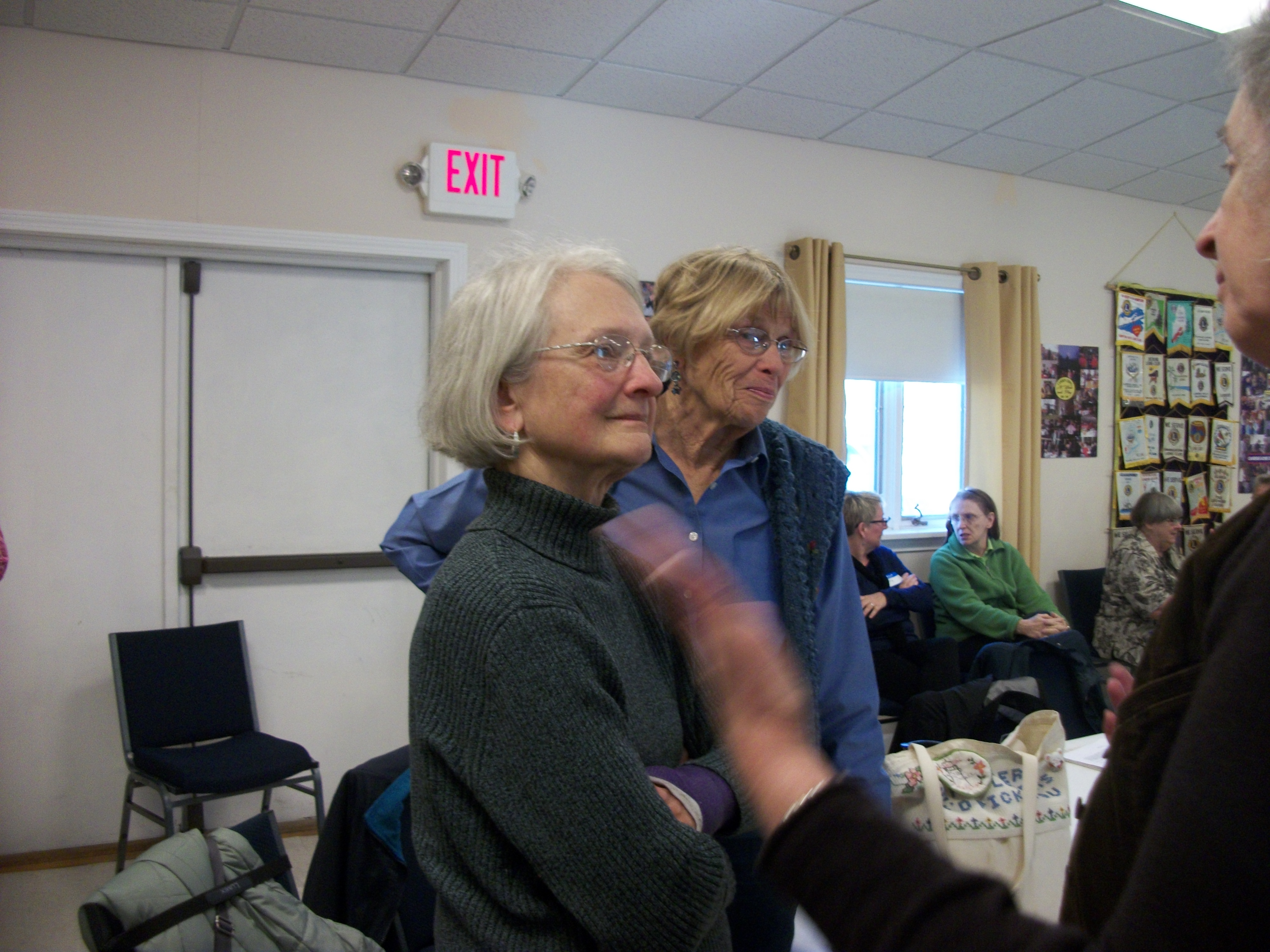
Here she is (grey sweater) talking to our members after her trunk show.

CQ, Jo Diggs, Nov 2013

I took LOTS of pictures.  But my little camera just didn’t do justice to her work.  So, I’ve posted a link to her blog where you can enjoy really good pictures of her work.  So, take a minute and take yourself on a little art outing.  Jo’s work is applique, and she does large and small art pieces–though in the future, she says, she is going to concentrate on large pieces.

Gallery.

ENJOY!

Books, Documentaries, Reviews: Sisterland: A Novel: Curtis Sittenfeld

Books, Documentaries, Reviews:  November 7, 2013

SISTERLAND

Curtis Sittenfeld

I  finished Wish You Were Here, Steward O’Nan, the other day.  And, moved on last night to Curtis Sittenfeld’s Sisterland.

In the opening pages, I discovered that there was a great earthquake in the midwest in the early 1800s.

Sisterland takes place in St. Louis, Missouri.  The opening date is 2009.

Two identical twin sisters:  the narrator twin is married with two children; Vi is single.  They may have psychic powers.

The sisters have lunch together and argue.  That night there is an earthquake tremor.  The frightened parents gather their children and put them into their bed.

Here’s text from the opening chapter:

I felt them falling asleep one by one then, my son, my daughter, and my husband.  Awake alone, I experienced a gratitude for my life and our family, the four of us together, accounted for and okay.  In contrast to the agitation I’d been gripped by before the earthquake, I was filled with calmness, a sense that we’d passed safely through a minor scare–like when you speed up too fast in slow highway traffic and almost hit the car in front of you but then you don’t.  The argument with Vi, inflated prior to the quake, shrank to its true size; it was insignificant.  My sister and I had spent three decades bickering and making up.

But now that several years have passed, it pains me to remember this night because I was wrong.  Although we were safe in that moment, we hadn’t passed through anything.  Nothing was concluding, nothing was finished; everything was just beginning.  And though my powers weren’t what they once had been, though I no longer considered myself truly psychic, I still should have been able to anticipate what would happen next.

Ok, I’m hooked!

I’ve read Sittenfeld’s American Wife, so know her abilities.  This book is going to be gooooood!


Sisterland: A Novel: Curtis Sittenfeld: 9781400068319: Amazon.com: Books.

PS:  Wish You Were Here is a lovely read.  I especially enjoyed the exploration of how a family comes together–or doesn’t–with all their complicated relationships–after the death of the father/grandfather. 

Books, Documentaries, Reviews: Sandor Ellis Katz at Cornell

Books, Documentaries, Reviews:  November 6, 2013

Sandor Ellis Katz

Cornell University

April 2, 2012

I finally slowed down to listen to Sandor Ellis Katz–WILD FERMENTATION–at Cornell Univerity.  The U-tube video is 90 minutes.  So, grab some handwork, settle in, and enjoy an interesting, thought provoking lecture that discusses, in part, how the standardization of food has drastically altered our ability to enjoy the full power inherent in heritage foods–even when so-called “heritage” foods are made and sold–something Katz thinks is false advertising.

Such changes have altered the “culture” in every sense of that word–the way we live, the cultures we use in foods (yogurt, kombucha, breads, beers, etc.)

So, do you ever try to make yogurt?  And have you noticed that you get really good yogurt for a few generations, and then you…don’t?

Well, the reason is that a culture is a community of many different organisms–thirty or more– that work together to keep the culture stable.  But this kind of community is very hard to standardize–so industry only uses part of the community–which means that what is being advertised is not really the genuine thing.  For instance, the dried powder we buy to start a yogurt culture does not contain the full community of organisms.  And, commercial kombucha only uses part of the SCOBY colony to make its product.  (A SCOBY is a symbiotic community of bacteria and yeasts.)  The same is true of yogurt, cheeses, breads, beer, and so forth.

Cultures for yogurt, kefir (pronounced ke-fear, I’ve learned), kombucha and so forth used to be passed down in families and communities–and they retained their full components in the process.  What we have now is NOT the full biodiversity of a heritage culture.  So the loss, the reduction, is enormous–and is a loss of the culture (the social grouping) as well.

The yogurt culture one can buy can only sustain itself for a few generations–because it isn’t complete.  Standardization killed it.  Food safety laws have limited it.

So, Katz’s main message is that we need to reclaim our food as mass production has been an abject failure in that this food lacks…cultures…and has changed our culture in unhealthy ways.  Shifting how we eat begins to reclaim our culture–so that we once again nourish our bodies and regain our health.

Take some time for yourself to understand what has gone wrong, what the limits of industrialization are, what you can do.

And, maybe try to locate a heritage culture for yogurt and/or kefir.

And, make some lacto-fermented foods for yourself.  They are so delicious!

Here is Katz’s video on how to make a sauerkraut–which bear no similarity to that limp stuff you get in a can:

Books Documentaries, Reviews: THE FOUR AGREEMENTS, Don Miguel Ruiz

Books, Documentaries, Reviews:  November 6, 2013

THE FOUR AGREEMENTS

Don Miguel Ruiz

One of the books I read when I first got to Maine–at the suggestion of Margaret Rauenhorst–was Don Miguel Ruiz’s THE FOUR AGREEMENTS.

When Melody Pendleton painted the kitchen, I was putting away “stuff” from my kitchen desk and found a little handout I had put there of Ruiz’s four agreements.

The book, of course, explains each one in depth, and I probably need to review it again.  But here they are:

Be Impeccable With Your Word:

Speak with integrity.  Say only what you mean.  Avoid using the word to speak against yourself or to gossip about others.  Use the power of your word in the direction of truth and love.

Don’t Take Anything Personally:

Nothing others do is because of you.  What others say and do is a projection of their own reality, their own dream.  When you are immune to the opinions and actions of others, you won’t be the victim of needless suffering.

Don’t Make Assumptions:

Find the courage to ask questions and to express what you really want.  Communicate with others as clearly as you can to avoid misunderstandings, sadness, and drama.  With just this one agreement, you can completely transform your life.

Always Do Your Best:

Your best is going to change from moment to moment.  It will be different when you are healthy as opposed to sick.  Under any circumstance, simply do your best, and you will avoid self-judgement, self-abuse, and regret.

This recipe is a pretty tall order.  It’s hard to break old family “tapes” where making assumptions and taking actions personally and NOT being impeccable with your word–no matter how hard–is how things have worked.  And how “things” get so messed up so quickly.

But even the small movements I have made in my own life in the direction of these “four agreements” has made my own life better in so many ways.

Turkey Tracks: Wild Turkeys in the Spring

Turkey Tracks:  November 4, 2013

Wild Turkeys in the Spring

So, many of you know by now that I love to put something on the blog from the opposite season of the year.  Since this is fall, that would mean something from spring.

Here’s a picture of two of the wild male turkeys that stay around the house all winter–roosting in the trees at night–they look like black garbage bags way, way up in the tops of the firs–and eating food the chickens discard into their bedding and which gets thrown out as I clean out the coop.

In the spring, they start courting the many hens that hang with them all winter.  And, as they fluff out their feathers and drag their wings on the ground, their heads turn cobalt blue.  See?

Turkey displaying

It’s not a great picture, but you can see their heads starting to turn blue.

Turkeys are very social.  Even wild ones.

It is routine for me to call “goodnight” to them as I lock up the coop at dusk and put my chickens to bed.  And these greetings start in late winter and go well into the spring.

After the spring courting–when the turkeys break into smaller bands of hens with one or two males–the hens nest and break away to raise their babies.  It is not unusual to see a hen with a dozen little ones following after her across a ditch or the road.

At this point I imagine that they are all fox food.  I can’t imagine how they survive the spring, hungry foxes, who are also raising babies.

Turkey Tracks: Fall Foliage in Mid-Coast Maine

Turkey Tracks:  November 4, 2013

Fall Foliage in Mid-Coast Maine


This has been one of the prettiest falls I ever remember in my ten years in Maine.

Perhaps it’s been the relatively dry Indian Summer?

The hillsides are literally orange–and when the sun hits them–Oh MY!  I find myself just wanting to drive around and capture the orange.

Two weeks ago, I took this video on a cloudy Sunday–so the hillsides don’t have sunlight firing them up.  Since then, the color has deepened and become even richer.

Here are two stills from that same day.  Remember, no sunshine…

And, you can see how what Sarah Orne Jewett called “the pointed firs” occupy the tops of our hills.  It’s colder up there, and with global warming, they are retreating up the hillsides.

Fall Foliage 7

Fall Foliage 2

Here are some views around the house, starting with a video taken from the upper porch, which looks out to a ridge and into our woods:

And looking into the path into our woods:

House Views 5