Turkey Tracks: Indian Summer in Maine

Turkey Tracks:  October 12, 2011

Indian Summer in Maine

Summer is officially over in Maine.

But, we have been blessed with some gorgeous fall weather, and now our leaves are coloring up fast.

We try to get as much outdoor sweater/light coat weather as we can these days.  Here’s John on the deck of The Waterfront restaurant in Camden, Maine, enjoying a fine, sunny lunch:

 —

We had a wonderful time at MOFGA’s–Maine Organic Farmers’ and Growers’ Association–Common Ground Fair this year as well.  I can’t imagine how we both left cameras at home, but we did.  And, as usual, there were many wonderful pictures to be had.  I would especially have liked some of the many, fabulous hand-knit sweaters made with local yarns we saw.  Or, of the conga dancers–we finally saw what that was–and it was wonderful–not like square dancing at all, but done in long lines with couples who do repeating patterns that ensure that they move up and down the line–all to the sound of fiddle music.  (A violin sings but a fiddle dances, we learned.)

Here’s a picture of the bird house that John bought and hung on a tree where we can see it all winter long.  People hang lots of bird houses in their woods around their houses in Maine–they provide shelter for the birds that winter off in a storm.  John wants to make some with the grandchildren next summer.  We can’t wait for them to see it.

We celebrated Bryan’s birthday here, as I wrote in an earlier entry.  Here’s a picture of the outside of his birthday card.  I used pictures from their time in Maine to create the card–along with other bits of flotsam and jetsam collected along the way.  The buttons come from South Carolina.  The blue ribbon is off a box of chocolates we got from our new chocolate store here in town, Chocolatier Blue.  You wouldn’t believe these chocolates.

We ate the last of our lamb from last fall:  lamb shanks.  John thought the plate so pretty, he took this picture.  Everything on that plate but the lamb came from our garden.  See the little white pearl onions in the background.  The spaghetti squash came from  Hope’s Edge.  The green is Gundru, for fermented kale.  The white sauce on the tomatoes is homemade mayonnaise.  It was all delicious!  A great fall dinner.

Books: Internal Bliss

Books:  October 12, 2011

Internal Bliss

The GAPS folks–Gut and Psychology Syndrome–have a cookbook out that helps those needing the GAPS diet–which is likely most of us these days–learn how to cook without using grains, sugars, and starchy vegetables.  You can order the main GAPS book and this new cookbook together on the GAPS diet web site:  http://www.gapsdiet.com/.  Or, you can order the cookbook alone.  The original GAPS book also has a lot of menus and recipes.  The main GAPS web site, which deals more with the GAPS problem at large, is  http://gaps.me.

I have written about the GAPS history and program in Mainely Tipping Points Essays 31 and 32, available on this blog.

Turkey Tracks: Chicken Mischief Continued

Turkey Tracks:  October 12, 2011

Chicken Mischief Continued

Sister Susan asked for a picture of our chickens raiding the greens I planted in five deep blue plastic pots after we harvested potatoes from them.

You can see they visit the pots daily.  Since I’ve got a nice crop of lettuce in the cold frame, I just let them have these tender greens.  Chickens would choose greens to eat over anything else, probably, even, over a fat worm or a bug.  John says my chicken wire just gave them a really good platform from which to eat.  All of them were on the pots when I ran to get my camera.

The big girl is Valentine, the Freedom Ranger from our spring batch of meat chickens.  She gives us either a small rose-brown egg or a HUGE rose-brown egg every day, which is always double-yolked.  Sometimes the smaller eggs are double-yolked as well.  The lighter tan girl is Sally, an Americauna Wheaten.  She lays blue eggs.  Her sister Nancy has become quite “broody,” so she spends most days in the coop sitting on whatever layed eggs she can acquire from the other hens.  Both Sally and Nancy are molting, so the coop and the yard are adrift with their pale feathers.  These girls are two years old now.  And, since Pearl, the new Wheaten has not started laying yet, we have no blue eggs at the moment.  In fact, all laying is slow these days as our daylight dwindles.  It’s getting to be time for chickens to rest.

Here’s a picture of our new rooster–Pierre.  Or, Pretty Pierre.  Or, most of all these days, My Roo.  He’s just six months old now, but he’s sweet, gentle, and comes to see what is going on with whatever moves or makes noise in the yard.  He’s my constant companion in the yard as he’s so curious.  He lets me get close now, but it really scares him to be touched.  The new hens have settled in now and all will let me pick the up and cuddle them whenever, pretty much.

 The Wheaten below is our new little Pearl.  She’s quite lovely.  See her little bearded face?  And, Ninja and Annie Chickie, the hen raised last year, are with Pierre.

Pierre, who runs as fast as the wind, has taught me that our poor old Nappy had something wrong with his feet.  I think he might have been in pain.  He walked very strangely, and he didn’t like to walk.  Perhaps that’s why he was cross and took to charging people???

Turkey Tracks: Let There Be Light

Turkey Tracks:  October 12, 2011

Let There Be Light

I keep forgetting that I’ve never put a picture of one of my favorite quilts on this blog.  I think it was among the most challenging quilts I’ve ever made, and I think it turned out well.  I designed it myself and drew some of the patterns, including the border, on Electric Quilt.  The quilt is made from a New York Beauty block, and I was inspired by any number of published quilters who have worked with this traditional block.  I remember the first time I saw a New York Beauty quilt years ago and how excited I was about making one myself.

The quilt is heavily quilted, with many different threads.  And, heavily beaded around the borders, as if the center is throwing light out to the edges.  Sarah Ann Smith took a picture of it–she’s got really good lights, etc.  But I can’t get the picture any bigger than this one without distortions.

Here’s the best I can do in my studio–and my camera distorts from top to bottom anda the colors aren’t right.  The splashes of bright green are lost, for instance.

Here’s a piece of the quilt–I used it to make my “business” card.  I put business into quotes as I don’t have any business to advertise.  We don’t really call these cards “calling cards” anymore, but I do give mine out to everyone I meet who seems as if they might be interested in some facet of this blog.  By the way, Vista Print makes beautiful cards for practically free.  I put this image on the front of the card, chose a coordinating color for the back, and put my information on the back.  Quilters could make different cards from details from different quilts pretty inexpensively.  When I reprinted my cards last month, I opted for GLOSSY on the front, and I really like it.

Here’s a close-up of the little version of the New York Beauty block:

 You can just see some of the beading, but even through it’s heavy, it’s also quite subtle.

I love this quilt.  I kept it, and it hangs in my quilt room!

I hung it in the judged section of the Pine Tree Quilt Show three years ago, and it only garnered a third.  I was terribly disappointed because I thought it was a first for sure, especially since Pine Tree judging is supposed to be about the merits of a quilt on its own, not in comparison to any other quilt in a curved judging event where percentages are considered for firsts, seconds, etc.  That’s judged quilting for you, though.  As much as people have tried to make quilt judging fair, it is terribly subjective, and the colors in this quilt are…different.  This quilt was a watershed for me.  I decided that I make quilts because I love to make quilts–good ones that are exciting and fun.  I don’t need someone else to tell me they’re wonderful because I know each one is, even when something has gone wrong along the way.

Mainely Tipping Points 35: Part 2: THE CASE AGAINST FLUORIDE

Tipping Points 35

PART 2:  THE CASE AGAINST FLUORIDE


In THE CASE AGAINST FLUORIDE:  HOW HAZARDOUS WASTE ENDED UP IN OUR DRINKING WATER AND THE BAD SCIENCE AND POWERFUL POLITICS THAT KEEP IT THERE (2010), Paul Connett, PhD, James Beck, MD, PhD, and H.S. Micklem, DPhil, demonstrate both that there is now documented worldwide evidence that low levels of fluoride are dangerously toxic for humans and that evidence for the effectiveness of fluoride in either making teeth stronger via ingestion or preventing tooth decay is very weak.  Connett et al conclude that the known, serious risks of fluoridation harm outweigh any claimed, but unproven, benefits.  

 With regard to fluoride’s effectiveness for tooth decay as an ingested drug, Connett et al note that in 1999, the CDC “finally conceded what many dental researchers had been reporting over the previous two decades:  Fluoride’s predominant mechanism of action was topical, not systemic.  In other words, if fluoride works at all, it does so via direct exposure to the outside of the tooth and not from inside the body” (13). 

 Connett et al explain that “the vast majority of countries in the world—including…nearly all European countries—do not fluoridate their water.”  And, World Health Organization data show that “rates of tooth decay in twelve-year-olds have been coming down as fast in non-fluoridated countries as in fluoridated ones.”  “Moreover, there is no evidence where fluoridation has been started and stopped in Europe that there has been a rise in tooth decay” (33).  Connett et al demonstrate that in most cases, countries rejecting fluoridation do so because health issues have “not been resolved” and because they do not “want to force it on people who didn’t want it” (32).  Connett et al show repeatedly that income level is “a far greater factor affecting dental decay than the percentage of the population that has fluoridated water” (40) and argue that “very high rates of tooth decay in the United States occur in cities that have been fluoridated for years” (170). 

 Connett et al explain that the fluoride added to public water is not a pharmaceutical grade drug—it’s a hazardous waste product from the phosphate fertilizer industry that cannot legally be dumped locally or into the ocean.  Once purchased by public water utilities, it becomes a “product” and escapes EPA’s “legal requirements for handling hazardous waste.”  No tests have been done to determine how much radioactive material or arsenic this hazardous waste contains (17-18). 

 A turning point in fluoridation should come as a result of the National Research Council’s (NRC) 2006 report on fluoridated water.  Connett et al show that this EPA-commissioned report determined that “fluoride was associated with damage to the teeth, bone, brain, and endocrine system and possibly caused bone cancer.”  The panel concluded that the “U.S. safe drinking water standard for fluoride (4 ppm) was not protective of health.”  And, “since the report was published, further evidence has emerged of lowered IQ associated with exposure to fluoride and of an increased incidence of osteosarcoma in boys who drink fluoridated water in the sixth to eighth years of life” (271, 181-194).     

 Fifty percent of all fluoride ingested stays in the body.  Fluoride calcifies in human bone and in the pineal gland, located between the two brain hemispheres, and concentrates in the kidneys. 

 Today, 32% of children in the United States in fluoridated areas have dental fluorosis, or visible damage to their tooth enamel, which means that “a child has swallowed too much fluoride before the permanent teeth have erupted” (270). For example, babies on formula in a 1 ppm fluoridated water system get up to 250 times more fluoride than a breast-fed baby (x, 270).  Dental fluorosis is a sign of systemic toxicity (114)—which means, as the NRC report and Connett et al conclude, that fluoride is likely having a much greater adverse effect on the body than its promoters over the years have realized.

 Connett et al discuss a recent study in Mexico which connected the severity of dental fluorosis to the incidence of bone fractures in children and adults (169-170).  And they note that the practice of using high doses of fluoride to treat osteoporosis results in, among other outcomes, an increase in hip fractures and gastrointestinal damage (174-175, 130-133). 

 The NRC report determined that clinical Stage II skeletal fluorosis is an “ `adverse health effect, as it is associated with chronic joint pain, arthritic symptoms, slight calcification of ligaments, and osteosclerosis of cancellous [porous] bones’ “ (139).  Connett et al note that skeletal fluorosis mimics arthritis which makes it hard to diagnose and that the United States has very high rates of physician-diagnosed arthritis—rates which are rising, likely due to the fact that “the aging process will coincide with lifelong accumulation of fluoride in…bones and joints” (170-171).    

 The NRC report noted that fluorides can interfere with brain and body functions by both direct and indirect means; that fluorides can produce free radicals in the brain, which can increase the risk of developing Alzeimers; and that the consistency of the Chinese studies looking into the effect of fluorides on human intelligence warrant additional research (151-152).  The NRC panel was not able to rule out the “possibility that fluoridation is associated with an increased risk of Down syndrome in children of young mothers (144).  And, the panel concluded that fluoride “ `appears to have the potential to initiate or promote cancers’ “ (145). 

 The endrocrine system involves glands that secret hormones; e.g., the thyroid, parathyroid, adrenal, and pineal glands.  The NRC panel noted that fluoride “ `affects normal endocrine function or response’ “ both directly and indirectly and expressed concern about fluoride’s impact on the thyroid gland (158).    

 Connett et al point to the incomprehensible lack of research on fluoride’s impact on the thyroid and note the need to study fluoride’s impact on the development of goiter in the thyroid; the impact of fluoride on a normal or underactive thyroid, given that it “calms an overactive thyroid”; and  fluoride’s relationship to the development of hypothyroidism with its attendant problems of “depression, fatigue, weight gain, muscle and joint pain, increased cholesterol levels, and heart disease” (157-165). 

 The NRC panel noted that “`any agent that affects pineal function could affect human health in a variety of ways, including effects on sexual maturation, calcium metabolism, parathyroid function, postmenopausal osteoporosis, cancer and psychiatric disease’” (165-166).

 With regard to diabetes, the NRC panel determined that fluoride exposure “`appears to bring about increases in blood glucose or impaired tolerance in some individuals and to increase the severity of some types of diabetes.’ “ The panel noted that since diabetics often drink more water, they will have higher fluoride intakes (166-167).

 Connett et al explain that as the kidneys concentrate fluoride, they are “particularly at risk” (198).  The NRC report noted that “ `the effect of low doses of fluoride on kidney and liver enzyme functions in humans needs to be carefully documented’ “ (197).  Connett et al note that EPA literature about pesticide poisoning warns that ingested fluorides have “ `a corrosive effect on the epithelial lining of the gastrointestinal tract’” (132).  Other areas of needed further study are the hepatic (liver), immune, and reproductive systems (198).   

 Part 3 will discuss what we can do about fluoridated water. 


Mainely Tipping Points 34: Part 1: THE CASE AGAINST FLUORIDE

PART 1:  THE CASE AGAINST FLUORIDE


Like many of you, I suspect, until very recently I never questioned the safety of fluoridating the general water supply.  Fluoride makes teeth stronger, right?  The government and many health organizations–like the American Dental Association, the American Medical Association, and the American Public Health Association–have scientific studies showing fluoridation is safe, right?  We’ve been fluoridating water for sixty years now with no ill effects, right?

My awareness of the toxicity and danger of fluoride and of the practice of fluoridation came slowly.  In 2006 when I started seriously researching food and health issues, information about fluoride toxicity emerged slowly.  There were some disturbing assessments in the Weston A. Price Foundation’s (WAPF) materials.  A local activist asked me to look deeper because she believed broken bones in children were much more common today due to fluoridation.  The fact that one of my grandchildren had already, at age two, fallen off the back of a sofa onto a thick carpet and broken his arm began to echo in my head.   I agreed fluoride was likely a problem, but I had other research and essays lined up to do first. 

In late June, I started getting ready for my family’s  annual summer visits by stockpiling food and household supplies.  Only, I couldn’t find a toothpaste for the children that didn’t contain fluoride.  Standing in the toothpaste aisles of various local stores, I remembered seeing recent email alerts concerning new information about fluoridation and brain damage in children. 

Because the FDA classifies fluoride as a drug, the FDA requires adult toothpastes to carry the following dire warning:  “Keep out of the reach of children under 6 years of age.  If you swallow more than used for brushing, get medical help or contact a poison control center right away.”  A dose is the size of a pea.      

Toothpastes, including children’s toothpastes, warn users not to swallow.  Have you tried, lately, telling children who are two, three, and four years old not to swallow when the color is luscious and the flavor delicious?

About this time, Tim Boyd reviewed THE CASE AGAINST FLUORIDE:  HOW HAZARDOUS WASTE ENDED UP IN OUR DRINKING WATER AND THE BAD SCIENCE AND POWERFUL POLITICS THAT KEEP IT THERE, by Paul Connett, PhD, James Beck, MD, PhD, and H.S. Micklem, DPhil, in the spring 2011 WAPF’S journal, WISE TRADITIONS (59).  Boyd noted the authors’ statement that the pea-sized dab of toothpaste contains as much fluoride as one glass of fluoridated water.  Boyd asked if adults call the Poison Control Center after drinking the recommended eight glasses of water per day since they would have exceeded EPA’s daily safety dose for fluoride.

Connett et al explain that controlling the concentration of fluoride is not the same thing as controlling the dose of fluoride, which includes not just drinking fluoridated water but the total dose from other sources, like toothpaste, tea, wine, pesticide residues on food, mechanically deboned meat, and food and beverages processed with fluorideated water (207).  With water, the “dose gets larger the more water is drunk; and the larger the dose, the more likely it will cause harm” since fluoride “is…highly toxic” (8-9).  Further, the kidneys only excrete 50 percent of the fluoride ingested; the rest moves mostly into calcifying tissues like the bones and the brain’s pineal gland and concentrates in the kidneys (123).    

Since scientific credentials are hugely important in the debate about fluoridation, do Connett et al have the kind of knowledge needed to assess the toxicity of fluoride? Connett’s PhD is in chemistry from Dartmouth.  He specializes in environmental chemistry and toxicology.  Until his retirement in 2006, he was a full professor at St. Lawrence University.  Additionally, for twenty-five years he’s worked in waste management.  He currently directs the Fluoride Action Network, whose website is a source of valuable information. 

Beck holds two doctorates:  Medicine from the Washington University School of Medicine and Biophysics from the University of California.  He is currently professor emeritus of medical biophysics at the University of Calgary, Canada. 

Micklem’s doctorate is from the University of Oxford.  He publishes mainly in the fields of stem cell biology and immunology.  He is an emeritus professor in the School of Biological Sciences, University of Edinburgh, UK, and has held visiting research fellowships at l’Institut Pasteur in Paris, Stanford University, and New York University School of Medicine.   

Connett et al’s fluoridation history follows the pattern I’ve seen in my research where a handful of determined men with cultural and political power successfully institute a problematic health practice.  Among the most effective men in 1950, when the U.S. Public Health Service (PHS) endorsed fluoridation, were Gerald Cox, a researcher at the Mellon Institute whose research was funded by Alcoa aluminum, and Harold Hodge, the chief toxicologist for the U.S. Army’s Manhattan Project, who supervised experiments where uranium and plutonium were injected into unsuspecting hospital patients (80-81).

Connett et al show that in 1950 there were many scientists with grave concerns about putting an untested drug into the public water supply.  From the 1930s onward there was “a considerable amount of scientific literature, particularly from Europe and from the U.S. Department of Agriculture,  that fluoride posed problems to the bone and to the thyroid (83).  These studies were ignored or dismissed. 

The PHS made its momentous decision to validate fluoridation based on two flawed studies, an article by Cox and Hodge, and two ongoing studies whose results were unpublished, so had not yet been subject to peer review (82-83).  It was a rigged process.          

So, once again, industry benefit is part of this history.   At first, the metal industry benefitted, and, now, the phosphate fertilizer industry benefits.  But also there were then and are now many people who believed/believe that fluoridation would help children, especially poor children, have better dental health and who trusted that the organizations to which they looked for scientific truth had actually researched fluoride objectively. 

Astonishingly, Connett et al report that no federal agency accepts responsibility for the safety of fluoridation.   

The Food and Drug Administration (FDA) has never approved fluoride for ingestion and rates fluoride as an “unapproved drug”—which is why it can mandate the toothpaste warning.  Nor has the FDA subjected fluoride to rigorous randomized clinical trials for either its effectiveness or its long-term safety (270). 

At the Center for Disease Control (CDC), only the Oral Health Division (OHD) is involved with fluoridation, and the OHD is staffed largely by dental personnel.  In 2008, Connett et al note, not one of the 29 staff members had scientific degrees qualifying them to assess the toxicity of fluoride, yet this division aggressively promotes fluoridation throughout the United States (23-24). 

The Environmental Protection Agency (EPA) has an indirect role in that it regulates safe standards for all “contaminants” in drinking water.  In 2002, as it is legally required to do every 10 years, the EPA asked the National Research Council (NRC) to review the current 4 ppm (parts per million) Maximum Contaminant Level (MCL) standard.  The NRC appointed a 12-member panel that, the authors state, was “the most balanced ever appointed in the United States to do any kind of review on fluoride” 137).  This panel issued its 507-page report in March 2006, in which it declared that the seemingly low-level 4 ppm maximum standard was not protective of health (25).

The ADA declared the NRC report irrelevant to water fluoridation on the day it was released—claiming erroneously that the panel only reviewed water fluoridation of 4 ppm.  The panel, in fact, “examined several studies that found adverse effects at levels less than 2 ppm” (138). 

The CDC followed six days later with the same conclusion.  To date, write the authors, the CDC has produced “no comprehensive analysis to support its claim.”  And “it’s hard to believe that in six days Oral Health Division personnel could have read and digested the report, let alone its over 1,100 references” (140).  

Ironically, in 1999, the CDC “finally conceded what many dental researchers had been reporting over the previous two decades:  Fluoride’s predominant mechanism of action was topical, not systemic.  In other words, if fluoride works at all, it does so via direct exposure to the outside of the tooth and not from inside the body” (13).  So, write Connett et al, to continue “the practice of forcing people to ingest fluoride has become even more absurd (269-270).

Part 2 will address fluoride’s specific toxicity in the body and claims of its efficacy.     



Turkey Tracks: Chicken Mischief

Turkey Tracks:  September 21, 2011

Chicken Mischief

Yesterday as I walked to the garage–on my way to the car to do an errand–I saw that four of our eight chickens were happily perched on the edges of the blue baskets (where we grew potatoes all summer) and were eating the now-lush greens!

Why didn’t I anticipate this turn of events?

I hauled out chicken wire and spread it over the baskets and so far…so good.

But’s chickens are VERY inventive.

Turkey Tracks: September Update

Turkey Tracks:  September 19, 2011

September Update

The garden is winding down, and our nights have been really cool lately.  We’ve been sleeping under TWO extra coverings.

The dehydrator has been running for most of the month.  This year, as I’ve already written, I’ve been drying our Sun Gold cherry tomatoes–planted for just that reason.  But, I’ve also been drying extra cucumbers and zucchini, and that’s been a really great project.  In other years,extra cukes would have to be pickled or lost.  And, I grated and froze zucchini, which wasn’t ideal as the grated zukes get bitter and very limp.  I really LOVE these dried cuke and zuke slices.  They can be used like crackers with dip, and I think they might reconstitute in soups or, in the case if the cukes, in some garlic and mint-spiced yogurt.   Corinne loved them all when she was here.

Here’s what they look like:

I harvested the dried beans I planted this year.  I only planted about 10 seeds as I thought they would climb.  They didn’t; they were more like a bush bean.  I  did not get a lot of beans actually.  Here’s what they look like:

One would have to plant a LOT of seeds to make this effort worthwhile.  I don’t understand about the color variation–but the dark brown beans look perfectly healthy…???

I walked past the blue baskets where we grew potatoes all summer one day a few weeks back and wondered if I could reseed them with some fall greens.  I topped off each with some compost from our bins and reseeded with radish, summer lettuce, spinach, and winter lettuce .  I did the same with the cold frame, which we dragged out from its summer storage and put back into the garden–well away from the snowplow’s path.

Here’s what the blue baskets looked like about 10 days ago.  You should see how lush they are now, and the cold frame is even lusher:

I didn’t expect to get this double use out of this project, so this has been fun.  Also, if we get a really cold night, I can throw a tarp over these baskets.

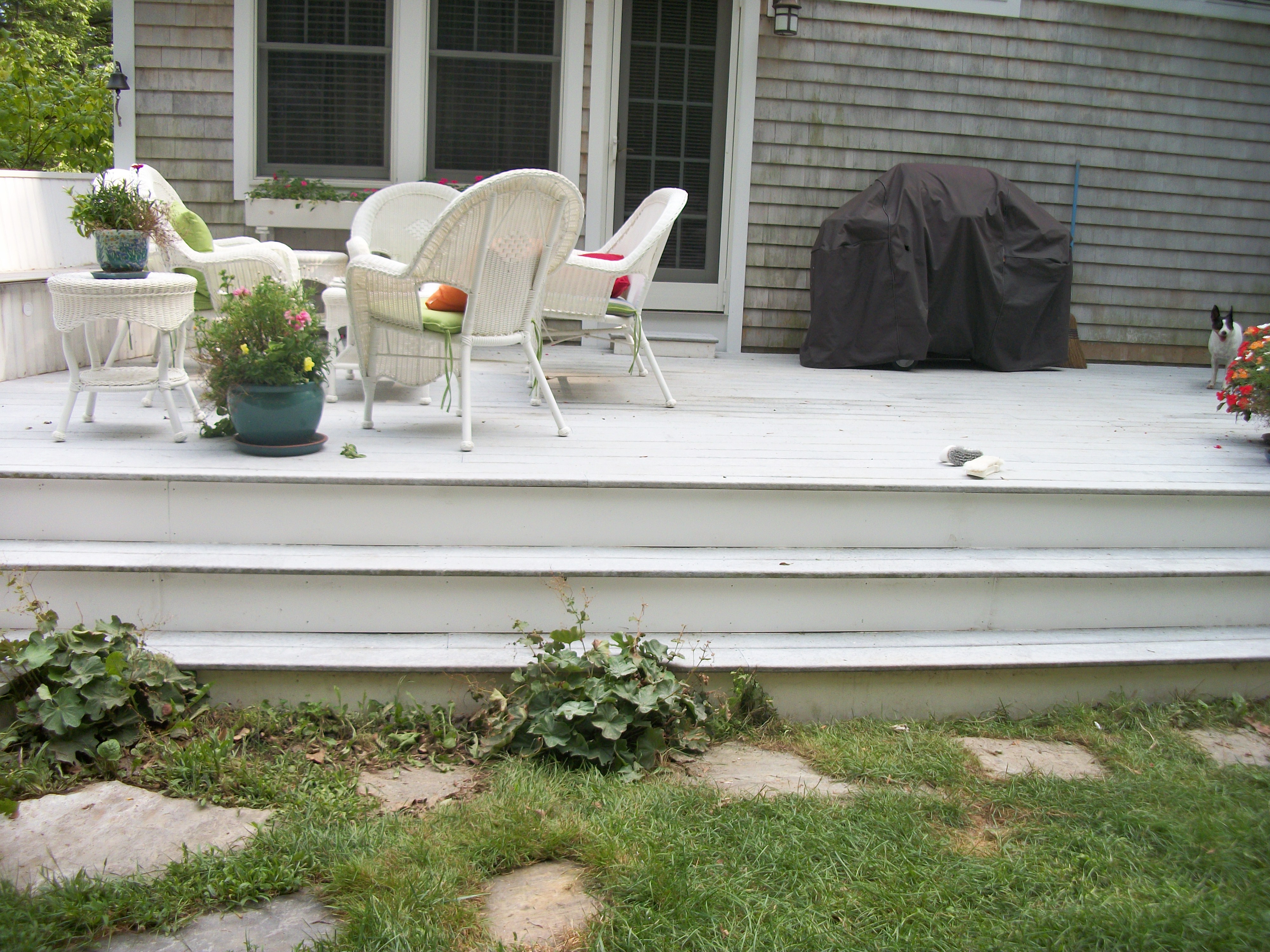
We’ve had the house trim painted–after seven years, it was time.  (Can’t believe we’re living in our eighth year in Maine!)  We used Greg Black’s Accent Painting, from Lincolnville, and are really pleased with his work.  (Greg had some of Rose’s meat chickens, so we met him the day we slaughtered chickens in early summer.)  The trim is all sparkly white now, mold has been scraped off part of the house where we get more rain drainage, and the upper deck and lower porch ceiling have been painted.  While the crew painted, John replaced back deck step boards that were rotting.  Didn’t he do a nice job?

Now he’s trying to solve the front door rain protection problem.  That door sits beneath the upper deck, and unless you put something, like a plywood board, on the upper deck, when it rains you get soaked at our front door.  We’re looking into some sort of plexi-glass solution–hung from or attached to the bottom of the upper porch.

The light has changed up here.  This back deck doesn’t really get morning sun any more.  So, soon we’ll be putting the deck wicker away for the year.  And, all the pots are dying pack now.   It’s ok though, as I’m ready to move inside to quilt intensely.

I love the changing seasons in Maine.

Turkey Tracks: Our Winter Turkeys

Turkey Tracks:  September 19, 2011

Our Winter Turkeys

Susan McBride Richmond and Chris Richmond live just up the hill from us, at Golden Brook Farm.  They have three children and are a source of ongoing inspiration.  Together they have put up three hoop houses, two of them large; have a large flock of chickens and sell eggs; and are presently raising some turkeys for winter eating.  We will get two of the turkeys around Thanksgiving.  Since we’ll be in Charleston, SC, for the holiday, we’ll have our turkeys for winter eating.

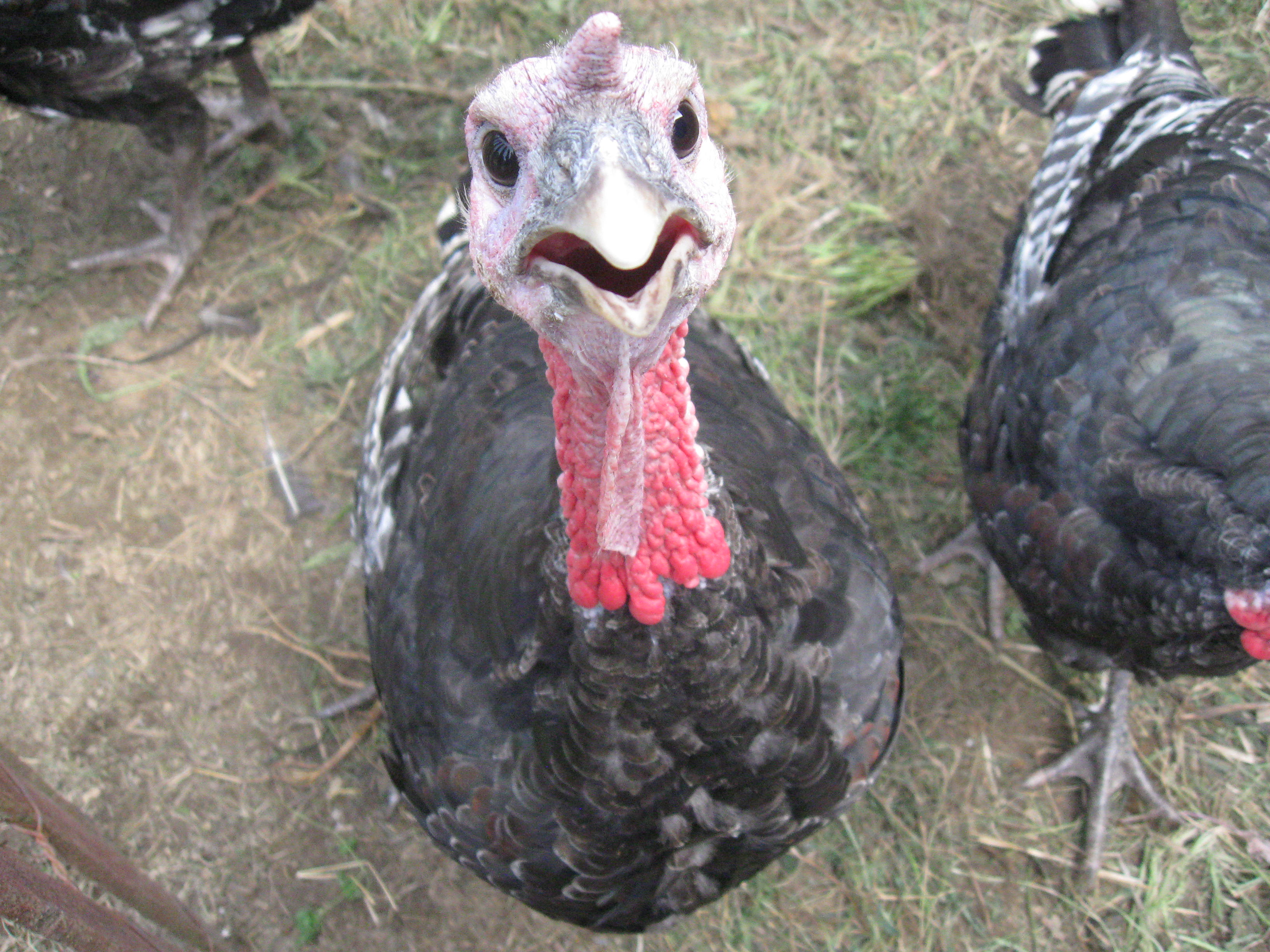
They are bronze-breasted heritage turkeys, and here’s what they look like now:

Turkeys are very social and will talk to you as long as you stand by a fence and speak to them:

This time will be the third that Susan and Chris have raised turkeys for us.  They have all been delicious!

And, last spring we got a lot of fresh wonderful greens from Susan’s second hoop house.   The third hoop house which is up and beginning to be planted will be icing on the cake for us since Susan will have greens this winter as well.  How cool is that!!

I wrote about Golden Brook Farm last fall when Susan and Chris hosted a potluck lunch and cider pressing.  This year they have purchased a cider press, and the event will be the weekend of Oct. 1st.  This year I’m bringing my camera!

Turkey Tracks and Interesting Information: Elderberries

Turkey Tracks and Interesting Information:  September 19, 2011

Elderberries

When we first moved to Maine, we were fairly focused on keeping trees from growing in the rock wall that buttresses our hill–between the front yard and the tiny meadow below the house.  We kept cutting back this one tree, which had roots deep into the wall and refused to die.

Some years later, Margaret Rauenhorst told me how beneficial elderberries were.  She makes elderberry jam, tinctures, and wine from them.  One day early last spring she made a gorgeous pie with the berries she’d frozen last fall that she shared with us.  Margaret and Ronald have a lot of the bushes on their property and are planting more.   Other friends also set about collecting the berries in the fall, Steve and Barb Melchiskey for instance.

While with Margaret one day last fall, I bought an elderberry tree and planted it on the slope next to our driveway.  Elderberries like wet feet apparently.  It’s thriving, bloomed this spring, and I was able to get about 1 cup of berries from it this year.

Not long after, I realized–from seeing the leaves on our purchased elderberry–that the pesky tree on the wall was also an elderberry.  So, we left it alone I collected those berries as well.  Here they are in my kitchen sink–ready to be picked off their stems and frozen:

Here’s what Dr. Natasha Campbell-McBride says about elderberries in GUT AND PSYCHOLOGY SYNDROME:

“Black elderberry is a small tree, which grows pretty much everywhere from cold to very warm climates.  In spring it bears clusters of tiny whitish flowers, which at the end of the summer turn into small juicy black berries.  Medicinal properties of this plant have been appreciated for centuries.  Its flowers, berries, leaves and bark were traditionally used for treating colds, pneumonia, flu, sore throat, hay fever, wounds, eye infections and many other ailments….Black elderberry has strong immune-stimulating properties and it is one of the most powerful anti-viral remedies known to man….You do not have to be an experienced herbalist to use this plant….From the end of summer/beginning of autumn make it your bedtime routine to take 1-2 tablespoons [for family of four] of berries out of the freezer and leave them at room temperature to defrost over night.  In the morning juice them together with pineapple, carrot or any other fruit and vegetables you planned to use.  If you do it every day or every other day throughout the cold season your family will not have any colds.”

Dr. McBride goes on to say that for one person 1 teaspoon of the berries daily is a good dose.

Here in Maine we can buy Avena herbs elderberry tincture, and I always keep it on hand.  And, I keep an elderberry tea on hand as well.  At the first sign of anything going wrong, I start using the tincture and drinking the tea.  Knock on wood, but I can’t remember when I had a cold last.