Turkey Tracks: Noro Iro Sweater

Turkey Tracks:  April 19, 2011

Noro Iro Sweater

It’s finished.

And, it’s quite wild, isn’t it?

The color mixture is not really “me,” actually, but I’ll have fun with it next winter nevertheless.  I can see it worn with a VERY plain top and VERY plain pants/skirt.   I made a bubble hat with leftover yarn that, believe it or not, tames everything down a bit.

I like the buttons that Helen of Heavenly Socks in Belfast helped me pick out:  http://www.heavenlysocksyarns.com/.  Helen is the best!  She will order more yarn than SHE needs just to get what you want.  And she always encourages you to buy extra “just in case,” which she takes back if you don’t use it.   The buttons pick up the lime green bits in the yarn.

A reminder:  Noro yarns are variegated in brilliant colors in ways that are impossible to “match.”  They just knit up the way the color wants to arrive.  I was successful at some matching up though…

Turkey Tracks: Notebook Covers and Fabric Boxes

Turkey Tracks:  April 18, 2011

Notebook Covers and Fabric Boxes

 NOTEBOOK  COVERS

On Friday, April 8th, Barb Melchiskey of Coastal Quilters organized a workshop with Carol Boyer, who came to us from New York with Marty Bowne, the founder of Quilting By the Lake, to make notebook covers using our overflowing button collections.   Eight participants started at 9 a.m. and quit about 3 p.m.  Some of us went home (me) and sewed even more as the projects were so much fun.  (The workshop enrolled 10 participants, but two could not come last minute.)  You might recall the blog entry I made last year during Carol’s visit.  We learned to stamp and paint on fabric, and Carol brought some of the many dolls she also makes to show at the Saturday meeting. 

 Here’s a picture of Carol with the first prototype cover she made:


Here’s a picture of completed notebooks as Carol and Barb refined the method Carol taught, which used bias tape to edge the covers. 


Here’s a picture of a Carol Boyer cover in process:


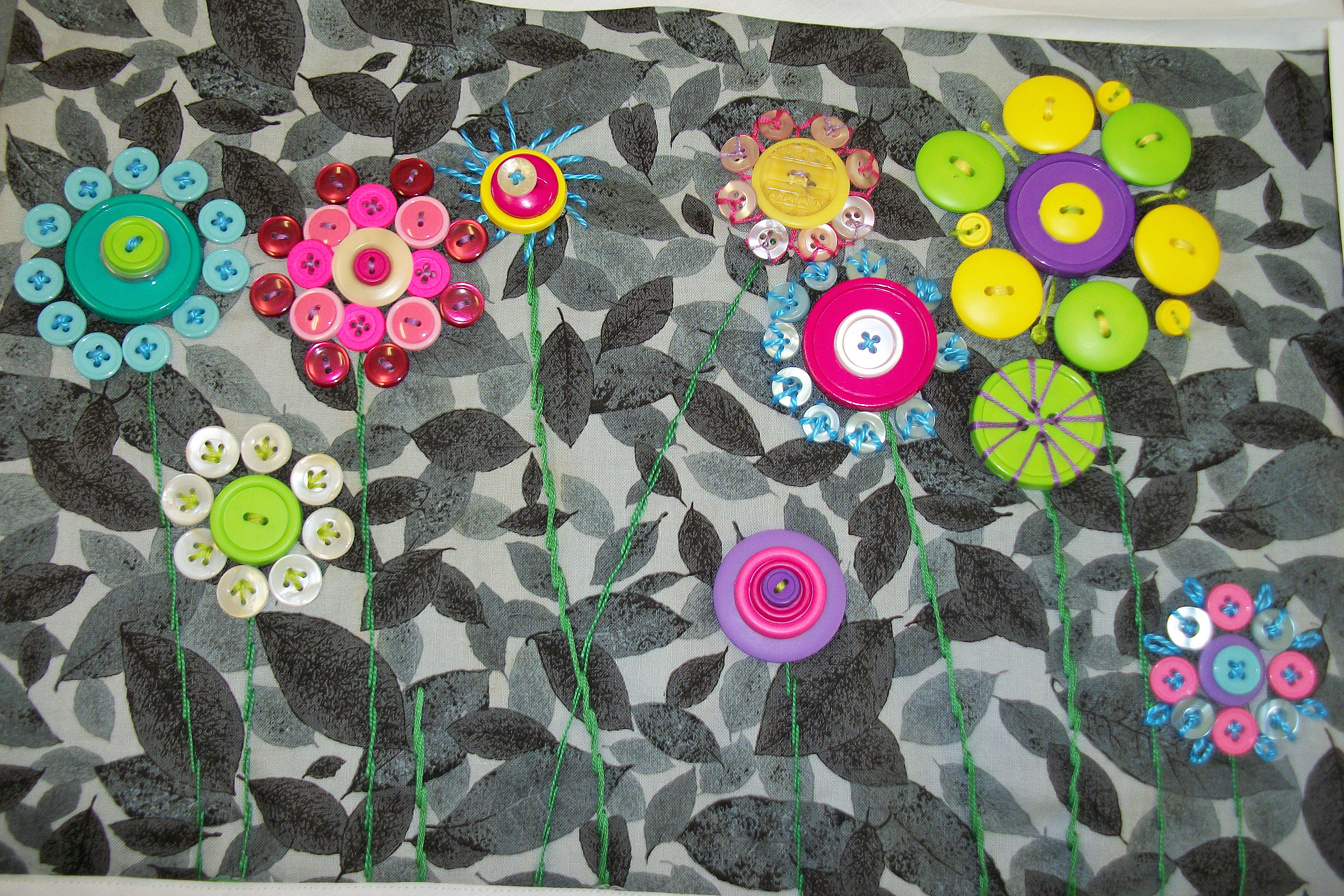
Here’s a picture of the possible variety with these book covers—from plain to decorated—that I did. 

The fabric and buttons on the “Bloom” cover–and the idea for single blooms–came from People, Places, and Quilts in Summerville, SC.  Here’s their number:   1-843-871-8872.  They sell kits with the fabric, buttons, and a colorful array of embroidery floss.  Their focus is pillows, and they sell books with the most adorable “sayings” one could embroider on a pillow and then decorate with buttons.  Carol Boyer taught us to use buttons as both single blossoms and to make multiple button “petals.”  And, she taught us to use embroidery thread–the whole six strands–in some of the creative ways you see above. 

I beaded the central leaf in the reddish cover fairly heavily–yet the effect is still fairly subtle.  – And the navy cover is of a Japanese indigo fabric, so I’m playing off the idea of Sachiko. 

FABRIC BOXES

On Saturday, April 9th, Coastal Quilters hosted Cheri Raymond, who taught us how to make fabric boxes. 

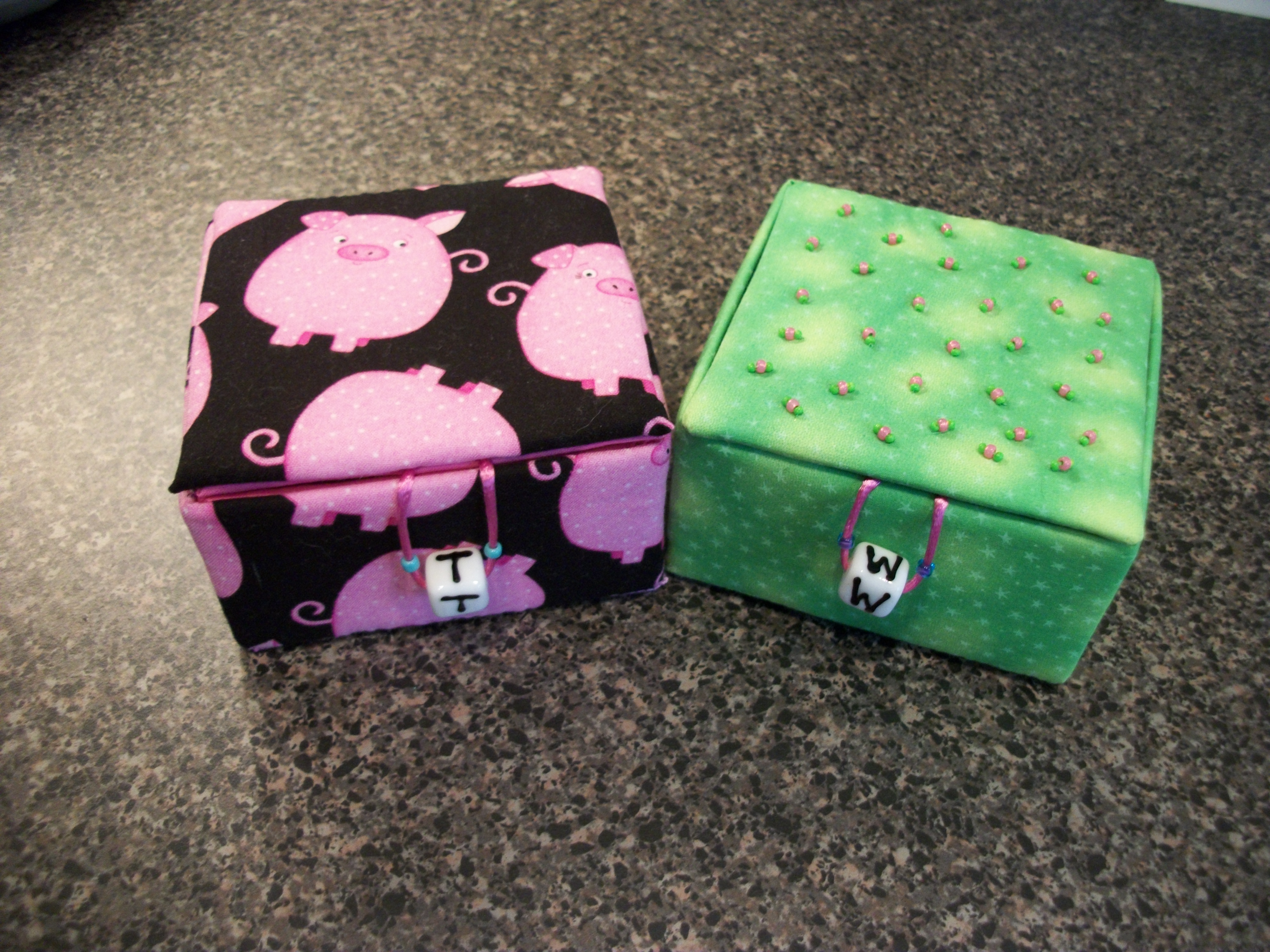
I’m afraid I did not do a good job of taking pictures of the amazing color combinations of boxes being made all around me as I was obsessed with making my own box.  But, here is one Beth Guisely made (green box) that I bought at our auction last year.  And, the one I made (pink pigs) at the meeting, so you can see what we did:

I glued the silk cord into the box top on the pink pig box and attached the cord on the inside of Beth’s box.  I experimented with beading the top of Beth’s box, and that worked out well.  (The boxes are gifts for two of my granddaughters.

And, here are the elegant insides of Cheri’s design:

It turned out that Pat Vitalo has been making fabric boxes for some time.  Here’s a picture of Pat’s very clever boxes:

The large open one folds up and is held together by its top.  I think it’s intended to be a sewing kit…

Anyway, you can see the Coastal Quilters had an intensive sewing weekend!

Turkey Tracks: First Freedom Rangers

Turkey Tracks:  April 16, 2011

First Freedom Rangers

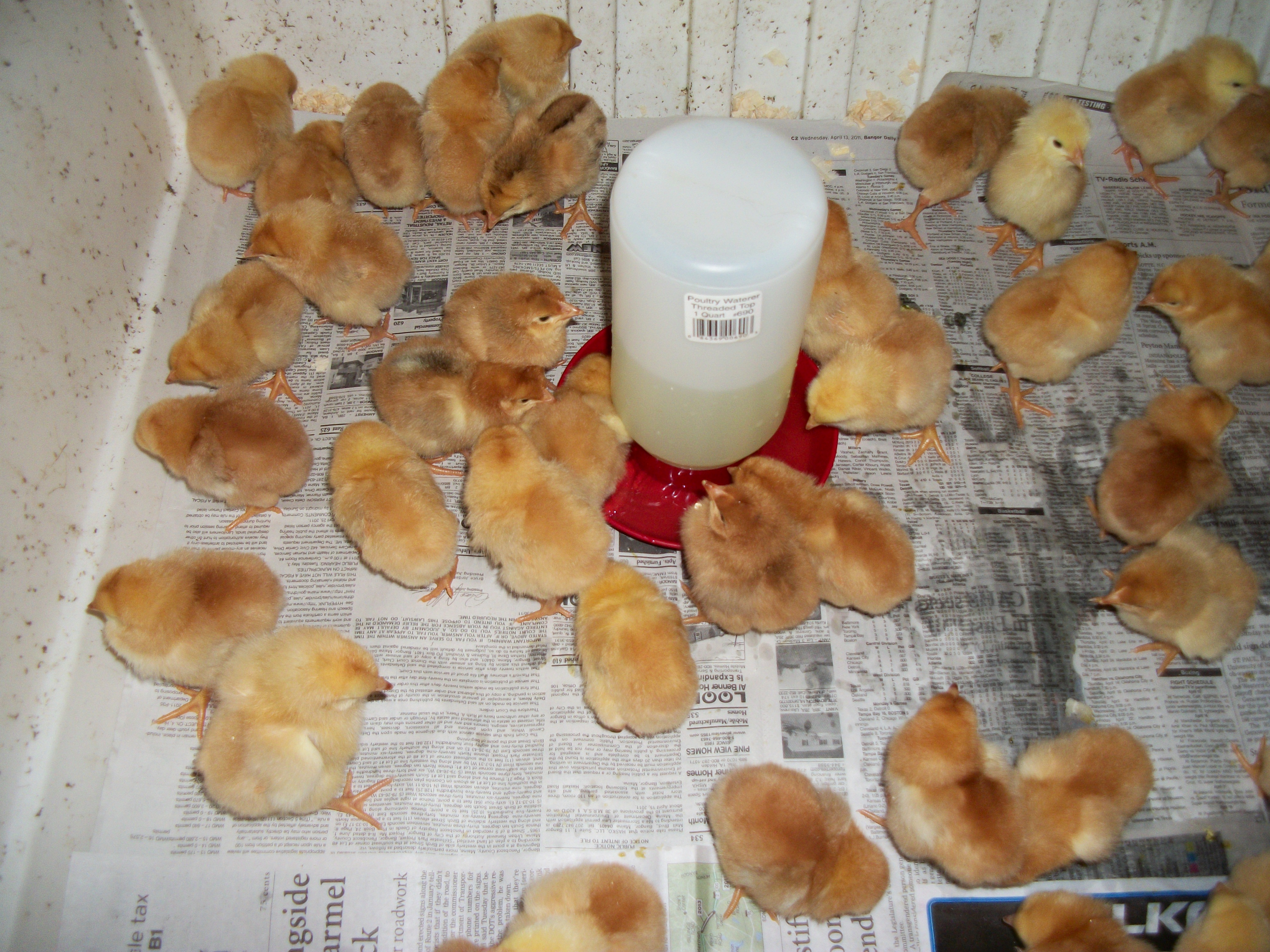
Here they are!

Our first Freedom Ranger chickens!

All 77 (75 plus two extras “in case”…) arrived at the Lincolnville, Maine, post office bright and early on Friday morning, April 15th.  Pete went to pick them up, and I met him at the house.  Margaret was there, too, as she was taking 15 of them.

As you can see, they are big, and lively.  There wasn’t a frail one in the bunch.

.

Freedom Rangers are good layers and good meat birds.  We will have some of each.

Freedom Rangers DO NOT HAVE any Cornish chicken in them, which makes them unique for meat birds.  The market, as I discussed in Tipping Points 9 on meat chickens, settled on meat birds which are all, virtually, Cornish or Cornish crosses.  The Cornish breed grows to over 5 pounds in 6 weeks and has a HUGE white, tasteless breast–produced for a market that went crazy about fat-free meat.  These chickens grow so quickly and are so heavy that their bones and organs won’t support them.  They are Frankensteins.  Their flesh has no texture and melts in your mouth.  Their bones don’t have the minerals they should have, so bone broths made from these bones aren’t as healthy as they should be.

Last year we tried Silver Cross’s–a cross between a barred rock and a Cornish.  The meat texture was lovely–like chicken I remember growing up.  The taste–was wanting.

Freedom Rangers are the same bird as the French sell under their Red label–which is highly sought after in France for taste and texture.

We’ll let you know in about 3 months.  Meanwhile, on Howe Hill, we have one frozen chicken left in the freezer.

Turkey Tracks: Spring Peepers

Turkey Tracks:  April 16, 2011

Spring Peepers

There are still a few patches of snow here and there, but the grass is greening up and bulbs are sprouting.   This past week, a clear herald of spring came:  the peepers started singing.

Peepers are tiny, tiny frogs with big, big voices.   They seem to live in wet lands, and we have one down the hill from us.  A little cold snap has silenced them for the past few days, but they’re stirring now.  I brought on the cold snap since I switched out my winter clothes for spring summer ones.  Unlike the peepers, I cannot crawl back into wherever it is that they winter.  Mud?

Here’s what they look like:

Here’s what they sound like:

http://www.youtube.com/watch?v=4SM6leUVorY

Interesting Information: “Autism, Chemicals and Food Additives”

Interesting Information:  March 27, 2011

“Autism, Chemicals and Food Additives”

Jane Hersey’s eldest daughter “showed symptoms of autism until her diet was changed.”  Says Hersey:  “Most parents of autistic children do not realize that help may be as close as their kitchen cupboards.”

Autism in the United States has “increased from 1 in 2,500 children to 1 in 110 children.”

Ben Feingold, MD, a pediatrician and allergist, formed The Feingold Association, which explores the link between diet and behavior. 

“Many parents have seen their children’s behavior and attention improve when they removed synthetic food dyes, artificial flavorings and certain preservatives from their diet.” 

“Children’s increased consumption of petroleum-based food additives may account for some of this [autism] rise, given that there has been a fivefold increase in food dye consumption per person in the United States since 1955.  (They even dye dill pickles yellow according to an article I read on food dyes in the Center for Science in the Public Interest (CSPI) newsletter–“Nutrition Action”  in the past 6 months.) 

“Try to limit your children’s exposure to scented cleansers, germicidal sprays, furniture waxes, room deodorizers, carpet and oven cleaners, insecticides, moth balls, oil-based paint and solvents like paint thinner.”  Also, wash new clothes and linens to stop “the off-gassing of formaldehyde and fire-retardant chemicals used in many fabrics.”

Choose “toothpaste, mouthwash, medicines, vitamins, soaps and lotions that have not been synthetically colored, flavored or scented.”  (I’d say if you have bad breath, eat more probiotics like those found in high-quality yogurt.  Bad breath comes from your gut, not your mouth.  Cavities are a sign of nutritional deficiencies, not unclean mouths.  (See The Weston A. Price Foundation web site for more info.)  (We use a half & half mixture of baking soda and sea salt, with a drop of essential peppermint oil on the toothbrush, to brush our teeth, and my gums have not bled at the dentists since I started using it.) 

The Feingold Association (www.feingold.org, 800-321-32887) publishes a FOODLIST & SHOPPING GUIDE identifying safe products. 

Jane Hersey wrote WHY CAN’T MY CHILD BEHAVE?

Jane Hersey’s article appeared in the March/April 2011 WELL BEING JOURNAL, 33-34.  This issue has an excellent article by Sally Fallon Morell of The Weston A. Price Foundation:  “Dirty Secrets of the Food Processing Industry.”

Mainely Tipping Points 29: A Cultural Studies Answer

Tipping Points 29

A CULTURAL STUDIES ANSWER

In WHY WE GET FAT (2011), Gary Taubes asks a scientific question.  His answer deploys scientific data from respected scientists working with the relationship of food to human body chemistry.  To recap, overweight people develop a hormonal disorder which is caused by eating carbohydrates, especially the easily digestible, highly processed carbohydrates (white flour, sugars, grains, starchy and/or sweet vegetables, and fructose from fruits bred to be big and sweet).  This disorder causes human bodies either to trap and store food energy in fat cells, no matter the energy needs of the body, or to funnel food energy to the muscles, which makes for a lean body with lots of energy that must be exercised away.

Taubes addresses some of why the inaccurate calorie in/calorie out, or “energy,” paradigm has persisted despite a decided lack of supporting science and the existence of a growing body of contrary evidence stretching back at least sixty years.  My own discipline, Cultural Studies, would begin where Taubes often leaves off by asking who is benefitting and what structural and cultural forces are being deployed for support.   

Cultural belief systems are probably the most powerful organizing forces man has ever devised.  Taubes describes a particularly insidious cultural belief that supports the energy paradigm.  By arbitrarily deciding that obesity is not a dysfunction of the body, a path opens which allows the belief that obesity is caused by the brain —which has been culturally interpreted to be about behavior, about character, about gluttony and sloth (80-86).    

Taubes’ identifies Louis Newburgh, a professor of medicine at the University of Michigan, as one originator of the “head case,” or psychological, explanation for obesity.    In the 1920s, Newburgh became a nationally recognized expert on obesity, and he posited that either obese people were taught to overeat by their parents or they had a “`combination of weak will and a pleasure seeking outlook upon life’” (83). 

“Newburgh,” Taubes notes, “was preaching to a medical establishment that had been taught to revere authority figures, not question their pronouncements” (83).  Newburgh, I’d say, lived in a time when most fat people were poor people.  He was a patriarch who was preaching something that most people of his own class understood to be true:  there’s something wrong with people who are poor, and the fat ones, well, they have “perverted appetites” (82).   

Wrapped up in this psychological explanation are the intersections of class, race, and gender.  Taubes points out that the poorer one is, the fatter one is likely to be since the calories available to the poor derive from cheap carbohydrates (18).  Taubes lists many worldwide studies of poor fat populations who are, with one exception, people of color.  (The exception is Naples, Italy, right after World War II ended, when Naples was destitute.)   Within these studies, the fattest of the fat, by large percentages, are women, who, Taubes infers, are giving the best food to their families (17-32). 

Taubes demonstrates that these poor people are not lazy, that they work hard, physical jobs.  And, like the investigating scientists, Taubes concludes that both malnutrition and subnutrition coexist in these populations because traditional patterns of living have been displaced and available food is mostly highly processed carbohydrates (17-32). 

The medical community, Taubes explains, uniformly swerved in the “head case” direction until well after World War II (84).  Historically, we know that post World War II America is when industry began providing more and more processed food, particularly the highly processed vegetable oils and margarines that replaced animal fats like butter, lard, and tallow.  And, we know that obesity, diabetes, heart disease, and cancer rates all increased.

In the 1970s, Taubes relates, the practice of “behavioral medicine” emerged and the term “eating disorder” became the preferred label, but the “head case” tenants are still intact.  The psychological eating dictates are with us today:  slow down your eating and eat only in the kitchen or at the dining room table (84).  I’d add this one:  we eat when we’re emotionally disturbed in order to nourish ourselves—rather than understanding when we’re emotionally upset, we have more trouble controlling an unsatisfying diet.  Anyway, Taubes notes that today “many, if not most, of the leading authorities on obesity are psychologists and psychiatrists, people whose expertise is meant to be in the ways of the mind, not of the body”—an outcome that ignores the chemical connections between obesity and diabetes (84). 

How is it that certain people get to be “experts” in combating obesity?  Newburgh, for instance, was a doctor of medicine.  Yet, most medical doctors study neither nutrition nor the chemical impact of foods on the human body.  So, where are medical doctors getting their information?  Like most of us, not many medical doctors have time to sit down and figure out whom among the “experts” actually has adequate credentials, is asking the right questions, has formulated solid scientific answers in an independent arena that is not tainted by either personal belief system or corporate funding, whose work has withstood ensuing peer critique, and whose results have been duplicated. 

Today, we are struggling with pronouncements from a host of medical doctors who have written very famous diet books—and made a lot of money–but whose diets often prove ineffective or, even, unhealthy when scientifically tested.  Many of these books are predicated upon the lipid hypothesis (anti-saturated fat).  Taubes uses the 1960s turn toward the belief that animal fats are bad for us and carbohydrates “heart healthy” to describe the formation of the lipid hypothesis belief system:   “…doctors and nutritionists started attacking carbohydrate-restricted diets, because they bought into an idea about heart disease that was barely even tested at the time and would fail to be confirmed once it was….They believed it though, because people they respected believed it, and those people believed it because, well, other people they respected believed it” (160-161). 

We are struggling with information from “expert” organizations like the American Dietetic Association, whose partners and sponsors, as revealed by Zoe Harcombe in THE OBESITY EPIDEMIC,  include “Coca-Cola ($31.4 billion), PepsiCo ($44.3 billion), GlaxoSmith Kline ($45.2 billion), General Mills ($14.9 billion), SoyJoy ($9.2 billion), Mars ($30 billion) and many others” (Tim Boyd, book review of Zoe Harcombe, THE OBESITY EPIDEMIC:  WHAT CAUSED IT?  HOW CAN WE STOP IT?, in “Wise Traditions,” Winter 2010, 50-52). Corporate industry funds academic departments and specific scientists and successfully obfuscates bedrock science, just as it did with tobacco and is doing with many current drugs and toxic chemicals.       

And we are struggling with a government whose agenda and regulatory mechanisms are controlled largely by industry–a government who has, regardless of dissenting bedrock science, used its authority and our tax dollars to effect vast, damaging, and unsustainable changes in our food system since World War II.  Industry has bent our government and our legal system to its will–corporations are now people, but do not have the ethical responsibilities of people–which is a potential death knoll for what remains of our democracy.      

In 1977, when Senator George McGovern’s U.S. Senate Select Committee on Nutrition and Human Needs—a group operating out of belief, not science, decreed that saturated animal fat was dangerous, Dr. Mary Enig, then a graduate student of biochemistry at the University of Maryland, was so puzzled that she analyzed the report and reached the opposite conclusions.  Enig’s own work pointed to the highly-processed vegetable oils and trans fats as the likely culprits in increasing rates of cancer and heart disease.  She noted that the McGovern committee had “manipulated the data in inappropriate ways in order to obtain untruthful results.”  She published her findings, and the edible oils industry not only successfully silenced her and her colleagues, they prevented them from getting any further research money.  Though Enig and her colleagues continued their research, it wasn’t until the 1990s when European work on trans fats began to be published that Enig was vindicated (http://www.stop-trans-fat.com/mary-enig.html).  Nevertheless, deadly trans fats, often labeled “partially hydrogenated fats,” are still allowed in our foods.  

So, who is benefitting from the current energy paradigm?  In the end, no one.

Turkey Tracks: April 1st Blizzard

Turkey Tracks:  April 1, 2011

April 1st Blizzard


It’s no April Fool’s Joke.

We got over a foot of snow up here on Howe Hill today.

It’s very wet, very dense, and our power went out mid-morning.  Hooray!!!! for the generator we installed a few summers ago.   All in all, it’s been a very peaceful day, and most people stayed at home.  I am making notebook covers to decorate in a class I’m taking next week.  I use those old-fashioned composition books–which have come back and are quite popular now. 


 We had a flock of finches at the feeders all morning.  The males are turning yellow, so their breasts are now pale yellow–a sure sign of spring.  They will be neon yellow by summer.  I tried to take a picture of all of the flock–at least a dozen birds–but they kept spooking when I pointed the camera at them–except for this brave, or hungry, fellow:

 The chickens are lonely today.  They were so happy to see me when I checked on them mid-afternoon.  Three eggs!

Turkey Tracks: Cookie A’s Pomatomus Socks

Turkey Tracks:  April 1, 2011

Cookie A’s Pomatomus Socks

I reconnected with my fried Jane Williams a few months ago.  When we came to Maine, Jane and her family went to London and on to Indonesia.  Jane’s back in Northern Virginia now, and I’m looking forward to a visit with her in April when she comes north to visit her mother.  In London, Jane went to the Royal Needlework school where she learned to be even more awesome fiber arts skills.  While I was learning quilting, she was already well into knitting.

Jane mentioned Cookie A’s work, and I went searching for examples.  I just completed Cookie A’s FAMOUS SOCKS–the very first pattern she put on knitty.com and which thousands of people have made now.  I’ve also bought BOTH her books, and I can’t wait to start another pair of her socks.  Only, most of my current yarn is variegated in nature, and Cookie A’s socks are spectacular in solid yards.  I’ll do what I can…

Let me just tell you that these socks were more than a notch above my current skills.  I tore out the first cuff and leg SEVEN TIMES before I finally “saw” the pattern.  Once that happened though, I was off and running and having a spectacular time–even though Cookie A knits on 4 double-pointed needles and not the 5 I use–which I use because I tend to “ladder” socks at the joins of the needles.  Maybe I got over that with this pair.

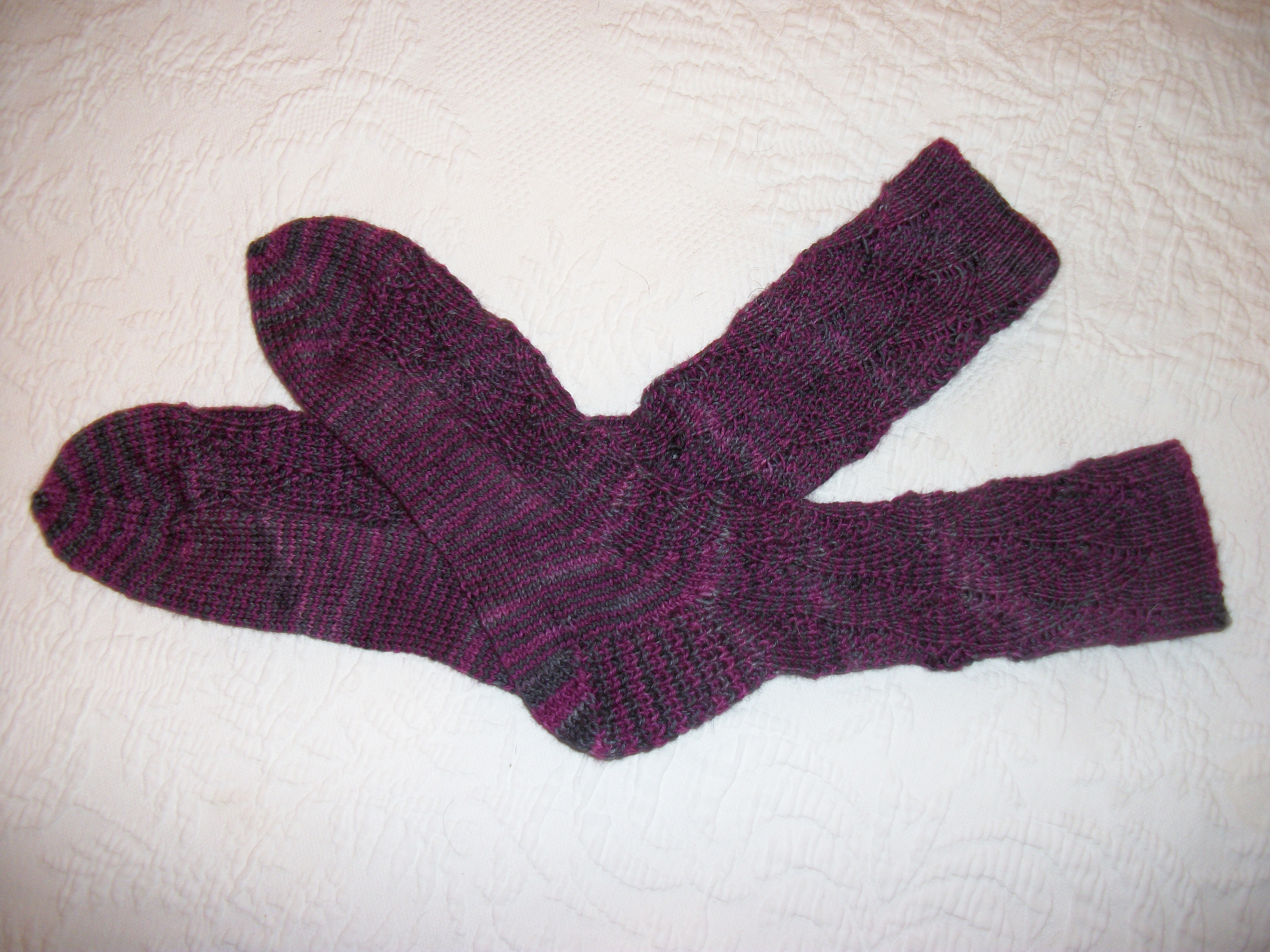
Here’s what the look like finished:

When you put them on. the little scales open up into a lacy pattern:

THANK YOU JANE AND COOKIE A!!!

Here’s the pattern and more information.  You can search to see more of Cookie A’s patterns.  The first book has detailed instructions of how to do yarn overs, increase, and the like.

http://www.knitty.com/ISSUEwinter05/PATTpomatomus.html

Interesting Information: “A reversal on carbs”

Interesting Information:  March 27, 2011

“A reversal on carbs”

“A growing number of top nutritional scientists blame excessive carbohydrates–not fat–for America’s ills.”

Walter Willet, chairman of the department of nutrition at the Harvard School of Public Health:  ” `If Americans could eliminate sugary beverages, potatoes, white bread, pasta, white rice and sugary snacks, we would wipe out almost all the problems we have with weight and diabetes and other metabolic diseases.’ “

Dr. Edward Saltzman, associate professor of nutrition and medicine at Tufts University:  “`Now a growing and convincing body of science is pointing the finger at carbs, especially those containing refined flour and sugar.'”

Dr. Frank Hu, professor of nutrition and epidemiology at the Harvard School of Public Health:  “`The overemphasis on reducing fat caused the consumption of carbohydrates and sugar in our diets to soar.  That shift may be linked to the biggest health problems in America today.’ “

Dr. Stephen Phinney, nutritional biochemist and emeritus professor of University of California, Davis, who has studied carbohydrates for 30 years:  ” `However, over time, as our bodies get tired of processing high load of carbs, which evolution didn’t prepare us for…how the body responds to insulin can change.’ ”  Phinney did a 12-week study in 2008 that compared low-fat and low-carb diets.  The low-carb diet lowered triglyceride levels by 50 percent though participants ate 36 grams of saturated fat a day.  (History and evolution show that grain agriculture–in a 24-hour day of human existence–comes in at 23 hours and 53 minutes.)

Dr. Eric Westman, director of the Lifestyle Medicine Clinic at Duke University Medical Center:  “`At my obesity clinic, my default diet for treating obesity, Type 2 diabetes and metabolic syndrome is a low-carb diet.’ “

Naysayers:  Dr. Joanne Slavin, a member of the advisory committee for the failed USDA low-fat diet regime, and Dr. Ronald Krauss, senior scientist at Children’s Hospital Oakland Research Institute and founder and past chair of the American Heart Assn.’s Council on Nutrition, Physical Activity and Metabolism, a believer in the calorie in/calorie out paradigm–which cannot demonstrate success in weight loss because it doesn’t work.  (See Gary Taubes WHY WE GET FAT.)

 Here’s the whole article:  Marni Jameson, “A reversal on carbs,” LA Times, December 20, 2010, http://articles.latimes.com/2010/dec/20/health/la-he-carbs-20101220

Interesting Information: The “Sweet 16,” Living Longer Gene

Interesting Information:  March 27, 2011

The “Sweet 16,” Living Longer Gene

Geneticist Cynthia Kenyon of the University of California, San Francisco, has discovered two genes, one of which helps you live longer with good health (Sweet Sixteen gene) and one of which causes ageing and death (Grim Reaper gene).  Her work has been “successfully repeated in labs around the world,” and “many experts believe [she] should win the Nobel Prize for her research into ageing.”  Eating carbohydrates “from bananas and potatoes to bread, pasta, biscuits and cakes–directly affect two key genes that govern youthfulness and longevity.” 

Ageing, it seems, is NOT caused by wearing out, but by genes affected by insulin.  To turn on the Sweet Sixteen gene, stop eating carbohydrates because they “make your body produce more insulin (to mop up the extra blood sugar carbs produce….”  More insulin means a more active Grim Reaper.  And, Jeff Holly “who specialises in insulin-like growth factor” confirms that the Grim Reaper “is linked to cancer of the prostate, breast and colon.” 

Kenyon herself has cut out all starch (potatoes, noodles, rice, bread and pasta) and eats salads (no sweet dressings), lots of olive oil and nuts, tons of green vegetables along with cheese, chicken and eggs.”  She avoids sweets, except for 80 percent chocolate.

Here’s the whole article:  Jerome Burne, “Can cutting carbohydrates from your diet make you live longer?” Daily Mail, 26 October, 2010:   http://www.dailymail.co.uk/health/article-1323758/Can-cutting-Carbohydrates-diet-make-live-longer.html.