Books, Documentaries, Reviews: Sally Fallon Morell’s Thumbs Down Review of Robb Wolf’s THE PALEO SOLUTION

Books, Documentaries, Reviews:  January 28, 2014

Sally Fallon Morell’s Thumbs Down Review

of

Robb Wolf’s THE PALEO SOLUTION:  THE ORIGINAL HUMAN DIET


In the fall 2013, in Wise Traditions, the journal of The Weston A. Price Foundation, Sally Fallon Morell gives Robb Wolf’s version of the Paleo diet a THUMBS DOWN.

Why?

Here’s Morel’s summation:

The fact is, while The Paleo Solution diet contains plenty of meat, it is just another version of food puritanism–a diet so lean, dry and deficient that it is impossible to follow and bound to lead to health problems.  No “paleolithic” or traditional culture ever ate this way, and we shouldn’t either.”

One problem Morell has is that Wolf, while saying that saturated fat has been demonized, stresses monounsaturated fats and LEAN meat–which can lead to something called “rabbit starvation“–characterized by, writes Morell, “muscle wasting, lethargy, diarrhea and eventually death if one relied too heavily on lean game animals such as rabbits”–which is what Morell claims Wolf’s diet does.  

Morell notes that Artic explorer Vilhjalmur Stefansson, who described rabbit starvation, noted that “primative peoples never ate lean meat”:  “according to Stefansson, the diet of the Eskimo and North American Indian did not exceed 20 percent protein, with the remaining 80 percent of calories, as fat.”  (Wolf cites Stefansson’s work.)

Saturated fat is where the fat soluble vitamin A resides.  Morell writes:  “Our bodies need saturated fat in large amounts–to build cell membranes (which need to be at least 50 percent saturated to work properly) and to support hormone formation and the immune system.”

Morell notes that there are two major dangers with Wolf’s “Paleo” diet.  First, the  high protein content and the recommended 2,000 to 5,000 IU of Vitamin D daily can rapidly deplete vitamin A in the body–which sets in place a serious health situation.  Second, the deficiency of saturated fat combined with low consumption of carbohydrates means the body cannot use carbohydrates to compensate for the lack of saturated fats.

Morell claims that Wolf’s stance on grains and nuts/seeds is inconsistent.  Grains are not ok, but nuts/seeds are–based on Wolf’s understanding of the role of palmitic acid.  Yet both grains and nuts/seeds contain palmitic acid writes Morell.  And she undertakes a very nuanced discussion of palmitic acid that more or less refutes Wolf’s claims that it is dangerous.  (Recent research also refutes the connection of palmitic acid and heart disease.)

Nor can Morell find a problem with raw milk or dairy from raw milk–which Wolf forbids.  Morell sites a number of nomadic people who thrive on dairy–an argument I’ve always found persuasive.

Wolf claims lacto-fermented foods contain too much salt and are not worth the hassle–which I’m sure represents a misunderstanding of these super foods.

So….

I personally liked–as I wrote some time back–Wolf’s attempts at showing how nomadic paleo peoples fared better healthwise than settled agricultural peoples.  And, like Luise Light’s work, I think we are eating waaaayyyy too many grains every day.   And there may be a problem with modern wheat.  But there are a lot of other grains…  We do need to prepare them properly.

I like the focus Paleo Diets have put on eating traditionally–as many of the traditional foods have been demonized or lost.  Since moving to Maine and getting back in touch with traditional foods, I have held a place for saturated fats, raw dairy, fermented foods, and good meats in my diet.  I also eat a lot of vegetables, avoiding the starchier ones except as treats, and I have a genetic gluten intolerance gene, so do better avoiding gluten.  And when I eat too many gluten-free substitutes, my joints start hurting.

As I’ve written before, when a group starts to take a diet out of its context (macrobiotic, Mediterranean, Paleo), not all of the parts translate–and we just get an Americanized version that’s something new again.  What Wolf has done is to not really lose his fear of fat…

Morell takes on a client  Wolf describes:  Charlie, who is trying to follow Wolf’s diet, but is listless.  What does he need to eat?  Charlie is suffering from rabbit starvation on Wolf’s diet, writes Morell.  And,

The truth is, his diet is terrible.  Desperate for fats, his body craves sugar.  His paleo diet has depleted him of vitamin A, needed for mental function and the formation of stress and sex hormones.  Poor Charlie needs more than blackout curtains [for dark, to sleep]–he needs rich, nourishing foods including butter, cream, bone broths, properly prepared grains, organ meats and cod liver oil.  Raw whole milk before bedtime is a wonderful, soothing food to induce sleep.  Calcium and tryptophan in milk help the body manufacture sleep-inducing melatonin–but Wolf insists we can get all the calcium we need from vegetables and fruit.

There’s more, of course.  If you’re interested, you can read the review for yourself.

http://www.westonaprice.org/thumbs-down-reviews/the-paleo-solution-byrobb-wolf

Books, Documentaries, Reviews: Patricia Cornwell’s PREDATOR

Books, Documentaries, Reviews:  January 24, 2014

Patricia Cornwell’s Predator

I downloaded and listened to this book from our Maine Library System.

I thought I’d try out a Cornwell as I’d heard off and on over the years that her books were good and are centered around a very cool woman forensic scientist, Kate Scarpetta.

Remember that I’d just finished P.D. James’ Devices and Desires and thoroughly enjoyed it.

After James, the Cornwell is a real letdown.

The characters seem really stereotypical, for one thing.  For another, much of the “plot” revolved around being inside the bad person’s head while perfectly horrible, terrible, scary, gory, inhumane acts took place–and all from a the always-very-rare serial killer.  Or, inside the victim’s head while they are being tortured.

Who on earth would want those kinds of images in their heads?

James kills people and has them do insane things all right.  But the Cornwell is different.  The experience felt very voyeuristic, and, frankly, not at all interesting.  Just…gory.  The story made me feel…dirty.

There is nothing of James’ elegance, or depth, or attention to the nuances of people in all their complexity.

It’s probably unfair to damn a writer from one book–especially when there are so many here from this writer–but I won’t go back to this well until I totally run out of other books to enjoy.

I worry about the United States with all its engagement with these kinds of stories…over and over and over again–and especially when they are visual as with television/movies.

And, good heavens!  The Grimm Fairy Tales certainly are…grim.   There’s plenty of blood.  But Cornwell and all the forensic shows are something different yet again.  There’s something here that does not just create express horror at what all a twisted person can do, but which, instead, begins to inure one to what should remain terrible.  In this process, the boundaries just get pushed further and further into the truly…rare and terrible.

Books, Documentaries, Reviews: Book Club List for 2014 and Early 2015

Books, Documentaries, Reviews:  January 19, 2014

BOOK CLUB BOOKS FOR 2014—EARLY 2015

Our book club met this week to pick our books for next year.

We are six in number:  three sets of two neighbors.

We each pick five books for the other members to consider, and we are guaranteed two of our books.  Six times two equals twelve.  Only we sometimes throw in an extra, as we did this year.

Here’s our AWESOME list:

February:  Dear Life, Alice Munro

2013 Nobel Prize, fiction: Canadian with Scottish roots, short stories and some autobiographical pieces.

March:  Claire of the Sea Light, Edwidge Danicat

Haitian author—explores black social classes through eyes of seven-year old Claire.

April:  The Boys In The Boat, Daniel James Brown

Nonfiction: 1936, Olympic eight-oar crew—sons of loggers, shipyard workers, farmers—win all and against Hitler’s German crew at Olympics.

May:  The Signature of All Things, Elizabeth Gilbert of Eat, Pray, Love

Love, adventure, discovery—spans 18th and 19th century—follows one family.  One member becomes a botanist, but meets a man who draws her into the spiritual.

June:  Life Among Giants, Bill Roorbach

Growing up next door to a famous dancer who pulls the protagonist and his family into mystery and murder.  He tries to figure out where truth lies and where love is.  Winning national prizes.

July:  The Flame Throwers, Rachel Kushner

Starts in Utah, with the “fastest girl in town”—motorcycle fast.  Moves to New York City and on to politically turbulent Italy in the 1970s.  Solid reviews.

August:  When We Were The Kennedys, Monica Wood

Memoir.  Growing up in Mexico, Maine.  Getting great reviews and winning prizes.

September:  River Town:  Two Years on the Yangzte, Peter Hessler

Nonfiction:  Hessler comes to Fuling in the Sichuan province, as a Peace Corps volunteer, to teach English and American literature, but learns more from his students while living in a radically different society.

October:  The Goldfinch, Donna Tartt

BIG novel tracing what happens to Theo Decker after he survives a bomb in a New York City museum that kills his mother.  As he makes his way out of the museum, dazed, hurt, but alive, he takes a very famous painting that mother and son had viewed together.  Layered, dense, compelling story.

November:  In Falling Snow, Mary-Rose MacCall

Love, war, secrets set against backdrop of WWI France.  Moving novel about the small unsung acts of heroism which love makes possible.

December:  Mastering the Art of French Eating, Anne Mah

Nonfiction:  Mah’s husband is posted to Paris.  The couple is only getting settled when the husband is posted to Iraq, which leaves Mah alone in Paris.  After feeling terribly lonely and a fish out of water, she rights herself and sets out on “food” journeys across France.  Not unlike Julia Child’s experiences…

January:  The Lowlands, Jhumpa Lahiri

Lahiri’s newest, set in India and America in the 1960s.  Follows the stories of two very-different brothers:  activist and scientist.

February:  Philomena:  A Mother, Her Son, and a Fifty-Year Search, Martin Sixsmith

Ireland, mother pregnant teenager in 1952, sent to convent, baby sold in America for adoption.

Books, Documentaries, Reviews: THE LOST LANGUAGE OF PLANTS, Stephen Harrod Buhner

Books, Documentaries, Reviews:  January 14, 2013

The Lost Language of Plants

Stephen Harrod Buhner

I read this book over two years ago.

It still haunts me.

LOST LANGUAGES OF PLANTS

This book haunts me because it describes how far down a very-wrong-road mankind has traveled–a road that ends in a cliff with no where else to go.  The cliff is sickness, starvation, and certain conflict for resources.

Can we turn around and backtrack?

Increasingly, I think it’s unlikely as a species that we can–because the losses of traditional knowledge are too great, so great that we cannot recuperate them.  And doubly unlikely because most of us are not in touch at all with what has been lost or what, as a species, we have created.  The tragedy springs from our fatal flaws–pride, arrogance, and greed.  We set about with chilling abilities–that grew stronger over time–to change the environment within which we found ourselves and, in the process, set in place what is killing and will kill…us.

Pessimistic?

You bet.  It’s why I called my essays “tipping points.”  I wondered where the tipping point would be for needed corrections to our behavior.

But now, when one out of two people are getting cancer and when we still continue along the road without making changes–caught as we are in an immense system that increasingly ties our hands and muffles our voices–I have lost hope in seeing change in my lifetime at least.

Change will come eventually, but only after this planet has swept most of us off its surface.  Hopefully, those who survive will begin to understand that mankind is part of Earth’s system, not in charge of Earth’s system, and that we must learn to live within Earth’s systems and alongside other life forms–each of which is important–for survival, let alone for flourishing.  And, yes, I recognize that we have multiplied and are, maybe, living longer, but what we have done to create this situation is not sustainable and will crash.

There is an awful lot in this book to take in and understand.  Yet, Buhner, a master herbalist whose life work has been understanding the chemistry and life force of plants, walks us through what has been lost and what we need to understand in accessible prose.  

The “lost” language of plants is a language that used to tell us about our system, where we fit in, the importance of the other life forms (animals, plants, soil, bacteria), and how they worked within the system.  Here, nature is not always “red in tooth and claw,” but synergistically connected.  Here one huge loss is the loss of the understanding of the whole of things–lost to modernity’s constant move to separate out the parts for study or control.  Or, destruction.  

Buhner makes the connection of mankind to the system and mankind’s destruction of the system in many places.  His use of this quote by Wendell Berry from Berry’s The Unsettling of America may give you some food for thought.

[Our bodies] are not distinct from the bodies of plants and animals, with which we are involved in the cycles of feeding and in the intricate companionships of ecological systems and of the spirit.  They are not distinct from the earth, the sun and moon, and the other heavenly bodies  It is therefore absurd to approach the subject of health piecemeal with a departmentalized band of specialists.  A Medical doctor uninterested in nutrition, in agriculture, in the wholesomeness of mind and spirit is as absurd as a farmer who is uninterested in health.  Our fragmentation of this subject cannot be our cure, because it is our disease.

And here’s a quote Buhner uses from the renowned scientist Edward O. Wilson (59):

Other species are our kin.  This statement is literally true in evolutionary time.  All higher eukaryotic organisms, from flowering plants to insects and humanity itself, are thought to have descended from a single ancestral population that lived about 1.8 billion years ago.  Single-celled eukaryotes and bacteria are linked by still more remote ancestors.  All this distant kinship is stamped by a common genetic code and elementary features of cell structure.  Humanity did not soft-land into the teeming biosphere like an alien from another planet.  We arose from other organisms already here.

Now before some of you react to this view, as some of you immediately will, before you grab the polarity religion/science, take a moment and think about what is being described.  Here is a whole design.  A magnificent design–within which we are a part.  And I can tell you that what Buhner is moving towards is trying to show you how intricate is this design– down to the cellular level.  He uses the work of Barbara McClintock, taken from her 1983 Nobel lecture, to reinforce his understanding of the intelligence that is involved.  And Buhner does hold a huge place for spirit underlying this system, as I will show below.

Antibiotics, it has been found, can act as bacterial pheromones, biologically based chemical motivation signals, that literally pull bacteria to them.  Once in the presence of an antibiotic, the bacterial learning rate immediately increases by several orders of magnitude….Bacteria also intentionally inhibit the internal mechanisms for reducing mutation in their genetic structure in order to promote quicker resistance development.  Nor do bacteria compete with each other for resources, as standard evolutionary theory predicted, but rather, they promiscuously cooperate in the sharing of survival information.

The recognition, long delayed by incorrect assumptions about the nature of genetic structure, is now widespread that genetic structures in all organisms are not static but fluid, sometimes within a wide range.  (This is part of a growing recognition that nature may not be red in tooth and claw but much more mutualistic and interdependently connected than formerly supposed.)  Barbara McClintock, who early recognized the existence of transposons, noted in her 1983 Nobel lecture that the genome “is a highly sensitive organ of the cell, that in times of stress can initiate its own restructuring and renovation.  She noted as well that the instructions for how genotype reassembled came not only from the organism but from the environment itself.  The greater the stress the more fluid and specific the action of the genome in responding to it.  This has had a great many unlooked for consequences.  (122-123).

The growth of our disease rates, Buhner argues, parallels “the decrease of diverse plants as foods and medicines” (206).  The substitution of man-made chemicals, born out of reducing the whole to various parts, treat symptoms, not the underlying causes of disease.  This is not a new argument Buhner makes.  But Buhner notes, as do many others now, that our ability to create technical “fixes” is coming to an end, for we have nothing in the pipeline to treat superbugs, superweeds, and super mad living entities that we have incited to…survive…us.

One of the most poignant–and useful–sections of the book is when Buhner describes the development of a plant community.  He begins by noting how the “naming” of plants (taxonomy) involved grouping plants that looked similar or had similar evolutionary origins does not work.  Plants need to be “seen” by how they function within their community:  “To understand plants and Earth’s ecosystems they have to be viewed as living systems, not isolated within the language of Western taxonomy” (176).

And:

Naming plants instead by their function, by their relationship to their habitat, connects people to that habitat, to the communications and purposes that run through ecosystems.  Such naming carries within itself the implicit knowledge of what will happen if a plant is driven to extinction or declines in population.  Many older folk taxonomies–often more complex than Western systems–have long recognized that plants play unique and important functions in ecosystems.  Their names for them (as with such plants as Elders and Ambrosias) often reflect plant/ecosystem connections and interdependencies and describes more accurately their true nature and functions.

Plants mean nothing in isolation; they are a life-form rooted in and identified by their community, by their relationships to and interactions with all other life on Earth.  Individual plants form local neighborhoods and neighborhoods associate together in communities and those group together as ecosystems that interconnect together to form biomes which together form the larger system called Gaia.  Ecosystem function determines the plants that grow within them and the nature of plant associations (176-177).

Buhner goes on to describe a Sonoran Desert plant community and how it formed and how it has an Ironwood tree (an Elder) at its center.  The description of the anchoring Ironwood, the understory plants, the ground plants, the interrelated insects, the chemical smells produced to communicate and heal is…mind-blowing.  And, allows one to begin to see what has been “lost” when we mindlessly cut down and clear land and plant monocrops.  The integrity of the system is ripped apart and various components simply do not know how to relate.  Sickness evolves.

Buhner describes the framework in another way–by listing the basic components of a basic framework found when nonindustrial epistemologies are compared.  Here is Buhner’s list–it offers much food for thought.  Note that the starts with “Spirit.”

At the Center of all things is spirit.  In other words, there is a central underlying unifying force in the Universe that is sacred.

All matter is made from this substance.  In other words, the sacred manifests itself in physical form.

Because all matter is made from the sacred, all things possess a soul, a sacred intelligence or logos.

Because human beings are generated out of this same substance it is possible for human beings to communicate with the soul of intelligence in plants and all other matter and for those intelligences to communicate with human beings.

Human beings emerged later on Earth and are the offspring of the plants.  Because we are their offspring, their children, plants will help us whenever we are in need if we ask them.

Human beings were ignorant when they arrived here and the powers of Earth and the various intelligences in all things began to teach them how to be human.  This is still true.  It is not possible for new generations to become human without this communication or teaching from the natural world.

Parts of Earth can manifest more or less sacredness, just like human beings.  A human being can never know when some part of Earth might begin expressing deep levels of sacredness or begin talking to him  Therefore it is important to cultivate attentiveness of mind.

Human beings are only one of the many life-forms of Earth, neither more nor less important than the others.  Failure to remember this can be catastrophic for individuals, nations, and peoples  The other life in the Universe can and will become vengeful if treated with disrespect by human beings (37-38).

Well, there isn’t much in our education or training or, often, in many of our religions, that constructs a list like this one.

The first time I read it, I dismissed parts of it out of hand.  Then I read it again after reading the book, especially the parts of how a natural plant ecosystem is created, looks (messy by our standards), and functions, and the list called to me in different ways.  Reading it now is, yet again, a different experience, and I am reminded of how much has been lost when so many of us have become so profoundly disconnected from nature, from the land, from plant ecosystems, from animals, from our food, from…each other.


Books, Documentaries, Reviews: Alice Munro’s RUNAWAY

Books, Documentaries, Reviews:  January 4, 2013

Alice Munro’s Runaway


Alice Munro is from Canada.

She is the 2013 Nobel Laureate for fiction.

Munro writes short stories.

Here’s a link describing her work, etc.:  Where to start with Alice Munro, the newest Nobel laureate for fiction · The A.V. Club.

The third book I downloaded from the library and am listening to while I quilt is Munro’s Runaway.

I’m a bit into the story of the title and am really impressed with how Munro writes, what she says, and the characters she draws.

She has been compared to Chekov.

Personally, I think so many good writers come from Canada because they have a real winter.

That winter gives them time to reflect and to think.

Oh my goodness!  What they dream up!


Books, Documentaries, Reviews: WATERSHIP DOWN, Richard Adams

Books, Documentaries, Reviews:  January 4, 2014

Watership Down

Richard Adams


The second audio book I streamed from the Maine library system was Richard Adams’ Watership Down.

I’ve always been a prolific reader, but I think this book fell into a period of my life when I was working a lot and had small children.

I think I was working retail, which included some nights.  And I think I was tired as I was juggling a lot.

So, it was really fun to circle back and “read” this book while I quilted through this daunting Maine winter.

It’s kind of fun to see some of the many Watership Down covers that this wildly successful book has had:  Watership Down cover – Google Search.

It’s even more fun to listen to the introduction where the narrator describes how difficult it was to get the story–written for the author’s two children–published.

I really enjoyed the book.

Why wouldn’t I?  It’s one of those stories we in what we call “Western Civilization” tell ourselves over and over.

There is a foretold life-threatening crisis, and only a few of the “rabbits” take heed when the rabbit with second sight warns.  There is a leader who is wise, thoughtful, and brave.  There is a warrior who puts himself into situations where his life (and the good of the tribe) is threatened over and over.  There are timid rabbits who rise to the occasion.  The wisdom of tricks, not always brute force, wins out in the end  Freedom is an issue here.  Freedom and a safe “home” ground.  The sacrifices of these few and brave “rabbits” ensure the well-being of countless generations that follow them.

What there is NOT is a female rabbit with more than a slightly supporting role.  This society is fun by males, but males who cherish their females.  Hmmmmm.  And this story was written for two little girls.

I told my oldest grandson, who is already a deep reader, that I thought he’d love this book.

And he would.

And I plan to discuss the lack of a female role with him after he’s read it.

▶Books, Documentaries, Reviews: The Future of Food – Trailer – YouTube

Books, Documentaries, Reviews:  December 30, 2013

The Future of Food Trailer on YouTube

I couldn’t get all of this information on The Future of Food on one blog entry.  So here’s the trailer:

▶ The Future of Food – Trailer – YouTube.


It’s important that we all understand the issues with GMO foods since this battle is heating up across the nation and will come to your area sooner or later.

GMO foods have never been tested properly.

There is a lot of good science now showing that these foods are harmful.

At the very least, GMO foods should be labeled–which is what the rest of the world is doing.

Here in “exceptional” America, we are asleep at the wheel.

Books, Documentaries, Reviews: The Future of Food

Books, Documentaries, Reviews:  December 30, 2013

The Future of Food

A Film By Deborah Koons Garcia (2004)


We have a “swap shop” at our local dump here in Camden, Maine.

I’ve gotten some really cool things there–and, I’d like to think, dropped off some really cool things I’m not using there so someone else can use those things.

Books and DVDs are big items people “swap” at the Swap Shop.

Ronald VanHeeswijk brought me The Future of Food from the Swap Shop last summer some time.

I watched it when the cable was out.

It’s a good documentary.  Sturdy.  Covers the issue of GMO foods.  Has lots of scientist experts.  Exposes Monsanto’s goals to control food.  Did you know there are patents now on “life,” like cells, seeds, and so forth.  That’s pretty scary.

Here’s a review:

The Future of Food | Top Documentary Films.

Books, Documentaries, Reviews: THE BROTHERS, Stephen Kinzer

Books, Documentaries, Reviews:  December 29, 2013

THE BROTHERS

Stephen Kinzer

The Brothers is a devastating book.

It’s also a deeply “Cultural Studies” book, which is my academic area.  This book  describes a system of cultural power which allowed men who wielded their cultural power to keep the status quo in place–a status quo from which they benefited mightily.  And, again, I am drawn to the notion that there is no possibility of an actual democracy when systems of cultural power control information, government functions, and the legal apparatus in the way that they do.  The recent Supreme Court decision that allows corporations to be “people” is the culmination of this same kind of cultural power.

This book could probably only have been written 50 years after the events that it describes as the dust of history needed to settle fully.  If someone tried to write this book very much earlier–while the players were still alive–that person would likely have put him/herself in danger and at the very least would have been discredited, fired, demoted, banished–as that’s what happens when the powerful don’t like being exposed.  It still happens in America today–as I have described many times in this blog.  You betcha!

IMG_0065

We need to pay attention to the history this book details because we have not yet fully learned these lessons of history.  For instance, this morning the The New York Times reported that it is clear after its own extensive investigation of the Benghazi disaster that American intelligence and State Department people were so focused on Al Qaeda they missed entirely that local people were telling them to get out of Benghazi because the danger was local–home grown boys thought to be bought off with American aid started the Benghazi riots.

We made these same mistakes with the Soviet Union after World War II.  We, led by the Dulles brothers, created a monster enemy and then tacked onto this enemy a huge conspiracy theory–one that bore little connection to reality, but out of which we acted.  And, act we did, in the process fomenting murder, torture, and chaos across the world–all of which was unnecessary, secret, cruel, inhuman, stupid, and, yes, evil incarnate.  And all of which created genuine hatred and the “blowback” with which we live today.  The Dulles brothers, John Foster Dulles as Secretary of State and Allen Dulles as head of the CIA (which he built into an immense organization), along with President Dwight D. Eisenhower, led us into the mess we now find ourselves.

Here’s an illustrative quote from Kinzer:

During the late 1940s and early 1950s, many Americans projected the worst images of their World War II enemies, including the Nazi campaign of mass murder, onto Soviet Communism.  Americans were told, and came to believe, that Soviet leaders were actively plotting to overrun the world; that they would use any means to ensure victory; that their victory would mean the end of civilization and meaningful life; and that therefore they must be resisted by every means, no matter how distasteful (115).

Fear is a powerful motivator.  And in the hands of those who have an agenda…fear mongering is very effective.   My dad was military.  I grew up with sirens going off in the night and my dad rushing out of the house, dressing as he went.  We lay in our beds, waiting for the telephone call to tell us it was ok, just a drill.  I spent some time under school desks as well.  And, in long lines of cars practicing getting out of a city targeted by a nuclear bomb.  My family’s life was dedicated to “keeping America safe.”  Little did we know that our lives were being sacrificed so that a bunch of wealthy, privileged people could continue playing in their particular sand piles.  Or, that so we could continue to have all the riches we all take so much for granted–the resources of which came and come from many of the countries targeted by the Dulles brothers and their ilk.

Stalin was a monster.  There is no doubt about that.  But the Soviet Union had been wiped out during World War II.  And the actions of the United States–actions coming out of this projection of the Soviet Union as an enormous enemy to be feared, terrified the Soviets.  They, in turn, took compensatory actions.  But, over the years, some of their leaders reached out to the United States and were rebuffed at key moments by John Foster Dulles–who “saw” that their overtures were just plots to get us to lower our guard.

I always said that I would never vote for a military man for President of the United States, but that President Dwight D. Eisenhower seemed to be a pretty good president.

I take it all back.

Military men are trained to identify and seek out enemies and to neutralize them.  Eisenhower was no except it seems.  He was as motivated as the Dulles brothers by the specter they created of an evil Soviet Union with plans to spread communism over the whole world.  And while the Dulles brothers could present their world views to him,  Eisenhower had the power to grant them the power to try to depose and murder–yes murder–anyone they did not like.  Recent scholarship, explains Kinzer, thinks that Eisenhower used the Dulles brothers, not the other way around.

Together, these three men lied to the American people, repeatedly.  They secretly deposed NATIONALIST leaders trying to take back their countries from the nations that had colonized them and were sucking out all their rich resources.  These three men used the power and money of the United States to prevent democratically elected leaders from throwing out American corporations–which were making these men and others in their networks wealthy.  They called these nationalist, neutralist leaders “communists” and said that if they stayed in power, they would join with the Soviet Union in plots against the United States.  John Foster Dulles, in fact, was the coiner of the term “domino theory” which was used to drag us into the Vietnam War.   And the thing is, John Foster Dulles believed what he believed, and he got rid of anyone who tried to complicate his belief system with complexity, facts, or actual truth.

Kinzer describes in detail what occurred with six of the “monsters” the Dulles brothers created and sought to defeat:  Mohammad Mossadagh of Iran, President Sukarno of Indonesia, Jacobo Arbenz of Guatemala, Patrice Lumumba of the Congo, Ho Chi Minh of Vietnam, and Fidel Castro in Cuba.  All of these men were trying to be “neutralists” and to not become engaged with the battle lines drawn by the Cold War rhetoric that reduced the world to two ways of being:  capitalist and communist.  But the Dulles brothers and Eisenhower would not allow nations to be “neutral” if they could force them into the USA camp.

I read quite a bit about the shoddy history of Vietnam when I went back to school.  And I knew we installed a friendly Shah in Iran, but I did not know just how we did that and who we deposed.  I knew about the cesspool created in Cuba by American interests–from the mafia to American corporations.  I did not know so much about Sukarno and Indonesia.  And I am still sick at heart after reading about our role in Patrice Lumumba’s terrible death.  (The uranium that we used in the atomic bombs we dropped on Japan came from the Congo.)  What I like about this book is that Kinzer has put all of these events in one place, so readers can see the full extent of what was done in the name of the American people.

One piece of history I took away from this book is how alone the US was in its refusal to “see” nationalism and neutralism as an OK place to be.  With the possible exception of Germany, most European nations did not agree with the United States’s stark views about good and evil.  (John Foster Dulles supported, liked, and admired the Nazis long after other Americans had seen them for what they were.)  And Britain, often our staunch ally, refused to participate.  Churchill, in fact, loathed John Foster Dulles.  He thought Dulles a “narrow-minded ideologue and deplored his vivid denunciations of Communism.” Churchill noted after one of their meetings that Foster Dulles “`is the only case I know of a bull who carries his own china shop around with him’ ” (201).

In addition, Allen Dulles early on put CIA teams into fifteen countries in Europe that were charged with creating underground armies “that would be ready to rebel and spread terror in case of Soviet invasion or the election of leftist governments” (135).  Kinzer notes that the Swiss scholar Daniele Ganser “reported that in eight of the fifteen countries where the CIA shaped `stay-behind’ armies–Italy, Turkey, Germany, France, Spain, Portugal, Belgium, and Sweden–`links to terrorism have been either confirmed or claimed’ ” (136).   And the CIA Allan Dulles built had plenty of money and virtually no oversight beyond those men who agreed with what it was doing across the world–and that agreement was often formed by their own economic self interest or their need to be part of the cultural power structures.  (Does this sound a bit like the NSA thinking its ok to tap the phones of world leaders?)

The Dulles brothers were born into seats of power and wealth.  They also came from a family of Calvinist Christians who believed that they owned and understood all “truth”–and that they, and America, as all were “exceptional,” were tasked to be major players in the internal battle between good and evil–which is why they sought out “evil” to fight.  Again, John Foster Dulles was a smart man who was so wedded to his ideology that he became a very dumb man. He had no flexibility and could not “see” beyond his belief system.  He put all the complexities of the world into a simple good/bad world view.

But, Allen Dulles was quite different. Allen was a curious combination of someone who liked people, but seemed to have no empathy for them.  He was a womanizer of monumental proportions–and sought out women, wine, song, playing, debauchery, for his whole life.  At one point, he was sleeping with Henry Luce’s wife while Luce was sleeping with Allen’s girlfriend.  From the beginning, Allen was drawn to the secret, covert life he lived.  He was a danger junkie in many ways–if only from the safety of his office desk for much of his life.  He was not in any way a deep thinker–but a devious, cunning man who led his men into dirty, dirty tricks across the world in order to get his way.  One cannot read the saga of Patrice Lumumba without feeling enormously dirty oneself.  In the early CIA, Allen hired men like himself–men born into wealthy, powerful families who were bored.

The ends do not justify the means.

And I do not understand how anyone professing to be Christian can think that justifying the “means” is ok.

Kinzer’s book is an important corrective to the history that we have been taught and have told ourselves since World War II.

I think you should read it.

Kinzer is primarily a journalist, not a trained historian.  But here he is doing what good journalists should do:  inform, not entertain.  He is the author of All the Shah’s Men, Overthrow, and Bitter Fruit.  He served as the New York Times‘s bureau chief in Turkey, Germany, and Nicaragua and as the Boston Globe’s Latin America correspondent.  He is a visiting fellow at the Watson Institute for International Studies at Brown University, where he teaches in the international relations program.  He contributes to The New York Review of Books and is a columnist for The Guardian.

Books, Documentaries, Reviews: Reading THE GOLDFINCH, Donna Tartt

Books, Documentaries, Reviews:  December 21, 2013

Reading THE GOLDFINCH

Donna Tartt

I read fiction mostly at night when I go to bed.

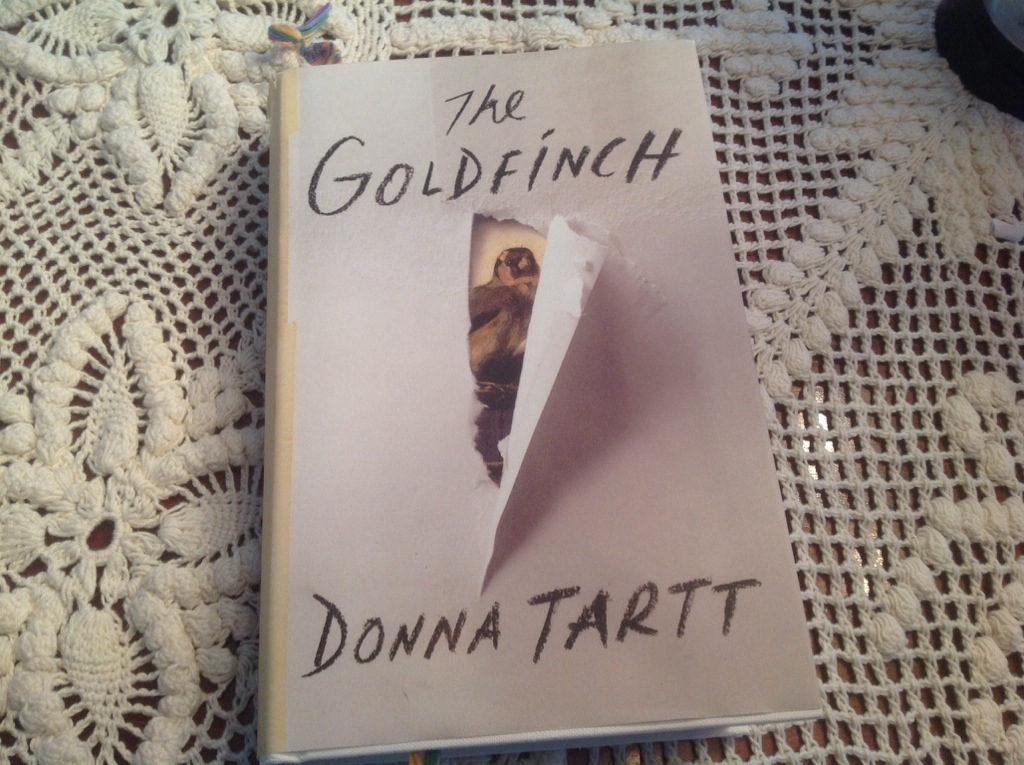
Last night I started THE GOLDFINCH.

20131221-110000.jpg

Theo Decker is the opening narrator.  At 13, he loses his mother in a sudden accident, which he survives.

Here’s a titillating paragraph near the opening of the novel:

“Oh, drat!”  cried my mother.  She fumbled in her bag for her umbrella–which was scarcely big enough for one person, let alone two.

And then it came down, cold sweeps of rain blowing in sideways, broad gusts tumbling in the treetops and flapping in the awnings across the street.  My mother was struggling to get the cranky little umbrella up, without much success.  People on the street and in the park were holding newspapers and briefcases over their heads, scurrying up the stairs to the portico of the museum, which was the only place on the street to get out of the rain.  And there was something festive and happy about the two of us, hurrying up the steps beneath the flimsy candy-striped umbrella, quick quick quick, for all the world as if we were escaping something terrible instead of running right into it.

This novel comes highly recommended and is included in those holiday reading lists for gift-giving or for your own pleasurable reading.  Besides, old friend June Derr says its good.