Books, Documentaries, Reviews: THE TIGER’S WIFE, Tea Obreht

Books, Documentaries, Reviews:  December 19, 2013

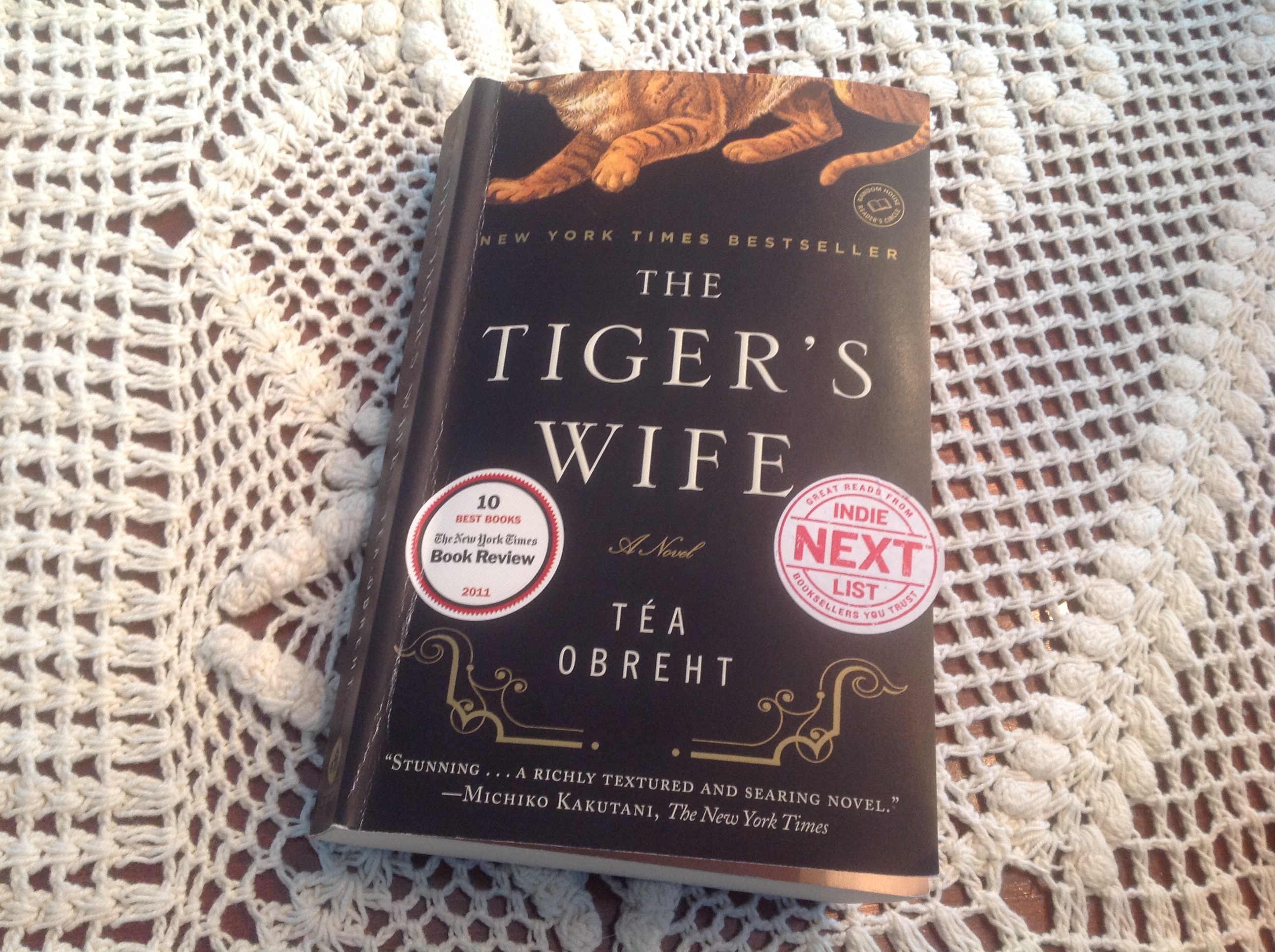
The Tiger’s Wife

Tea Obreht

I’ve read it twice now.

And loved it both times.

I read it first last year, after which I recommended it for our Book Club.

And I just finished it for the second time and found this second reading was even more enjoyable as I picked up on details and connections I had not seen as sharply as I did with the first reading.

IMG_0035

The novel begins in unnamed Balkan countries after one of a long series of wars has ended–think Christians vs. Muslims and Turks vs. Ottomans.  But the novel takes readers back to the war years–not with graphic descriptions of war, but with descriptions of how war affects populations in general.

The protagonist, Natalia, is a young woman, a doctor, who has grown up during the war.   And the story begins as she and a doctor friend, Zora, go into conquered territory (that used to be part of a whole) on a peaceful mission to inoculate school children in a remote village.  She hears on the way that her grandfather, who raised her, has followed her to, according to her grandmother, help her, has died in yet another remote and strange village–which turns out to be not so very far from the village where Natalia is presently.  But Natalia’s grandfather is very sick with cancer, which Natalia and he have hidden from his wife.  So, WHY has he left home?  And so it begins, the unraveling of the history of her grandfather’s life in all its complexity and its mysteries AND of Natalia’s life, which is still fairly new.  The journey Natalia makes is a coming of age journey for her.

The grandfather and the granddaughter are both doctors, the grandfather a famous, once-respected one in the old regime.  Natalia and her grandfather are wedded to science and rationality; yet their lives are both filled with stories, of narratives that defy a grounding in actual reality.  And the reader begins to understand that “stories” are how we explain what we don’t understand.   The “tiger” of the title functions in the intersection between the real and the explanatory narrative–much as the white whale did in Moby Dick, as more than one reviewer notes.  And the zoo that holds tigers and the elephant functions a metaphor as well, but I’m still thinking about what is involved.

Here’s a quote from the text:

He learned, too, that when confounded by the extremes of life–whether good or bad–people would turn first to superstition to find meaning, to stitch together unconnected events in order to understand what was happening.  He learned that, no matter how grave the secret, how imperative absolute silence, someone would always feel the urge to confess, and an unleashed secret was a terrible force.

Part of what resonates with me in this novel is how people behave when what they know and the cultural power they have is perceived to be threatened or is threatened.  Is that not what is at the bottom of much of our politics these days?  We now live in a multi-cultural society, and there is a lot of fear of “loss” on the part of those who have had cultural power and who are now having to share it.

All through the war, my grandfather had been living in hope.  The year before the bombing, Zora had managed to threaten and plead him into addressing the National Council of Doctors about recasting past relationships, resuming hospital collaboration across the new borders.  But now, in the country’s last hour, it was clear to him, as it was to me, that the cease-fire had provided the delusion of normalcy, but never peace.  When your fight is about unraveling–when it is about your name, the places to which your blood is anchored, the attachment of your name to some landmark or event–there is nothing but hate, and the long, slow progression of people who feed on it or are fed it, meticulously, by the ones who come before them.  Then the fight is endless, and comes in waves and waves, but always retains its capacity to surprise those who hope against it.

Natalia’s grandfather is well aware of the power of stories.  He creates a memory story with Natalia during the night he shares an experience with her that revolves around a rescued elephant coming to their local zoo.  It’s a magical scene that is powerfully written.  And he shared his own story of his experiences with “the deathless man.”  But she ferrets out his story of “The Tiger’s Wife” after he has died–a story that took place in the remote mountain village from which he came.

There are many other stories wound up in this tale.  Yet they are interconnected in many ways so that they form at least parts of a whole history–the parts Natalia needs to know to form her own whole story of understanding of her grandfather and, though that understanding, of why people often act the way they do.

I will keep my copy as a treasure.  And maybe in a few years will reread it again.

PS.  Obreht was born in Bosnia, but left there at age 7.


Books, Documentaries, Reviews: GROWING OLDER, Joan Dye Gussow

Books, Documentaries, Reviews:  December 2, 2013

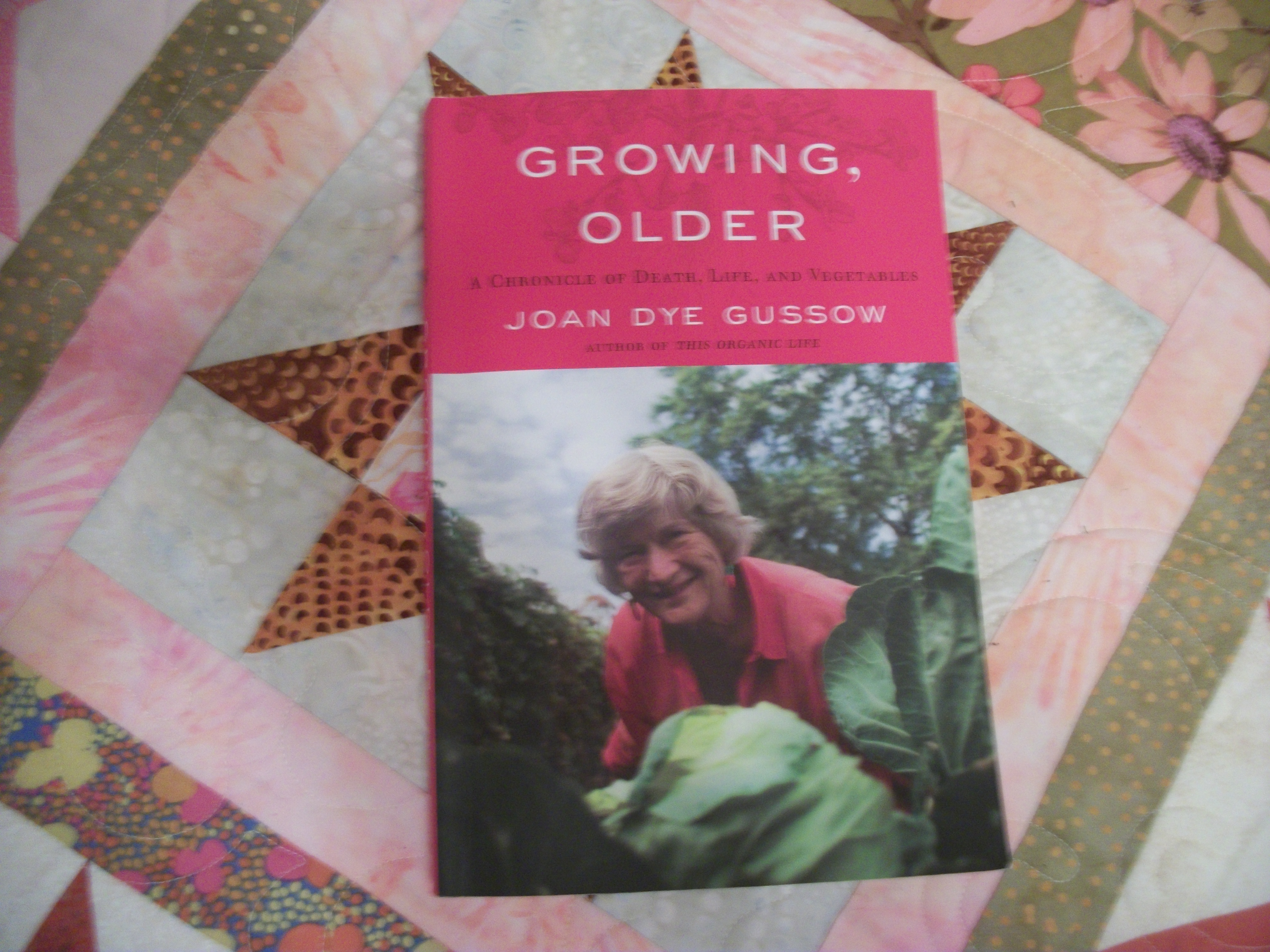
Growing Older

Joan Dye Gussow

Kathleen Nixon recommended Joan Dye Gussow’s This Organic Life shortly after we moved to Maine.

I read and loved it.

Of course I did.  Here was a woman who held and lived my values.

Growing Older

Gussow is a “food hero,” as she has spent much of her life addressing our flawed food system.  In addition, she helped pioneer urban gardening and attempts still to grow most of her food.  She is a Professor of Nutrition Education and was still teaching one course a year at Columbia University while writing Growing Older, which was published in 2010.  As of 2013, she is 85 years old.

For me, Gussow has been a huge inspiration.  She, too, lost her husband of 40 years to cancer when she was 68.  But she continued living her rich and thoughtful life.  Like me, she is passionate about food and health issues–and feels in many ways, as I do, like a Cassandra.  She can see the trouble brewing, but beyond trying to shine a light on the problems with her writing and by the daily choices she makes, is powerless to do much more than that.  She is feisty and will stick up for what she knows–and she does know what she knows after a lifetime of study.  She has, for instance, testified about industry advertising of bad foods targeted to children.

One of the issues Gussow grapples with in this book is her forty-year relationship with her husband.  Alan, an artist, was proud of Gussow’s work, but never really embraced it in a way that allowed intimacy between them.  And just about six weeks after Alan died, Gussow found herself skipping down a side-walk and was horrified that she felt such a lightness of being.  She promptly went to a counselor who helped her put her emotions into a perspective that enlarged her understanding of them.

She had an “aha” moment when the universe spewed up an article by Richard K. Moore called “escaping the Matrix”–which draws on the sci-fi film The Matrix, which posits that we are living in a ” `fabricated collective illusion’ ” about “who and what really runs the world” (31-32).  In the film “Morpheus invites Neo [love those names] to choose between a red and a blue pill.  The blue pill will allow him to continue living in any way he wants.  The red pill will allow him to see the truth.”  Joan’s “aha” moment comes when a friend notes that she has taken the red pill and Alan took the blue pill.

She writes:

Of course.  That explained so much.  I was always scrambling around trying to get to the bottom of things–figuring out what seemed to be “really” going on, and anguishing about the ills of the planet.  Alan, on the other hand, had a profound need to believe (or seem to believe) that the world–human and otherwise–was just as it appeared to be, with everyone liking him, everyone having honorable motives, and so on.  He left all suspicion, all bouts with reality, to me.  Since he managed his public world so smilingly, and so deftly controlled the situations in which he interacted, there were only a few occasions when life brutally asserted that his self-created picture was not the real world.  On those occasions, he was always deeply shaken and depressed.

Except when he wasn’t; except for the occasions when his capacity for denial astounded even me.

And she sums up in this way:

So the red pill/blue pill metaphor helped me understand, at last, what had on the deepest level isolated me from Alan.  To a truly remarkable extent, we were interested in the same global problems, and our areas of expertise overlapped rewardingly as many people noted:  He was trying to keep the natural world intact with art; I was trying to save it with food.  We once took a sociological test to assess our values and came out eerily similar; it’s just that we looked at the world from wholly different emotional perspectives.  I took our planet’s environmental distress really seriously; he couldn’t.  He could verbalize his anxieties about what was happening to the world, but he couldn’t really let them affect his emotions.  He could admire my passions, but he could not share or even really understand them.  My belated recognition of that solved a hundred puzzles that had littered our marriage (33-35).

It takes real guts to share such a story as this one.

But it’s an important sharing because one can expand the metaphor far beyond this husband and wife.  And, Gussow means it to be expanded, clearly.  Alan’s psychic burden of anxiety is not allowed to reach his emotions.  Or, maybe it’s that the anxiety is paralyzing his emotions.  In any case, the result is the production of a kind of non-action in terms of trying to make changes about lifestyle patterns, for instance.

I believe Alan’s “blue pill” stance is what is affecting most people today.  They don’t even know where to begin with changing the structural problems we face.  And those structural issues have become so enormous that maybe they can’t be turned around without, first, a catastrophe of some sort.  So we all just go on fiddling while Rome burns–if we want another metaphor we might understand better than the one in The Matrix.

It was such a relief for me to read Growing Older–on so many levels.  Long-term marriages (47 years for John and me) always contain phases, and the people within them change from time to time.  Some change utterly.  I did when I went back to school.  Like Stephen Douglas, who once said something like “when you’ve learned to read you can’t unlearn it,” I learned…to read.  And that made me different.  More like John in terms of education, which changed our power structure.  And more unlike John because my Cultural Studies degree called into question systems of cultural power of all sorts, like class, race, patriarchy, religion, etc.  John had done well under many of these systems.  And I am a grateful beneficiary of John’s success.  Our differences and my passions did produce the kind of intimate rift Gussow describes.  And, like her, I did feel a lightness of being when the struggle was over.

So, Thanksgiving and this quiet dark season produces reflection.  And last year at this time, John had only five weeks left of his life.  I have found myself over the past fall months, thinking about this count down to the first year anniversary.  And I am humbled by the reality that we never know what life will bring our way from one moment to the next.

Thanks you, Joan Gussow, for all of your wisdom and for all of your efforts to make a difference.

Books, Documentaries, Reviews: New Books In The Mail

Books, Documentaries, Reviews:  November 14, 2013

New Books In The Mail

Look what came in yesterday’s mail?

Books

And Stephen Kinzer’s THE BROTHERS, about the Allan and Foster Dulles, rolled in a day later.

I’ve never read Donna Tartt’s work, but listened to a really great review about this author and this novel.  It’s a big sprawling thing.

And, Jill Lepore’s work on Jane Franklin is also all over the media and is being reviewed really well.  I love it when women’s voices from the past get reclaimed and surfaced.

It’s going to be a good winter of reading.

Books, Documentaries, Reviews: Sisterland: A Novel: Curtis Sittenfeld

Books, Documentaries, Reviews:  November 7, 2013

SISTERLAND

Curtis Sittenfeld

I  finished Wish You Were Here, Steward O’Nan, the other day.  And, moved on last night to Curtis Sittenfeld’s Sisterland.

In the opening pages, I discovered that there was a great earthquake in the midwest in the early 1800s.

Sisterland takes place in St. Louis, Missouri.  The opening date is 2009.

Two identical twin sisters:  the narrator twin is married with two children; Vi is single.  They may have psychic powers.

The sisters have lunch together and argue.  That night there is an earthquake tremor.  The frightened parents gather their children and put them into their bed.

Here’s text from the opening chapter:

I felt them falling asleep one by one then, my son, my daughter, and my husband.  Awake alone, I experienced a gratitude for my life and our family, the four of us together, accounted for and okay.  In contrast to the agitation I’d been gripped by before the earthquake, I was filled with calmness, a sense that we’d passed safely through a minor scare–like when you speed up too fast in slow highway traffic and almost hit the car in front of you but then you don’t.  The argument with Vi, inflated prior to the quake, shrank to its true size; it was insignificant.  My sister and I had spent three decades bickering and making up.

But now that several years have passed, it pains me to remember this night because I was wrong.  Although we were safe in that moment, we hadn’t passed through anything.  Nothing was concluding, nothing was finished; everything was just beginning.  And though my powers weren’t what they once had been, though I no longer considered myself truly psychic, I still should have been able to anticipate what would happen next.

Ok, I’m hooked!

I’ve read Sittenfeld’s American Wife, so know her abilities.  This book is going to be gooooood!


Sisterland: A Novel: Curtis Sittenfeld: 9781400068319: Amazon.com: Books.

PS:  Wish You Were Here is a lovely read.  I especially enjoyed the exploration of how a family comes together–or doesn’t–with all their complicated relationships–after the death of the father/grandfather. 

Books, Documentaries, Reviews: Sandor Ellis Katz at Cornell

Books, Documentaries, Reviews:  November 6, 2013

Sandor Ellis Katz

Cornell University

April 2, 2012

I finally slowed down to listen to Sandor Ellis Katz–WILD FERMENTATION–at Cornell Univerity.  The U-tube video is 90 minutes.  So, grab some handwork, settle in, and enjoy an interesting, thought provoking lecture that discusses, in part, how the standardization of food has drastically altered our ability to enjoy the full power inherent in heritage foods–even when so-called “heritage” foods are made and sold–something Katz thinks is false advertising.

Such changes have altered the “culture” in every sense of that word–the way we live, the cultures we use in foods (yogurt, kombucha, breads, beers, etc.)

So, do you ever try to make yogurt?  And have you noticed that you get really good yogurt for a few generations, and then you…don’t?

Well, the reason is that a culture is a community of many different organisms–thirty or more– that work together to keep the culture stable.  But this kind of community is very hard to standardize–so industry only uses part of the community–which means that what is being advertised is not really the genuine thing.  For instance, the dried powder we buy to start a yogurt culture does not contain the full community of organisms.  And, commercial kombucha only uses part of the SCOBY colony to make its product.  (A SCOBY is a symbiotic community of bacteria and yeasts.)  The same is true of yogurt, cheeses, breads, beer, and so forth.

Cultures for yogurt, kefir (pronounced ke-fear, I’ve learned), kombucha and so forth used to be passed down in families and communities–and they retained their full components in the process.  What we have now is NOT the full biodiversity of a heritage culture.  So the loss, the reduction, is enormous–and is a loss of the culture (the social grouping) as well.

The yogurt culture one can buy can only sustain itself for a few generations–because it isn’t complete.  Standardization killed it.  Food safety laws have limited it.

So, Katz’s main message is that we need to reclaim our food as mass production has been an abject failure in that this food lacks…cultures…and has changed our culture in unhealthy ways.  Shifting how we eat begins to reclaim our culture–so that we once again nourish our bodies and regain our health.

Take some time for yourself to understand what has gone wrong, what the limits of industrialization are, what you can do.

And, maybe try to locate a heritage culture for yogurt and/or kefir.

And, make some lacto-fermented foods for yourself.  They are so delicious!

Here is Katz’s video on how to make a sauerkraut–which bear no similarity to that limp stuff you get in a can:

Books Documentaries, Reviews: THE FOUR AGREEMENTS, Don Miguel Ruiz

Books, Documentaries, Reviews:  November 6, 2013

THE FOUR AGREEMENTS

Don Miguel Ruiz

One of the books I read when I first got to Maine–at the suggestion of Margaret Rauenhorst–was Don Miguel Ruiz’s THE FOUR AGREEMENTS.

When Melody Pendleton painted the kitchen, I was putting away “stuff” from my kitchen desk and found a little handout I had put there of Ruiz’s four agreements.

The book, of course, explains each one in depth, and I probably need to review it again.  But here they are:

Be Impeccable With Your Word:

Speak with integrity.  Say only what you mean.  Avoid using the word to speak against yourself or to gossip about others.  Use the power of your word in the direction of truth and love.

Don’t Take Anything Personally:

Nothing others do is because of you.  What others say and do is a projection of their own reality, their own dream.  When you are immune to the opinions and actions of others, you won’t be the victim of needless suffering.

Don’t Make Assumptions:

Find the courage to ask questions and to express what you really want.  Communicate with others as clearly as you can to avoid misunderstandings, sadness, and drama.  With just this one agreement, you can completely transform your life.

Always Do Your Best:

Your best is going to change from moment to moment.  It will be different when you are healthy as opposed to sick.  Under any circumstance, simply do your best, and you will avoid self-judgement, self-abuse, and regret.

This recipe is a pretty tall order.  It’s hard to break old family “tapes” where making assumptions and taking actions personally and NOT being impeccable with your word–no matter how hard–is how things have worked.  And how “things” get so messed up so quickly.

But even the small movements I have made in my own life in the direction of these “four agreements” has made my own life better in so many ways.

Books, Documentaries, Reviews: Rebecca Eaton and Downton Abbey

Books, Documentaries, Reviews:  November 4, 2013

Rebecca Eaton and Downton Abbey


Want to know all the “ends and outs” of Downton Abbey and Masterpiece Theatre?

NPRs Diane Rehm interviewed Rebecca Eaton last week.  So go find out all about Downton Abbey–including why we won’t see it in the US until January–and why Matthew had to go “under the car.”   And hear a lovely history of how Masterpiece Theatre became such a success.

Rebecca Eaton: “Making Masterpiece: 25 Years Behind The Scenes At Masterpiece Theatre And Mystery! On PBS” | The Diane Rehm Show from WAMU and NPR.

ENJOY! a lovely hour with Diane and Rebecca!

Books: NPR Interview With Stephen Kinzer, Author of THE BROTHERS

Books, Documentaries, Reviews:  November 3, 2013

NPR Interview With Stephen Kinzer

Author Of

THE BROTHERS


Well, here’s a book I’m buying.

THE BROTHERS is a really good example, I’m thinking, of what I learned in Cultural Studies–the power of those with cultural power to effect vast and sweeping changes in a nation.

The “brothers” are John Foster and Alllen Dulles.  AT the same time, one was head of the CIA, the other Secretary of State.  Together they changed the course of our nation from being a nation that would help out with something like World War I or II, to a nation that went out actively and sought out actively “monsters” to police.

The “brothers” could no begin to imagine the blowback from this shift in philosophy–with which we are dealing profoundly today.

I think it would take a long time to pass before a nation could look back on accumulated history and see the philosophical shift and to understand how it happened and why it happened.

Kinzer is a journalist, not a historian.  So there might be a critique mounted against his credentials.  But, I don’t think one can say that THE BROTHERS is a populist, read lightweight, book.

I’m going to read it…

At the very least, you’ll learn a lot from the interview by NPR’s Terry Gross:

Interview: Stephen Kinzer, Author Of The Brothers : NPR.


Here’s a quote from the web page:

In 1953, for the first and only time in history, two brothers were appointed to head the overt and covert sides of American foreign policy. President Dwight Eisenhower appointed John Foster Dulles secretary of state, and Allen Dulles director of the CIA.

Journalist Stephen Kinzer says the Dulles brothers shaped America’s standoff with the Soviet Union, led the U.S. into war in Vietnam, and helped topple governments they thought unfriendly to American interests in Guatemala, Iran, the Congo and Indonesia. In his new book, The Brothers, Kinzer says the Dulles’ actions “helped set off some of the world’s most profound long-term crises.”

John Dulles died in 1959. President Kennedy replaced Allen Dulles after the covert operation he recommended to overthrow Fidel Castro in Cuba ended disastrously in the 1961 Bay of Pigs invasion.

Kinzer tells Fresh Air‘s Terry Gross that the Dulles’ shared background and ideology played out in their policy decisions: “They had this view of the world that was implanted in them from a very young age,” Kinzer says. “That there’s good and evil, and it’s the obligation of the good people to go out into the world and destroy the evil ones.”

Books, Docementaries, Reviews: Parul Sehgal On Jealousy

Books, Documentaries, Reviews:  October 27, 2013

Parul Sehgal On Jealousy


Want to take 13 minutes and listen to an amusing, smart, funny, classy TED video?

Parul Sehgal’s TED talk, “An Ode to Envy” starts with Sehgal telling us a really funny piece of her past.  Then she moves on to discuss Envy, jealousy, and where it appears in some of our great literature.

I’ve already listened twice and will do so again likely.

ENJOY!


PS:  You can download the TED talks as podcasts on ITunes.  That way you don’t have to search around for different one.

Books, Documentaries, Reviews: “The Greater Good”–Are Vaccines Safe?

Books, Documentaries, Reviews:  October 21, 2013

“The Greater Good”

Are Vaccines Safe?

Maybe some vaccines are safe.

But, who knows?

No one knows how many people are being hurt by vaccines.  Or, how.

Few scientists are doing research on that question at the cellular/molecular level.  And the research of those who are finding significant problems is being ignored.

Maybe vaccines are effective.

But, no one really knows.

The only studies that call vaccines safe are epidemiological studies that compare large groups of people.  And the industry-created myth that vaccines can provide “herd immunity” has allowed state governments to mandate vaccines for “the greater good” of all.  (See earlier post discussing herd immunity.)

In fact, these epidemiological studies only show correlation, NOT causation, in terms of stopping disease.  So one burning, unanswered question is what has caused some deadly diseases (polio, small pox) to dissipate over time since vaccines came into play only AFTER these diseases were on the wane.

Indeed, there are many unanswered questions about vaccine safety.  But it is quite clear that vaccines are a life-threatening risk for some people.  And, maybe, even, for all people at the level of the inducement of chronic illness.

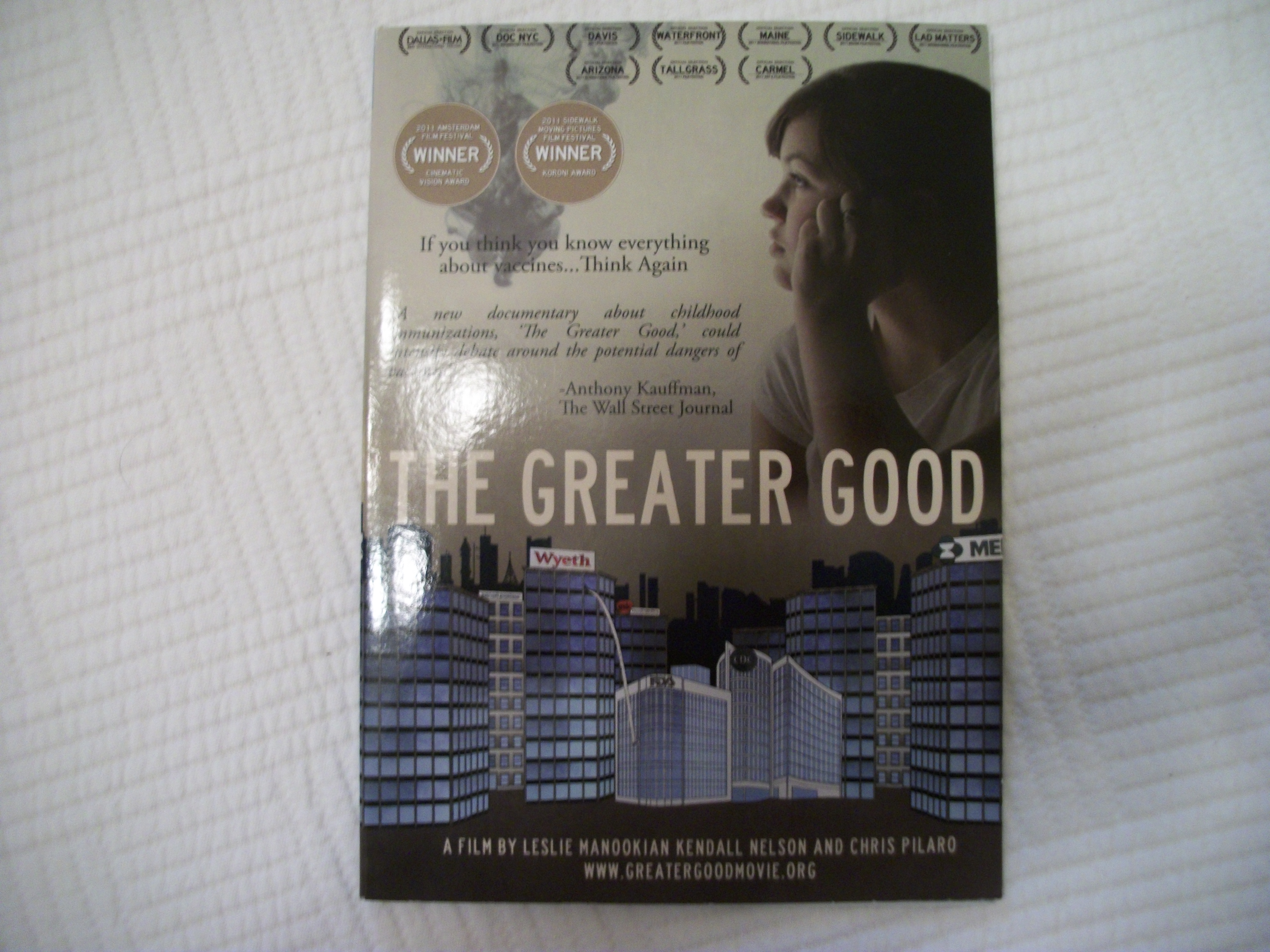
“The Greater Good” is a documentary film that tries to at least surface many of these worrisome questions.  It is being shown all over the country to general audiences and to medical groups and institutions.  The film contains voices from across the spectrum of this issue of vaccine safety–including that of a major medical spokesman, Dr. Paul Offit, who has said famously that babies can tolerate 10,000 vaccines at once.

So, please, please, please–before you get another vaccine or give one to a child, do not assume that you have a good understanding of the issue of vaccine safety.  Or even the need for vaccines.  Start your research with “The Greater Good” for less than the price of a large pizza.
Documentary, The Greater Good

Here’s what I took away from the film–and I hope it’s enough to spark you to NOT assume that your doctor knows and understands the dangers of vaccines.  That does not mean your doctor is a bad person.  It just means your doctor is caught in the same “kool aid” information bubble that you might be caught in, that most of the US is caught in since the media is not doing its reporting job properly.

First, the film takes a close look at three families whose children have been harmed by vaccines.  Gabi Schrag acquired a terminal illness from the UNTESTED vaccine Gardasil when she was fifteen.  Another family’s baby daughter died after a vaccine around her first birthday.  This child was apparently reacting to earlier vaccines, but her parents and pediatrician did not recognize the trouble signs.  Her two brothers did not die, but in retrospect, the parents recognize that their sons, too, have been harmed.  The third family’s son, now 11,  acquired autism from the mercury in vaccines.  That’s not a theory; the mercury showed up in blood tests.  His body could not detox itself, and the mercury and other components in vaccines permanently injured his brain.

***Barbara Loe Fisher became an activist for vaccine safety when her son was injured permanently.  She notes that in 1980, children received 23 doses of 7 vaccines.  Today, the vaccine schedule calls for 69 doses of 16 vaccines.  That’s TRIPLE the number of vaccines.  That’s an industry at work in my opinion.

Dr. Lawrence Palevsky noted that he did not question vaccine safety until the Hepatitus B vaccine was recommended for newborn babies when, he said, infants are not at risk for Hepatitus B.

Fisher now has the following mantra:  SHOW US THE SCIENCE AND ALLOW US THE CHOICE.  She notes the irresponsibility of any system that takes vaccines off the table when they might be factors or co-factors for the causes of chronic illness or outright injury.  Vaccines need to be shown to be safe and effective, and they have NOT BEEN.

Dr. Palevsky–as do other worried experts in the documentary–notes that reducing the vaccine safety issue to just that of autism has worked to hide the bigger issues.  He notes that today ONE IN SIX children have some form of neural disability.  And he wonders how many other chronic diseases are the result of vaccines.  You read that right:  ONE IN SIX CHILDREN.

Vaccines contain ingredients like mercury, aluminum, formaldehyde, and preservatives–ingredients that are meant to keep them in your body for as long as possible.  Palevsky and Bob Sears, a pediatrician, notes that there has been no safety testing for these ingredients.  (Sears wrote a book that is pro-vaccine, but which, among other things. recommends spreading out vaccine doses.)

Chris Shaw, PhD, is a scientist who studies the origins of neurological diseases.  He says we cannot claim that vaccines are safe as their ingredients were chosen to make them stay in your body.  Injectable aluminum injected into mice in an attempt to replicate the vaccine schedule showed the rapid emergence of symptoms that included cognitive deficits, muscle and motor malfunctions, and behavioral symptoms.  Autopsies showed massive damage to motor neurons–and Shaw posed that this situation was creating the conditions for diseases like MS and Parkinsons twenty to thirty years later.  The FDA ignored these studies and refused to perform additional research.

So, how many children are being sacrificed for “the greater good”?  We don’t know.  Vaccine harm reporting is voluntary.  But the fact that Congress created the Vaccine Compensation Program to pay off parents of harmed children signals that harm is being done.  By the way, you pay into the fund every time you or your children get a vaccine–so here again is how industry is making YOU pay for your own injuries.  Vaccine makers generate about $21.5 billion in annual sales.

Are there truly benefits from vaccines?  If so, what are they?  Do those benefits outweigh the risks?  We don’t know.  By the way, the last measles death in the U.S. was in 2003 and many are saying measles death has a strong correlation to poverty and malnourishment.  Vaccines won’t “cure” that.  (See earlier posts on the “measles outbreak” nonsense.)

What vaccines would you choose to get or give to your child.  hepatitis B is not polio.  And chicken pox is not small pox. And since 99% of the population lives in cities now, how many children are stepping on rusty nails?  We now have good medicines for whooping cough.  There is a big correlation between polio and the use of DDT, and polio was on the wane when the vaccine started.

What vaccines would you get for yourself?  The flu shot?  Do you know that science does not show that it is effective and that many flu shot forms still contain mercury?  Or, other worrisome ingredients.   But if you’re going to the third world, you might want to get appropriate vaccines.  Just understand the risks first.

Did you know that INDUSTRY does the testing on new vaccines?  The FDA accepts their word for the testing.

Did you know that INDUSTRY cannot be sued for vaccine harm?  Thus there is no accountability or responsibility when vaccines harm people.  Which brings me to Gardasil…

GARDASIL

So, let’s look at Merck’s Human Papilloma Virus (HPV) vaccine Gardasil–and let’s note that HPV only MAY–only MAY I repeat–cause cervical cancer.

Merck asked the FDA too “fast track” Gardasil, and FDA agreed.  As a result, whatever testing Merck was doing (on just over 1,200 girls under sixteen) was stopped.  SO, GARDASIL HAS NEVER BEEN TESTED FOR SAFETY.  Really, Gardasil has never been tested on anyone in a trial that was carried to its conclusion.  So industry has no idea of its effectiveness either.  What’s occurring is a giant experiment on young people. 

Today, both young women and young men are being pressured to get this vaccine.  Young men are said to carry HPV in their mouths.  So they can “infect” young women.  Do you really think any vaccine is going to kill HPV virus in someone’s mouth so that they never carry it again?  Really?  Hello…we all carry stuff like this all the time–on us, in us, it’s all around us.

Gardasil was released in 2006, and Merck spent $100 million on advertising targeting young women.  You could be “one less” the ads stated.

Gabi Schrag saw those ads and got the multiple-shot vaccine–which caused her to get central nervous system vasculitis and central nervous system lupus.  She will die.  She is dying.  Meanwhile, her life is a living hell.  She has many symptoms, including seizures, paralysis on her face, partial vision, extreme fatigue, and on and on.  Her family buckled under the medical costs and stress.

Diane Harper, MD, MPH, MS, is one of the world’s leading experts on HPV and was the LEAD RESEARCHER FOR THE GARDASIL TRIALS (before they were cancelled).

Harper notes that the death rate from cervical cancer is 3 per 100,000.  Young people are more at risk from an automobile accident than from cervical cancer.  PLUS, we have a very good system in place to defeat cervical cancer:  PAP smears–which are not risky.  Plus, Harper notes, our daughters are not cancer deaths waiting to happen–which the Merck ads indicate.  In fact, says Harper, while Merck’s ads are not lies, they are false in their overall impressions.

WOLVES IN THE CHICKEN HOUSE:

Now let’s talk about Dr. Paul Offit.

Offit’s credentials are pretty heavy duty.  And his certainty about the safety of vaccines so complete that I decided to poke around a bit.  It didn’t take one minute to surface some real conflicts of interest–ones that are at the heart of what is wrong with medicine today, and why many people like me do not trust it.

Offit is a pediatrician.  He is the Chief of infectious Diseae at the reknowned Children’s Hospital of Philadelphia, or CHOP.  He is also a professor of pediatrics at the University of Pennsylvania’s medical school.

Pretty good, huh?  You’d pay attention to someone like this man, wouldn’t you?

Only Offit has strong financial ties to the vaccine industry–as a story of Sharyl Attkisson for CBS News reveals.  He consistently refuses to disclose his industry ties.  But, his research Hillman chair at CHOP is funded by Merck, for $1.5 million.  He co-invented the Rotavirus vaccine and sold it to Merck–his share was somewhere between $29 and $46 million.  He was on the CDC’s Advisory committee on Immunization Practices when his vaccine was put onto the vaccine schedule.  Yet he said in the film that he does not see any wrong doing in the intersections between doctors and the vaccine industry.  (We need to enroll him in a course on ethics and morals immediately.)

In this documentary, Offit says that UNTESTED Gardasil is a “safe and beautiful” vaccine.  Yet, by 2010, there were 85 recorded Gardasil deaths.  And, uncountable injuries as no one is looking for them.

Offit also said the following:  “Are parents really in the best situation to evaluate the data?  I don’t think they often have that expertise.”

Really?   Apparently some of us do a better job of that then people like Offit do.

But, it is this kind of statement that misleads parents into trusting people like Offit–into trusting in his goodness, in his knowledge, and his genuine interest in the health of their children.  To those folks, I say “WAKE UP.”  There’s BIG MONEY involved here, and we live in a system that has thoroughly detached morals and ethics from the business of making money.l

* * * * *

Clearly, the “one size fits all” vaccine schedule is a mistake for too many children.

Clearly, industry is driving the vaccine juggernaut, not science.

Clearly, the states have overstepped their bounds by forcing people to get vaccines they do not want to get in the name of a misuse of the very real scientific concept of “herd immunity”–of which the vaccines cannot ever be part.  Here, again, is where politics is trumping science–as it has in many of the issues about which I research and write.  And when politics makes this move, it does harm.  When it does it by and for industry, it is evil.

Clearly, the vaccine industry needs to be held accountable for the harm it is doing.  They need to answer in our courts of law.

Clearly doctors like Offit need to lose their prestige and power and the positions they are misusing.

Clearly, the media need to do a better job of reporting all sides of the vaccine safety issue.  And of exposing people like Offit and the rigged system that Merck is using for its own gain.

Clearly, parents have got to educate themselves and take responsibility for NOT being driven like fearful sheep into harming their children or themselves.

Clearly, clearly, clearly…

…this film is a “must see” immediately for you, your family, your doctors.