Books, Documentaries, Reviews: THE SNOW CHILD, Eowyn Ivey

Books, Documentaries, Reviews:  December 8, 2015

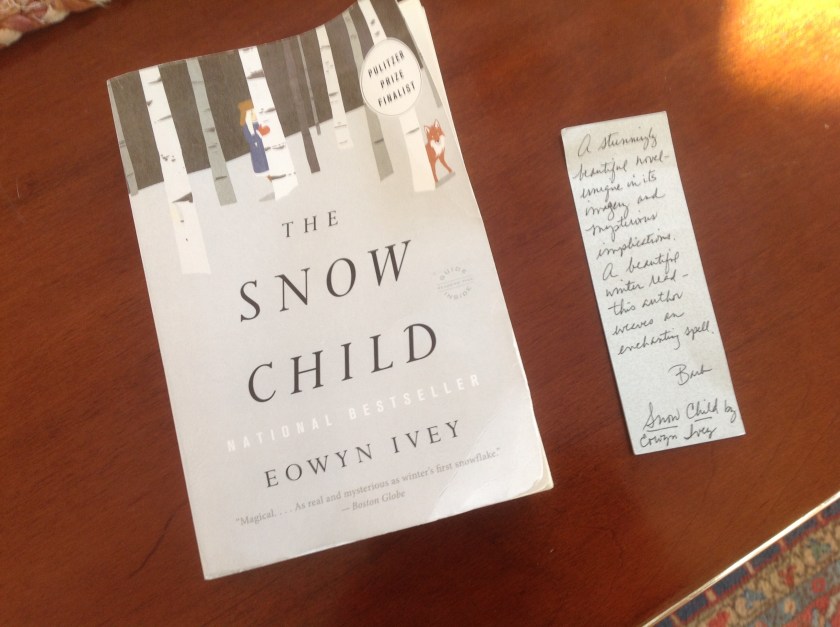
The Snow Child

Eowyn Ivey

I really, really enjoyed this novel.

IMG_0728

I got it at West Bank Books a few months back, after reading the enclosed book mark from a staff member and after getting high praise from the book while in the store.

This novel is Ivey’s first, but she is a seasoned writer.  The prose is lush and evocative of the Alaska she loves.

The story is set in the 1920s among Alaskan homesteaders and uses a Russian fairy tale of a snow child to weave an engrossing read.

Books, Documentaries, Reviews: “Chemotherapy is a Waste of Money”

Books, Documentaries, Reviews:  November 9, 2015

“Chemotherapy is a Waste of Money”

Peter Glidden is a Naturopath.

Naturopaths get very similar training to MDs, except that NDs get a lot more education about nutrition and come at illness with an entirely different focus.  NDs believe in the innate ability of the body to heal itself IF it is getting the right nutrients and is in balance.  Curing illness, thus, requires restoring balance to the body and, maybe, the spirit/mental outlook on life.

MDs, especially today, manage disease and use technical methods that come from outside of the body and involve a “war on the body” mentality:  MDs cut, poison, and burn the body in an attempt to eradicate disease.

Glidden believes that there can be a strong roll for some surgery, especially in emergencies, but does not believe that strategies of poison and burning (radiation) work.

Statistics bear Glidden out.

Glidden’s book The MD Emperor Has No Clothes is an angry, bitter book.  But it clearly describes the differences between these two practitioners.

IMG_0717

And, of course, there is a history to this bifurcation between NDs and MDs.  Mainstream medicine’s development reflects the development of a system of cultural power that was able to drive out its competition by labeling it “quackery” and by passing laws that disallowed its practices.  Yet, there is an absence of data to support cut, poison, burn as applied to disease–and glaring absences of science that should be explored, but…are not.  Meanwhile, the competition does have success rates.  Just look at the history of Burzynski’s treatments for brain cancer, or Hoxie’s plant/herb based treatments for cancer, or the many practices across the world today that are having an amazing success in healing cancer.  (You can explore this arena in the nine-part documentary series The Truth About Cancer:  A Global Quest, the work of Ty Bollinger.)

Mainstream medicine attempted to buy both Burzynski’s and Hoxie’s treatments, and when that did not work, has attempted to ban them.  Burzynski has won every legal battle thrown his way, and he has faced down something like 20 legal challenges.  The FDA even tried to steal Burzynski’s patents on his treatment formulas.   (There are two excellent documentaries on this slimy story.)  Hoxie moved his clinic to Mexico where patients are being cured daily.

Here in America, industry has us by the throat and is preventing any real exploration of what might work to heal cancer.  And, profiting mightily with surgery, chemo, and radiation.  And is busily trying to bring NDs into a role of helping poison/burn patients fare better than they normally do by inhancing needed nutrition.  In many states, NDs are not allowed to practice.  If you live in one of these states, try to find a chiropracter who has a lot of nutritional knowledge.  They often have very similar training to an MD or NDs.

Do note that two large studies in recent years have shown that the war on cancer, as it is being waged, is lost.  Chemo and radiation do not work.  Two large studies clearly show that hemo has a success rate of from 3 to 5 percent for all cancers.  New synthetic drugs that will cure are not forthcoming.  So, best we return to looking at how our bodies fit into the natural world (read plants here–which cannot be patented) and how to restore balance that actually cures the body.

Here’s Glidden on chemotherapy:

▶ Chemotherapy is a Waste of Money – YouTube.

Here’s something I truly believe, and I feel that this is the path to travel, especially after watching “The Truth About Cancer:  A Global Quest.”

IMG_0713

Books: The Southern Reach Trilogy

Books:  November 3, 2015

The Southern Reach Trilogy

I’m reading the Southern Reach Trilogy.


IMG_0762

I’m about halfway through the third book.

This trilogy is one of the more different reading experiences I’ve had.

It’s an “eco-sci-fi” genre–not a genre with which I’m very familiar.

I have to say I’m really enjoying the read.  But all will depend upon the wrap up.

Will VanderMeer carry off his tale.  Or will it fall flat?  I’ll know soon.

The first book sets the stage and is, in a way, “her” story.  She’s a biologist.  And she’s part of a team that goes into “Area X” to explore it’s very strange and lethal properties.

The second book is “his” story.  He’s put in charge of the “Southern Reach,” the organization that monitors and studies Area X.

The third book?  I’m not sure yet.  And the mysteries of Area X have not yet been revealed.  But, it’s borders are spreading…

Books: LEAVING BEFORE THE RAINS COME

Books:  July 27, 2015

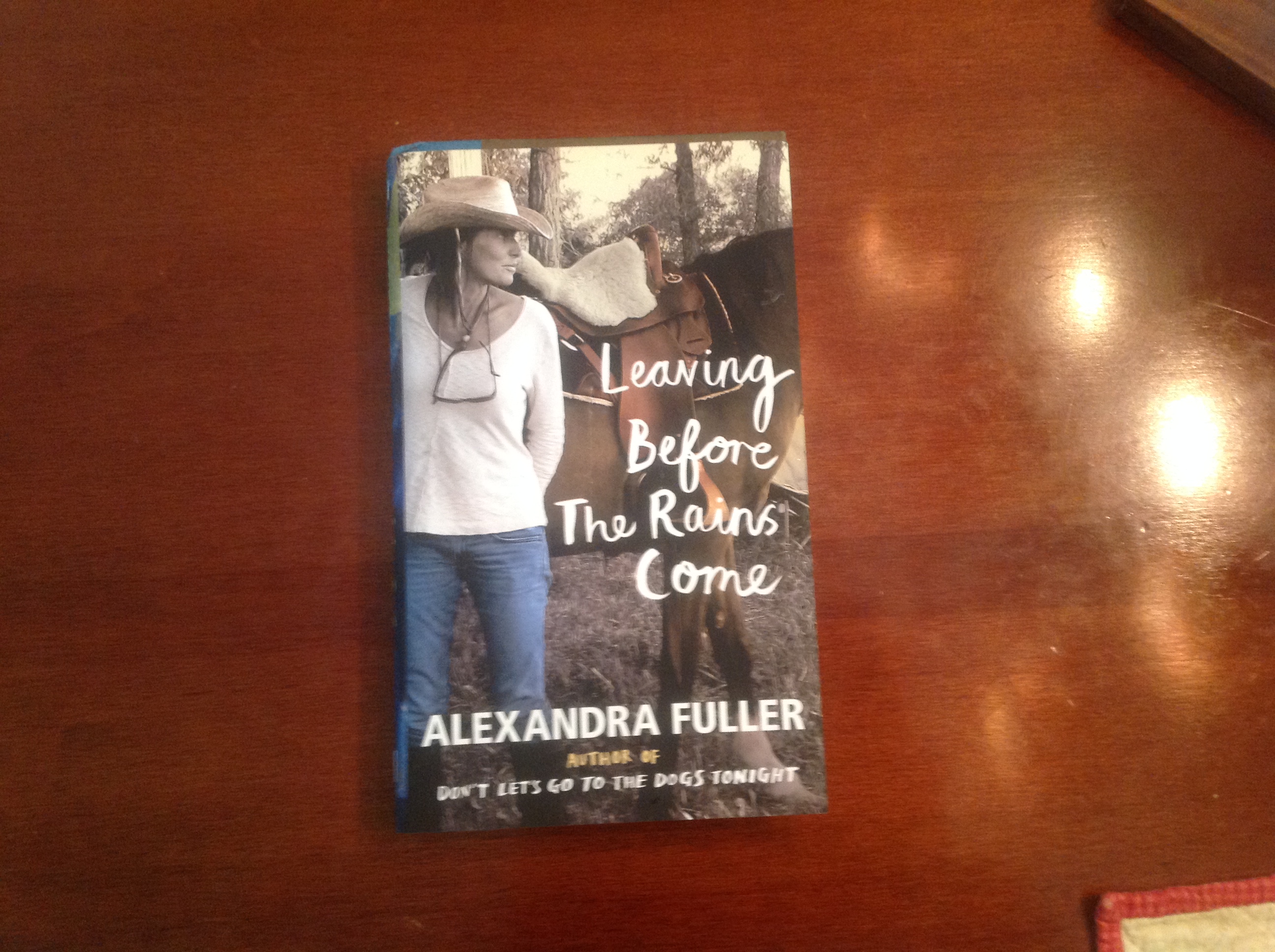
LEAVING BEFORE THE RAINS COME

ALEXANDRA FULLER

I am just back from six days on the windjammer J&E Riggin.

Six days comprised of glorious water views, fabulous Annie Mahle food and John Finger sailing, fun and enlightening Geoff Kauffman singing and storytelling, and island and town exploring.

Six days of reading/reading/reading, relaxing, visiting, and having a real vacation.

I’ve already signed up for this same trip next year.  AND for the four-day quilting cruise September 2016.  (Knitters, birdwatchers, readers, food appreciators, sailing lovers, and so for forth could come too.)

So, here’s a book I read on the Riggin:


IMG_0631

And I loved, loved it.

Alexandra Fuller, raised in southern Africa, married Charlie Ross, from America (Philadelphia).

Fuller, in wise and wonderful ways, brings home the point that we are NOT all alike under the sun.  Culture is a huge part of who we are–unless we have just all become consumers who live in “safe” places.

Here’s a short quote from a much longer, much richer passage where Fuller begins to get at the differences between being raised in southern Africa and most anywhere in America:

A pod of hippos snorted at us as we began our wobbling descent downstream.  I closed my eyes and paddled as calmly as I could.  Behind me, I could hear Charlie taking deliberate, sweeping strokes through the water.  He was unafraid of what might happen, because he saw the hippos not as I did, as the most murderous of all African wildlife, but as fellow river dwellers.  Charlie knew he was supposed to be here.  I knew I was a trespasser.  “Don’t panic,” Charlie said.  We were wearing lifejackets, Charlie had a throw bag and a river runner’s knife.  He knew CPR and had taught river rescue on rivers in Wyoming and Colorado as well as on the Zambezi.  But I understood; it’s rarely the thing you prepare for that undoes you (43).

And a quote showing how connected we are in our culture while we are still in it:

And two weeks later, when I lay in bed coughing and fevered, I believed I could remember the woman who had made me sick, because however hard we work to isolate ourselves from one another and to shore ourselves up against discomfort, we are not immune from one another.  There is no way to shut the doors against our contagions, to ward off the effects of our collective stupidity and greed and violence.  Those who have an understanding of the mhondoro ceremony were correct when they told me that all beings in a community are connected, that the madness of one is the madness of everyone, that there is no separation of minds and bodies between people.  It was true when they said the sickedness and carelessness and avarice of one would bring pestilence on the whole.  Your sickness is mine.  My sickness is yours (204).

How Fuller plays out these ideas, how she sees them in her own life, is so well done.

The book is about the breakup of a marriage of some standing, yes, but it’s also about so, so much more.

I highly recommend this one.

Books: Winnie the Pooh and Saving Bees

Books, Documentaries, Reviews:  July 6, 2015

Winnie the Pooh and Saving Bees

A new Winnie the Pooh book is under way–in which Winnie will encourage readers to work to save bees.

In case you missed it, here’s the story:

New Winnie the Pooh story: In which Pooh encourages children to save the bees – Telegraph.

Books: PEOPLE OF THE BOOK, Geraldine Brooks

Books:  June 15, 2015

PEOPLE OF THE BOOK

by

Geraldine Brooks

IMG_0614

I don’t know how I’ve missed Geraldine Brooks for as long as I have.

Mercy what a good read!!

The book traces–going back into time–the history of a very special Jewish book, a haggadah.  Again and again through time the book is saved by Muslims or Christians, in eras where the players might have quite logically destroyed it as being blasphemous.

Sounds dull, right?

Believe me, it’s anything but dull.  The characters in each era are developed so beautifully, and the book’s suspense continues right up to the final pages.

On the strength of this book, I downloaded CALEB’S CROSSING from our Maine audio library, and I enjoyed it as much as PEOPLE OF THE BOOK.  (What a treat to have it read to me as I sewed.)

Brook’s writing is beautiful, yes, but it also makes characters and history come alive by engaging all the complexity that makes us human and makes an era what it is.

Poems: “Almost June in New England”

Poems:  June 1, 2015

And now it IS JUNE.

Here is a poem Jeanne Gervais sent me the other day–before I got home and could post it.

Almost June in New England

Barefoot on dirt

and warm porch floorboards.

Indoor plants are outside

breathing air, soaking sun.

I saw an ant, a Robin with red breast

all in a morning.

Look at all the light green buds in the trees!

When did that happen? Wasn’t it yesterday we had snow.

Jeanine Gervais

May 26, 2015

Poem: “Mending Wall,” Robert Frost

Poem:  May 2015

Jeanine Gervais sent me this Robert Frost poem the other day.

I thought you might enjoy it too.

We in Maine are busy with spring clean-up, which involves fixing walls and picking up brush, so the poem is timely.

MENDING WALL

Robert Frost


Something there is that doesn’t love a wall,

That sends the frozen-ground-swell under it,

And spills the upper boulders in the sun,

And makes gaps even two can pass abreast.

The work of hunters is another thing:

I have come after them and made repair

Where they have left not one stone on a stone,

But they would have the rabbit out of hiding,

To please the yelping dogs. The gaps I mean,

No one has seen them made or heard them made,

But at spring mending-time we find them there.

I let my neighbor know beyond the hill;

And on a day we meet to walk the line

And set the wall between us once again.

We keep the wall between us as we go.

To each the boulders that have fallen to each.

And some are loaves and some so nearly balls

We have to use a spell to make them balance:

‘Stay where you are until our backs are turned!’

We wear our fingers rough with handling them.

Oh, just another kind of out-door game,

One on a side. It comes to little more:

There where it is we do not need the wall:

He is all pine and I am apple orchard.

My apple trees will never get across

And eat the cones under his pines, I tell him.

He only says, ‘Good fences make good neighbors’.

Spring is the mischief in me, and I wonder

If I could put a notion in his head:

‘Why do they make good neighbors? Isn’t it

Where there are cows?

But here there are no cows.

Before I built a wall I’d ask to know

What I was walling in or walling out,

And to whom I was like to give offence.

Something there is that doesn’t love a wall,

That wants it down.’ I could say ‘Elves’ to him,

But it’s not elves exactly, and I’d rather

He said it for himself. I see him there

Bringing a stone grasped firmly by the top

In each hand, like an old-stone savage armed.

He moves in darkness as it seems to me~

Not of woods only and the shade of trees.

He will not go behind his father’s saying,

And he likes having thought of it so well

He says again, “Good fences make good neighbors.”
Books, Documentaries, Reviews: A LITTLE LIFE, Hanya Yanagihara

Books, Documentaries, Reviews:  May 17, 2015

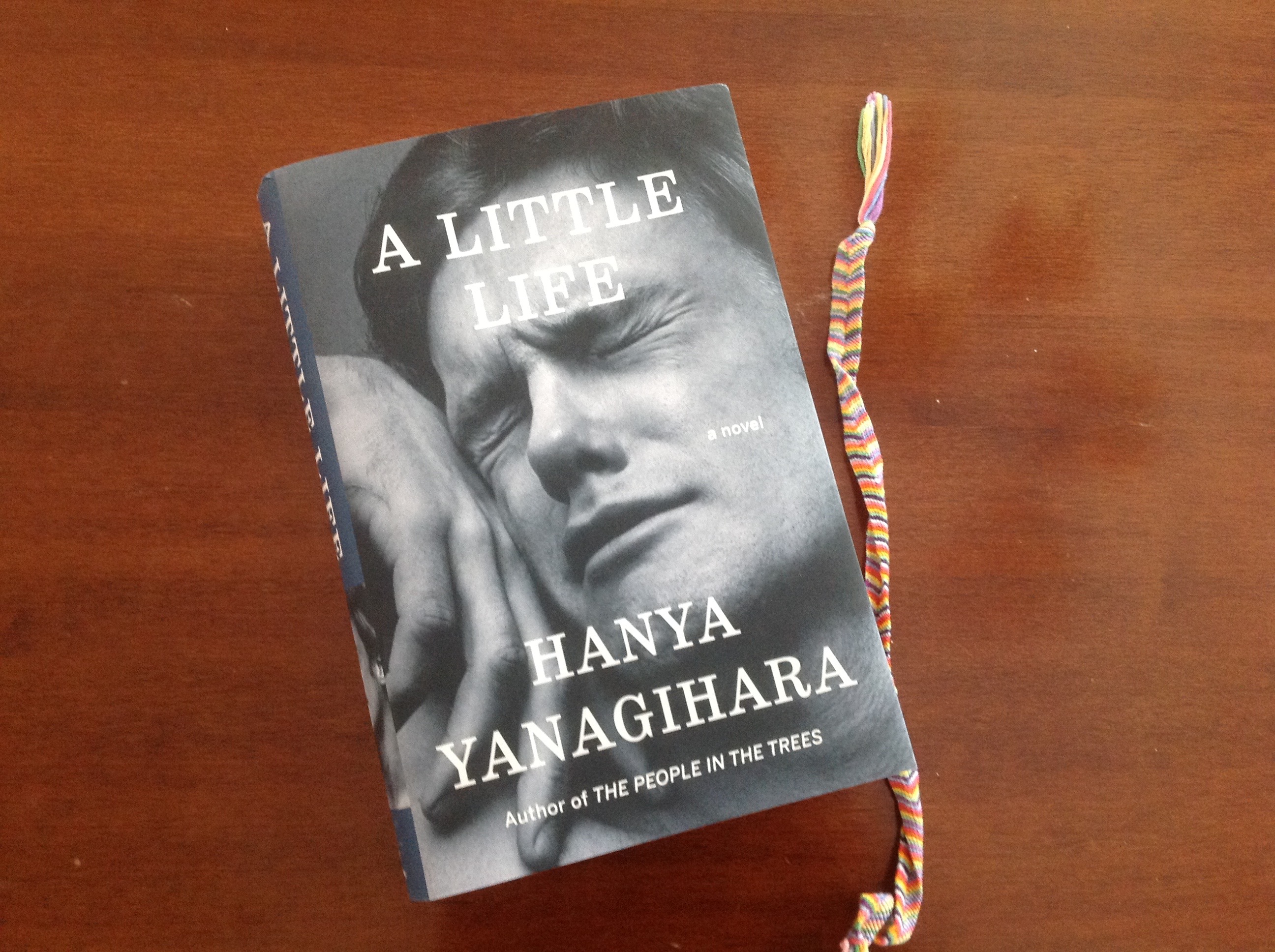
A Little Life

Hanya Yanahihara

I finished it.  All 720 pages of it.

I was sad to see it end.

But glad, too, for the story had finished appropriately.

IMG_0605


It’s a book to savor.  It’s a hard read though–because this astonishing writer is uncompromising with her story.  People get hurt when they are young some times, and the hurt cannot be cured and causes life-long beliefs and practices that cannot be changed.  We Americans have such a belief that anything that goes wrong can, magically, be fixed technically or with love–and more often than not, they can’t.  The darkness of this novel, though, is suffused with the glow and warmth of love and, also, with bad behavior that stems from love fueled by ego and fear.  It’s also an amazing love story that spans over thirty years–some of them troubled, some of them fulfilling.

This “little life” impacts a bigger circle than realized, as may be true for many of us.  Who knows at the time?

The quotes below only show the writer’s ability to…write.  You can trust that the story she weaves has as much complexity and depth.


* * *

The other aspect of those weekday-evening trips he loved was the light itself, how it filled the train like something living as the cars rattled across the bridge, how it washed the weariness from his seatmates’ faces and revealed them as they were when they first came to the country, when they were young and America seemed conquerable.  He’d watch that kind light suffuse the car like syrup, watch hit smudge furrows from foreheads, slick gray hairs into gold, gentle the aggressive shine from cheap fabrics into something lustrous and fine.  And then the sun would drift, the car rattling uncaringly away fro it, and the world would return to its normal sad shapes and colors, the people to their normal sad state, a shift as cruel and abrupt as if it had been made by a sorcerer’s wand (26)

* * *

Later, he would look back on this episode as a sort of fulcrum, the hinge between a relationship that was one thing and then became something else:  his friendship with JB, of course, but also his friendship with Willem.  There had been periods in his twenties when he would look at his friends and feel such a pure, deep contentment that he would wish the world around them would simply cease, that none of them would have to move from that moment, when everything was in equilibrium and his affection for them was perfect.  But, of course, that was never to be:  a beat later, and everything shifted, and the moment quietly vanished (176).

* * *

“The axiom of the empty set is the axiom of zero.  It states that there must be a concept of nothingness, that there must be the concept of zero:  zero value, zero items.  Math assumes there’s a concept of nothingness, but is it proven?  No.  But it must exist.

“And if we are being philosophical–which we today are–we can say that life itself is the axiom of the empty set.  It begins in zero and ends in zero.  We know that both states exist, but we will not be conscious of either experience:  they are states that are necessary parts of life, even as they cannot be experienced as life.  We assume the concept of nothingness, but we cannot prove it.  But it must exist.  So I prefer to think that Walter has not died bukt has instead proven for himself the axiom of the empty set, that he has proven the concept of zero.  I know nothing else would have made him happier.  An elegant mind wants elegant endings, and Walter had the most elegant mind.  So I wish him goodbye; I w ish him the answer to the axiom he so loved” (288).