Turkey Tracks:

Turkey Tracks:  October 14, 2014

“My Salad”


We got a bag of mixed lettuce from our CSA (Community Shared Agriculture) farm, Hope’s Edge, last Friday.

Located just west of me, the farm has had some heavy frosts–though our yo-yo weather continues and today is nearly 70!

So, the lettuce was a welcome treat in our weekly share.  This lettuce has…survived.

When one tries to eat within the seasons, lettuce runs out in the fall.  I personally switch to lacto-fermented foods, like sauerkraut, when the lettuce runs out.  I am so not a fan of the lettuce that gets shipped in here from California in plastic boxes.  That lettuce has been gassed and is very old–like about 18 days old.  Whatever zip was in it is long gone.

I’ve been savoring my bag of lettuce–knowing that the cukes, the tomatoes, the celery are all nearing the end of their days.

Here’s another poem from Jeanine Gervais, who seems to be in a creative mood these days.  She’s eating, likely, what’s left in her garden these days.

My Salad

A Zen Buddhist monk book says

to practice

living

in the moment

say,

“I am washing the dishes

to wash the dishes”

and so I eat my salad

to eat my salad

15 seeds

in tiny halved cherry tomato

raspberry dressing

a pink blanket

covers green leaves

speckled by black pepper polka dots

the white of sliced

radishes

edged

in magenta

a still frame

captured.

By Jeanine H. Gervais

October 11, 2014

Book Review and Interesting Information: MERLE’S DOOR and PUKKA’S PROMISE

October 2, 2014


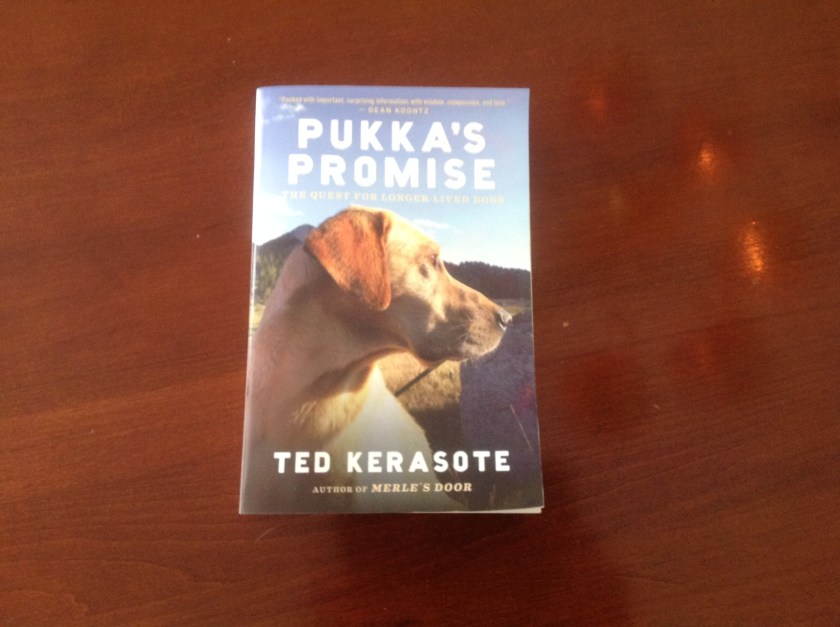
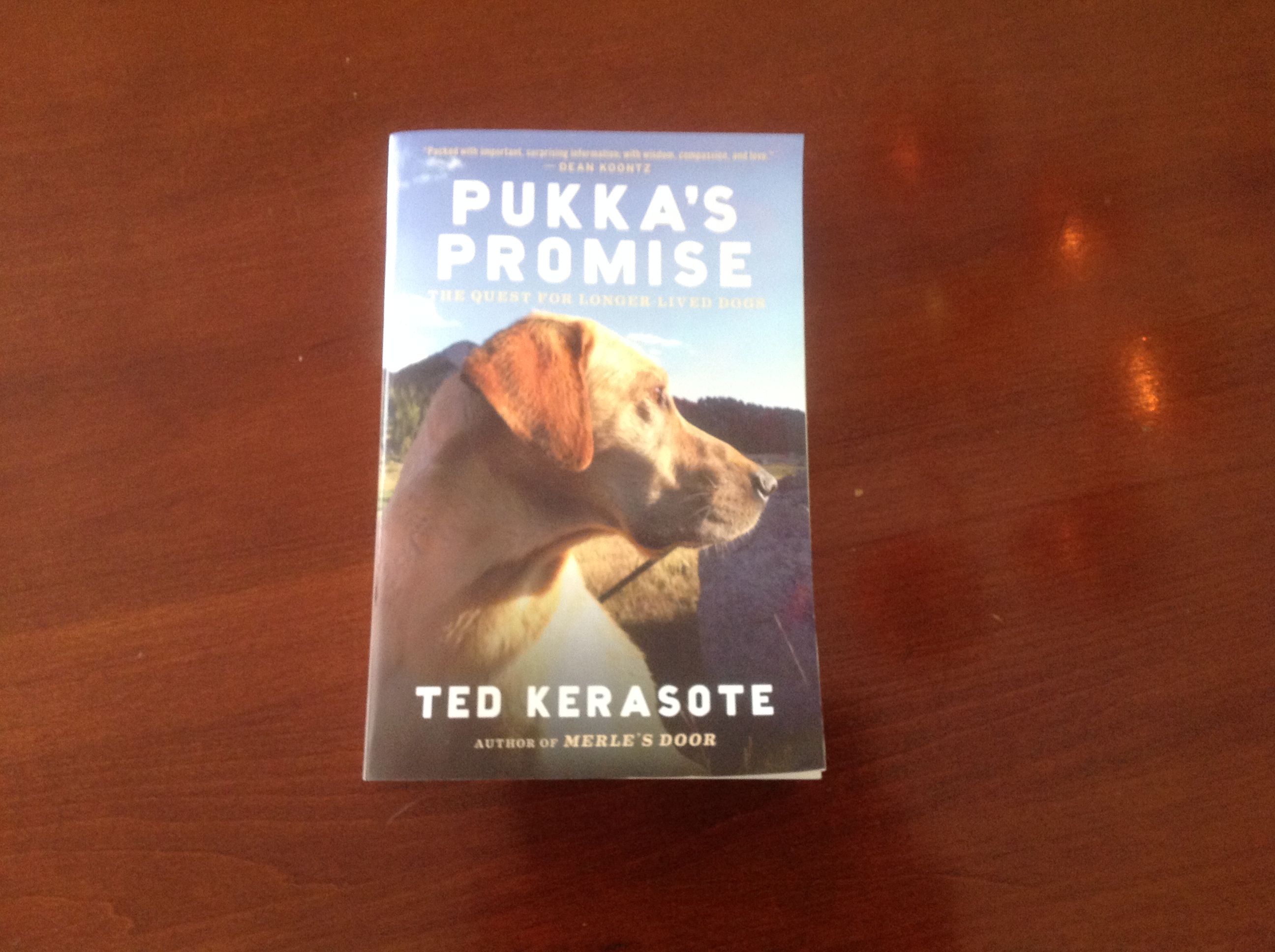
MERLE’S DOOR and PUKKA’S PROMISE

Sometime over the summer, I downloaded an audio book from my local library–which taps into the whole Maine downloaded books system–called MERLE’S DOOR by Ted Kerasote.

(I listen to audio books while I quilt these days in lieu of listening to Podcasts about the state of the world since I’ve decided there isn’t much I can do about any of the grim news that assaults us daily.  This “news break” has been such a gift!)

I knew nothing about either this book or Ted Kerasote–just thought I’d see what this book about a dog was like.

MERLE’S DOOR is a charming book about a man and a stray dog who adopt each other and become fast friends:  brothers, really.

Kerasote lives near Jackson Hole, Wyoming, and is a devout outdoorsman and naturalist.  Merle was more than happy to accompany him on hikes, bike rides, camping, skiing, and so forth.  And Kersote allowed Merle to have his own independent life, coming and going through his own door, as much as was possible, which was a lot in a small rural community in Wyoming.

When Merle died at about 13, Kerasote was devastated to lose this friendship.

Kerasote knew he would try to replicate the friendship he had with Merle, and he eventually does so with Pukka (pronounced like hockey puck).

But, first, he does a lot of research, including interviews with university research vets, on how to best extend a dog’s life in today’s times, and PUKKA’S PROMISE contains this cutting age information.

IF YOU HAVE A DOG OR WANT TO GET A DOG PUKKA’S PROMISE IS A MUST READ since much of the information in this book HAS NOT TRICKLED DOWN TO YOUR LOCAL VET.
IMG_0385

Kerasote starts with how to best pick a dog in this era of massive and rampant inbreeding–which is resulting in malformed dogs with all kinds of genetic structural issues that will shorten your dog’s life and cost you a boatload of both emotional angst and money.

Here are some quick highlights:

Should you spay or neuter?

No, spaying and neutering removes the dog’s body’s ability to produce the sex hormones which are crucial to good health.  The adrenal glands simply cannot make up the needed sex hormones.  Dog cancer is one result.  Other diseases are as well.  Tubal ligations, vasectomies, and hysterectomies all serve the same purpose, are much quicker, and, obviously, are cheaper.  Best of all is to leave the dogs intact.  Dogs today don’t run wild through neighborhoods, and females only come into heat twice a year, which can be effectively managed.  It is interesting to note that in Europe, dog owners do NOT automatically spay/neuter their dogs and things have not gone to hell in a handbasket with regard to unwanted puppies.

There are alternative arguments, and Kerasote covers them.  So, the reader walks away with a foundation for any future decision making regarding a new puppy.

What about vaccines?

Ted counted up all the vaccines given to Merle over his 13 years, and it came to about 70.  So, he sets about determining which ones might actually be useful and settles on 4 that are spread out over time:   rabies, parvo, distemper, and adenovirus-2.  He also uses titers to check for vaccine effectiveness rather than mindlessly revaccinating.  As with humans, vaccines can be dangerous for dogs.

What about heartworm meds?

For the past three years, I have nearly killed my aging dogs with heartworm meds.  It took me two years to connect Reynolds’ dire reaction to the heartworm med I gave her in the spring when mosquitoes were just coming out.  We are talking paralysis, foaming mouth, no eating for days with very little drinking of water, for days my having to carry her outside so she could try to pee.  We are talking one sick dog who took a long, long time–most of the summer–to heal.  TWICE, much to my shame.  Then this spring, it happened to Penny, who has a cast-iron stomach.

Kerasote notes that the heartworm parasite in mosquitoes has to have an outdoor temperature above 57 degrees to proceed with its life cycle and it still has to bite your dog to infect him/her.  If the temps drop, even for a few hours, the cycle cannot continue. If you live in parts of the United States that are consistently hot, heartworms are a problem, but they might also be dealt with by giving your dog two yearly treatments–September and December–rather than monthly treatments–since it takes several months for heartworms to develop in a dog.  Bear in mind that the American Heartworm Society that makes treatment recommendations has eight out of ten sponsors that are Big Pharma!

What about ticks and fleas?

You take a huge risk with the available treatments that include pesticides–for you and for your dog.  There are safer ways to cope, and Kerasote lists them.

What to feed:

After a lot of research, including visits or attempted visits to dry dogfood makers, Kersote decides that there is no dry dogfood that is healthy.  Kibble is grain based, and dogs don’t eat grain.  He opts for a type of raw food/cooked food diet for Pukka.  He fed Merle a combo of dry dogfood and raw bones, and noted in retrospect that Merle did have diet-related issues.

There is also a fascinating section on “shelters,” which can actually be massive kill zones.

Sooooo.  I, obviously, highly recommend this book.


Books, Documentaries, Reviews AND Interesting Information: No Time To Cook

Books, Documentaries, Reviews AND Interesting Information:  July 11, 2014

No Time To Cook


I’m so enjoying this summer.

In the mornings, I’m getting up early, feeding and releasing the chickens from their coop, feeding the dogs, making a big cup of tea, and sitting on my back deck with a book for at least an hour before really starting my day.

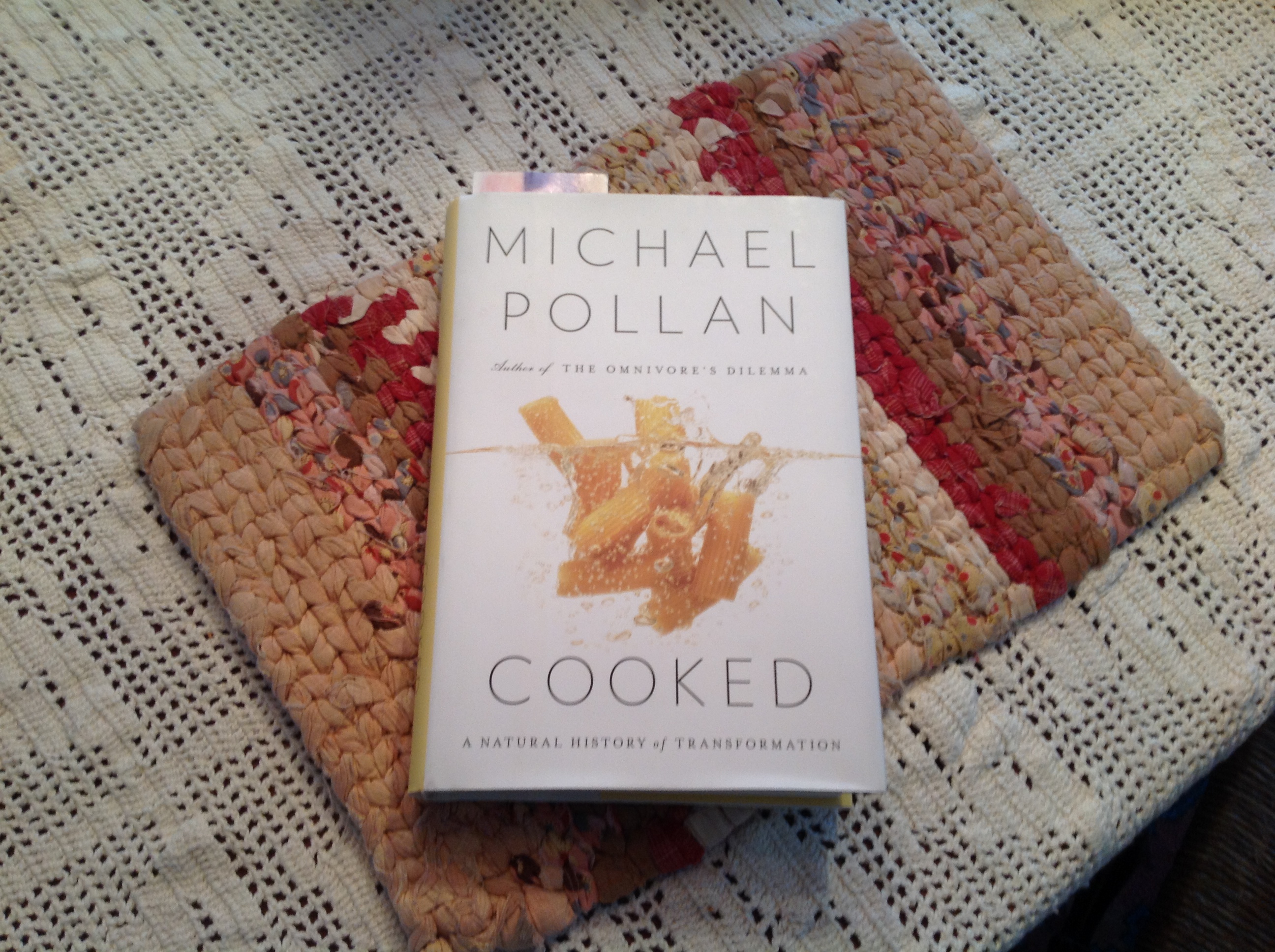
At night, before bed, I read fiction.  In these early morning hours, I am reading mostly nonfiction.  My current book is Michael Pollen’s Cooked, which I’m really enjoying in all kinds of ways.  I love the way Pollen THINKS about his subjects as it’s thinking that is informed by a lot of research of all kinds–to include spending time cooking.

IMG_0251

I’ve waded through the “fire” section–which is all about roasting meat over coals and all the implications of this very male form of cooking.  Think pit barbecue.

I’ve almost finished “water”–which involves stewing, souping, braising–or cooking in a pot with aromatics and liquids.  This “water” section also takes on the fact that we say we have no TIME to cook any more.  If buying food saves us thirty minutes a day, what are we doing with that time?

But wait!  Does buying food really save us thirty minutes?  Does going to a restaurant?

Americans work longer than any other industrial nation, writes Pollen.  Since 1967, we’ve added 167 hours, or the equivalent of a month’s full-time labor, to our work year.  With two parents involved, the amount is more like 400 hours.  Why?

This probably owes to the fact that, historically, the priority of the American labor movement has been to fight for money, whereas the European labor movement has fought harder for time–a shorter workweek, longer vacations.  Not surprisingly, in those countries where people still take home cooking seriously, as they do in much of Europe, they also have more time to devote to it (183).

And these people who cook are thinner, Pollen points out in a number of places in the book:  “the more time a nation devotes to food preparation at home, the lower its rate obesity” (191, 192).

So, we spend more time working.  We spend more time on the car.  We spend more time shopping.  We spend more time in front of screens (35 hours a week on average watching tv), surfing the Web (13 hours), and playing games on our smart phones.

Folks, WE HAVE TIME TO COOK good food.  It’s always already about the choices we are making, isn’t it?

We’re also doing a lot of what is called “secondary eating”–or eating while doing something else:  watching tv, driving, getting dressed, and so on.  We now spend 78 minutes a day in secondary eating and drinking (190).

Pollen and his family try an experiment:  Microwave Night.

He and his son go to the grocery store to pick out a dish for each person–three dishes (the third for his wife) and a dessert.  The total cost was $27.  (Pollen notes that he could have bought grass fed beef and veggies for a stew that would feed the family for two nights for the same amount of money.)  Their first obstacle is to buy food that has recognizable ingredients and isn’t full of hydrolyzed vegetable protein (soy).  Their second is realizing that some of their foods have packages that announce that they need to be cooked in the oven for best results and will take up to 45 minutes.

To make a longer story short, it takes an hour to microwave all the food–and at no time can they sit down together at the table as someone is always checking on the dishes in the microwave or their food isn’t ready yet, or is, but is getting cold.  Dinner time was a disaster in terms of family time.  The food also all tasted “remarkably similar”–no matter how exotically different–and much like what airline food used to taste like.

The next night, they ate a stew, visited over the table, and were relaxed and energized.  The stew had been in the refrigerator since Sunday–when it had been cooked for the week–a practice Pollen has worked into his schedule.

By the time the sweet smells of allspice, juniper, and clove began to fill the house, Isaac and Judith had gravitated to the kitchen; I never had to call them to dinner.  I brought the pot out to the table, and began serving everyone from it (200).

For the first time all day, it felt like we were all on the same page, and though it would be overstating things to credit that feeling entirely to the delicious braise, it would also be wrong to think that eating the same thing from the same pot, this weeknight communion of the casserole, had nothing to do with it, either (201)

So, I’m looking forward to the Air and Earth sections of Cooked.

And I remain certain that I will continue to “occupy my kitchen”–as I have all of my adult life.

Books, Documentaries, Reviews: “Ingredients” Documentary Looks at the American Food System

Books, Documentaries, Reviews:  July 10, 2014

INGREDIENTS Documentary Looks at the American Food System


Dr. Joseph Mercola posted information on this new documentary a few weeks ago.

Here’s a quote from Mercola’s post:

The American food system is nearing a state of crisis. Ingredients is a documentary that explores the failings of the industrial food model, and how the local food movement is gaining momentum as a far better alternative. The film presents a refreshing look at food from the standpoint of sustainability, safety, flavor, nutrition, culture, and community.

This documentary takes us across the US from the urban food deserts of Harlem to the biodynamic farms of the Hudson River and Willamette Valleys, and into the kitchens of several celebrated chefs—culinary game-changers who are teaching us all how to eat better.

The current system, focused on cheap convenience foods, is costing Americans dearly. Most Westerners have lost their primal connection to food. Mealtimes used to be savored and shared with others.

Food preparation is now typically viewed as a chore that interferes with other “more important” activities. This detachment from food represents a cultural “disconnect” between humans and the earth, to the detriment of both. It’s time for radical changes to our modern food paradigm, which is the subject of this uplifting documentary.

This article discusses some of the costs to our so-called “cheap” food system, the industrial practice of Confined Animal Feedlot Operations (CAFOs), monocrop culture, and GE foods.  It also discusses the exciting movement to reconnect to farmers and real food grown locally.

There is a film trailer to watch on the site–and an interview with Joel Salatin of Polyface Farm.

Take a look?  And try to catch the movie in your future.  It’s free on Amazon Prime at the moment…


“Ingredients” Documentary Looks at the American Food System.


Turkey Tracks and Books, Documentaries, Reviews

Turkey Tracks and Books, Documentaries, Reviews:  June 23, 2014

Maine Summer Sky and Reading on the Back Deck

The Flame Throwers:  Rachel Kushner


For the past three mornings, I’ve spent a few hours reading on the back deck–drinking my early morning tea and moving from sun to shade and back as the heat dictates.

The morning sky has been that incomparable shade of blue that we get here in the summer:

IMG_0305

Around noon, the wind comes up and, sometimes, clouds blow in.  But the mornings…  Well, they are a delight.

In the late afternoon the temps start to drop–all the way to high 40s last night–which means glorious sleeping.

What have I been reading?

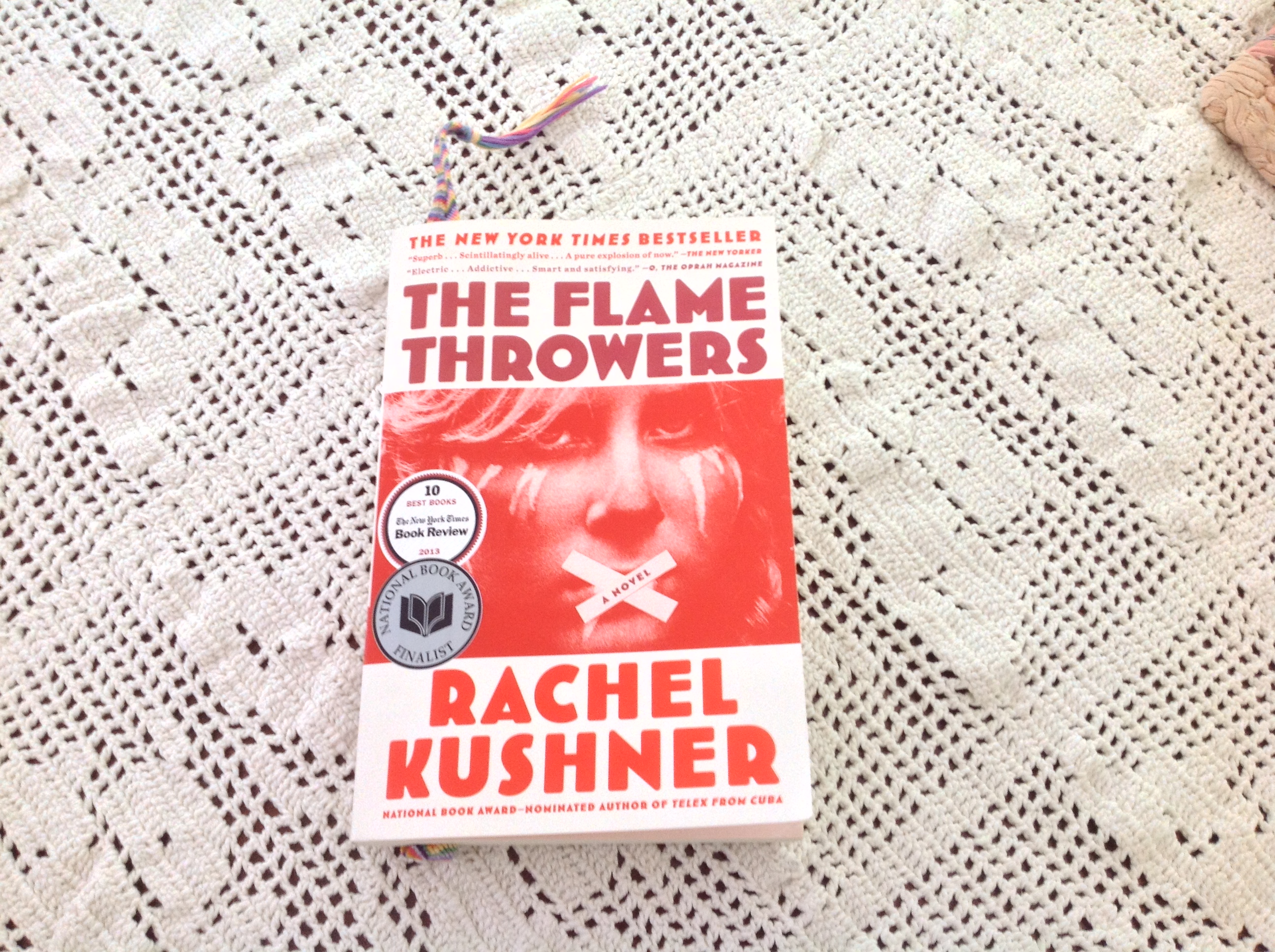
Our book club selection for July.

IMG_0307


I finished it today and will move on to something else.  For some reason, I seem to read more fiction during the summer.  Maybe that’s about slowing down and relaxing a bit.

This book is a New York Times bestseller–and for good reason.  It’s a dense, complicated, terrific read.

It was also one of the 10 best books of 2013, as picked by The New York Times.

And a National Book Award finalist.

The story takes place mostly in 1975-1977–in New York City and Italy.  Both were experiencing turbulent times, with a lot of labor unrest, anarchy, and pervasive challenges to “law and order” and the status quo.  Remember that 1968 was a year in which students all over the world (remember France?) famously protested  class inequities, the Vietnam war, loss of wages among the poor, and so on.  But that unrest continued for, obviously, a decade.

Reno thinks she is a “land artist”–which means she likes to create marks on the earth and photograph them.   What especially draws her are marks that chart speed/time and line–which involves motorcycles.   She falls into a company of very successful avant garde artists in New York City, but only in a “hanger on” sort of way.  Underneath is always already, the silencing of women and their reduction to sexual relationships.  The novel is much, much more complicated than these easy simplicities I am voicing here.

There are, in this novel, many riffs on language and the double meanings of words–or the loaded cultural baggage in words.  Here’s an example of one such riff–made and taped by one of the artists:

Home.  We say ‘home,’ not ‘house.’  You never hear a good agent say ‘house.’  A house is where people have died on the mattresses.  Where pipes freeze and burst.  Where termites fall from the sink spigot.  Where somebody starts a flu fire by burning a telephone book in the furnace.  Where banks repossess.  Where mental illness takes hold.  A home is something else.  Do not underestimate the power in the word home.  Say it. “home.”  It’s like the difference between ‘rebel’ and ‘thug.’  A rebel is a gleaming individual in tight Levi’s, a sneering and pretty face.  The kind Sal Mineo wet-dreams.  A thug is hairy and dark, an object that would sink to the bottom when dropped in a lake.  A home is maintained.  Cared for.  Loved.  The word home is savory like gravy, and like gravy, kept warm.  A good realtor says ‘home.”  Never ‘house.’  Always ‘cellar’ and never ‘basement.’  Basements are where cats crap on old Santa costumes.  Where men drink themselves to death.  Where children learn firsthand about sexual molestation.  But cellar.  A cellar is where you keep root vegetables and wine.  Cellar means a proximity to the earth that’s not about blackness and rot but the four ritual seasons.  We say ‘autumn,’ not ‘fall.’  We say ‘The leaves in this area are simply magnificent in autumn.’  We say ‘simply magnificent,’ and by the way, ‘lawn,’ not ‘yard.’  It’s ‘underarm’ to ‘armpit.’  Would you say ‘armpit’ to a potential buyer?  Say ‘yard’ and your buyer pictures rusted push mowers, plantar warts.  Someone shearing off his thumb and a couple of fingers with a table saw.  A tool shed where water-damaged pornography and used motor oil funneled into fabric softener bottles cohabitate with hints of trauma that are a thick and dark as the oil.

And on and on it goes.

Here’s the opening paragraph of The New York Times book review by Christina Garcia–followed by the url to the review:

In “The Flamethrowers,” her frequently dazzling second novel, Rachel Kushner thrusts us into the white-hot center of the 1970s conceptual art world, motorcycle racing, upper-class Italy and the rampant kidnappings and terrorism that plagued it. It’s an irresistible, high-octane mix — and a departure from the steamier pleasures of her critically acclaimed first novel, “Telex From Cuba.” The language is equally gorgeous, however, and Kushner’s insights into place, society and the complicated rules of belonging, and unbelonging, can be mordantly brilliant. None of the characters in “The Flamethrowers” are quite what they seem, fabricating pasts as nonchalantly as they throw together their art. Above all, they hunger to be seen, to distinguish themselves from the ordinary. One artist, responding to the question of why he invents, defends his florid lies as “a form of discretion.”

Garcia finds the novel’s ending chapters…disjointed.  I did not, though I see what she means.  I think when Kushner’s characters move aside their imaginative lives and touch down to earth, something is lost–for them.  That truth (what else is there?  is this all there is?) is the hard truth we all must face as we face our own mortality.  The two main characters have to…grow up…amidst the disjointed facets of their lives which are made more disjointed by chaos and violence.

Books, Documentaries, Reviews: BILLY LYNN’S LONG HALFTIME WALK, Ben Fountain

Books, Documentaries, Reviews:  June 23, 2014

Billy Lynn’s Long Halftime Walk

Ben Fountain


IMG_0306

It’s a prize winner–and it should be:

National Book Critics Circle Award for Fiction

Finalist, National Book Award

Finalist UK National Book Award

Los Angeles Ties Book Award for Fiction

Flaherty-Dunnan First Novel Prize

Texas Institute of letters Jesse H. Jones Award for Fiction

Pen New England Cerulli Award For Excellence in Sports Fiction

And, here’s the The New York Times book review:   http://www.nytimes.com/2012/05/20/books/review/billy-lynns-long-halftime-walk-by-ben-fountain.html

BUT, 

while I think everyone in America should read this novel, I know that not all that many, in terms of total percentages, will.  Which is too bad, as this country badly needs a corrective in its national consciousness about the thing we call war. 

I will caution that this novel involves a group of Army soldiers who talk like soldiers and, often, act like the 19 and 20-something year olds that they are.  These fellows have been exposed to terror and fear and actual combat for some time.  In one encounter, an embedded cameraman captures heroic actions in a fight that gets uploaded onto utube and plays on the nightly news.  We now have the “Bravo Heroes” who have been brought home for a “victory” tour designed to make a case for the war.  This “vacation” from the war is undergirded horribly by the certain knowledge that they will be going back very shortly.

Fountain has mounted a devastating critique of a country of well-meaning nice folks who speak a cultural language ABOUT war (freedom, kick their buts, did your duty, Nine 11, terrorists) and enjoy violent games (football) and mindlessly send young men to war without really understanding what happens to those young men when the full impact of actual war with all its violence surrounds them.  Nor do these citizens understand the relative ineffectiveness of this (Iraq) war effort.  Nor do these same nice folks understand how these young men feel when they come home and encounter the fact that the country whose “freedom” they are fighting for is but a giant shopping mall with a country attached (as Fountain says somewhere in the book)–complete with wealthy industry captains (like the owner of the Cowboys football team who tries to win what he wants at all costs and without any regard for actual human beings and who behaves beyond despicably when he does not “win” what he wants from these soldiers.  The underbelly of that mindset is much like closing that bridge in New Jersey to get back at a local mayor.)

Here’s a quote:

Americans fight the war daily in their strenuous inner lives.  Billy knows because here at the contact point he feels the passion every day.  Often it’s in their literal touch, a jolt arcing across as they shake hands, a zap of pent-up warrior heat.  For so many of them, this is the Moment:  His ordeal becomes theirs and vice versa, some sort of mystical transference takes place and it’s just too much for most of them, judging from the way they choke in the clutch.  They stammer, gulp, brainfart, and babble, gum up all the things they want to say or never had the words to say them in the first place, so they default to old habits.  They want autographs.  They want cell phone snaps.  They say thank you over and over and with growing fervor, they know they’re being good when they thank the troops and their eyes shimmer with love for themselves and this tangible proof of their goodness.  One woman bursts into tears, so shattering is her gratitude.  Another asks if we are winning, and Billy says we’re working hard.  “You and your brother soldiers are preparing the way,” one man murmurs, and Billy knows better than to ask the way to what.  The next man points to, almost touches, Billy’s Silver Star.  “That’s some serious hardware  you got,” he says gruffly, projecting a flinty, man-of-the-world affection.  “Thanks,” Billy says, although that never seems quite the right response.  “I read the article in Time,” the man continues, and now he does touch the medal, which seems nearly as lewd as if he’d reached down and stroked Billy’s balls.  “Be proud,” the man tells him, “you earned this,” and Billy thinks without rancor, How do you know?  Several days ago he was doing local TV and the blithering twit-savant of a TV newsperson just came out and asked:  What was it like?  Being shot at, shooting back.  Killing people, almost getting killed yourself.  Having friends and comrades die right before your eyes.  Billy coughed up clots of nonsequential mumblings, but as he talked a second line dialed up in his head and a stranger started talking, whispering the truer words that Billy couldn’t speak.  It was raw.  It was some fucked-up shit.  It was the blood and breath of the world’s worst abortion, baby Jesus shat out in squishy little turds.

That newsperson sounds a bit like the one in the Hunger Games movies…

Doesn’t s/he?

You know, as long as we are distracted by the “bread and circus” of American life, we will not “see” what’s really going on in America these days.  And underneath this story, is a plea to follow the money, to reject the fireworks and stars at halftime, to understand the real costs being extracted from all of us…

This novel also resonates strongly with Stephen Kinzer’s The Brothers, which I discussed elsewhere on this blog.


Interesting Information: “Ingredients” Documentary Looks at the American Food System

Interesting  Information:  May 24, 2014


INGREDIENTS

A New Documentary

Dr. Joseph Mercola posted a blog on the new documentary Ingredients recently.

This blog post of mine is not included under “Books, Documentaries, Reviews” because I have not yet seen this film

Here’s part of what Dr. Mercola’s blog says.  There is more, of course.  I put the url at the bottom of this entry.  Do pay attention to the real costs incurred in “cheap” food.  And note that on average Americans pay less than 7% of their income for their food weekly–yet what you put into your body about three times a day has real and important connections to your well being and health.  Poor health, as is noted below, is expensive.


The American food system is nearing a state of crisis. Ingredients is a documentary that explores the failings of the industrial food model, and how the local food movement is gaining momentum as a far better alternative. The film presents a refreshing look at food from the standpoint of sustainability, safety, flavor, nutrition, culture, and community.

This documentary takes us across the US from the urban food deserts of Harlem to the biodynamic farms of the Hudson River and Willamette Valleys, and into the kitchens of several celebrated chefs—culinary game-changers who are teaching us all how to eat better.

The current system, focused on cheap convenience foods, is costing Americans dearly. Most Westerners have lost their primal connection to food. Mealtimes used to be savored and shared with others.

Food preparation is now typically viewed as a chore that interferes with other “more important” activities. This detachment from food represents a cultural “disconnect” between humans and the earth, to the detriment of both. It’s time for radical changes to our modern food paradigm, which is the subject of this uplifting documentary.

The Exorbitant Cost of ‘Cheap Food’

Americans have become dependent on cheap convenience foods that can be “prepared” in five minutes or less—or without taking both hands off the steering wheel. More than 17,000 new processed food products are introduced each year. Bright, catchy packaging conceals foods laden with chemicals, unhealthful fats, and high fructose corn syrup, all of which contribute to today’s skyrocketing rates of obesity and illness, especially among our youth.

Americans spend less on food than any other industrialized nation—an average of $151 per week, which amounts to less than seven percent of their income. How can such a low value be placed on something so important for your health and longevity?

The US beef industry has managed to cut its prices in half since 1960. Unfortunately, cheap food contains cheap and toxic ingredients… and you get what you pay for. Food imports have increased four-fold over the past decade, overwhelming the FDA with inspections. Of the 200,000 shipments from China in 2006, less than two percent were sampled for quality and safety.

“Cheap food” isn’t cheap when you consider all of the hidden costs associated with it. You make your first payment at the grocery store—just consider this your down payment, because you may be paying for it FIVE more times!

  1. Subsidies: At tax time, you pay for “cheap food” a second time with your contribution to agricultural subsidies. Processed food is mostly corn, canola, soy, rice, wheat, and sugar. These products (along with cotton) account for 98 percent of subsidies.
  2. Foodborne Illnesses: You may pay for cheap food a third time if you visit your doctor as a result of foodborne illnesses. CDC estimates that foodborne illnesses such as E. coli and salmonella cause 5,200 deaths each year in the US. Mass scale operations are riddled with quality control problems, leading to outbreaks of illness and food recalls.
  3. Chronic Disease: You pay for it a fourth time if you return to your doctor later for a chronic illness—heart disease, obesity, diabetes, stroke, and cancer—consider these “foodborne” illnesses that just take a little longer to manifest. According to CDC, one in three children born in the year 2000 will develop type 2 diabetes.
  4. Environment: As soon as the factory farmer files for bankruptcy and leaves, you pay for your food a fifth time. This is what often happens when they are asked to clean up their land—a monumental expense that often results in bankruptcy, sticking the rest of us with the tab.
  5. Energy: The sixth time is when you pay your fuel bill. Processed foods and imported foods have an extremely large energy footprint. One-fifth of US fossil fuel consumption goes to the growing, packaging, and transporting of food.


http://articles.mercola.com/sites/articles/archive/2014/04/19/ingredients-documentary-american-food.aspx


Books, Documentaries, Reviews: David Perlmutter, MD, with Kristin Loberg: Grain Brain

Books, Documentaries, Reviews:  May 15, 2014

Sylvia Onusic’s Review

of

David Perlmutter, MD, with Kristin Loberg

Grain Brain


First, Dr. Sylvia Onusic is a Board Certified and licensed nutritionist AND has a PhD in Public Health education.

Dr. Onusic reviewed Perlmutter and Loberg’s book Grain Brain in the Winter 2013 Wise Traditions, the journal of the Weston A. Price Foundation:  Grain Brain – Weston A Price Foundation.

Dr. Onusic gives the book a qualified “thumbs up,” and in the review surfaces the problems she finds within its pages–such as not addressing “the importance and role of healthy carbohydrates in the diet, especially those prepared in ways which enhance their nutrient absorption by soaking and fermenting.”  Or, addressing that “old forms of wheat such as spelt and kamut do not contain the high levels of gluten that modern hybrids do” and that fermenting grains can make them acceptable to those with gluten sensitivities.  Or, the importance of raw milk and its products.  Or, that he claims that DHA (docosahexaenoic acid) made from algae is a “source equal in value to cod liver oil.”  But DHA from algae is man-made, while cod liver oil is a natural source of DHA.  Additionally, algae DHA has a record of causing digestive upsets.  ANd he neglects to explain that while vitamin D is important, it needs to be used with vitamins A and K, as “all three are needed together.  (Cod liver oil contains all three.)

I was intrigued with the discussion of specific foods that “cross-react” with gluten (producing the same reaction).  They include coffee, chocolate, and non-gluten containing grains.  PEG, polyethylene glycol, found in many personal care products is also cross-reactive with gluten.  PEG is found in the gallon of bowel prep used for a colonoscopy and can cause “inflammation which shows up in the test results.”

Also interesting:  “Modern foods contain up to forty times more gluten than traditional grains, and modern gluten can be addictive.”

But, she also says the following:

Grain Brain is a good read packed with a great deal of knowledge related to reviews of the latest research in current nutrient brain-related issues, as well as good detail on gluten sensitivity, celiac disease, testing, cholesterol and fats, and hormones related to inflammation and obesity.  The book continues to enjoy phenomenal success on a number of New York Times best seller lists.

Caesareans and Breast Feeding and food sensitivities:

Research shows that babies born through caesarean section have a higher risk of developing ADHD because they miss out on the probiotic inoculation that babies normally receive when passing through the birth canal.  Breastfeeding is also important in that it may dampen later immune response to gluten and the development of food sensitivities.

Gluten sensitivity can be tested for at Cyrex Labs or Entero Labs.  (I used Entero.)


Books, Documentaries, Reviews: Elizabeth Gilbert’s THE SIGNATURE OF ALL THINGS

Books, Documentaries, Reviews:  April 15, 2014

The Signature of All Things

Elizabeth Gilbert

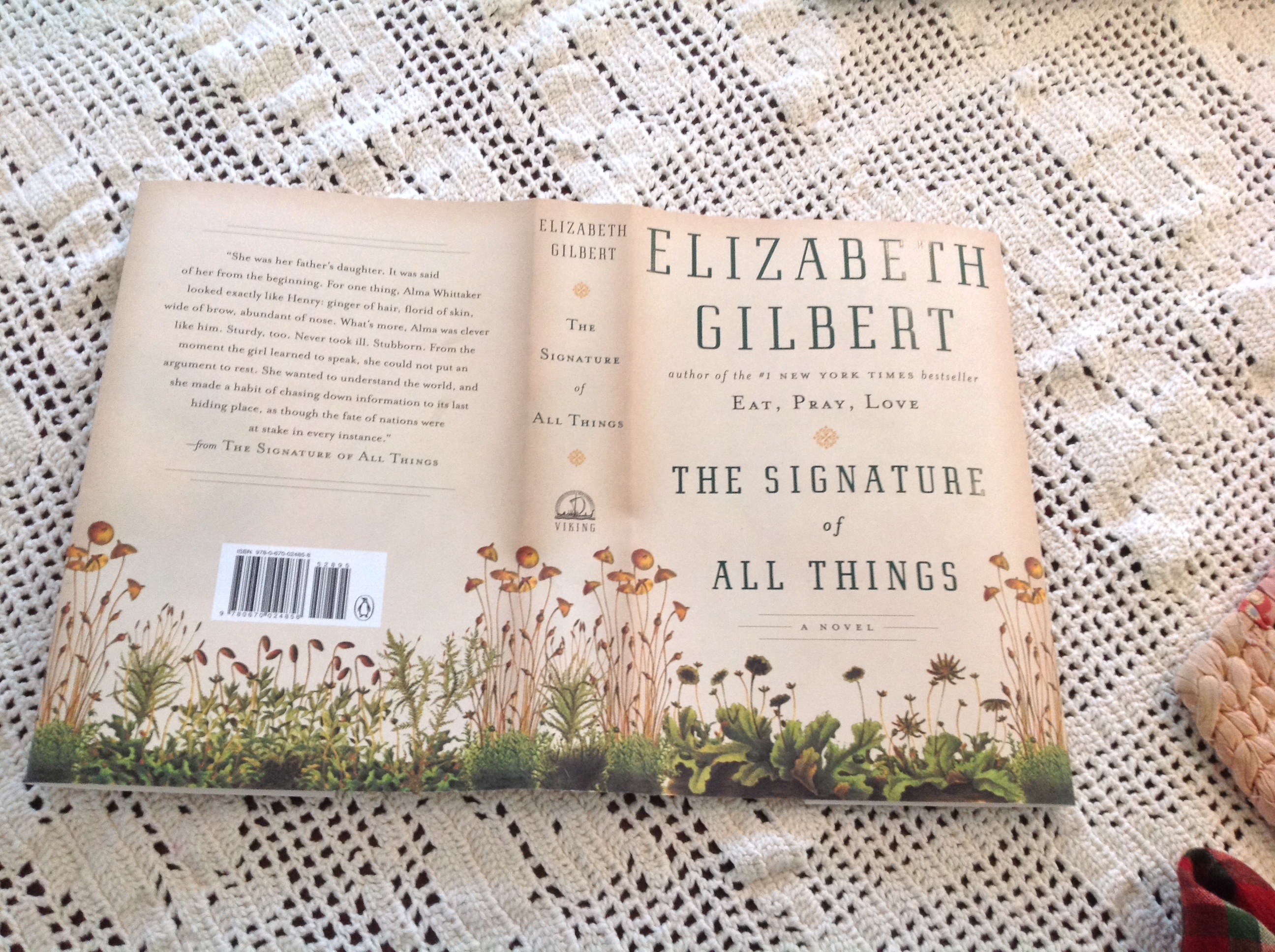
I am so enjoying reading Elizabeth Gilbert’s The Signature of All Things.

IMG_0273


Our book club met yesterday, and three of us out of six just started this book.  But ALL of us were enjoying it or had finished it and liked it a lot.

Only one of the six liked Gilbert’s Eat, Pray, Love.  I didn’t read it, but saw the movie and thought it pretty…lame.

Many of us were afraid this new novel would also be…lame, so we were delighted to realized that Gilbert is a strong writer who, here, is weaving a compelling, interesting story.

The novel takes place from 1800 forward–in that era when western men scattered across the globe to discover its treasures.  In this case, the treasures are plants of all types.  And, fortunes are made on the medicinal plants, for instance.

I’m only about 100 pages into the 500-page novel, but look forward each night to a session of reading.


Books, Documentaries, Reviews: Jennifer McGruther’s THE NOURISHED KITCHEN

Books, Documentaries, Reviews:  April 29, 2014


The Nourished Kitchen

Jennifer McGruther


WOW!

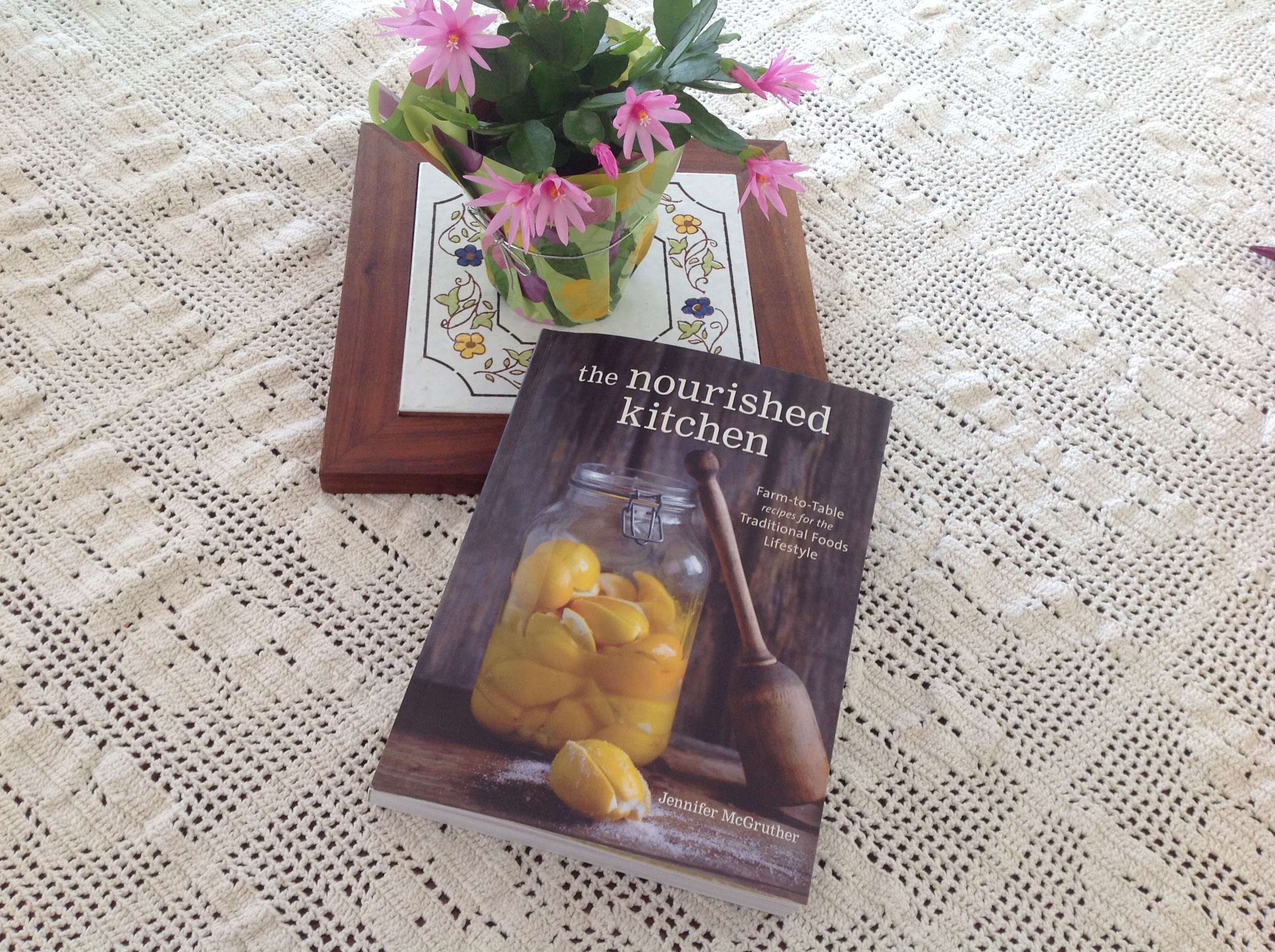
Here’s a terrific new cookbook that’s playing off of Sally Fallon Morell and Dr. Mary Enig’s book Nourishing Traditions.  Morell and Enig are part of The Weston A. Price Foundation organization.


IMG_0255


My friend Rose Thomas, aka “Chicken Rose” to my family as there are others named Rose in my life, dropped by the other day for a cup of tea.  I told her that I had just gotten a really nice new cookbook, and as soon as I picked it up to show her, she said “I just got it too.  On my Kindle.”  But she had a lot of fun actually holding the book in her hands and said so.

So, it’s a book that’s “in the wind” on a number of whole-foods sites.

The author is from Colorado–in the mountains–and seems to have a kind of rural setting.  So there are discussions of foraging for strawberries, wild greens, and cooking wild game.  We might not be able to get elk, but we can get deer and rabbit here in Maine. And our berry gardens are superb.

There’s a terrific chapter on cooking and fermenting ancient grains.  And a resource section that tells where to buy them.

There’s an exciting chapter on fermented foods–with some exciting combinations of ingredients.

Indeed, what’s piquing my interest the most are the different combinations this cook is using in her every day foods.

The section on desserts have some healthy, interesting, delicious looking combinations.

This one is HIGHLY RECOMMENDED!

PS:  Those are salt-preserved Meyer lemons on the cover–an “asset” I keep in my refrigerator all the time.  I cover with a film of olive oil that is delicious drizzled over any kind of baked fish.  A  tablespoon of the chopped lemon and oil put into smashed potatoes with butter adds a delicious sparkle to the mixture.