So, today I am, like others here along the South Carolina coast, waiting to see if Hurricane Lee does indeed make the predicted turn to the north.
While that turn north would make me happy, it would also mean that it likely would head to the Gulf of Maine coast, where so many of my friends live. They have had the wettest spring/summer on record, so the ground is soft and already wet. It is still raining every day or every few days in coastal Maine, say my friends. High wind would likely topple trees–so my Maine friends are worried.
I’ve seen quite a few of these beautiful butterflies soaring around my flowering beds in recent weeks.
What interesting patterns on the wing undersides:
It’s a Variegated Fritillary:
Variegated Fritillary. Identifying Characteristics: Variegated Fritillary butterflies have a wingspan of 1.75 to 2.25 inches. The coloring of this species is tawny brown to burnt orange with black dots and lines.
Son Bryan, DIL Corinne, and their three girls scour the beach when they arrive there, looking for prehistoric shark teeth.
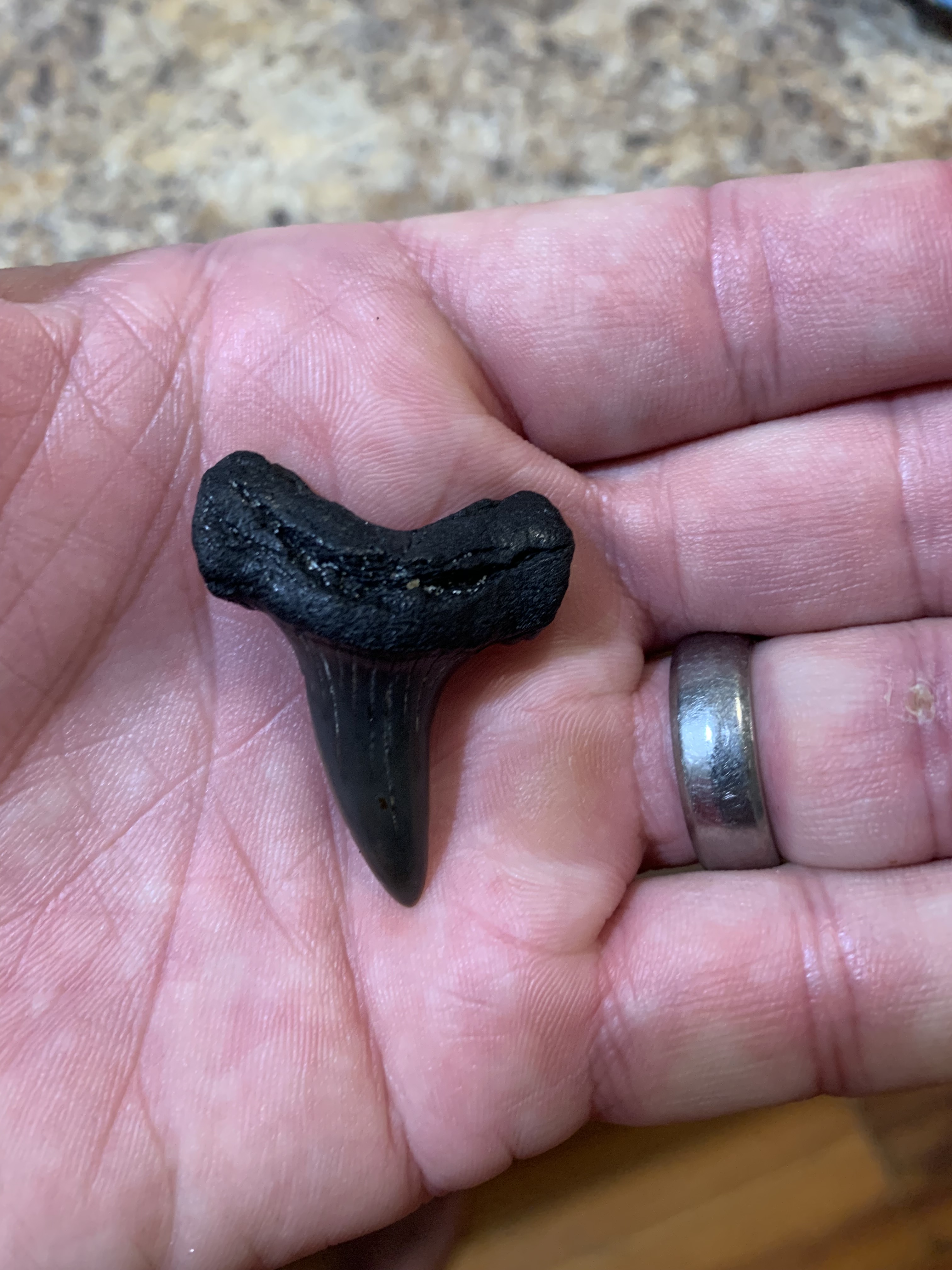
This one, found recently, is a rare find–as it is SO BIG and not broken. It is from a GRANDPARENT to the famous Megalodon shark, an apex predator back in its time. (There are folks here who can identify these shark teeth.)
Megalodons were HUGE sharks, kin maybe to today’s Great White Sharks. Here’s info from Britannica about the size of this shark:
“This data suggests that mature adult megalodons had a mean length of 10.2 metres (about 33.5 feet), the largest specimens measuring 17.9 metres (58.7 feet) long. Some scientists, however, contend that the largest forms may have measured up to 25 metres (82 feet) long. Studies estimate that adult body mass ranged from roughly 30 metric tons (1 metric ton = 1,000 kg; about 66,000 pounds) to more than 65 metric tons (about 143,000 pounds), adult females being larger (in both length and mass) than adult males” (https://www.britannica.com/animal/megalodon).
Here is another recent find that is smaller but in good condition:
The idea of the great Megalodon sharks has sparked a novel that, in turn, has sparked several movies called THE MEG. Wikipedia explains:
I will confessed I watched the movie–I stumbled into it one night. And it was interesting to view how the movie portrayed the bigness of the Megalodon shark.
Here’s a link to more info on the Megalodon from wiki:
But first, here is more info on “the turtle”–learned from my family who live nearby. The turtle is likely VERY old. Three generations of the family who own her have taken care of this turtle: the grandmother passed the turtle to her daughter, who passed the turtle eventually to her daughter, the current owner. The turtle IS… VERY BIG. And, obviously, long-lived.
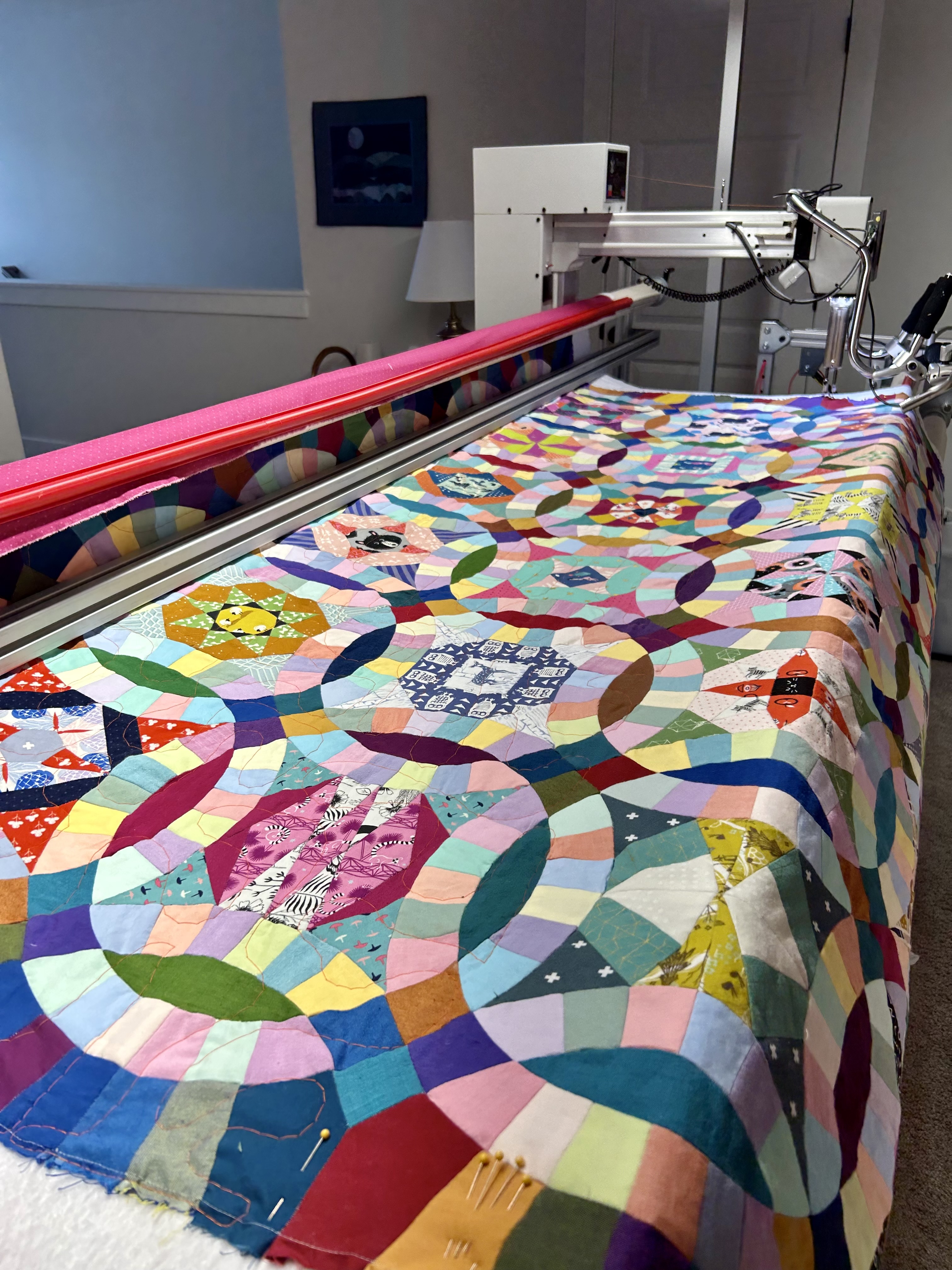
“Happy” is now basted and ready for hand quilting. Here she is on the longarm.
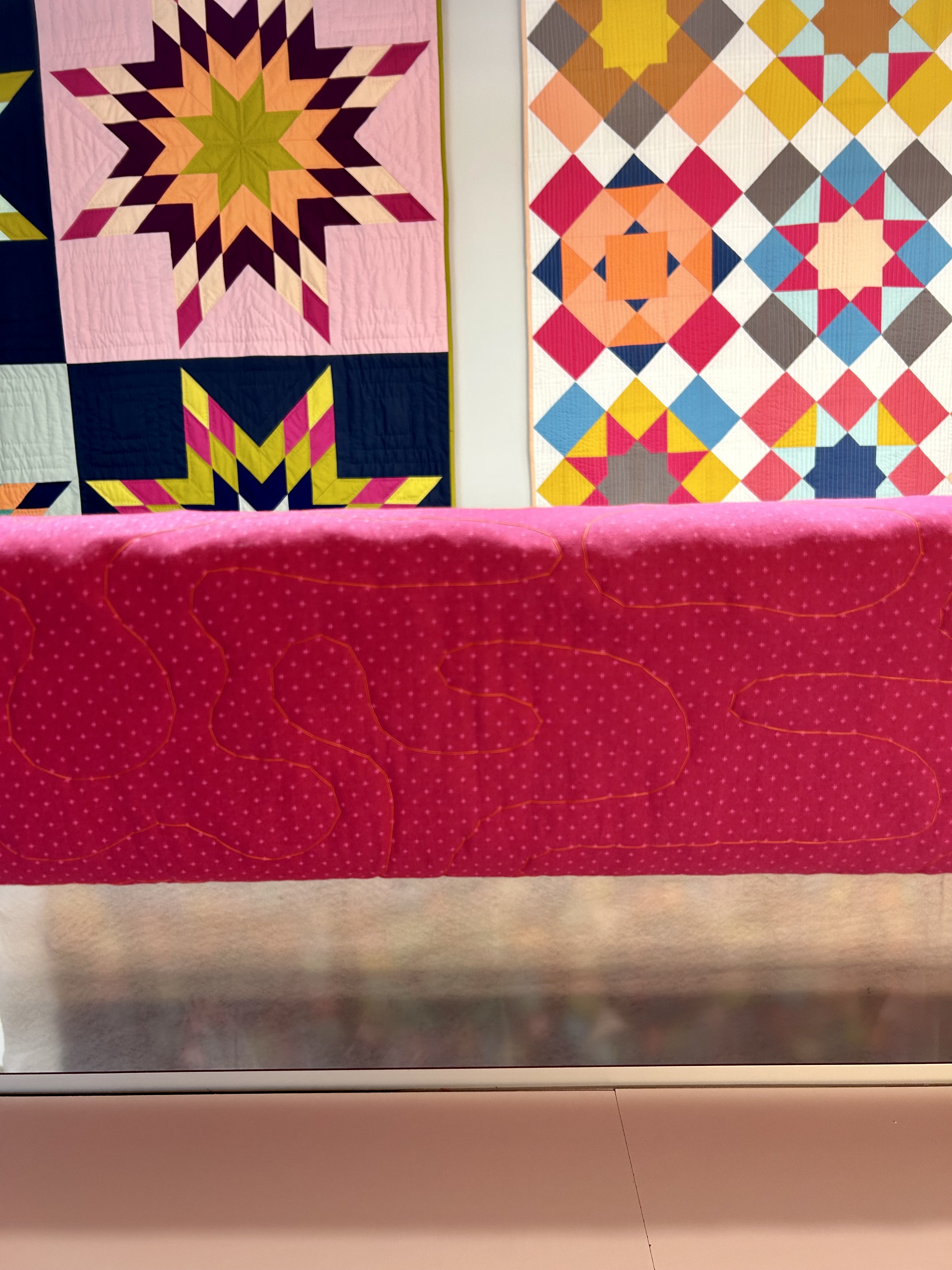
Below you can see the big basting stitches I can do on the longarm. And, this time I covered the quilt more densely than I did on Traverse. It is very easy to clip these threads when I need to do that.
The backing is this lovely Ruby Star Society fabric–which is in keeping with the Cotton+Steel/Ruby Star Society fabrics I used in the centers of the blocks on the front.
And here she is all done.
It is really hard to get enough light on a quilt in this room. But my longarm light bar gives me plenty of light.
I’m thinking I’ll need a dark solid for binding. I had wondered about the backing fabric for binding, but… I don’t think so. But I’m not sure about that yet.
Now I’ll put Big Red on the longarm. Meanwhile, I think I’ve stopped moving around blocks on the “Summer Camp” mystery quilt from the Modern. Quilt Studio. Maybe it needs to be called “Summer Camp.”
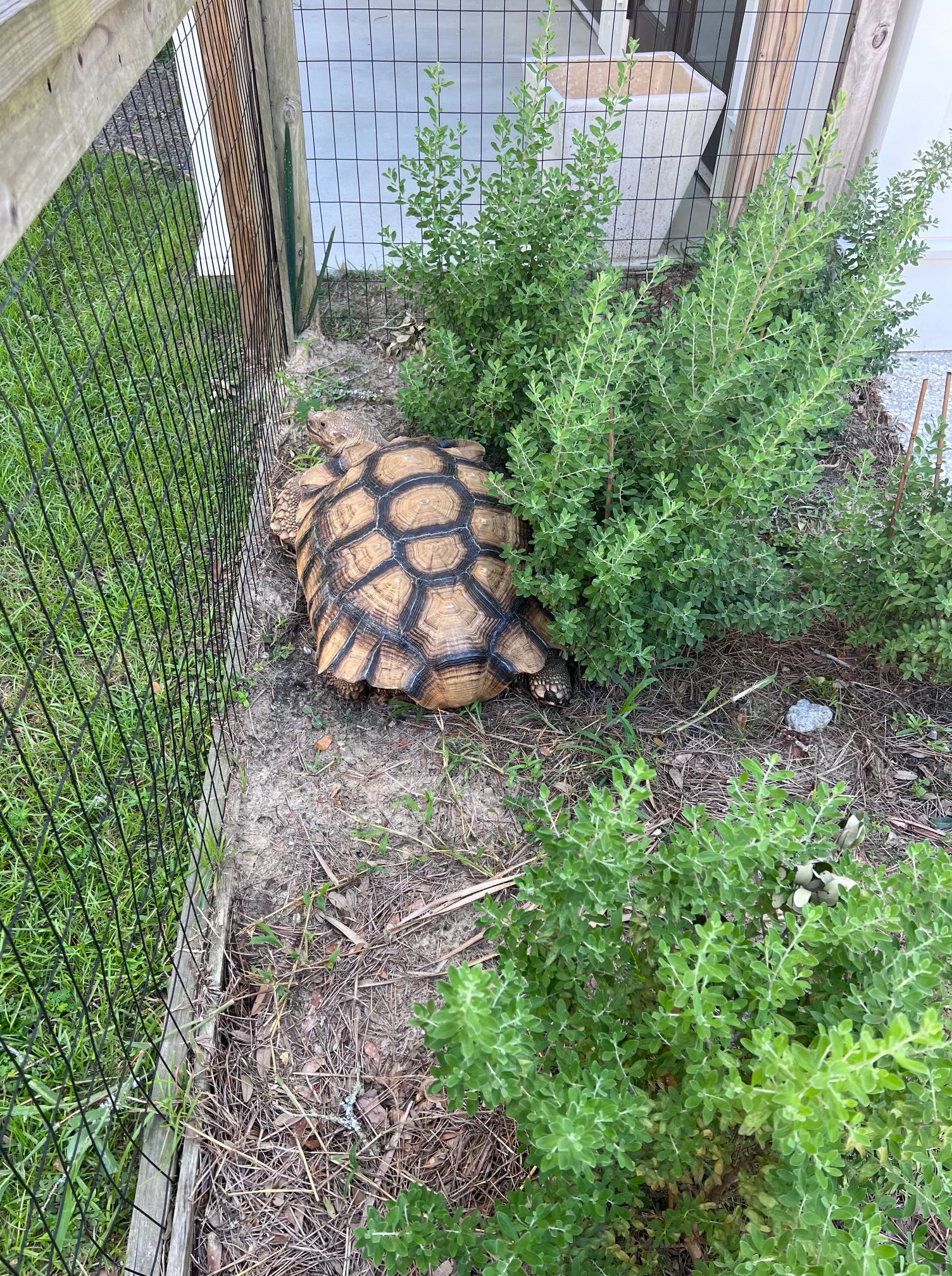
On Saturday Granddaughter Mina sent me a picture of this turtle, which was next door. She identified it as a “pet,” and I thought she was joking.
My first question: what kind of turtle is it?
She thought it a tortoise.
I could not find such a large tortoise in the list or images of native South Carolina turtles.
Along the google way I found this verbiage on identifying types of turtles: “If you know what to look for, you can spot the differences between freshwater, land, and sea turtles. Freshwater turtles are often small with flat feet. Land turtles, called tortoises, have big, round shells and flat feet. Sea turtles that have smooth, flat shells and flippers for swimming.” So tortoise is a category. But what kind of tortoise. Seems larger than the ones I looked at online.
And I found that the carapace pattern is called “rings.”
Aha! On Monday, I tried again and GOT IT. It’s a Sulcata Tortoise.
It’s finally cooler–so I went with son Bryan, Corinne, and two of the three girls to the Isle of Palms beach around 11:30. We arrived with chairs, lunches, water, and all the beach toys–which involves a ride to an access path on the golf cart, which also pulls a little blue cloth wagon filled with all one would need at the beach.
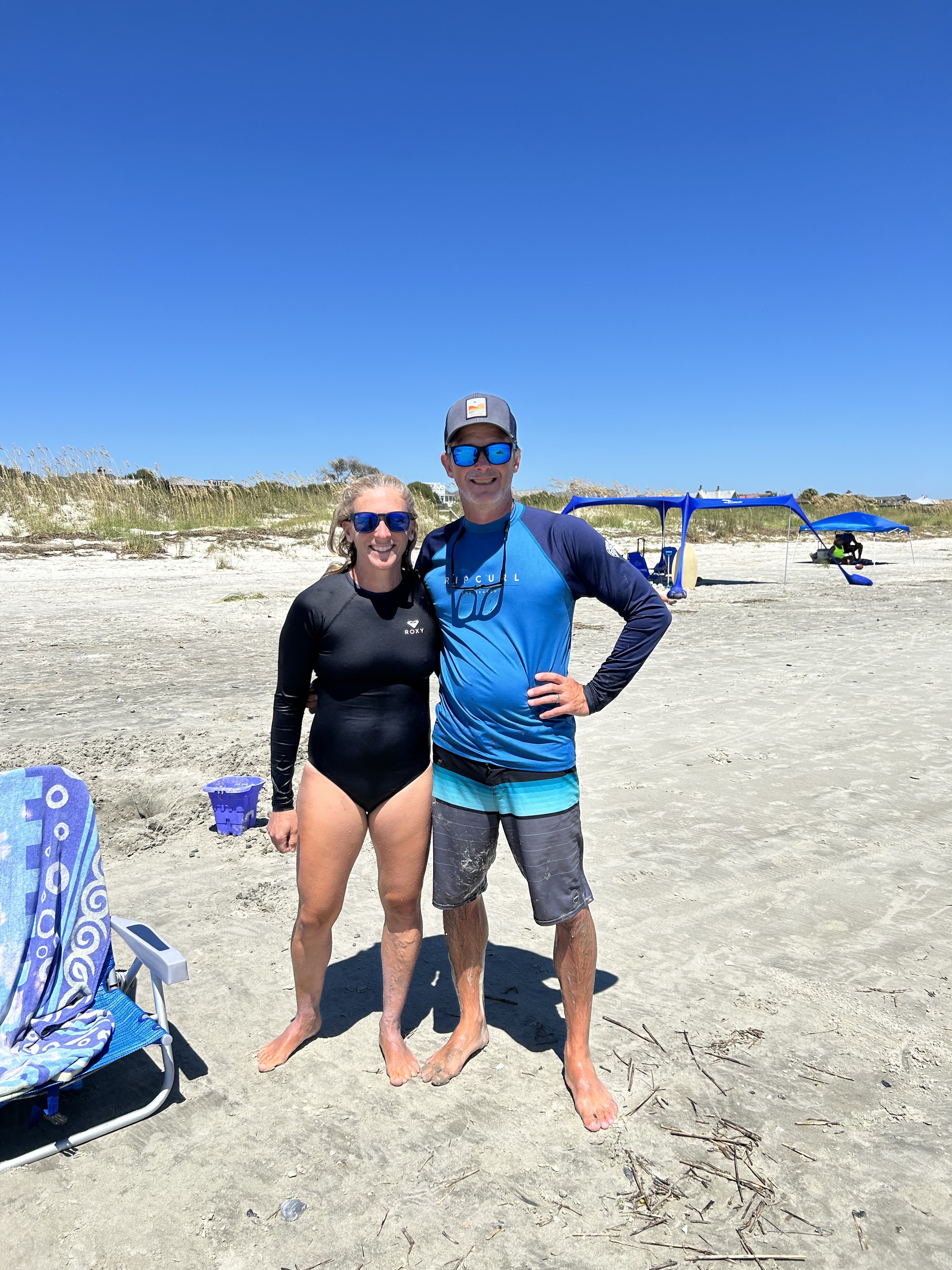
It was a wonderful outing, and I swam with Corinne and granddaughters. We all like to body surf, which I had not done for 30+ years. It was so much fun. It was full high tide with very little current, and the waves were perfect. Here I am with the granddaughters, just out of the surf.
Here are Bryan and Corinne–both of whom spent some time looking for shark’s teeth in the wake of the falling tide. But, more on shark teeth in another post. Note they wear sun-protective tops, which means that part of one’s body does not need sun screen. I have a good top too.
Corinne packs an awesome lunch for her family. Each has an individual Bento box filled with healthy food, and there are other snacks as well. (I bring my own lunch given my food issues.)
Here is Corinne unpacking the lunches. Her wide-brimmed hat protects her face, ears, and neck.
After lunch, the tide had dropped enough for Bryan to dig a hole that reached water, so he could make a sand castle. He loves doing that and has not had time this summer to make one, given all their summer trips away. This one is small compared to his usual sand castle efforts that are better started at a lower tide.
Building the sand castle becomes a family effort eventually. Those chairs in the background are ours, and you can see the blue wagon that carries everything but the surf boards, which go on top of the golf cart. I have a wagon like this one that I used for quilt retreats. They fold up and store so easily in a small space.
We swam again, we three wave riders, while Bryan built his sand castle.
I left them when I felt my Maine-white skin starting to get burned. My tan is better now, but not anywhere it needs to be for sun protection here. Once home I showered, washed all the beach clothing/towel, made a big espresso, and settled in to rest and read.
I can still remember vividly when I got my first library card at the library at Barksdale Air Force Base in Shreveport, Louisiana. I was about 9 or 10 I think and could ride my bike there on my own. I have never lost my wonder and excitement about libraries, which eventually led to the time I spent in the stacks at George Mason University’s campus library and libraries also available to me in the Washington, DC, area, like the big national library downtown.
My local library here is the Wando Mt. Pleasant Public Library. It is less than 10 minutes from my house–depending on how many red lights one encounters. It is very near Wando High School, which makes sense. Wando is a big name here–for one of the three BIG rivers that reach the coast around Charleston: the Wando, the Cooper, and the Ashley.
I visited the library one day this past week to get some new “pleasure” books to read. I read nonfiction all the time, but mostly online now. I also wanted to check out this local library more thoroughly than I had before now. The local library can tell you a lot about one’s community.
There is a kiosk in the front of the library where you can pay $1 for any books there you want to buy. There are always good books on that kiosk. Basically, I “rent” some books so I don’t have the pressure of reading them in a hurry. When I’m done with these books, I’ll return them to the library. These days, I read at my noon dinner and afterwards with my espresso coffee–as I hand-sew at night, often until quite late, while watching something on tv.
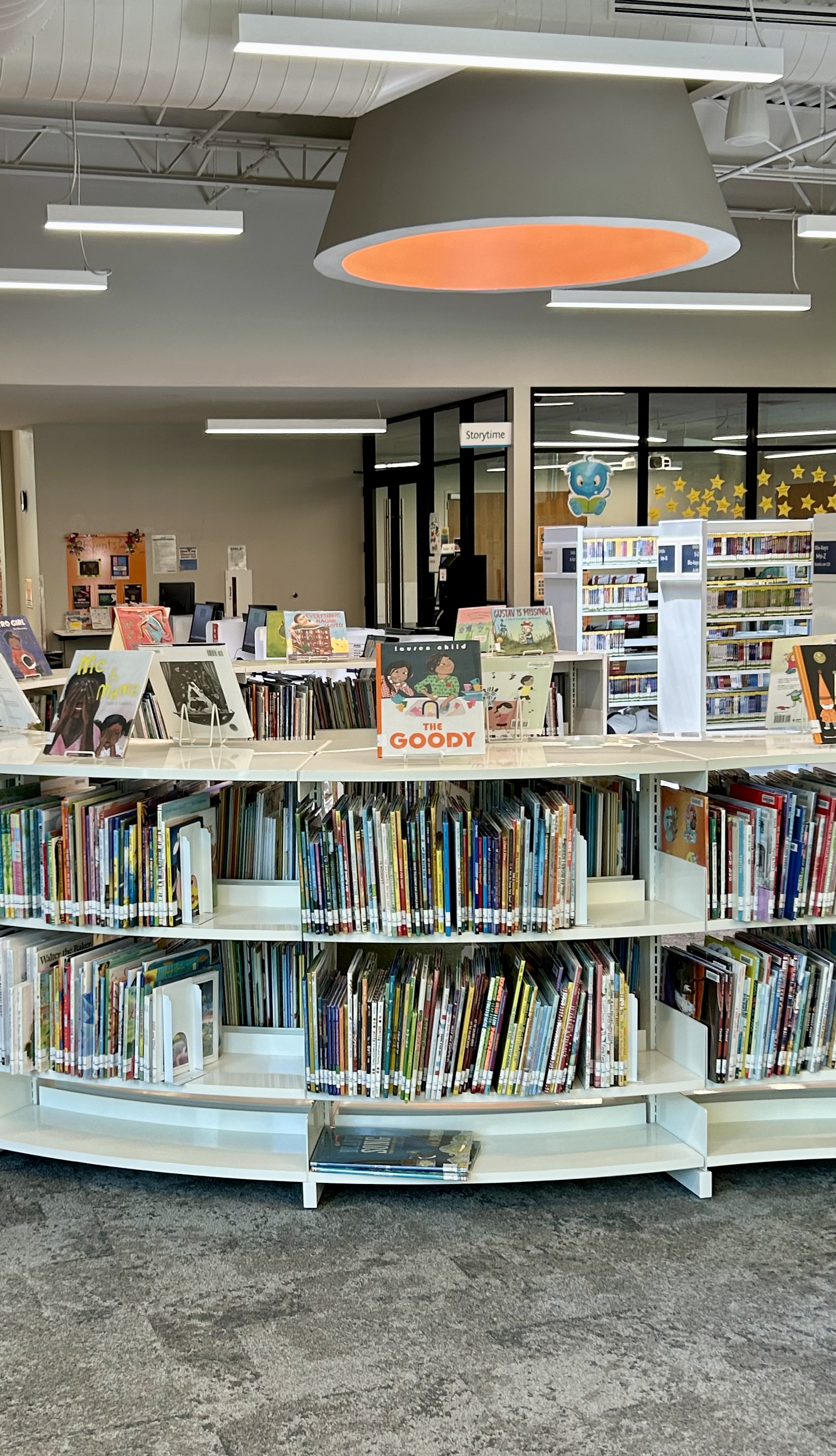
From the outside, the building is low and not impressive, with lots of parking. Inside, the spaces are filled with light, color, and exciting places to investigate, especially for young children. There are so many windows, each with a nice view. *Note: I can’t have (library policy) and don’t want people in any of my pictures, so I cropped the pictures I took to take out people. A person’s right to privacy is a cherished issue for me.
Here, in the children’s section, there are wonderful nooks that invite exploration. On a weekday morning, I was surprised by how many parents, including lots of dads, and how many children were in the library. This nook has some entrances that are low to the floor, which must surely call to a child. The “balloons” rise to the sky, which is very high in this alcove.
There were LOTS of cushioned reading places in front of windows–and only this one was not occupied by a parent reading to a child.
The inside of the children’s section has two very long swirling, serpentine shelves of books, each topped with books that, hopefully, draw a busy child’s attention. And note the little table nestled into one of the curves.
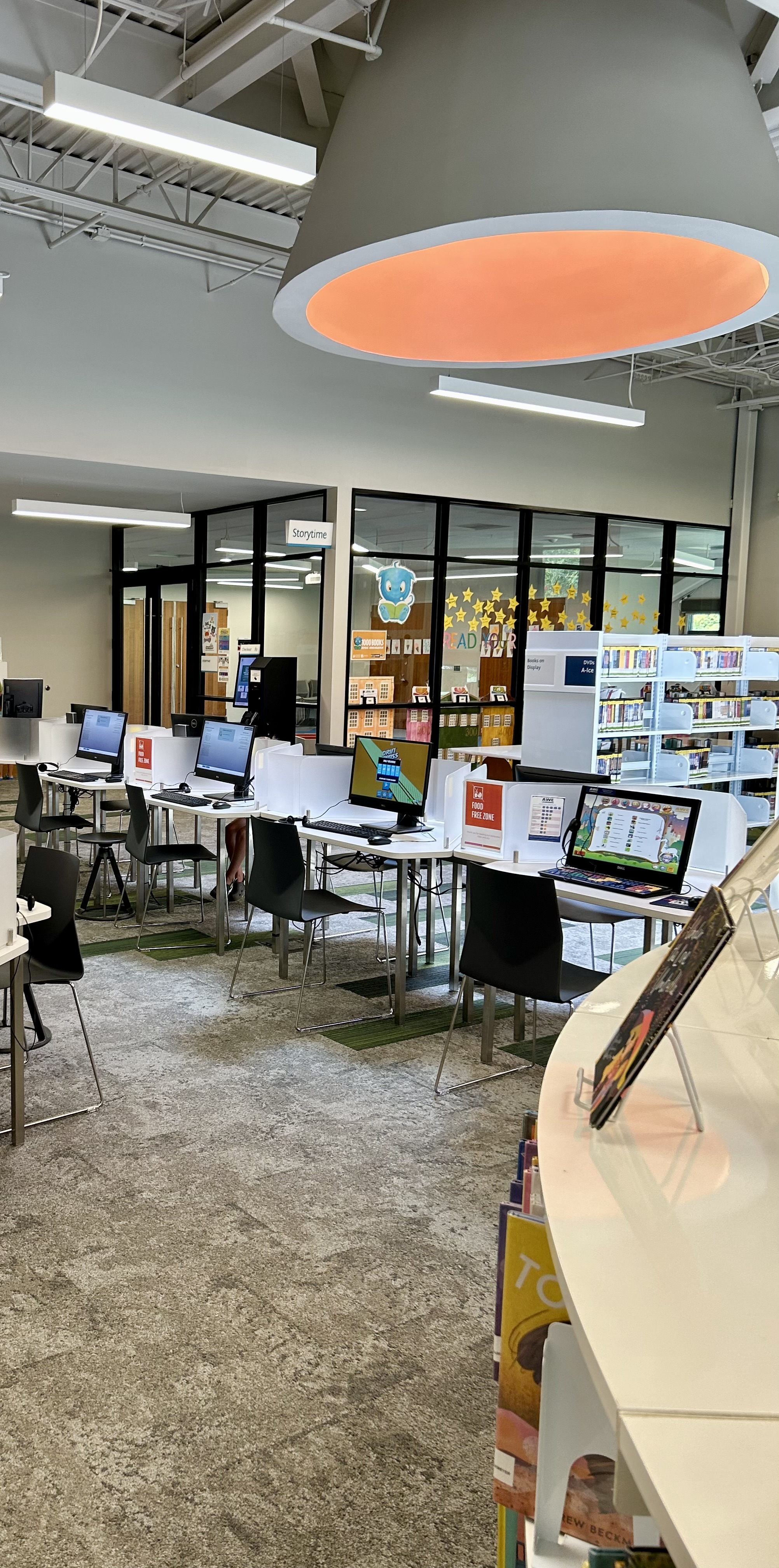
The ceiling is high and industrial which gives the library a sense of space and light. Note the meeting room in the far right corner. There are lots of these meeting rooms scattered across the library, some big, some small.
There are banks of computers everywhere in the library–two banks here, but I cropped one bank out of the picture as children were seated there.
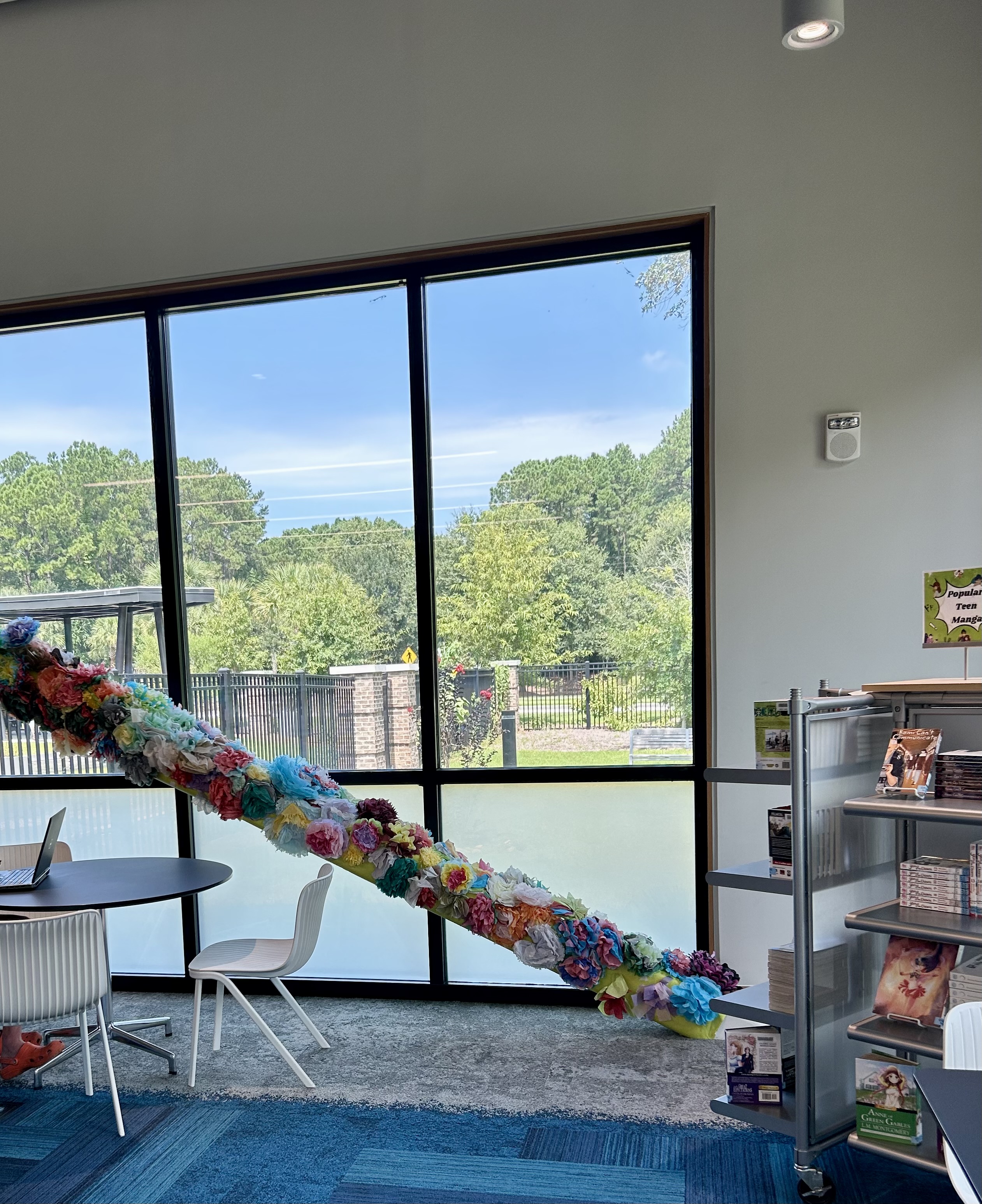
The juvenile/young adult section is more traditional, but here, too, there is color and whimsy and a beautiful view.
And look what I found as I wandered the halls and passed meeting rooms: a whole room of sewing machines that one can use!!! And there was a woman using one.
The adult section, which one encounters upon entering the library, is also quite large. And I returned to it to look more closely at the kiosk where I could buy some books.
I came home with three books that I am looking forward to reading. And as I said above, after I am done, I will return them to the library so someone else can “buy” them to read.
It is slowly getting cooler, so I am, again, thinking of walking the beach. And, maybe, swimming again, too. But today I need to make a run to Costco and to return a split hose extension to Loews.
Yesterday I used the air fryer to cook chicken, some corn on the cob, and a broccoli/carrot mixture–so I have food for today, which makes it a “free” day for me.
Between the Mt. Pleasant, in Charleston County in South Carolina, and the string of outer barrier islands, lies a wide salt marsh.
Beaches and sand dune systems form on the side of a barrier island facing the ocean; the side facing the shore often contains marshes, tidal flats, and maritime forests.
The salt marsh here is beautiful, and here is a link to some pictures of salt marshes. I wanted to stop on the connector highway to take a picture for you, but I don’t feel safe to stop on the side of the busy connector, never mind getting out of the car.
When I arrived here last December, the salt marsh was dormant. The grasses had died back and were brown. Now they are a lush and tall verdant green.
The areas between the islands and the mainland are “tidal flat” wetlands. They can be mostly mud if near where a river comes into the sea. They are “swamps” if trees and big shrubs are involved. And they are salt marshes if they open, grassy, and lined with ribbons of canals.
These salt marshes are the ecological guardians of the coast. Their grassy and sinuous channels fill and drain with saltwater as the tides ebb and flow, providing food, shelter, and nursery grounds for birds, fish, and other wildlife, ranging from dolphins and otters to snails and turtles.
Healthy salt marshes cleanse the water by filtering runoff, and help other ecosystems, including oyster reefs and seagrass beds, thrive. Conserving salt marsh helps people, too. Marshes can reduce erosion, stabilize shorelines, protect against storm surge, and support species that are crucial to recreational and commercial fishing, hunting, birding, and other activities.
The above information is in the link below, if you want to read more.
In Maine, I used a man called a “grinder” to sharpen knives and scissors to perfection. The knives I took once a year or so and then sharpened with one of those metal sharpening rods (a “honing rod”) as needed.
But here I have not needed yet to track down a person or place that sharpens knives. And, honestly, back in Maine or Virginia, dropping knives off at a store where they are sent out somewhere wasn’t ideal. I’ll call one of the local quilt shops here to find out who sharpens their scissors. That’s how I found the Maine grinder.
But, a Maine friend told me she had purchased an electric sharpener recently. I used to have one of those, and in time it wore out. I didn’t know they wore out but they do. My friend told me the one she bought. Like me, she cooks a lot and loves having sharp knives.
When I read the comments online at Amazon about the one she got, people loved it, but a few comments educated me about the angles these kinds of sharpeners use. Different sharpeners use different sharpening angles–often from the same manufacturer as people “in the know” do prefer one or the other. Who knew?
I settled on this one–as apparently its angle made a sharper knife edge. It will also sharpen serrated knives. And, it was a bit cheaper too. And note that there are VERY precise and exact instructions for sharpening knives. VERY. You don’t just run knife through the left two sides–often one only needs the far right slide–like with serrated knives.
Oh boy! My knives are SHARP! I even tried my steak knives–which were a wedding present back in 1966, so they are 57 years old now and have never been sharpened. They had serrated edges at the point for about an inch that were mostly worn away–so I just sharpened them as usual. (Their blades could use a polish session.)
Oh my heavens!! They are so sharp now–and a pleasure to use. I would have never taken these all to a grinder to sharpen. It never occurred to me.
This one I sharpened too–the sharpener sharpens the points on a serrated knife.
The grinder in Maine was not horribly expensive, and he also sharpened scissors. But the cost of doing all my knives and scissors did mount up over time. This new sharpener is cost effective from that standpoint.
So, now, I’ll figure out the scissors. As you all might know now, LOL, I sew and cut a lot. Some of my sewing scissors have a partially serrated blade which must NOT be sharpened.
Also, as you might know, all people who do sharpening work are NOT equal. You have to find a good one. That’s why I’ll call the quilt shops.
And I will, sooner rather than later so I’m ready when the need arises.
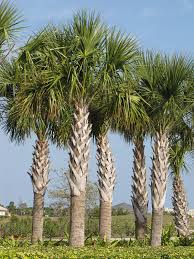
The Sable Palm is a palmetto, but I mistook that in an earlier post and called a regular low shrub that is also a palmetto and called a palmetto the South Carolina state tree. The Sable Palm is the real state tree and is on the South Carolina flag.
Here’s a link to that flag if you want to see what it looks like.
And here’s what the blooms look like. They have been “blooming” for several weeks now.
Here’s a close-up.
Fruit does form after these blooms–a tiny pea-size darkly colored edible fruit–but it is mostly seed and skin.
Local people say that when the blooms die back, they are a mess to clean up. That is probably also true for the palm fronds when they die as the tree grows upwards and forms new palms.
The dried upwardly facing pieces on the trunk are the remnants of old palmetto fronds that died. This area of the palm is called the “boot.”
And that’s all I know about the South Carolina state tree for the moment.









 Louisa Enright's Blog