Spiders Are Part of the Natural World

And THIS very interesting critter has been living on the outside screen of my back porch for the past three to four days. Her/his legs make this spider about 2 inches big.

I posted this picture to our local neighborhood Facebook group, asking if anyone could identify what kind of spider this one is. I thought maybe a Wolf spider as it is one of four big spiders in South Carolina. But the coloring was…wrong.

In due time, a neighbor identified this spider, and it is NOT a Wolf spider. S/he is a White-Banded fishing spider (Dolomites albineus). Measurements for spiders are kind of confusing–in that some seem to use just the body length, while others use the whole length, including the legs. The inclusion of the legs can make a bigger profile, of course.

By this morning, another neighbor said she has had two around her house as well.

We have a lot of cache water basins here (low-country drainage methods)–and some have sprinkler/fountains in the middle (beauty, yes, but also mosquito control). But there is standing water in drainage ditches, too, and water plants grow there. Likely this area is a good habitat for this spider.

This spider literally can “walk on water” to hunt prey. They have hairs that can repel water, and they can capture an air bubble on their abdomen that allows them to swim and dive (Wikipedia).

This spider can build webs, but the webs are not used for catching prey since they hunt their prey. The webs are used by the female as a sac to protect her eggs, which she carries nestled beneath her head, held secure in her fangs. Thus, if female, she is part of the “nursery egg” grouping of spiders.

But, why is this critter NOT in or near the water right now? Is s/he a she, and is she working currently on laying eggs? In a typical year, this spider can create and carry multiple egg sacs in warm weather. She can and will try to eat her mate. Freezing temperatures kill them, but the eggs can overwinter and hatch in the spring.

Ah, these spiders can and do venture far from water. They can and do capture and eat other insects, including “flies, moths, beetles, mayflies, and other insects.” Thus, s/he is using my porch screen as a perch from which she can strike. And she is a help for control of insects in my garden, as she is when she kills insects on a tree that are harming it.

Here is a nice site that contains much more information about this spider.

https://mdc.mo.gov/discover-nature/field-guide/whitebanded-fishing-spider

By the way, the Wolf spider is the South Carolina state spider. Who knew? The Wolf spider is also a predator who does not rely on a web to capture its prey. And if carries a web sac on its back. Local information on the Wolf spider:

https://www.islandpacket.com/news/state/south-carolina/article265506996.html

Ten Common Food Myths

When I moved to Maine, I encountered a strong bias toward healthy, clean local foods and homeopathic help when needed. Living in Maine changed my life.

One of the first books given to me by a dear friend was Sally Fallon Morell’s Nourishing Traditions. It really changed my life. Morell is one of the founders of The Weston A. Price Foundation, an organization that sells no products beyond books and information based on research, often done by scientists who have specialized in how food works in the human body.

Price was a dentist who traveled the world to find groups of healthy local people in order to identify why they were healthy. He judged “health,” in part, by the condition of their teeth. What each healthy group was eating was a primary question for Price. He learned these groups of people ate healthy, clean, WHOLE foods present in their particular environments. AND, he noted that when they started eating “modern” foods, they became malnourished and sick. He left a most interesting archive of his discoveries.

The Weston A. Price Foundation has a terrific web site that anyone can use to research a food or health question.

Sally Fallon Morell is a nutritional researcher in her own right. In the formation of the Weston A. Price organization, Morell worked with Dr. Mary Enig, an internationally recognized expert on how various fats work in the human body. Enig had published work that said that trans fats were dangerous for humans–in the era when industry was seeking to substitute plant fats for the animal fats humans have eaten for thousands of years. The industry went after Enig, and she lost all research money and never got more. A few decades later, “science” had to acknowledge that trans fats were indeed dangerous for humans. But note that this story illustrates how powerful industries work to create room for their own products: they demonize what they want to replace.

Here’s an article that came into my internet feed the other day. It is based on an interview with Morell. You might find some surprises here that run counter to popular belief.

It should be no surprise to anyone these days that media bombards us with countless claims about what is healthy for humans, much of which is a departure from what has supported humans for thousands of years and much of which is based on “science” supported by industry to “prove” their claims are true.

Living in Maine, with all its farms and clean foods, transported me back in memory to how I grew up. My father was military, and we moved frequently, but lots of time was also spent with my mother’s people in rural Georgia, with access to local foods from the family farm and gardens. Family members gathered food daily, and much time was spent on food preparation and eating together.

After exposure to Morell’s Nourishing Traditions, I promptly reverted to eating the kind of traditional my grandparents ate. And I’ve never turned back from that practice. It is serving me well in so many ways as at 78 I am healthy and strong and have boundless energy and a zest for life. My food is my medicine, and I don’t need anything concocted by industries that do not have my best interests at heart.

Local Jo’s

Here’s where I pick up my raw milk, raw cream, raw butter, and healthy eggs here in South Carolina.

This store is about 10-15 minutes from my house. (Local peeps, it is at the end of Rifle Range, where it meets Ben Sawyer Boulevard., on the left in the Oyster Park shopping center.)

The Milky Way Farm raw milk is local and comes in every other week on Wednesday. The raw cream and butter from Pennsylvania comes in late in the day on that same Wednesday. Note, in Pennsylvania, these products have to be labeled for use for dogs and cats–and that is a political fact that shows how industry has been able to control what we eat by creating fear about a natural food that people have consumed for thousands of years. Note that Maine allows the sale of raw dairy and has for a long time–without problems. I believe South Carolina does as well. But there are different laws in different states. All of these raw dairy products are rigorously tested for any problems.

I absolutely thrive on raw dairy products and have for decades now. I feel so lucky that I can obtain them here in South Carolina. Note that the very best time to buy raw butter is in the spring when the grass is fresh. The spring butter is a deep yellow color, unlike the winter butter. I try to buy some extra to freeze for the winter, but I don’t have much freezer space here, and I’m hesitant to stock a small freezer in the garage–hurricanes and power outages, you know. And it is easy enough to shop frequently here.

Way back when I started this blog–and after getting to Maine and researching food issues for various complicated issues of my own–I tried to read for folks too busy to research for themselves and to post what I was learning on the blog AND to publish informative essays in the local paper for my community to read. Over 40 essays were published, and they are all here on the blog.

One of the books I read fairly early in this effort was THE UNTOLD STORY OF MILK by Ron Schmid (2009). Starting in April 2010, I wrote three essays around this book and my own life experiences with raw dairy. They are the Mainely Tipping Points essays 6, 7, and 8. If my links below do not work, just search on the title of the book. I, myself, had trouble getting to these essays as the blog is old, and I often have trouble getting back to early essays until I figure out what search words to use.

https://wordpress.com/post/louisaenright.com/63

https://wordpress.com/post/louisaenright.com/66

https://wordpress.com/post/louisaenright.com/68

It is so, so important to constantly read food labels–because they change all the time, as does the meaning of various words used in labels. And it is important to know the history of many foods in order to make good choices that will keep you and your loved ones healthy. And to know what constitutes an objective scientific study that is valid and what is just industry advertising all dressed up as something useful for you.

Question…everything.

Raw dairy was one of the many food places where I started to transform my life and my health, so I took this little trip down memory lane as to why I took this direction.

Cricket Frogs

I am fascinated with the, literally, hundreds of tiny little frogs that live in the pine straw in my garden beds–and who bail to the grass when heavy rains make the pine straw too wet for them (?).

After researching frogs in South Carolina, I think they are a local form of the Southern Cricket Frog. The Northern Cricket Frog may be more prevalent in the western part of the state.

I took this pictures on the driveway after heavy rains.

These tiny frogs range from 1/2 inch to just under an inch. They derive from the tree frog family, but do NOT have tree-frog sticky foot pads. But they can jump, apparently, astonishing distances.

Mostly, I see them RUNNING and jumping.

Here’s a video I took just a big ago–before we get more rain today.

These little creatures eat insects, of course. They can, apparently camouflage themselves, so I see a range of tan/grey (the clay), to brown (the pine straw) to a deep black (the compost dirt). They can also “play dead” when you pick them up. And, they will pee on your hand too.

Here’s more info if you feel so inclined.

https://srelherp.uga.edu/anurans/acrgry.htm

https://www.nwf.org/Educational-Resources/Wildlife-Guide/Amphibians/Southern-Cricket-Frog#:~:text=Southern%20cricket%20frogs%20are%20found,with%20shallow%20bodies%20of%20freshwater.

Flamingos

My friend Betsy is traveling in Europe. While in Prague, capitol of the Czech Republic, she visited the Prague zoo and took this video. Betsy has a grown son in Florida and has visited the Everglades, but has never seen flamingos. And here they were in the Prague zoo.

I’ve never seen flamingos either, so loved seeing this video.

Megladon Sharks

What a fun day DIL Corinne and her two youngest girls had yesterday.

They went with a local scientist to expert to look for fossils on the river sandbars at low tide.

This area was once the home to the huge dinosaur-era Megladon shark. Megladons raised their pups in this area, which was once all under water.

https://www.nhm.ac.uk/discover/megalodon–the-truth-about-the-largest-shark-that-ever-lived.html

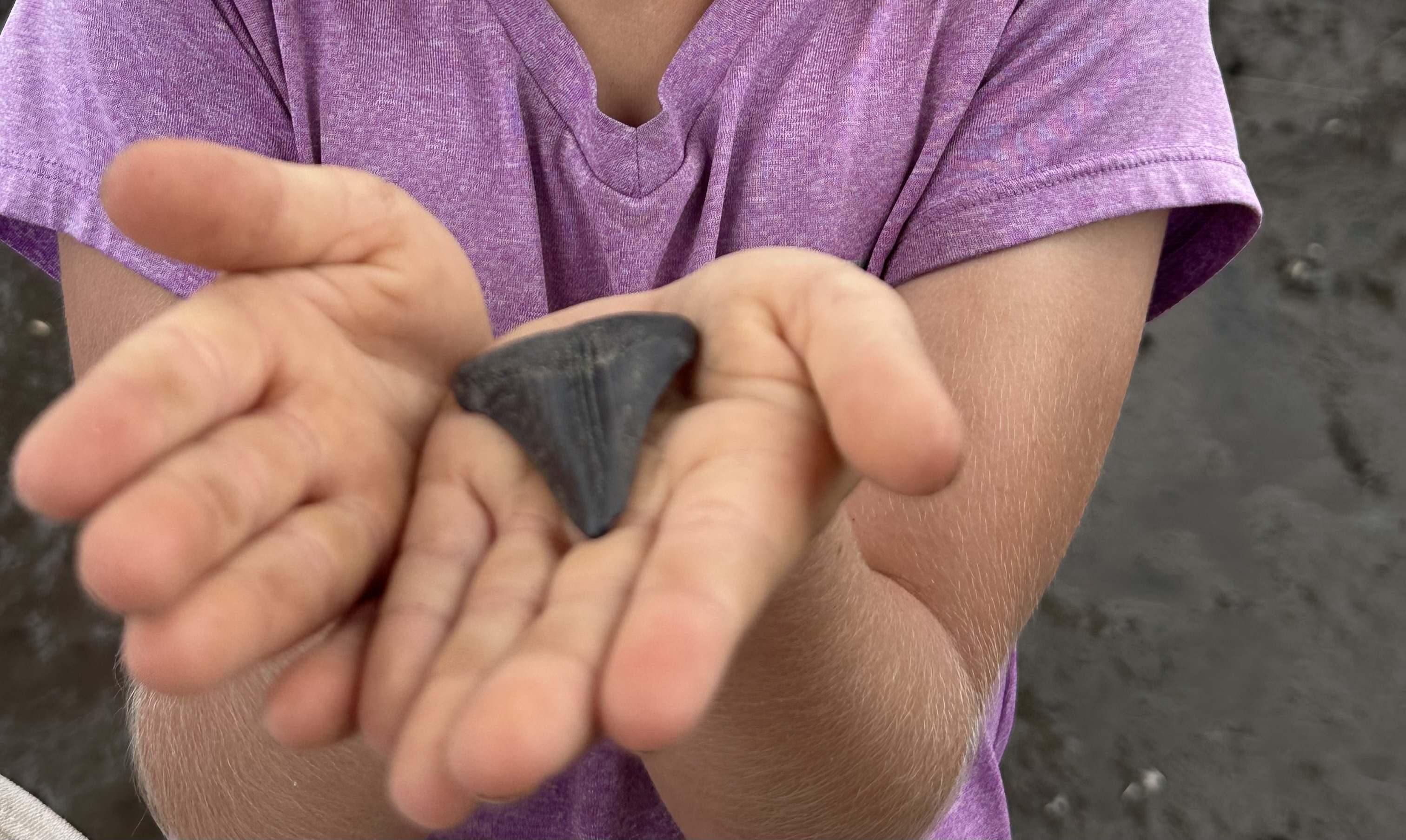
They did find a shark tooth–a very big one. Turns out it was from an Augustiden shark, the great grandfather to the Megladon shark. The very big tooth looks just like the one pictured here.

https://en.wikipedia.org/wiki/Otodus_angustidens

Pictures show they came home dirty and happy.

The Bee Cause Live Interview Is Tomorrow

My DIL Tami Enright is the director of The Bee Cause Project–initially funded in South Carolina by Georgia’s Ted Dennard of the Savannah Bee Company.

Ted Dennard and Tami Enright partnered to create and facilitate The Bee Cause Project, and Tami has grown the program nationally and internationally as “bee grants” have gone to over 500 schools and organizations. There are now Bee Cause hives in all 50 states. And, The Bee Cause also creates inspirational and educational programs that support protecting bees. The Bee Cause work is impacting hundreds of children and adults across the US, Canada, and Puerto Rico.

There will be a live interview about bees tomorrow in Athens, Georgia, with Tami as the guest expert. Some 40 thousand school children and many adults are signed up to watch live.

The Bee Cause Project’s web site follows if you are interested in more information:

https://www.thebeecause.org

Asian/Asiatic Jasmine

Son Mike suggested a ground cover plant for my rose bed the other day, but could not remember the name. He said he and Tami loved it in their old house. Tami knew the name: Asian or Asiatic Jasmine.

I found 11 plants at Loews Monday and bought them all: $3.48 each.

This plant is actually NOT a jasmine, though it makes a really fragrant little flower in the spring. It basically is a kind of vine, which will put up tendrils that go upwards about 10 inches in height (and ones that spread) and will cover the ground in sun or shade. One article noted that it can cover a bed in a year, two at the most, and will go right up your leg if you stand still long enough. BUT, that it is not hard to control if one pays attention.

I planted it among the roses, and if it does not work well as an understory plant there, I’ll pull it out and put it along the shaded sides of the house. Facing the house, the long strip to the end of my long house is totally in shade. That bed is now covered with pine straw, which I will keep as grass would struggle in that dense shade as well.

Time will tell…

Palmetto “Bugs” and the German Cockroach

Roaches are nocturnal. And there is nothing more disturbing than at night seeing a 2-inch dark brown bug fly up to a wall if you turn on a light in a dark room. In South Carolina, that would be a Palmetto Bug. Or, equally bad, to turn on a light in the kitchen to see a smaller light brown roach run across the floor or a countertop and duck into a crevice or under an appliance (the German cockroach). Or, in the kitchen, to see large dark brown roaches running very, very fast across the floor to hide (American cockroach)–a sight I remember vividly from my Georgia childhood at my grandparents. (And yes, they sprayed constantly.)

But first, let’s understand more about roaches, as they are a very, very, very old species. And that fact alone warrants my interest. (I probably should have been an entomologist or a zoologist.) The German cockroach, for instance, started out in caves in Asia. Here’s a quote from a 2020 Smithsonian magazine article documenting how old they are:

“Cockroaches—among the hardiest of insects—may be among the species guaranteed to outlive us all. But perhaps even more intriguing than the future of these persistent pests is their unusual past. A pair of 99-million-year-old roaches are now the oldest known animals that unambiguously adapted to life in caves, according to a study published this month in Gondwana Research.”

“The discovery earns the bugs the unique honor of being the only cave dwellers ever described from the Cretaceous, the period spanning 66 to 145 million years ago and the final era of the non-avian dinosaurs.”

https://www.smithsonianmag.com/smart-news/99-million-year-old-cockroaches-are-oldest-known-cave-dwellers-180974284/

When humans started trading spices around the world, these cave roaches went along for the ride. The result is roach history as roaches adapted and survived.

Roaches were not a problem for me in rural Maine. Maybe they are in crowded urban areas in Maine, but I never saw one in my house in Maine. But in South Carolina, roaches are part of the terrain. Roaches thrive here. Steps must be taken to prevent them from taking up abode in one’s house.

There are three major roaches that can be a problem for humans in South Carolina: Palmetto “Bugs” and German cockroaches. The American cockroach is often mistaken for the true Palmetto roach, though it does not really fly.

Palmetto “Bugs”–also known as “waterbugs” or as “smoky brown cockroaches”– are cockroaches, not some other kind of bug. Although closely related to the American cockroach, Periplaneta americana, they are different. They are Periplaneta fuliginosa, and they are a kind of tropical cockroach. Palmetto Bugs come into a house seeking water–they dehydrate easily–and then while seeking water, they might take advantage of something like rotting organic matter in a garbage can or dirty dishes in a sink. American cockroaches, too, live outside normally, but clearly will come inside and stay if they find a habitat there that richly supports them.

The German cockroach (Blattella germanica) is smaller, grows to adulthood much more quickly (60 days), and then breeds like crazy. This roach gets to be about an inch and ranges from a very light to a darker brown. It can sort of fly, perhaps gliding if threatened. It inhabits houses. These cockroaches can’t survive in the wild.

The Palmetto Bug can get as big as about 2 inches. They can fly short distances if needed. They have a TWO YEAR lifespan, but don’t breed until they are about a year old. From wikipedia: “P. fuliginosa can reproduce through sexual reproduction and in some cases through parthenogenesis, which is a form of asexual reproduction.[5]

And, “The smokybrown cockroach is a detritivore and can feed off a wide array of organic (including decaying) matter.[1] Like most cockroaches, it is a scavenger, whereby it feeds on many different types of foods including dry earthworms, pet food, pet waste such as feces and urine, paper, and many types of ripe fruits.[1]

In this way, in its natural habitat, Palmetto Bugs help break down organic matter in the woods, so they have a useful purpose. So, the “smokybrown cockroach may come indoors during daylight hours to look for food and even to live; generally, however, in warm weather, it will move outdoors.[3][2] They tend to lose moisture twice as fast as their relative, Periplaneta Americana, therefore requiring environmental conditions with constant moisture to avoid drying out.[4]?

https://en.wikipedia.org/wiki/Smokybrown_cockroach

So, about a month ago, I saw what was likely a German cockroach on my kitchen counter. It probably came in on a grocery bag, as they don’t really live in the wild.

I consulted my son Bryan and bought a really strong gel bait on Amazon with great reviews. It only takes a tiny, tiny bit of this gel in one spot, but one can’t put the bait in any place where it would get mopped or wiped, or near an appliance that gets hot (oven, dishwasher), or in any place where it would get disturbed and spread so that it could harm a human. So, I baited the very back of the cabinet area under the sink and way back of the garbage pull-out cabinet, around the garage door sides, and in an area adjacent to the back screen door.

I have never left dirty dishes in a sink, so that’s not a problem. And now that I’m not composting, I am not using my super nice composting pail. I don’t think a roach could get into it anyway, but… I do not allow any organic matter or bones to sit overnight in my garbage can: I take the whole bag out to the big cans in the garage. And I double bag all organic matter or meat bones.

I have not seen another roach–and I check at night frequently by turning on the kitchen light.

Time will tell…

Biomimicry

Well, here’s an interesting concept.

A friend sent me this newsletter, signed by someone named Krista:

The On Being Project <newsletter@onbeing.org>

The newsletter discussed the book that Janine Benyus wrote in 1999: Bioimicry. Krista writes that the book has “made its way quietly through the world ever since, in ever wider, radical ripples.”

Krista continues: “I invoke that word “radical” in its root sense — of driving back to the core. Consider basic life/design principles around which biomimicry orients — all of them at work in every moment beneath our feet, in the air we breathe, in the sky above.”

“I pay attention when I start hearing about the same thing from disparate corners. Across the last few years, I started hearing the intriguing word “biomimicry” invoked by people doing all kinds of things I would not have immediately connected with modeling from the natural world: sustainable investment; human-centric social media strategy; innovative philanthropy. And they were all also, notably, humans I experienced to be especially creative, expansive, wise — and kind.”

And then she (or the book) creates the following list:

“Nature runs on sunlight, 
uses only the energy it needs, 
fits form to function, 
recycles everything, 
rewards cooperation, 
banks on diversity, 
demands local expertise, 
curbs excesses from within, 
and taps the power of limits.”

Here’s the Amazon link to the book:

And here’s more info on Benyus from Wiki:

https://en.wikipedia.org/wiki/Janine_Benyus

One has to wonder how the battle between contrary forces in our culture will turn out in the end: human acquisition of wealth and power or human survival.