Interesting Information: Adequate Fat-soluble Vitamins (A, D, and K) Intake Is A Challenge Today

Interesting Information:  May 2, 2014

Adequate Fat-Soluble Vitamins (A, D, and K) Intake Is A Challenge Today


Here’s a sidebar entitled “The Challenge” from the Winter 2013 issue of the journal of The Weston A. Price Foundation’s journal, Wise Traditions (39):


Weston Price found that indigenous people consumed over 12,000 IU of fat-soluble vitamin A and over 1500 MG calcium in their diets on a daily basis.  In our experience these are amongst the most difficult elements to get enough of in an industrial diet, as well as in a non-industrial whole foods diet.

Some groups of people he studied ate little or no meat, but large quantities of raw or fermented milk and cream; others ate beans and grain and small amounts of animal products, including insects and dried shrimp and fish.

But no matter what the particulars of the diet, all had high levels of the fat-soluble vitamins A, D and K, as well as calcium.  Obtaining these from either the industrial diet or a small garden is the challenge of the modern age.

Food for thought…


Interesting Information: Thinking About Ancient Grains

Interesting Information:  May 1, 2014

Ancient Grains


I love grains.

Who doesn’t?

But I try not to eat very many of them because they cause all kinds of trouble–indigestion, stomach aches, creaky joints, and terrible diarrhea.  Clearly they were part of what went wrong with my system that caused me to start having allergic reactions to foods so that I was passing out in a split second whenever I encountered something my body decided was poison.  Clearly grains were a part of the “leaky gut” problem so prevalent in America today.

A few years back,  I had Entero Labs do a full fecal testing for gluten intolerance and genetic gluten issues.  I have a double copy of a “gluten intolerant” gene–which means that BOTH of my parents had it.  And, indeed, my dad died with dementia, probably caused by malabsorption issues–particularly of the B vitamins which are instrumental in mental health.

This genetic factor also means that ALL of my siblings have this gene.  One of my sisters had herself blood tested at a local hospital (which can often throw false negatives and depends on how the doctor orders what to be tested)–and she did show a gluten allergy.

She misses grains, too.

As noted on this blog before, grains are as addictive as crack cocaine (that’s only partly meant to be funny).  And my sister and I both slip in and out of eating “just a tiny bit” of grains.  She does not touch gluten.  I sometimes try.  But, the problem with gluten intolerance is that only the tiniest bit can cause inflammation and pain and digestive troubles once more.  And the other problem is that substituting other grains is not a great strategy either–as none of these grains is likely properly prepared.  Many are highly processed and useless in terms of nutrients.

So, with that in mind, I have to say I did enjoy Natalia Adarova’s  very interesting article in the Winter 2013 journal of The Weston A. Price Foundation, Wise Traditions:  “Northern Roots of the Ancient Grains” (32-36).

Adarova begins by discussing the ancient roots of humans’ consumption of grains in Russia/Eastern Europe and how powerfully represented the growing, harvesting, and cooking of grains figured in the local cultures.  For instance, Adarova notes that while  the commonly accepted dates for grain consumption by humans was 10,000 years agom evidence at the Kostenka paleolithic camp shows that “grains were already used in a very sophisticated manner some seventy thousand years ago as it is thought that Kostenka camp belongs to that period.”  But human consumption of grains predates even this particular camp:  “In fact, grains have probably been foraged since the dawn of Eurasian man, thought to appear three hundred to four hundred thousand years ago on the Eastern European plain–which interestingly coincides with the warmest interglacial period in the history of Earth” (33).

So, why are so many people–including me–having so much trouble with grains today?

I know already–and have written about these issues on this blog–that modern grain has been hybridized so that it contains new ingredients that mankind has not eaten before the early 1950s.  And, I know, too, from the work of Luise Light, which I have also written about here on this blog, that as a culture we eat way, way, way too many grains every day.  (Light’s panel of scientists recommend 2 to 3 servings, with 2 servings for women and 3 for very big men, and a serving being 1/2 cup, which translates to ONE piece of toast.)

But Adarova surfaces additional reasons why “modern” bread is a problem:

Modern bread sold at the stores can hardly be called “bread” at all.  A quickly risen product of the instant gratification age, made from genetically altered grains in order to yield higher and faster crops, grown in poor soils, stripped of any nutrients and full of harmful additives, is a far cry from the food that nurtured thousands of generations.

Ancient peoples fermented grains to remove phytic acid–which grains used to avoid being eaten and which prevent proper absorption of nutrients in humans:

Preparation of traditional Russian sourdough bread was a complicated art and science.  Dough had to be fermented only in oak barrels using a triple leavening process.  The dough was considered a living substance, almost a creature, hence during the leavening and baking it was prohibited to curse or act aggressively–an action thought to negatively affect the rising process.

Fermenting and sprouting both increase the nutrient load in the grain–and these ancient peoples used both methods.

And here’s new information I had not really considered before:  our modern diet of processed food does not properly feed our gut flora and fauna–which makes it really hard to digest bread/grains:

“An apple a day” is the new health recommendation picked up by the Russians, who in ancient ties normally reserved apples for cattle and horses in the bad harvest years; the older recommendation was “a glass of kefir a day.”  Besides genetics, which is an architectural blueprint, the second most important thing we inherit is our parents’ shared microflora.

Since ancient times Slavic people considered the abdomen as the epicenter of the mystery of life.  the word “abdomen” and “life” are synonyms in the Russian language.

Ancient Slavs knew that gut flora can either be your friend or your foe.  They knew that flora could be transferred and could quickly turn pathogenic if handled incorrectly.  Kissing strangers was prohibited and has never been used as a greeting.

Adarova notes that the “old rules” mandated that one eat animal fat with grains:  ” `You can not spoil kasha with too much gutter’ is an old Russian saying, hinting at the importance of this ingredient in grain consumption.  Russian sourdough was always consumed with a thick lalyer of butter, a widespread tradition in other parts of Europe as well.  Animal fats lubricate the gut protecting it from fiber damage while maximizing the absorption of fat-soluble nutrients” (36).

Finally Adarova points to the detoxifying effect of consuming clay and notes that a number of European bread recipes (Italy, Sweden) call for the addition of clay.  Apparently, ancient grain storage involved clay-lined and clay-sealed pits that kept grains viable for a hundred years.

Here’s the url if you want to read the whole of this very interesting article:   http://www.westonaprice.org/traditional-diets/northern-roots-of-the-ancient-grains


PS:  The nightly “news” I watched last night–to see our local weather–contained a story about how doctors were recommending MORE FIBER.  Please take a look at my Mainely Tipping Points essays on added fiber.  Too much fiber is a real problem and most of us get plenty of fiber already.  Too much fiber causes constipation…  And the types of fiber recommended are really hard on the body.


Interesting Information: The Bee Cause Pollinates An Important Message

Interesting Information:  May 1, 2014

The Bee Cause


The Charleston City Paper, South Carolina, just did a really nice piece on DIL Tami Enright’s project:  The Bee Cause.

There is a lot of information in this article about this very successful project to preserve bees in Charleston.  And, about how connecting bees to children and learning and science is really working for everyone involved.

The Bee Cause Project pollinates an important message | Dirt | Charleston City Paper.

Interesting Information: Skin in the Game

Interesting Information:  April 7, 2014

Skin in the Game


We all have skin in the game of life.  Literally.  Our own skin.

Our skin is our largest organ–a fact I’ve seen many times, but I like the way John Moody, in “The Clothing Conundrum:  Safe, Warm, Winter Dressing,” writes about our skin (Wise Traditions, Winter 2013, 47-49).

An adult’s skin averages “twenty-two square feet in surface area and [weighs] eight pounds.

Our skin is our first line of defense “against a host of dangers.”  And, “the body also uses our skin as an important pathway to eliminate certain toxins, but at the same time, it thus also becomes an easy way of access for many toxins to gain entry into our body.”

Warning:  “This entry pathway may be even more dangerous than others, such as inhalation or ingestion, since toxins that enter through the skin bypass the digestive and respiratory tracks and the defenses these systems employ.”

“For instance, studies have shown that our skin possibly absorbs more chlorine in a five to ten minute hot shower than in drinking five to ten glasses of chlorinated water!”

AND:

“When you use personal care products (make-up, deodorants, etc.), the chemicals in those products can show up in the bloodstream less than sixty seconds after being applied to the skin.”

“A 2008 study by the Environmental Working Group looked at twenty teenage girls and found sixteen chemicals with potentially harmful health effects in blood and urine samples from their personal care products.”

Moody goes on to discuss how modern clothing is coated with chemicals that are known toxins and how we wash clothes in another whole set of toxins.  And, he makes a case for using traditional fibers that are free from toxins, which is food for thought.  He notes that hemp is a great natural fiber, but has been banned by many states as it is related to marijuana–even though it is NOT marijuana–which has been a boon to industries that fabricate cloth from chemicals.  You can read the whole article if you like: http://www.westonaprice.org/health-issues/the-clothing-conundrum-safe-warm-winter-dressing.

* * *

I saw an ad on television last night for a product to treat acne.  The ad depicted a young man with truly terrible acne.  And, of course I wondered two things:  what chemicals are involved in the ad’s product and what is this young man eating and/or to what is he being exposed.

We should not have to fix a problem that starts inside us by slathering on a chemical product from the outside.

When you see sores on the skin, it’s a sign that the body is trying to detox itself.

So, our skin is always already “in the game.”  Every day.

Interesting Information: How Foxes Hunt in Snow

Interesting Information:  April 1, 2014

How Foxes Hunt in Snow

Remember the blog post on how dogs often turn and turn in circles before stopping to defecate?

And, that they statistically meaningfully line up on the north/south polar axis?

Well, here’s more to that story.  It seems foxes can detect mice beneath three feet of snow by sensing the same kind of polar magnetic pulls/energy that the dogs use to “line up” in a way that gets their prey.

Fascinating!

The included video demonstrates just how foxes get a mouse that has burrowed deep into the snow:

Enjoy.

Microwave News | Inordinate Love of Foxes.

Interesting Information and Books, Documentaries, Reviews: Education Uprising — YES! Magazine

Interesting Information AND

Books, Documentaries, Reviews:  March 31, 2014

Education Uprising

YES! Magazine


The spring 2014 issue of YES! Magazine is all about the current state of education in the United States:  EDUCATION UPRISING.

I hope that all parents and grandparents will go online and read the education articles because our public education system is being systematically destroyed.

The good news is that people all over the country “get” what is happening–and why–and are leading successful protests for change.

I will be highlighting some of the stories in this blog post, but here is the url to this free magazine:

Education Uprising — YES! Magazine.


* * *

There are TWO pieces of information that you might want to know that happened in my life:

I wrote my PhD (Cultural Studies) dissertation on the school choice movement–FOR SALE:  SCHOOLS/STUDENTS:  THE SCHOOL-CHOICE MOVEMENT:  AN EFFECT OF NEOLIBERALISM’S PASSIVE REVOLUTION (2002).  I researched this topic deeply for five years and it was crystal clear that “school choice” (vouchers/charters) was not about what’s best for children or offered a way to improve education, but was about the market wanting to colonize schools so they could get at the money pot that funds it.  At the time of my dissertation–ten years or more ago now, this pot of money was bigger than the military budget.  Today this pot is about $600 billion from the federal government alone–as Dean Paton notes in “The Myth Behind Public School Failure,” discussed below.

My sister taught first and second grades in an inner-city Norfolk, Virginia, school that had been deemed a “failing” school until about eighteen months ago.  In the several years before she retired, she was tasked with testing 6 and 7-year olds over FIFTY PERCENT of the entire teaching time of the school year–which she felt was cruel and ineffective.  She was tasked in her final years to teach with a programmed plan that she felt had little success with her children. When experts came to view her classroom, she was touted as a “master teacher” numerous times.

So, it was with real joy that I read the first story in the YES! issue on taking back education:  Dean Paton’s “The Myth Behind Public School Failure.”  BECAUSE Paton “got it.”  Here’s the url:

The Myth Behind Public School Failure by Dean Paton — YES! Magazine.

Paton traces the origins of the myth that American schools have ever been failing–as I did in my dissertation.  Sure, there are schools or districts (usually very poor) that could be said to be “failing,” but IN GENERAL, American schools before NO CHILD LEFT BEHIND were doing a quantifiably (yep, that means via data and math) good job.  The document making claims of failure, “A Nation At Risk,” famously, was, as Paton notes, “remarkably free of facts and solid data.”

The strategy to PRIVATIZE public schools has always already been to pick them off one by one by deeming them FAILING–and along the way a HUGE testing market emerged that created the tests that said a school was failing.  (In 2012, Pearson PLC, “the curriculum and testing juggernaut,” made more than $1 billion, writes Paton.)   Then the teachers got targeted as being responsible for the “failure.”  What got produced was a “manufactured catastrophe,” or what Paton notes Naomi Klein calls “`disaster capitalism.’ ”   

Teachers used to be valued community members, and in order for the market to colonize the schools and get to the pot of money, they had to demonize the teachers.  So, those trying to privatize the schools (or the misguided people who got caught up in this whole business) started proposing that teachers be rated according to their test scores–regardless of the reality of the students in their classrooms.  But, Badass Teachers Association (BAT) co-founder Priscilla Sanstead’s Twitter banner says the following in the article listed below about the Seattle teachers who boycotted the MAP test:

Rating a teacher in a school with high poverty based on their student test data is like rating a dentist who works in Candyland based on their patient tooth decay data.

The turning point for change may have come in 2012 when “then-Texas Education Commissioner Robert Scott” said publicly “that high-stakes exams are a `perversion.’ ”  Following Scott, in January 2013, teachers at Seattle’s Garfield High School “announced they would refuse to give their students the Measures of Academic Progress Test–the MAP test.”  The administration threatened them, but, ultimately, backed down.  And this boycott triggered a nation-wide backlash against high-stakes testing and the current NO CHILD LEFT BEHIND policies that have reduced education to educational bulimia ingested and disgorged on tests.

In “Pencils Down:  How One School Sparked a Nationwide Rebellion Against a Test-Obsessed Education System, Diane Brooks tells the story of how Seattle’s Garfield High School teachers decided to and did boycott the MAP tests.  Here’s the url to this fascinating story:  

These Seattle Teachers Boycotted Standardized Testing—and Sparked a Nationwide Movement by Diane Brooks — YES! Magazine.

So, how are students now being assessed?  

Brooks notes that schools opting out of high-stakes testing are looking to “the New York Performance Standards Consortium, a coalition of 28 high schools across the state…[that] track student progress with performance-based assessments. Rather than take standardized tests, students do in-depth research and papers; learn to think, problem-solve, and critique; and orally present their projects.”  This approach “not only provides more effective student assessment, but also emphasizes critical-thinking skills over rote learning.”  

And, here’s a link to the article about how Diane Ravitch, an architect of NO CHILD LEFT BEHIND, is saying she was wrong, she made a mistake, it does not work:

Architect of Bush Administration’s No Child Left Behind Law: “I Was Wrong” by Scott Nine — YES! Magazine.

 In “The Best Way to Learn About a Tree,” David Sobel notes that KINDERGARTEN used to mean “children in the garden.”  Now, though, high-stakes testing has reached all the way down to Kindergarten, which is now “the new first grade.”  As a result, these children are spending more and more time indoors as kindergarten teachers “are required to focus on a narrowing range of literacy and math skills”  Sobel quotes David McKay Wilson, a journalist who writes in the Harvard Education Letter that studies show that `some kindergarteners spend up to six times as much time on those topics and on testing and test prep than they do in free play or `choice time.’ ”  Additionally, “teachers are required to use scripted curricula that give them little opportunity to create lessons in response to students’ interests.”

So, what’s at stake here?  “The efforts to force reading lessons and high-stakes testing on ever younger children could actually hamper them later in life by depriving them of a chance to learn through play.”

The article goes on to list some really exciting kindergarten programs where children actually learn in gardens/forest/nature.

You Can’t Bounce Off the Walls If There Are No Walls: Outdoor Schools Make Kids Happier—and Smarter by David Sobel — YES! Magazine.

There are MANY other wonderful, thought-provoking articles in this issue.  Some deal with the harm done by current zero tolerance policies in schools today–which are often exercised without any real understanding of what a student is juggling.  The Restorative Justice program is described in detail, for instance.  Start with this article:

Discipline With Dignity: Oakland Classrooms Try Healing Instead of Punishment by Fania Davis — YES! Magazine.

There are more stories in this issue.  Of course there are.

But these can get you started.


Interesting Information: Coalition of States for Mandatory GMO Labeling

Interesting Information:  March 30, 2014

Coalition of States for Mandatory GMO Labeling

The following states have joined together to form the above coalition:

Arizona, California, Connecticut, Florida, Hawaii Idaho, Massachusetts, Minnesota, New Jersey, North Carolina, Oregon, Pennsylvania, Vermont, Virginia, and Washington.

Why isn’t Maine part of this Coalition?  

Probably because we have a very strange governor in Paul LePage–who stated publicly that the worst BPA could do was to make women have mustaches…

Why isn’t YOUR state–especially since

90 percent of the American people want a national GMO labeling law.  

We have a right to know what’s in our food!

Why don’t we have a national GMO labeling law?

Why did the FDA just rule that they thought it would be ok for industry to CHOOSE to label GMOs?

Follow the money…

* * *


MoveOn.org has a petition you can sign…

http://petitions.moveon.org/sign/tell-senators-warren


State list taken from the Well Being Journal, January/February 2013, 10.


Interesting Information: Scientific Studies Validate Sustainable Organic Agriculture

Interesting Information:  March 28, 2014

“Scientific Studies Validate Sustainable Organic Agriculture”

Andre Leu


One of the big news stories of 2013 was the appearance in the media of the results of the 12-year study out of Iowa State University (ISU) showing that “organic systems can have equal to higher yields than conventional systems” (30).   This article , by Andre Leu, in Wellbeing Journal, January/February 2013, 27-34, lists and discusses many of the studies, including the 12-year ISU study, that show that organic systems are superior to commercial systems that deploy chemicals for both plant growth and weed control.  The studies Leu lists are both national and international–which forestalls the argument that commercial agriculture might be ok in the developing world.

Leu begins with studies from the mid-90s, and the reader begins to realize that the science for organic systems has been there for years, but that we aren’t reading about that science in our media in any sustained way.  For instance, the Iowa study ended in, I believe, 2011, but the story didn’t break in any major way until 2013.

Here’s Leu’s synopsis of the ISU study:

The results from the Long Term Agroecological Research (LTAR), a 12-year collaborative effort between producers and researchers led by Kathleen Delate of Iowa State University, shows that organic systems can have equal to higher yields than conventional systems

Consistent with several other studies, the data showed that while the organic systems had lower yields in the beginning, by the fourth year they started to exceed the conventional crops.

Across all rotations, organic corn harvests averaged 130 bu/ac while conventional corn yield was 112 bu/ac.  Similarly, organic soybean yield was 45 bu/ac compared to the conventional yield of 40 bu/ac in the fourth year.

On average, the organic crop revenue was twice that of conventional crops due to the savings from non-utilization of chemical fertilizers and pesticides (30).

Here’s another assessment of the Iowa Trials from the Leopold Center for Sustainable Agriculture:

LTAR’s findings concur with recently published results from the Rodale Institute’s 30-year Farming Systems Trial in Pennsylvania. The Rodale Institute also concluded that organic systems can provide similar yields and greater profits. In addition, they calculated that organic crops required 45 percent less energy, and contributed significantly less to greenhouse gas emissions. Organic corn proved especially profitable during drought years, when its yields jumped up to 31 percent higher than conventional.

http://www.leopold.iastate.edu/news/11-15-2011/long-running-experiment

So, the next time you read that, or someone says that, organic agriculture cannot “feed the world,” challenge that statement.  Here’s a quote from Leu:

Reputable studies by major universities are finding organic agriculture can feed the world.  A recent study by Badgley et al from the University of Michigan showed that organic farming can yield up to three times more food on individual farms in developing countries, as compared to conventional farms.  These findings refute the long-standing claim that organic farming methods cannot produce enough food to feed the global population (27).  (This study was done in 1995.)

Here’s another Leu quote:

Rick Welsh, PhD, of the Henry A. Wallace Institute reviewed numerous academic publications comparing organic production with conventional production systems in the U.S.  The data showed that the organic systems were more profitable.  This profit was not always due to premium prices but also due to lower production and input costs as well as more consistent yields.  Welsh’s study also showed that organic agriculture produced better yields than conventional agriculture in adverse weather events, such as droughts or higher than average rainfall.  (This assessment was done in 1996.)

Nicolas Parrott of Cardiff University, U.K., authored a report titled “The Real Green Revolution.”  He gives case studies that confirm the success of organic and agroecological farming techniques in the developing world.  (This report was done in 2002).

Leu’s article contains a valuable list of studies and an additional reading list.

So…..

Why is our food still swamped with deadly chemicals that are not needed and that are making way too many of us sick?

Follow the money…

Industry has a choke hold on our farmers.  Industry is selling them expensive patented seeds every year, selling them the tons of chemicals needed to grow these expensive seeds in the conventional system–more chemicals each year as the efficacy of these chemicals grows less effective–and selling the giant machinery needed in the conventional system.  Industry also funds most of the agricultural programs at the universities, and those folks, in turn, tell farmers how to farm with conventional methods. Farmers are caught in what I’m now calling a “kool aid loop” as the only information they are getting is from the agricultural university system (now also an industry) and from the chemical salesmen.  Plus, the government is incentivizing them to grow crops (soy and corn) for a food industry that is selling us tasty fake food that is also killing us.  THIS IS HOW UNFETTERED CAPITALISM COLONIZES A SECTOR OF THE ECONOMY and how all these colonized sectors become webbed together so that we are all caught in a giant spider web of trouble.

Nor are our small farmers who are trying to change getting government support to help back out of this industrial seed/chemical/big equipment/low prices madness.  No, in the recent Farm Bill, BIG, conventional farmers are getting almost all of the helpful money because the SYSTEM IS RIGGED in their favor.  Money begats money.

It’s a broken system…

And only we can change it…

Start by eating local, clean, nutrient-dense whole foods grown by farmers you know.

You aren’t going to find this food in your local grocery store chains.


Interesting Information: Here’s A Treat For You

Interesting Information:  March 28, 2014

Here’s A Treat For You


My apologies to those of you who are connected to me via Facebook, as I did “share” this beautiful post there.  But I did want to share it more widely, so am putting it up as a blog entry.

ENJOY this beautiful art form…

Andres Amador is no ordinary artist. He neither draws or paints. He doesn’t sculpt. Instead of a white canvas, he uses nature, namely the beach. Instead of a brush, he uses a rake. Andres creates artworks that are larger than 100,000 square feet. He spends countless hours on his pieces even though he knows that the tide will soon wash it away…

The San Francisco Globe.

Books, Documentaries, Reviews: Denise Minger’s DEATH BY FOOD PYRAMID

Books, Documentaries, Reviews AND Interesting Information:  March 26, 2014

Death By Food Pyramid:

How Shoddy Science, Sketchy Politics and Shady Special Interests Ruined Your Health…

…and How to Reclaim It

Denise Minger


Denise Minger’s book is a very useful book in so many ways and is, in my not-always-so-humble opinion, a really good addition to the ongoing discussion about food knowledge, food history, and food safety.
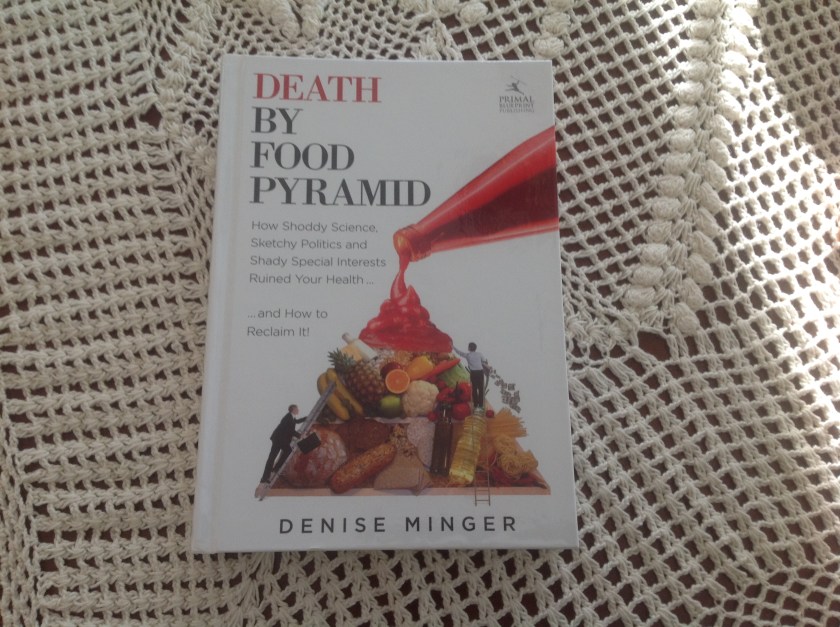
IMG_0060

Minger, as you may recall from earlier posts on this blog, is the young woman who took on T. Colin Campbell’s The China Study by digging deep into his research data and showing that, likely, because his belief system about veganism was so strong that he missed what the data was telling him.  Indeed, in the middle of the movie lauding vegetarianism and veganism, Forks Over Knives, the Chinese doctors Campbell worked with in China announced that health seemed to be determined by “meat and vegetables.”

In addition, Minger has an absolutely wicked sense of humor.  But, more importantly, she has a kind of research worldview that looks objectively at what happened and what is, not what gets driven by belief system so that it becomes “truth” when it isn’t.  Despite the grim title, Minger ends her book with a powerful plan of attack on how to win back, as Chris Masterjohn notes in his forward to the book, “the right to a healthy future.”

Minger begins the book with the tale of her 16 to 17th year of living after falling prey to a raw food diet comprised mostly of fruit.  A trip to the dentist revealed SIXTEEN cavities and the dentist’s observation that he had never seen ” `teeth like this on someone so young’ ” (5)  Later she realized that her “teeth had likely fallen victim to a deficiency of fat-soluble vitamins” (5).  Those are the crucial vitamins that live, you know, IN MEAT FAT.  And here’s an example of a typical Minger bit of humor:  “Although the doctor insisted I’d had low levels of iron and vitamin B12, my most deadly deficiency, I would later learn, was in critical thinking” (5).

Here’s another:

Contrary to popular belief, America’s dietary guidelines aren’t the magnum opuses of high-ranking scientists, cerebral cortexes pulsating in the moonlight as they solve the mysteries of human nutrition.  What reaches our ears has been squeezed, tortured, reshaped, paid off, and defiled by a phenomenal number of sources.  And as my own story proves, the USDA’s wisdom, pyramid and beyond, isn’t the only source of misguided health information out there.  But it is some the most pervasive, the most coddled by the food industry, the most sheltered from criticism, and–as a consequence–the most hazardous to public health (7).

Like I have done in the Mainely Tipping Points Essays, Minger goes back to the history of the USDA Food Pyramid and surfaces the swarmy political history of the early 1980s where Luise Light, hired by the USDA to come up with a good food guide, puts together a team of eminent scientists and nutritionists–only to find their recommendations (especially about grain consumption) undercut and overturned by industry shills in the upper regions of the USDA.  (Science-based food policy needs to be removed from the USDA–their interests are in conflict.)  She goes on to identify other players in how our farm policy got so far off track–if one is trying to grow healthy food.  And, how political theater instituted policies out of belief system (with help from the industries who would profit), so that we wound up with the deadly one-size-fits-all low-saturated fat, high-carb diet that is advocated today.  Look around you to see how well that’s all working for a lot of us.  In any case, Minger does a good job of pulling together the important highlights of this history in a readable, interesting form.

One of the arguments Minger makes is that the current “one-size-fits-all” USDA dietary information is “rubbish.”  (The same should be said for one-size-fits-all medicine, school curriculums, and on and on.)  Minger goes to some length to show that we do not all relate to foods in the same way.  We have genetic differences that control how our bodies take up, or don’t, the nutrients in foods–which explains why some folks can tolerate a vegetarian or vegan diet better than others.  Like me, a vegetarian diet made Chris Masterjohn profoundly ill.  (I am still trying to recover from my vegetarian years.)  But all of us likely know people who don’t eat meat or, even, nutrient dense foods, and they are not visibly sick, have reasonable amounts of energy, and so forth.

But, who should one trust?  To answer that question, Minger notes that “our understanding of diet and health is still too young for anyone to have all the answers.”  So, she writes, “Anyone who’s certain they’re right about everything in nutrition is almost definitely wrong.”  And we should not confuse “certainty” with “an evidence-backed opinion that seem reasonably correct.”  Look for people who keep an open mind and who are willing to “consider and integrate new information.”  None of us should be so certain that we lock all the doors.  Rather “a well-reasoned argument with a dash of humility is an open” door (53).

Minger also cautions that despite their white coats, “doctors tend to be some of the least educated health professionals on matters of nutrition.” Doctors don’t, too often, get their ideas on nutrition from “nutrition journals or other scientific literature, but from profit-driven industries with products to push” (57).

To buttress how to find the “well-reasoned argument,” Minger explains at some length how to vet the myriad number of studies out there claiming to hold truth.  She walks readers through what to look for in a study and what to throw into the nearest trash can.  I personally think that we all need to understand what comprises a genuine, useful study and what is fake science.  Of course she takes on the issue of causation versus the simple correlation that pervades much of today’s government, media, and industry hype about “food science.”  I can’t reproduce this whole section of the book for you, but I can urge you to read it so you can begin to understand how to vet information for yourself.  Just because something comes from a place like Harvard does not mean it has any value whatsoever.  One has to look at the nature of the study and WHO HAS FUNDED IT.  Minger also looks at what’s wrong (or what has been misreported) with the key BIG studies, like the longitudinal Framingham Heart Study–which was never able to prove the high cholesterol, dietary saturated fat, and heart disease theory.  Moreover, “multiple papers spawned by Framingham also link low cholesterol levels with greater risk of cancer….” (146).  And it is fascinating to me that in the news recently is the revelation that a blood test that measures lipids (fats) in the blood is 90% accurate as a prediction for Alzeimers:  LOW lipid levels point toward getting or having Alzeimers.

One really important section of the book walks through the history of Ancel Keyes and the lipid (fat) hypothesis.  Unknown to me was the fact that a competing theory was circulating at the same time arguing that sugar was the leading cause of heart disease.  Since sugar lost this battle in the political arena, the name of the scientist, John Yudkin, also got lost.  Other scientists adopted one or the other theory, but the real problem (and what turns out to be a problem with many of the studies) is that trying to blame illness on one single macronutrient does not consider the bigger, more complicated picture.  (Trying to understand the complicated “whole” of things by viewing one of its parts is the curse of modernity AND the producer of bad science.)  I think it was useful to see Keyes and Yudkin within the CONTEXT of their times–an analysis which makes Keyes less of a “demon” who left out information that didn’t fit his hypothesis and more of a scientist who just tried to simplify a cause (fat) too much.

Of course Minger addresses the rise of the use of trans fats and the PUFAs (polyunsaturated fatty acids) with high Omega 6 levels and chronic illness.  And she notes how major organizations like the American Heart Association (AHA) produce studies recommending the PUFAs that are written by people from industry.  For instance, William Harris the author of such a paper for the AHA “received significant funding from the bioengineering giant Monsanto, in addition to serving as a consultant for them.”  Monsanta is pioneering currently a GMO soybean supposedly enhanced with Omega 3’s while also providing Omega 6 (177-178).

Minger discusses the “modern Trinity” of diets (Paleo, Mediterranean, and Whole Foods/Plant-Based)–showing in the process where these diets deviate from their origins.  Modern Paleo, for instance, calls for the use of lean meats and low fat intakes, though ancient peoples ate a lot of animal fat and gave lean muscle meat to their dogs.  Paleo peoples also likely included some legumes and grains in their diets.  And some ate a lot of dairy.   The original Mediterranean diet was adopted from the island of Crete.  Yet those folks fasted almost 180 days a year for religious reasons and foraged for a lot of wild greens seasonally.  The success of the plant-based diet is unclear as it is always compared to SAD, the Standard American Diet, and not to either Paleo or the Mediterranean diet.  This diet needs longitudinal study as to the impact of the lack of fat-soluble vitamins and other nutrients on fertility and bone development, among other things.  It would be wise to note as well that there is no known primitive culture that has lived for some generations entirely on a plant-based diet.

Where do these diets intersect?  They ALL EXCLUDE  industrially processed vegetable oils; refined grains and sugar; “chemical preservatives and lab-produced anythings”; and “nearly any creation coming in a crinkly tinfoil package, a microwavable tray, or a McDonald’s takeout bag.”  They ALL INCLUDE tubers, low-glycemic fruit, and all non-starchy vegetables (225).

There is a lovely discussion of the work of Weston A. Price, who searched the world for healthy groups of people, to see what kinds of food they ate to produce optimal human health.  Minger highlights many of Price’s groups and concludes that while eating patterns could vary enormously, what they all had in common was the presence of nutrient dense foods.

Minger’s takaway:

Eliminate or drastically reduce intake of refined grains, refined sugars, and high-omega-6 vegetable oils.

Secure a source of the precious fat-soluble vitamins.

Stock your diet with nutrient-dense foods.

When choosing animal foods, limit muscle meat and favor “nose to tail” eating.  (Yes, that means the organs, like the liver and bone marrow which is full of gelatin.)

Respect your genetics.(Some of us thrive on high-fat, low-carb diets and others of us do better on a high-starch diet and it all has to do with genetics that dictate how we process fats and starches.)

Acknowledge that health is about a lot more than what you put in your mouth.

Above all else, stay anchored in your own truth–as long as you have not become ensnared in a “psychological trap that prevents you from following your body’s instincts.”  Remember, “you are not low-carb, or lowfat, or plant-based…” (242-243).

Again, Minger’s book is very useful.  I highly recommend it for a no-nonsense detangling of what we do and don’t know about food.