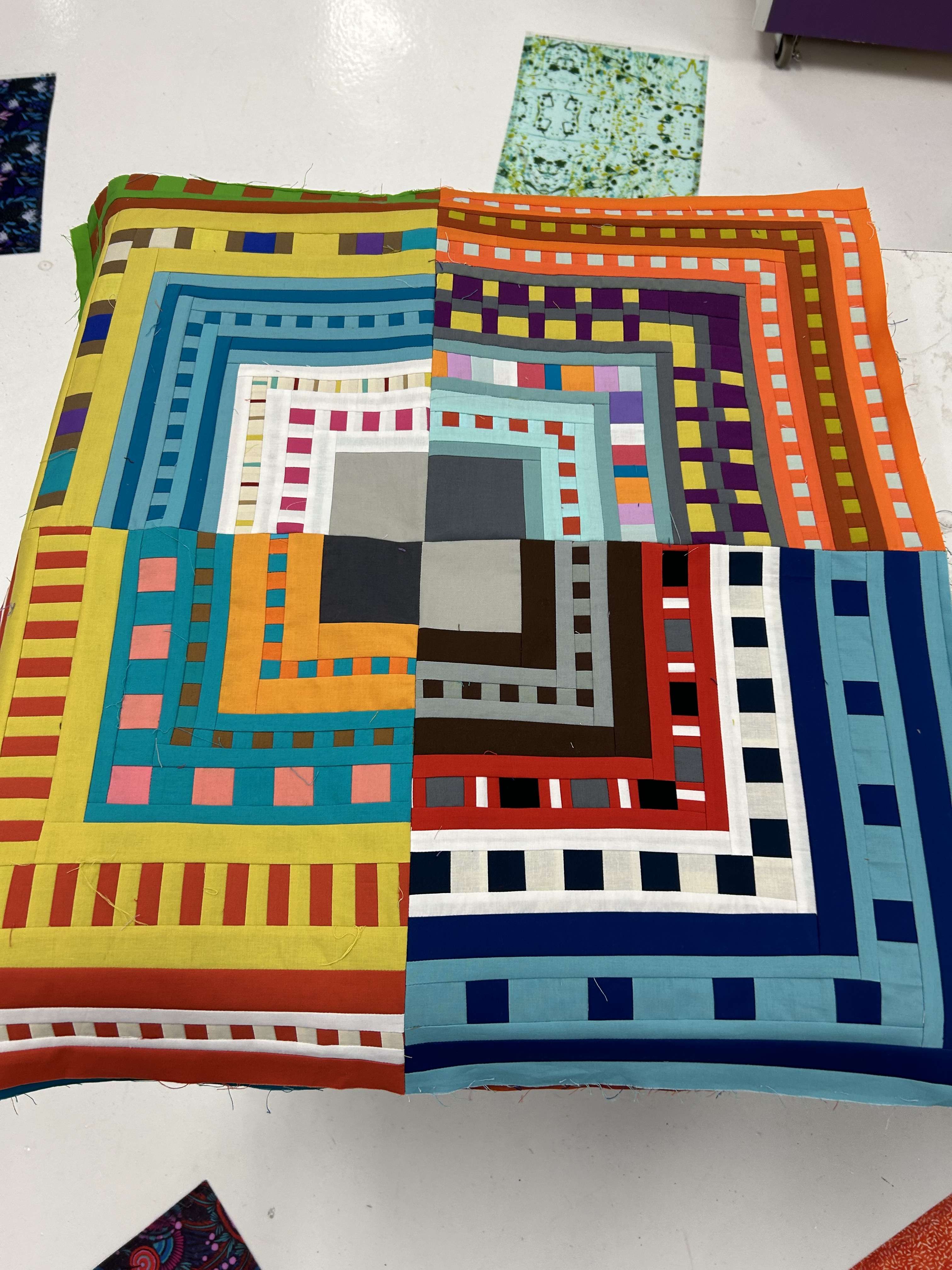
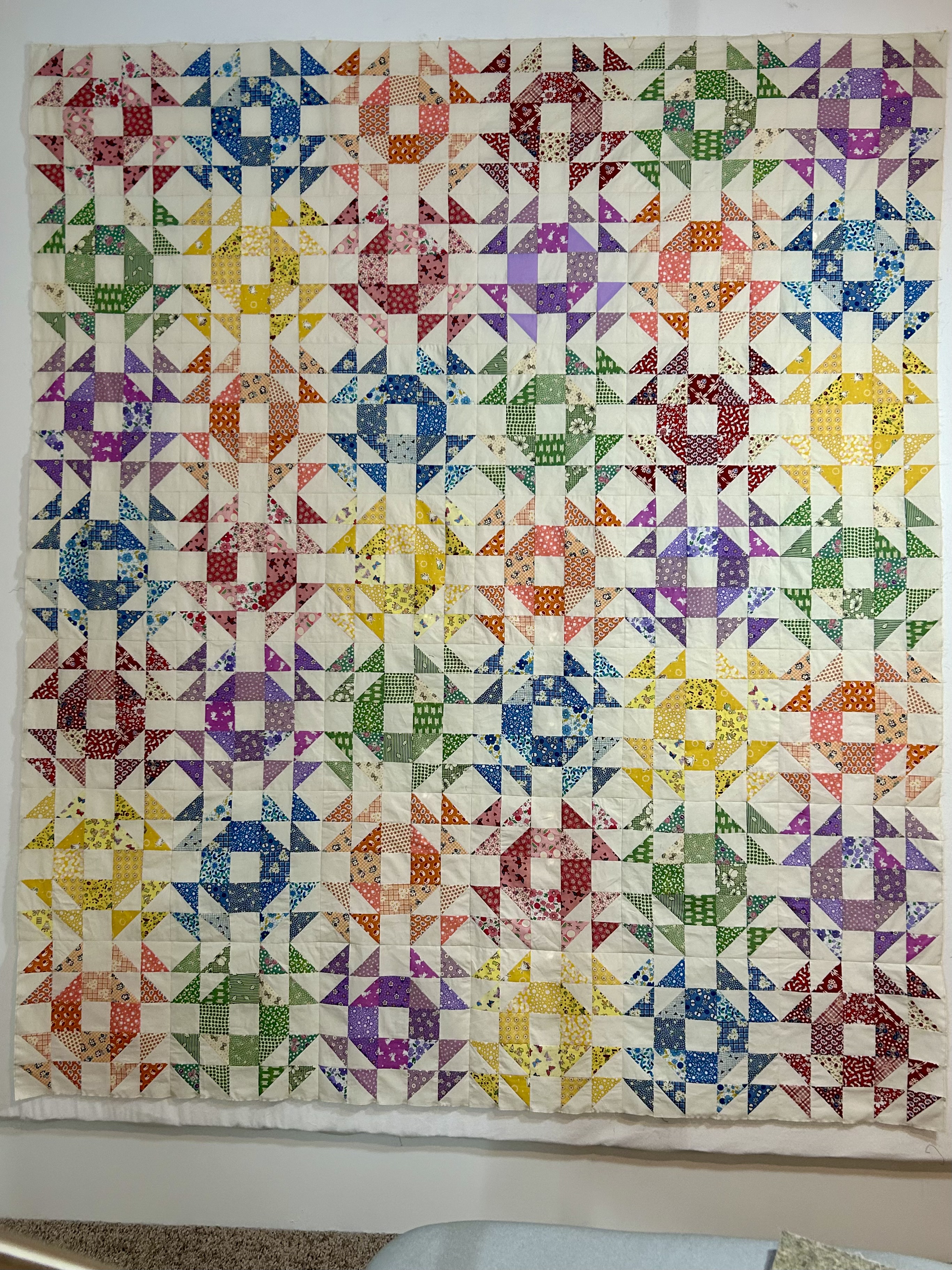
“Traverse” is…Done

She’s in the washing machine–with four color catcher cloths–as I write here. There were a lot of loose threads on her. And, yes, I did prewash these Artisan shot cottons, but…I am not taking any chances with anything running given all these brilliant colors.

I spread her out on my bed as I promised many of you pictures. She glows… And she is going to live folded on my bed.

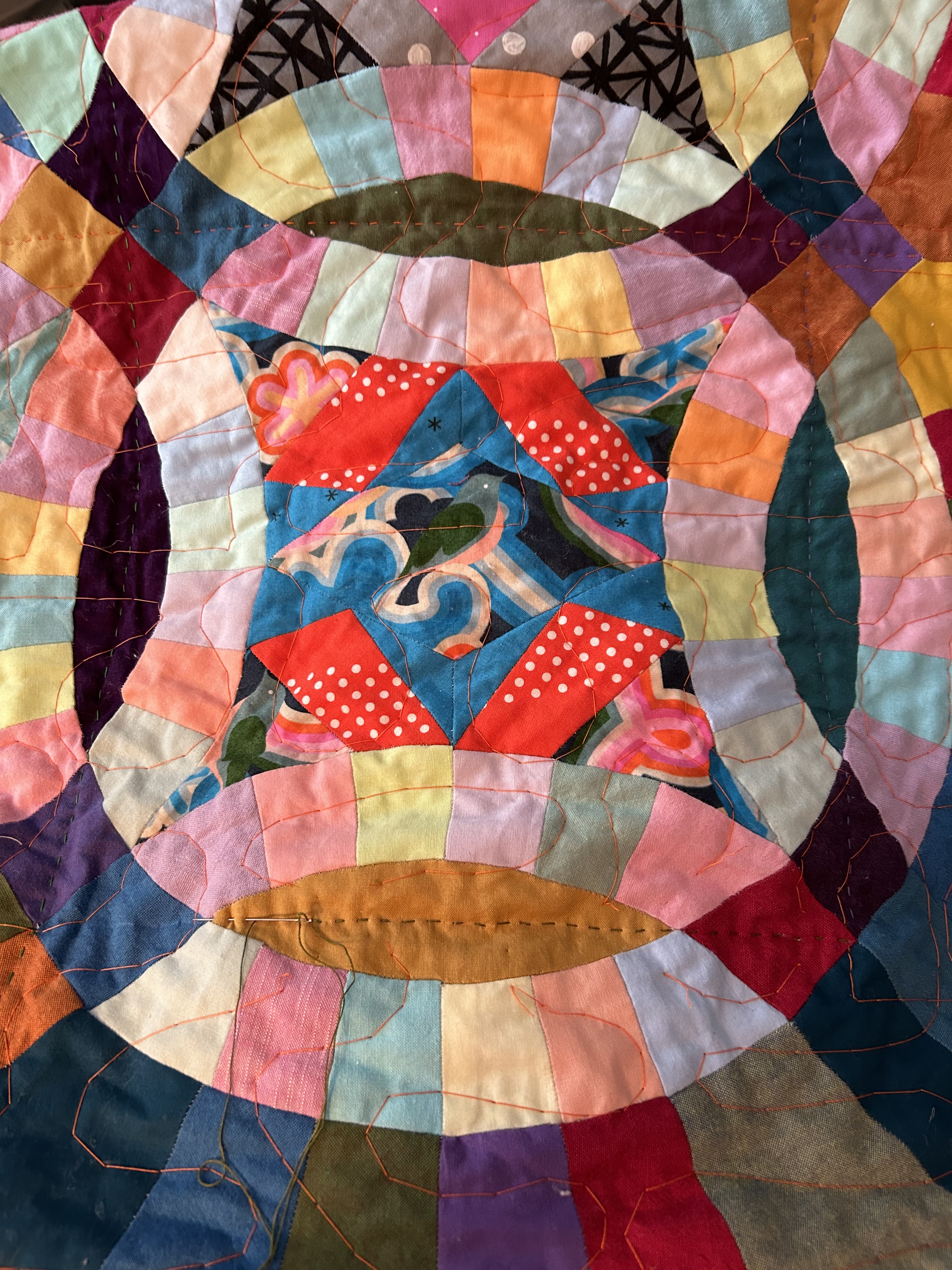
I layered her and started the hand quilting back in June, and I’ve been faithful to spending some time with Traverse every night. I used 12-wt cotton threads (Sulky, Wonderfil, Aurafil) that matched the fabrics as close as I could–and had fun playing with how to quilt around or over or through the patterns. And, I used a size 6 Tulip embroidery needle. I could have used a 7, which would be a bit smaller and thinner, but I was comfortable with the 6.

You may recall that I took designer Tara Faughnan’s online class on hand quilting–and set out to learn a new method. My front stitches have always been good, but not the back ones. I can tell you now that I have improved a lot and most of my back stitches are good now. And I kind of know when to check the back to make sure all is good.

Here are some close-up pics of the quilting:

I used a thinner cotton batting (Dream Cotton Request I think) and a thinner backing fabric (Cotton Couture). The binding is a dark green/teal Kona solid cotton that work really well.

BUT–there is always a BUT. I will never again use a thinner batting as I couldn’t get purchase with my needle to bury my sewing knots in the batting. And with the thicker needle, the batting bearded badly up through both the backing and the front. I even had trouble with it when sewing down the binding.

I recently also used Dream Cotton on the longarm, and I’ll never do that again either–and I already knew better and did it again, so there’s that. Dream Cotton is pure cotton, yes. It does not have any scrim or polyester, as such it just does not hold its shape. And it is a bear to get it to lie flat on the longarm when it has been stretched to lie flat as one moves through the quilt and checks that the quilt layers are all flat as you roll the quilt up.

I LOVE the look of the shot cottons too, but they are hard to manage. Their thicker threads just fray so, so easily. And it is hard to pull a knot through the fabric without starting a run. I eventually found ways to bury my knots in nearby seams, and that worked, but it was a learning curve.

Anyway!!! Traverse is done and is beautiful!

Green Tree Coffee and Tea

I love coffee!

And I am missing the coffee I purchased on a regular basis in Maine. This small business in Lincolnville, Maine, just north of Camden, roasts and blends its own coffee.

I have enjoyed a latte many times while sitting on the porch pictured below–sometimes with a guest visiting or with a local friend.

So yesterday, I ordered some. I love Dark Harbor and, especially, Roma espresso, which is a special blend made by Green Tree.

https://www.greentreecoffee.com

Ordering proved to be really easy online, but along the way, owner John called me and we had a nice chat. He wished me to be well in my new home in South Carolina and said he’d mail my coffee first thing Monday.

So now I’ll be hanging out looking for my coffee package!

Bits and Pieces, Early December 2023

Hello Everyone!

I’ve been busy and have neglected the blog. For one thing I’ve been walking almost every day for the past two weeks: 2 miles is becoming easy now. And I’m sleeping so, so well.

Anyway, here’s a bit of a long post for you.

In anticipation of walking the winter beach and traipsing through tidal pools, I got a pair of navy blue Bog Boots–on sale!! And they fit beautifully. When I saw the constellation theme, I knew this pair was for me.

The berries on the little Chinese Holly plants that the builder’s landscape sub planted have turned red. Aren’t they beautiful? And all are healthy. Now I really, really need to trim back the red rose plants, which are still blooming.

“Sprinkles” is off the longarm–and the quilting looks awesome. It is now bound and ready for the last hand sewing of the binding.

Look at the adorable backing for “Sprinkles”! It is a Ruby Star Society print–and I bound with it as well.

Traverse is also bound, and I’m hand sewing down the binding now. Oh my heavens, that hand quilting was a LONG project, however delightful.

So, I now have FOUR quilts with binding ready to be sewn by hand. I dragged out my three thread spools–each of which holds 10 threaded needles. Two of these were gifts to me years ago. The only issue is that these needle eyes are tiny, tiny, tiny–too tiny for any threader unit I’ve ever tried. I resorted to magnifying lenses and a strong light. After a while, I got faster, but…

I now have two sides of Traverse done–and have ordered some color catcher cloths for when I wash it–just to be sure. I’ve used up most of the 30 threaded needles now.

I couldn’t stop making the Serpentine blocks from Tara Faughnan’s online class–and I do love this scrappy one. The small quilt I made from these blocks is ready to go on the longarm. I’m still wondering about being able to make an improv quilt with these small fun, playful projects. The third month is a block Tara calls “Lines.” You can see it on her Instagram page.

I have seven colors of these 1920/30 reproduction fabrics–and I’ll make the red one today–the one below is pink. I’m loving the secondary patterns that will come along with this project.

So, this brings you pretty much up-to-date with me.

I’m good, and hope you all are as well.

Good Morning!

I started this post this morning, so now I have to say “good afternoon”!

I walked 2 miles with a neighbor this beautiful sunny morning while we talked and talked, which made the miles go by super fast. This is my 4th day of regular walking, but the first 2-miler.

People here love to celebrate Christmas. Already now, with December 1st still to come tomorrow, houses in my neighborhood are lit with lights, and inside one can see that inside decorated Christmas trees are up and all lit up. Many houses also have candles in the windows.

I took this picture of a live tree outside Whole Foods recently. The trees and greenery for sale around the store smell so good. It’s a smell I will always miss from my time in Maine and walking in woods redolent of evergreen trees.

This tree was $79. Ummm. No. I left all the Christmas decorations–save for one box of special ornaments–in Maine. I had no idea where I would be living here when I packed. So I jettisoned the stored Christmas to the local community.

So far, I haven’t bought anything new–decorating here takes ladders and lights and stringing cords and, for me, a fake tree, which I will not do. And the live ones don’t last long here in our warmer weather. I’ll just enjoy the neighbors’ efforts. And I do.

And now there is an easy fish chowder base getting hotter in the oven. Soon the fish part will go into it. And then I’ll eat (outside on the porch today!) and move toward sewing. The other house chores are all done.

I Went Down a Rabbit Hole

Yep, I sure did.

I fell in love with this month’s “Serpentine” block–and the classic way designer Tara Faughnan presented it was what you see with the red and aqua blocks in the top above. But at some point I also got interested in seeing more of the checkerboard in the block–and what a scrappy version would look like.

I love this top, which I’ve called “Surprise.” I think it will need a simple grid quilting pattern–basted on the longarm and sewn on my domestic.

Note, too, that the curved arc in this block can be presented in so, so many ways. It can make circles (without the 4-patch addition) and by lining up the colors in the 4-patch, one gets an elongated arc. I could go on, but I can assure you that on the community page, there are so, so many variations that can take your breath away. Quilters are so creative!!

I’m still toying with the idea of combing these monthly blocks in some way–which is why I have kept the same fabric palette. Remember this idea?

These pieces are more in scale for an improve quilt of some sort, especially if I split up the two classic curved blocks.

Next month is a block called “lines,” so we are all waiting now for December 1st.

I put some of the leftover 4-patches together to make 8.5 inch (unfinished) blocks. Will they combine with “lines” in some way?

Meanwhile, it is time to return to the 1920/30s blocks on the left of the design wall. I’ve been making the half-square units in pink and blue as leader/ender pieces. AND, it’s time to quilt this as yet unnamed quilt. It’s loaded on the longarm.

It needs some curves I think. I”ll baste it first and decide about quilting with curves or taking it off and sewing a grid on the domestic. There is an adorable backing in place, but I’ll show it to you later.

Have a lovely day!

Patchwork Gals

Our monthly Patchwork Gals meeting–I’m beginning to think of myself as a member of this group–was on November 15th.

As usual, the Show and Tell part of the meeting was awesome. There is so much talent in this group, but there are beginning quilters too, and I do so like a mixture of quilter types in a quilt group. Thus, each month many types of quilts are shown, including modern, traditional, art, and…more. The program for this month discussed and demonstrated how to make wave and scallop borders.

The quilt that totally blew us all away was made by Marva Hayne–and it had won first place in a recent show, but I did not catch the name.

This quilt is ALL appliqué. And Marva captured the most amazing images, but also the presence of light. This quilt just glows.

I can’t even…

Marva also showed this smaller quilt of white birches–and again, the way she captured light just made her quilt glow. Her quilt effects are made totally with appliqué.

I went home missing Maine’s stands of white birches. And, grey birches.

Marva is an artist.

Marva faced this quilt, and I was reminded how nice that looks when done correctly. It’s not a skill I have practiced at all, however.

I’m looking forward to the December meeting.

Two Food Ideas

I LOVE raspberries. In Maine I had a big bed of raspberry plants and froze LOTS for winter eating.

Here, one can buy raspberries fresh pretty much all year long. And I like to combine them with the blueberries and blackberries that also seem to be available all year long–with a drizzle of maple syrup–as a dessert at night, when I eat a lighter meal. (Pricey, but better for you than sweets like a fake ice cream.)

The berries come in little plastic containers–and the blueberries and blackberries do just fine stored in the refrigerator in those containers. But NOT the raspberries. I’ve discovered if I put them on a bed of paper towels and just loosely cover them with one of my “One World, Zero Waste” fabric sheets–NOT more plastic–they last without melting or molding for many days. In the plastic container, the raspberries start to go bad in one day or less.

I’ve blogged about these fabric tops and replacements for paper towels before now, and I continue to use them heavily. I use the sheets to top dishes in the microwave too and then into the wash they go. Mine were a very welcome gift from my DIL Corinne.

I especially like the string-drawn tops–the big ones will also cover a rectangular dish.

Here they are in use in my refrigerator–with one laid over the raspberries and the small one over a bowl:

I’ve had mine for nearly a year now, and they are going strong.

To the left of the milk you can see a quart jar of organic “olio nuevo” just harvested a few weeks ago at Organic Roots–a small farm in California. I bought a gallon and took quarts to each son. New oil like this comes with all the “bits” that will settle to the bottom of a vat in 5 or 6 weeks. And it comes with the most amazing fresh smell and taste, especially when warm. New olive oil only has a short shelf life–about 6 months.

So that leads me to this plate of food, which contains a “salad” of warm blanched and roughly chopped collard leaves–with a bit of this olive oil, the carrot part that was in the container with the raw onion I wanted and which I grated, and a bit of the raw onion–salt and herbs. It was and is delicious. I included some of this salad in three scrambled eggs last night: delicious!

The rest is no surprise to you blog readers: grilled lamb chops and sweet peppers and some of the Carolina Gold Rice. (I couldn’t find any organic Carolina Gold Rice at Whole Foods so will call Anson Mills again tomorrow.) Grilled sweet peppers are so much sweeter than they are roasted in the oven or the Air Fryer.

My little diffuser is happily diffusing this morning–loaded with Young Living lavender and lemon essential oils today. Then I’m going to switch to the green tree oils, like pine, cedar, and some of the firs and balsams. And I’ll soon also order some vanilla essential oil. I have peppermint on hand as I use it to keep bugs away in the summer. Who knew that pine and grapefruit would smell delicious, not me.

It’s overcast today, with gentle rain predicted! So I’m going upstairs to sew on the project that obsessed me for some days now.

Low Country “Carolina Gold Rice”

South Carolina is rice country.

Yes, there is corn here too (think grits, for instance, and the fabulous dish called “shrimp and grits”), but corn has been more of a staple. At one time–and for some still now in this region–rice is also a staple. Many would choose rice at a holiday meal over dressing of any kind.

There is a heritage variety of rice here that almost got lost in time: Carolina Gold Rice.

I first bought this “supermarket” version, only to find it isn’t the “real deal.”

It isn’t organic, but it made a very nice rice with a nutty flavor, as you can see. It does have a different taste than the white rice I’ve always eaten.

So now I’m on the hunt for the “real deal,” the heritage rice that is grown by Glen Roberts of Anson Mills. I have a call into the retail number of that company to see if I can buy some, but so far, they have neither answered their phone or called me back.

So when is the rice harvest anyway? Ah, early fall, so I will keep trying. And I’ll check Whole Foods for Carolina Gold Rice that is organic and must be refrigerated or frozen.

I found a really good article by Ari Weinzweig on the history of this heritage rice, linked below, which concludes with a recipe. This rice does not cook like other rice types cook, so recipes have to be adjusted.

Roberts of Anson Mills actually mills his heritage rice on Tuesday and ships the rice frozen or cold-packed, in order to preserve the inner sprout that provides more nutrients than other kinds of rice. Additionally, the rice is hulled only partially, which is said to mimic how it was processed back in the day and which adds to its unique flavor.

Here’s a quote about when this rice came to America:

“The original Carolina Gold rice is believed to have come to the Carolinas in roughly 1685 arriving from Madagascar in the form of a bushel brought back by Dr. Henry Woodward of Charles Town. From that single sack the rice grew to cover the land of hundreds of commercial plantations stretching down from the Cape Fear River basin of North Carolina all the way to the northern end of Florida.  The bulk of the production though stayed in South Carolina, where by 1691 it was so well established that the state legislature allowed for planters to pay their taxes in rice. Rice was originally milled as it was elsewhere in the world, with wooden mallets. (More about this technique in a minute). The first water-powered rice mill was built in 1787.”

The article traces the history of this rice up to the point where it more or less disappeared in this region.

“For most of the 20th century Carolina Gold was nothing more than a trademark owned by a large rice company that didn’t even grow Carolina Gold rice but liked the name.  But now . . . wow. . . the stuff that Glenn is growing and milling for Anson Mills is something spectacular, head and shoulders above what we were getting, which, again, was already really good.  All of which has absolutely nothing in common with the supermarket “Carolina Gold” rice, which has even less in common with the real article than cultivated wild rice has with really wild, wild rice.” 

But what makes Roberts’ rice so different: “For opener’s Glenn’s rice is grown organically, and he’s insistent that raising rice without sprays isn’t just the right thing to do for environmental reasons but also because it has huge positive impact on the flavor of the rice.  Beyond that he’s making sure the rice is fully ripened in the field before being brought in. As it does with any other produce proper field ripening is a huge factor in getting full flavor development into our food. (Because it’s very difficult to feel or see the difference with grains I think this issue hasn’t gotten much attention.  But as it does with the Anson Mills grits, the field ripening radically enhances the flavor.) Additionally, the newly harvest rice is stored frozen in the husk until we order it, at which point Glenn mills it with a small rice mill brought over from Japan…especially designed for Glenn, in order to emulate the 19th century hand-pounding which, at that time, was the way that slaves husked the rice and broke off most of the bran to prepare it for cooking in the kitchen.” 

https://www.zingermansroadhouse.com/2019/11/carolina-gold-rice/

So, I’m now now on the hunt for some version of “the real deal” and not the supermarket version I bought.

I’ll let you know…

Meanwhile, I still love the sprouted brown rice that I have on hand–though all I have to do is to walk by the bag of rice to put on several pounds–so rice, for me, is a treat, not an every day or even often treat. Here’s one version.

Sprouted brown rice has more nutrients available to the human body, according to the Weston A. Price Foundation nutritional materials.

NO, This Mixture Didn’t Work

On one recent day, I pan sautéed baby bok choy and added some radicchio leaves. I love sautéing the baby bok choy and just cook it until it is barely fork tender; otherwise it gets too limp.

But this mixture was so, so not good. The sweet bok choy did not compensate for the bitterness of the radicchio. Not an all. I love radicchio raw in salads, and it is good grilled in chunks, but this mixture is a hard no.

This cabbage and carrot and garlic (with other herbs) was a much nicer mixture. I used either beef tallow or duck fat; I forget which.

And here was my meal that day. Air fried French Fries and sweet peppers, the cabbage, and a grilled loin steak. I’ve moved to a sunny spot on the porch on the cooler days. The plant is a Croton Petra.

And yesterday I cooked a lot, so have food for a few days.

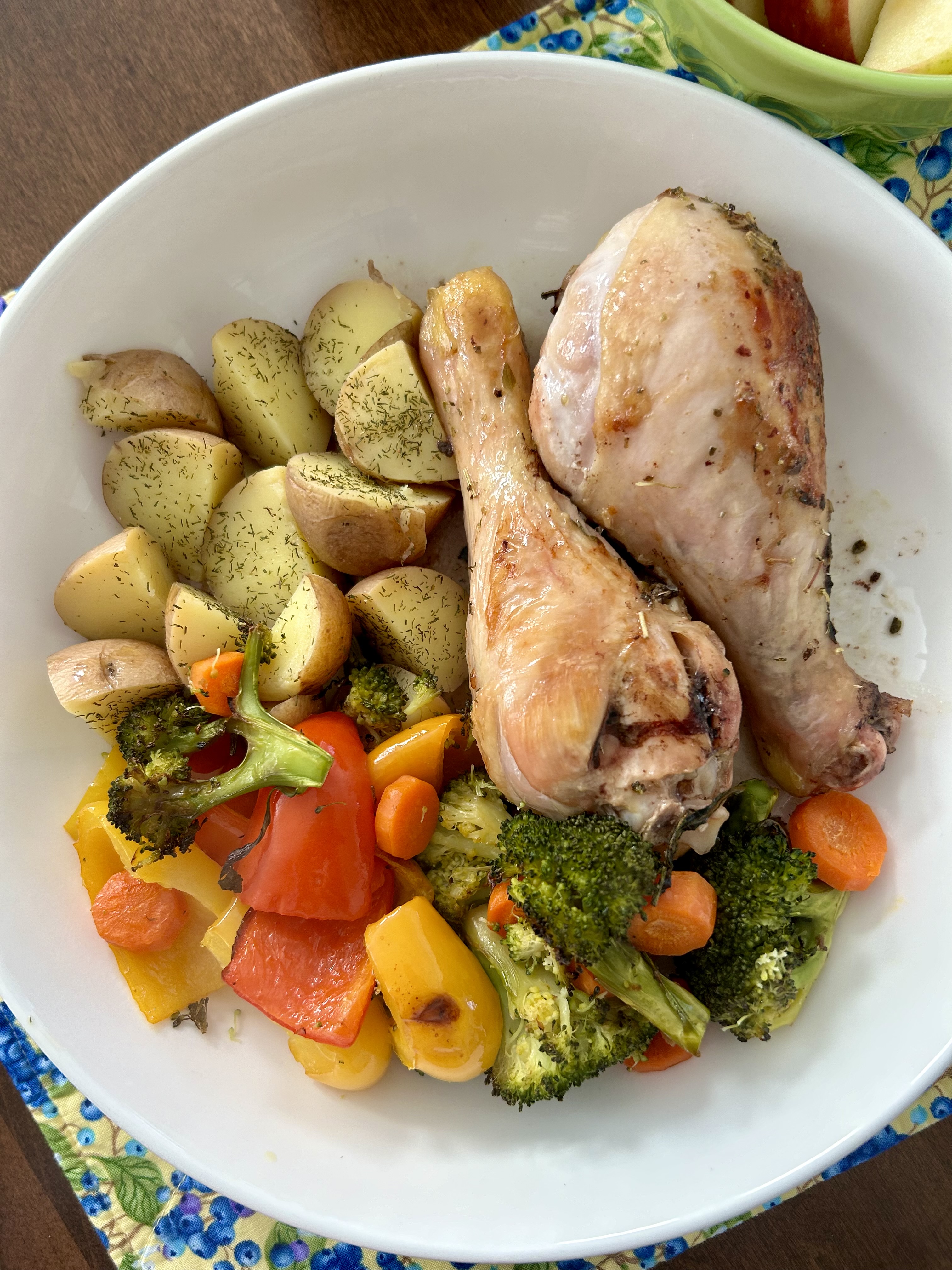
I made oven roasted chicken, cauliflower and carrot, red peppers, and asparagus–paired with leftover cold green beans with some sweet onion and dressed with dill and good olive oil.

There was too much food on this plate!! The green beans went into my salad last night. And that’s how that goes.

“Red Positivity” is Off the Longarm

Whew!

She is a BIG and heavy quilt.

The quilting came out really well: Acadia pantograph. I wanted something curvy and with some hint of plants.

I can never resist trimming a quilt at this stage–so I did stop everything and trim her. I had already cut the binding, so I sewed the lengths together and ironed it. Today I’ll sew on the binding before I do anything else quilty. The binding is that same lavender (Kona Thistle).

I used a medium grey thread, which worked really well front and back, which is a medium to lighter grey.

We got a little rain over the past two days. Not so much as an inch though. I’ll take what I can get–it’s more than I could put down with the hose. And it will be warmer and humid today–not quite 80 though.

Our family is starting to gather for Thanksgiving: one grandson flew in from college last night late; the other comes Tuesday. Three Enright families (sisters) from Boston rented a beach house and most of them are coming today. DIL’s brother and fiancé are coming from Minnesota. Altogether we will be 32 by last count.

It will all be a “party in motion” starting this weekend.