Part 1: How I Make A Bias Binding and Install a Bias Or Straight Binding

I always make bias bindings for my projects that require bindings. The only time I don’t cut bias bindings is when I don’t have enough fabric for a bias binding that I really want to use, but I can cobble out a straight-cut binding from that desired fabric.

Why bias binding? Bias binding wears better over the long haul. And, yes it is easier to install. Straight-cut bindings have only one to three strands at the fold line, whereas bias binding has cross-hatched threads at the binding fold.

I use the same method I use for bias binding to install a straight-cut binding on to a project. Why? The bias seams are less bulky. Way less bulky. Often you don’t even notice bias binding strip joins.

Note: I’m not going to talk about how to sew the binding to make nice corners on your quilt–but here’s a video from Jenny Doan of Missouri Star that covers everything, including how to do the corners. I learned several things I’ll try from watching the video. My method is a bit more “fiddly” than Jenny Doan’s but it works really well for me. Also, my final seam joining is different from hers, but maybe I’ll try it too.

To cut bias binding, press your fabric and place it on your cutting board–it doesn’t matter if it is right side or wrong side up. Line up your long ruler on the left side of the fabric on the 45-degree angle mark. (You will later cut off the points to join the fabric strips you cut–but make sure the 45-degree line does line up with the grid on your cutting mat. Or make sure you have a clear straight line on the left.) *Note that I just pulled this fabric to show you how to line it up and I didn’t iron it. I would not cut it without pressing it.)

Draw a marking line down the ruler if you are going to need to move the ruler further down to reach the right side of the fabric. Cut along that line–you will now have two pieces. Put one aside, remembering you can return to it for long strips if needed. The less strips, the less seams in the binding.

If you want a smaller, shorter cut, you can also line up the 45 degree line on your ruler at the TOP of your fabric. Again, make sure it is on a strait edge–the fabric or the lines on your cutting mat. Here’s a pic with a piece of paper to illustrate:

I cut my bindings at 2 1/4 inches as that makes a plump, tight binding for me with no loose floppy space at the binding fold.

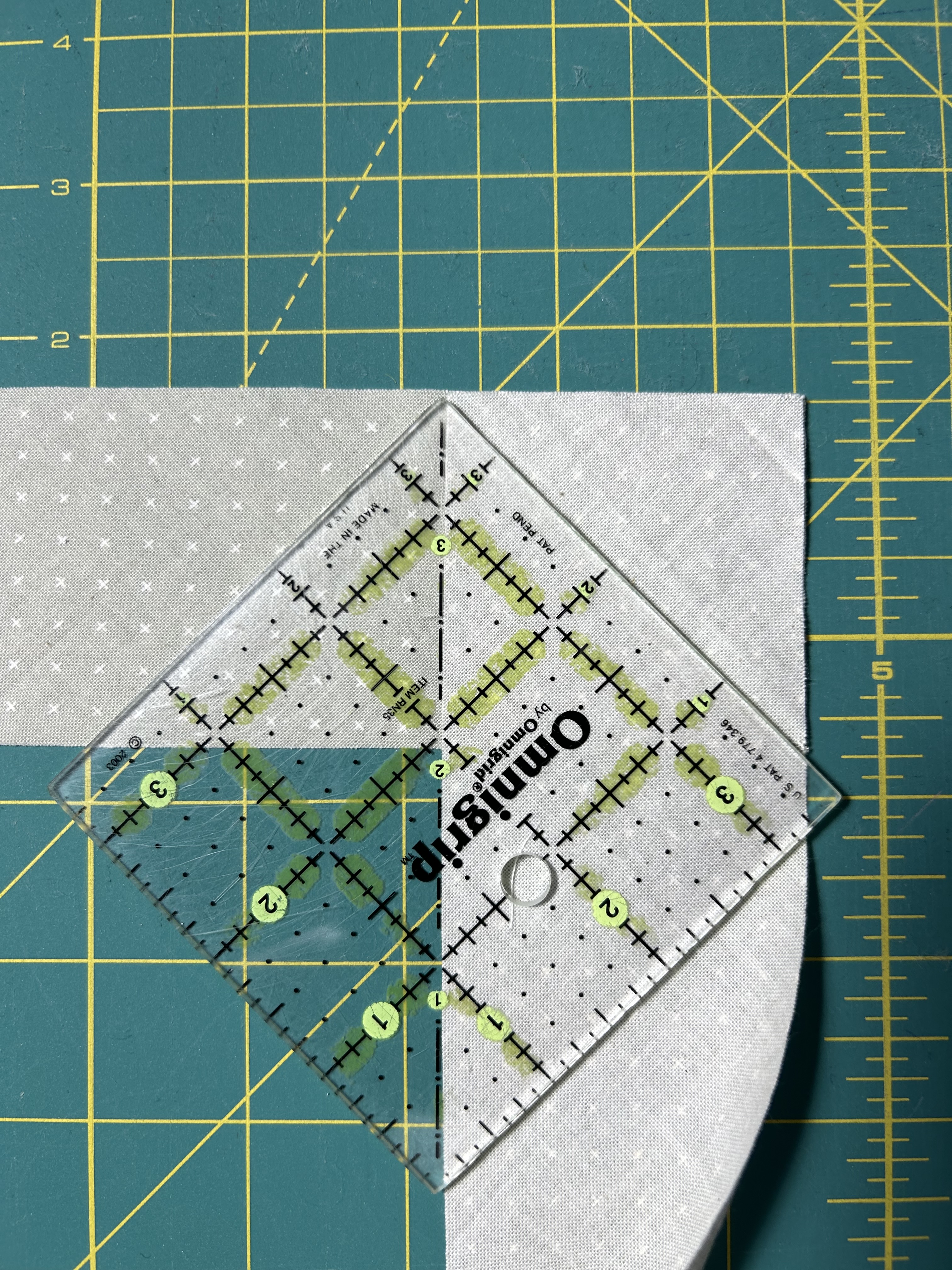
Cut the points off of your strips before joining them right sides together. Line them up like this photo shows. Make sure the right sides of the two strips line up together. Mark the place on the top piece where the bottom piece ends and line up your ruler from that mark on the bottom to the top. Make sure the top of the ruler will let your pencil touch the point and is on the bottom the mark you have made. Draw a line and sew on it. I will pin the top right corner to keep it stable while I sew.

When you have all the strips sewn together, trim the seams at 1/4 inch and press them all to one side.

Then press the strips in half, lining up the raw edges. Note that in the pic below I have not yet ironed the left side of the strip.

On one end of your strips–the end you’re going to start to sew on to your quilt, open up your strip and cut a 45-degree angle–so that the point is at the TOP and when refolded the fold is at the bottom.
Now you are ready to install your binding. So go to Part 2.
She’s Home

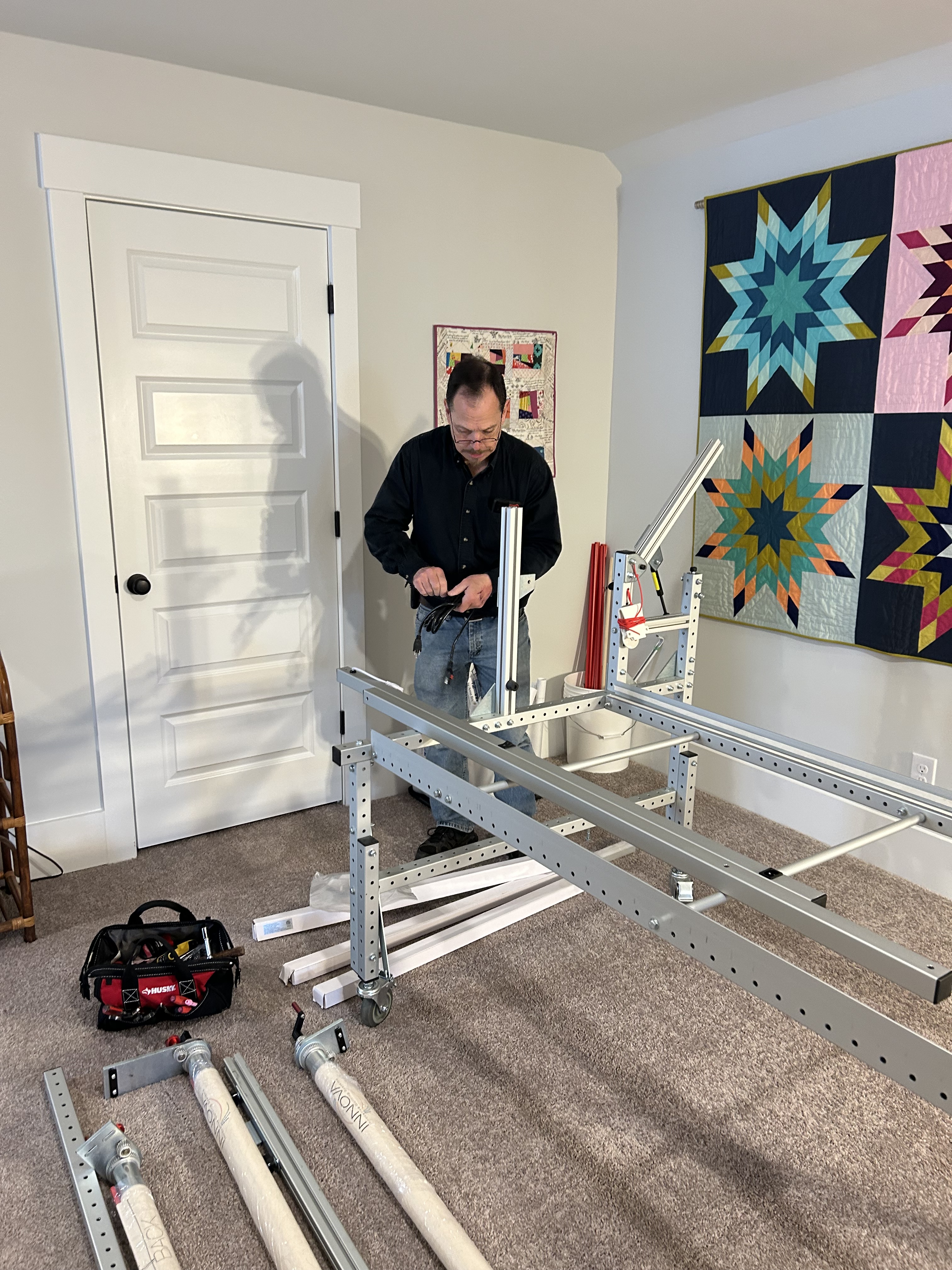
Innova arrived yesterday–brought to her new home by the capable hands of Rob Engime of Olde City Quilts in Burlington, NJ, where Judy Engime held down their store while Rob traveled to me. It was a 12-hour trip for Rob.

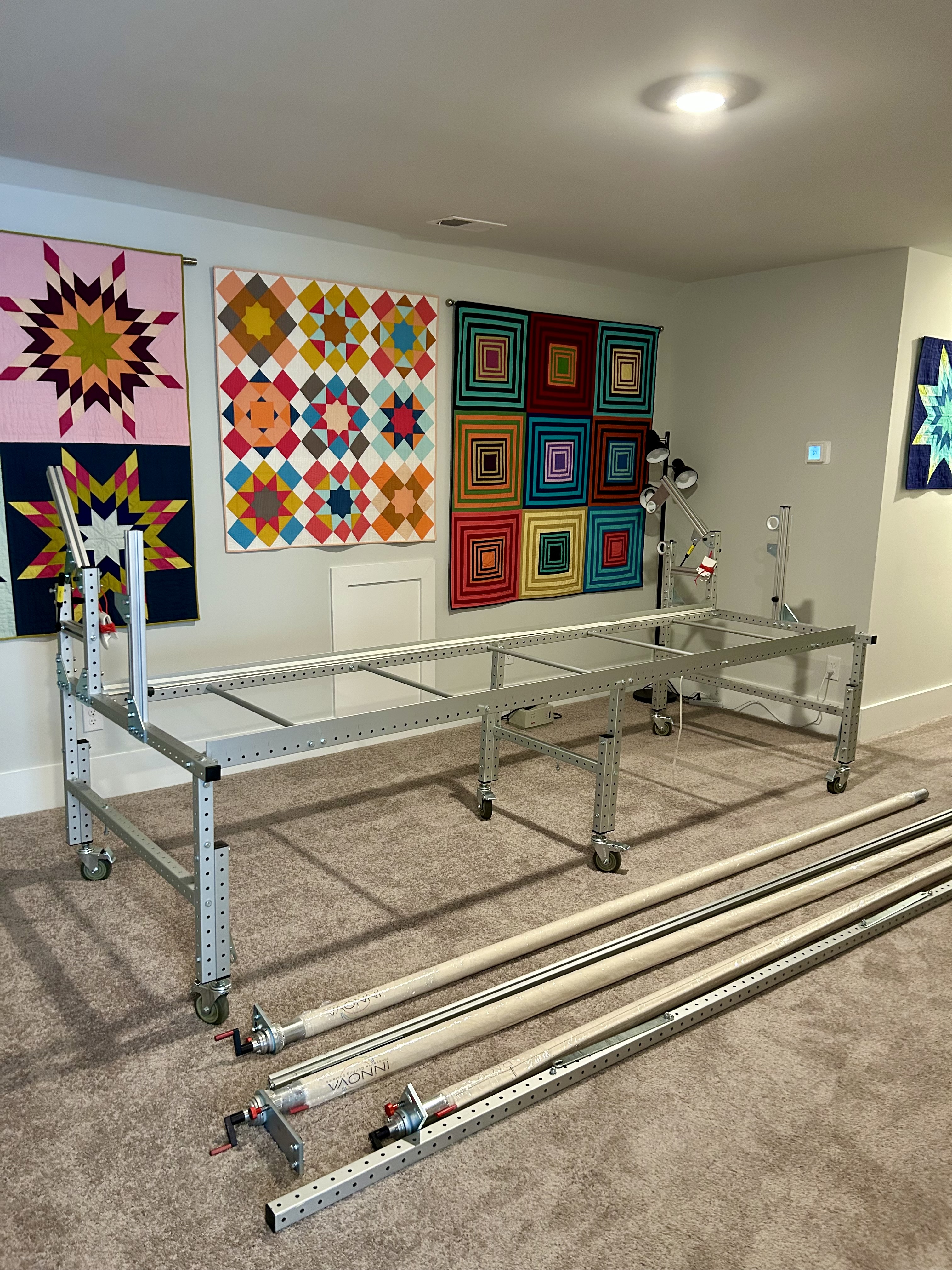
It took many trips up the steep stairs for Rob to bring in all Innova’s parts. I helped with some of the lighter pieces, but, truthfully, Rob did most of the trips up the stairs. The first step was putting the base frame together.

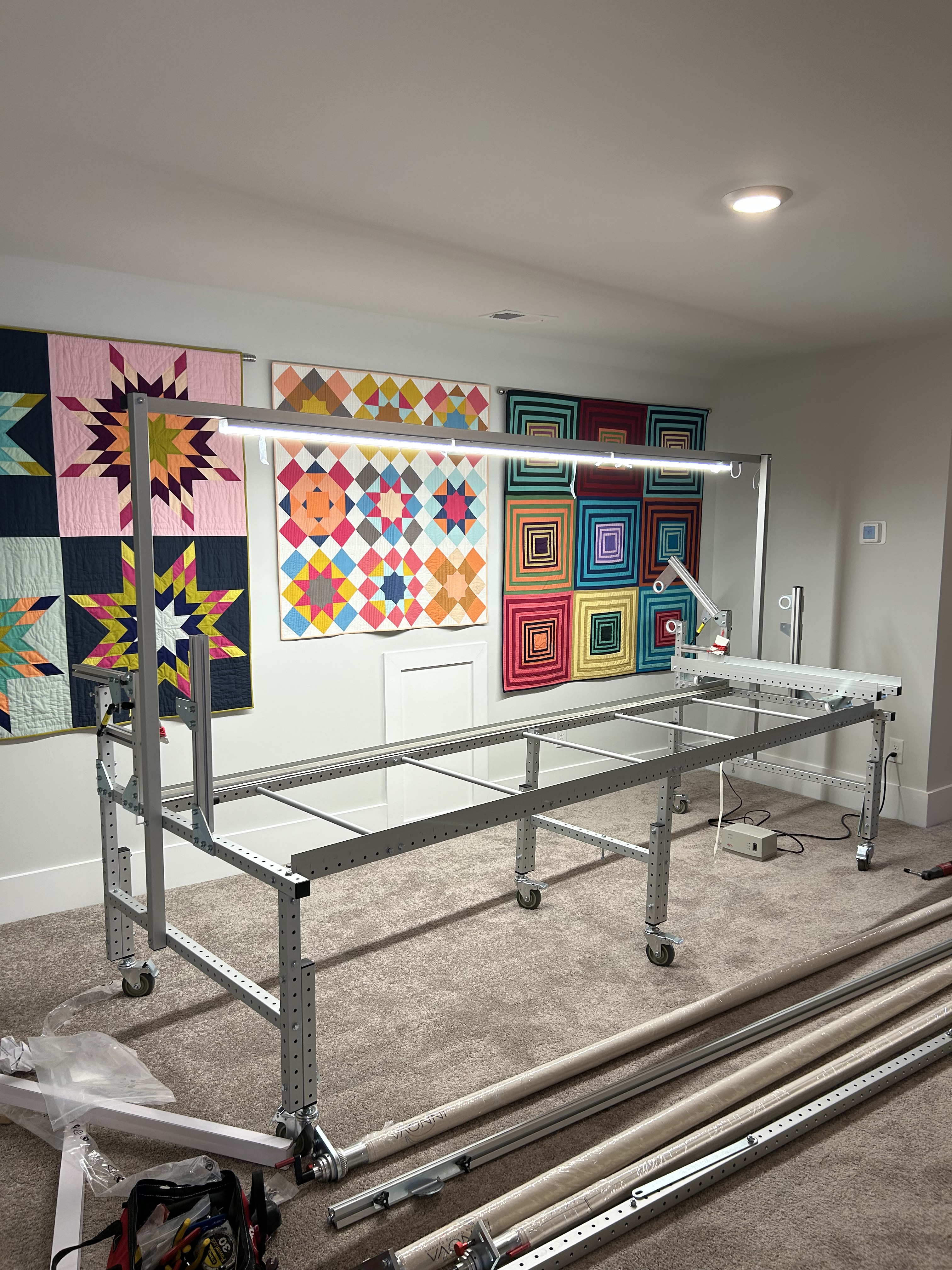
The second step was to install the much-needed new light bar. I had great light in my quilt room back in Maine, but only one small ceiling light in the bonus room here.

Oh my heaven’s. It is perfect. Let there be light! There will be no need for secondary light sources with this light bar in place.

Next, the table pieces get inserted. Note that Innova’s front faces the wall quilts–and we put her on a slight angle so I will have plenty of room to walk around the machine, to load quilts, and to quilt from the front. Having the back facing the room is awesome because I can easily trim quilts on the machine’s back counter. Innova is in a permanent position now; I won’t have to move her.

Innova herself is now on her sliding platform, and the roll-up bars are in place.

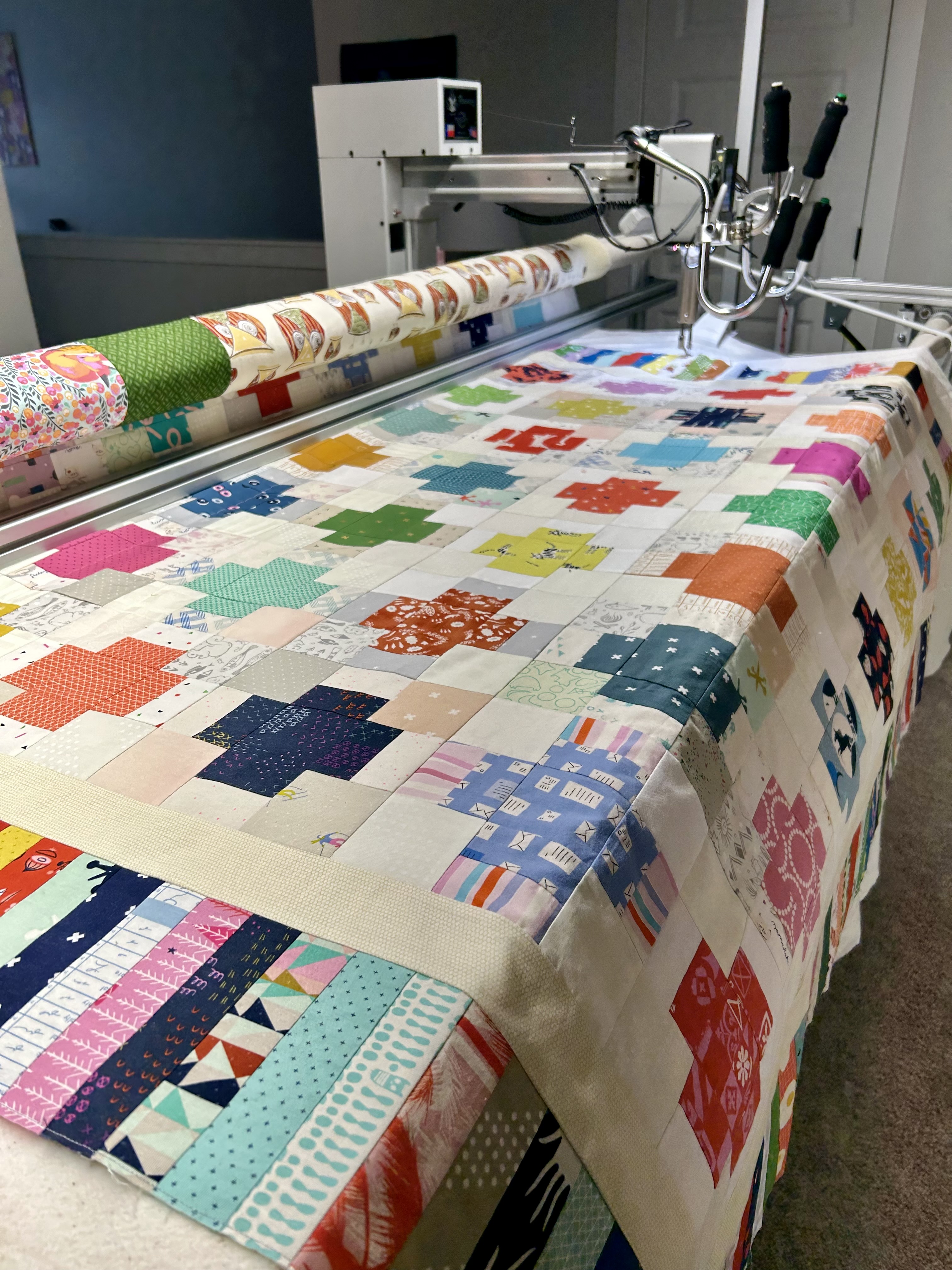
After Rob left, I installed the overlay grid I use on the back counter for pantographs and slid the pantograph I want to use next in place. The grid allows me to mark on it with wet-erase markers. The scrappy backing I made 7 months ago, back in Maine, is now loaded.

And I spent late yesterday and into the evening setting up and basting the first quilt to be quilted on Innova in South Carolina. It is one of three final quilts of the Cotton+Steel project of these last two years–three if we count these last three quilts. Oh wait! there are the blocks I made back in Maine from the small squares leftover from other C+S projects that I pieced together while waiting for the house to sell.

Suffice it to say that this morning I’m feeling so happy. And I savoring all that I learned from Rob yesterday–which was a lot.

I love my Innova, and I’ll be eternally grateful to Rob and Judy Engime for packing up Innova back in Maine, storing her for me all winter, and bringing her to me here in South Carolina.

Today I’ll begin quilting this quilt, going slow to get acquainted with Innova again, and I will sew together the binding pieces as a break, and will, maybe, sew the last three Churn Dash blocks for the quilt on the design wall.

And, yes, I’ll break for a long walk with my music.

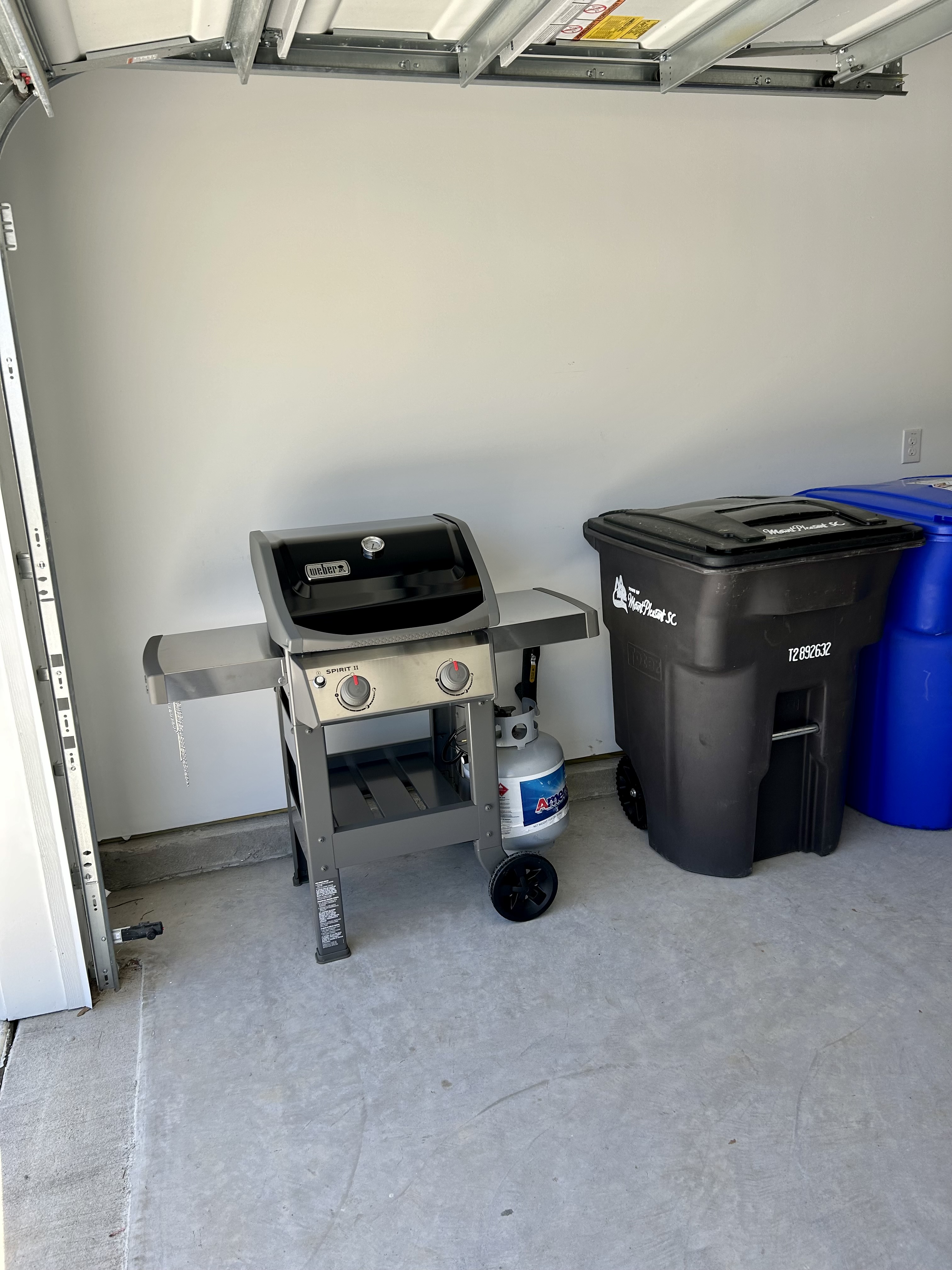
Yes, The Grill Did Come Assembled

Some of you asked…

And, yes, I’ve been using it.

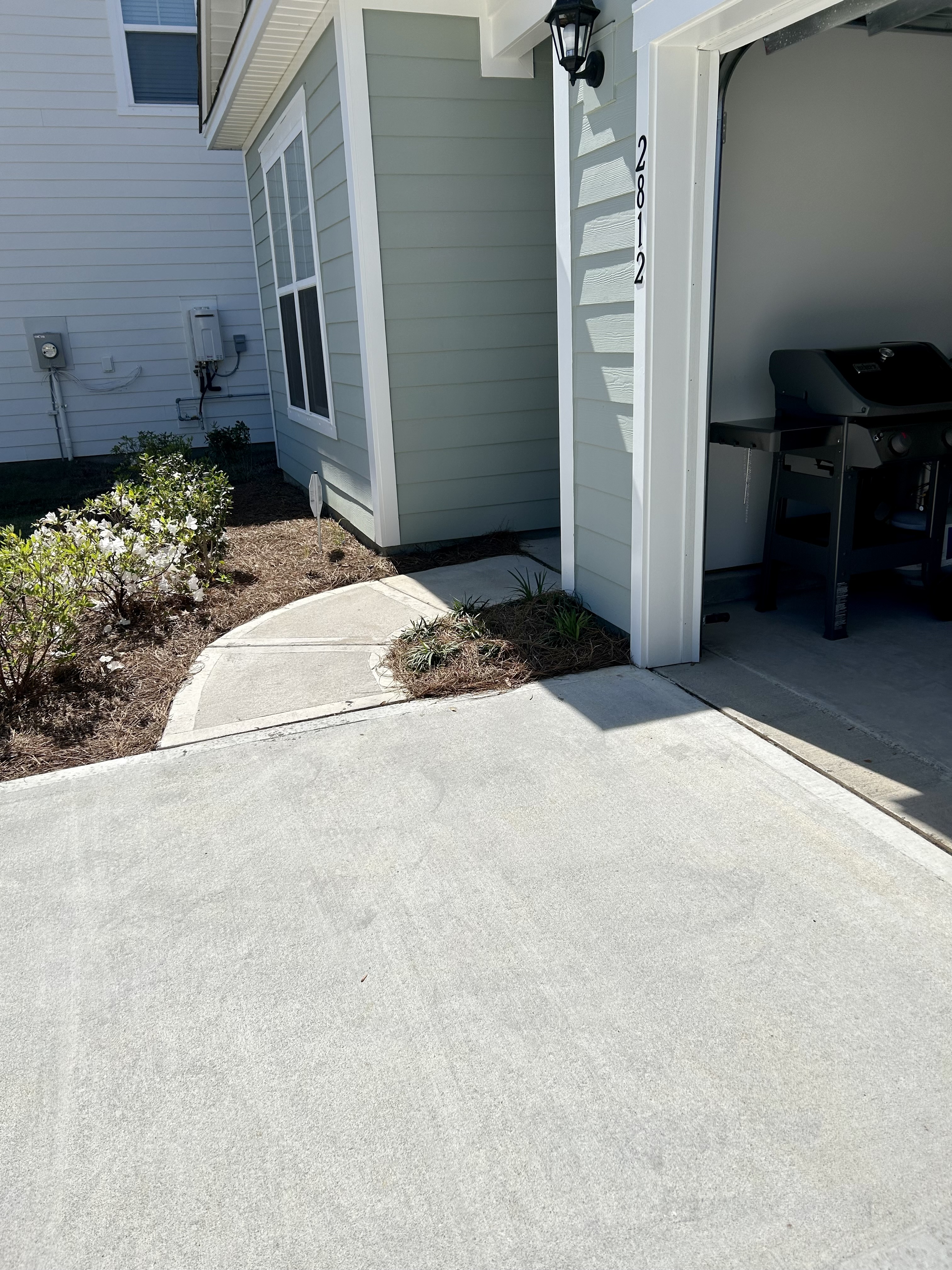
It lives in the garage, where it is protected from weather.

It’s easy to roll it out to the driveway.

I am LOVING having an attached garage–the grill is mere steps from the kitchen.

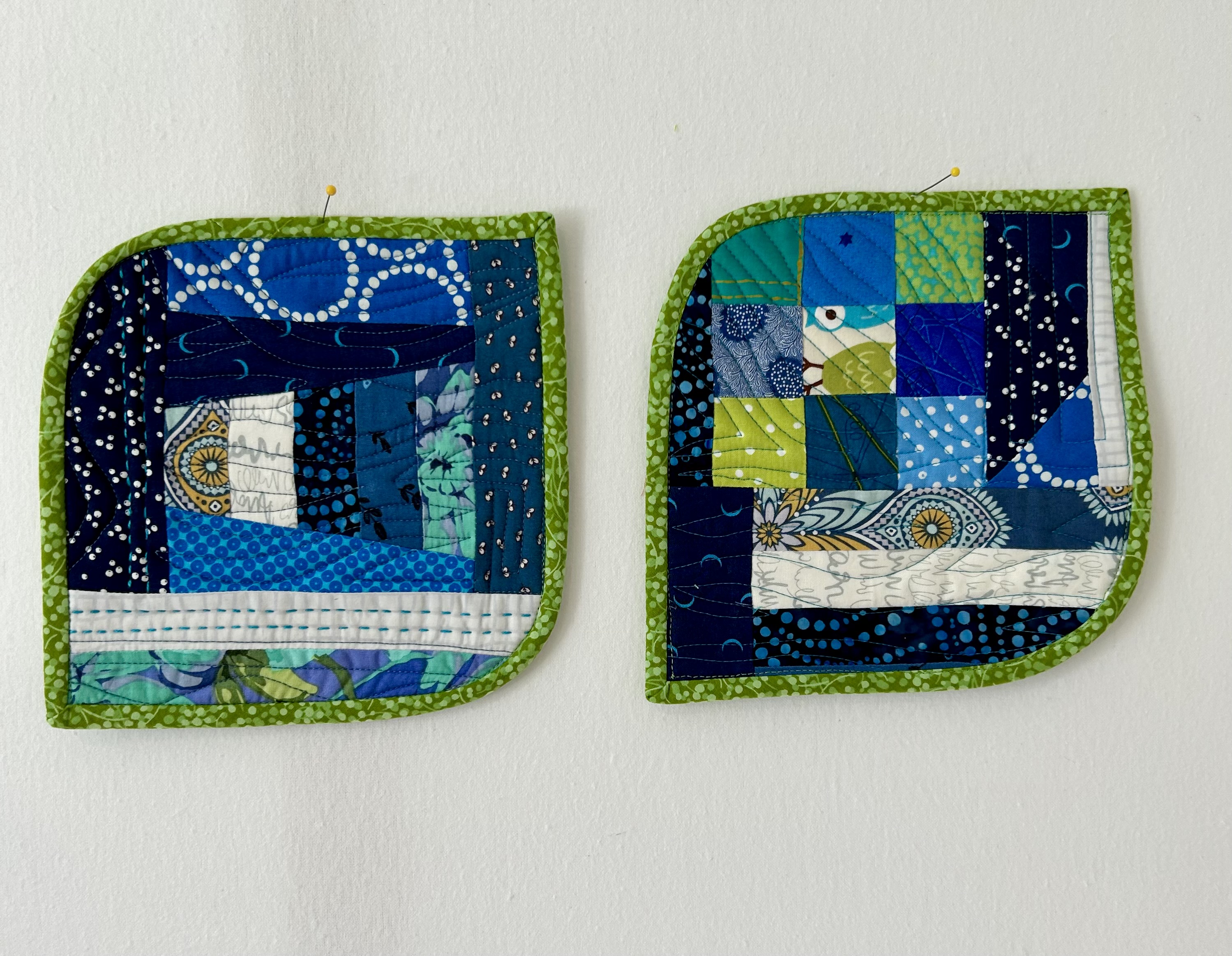
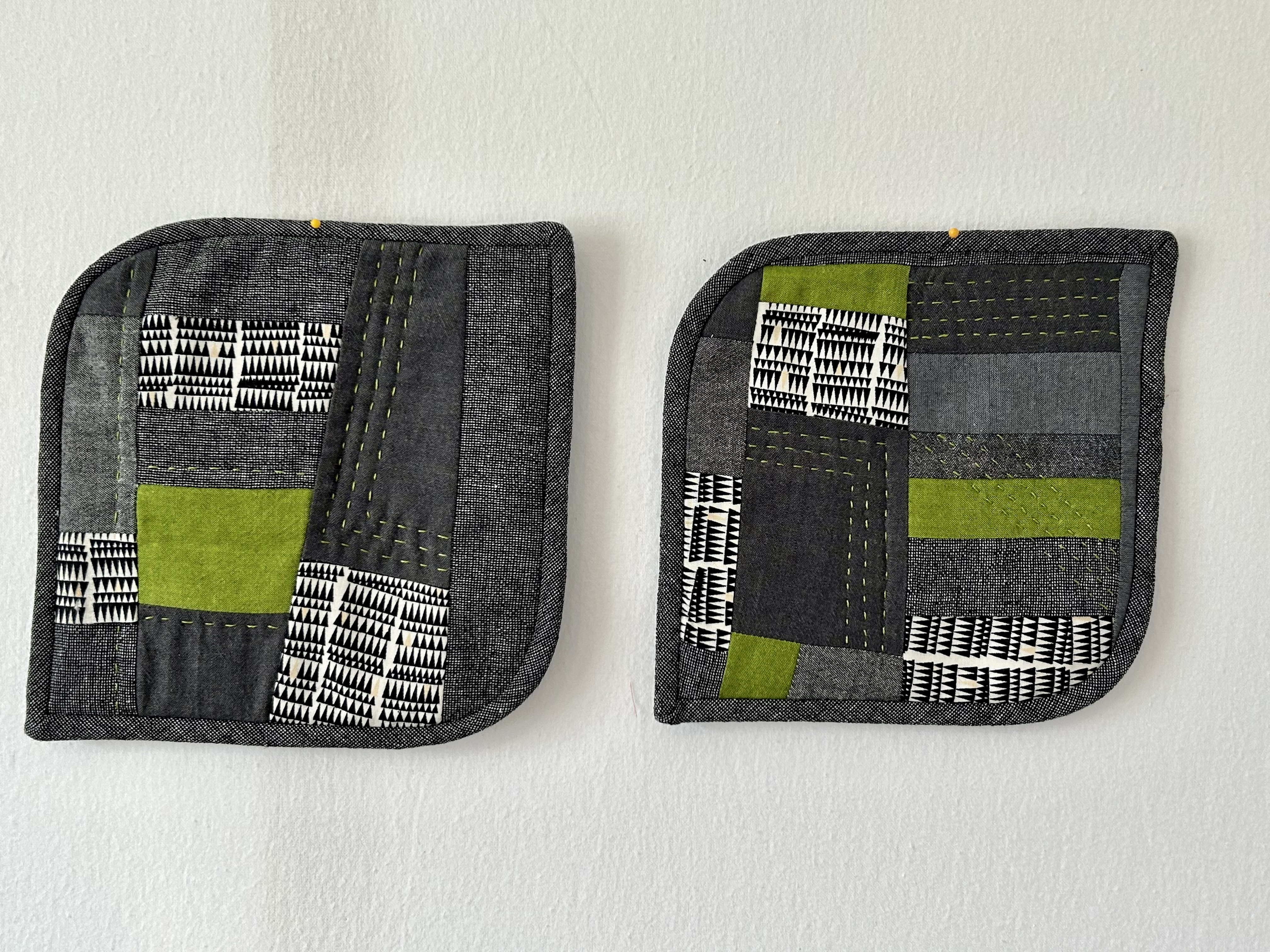
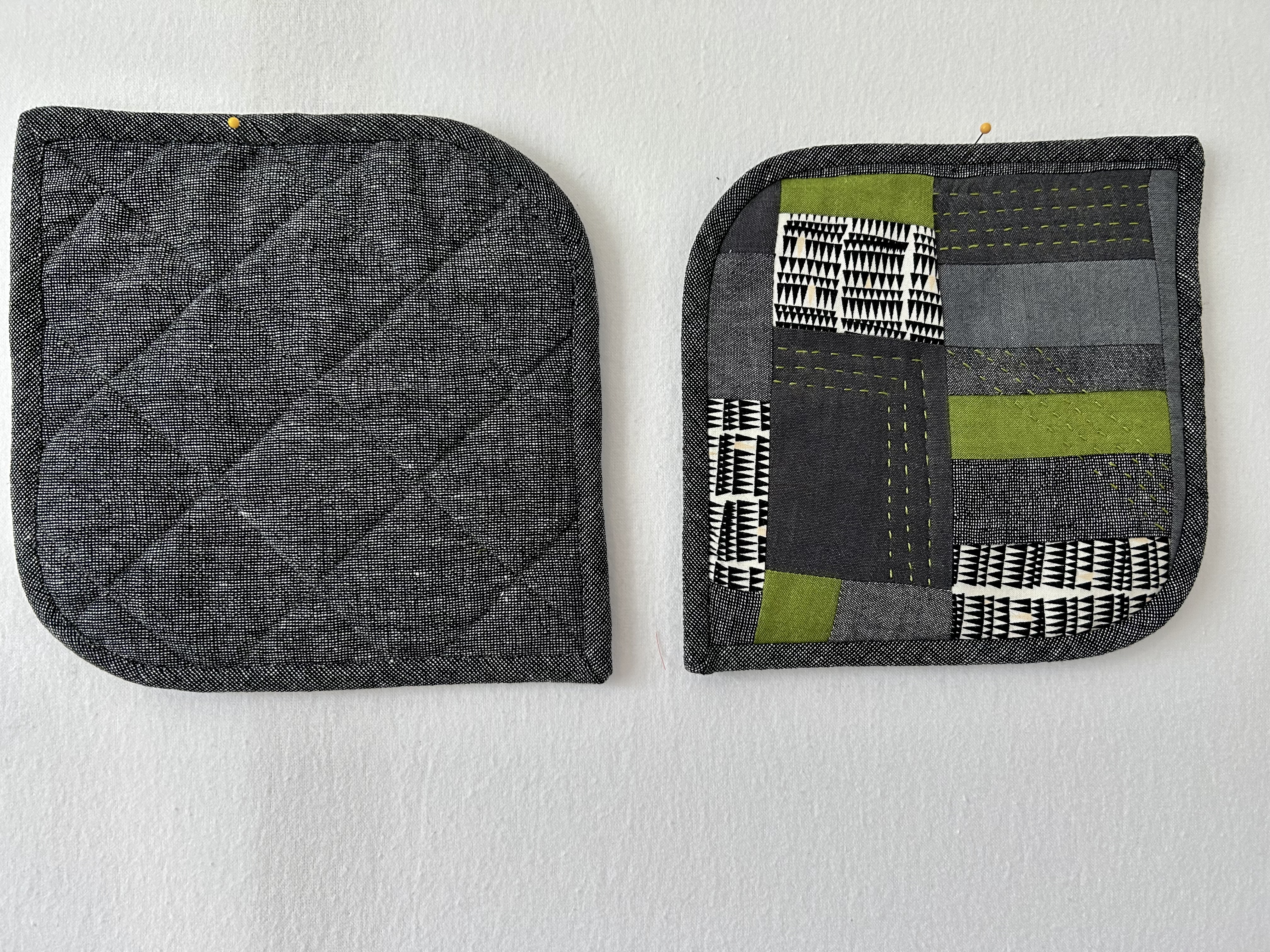
I made two more pot holders yesterday. It’s hard to quit, but I have moved on now after these two. But I have fresh freezer paper patterns should the need arise, LOL.

And the back.

I have my old Janome, which is going strong, set up with a walking foot attached, so it is easy to move over to it when a walking foot is needed–like for this walking foot quilting and the binding.

These potholders are thick–with two inner layers (Insul-Brite and batting) and the two outer layers. And the funky shape makes installing binding a bit more tricky at the join. And the thickness means the binding has to wrap around a lot of thickness–so I should be using 2 1/2 inch binding rather than the 2 1/4 inch I usually use. Single fold bias tape doesn’t cut it for this thickness. The stitching on the binding on the last one was the best so far, but it wasn’t perfect. And, I like perfect.

Needless to say, this project has been a learning curve for me.

And I like learning curves, too.

This pair is going to son Bryan.

I did sew a few Churn Dash blocks yesterday for the quilt on the design wall. They are so fun to make and sew up quickly. But tomorrow I will return to the quilt from hell as I’ll be staying with my two older granddaughters while their parents make a quick trip to see Old Miss with grandson Kelly–one more time before a final decision is made. So, hand-sewing will be needed.

The longarm light bar is due in New Jersey tomorrow. Its trip from out west took forever as the shipping company clearly has been short-handed–which is a common story these days. So, the delivery plan now is next Friday.

Potholders and Hot Pads

I BADLY needed a break from the quilt from hell. So I gave myself a few days to play with a new project. OK, two new projects, actually, but I’m resisting so far making more churn dash blocks for the quilt on the design wall. I need to fill those holes–it’s under 20 blocks.

I have been watching friend Betsy Maislen make adorable pot holders in recent months–and she had fun playing with her machine’s decorative stitches for the quilting. And a year ago, I was also tempted by Debbie Jesse’s post on her A Quilter’s Blog when she made a whole slew of color-dedicated, scrappy potholders using a funky shape from Hannah Haberkern: https://hannahsews.com. Recently Debbie Jesse returned to this funky potholder project–and added a matching mitt. She made these two items, and I fell in love:

I have put links to Debbie Jeske’s posts below this post. And here’s a picture of Hannah Haberkern’s initial funky potholder. Isn’t it fun? She used her walking foot for the quilting.

The insulating product most used for potholders is Insul-Brite–which contains a needle punched fluffy fiber with a poly layer. The product repels both heat and cold.

Info on the package recommends two layers, poly side out, with an inner batting layer that will absorb condensation. So, that’s 3 layers, plus the two outside top/bottom layers. Various people writing about how to use this product also recommend additional batting layers for really good heat control, so I did add one more for the hot pad I also made.

You also need bias binding–which I always do anyway–but many use single-fold bias tape for the binding–and I will try to do that when I get a chance to buy some in colors I like locally.

Confession: I’ve never been able to properly sew down the free edge on binding with my machine and always hand sew the free edge. BUT, I need to rethink and learn to do a good job so that the back and fronts both look nice. I suspect using a glue stick and/or clips would help.

So, here’s what went home with son Mike, who REALLY needed some fresh potholders. And, a big counter hot pad for hot dishes coming out of the oven. Word is he’s already used them and likes them.

I used some Essex Linen I had in my stash as my focal point, some peppered cottons in grays and the one green, and a Carolyn Friedlander print. I made my bias binding from the linen.

I made TWO LAYERS first–doing the front and back layers separately and then combining them. The front layer had the top and the Insul-Brite; the bottom had the back, the Insul-Brite, and a batting layer that would land up in the middle of the potholder. Before quilting each package, I sewed the edges with a bigger basting stitch. Also, before installing the binding, I, again, sewed around all the edges. *Also, I released the foot pressure to handle this thickness. (The linen binding was super stretchy, which made hand sewing the back edge pretty easy.)

Here’s the back.

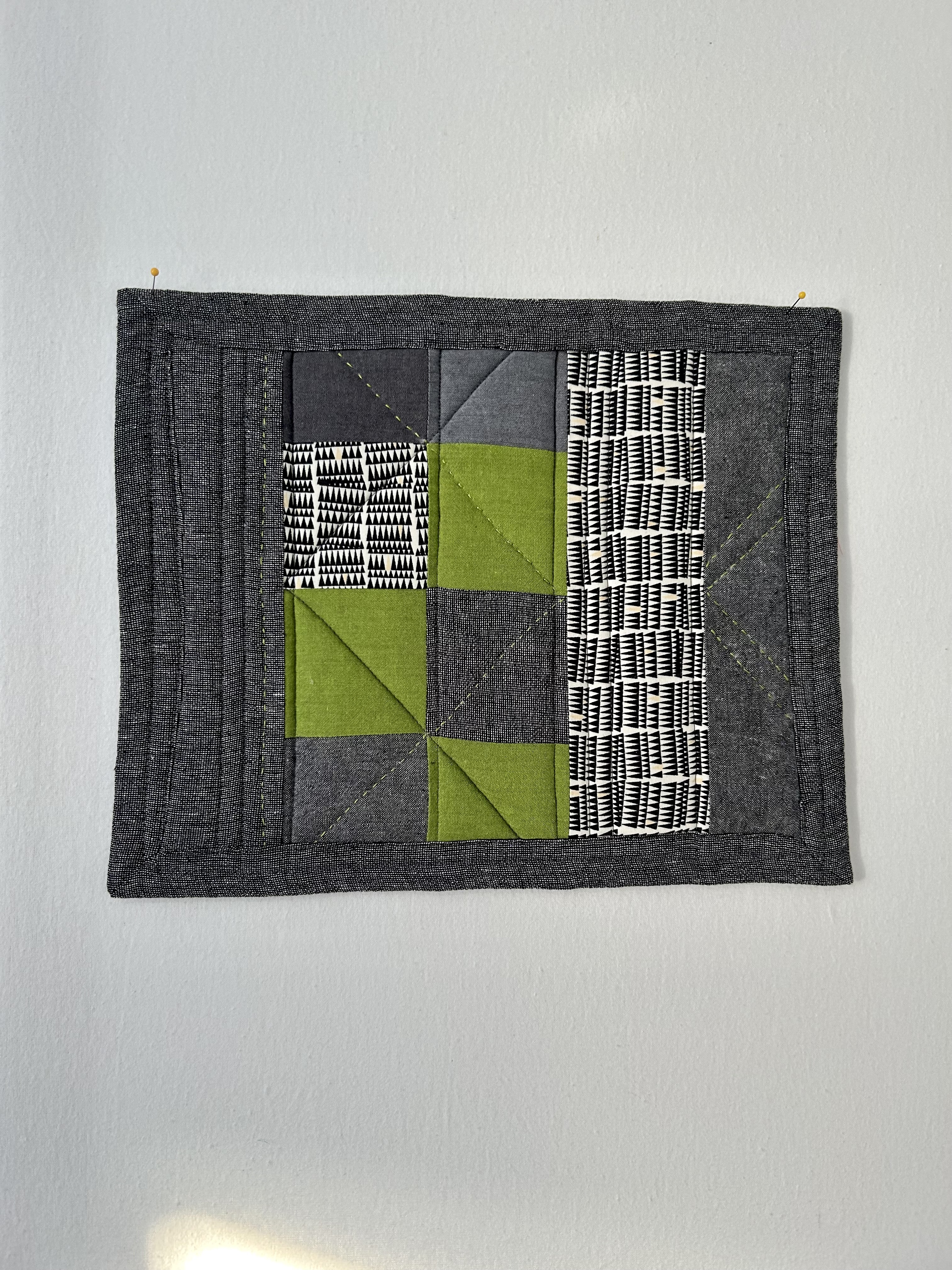
Here’s the BIG trial counter hot pad–which has 4 inner layers as I added an extra batting piece. I’m also experimenting with this kind of binding where a larger backing comes around to the front, but haven’t quite “got it” yet–in that it’s width is chopping off blocks. It works really well, though, if the top doesn’t contain pieced blocks that need only a 1/4 inch seam. Also, I used my machine to stitch additional lines of quilting here and there as hand-sewing into this thickness was hunt and peck. And, slow.

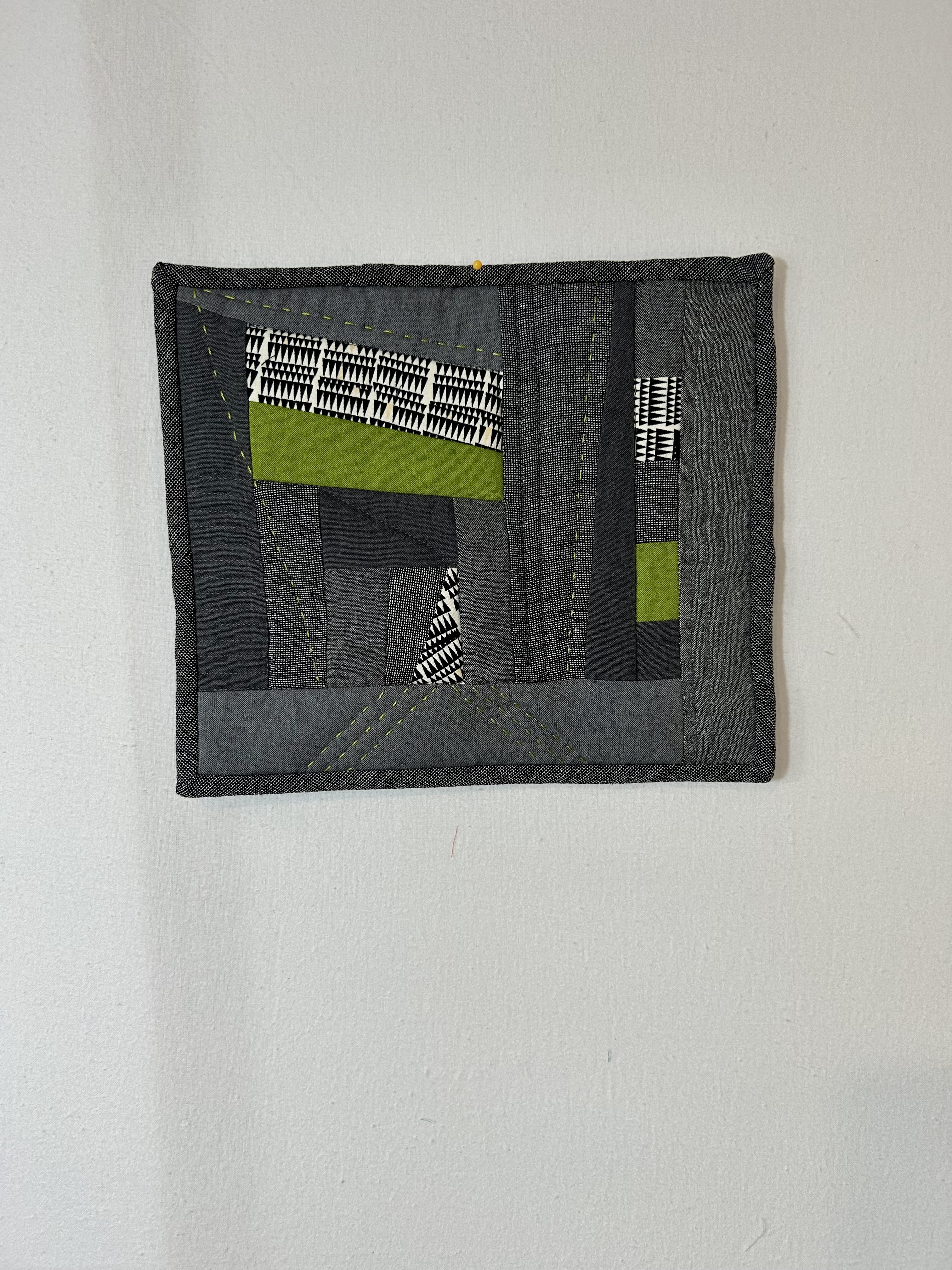
I could not resist playing with scraps before putting these fabrics away–so I have this hot pad for myself–but with only 3 inner layers. Thus, I can test out how heat protective it is.

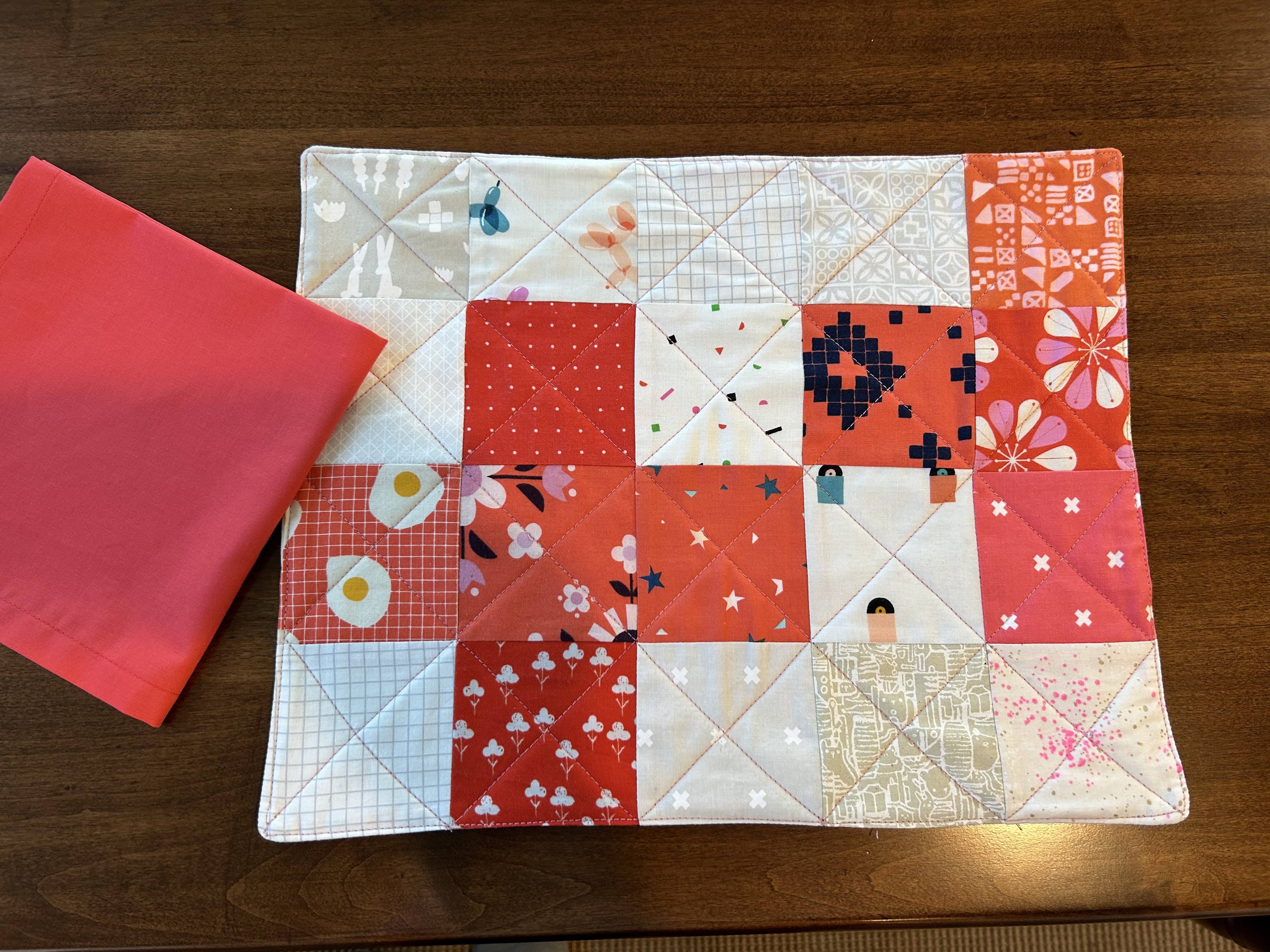
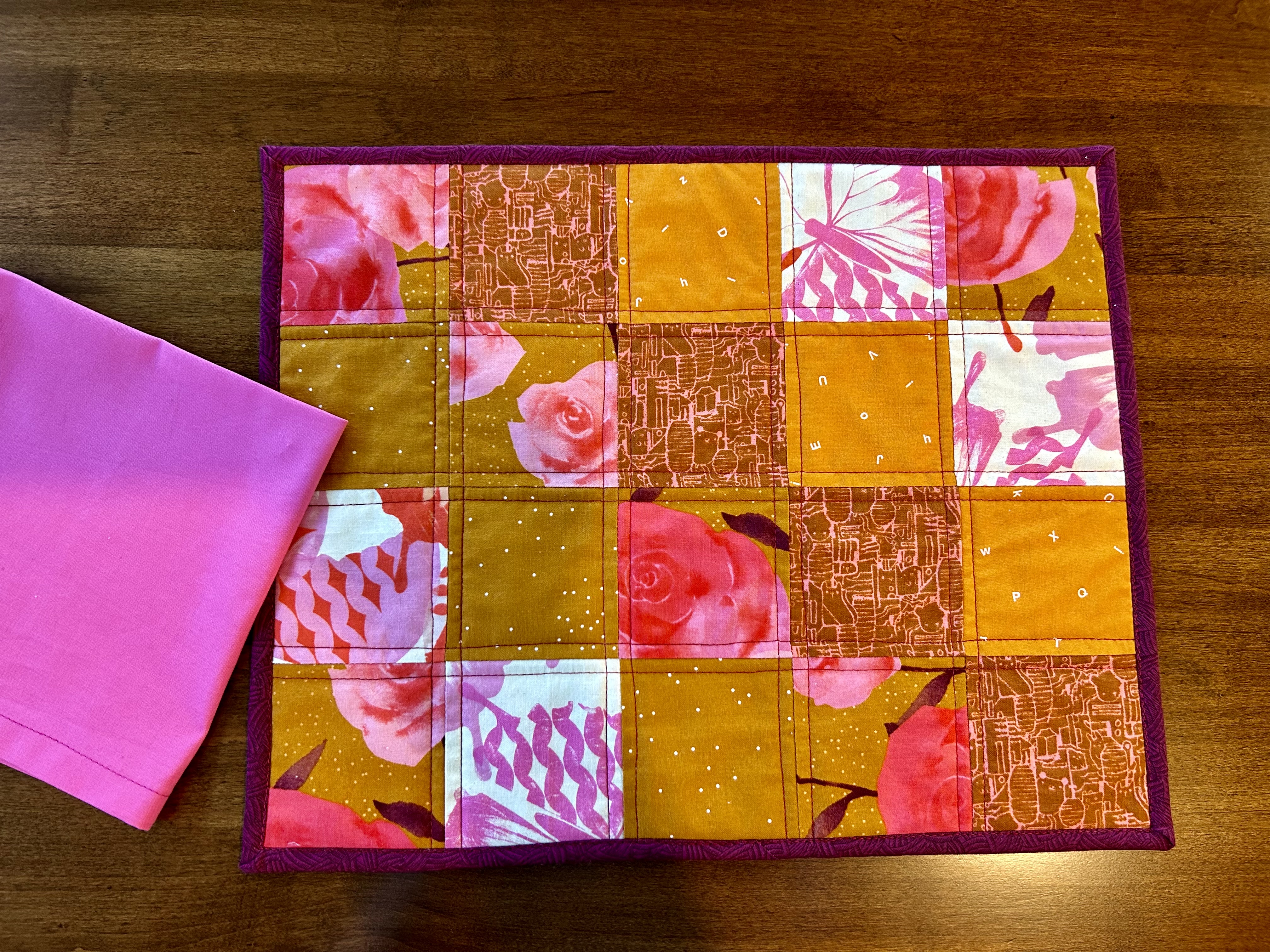
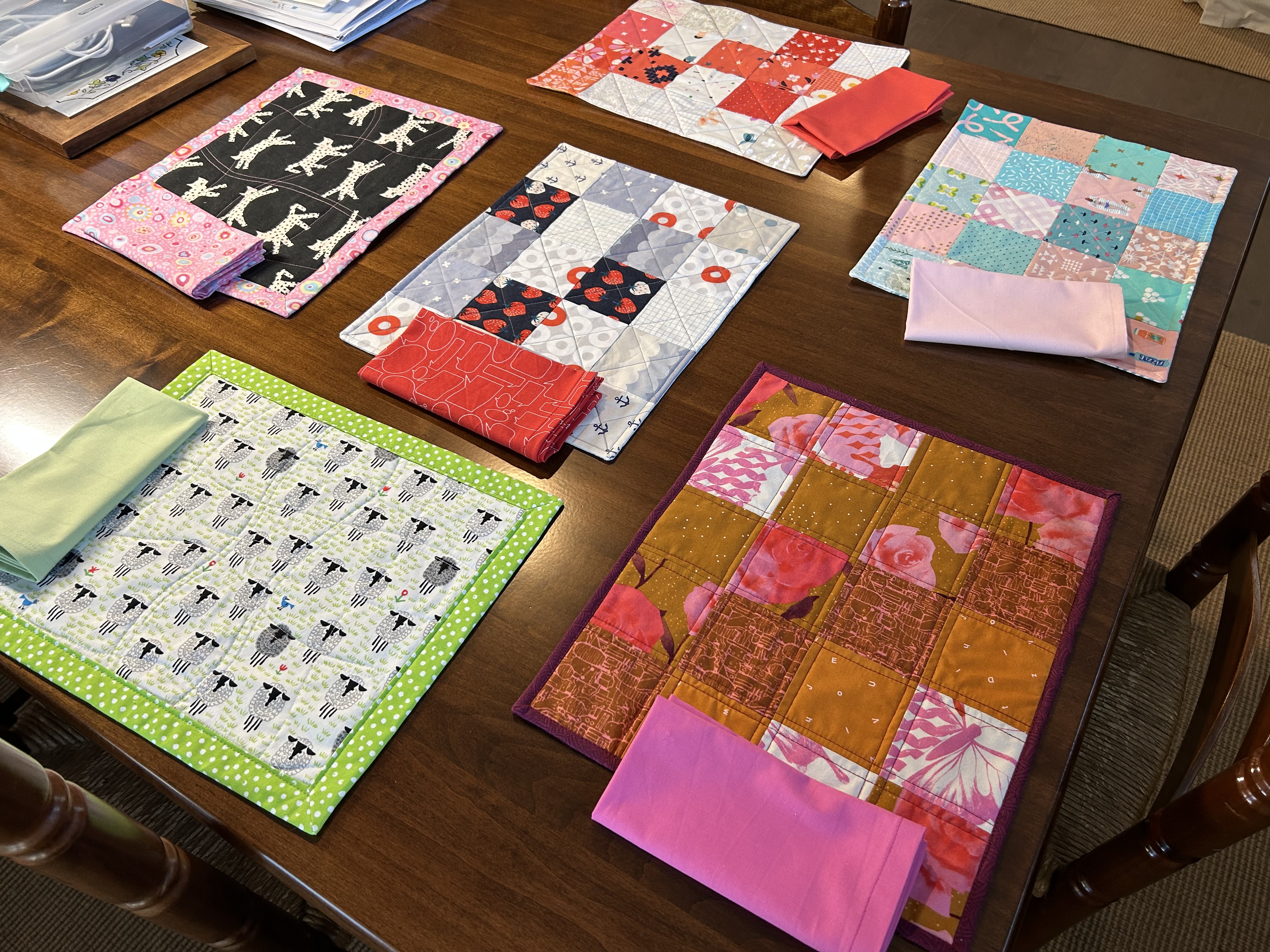
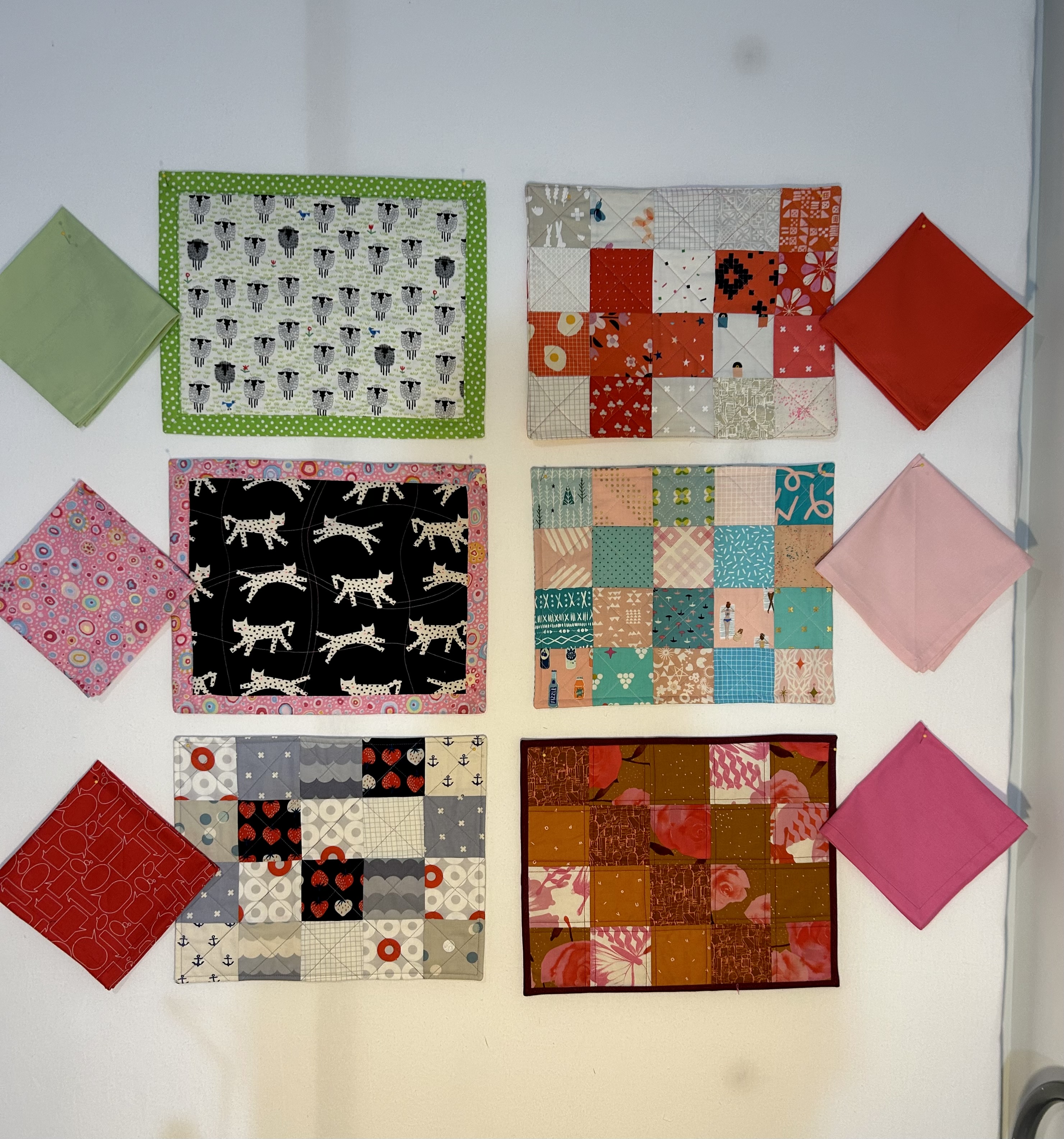
The other project is trying out various methods to make placemats from the 3 1/2 inch blocks I have from the Cotton+Steel project where I cut up the whole saved stash. Son Bryan’s family needs new placemats–and granddaughter Ailey is going to help me make some for them.

Next on the potholder project, I’ll try using just two inner layers (Insul-Bright and batting) and bought single-fold bias tape. What a great way to play with scraps and to have some gifts on hand.

Here’s the recent post from A Quilter’s Table:

https://aquilterstable.blogspot.com/2023/03/bombazine-and-more.html?m=1

Here’s the link to Debbie’s scrappy potholders from last year:

https://aquilterstable.blogspot.com/2022/03/scrappy-potholders.html?m=1

One More Row

Yesterday I finished the last block center for the “36-Ring Circus” English Paper Piecing ((EPP) wedding ring quilt I’ve worked on for YEARS now. And, that I’m now determined to finish.

I had these centers all prepped back in March 2022, but did not sew them together. Now, I realized I wanted to make sure that I understood how they would each fit into the last row of the quilt–taking into consideration the placement of the centers in the whole quilt.

I laid out the finished top three rows and lined up the finished bottom two rows. Hmmm. It is interesting and kind of funky with the Cotton+Steel fabric centers.

How these bottom blocks of the 6th row get placed depends on WHAT one is looking in one moment–which is always true of quilt block placement. I can already see blocks I might want to switch around, but then also see “but wait, it would be too close to `that block.'” I am going to switch out the far right two blocks though–even though the corner block will be close to the red mushroom block above it. The lighter aqua block is too pale to hold down the corner.

At some level, it just is what it is…

But, I’m seeing other issues that are not working for me while looking at this picture–which is why taking a picture is a really good idea. I need to split up the blocks with the strong blue in them.

I still have to make and sew the templates that will square off this quilt. They are larger and might go faster. I’ll use all dark solid fabrics. And I might need to add some additional borders–a narrow one and a wider one. Thank heavens as they would be done on a sewing machine.

I took a moment yesterday to finish off the edge of this cotton kitchen towel hand cloth used to dry wet hands–made from cotton balls I had on hand for grandchildren, but which didn’t get used to teach them to knit due to no visits to Maine during covid. These balls became my hand work at night while I packed up in Maine. And, later, while I was waiting to get into my new home.

I had fun playing with patterns along the way–and explored a moss stitch in one of these hand cloths. A plain old garter stitch is sturdy for this kind of use too.

The cloths sit in a dish given to me many years ago by another Enright “outlaw” wife during a visit to Maine: Judy O’Connor.

The outdoor room blinds are being installed as I write this morning.

A Busy Weekend

It’s a big family weekend. Oldest grandchild, Bowen, came home Friday afternoon on spring break from Furman University. The two older granddaughters are playing in a tennis tournament in Pawley’s. DIL Tami’s mother (Mimi/Debbie) is here, and we had such a nice visit here at my home Friday morning. (She will be relocating to Charleston in the, hopefully, near future.) Bryan and Corinne invited me to dinner last night, and Mike and Tami will have “Sunday Night” dinner tonight.

So, I started the weekend Saturday morning with a trip to Kudzu’s Bakery to pick up TWO of their famous chocolate mousse cakes, one for the dinner at each house. Bryan’s girls were ecstatic when I came in with their cake last night. (So was Bryan, actually, who said he would definitely have a second piece some time before bed.) These cakes are flourless and basically mostly chocolate mousse and looked totally deliciously rich.

Bryan has a smoker/grill that is awesome, and he cooked a boned/rolled leg of lamb on it for dinner–and followed with roasted fresh asparagus on the grill while the meat rested. Corinne made mashed potatoes, and we ate outside on their back porch and had such a nice visit. I think Bryan’s leg of lamb, marinated with fresh rosemary from his garden, garlic, salt, and the olive oil I gave as a gift, was the best I’ve ever eaten.

Tonight Mike and Tami’s long table will be full. They are six in that family, and all will be at dinner. Bowen picked up his girl, Hannah, last night at the airport. (She has the same college break he does though she is in Maryland.) Bowen’s roommate and his girlfriend are visiting. Mimi and I will be there. And who knows who else will show up as the circle of friends for these four teenagers is large and some know good cooking when they eat it.

I have now been over the Ravenal Bridge, which links Mt. Pleasant to Charleston, twice now in the past week. Yeah! The bridge is 8 lanes, is very high, has a walkway along the coastal side, has an awesome view from its high point, is gorgeous, and ends in a tangle of highways coming into Charleston. Waze took me through safely to take my vacuum cleaner to Low Country Vacuum and Sew on Savannah Highway and to retrieve it Friday afternoon.

Patriot Point, on the Mt. Pleasant side of the bridge, lies to the coastal side of the bridge, and friend Gina Caceci sent me an article about all the places of interest at Patriot Point, which include the presence of water taxis that connect Mt. Pleasant to the downtown Charleston Harbor tourist/shopping areas. The taxis would be fun and would mean one would not have to find parking in downtown Charleston. Something about which to think as SIL Maryann Enright is coming for a visit March 13th and might enjoy that adventure.

To back up a bit–I had one question from blog readers about the EPP method post I did a few days back–specifically about folding part of the quilt to attach a new piece. I updated that post with this picture–so you can see that the left side center block is folded in half, templates and all, so I can grip it in my left hand in order to manage the sewing with the flat back stitch better in my right hand. Thus the piece can be picked up–as it is pretty much impossible to stitch with the piece flat on the table. You can fold a much larger piece of the mother quilt in this way as well.

Low tide is at noon today, but Isle of Palms had a festival of some sort yesterday, and the island was packed with visitors–made worse as it was a wam day, definitely warm enough for beach swimming for the hardy.

In addition, there was some sort of accident across from the connector to the mainland when I headed home early evening. It took me forever to get home as the main artery on IOP was backed up for more than a mile. I suspect a walk on the beach today might be a problem due to weekend visitors, so maybe I will walk around Mike and Tami’s neighborhood. I can take some hand-sewing over, sit on their back porch “outdoor room” and enjoy the coming and going of the family.

But first I have to go to the grocery store myself. And mop all the tracks I’ve made on the floor while reorganizing the garage yesterday (to get ready for the grill that will arrive fully assembled tomorrow…hopefully) and while giving “Girlie” car a good cleaning.

The pine pollen…continues.

An English Paper Piecing (EPP) Method

One reason I have hated this EPP project is that the curved rings are so very hard to attach. I finally saw Tara Faughnan, in one of The Color Collective classes, hosted by Sewtopia, use artist tape, installed on the front of the block, to hold pieces in place while they are being stitched. With the tape, I can keep the rings lined up without losing how they should fit properly into the bigger block. Basically, one runs into the same problems with these curves that one has with sewing any curves together–seemingly excess fabric that falls into place if both sides are laid flat.

To remind, here’s how I start a set of rings so I don’t wind up with colors butted up to each other that don’t work in one way or another.

When I have the outer rings sewn, I can overlay them on the center piece and use the tape to hold everything firm. (The tape can be reused–and when I’m done for the moment, I put pieces back on the tape ring so they don’t dry out.) When sewing the rings, I also use a small piece of the tape to hold the inner curved top pieces firmly while I sew them. The pieces in the middle are easy to sew with the standard method of putting right sides together and whip stitching them.

One uses what is called a “flat back” stitch to sew a block that is laid out flat. Note that I’ve written how the block will fit into the larger block on the back pieces. And remember that I also take a picture of the block so I don’t get mixed up with what color goes where and how the finished ring piece fits on the final block. When sewing rings to the mother row, I can just ruthlessly fold the mother row so I can get hold of what I am trying to sew. One needs purchase as sewing into the flat piece on a surface is too hard to manage.

Here’s an example of folding over part of the quilt, templates and all, so you can sew it more easily. Note that the center block on the left is folded in half. I am right handed, so it is easier for me to fold left and sew with my right hand.

Here’s a finished ring block.

And here it is attached to a center block with the tape so I can attach it from the back.

Now both rings are attached and the block is ready to go into the “mother ship.”

Voila!

I am so not looking forward to attaching, when completed, these rows to the other three rows.

It will be…painful.

But let’s not borrow that trouble this morning as progress is happening steadily!

Tennis Weekend

Saturday and Sunday involved watching tennis matches as granddaughter Talula played in a local tournament.

It was so fun to see her play after following her matches from Maine.

Both days were ‘murky” in the morning, and the gnats were bad. I didn’t bring my Young Living peppermint essential oil with me, but I have it with me permanently now, along with lavender. I’m sure the cooler, cloudy weather was a mannerly boon for the tennis players, but on both days the sun came out in the afternoon.

Look at these pretty palm trees. And that’s Tami’s back with a leash holding her mother’s little puppy. I have not seen Mimi in…decades…so it was very fun to see her again. She came down from Spartanburg for a family birthday party. Mike and Tami had a family dinner with both grandmothers Sunday night. It was delicious and very fun and a nice way to wrap up the week.

Mike and Tami traveled Friday to attend son Kelly’s wrestling matches for the state winners. So, I slept over with the granddaughters and cooked dinner Friday night. I went over Friday morning to let dogs out and took part of the hand sewing EPP project with me and had a peaceful hand-sewing day, though I had to go home once in the afternoon to retrieve a delivered package from the front porch–a wooden table for the back porch.

I finished another block and will attach it to the mother ship row.

Two more blocks to go for this row–and I finished the next center but need to lay out its rings.

The pine pollen is TERRIBLE here. Of course, there are so many pines that heavy pollen should not have been such a surprise. Maine had pine pollen too, and it could be heavy. Here, though, the pine pollen is over the top. Everyone is happy when there is a bit of rain to wash off the cars and walkways. The porches have to be cleaned though. And my dark floors show it tracking inside so easily.

I put together the little wooden table this morning–it’s the last piece of furniture for the porch. Now only the porch blinds remain to be installed for my outdoor room to be complete.

The refinished dining room table comes back TOMORROW! I can hardly wait to see it.

I spent some time this morning observing gutters being installed at my neighbor’s house behind me. Oh my! I had not thought about the need for gutters, though we installed them in Maine. And, yes, many houses here in my neighborhood have had gutters installed already I realized as I stopped to check.

I’ll have to get a quote. For sure.

It is a quiet kind of a day. I’ll probably run over to the beach in a bit for a walk.

Some Ways to Hang Your Quilts

I had a request to blog about how I hang my quilts.

I can do that.

Note that one can always hang a curtain rod with its own supports that is long and just switch out whatever quilt one wants from time to time. I think Bonnie Hunter hangs quilts this way in her Inn. If you don’t know Bonnie Hunter, check out her blog.

Note, too, that for really heavy, bigger quilts, I use curtain rods with decorative ends. Note that the middle quilt below, as it is not as wide or heavy, uses an invisible dowel wooden rod which can be bought at most hardware stores and cut to size. You want the SMALLEST dowel/curtain rod that can support the weight of the quilt without bending as you don’t want a bulge at the top of your quilt. And you want the quilt to sit at the top on the rod so that the rod is at the top and not down into the quilt–where the bulge of it can detract.

Thus, the most important thing with hanging quilts is installing a hanging sleeve that is level with the top of the quilt AND that allows space on the outer sides for the dowel/rod to show.

I double a wide band of fabric (for a big quilt about 4 inches, which means a piece about 9 inches wide. I cut and turn in the sides twice (neat finish on the sides) so that the sleeve leaves space on either side for the dowel to peek through. A curtain rod’s ends are always going to show–but you have to figure out where to position nails so they don’t show–they can hide just inside the edge of the quilt if you leave proper space between the binding edge and the sleeve edge. Dowels should not be cut wider than the binding on the quilt as you want to hide the dowel in the gap between the edge of the sleeve and the binding outer edge. I double the 9-inch strip and press it before sewing the sleeve’s two raw edges to the quilt top when I install the binding.

For a big quilt I might machine baste the sleeve into the seam allowance first. And some quilters recommend splitting the sleeve into two parts for a wide, heavy quilt. Next, after binding, you have only to sew down the bottom of the sleeve.

BUT, and this is important, there is a method for sewing down that bottom edge as you have to place it a bit above where it would go without allowing for some excess hanging room. But not high enough from the bottom so that the top of the sleeve starts to show over the top edge of the quilt. Mostly I bring that bottom edge up about 1/2 inch, but I always test with a rod to make sure I haven’t gone too high. Pin and sew down the bottom edge of the sleeve.

You can see the excess fabric on the outer sleeve side in the picture below. The bigger the dowel/rod, the bigger amount of excess fabric you want. And here, I should have gone higher at the bottom of the sleeve so the dowel would locate higher near the binding.

See the bulge at the top?

I use nails that have a head big enough to hold the dowel so it won’t slide off the nail. For a bigger, heavier quilt you will need bigger nails. But always get ones that have bigger heads.

Lay your dowel where you want it on the wall and mark where you want the nails to go. Remember to put the nails at least 1/4 inch or a bit more from the edge of the dowel. The position of the nails will be a bit different for a curtain rod depending on the decorative end of the rod. The nails have to be inside those ends and very close or inside each side of the quilt edge. Then use a leveler to make darn sure the dowel/rod is level. I have a long leveler and a short one. After I put in the nails, I use the leveler again to make sure all is level at that stage. And I check again after I hang the quilt as it is fairly easy at that point to remove a nail and replace it if needed.

Remember we do the best we can all along the way to make sure a quilt is square and the top level. But quilts are rarely perfect. Fabric stretches, things shift. Just do the best you can. Remember the nails have to fall below the top binding on the quilt.

I measured from the ceiling down to line up the quilts below. And for the 4-season trees, I used matching white rods–and when the top two were hung on their rod, I used my long leveler (about 3 feet) to place the vertical placement of the lower rod so it was in line with the top rod and its nails.

If you want to remove or change a hanging quilt, you pull out the nails, patch the hole with sparkle, sand it totally smooth, and repaint the patch with matching paint.

And, there you have it.

The Design Wall is DONE!

Isn’t it wonderful? Bryan came back yesterday with the white duck tape and two girlies in tow. After they left, I installed the white flannel. I couldn’t be happier about the completion of this project.

The late afternoon sun comes through the windows, so I’ll have to remember to either close the shutters or set them in a way to deflect the light so it does not fade anything pinned to the wall.

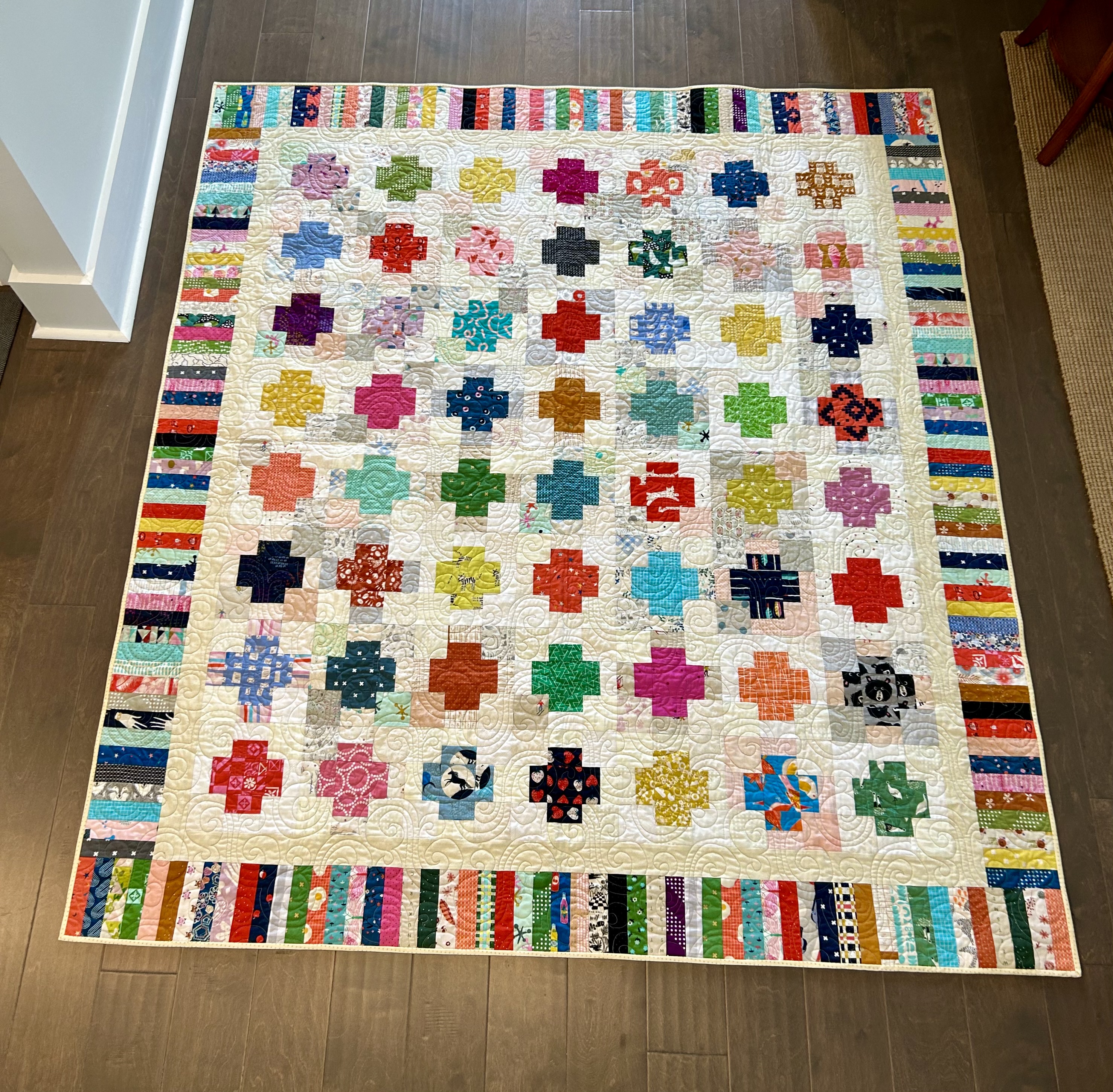
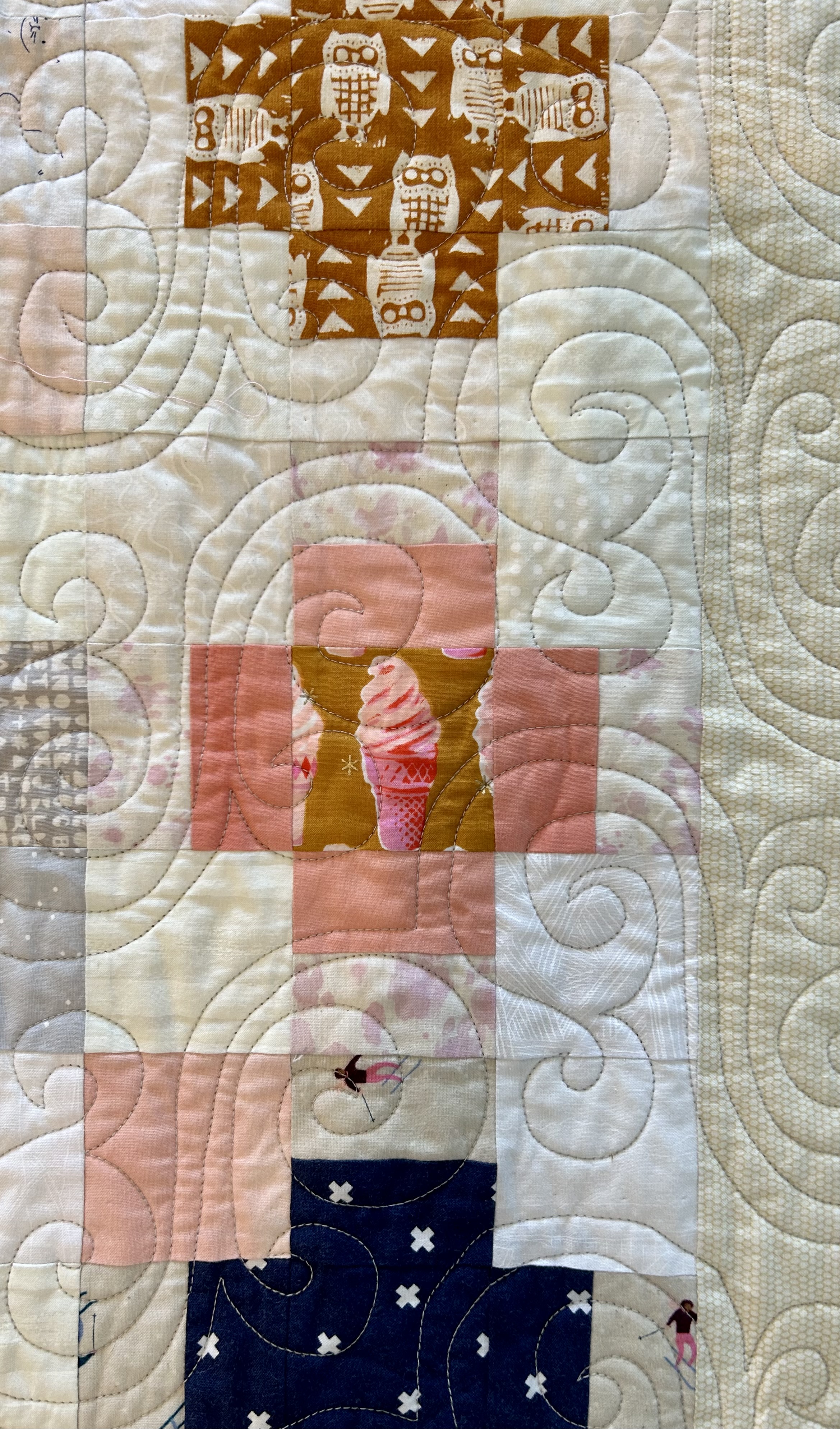
Of course I couldn’t resist pinning SOMETHING to it, so I dragged out the last batch of Churn Dash blocks I made in Maine–with the last (ok, almost the last) of the Cotton+Steel fabrics. They just went on the wall mostly willy nilly–I’ll be moving them around a lot I’m sure. As I sew, I’ll notice what isn’t working, and that’s what I love about having a design wall. I can’t “see” this way when I try to lay out blocks on a rug or a bed.

Two of these blocks had piecing errors, so they are now on my sewing machine table–along with some pieces ready to be made into blocks and neatly pinned together back in Maine. And, I will need more blocks to get 8 by 9 rows. I will use some sashing between the blocks.

I took these pictures this morning–it is kind of a murky day, so the colors are not showing up as vibrant as they are. But these “random” blocks–with just interesting colors combined–are so darn cute. Some of the centers have cute images, but that is just because I had some of those blocks on hand already cut.

Putting up these blocks on the wall is tricky as I do not want them to distract from finishing the quilt from hell.

Here is the next block center in the quilt from hell–it’s the 3rd in the 5th row (of 6 rows). I’ll sew it together today.

Here’s how I lay out the rings, and I can see that I will want to move the bright yellow piece at the bottom to another spot. Taking pictures of work is always…revealing. In the big scheme of things though, in the whole of a finished quilt made from so many tiny pieces, it will mostly all just work out. Mostly.

Everything is very quiet here this morning. A lot of the dog walkers are not out. People must be enjoying Sunday morning breakfasts and for many, a day off tomorrow.