Turkey Tracks: Handmade Winter Snow Globe by Kathy Daniels

Turkey Tracks:  January 4, 2013

Handmade Winter Snow Globe By Kathy Daniels

Coastal Quilters had their annual Christmas party early in December.  As part of the festivities, we had a Yankee Swap.  Though I’m sure other members think they wound up with the best gift, I came home with the BEST swap ever–a handmade snow globe, made by member Kathy Daniels, who is an art quilter.

Here’s a picture:

Winter Globe

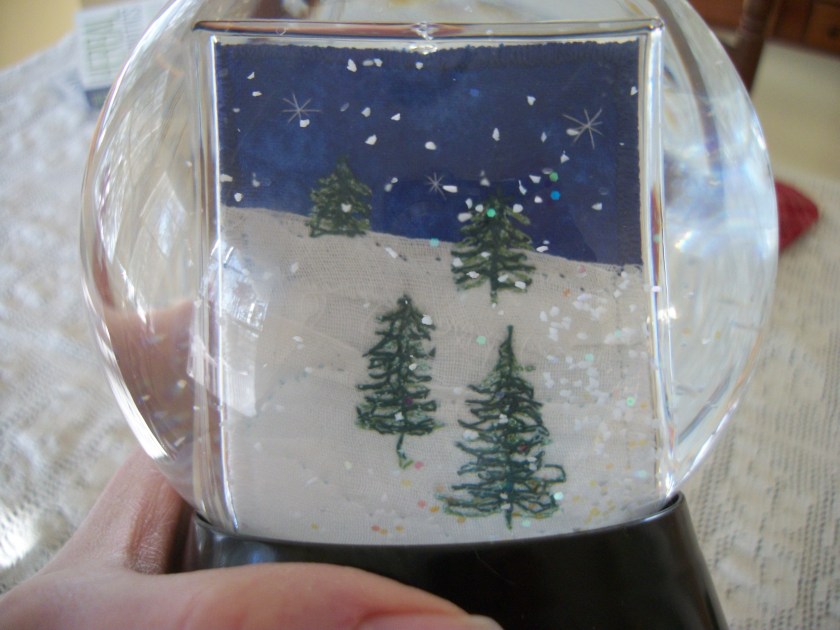
The insert on the inside of the globe has two fabric sides–both made by Kathy.  The tree side has white fabric for snow, blue fabric for sky, and tiny trees thread-painted with her sewing machine.  The stars are embroidered onto the sky fabric.  Here’s a close-up, sans most of the snow:

Winter Globe 3

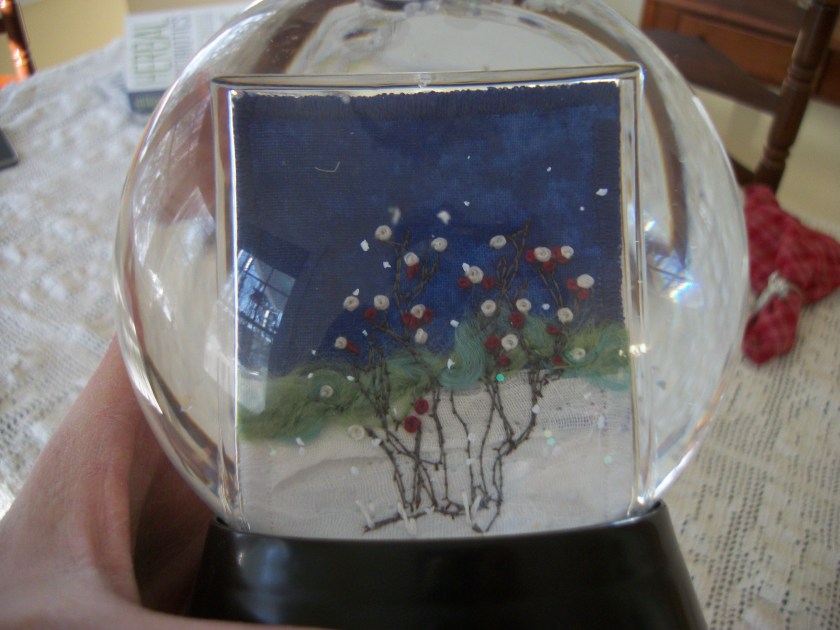
The other side is a tiny bare bush that is dotted with French knots that make up red and white berries.  Kathy has couched a line of frayed, fuzzy thread to separate the snow and the sky.

Winter Globe 2

Kathy says this project was not hard.  There’s probably a kit somewhere for the apparatus itself–and the interior fluid.  The outer ball is soft plastic, not hard, so one does have to be gentle with it.  It came in a large box that I will use to store it when spring makes itself felt.

I have shaken up the snow and watched it fall so many times now since early December.  Something about watching the falling snow is soothing.  The action slows one down for at least a minute!    It’s a gift that will keep on giving–full of creativity and promise.

Kathy did a trunk show for Coastal Quilters some time back, before she moved to Camden from elsewhere in Maine, so there is another entry about her, with pictures of her and some of her amazing quilts , elsewhere on this blog.  And, her web site is http://studiointhewoods.blogspot.com/.  I’m sure you’ll find lots of good quilt pictures and fiber art projects on Kathy’s blog.

Enjoy!

Turkey Tracks: Chickens Start Laying Again

Turkey Tracks:  December 31, 2012

Chickens Start Laying Again

Our chickens stopped laying sometime in October.

That’s ok, because they need a break.  By Easter time, most of our hens are laying every day and only slack off as the summer progresses.

The chickens who are a year old molt in the fall.  They are the worst-looking, most pitiful little things until they grow in new, glossy, glorious feathers.  It takes all their energy and LOTS of protein to grow in new feathers.  Besides, laying eggs is an awesome and involved task.  They just plain need to rest so I have never put light on them to extend the normal light quotient of the days.  I do put a red light if the temperatures drop below zero.

Just before Christmas, chickie Valentine, a Freedom Ranger, laid an egg.  Valentines eggs are HUGE.

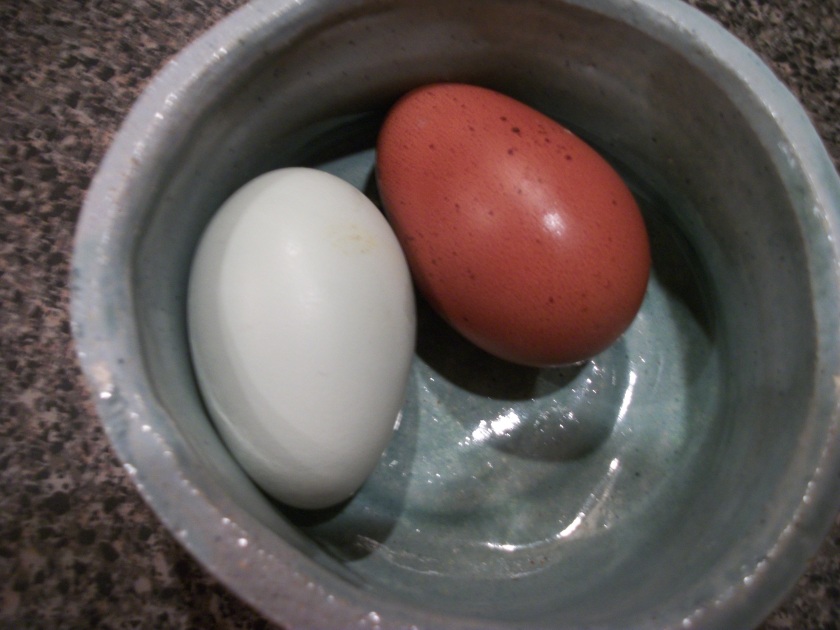
A few days later, Pearl, the younger Wheaten Americauna laid a stunning blue egg–great color and shape.  (I know it was Pearl because I saw her making a bed in one of the egg boxes and because Nancy, who is now almost 4 years old, is still growing in feathers.)

And a few days ago, Pearl and Rosie, my only Copper Black Maran female now, gifted us with two eggs.

Aren’t they pretty?  That chocolate brown egg is characteristic of the Marans.

100_2611

Then, we got the big snow, and the chickens are locked into their cage/coop arrangement–which they hate.  Even if I opened the coop, they would not come out.  Wisely, they know they are sitting ducks in the snow and with all the bare bushes that offer little protection from a swooping bird predator.  You will recall that’s how we lost a huge Maran female two winters ago.

This morning I took them some leftover meat and pancakes, with some milk poured over–alongside their normal grain feed.  Pearl was investigating egg boxes again.  I predict we’ll have another egg before long.

I am a bit surprised as in previous years, the hens didn’t start laying again until the days got longer.  I had expected Blackbird, the little hen we let Chickie Sally (eaten by the fox in August) raise this summer, to start laying her first eggs any day now as she is a full five months old.  Blackbird is a Wheaten/Maran cross, and she’s solid black with a small comb.  She’s beautiful.  Her eggs will be an olive green color.

Blackbird is also the low bird on the chicken pecking order, so she’s fairly stressed when she’s locked in with all of the hens.  Pearl, the former low bird, chases her endlessly.  Rosie, the head chick, is mean to everyone but Valentine, who is twice her size.  No one messes with Valentine.

Turkey Tracks: Big Snow in Maine

Turkey Tracks:  December 30, 2012

Big Snow in Maine

We have at least 2 to 2 1/2 feet of snow on the ground–from two separate storms I think.

The plow/shovel guys have been here three times in three days.  By late afternoon yesterday, they had us all plowed and shoveled out.  But, it snowed all night, and when I went out to let the chickens out of their coop and to feed them, the snow was almost to my knees again.

This last snow was light and fluffy–the earlier ones were heavy, wet, hard to shovel, and packed down almost right away.

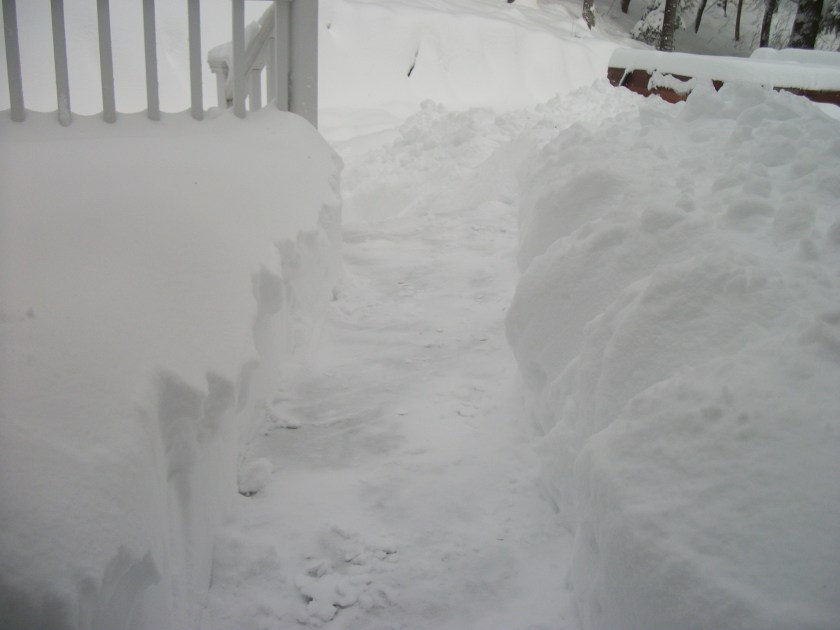
Here’s what our back deck looks like now–I had cleaned the hot tub top yesterday and will have to shovel a path to it and get that snow off the top today–otherwise, as it melts it forms a heavy sheet of ice that is murder to get off:

100_2614

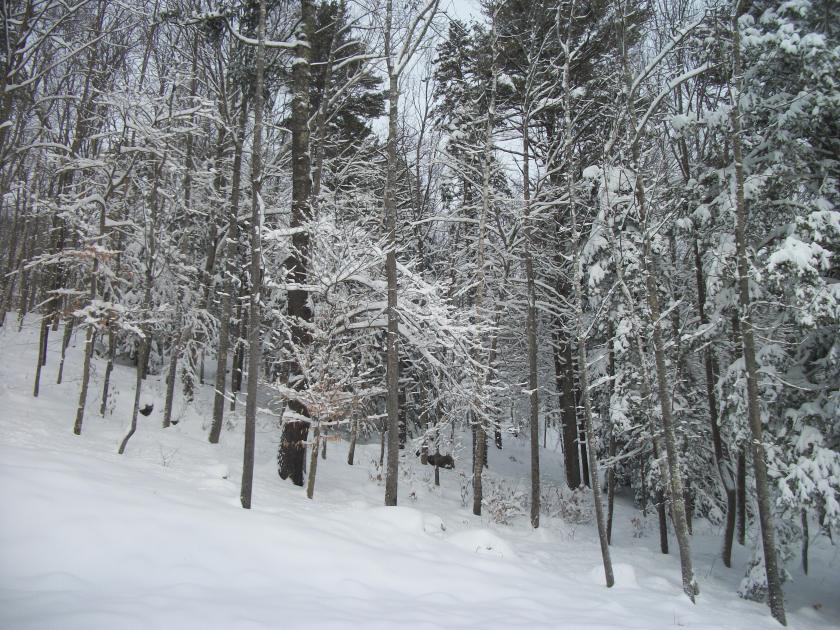
Here are our back woods–coated with snow and looking like they are decorated with spun sugar.

100_2615

Here’s John’s funky bird house and the blue birdhouse Bryan gave me last year.  We hang lots of birdhouses around our woods as the birds go into them for shelter in the cold.  Often, the birds will cram themselves into one birdhouse so they can share warmth.

100_2616

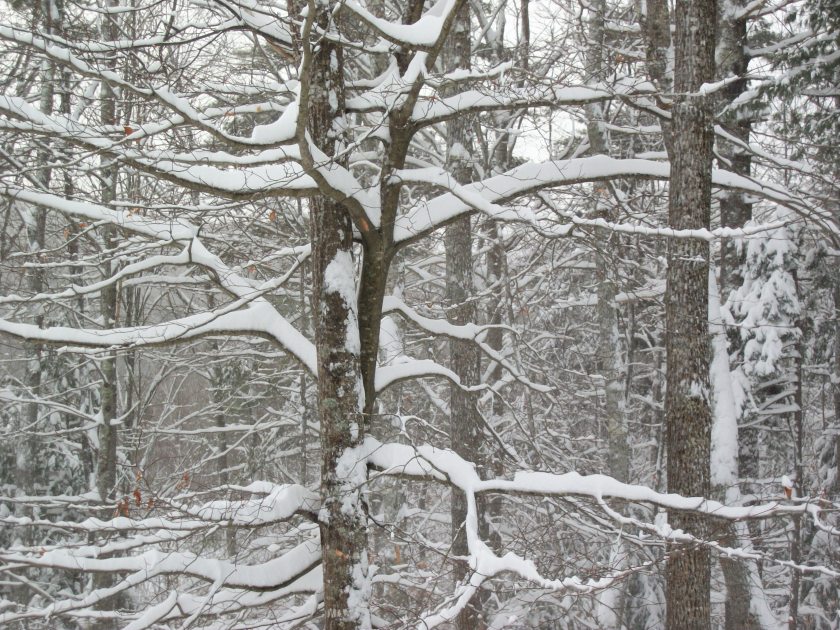
More spun sugar.  When the snow falls straight and light–with no wind–you get upright, thin layers of snow on all the surfaces that will hold the snow.

100_2618

We love WINTER in Maine!

Turkey Tracks: Christmas Day Dinner

Turkey Tracks:  December 29, 2012

Christmas Day Dinner

We’re almost at New Year’s Eve, so I better post about our Christmas dinner feast.  Included are some lovely recipes.

As I write, we’ve got a foot of snow on the ground, which makes me so happy.  I love winter so much up here in Maine.  It’s not just the crisp cold, the brilliant night skies, the full moon that is so bright you can read a book by it, the long nights that lend themselves to quiet reflection and many fun projects, it’s the quiet times one has with friends.  Christmas Day Dinner was one of those times.

Over the years, we’ve had many a holiday dinner with Sarah Rheault and various members of her family and/or with Margaret Rauenhorst and Ronald VanHeeswijk.  We’ve met at any one of our houses, depending upon what is going on at the moment.  This year, the dinner was at our house and Sarah, her son Chrisso (in from Louisiana), and Ronald were present.  ( Margaret is in Minnesota with her mother, who has just been moved to a nursing home.)

Sarah and Chrisso brought the most fabulous hors d’oeuvre (salmon, trout, and a whole brie heated and topped with a cranberry sauce).  And, Chrisso put together a cheese plate to eat after the salad.  Filled with 5 or 6 special cheeses, it was a divine treat over which we lingered for some time.  Sarah made her traditional cranberry pudding with a hard sauce for dessert–which we all love.  And Chrisso brought a chocolate pound cake that he and his fiance Melanie made back in Louisiana.

For the main course, we had a standing rib roast, scalloped potatoes, kale blanched and reheated in brown butter, and “southern” cornbread, made with no flour in a hot cast-iron skillet coated with melted fat–in this case, butter–in a very hot oven.

I wasn’t sure if John’s sister Maryann would be with us, so when Chrisso said he would be coming, I called Curtis Custom Meats and asked it I could switch my grass-fed 3-rib roast to a 4-rib roast–and they were so lovely and said it would be no trouble at all.  When Maryann and I picked it up last Saturday, I could see that it was a HUGE piece of meat.  Here it is, alongside some items like the small bowl and the carrot, so you can see what HUGE looks like:

4-rib standing rib roast

I’ve used a Julia Child recipe for standing rib roasts for a half-dozen years now, and it’s all really simple.  Let the meat sit out at room temperature for AT LEAST two hours (especially for a roast this size); heat the oven to 325 degrees; salt, pepper, herb, etc., the outside; put the bone side down and the fat side up; and cook the meat until a meat thermometer hits 120 degrees ON THE SHORT END OF THE ROAST–at least a rib from the end.  A roast this size takes about 2 to 2 1/2 hours to cook–depending on how cold the inside is when you start.  Let the roast sit on the oven for at least 15-30 minutes to let the juices reassemble themselves.  Put a cover on the roast if you think you need to.  (Julia cooks this roast so that it is done an hour ahead of when you want to eat it–and she sits the pan over a large pot of hot (not boiling, not even simmering) water.  She covers it with the lid of another roasting pan.)

Carving is dead simple–especially if Curtis Custom Means has precut the bones so that they are only attached at the base of the roast and tied all together.  You slice off the bones in an arc–releasing the roll of meat.  Cut the bones into separate pieces so that anyone who wants to chew one can. Then slice the roll of meat as you like it–into slabs or into thin strips.  (I use the leftover bones to make a bone broth the next day.)

Fabulous!

The kale is also dead easy.  Rinse the kale in the sink.  I used FOUR bunches for 5 to 6 people.  Here’s how much I started with:

kale

Put on a big pot of water to boil.  Rinse each kale leaf, rip the green from the stalk, and when the water in your pot boils and you’re all done de-stalking the kale, drop the leaves into the water and let it cook for about 5 minutes–or less if your kale is smaller and more tender.  This blanching makes the kale sweet.  (The chickens get the stalks and delight in eating the bits of green leaf remaining.)  Drain off the kale into a colendar, run cold water over it until you can handle it with your bare hands.  Squeeze out the water, roughly chop the wilted leaves on a chopping board, and put them into a bowl until you are ready to reheat them in a big dollop of butter (at least 1/2 cup) that you have allowed to just get toasty, light brown in a skillet–a step you do at the last minute.

Here’s what the kale looks like wilted.  You can see how much it wilts down:

kale reduced

Scalloped potatoes are also dead easy to cook.  You can put them together and mostly cook them and just reheat them while someone is carving the meat.

Start with boiling potatoes (not russets).  Peel and slice into thin rounds (under 1/4 inches)–putting the slices into a bowl of water so they don’t brown.

sliced potatoes in water

If you’re going to cook ahead, heat the oven to 400 degrees and grease a 2-inch high pan with butter.  (I used a square pan this time.)  You could also run a cut clove of garlic over the pan before buttering if you feel up to it.

Grate some cheese (good swiss or cheddar) and cut a bit of onion into fine dice:
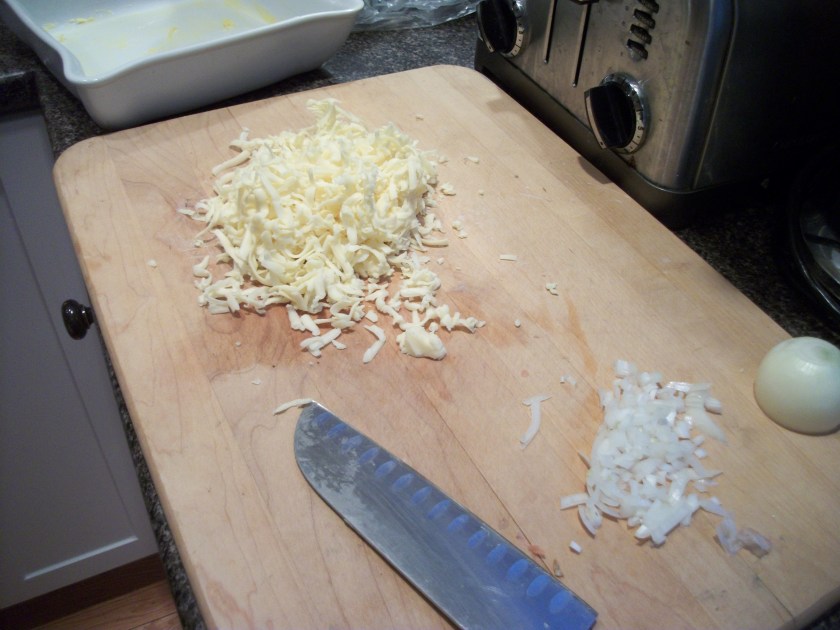
cheese and onion

Drain the potatoes in a colendar and dry them in a towel:

drying potato slices

Assemble the dish.  Put a layer of potatoes on the bottom.  Top with a tiny bit of onion and a handful of cheese.  (You could salt each layer lightly if you like–sometimes I forget and just salt the top–the milk you add washes it all together.)  Top with more potatoes.  If you are cooking ahead, I don’t put cheese on the top.  If you are not, put cheese on top.  Pour at least a cup of milk over the whole dish.  If you heat the milk, the dish will cook faster–say 30 minutes.  If not, it takes longer (45 or so–which is why putting the cheese on the top will get too brown.)  If cooking ahead, cook until most of the milk is absorbed and the potatoes are softening–remove and let sit on the stove or a counter and dot the top with butter and reheat while someone is carving the meat–about 10 minutes.  You’ll know when the dish is cooked–the top will have crispy brown bits and potatoes will be soft and the milk will be gone.

Delicious!!!  Reheats well the next day, too.

Here’s the table ready to go–graced with our old, old (now) tablecloth and the Fosteria red glasses I got for my wedding almost 47 years ago now.  That’s horseradish cream in the bowl in the center–equal parts of sour cream (I used my fermented piima cream) and horseradish.  I also cut this mixture with some fresh raw heavy cream.

Christmas dinner 2012

This Christmas Day Dinner was about food, friends, and not a lot of fancy decorations.  In the background, you can see a tv tray with 3 sprouting amaryllis and some paper white narcissus–which will cheer us in January.  This window is the only window that does not have outside roof overhangs and that gets the weak winter sun.  My sisters will smile as they will recall our mother and her wintering over of plants in glass jars with dangling roots and dingy water–something I always didn’t like to see in the dining room.  But, here they are as we love having their outrageous flowering in the dead of winter.

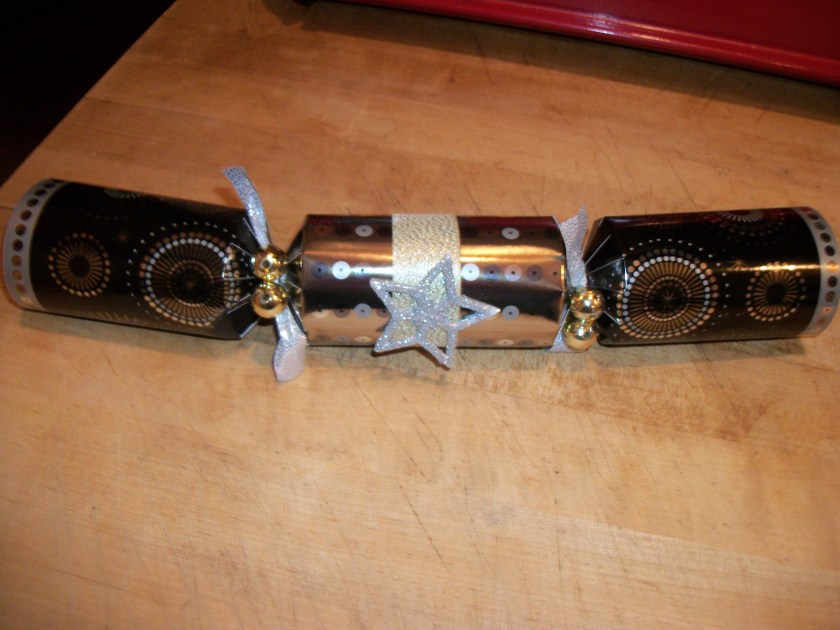
Sarah is British–and that means she finds us what she calls Christmas “Crackers” for dinner entertainment.  Here are a few left in the original box.

Christmas crackers in box

Here’s one alone:

Christmas crackers

You cross your arms, holding your “cracker” in one hand, and the people on either side of you pull your cracker apart (and it “pops” with a kind of firecracker fire) as you sharply pull one of theirs.  Out fall toys, tiny games, a crown, and some fortunes.

Here we are with our crowns on:
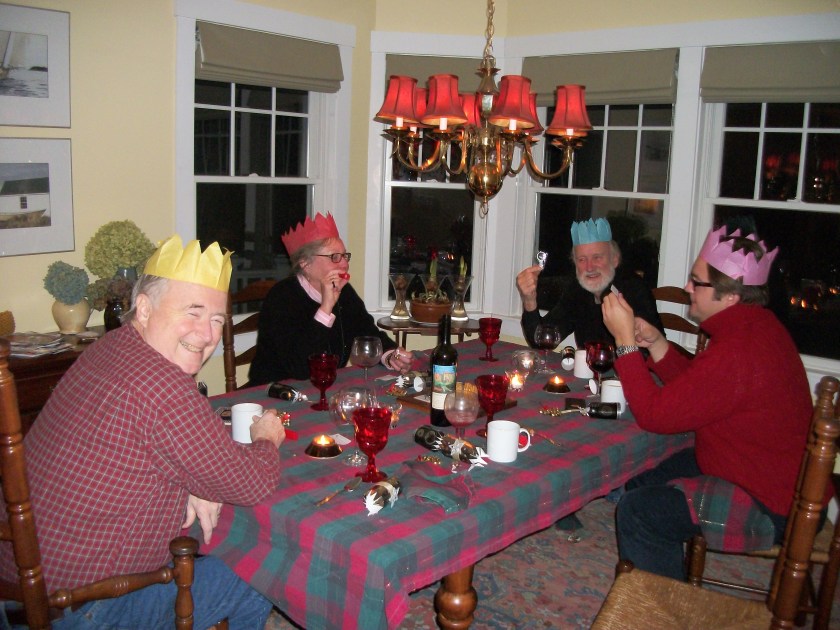
Christmas dinner 2012 at table

One year I got a miniature deck of cards that I carry with me in my purse in case I get stranded at an airport and want to play solitaire or somesuch game.  This year I got a spinning top that spins beautifully.

The fortunes are a lot of fun:

Why do birds fly south in the winter?  Because they can’t afford to take the train.

What did the hat say to the scarf?  You hang around while I go on ahead.

What is grey and has four legs and a trunk?  A mouse going on holiday.

How do you make a band stand?  Hide all the chairs.

The fifth one got lost in the merriment.

THANK YOU SARAH AND CHRISSO.

We had such a nice time, and even though we ate and ate, we had a ton of leftovers.  So, everyone came back the next night to help us remedy the leftover situation.  And, again, we had a lovely evening.

Turkey Tracks: Celeriac Cream Soup

Turkey Tracks:  December 26, 2012

Celeriac Cream Soup

How many of you know what a celeriac root is?

I can guarantee you that I did not before I moved to Maine and joined Hope’s Edge, our Community Shared Agriculture (CSA).

Celeriac roots are a very common root, storage vegetable in Europe.  They can be peeled and grated raw for a salad, grated and sautéed, braised, or cut up and added to a soup or stew.  You can pretty much treat them like a potato or a rutabega, though they are less dense than a potato.  Or, they can be the “star” of their own soup.  They have a mild celery taste and probably have components that are really good for you.  They stored well in my refrigerator–I got them from Hope’s Edge back in October.

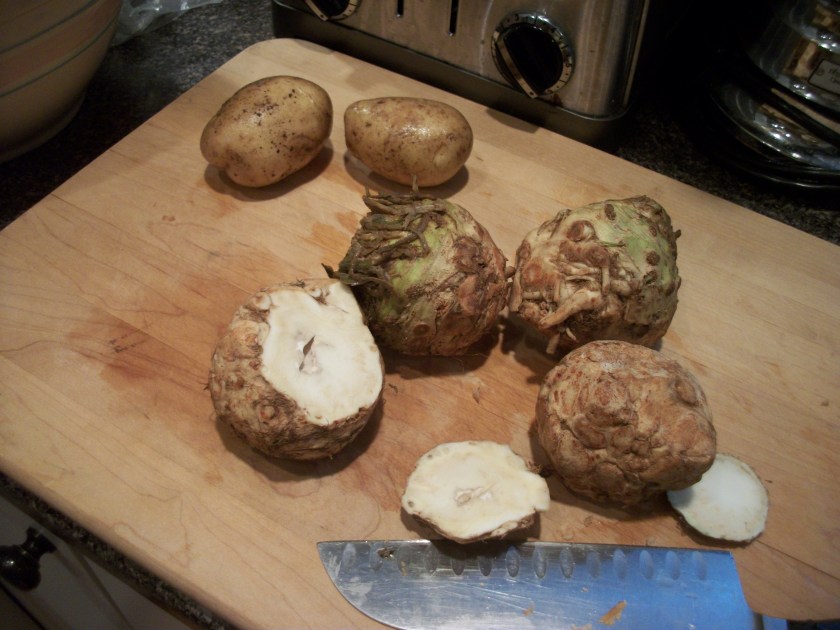
Here’s what a celeriac root vegetable looks like.  I put potatoes I needed for the soup in the background so you can see the contrast.  I run my knife down the sides to peel them–turning them over to get what I missed at the bottom when I’ve gone all the way around.  When you cut open a celeriac, the flesh is white and very dense.

celeriac and potatoes

The Farmer John Cookbook had a nice celeriac soup recipe, so I started from there.  It’s pretty much the same method that Julia Child teaches for her leek and potato soup.

Leeks or onions–I used onions as I was out of leeks–sweated out in a bit of butter.

I added carrots, some garlic scapes from the freezer, and some actual garlic.  I didn’t add extra celery as I wanted to see how “celery” the celeriac is.

Be patient with the sweating out–in a heavy pan, like a Creuset.  (If I could have only one pan, it would be a Creuset pot.  The next would be a cast iron skillet.)  Cook slowly over medium heat.  Add sea salt.  Stir to keep anything from burning prematurely.  When you begin to get bits of caramel browning–throw in the stock.  I used my last batch of chicken bone broth–simmered for 2 days in the crock pot and then strained.  I don’t strain off any fat as I’m quite sure now that fat does not make you fat and that we all need good sources of fat to be healthy.

Throw in the cut up celeriac–you need 3 to 4 cups for about 8 cups of broth.  You could have more or less of either.  Throw in, too, two or three peeled potatoes–which will thicken up the soup.

Here’s an interesting addition–about 1/4 to 1/2 cup of almonds–I put a few handfuls in the blender and let it rip until I have a nice powdery nut mix.  The almond will also thicken the soup and will add a delicate flavor.

Grate in some fresh nutmeg.  Taste for salt and add more if needed.

Let it all cook for 25 minutes or until the celeriac is soft.  Here’s what it looked like on the stove–you can see the almond “flour” on the top.

celeraic cream soup in process

Then, turn it off, let it cool a bit, and “boat motor” it with an immersion blender.   When all is smooth, add at least a cup of heavy, preferably raw, cream.  Stir, taste for salt and nutmeg, and serve in a bowl.  You could put a chunk of butter on the top once the soup is in the bowl.  Or, a drizzle of cream or sour cream.  It’s really rich.

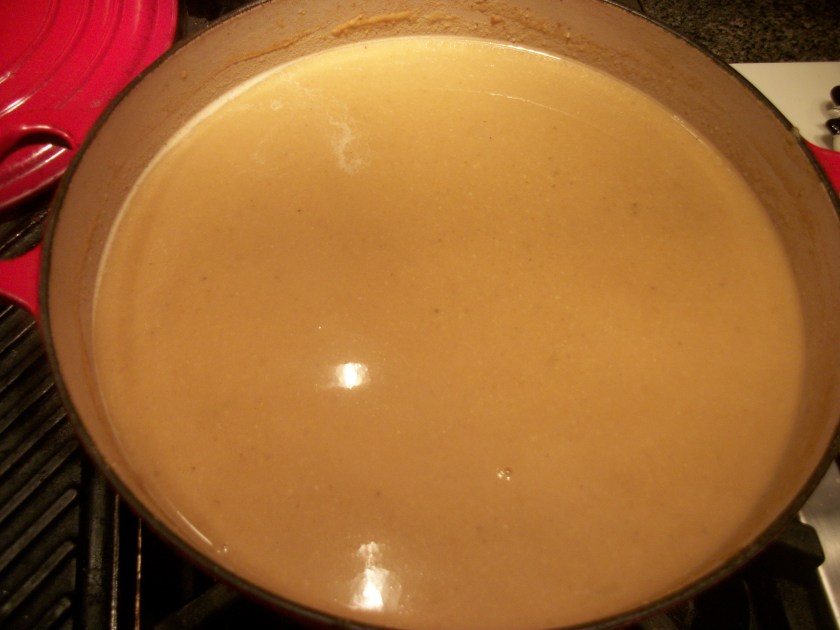
Here it is finished:

celeriac cream soup

Celeriac cream soup has a delicate, lovely flavor.  Enjoy!

Turkey Tracks: Highlights From Thanksgiving 2012

Turkey Tracks:  December 15, 2012

Highlights From Thanksgiving 2012

Christmas is drawing close to us now.

But, I’m still savoring Thanksgiving.

Here’s one of my cherished moments:

In the woods, Nov. 2012

Here’s another:

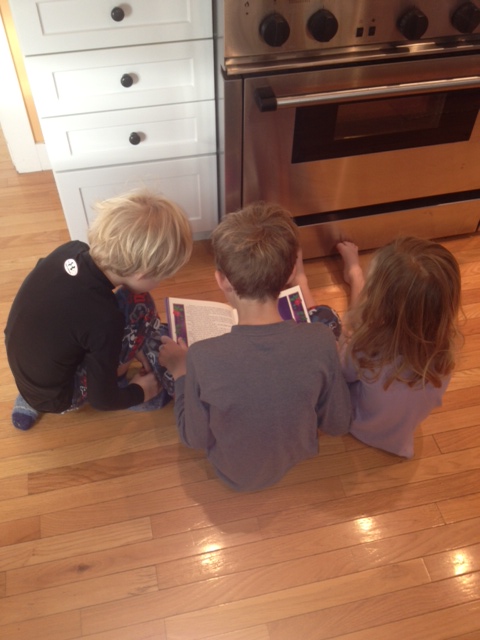
Bo reading to kiddos, Nov 2012

Bo was reading to Kelly and Wilhelmina while waiting for muffins to cook.

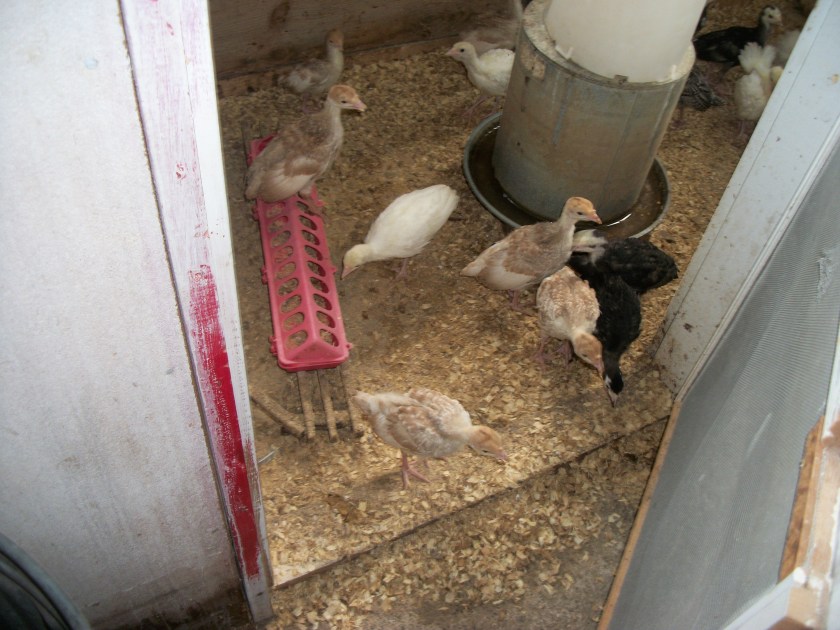
Last summer we visited our neighbors Chris Richmond and Susan McBride Richmond–who had just started raising our Thanksgiving turkey at Golden Brook Farm.  I tried to remind the kiddos of this visit, but I don’t think they got it then or at Thanksgiving.  Probably there was too much going on the day of the visit to Golden Brook–the Richmond-McBrides have terrific children, some of whom are the same ages as some of our crew, and in addition to friendly children there were barns to explore and new sights to see.

Thanksgiving turkies, Aug. 2012

We got in two good hikes before the weather turned too cold for the clothing the children had available.  The first, up to the  Maiden Cliff area, is one of our favorites.  On the way there is a gorgeous stream to cross.  Here’s the view–the red in the foreground is a blueberry barren.  We live across the lake/river and back to the left on that range of hills.

Thanksgiving hike to Maiden Cliff, 2012 edited

After the weather turned off really cold (and has since, alarmingly warmed up again so that there is no snow at the Snow Bowl), we had to find all kinds of layers to keep the kiddos warm.  Here they are in front of the base of the Rockland Christmas Tree–which is all made of lobster crates and buoys.

kiddos and lobster Christmas tree, 2012 edited

Talula has lost a front tooth and is working on losing the other front tooth.

Turkey Tracks: Roasting and Cooking the Blue Hubbard Squash

Turkey Tracks:  December 14, 2012

Roasting and Cooking the Blue Hubbard Squash

Remember the Blue Hubbard Squash I grew and wrote about back in October?

Well, I roasted it this week.

The temperature had been dropping, and I had the squash stored in the garage so they could keep on “sugaring off.”  Temps were low enough that I was afraid that the garlic and the squashes would freeze in the garage–so everything came inside.

John cut last year’s Blue Hubbard, which I bought for about $8, out in the garage–a place of mystery to me.  This year I was on my own.  And let me tell you, it took the BIG French knife, lots of muscle, and lots of patience.  I could only get the knife into one side at once.  Eventually, I was able to pry it open.

I scooped out the seeds and pulp and took them out to the chickens, who ooed and ahhed.  The smell of the squash was so clean and sweet.  The flesh was bright, intense orange.

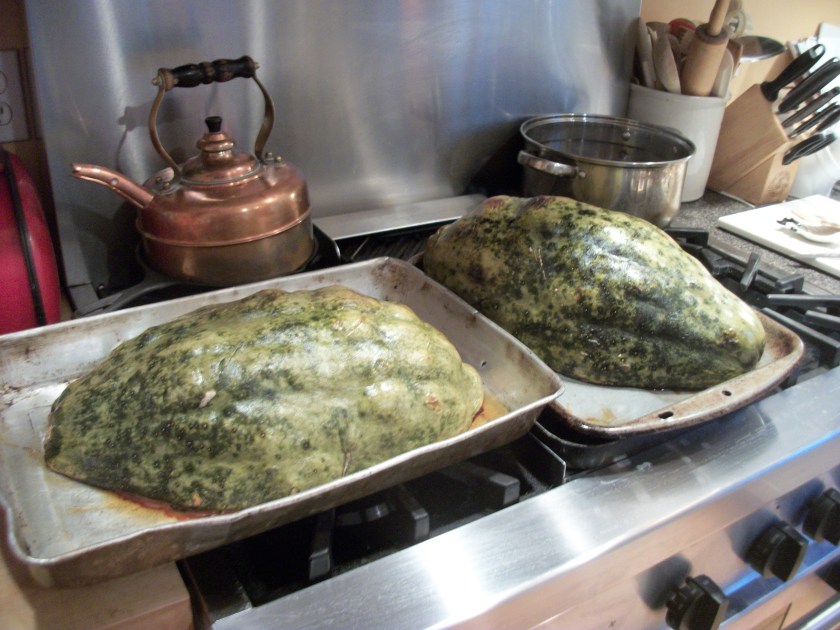
Each half took up the whole of one of my big baking pans and both filled the whole of the oven.  It took about 90 minutes to roast them completely.

Blue Hubbard cooked

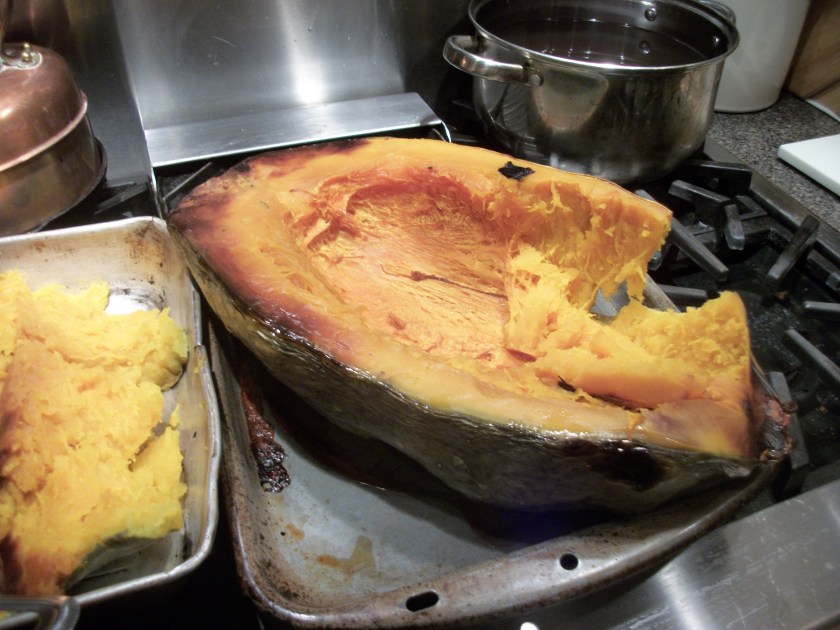
Here are the halves, flipped over and ready to have the roasted flesh scooped out.

Blue Hubbard cooked 2

This one squash made an enormous amount of cooked filling.  I put serving sizes into plastic bags and froze them–reserving about 4 cups for that night’s dinner–pan fried local ham steak, sauteed baby bok choy (with fresh ginger and our garlic), and the Blue Hubbard squash.  (Fall is the traditional time for “putting up” pork raised over the summer–and a pork ham takes a bit of time to smoke, so big ham slices are now filling the local coops.)

I placed the roasted squash for dinner into a saucepan with a cover–added about 1/4 cup of our local raw butter, a big dollop of our local raw heavy cream, a splash of our local maple syrup, a pinch of sea salt, and about a teaspoon of Penzy’s cinnamon.  I put the mixture on low heat and went back after a bit to stir it all up.  It was smooth and incredibly sweet–I hardly needed the maple syrup in the mixture.

Delicious!

Turkey Tracks: Blog Request: Cream Caramel Cake

Turkey Tracks:  December 14, 2012

BLOG REQUEST:  CREAM CARAMEL CAKE

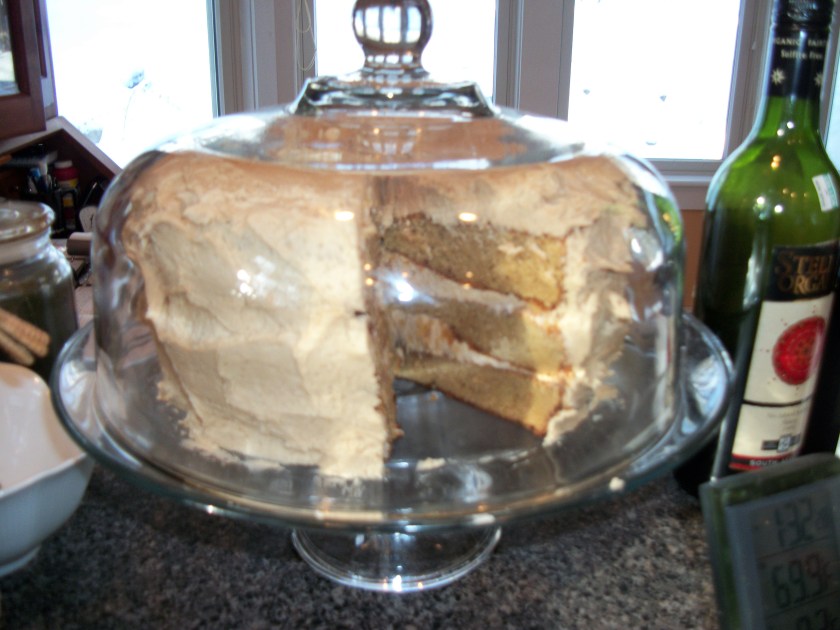
A blog reader recently asked me to post the recipe for the Cream Caramel Cake I pictured in the January 25th entry, 2011, on making French Onion Soup, which included a picture and a discussion of a Cream Caramel Cake I found in Better Homes and Gardens, December 2005.  The reader tore out the picture and didn’t get the recipe.  I tore out the recipe, but didn’t save the picture.  Nevertheless, I feel sure that the cake recipe below is what this reader is asking me to post.

Caramel cake cut

The cake pictured in the magazine was a secret family recipe, so this recipe probably comes close but isn’t exactly what Pat Shelter is really making.  I didn’t have mocha syrup on hand, so kind of make one up–you can go back to the original entry to see what I did.

This is a BIG cake–3 LAYERS–with 8 CUPS OF POWDERED SUGAR in the frosting.  There’s so much sugar that it makes my teeth hurt just to read the frosting recipe.  The cake itself seems to be assembled in a classic manner.  Do bring your ingredients to room temperature before starting the cake–or the frosting.

Cake ingredients:

1 cup butter

5 eggs separated

1 cup buttermilk

3 cups sifted cake flour

1 tsp. EACH baking powder and baking soda

pinch of salt

2 1/2 cups sugar

5 Tablespoons total:  mocha syrup, coffee liqueur, and Irish cream liqueur–or strongly brewed coffee for all 5 Tablespoons

2 tsps. vanilla extract

1 recipe IRISH CREAM FROSTING  (1 cup butter, softened, with electric mixer on medium to high speed until smooth.  Gradually add 2 cups of powdered sugar, beating well.  Slowly beat in 6 Tablespoons of whatever flavoring from above you have chosen.  Beat in 2 Tablespoons of vanilla.  Gradually add 6 MORE CUPS POWDERED SUGAR, beating until smooth and of spreading consistency.

1.  Allow butter, egg yolks, egg whites, and buttermilk to stand at room temperature for 30 minutes.  Meanwhile grease and flour three 9-inch round cake pans; set aside.  In a bowl stir together flour, baking powder, baking soda, and salt.  Set aside.

2.  In a mixing bowl beat butter with an electric mixer on medium to high speed for 30 seconds.  Beat in sugar until well combined.  Beat in egg yolks one at a time.  (Take time on this step.)  Beat on high speed for 5 minutes.

3.  Alternately add flour mixture and buttermilk to butter mixture, beginning and ending with flour mixture.  Beat on low speed after each addition just until combined.  In a bowl combine the listed flavorings as desired–or use strong coffee–and gently stir into cake.

4.  Thoroughly wash beaters.  In a mixing bowl beat egg whites on medium to high speed until stiff peaks form (tips stand straight).  Fold 1 cup of the beaten egg white mixture into the egg yolk mixture, fold remaining egg whites into egg yolk mixture.

5.  Divide batter among prepared pans.  Bake for 20 to 25 minutes or until tops spring back when touched.  Cool cakes in pans on wire racks for 10 minutes.  Remove cakes from pans; cool thoroughly on racks.  DO NOT FROST UNTIL THE CAKE LAYERS ARE TOTALLY COOL.

6.  To assemble cake, place one cake layer on a serving plate.  Spread top of cake with 3/4 cup of the Irish Cream frosting.  Top with a second cake layer.  Spread top of cake with 3/4 cup frosting.  Top with remaining cake layer.  Spread remaining frosting on top and sides of cake.

Turkey Tracks: Ann’s Blue and White Chocolate Feather

Turkey Tracks:  December 8, 2012

Ann’s Blue and White Chocolate Feather

Ann O’Callaghan is my husband John Enright’s first cousin.  She and her sister Margaret Nealon live a few blocks from each other in the Boston area.  Their children have all grown up together, and it is the greatest pleasure to John and me that our sons have kept close ties with both of these families and all their children.  Now, John, Ann, and Margaret are grandparents many times over as many of their children now have children of their own.

Ann and Margaret have always been more sisters than cousins to John.  Their mother died very early, so Ann left Ireland as a teenager to come to Boston to live with one of her mother’s sisters.  (John’s father was her uncle.)  Margaret, who had lived with another of her mother’s sisters, followed Ann to America some years later.  All of these families are outliers from their mother country–Ireland–where the bulk of all their families live.

When we moved to Maine from northern Virginia, we began to see more of Ann and her family.  Every time Ann would come to visit, she admired whatever quilts I was working on at the time.  Always she would tease and say how much she would love a quilt.  And, I would always ask “what colors do you like.”  The answer was consistent.  Blues.  So, this winter, as part of my scrappy project, I made Ann a quilt.  John’s sister, Maryann Enright delivered it to Ann a few weeks ago, so now I can put it on the blog.

Here’s Ann’s Blue and White Chocolate Feather:

Ann's blue and white chocolate feather

The pattern is from “American Patchwork and Quilting” (August 2010).  It’s called “Outside the Box” and was designed by Karen Montgomery of The Quilt Company.  It uses 3 1/2 inch squares–which I took from the box where I store pre-cut leftover fabric from other quilts and from my stash.  I purchased the white fabric.  What’s cool about this concept is that the block is made like a log-cabin, in that it has a light and a dark side made from 16 blocks–six white and 10 blues.  So, the block combines in the same way that a log cabin block does–into all kinds of log-cabin patterns.

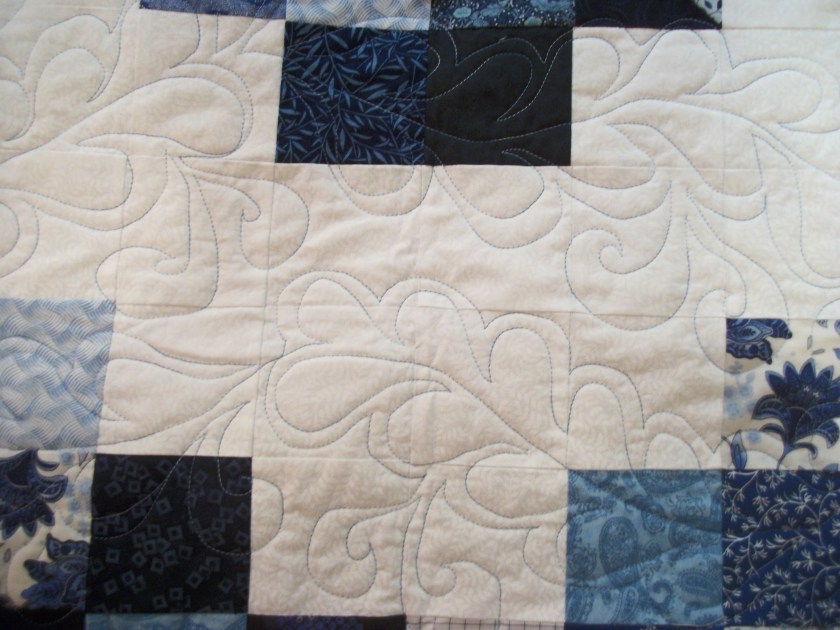
The quilting is from the Chocolate Feather pantograph, thus the name.  And it came out beautifully–it’s a functional quilt meant to be used and loved.

Ann's blue and white quilted

Here’s a view of the center:

Ann's blue and white, center

I like the varigated blue thread on this quilt a lot.

Ann's blue and white quilted

Ann's blue and white backing, binding, top, 2

Somehow, I’ve made a lot of blue and white quilts over the past year.  My blue and white stash has been reduced considerably–which is the goal.  I’m working on another right now, actually.  It, too, has a white background, though the pattern is different.  What I’m wondering about now is how a low contrast Kaffe Fasset kind of treatment, where the white becomes a blue print and the blue blocks are made into squares that float around in the print…

Perhaps I’ll find out this winter as I have enough 3 1/2-inch blue squares to make another quilt…