Turkey Tracks: Spinner

Turkey Tracks:  March 13, 2011

Spinner

I’ve been on a mission to use up more of my stash fabrics.  After all, I loved them when I bought them.  And, it’s true that I still love most of them now.

Whenever I finish a quilt, I cut small leftover pieces of fabric into the largest useable square I can, beginning with 6 inches and going down to 2 inches and 1 1/2 inch strips for log cabins.  Lately, though, especially after making this quilt, I’ve been cutting pieces into useable strips and not cutting further since this quilt needed a rectangle, not a square, so I had to cut those extra. 

The 8-inch “Spinner” block was designed by Bonnie Hunter and appeared in the March April 2010 (#132) issue of QUILTMAKER magazine.  Her idea is as you cut and sew other projects, you make a few of these blocks here and there, and soon, you’ll have enough for a quilt.  I found myself putting aside other projects and making all of these blocks uninterrupted.  They’re fairly addictive.     

What is helping control the quilt is the repeating red square within each block and across the quilt–a tactic Hunter recommends.  Here is a rather fuzzy picture since somehow very often I can’t seem to hold the camera still reliably.  But, note, also, the little quilt to the left, which was made from the small triangles that are cut off of Spinner’s large rectangle’s flip and sew method.  That small quilt is called “Essence,” since a friend who saw it on the design board said that it was the essence of the large quilt.  Essence is almost finished now, so will appear here soon no doubt.   
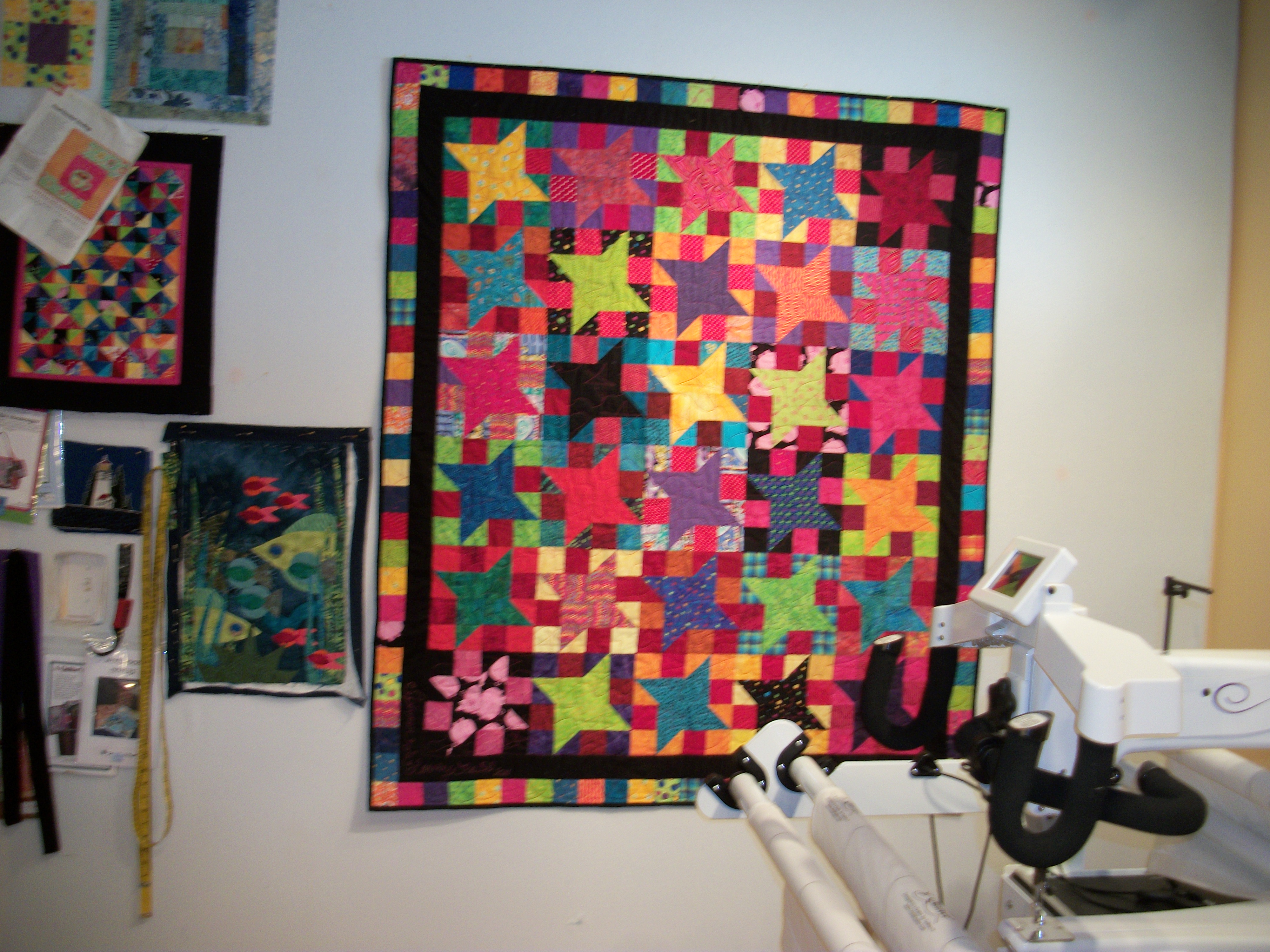
 

I quilted Spinner on Lucy the Long Arm, and I think it came out rather well.  I learned to use a round template on the outside borders.  I think I had old thread, however, and struggled with thread breaking a lot.  I got an additional thread spike that sits close to the take-up arm on the machine, so maybe that will help with the Mettler cottons I use for machine quilting on the domestic machine.   

 The pink pig backing, seen below, came when I realized Marge of Mainely Sewing in Nobleboro had some of this fabric left.  Remember that Karen Johnson,  The Community School student who learned to make a quilt with me last year, used it to back her quilt?  In fact, this quilt is very like Karen’s quilt, which probably shows how much I liked what she did.   You can see Karen’s quilt in the May 17, 2010, post called “Two Quilts.”  


Don’t know who it’s going to yet.

Turkey Tracks: Red Fish Quilt

Turkey Tracks:  March 13, 2011

Red Fish Quilt

 I finished the Red Fish quilt.  I started it the summer of 2010 in a class with Jo Diggs at the Pine Tree Quilters’ Guild show. 

 Here it is:

 Each piece was hand appliqued onto the hand-dyed background fabric.  I hand quilted around each appliqued piece to make them stand out from the fabric.   I hand quilted the green fauna in the foreground bottom and the dark hillock at the bottom.  But, the hand quilting on applique shapes didn’t show up, and there were too many layers to do it easily.  So, as I machine piece well, I used that skill to get the final effects I wanted and to make the three thread painted little blue fish.   In retrospect, leaving the small fish’s fins and tails alone might have been a better choice…  I don’t think the quilt needs more beading than it has. 

There are more hours in this little quilt than I want to think about, and I’m glad it’s finished.  I have even more respect for Jo Diggs who makes BIG quilts using this method.  Take a moment and look at her gallery, and you’ll see what I mean:  http://www.jodiggs.com/jodiggs/Gallery.html.    

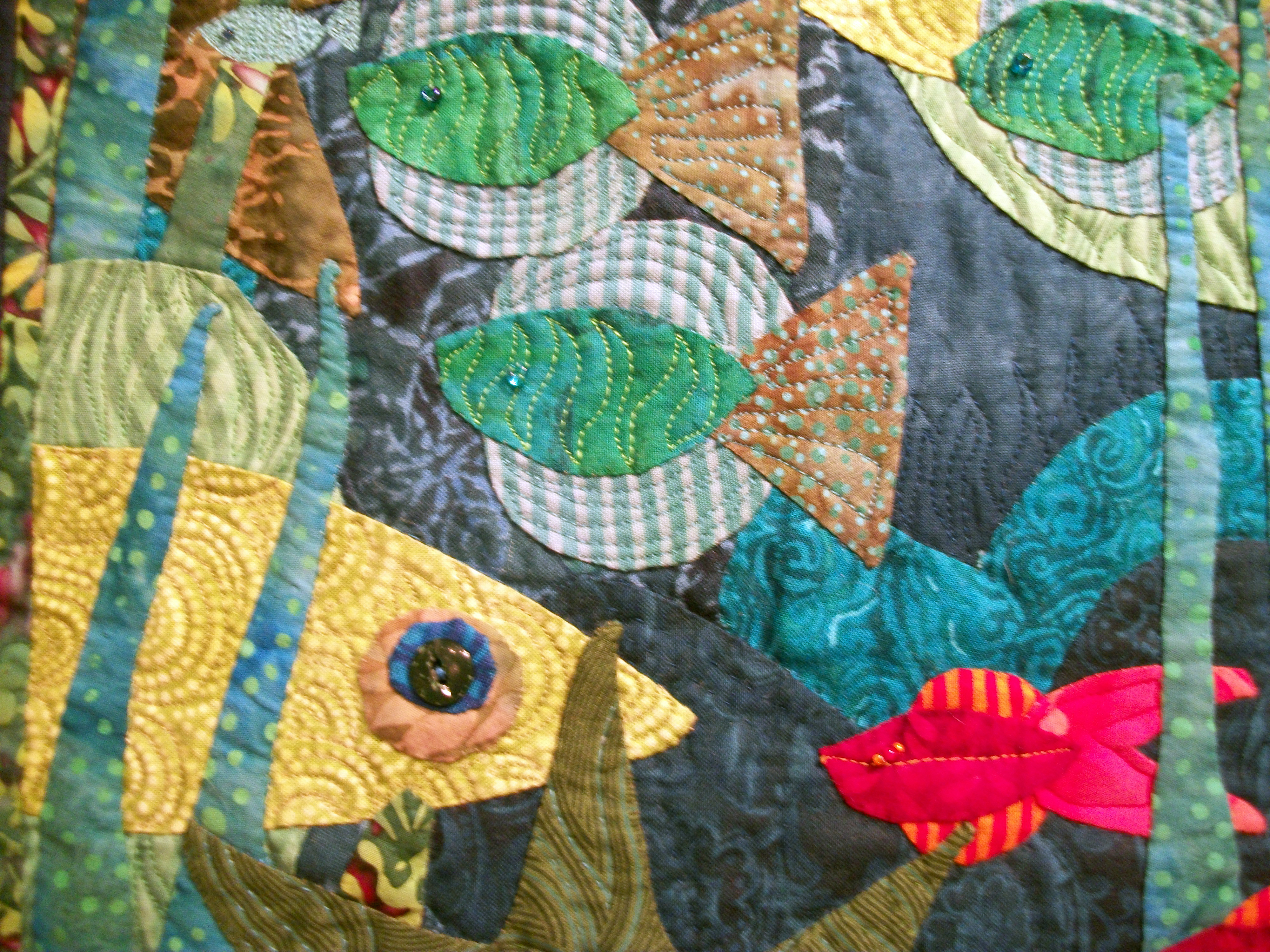
Here’s a very close-up view of a piece of the quilt. 

Turkey Tracks: Blowing My Nose in Style

Turkey Tracks:  March 13, 2011

Blowing My Nose in Style

On January 19, 2011, I wrote a post called “Cutting the Waste Stream and Detoxing the Kitchen.”  One of my issues of the past few years has been how to cut back on the amount of paper we use.  My use of paper towels, napkins, and, now that I think about it, toilet paper, seemed/seems excessive.  So, I’ve been searching for ways to cut back. 

Paper Towels:  I’m happy to report that our paper towel use is practically nonexistent.  So nonexistent that I can’t remember when I used one last.  Putting a bowl of cheap white (so I can see stains) wash cloths on the kitchen counter is working beautifully.  They can be used to where I would have once used paper towels.  (I do not use them to wipe out the cast iron skillet, but more on that in a minute.)  They can also be used inside a bag of lettuce or anything going into the refrigerator than needs a bit of drying.  I could also use them to drain bacon slices, though I’ve mostly just put the cooked slices on a plate.  Once cooled, they reabsorb the fat, and meat fat does not make you fat or hurt your heart, contrary to the low-fat ideology of the past 30-40 years.  As for cleaning the skillet, we pour off extra fat for the dogs and chickens, or for us sometimes, like saving bacon fat or using the glorious fat from a beef or lamb roast on toast the next day–all traditional practices lost over the past 40 years.  A swishing with hot water in the sink takes out the residue in the skillet, and drying the pan with a bit of heat preserves its all-important coating.

I also bought two washcloths for each of our bathrooms, put them under the sink, and use them to spot clean the bathroom.  (Our cleaning woman already uses rags and washcloths to clean the house–she brings them with her.)  That’s working well, too. 

All the washcloths just get thrown into the laundry every week.  If some are dirtier or greasier than others, they go into the pile of dish cloths, etc., that might need either a bit of clorox (winter) or line bleaching (summer). 

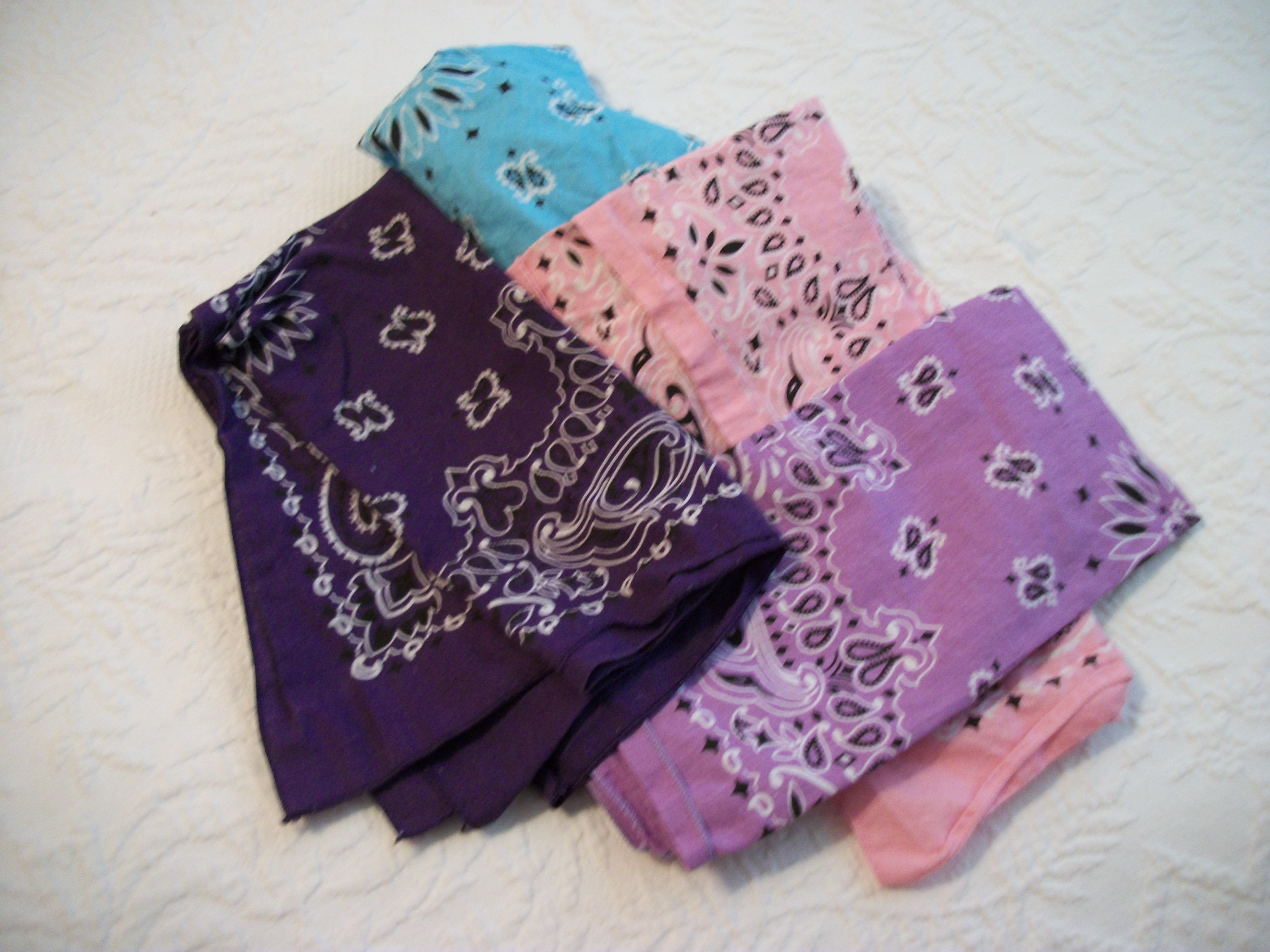
Paper Napkins:  We’ve been using our cloth napkins at the dinner table–and reusing them until they are demonstrably dirty.  Growing up, we did not wash cloth table napkins every day.  One had a set place at the table and reused one’s  napkin.  Not doing so saves on water, soap, and energy as well as NOT using paper napkins.  But, for me, who for most of my life has had a chronically runny nose (driven I now realize mostly by food allergies), paper napkins were needed as kleenex just wasn’t strong or thick enough.  So, one day this winter, we had lunch with old Tufts friends of  John’s, Jack and Barbara Moore, of the schooner Surprise, and Jack pulled out a BIG, sturdy, handkerchief from his pants pocket.  It was one of those colored bandanas like we now use to decorate the necks of dogs.  When I said “YES!” and explained my search, he told me he bought them at Reny’s (our local version of a mixed-bag kind of store) for under $2 each.  John and I went that same day and got some.  John got a manly navy blue, and I got these:


They were a little stiff at first, but are now, after several washings, soft as butter.  And, I love them!  They’re so much nicer than paper napkins, and they are so much bigger and sturdier than any of the white handkerchiefs I could find online.

Toilet Paper:   Well this issue is tougher, as Colin Beaven discovered when he started his “No Impact Man” blog and the press became obsessed with the family’s toilet habits.  (Beaven’s blog resulted in a book and a documentary.)  To backtrack, Colin, his wife, and their young daughter attempted to erase or to balance  their energy use footprint for one year, though they lived in New York City.  Toilet paper requires a lot of energy to produce, process in sewage, etc.   And, Beaven points out:  “More than half the world believes that washing their nether regions is far more hygienic than using toilet paper, a practice largely confined to our Western culture.”   I wasn’t surprised to read Beaven’s  information as a few years back, my book club had read Mohja Kahf’s THE GIRL IN THE TANGERINE SCARF:  A NOVEL, wherein the Muslim/American female protagonist does a whole riff on how Muslims view Americans as walking around with and sleeping with dirty nether regions.  Think about it. 

I tried, here at home, to wash rather than to wipe after reading Beaven’s book.  It’s not hard as long as you’re  next to the sink where you can put warm water into a container stored by the toilet.  It’s a bit awkward from lack of practice, of course.  And a container that pours is better than one that doesn’t.  It’s impossible in a public restroom or in someone else’s home.  You do need a container and a drying washcloth or towel–not items one carries around or that friends’ bathrooms supply.  In any case, it is MUCH cleaner, so the half of the world that washes rather than wipes is right about the cleanliness aspect of this issue.

Anyway, I’m pleased with how we’ve been able to curtail our paper use.  It’s a step in a needed direction, a step that refuses to be part of the extraction economy.  And a reminder that sometimes those who live in different cultures or who lived “back in the day” might have better practices than we do.        

Turkey Tracks: Alewives Visits Camden Quilters

Turkey Tracks:  February 17, 2011

Alewives Visits Camden Quilters

Rhea Butler and her mother, Barbara Neeson, came from Alewives quilt shop in Damariscotta Mills, (http://www.alewivesfabrics.com) for our February 12th meeting.  Barbara owns Alewives, and Rhea is the resident quilt artist and designer. 


 Rhea’s on the left, Barbara is in the middle, and CQ member Barb Melchiskey is on the right. 

 Rhea taught us how to make her copyrighted “La La Log Cabin” block and quilt, which derives from a long history of improvisational quilting—which, for Rhea, includes such quilting as that of the Gee Bend quilters and Denise Schmidt of Bridgeport, CT.  This pattern is meant to be made from your stash fabrics, though you could certainly buy new fabrics as well.  Above, you see a soft blue/green version.

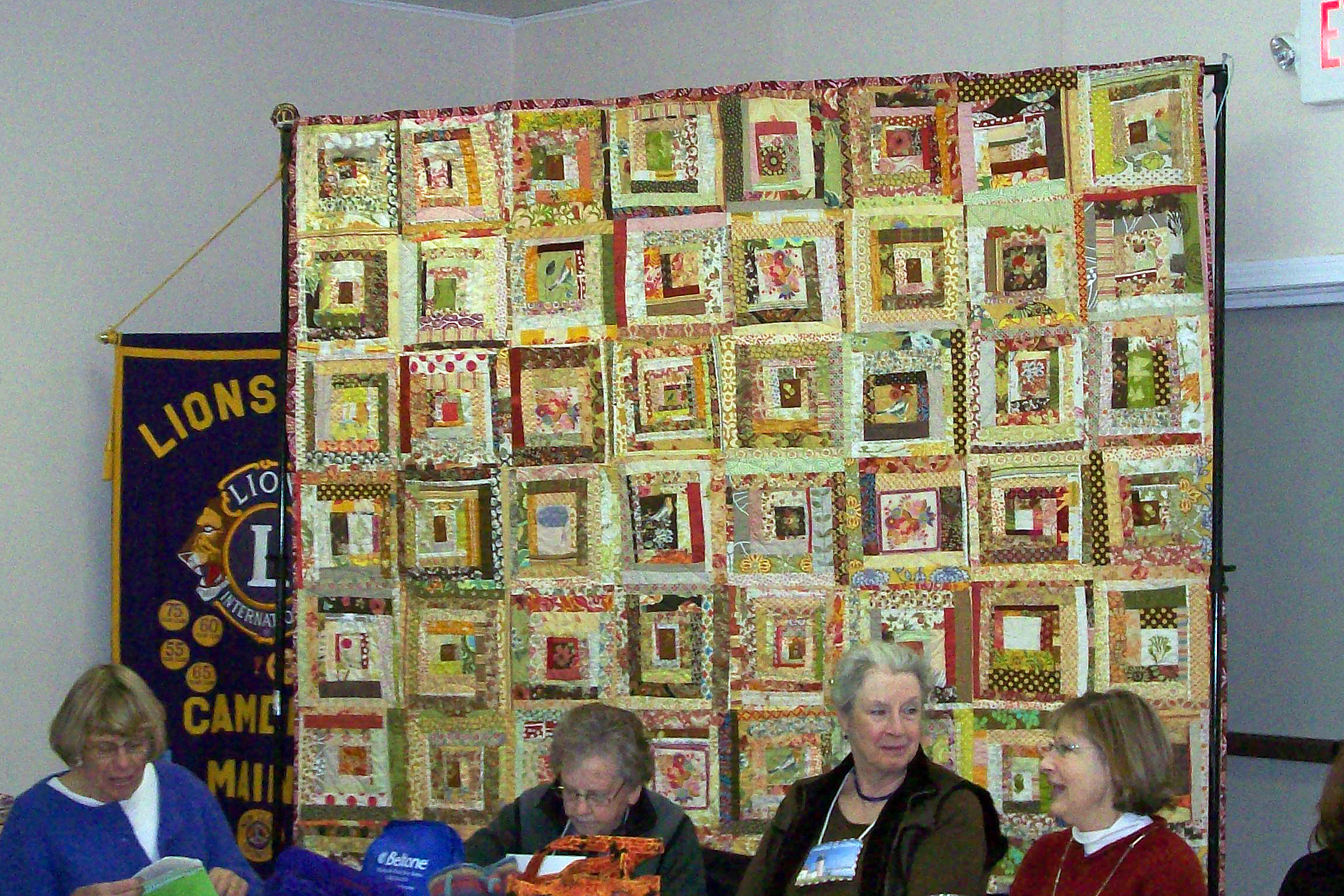
 Rhea loves color and starts her blocks with an overall sense of how she wants the finished quilt to look.  She wanted the big quilt she brought to demonstrate her La La Block to “glow,” and it did.  See?


Barb Melchiskey, Sylvia Lundevall, Eleanor Greenwood, and Patty Courtney.

Rhea used neutrals and added bits of red and green.  She tries to put interesting, clever, or meaningful fabrics into the center of her blocks.  She also loves to mix textures and to employ whimsical bits of cloth, such as the little colored dots on the edges of fabric selvages.  And she tears fabric into strips and roughly cuts centers with just sissors, which helps to give her blocks an interesting “off-center,” funky look.  Rhea used three harmonious fabrics in shades of yellow/gold for the backing, layered in from side to side in big swaths.  

 Rhea provided us with a free pattern for her block/quilt, which is typical of her and Barbara’s generosity.  We had a wonderful meeting with her, and I suspect many of our members will produce  La La Cabin quilts.  I know I will as I’m on a mission to use up more of my stash and will definitely make one.

 Rhea also keeps a lively, interesting blog:  http://alewivesgirl.blogspot.com.

Turkey Tracks: How to Sew On a Button

Turkey Tracks:  February 15, 2011

How to Sew On a Button

A friend told me recently that s/he wanted to learn to sew on a button. 

We meant to sit down so I could demonstrate.  There are a few tricks.

But, the internet is a wonderful thing for this kind of information.  Here’s a terrific video showing exactly how to sew on a button, including the bit of information I would have included about creating a thread shank between the button and the material about equal to the thickness of the material that the button will be handling. 

I would also note that sometimes, if I don’t want to see a knot on the inside of my jacket or sweater or whatever, I will start sewing my button on from the front side, so the knot is hidden.  I also, like the demo here, return to the front side to clip off my thread, but, first, I do a quick knot into the thread shank to doubly secure the thread.

http://www.videojug.com/film/how-to-sew-on-a-button

Turkey Tracks: In Progress: Noro Iro Sweater

Turkey Tracks:  February 12, 2011

In Progress:  Noro Iro Sweater

Well, here’s my Noro Iro sweater in progress.  You may recall that I’m using a pattern from Jane Ellison’s book, KNITTING NORO.

I have run into gauge problems.  The pattern calls for a 7mm needle, which falls somewhere between our 6mm (10 1/2) and 8mm (11) American needles–which means the sweater will fit ok but is going to take more yarn!!!   Fortunately Helen at Heavenly Socks in Belfast, Maine, has two extra skeins since she so generously ordered the yarn for me, which meant she had to order 12 skeins and hope to sell the other 4 since I was only supposed to need 8.  She’s great that way!

 What you see here is the back.  The bottom is knitted in a textured pattern for about 11 inches.  Then you switch to stockinette.  Both showcase the yarn nicely.  I wish I had put that wide dark band fully at the bottom.  I do like the scalloped bottom edge.

Here’s the pattern I’m trying to do.  Notice how matched the yarn is on the sleeves and front body.

I have no idea how my sweater is going to come out because I can already see that the back will be different.  The back is twice as wide as either of the front pieces, right?  So, the yarn color on the front is knitting out twice as thick before changing to a new color.  In other words, the only way you could try to match color would be to do a lot of cutting of yarn.  And, I don’t think that’s the purpose of this yarn anyway.

Oh well!  It will be what it will be!

It’s feeling a little fussy to me though.  Like one of those garments that are wearing you rather than you wearing them!

Turkey Tracks: Dry Body Brushes

Turkey Tracks:  February 12, 2011

Dry Body Brushes

DRY Body Brushes are one of life’s true pleasures!

Instead of feeding your true love a poisonous, tasteless strawberry–shipped across the country in February–or from even further afield–and timed for Valentine’s Day–consider giving a set of body brushes.

Body brushes can be ordered online.  Here’s what ours look like.   The larger one has a handle that slips off so you can use the head in your hand.  The handle is good to reach everywhere on your back.  The smaller brush is softer and perfect for your face.

The skin THRIVES on being brushed daily.  You brush gently, starting in the middle of your body and working the front and, then, the back.  Sit down and brush your feet really well.  Use a softer brush for your face and brush in little circles. 

The brushes remove old dead skin, promote circulation, stimulate nerves, and the brushing feels terrific.  Shower afterwards.  The brushes are for your DRY body.   In less than a week your skin will feel softer.  You’ll notice a real difference. 

After a dry brushing, you tingle all over.


Turkey Tracks: Chicken Feed Recipe

Turkey Tracks:  February 9, 2011

Chicken Feed Recipe

Our chickens are very tired of being “cooped up” in their coop and attached cage, both of which are now banked high with snow and which are, therefore, dark.  You will recall that the chicks were venturing out in the snow paths we made, lured by me and sunflower seeds, until a bird (an owl?) killed May May at dusk one day.

The cage, actually, has about 2 feet of snow on its top as well–which probably provides quite a bit of insulation, especially since I layered tarps over it before the first snow fall.  Inside the coop, we have a red 60 watt translucent light, which gives them a bit more heat.  (The temps up here were in the teens last night.)  I plug in the light in the morning when I feed the chicks so they have some light in their coop during the day.  I turn if off about 8 p.m.  They don’t really like the light on all night, so I only leave it on all night when the temps fall into the single digits.  They get quite cross when they go all night with the light on.

Chickens are very social, so I try to visit them several times a day after they have finished laying.  They don’t like to be disturbed when they are laying.  I open the roof, and they come to see me.  Several will fly up to perch on the opened roof edge and like to be petted and rubbed.  All of them talk to you.  I throw a handful of sunflower seeds into the cage, which is now many inches deep with coop bedding that falls out when the cage door gets opened in the morning.  They scratch around looking for the seeds, and it gives them something to do.  They are VERY bored.  (The dogs are too.)  The other day I sacrificed some of my compost worms and took a full bowl out to the coop.  Mercy me!  Those chickens were so excited.

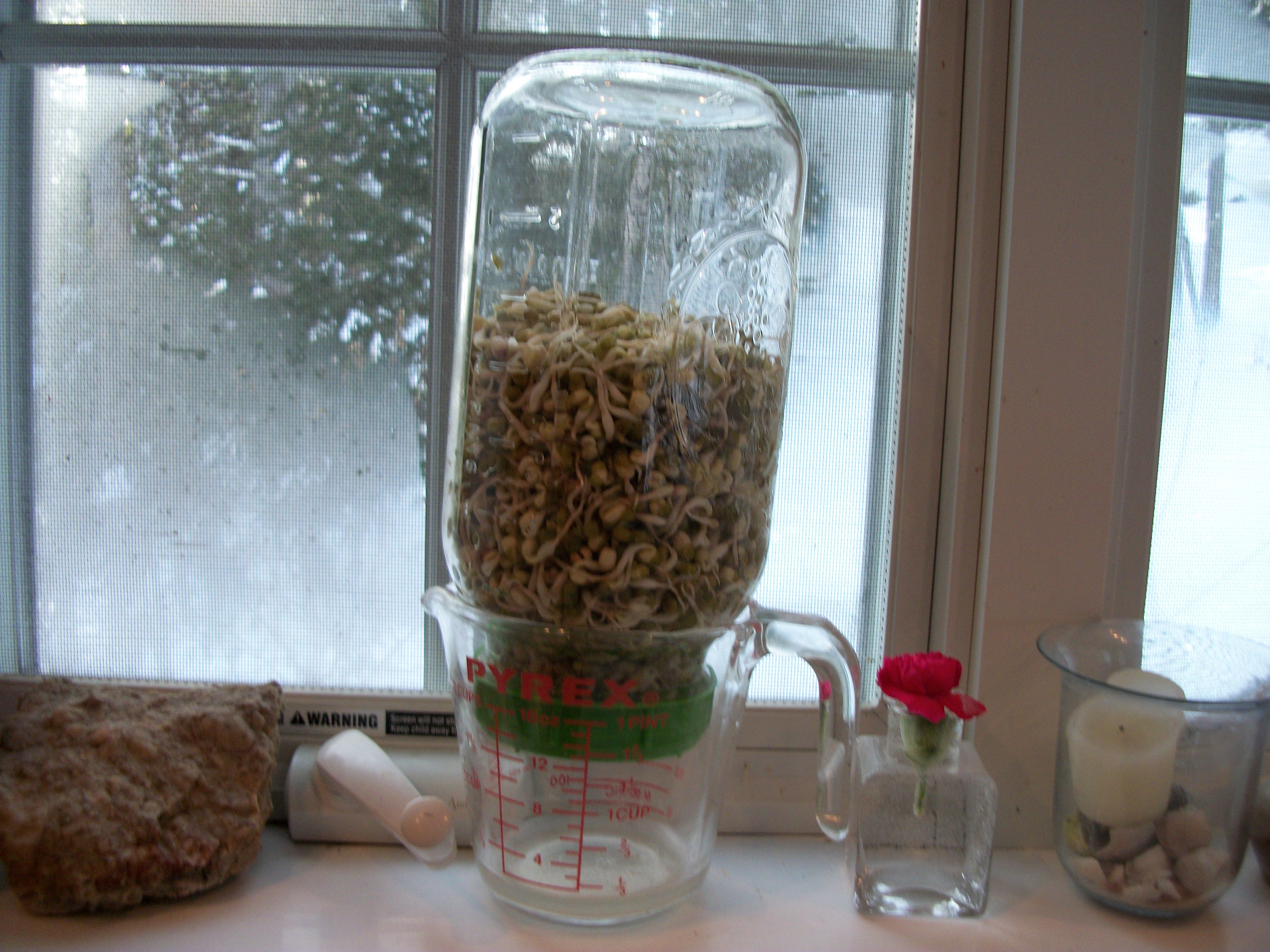
Chickens love greens, and now all the grass is covered with snow.  I give them as many greens as I can–leftover lettuce, cooked greens, the stems from cleaning greens, and so forth.  I’ve even been known to BUY them some lettuce.  But, what the really love are sprouts, so I’ve been sprouting mung beans for them–something I do this time of year anyway to get fresh greens into our diets.  If I leave the sprouts growing longer, they start to grow leaves, and the chicks really like those.  Here are some sprouting in the kitchen window:

 That rock in in the window is a piece of the old, old Bryan mill stone from the mill out on what was once the farm in Reynolds, Georgia.  My Uncle Buddy gave it to me long years ago now.   The mill was gone by the time I was a child, but he remembered it.

I also give the chickens a big bowl of milk, some hamburger, a bit of bread to soak up the milk, kitchen leftovers they like, and whatever greens I can muster up first thing in the morning.  They love cooked oatmeal, like a warm mash, on a cold morning.  Ditto ground corn cooked in a bit of milk.  This food is their second choice, after greens.

I don’t feed my chickens commercial organic feed, which is full of industrial by-products, like spent, rancid oils, SOY, and  synthetic protein, needed because the corn/soy ratio doesn’t supply enough protein.    Chickens fed commercial feed, even organic feed, produce egg yolks with soy isoflavones, which are phytoestrogens that act like hormones and which affect human reproductive and nervous systems.

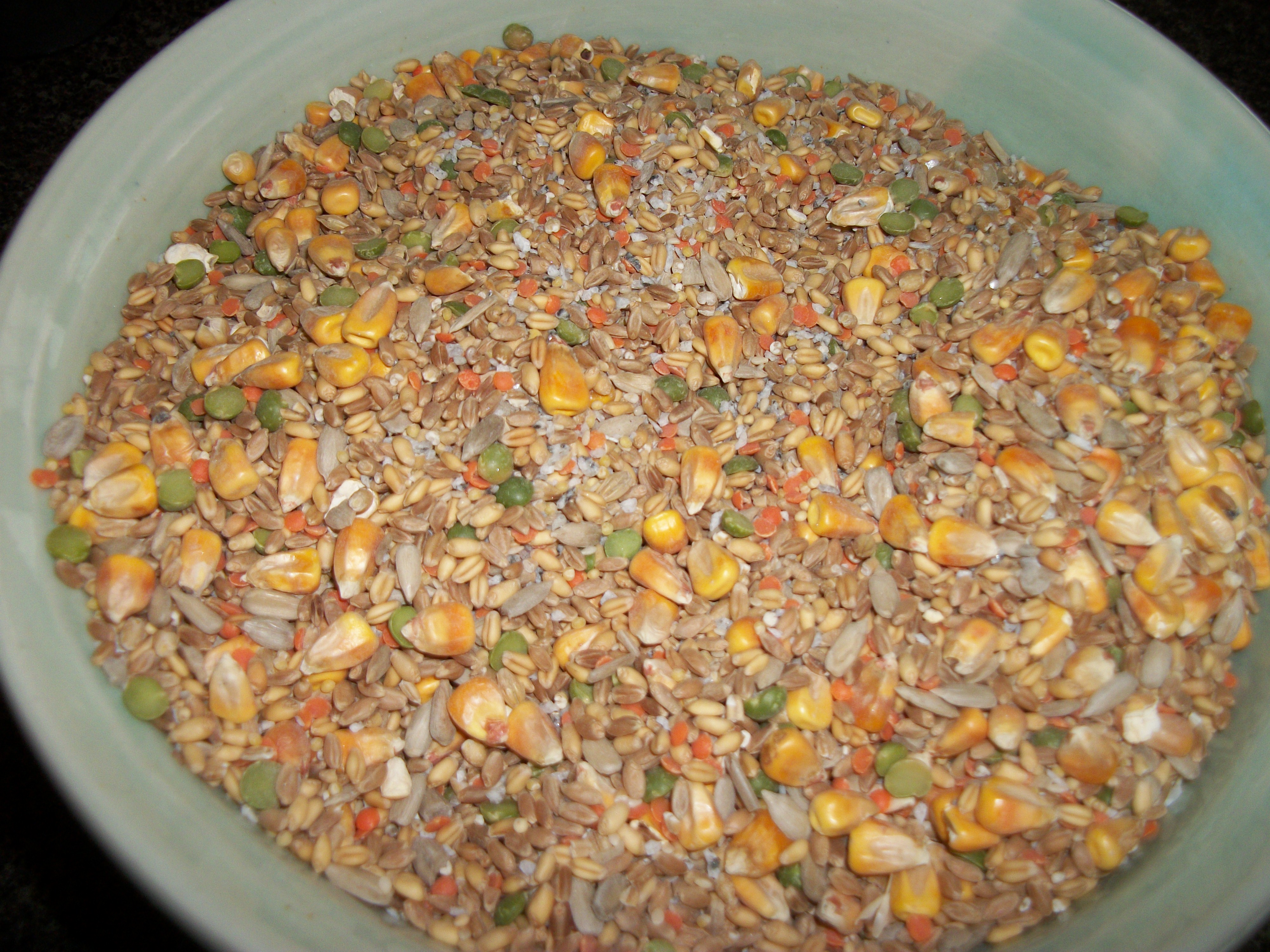
Here’s what the mixture I make for them looks like–and I’m darn lucky to have access to all of these organic grains.  Looks good enough to grind and cook, right?  I could, if I didn’t put grit into the mixture.  See the tiny rocks–grit–mixed it?  That’s what chickens use to help digest their food inside their crop, or gizzard.   Anyway, I keep all the grains, seeds, and beans separate out in the garage, so I can use them if I like.

I got the master recipe from a farm out west somewhere, called Greener Pastures (www.greenerpasturesfarm.com/ChickenFeed Recipe.html).  Thanks so much for sharing, Greener Pastures!

This recipe uses wheat, which has a fair amount of protein, as the base grain and peas and lentils for proteins.  Everything is organic.  So, here’s what I’m mixing up:

3 parts hard red winter wheat

3 parts soft spring wheat

1 part whole corn (I up this in the winter to almost 3 parts to help the chicks gain and hold fat, and in the summer I throw out a bit of whole corn for scratch feed.)

1 part steel-cut oats

1 part hulled barley

1 part hulled sunflower seeds

1 part green split peas

1 part lentils

Any other seeds/grain I think they’ll like for a change:  millet, sesame seeds, etc.

About two cups of grit per mixture.

Turkey Tracks: Camden Harbor, Winter Schooners

Turkey Tracks:  February 8, 2011

Camden Harbor, Winter Schooners


This view of the northeast side of Camden’s inner harbor lies directly below the library.  To the right, the harbor is more bustling, especially in the summer.  The three winter-wrapped windjammers, or schooners, or just “jammers,” are, from right to left, the Mary Day, the Lewis R. French, and the ketch, Angelique.  (Thanks Lewis McGregor for getting the names right–see comment.)

I took this picture a few weeks ago while John ran into the library to return a  book. 


Turkey Tracks: I Feel Rich: 5 Pounds of Processed Pecans

Turkey Tracks:  February 1, 2011

I Feel Rich:  5 Pounds of Processed Pecans


We’re almost out of the pecans my first cousin Teeny Bryan Epton and her partner brought to us last September.  (Thanks Teeny and Lori!)

With our friends Margaret and Ronald, we order many household items in bulk from Associated Buyers, located in New Hampshire.  AB delivers, also, to all our local coops, or cooperatively owned stores.  I ordered 5 pounds of organic pecans in this last order.  

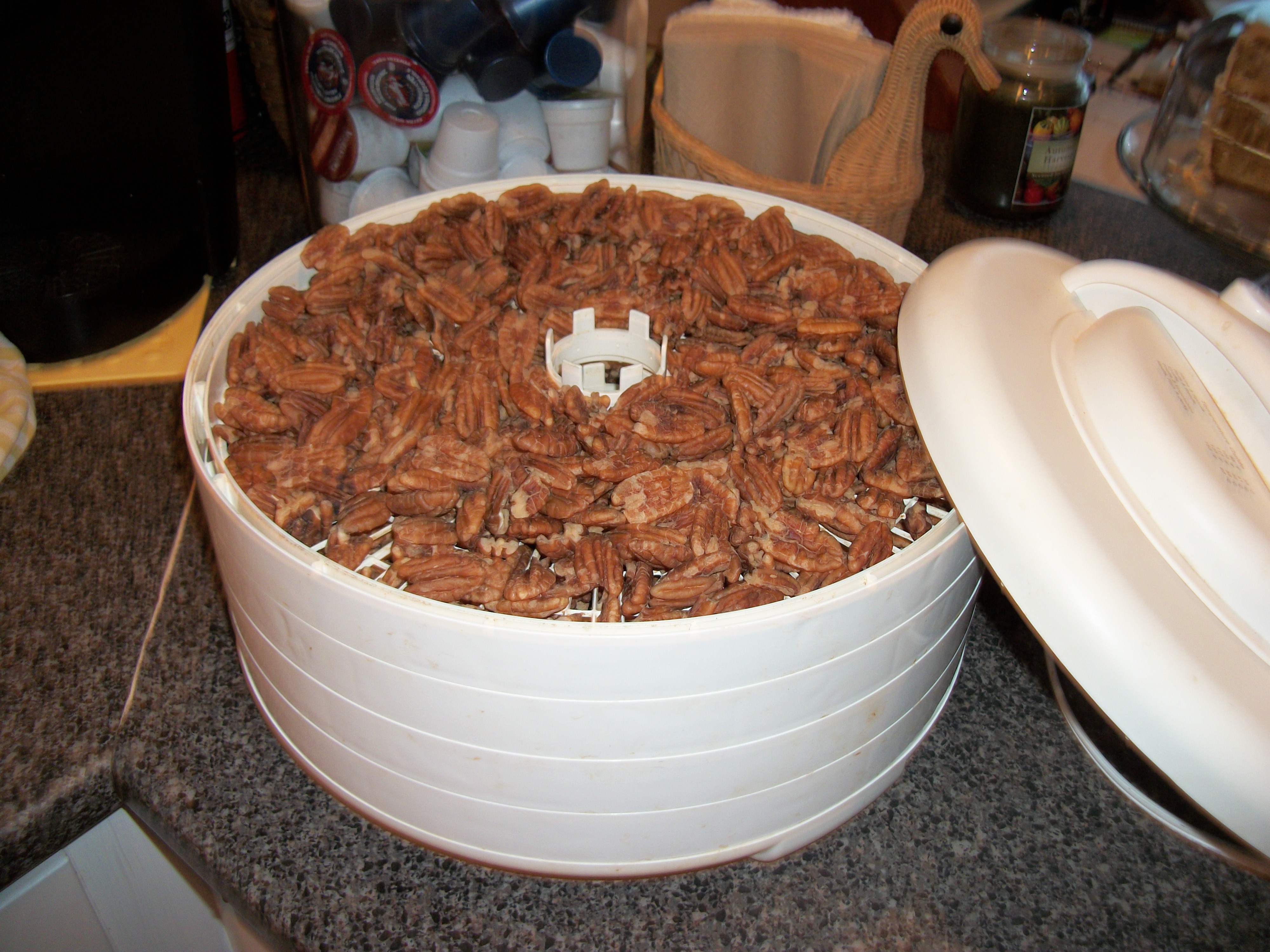
 I soak the nuts over night, dry them gently in the dehydrator, and store them in Mason jars.  Five pounds lasts for months and months.  I keep pumpkin seeds, walnuts, pecans, almonds, and, lately, hazelnuts.  Crispy nuts are delicious! 

ALL nuts, seeds, legumes, and tubers need to be processed in some way to remove the phytates that can prevent your body from absorbing nutrients it needs from many foods.  One prepares most nuts by soaking them in salted water over night and drying then in a dehydrator or an oven on very low heat.  Drying can take, sometimes, well over 24 hours.  I found this information and the recipes in Sally Fallon and Dr. Mary Enig’s treasure trove of a book, NOURISHING TRADITIONS.  Fallon and Enig are part of the Weston A. Price Foundation (www.westonapricefoundation.org).  (Be sure to use .org and NOT .com, which is a scam site.)  I trust the WAPF folks because they have the scientific credentials to understand the chemistry of food and human bodies and because they are not affiliated with industry in any way.

Here are the pecans in the four-tray dehydrator:

And, here they are all jarred up.  The big jar is a half-gallon size with which I’ve recently fallen in love.  Now I’m a rich woman!  I have food assets.