Turkey Tracks: Ball-band Dishcloth

Turkey Tracks:  January 9, 2011

Ball-Band Dishcloth

I finished the Ball-Band Dishcloths I talked about some time ago as an unfinished project.  I have no idea why they are called “ball band” discloths.  Maybe it’s the pattern…

I used red and green Peaches & Cream cotton for potential Christmas use–though they are looking very pretty on top of my yarn pile at the moment.  I got the pattern from Kay Gardiner and Ann Shayne’s MASON-DIXON QUILTING.  But, as they note, the pattern is on the inside of the label of many of the P&C yarn balls.

Here’s what they look like:

I added the little braided end. It’s easier than weaving in all the loose ends.

These beauties hold up really well.  I have some that are three years old now and going strong.   As Gardiner and Shayne say:  THEY MUST BE USED!!!  Plus, they’re fun to make.

Turkey Tracks: Elaine Gottschall’s Muffins

Turkey Tracks:  January 9, 2011

Elaine Gottschall’s Muffins

Since reading about the 1980 USDA food guide that changed the scientifically recommended guidelines for grains from 2 to 3 servings to 9 to 11 servings AND since realizing that my own food allergy problems are related to gut dysfunction, I censor grains in my diet.  I wrote about this USDA debacle in some of my Mainly Tipping Points essays which I have posted on this blog.  Along the way, other reading showed me a whole new way to get a bread-like product with ground nut “flours.”   

In the 1950s, Elaine Gottschall was, at first, a lay person with a seriously ill child when she discovered Dr. Sidney Haas’s work on gut dysfunction in the 1950s.  She adopted his Specific Carbohydrate Diet, now called the GAPS diet (Gut and Psychology Syndrome), and cured her child.  Dr. Natasha Campbell-McBride, among others, has discovered the connection with gut dysfunction and neurological disorders, like autism, ADD, ADHD, dyspraxia, dyslexia, depression, and schizophrenia, and is having a lot of success helping those impacted.  Dr. Joseph Mercola has a book called the NO GRAIN DIET.   

Anyway, this nut-muffin or nut bread recipe is from Gottschall’s book BREAKING THE VICIOUS CYCLE.  It’s delicious and very filling.   Two of these muffins hold me for hours. 

Use organic nuts if you can.  AND, you REALLY DO NEED paper muffin cups.  (Don’t use foil as it will be aluminum toxic.)  The recipe makes about a dozen muffins–more if you add bulky items like banana.

2 1/2 cups ground nuts.  (You can buy nuts already ground at co-ops and stores specializing in nutrient-dense whole foods.) 

 1/4 cup melted butter, or yogurt, or small amount of fruit juice, or pure apple butter (enough to moisten well)

1/2 cup (or less) honey

1/2 tsp. baking soda

1/8 tsp. salt

3 eggs

Additions:  1/3 cup dried fruit, and/or grated lemon/orange rind, and/or flavoring (almond, vanilla).  Fresh blueberries are nice.  For a banana version, add two mashed, ripe bananas and an extra egg.  For coconut, add dried/unsweetened coconut for part of the flour.

For nut bread, add one extra egg (4 eggs) and put into well-greased 1-quart baking dish.

Mix all together and bake at 375 degrees for 15-20 minutes. 

Gottschall’s book has many good recipes.  But, she wrote it at a time when we did not know how dangerous artificial sweeteners are.  Don’t use them.  Some of my essays cover artificial sweeteners as well. 


Turkey Tracks: Red Fish Quilt In Progress and Copyright Laws

Turkey Tracks:  January 9, 2011

Red Fish Quilt In Progress and Copyright Laws


Two summers ago, I took two quilting classes from Jo Diggs, at our state-wide Pine Tree Quilting Guild (PTQG) annual show.

Jo Diggs is an amazing quilter and an effective, caring teacher.  She cuts fabric free-hand and hand appliques the shapes to make her designs.  She does landscapes, floral compositions, and underwater fish and vegetation.  She relies on fabrics she can buy.  She does not artistically manipulate (paint, stamp) fabric.  You can an idea of the kind of work she does on her web site:  www.jodiggs.com.  But, there is no substitute for seeing her work in person.  And, she will be teaching at the Mid-Atlantic Quilt Show in Norfolk, VA, in February.

Before I took Jo’s class on landscapes, I had been doing landscapes.  I can clearly state that I will never be able to be the kind of artist she is.  Her visions are unique and enormously satisfying.  And I did learn more about method from her.  The fish class, though, was formative.  Prior to this class, I had no idea how to go about creating a picture of fish from inside my own head and with fabric available to me.  I did not know how to “think” a fish by combining various shapes in layers.

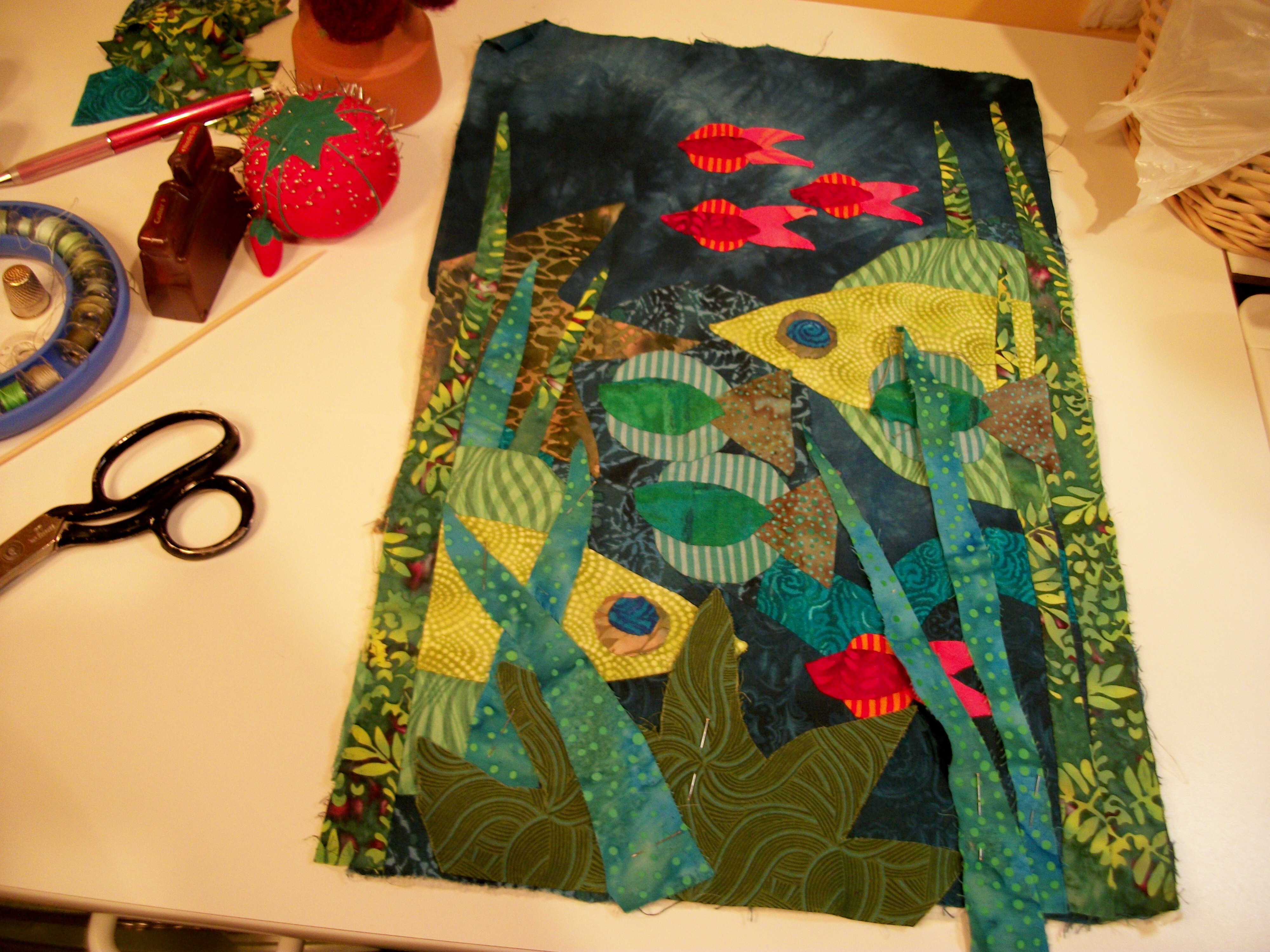
The small quilt top I started stayed pinned to my design wall for 18 months.  I finally picked it up and started hand-sewing just before going to Charleston for Thanksgiving.  Hmmmm, I thought.  Maybe I can do this work.  Last week, I picked up the top again, in the middle of two other quilting projects and three knitting projects, and quickly became obsessed.  Here’s what it looks like so far:

 I’m getting better at the applique as I go along.  My circles have improved immeasurably already.  The fish will all get eyes via embellishment at the second stage.  The large green fish, for instance, will get a button eye.  And, already, some of the foreground has changed.  It does have more depth when you look at it straight on… 

I haven’t a clue how to quilt it, but will figure it out. 

Meanwhile, if this quilt does turn out to be good enough to think about hanging it at the annual Pine Tree show, I will have to get Jo Digg’s permission since it was developed in a class she taught.  Pine Tree recently sent out new protocols for displaying quilts.  If you developed a quilt in a class, made it from a pattern in a magazine or book, or from a pattern you purchased, you have to get the permission of the designer to display the quilt.  I don’t think you can sell such a quilt without getting the permission of the designer either.  Exceptions involve using traditional blocks.  Amy Butler, who designs patterns and fabric, clearly states that if you buy one of her patterns, you may not sell the item to anyone without her permission. 

I’m all for a designer getting credit for his/her work.  I think having to get permission for using a pattern in a published magazine or a book is a bit silly and defeats the purpose of the said magazine or book.  One must give credit, yes, but getting permission is an overload for everyone.  I think selling products made from a published pattern should be ok, too, provided one gives credit to the designer. 

The big problem I have with how to negotiate this terrain with regard to taking classes is deciding where there is a novel, copywrited product and where there is a method to be learned.  No one else can combine fabric in the way Jo Diggs does.  She is an artist and the work she does comes from inside her head.  She can teach me “fish,” but I’ll never create them or put them into a quilt in the way she does.  I could not if I tried.  What she does is unique.  So, did I learn a method from Jo Diggs.  Or am I forever bound to call her for permission whenever I make an applique quilt using anything remotely resembling her fish method?

I don’t know.

But, I can tell you that I’m not likely to take any more classes if these interpretations prevail.  I already refuse to buy Amy Butler’s patterns or fabrics  and would encourage you not to do so as well until she mitigates her legal stance in writing on her patterns.  And, if my little fish quilt turns out ok and if I can reach Jo Diggs without too much trouble and if she gives permission, I might hang it at PTQG.  But if there is any hitch, I will not.  So it will be interesting to see how many quilts PTQG hangs this year.

Clearly this whole terrain has gone over the edge of sanity.  I will be interested to see how much of an impact it has on teachers, books, and quilt shows.


Turkey Tracks: Annie’s First Egg

Turkey Tracks:  January 8, 2011

Annie’s First Egg

Yesterday I was in hurry and rushed down the wooden boardwalk to my car.  The chickens were out, and I walked through them.  When I reached the end of the boardwalk, I was aware that our rooster, Napoleon, or Coq Au Vin, depending upon whether you are talking to John or the grandkids, was chasing me.  Mercy!  He has been so docile all winter, often letting me pet him while he makes all sorts of contented noises.  Here’s a winter picture of the chickens hanging out at a back door.  They are very social and come visiting on the porches often.  Annie is closest to the door.

When I got home, I visited the coop to check food and water levels.    There was a dark brown egg in a depression in a corner, under a lower roost!  It could only be Annie’s since it is the smaller size of a pullet just starting to lay.  Here’s a picture of Annie’s first egg  in the middle of Rose Thomas’s eggs.  (The blue eggs are from her wheaten Americaunas and the light brown ones are from, likely, her Red Sex-Links.)

The fact that Roo chased me suddenly made perfect sense.   One of the hens was laying again!

For those of you who don’t know chickens, when the days grow shorter, hens stop laying and rest.  You can see in the picture of the chickens that Annie’s comb is much redder than the older hens.  Depletion of comb and leg color happens because egg production takes everything out of the hens.  You can keep hens laying by artificially lighting them to extend what they think of is daylight.  We don’t do much lighting,  preferring to let the hens rest.  We only light (using a red light bulb if we can find one) for warmth on the coldest days and nights.  But, our days are already getting longer now.  And, lighting the coop with a white light recentlyfor a few hours at dusk to get it warm while we are waiting for ordered red bulbs to come may be a factor.

In any case, you can see why eggs were so valuable around the winter holidays because they would have to have been saved since about mid-November if one wanted a special cake.  And, you can see why Easter is a celebration involving eggs because eggs would, once again, be plentiful.

Turkey Tracks: Glee!

Turkey Tracks:  January 6, 2011

Glee!

Season 1 of the television show GLEE is available on DVD.

It’s just plain fun to watch it.

So, if you’re looking for some light-hearted viewing, take a look.  Each show features really great music, often accompanied by intricate dance segments and great costumes.  It’s like watching a fairly elaborate staged musical, over and over. 

There is a thin plot progression and some character development , so I’d recommend you watch the episodes in order.  Out-of-control, stereotypical, campy characters are part of the fun.  Often there is some greater message of how to have a more inclusive society or what’s “the right thing to do.” 

The background vocals feature the Tufts glee club, which is what interested John in the first place.

Season 2 releases later this month.

Turkey Tracks: Three Knitting Projects

Turkey Tracks:  December 30, 2010

Three Knitting Projects

I have three knitting projects going on at the moment.

First, I bought this book at the Border’s in Portland when we spent the night before flying to Charleston at Thanksgiving.  I LOVE Noro yarn.   The colors are brilliant, vivid, and so much fun.  I’ve made two scarf Noro projects.  And, two matching hats.  But I’ve never worked with the bulky weight–Iro.   KNITTING NORO has a bulky cardigan that I really liked, and Helen at Heavenly Socks in Belfast helped me find an Iro I liked.  She ordered it for me forthwith AND gave me a 20 percent discount on it as part of her holiday discount special.


Amazon.com: Knitting Noro: The Magic of Knitting with Hand-Dyed Yarns 9780307586551: Jane Ellison: Books

Here is the yarn I chose.  You can see I’ve wound 5 of the skeins.  I left three so you could see how pretty they look, too:

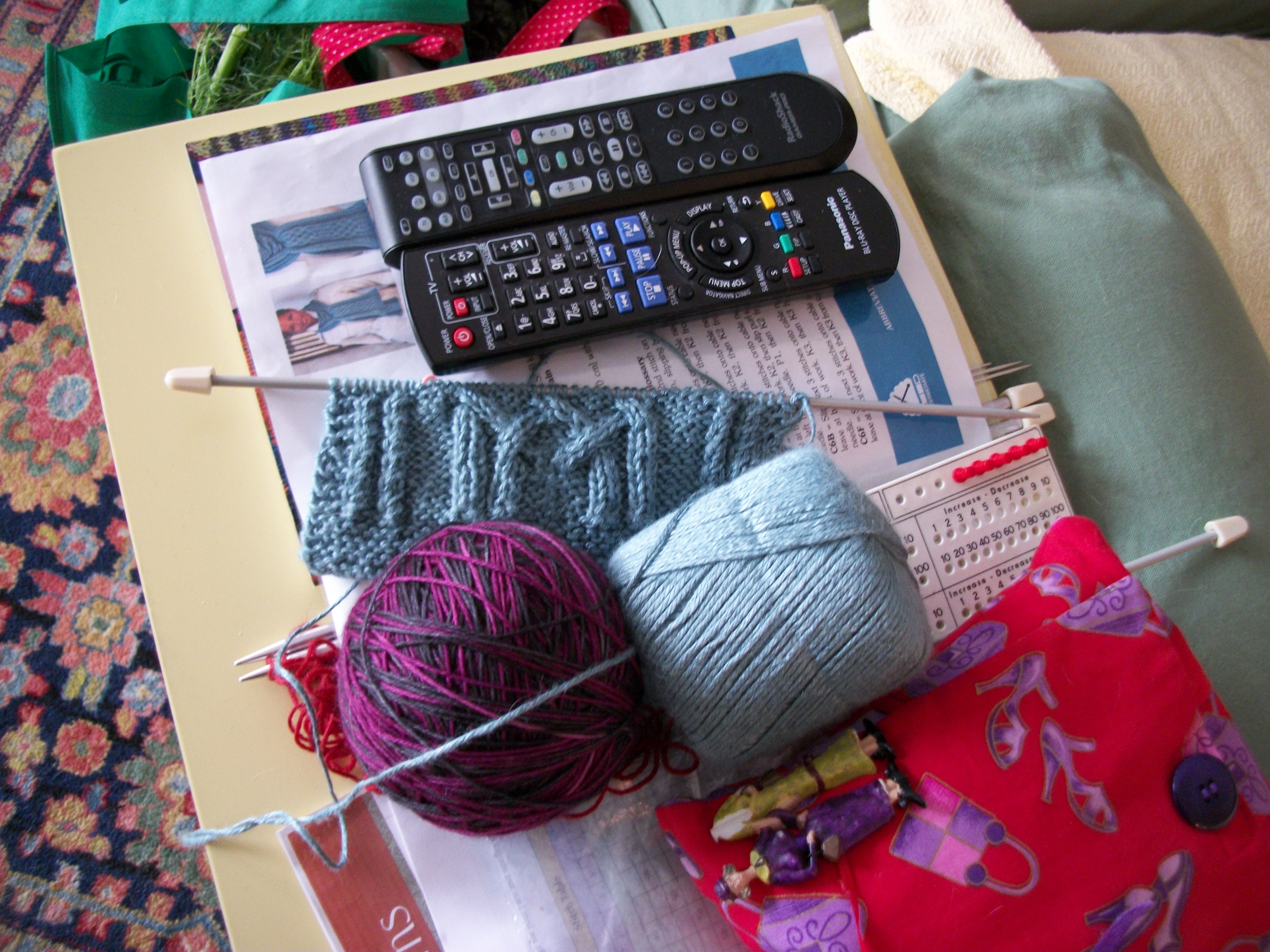
I can hardly wait to start this sweater.  But, but, I have two other projects ahead of this one.  A silk/bamboo scarf–so I can master cables and an intricate pattern.  (I’ve already taken it out twice, but I’m getting the hang of it now.  And, some sock yarn (magenta and dark grey) that I’m going to use to try socks that start at the toe AND that use a 5-stitch pattern.

In addition, I’m working on 3 quilts in various stages of development and just sent one off in the mail today.  But more on that later.

Turkey Tracks: Blizzard!

Turkey Tracks:  December 27, 2010

Blizzard!

 We woke up to a blizzard this morning.

We knew it was coming as it’s been moving north for the past two days and as various relatives who live further south have called or sent pictures of deep snow.  Maryann, John’s sister, drove in from Boston about 1 p.m. yesterday, with the storm on her heels. 

We had at least a foot of snow on the ground at 7 a.m.  I donned boots, hat, coat, mittens and set out to get to the chicken house.  The snow was calf deep, but I was able to get food to the chickens and to change out their water.  I returned with the shovel and got a path organized to them.  It’s fairly light snow to move.  The chickens have been hunkering down in their coop during the past few days of colder weather.  They were happy to see me, and Annie “talked” while I fed them.  I didn’t open the door into their larger cage as the wind was high.  By now, though, their cage and coop are banked with snow, which gives them quite a bit of insulation. 

Inside, I cut up one of our meat chicken for dinner and put the backs, feet, wings, head, etc, into a pot and got a bone broth going with lots of onion, celery, carrots, garlic, and herbs.  It smells heavenly.  We’re low on bread, so I dragged out the bread machine and got that going.  The plow crew came and cleared the driveway, the front porch, and the paths around the house, and John and Maryann shoveled the upper porch and refilled the bird feeders.  Now, we’re all hunkered down enjoying a snow day.  Maryann is hoping to get out tomorrow to meet up with friends going to the Cape.  Likely she will make it.  New Englanders are brilliant with snow removal.

Dinner tonight is a bouillbaise made with chicken and fragrant with saffron, roasted tomatoes put up last summer, fennel, leeks, and the pernod Maryann brought me this trip.  (We couldn’t find it around here.)  We’ll add salad (the last of Rose Thomas’s hoop house lettuce) and broccoli.  And then, there is the Lane Cake, the fudge, and the Italian pizzelles.  Mercy!!!  We are blessed!!       

Turkey Tracks: Louise Bryan’s Fudge

Turkey Tracks:  December 27, 2010

Louise Bryan’s Fudge

Louise Phillips Bryan was my beloved grandmother.  My mother’s mother, she lived in Reynolds, Georgia, in a big old brick house that sat right across from the town square.  The Baptist Church sat on one corner of this square–and was across from Big House–and the Methodist Church sat on the opposite, diagonal corner.  The Bryan family was Baptist, only Grandmother, upon occasion, would declare that she was actually a Presbyterian.

From the time I was a tiny thing, I spent lots of time with her, especially after my sister Susan, four years my junior, was born.  At that time my father, who was in the Air Force, was stationed in Savannah, Georgia.  I remember him driving me half way to Reynolds and my Uncle Buddy meeting us and taking me the rest of the way home.  And, yes, Reynolds and my Grandmother was “home.”  (By the time I graduated from college, I had attended 14 schools that I can remember.)

Grandmother did not cook much.  She had a cook for breakfast and dinner (in the middle of the day) and who came back if the family needed her for a supper event like a back-yard steak cookout.  But, Grandmother made supper, and she cooked sweets, and made jams and jellies and canned tomatoes.  Life at Big House revolved around meals to a large extent.

Anyway, I learned to make her fudge probably around the time I was ten.  I’ve been making it ever since, and especially at Christmas.  So, I want to put down the recipe here so it does not get lost.  Right now, there is a tin of Grandmother’s fudge on the counter, the cake stand holds her Lane cake, and the cookie jar is full of pizzelles–just in case people stop in for tea.

Louise Bryan’s Fudge

The ingredients are simple.  The method is a bit tricky.  I’ll try to describe it as best I can, but you may have a few trials and errors before you master it.  They’ll all still taste good.  And, after all, that’s how I learned to do it when I was 10.  No one fussed at me when I failed.  They just let me alone in the kitchen.  Although, usually there was more than one person involved when fudge was being made.  My Aunt Martha, for instance, LOVED Grandmother’s fudge.  She was often an instigator for making it.  (Martha was just 10 years older than me and was married to my Uncle Buddy, aka Sydney Bryan.)  So, maybe, actually, the way I learned was in the company of family women.   Whatever, I learned in a relaxed way, which made me confident about my skills.

The recipe doubles quite well, and I usually make it doubled.  But, until you master it, maybe keep to the single recipe?

Heavily butter a large flat plate or pyrex pan so you are ready when it’s time to pour the fudge to let it set.

4 heaping Tablespoons of cocoa, 2 cups of sugar, 2/3 cup of milk, and 2-3 Tablespoons of white corn syrup.  (The corn syrup keeps the fudge smooth; it helps it to “make” without sugaring.)  You’ll also need 3 Tablespoons of butter and 1 tsp. vanilla.  If you’re using unsalted butter, add a pinch of salt.  Grandmother almost always put pecans in her fudge.  And, they are delicious in it.  (Soak them first in salted water overnight and dry them in a low oven or dehydrator until they are crispy to remove their phytates.)  Pecans are a staple nut in Georgia, and Grandmother had two trees in her back yard.  I don’t know how many to tell you–at least a cup chopped?

Dump everything BUT the butter and vanilla into a fairly large saucepan.  At least 1 1/2 quarts.  The fudge will rise up the pan as it boils down, so use a deep pot.

Stir only until the mixture comes together and begins to boil.  Don’t let it boil too hard.  But don’t let it just simmer either.  A slow rolling boil is best.  DON’T STIR IT.  If you do, it will sugar on you.

When it seems to be thicker, start testing it.  Dip a spoon into the mixture and let a few drops fall into a glass of cold water.  At first the fudge drops will shatter.  When they start to congeal, taste the drops.  The fudge is ready when the drops form threads and are chewy.  IMMEDIATELY turn off the heat, put in the vanilla (it will splatter and hiss) and add the butter.  Stir with a BIG SPOON vigorously to cool the mass.  When you start to see stir lines in the fudge pour it into the waiting pan.  This part is the really tricky part.  If you pour too soon, it won’t harden.  If you beat too long, it will “set” and you’ll have a pot full of congealed fudge.  Most people err on the side of pouring too runny.  And, the only thing I can tell you is that you might have to cook a few batches to get it for yourself.  It does make great cake icing poured off a bit runny.  And, I suppose you could roll it into balls with greased hands…???like a kind of taffy if you get it too runny.

When the fudge has “set” but is still warm, cut it into pieces and remove them to a tin or container you can close.  If you wait too long, it’s hard to get the pieces out of the pan.  The butter on the bottom hardens, too.

It’s dead simple once you understand when to stop cooking it and when to pour it off.  And, it’s DELICIOUS!

Turkey Tracks: White Christmas

Turkey Tracks:  December 23, 2010

White Christmas

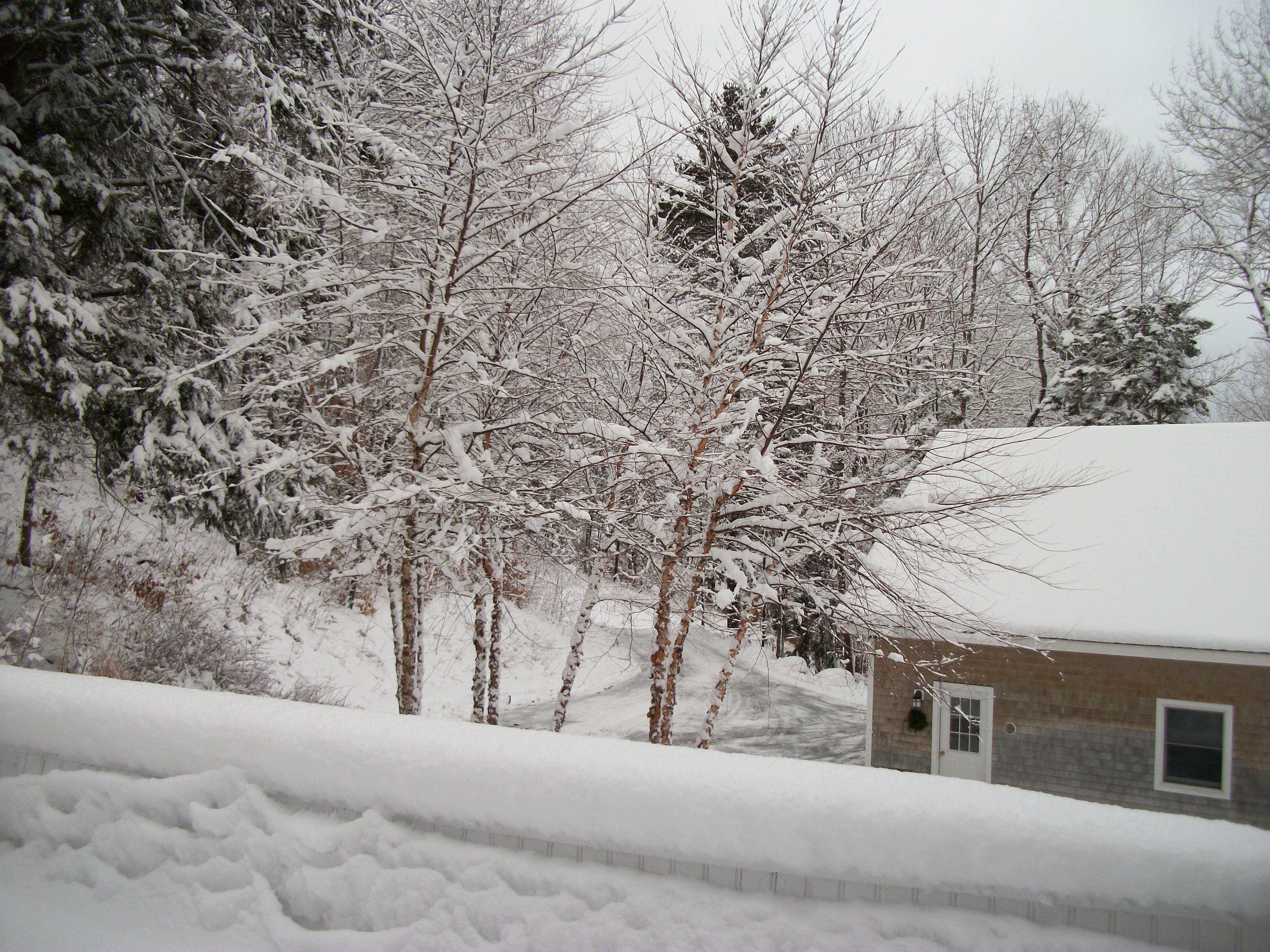
It snowed last night!

Here’s a view past the back deck out over the side garden, past the garage, and on down the driveway to the main road: 

 Here’s a view on the other side of the house, over the frozen stream, and looking into our woods:


 It’s a gift of the universe!

Turkey Tracks: Winter Solstice

Turkey Tracks:  December 23, 2010

Winter Solstice

Winter Solstice was last Tuesday, December 21st.

The solstice is the longest night of the year.  After solstice, light begins flooding back into the world, albeit bit by bit.   But, before long, we will look at one another and say “the days are getting longer again.”  Right now, it’s dusky dark by 4 p.m.

I don’t mind the dark.  I find this time of year restful, reflective, tranquil, and filled with white, actually.  We have white snow, gorgeous big moons and moonlight, the stars form an impressive canopy in the sharp winter air, and the light now, with the sun low in the sky, is amazing.  It’s beautiful here, and that’s without the smell of evergreens, red berries glowing alongside the road, and the lakes freezing over.  It’s the best time of the year for the hot tub too, especially with the Milky Way so visible. 

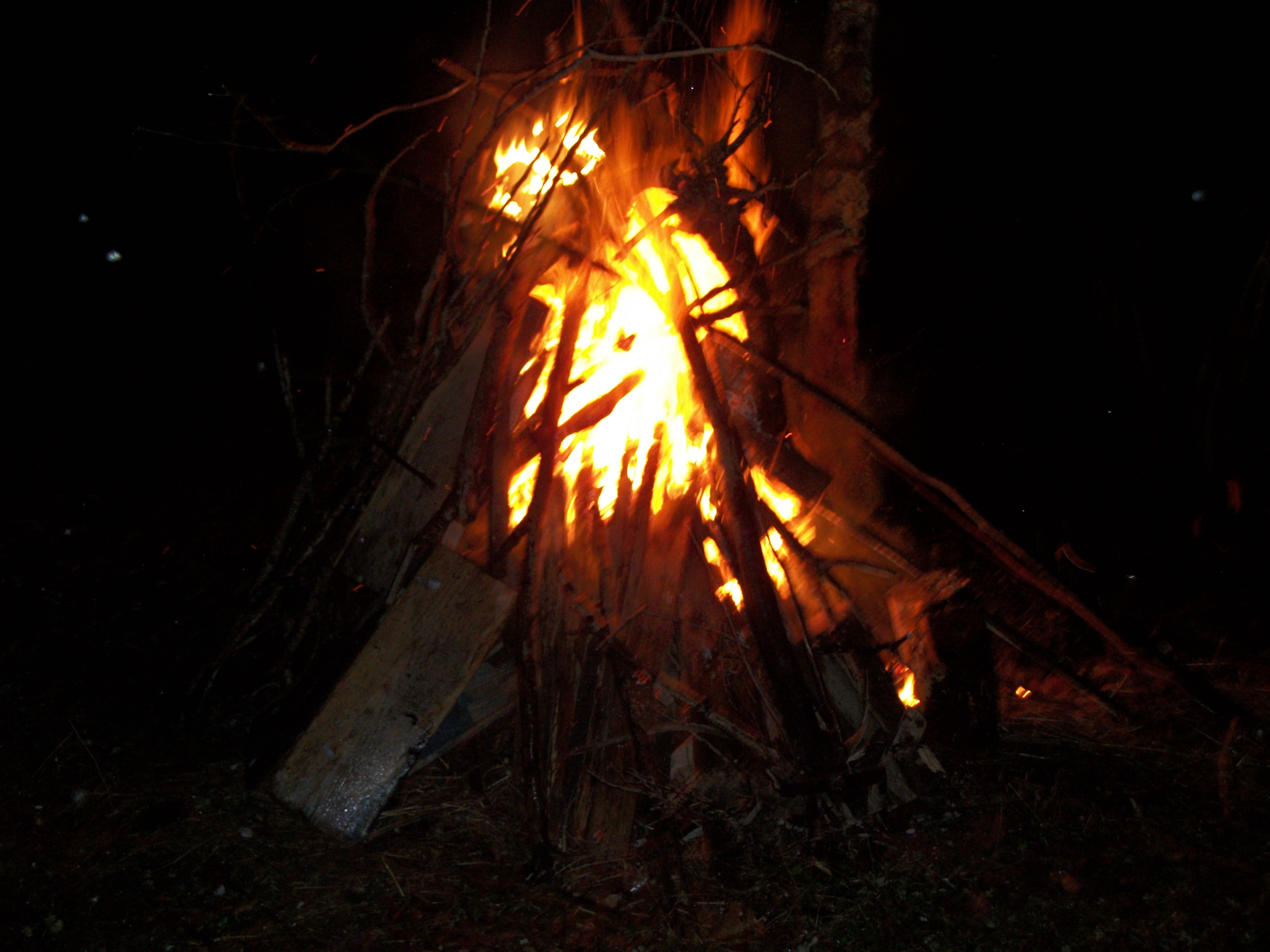
Solstice is a fun night for us since for some years now we’ve gone to Margaret and Ronald’s house for a big bonfire.  This solstice was no exception, and Ronald had just lit the bonfire when we arrived at 4:30, despite spitting rain.

Here’s a picture of Ronald on the left, another guest in the middle, and John on the right:

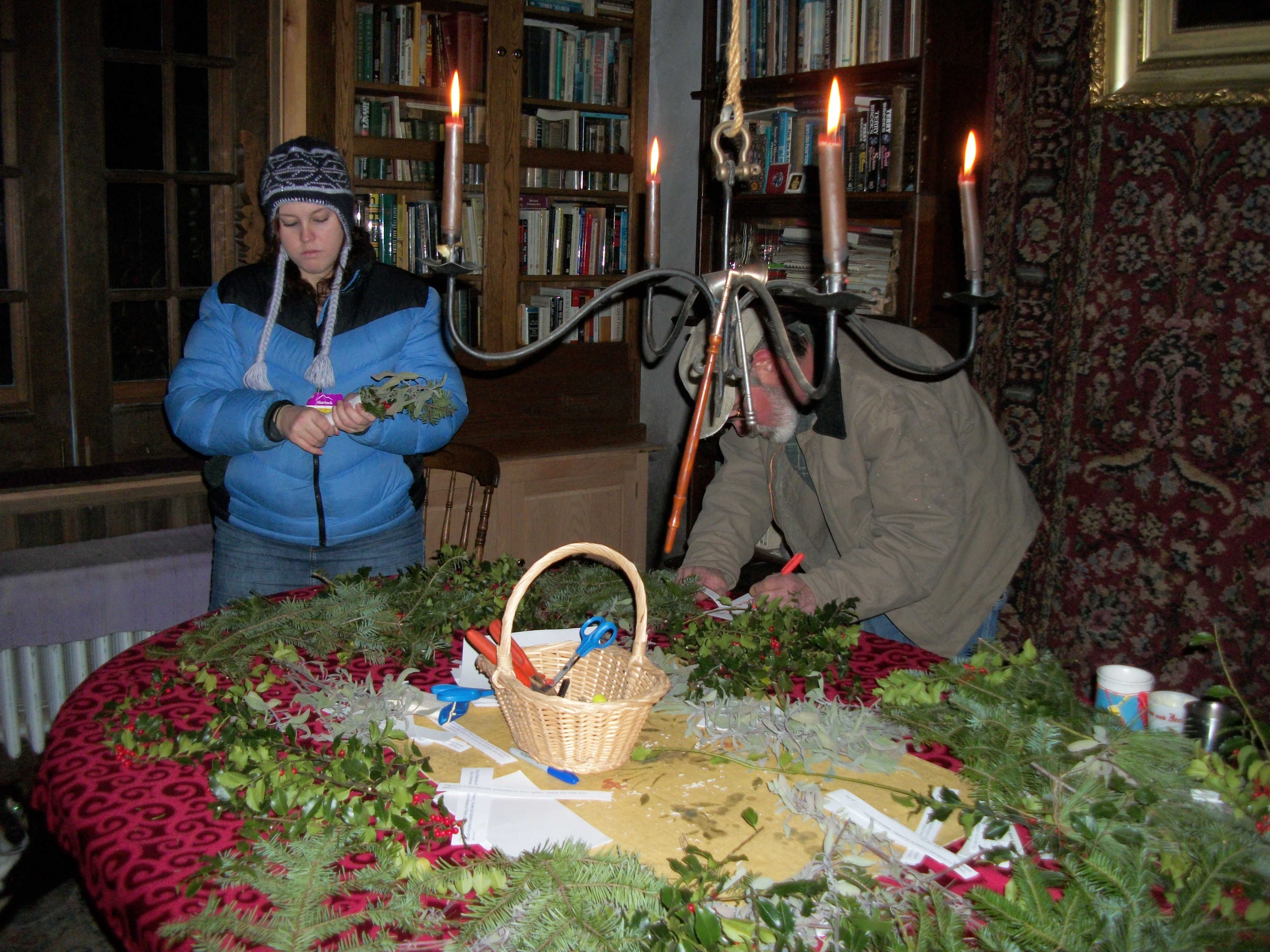
Inside, candles are the only light.  One feels as if one has stepped back into time.  Margaret serves nuts, dried fruits, and some cooked winter squash, hot chocolate, cider, and her father’s famous Tom and Jerry’s.  The T&J’s are a heavenly mix of meringue, nutmeg, and liquor.  I look forward to having two small cups every year.  They warm the tummy and the heart and make you want to leave the inside fire and go outside and throw your “intentions” in the fire.  Here’s how Margaret sets up her “intentions” table:

 Pine is for the past.  You wrap pine into a paper note you’ve written on–hopefully about letting go of something troubling–tie it with string, and throw it into the fire, where you watch it burn.  Holly is for the future, so you make one of those dedicated to something about your future.  You can make as many of each as you wish, and Margaret encourages you to do so.  There is something magical about intentionally letting go of something.  And, of bringing something wonderful into your future.

Thanks you Ronald and Margaret for making this special time happen for us each year!