Turkey Tracks: Three Knitting Projects

Turkey Tracks:  December 30, 2010

Three Knitting Projects

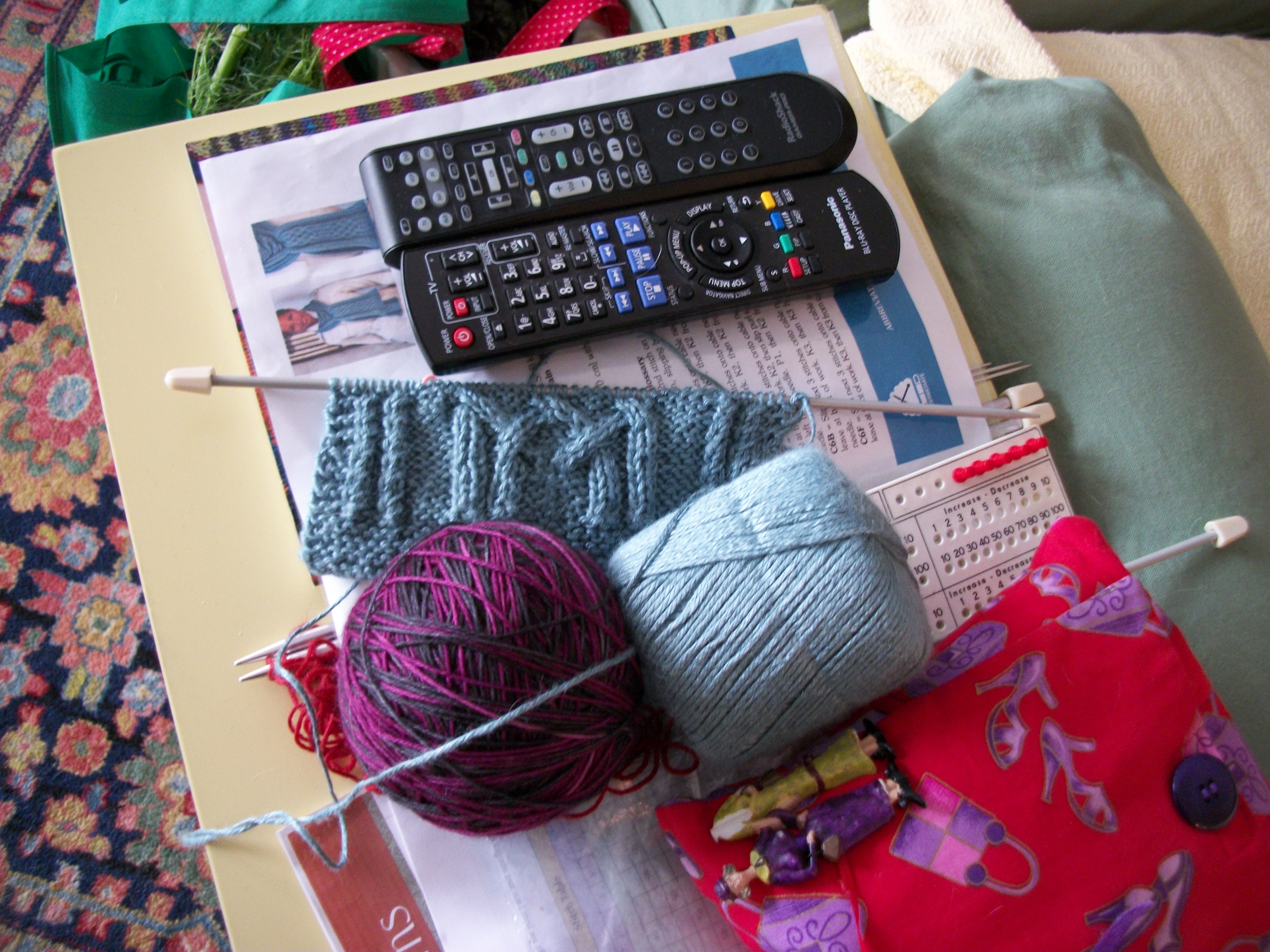
I have three knitting projects going on at the moment.

First, I bought this book at the Border’s in Portland when we spent the night before flying to Charleston at Thanksgiving.  I LOVE Noro yarn.   The colors are brilliant, vivid, and so much fun.  I’ve made two scarf Noro projects.  And, two matching hats.  But I’ve never worked with the bulky weight–Iro.   KNITTING NORO has a bulky cardigan that I really liked, and Helen at Heavenly Socks in Belfast helped me find an Iro I liked.  She ordered it for me forthwith AND gave me a 20 percent discount on it as part of her holiday discount special.


Amazon.com: Knitting Noro: The Magic of Knitting with Hand-Dyed Yarns 9780307586551: Jane Ellison: Books

Here is the yarn I chose.  You can see I’ve wound 5 of the skeins.  I left three so you could see how pretty they look, too:

I can hardly wait to start this sweater.  But, but, I have two other projects ahead of this one.  A silk/bamboo scarf–so I can master cables and an intricate pattern.  (I’ve already taken it out twice, but I’m getting the hang of it now.  And, some sock yarn (magenta and dark grey) that I’m going to use to try socks that start at the toe AND that use a 5-stitch pattern.

In addition, I’m working on 3 quilts in various stages of development and just sent one off in the mail today.  But more on that later.

Turkey Tracks: Blizzard!

Turkey Tracks:  December 27, 2010

Blizzard!

 We woke up to a blizzard this morning.

We knew it was coming as it’s been moving north for the past two days and as various relatives who live further south have called or sent pictures of deep snow.  Maryann, John’s sister, drove in from Boston about 1 p.m. yesterday, with the storm on her heels. 

We had at least a foot of snow on the ground at 7 a.m.  I donned boots, hat, coat, mittens and set out to get to the chicken house.  The snow was calf deep, but I was able to get food to the chickens and to change out their water.  I returned with the shovel and got a path organized to them.  It’s fairly light snow to move.  The chickens have been hunkering down in their coop during the past few days of colder weather.  They were happy to see me, and Annie “talked” while I fed them.  I didn’t open the door into their larger cage as the wind was high.  By now, though, their cage and coop are banked with snow, which gives them quite a bit of insulation. 

Inside, I cut up one of our meat chicken for dinner and put the backs, feet, wings, head, etc, into a pot and got a bone broth going with lots of onion, celery, carrots, garlic, and herbs.  It smells heavenly.  We’re low on bread, so I dragged out the bread machine and got that going.  The plow crew came and cleared the driveway, the front porch, and the paths around the house, and John and Maryann shoveled the upper porch and refilled the bird feeders.  Now, we’re all hunkered down enjoying a snow day.  Maryann is hoping to get out tomorrow to meet up with friends going to the Cape.  Likely she will make it.  New Englanders are brilliant with snow removal.

Dinner tonight is a bouillbaise made with chicken and fragrant with saffron, roasted tomatoes put up last summer, fennel, leeks, and the pernod Maryann brought me this trip.  (We couldn’t find it around here.)  We’ll add salad (the last of Rose Thomas’s hoop house lettuce) and broccoli.  And then, there is the Lane Cake, the fudge, and the Italian pizzelles.  Mercy!!!  We are blessed!!       

Turkey Tracks: Louise Bryan’s Fudge

Turkey Tracks:  December 27, 2010

Louise Bryan’s Fudge

Louise Phillips Bryan was my beloved grandmother.  My mother’s mother, she lived in Reynolds, Georgia, in a big old brick house that sat right across from the town square.  The Baptist Church sat on one corner of this square–and was across from Big House–and the Methodist Church sat on the opposite, diagonal corner.  The Bryan family was Baptist, only Grandmother, upon occasion, would declare that she was actually a Presbyterian.

From the time I was a tiny thing, I spent lots of time with her, especially after my sister Susan, four years my junior, was born.  At that time my father, who was in the Air Force, was stationed in Savannah, Georgia.  I remember him driving me half way to Reynolds and my Uncle Buddy meeting us and taking me the rest of the way home.  And, yes, Reynolds and my Grandmother was “home.”  (By the time I graduated from college, I had attended 14 schools that I can remember.)

Grandmother did not cook much.  She had a cook for breakfast and dinner (in the middle of the day) and who came back if the family needed her for a supper event like a back-yard steak cookout.  But, Grandmother made supper, and she cooked sweets, and made jams and jellies and canned tomatoes.  Life at Big House revolved around meals to a large extent.

Anyway, I learned to make her fudge probably around the time I was ten.  I’ve been making it ever since, and especially at Christmas.  So, I want to put down the recipe here so it does not get lost.  Right now, there is a tin of Grandmother’s fudge on the counter, the cake stand holds her Lane cake, and the cookie jar is full of pizzelles–just in case people stop in for tea.

Louise Bryan’s Fudge

The ingredients are simple.  The method is a bit tricky.  I’ll try to describe it as best I can, but you may have a few trials and errors before you master it.  They’ll all still taste good.  And, after all, that’s how I learned to do it when I was 10.  No one fussed at me when I failed.  They just let me alone in the kitchen.  Although, usually there was more than one person involved when fudge was being made.  My Aunt Martha, for instance, LOVED Grandmother’s fudge.  She was often an instigator for making it.  (Martha was just 10 years older than me and was married to my Uncle Buddy, aka Sydney Bryan.)  So, maybe, actually, the way I learned was in the company of family women.   Whatever, I learned in a relaxed way, which made me confident about my skills.

The recipe doubles quite well, and I usually make it doubled.  But, until you master it, maybe keep to the single recipe?

Heavily butter a large flat plate or pyrex pan so you are ready when it’s time to pour the fudge to let it set.

4 heaping Tablespoons of cocoa, 2 cups of sugar, 2/3 cup of milk, and 2-3 Tablespoons of white corn syrup.  (The corn syrup keeps the fudge smooth; it helps it to “make” without sugaring.)  You’ll also need 3 Tablespoons of butter and 1 tsp. vanilla.  If you’re using unsalted butter, add a pinch of salt.  Grandmother almost always put pecans in her fudge.  And, they are delicious in it.  (Soak them first in salted water overnight and dry them in a low oven or dehydrator until they are crispy to remove their phytates.)  Pecans are a staple nut in Georgia, and Grandmother had two trees in her back yard.  I don’t know how many to tell you–at least a cup chopped?

Dump everything BUT the butter and vanilla into a fairly large saucepan.  At least 1 1/2 quarts.  The fudge will rise up the pan as it boils down, so use a deep pot.

Stir only until the mixture comes together and begins to boil.  Don’t let it boil too hard.  But don’t let it just simmer either.  A slow rolling boil is best.  DON’T STIR IT.  If you do, it will sugar on you.

When it seems to be thicker, start testing it.  Dip a spoon into the mixture and let a few drops fall into a glass of cold water.  At first the fudge drops will shatter.  When they start to congeal, taste the drops.  The fudge is ready when the drops form threads and are chewy.  IMMEDIATELY turn off the heat, put in the vanilla (it will splatter and hiss) and add the butter.  Stir with a BIG SPOON vigorously to cool the mass.  When you start to see stir lines in the fudge pour it into the waiting pan.  This part is the really tricky part.  If you pour too soon, it won’t harden.  If you beat too long, it will “set” and you’ll have a pot full of congealed fudge.  Most people err on the side of pouring too runny.  And, the only thing I can tell you is that you might have to cook a few batches to get it for yourself.  It does make great cake icing poured off a bit runny.  And, I suppose you could roll it into balls with greased hands…???like a kind of taffy if you get it too runny.

When the fudge has “set” but is still warm, cut it into pieces and remove them to a tin or container you can close.  If you wait too long, it’s hard to get the pieces out of the pan.  The butter on the bottom hardens, too.

It’s dead simple once you understand when to stop cooking it and when to pour it off.  And, it’s DELICIOUS!

Turkey Tracks: White Christmas

Turkey Tracks:  December 23, 2010

White Christmas

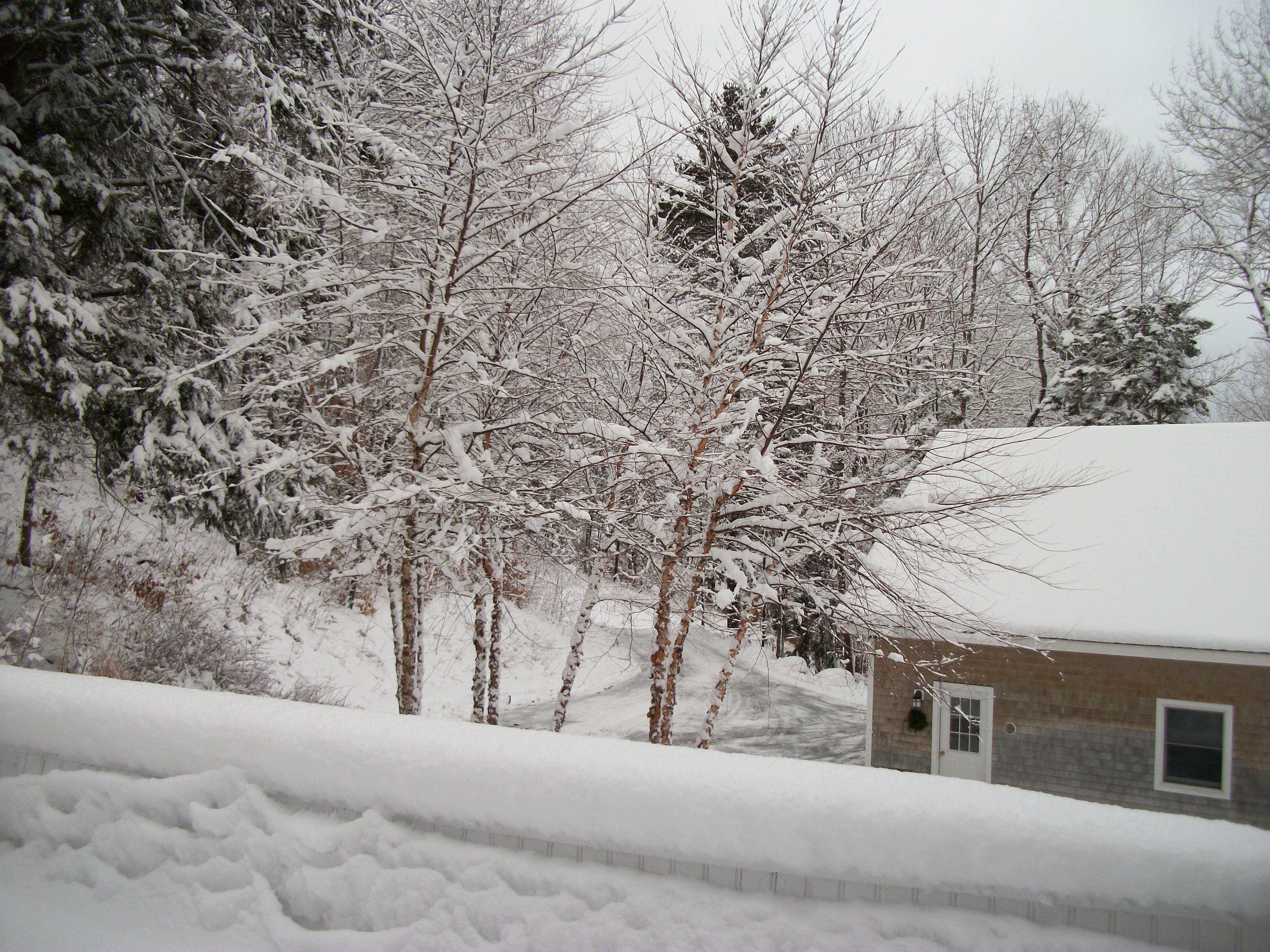
It snowed last night!

Here’s a view past the back deck out over the side garden, past the garage, and on down the driveway to the main road: 

 Here’s a view on the other side of the house, over the frozen stream, and looking into our woods:


 It’s a gift of the universe!

Turkey Tracks: Winter Solstice

Turkey Tracks:  December 23, 2010

Winter Solstice

Winter Solstice was last Tuesday, December 21st.

The solstice is the longest night of the year.  After solstice, light begins flooding back into the world, albeit bit by bit.   But, before long, we will look at one another and say “the days are getting longer again.”  Right now, it’s dusky dark by 4 p.m.

I don’t mind the dark.  I find this time of year restful, reflective, tranquil, and filled with white, actually.  We have white snow, gorgeous big moons and moonlight, the stars form an impressive canopy in the sharp winter air, and the light now, with the sun low in the sky, is amazing.  It’s beautiful here, and that’s without the smell of evergreens, red berries glowing alongside the road, and the lakes freezing over.  It’s the best time of the year for the hot tub too, especially with the Milky Way so visible. 

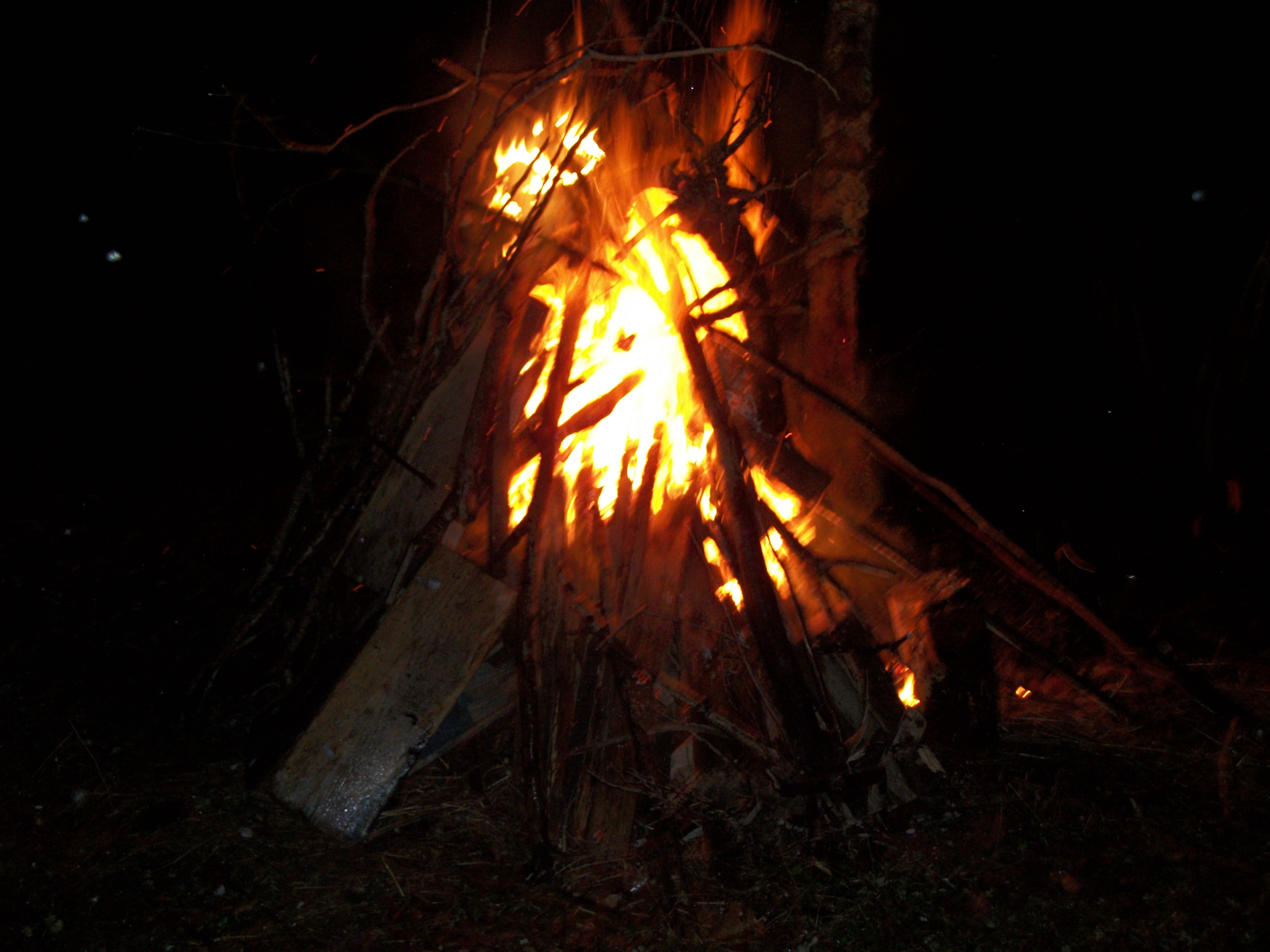
Solstice is a fun night for us since for some years now we’ve gone to Margaret and Ronald’s house for a big bonfire.  This solstice was no exception, and Ronald had just lit the bonfire when we arrived at 4:30, despite spitting rain.

Here’s a picture of Ronald on the left, another guest in the middle, and John on the right:

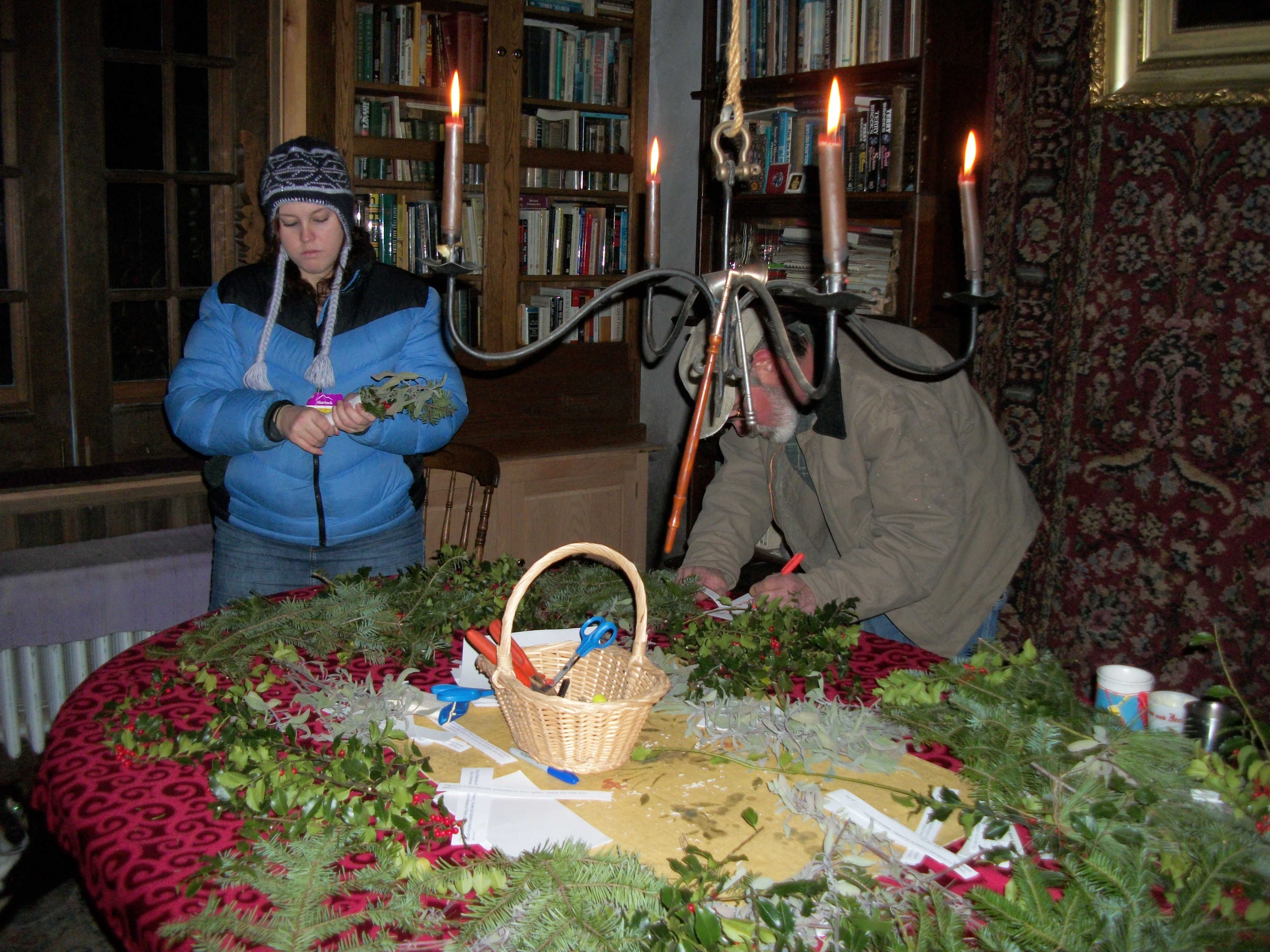
Inside, candles are the only light.  One feels as if one has stepped back into time.  Margaret serves nuts, dried fruits, and some cooked winter squash, hot chocolate, cider, and her father’s famous Tom and Jerry’s.  The T&J’s are a heavenly mix of meringue, nutmeg, and liquor.  I look forward to having two small cups every year.  They warm the tummy and the heart and make you want to leave the inside fire and go outside and throw your “intentions” in the fire.  Here’s how Margaret sets up her “intentions” table:

 Pine is for the past.  You wrap pine into a paper note you’ve written on–hopefully about letting go of something troubling–tie it with string, and throw it into the fire, where you watch it burn.  Holly is for the future, so you make one of those dedicated to something about your future.  You can make as many of each as you wish, and Margaret encourages you to do so.  There is something magical about intentionally letting go of something.  And, of bringing something wonderful into your future.

Thanks you Ronald and Margaret for making this special time happen for us each year!

Turkey Tracks: Dianne Hire’s Quilts

Turkey Tracks:  December 16, 2010

Dianne Hire’s Quilts

Dianne Hire came to visit with Coastal Quilters during their December monthly meeting.  She has a new book out, and we wanted to see it and some of her quilts that appear in it.

Dianne Hire is a nationally recognized quilter and teacher.  Her quilts have hung in major shows, like Houston and Kentucky.  Some are in permanent collections, like Houston.  We are so lucky that she lives nearby, in Northport. 

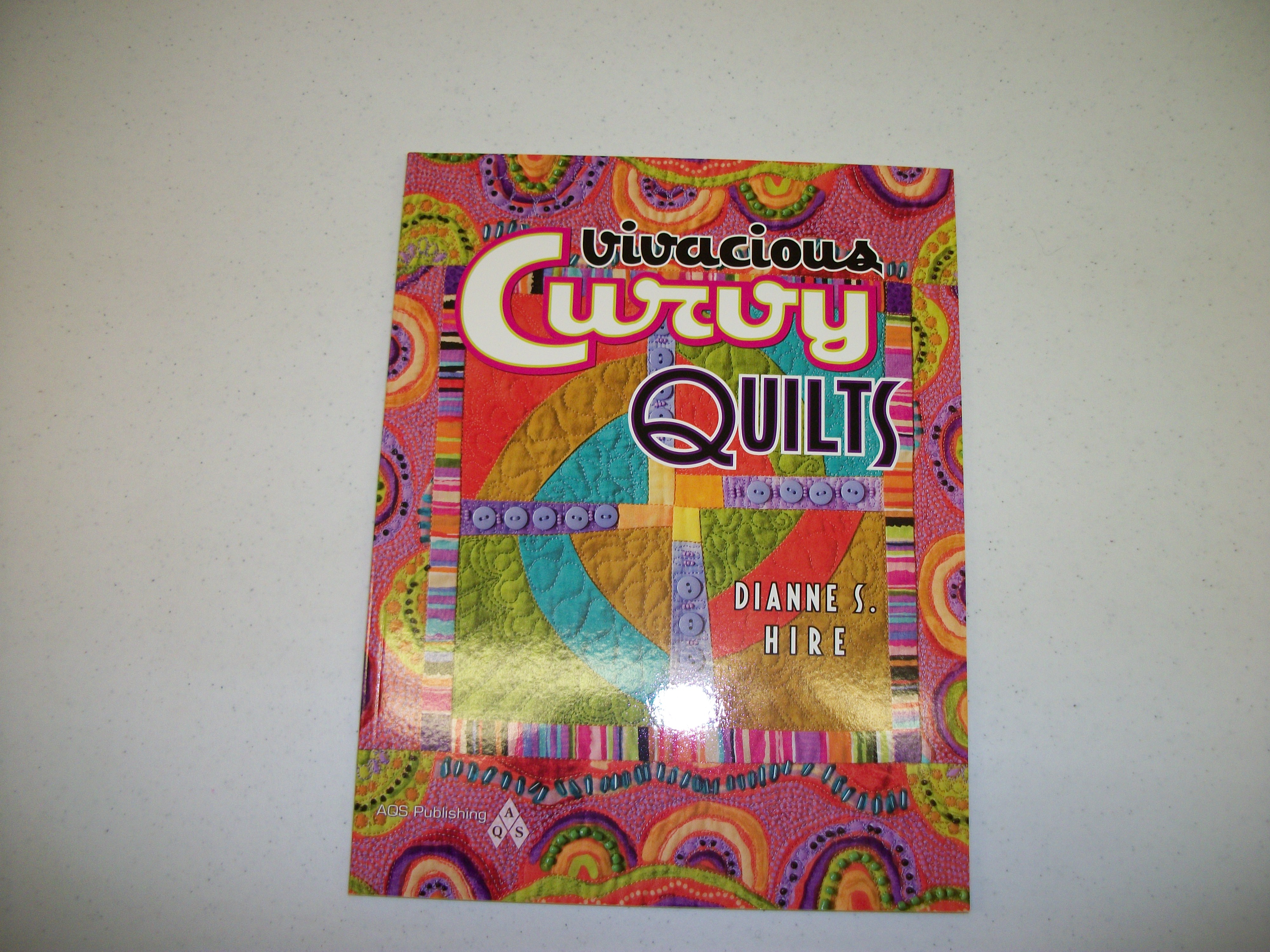
Her new book VIVACIOUS CURVY QUILTS came out in October:

Here’s the quilt from the cover:

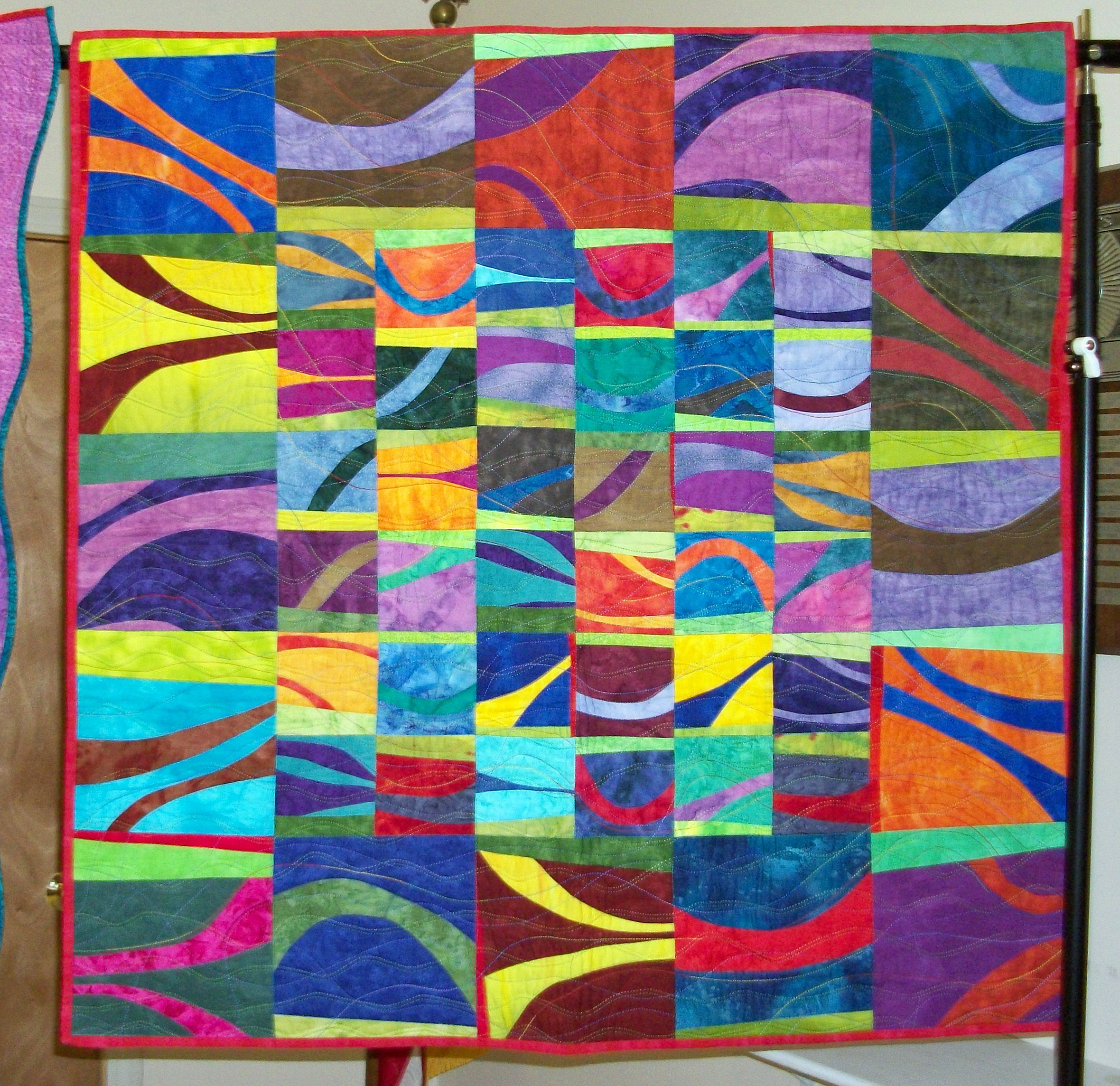
Here is a picture of a quilt that uses the curved piecing method Dianne’s book teaches:

Isn’t it wonderful?  So lively.

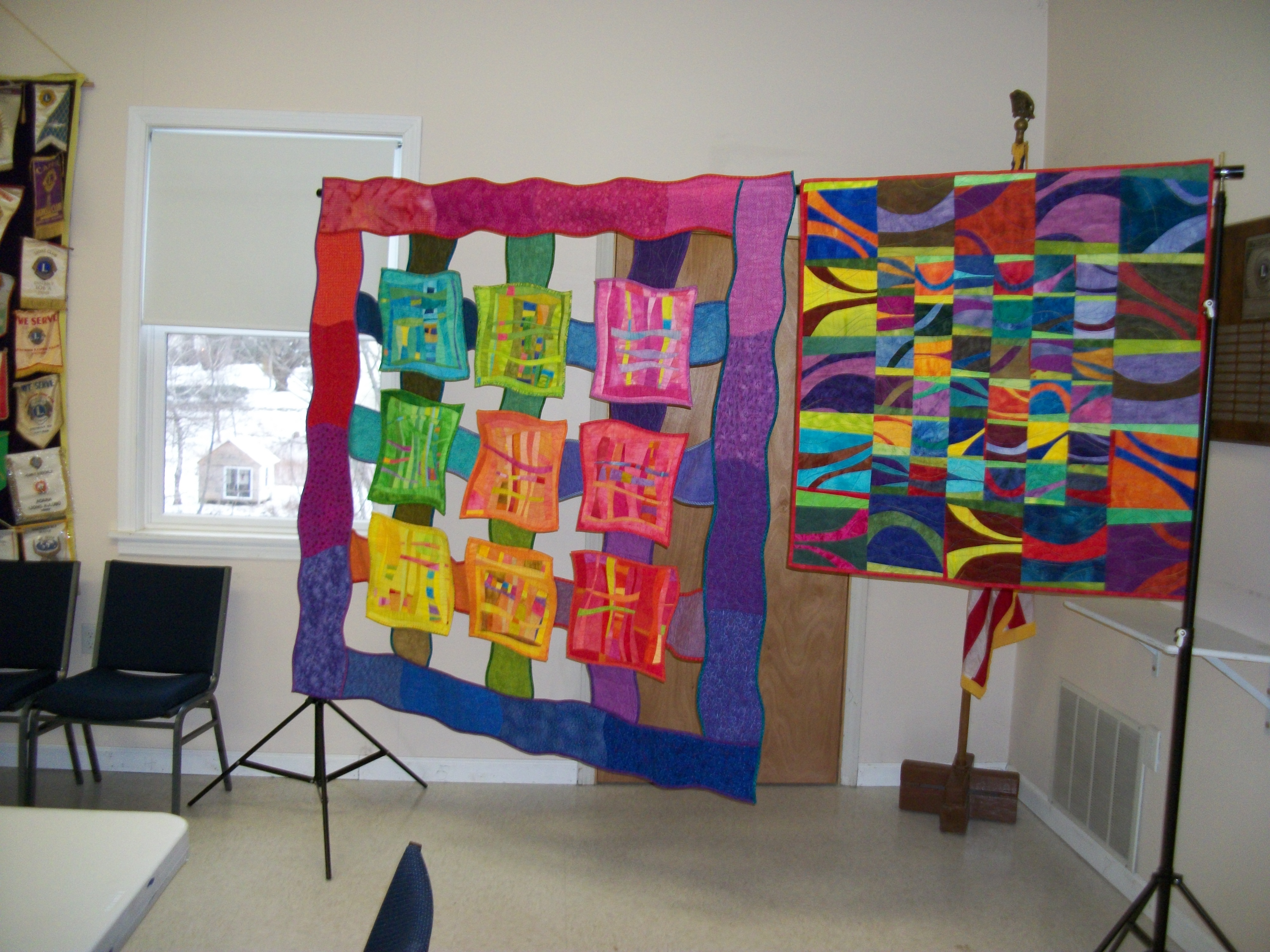
Here’s a picture of this quilt hanging beside a quilt that has hung in numerous major shows:

Dianne also showed us a work-in-progress quilt that will be a masterpiece, a large quilt that will make a huge statement in the world of quilting.  I hesitate to show the whole top or even parts of it as I’m superstitious and because I’m not sure she’s ready to reveal this work at this stage.  But, hold your breath because it’s an amazing, delightful, intricate, colorful quilt.  And, quite different from her other work.  Dianne says this quilt has been living in her head for about 14 years.

I fell in love with a border she developed in her first book,  QUILTERS’ PLAYTIME:  GAMES WITH FABRICS.   Here’s a picture:  it’s the black and white border to the left of the quilt:

But, my interest was still bubbling at the meeting.  It wasn’t until I went home that I realized I really wanted to learn how to do these kinds of odd borders.  So, I ordered QUILTERS’ PLAYTIME online.  I wish I’d bought it from Dianne! 

GO DIANNE!  Finish that masterpiece!

Turkey Tracks: Hominey Grill

Turkey Tracks:  December 15, 2010

Hominey Grill

If you are ever in Charleston, SC, do search out Hominey Grill, which is in the downtown area. 

I had the great good fortune of being taken there by Tara Derr Webb, who has already forgotten more about food than I will ever learn.  She grew up with our sons Mike and Bryan and fits, age wise, exactly between them.  Tara and her husband Leighton have only recently moved to Charleston.

Visiting Hominey Grill is just like it used to be when we all gathered at my grandparents’ dinner table in Reynolds, Georgia–a tiny town located south of the central part of the state.  It’s about 2 hours from Atlanta, and is an hour west of Macon.  Neighboring towns are Fort Valley, 12 miles across the Flint River and its swamp.  And, Butler, 8 miles to the west. 

Dinner was a large meal held in the middle of the day.  Supper was a much lighter meal held early evening.

When I grew up, Reynolds was surrounded by many small farms.  But, that all changed with the structural changes in farming over the past thirty years.  Most small farmers are gone now.  Georgia farming land is owned and farmed by big agribusinesses.

A summer day in Reynolds started with my Pop Pop coming through the side door with several large, flat baskets filled with vegetables and flowers from his garden out on the farm.  Pop Pop was a country doctor who also farmed.  He loved the land, and he loved to grow flowers and food.  The women would gather on the North Porch after breakfast and shell or snap whatever peas or beans had come into the house in Pop Pop’s baskets.  Grandmother would have already arranged the glads or zinnas and put them around the house.  Afterwards, we were free to pick blackberries for a cobbler to be served at dinner and/or go swimming in the pool the town fathers–Pop Pop among them–had built a few miles outside of town.  The pool had three wells of artesian water flowing into it all the time, and it was next to a creek that cut through the swamp.  When we got tired of swimming in crystal clear, very cold water, we’d fish in the creek.   Dinner was at noon, and we would be ravenous by the time it was served.

Eating at Hominey Grill brought all that back to me.

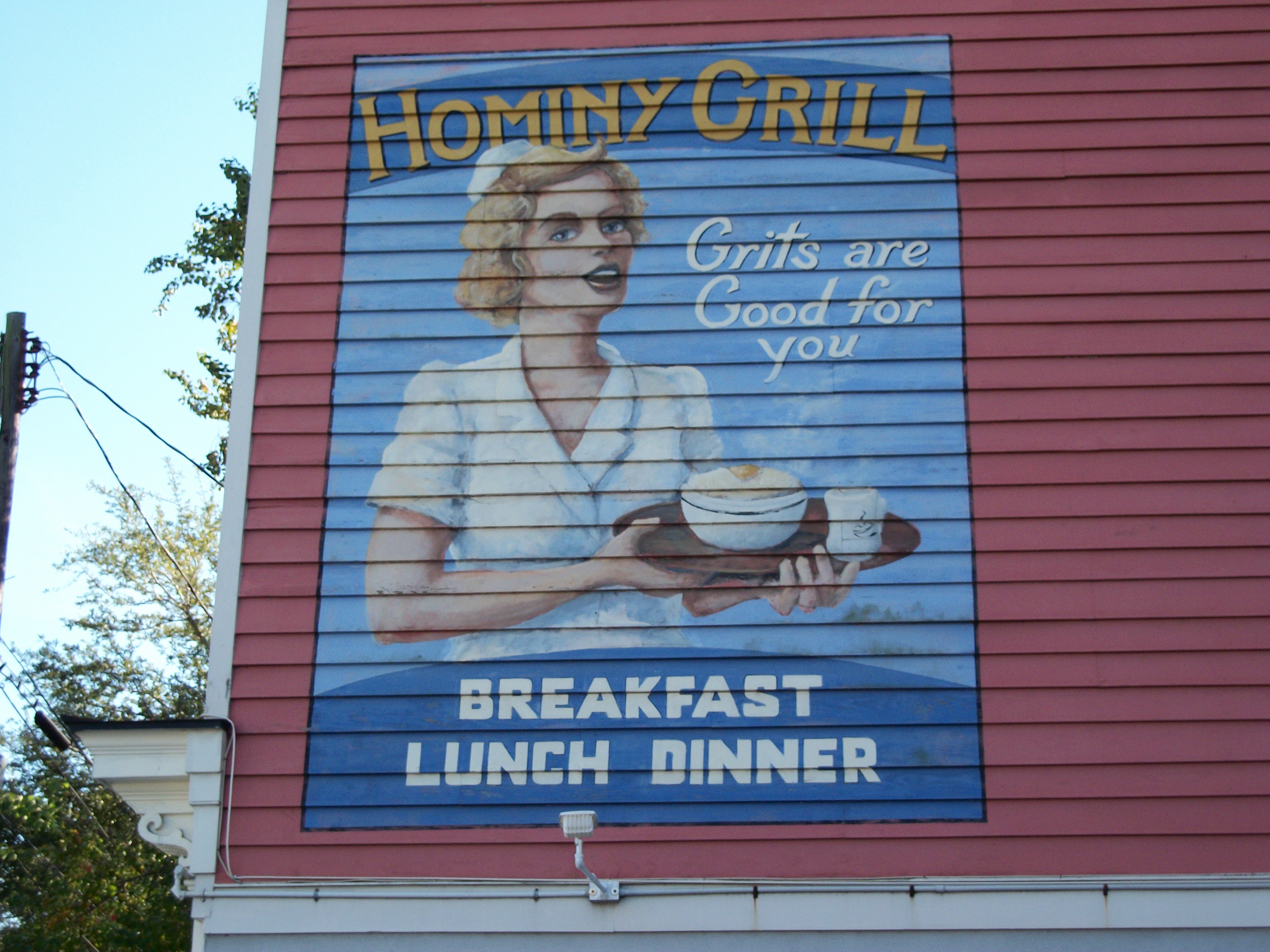
Here’s the first thing I saw when we drove into the parking lot:

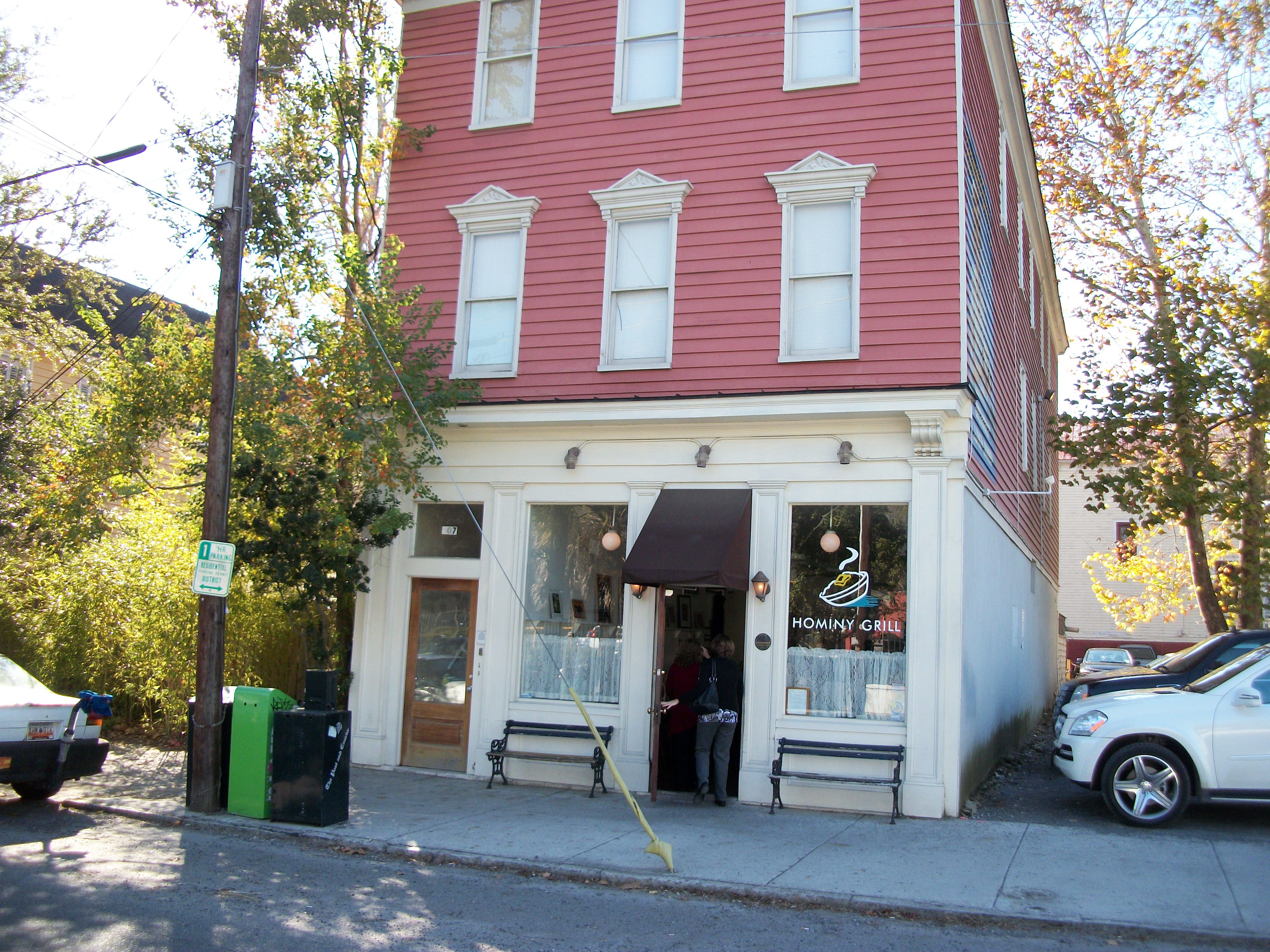
 Here’s a picture of the front of Hominey Grill”

Here’s one of three blackboards on the walls inside.  This one lists the day’s vegetable sides:

Oh my, it makes me hungry just to look at it.  And I recall again that many of the vegetables came to the table swimming in local butter or served, as with tomatoes, with a side of homemade mayonnaise.  Meat was part of a meal, but not in huge amounts.   I do not remember ever eating a green salad at my grandparents’ table.   But greens were plentiful–turnip greens, collard, mustard greens.  I do not remember kale.  Fruit was generally eaten at other times of the day–except for strawberries which we ate with heavy cream and sugar when they were in season.  Dessert was special, and, often, something like a cake was served in the late afternoon during the winter holiday season.  No one was sick, and no one was fat. 

Thank you Tara!!!!  And, thank you Mike and Tami for taking me back for a second time over Thanksgiving.

Turkey Tracks: Rosie’s Gift

Turkey Tracks:  December 15, 2010

Rosie’s Gift

Our monthly quilt meeting was Saturday, December 11th.  We have a potluck and Christmas party during our December meeting. 

I have, for some years now, volunteered to bring the December door prize.  I collect items for the Christmas door prize all year long.   And, people give me items to put into the box over the year as well.

Last February I made my annual trip to Virginia to be with my old quilting friends in Williamsburg.  We’ve been making this trip together for about 15 years now.  We spend a week in a timeshare that Rose Pilkerton organizes.  We catch up, quilt night and day, take turns cooking, and attend the Mid-Atlantic Quilting Show.  The week is full of sharing:   laughter, jokes, movies watched while quilting, and the work of quilting projects.  These friends help you “unsew” if you need to, sew on bindings, and lend you whatever you need.    

Rose Pilkerton gave me this treasure of a notebook holder she had made for the Coastal Quilters’ December door prize:

Here’s the inside:

She also gave me one for myself that used a red fabric featuring old sewing machines.  AND, a key chain made from the same fabric.  I carry them both everywhere, and I think of her everytime I use either of her gifts. 

Rose’s generosity-and Rose herself–are metaphors for what I love in my quilting friends, of what I aspire to be.

The Maine quilter who won the December gift box loved Rose’s contribution.

And I love Rose!

Mainely Tipping Points 21: Stevia: Is It Safe?

Mainely Tipping Points 21

Stevia:  Is it Safe? 

Stevia is a powerful sweetener, and is virtually calorie free.  But, is it safe for human consumption?  Safety may depend upon how the plant is used.

 Jim Earles in “Sugar-Free Blues:  Everything You Wanted to Know About Artificial Sweeteners” (2004) (www.westonprice.org/modern-foods/570-sugar-free-blues.html), notes that stevia rebaudiana is a member of the sunflower family and is a native of Paraguay where it has been used for centuries.  The leaves are about 30 times sweeter than sucrose, and the whole leaves contain many beneficial compounds.  Traditional societies used whole stevia leaves to sweeten teas and herbal medicines.   

  Beginning in the late 1970s and early 1980s, Earles continues, a number of United States companies began to use stevia leaves, including Celestial Seasonings, Lipton Tea Company, Traditional Medicinals, and a host of smaller firms like Sunrider International.  These firms utilized a provision in federal law allowing the food industry to make a “self-determination of Generally Recognized as Safe (GRAS) status for items with a long history of `common use in food’ prior to 1958, providing that it enjoyed widespread use without any apparent adverse health effects.”    

  In 1985, writes Earles, apparently prompted by protests from the NutraSweet Company, maker of aspartame, the U.S. Department of Agriculture forced Sunrider International to burn its supply of stevia, calling it “adulterated.”  The Food and Drug Administration (FDA) refused to even test stevia samples from Wisdom Natural Brands.  Earles reminds that NutraSweet’s newly acquired patent on aspartame was extremely lucrative and that no patent would be awarded to a naturally occurring substance.

 Next, Earles continues, the FDA targeted Celestial Seasons and refused to process that company’s petition to give stevia GRAS status.  And in 1991, the FDA banned the importation of stevia.  The FDA began raiding health food stores “suspected of selling stevia products” and ordering “the confiscation of books which refer to stevia’s potential use as a natural sweetener.”

 The Traditional Medicinals herbal-tea company, the American Herbal Products Association (AHPA), and the Lipton tea company all tried to present studies to the FDA to no avail.  The FDA “ignored their usual protocol and refused to even file the petitions for approval.”  Earles writes that this action “would have left the FDA in the position of having to publicly defend its actions, something which they were unwilling to do.”

Meanwhile, Earles continues, scientists discovered individual sweet compounds (called glycosides) within the plant, to include stevioside, steviobioside, rebaudiosides A, B, C, D, and E, and dulcoside.  These purified substances are between 50 to 450 times sweeter than sucrose.  But, these extracted substances no longer contain the many nutrients present in whole stevia leaves.   

 Earle relates that the Japanese, beginning in the early 1970s, “began to take a distinct stand against artificial sweeteners, especially aspartame, due to their possible health risks.”  They conducted “extensive tests on stevia and stevioside” and “accepted it as a safe alternative.”  By 2004, stevia had “reportedly captured over 50% of the Japanese sweetening market, even though the Japanese technically classify it as a food additive.”  Earle does acknowledge that FDA officials, occasionally, when pressed,  indicated that they were worried about two issues:  toxicity and a “possible adverse effect on fertility.”  Earle discounts these allegations because he cannot find studies that prove them.    

 In 1995, Earle relates, after efforts from many parties, the FDA revised their 1991 import alert and allowed stevia to be imported, but limited its use to a dietary supplement, which meant that stevia could not be used as a sweetener.  And, the FDA granted stevia GRAS status in late 2008, which allows stevia to be used as a no-calorie sweetener in foods and beverages.

 Why?  My guess is big industry saw stevia’s sweetener potential when their existing non-nutritive chemical brews were increasingly being questioned.  Both Pepsi and Coke immediately introduced zero or low-calorie beverages featuring the stevia   extract rebiana, a highly purified rebaudioside A.  Coke’s rebiana is called Truvia, and Pepsi’s is called OPureVia.  One of Coke’s stevia products is Sprite Green.  Pepsi introduced a grouping of stevia-flavored waters called SoBe Life.     

 At this point, the story, like the FDA’s stance on stevia, flips.  Apparently there are reasons to worry about stevia purified extracts and, maybe, the leaves.    

 The Glycemic Research Institute (GRI) delisted and banned stevia in 2008 because “various scientific commissions have determined that Stevia’s potential for toxicity renders it an inappropriate sweetener in humans” (www.glycemic.com/SteviaReport.htm).  The GRI cites a 2007 study published in “Food Chemistry Toxicology Journal” showing that stevia glycosides exhibit genotoxicity, which means the substance can affect the well-being of a cell’s genetic structure, causing the genetic material to mutate, or, be mutagenic.  The GRI cites a National Academy of Sciences concurring determination. 

 Further, the GRI notes that the European Commission’s Scientific Committee on Food issued an “Opinion on Stevioside as a Sweetener” in 1989 and 1999, which found that “stevioside extracts from Stevia rebaudiana leaves “ to be considered as toxicologically not acceptable” because existing tests have not followed “Good Laboratory Practice,” because tests for fertility and teratogenicity (fetal malformation) have not been done, and because questions about the metabolism of stevioside and the mutagenicity of metabolites remain. 

 The GRI determined also that “beverages that contain stevia and/or steviol glycosides do not qualify for the `Certified Natural Beverage’ mark.”

 The GRI report on stevia includes information from the Center for Science in the Public Interest (CPSI) and refers to a report by toxicologists at the University of California, Los Angeles (UCLA), showing stevia sweetener causes “mutagens and DNA damage, which raises the prospect that it causes cancer.”  Both CPSI and the UCLA experts wrote the FDA asking the agency to call for more independently conducted tests and noting that “the FDA’s guidelines advise testing prospective major new food additives on two rodent species, usually rats and mice.”  Rats have been tested, but not mice.  CPSI and the UCLA scientists recommended a lifetime study of mice in order to fully evaluate risks.  Current tests accepted by the FDA have been performed by Cargill, which owns Coke. 

 Additionally, CPSI’s statement on stevia safety notes that current tests on rats demonstrated the reduction of sperm production and an increase of cell proliferation in the testicles.  Tests on pregnant hamsters demonstrated fewer and smaller offspring.       

 The Mayo Clinic web site notes that stevia’s side effects are “generally mild”:  nausea and a feeling of fullness.  Mayo cautions that stevia is likely safe in moderate doses, but acknowledges that more research is needed and that until “we have more research, women who are pregnant or breast-feeding should probably avoid using stevia.”  Mayo further cautions that “people taking diabetes or blood pressure drugs should use stevia with caution because of the risk that it might cause hypoglycemia or hypotension when combined with these drugs” (www.mayoclinic.com/health/stevia).

 So, is Stevia safe?  We don’t know. 

I, personally don’t like the taste of stevia, which is a problem many people have.  If I did like it, I think I’d grow the plants, which are in most nurseries in the spring now, and harvest and dry the leaves for use in tea because of its nutrients.  That way I’d be using a whole food, which is how the plant is used traditionally.  In the end, I much prefer a local, nonheated honey in my tea for sweetening.      

 Beware the small sweetening packets of stevia.  That form is highly processed and adulterated with additives like maltodexterin, which is a highly processed carbohydrate, usually from corn, that raises insulin levels.  Often, maltodexterin is the first ingredient, which means you’re only getting a whiff of stevia.  Or, as with Stevita, xylitol is added as a “flowing agent”; yet, xylitol is a wood alcohol sugar, so I’m suspicious as to its inclusion.  Perhaps it’s there to improve the taste?

Turkey Tracks: Kelly’s Potholder Loops Rug

Turkey Tracks:  December 14, 2010

Kelly’s Potholder Loops Rug

Last summer, days before the Mike and Tami Enrights were to drive back to Charleston, Kelly (5 1/2) began asking me multiple times daily to learn to knit.  I promised him I would come prepared Thanksgiving.

How to teach a younger child to knit?

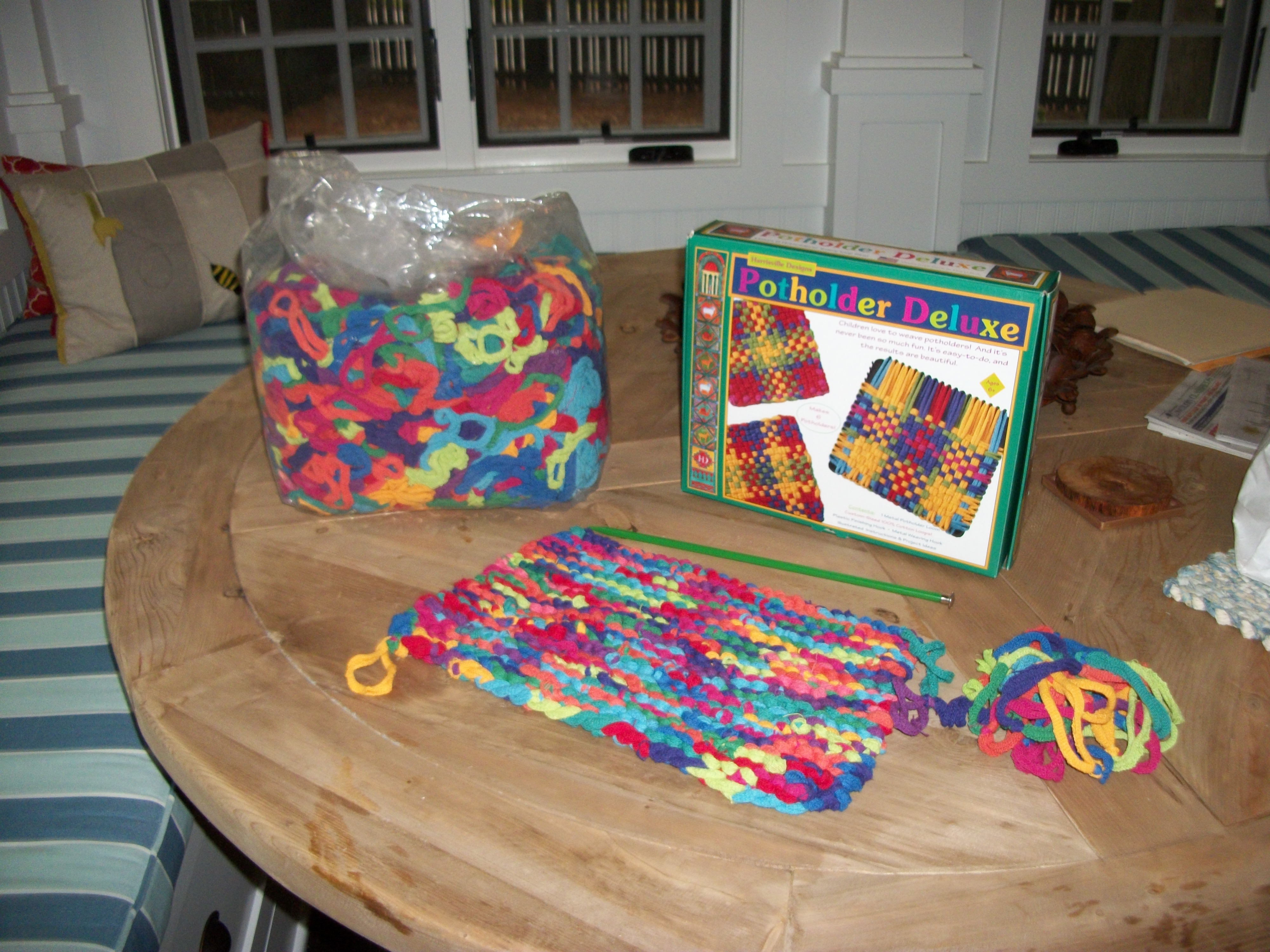
I fell back on Kay Gardiner and Ann Meador Shayne, MASON-DIXON KNITTING, for ideas.  They recommend a potholder loops rug.  Aha!  All the kiddos had gotten into making potholders while they were here last summer.  Gardiner/Shayne also recommend Harrisville Looms for high quality, beautifully colored, potholder loops.  (The loops we worked with over the summer were a nightmare–poly blends that stretched all out of shape, etc.)  I went online and ordered GOBS of loops and, because they looked really good,  two high-quality boxed potholder loom/loops sets for any kiddo who wanted to make potholders.  (They would make great teacher gifts.)  I had them shipped directly to Mike and Tami.  I was ready to keep my promise to Kelly.

The loops and looms were indeed very high quality.  I HIGHLY recommend them.  The loop colors are beautiful, and you can order isolated colors if you like.

Here is a picture of our beginnings:

Along the way, we made a HUGE ball of the potholder looops–and all the kids participated in that effort.

Kelly could knit, but required supervision to ensure he didn’t drop loops, or get the needle into the wrong part of a knitted loop, and so forth.  We both liked the closeness of this collaboration.  His attention span, though, was only good for 5 or 6 stitches at a sitting.  Nevertheless, he was amazed at how his efforts made his rug grow and grow.  It grew especially at night.  So when he waked in the morning, he checked it first thing.  He decided he wanted a LONG rug to take to school for naps, and we measured and measured each day until the rug grew to be as long as he was.

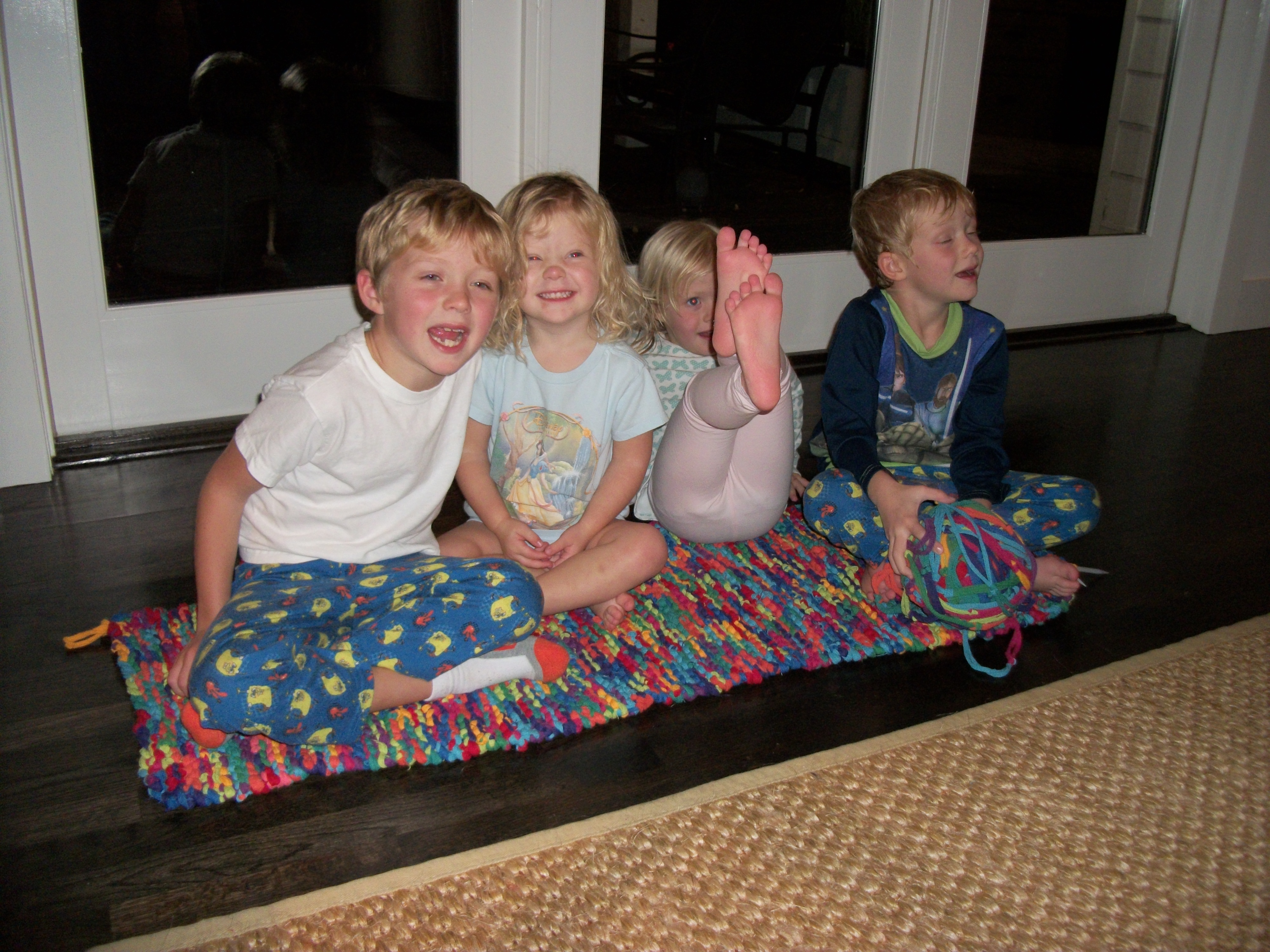
Here’s the finished rug with, left to right, Bowen, Wilhelmina, Talula, and Kellly.  It is VERY hard to get four active children to sit still.  Kelly has the remnants of the loop ball we made in his hand.

Note:  You  need either VERY long needles or a circular needle of at least 25 inches, and bigger would be better.  This project would make great placemats, especially if you ordered specific potholder loop colors.  You could make potholders to go along with placemats to keep drinks off of a nice table.

Meanwhile, the kiddos first cousin Ella Monahan made a potholder and took it home to Florida with her after the holidays.

And, Bowen, who is now 7, announced he’d really like to learn to knit as well.   Tami drove, and I got him some needles and some Peaches & Cream cotton thread to make himself a yellow scarf.  He could master knitting, though he worried himself to death that he wasn’t doing it right.  But, he was.  And, he’s the only person I have ever taught that grasped the left hand European style at once.  (It’s so much faster, but harder to master.)   Bowen’s attention span was good for about a 25-stitch row.   Thus, the scarf became a wash cloth as Bowen grasped the full appreciation of his task.  And, he asked me to take it home and finish it so he could give it to neighbor Leeola, who, in her late 80s, tragically fell in her front yard and broke a hip a few days after Thanksgiving.

Here’s Bo’s washcloth finished:

These Peaches & Cream wash/dish cloths wear like iron.  I use mine all the time, and some of mine are two or three years old now.  There is a famous, fancy-looking, but easy Peaches & Cream dish cloth pattern.  It’s featured in the MASON DIXON QUILTING book and is on many of the Peaches & Cream labels.

I remember crawling into my grandmother’s bed in Reynolds, Georgia, on winter mornings.  She’d be sitting up in bed, knitting.  I can still hear the clicking sounds of her needles as I snuggled down next to her.  She made us hats and gloves and scarves, and when they would arrive at our far-flung Air Force base homes, we’d feel her love for us.  She also made us beautiful dresses on a tredle sewing machine in her bedroom and boxed them up and sent them to us.  When a box came, we could hardly wait to open it.  At that time, materials were expensive, and bought clothes very expensive–especially on Air Force officer salaries.  Later, I learned to sew on her machine.  I tell this story because these influences stuck with me and appeared down the road of my life.  I hope they do with my grands.