Turkey Tracks: Winter Soup for Health

Turkey Tracks:  February 9, 2015

Winter Soup for Health

The snow has stopped!

And the sun is very weak in the cloudy sky, but one can feel its warmth and see the brightness.

I went out this morning and had no problems getting out to Hope to pick up chicken food, mealy worms (my chickens are ecstatically digging for them out in their coop and cage), and more black-oiled sunflower seeds.  (The turkeys are totally famished in this desert of snow.)

I don’t have to cook today because I cooked yesterday, so I will be able to get Bonnie Hunter’s mystery quilt on the long arm and to start quilting it.

I made a winter stand-by–a beef bone broth soup.  Look at the color and jellyness of this broth which I made earlier in the week.  Remember that I cooked this broth with the bones and added carrots, onion, garlic, a bit of celery, some salt, and a dollop (1/4 cup) of vinegar which helps leach the minerals out of the bones.  (If I had leftover wine, I would have used it.)


Beef Bone Broth
Beef Bone Broth

I removed the solid layer of fat (beef tallow) from the top of the cooled broth–it all came up in one round piece.  I rinsed it, warmed it in a pot, and poured it into a jar.  While I cooked, the tallow softly jelled, and I spread some on a piece of toast, salted it, and YUMMO, what a treat.  (It jells a creamy white, and I had some this morning too.)  People used to routinely save the fat drippings from a roast and spread them on toast for breakfast or lunch.  It’s delicious and good for you.  I will eat it and use it as an oil to sauté…whatever.

beef tallow
beef tallow

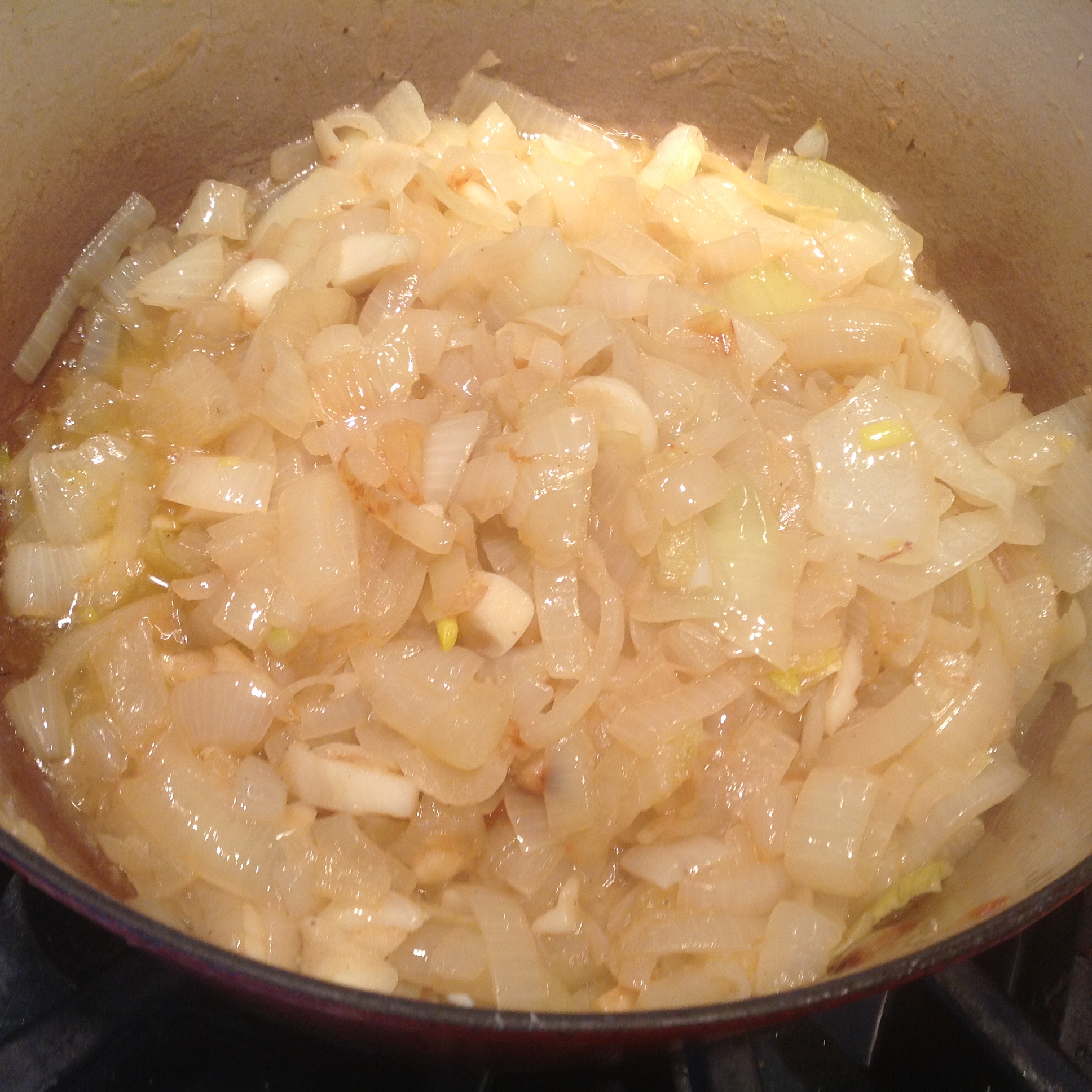
I have been yearning for a French onion soup, but decided to upgrade that a bit.  I started with 6 or so BIG onions–sautéing them SLOWLY in my enamel/iron pot in a mixture of coconut oil (UNREFINED–I get my oil from Wilderness Family Naturals) and raw butter.  I also added two whole garlic heads–after I smashed and roughly cut the cloves.  (Garlic is a GREAT immune system builder, and both onions and garlic contain sulfur, of which we all need more.)
sautéing onions
sautéing onions

I cooked these onions for about 40 minutes on low heat–until they were golden and the onions were starting to stick to the pan.  At the end you have to lower the heat and watch and stir often.  If they start to burn, add the broth immediately.

IMG_0559.JPG

After adding the broth, I threw in several handfuls of the kale I dried all last summer and stored in Mason jars:

dried kale
dried kale

Taste now to see if you need more salt.  I used a local salt dried in Maine in hoop houses–it comes in different coarseness.  This one was fine.  I keep different kinds of good sea salt–some are coarse, some are flaky, some are lovely colors of pink or are grey and moist–depending from where they have come.

IMG_0558.JPG


I wanted a bit of thickening, so I added two handfuls of short-grain organic rice.  (My pot was rather large so this isn’t too much rice–it will swell to about 2 cups when cooked.)

IMG_0563

I let the broth with the rice simmer slowly for about 30 minutes to cook the rice, then turned it off and let it sit UNCOVERED on the stove.  It’s not going to spoil in the few hours before I ready to eat dinner.  If you cover it, that’s trouble as the trapped heat can grow bacteria.

Meanwhile, I made a meatball mixture using the defrosted grass-fed hamburger I keep in my freezer.

I added two of my eggs to one pound of hamburger:

IMG_0557.JPG

I grated a carrot into the mixture.  Look at these pretty rainbow carrots.  They are so sweet.

IMG_0556.JPG


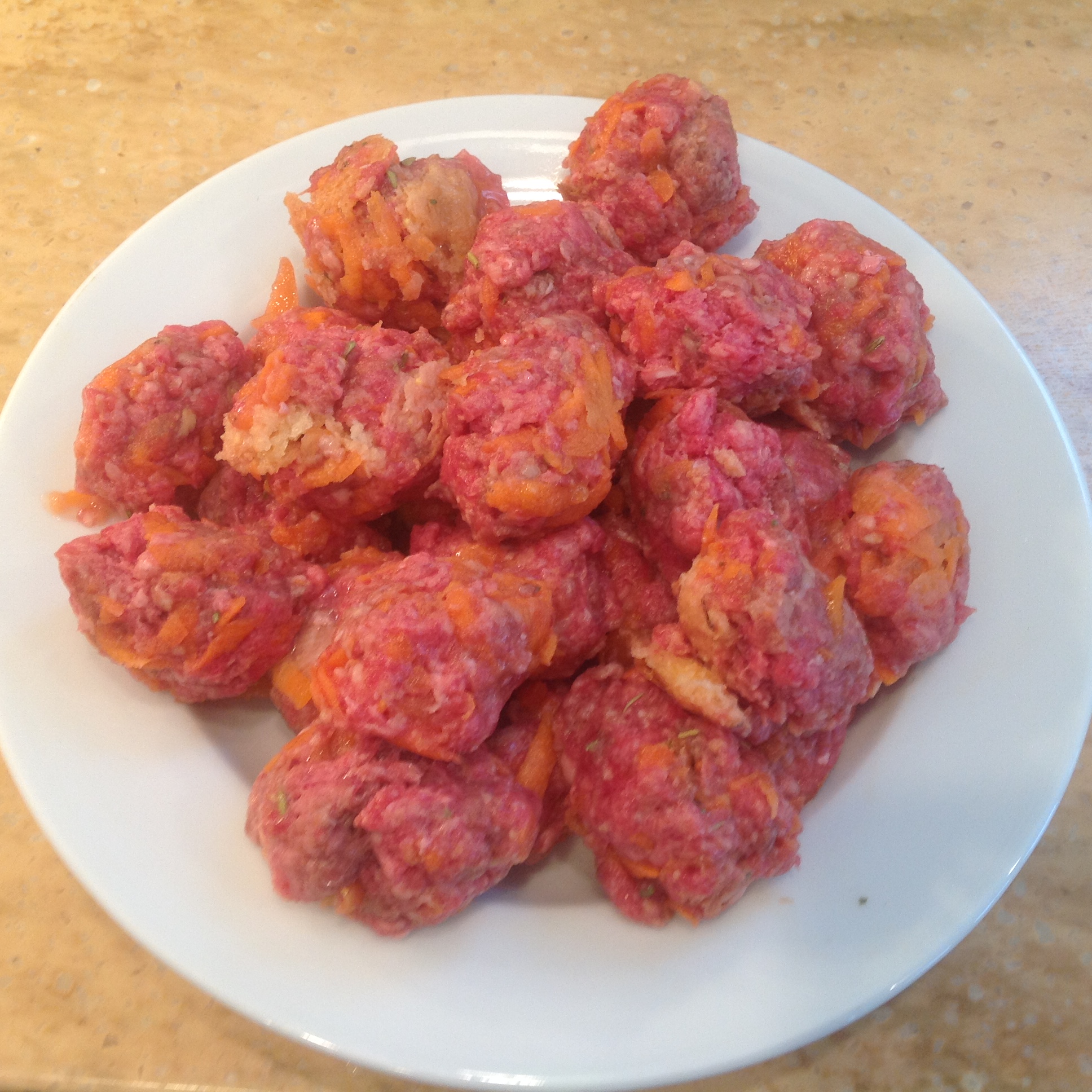
I tore up some of the gluten-free bread heels I had leftover, added some salt, added some Penzy’s herbal spice (a Provencal mix I keep on hand), and made meatballs.

IMG_0560.JPG


IMG_0562

I put the meatballs in the refrigerator–not even bothering to cover them–until I was ready to reheat the soup gently.  The meatballs cook in the hot simmering broth in about five minutes.  Don’t boil them please.  They float to the top when done.

I grated some raw milk Swiss cheese and put it in the bottom of my soup bowl, where the hot soup melted it.  I could also have used a cheddar or somesuch and added it to the meatballs instead of in the bottom of the bowl.  But I wanted the French Onion Soup feel of the cheese melted into the soup.

IMG_0565

It was a delicious dinner–eaten with a few crunchy organic, GMO-free tortilla chips.

The broth just screams healthy, healthy, healthy, and it goes down so, so easily.

You cannot, cannot, cannot get the taste and health of this soup using a boxed or canned broth.

And today I don’t have to cook!

Tonight I will add some of the lacto-fermented sauerkraut on the top of the soup as a condiment, which will add some lovely probiotics and enzymes for digestion.
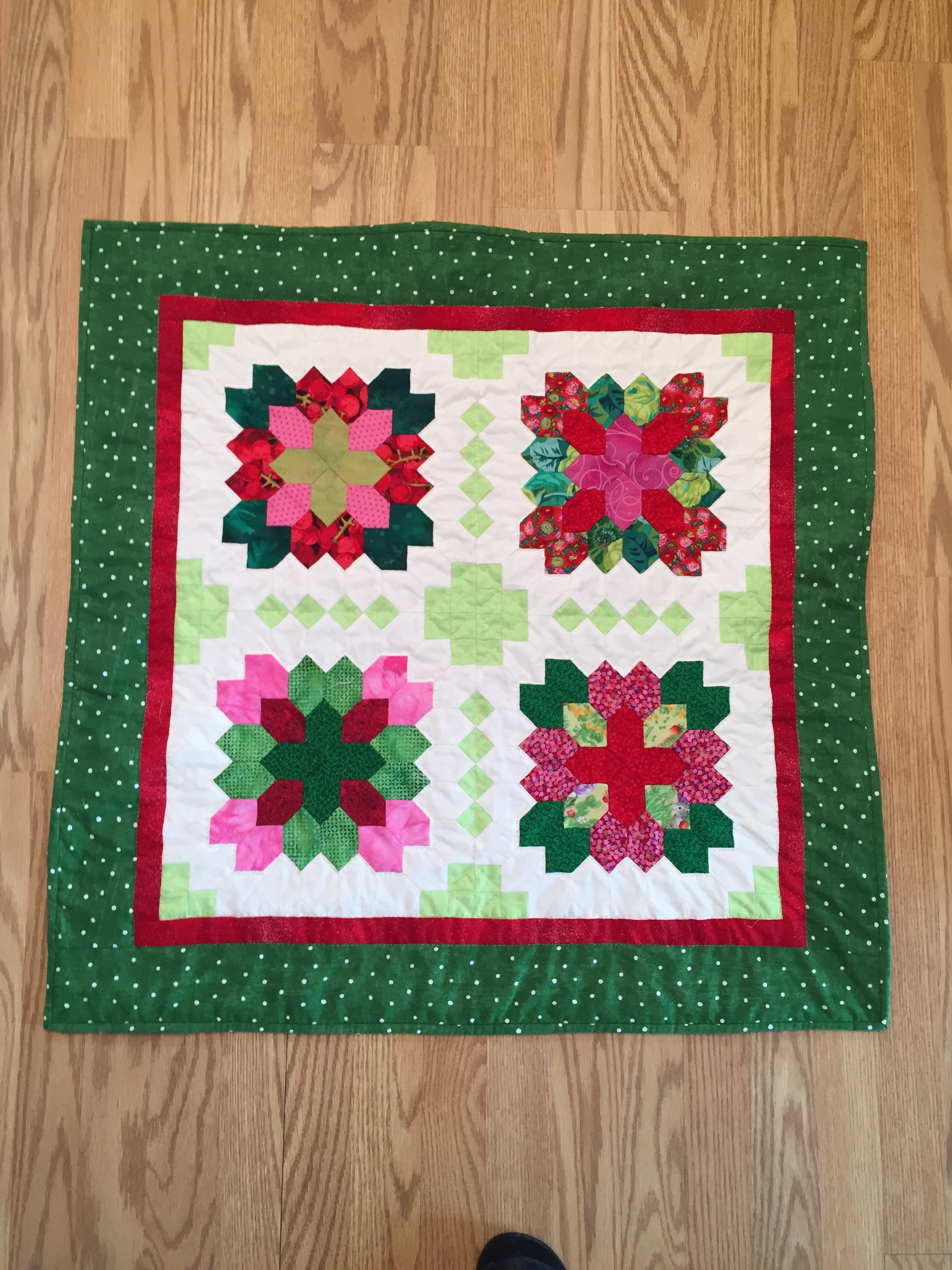
 

Turkey Tracks: “Lucy Boston Quilt: Red and Green”

Turkey Tracks:  February 8, 2015

Lucy Boston Quilt:  Red and Green


About six months or more ago, I became fascinated with the Lucy Boston quilt block–made with paper piecing.   I saw these blocks at Alewives quilting store in Damariscotta Mills, Maine.  Rhea Butler and some of her staff were playing around with these blocks.  And theirs look much more like Lucy Boston’s eclectic fabric choices–see below.

I thought I’d just experiment and that I’d try to do opposites on the color wheel, like red and green.  Maybe I’d even make several small quilts playing with opposites on the color wheel, like purple/yellow and blue/orange.

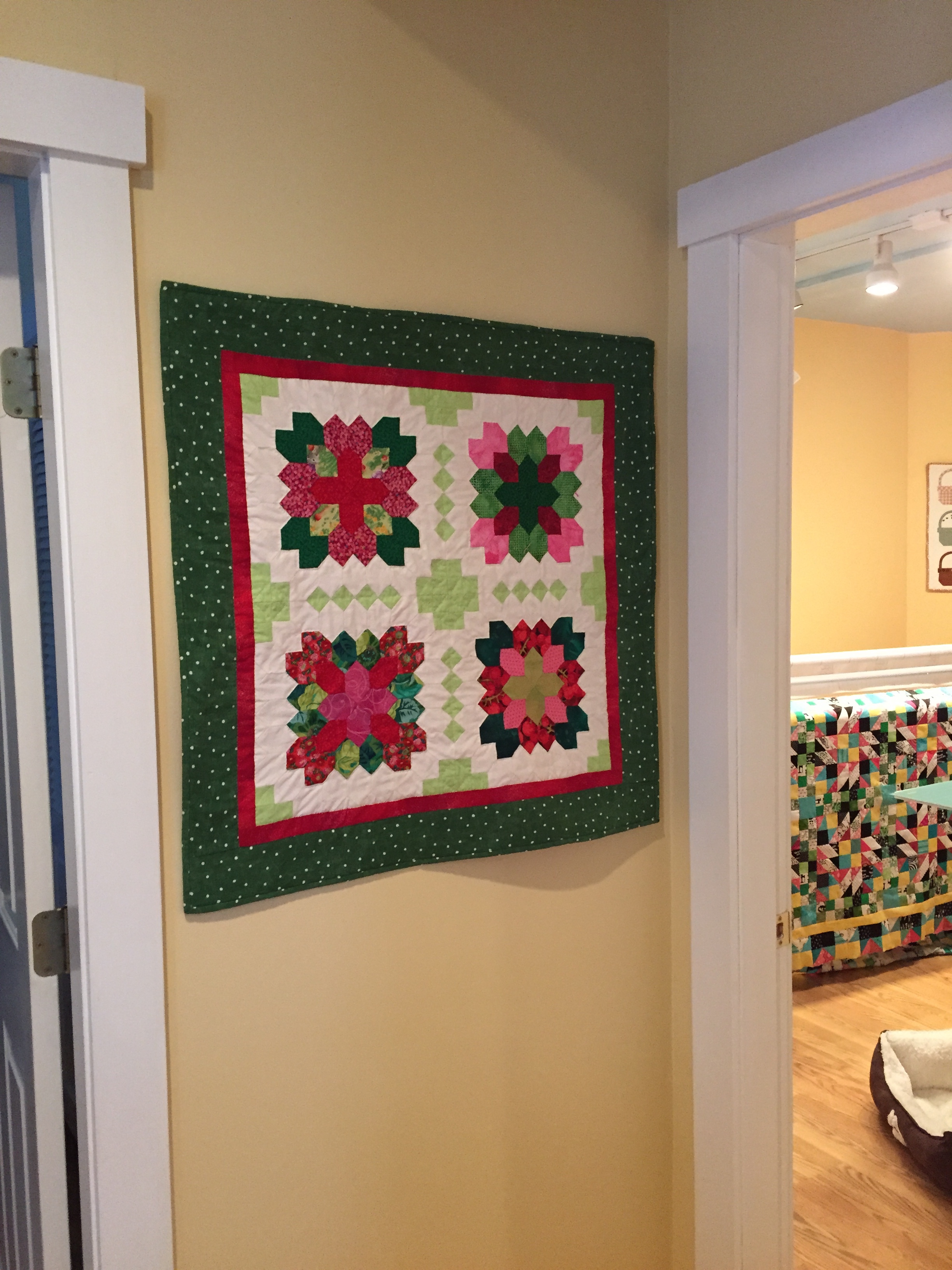
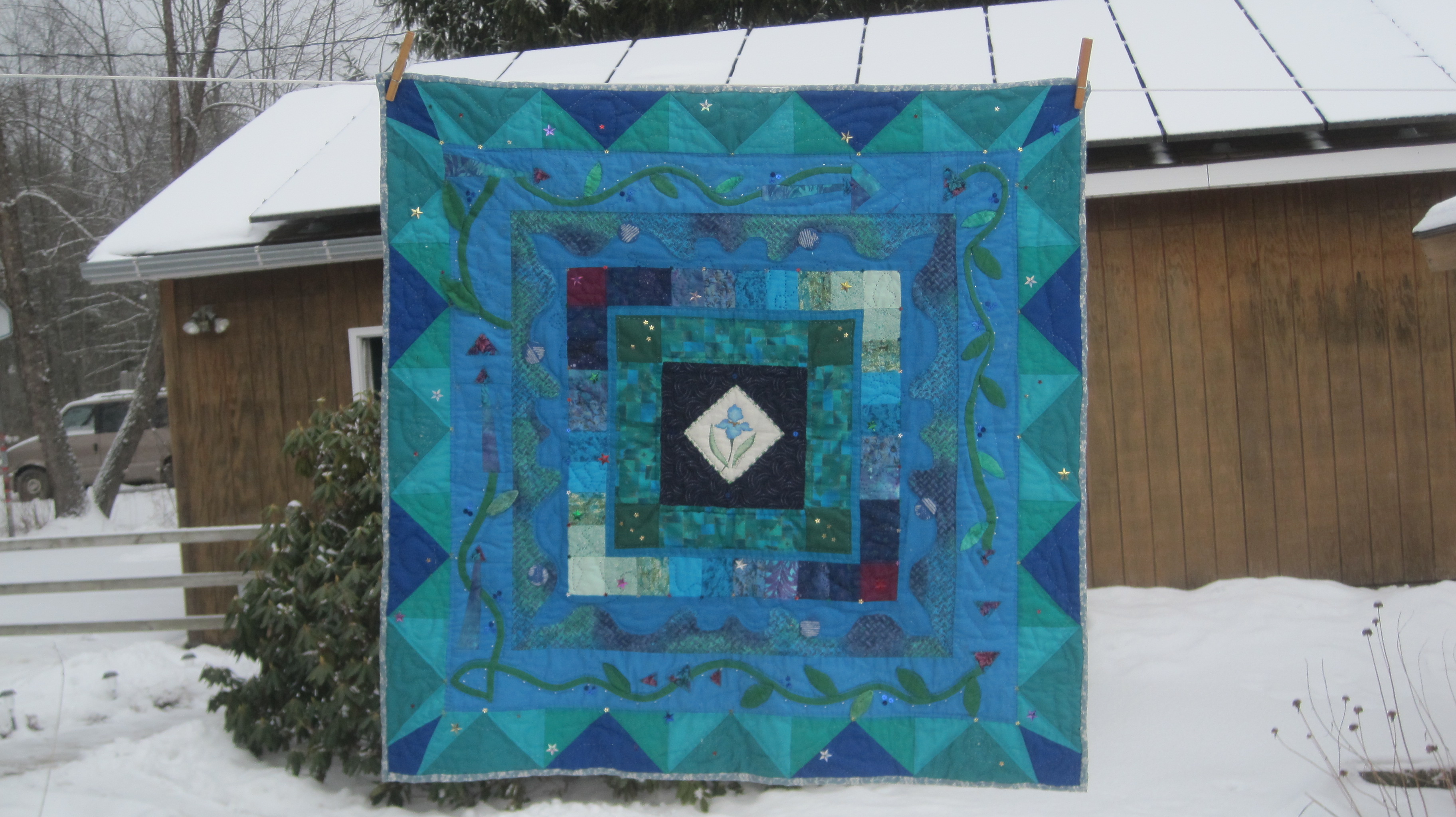
I wound up doing four blocks–which turned out being larger than I had thought once surrounded with the outlying neutral pieces.  This quilt finishes at 33 inches square.

IMG_0127


This quilt also did not turn out to be square–even with the paper piecing–due to the bias edges on the pieces needed to make a straight edge.

Here’s a close-up of the blocks–which are very fun to do:

IMG_0129


And, closer still of the joining blocks–which I kept very plain:

IMG_0128

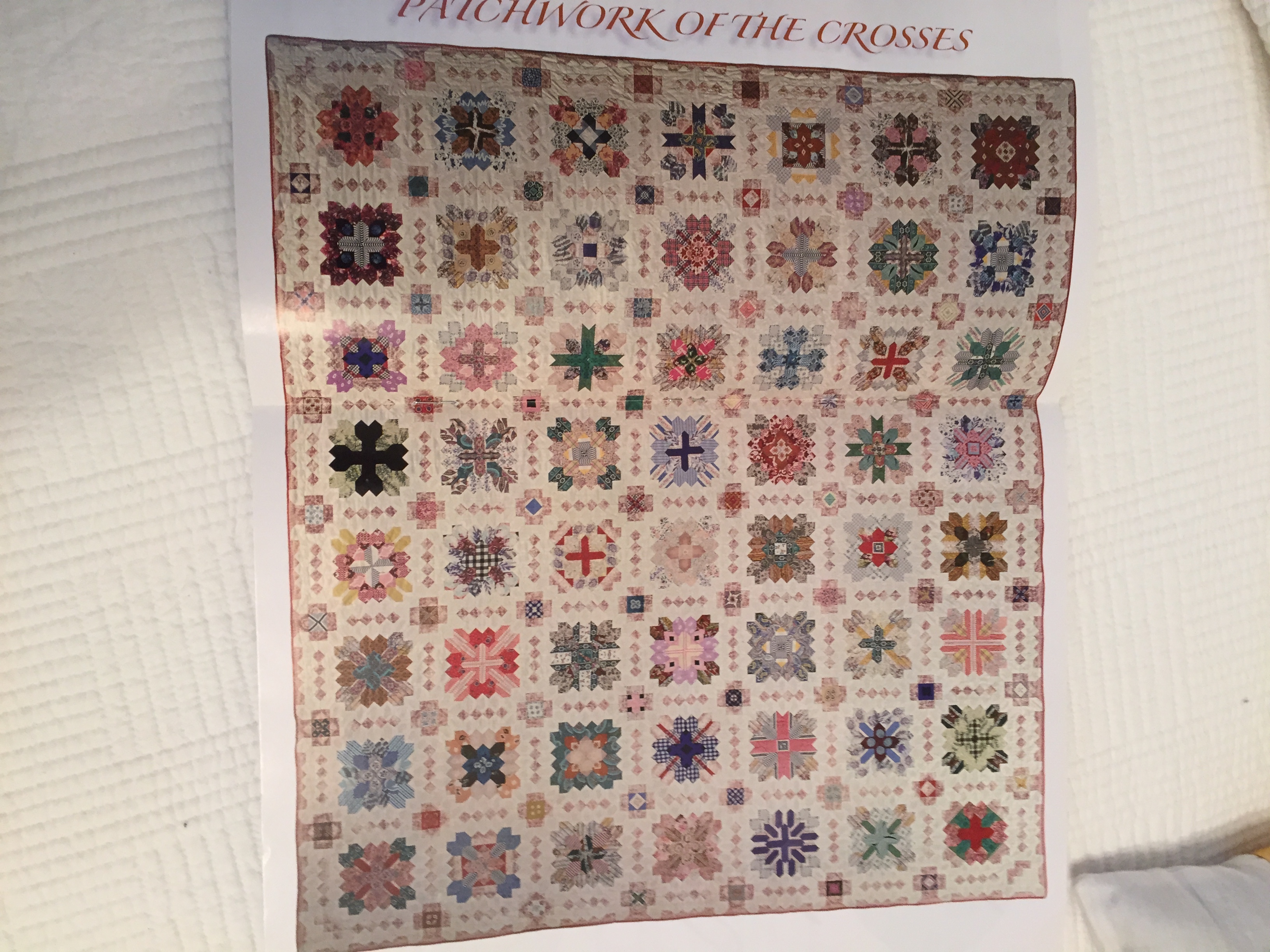
Lucy Boston herself made a coverlet–with elaborately fussy cut pieces of fabric–and the amazing coverlet is captured by Linda Franz in her book LUCY BOSTON:  PATCHWORK OF THE CROSSES.  Lucy Boston lived in England and made these blocks in the 1950s.

IMG_0130


Here are more pics of this amazing quilt–from the book:

IMG_0131


IMG_0132

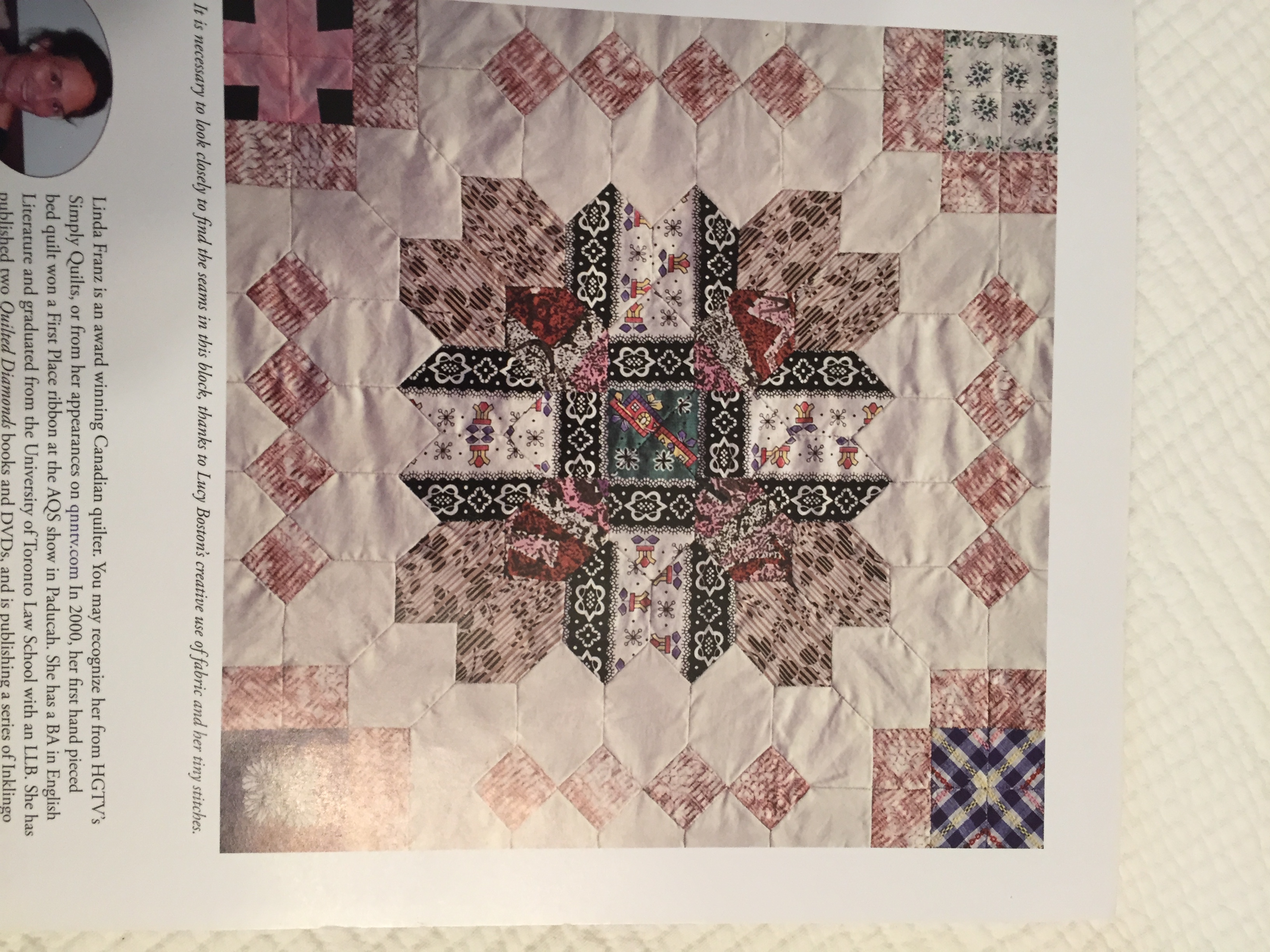
And a close-up of one block to give you some idea of the complexity Lucy Boston manages–look also at her cornerstones around each block:

IMG_0133

So, I learned a few things about this kind of project.  Cut the edge paper pieces on a STRAIGHT EDGE.  And stay stitch them with the sewing machine.

I had a terrible time trying to decide how to quilt this project–and opted for some rudimentary quilting that used pearl cotton in straight lines and handquilting that just outlined the blocks.  But, handquilting was really, really hard with the thickness of the seams.  Since I had done all this handwork, I was not especially wanting to use the machine to quilt.  BUT, I think I would now if doing this kind of project again.  I don’t know, maybe Lucy Boston had the right idea with just making a coverlet–where she stitched around the edges, right sides facing, and turned the coverlet and…ironed flat???   I didn’t want to tie this quilt as I thought that would look messy.  But, maybe just in the center of the cornerstones???  And with a very neutral pearl cotton???

Linda Franz does have alternative sewing methods–including stitching the blocks all on a domestic machine.

And Leah Day has a video on her web site showing an alternative way to paper piece that is different than whip stitching.  I linked to this video in an earlier post on paper piecing.  Search for Leah Day, and you will find it.  Or just go to Day’s site and search for hexies and sewing…

These blocks are really fun to make–and I find myself wondering how they would look butted up to each other without the surrounding neutral layers.

Hmmmm.

Meanwhile, this quilt wanted to be outside my quilt room:

IMG_0136

And daughter-in-law Tami’s quilt that used to occupy this spot has been moved to a place of honor in the main room on this floor.

Turkey Tracks: I Broke Down and Bought One

Turkey Tracks:  February 8, 2015

I Broke Down and Bought One

A crock pot, that is…

With a crockery liner…

…and I have no idea if this crock pot liner has lead or will leak lead or not…

IMG_0561

WHY?  Did I do it…

Because I had another near miss with leaving the bone broth soup pot on low while I forgot it and left the house for several hours…

I got home about 10 minutes before the water level would have dropped to burning everything up…

Which would have meant…

Smoke…

Mayhem…

A mess…

Stupid!!!

One of the worst feelings ever is driving home after several hours and remembering, remembering, remembering that you did not turn off the low flame under the bone broth soup pot.

Now, I keep a bone broth soup in the refrigerator almost all the time, especially in winter.

It takes a good 24 hours to leach all the minerals out of the bones, so it’s actually not all that hard–especially if there are multiple things going on–to…forget it…

So, I’ll risk the lead and save the house.

You can see this big pot (it holds EIGHT QUARTS) is perking right along with a bone broth.  This one has a chicken carcass and all the roasted veggies from the chicken, a lamb leg bone, and the lamb rib bones from the lamb I got this year.

Bone broths are incredibly medicinal, especially in the winter.

Turkey Tracks and My Essays: Why I Love Winter In Maine

Turkey Tracks and My Essays:  February 5, 2015

Why I Love Winter in Maine


It snowed all night again and is still snowing now.

The paths dug through the snow from four storms in ten days are now running like mazes through what is, in places, shoulder high snow banks.  The untouched snow is well over knee deep up here on Howe Hill, and in places where it has drifted, much deeper.

I just came in from a trip to the garage and down the driveway to the mailbox.  This new snow comes to the tops of my black boots–or about 10 inches or so.  The end of the driveway was knee-deep with plowed snow.  I waded through it gingerly, feeling for a solid bottom as I went.  (Falling over into snow is no fun:  it is very difficult to get back up as there is no way to get traction to get up again.  You can’t just push down on the snow bank to push yourself up as your arms go in too.)  My mailbox door was open, and it was, again, filled with mail and snow–which is why I knew I needed to get down there.  I cleaned it out and banged it shut again.  The mailbox is almost covered by the plow’s snowbanks–only the top sticks out now.  I put a reflective marker in front of it to alert the plow guys, and retraced my steps up the hill.  Last winter that mailbox got hit and was in pieces in the road.

My writers’ meeting cancelled for this afternoon.  It’s a moot point for me as there is no way I’m going anywhere with four feet of snow at the end of the driveway.  And, truth to tell, I’m enjoying this quiet, sweet day of falling snow and cancelled events.  After lunch (I made lamb liver pate, which I’ll have with toast, cherry tomatoes, and dilled lacto-fermented pickles), I’ll sew and listen to the P. D James mystery I’ve almost finished.

In the garage, I filled two buckets:  one with chicken feed (they eat so much in the cold, and temps will drop again to single digits and below tonight) and one with bounty from my freezers.  The food I put up all summer is being eaten now–orange pumpkin roasted and  frozen, red tomatoes frozen whole, greens of all kinds (beans, kale, parsley, zucchini)–all laced with grass fed beef and lamb and truly free-range chickens.  The garage refrigerator freezer is packed with fruit from my garden (strawberries and raspberries) and from Hope’s Edge CSA (which finds organic blueberries for members).  And every day now, I am getting three to five fresh, soy-free eggs.  I have all sorts of lacto-fermented foods that glow red, orange, and green in my kitchen refrigerator and provide crunch and a sense of freshness.  And I get fresh Milk House raw milk and yogurt from friend Rose each Wednesday.  I am so blessed, and it’s so great to enjoy the fruits of one’s summer labor.

So, when people from away ask me why I stay in Maine in the winter, or why I  keep chickens that have to be cared for–whatever the weather–first thing in the morning, sometimes at midday, and at night when they roost and need to be locked into their safe little coop, I’m never quite sure where to start with explanations.

You know, sometimes it’s hard to deal with all the snow, the cold, and the chickens.  In the blizzard, it was hard to keep the back door and the path over the deck to the steps clear.  It has to be kept clear so I could get out that door to go to the chickens.  And, the chickens are especially hard to get to in the deep snow I have to negotiate before my terrific guys who shovel me out come.  The chicken coop has been “snowed in” several times now in the past ten days, and it has to be cleared.

But, I never feel more alive than when I successfully solve a winter problem–like getting the mail and protecting the mailbox (hopefully) and getting to the chickens.

These trips “wake me up” in so many beautiful ways.

They get my blood flowing strong and true.

They put me squarely into nature–which can bite (snow in my boots, bitter cold, blowing wind), but which can also provide such incredible beauty.

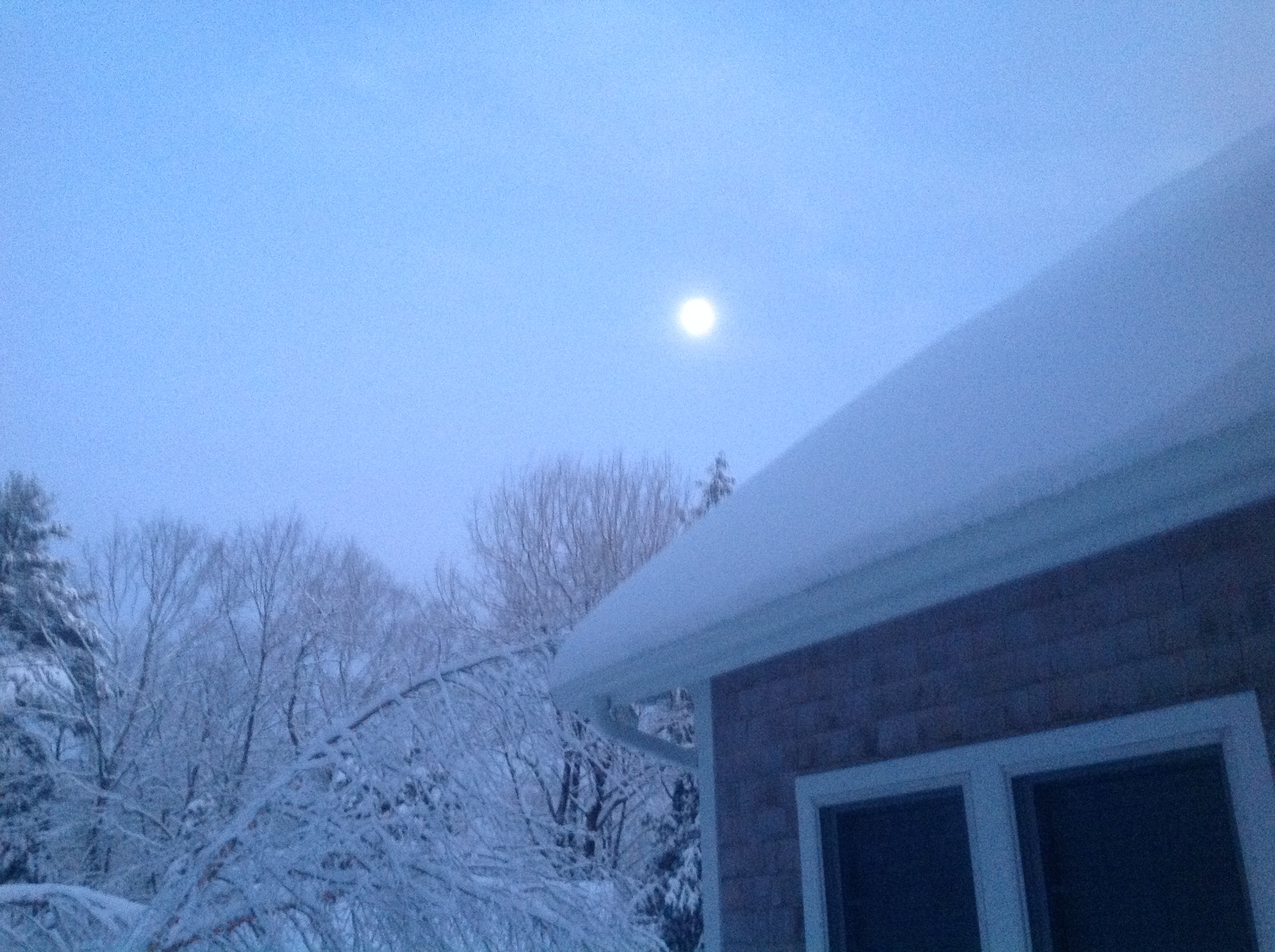
Look at what I saw coming in from locking up the chickens at dusk the other day.  The soft blue of dusk and the rising moon were so beautiful.

IMG_0547


It’s hard to describe or even take a good picture of the sunsets–where, often, the real show is not in the west, but in the backlighting of the east:

IMG_0125

Today, everything outside is coated with snow–so the trees and shrubs look like they have been coated with spun sugar:

IMG_0134

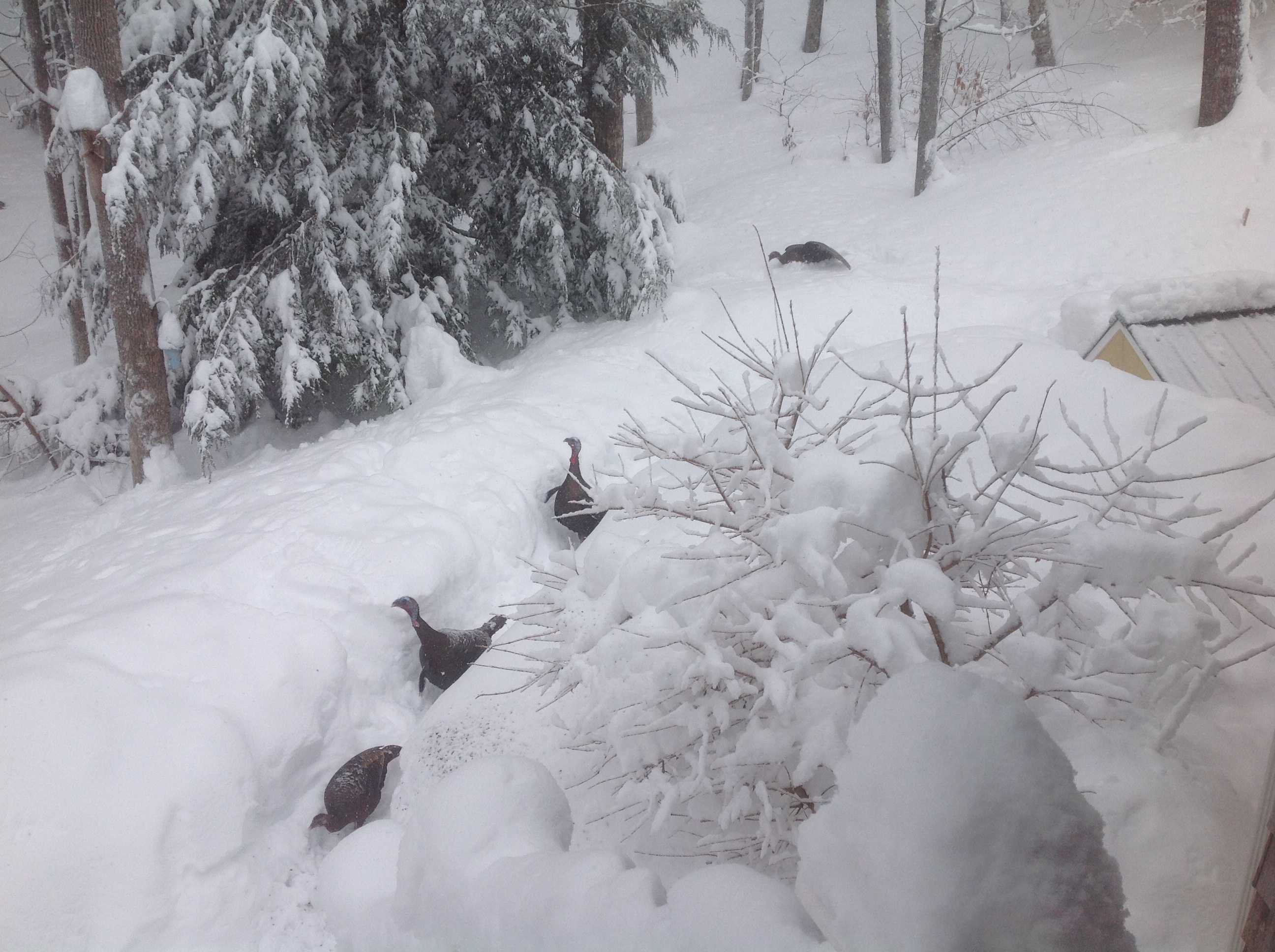
The snow is so deep that the turkeys have to fly everywhere–which takes so much energy for them.

They came late morning looking for a handout of sunflower seeds.  One–at the top of this picture–got stuck in the snow, and I watched him struggle until he was able to get under the pine tree.

IMG_0550

A bunch of the turkeys are sheltering under that big pine now as I write.  They must be so hungry today.

The little turkey hens fly up to the upper porch and look for billed-out sunflower seeds on the porch.  They fly to nearby trees when I come out.

I’ve never seen so much snow at once.  Not even in my years in Bellevue, Nebraska (outside Omaha).  I guess that in itself is kind of exciting.

It’s unclear to me what the weather will be like on Saturday.  The weather folks seem to be waiting to see what two large storms headed our way are going to do when they collide and merge.  It could mean more snow.  A lot of more snow.  But there is no use worrying until things are clearer.

Meanwhile, I had a lovely day yesterday:  Linda was here in the morning and visited as well as cleaned, lunch and a Zoot’s coffee with friend Giovanna, and a lovely meeting of the monthly knitting club at Eleanor’s.

I am happy to stay mostly inside today.

I have to go feed the chickens now…

My Essays: Alone

My Essays:  February 5, 2015

Note:  I am starting a new category on this blog:  “My Essays”

I am going to try to write at least one a month–maybe sometimes more if the writing muse strikes…


January 2015

Alone

The other day I drove up my steep drive in Maine and paused in front of the garage door.  I wanted to sit quietly for one brief moment to enjoy and reflect on the profound sense of pleasure I was feeling. 

Tom Jackson had solved the problem with the overflowing well that was pouring water over the driveway and making a death-trap sheet of slick ice between the garage and the house.  PDQ Doors had just fixed the problems with the automatic garage doors, problems friend Gina Caceci and I couldn’t sort out with her on a ladder with a Phillips Head screwdriver and with me holding the ladder, her leg, and a spare light bulb.  And Stephen Pennoyer had been at my house for nearly two weeks fixing EVERYTHING inside that needed repairing, painting, or upgrading. 

I don’t think I’ve ever lived in a house where everything inside was in tip-top order all at the same time.  I smiled to myself, reached for the garage door opener, and…nothing.  The gods of chance and mayhem had struck anew.

Since January of 2013, when my husband John died, I have been alone and have carried the responsibility for myself, for my home, and for all my actions and decisions.  I have spent these past two years either learning to do all the things that my husband John used to do, or, in finding who can help me do what I cannot.  At times this learning curve has been quite steep. 

Of course I am not totally alone.  I have a warm and loving family, though they live in Charleston, South Carolina.  I have a sister who calls frequently from Virginia Beach, Virginia, and fusses at me for not carrying my cell phone every time I go outside to take care of my chickens.  (Suppose you fall out there?)  I have a sister-in-law and Enright cousins who come to see me from Boston.  I have wonderful neighbors who help me with emergencies—like the time last winter when Chris Richmond and his son Carleton helped me bail out a flooding garage.  And I have a lot of local and faraway friends whom I enjoy and who spoil me to death.

At some level, I find myself wondering, are we not always “alone,” even if we are married?  Are we not all single souls who traverse our lives with differing amounts of connection along the way?  Being married does not always mean that all responsibilities get shared.  Most marriages, I think, divide up responsibilities.  I didn’t help John with repairs or keep our financial books once our sons entered college, and he did not help me shop, cook, garden, or organize the dailyness of our lives. 

Perhaps the relationships and responsibilities within a marriage and the subsequent loss of it all contains lessons for us to learn in this life.  Perhaps these lessons are part of our work here on earth.  It interests me that I am now learning the parts of what John knew, while he never got to learn what I know. 

I have never lived on my own until now.  I married at twenty-one, so went from my father’s house to marriage and our first apartment.  And though I worked for many years at various jobs outside the home, I have never been totally financially responsible for myself.  Predictably, my new situation has been scary, but also exhilarating. 

I have mostly faced and conquered my worst fears.  Our joint hard work of thirty-eight years produced savings that buttress my present life—so long as the stock market does not crash utterly and our banks don’t disappear into a dark night—fears about which I’ve accepted I cannot do anything whatsoever.  My health is good, and if it goes south, I can go there too to be with my family.  Or, not, for I do love where I live with all my heart and soul.  I no longer wake often in the night wondering if I have heard a strange noise or if I smell smoke or if I have left on the oven or iron.

I have set some safety rules.  After a bad fall a few days after John died, I determined that I would not get out of bed without turning on the light first.  I think it’s wise not to put any pot or pan on the stove unless I am inside the house.  (Suppose I fall outside or get distracted?)  I concentrate on the stairs or on the winter ice.  I am careful in restaurants as I have food allergies that can cause me to pass out.  And I am careful with the cord on the electric mower and with the propped-up lid of the chicken coop. 

I have learned who my real friends are.  Actually, some of these lessons have been surprising.  People have disappeared who cannot make the switch from wanting to be with “the Enrights” to wanting to spend some time with just me.  Some of these losses have been painful, but not overwhelmingly so as I have realized that this change is common to widowhood.  And I will confess that I have let go of some people, too.  I am finding that I deeply treasure the peace of my days and have less patience with the cruelty of others.  I am finding, too, that doors open even as others shut.            

There are many joys to being alone.  I can call an electrician, a plumber, a carpenter, a painter, or a gardener whenever I want to without having a pitched marital battle about “doing it yourself” or “emasculating your husband.”  I can change anything I want to around the house without the need of coming to consensus.  I can read in the middle of the night in my own bed if I wake and want to do so.  I can cook and eat what I want when I want.  And I am learning to travel by myself and to plan treats for myself when others cannot join me. 

This winter, I have been thinking that I have spent much of my life nurturing others in my kinship network and in the greater community.  As wife, mother, daughter, sister, aunt, niece, granddaughter, grandmother, friend, neighbor, and so forth, a chunk of my time has been spent thinking about or doing for others.  Suddenly, it seems ok to concentrate on being more nurturing to myself, to further learn who I am on my own outside the responsibilities of those relationships—especially as I never had the early learning of being alone and on my own. 

I am not discarding these kinship and communal relationships.  But in the stark clearness of both my aloneness and my age (seventy in March), I am deciding to examine where I think I have a relational responsibility a bit more closely.  Is help really needed, or do I need to be helpful to try to create meaning in my life?  The latter case is not always a healthy place to be.

I hoped, as I examined the garage door opener, that it just needed a new battery.  When John was alive, I would have taken it to him and waited for a solution to the problem.  Now, I hoped that Radio Shack in Rockland carried the tiny little battery that emerged from the opener.  And, a day later, when I got home from Rockland and the opener still did not work,   I took out the battery the young man had installed, turned it around, and put it back.  Voila!  The door shuddered open, the light came on, and once again, everything inside my house and garage was in tip-top shape.

As was I.

Blog Readers’ Quilts: Judith Brill’s Quilts

Blog Reader’s Quilts:  February 4, 2015

Judith Brill’s Quilts

Judith lives in New York.

We met on my blog, and we chat back and forth on email.

Judith sent me these pictures of two quilts she will be hanging in a quilt show in Cooperstown, NY.

The are so pretty…

I thought you’d enjoy seeing them:


IMG_7993


IMG_7991

Thanks, Judith!

Keep up the good, good work!


Interesting Information: “Shedding Light on Three Big Lies About Systemic Pesticides and Bees”

Interesting Information:  February 4, 2015

Shedding Light on Three Big Lies About Systemic Pesticides and Bees

So, first of all, who’s lying?

An industry shill, of course.

Does this work?  Yep.

You might want to go back to my Tipping Points 7 Essay about raw milk lies, as it details just how effective industry can be when promoting lies.  Back in 1945, when the developing milk industry was trying to eliminate competition, they hired a writer to create stories about an “epidemic” of undulent fever, said to be caused by drinking raw milk.  The writer even made up a fake town where the “epidemic” was said to occur.  And sixty years later, when I started drinking raw milk in Maine (and loving it), my mother, then in her 80s, raised the undulent fever risk.  She had stopped drinking raw milk, a victim of the scare tactics of industry.  One of my fondest memories of her when I was a child was her standing on the back porch of my grandmother’s home, her long legs bare in the heat, her wild black hair curling every which way, as she dipped a steel ladle into the tall silver can of milk that had just come from the farm, pouring the milk into a glass, and drinking it all down in long, delicious swallows.  She used to drink buttermilk like that, too.  And clabber, or soured milk, was one of her favorite things to drink back in those “old days.”

Industries lie all the time.

And they do get away with it.

Here’s a really, really good debunking of industry lies about pesticides and bees.  I’m assuming you know that if we lose the bees, we lose an enormous amount of the food we so take for granted.

(Thanks Beedy Parker for sending this article along.)

One tactic industry uses was learned from the cigarette industry–and I have Tipping Points essays on that topic as well.  By claiming “the science isn’t clear,” when it is really clear even though objective scientists are being fired and demonized, industry can keep the issue unresolved–while they continue to make tons of money.  Neonics are extraordinarily toxic.  Period.

Do take a moment and read this very interesting article.

Shedding Light on Three Big Lies About Systemic Pesticides and Bees.

Poems: “Our Winter of 2015”

Poems:  February 4, 2015

I asked Jeanine Gervais, who lives in the northern Boston area, which has also been slammed with snow, to write a poem about winter for the blog.

Note:  a “snow farms,” I just learned are the places (like empty parking lots) where cities/towns are putting snow to get it off the streets.

Our Winter of 2015


By Jeanine H. Gervais…inspired by my friend, Louisa P. Enright


It has been snowing for years now

or so it seems

The sky a milky white

warns us

more to come.

Blankets of snow will silence everything.


There is no escape:

TV weathermen with anxious voices reminding us

of record snow fall…school closings…stay off roads

sand and plow trucks have been deployed.


Why do they broadcast TV newsmen

on top of snow mounds,

then too breathless to give reports,

like we need to see snow mounds

we have the real thing.

We have our own snow farms, too.


It takes 15 minutes to put on four layers

the windchill factor minus 17 degrees

to find the mailbox glued shut

but it doesn’t matter because mailmen who deliver in rain, sleet, and snow,

don’t.  I miss my mail.

The Boston Globe newspaper tube

a frozen cannoli,

glare ice hides

under baby-powder snow.

I hear the roofs heave,

salt is eating my car.


Friends from Florida and Arizona

send emails

with cute remarks

but that’s okay,

we can take it.

We had to jump off merry-go-rounds,

such a gift.


February 2, 2015