Turkey Tracks: Celeriac Cream Soup

Turkey Tracks:  December 26, 2012

Celeriac Cream Soup

How many of you know what a celeriac root is?

I can guarantee you that I did not before I moved to Maine and joined Hope’s Edge, our Community Shared Agriculture (CSA).

Celeriac roots are a very common root, storage vegetable in Europe.  They can be peeled and grated raw for a salad, grated and sautéed, braised, or cut up and added to a soup or stew.  You can pretty much treat them like a potato or a rutabega, though they are less dense than a potato.  Or, they can be the “star” of their own soup.  They have a mild celery taste and probably have components that are really good for you.  They stored well in my refrigerator–I got them from Hope’s Edge back in October.

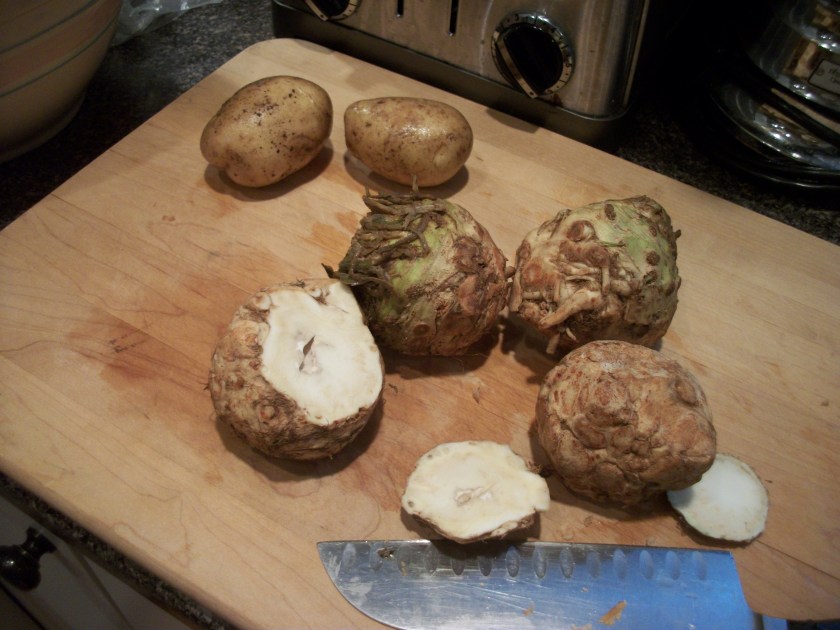
Here’s what a celeriac root vegetable looks like.  I put potatoes I needed for the soup in the background so you can see the contrast.  I run my knife down the sides to peel them–turning them over to get what I missed at the bottom when I’ve gone all the way around.  When you cut open a celeriac, the flesh is white and very dense.

celeriac and potatoes

The Farmer John Cookbook had a nice celeriac soup recipe, so I started from there.  It’s pretty much the same method that Julia Child teaches for her leek and potato soup.

Leeks or onions–I used onions as I was out of leeks–sweated out in a bit of butter.

I added carrots, some garlic scapes from the freezer, and some actual garlic.  I didn’t add extra celery as I wanted to see how “celery” the celeriac is.

Be patient with the sweating out–in a heavy pan, like a Creuset.  (If I could have only one pan, it would be a Creuset pot.  The next would be a cast iron skillet.)  Cook slowly over medium heat.  Add sea salt.  Stir to keep anything from burning prematurely.  When you begin to get bits of caramel browning–throw in the stock.  I used my last batch of chicken bone broth–simmered for 2 days in the crock pot and then strained.  I don’t strain off any fat as I’m quite sure now that fat does not make you fat and that we all need good sources of fat to be healthy.

Throw in the cut up celeriac–you need 3 to 4 cups for about 8 cups of broth.  You could have more or less of either.  Throw in, too, two or three peeled potatoes–which will thicken up the soup.

Here’s an interesting addition–about 1/4 to 1/2 cup of almonds–I put a few handfuls in the blender and let it rip until I have a nice powdery nut mix.  The almond will also thicken the soup and will add a delicate flavor.

Grate in some fresh nutmeg.  Taste for salt and add more if needed.

Let it all cook for 25 minutes or until the celeriac is soft.  Here’s what it looked like on the stove–you can see the almond “flour” on the top.

celeraic cream soup in process

Then, turn it off, let it cool a bit, and “boat motor” it with an immersion blender.   When all is smooth, add at least a cup of heavy, preferably raw, cream.  Stir, taste for salt and nutmeg, and serve in a bowl.  You could put a chunk of butter on the top once the soup is in the bowl.  Or, a drizzle of cream or sour cream.  It’s really rich.

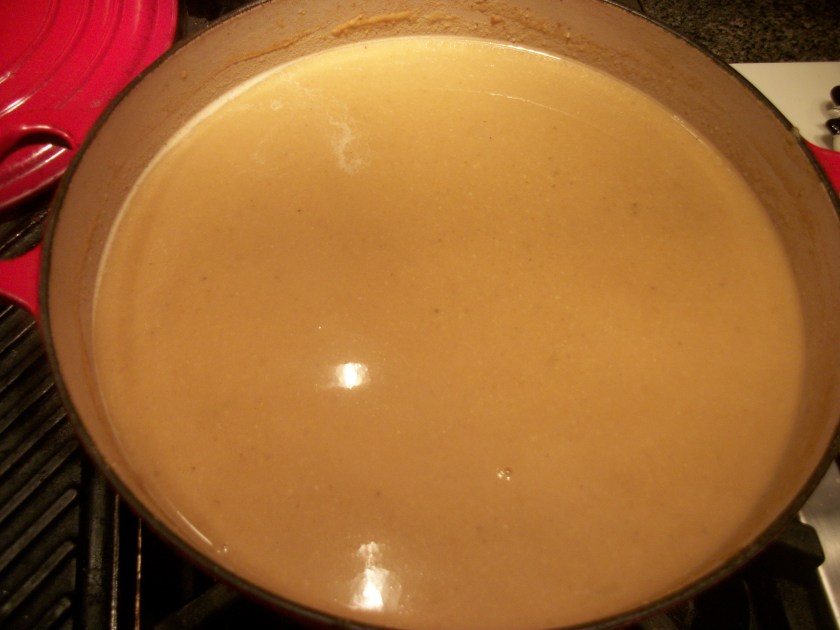
Here it is finished:

celeriac cream soup

Celeriac cream soup has a delicate, lovely flavor.  Enjoy!

Turkey Tracks: Highlights From Thanksgiving 2012

Turkey Tracks:  December 15, 2012

Highlights From Thanksgiving 2012

Christmas is drawing close to us now.

But, I’m still savoring Thanksgiving.

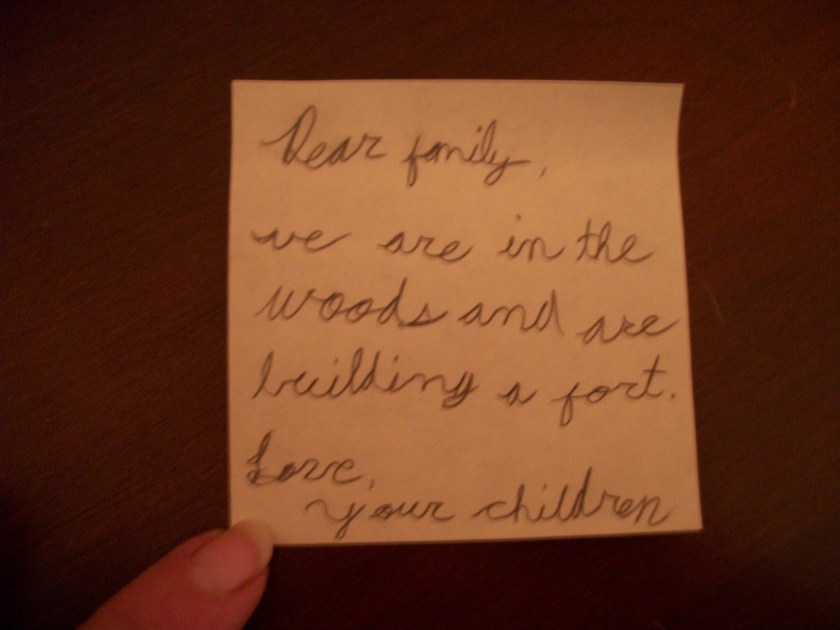
Here’s one of my cherished moments:

In the woods, Nov. 2012

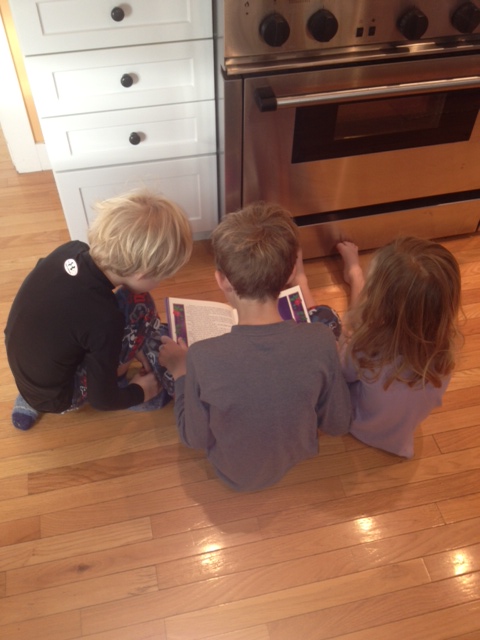
Here’s another:

Bo reading to kiddos, Nov 2012

Bo was reading to Kelly and Wilhelmina while waiting for muffins to cook.

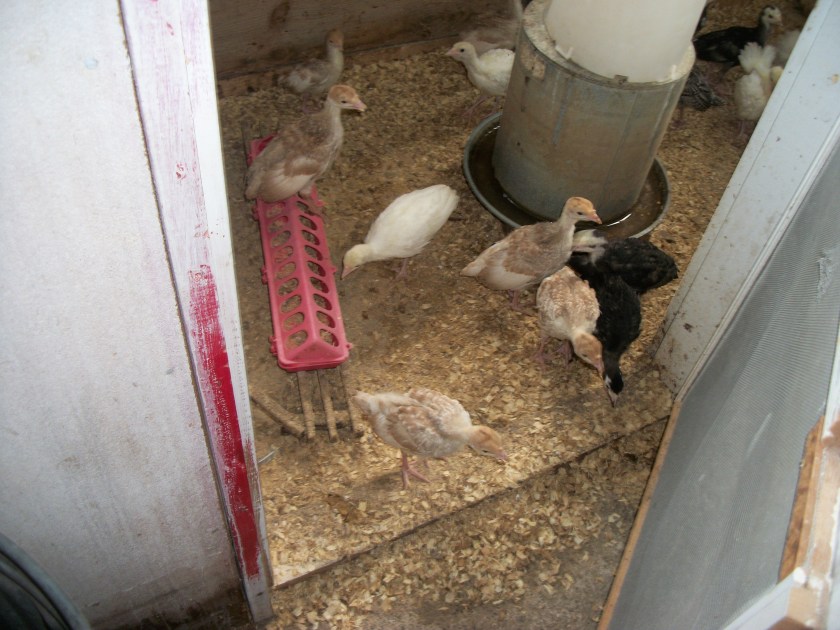
Last summer we visited our neighbors Chris Richmond and Susan McBride Richmond–who had just started raising our Thanksgiving turkey at Golden Brook Farm.  I tried to remind the kiddos of this visit, but I don’t think they got it then or at Thanksgiving.  Probably there was too much going on the day of the visit to Golden Brook–the Richmond-McBrides have terrific children, some of whom are the same ages as some of our crew, and in addition to friendly children there were barns to explore and new sights to see.

Thanksgiving turkies, Aug. 2012

We got in two good hikes before the weather turned too cold for the clothing the children had available.  The first, up to the  Maiden Cliff area, is one of our favorites.  On the way there is a gorgeous stream to cross.  Here’s the view–the red in the foreground is a blueberry barren.  We live across the lake/river and back to the left on that range of hills.

Thanksgiving hike to Maiden Cliff, 2012 edited

After the weather turned off really cold (and has since, alarmingly warmed up again so that there is no snow at the Snow Bowl), we had to find all kinds of layers to keep the kiddos warm.  Here they are in front of the base of the Rockland Christmas Tree–which is all made of lobster crates and buoys.

kiddos and lobster Christmas tree, 2012 edited

Talula has lost a front tooth and is working on losing the other front tooth.

Turkey Tracks: Roasting and Cooking the Blue Hubbard Squash

Turkey Tracks:  December 14, 2012

Roasting and Cooking the Blue Hubbard Squash

Remember the Blue Hubbard Squash I grew and wrote about back in October?

Well, I roasted it this week.

The temperature had been dropping, and I had the squash stored in the garage so they could keep on “sugaring off.”  Temps were low enough that I was afraid that the garlic and the squashes would freeze in the garage–so everything came inside.

John cut last year’s Blue Hubbard, which I bought for about $8, out in the garage–a place of mystery to me.  This year I was on my own.  And let me tell you, it took the BIG French knife, lots of muscle, and lots of patience.  I could only get the knife into one side at once.  Eventually, I was able to pry it open.

I scooped out the seeds and pulp and took them out to the chickens, who ooed and ahhed.  The smell of the squash was so clean and sweet.  The flesh was bright, intense orange.

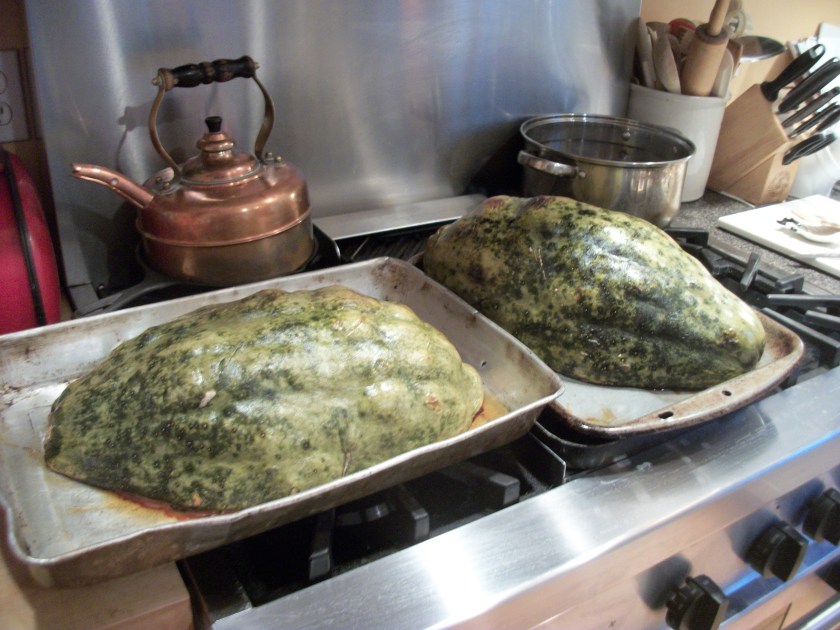
Each half took up the whole of one of my big baking pans and both filled the whole of the oven.  It took about 90 minutes to roast them completely.

Blue Hubbard cooked

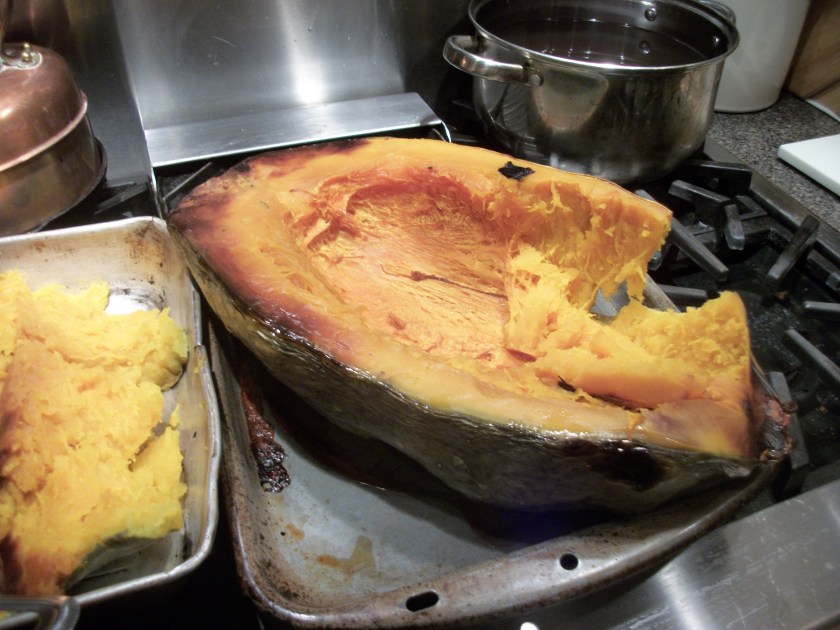
Here are the halves, flipped over and ready to have the roasted flesh scooped out.

Blue Hubbard cooked 2

This one squash made an enormous amount of cooked filling.  I put serving sizes into plastic bags and froze them–reserving about 4 cups for that night’s dinner–pan fried local ham steak, sauteed baby bok choy (with fresh ginger and our garlic), and the Blue Hubbard squash.  (Fall is the traditional time for “putting up” pork raised over the summer–and a pork ham takes a bit of time to smoke, so big ham slices are now filling the local coops.)

I placed the roasted squash for dinner into a saucepan with a cover–added about 1/4 cup of our local raw butter, a big dollop of our local raw heavy cream, a splash of our local maple syrup, a pinch of sea salt, and about a teaspoon of Penzy’s cinnamon.  I put the mixture on low heat and went back after a bit to stir it all up.  It was smooth and incredibly sweet–I hardly needed the maple syrup in the mixture.

Delicious!

Turkey Tracks: Blog Request: Cream Caramel Cake

Turkey Tracks:  December 14, 2012

BLOG REQUEST:  CREAM CARAMEL CAKE

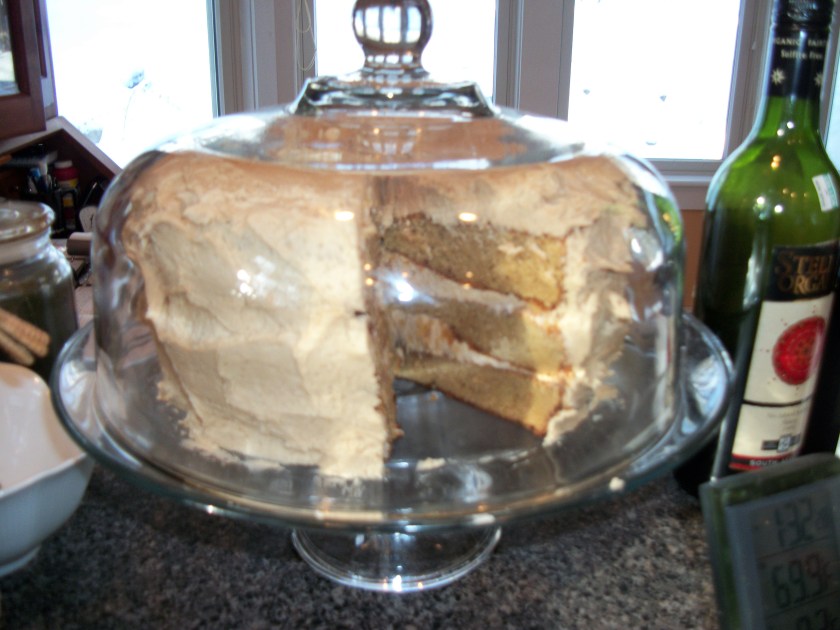
A blog reader recently asked me to post the recipe for the Cream Caramel Cake I pictured in the January 25th entry, 2011, on making French Onion Soup, which included a picture and a discussion of a Cream Caramel Cake I found in Better Homes and Gardens, December 2005.  The reader tore out the picture and didn’t get the recipe.  I tore out the recipe, but didn’t save the picture.  Nevertheless, I feel sure that the cake recipe below is what this reader is asking me to post.

Caramel cake cut

The cake pictured in the magazine was a secret family recipe, so this recipe probably comes close but isn’t exactly what Pat Shelter is really making.  I didn’t have mocha syrup on hand, so kind of make one up–you can go back to the original entry to see what I did.

This is a BIG cake–3 LAYERS–with 8 CUPS OF POWDERED SUGAR in the frosting.  There’s so much sugar that it makes my teeth hurt just to read the frosting recipe.  The cake itself seems to be assembled in a classic manner.  Do bring your ingredients to room temperature before starting the cake–or the frosting.

Cake ingredients:

1 cup butter

5 eggs separated

1 cup buttermilk

3 cups sifted cake flour

1 tsp. EACH baking powder and baking soda

pinch of salt

2 1/2 cups sugar

5 Tablespoons total:  mocha syrup, coffee liqueur, and Irish cream liqueur–or strongly brewed coffee for all 5 Tablespoons

2 tsps. vanilla extract

1 recipe IRISH CREAM FROSTING  (1 cup butter, softened, with electric mixer on medium to high speed until smooth.  Gradually add 2 cups of powdered sugar, beating well.  Slowly beat in 6 Tablespoons of whatever flavoring from above you have chosen.  Beat in 2 Tablespoons of vanilla.  Gradually add 6 MORE CUPS POWDERED SUGAR, beating until smooth and of spreading consistency.

1.  Allow butter, egg yolks, egg whites, and buttermilk to stand at room temperature for 30 minutes.  Meanwhile grease and flour three 9-inch round cake pans; set aside.  In a bowl stir together flour, baking powder, baking soda, and salt.  Set aside.

2.  In a mixing bowl beat butter with an electric mixer on medium to high speed for 30 seconds.  Beat in sugar until well combined.  Beat in egg yolks one at a time.  (Take time on this step.)  Beat on high speed for 5 minutes.

3.  Alternately add flour mixture and buttermilk to butter mixture, beginning and ending with flour mixture.  Beat on low speed after each addition just until combined.  In a bowl combine the listed flavorings as desired–or use strong coffee–and gently stir into cake.

4.  Thoroughly wash beaters.  In a mixing bowl beat egg whites on medium to high speed until stiff peaks form (tips stand straight).  Fold 1 cup of the beaten egg white mixture into the egg yolk mixture, fold remaining egg whites into egg yolk mixture.

5.  Divide batter among prepared pans.  Bake for 20 to 25 minutes or until tops spring back when touched.  Cool cakes in pans on wire racks for 10 minutes.  Remove cakes from pans; cool thoroughly on racks.  DO NOT FROST UNTIL THE CAKE LAYERS ARE TOTALLY COOL.

6.  To assemble cake, place one cake layer on a serving plate.  Spread top of cake with 3/4 cup of the Irish Cream frosting.  Top with a second cake layer.  Spread top of cake with 3/4 cup frosting.  Top with remaining cake layer.  Spread remaining frosting on top and sides of cake.

Mainely Tipping Points 45: Part II: How Soy Got Into Our Food Chain

Mainely Tipping Points 45:  December 13, 2012

Part II:  How Soy Got Into Our Food Chain


Part II of this series on Soy explores how soy got into the human food chain.  As established in Part I, the expert I rely on for soy information is Kaayla T. Daniel, PhD, CCN, the author of THE WHOLE SOY STORY:  THE DARK SIDE OF AMERICA’S FAVORITE HEALTH FOOD (2005).  Daniel’s credentials show her to be an outstanding nutritionist and her extensive research on soy makes her an expert.  All quotes are from this text. 


* * *

Soy is a powerhouse in terms of the potent chemicals its beans contain.  For instance, soy is one of more than 300 plants that contain phytoestrogens, which stop reproduction.  Yet soy is the only one of these plants humans eat.  Besides phytoestrogens, soy contains many more powerful chemical components which are dangerous for humans unless they can be mediated in some way first.  Indeed, the Food and Drug Administration (FDA) lists soy on its Poisonous Plant Database (31).    

 It is true, Daniel writes, that the ancient Chinese “valued the soybean as a national treasure” and honored it with the name “ `the yellow jewel.’ “The soybean, though it is not a grain, is one of the Five Sacred Grains, alongside rice, millet, barley, and wheat.  But, the ancient Chinese did not eat the soybean.  They used it as a green manure to fix nitrogen in the soil (9).

 The Chinese began to eat soybeans “no earlier than about 2500 years ago.”  They fermented soybeans as they “remain toxic after ordinary cooking….”  Fermentation tames the trypsin inhibitor that causes bloating and gas.  Miso paste, used to preserve meat and seafood, and soy sauce, the liquid produced in the production of miso, appeared first.  Natto appeared around 1000 AD, and tempeh appeared “no earlier than the 1600s.”  Thus, “claims that soybeans have been a major part of the Asian diet for more than 3000 years…are simply not true” (9-10). 

 Soy moved to Japan with the Chinese missionary priests “sometime between 540 and 552 AD.”  Japanese miso documentation first appears in 806 and 938 AD.  Tofu, which is a precipitated product, not a fermented one, appears about the same time and is called “the meat without the bone.”  Tofu “appeared regularly on monastery menus as an aid to spiritual development and sexual abstinence, a dietary strategy validated by recent studies showing that the plant-form of estrogens (called phytoestrogens) in soy can lower testosterone levels” (10-11).

 Tofu consumption spread “throughout China, Korea and Southeast Asia.”  By 700 AD tofu was “accepted as a meat or fish replacement, at least when pork, seafood and other preferred sources were unaffordable or unavailable.”  But, “except in areas of famine, tofu was served as a condiment, consumed in small amounts usually in fish broth, not as a main course.”  In truth, Asians, including the Japanese who eat the most soy, don’t eat more than 1.5 percent of their diets in soy.  And the Japanese, as has been shown in even recent studies, on average eat only about one tablespoon of soy a day (28).  Plus, the types of soy Asians eat are old-fashioned products like miso and tempeh, not commercial soy in products like “soy sausages, soy burgers, chicken-like soy patties, TVP chili, tofu cheesecake, packaged soymilk, or other of the ingenious new soy products that have infiltrated the American marketplace” (12-13).

 Soybeans probably came to Indonesia from trade with southern China trade around 1000 AD.  The Indonesians appear to have invented soy tempeh (fermented whole soy beans) as the “world’s earliest reference to tempeh manufacture occurs in the Serat Centini, a book published in 1815 on the orders of Sunan Sugih, Crown Prince of Central Java.  Indonesian tempeh became “known as food for the poor, even though people of all classes continued to consume it” (13).

 Asians “rarely—if ever—baked or boiled soybeans, ground them into flour, or roasted them to make nut-like snacks.”  Likely, these practices left diners with “a stomach ache or worse,” unlike the time-honored traditional techniques” for preparing soy.  Nor did Asians “press or crush great quantities of soybeans to extract soy oil,” so “they never faced the challenge of finding creative ways to use massive amounts of the leftover protein.”  What oil they did extract was used to light lamps, and the leftover protein “served as an excellent fertilizer” (14)

 Soy goes west as early as 17th century France, where soy sauce becomes a secret ingredient at court banquets.  Ben Franklin sent soybeans to America in 1770, but soy remained “a little-known commodity…for more than a century.”  It wasn’t until 1935 when soybeans were grown for food oil that its plantings “equaled those used for crop rotation”—to fix nitrogen in depleted soils (17).

 Early western soy proponents were John Harvey Kellogg, the breakfast cereal king; Artemy Alexis Horvath, PhD, who promoted soya flour in academic and popular fronts; Henry Ford, who thought soy plastics would be great in cars and who wore soybean-fiber ties to promote soy as a cloth; Adolf Hitler, who promoted whole-food vegetarianism; and Benito Mussolini, who wanted to make soy flour a “mandatory ingredient in the Italian staple polenta.”  By the 1950s and 1960s, the Communist Party in the Soviet Union” pushed soy protein and soy margarines as the solution to low-cost feeding of the masses…” (18-20).

 The U.S. soy industry has claimed that Asians, especially the Japanese, eat a lot of soy and have better heart health and fewer cancers that do North Americans.  But, as noted above, soy proponents in the west have had to admit that soy consumption in Asia is not as great as they advertised.  Further, the famous claims that Okinawans enjoy longevity due to soy-rich vegan diets have been debunked, and Daniel covers this issue thoroughly.  As with other Asians, Okinawans do eat small amounts of soy, but their diets include primarily meat, fish, and lard.  There seems also to be a genetic factor involved in Okinawan longevity (15-16).  And, as Sally Fallon Morell of The Weston A. Price Foundation notes in the introduction, the Japanese, who eat the most soy in Asia, and Asians in general, have higher rates of cancer of the esophagus, stomach, pancreas, and liver than do North Americans (5). 

 What differs between how soy is viewed in the East and the West is that in the West soy “is a product of the industrial revolution—an opportunity for technologists to develop cheap meat substitutes, to find clever new ways to hide soy in familiar food products, to formulate soy-based pharmaceuticals, and to develop a plant-based, renewable resource that could replace petroleum-based plastics and fuels.”  Even today, “very few soybeans are sold for whole food products,” so that “the `good old soys’ of Asia—miso, tempeh and natto—thrive only in niche markets.”  The soy industry knows that “the big profits are not to be found in old-fashioned, funny-tasting foreign foods, but from splitting the `yellow jewel’ into two golden commodities—oil and protein” (21-22).

 Most soybean oil (97 percent in 1997), which is highly processed, goes into food products—salad and cooking oils, shortening, and margarine.  The protein was at first fed to “animals, poultry and, more recently, fish farms.”  But now, the soy industry “aggressively markets soy protein as a people feed as well”—so that “soy is now an ingredient in nearly every food sold at supermarkets and health food stores.”  And, the soy industry profits from soy waste products, like soy lecithin (used as an emulsifier), “protease inhibitors (digestive distressers sold as cancer preventatives), and isoflavones (plant estrogens promoted as `safe’ hormone therapy, cholesterol reducers, and cancer cures”) (21-23). 

 The soy industry has “Americanized soy around the globe”—running into trouble “only when Monsanto—the biotech bully boy”—pushed for acceptance of its genetically modified (GM) `Frankenstein’ soybeans” (27).  China is “now the world’s largest importer of U.S. soybeans” (30).  And, Asia is potentially a “huge market” for American-style imitation soy products (28).

 Next:  the difference between American industrial soy products and the old-fashioned “good old soys.”


Turkey Tracks: Ann’s Blue and White Chocolate Feather

Turkey Tracks:  December 8, 2012

Ann’s Blue and White Chocolate Feather

Ann O’Callaghan is my husband John Enright’s first cousin.  She and her sister Margaret Nealon live a few blocks from each other in the Boston area.  Their children have all grown up together, and it is the greatest pleasure to John and me that our sons have kept close ties with both of these families and all their children.  Now, John, Ann, and Margaret are grandparents many times over as many of their children now have children of their own.

Ann and Margaret have always been more sisters than cousins to John.  Their mother died very early, so Ann left Ireland as a teenager to come to Boston to live with one of her mother’s sisters.  (John’s father was her uncle.)  Margaret, who had lived with another of her mother’s sisters, followed Ann to America some years later.  All of these families are outliers from their mother country–Ireland–where the bulk of all their families live.

When we moved to Maine from northern Virginia, we began to see more of Ann and her family.  Every time Ann would come to visit, she admired whatever quilts I was working on at the time.  Always she would tease and say how much she would love a quilt.  And, I would always ask “what colors do you like.”  The answer was consistent.  Blues.  So, this winter, as part of my scrappy project, I made Ann a quilt.  John’s sister, Maryann Enright delivered it to Ann a few weeks ago, so now I can put it on the blog.

Here’s Ann’s Blue and White Chocolate Feather:

Ann's blue and white chocolate feather

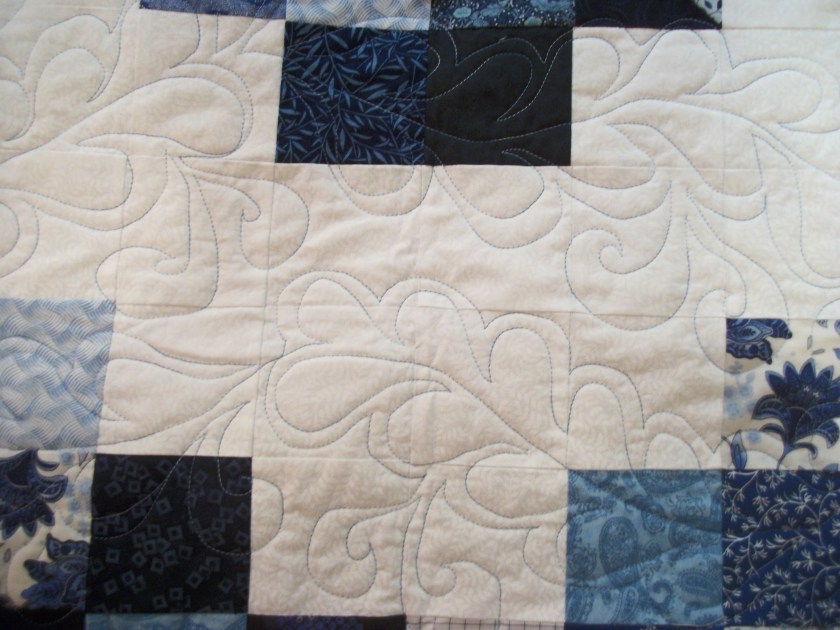
The pattern is from “American Patchwork and Quilting” (August 2010).  It’s called “Outside the Box” and was designed by Karen Montgomery of The Quilt Company.  It uses 3 1/2 inch squares–which I took from the box where I store pre-cut leftover fabric from other quilts and from my stash.  I purchased the white fabric.  What’s cool about this concept is that the block is made like a log-cabin, in that it has a light and a dark side made from 16 blocks–six white and 10 blues.  So, the block combines in the same way that a log cabin block does–into all kinds of log-cabin patterns.

The quilting is from the Chocolate Feather pantograph, thus the name.  And it came out beautifully–it’s a functional quilt meant to be used and loved.

Ann's blue and white quilted

Here’s a view of the center:

Ann's blue and white, center

I like the varigated blue thread on this quilt a lot.

Ann's blue and white quilted

Ann's blue and white backing, binding, top, 2

Somehow, I’ve made a lot of blue and white quilts over the past year.  My blue and white stash has been reduced considerably–which is the goal.  I’m working on another right now, actually.  It, too, has a white background, though the pattern is different.  What I’m wondering about now is how a low contrast Kaffe Fasset kind of treatment, where the white becomes a blue print and the blue blocks are made into squares that float around in the print…

Perhaps I’ll find out this winter as I have enough 3 1/2-inch blue squares to make another quilt…

Mainely Tipping Points 44: THE WHOLE SOY STORY

Mainely Tipping Points 44:  December 7, 2012

Part I:  THE WHOLE SOY STORY


Just the other day I stood in front of a store cooler with $40 worth of a premiere brand of bratwurst sausages in my hand.  How delicious they would be for dinner grilled and served alongside applesauce, pan-sautéed cabbage, corn bread, and assorted pickles and mustards.  Almost absentmindedly, I glanced at the ingredients on the label and was startled to see soy protein isolate.  I put the sausages back into the cooler for two reasons:  I don’t think our food should be padded with soy “meat extenders” so industry can make more money, and I don’t think commercial soy is at all safe to eat, especially the highly processed forms like soy protein isolate. 

The person I rely on for soy information is Kaayla T. Daniel, PhD, CCN, the author of THE WHOLE SOY STORY:  THE DARK SIDE OF AMERICA’S FAVORITE HEALTH FOOD (2005).  Daniel is known as the “naughty nutritionist” because with outrageous humor she specializes in debunking food myths, like the myths surrounding commercial soy.  And, Daniel comes with the kinds of credentials and training which allow her to understand the value of what she is researching, like why some studies have good designs and are executed properly and why others are corrupt, in that they have been designed and paid for by industry to make commercial soy appear to be safe and, even, healthy, when it is not. 

If you are totally confused by the alphabet soup that follows many names in the nutrition field, take a look at Daniels article “What Should I Do to Be a Nutritionist?   Making Sense of All Those Confusing Degrees and Credentials,” published in the Weston A. Price Foundation (WAPF) journal, “Wise Traditions,” Fall 2009, http://www.westonaprice.org/health-issues/what-should-i-do-to-be-a-nutritionist.  Daniels walks the reader through what kind of nutritional programs are available and what their strengths and pitfalls are.  She explains what kinds of organizations certify people with dietary and nutritional training, which lets them begin to use the coveted initials behind their names. 

You’ll find, too, that this terrain is a minefield of disingenuous claims.  For instance, , anyone can claim to be a nutritionist, so the alphabet soup tells everyone what kind of training and testing has been involved.   And, Daniels notes that Mary Enig, PhD, MACN, “is fond of saying [that] `Dietitians are trained to dispense processed food.’ (That MACN behind Enig’s name is the coveted Master of the American College of Nutrition, “a prestigious category for those who have made outstanding contributions over an extended period of time to the field of nutrition.”)  

Daniels herself studied under the legendary H. Ira Fritz, PhD, CNS, FACN.  The CNS stands for Certified Nutritional Specialist, and the FACN designates that Fritz is a Fellow of the American College of Nutrition.  The FACNs, explains Daniels, “hold doctoral degrees, [have] expertise as practitioners or educators and [have] a publication track record.”  (Dr. Enig’s MACN is a step above the FACN, which she also holds.) 

Dr. Fritz is now emeritus professor at both Union and Wright State University in Dayton, Ohio, and was, in addition to Daniels, mentor to a number of “superstars” in the field of nutrition.  Daniels herself is a CNN, or Certified Clinical Nutritionist, which is a very respected credential.  And, she is a board member (Vice President) of the WAPF and regularly publishes articles in its journal “Wise Traditions,” where she also has a column on soy issues.  And, she blogs at the WAPF web site and on her own blog, http://liberationwellness.com.    

With the publication of THE WHOLE SOY STORY, Daniels acquired a national reputation.  She appeared on the Dr. Oz show, where that megalomaniac did not allow her to speak more than one sentence.  (Oz ended that segment by passing out stalks of soy to the audience, each fluttering with raw edamame pods.)  She appeared on the Oz show as counter to Dr. Mark Hyman, a pro soy advocate, who did not seem to know that soy milk and tofu are not fermented soy products, which are safer to eat.  Her in-depth response to Hyman in the Fall 2010 “Wise Traditions” is worth reading, in that it discusses in a short article many of the myths and dangers of eating untreated soy:  http://www.westonaprice.org/soy-alert/response-to-dr-mark-hyman.  Daniels has been on ABC’s View From the Bay, NPR’s People’s Pharmacy, and will soon appear on PBS Healing Quest.  She was WAPF’s 2005 recipient of the Integrity in Science Award.

I am taking a lot of time setting up Daniel’s credentials because I hope this activity helps readers understand not only what I am looking for when navigating the maze of whom to believe when it comes to nutrition, but how readers, too, should discern the value of what they are reading.  We can no longer rely on studies from Harvard as being reliable just because they come from Harvard.  One has only to look at the recent study denouncing red meat done to see that Harvard nutrition scientists are perfectly capable of producing terrible, useless studies.  (See my blog, https://louisaenright.wordpress.com/?s=red+meat.).  Daniels has solid credentials, she works with people at the WAPF who also have solid credentials, and for THE WHOLE SOY STORY she looked at the history of soy, at all the major soy studies, at the major soy issues, and at the major soy industry proponents.

We are being besieged at the moment with the idea that we should all eat mostly a plant-based diet.  Vegetables and fruits are touted as being chock full of wonderful ingredients that will make us healthy.  What is being lost in this current moment of insanity is not only that plants are not nutrient dense, but that plants manage their lives chemically and that some of those chemicals are so potent that they can cause quite a bit of harm to humans.  Many of the plants that we eat everyday can, if overdone or eaten without being treated to reduce the chemical load, cause serious trouble.  And, it’s easy to over eat certain foods since they are now available all year round.  Take spinach, for instance. It’s loaded with oxalates, which can cause kidney stones if eaten in excess.  Or, the grains and legumes I wrote about in the  Mainely Tipping Points Essay series on the Paleolithic diet, essays 41, 42, and 43, which are loaded with antinutrients that must be treated to be safe to eat.  For more information in this vein, see Daniels; “Plants Bite Back,” “Wise Traditions,” Spring 2010, http://www.westonaprice.org/food-features/plants-bite-back.  

Soy is a dangerous plant food without a long history of use as a food.  And we are feeding it to animals and fish we eat and whose eggs we eat.  We are dumping soy into processed and packaged foods, including things like canned tuna fish and, unlabeled, in the hamburger in your local grocery store.  We are loading it with sugars and drinking it, to include putting it into baby formula.  We are, in short, wallowing in soy.

Here are some quotes from the flyleaf of THE WHOLE SOY STORY:  “Soy is NOT a health food.  Soy is NOT the answer to world hunger.  Soy is NOT a panacea.  Soy has NOT even been proven safe.”

And, here’s a quote to help start off this series on soy, again from the flyleaf:  “Hundreds of epidemiological, clinical and laboratory studies link soy to malnutrition, digestive problems, thyroid dysfunction, cognitive decline, reproductive disorders, immune system breakdown, even heart disease and cancer.   Most at risk are children given soy formula, vegetarians who eat soy as their main source of protein and adults self-medicating with soy foods and supplements.”   

Next:  how soy got into our food chain.        

Turkey Tracks: Some Favorite Recent Pictures

Turkey Tracks:  November 18, 2012

Some Favorite Recent Pictures

Three of the grandchildren and son Bryan have birthdays in September.

Remember the socks I was making out of leftover yarn?

Birthday socks–worn with very feminine white nightgowns purchased at a local Camden store:

Ailey Enright, the youngest grandchild for the moment, will be two the 25th of November.  She belongs to Bryan and Corinne, and she is intrepid.  No matter how cold the water, in she goes…

Bryan and Bowen (Mike and Tami’s oldest) were learning to surf.  Guess you will likely outdo both…

I love this one, taken on this same cold day.  Cousins–the oldest and the youngest:

Charleston cousins at Halloween:  the children of three families are represented here:  Mike and Tami, Bryan and Corinne, and Joey and Meaghan Kelly’s Meyer is in the red costume:

Talula is going to be a designer/artist of some sort.  She put this costume together herself, but got help with her eyes.  The photo is by Tara Derr Webb, who is clearly a mentor here and who is, herself, a working artist, a budding farmer, an amazing cook, and a gifted photographer.

Morning with Daddy:

Ailey with Uncle Michael:

Here are the Mike and Tami kiddos painting pumpkins with Uncle Joey and cousin Meyer.  Joey is Tami’s brother, and he’s so good with all these children.

First day in a new school.  I made the dress Mina is wearing, on the left, some years back.  Each girl had a matching dress, and I thought they were long outgrown.

Meyer Kelly on his quilt.  I love nothing better than to see a quilt I’ve made being used and loved:

Ditto, Owen Black on his quilt:

That’s all folks!


Turkey Tracks: Fox With Foot Fetish

Turkey Tracks:  November 18, 2012

Fox With Foot Fetish

We’ve had a few chuckles over this information.

You might remember that we lost two chickens to a fox about six weeks or so ago.  Our whole neighborhood had seen her/him from time to time.  Susan McBride and Chris Richmond, up at Golden Brook Farm, thought for a few days fox had gotten one of their sweet, new barn cats.  And, they breathed a sigh of relief when they took their crop of meat chickens to be slaughtered without any loss along the way.

Things died down, then neighbor Marina Schauffler sent me this post:

In case you’re in need of a little humor, here’s an update on the neighborhood fox thief. Your chickens aren’t the only victims. I have now lost FIVE shoes to our fox friend. I kick off shoes on our back porch and noticed that one (then two, then three) were missing, but thought the boys had knocked them off or moved them. When a hiking boot went missing this morning, I hopped online and found that there are foxes with a foot fetish—who steal shoes for their pups to play with! One in Germany got nicknamed Imelda (after Imelda Marcos) ‘cause she ran off with 120 shoes in one community! I have to laugh (even though it’s going to be costly replacing them!)—I wish I could have seen her hauling off the half-pound hiking boot!

My chickens are loose again.

So far, so good…

Mainely Tipping Points Essay 43: Part III: Paleo Diet: What’s Wrong With Legumes?

Mainely Tipping Points Essay 43:  November 16, 2012

Paleo Diet, Part III:  What’s Wrong With Legumes?


To recap from Parts I and II, Paleo Diet advocates argue that humans are genetically wired to eat meat, foraged vegetables, fruits, nuts, and seeds.  Paleo peoples, they argue, did not eat grains, legumes, or dairy and were superbly healthy.

 But, what’s wrong with beans and peanuts, also known as legumes?

 Rob Wolf, in “The Paleo Solution,” puts it simply:  “dairy and legumes have problems similar to grains:  gut irritating proteins, antinutrients…protease inhibitors, and inflammation.”  Antinutrients, like phytates, bind to metal ions, like magnesium, zinc, iron, calcium, and copper, which make them unavailable for absorption by our bodies.  Protease inhibitors prevent the breakdown of proteins which means your body cannot “effectively digest the protein in your meal” (98-99, 93).  In other words, antinutrients and protease inhibitors cause malabsorption and disease.    


Nora T. Gedgaudas, C.N.S., C.N.T., in “Grains:  Are They Really a Health Food?:  Adverse Effects of Gluten Grains” (“Well Being Journal,” May/June 2012), notes that “legumes typically contain 60 percent starch and only relatively small amounts of incomplete protein, and they also contain potent protease inhibitors, which can damage one’s ability to properly digest and use dietary protein and can also potentially damage the pancreas over time, when one is overly dependent on them as a source of calories.”  (Gedgaudas’ web site is http://www.primalbody-primalmind.com.) 

 William Davis, MD, in “Wheat Belly,” notes that the carbohydrate in legumes contains amylopectin C, which is the least digestible of the amylopectins—which leads to the chant “Beans, beans, they’re good for your heart, the more you eat ‘em, the more you…”.  Yet, the reality of the indigestible matter is not so funny:  “undigested amylopectin makes its way to the colon, whereupon the symbiotic bacteria happily dwelling there feast on the undigested starches and generate gases such as nitrogen and hydrogen, making the sugars unavailable for you to digest” (33).

 Davis goes on to note that amylopectin B is “the form found in bananas and potatoes and, while more digestible than bean amylopectin C, still resists digestion to some degree.  Remember that wheat has amylopectin A, which is the most digestible form of the amlopectins and, thus, can raise blood sugars more than eating a sugar-sweetened soda or a sugary candy bar.  The lesson here is that “not all complex carbohydrates are created equal….”   And Davis cautions that as the carbohydrate load of legumes “can be excessive if consumed in large quantities,” it’s best to limit servings to about a ½ cup size (33, 213). 

 Wolf is less compromising when it comes to combining plant-based foods, like beans and rice, to obtain essential amino acids—which we must eat as we cannot make them on our own.  The eight essential amino acids are “plentiful in animal sources and lacking to various degrees in plant sources.”  Wolf notes that “many agricultural societies found that certain combinations (like beans and rice) can prevent protein malnutrition.”  But, relying on the work of anthropologists who have compared them, Wolf notes that “most vegetarian societies…are less healthy than hunter-gathers and pastoralists.”  That’s because “plant sources of protein, even when combined to provide all the essential amino acids, are far too heavy in carbohydrate, irritate the gut, and steal vitamins and minerals from the body via anti-nutrients.”  Wolfs’ final assessment:  “Beans and rice, nuts and seeds, are what I call “Third World proteins.’  They will keep you alive, they will not allow you to thrive” (208-209).

 Wolf cautions that unless you are lean and healthy, don’t eat fruit.  He adds, further, that “there is no nutrient in fruit that is not available in veggies, and fruit may have too many carbs for you” (214)

 Dr.  Natasha Campbell-McBride expanded on the 1950s Specific Carbohydrate Diet (SCD) of Dr. Sidney Valentine Haas and created the “Gut and Psychology Syndrome” (GAPS) diet.  (That history is in my Mainely Tipping Points Essay 31 on my blog:  https://louisaenright.wordpress.com.)  Haas recognized the connections between diet and disease, especially in the debilitating digestive disorders, and put patients on a diet that eliminated dairy, grains, legumes, and starchy vegetables, like potatoes.  (Dairy is slowly added back after healing has started, beginning with cultured forms, like yogurt.  But, some patients are not able to tolerate dairy permanently.)  Haas’s SCD diet emphasized bone broths, meat stews that included animal fat, vegetables, and some fruits.  The results were, and are, amazing. 

 Dr. Campbell-McBride was one of many now, like Wolf and Davis, who made the further connection that too many starchy carbohydrates foment conditions in the gut that allow out-of-control yeasts to degrade the gut lining—which allows food particles to escape into the blood stream and trigger autoimmune reactions.  Campbell-McBride is one of the first to realize that these out-of-control yeast populations produce toxins that affect the brain and create problematic behavior.  Conditions like autism, for instance, might not really be autism, but effects of inappropriate diet and malfunctioning body systems. 

 Sally Fallon Morell and Mary G. Enig, Ph. D. of The Weston A. Price Foundation (WAPF) hold a place in their 1999 “Nourishing Traditions,” for most legumes—if properly soaked and cooked so that phytic acid and enzyme inhibitors are destroyed and difficult-to-digest complex sugars are made more digestible and if legumes are cooked and eaten with at least small amounts of animal protein and animal fat. 

 Morell and Enig write that soybeans, however, should only be eaten sparingly and only after fermentation into miso, tempeh, and natto because the chemical package in soy is so powerful and so dangerous (495-496).  A  commercial method has never been fully developed that renders soy completely safe.  But, more on soy in Mainely Tipping Points 44 .  (Note that tofu is not a fermented soy food.) 

 Morell and Enig are careful to caution that “vegetable protein alone cannot sustain healthy life because it does not contain enough of all of the amino acids that are essential.”  Indeed, “most all plants lack methionine, one of the essential amino acids” (495-496).  Further, both Morell and Enig have made clear repeatedly in the WAPF journal “Wise Traditions” that the current government support for plant-based diets is dangerous and unscientific.          

 In the end, what Paleo diet advocates are asking is why, in the first place eat foods with such high carbohydrate loads, inferior protein, and so many dangerous chemicals —especially when a diet of meat, vegetables, fruits, nuts, and seeds supplies nutrients in dense, safe, satisfying forms. 

 This Paleo question is especially good to contemplate if one is overweight and experiencing the attendant health issues that accompany that condition and are trying to make changes.  Or, if one has ongoing digestive disorders which really must be addressed.