Turkey Tracks: The Wood Pile

Turkey Tracks:  April 24, 2012

The Wood Pile

Stopped by Pete and Rose Thomas’s last week.

Look what’s lining their driveway.

Pete is hoping this woodpile will take them through next winter.  Their wood use is heavier these days–due to the wood-burning oven where Rose is making the most delicious pizzas and all kinds of baked breads.  She also uses the oven to cook all kinds of foods:  meats, roasted tomatoes, and so forth.

Pete’s making progress on cutting the timber into firewood lengths, but it’s a HUGE job!

Go Rose!  Go Pete!

Interesting Information: This “Food” is TWO YEARS OLD

Interesting Information:  April 23, 2010

This “Food” is TWO YEARS OLD

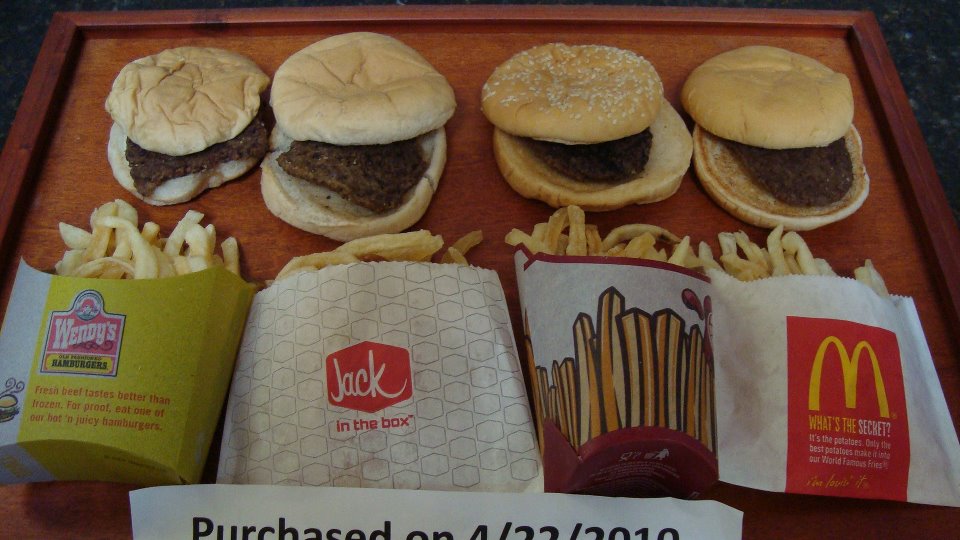
Willow Rheault Kreibich posted this picture on FB recently.

The picture is taken from the FB wall photos of the LiveWell Wellness Centers–so you can go and have a look for yourself.

This food was purchased on April 22, 2010, so it is now TWO YEARS OLD.

Do you really want to feed this “food” to yourself or to your children????

Can we in any way call this food that even bugs won’t touch “nourishing”?

I copied and pasted below the picture what the folks at LiveWell wrote beneath their wall photo

Our fast “food” display is now 2 years old.  The word food is questionable, since the bread-like and meat-like substances have not molded or spoiled in any way.  Bugs won’t even bother with it.  Please think twice about giving this to your kids.  You have a choice, but they don’t.  We truly are what we eat.

Interesting Information: Study Links Pesticide To Bee Deaths

Interesting Information:  April 23, 2012

Study Links Pesticide to Bee Deaths

David Abel, in “The Boston Globe,” reported on a recent Harvard Public Health study that made a one-to-one link between bee colony collapse disorder and a chemical in the neonicotinoid family, imidacloprid (April 6, 2012, B1).

Before 2006, Abel notes, “the typical bee colony collapse was between 25 and 30 percent”–a figure which has “doubled since then.”  Imidacloprid was first reviewed by EPA in 2008.

One strategy chemical companies use to prevent chemicals from being banned is to claim a study is faulty, that more study is needed.  Bayer, the German chemical company who sells the most imidacloprid, immediately claimed the study flawed in that too much of the chemical was used in the study.  But, Alex Lu, associate professor of environmental exposure biology at the Harvard School of Public Health, said “it took only low levels to cause hive collapse, less than is typically used in crops or in areas where bees forage.”  Most importantly, this study clearly linked bee death and colony collapse to imidacloprid.  In other words, there is no question that there is a one to one link here and that the result is bee death.

Imidacloprid is used increasingly in crops such as corn and soybeans.  In Maine, it’s used on “wild” blueberry barrens.  Bees are exposed to imidacloprid both through nectar from the sprayed plants AND through the high-fructose corn syrup with which they are fed.  Charles Benbook, chief scientist of the Organic Center in Boulder, Colorado, and former executive director of the National Academy of Sciences on Agriculture, warned that what’s happening to bees doesn’t just stop with bees:  “People, especially children, consume a lot of high-fructose corn syrup.  The presence of any pesticides in high fructose corn syrup should be a concern for the general public.”

Neonicotinoids act on an insect’s central nervous system.  What do you think it will do to human nervous systems?  Especially when we are learning more and more each day that very small amounts of these chemicals can do a ton of damage.

The Harvard study showed that after 23 weeks of exposure to low levels of imidacloprid, 15 of the 16 treated hives were dead.  Those exposed to higher levels died first.

EPA officials, after the release of this Harvard study, have moved up in their registration schedule so that they will begin a review of imidacloprid by the end of this year.

Parts of France and Italy banned imidacloprid in 2009, and colony collapse disorder there has been substantially reduced.

Bees are our canaries in the coal mines.

Do not eat corn unless it is clearly organic.  Do not eat soybeans, period.  (I’ll write more on that later.)  In addition, both corn and soybeans are likely GMO’d, which is a whole other set of problems for human health.

TurkeyTracks: This One’s For You, Nancy

Turkey Tracks:  April 22, 2012

This One’s For You, Nancy

It’s a rainy Sunday.

We are delighted!

I can’t tell you how dry it is in Maine.  And, until the past few days, way too warm for April.

The new strawberry plants (50) arrived, and I planted them the other day.  I plant the most delicious little strawberry–Sparkle.  Strawberries get planted early spring, but one pinches off all the blossoms the first year to give the plants a year to develop.  So, we won’t eat these strawberries until June 2013.  It’s ok.  I think we’ll get another year or, even, two out of the old bed.  I’m just thinking ahead.

I also planted peas, the cold frame with lettuce, and raked back the straw from the asparagus bed.  I was planning in my head to go get some cool-weather plants, like broccoli, until my better sense kicked in as it’s really way too early.  I had to water everything deeply, and my muscles are still screaming from all this different, outdoor activity.

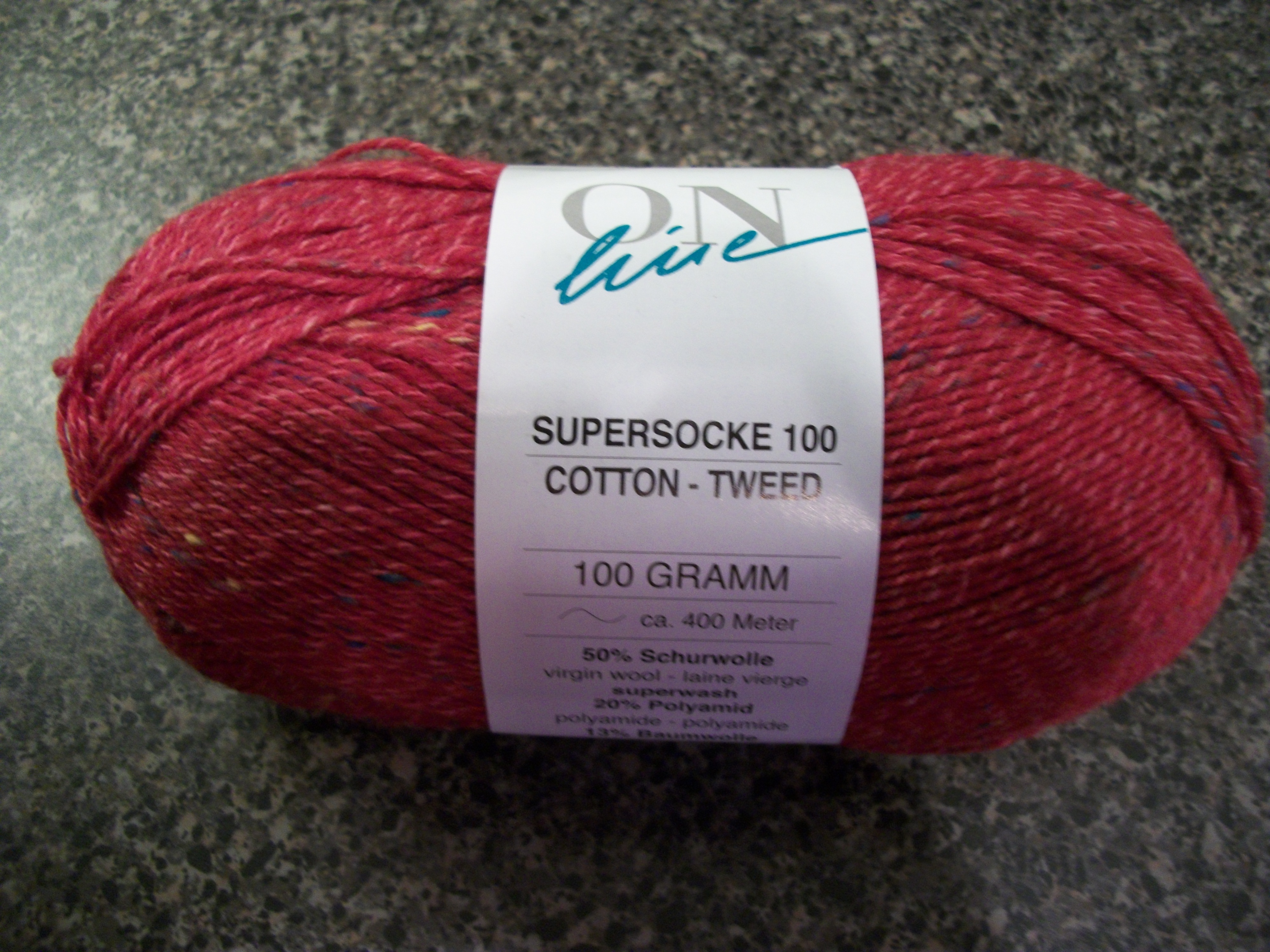
John and I had a delightful lunch in Belfast.  And, I found some red sock yarn for my niece, Nancy Howser Gardner.  We have a deal.  She’s making me a scarf, and I’m making her some red socks.  So, Nancy, this yarn is for you.  It’s 50% wool, but has some cotton in the blend.  It’s really pretty.  See those little blue flecks in the mixture?

God knows when Nancy will get these socks.  She’s got my sweater in front of her socks.  And some socks for the kiddos from leftover yarn.  And a linen shawl.  But, I’m down to the sleeves now.  And little socks and the shawl should go fast.  And, anyway, that red yarn is really drawing me.  I think I’ll pick a Cookie A sock pattern for Nancy’s red socks.

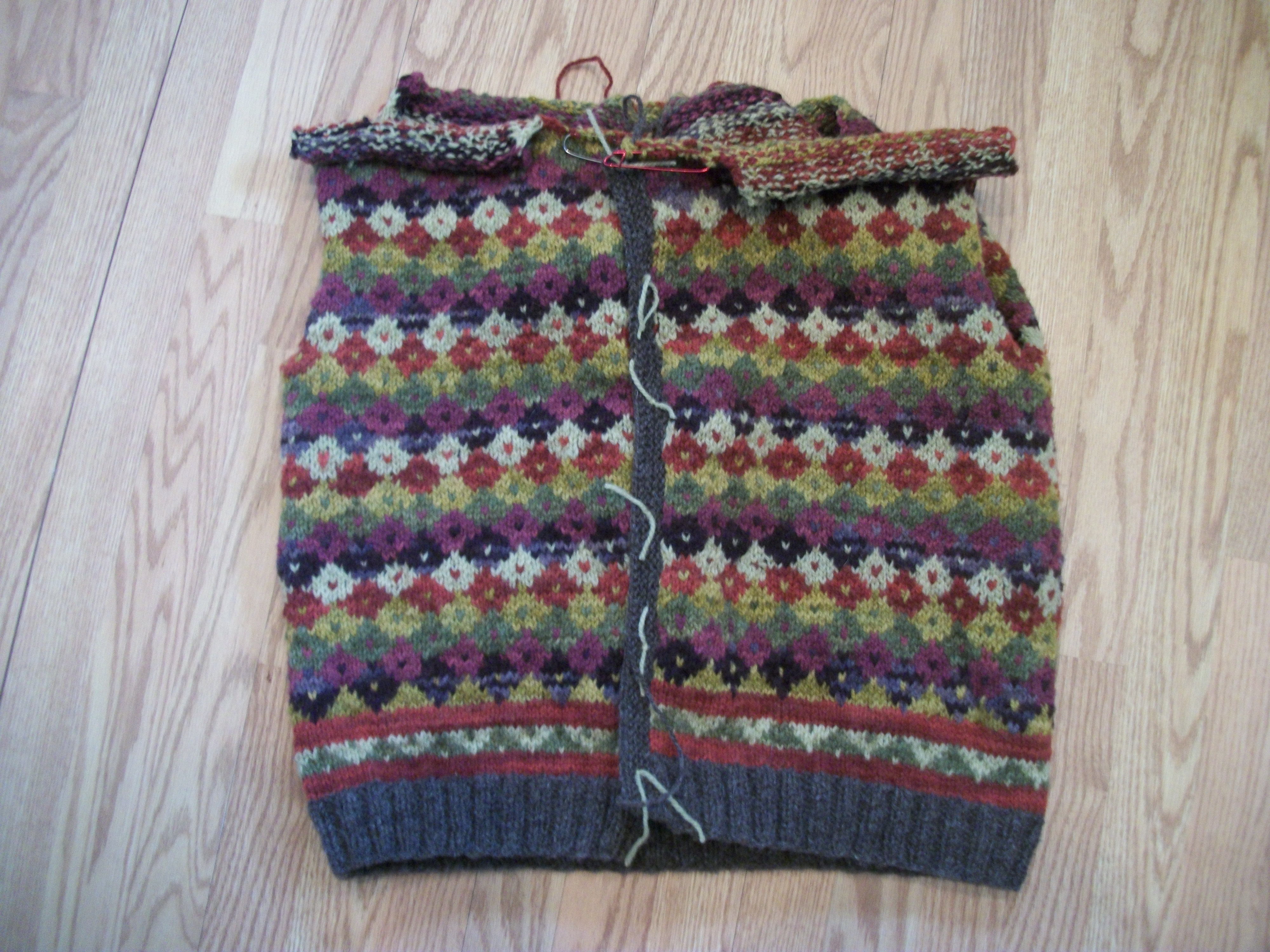
Here’s what the sweater looks like now.   I’ve sewn the shoulder seams since I took this picture, so I can now pick up the neck stitches.  I got a circular needle of the right size (7) in Belfast to do so.  I’ve got one sleeve mostly done.  The best news is that after sewing the shoulder seams, I could try it on.  I did, and IT FIT beautifully.

To remind, this yarn comes from Kelly Corbett’s Romney Ridge Farm down in Woolwich, Maine, just south of Damariscotta.  The yarn is all hand-dyed and the colors shade in and out–you can see that in the purple diamonds.  The yarn on the ribbing is the natural color of one of Kelly’s sheep.

Aloisia Pollock designed the pattern for the sweater and the carrying color pattern and taught Giovanna McCarthy and I how to do it.  You can view the yarn balls and get all the info on both of these terrific women from earlier blog postings in the knitting category.  Giovanna chose different colors, and her sweater is gorgeous too.  You can see Giovanna’s colors on the earlier posting as well.

Interesting Information: Carmina Burana

Interesting Information:  April 20, 2012

Carmina Burana

One of the many joys of living in mid-coast Maine is that a very rich array of arts are available to us each week of the year.  This area is known for its artists, musicians, writers, and so forth.  We live in an intellectual mecca in many ways.

Last weekend, we attended one of the many concerts that the Bay Chamber organization brings to us each year.  This event featured Carl Orff’s “Carmina Burana,” performed by our own Down East Singers and three soloists (NPR’s Suzanne Nance, Daniel C. Stein, and Andrew Garland), each of whom had gorgeous voices.

If you think you don’t know Orff’s “Carmina Burana,” you do.  The opening song, “O Fortuna,” has been featured in literally hundreds of movies.  Take a look:

http://en.wikipedia.org/wiki/Carl_Orff’s_O_Fortuna_in_popular_culture

And, here’s one utube version of the many listed versions of ” O Fortuna”:

http://www.youtube.com/watch?v=p9eEwsGPf3s

What I didn’t know until last Saturday, was that the WHOLE “Carmina Burana” is a collection of very old  secular songs originally written in medieval Latin, Old French, and Middle-High German.  Anthony Antolini, conductor of the Down East Singers, told us that “Carmina” is from the Latin word “carmen,” which means secular songs.  The first song, “O Fortuna,” is about Fortune, the Empress of the World, and often features a wheel of life that turns–something you can see in the utube selection above.  These early songs were “spicy” and were sung by goliards, or street persons living by their wits.

Mercy!  It’s always so fun to learn something new.

Interesting Information: Canola Oil and Toxic Erucic Acid

Interesting Information:  April 19, 2012

Canola Oil and Toxic Erucic Acid

Canola oil is the “go to” oil for almost everyone now.  Because it does not have a strong taste–as it’s highly processed–it gets put into salad dressings, baked goods, and cooked with in all kinds of ways.

Loren Cordain, the modern “father” of the Paleo diet research, has withdrawn his support of canola oil, which he allowed in the 2002 original version of his THE PALEO COOKBOOK.

Here’s the excerpt explaining why (22-23):

Since the publication of the first edition of THE PALEO DIET in 2002, I have reversed my position on canola oil and can no longer endorse its consumption.  Canola oil comes from the seeds of the rape plant (Brassica rapa or Brassica campestris), which is a relative of the broccoli, cabbage, Brussels sprouts, and kale family.  Undoubtedly, humans have eaten cabbage and its relatives since before historical times, and I still strongly support the consumption of these health-promoting vegetables.  Nevertheless, the concentrated oil from Brassica is another story.

In its original form, rape plants produced a seed oil that contained elevated levels (20-50 percent) of erucic acid (a monounsaturated fatty acid labeled 22:1n9).  Erucic acid is toxic and causes tissue damage in many organs of laboratory animals.  In the early 1970s, Canadian plant breeders developed a strain of rape plant that yielded a seed with less than 2 percent erucic acid (thus the name canola oil).

The erucic acid content of commercially available canola oil averages 0.6 percent.  Despite its low erucic acid content, a number of experiments in the 1970s showed that even at low concentrations (2.0 and 0.88 percent), canola oil fed to rats could still elicit minor heart scarring that was considered pathological.  A series of recent rat studies of low-erucic canola oil conducted by Dr. Ohara and colleagues at the Hatano Research Institute in Japan reported kidney injuries, increases in blood sodium levels, and abnormal changes in the hormone aldosterone, which regulates blood pressure.

Other harmful effects of canola oil consumption in animals (at 10 percent of their total calories) included decreased litter sizes, behavioral changes, and liver damage.  A number of recent human studies of canola and rapeseed oil by Dr. Poiikonen and colleagues at the University of Tempere in Finland showed it to be a potent allergen in adults and children that causes allergic cross-reactions from other environmental allergens.  Based on these brand-new findings in both humans and animals, I prefer to err on the safe side and can no longer recommend canola oil in the modern-day Paleo Diet.

Cordain goes on to say that olive oil has “less than positive omega 6 to omega 3 ratios–11 to 7.  So, excessive consumption without enough long-chain omega 3 fatty acids (EPA and DHA) will “derail an otherwise healthy diet.”

The Weston A. Price Foundation (WAPF) has long warned that all of the highly-processed vegetable oils cause heart disease.

I use high-quality (centrifuge extracted) coconut oil to saute or bake.  Or, tallow or lard if I can get it.   If I’ve got chicken fat on top of my broth, I use that to sweat out vegetables for a soup using the broth.  I reserve high-quality olive oil for salad dressings.  I use rendered duck fat to pan fry potatoes for a special treat–and they are beyond delicious!  It’s pretty safe to say that I rarely, rarely deep-fry anything.  I think the last time was some doughnuts, but I’ve since learned more about fats.

I’m not above eating the very occasional homemade doughnut when breakfasting out, however.  The are delicious.  And, addictive.

Turkey Tracks: Tami’s First Quilt

Turkey Tracks:  April 19, 2012

Tami’s First Quilt

Tamara Kelly Enright, or Tami, is SEWING!

Two summers ago, Tami bought a used Janome sewing machine from Marge Hallowell at Mainely Quilts in Nobleboro.  But, she has her hands so full with four kiddos under 8, now.  So, about 18 months passed before, during Thanksgiving, we got it out and started a project.  She made a receiving blanket for her coming nephew, Meyer Kelly.  And, I left her with fabric for pillowcases, the instructions, and with two extra feet ordered for her machine–a walking foot and a darning foot for free-motion quilting.  Soon, she was making pillowcases with abandon.

What’s fun about this story is that her two youngest–Talula and Wilhelmina–are helping pick out fabrics, hanging over the machine, and getting very excited when it’s time to give the gift that has just been made.  My guess is that there are two generations learning to sew now.

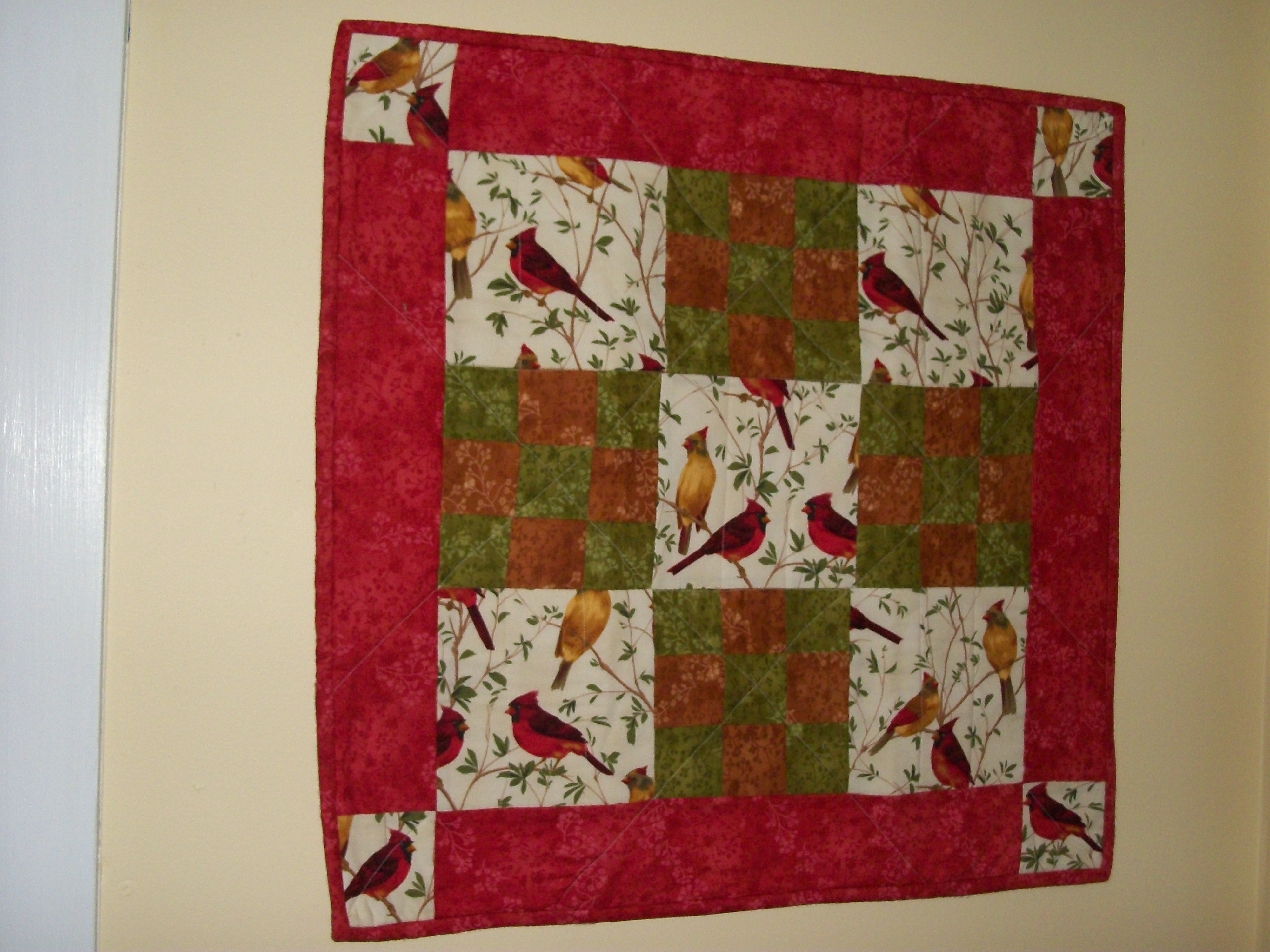
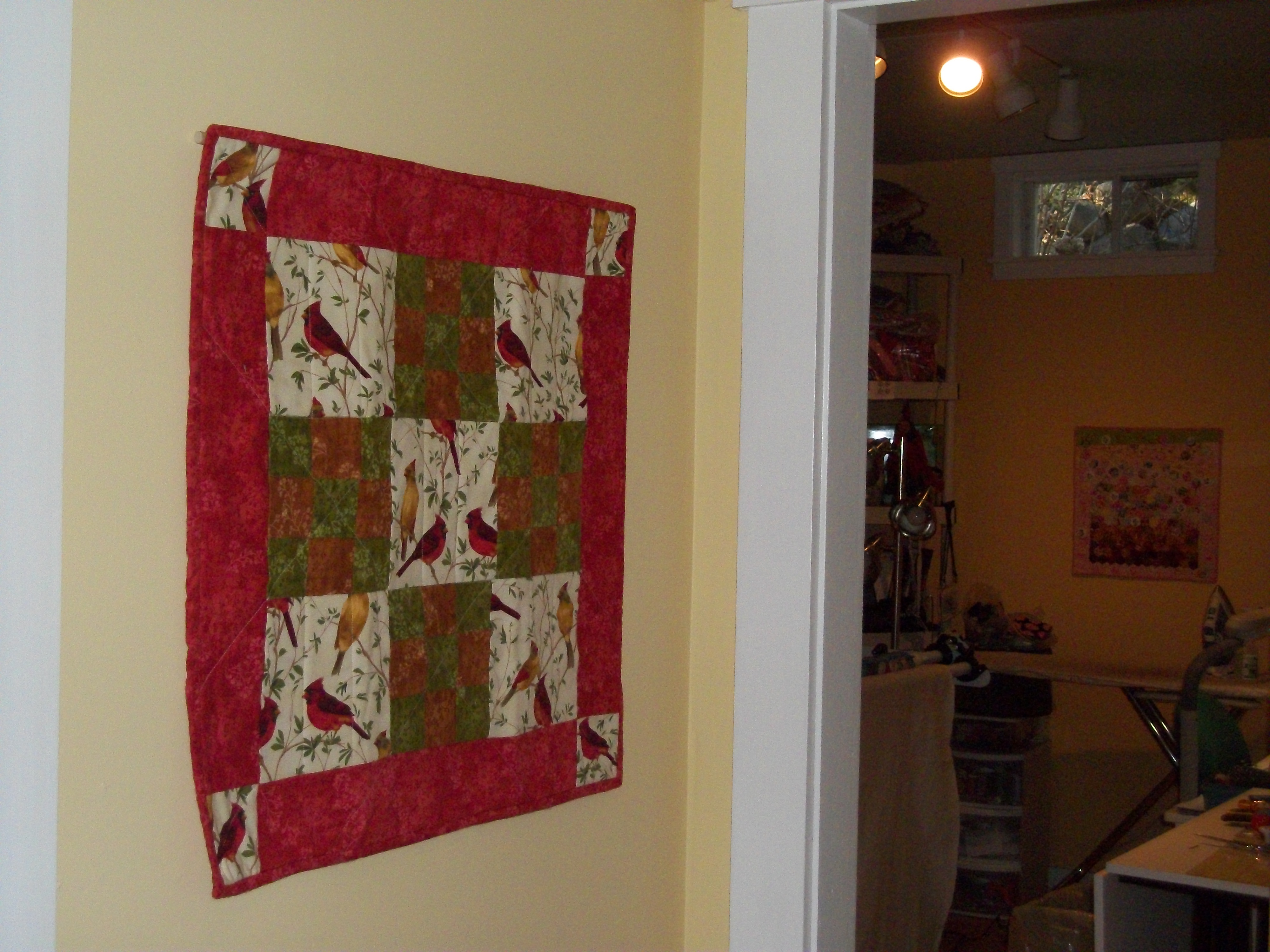
So, imagine my surprise and pleasure when a wall quilt arrived in the mail for my birthday.  And, it’s beautiful!  The girls helped pick out the fabric, and the whole family participated in that the guys had to do without mom for a bit while she sewed.  I hung it outside my quilting room door.  Isn’t it beautiful?

Tami’s first quilt is called “Maine’s Breakfast With a View” because from the windows in our dining area, you can see all the bird feeders and birds, the woods beyond the house, and, in winter, the ridge beyond our house.

I love the bird fabric.  I’ve been very drawn to bird fabric lately and just bought a yard to fussy cut not long ago.  There are so many really gorgeous bird fabrics on the market now.  I also really love the reds in this quilt–they look so warm in this spot outside my quilt room.  And I think the way Tami coordinated fabrics in this quilt shows real promise.  She is now taking a sewing class as she’d like to make some dresses for the girls–which is all how it starts.

What a fabulous birthday present!  I will treasure this quilt always!

Interesting Information: The Maine CDC Joins the Salt War

Interesting Information:  April 15, 2012

The Maine CDC Joins the Salt War

Recently, the Maine CDC ran a warning in our local paper, The Camden Herald, about the dangers of salt consumption.  Its conclusions were based on a 2010 study out of Stanford.

At best, this Stanford study can only be called junk science.  As such, it—and our government’s support of it–will only confuse people about how to eat.

First, the study uses data from the Framingham heart study.  Framingham relies on what people said they were eating–which is famously always already vexed.  Stanford singles out salt consumption.  But, what about everything else folks were eating that might cause heart disease?  Therefore, this Stanford study can only show correlation, not causation with regard to salt consumption.  Acting from correlation is famously not scientific.

Second, the 2010 Stanford study’s results are based on a computer model that predicts causation.  But, computer models only work if they are using correct data.  This data can only be based on faulty information since people are only remembering what they think they have eaten.

Third, there are many, many studies showing that salt consumption is not related to blood pressure.  Or, heart disease.  You can read an essay I wrote on the salt wars on this blog:  Mainely Tipping P0ints 38.  You can view a video refuting this government anti-salt campaign, “The Salt Guru:  Fight Feds for Salt Freedom,” http://www.youtube.com/watch?v=re_V0pazMfc&feature=youtu.be.   And you can view the Weston A. Price’s press release on their main web page, http://www.globenewswire.com/newsroom/news.html?d=243574.  .

Salt is crucial for human health, so why is our government starting another salt war?  One reason might be industry production costs, especially when industry is using a lot of salt to mask the quality of inferior, fake foods.

We need to insist that our government be more careful about warning people about what is dangerous to eat.  We need to insist that our government does not facilitate or participate in faulty belief systems.  We need to insist that our government promotes solid science.  Otherwise, our government is working for industry and not for us.

Eat good salt, though, not the fake kind.  Buy unprocessed sea salt.


Turkey Tracks: “Seriously Scrappy” Quilt

Turkey Tracks:  April 13, 2012

Seriously Scrappy Quilt

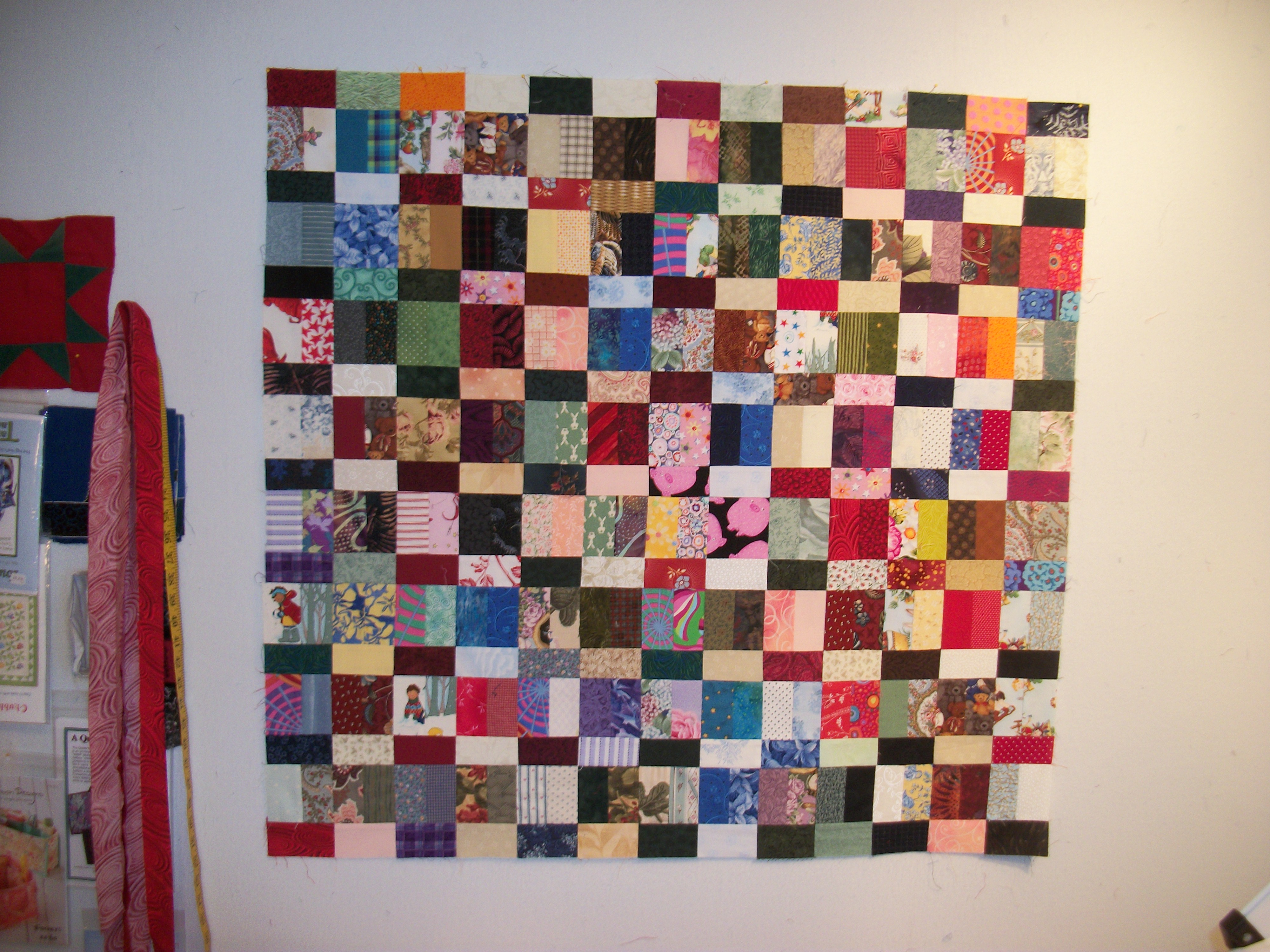
Here’s the latest finished quilt from “The Scrappy Quilt Project.”  Starting with a pattern from SUCCESSFUL SCRAP QUILTS (Judy Turner and Margaret Rolfe), I made light and dark blocks and alternated them.  So far, so good:

I had already pulled enough rectangles to make two other quilts–one of those tops is finished so will go on the long-arm next week.  The other uses strips of the cream-colored rectangles with some rich dark brown fabric and, maybe, a coordinating paisley.  So this quilt, already named “Seriously Scrappy” is using up as many of the remaining rectangles as is possible.

I had enough red and green rectangles to make a border–see?

Here’s a different angle:

With the top in hand, I went down to get help from Marge Hallowell of Mainely Quilts–who has been a great advisor with The Scrappy Quilt Project, and ran right into a fabric that had just come into the store.  I knew at first sight it would be perfect for the back:

See how well the top and this fabric play together–especially when bound with the great olive green striped fabric cut on the bias.  I make all my bindings on the bias now.  They just perform and wear so much better than using a straight grain.

Here’s a close-up of the quilting–with a few stray white dog hairs in the picture.  The dogs love it when I put bindings on quilts; they get beneath the quilt on both sides of me.  I used the Bishop’s Fan pattern groovy boards for the first time, and I LOVED doing it–so much I ordered a third board to make the quilting easier for the Bishop’s Fan and for the clam shell pattern.  Groovy boards make this daunting pattern really easy, and I love the way it looks on the quilt itself.  I used a variegated green Superior thread that Marge Hallowell of Mainely Quilts helped me pick out.  It’s beautiful on both sides of the quilt.  You always have to remember how a thread will look on both sides of a quilt–and I don’t like threads to really stand out all that much usually.

Years ago, my sister Maryann Enright asked me for a quilt that “had all the other quilts in it.”  So, Maryann, here it is!

Interesting Information: Letter to Maine Senators Snowe and Collins, Safe Chemicals Act of 2011

Interesting Information:  April 11, 2012

Safe Chemicals Act of 2011

My Dear Blog Readers,

The Safe Chemicals Act of 2011 will be voted on this month.

I urge you to read the letter I wrote to my own Maine senators, and I urge you to write to your own senators about this issue.  Use whatever parts of my letter you desire.  You can copy text, google your senators, and send them information online.  All of them have email set up to hear from their constituents.  It only takes a moment.

I, personally, have lost so many loved ones and community members from cancer.  Many of these people were very young.  I know you have as well.  We have to back ourselves out of the mess we’ve made with all these chemicals.  And that will start by using real science to access the risk of each and every chemical in use.  Be aware that despite mainstream media information to the contrary–which constantly claims “cures” for cancer–these chemicals are killing us in alarming, record numbers.  The profits industry is making are not worth one single human life.

We must act together now.  Write your senators and congresspeople.

Louisa


Dear Senator Snowe and Senator Collins,

I am writing to ask you to support the Safe Chemicals Act of 2011 (S. 487), sponsored by Senator Frank Lautenberg.  Since 1976 the Toxic Substances Control Act (TSCA) has been the only legislation controlling chemical use.  However, TSCA is toothless and, as such, has been powerless to prevent the use of chemicals that are harmful to humans.  As a result, we are awash with chemicals that are causing a wide range of illnesses, including cancer. 

Leigh Erin Connealy, MD, a cancer specialist, said in a recent interview that cancer is now the number one killer of people from 1 to 85 years old and that one in two men and one in three women will experience having cancer—the treatment of which has vastly increased national medical costs.  These rates are so horrific that they are hard to comprehend. 

In LIVING DOWNSTREAM, biologist and cancer survivor Sandra Steingraber, PhD, wrote that a whole new class of very aggressive cancers is now increasing, like non-Hodgkin’s lymphoma which has tripled since 1950.  Lymphomas are “consistently associated” with the phenoxy pesticides and herbicides which are used widely on crops, lawns, gardens, timber stands, and golf courses. 

Petroleum-derived synthetic chemicals, writes Steingraber, “easily interact” with our bodies and, thus, interfere with our life processes.  Many are soluble in fat and collect in animal tissues high in fat, like human brains, breasts, bone marrows, and livers, all of which are sites where cancer is increasing. 

TSCA “grandfathered” or exempted more than 60,000 industrial chemicals.  TSCA wrongly presumes that these chemicals are safe unless the U.S. Environmental Protection Agency (EPA) proves harm.  Yet in more than 30 years, EPA has ordered chemical manufacturers to fully test only 200 of what are now 80,000 or more chemicals.  Of the few thousand chemicals that science shows for certain are dangerous, EPA has only banned or restricted the use of 5 toxic chemicals. 

Further, after a recent EPA panel convened to access the risk of atrazine to human health concluded that there is a one-to-one relationship of this chemical with human cancers, EPA has pushed off any action until 2013.  Meanwhile, more people are dying.  This lack of action seems to me to be not only lacking in consciousness, but  immoral and unethical.  Industry is still free to continue to use tons and tons of this chemical every year.  It is now in all of our water and much of the soil where food crops grow.      

The President’s Cancer Panel 2009 report states that our regulatory system for chemicals is deeply broken; that we are putting ourselves and, more importantly, our children at great risk; and that we must adopt precautionary measures rather than using reactionary measures, which means waiting until sufficient numbers of humans are maimed or killed.  The Precautionary Principle states that no chemical can be used unless it has been thoroughly demonstrated not to be harmful for human life. 

The Cancer Panel directly connects cancer and environmental toxins.  Indeed, the Cancer Panel is “particularly concerned to find that the true burden of environmentally induced cancer has been grossly underestimated” and that human “exposure to potential environmental carcinogens is widespread.”

The Cancer Panel determines that TSCA “may be the most egregious example of ineffective regulation of environmental contaminants”:  “TSCA does not include a true proof-of-safety provision”—which means “neither industry nor government confirm the safety of existing or new chemicals prior to their sale and use.”

The Cancer Panel surfaces the “catch 22” at the heart of TSCA:  it allows industry “to avoid discovering worrisome product information which must be reported by simply not conducting toxicity tests.  And, as the “EPA can only require testing if it can verify that the chemical poses a health risk to the public,” the “EPA has required testing of less than 1 percent of the chemicals in commerce….”  

In order to protect its market, the chemical industry has followed the very successful tobacco industry model, which Devra Davis details in THE SECRET HISTORY OF THE WAR ON CANCER.  The tobacco industry spent astonishing amounts of money to advertise tobacco use, to delay negative decisions, to hide negative science, to craft favorable legal decisions, to obfuscate science with problematic studies from paycheck scientists, and to fire or discredit anyone saying tobacco use was unhealthy. 

Scientists are beginning to discover that very small amounts of chemicals can cause vast human harm.  Regulatory bodies, explains Dr. Frederick Vom Saal, have determined what they believe to be safe levels for humans by using an idea dating from the sixteenth century:  “the dose makes the poison.”  Vom Saal says this premise is false, especially for any hormone, like Bisphenol A, or BPA, which is “one of the most toxic chemicals known to man.”  Vom Saal explains that recent studies are showing that even minute levels of BPA are unsafe. 

We are, Steingraber argues, “running an uncontrolled experiment using human subjects”—an experiment that has had deadly consequences since the World Health Organization has concluded that “at least 80 percent of all cancer is attributable to environmental influences.”  Cancer cells, Steingraber argues, are “made, not born.”

It is very clear that we cannot continue using untested chemicals and enjoying healthy lives.  It is very clear that we are massively harming our children and tampering with our ability to procreate successfully.  It is very clear that we must develop a political will for change.   

The Safe Chemicals Act of 2011 would  require chemical companies to demonstrate the safety of industrial chemicals and the Environmental Protection Agency (EPA) to evaluate safety based on the best available science.  It is a step in the right direction. 

Again, I am respectfully asking you to support it fully.