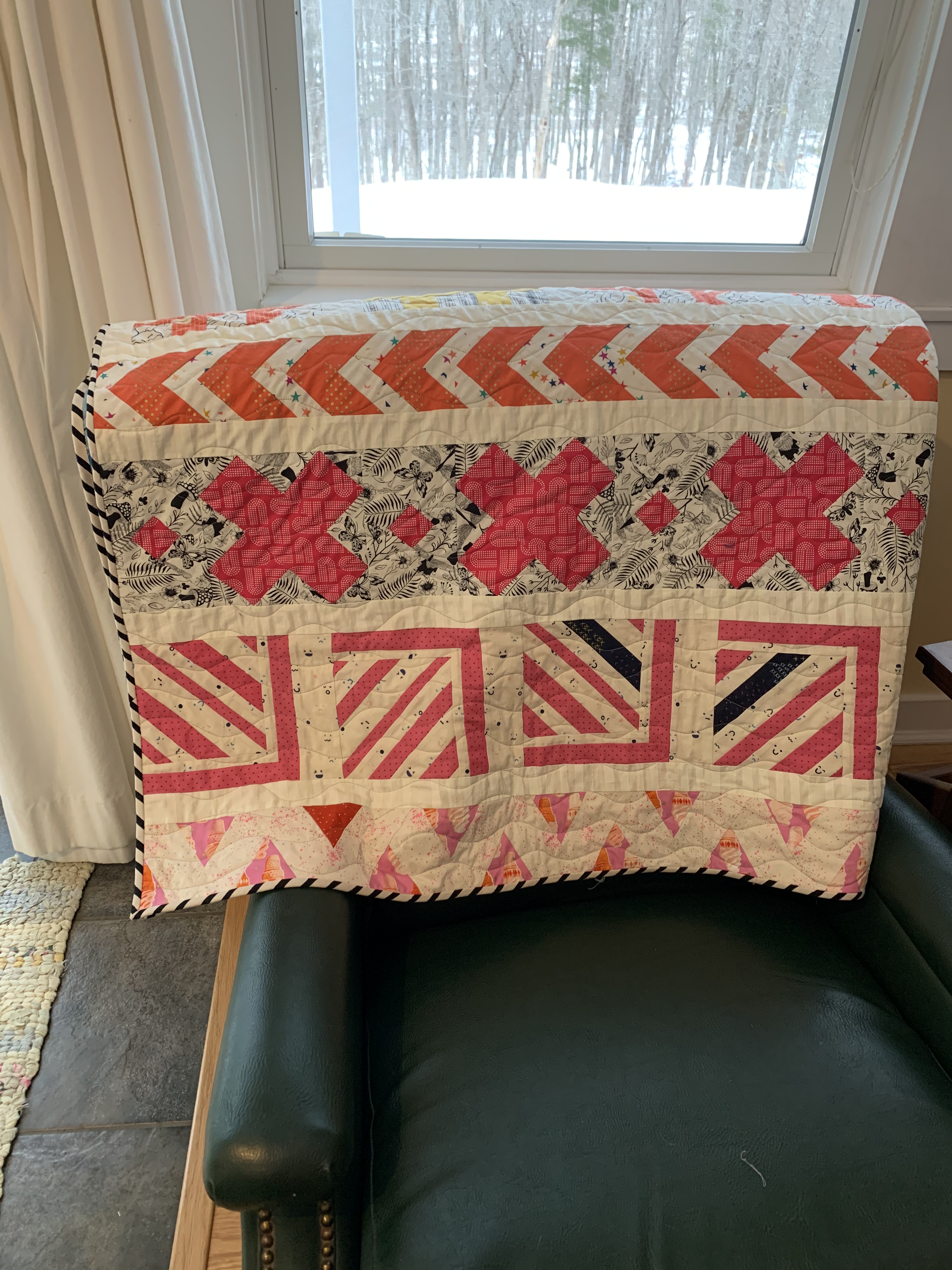
It would be hard for me to pick which one of these two Sugaridoo/Bernina Quilt-Alongs I like the best. Certainly I had fun with picking the fabrics on the Cotton+Steel version. And since I always started each month with the Rainbow version, the C+S version was much easier to make.
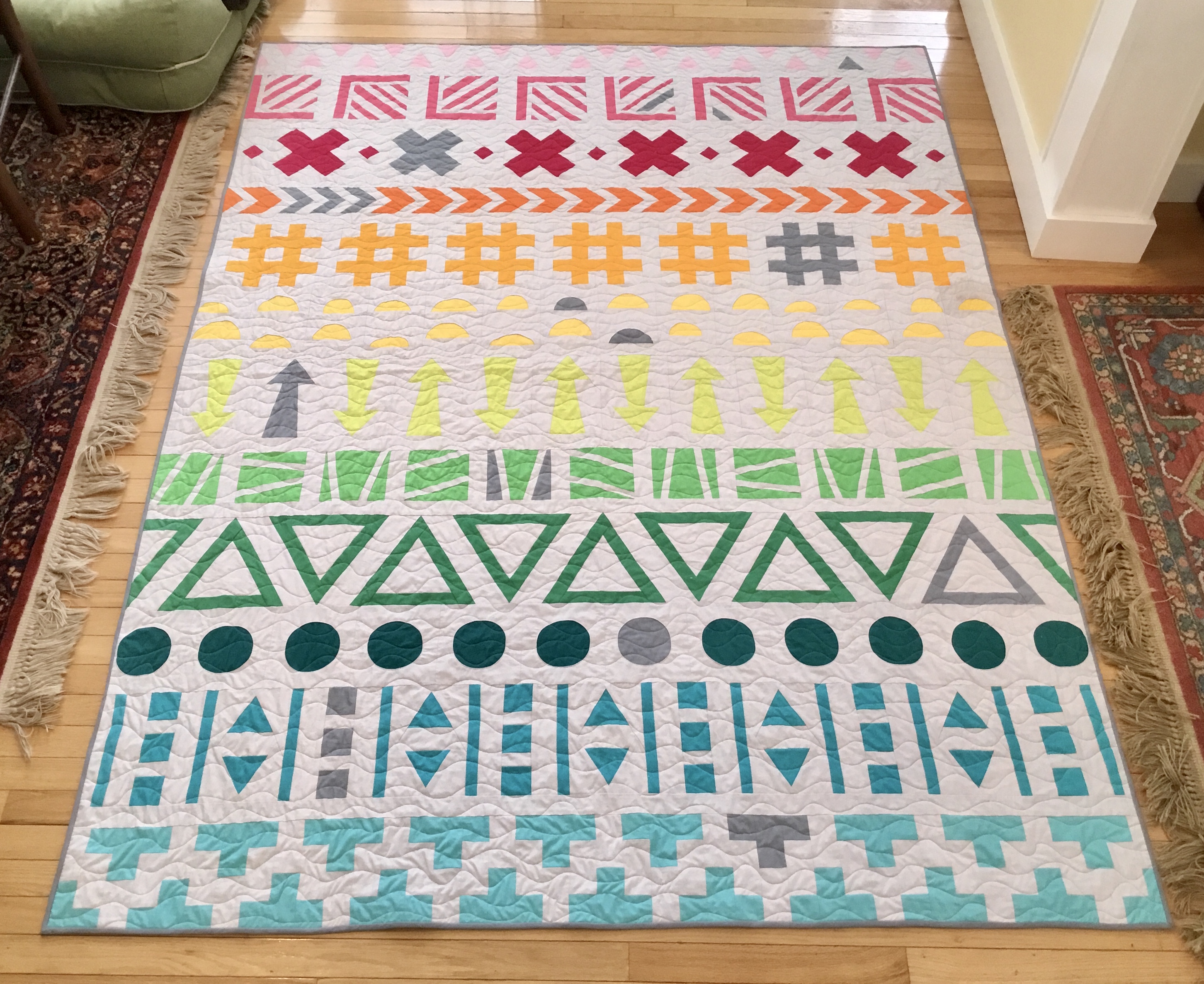
As a reminder, here is the solid Rainbow version—with fabrics Sugaridoo chose.
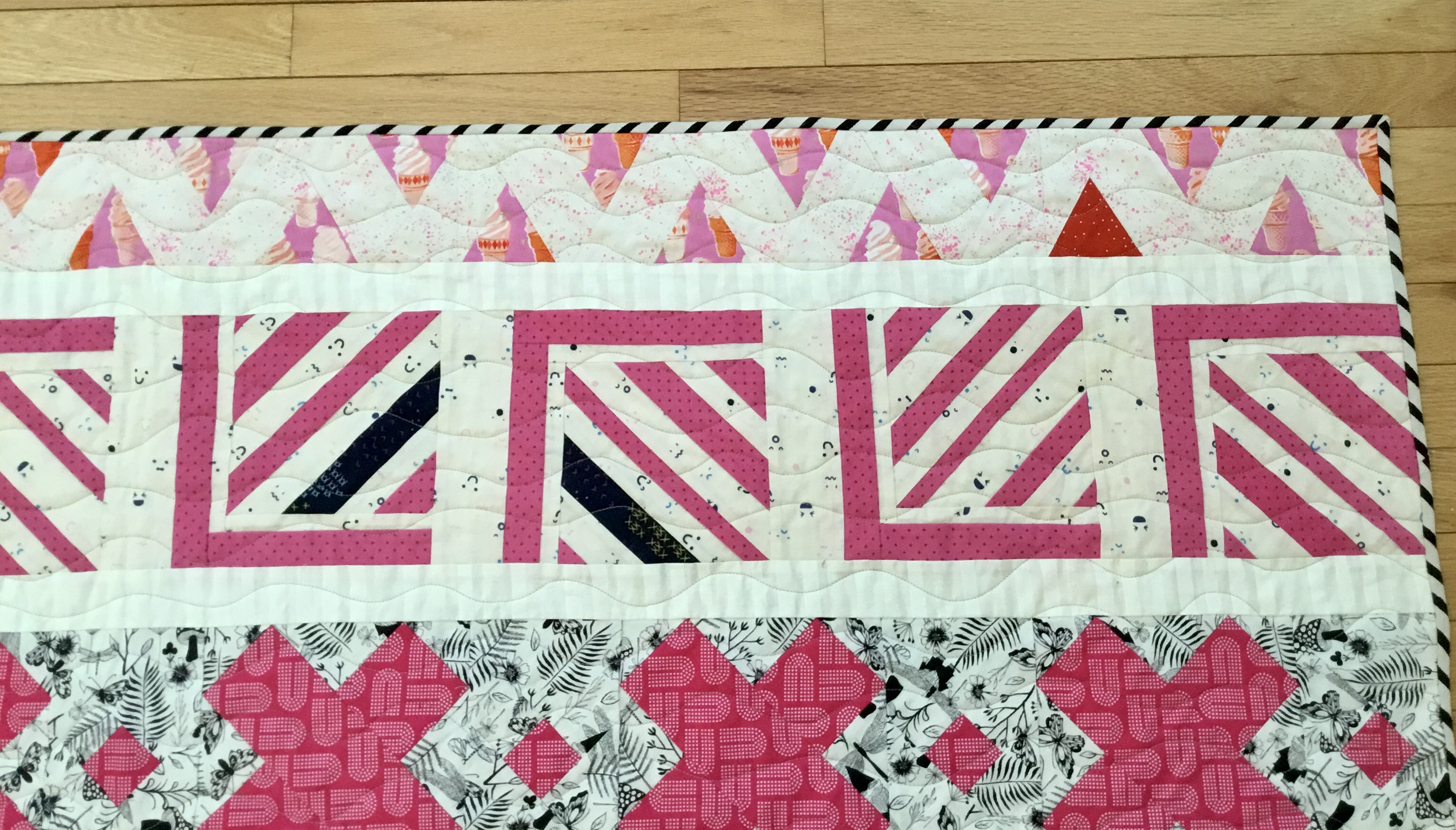
I took a bit of a chance with the wide stripe binding—but I’m really pleased with how it turned out. I cut bindings on the bias, so a bias-cut stripe can work really well with some quilts. There is actually a lot of black in this quilt, so the binding fits right in just right. The first pic below is the bottom, and the second the top.
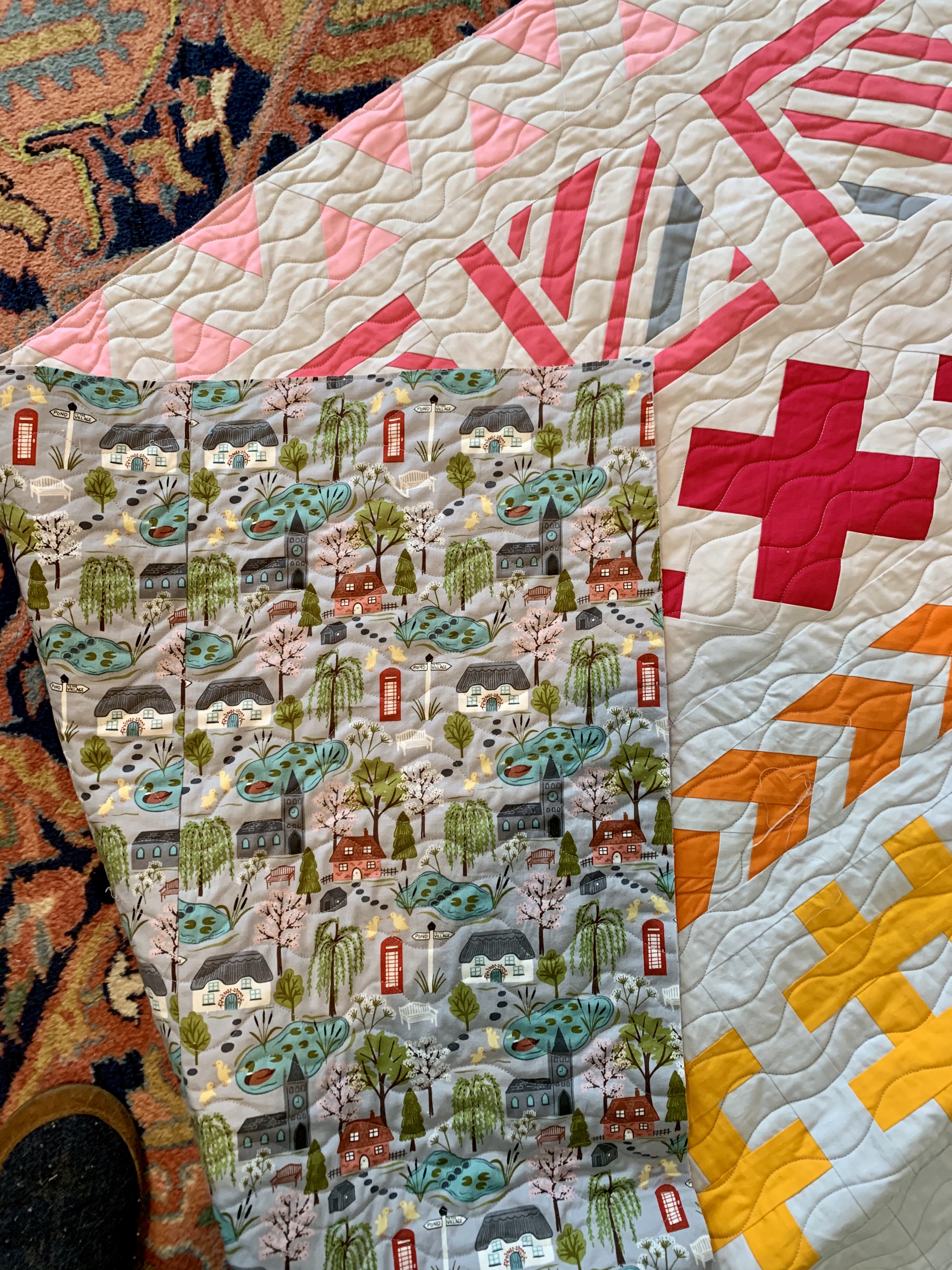
And, this binding works well for the backing fabric as well.
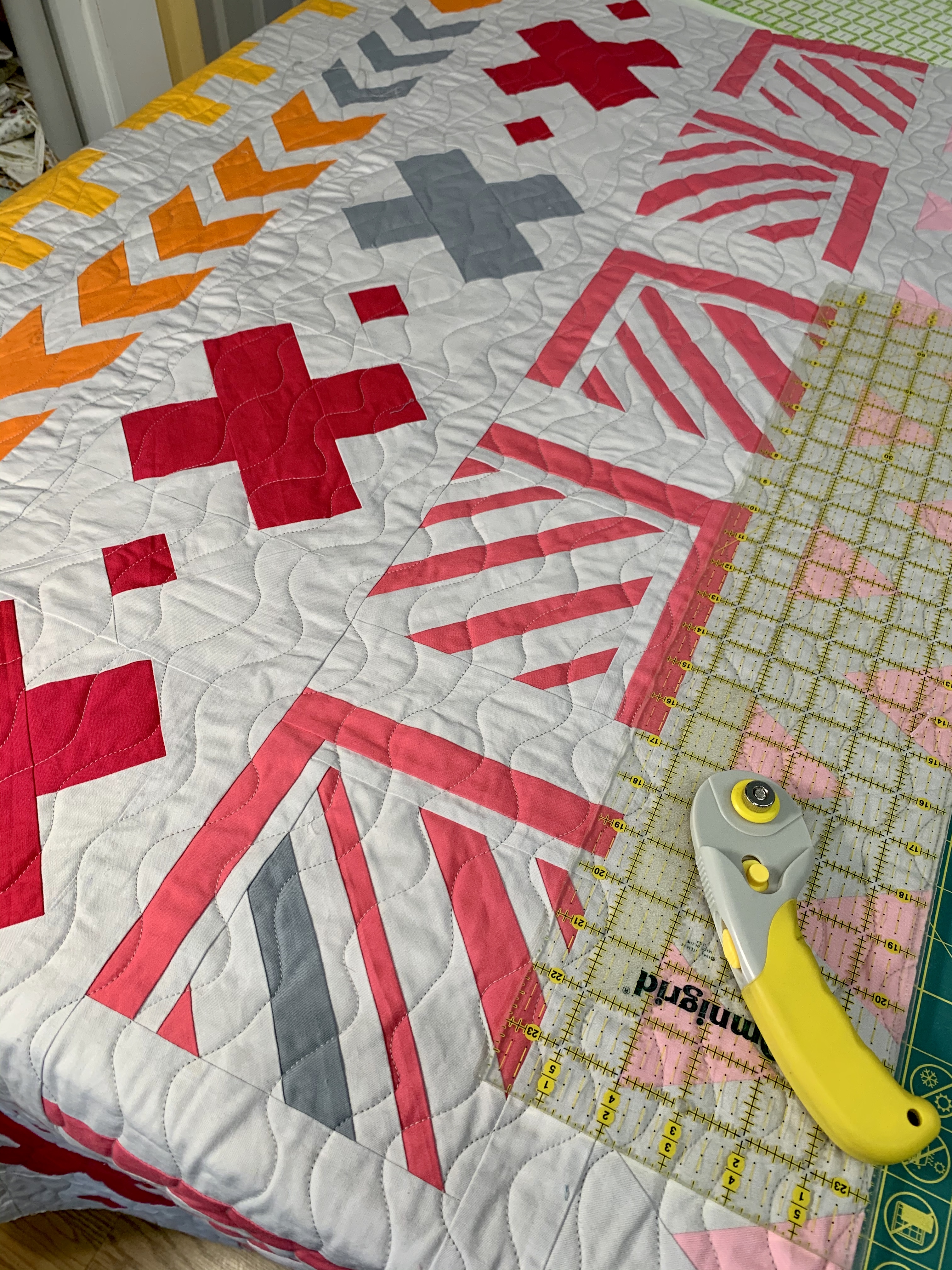
Here are some close-up pics of various parts of this quilt. Note that I varied the “accent” piece in each row to fit that row.
As noted in the post about the Rainbow version, each row’s pattern offered both a pattern and a learning curve.
It is very satisfying to finish a year-long project, let alone TWO os the same project. I’m still not sure what possessed me to undertake two of the same quilt at once. But I’m not sorry…
And now the promised snow is starting, so I will have another quilty day.
This last week was a busy one for me, so blog postings got put on hold. This coning week will contain several snow storms, starting later today, and that is just fine by me. I have food (or will get what I need this morning), and I have LOTS of ongoing quilty projects.
The “Trees” quilt top is done now. Remember that these quilt blocks were inspired by the work of Amanda Jean Nyberg of Crazy Mom Quilts. Making the tree trunks turned out to be the most time-consuming task in this project. A lot of solid stash went into “Trees” and more printed scraps and cuts from the print stash then I would have thought.
I purchased a new WILD print for the backing—as I didn’t have a backing in my stash that would work for this quilt. It’s a “rainbow” print from Alison Glass and Andover fabrics called “Art Theory Whole Cloth in Day.” It’s WILD, right? But it screams about the abundance in spring/summer flora and the insect world. The colors are perfect though. I don’t know about the binding yet—probably a solid green from my stash. Or maybe that majenta.
The “My Pips” top is now quilted, and I will trim it today and install the binding. This quilt block and these fabrics are a project in season 3 of The Color Collective, Tara Faughnan designer/teacher, on Amy Newbold’s Sewtopia platform. I really, really liked the fabric palette for this project.
After Debbie from A Quilter’s Table recommended WALK, a book about quilting on a domestic sewing machine with one’s walking foot, I scrolled her blog once again to look at her quilting and found this quilt on her “Working Small, ”December 27, 2020, post (https://aquilterstable.blogspot.com/search?updated-max=2020-12-28T08:09:00-08:00&max-results=1&start=5&by-date=false). I include it here to show the lovely curved quilting she did—by starting her diagonal curve lines from opposite corners and working from the center line on each side and working out to the corners of the quilt. And, by the way, right now Debbie is doing a self challenge of 50 small scrap quilts in 50 days, which is inspiring and down right fun to see.
Here’s “My Pips” at this point. I’ve been looking and looking at these great swirls—which remind me of spring winds swirling about and bringing warmth with them. I think I’ve decided NOT to do the opposite swirl pattern on this quilt. I think what is there now is enough. And I am noting that my swirls are an inch apart. Debbie’s seem to be a bit wider, and that, I think makes a difference in the acquired density. The binding will be the Kona “Thistle” lavender fabric you see in this quilt.
Here’s a closer view.
The February Color Collective project in somewhat underway now. The fabrics are washed, ironed, and partially cut. Tara’s improv quilt is called “Bokeh” and is, in part, all about how color relationships work to create certain effects in a quilt. These end-cut squares are going to allow me to figure out how my blocks will look—and I’m already moving around ideas A LOT before I actually sew ONE idea together—maybe later today. (I probably won’t be able to resist). This quilt involves MANY ideas about how blocks function in a quilt, and I think these improv block versions will begin to inhabit a life of their own. Quilts DO talk to their maker if the maker listens.
Here’s one block mock-up to try. I’ll probably change it, knowing me. But once chosen, each idea will make four blocks. And you can see that they can be turned in multiple ways and spread throughout the top. Or, not. I will definitely spread them around. I was thinking of a small quilt, just to try out this method. But I can already see that I’ll get addicted. I usually do to Tara’s projects. And these projects are so much fun when one gets rolling with them.
Here’s the palette. There are darks, lights, brights, mediums, cools and warms.
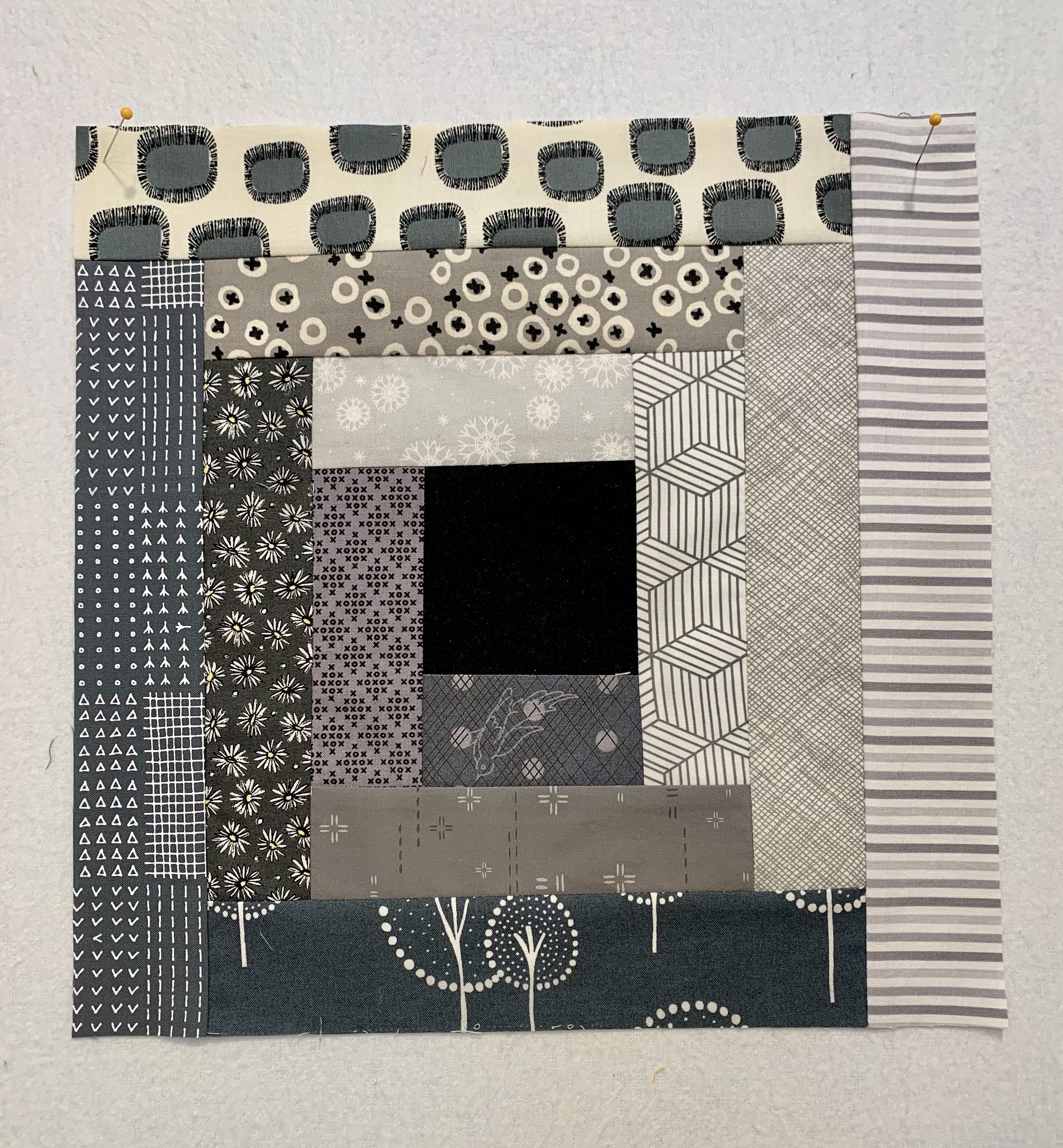
I have been ironing and cutting and replenishing blue and grey fabrics for many days now—for a large log cabin housewarming quilt for a niece out in Wyoming. I played with ideas for block size and decided on a 12-inch block made using a Creative Grids ruler that will also make a 6-inch block. I had one of these rulers in the 8-inch size, but it didn’t feel right to me for this project. I REALLY like these rulers for both log cabin and pineapple block projects as the finish for each block is dead perfect.
With the “Trees” top finished and the design wall vacuumed and ready to go, I made some initial blocks. I don’t know about the setting yet—when I’ve made more blocks my niece will choose the setting she likes. And I’m sure blocks will get moved around. But here are the first blocks. This is the primary quilt project for me now as this family is moving into their new home TODAY.
I’m thinking down the road that I’ll make this quilt in dark and light greys with a black center chimney. So while cutting, I made a trial block, and I really like it. I’ve been wanting to make a grey quilt.
The binding on “Sugaridoo: Cotton+Steel/Ruby Star Society”—the second Sugarisoo quilt—is almost done, and I really love the wider black and cream stripe for this quilt. I will finish it tonight probably, So pics will come soon.
The hand quilting thread for “My Splice” came, so I will circle back to that project after I complete the binding on “My Pips.” I have no idea how I’ll quilt “Trees,” but it will be likely on the longarm as I think it needs curves. Did I just say “curves” after loving the curves on “My Pips.” Hmmmm…
Meanwhile, as you can see, I have lots of fun projects for quilty play and production. And I am noting that I did not cover three projects I would really LIKE to make—OR the assembling of the improv blocks made for me by my fellow “Be Inspired“ prompt challenge members.
There are some quilts I make that just don’t want to go on the longarm. A longarm machine quilts side to side, so any kind of long diagonal line, or, even, a straight line that runs down the length of the quilt, would not work well with my machine’s 18-inch throat.
Jacquie Gering’s book WALK comes to the rescue of how to quilt with your walking foot.
Debbie of her A Quilter’s Table blog recommended this book, and you can see her work with this kind of walking foot quilting in so many of the quilts in her gallery.
What I learned immediately is how to figure out exactly where the needle is when the walking foot is installed—so that it is easy to make clear, precise lines AND to echo curves. Some of the quilting designs are just…amazing.
If you read this blog at all you know that I love learning curves—especially quilty learning curves. So, you will not be surprised to learn that I’m going to quilt “My Pips” with curves made with my walking foot.
It is Friday. And we are getting rain later today, so AC and I went out late morning to run food errands and to make some time for AC to chase his red rubber ball to run out his kinks.
What amazes me is that he knows where we are in the car, and if we are near any of the places where he can chase his ball, he begins to “talk” to tell me he’s so ready to go when we get there. It is a rare day when I don’t take him somewhere to run.
It’s hard to throw the ball and take videos, but here’s what I got this late morning at the Barrett’s Cove parking lot. Look at that happy face and wagging tail as he brings the ball back. If I can get the ball ahead of him, he’ll put on a burst of speed that is so fast. I’ve started wondering if he’s got some greyhound in him somewhere.
For some reason, when he brings back the ball, he rubs all over my legs, going around and around my body.
When he starts to out of breath, I’ll do a few “short” throws where I pound the ball against the surface so it goes high in the air. Most of the time he catches it on the fly, which is pretty darn awesome.
Here’s a picture of Barrett’s Cove. It is just one of my favorite spots winter and summer.
When we got home, it started to snow—not rain. And it is so pretty.
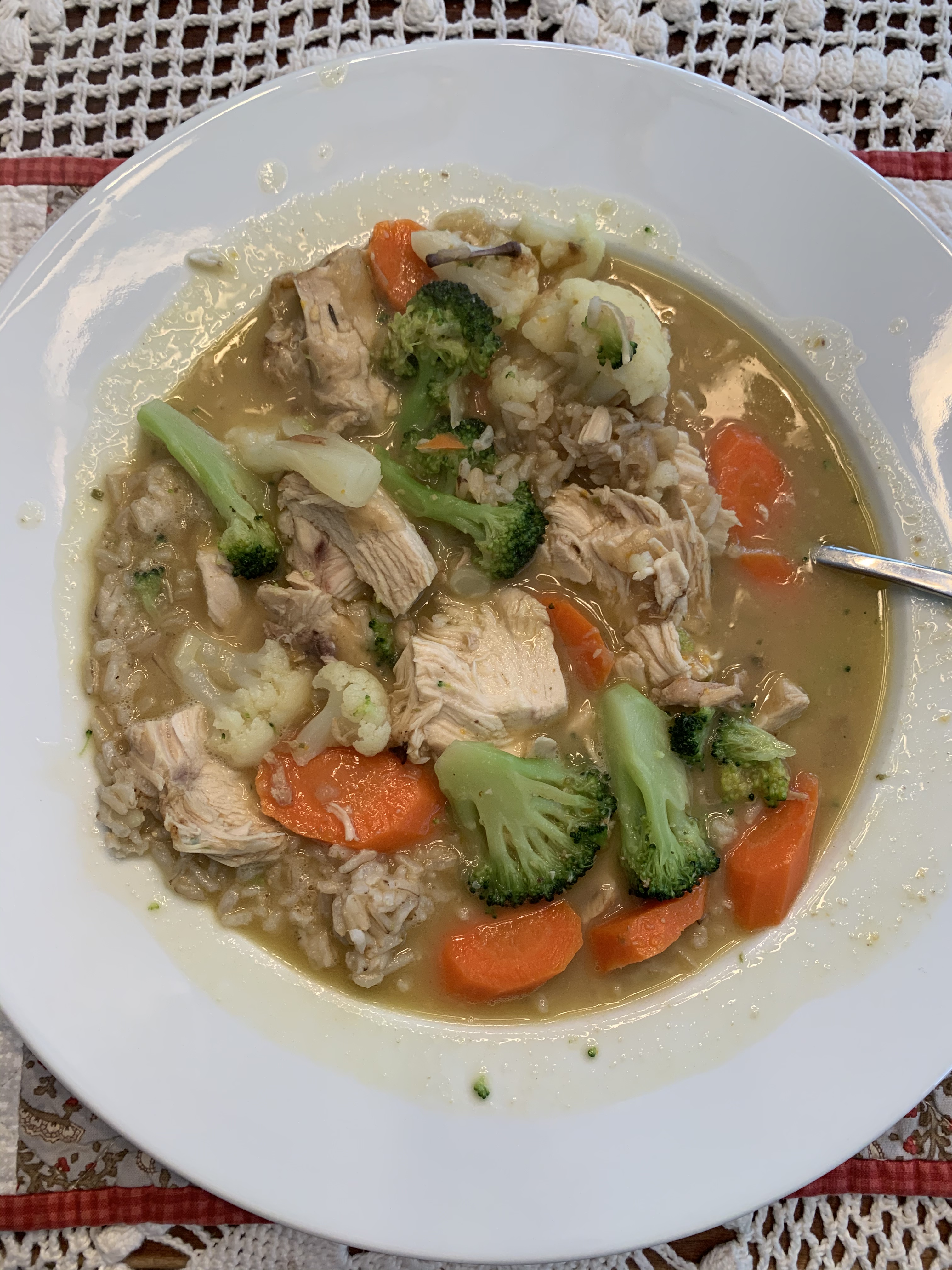
A warm lunch was in order:
I cooked some chicken breasts in 14 minutes in the Instant Pot last night! So I had delicious leftover tender and tasty chicken and a cream-based sauce made with onions sauteed in ghee and with some heavy raw cream, dried herbs, and a bit of mustard added. I added more chicken broth to the leftover sauce after I put away the groceries, and quick-cooked some fresh broccoli, cauliflower, and carrots in the sauce while I got the chicken off the bone. I added the chicken and poured the whole thing over the leftover rice from last night. I cooked a whole bag of sprouted brown rice in the Instant Pot some days back and froze the extra rice in individual portions.
And now I’m going to finish lunch and have some sewing time.
My love of the Tulip Sewing Needles started with the kind of “big stitch” hand quilting I often do that uses heavier threads. I prefer perle cotton size 8 and 12-weight cotton threads. The 12-weight is lighter than the size 8 cotton, but much heavier than a 50-weight thread such as I use with piecing. I prefer these threads to embroidery floss or the heavier perle cottons.
There are multiple manufacturers for these threads, so I am only limited by color availability. Red Rock Threads is a good place to start. Sulky’s 12-weight cotton threads also come in “mini” spools of 50 yards for $1.65 each, which allows one to collect an array of colors. And anyone reading this blog knows I love color in all forms.
I purchased the larger blue and ivory spools years ago—and I have a few of the blue and a lot of the ivory left. I have machine quilted quilt sandwhiches using either of these colors, but they lay down a strong line. I think they are best for grid quilting a quilt—and then decide if you want a strong quilting statement or not.
But, back to Tulip needles. My first ones were Sashiko needles. They are NOT cheap—they only come about 4 to a pack. BUT, they slide through fabric like a dream and they don’t bend. And I don’t have trouble threading them. In other words, these needles last. They are “polished” up and down to make them slide through the fabric easily. And they are available in many places online, including Amazon.
Here’s one of my Sashiko needles at work on my “My Splice” quilt with some 12-weight thread. The horizontal lines are from my longarm machine basting lines. I got a bit of a start on this project last night.
This quilt is going to look awesome when the hand quilting is done.
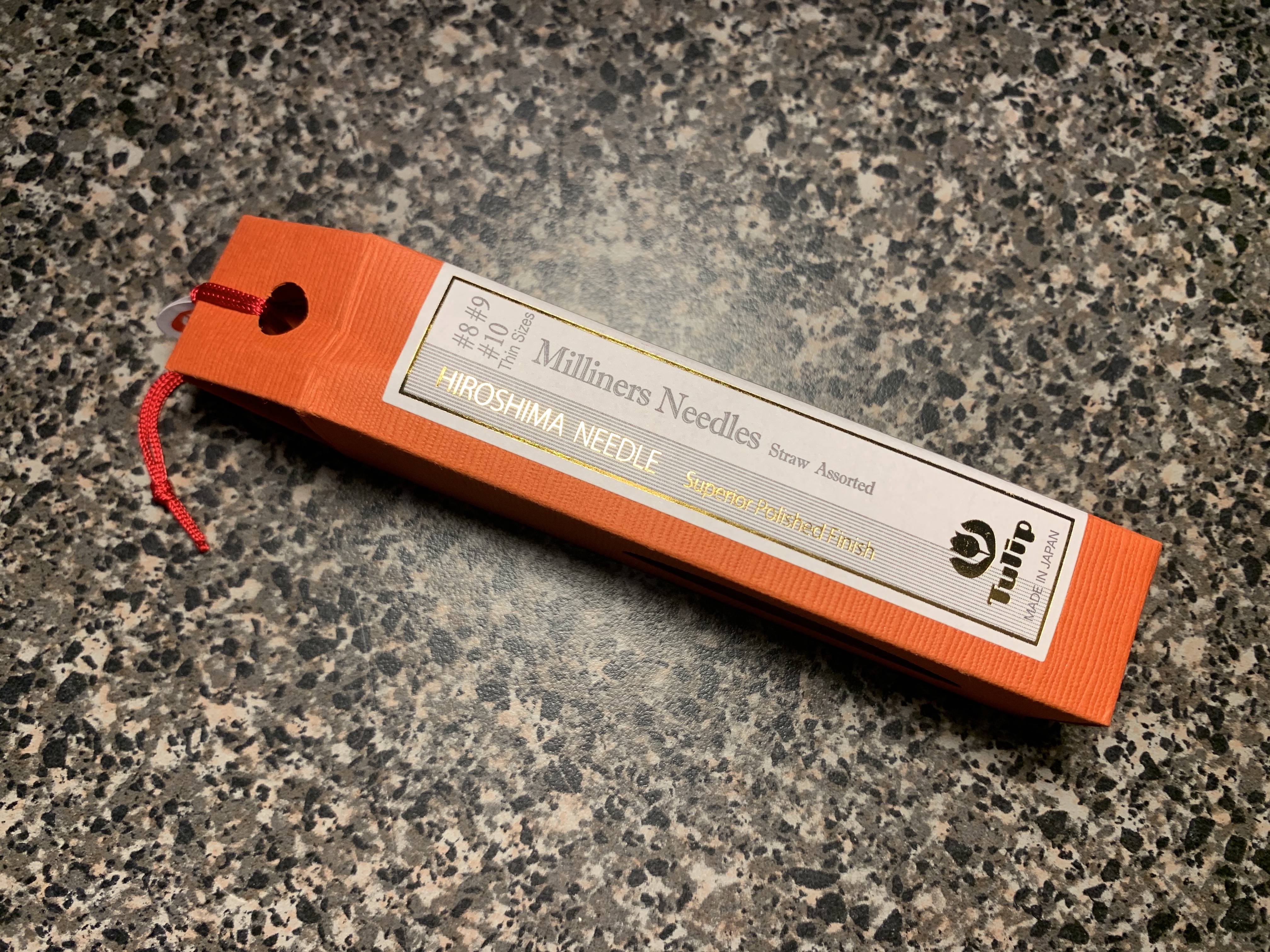
The Tulip needles come beautifully packaged.
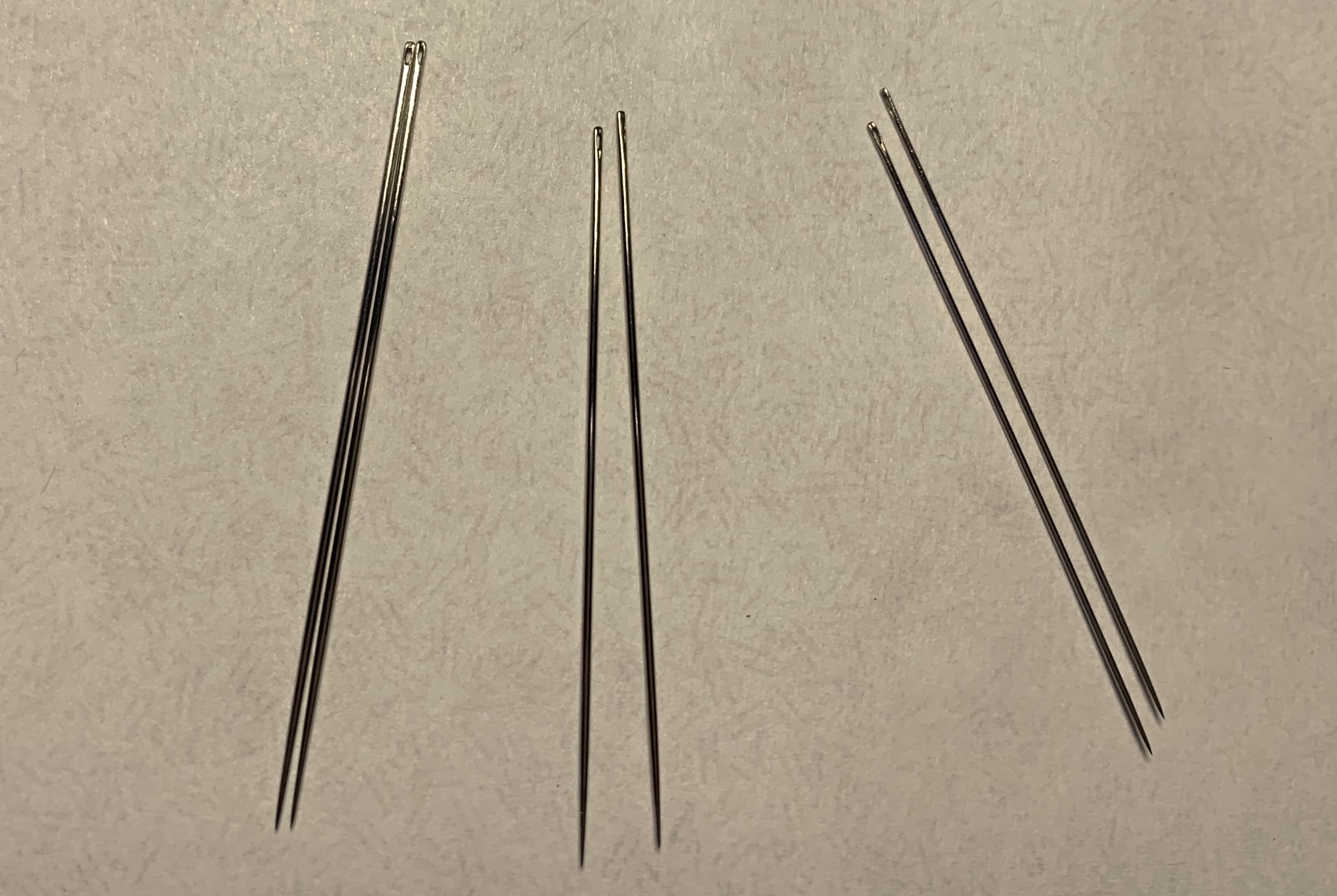
Inside, one finds the actual container. This one contains 6 needles, two of each size.
This purchase of an assortment of straw needles was an experiment that I’m delighted to say is a happy one. Remember that the smaller the needle number, the bigger the needle. So, the size 8 is bigger than the other needles. I like all three of these needles. They are super sharp.
I lost one I was using to sew down the binding on Sugaridoo Rainbow a few days back. It fell out of the quilt sometime, likely, when I was finished for the night and folding it up. That led to vacuuming out the couch where I sit at night and then the whole carpet. And under the chair where I hang quilts I’m working on. But I’ve never found it. Lost needles have a funny way of appearing sometimes, so I am hoping this one does. And now I don’t leave the needle lose in my work—I clip it down with one of those little quilty clips we have all grown to love.
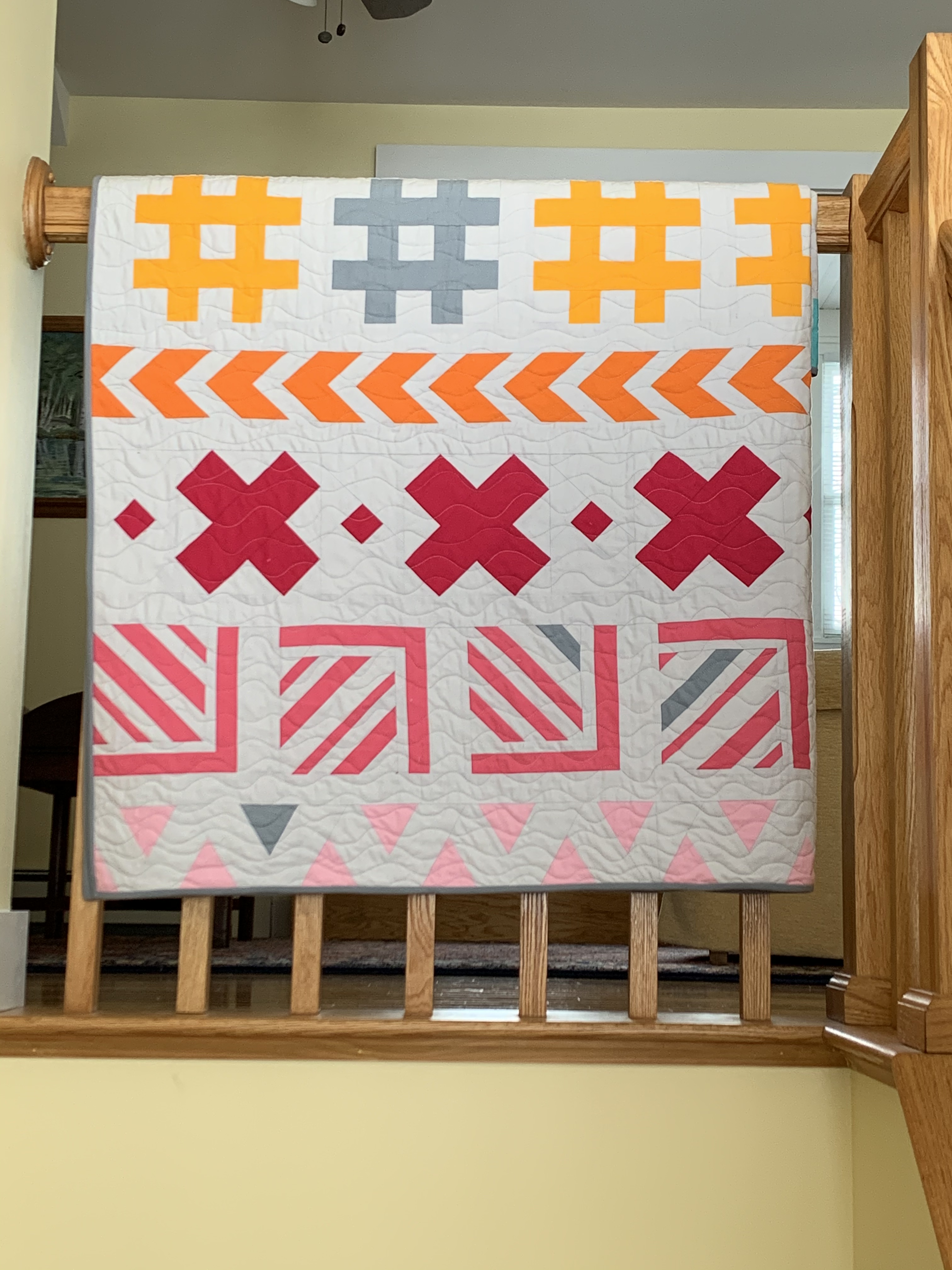
Sugaridoo Rainbow is now living on the stair bannister, and I’m enjoying seeing its happy face when I go up and down the stairs during the day. I will turn it about so I see different colors off and on.
My Tulip needle (a size 9 I think) did a great job with the Sugaridoo binding.
This quilt is the result of the 2019-2020 Bernina Quilt-Along designed and managed by Sugaridoo. I’ve never done an online QAL, and this one was suggested by our leadership in Coastal Quilters (Maine) as a mechanism to learn some new techniques and patterns. We started in, if I remember, November 2019, and we got a new pattern for a new row once a month and the final assembly plan in the 13th month. Videos accompanied each month’s pattern and row release—so I now have these twelve patterns and some learned methods I didn’t know. And I did purchase the rainbow kit that Irene of Sugaridoo put together. I’ve never made a rainbow quilt. (Sugaridoo also included a color scheme that was not rainbow, and I’ve so enjoyed seeing what people who went that route and varied their colors produced.)
Here is another view—this quilt is 70 wide and about90 long. The pale grey background lent itself to using a pale grey thread for quilting. I wanted an extremely simple way to quilt this quilt as I do not do intensive quilting—I don’t have the skills or the patience—and I didn’t want to distract from the graphic nature of this quilt.
I saw many bright and wonderful backing fabrics as people begin to reveal their finished quilts. But I fell in love with this quiet backing fabric which holds the colors of the quilt more or less and just works to make the front brilliance a bit quieter.
I used the darker grey “highlight” (Kona Titanium), and I am happy with that choice.
I’m happy with how this quilt came out, and I enjoyed the year-long journey with Sugaridoo.
I made TWO of these quilts—as I’m always looking for fun ways to use my Cotton+Steel/Ruby Star Society fabrics. The second one will go on the longarm pretty soon now. All the parts are ready, and I will again quilt it with these simple curvy lines.
We’re getting our first BIG storm tonight—with a lot of accumulation overnight.
That meant I had to cancel my right eye cataract surgery for tomorrow early. The reschedule date will be March 2. There was no question that I had to cancel—once it starts to snow hard, it isn’t safe to drive down and up Howe Hill or my steep and curving driveway where deep ditches live alongside. The plow guys get to me soon enough, so I just stay put until they do.
So, it’s brrr cold too, and I will work on sewing projects. I need to get “Trees” off the design wall to make space for a planned large log cabin quilt.
This “trees” block, as you may recall from other posts, is based on/inspired by a block by Amanda Jean Nyberg of Crazy Mom Quilts. I’m planning 8 by 9 rows so will have a nice lap-size quilt. The tedious part of this quilt block is making the tree trunks. Piecing and trimming the block goes really fast actually.
I’ve often noted, as have other quilters I know, that it is so fun to start a project, but at some point, it becomes tedious to finish up the blocks. I’m sitting on my fingers now to finish this one before diving fully into the log cabin blue/grey project. And I’ve already started wondering about a log cabin with a black center chimney and light and dark greys. I’ve gone as far as cutting out the parts for one grey block to see how that looks. I’ve wanted to make an all grey quilt for some time.
Meanwhile, I have a BIG block of flying geese cut out to see how that looks—from a pattern in the “Simply Modern” magazine an issue back. More on this one later, of course. And then the 4th project from The Color Collective will be dropped today. The fabric is already here, and it is, as always, intriguing and pretty.
I’m taking a break from “Trees” (I finished the leftover parts of the “Pips” quilt yesterday) from time to time to iron/cut, iron/cut the blue grey fabrics for the log cabin.
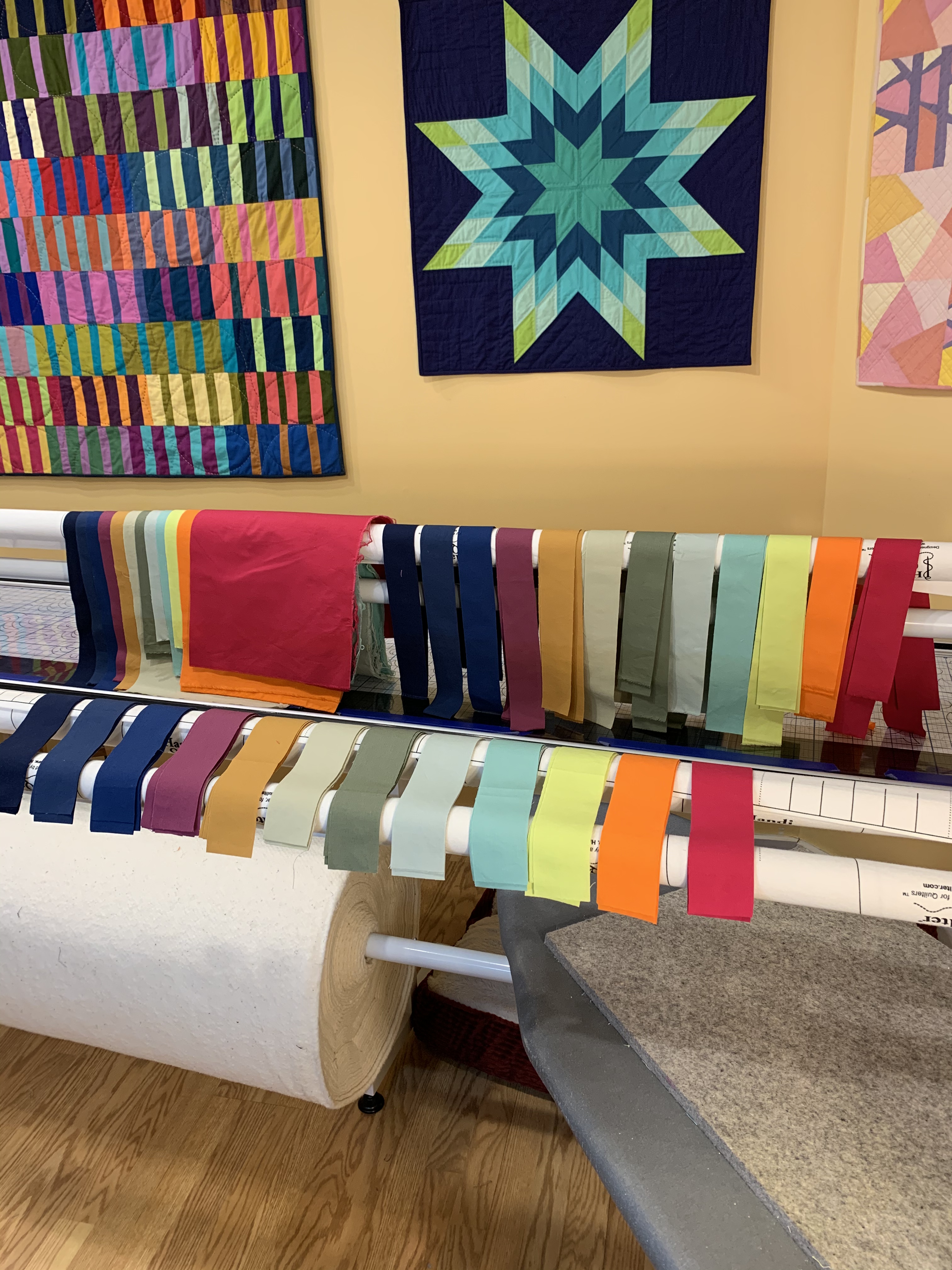
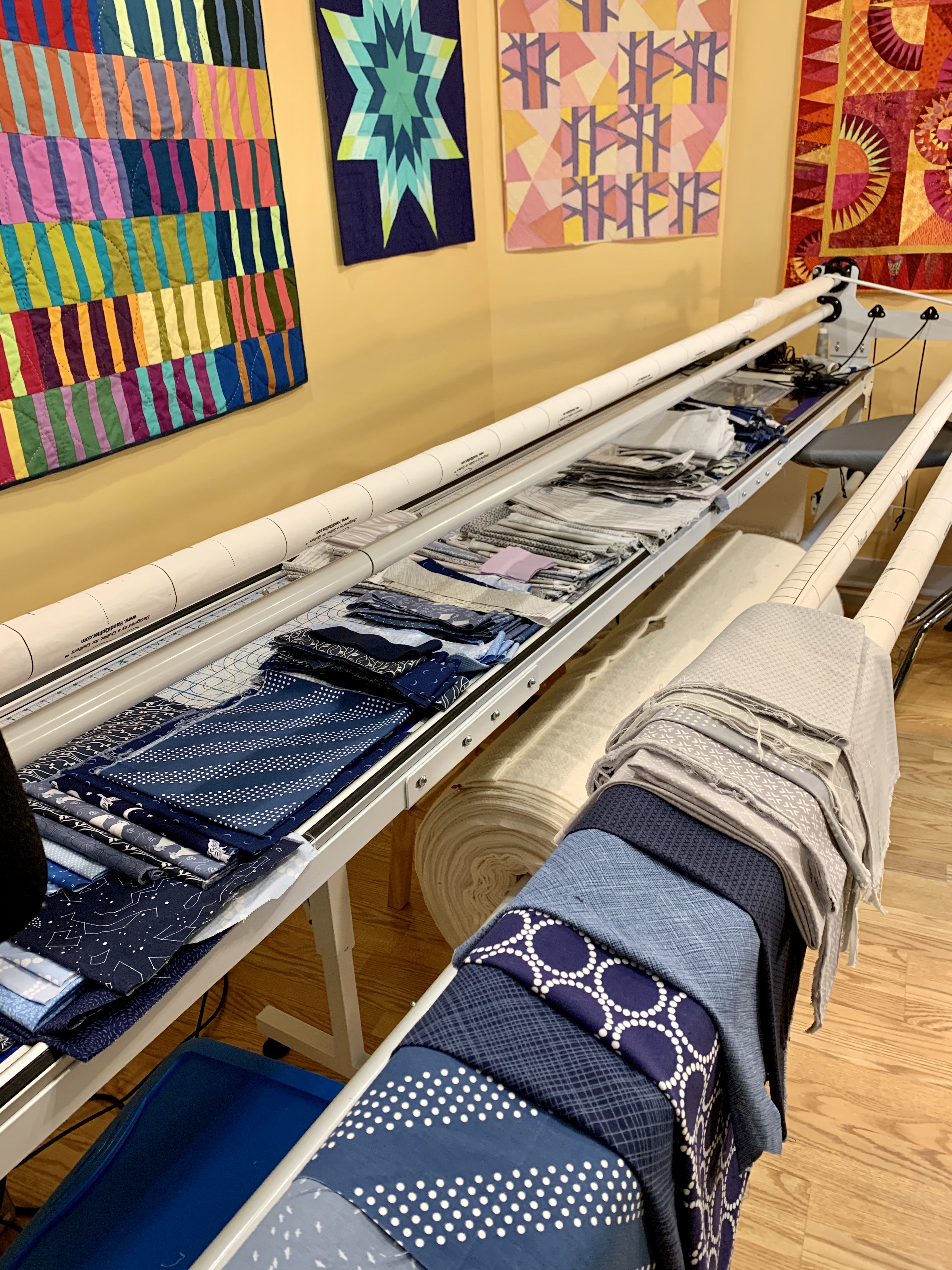
The fabrics on the longarm bar are ironed and ready to cut into some strips. I’m almost done with the ironing and first cutting of strips. Meanwhile, all the fabrics I pulled from the stash or purchased (I was almost out of light grey fabrics and had no good medium dark blues), will be ironed and ready to cut when I need more strips. The ironed fabrics and strips are living on the long arm bed for the moment.
So now it is time to get dressed and get about this promising quilty day!
AC Slater…chews…when things aren’t perfect for him. He is still a young dog with a LOT of energy and is not above chewing his dog bed when he thinks I need to pay him more attention. I have repaired this bed MANY times now—and much of the bottom is taped with that sturdy silver tape.
So, way back in mid December I saw a dog bed online that looked yummy and claimed it helped dogs to relax into it. Knowing that the customer claims about their dogs loving this bed could be total fabrications, in a weak moment I ordered one in a size recommended for my dog’s weight.
It came from China, of course. And it took weeks and weeks. And it came with all the air sucked out and in a plastic bag that fit into my mailbox. I could tell as soon as I got it out of the bag and air went back inside, that it was too small for my dog. Way too small. This “smallness” feature of many products from China, LOL, I’m thinking is due to the fact that the Chinese are smaller and thinner than we are. And, apparently, their dogs are smaller too!!
AC was intrigued with the fluffy nature of this bed. I think he thought it was an animal carcass of some sort. I put it inside his existing bed, thinking he would love the soft support there.
He would have absolutely NOTHING to do with this arrangement. He would not willingly put a foot on this bed.
As soon as I turned my back and started sewing, he dragged the new bed out of HIS bed and chewed a hole in it and spread the inside fluff all over the rug.
He was terribly ashamed of himself when I pointed out that this behavior was NOT ok. There were apologies and attempts to crawl into my lap. And I restuffed the bed and sewed up the hole.
The next day, he agreed to get into the bed to humor me…
And when I started sewing again, he chewed another hole in the bed, but did not drag it out of his bed.
So, I’m giving up.
He does not like the bed, and that’s that. And I think he thinks it is some sort of animal pelt—or a toy like his squeaky toys that he demolishes in short order.
Sugaridoo, as hosted by Bernina, ran this QAL for a year.
Each month Sugaridoo gave us a new row to make and supplied us with patterns and videos. So I now have 12 new patterns in my files to be used whenever I see fit—and they are all interesting and lively. Almost any of them would make a quilt all by themselves. For me, there were some learning curves as well, and that’s always good.
Somehow I made two rows each month—one in this solid rainbow version, and one in all Cotton+Steel. I sat on these finished tops for a bit as I thought about how to quilt them. I didn’t want any quilting that distracted from these very graphic blocks. And I like to make soft quilts that are functional, so I didn’t want heavy quilting—assuming I have the patience for that, which I clearly do not. I chose just simple wavy lines and am very pleased with the result. I will do that in the other quilt as well.
Trimming up the sides:
Admiring how the soft, traditional backing I chose works to soften the graphic nature of the top.
Putting on the binding. I used the same dark grey that Sugaridoo used for the accents in each row. I think it is working well.
So now I have some hand-sewing for night tv watching.
AND a solution for quilting the second Sugaridoo quilt that is all organized and ready to go.