DIL Tami Enright shared this informative interview on South Carolina ETV the other day.
I think some of you might enjoy it.
Tami is a co-founder of The Bee Cause and its Director. The Bee Cause now has hives in all 50 states and in some international countries.
In this video, Tami not explains the history of The Bee Cause but what we can each do in our lives to help create a habitat for bees. Small acts can make a difference.
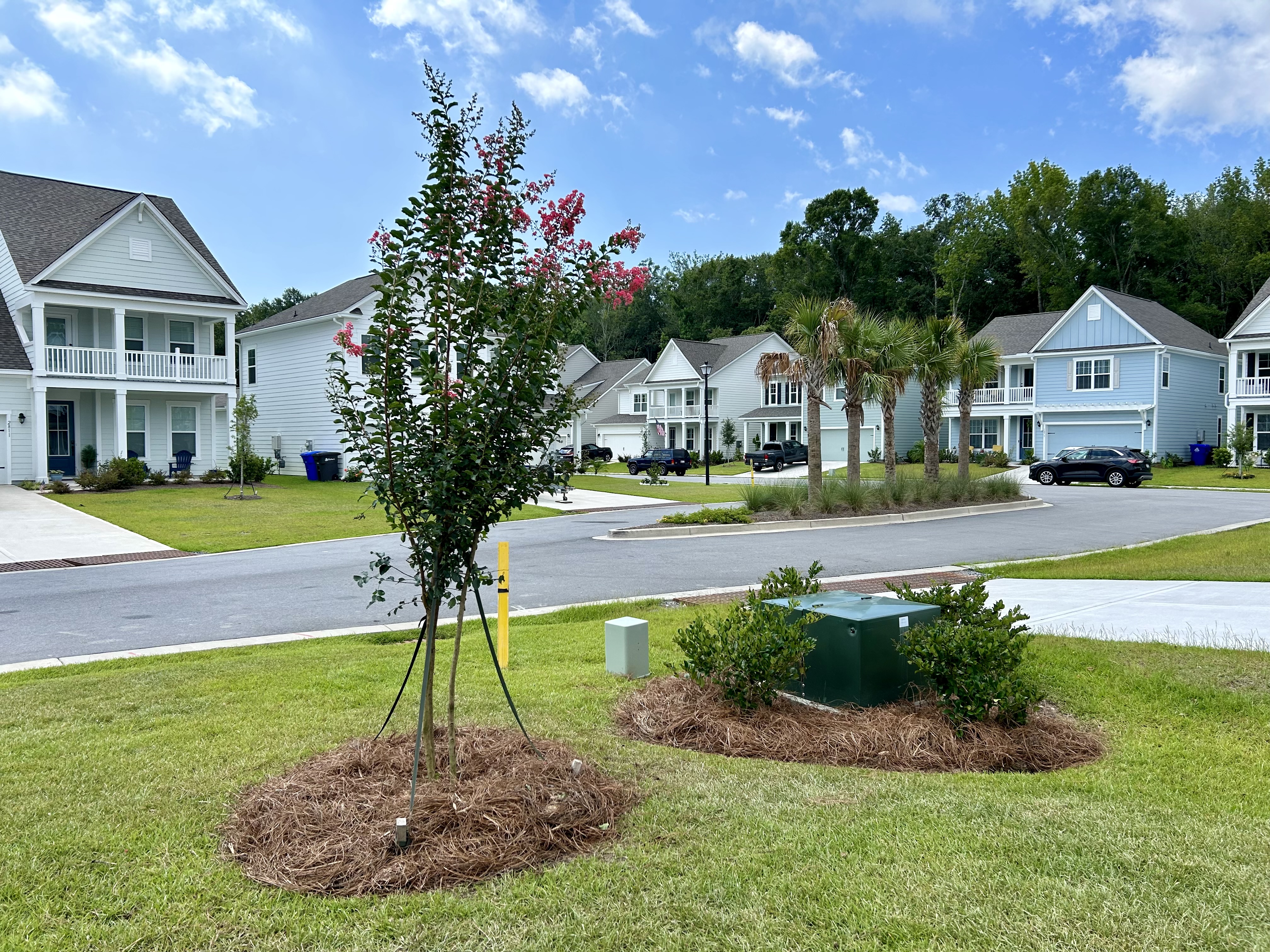
I’ve been worried about this tree in my front yard–a willow oak planted by the developer.
These trees are hardy here, yes. But they will get HUGE and will dwarf the house, the front yard, the street and the neighborhood. Plus the roots that develop get huge and thick and can spread far and wide–disrupting…the street, the driveway, the house foundation (?), and so on. I am hearing some real horror stories.
So, I contacted Estaben Hernandez (EstebanHernandez Luxury Painting). Estaben is also a carpenter, and his brother has a landscape business. These two guys are a part of a network of young men who are hard and willing workers. Estaben made taking out the willow oak and replacing it with a gorgeous Crape Myrtle an easy event. And I am so grateful. He and his guys chose a beautiful tree for me. (I wanted a watermelon pink color.) And the willow oak went to one of the guy’s brother’s house, where there was ample room for it.
I made a trip to Loews and got new pine straw for these two beds and put it down myself. The pine straw is light to move and easy to put down.
Now, all I have to do is pay attention to how much water this new tree is getting. And I already do that with the grass and the beds I have planted. (The roses are blooming like crazy again and are so cheerful. The flowers are smaller, but that’s due to the heat.)
I find myself following the afternoon thunderstorm possibilities–especially in the strong heat we have had recently. (It was 102 on my back porch one afternoon last week.) You would think this storm would have provided some good rain. Well, it did for some west of me. For sure. We didn’t get one drop out of these scary clouds.
But we did get a good rain a day Saturday evening. So I’m good on the watering for one more day. I usually water early evening, so the plants can take all the water in without the sun drying everything out too fast. The night temps are in the 80s, so leaves don’t stay wet long. Plus, the extreme heat would fry a plant’s leaves that were wet if I watered during the day. Early morning watering might be ok, but is not as ideal as early evening watering.
Today it is a bit cooler. High 80s and into the 90s mid to late afternoon. It is late July in the tropics–and August is coming. My house is cool–I run a dehumidifier upstairs in the afternoons–and floor fans on low to keep the air moving–and that helps a lot. High humidity makes everything feel hotter.
Daughter-in-Law Tami showed me this video of the hive in her back yard recently. And I saw the hive for myself last Sunday.
I’m really interested because I’m going to get some of the honey from this hive in the near future, yes, but also because beekeeping is a very big practice in my family and in this area.
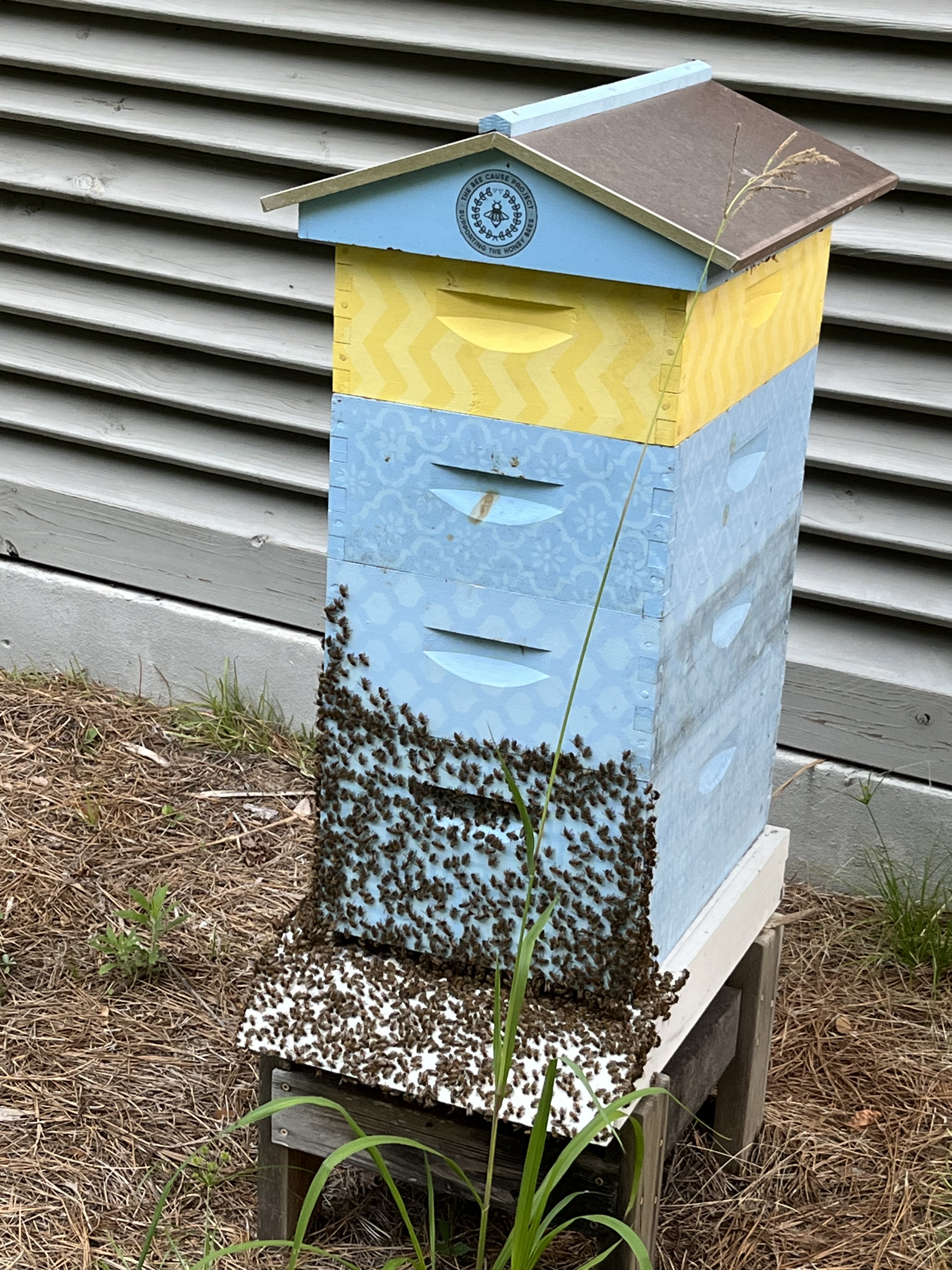
Tami told me that some of the bees are outside the box for a variety of reasons: it’s hot and humid here now with temps in the mid to high 90s, the bees might be contemplating a swarm from the hive, and/or it is crowded inside the hive as there are now a lot of bees. The presence of bees outside the hive is called “bearding.”
Tami also said that it is very normal for bees in a hive that is this healthy to create a swarm and that beekeepers should let them carry out that intention if the bees want to swarm. Reducing the size of the hive by some bees swarming gives the remaining bees a chance to rest. It also gives them time to clear out the mites that can and do infest a hive. Mites, Tami, said are the number one danger to a bee hive. Mites set up and live in the empty little wax hexagon cells the bees have just created to store their honey.
There are FIVE “supers” (the narrow upper drawers) on this hive, which means that there are a lot of bees involved and that they have had to work hard to try to fill up each drawer as it is installed. She will harvest three drawers in the near future, especially if the bees swarm, as that will leave less real estate at mid-summer for the bees to try to fill with honey. The bees will need two supers of honey for the winter–more than that means they have to keep a lot of the hive warm all winter, which is also hard on the bees who need to rest in the winter.
Here’s the hive earlier in the year with three supers installed. The bottom thicker box is the brood box where the queen lives. (I think that’s right.)
Here’s a very bad picture of Tami. She is the co-founder and director of The Bee Cause, an organization that strives to preserve bees and to educate people about bees. The Bee Cause now also tries to educate people about the natural world and how humans interact and are impacted by the natural world–which includes the destruction of natural habitats. Bees, for instance, alongside other pollinators, pollinate most of the plant crops that humans rely on for food. If bees and other pollinators are killed by human practices, the end result will be a huge loss of the foods that humans need.
Here’s some recent honey from a beekeeper who works closely with Tami. This honey is the honey that I keep on hand all the time.
Honey is also a wonderful medicinal–both to eat and to use for wounds. But that is a tale for another day. And honey does not really go bad and can remain viable for thousands of years.
Honey and some maple syrup are my only sweetners.
And now you can understand that I am trying to do my part by planting plants that bloom and, therefore, nurture pollinators. And, also, why I am trying to create a healthy habitat around my house, as with the use of pine straw bedding that provides a home for many creatures and hand-weeding my new sodded grass until it gains enough purchase to thrive on its own–which it now has.
Finally, perhaps you can understand also why I am very sad at the amount of chemical use taking place in my new neighborhood and in this region–herbicides for the grass and “weeds” and insecticides for “the bugs.” Note that spraying Round-Up (glysophate) for weed control is very dangerous for people. We know that now. The data is very clear now. And indescriminate spraying for mosquitoes kills ALL the insects, bees included.
I am not against judicious use of chemicals when needed around a house. Chemicals that kill termites, for instance, can be put around the foundations or into traps set near a house’s foundation. And inside baiting for roaches is confined to specific spots. In Maine, we had to solve an infestation of carpenter ants and…ick…bedbugs brought in on our luggage. Both solutions were chemical.
The natural world has a power of its own, you know. And we violate it at our own peril. We are, perhaps, a self-solving problem for the natural world.
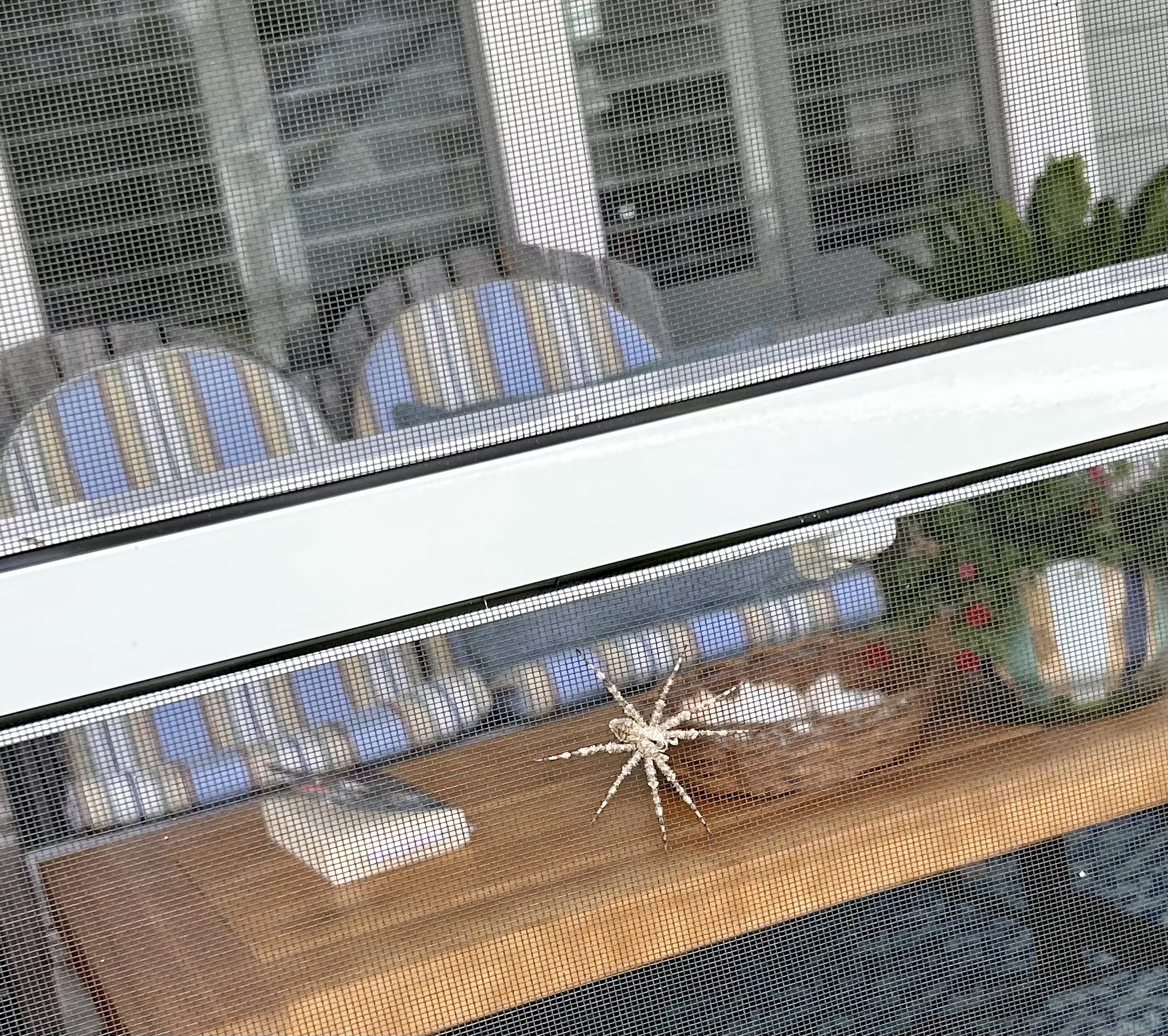
And THIS very interesting critter has been living on the outside screen of my back porch for the past three to four days. Her/his legs make this spider about 2 inches big.
I posted this picture to our local neighborhood Facebook group, asking if anyone could identify what kind of spider this one is. I thought maybe a Wolf spider as it is one of four big spiders in South Carolina. But the coloring was…wrong.
In due time, a neighbor identified this spider, and it is NOT a Wolf spider. S/he is a White-Banded fishing spider (Dolomites albineus). Measurements for spiders are kind of confusing–in that some seem to use just the body length, while others use the whole length, including the legs. The inclusion of the legs can make a bigger profile, of course.
By this morning, another neighbor said she has had two around her house as well.
We have a lot of cache water basins here (low-country drainage methods)–and some have sprinkler/fountains in the middle (beauty, yes, but also mosquito control). But there is standing water in drainage ditches, too, and water plants grow there. Likely this area is a good habitat for this spider.
This spider literally can “walk on water” to hunt prey. They have hairs that can repel water, and they can capture an air bubble on their abdomen that allows them to swim and dive (Wikipedia).
This spider can build webs, but the webs are not used for catching prey since they hunt their prey. The webs are used by the female as a sac to protect her eggs, which she carries nestled beneath her head, held secure in her fangs. Thus, if female, she is part of the “nursery egg” grouping of spiders.
But, why is this critter NOT in or near the water right now? Is s/he a she, and is she working currently on laying eggs? In a typical year, this spider can create and carry multiple egg sacs in warm weather. She can and will try to eat her mate. Freezing temperatures kill them, but the eggs can overwinter and hatch in the spring.
Ah, these spiders can and do venture far from water. They can and do capture and eat other insects, including “flies, moths, beetles, mayflies, and other insects.” Thus, s/he is using my porch screen as a perch from which she can strike. And she is a help for control of insects in my garden, as she is when she kills insects on a tree that are harming it.
Here is a nice site that contains much more information about this spider.
By the way, the Wolf spider is the South Carolina state spider. Who knew? The Wolf spider is also a predator who does not rely on a web to capture its prey. And if carries a web sac on its back. Local information on the Wolf spider:
When I moved to Maine, I encountered a strong bias toward healthy, clean local foods and homeopathic help when needed. Living in Maine changed my life.
One of the first books given to me by a dear friend was Sally Fallon Morell’s Nourishing Traditions. It really changed my life. Morell is one of the founders of The Weston A. Price Foundation, an organization that sells no products beyond books and information based on research, often done by scientists who have specialized in how food works in the human body.
Price was a dentist who traveled the world to find groups of healthy local people in order to identify why they were healthy. He judged “health,” in part, by the condition of their teeth. What each healthy group was eating was a primary question for Price. He learned these groups of people ate healthy, clean, WHOLE foods present in their particular environments. AND, he noted that when they started eating “modern” foods, they became malnourished and sick. He left a most interesting archive of his discoveries.
The Weston A. Price Foundation has a terrific web site that anyone can use to research a food or health question.
Sally Fallon Morell is a nutritional researcher in her own right. In the formation of the Weston A. Price organization, Morell worked with Dr. Mary Enig, an internationally recognized expert on how various fats work in the human body. Enig had published work that said that trans fats were dangerous for humans–in the era when industry was seeking to substitute plant fats for the animal fats humans have eaten for thousands of years. The industry went after Enig, and she lost all research money and never got more. A few decades later, “science” had to acknowledge that trans fats were indeed dangerous for humans. But note that this story illustrates how powerful industries work to create room for their own products: they demonize what they want to replace.
Here’s an article that came into my internet feed the other day. It is based on an interview with Morell. You might find some surprises here that run counter to popular belief.
It should be no surprise to anyone these days that media bombards us with countless claims about what is healthy for humans, much of which is a departure from what has supported humans for thousands of years and much of which is based on “science” supported by industry to “prove” their claims are true.
Living in Maine, with all its farms and clean foods, transported me back in memory to how I grew up. My father was military, and we moved frequently, but lots of time was also spent with my mother’s people in rural Georgia, with access to local foods from the family farm and gardens. Family members gathered food daily, and much time was spent on food preparation and eating together.
After exposure to Morell’s Nourishing Traditions, I promptly reverted to eating the kind of traditional my grandparents ate. And I’ve never turned back from that practice. It is serving me well in so many ways as at 78 I am healthy and strong and have boundless energy and a zest for life. My food is my medicine, and I don’t need anything concocted by industries that do not have my best interests at heart.
Here’s where I pick up my raw milk, raw cream, raw butter, and healthy eggs here in South Carolina.
This store is about 10-15 minutes from my house. (Local peeps, it is at the end of Rifle Range, where it meets Ben Sawyer Boulevard., on the left in the Oyster Park shopping center.)
The Milky Way Farm raw milk is local and comes in every other week on Wednesday. The raw cream and butter from Pennsylvania comes in late in the day on that same Wednesday. Note, in Pennsylvania, these products have to be labeled for use for dogs and cats–and that is a political fact that shows how industry has been able to control what we eat by creating fear about a natural food that people have consumed for thousands of years. Note that Maine allows the sale of raw dairy and has for a long time–without problems. I believe South Carolina does as well. But there are different laws in different states. All of these raw dairy products are rigorously tested for any problems.
I absolutely thrive on raw dairy products and have for decades now. I feel so lucky that I can obtain them here in South Carolina. Note that the very best time to buy raw butter is in the spring when the grass is fresh. The spring butter is a deep yellow color, unlike the winter butter. I try to buy some extra to freeze for the winter, but I don’t have much freezer space here, and I’m hesitant to stock a small freezer in the garage–hurricanes and power outages, you know. And it is easy enough to shop frequently here.
Way back when I started this blog–and after getting to Maine and researching food issues for various complicated issues of my own–I tried to read for folks too busy to research for themselves and to post what I was learning on the blog AND to publish informative essays in the local paper for my community to read. Over 40 essays were published, and they are all here on the blog.
One of the books I read fairly early in this effort was THE UNTOLD STORY OF MILK by Ron Schmid (2009). Starting in April 2010, I wrote three essays around this book and my own life experiences with raw dairy. They are the Mainely Tipping Points essays 6, 7, and 8. If my links below do not work, just search on the title of the book. I, myself, had trouble getting to these essays as the blog is old, and I often have trouble getting back to early essays until I figure out what search words to use.
It is so, so important to constantly read food labels–because they change all the time, as does the meaning of various words used in labels. And it is important to know the history of many foods in order to make good choices that will keep you and your loved ones healthy. And to know what constitutes an objective scientific study that is valid and what is just industry advertising all dressed up as something useful for you.
Question…everything.
Raw dairy was one of the many food places where I started to transform my life and my health, so I took this little trip down memory lane as to why I took this direction.
I am fascinated with the, literally, hundreds of tiny little frogs that live in the pine straw in my garden beds–and who bail to the grass when heavy rains make the pine straw too wet for them (?).
After researching frogs in South Carolina, I think they are a local form of the Southern Cricket Frog. The Northern Cricket Frog may be more prevalent in the western part of the state.
I took this pictures on the driveway after heavy rains.
These tiny frogs range from 1/2 inch to just under an inch. They derive from the tree frog family, but do NOT have tree-frog sticky foot pads. But they can jump, apparently, astonishing distances.
Mostly, I see them RUNNING and jumping.
Here’s a video I took just a big ago–before we get more rain today.
These little creatures eat insects, of course. They can, apparently camouflage themselves, so I see a range of tan/grey (the clay), to brown (the pine straw) to a deep black (the compost dirt). They can also “play dead” when you pick them up. And, they will pee on your hand too.
My friend Betsy is traveling in Europe. While in Prague, capitol of the Czech Republic, she visited the Prague zoo and took this video. Betsy has a grown son in Florida and has visited the Everglades, but has never seen flamingos. And here they were in the Prague zoo.
I’ve never seen flamingos either, so loved seeing this video.
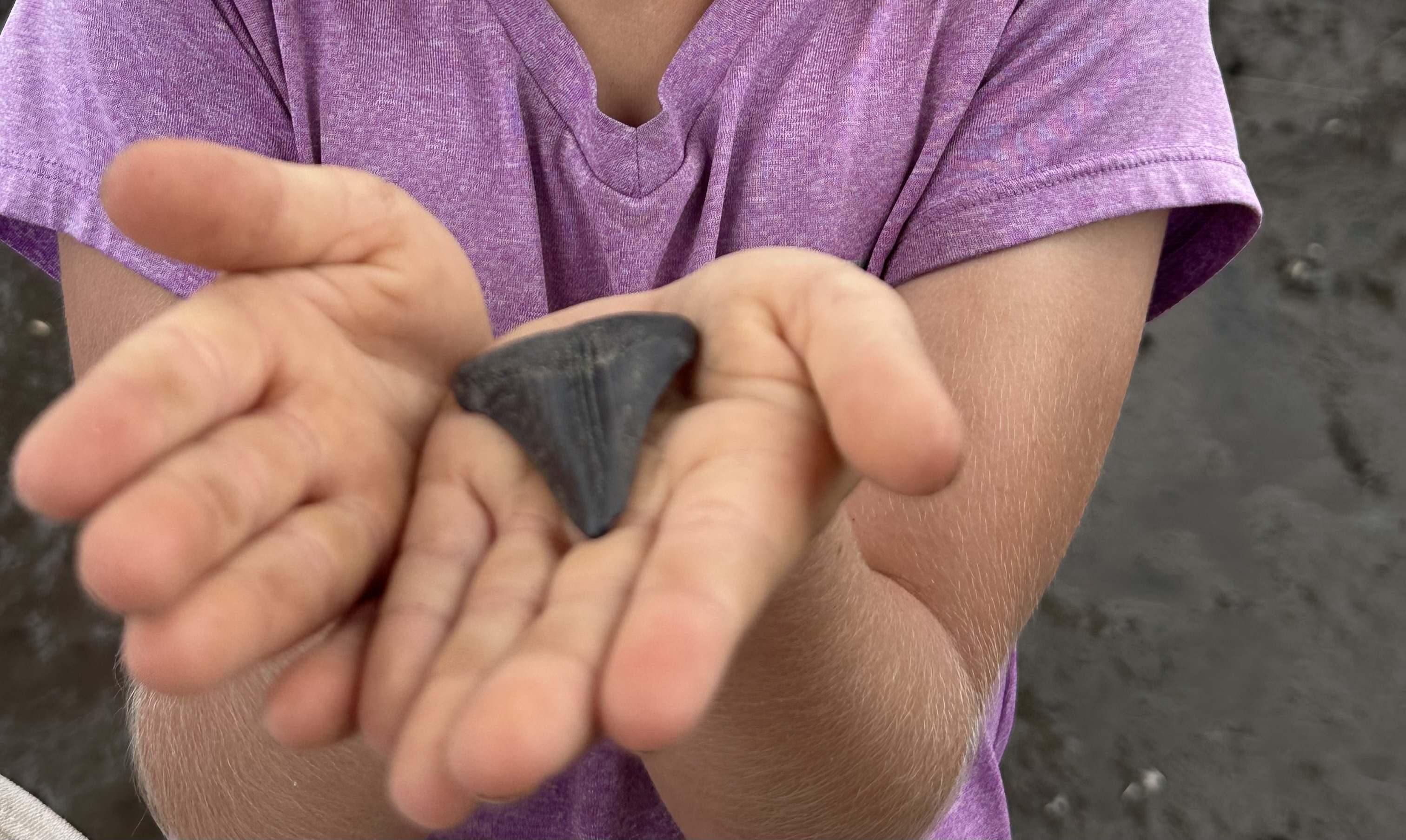
They did find a shark tooth–a very big one. Turns out it was from an Augustiden shark, the great grandfather to the Megladon shark. The very big tooth looks just like the one pictured here.
My DIL Tami Enright is the director of The Bee Cause Project–initially funded in South Carolina by Georgia’s Ted Dennard of the Savannah Bee Company.
Ted Dennard and Tami Enright partnered to create and facilitate The Bee Cause Project, and Tami has grown the program nationally and internationally as “bee grants” have gone to over 500 schools and organizations. There are now Bee Cause hives in all 50 states. And, The Bee Cause also creates inspirational and educational programs that support protecting bees. The Bee Cause work is impacting hundreds of children and adults across the US, Canada, and Puerto Rico.
There will be a live interview about bees tomorrow in Athens, Georgia, with Tami as the guest expert. Some 40 thousand school children and many adults are signed up to watch live.
The Bee Cause Project’s web site follows if you are interested in more information:








 Louisa Enright's Blog