Interesting Information: That “Green Thing”

Interesting Information:  September 29, 2013

That “Green Thing”


Friend Jon Strother–who served with John Enright at Offutt Air Force Base 50 years ago, who was in our wedding honor guard with crossed swords outside the base chapel, and who lives in Northern Virginia in a town near Falls Church–sent me the following post.

I found it…sad…because we have drifted so far from the days when everyone actually “conserved” things.  I have been organizing the house and yard for fall and winter.  And, once again, I added yet another really good cardboard box to my stash in the garage attic.  I can’t just break them down and throw them away.  For one thing, a decent-sized one costs at least $6 if I don’t have one and want to mail a quilt.  For another, it just seems monumentally wasteful.

Today, goods come flying through the mail in these gorgeous boxes–and we just break them down and take them to the dump.  What’s wrong with us?  We can’t just keep on using up resources like this…  OK, I thought, so you’re getting to be like your mother, who filled up many of her kitchen cabinets with those little plastic tv dinner trays.  Only, there really wasn’t another use for those plastic slabs, and there is for a good box.  Or, for a good paper bag.

It’s so sad to me to see how much we have allowed the market to orchestrate our lives–so that paying to exercise, or not cooking your own food, or always having to have everything new, or endlessly drinking from plastic bottles and throwing them away, or throwing out a good box seems…normal.

I don’t know who wrote this piece.


THAT “GREEN THING”

Checking out at the store, the young cashier suggested to the much older woman, that she should bring her own grocery bags because plastic bags weren’t good for the environment.

The woman apologized and explained, “We didn’t have this ‘green thing’ back in my earlier days.”

The young clerk responded, “That’s our problem today. Your generation did not care enough to save our environment for future generations.”

She was right — our generation didn’t have the ‘green thing’ in its day.

Back then, we returned milk bottles, soda bottles and beer bottles to the store.  The store sent them back to the plant to be washed and sterilized and refilled, so it could use the same bottles over and over. So they really were recycled.

But we didn’t have the “green thing” back in our day.

Grocery stores bagged our groceries in brown paper bags, that we reused for numerous things, most memorable besides household garbage bags, was the use of brown paper bags as book covers for our schoolbooks.  This was to ensure that public property, (the books provided for our use by the school) was not defaced by our scribblings.  Then we were able to personalize our books on the brown paper bags.

But too bad we didn’t do the “green thing” back then.

We walked up stairs, because we didn’t have an escalator in every store and office building. We walked to the grocery store and didn’t climb into a 300-horsepower machine every time we had to go two blocks.

But she was right. We didn’t have the “green thing” in our day.

Back then, we washed the baby’s diapers because we didn’t have the throwaway kind.  We dried clothes on a line, not in an energy-gobbling machine burning up 220 volts — wind and solar power really did dry our clothes back in our early days. Kids got hand-me-down clothes from their brothers or sisters, not always brand-new clothing.

But that young lady is right; we didn’t have the “green thing” back in our day.

Back then, we had one TV, or radio, in the house — not a TV in every room.  And the TV had a small screen the size of a handkerchief (remember them?), not a screen the size of the state of Montana. In the kitchen, we blended and stirred by hand because we didn’t have electric machines to do everything for us.  When we packaged a fragile item to send in the mail, we used wadded up old newspapers to cushion it, not styrofoam or plastic bubble wrap. Back then, we didn’t fire up an engine and burn gasoline just to cut the lawn.  We used a push mower that ran on human power.  We exercised by working so we didn’t need to go to a health club to run on treadmills that operate on electricity.

But she’s right; we didn’t have the “green thing” back then.

We drank from a fountain when we were thirsty instead of using a cup or a plastic bottle every time we had a drink of water.  We refilled writing pens with ink instead of buying a new pen, and we replaced the razor blades in a razor instead of throwing away the whole razor just because the blade got dull.

But we didn’t have the “green thing” back then.

Back then, people took the streetcar or a bus and kids rode their bikes to school or walked instead of turning their moms into a 24-hour taxi service in the family’s $45,000 SUV or van, which cost what a whole house did before the “green thing.”  We had one electrical outlet in a room, not an entire bank of sockets to power a dozen appliances.  And we didn’t need a computerized gadget to receive a signal beamed from satellites 23,000 miles out in space in order to find the nearest burger joint.

But isn’t it sad that the current generation laments how wasteful we old folks were just because we didn’t have the  “green thing” back then?

Please forward this on to another “selfish old person” (don’t take it personal, just trying to make a point) who needs a lesson in conservation from a smartass young person…

We don’t like being old in the first place, so it doesn’t take much to piss us off…especially from a smartass who can’t make change without the cash register telling them how much.

The end!
Interesting Information: Food is the Best Medicine – YouTube

Interesting Information:  September 25, 2013

Friends sent me this video of Dr. Natasha Campbell-McBride, who is a Russian/British neurosurgeon and nutritionist who is on the cutting edge of understanding the importance of the relationship of gut integrity to being healthy.  I’ve written about her GAPS work many times on this blog.  She is a heroine of mine.

Get a cup of coffee or tea, pull up a chair, and treat yourself to 45 minutes or so of real wisdom.  This woman cured her child of autism and has a clinical practice in Britain where she has cured so many people sick with neurological diseases or food allergies.

There are other, longer videos of her speaking on utube if you want to go further, for longer.  But this video is a very good start if this topic is new to you or if she is new to you.

Enjoy!

Food is the Best Medicine – YouTube.

Interesting Information: A Horror Story

Interesting Information:  September 24, 2014

A Horror Story

I can tell this story now that my niece (and namesake) has delivered her beautiful second son and is home safely.

To tell this story before this event would have scared my niece to death.  Though she had chosen to use a midwife and to have her son in a birthing center, the birth still took place in a hospital.  And hospitals are not places one wants to be in these days.

Heather Ann (Woodward) Nichols, 29, grew up in Owls Head and Rockland.  She met husband Matt in Portland, and they married int he spring of 2011.  Heather went to one of our best state hospitals to have her first baby in early August.

The baby’s room was all ready, the couple was so excited about the birth of their first child, and the birth apparently went well.  Heather had an episiotomy during the birth process.  Heather went home with her daughter, Ruby Ann, and in a matter of hours, starting experiencing a lot of pain.  She went back to the hospital and died a few days later.  She had picked up a flesh-eating bacteria through the episiotomy–A Streptococcus, or necrotizing fasciitis.  These bacterias LIKE living in hospitals.

NPR’s Diane Rehm has had many programs on the overuse of antibiotics over the many years I’ve listened to her radio show.  She had another one last week (September 2013).  But, the herbalist Stephen Harrod Buhner says that it’s way too late now to try to cut back on the heavy use of antibiotics–most of which are used on the animals in our food supply–to promote growth in overcrowded conditions.  The barn door is already open, and we can’t go back.  Worse, there are no magic drugs in the pipeline that can control the super pathogens that we now face.

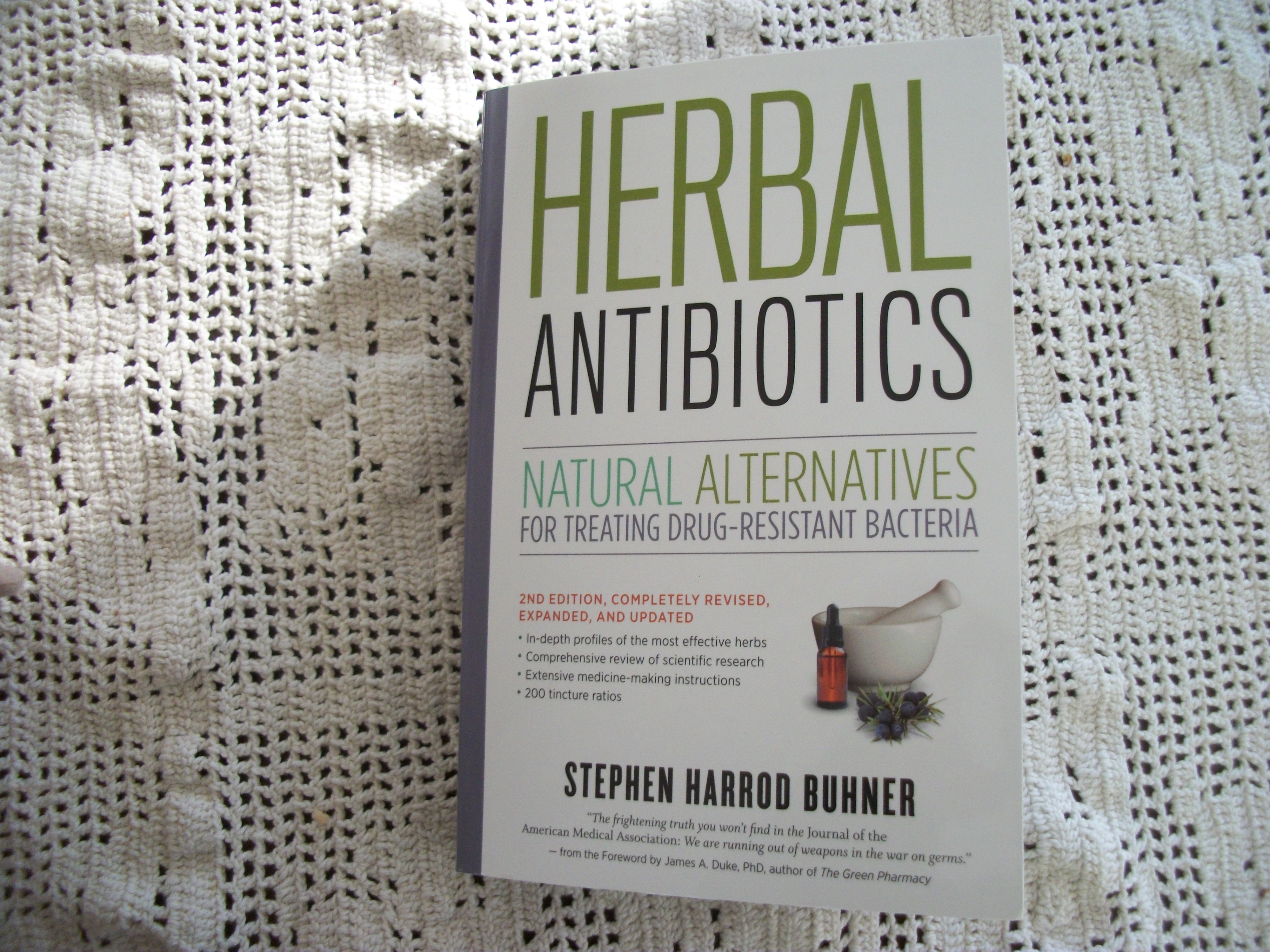
Herbal Antibiotics

Here’s a quote from Buhner’s HERBAL ANTIBIOTICS (13-14):

The thing that so many people missed, including my ancestors, is that all life on Earth is highly intelligent and very, very adaptable.  Bacteria are the oldest forms of life on this planet and they have learned very, very well how to respond to threats to their well-being.  Among those threats are the thousands if not millions of antibacterial substances that have existed as long as life itself.

One of the crucial understandings that those early researchers ignored, though tremendously obvious now (only hubris could have hidden it so long), is that the world is filled with antibacterial substances, most produced by other bacteria, as well as fungi and plants.  Bacteria, to survive, learned how to respond to those substances a long time ago.  Or as Steven Projan of Wyeth Research puts it, bacteria “are the oldest of living organisms and thus have been the subject to three billion years of evolution in harsh environments and therefore have been selected to withstand chemical assault.”

What makes the problem even more egregious is that most of the antibiotics originally developed by human beings came from fungi, fungi that bacteria had encountered a very long time ago.  Given those circumstances, of course there were going to be problems with our antibiotics.  Perhaps, perhaps, if our antibiotic use had been restrained, the problems would have been minor.  But it hasn’t been; the amount of pure antibiotics being dumped into the environment is unprecedented in evolutionary history.  And that has had tremendous impacts on the bacterial communities of Earth, and the bacteria have set about solving the problem they face very methodically.  Just like us, they want to survive, and just like us, they are very adaptable.  In fact, they are much more adaptable than we ever will be.

What does the overuse of antibiotics look like?  Buhner quantifies the overuse in this way (7):

In 1942 the world’s entire supply of penicillin was a mere 32 liters (its weight? about 64 pounds).  By 1949, 156,000 pounds a year of penicillin and a new antibiotic, streptomycin (isolated from common soil fungi) were being produced.  By 1999–in the United States alone–this figure had grown to an incredible 40 million pounds a year of scores of antibiotics for people, livestock, research, and agricultural plants.  Ten years later some 60 million pounds per year of antibiotics were being used in the United States and scores of millions of pounds more by other countries around the world.  Nearly 30 million pounds were being used in the United States solely on animals raised for human consumption.  And those figures?  That is per year.  Year in, year out.

Buhner also notes that most of these antibiotics pass through animals and are excreted into the various waste stream systems where THEY NEVER GO AWAY.  And, “hospital-acquired resistant infections, by conservative estimates, are the fourth leading cause of death in the United States.  And that doesn’t even include the death toll from infectious diseases in general, the same infectious diseases that were going to be eradicated by the year 2000 (11).

Buhner argues in HERBAL ANTIBIOTICS that our only solution is to return to plant-based medicinal strategies.  This book is daunting in its scope.  I feel like I did when I first started reading NOURISHING TRADITIONS with all its information and new ways of handling food.  But, by now I have waded deeply into traditional food ways and into sourcing local foods and into thinking about and researching alternative medical strategies.  So, I will begin with baby steps with finding ways to use herbal antibiotics–remembering that all the most powerful medicines are located in plants, which themselves organize through chemicals.  That would lead to Buhner’s THE LOST LANGUAGE OF PLANTS, which was an eye-opener for me and which I will write about in a separate post.

And, what can we do about this very serious problem of antibiotic resistant diseases–which are part and parcel of ALL the superbugs we have created with our greedy and stupid practices that have ignored the powerful interconnectedness of nature?

Stay out of hospitals if at all possible.  I, for instance, am done with getting blood tests unless I need one because I’m sick.

If you are pregnant, watch the excellent documentary THE BUSINESS OF BEING BORN.  You will be shocked to discover how much of pregnancy and birth in the United States has been colonized by practices located in making money, rather than in practices grounded in science.  And, yes, I will write a separate posting on this documentary.  For the moment, note that something like 85 percent of births across the rest of the world are overseen by midwives–and the survival rates are much higher than those in the US.  Note, too, that most OB/GYNs have NEVER SEEN a natural live birth.  These doctors are highly trained surgeons, and we are so lucky to have them if trouble develops, but have them attend normal births is a super, and expensive, overkill.  So, do some research on your own.  Learn for yourself what the issues are.  And make your birth choices not out of fear, but out of knowledge–like my niece recently did.

Interesting Information: Interview: Reza Aslan, Author Of ‘Zealot’ : NPR

Interesting Information:  September 3, 2013

Historical Jesus

Yes, I’ve been listening to a lot of NPR, especially FRESH AIR, as I’ve been cutting up my quilting stash.  I am happy to report that I am fifteen minutes away from being done with that task.  YEAH!!!

Terry Gross interviewed Reza Aslan recently about his book on the historical Jesus–who was, apparently, a Zealot, or part of an historical movement that sought to make radical change in his world.

Aslan, an Iranian, came to the US when he was around 16–escaping from Iran with his family.  He converted to Evangelical Christianity at 16 and set off on a spiritual and educational journey that has filled his life.  From Wikipedia:  Aslan holds a Bachelor of Arts degree in religions from Santa Clara University, a Master of Theological Studies degree from Harvard Divinity School, and a Master of Fine Arts degree from the University of Iowa‘s Writers’ Workshop, where he was named the Truman Capote Fellow in Fiction. Aslan also received a Doctor of Philosophy in Sociology, focusing in the history of religion, from the University of California, Santa Barbara.[7][8][9] His dissertation was titled “Global Jihadism as a Transnational Social Movement: A Theoretical Framework”.[10]  

Aslan is now a professor of Islamic Studies at the University of Iowa.  Sometime before Harvard, he returned to being a Muslim.

Whatever you think of Aslan or the historical Jesus (versus the spiritual Jesus of metaphor),  Terry Gross’s interview is fascinating from many angles.  You can hear the interview and read all the comments following it at this url.   And, yes, there was a flamboyant Fox interview that went virile–where the interviewer was trying, unfairly, to create a sensational event and where Aslan made more claims about his historical credentials than maybe could be made.  (But blended degrees like Aslan has can contain a ton of historical work–which criticizers might not fully realize.)

Have fun.  I think the book would be an interesting read.  If only my read pile wasn’t so out of control…

Interview: Reza Aslan, Author Of ‘Zealot’ : NPR.

Interesting Information: Paying Till It Hurts: Why American Health Care Is So Pricey : NPR

Interesting Information:  September 3, 2013

PAYING TILL IT HURTS

Terry Gross of the NPR Program FRESH AIR interviewed Elizabeth Rosenthal about the series of articles she is doing for The New York Times on our very broken medical system–a system which is overcharging patients and which has no rational, controlling mechanism to keep costs (or to provide science-based good medicine) within reasonable levels.  Reasonable here can be determined by comparing US health care costs to the rest of the developed world.

Terry’s interview with Rosenthal is so interesting.  And in the following link, you can find that interview AND links to Rosenthal’s pieces on colonoscopies, joints, and childbirth in the US.

Don’t miss this one!

Paying Till It Hurts: Why American Health Care Is So Pricey : NPR.

Interesting Information: “Furloughed Federal Employees”

Interesting Information:  August 27, 2013

Furloughed Federal Employees

John and I lived in Falls Church, Virginia, for almost 40 years.

Former neighbor and dear friend Gina Caceci has a recent letter published in The Washington Post‘s letters to the editor–July 30, 2013, A12.

I loved it.

Here it is:

Here are two suggestions for “out of office” messages that furloughed federal employees can use in their emails or on voice mails:

1.  “I am currently out of the office on unpaid furlough.  Please contact Congress for assistance.  They are actually not working but still getting paid for it.”

2.  “I’m currently out of the office on furlough.  If you don’t understand what this means, please go to your bank, take out 20 percent of your last paycheck and burn it.”

Gina Caceci, Falls Church.

Somewhere I read that Congress is only slated to work NINE DAYS in September.  Good heavens!


Here’s a picture of my beautiful friend, Gina

Gina, fall 2012

Interesting Information: Did You Know?

Interesting Information:  Did You Know?

Did You Know?


That SOY is being added to Whole Foods chicken, duck, and goose liver pates?


Yep!  Soy Protein Isolate (SPI)–which is a highly processed, industrial food which, according to Kaayla T. Daniel in THE WHOLE SOY STORY, is full of toxins and carcinogens.

Why?  To pad the real ingredients in order to make more money.

 * * *


Here are some other surprising places soy is found.

Celestial Seasons Teas (some) contain soy lecithin.

Vaccines can contain soy adjuvants.

Instant Oatmeal (which is a poor food choice to begin with) can contain SPI, partially hydrogenated soy oil (a trans fat) and high fructose corn oil.

Soft drinks (Mountain Dew Squirt, Fanta Orange, and other citrusy sodas) can contain brominated vegetable oil (first developed as a flame retardant)–which works to emulsify the citrus-like flavors.

Artificial fire logs and soy candles can put soy into the air you breath-which is a serious issue for those with soy allergens.

Corkboards and floor mats.

Meltaway cupcake liners.

Coated cast-iron cookware.

The takaway here:  keep reading labels as they change all the time.

This information was taken from “Soy Alert!” in the Summer 2013 “Wise Traditions,” the journal of the Weston A. Price Foundation–and was written by Kaayla T. Daniel.  This journal is fully available on-line.

Interesting Information: Bacterium Resistance to Antibiotics in Meat

Interesting Information:  August 14, 2013

Bacterium Resistance to Antibiotics in Meat

I don’t buy meat in supermarkets.

It’s too dangerous these days.

And I quit buying ground turkey or chicken when I noticed some years back that the packages had been flavor “enhanced” with commercial products.  That’s a red flag for me that something is definitely wrong.

Here’s a little article that appeared in the Maine Organic Farmer & Gardener newsletter (June-August 2013, page 10).

The National Antimicrobial Resistance Monitoring System, an FDA, USDA and CDC program, found that more than half the 480 samples each of ground turkey, pork chops and ground beef collected from supermarkets in 2011 tested positive for a bacterium resistant to antibiotics.  The USDA says almost 80 percent of antibiotics sold in the United States are used in animal agriculture.  (“Report on U.S. Meat Sounds Alarm on resistant Bacteria,” by Stephanie Strom, The New York Times, April 16, 2013; www.nytimes.com/2013/04/17/business/report-on-us-meat-sounds-alarm-on-superbugs.html?_r=0).

The answer to this dilemma is NOT to quit eating meat in favor of a plant-based diet.  I’m hoping that I’m showing that plants come with pretty strong chemical packages that need to be mediated (and isn’t by most folks) and that plants are not nutrient dense.  AND, that appropriately raised meat is part of a holistic circuit on a farm and is good for us in that it contains all of the essential amino acids in the correct proportions that our body can use.  A good diet blends the foods available to us and, hopefully, we eat these foods in their established seasons.

Resistance to antibiotics is a very serious condition.  It means that we don’t have anything to stop the superbugs that we have created with our dirty meat farming practices.

I am encouraged with all the work being done on gut integrity–and the realization that wiping out all our gut flora and fauna with antibiotics creates even more serious illnesses–which occur in a cyclical way if antibiotic use is not curtailed.

It’s time to fall back on building strong immune systems folks…

As for meat–go out into the country surrounding your cities or suburbs and find some farmers who will raise clean, hopefully soy-free meat for you.  In the end, this practice is cheaper as illness is very expensive.

Mainely Tipping Points 48: Is Dr. Russell Blaylock a Quack?

Mainely Tipping Points 48:  July 2, 2013 


Is Dr. Russell Blaylock a Quack?


Wikipedia says Dr. Blaylock is a quack because he does not follow “science based medicine.”

On the basis of a Wiki page, which is anonymously written, a Facebook page on my news feed discussing Dr. Blaylock was removed by a FB friend yesterday without allowing the benign discussion taking place to go forward to its conclusion—which amounts to silencing and censorship, which means a refusal to dig deeper into the issue at hand to see what science actually says, which means a policing of the status quo, which means fear is present.

Science based medicine…

Well, that’s something I’ve been researching and writing about for the past five years or so.  And, living, since my husband fell into the hands of “science-based” medicine practices during a time when the oversight boards for prostate cancer were saying that doing nothing was the best course to take since the treatments did not affect the outcome.  I will go to my grave believing that the treatments did affect the outcome in that they hastened John’s death.  How could they not since they assaulted his body in countless ways.  It never had a chance.

I am sympathetic with our local doctors, most of whom are caring people who wanted to make a difference for John.  The problem is that their tool box did not contain what John needed, so they just recommended the tools they had, regardless of the shift in the science.  These doctors built their careers on these tools—such a shift threatened their ability to support themselves.  That’s a grave place to be in.   

What do we know about Dr. Russell Blaylock?

His own web site details his medical credentials (http://www.russellblaylockmd.com/). I do not doubt them since they would have long since been debunked if he were not telling the truth.  You can go there for the whole list of his medical credentials.

The pertinent information is that Dr. Blaylock is a board certified neurosurgeon who practiced for 25 years before he retired.  He worked with the eminent neurosurgeon Dr. Ludwig Kempe.  Together they developed the transcallosal removal of intraventricular tumors, which he claims is still used today, and the ventriculolymphatic shunt in treatment of hydrocephalus.  Their personal relationship continues to this day.

A turning point for Dr. Blaylock came when he started using “high-intensity nutritional supplementation in craniocerebral trauma patients” which “met with great success.”  Eventually, Blaylock retired in order to spend more time studying and researching nutrition and healing with nutrition. 

In that regard Blaylock is part of the current and growing movement which seeks to understand the connections between foods and human health.  Some stars in this arena are Dr. Mary Enig (fats), Dr. Natasha Campbell-McBride (GAPS), Dr. Joseph Mercola (amazing general blog), Dr. Kaayla T. Daniels (soy), Dr. William Davis (WHEAT BELLY), Dr. Chris Masterjohn (vitamins A, D, and K), Michael Pollen, Sally Fallon Morell, all the scientists now working on the integrity of the gut and gut health and its connections to behavior, and so forth.  Blaylock’s work in this arena led to The Weston A. Price Foundation giving him their Integrity in Science Award in 2004.

Blaylock is a member of the International and American Associations of Clinical Nutritionists, the American College of Nutrition, the Price-Pottenger Nutrition Foundation, and many other health-related organizations.  (Pottenger did the famous cat studies involving the generational effects of malnutrition.)     

Dr. Blaylock is on the editorial staffs of the Journal of American Physicians and Surgeons and of the Journal of the American Nutraceutical Association.  He is on the board of Fluoride.  He is, or was if he’s retired from there, a visiting professor in the department of biological sciences at Belhaven College in Jackson, Mississippi—a conservative Christian college for those of you who think you are dealing with a liberal.

His web site lists his publications and his three books—the first being EXCITOTOXINS:  THE TASTE THAT KILLS.  (Aspartame is an excitotoxin.)  It makes sense to me that Blaylock’s interest in the impact of excitotoxins on the brain lines up with the fact that he was a practicing neurosurgeon.

Is this a “star” resume?

I do not know, medically speaking.  It is the resume of a working neurosurgeon of twenty-five years who got interested in the relationship of healing and food nutrition and acted on it.  It is the resume of someone who went on to study nutrition, to put himself in the nutritional arena with his associations, and to write about nutrition.

So, where does he begin to fall afoul of the Wiki author of his page?  The following list lies at the juncture of where many folks are asking “where’s the science?”—vaccines, aspartame, mercury in dental amalgams, fluoride, and aluminum cookware.

Which takes us back to “science-based” medicine…

Vaccines:  Would it surprise you to know that there have been NO LONG TERM gold-standard studies on the efficacy of vaccines?  That renders all we “know” about vaccines in the correlation camp.  There is not solid cause and effect scientific data in this country.  None.  Period.   

Would it surprise you to know that many scientists are now thinking that smallpox was tamed by sanitation and that polio may have been caused by DDT?

Would it surprise you to know that there is a government organization that pays off parents of children who have been harmed by vaccines?  Or that you can’t sue a vaccine maker if you or your child is harmed?

Recently, two young women died after a Gardasil vaccine.  Researchers examined their brain tissues and discovered that the vaccine had breached the blood-brain barrier, which in turn triggered the fatal autoimmune response that killed the girls—which vaccines are not supposed to do (Pharmaceut Reg Affairs 2012, S12:001).  What if other vaccines are making this leap? Could that account for the undeniable vaccine damage in children?  Leslie Mannookian’s documentary THE GREATER GOOD addresses the lack of science in the vaccine debates.  It is being shown all over the country in many venues, including to medical personnel.  I, for one, am going to see this film, which I think is available online, as soon as possible.

Fluoride:  I wrote three essays on this blog (Tipping Points Essays 34-36) that attempted to summarize the book THE CASE AGAINST FLUORIDE—written by three senior, well-established scientists with impeccable biographies in chemistry, toxicology, medical biophysics, and biological sciences.  There never was any science supporting putting fluoride in the water.  The most recent mandated government-sponsored assessment raised dozens of red flags about fluoride.  It was the first panel that contained nonbiased scientists.  The dose isn’t controllable, and even the American Dental Association warns not to feed infants formula made with fluoridated tap water.  Studies from all over the world show that fluoride is dangerous:  it harms bones and affects IQ in developing infants.  Countries that do not fluoridate do not have worse cavity rates than the U.S. does.  The stronger correlation with healthy teeth is good diet.

Mercury amalgams:  The mercury in your fillings off-gasses for the rest of your life and can make you sick.  Mercury is very, very toxic.  Europe is banning mercury fillings.  In our country dentists are quietly switching to non-mercury fillings.  I and many of my family members have had old mercury fillings removed.  (Be careful doing that and find a dentist who knows the danger of what s/he is doing.)

Aspartame:  Aspartame has, famously, never undergone third-party independent and objective assessment.  Industry supplies the “proof” of safety and the government (with staff assessment by actual scientists saying no about aspartame) allowed its use.  That’s a nasty, nasty story—and I covered it in Tipping Points Essay No. 19 on this blog.  The approval was a political decision, not a scientific one.  If you go to www.snopes to check on claims that aspartame is dangerous, you will see that the story is “false” and you will see a letter written by a government staffer claiming it was tested.  Don’t you believe that because the studies were all industry produced.  That’s the kind of corrupt system our government is running now, and we have got to get the foxes out of the regulatory henhouses and put in some laws with teeth if we want our government to actually protect us. 

Aluminum cookware:  Aluminum is a toxic metal.  If you cook with it or use a lot of aluminum foil, it will reside in your body.  Our bodies have enough environmental burdens without having to cope with aluminum toxicity.  I don’t use it any more—either cookware or foil.  Parchment paper works just as well in most cases. 

So, you decide about Dr. Blaylock. 

He’s not a saint.  He’s got quirks—like most of us he is a complex figure, not a cartoon all bad/all good character.

He’s asking “where’s the science” behind a number of mainstream medical practices and recommendations that he (and I, after researching them) believe are quite dangerous.  He’s looking for ways to effect healing by giving the body the healthy nutrient dense food it requires.

The response from the mainstream—as it almost always is—is to demonize him as a quack.  Devra Davis, a premier scientist, described this industry-driven process brilliantly in THE SECRET HISTORY OF THE WAR ON CANCER.  And make no mistake about it, too much of science and medicine today is industry driven, with little relationship to actual science and a huge relationship to profit making. 

With demonization, Blaylock joins any number of folks who have said “where’s the science” and been attacked and smeared in an attempt to erase what he’s asking as it falls into the realm of “an inconvenient truth.”  Dr. Mary Enig, for instance, tried to tell us about the danger of trans fats and about the healthy nature of high-quality saturated fats.  She lost all her research money and was demonized and not published for years.  But, she was right all along.  

Follow the money.  Vaccines, aspartame, and fluoride are big, big money.  Under our economic system, it is entirely logical that industry would fight to continue making that money and that it enslaves us all to its purpose, doctors included.    

Demonization is how a system of cultural power maintains the status quo.  But that status quo is not ultimately healthy for you. Today, one in two people will get cancer.  That’s 50 percent.  That’s a plague.  So, think twice, investigate, learn how to find and read reputable sources, and choose not to participate in practices that will make you sick. 

Ultimately, this issue isn’t about Blaylock personally.  It’s about “where’s the science?”  It’s about your health.   

Interesting Information: Is Popcorn Giving You Heart Disease?

Interesting Information:  June 27, 2013

Is Popcorn Giving You Heart Disease?

I love popcorn!!

But I gave away my microwave and quit using microwave popcorn years ago.

(Giving away the microwave is a whole other conversation we could have.  But note that I do not miss the microwave.)

At first, it seemed so easy to pop popcorn in the microwave.

But, then I read that like teflon, microwave popcorn contains a very dangerous chemical–one that is being connected now to heart disease.

I bought an air popper, which pops in no time.  I add some sea salt and LOTS AND LOTS of healthy, gorgeous butter.  It’s so much better than the microwave stuff, and the air popper is just about as fast.  Plus, air poppers are under $30.

Here’s the web site for the whole story:

Is popcorn giving you heart disease? | Fox News.