Interesting Information: Mammograms: Yes or No?

Interesting Information:  May 25, 2013

Mammograms:  Yes or No?

I don’t get mammograms any more.

I’m more afraid of the danger the smashing of my breasts and the x-rays pose for my body than I am of the fear-mongering that might make me want to get a mammogram.

It’s not that I’m not afraid of getting cancer.  It’s that I don’t think mammograms are useful for either detecting or dealing with breast cancer.

And that’s because for the past five years, I’ve been seeing a lot of information that questions this whole practice.

For instance, the authors of a new study published in the New England Journal of Medicine (2012; 367:1998-2005) conclude that “nearly one-third of the women who received a diagnosis of breast cancer would never have developed the full-blown disease if left untreated.”  Apparently cancers come and go in our bodies all the time and may be connected to how our bodies deal with and cure illness.

Here’s a further synopsis of this study, taken from The Weston A. Price Foundation’s journal, Wise Traditions (winter 2012, pg. 14)–all of which is available for free online:

Nevertheless, in such cases [seeing possible cancer] patients typically undergo dangerous and invasive procedures such as surgery, radiation therapy, hormonal therapy, and chemotherapy.  H. Gilbert Welch, author of the study, speculated that as mammography technology has become more advanced, doctors are discovering breast lesions in such an early stage of development, it is virtually impossible to distinguish them from the benign cell clusters.  Even worse than the false positives is the fact that the mammograms “fail to catch forms of breast cancer that develop rapidly, explaining why the more widespread use of screenings has done so little to curb the rate at which late-stage breast cancer is found.”  According to Welch, “The sad fact is that there’s a subset of women who develop such an aggressive form of cancer it literally can’t be caught early.”  No one is voicing the thought that the mammograms themselves  may be causing these virulent tumors.

In other words, as I’ve read in numerous places elsewhere, mammograms don’t statistically affect the outcome of bona-fide breast cancer.

The same is apparently true for prostate cancer testing.  All the terrible, stressful  procedures don’t affect the outcome of the disease.  John and I often thought that we wished we had never known about the disease, that we had just lived our lives in bliss until some part of the disease made itself felt in a way that we sought out pain relief.

And doctors are still pushing failed dietary practices that cause diabetes (low fat, high carb, no red meat), are concerned with “high” cholesterol figures when that whole line of thought has been debunked, are still suggesting statins for treatment of a non-disease, are still pushing vaccines without adequate science to support them, will give antibiotics that wipe out all your gut flora and fauna at the drop of the hat, etc., etc., etc.  No wonder they have lost, at least, my confidence.

Truth in writing:  I come from a family of doctors and nurses.  They are all good, caring people.  I know a lot of doctors who are good caring people and who were wonderful to us when John was sick.  They are good people caught in a bad system.  Some of them are more willing to buck the system than others.  And am I glad they are there if I’m in a car wreck?  You betcha.  But for ongoing health care–I’ve taken to saying “stay away from them; they will kill you if you let them.”

Let’s call modern medicine what it really is:  an industry.

What I would like to see is a change in the medical paradigm where the focus is on treating disease from a holistic paradigm, not just treating symptoms, which usually means drugs, surgery, radiation, hormones, and chemotherapy.  These protocols are not working well, if at all.

For instance, the MONTH of radiation John had turned out not to have been needed at all (a suspicious spot on an x-ray was not suspicious after all).  Not surprisingly, his PSA began to rise radically.  My own take is that the month of radiation significantly weakened his body, which made him sicker.  The next treatment up in the standards of care was hormone therapy.  But hormones degrade the bones, so guess what?  The cancer showed up  in John’s bones next.  The oncologist also wanted to do chemotherapy, in spite of the fact that statistics clearly showed it would not prolong life.  The best she could do was to say that “it might make you feel better.”  Really?  Flooding your body with a terrible poison every three weeks might make you fell better?  And bless her heart, for she was a caring person and wanted to help, she offered the hope card:  miracles happen, why not you?  And the treatment for degraded bones?  A drug that basically turns bones into cement, which makes them brittle, and which has horrific side effects.  We stopped the cancer ride at the hormone therapy stop.  But how many desperate people don’t stop?

We do not have another mainstream paradigm than these failed standards of care–crafted by Big Pharma and not science.  And doctors who stray from the “standards of care” are penalized or lose their licenses.  That’s how industry works.  Industry does not care about science; it cares about money.  Practitioners within it are, simply, workers.  All freedom has been lost for them.

AND, the amount of $$$$ involved in treating symptoms is, simply, mind boggling, so the industries involved will fight change tooth and toenail.  The only component that can create change is the grassroots understanding of the problem and a consequent refusal to participate in practices that cause harm and do not work.  We have to take the $$$$ out of the mix.  Do you have any idea what a month of useless radiation costs?

Healing disease is going to have to involve cleaning up what’s causing disease (bad food and a degraded habitat).   The notion that we can degrade the world and create a technological fix to the disease that occurs has to be understood as a nonstarter.

Cancer will strike 1 out of 3 women and 1 out of 2 men.  (Or it’s the other way around.)

Contrary to hype, most will not survive to live out their lives.  Five years is not “survival.”

Cancer is a plague.

Isn’t it time for us to insist on cleaning up the mess we have made?

If not for ourselves, for our children and grandchildren.


Interesting Information: Fat-Soluble Vitamins Need FAT

Interesting Information:  May 23, 2013

Fat-Soluble Vitamins Need FAT

Yep!  They need the right kind of FAT to activate best in your body–and that’s a fat low in polyunsaturated fatty acids–which includes most vegetable oils.

You can supplement all you want–with food, with supplements–but if you don’t have enough good dietary FAT, the fat-soluble vitamins don’t go to work.

Chris Masterjohn is the young scientist that The Weston A. Price Foundation (WAPF) is helping to develop.  He has a PhD in Nutritional Sciences from the University of Connecticut and is currently working as a Postdoctoral Research Associate at the University of Illinois, studying the interactions between vitamins A, D, and K.  His blog is “The Daily Lipid,” which is supported under the Cholesterol-And-Health.com web site.   So you can see he is following in the footsteps of Dr. Mary Enig, who is an internationally recognized expert on fats and the human body.

Masterjohn is a frequent (and welcome) contributor to WISE TRADITIONS, the quarterly journal of the WAPF.  THe winter 2012 issue has an important Masterjohn article:  “Nutritional Adjuncts to the Fat-Soluble Vitamins,” found at http://www.westonaprice.org/fat-soluble-activators/nutritional-adjuncts-to-the-fat-soluble-vitamins.

This article is important because it illustrates that the current scientific paradigm of studying components of foods in isolation leads us to making really bad decisions.  An illustration would be the recent uproar about one component in red meat studied in isolation.  The result:  red meat might be dangerous to eat.  BUT, BUT, BUT, that component never exists in isolation in red meat.  It operates alongside all the other components, or synergistically.  And, red meat is the ONLY place we get vitamin B12 IN A FORM where our body can use it.  (Aren’t you wondering after all these years of folks trying to demonize red meat WHY?  First it was the fat.  Now it’s an isolated component.  Who is paying for this research anyway?  Where are we dealing with a belief system and where is good science?)

We need a new paradigm.  We need to study how components operate SYNERGISTICALLY , or how they react with each other and need each other to give us the best of what they have to offer.  Masterjohn traces the history of how science tried to understand how the fat-soluble vitamins work by isolating each one.  As a result, researchers did not get to an understanding of the truth of these vitamins.  The result was that people were told they needed more vitamin A.  No, it’s really vitamin D.  And vitamin K only works to help coagulate blood.  The role of vitamin K2 was dismissed entirely as it appears in very small quantities.  (Bigger is not always better.)

Masterjohn writes that the fat-soluble vitamins A, D, and K2 “interact synergistically to support immune health, provide for adequate growth, support strong bones and teeth, and protect soft tissues from calcification.”

And, said another way:   “We now know that vitamins A and D also cooperate together to regulate the production of certain vitamin K-dependent proteins.  Once vitamin K activates these proteins, they help mineralize bones and teeth, support adequate growth, and protect arteries and other soft tissues from abnormal calcification, and protect against cell death.”

BUT, the synergism is bigger than just these three vitamins:

Magnesiumn is “required for the production of all proteins, including those that interact with vitamins A and D.

Vitamins A and D “support the absorption of zinc and zinc supports the absorption of all the fat-soluble vitamins.”

Many of the proteins involved in vitamin A metabolism and the receptors for both vitamins A and D only function correctly in the presence of zinc.

Dietary fat is necessary for the absorption off at-soluble vitamins.

Nature provided these ingredients for us in nutrient-dense foods.  Trying to obtain them through supplements can drastically throw off how they interact with each other–which means trouble in the body.

Masterjohn argues that we need to eat the right kinds of fat to access the crucially important fat-soluble vitamins:

Human studies show that both the amount and type of fat are important.  For example, one study showed that absorption of beta-carotene from a salad with no added fat was close to zero.  The addition of a lowfat dressing made from canola oil increased absorption, but a high-fat dressing was much more effective.  Canola oil, however, is far from ideal.  Studies in rats show that absorption of carotenoids is much higher with olive oil than with corn oil.

Similarly, studies in humans show that consuming beta-carotene with beef tallow rather than sunflower oil increases the amount we absorb from 11 to 17 percent.

Why is the animal fat a better fat in terms of absorption?  Masterjohn poses that the lower the fats are in polyunsaturated fatty acids, the better they work inside our bodies.  He poses that polyunsaturated fatty acids likely promote the oxidative destruction of fat-soluble vitamins in the intestines before we are able to absorb them.”

Nutrient-dense foods derive from animals:  meat, milk, eggs, REAL cod-liver oil (not the pasteurized kind with vitamins added back), etc.  Yes, plants are important sources of useful components, but our bodies work best with nutrient-dense foods.

Interesting Information: Portland, Oregan, Citizens Reject Fluoride

Interesting Information:  May 23, 2013

Portland, Oregon, Citizens Reject Fluoride

For the FOURTH time since 1956 Portland, Oregon, citizens have rejected adding fluoride to their water supply.  This time, by a 60-40 percent margin.  And, despite “public health experts” support of the proposal to add fluoride to the water.

Who are these “public experts”?  Are they local doctors?  Are they public health officials?

One thing these “experts” are NOT is people who have read the most recent government report assessing the use of fluoride in the water.  That report raises all kinds of warning flags about putting fluoride in the public water systems.  And they are NOT people who are aware that even the American Dental Association is telling people not to use fluoridated public water in baby formula because the dose is much to great for infants.  There isn’t a geriatric association to warn senior citizens with health issues not to drink fluoridated public water as the dose is likely too great for them.

Let’s step back a moment and remember that “public health experts” who are MDs and those trained as public health officials are NOT scientists.  MDs and dentists are PRACTITIONERS, not scientists.  They are not trained to vet the array of scientific studies about fluoride (or lots of other thorny health issues, like, for instance, vaccines or what to eat).  They know only what they have been taught or have been told.  Give them wrong information, and they are, as much as you and I, caught in a bad information loop that is not based on any reputable science.  And like most people who are working long hours, they do not have time to do extensive, deep research anyway.

Let’s also note that it is absolutely irresponsible for these “public health experts” people to publicly support something like putting fluoride into the water–a dangerous chemical whose dosage cannot be controlled–without first doing RECENT research, which would include AT LEAST looking at the most recent government report, which was done by a panel with the kinds of credentials that ensure that panel members know how to vet the evidence.

SCIENTISTS are, thus, telling us that fluoride in the water is dangerous and that it does not prevent cavities.  The correlation between diet and cavities is stronger than the correlation between fluoride and cavity prevention.  Remember, anyway, that correlation is NOT CAUSATION.  Causation has to be proved, and with fluoride, it NEVER HAS BEEN PROVED.  If you have cavities, you are likely eating too much sugar or have other malabsorption issues going on.  (Remember that all those grains these same “public health experts” have us eating turn right into sugar in your body.)  And, I’m beginning to realize that cavities can actually be healed with a good diet of nutrient-dense foods.  How’s that for a surprise?

There is a good book about fluoride from three scientists who know how to vet the evidence.

Tim Boyd reviewed THE CASE AGAINST FLUORIDE:  HOW HAZARDOUS WASTE ENDED UP IN OUR DRINKING WATER AND THE BAD SCIENCE AND POWERFUL POLITICS THAT KEEP IT THERE, by Paul Connett, PhD, James Beck, MD, PhD, and H.S. Micklem, DPhil, in the spring 2011  WAPF journal, “Wise Traditions.”  Boyd noted the authors’ statement that the pea-sized dab of toothpaste contains as much fluoride as one glass of fluoridated water.  Boyd asked if adults call the Poison Control Center after drinking the recommended eight glasses of
water per day since they would have exceeded EPA’s daily safety dose for fluoride.

Don’t have time to read the book?  That’s ok, because I read it for you.  I have three essays on this blog summarizing the main evidence and the authors’ arguments:  Mainely Tipping Points Essays, Nos. 34, 35, 36.

Here’s the url for the NY Times article about the Portland vote:

http://www.nytimes.com/2013/05/23/us/oregon-fluoride-measure-in-portland-is-defeated.html?_r=1&

GO PORTLAND!!!

Interesting Information: Osteoporosis Cure

Interesting Information:  May 21, 2013

Osteoporosis Cure

I’m behind in my reading and reporting.

Blame it on the inherited ipad where I am playing “Word” with kin, friends, and at least one former highschool classmate.  It will keep my brain active, right?  And it allows me to stay connected in a whole new way, right?  I hope so, as I love language and words and am learning so many new ones.

I finished the winter 2012 WISE TRADITIONS, the journal of The Weston A. Price Foundation, the other day.  There is always such good information in it, and it’s free on-line to any reader.  (I get a hard copy because I write all over the pages taking side notes, making comments, circling important information, and so forth.)  This issue is on the importance of fat-soluble vitamins–and I will write more on that tomorrow.   Remember that I am reading so I can report back to you and if you want to read more, you can follow in my footsteps and go to the texts I surface for you.

A letter called “Geriatric Rickets” caught my eye, written by Philip Ridley of London, UK.  His mother suffered from osteoporosis–a disease he believes (as I do) that is caused by malnutrition from the diet his (and our) health practitioners have been pushing for the past forty years or so–low-fat, high-sugar, high-carb intake.

First, Ridley’s mother stopped taking the osteoporosis drugs “given for free in the U.K. on the National Health Service.”  Ridley notes that

these drugs operate by inhibiting osteoclasts and stimulating osteoblasts.  The former break down old bone cells and the latter build new bone cells.  The problem with meddling in this process is that strong bones require the renewal of old bone cells with new bone cells.  The drugs therefore increase brittleness and they also do nothing about the malnutrition that causes weak bones in the first place.”

Ridley also notes that “women at the final stages of geriatric rickets are given an infusion of these toxic drugs directly into the marrow.  I have heard from families that this is the most painful treatment.”

Ridley’s mother CURED her osteoporosis by eating “bone broths, sourdough bread [fermented foods], butter, soaking of beans and grains, raw grass-fed Guernsey milk, two Royal Blend high-vitamin butter oil and fermented cod liver oil capsules per day, liver and bacon once a week, and an herbal remedy for strong bones.”  Ridley’s mother “had always had grass-fed meat, wild fish, and fresh vegetables, but lacked the fat-soluble vitamins as a result of following the lowfat diet since it was introduced into Britain in 1983, when skimmed milk first came available.”

Ridley and his mother spent “the last decade since her diagnosis waiting for the horrid, inevitable broken hip or back bone.”  But, Ridley reports that her last bone density test showed that she no longer needed to be followed for osteoporosis.  Her diet had healed her bones.

Ridley also notes that the only nutritional supplement  given for osteoporosis in the UK is calcium tablets.  But, calcium given this way “simply calcifies the soft tissues in combination with the low fat diet they promote.”  When people ask Ridley how to strengthen bones he says “eat bones.”

Ridley dams the way doctors and Big Pharma work together to put women on drugs–and what he says is true in America as well:

Geriatric rickets is becoming a silent, worsening epidemic amongst women because the bone density tests kick in for all at around sixty-five years of age, and, much like the cholesterol levels that lead to statin prescriptions, the triggers for bone density treatment are manipulated to catch the greatest number of customers for the drug companies.”

AND:

Doctors in the NHS also get performance-related pay based on the number of women tested and the number of women who test negative who hare placed on the drugs.  Most women nowadays will, as a result of lowfat diets, suffer low bone density, so a vast number of women are now being put on these toxic drugs, yet they could all be saved anguish if we would only call osteoporosis what it is and treat it accordingly.

That would be “geriatric rickets.”

Ridley also notes that “routine bone density tests most likely also cause cancer because they use radiation.”

I could add that when I came to Maine, I had arthritis in my right hip and terrible back pain.  I know my bones are much stronger now as a result of how I eat.  My gums don’t bleed when I go to the dentist.  And I’ve (knock on wood) had no new cavities–a sure sign of malnutrition.  I refuse to get any more bone density tests.  Or, mammograms, for that matter.  And I’m not going to go through the airport x-ray machines any more either.

I also have well water, which means I am no longer getting any fluoride.  For about two years after we came to Maine, I could hardly sleep at night from the pains in my bones.  I was restless and twisted and turned.  I just plain hurt.  I think it was the fluoride coming out of  my bones–and fluoride has been shown to make bones brittle, not strong.  There are a number of essays on this blog addressing the fluoride–which is one of the biggest scams in our lives today.  There isn’t any science behind adding it to the water and a LOT of science showing how dangerous it is.  Anyway, I don’t have these pains any more, and I can feel such an improvement in the health of my bones.

Here’s the whole letter if you want to read it:  http://www.westonaprice.org/letters/letters-winter-2012.

Interesting Information: Is Vitamin Water Healthy?

Interesting Information:  May 20, 2013

Is Vitamin Water Healthy?

My niece Nancy Howser Gardner is passionately interested in healthy food and healthy practices, and it’s been really fun to watch her growing in her knowledge and in her conviction about what is best for her family.

She posted a web site about a month ago that listed and compared unhealthy drinks.  I tried to find it again and turned over lots of lists of “ten unhealthy drinks,” but not the one Nan posted.

I wasn’t surprised by the cream-based chocolate/coffee drinks.

I was surprised by three others, however.

The list said that 36 grams of sugar is a desirable daily limit of sugar.

VITAMIN WATER, touted as a healthy drink, has 32 grams of sugar.  One drink.

SoBe Green Tea has 51 grams!!!

And Minute Maid Lemonade has 67.5 grams of sugar, which is the equivalent of 16 sugar cubes.

I wonder if the sugar form is High Fructose Corn Syrup?

And what kind of vitamins are in the water?  Likely they are synthetic, cheap versions of what you should be getting from your food.

Takeaway:  If the food industry is telling you they’ve made something for you to eat or drink that is a healthy choice, send up the red warning flags and start reading the label.

Interesting Information: Bees, Bees, Bees

Interesting Information:  May 8, 2013

Bees, Bees, Bees

April in Charleston, SC, where my two sons live with their families, is a very busy month for bees.

Tamara Kelly Enright is a beekeeper.

She has two hives in her yard and is teaching her children how to care for them.  She helps manage ten other hives with Tara Derr Webb at Deux Peuces Farm in Awendaw, SC.  And she supervises two hives at a local school for rescued children, where learning how to care for bees is part of their emotional development via a deep connection to nature.  She is deeply involved in placing demonstration bee hives into local schools–a practice started and funded by the Savannah Bee Company.

Tami and Kelly suited up one sunny Sunday afternoon to check the two bee hives in her yard.

Here are the hives, tucked into a corner of the yard.  Tami has planted jasmine on the lattices behind the hives, which the bees are going to love.

Bees, Two Hives

Here’s a video of Tami and Kelly telling you what they are going to do:

Here are Tami and Kelly opening the bee hive.  They have to break the insert loose–it is sealed by the bees with a waxy substance called propolis–which has amazing healing properties.

Bees, opening the hive

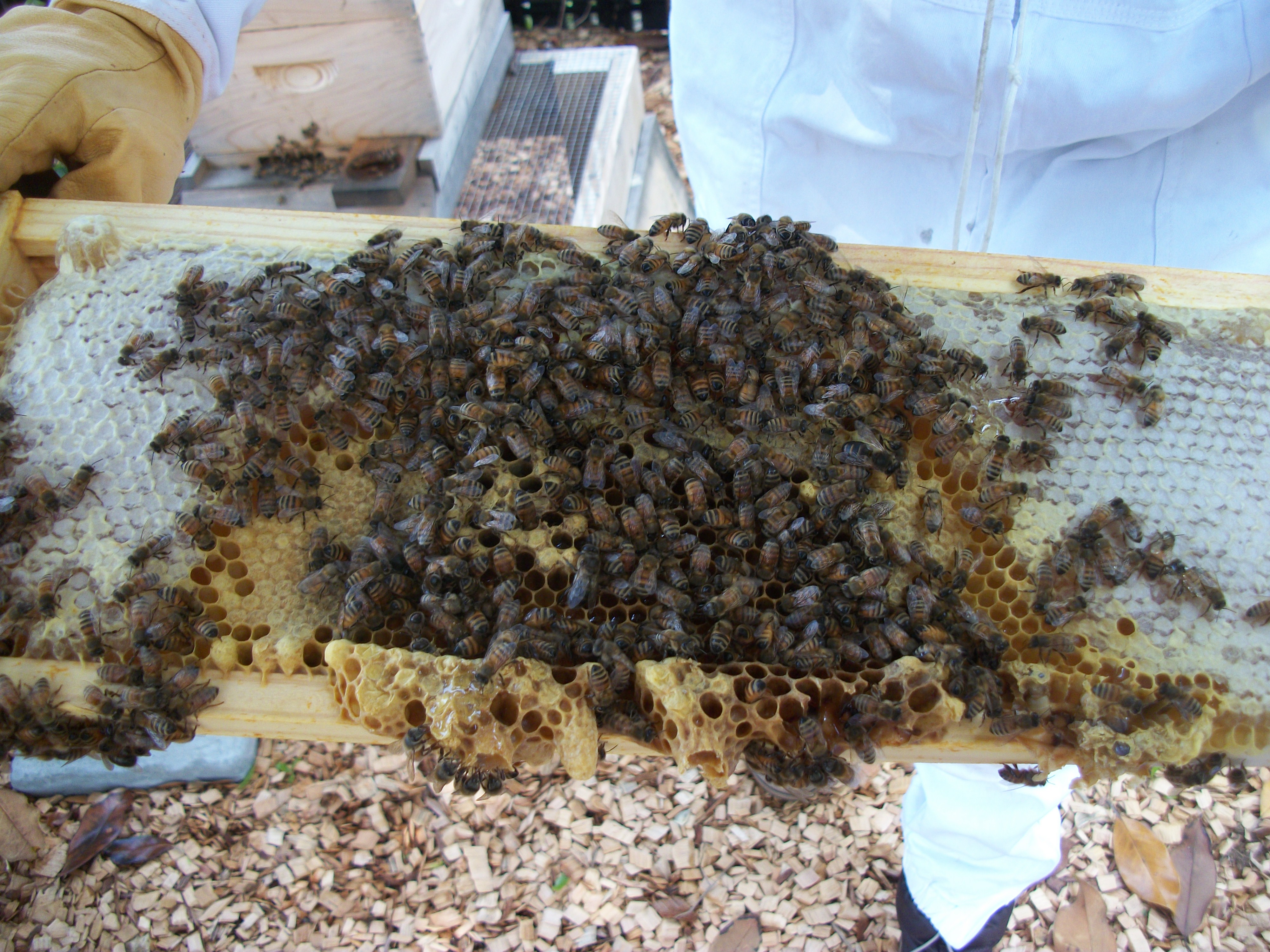
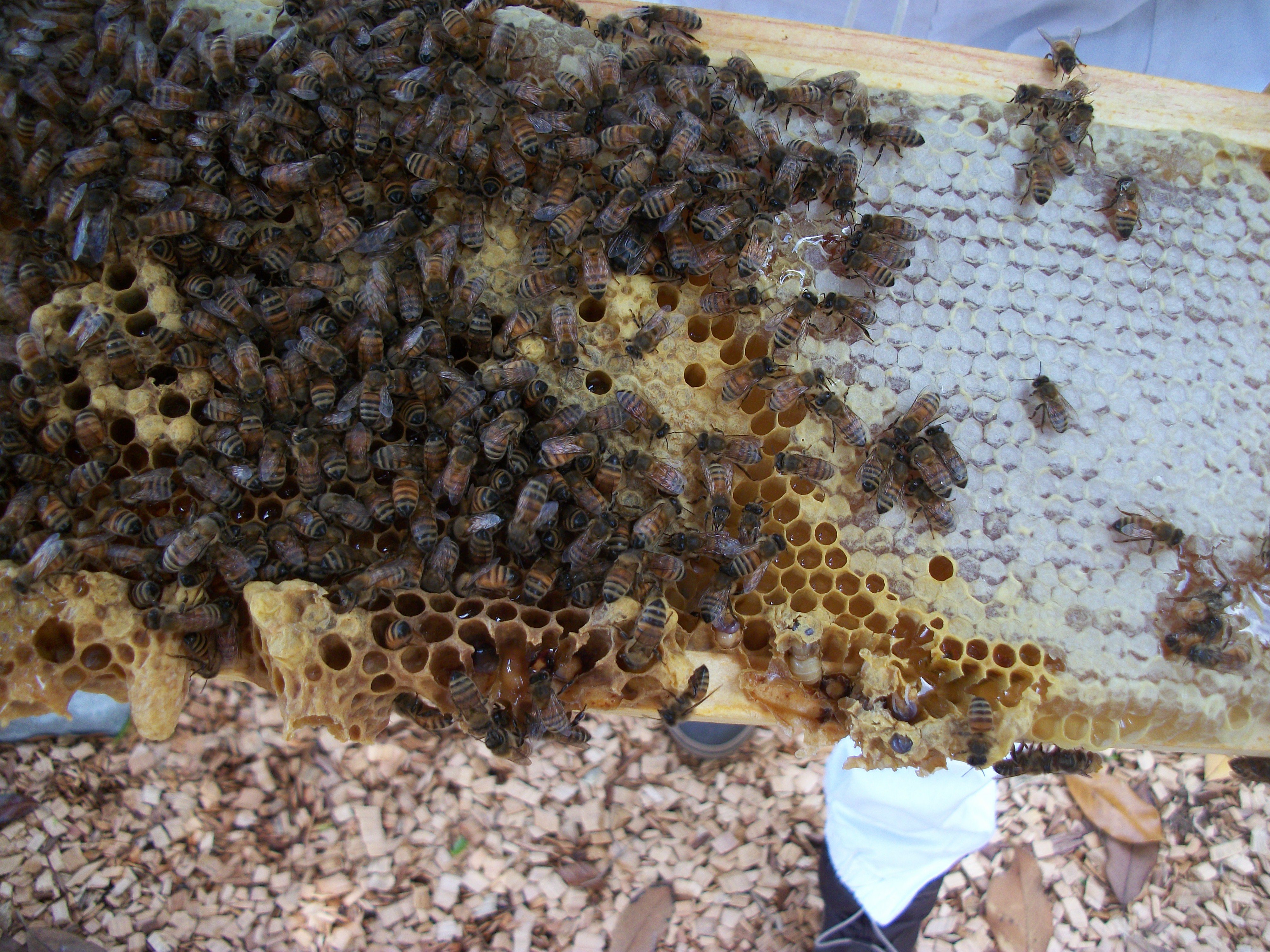
Here’s a close-up of one of the inserts.  You can see the waxed cells and the “brood,” which are the cells holding baby bees and developing bees in the foreground.  The second picture shows the brood even better.

bees up close

You can see the cells with baby bees hatching in the center front of this picture.

bees up close 2

Here’s another video up close so you can see what it feels like to work inside the hive and its panels:

During the time I was in Charleston, Tami rescued two swarms of bees.  One swarm came from one of the demonstration hives in Talula and Mina’s school.  The school staff sent out a call for help to local beekeepers, and Tami went and rescued the hive.  She brought it home and used it to repopulate one of the ten hives on Deux Peuces Farm–which had lost three queens–rendering three of the hives inoperable.

The second swarm Tami rescued landed up next to a local pool.  The pool people were going to call an exterminator, but agreed to let Tami come at night and get the swarm, which she did.

A friend told me today that he just heard that America alone has lost over 43% of their bee population.  I don’t know if that figure is correct, but I do know that it is a very serious problem for our food supply.  Yet we continue to allow chemicals to be used that kill bees.  The European Union, while I was in Charleston, banned one of the greatest offender chemicals for two years to see if it helped preserve the bees.

Turkey Tracks: Elver Eels Per Pound

Turkey Tracks:  April 10, 2013

Elever Eels Per Pound

Ok, so I know more about Elever eels.

First, they sell for a whopping $2000 a pound.

Second, they are tiny, tiny when caught here in the spring–like a piece of angel hair pasta.

Third, they are coming from the bay and are trying to go up the river.  They are likely coming from the Sargasso Sea area.  At this stage they are called glass eels as they are translucent.

Forth, they are sold live and raised to be big before being eaten.

The $2000 explains why people are being fined for netting them without having proper permits.

Interesting Information: BAG IT: Paper or Plastic?

Interesting Information:  April 7, 2013

BAG IT:  Paper or Plastic?

Assuming I’m not carrying my own bags, I’ve never been sure which bag to ask for–paper or plastic.  I’ve read arguments for both.

After watching the 2010 documentary BAG IT,  I’m now sure.  Ask for PAPER.

Why?  Paper degrades in landfills, can be recycled, is often recycled already, and gets recycled/reused ten times more than plastic bags.

BAG IT explores the above question by using an everyday, normal “everyman” who is seeking an answer to the paper/plastic question.

Here’s a synopsis from the web site:

Americans use 60,000 plastic bags every five minutes–single-use disposable bags that we mindlessly throw away. But where is “away?”   Where do the bags and other plastics end up, and at what cost to our environment, marine life and human health? Bag It follows   “everyman” Jeb Berrier as he navigates our plastic world. Jeb is not a radical environmentalist, but an average American who decides  to take a closer look at our cultural love affair with plastics.  Jeb’s journey in this documentary film starts with simple questions:   Are plastic bags really necessary? What are plastic bags made from? What happens to plastic bags after they are discarded? Jeb looks  beyond plastic bags and discovers that virtually everything in modern society–from baby bottles, to sports equipment, to dental sealants, to personal care products–is made with plastic or contains potentially harmful chemical additives used in the plastic-making process.   When Jeb’s journey takes a personal twist, we see how our crazy-for-plastic world has finally caught up with us and what we can do about it.   Today. Right now.

Here are some of the ideas I took away from the movie:

Plastic bags were created to be thrown away, but they don’t go away.  Plastic doesn’t break down in land fills.  Much of today’s plastic finds its way into our oceans, the life blood of this planet, where it is creating huge, floating toxic soups that ocean critters are eating, and, then, dying.  If we eat these fish, we are getting some of the chemicals they have ingested.  We are bombarded all day long with chemicals.  Tiny amounts of these chemicals can cause endocrine system disruptions that have radical repercussions for us, especially around reproduction and cancer formation.  Chemicals are changing how our children are constructed.  The sperm counts in males is dropping dramatically these days.

Plastic bags came about through the concept of “disposable living.”  They are meant to be used once and thrown away.

Plastic bags are being banned across the world.  But, the American plastic industry is suing towns that try to create laws that ban plastic the shopping bags.  The American Chemistry Council leads this effort.

Bottled water is one of the biggest plastic problems in the environment.

We are using enormous amounts of energy creating new goods that we are sending on a one-way trip to a landfill.  Landfills are contaminating our groundwater.  So simplify.  Try to recycle, reuse, repurpose, or do without.

One of the biggest scams in recycling plastic is that while some of us separate our trash by the numbers on the bottom of the plastic, only Numbers 1 & 2 get recycled routinely.  The rest of the numbers just make us think something is being done with the rest of the plastic trash.

Start checking labels on all kinds of products, especially body-care products.  Many are oil based.

Our grandparents didn’t have all these products.

The movie promotes some steps each of us can take:

Cut back on single-use disposable products.

Don’t drink bottled water.

Bring your own container.

Remove packaging in stores.

Choose products with less packaging.

Buy used.

Buy less “stuff.”

Simplify your life.

Remember that nature solves problems.  If we are a problem, nature is certainly going to solve us.

***

Where am I on this journey?

The two oil-based plastic products I have not been able to let go of are plastic wrap and plastic bags.  So that’s my new goal.  I can use glass containers, use plates on top of bowls in the refrigerator, use cheese cloth to wrap produce, and so forth.  I’ll start by not buying new bags or new rolls of plastic.

I don’t use oil-based cosmetics.  I use a waxy natural lipstick, coconut oil for moisture, and don’t do all the skin foundation cosmetic stuff.  (Healthy vibrant skin comes from eating healthy, nutrient dense foods.)  I have natural shampoos and conditioners.  I use baking soda and salt, flavored with an essential oil of peppermint or lemon, for toothpaste.

I’ve been successful at not using aluminum foil, which is terribly toxic.  Parchment paper works fine for baking or topping a dish I’m taking somewhere.

I hardly ever use paper napkins or paper towels.  But I do, some.  The napkins are mostly for guests since they seem to panic if we don’t have them.  Bacon grease in the cast-iron frying pan is where I’m likely to use paper towels.  I could use newspaper…  I’ll try that.  And newspaper could also clean glass…  The rest of the cleaning could be done with rags.

But, there’s still toilet paper…

Anyway, I invite you to join me on this journey.  Do it for the children you love.

Interesting Information: Homing Bees

Interesting Information:  April 2, 2013

Homing Bees

Old friends Leighton and Tara Derr Web are working with bee master Tamara Kelly Enright (my daughter-in-law) to start ten hives on Deux Peuces Farm in Awendaw, SC.

Leighton oversaw the building of the ten hives.  Here’s Tami trying her hand at cutting some of the hive wood:

And here are Tami and Leighton “homing” the 50,000 bees in the ten hives.  Tami is setting up a hive by installing the pieces which the bees will use to build the interior of the hive.  I presume Tara is the photographer.

Tami’s honey is called “Talula Bee Honey,” and it is highly prized in the Charleston, SC, area.

And you can see much more information about Tara and Leighton and their farm on THE FARMBAR web site, which is linked on this blog.  See the right sidebar to click over to The Farmbar.  There are some gorgeous articles and pictures on The Press section of Tara’s blog.

Interesting Information: Chewing Gum Disaster

Interesting Information:  March 27, 2013

Chewing Gum Disaster

I love chewing gum.

Always have.

I probably got that love from my mother.  She used to read in bed at night, and you could always tell how excited the book was by the speed with which she popped the gum in her mouth.

Gum today has some exciting flavors and names, like Wrigley’s “Rain…a tingling spearmint.”  And the packages are colorful and beg to be picked up and chewed.

The other day, though, I noticed that “Rain” had a warning on the cellophane wrapper (NOT on the actual box) that the package contained a chemical called phenylalanine.  Hmmmm.  What is that?

That’s when I looked closer at the label.

Aspartame.  Soy Lecithin.  Sorbitol.  Natural and artificial flavors.

Where was the plain old sugar?

This was not a sugarless gum…

OK.  I’ll just get Juicy Fruit or one of the “normal” older gums.

Aspartame.

Aspartame is in ALL THE GUMS AT THE DRUGSTORE.

I had to go to a health food store to get a plain old gum with plain old sugar.

Aspartame is a neurotoxin.  Dr. Russel Blaylock calls it an excitotoxin and puts it right alongside MSG.  Blaylock claims excitotoxins promote cancer growth and the metastasis of cancer cells.  He cites a life time Italian study that links leukemia and aspartame.  The internet is full of testimonials from people whose health issues had reduced them to wheelchairs and who stopped drinking diet drinks filled with aspartame and who got their health back.  Military pilots are cautioned not to use it before flying planes.

I wrote about the history of aspartame and how it got FDA approval and what it does to humans in Tipping Points 19 and 20.  It’s another shoddy, terrible tale of regulatory agencies bought off by industry and of a total disregard for science or for the health of humans.  Aspartame has NEVER BEEN SHOWN TO BE SAFE.  There is plenty of information showing that IT IS DANGEROUS.

ALL the gum in the stores…

And what about phenylalanine?  In its natural form, it’s an amino acid that shows up in places like breast milk.  It can really harm people who can’t process it.  There have been enough of those folks that the gum is labeled for it.  The pheylalanine is gum has got to be a synthetic chemical brew, so who knows what effect it has on us.  Phenylalanine is reputed to be an analgesic and an antidepressant, so it kills pain and makes you feel happy.  The FDA allows it in foods as an additive and as a NUTRITIONAL SUPPLEMENT, which just shows you how far gone our food system is now.   So, the chewing gum industry is using it because it’s addictive and can kill pain, aren’t they?

And what’s soy lecithin doing in gum???

EVERY SINGLE GUM IN A MAINSTREAM STORE…

Chemical brews, not real food.

Don’t buy it.  Don’t chew it.  Understand what’s gone so terribly wrong with our food system.