Turkey Tracks: Preserving Garlic

Turkey Tracks:  February 2, 2012

Preserving Garlic

Some of our garlic is starting to go soft and to mold–especially the really big bulbs.  It’s that time of year.

Last year, I jollied the bulbs along by putting them into the refrigerator.  I swore then that I’d take the time to clean them and do SOMETHING with them next year.  For those of you who don’t grow things, one plants garlic in the fall, it winters over in the ground, sprouts in the spring, grows all summer–giving you fresh garlic scapes just when you’re hungry for fresh garlic taste–and one harvests in the early fall when the plants start to turn brown.  After pulling up the bulbs, one dries them in a warm dry place, which makes the true, strong garlic taste develop.  After that, one cuts off the stalks and stores the bulbs.  They need cool, dry storage.

Also, EAT GARLIC!.  It has the most amazing chemical properties which can build up your immune system, drive off colds and infections, and keep you generally healthy.  It didn’t get the reputation for vampire protection for nothing!  If you start coming down with a cold, mash a fresh garlic clove into some butter, spread it over a cracker or something like that, and eat it.  Salt helps.  Three times a day.  You’ll notice that help is occurring almost right away.

So, this year, I brined a jar of garlic, which took care of about half of our crop.  You can see what I have left to do.  You can also see the dusky blue light outside my kitchen window

I used a recipe from NOURISHING TRADITIONS since it uses whey.

Brining Garlic

In a quart Mason jar, place the peeled cloves of about 12 heads of garlic.  (If you roll them under your hands or in a towel, the cloves break free easily–all except for the pesky little ones.)

Add 2 teaspoons of dried oregano (I used a savory herb mixture with a Mediterranean base), 2 teaspoons sea salt, 2 Tablespoons of whey.  If you don’t have whey (you drip it out of yogurt), use another 2 teaspoons of sea salt.  Add water to cover, but leave a good inch free at the top.  You’ll notice I have my jar sitting in a saucer to catch drips if the fermentation process gets going in earnest and bubbles start going over the top.

Leave the jar on the counter for about three days, turning it upside down and shaking it a few times a day to distribute the juices.  Then, put it in a cool place.

You can use the garlic like fresh.  The juice is great in salad dressings.  Or, I suspect, a little would jive up soups.

I’m also going to make some GARLIC ELIXIR–from a recipe in WELL BEING JOURNAL, Jan/Feb 2012.  They took it from Doug Oster’s TOMATOES, GARLIC, BASIL:  THE SIMPLE PLEASURES OF GROWING AND COOKING YOUR GARDEN’S MOST VERSATILE VEGGIES.  Sounds like a good book.

Garlic Elixir

1 cup of garlic cloves, peeled

1/4 cup parsley

1 teaspoon salt (sea salt please)

1 Tablespoon red wine vinegar

Olive oil (1/2 to 1 cup)

1 tsp. black pepper

1 Tablespoon lemon juice

optional:  chopped black olives or capers to taste

Process garlic and parsley in a blender until chopped fine– put optional ingredients in first before blending the garlic and parley if using.  Place in a mixing bowl.  Add salt, vinegar, pepper and lemon juice, stir in olive oil.  Place in a glass jar and cover with thin layer of olive oil.  Will store in refrigerator for up to a month.

Wow!  I’m guessing some of that added to salad dressing would make some fabulous salad dressing.  Wonder if one could freeze it…

Push the cloves do

xxx

Turkey Tracks: Using Dried Zucchini Slices

Turkey Tracks:  February 2, 2012

Using Dried Zucchini Slices

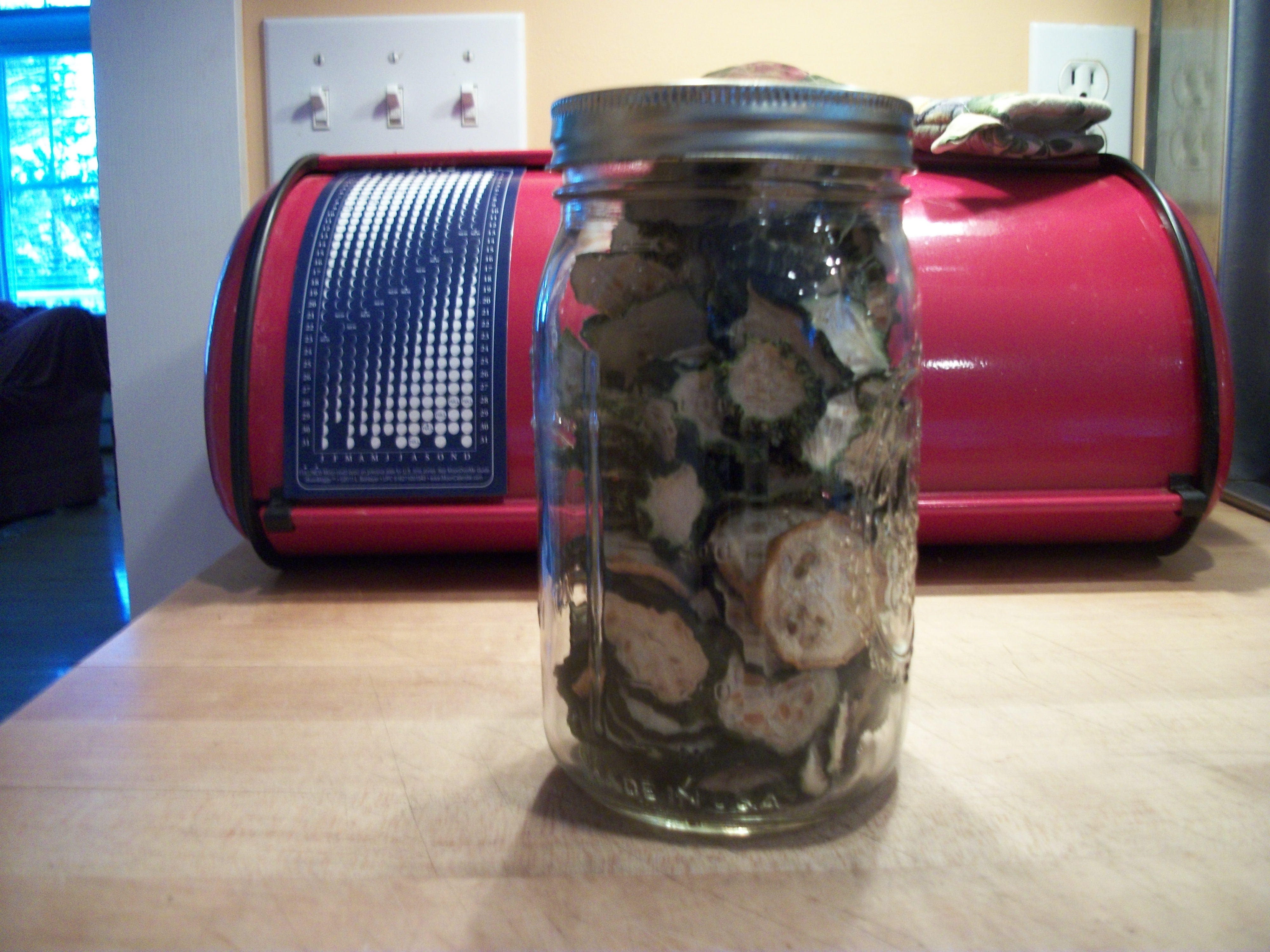
The zucchini slices I dried last summer have been a great success this winter.  Here’s a pic–with the 2012 Moon Maggy in the background I see.

To recap, when the glut of zukes comes in, I’ve tried to shred them and freeze them for winter soups or to put into the dog food.  But, the frozen shredded zukes develop this metallic taste.  And, the bits are positively slimy.  So, this past summer I tried slicing and drying them–having had great success drying halved small tomatoes.

One can just eat the zuke chips or use them in dips.  But, what we’re finding is that they are terrific thrown into soup in about the last five minutes to reconstitute.  They hold their shape and texture, are a delicious addition, and hold up to reheating soup.

Success!

We’re down to our last handful of tomatoes.  I dried a TON of them last summer before the late blight hit.  MORE next summer.

Turkey Tracks: Blue Hubbard Squash

Turkey Tracks:  January 23, 2012

Blue Hubbard Squash

I bought a Blue Hubbard squash in the late fall to roast for the winter.

Blue Hubbards are HUGE.  And they are legendary for being really, really delicious.

I tried to grow them last year, but it just wasn’t a good squash year in my garden.  I’ve already ordered the seeds to try again next year.

I put the squash next to other items in the kitchen so you could tell how big it it.  John had to take it to the garage and slice it into two parts with a saw.  The seeds are also supposed to be terrific, and I love to roast squash and pumpkin seeds, but I didn’t this time around.  Too much going on with everyone here for Christmas.  A missed opportunity I now regret.

Here it is cut in half.  It has beautifully orange flesh.

I put each half cut side down in a large pan coated lightly with coconut oil or olive oil and roasted about an hour.  You can tell from the smell when they are done.  And, you can check for sure by piercing with a sharp knife.

I scooped out the flesh and froze it in serving sizes for us.  And, of course we ate it that night.  I put it in a pot, heated it, mashed it, and added some cream, some butter, some maple syrup, some salt, and some cinnamon and nutmeg.  Delicious!

Add some eggs, and you’d have a great pie filling.

xxx

Turkey Tracks: Some Favorite Pictures

Turkey Tracks:  January 20, 2012

Some Favorite Pictures

Bryan took this picture on their visit in September.  It took me a while to pry it out of his camera, but it arrived not too long ago.

We had our house trim painted in September–thus the ladders next to the rock wall.   And you can see how social our chickens are.  They’ll come get in your lap if you let them–which Ailey is clearing worrying about.  Chickens are especially friendly if you’re eating anything.  In this pic they’re after the millet treat next to us.

Here’s another favorite picture–taken over Christmas when Mike, Tami, and the four kiddos were with us.

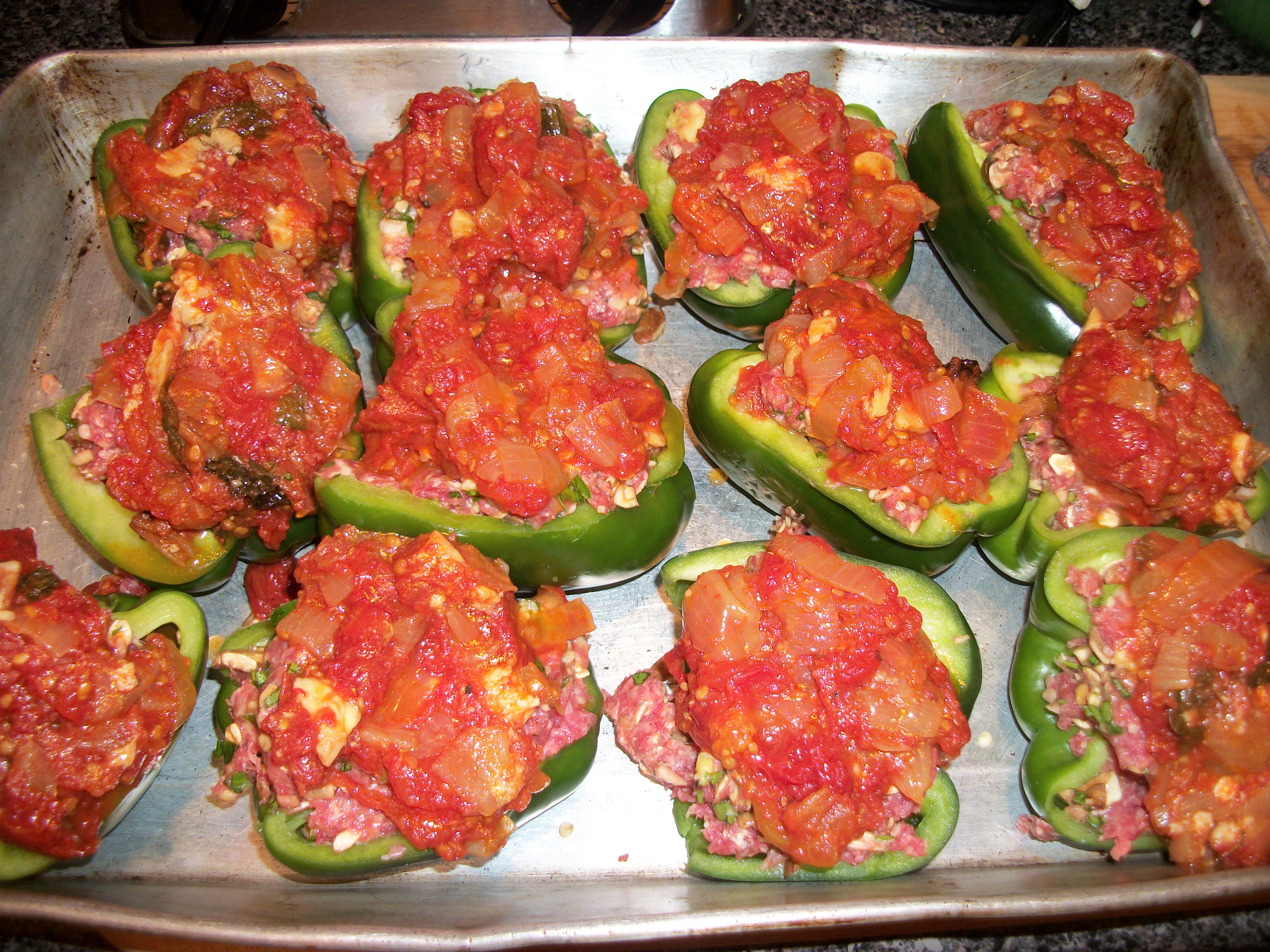
Talula and I were making stuffed green peppers–using the meatloaf recipe that’s already on this blog.  Here’s another view:

Here’s a pic of the stuffed green peppers ready to go into the oven.  They are topped with the roasted tomatoes I made last August and September and froze in mason jars.  That recipe is on the blog as well.  It takes about 45 minutes at 350 degrees to cook them.

Tami or Mike took this pic of John and Penny, who is the most affectionate dog.

Maryann came over Christmas and spent hours and hours playing with the children, who truly love her and her gentle ways with them:

Kelly came to us with a VERY loose tooth.  It took days and days with all of us periodically checking “how loose is it now,” but eventually it came out.  To our surprise, he lost the OTHER ONE the next day.  The tooth fairy only had a $5 bill found late at night after everyone else was in bed and, so, was completely broke after two nights of lost teeth.

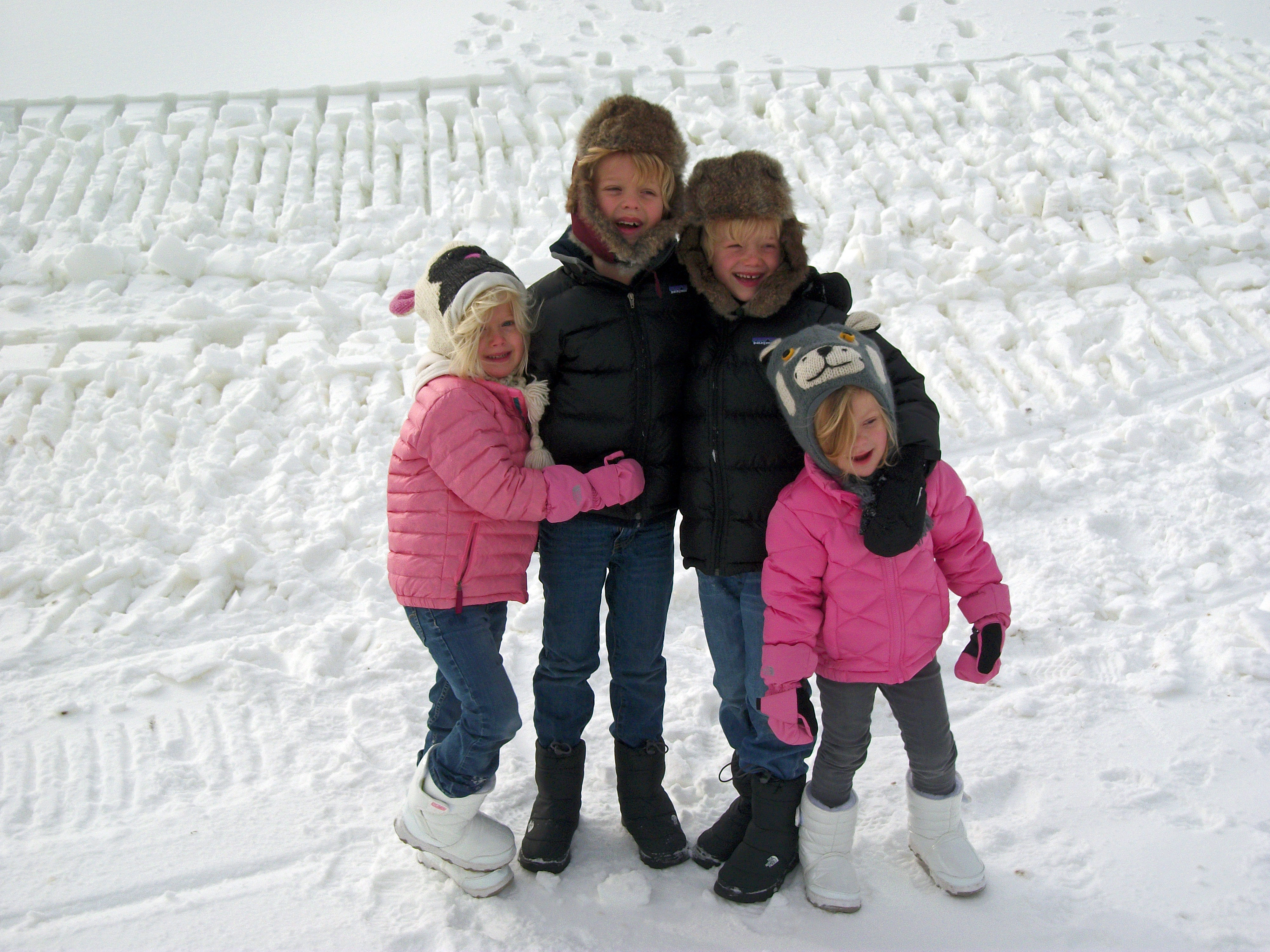
Here are the kiddos at the Snow Bowl, which is walking distance from our house.  We signed them up for a week of ski lessons while they were here, and to our amazement, by Friday, the boys were riding the T-Bar lift alone and Talula had mastered the Mighty Might Lift and the beginning slope in fine fashion.  Wilhelmina made progress, but kept running out of energy and would fall and lie down in the snow.  (Skiing is hard work.)  Her teacher told Tami the following:  “This little girl won’t come up out of the snow.  She told me she’d get up if I gave her chocolate.”

And, of course we got a Christmas tree.  And of course it’s Maine grown.

We put it outside on the upper porch and decorated it with white lights and pine cones.  We never did slow down enough to string popcorn and cranberries for it.

Turkey Tracks: Thanksgiving Highlights

Turkey Tracks:  December 3, 2011

Well, here we are–past Thanksgiving and moving toward Christmas.  I’ve had some trouble with posting pictures to this blog–Wordpress made some technical changes that have flummoxed me, so I’m a bit behind.  Or, it’s that I’m away from home…  But, I did promise to post several of the family’s recipes and a few pics.  So, here goes.  You’ll find below the Bryan family’s famous Chocolate Chess Pie–updated and perfected by Bryan Enright–with a crust I love for all my pies–and recipes for our poultry dressing and gravy.

Mike and Tami hosted the gathering.  They have a long table and a long room that will fit the 20+ people gathering to celebrate.  Bryan and I cooked for two days at his house, while Mike cooked in his kitchen.  Prior to any cooking, however, there is the gathering up phase–which starts with collecting/finding recipes, planning menus, assigning cooking tasks, and gathering food.

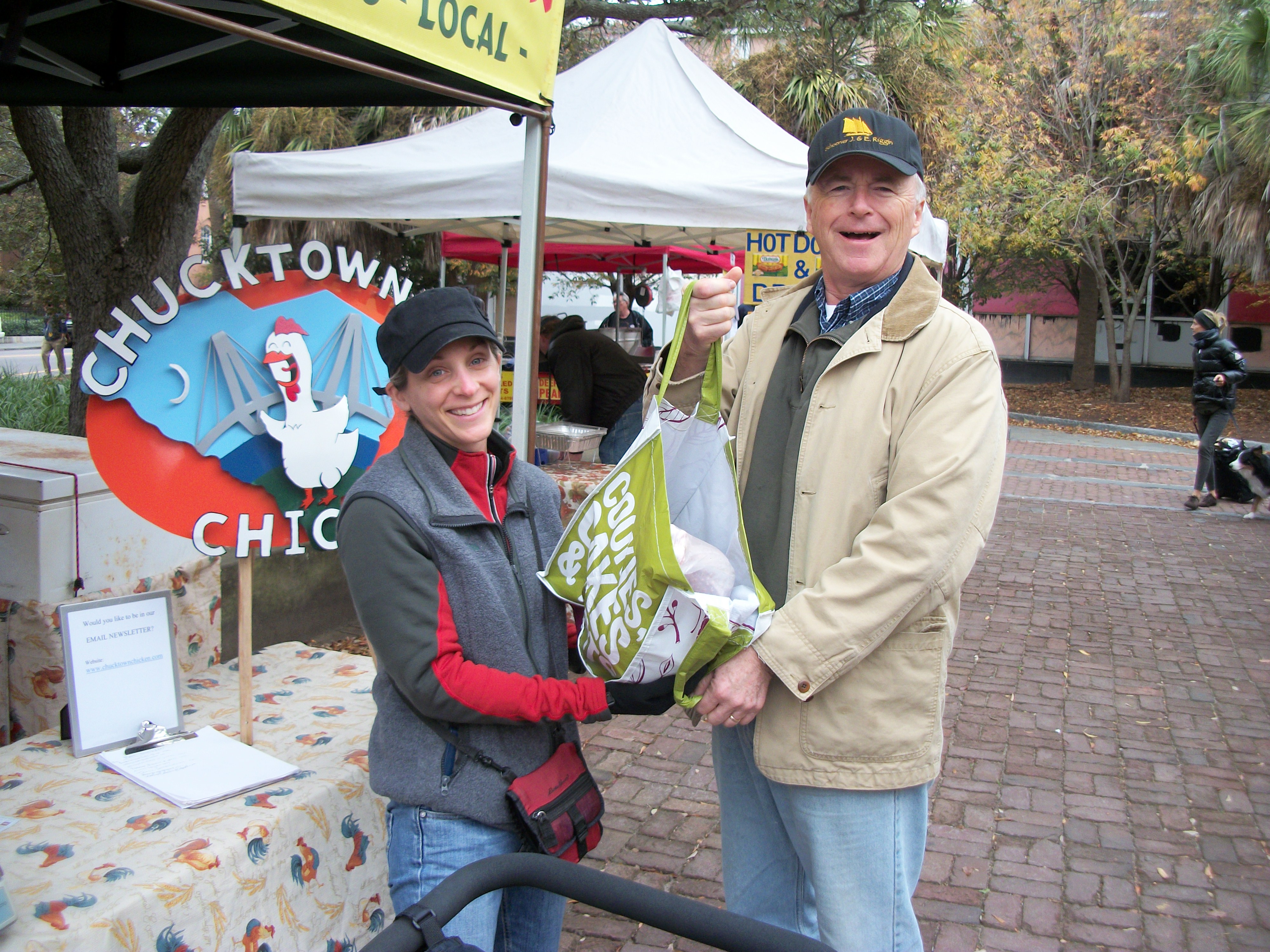
Corinne and I always hit the Charleston Farmers’ Market (5th best in the nation) the Saturday before Thanksgiving.  We picked up one of the two turkeys there, pie apples, and Brussel sprouts.  Corinne also bought a flat of kiwis, which grow abundantly in the Charleston area.

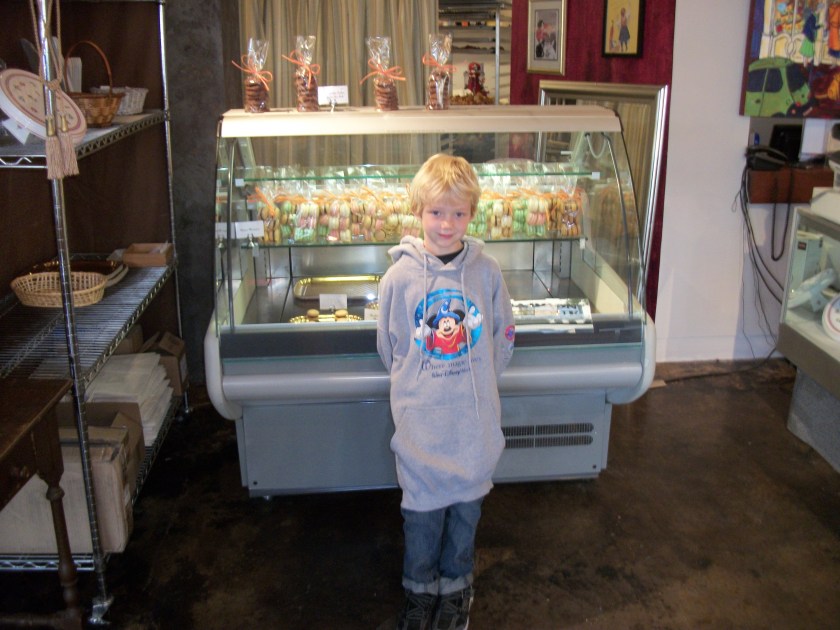
Part of the Farmers’ Market trip involves getting a big cup of coffee or tea at the market and chocolate croissants from a nearby bakery–called Macaroon something or other .  Here’s Kelly waiting for the croissants to be bagged.  He had never had them before, and he really liked them.  It was REALLY cold this morning, and Kelly, who spent the night with us at Bryan and Corinne’s, didn’t have a jacket, so we improvised.  Kelly was appalled that he had to wear a sweatshirt with Micky Mouse on it, but he went along, however reluctantly because he’s that kind of a kid.
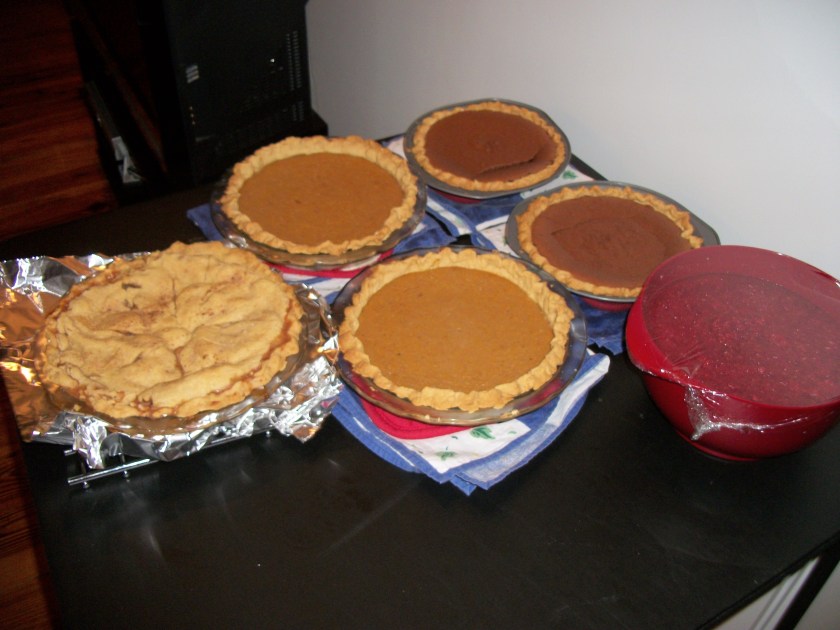
Bryan and I made 5 pies, the stuffing, cranberry relish, and the Brussel sprouts.  Here’s a picture of the finished pies–two chocolate chess (recipe below), two pumpkin (recipe given in an earlier blog post), and an apple.  We will serve them with MOUNDS of REAL whipped cream:
PIE CRUST

My favorite recipe for pie crust comes from Deborah Madison’s LOCAL FLAVORS (387).  You can mix it by hand, but it is so very easy in a food processor.  It makes enough for two 9-inch pies, or one 10-inch double with crust, or one large galette.

2 1/4 cups all-purpose flour

1/2 tsp. sea salt

3/4 cup (1 1/2 sticks) plus 2 Tablespoons unsalted butter

1 egg yolk

1/2 teaspoon vinegar (I usually use apple cider)

scant 1/2 cup of ice water

Put the flour, salt, and butter into the food processor and pulse 4-5 times to break everything up.

Combine vinegar and egg yolk in a measuring cup, mix, and add iced water to make a SCANT 1/2 up.  You may not use all the liquid.

While pulsing, add water mixture in a slow stream until dough crumbs start to come together.  Don’t let them come into a full ball, but combine them into a ball with your hands, wrap, and refrigerate for at least 30 minutes.  These crusts freeze well, too.  Think of future quiches…

Divide into two equal parts for 2 pie bottoms, or cut one large and one smaller piece for the bottom and top of a covered pie.

I roll out pie pastry on a silicon mat.  Often, I use a piece of waxed paper for the top.  Without the mat, I use two sheets of wax paper.

BRYAN FAMILY CHOCOLATE CHESS PIE

“Chess” pies are a big dessert feature in the south.  There are chocolate ones, lemon ones, and so forth.  All of them are delicious!  I think our family pecan pie is also a version as it’s made with brown sugar rather than corn syrup.

Bryan Enright took the family recipe that we had been trying to double as pie pans have gotten bigger and modified it to perfection.  Here’s what he does for TWO 9-inch pies.  Believe me, you will want TWO pies.  You can always give one to a good friend.

Use GOOD butter and eggs and REALLY GOOD chocolate.  This year we used Schaffen Berger, and we could really tell the difference.

2 1/2 cups brown sugar

1 1/2 cups white sugar

dash salt

2 1/2 sticks of butter

5 eggs

1/2 egg shell filled with milk–TWICE

2 1/2 teaspoons vanilla

4 ounces chocolate

Melt the butter and the chocolate together on very low heat.

Mix dry ingredients together.

Add chocolate/butter and mix in well.  Add vanilla.

Add eggs and milk and mix.

Pour mixture into two shells and cook at 325 degrees fir 35 to 45 minutes.  The middle will puff slightly.  Don’t overbake; the pie should be a little shaky in the middle when done.

Serve with mounds of REAL WHIPPED CREAM.

ENRIGHT FAMILY TURKEY DRESSING

This dressing has evolved over the years.  The cornbread and sage came from my grandmother Philpott; the sausage came from John’s mother in Boston; and the celery and onion came from lots of places.

There are FOUR tricks to making good stuffing:  a good stock, really dry bread/cornbread, lots of eggs, and fresh sage.

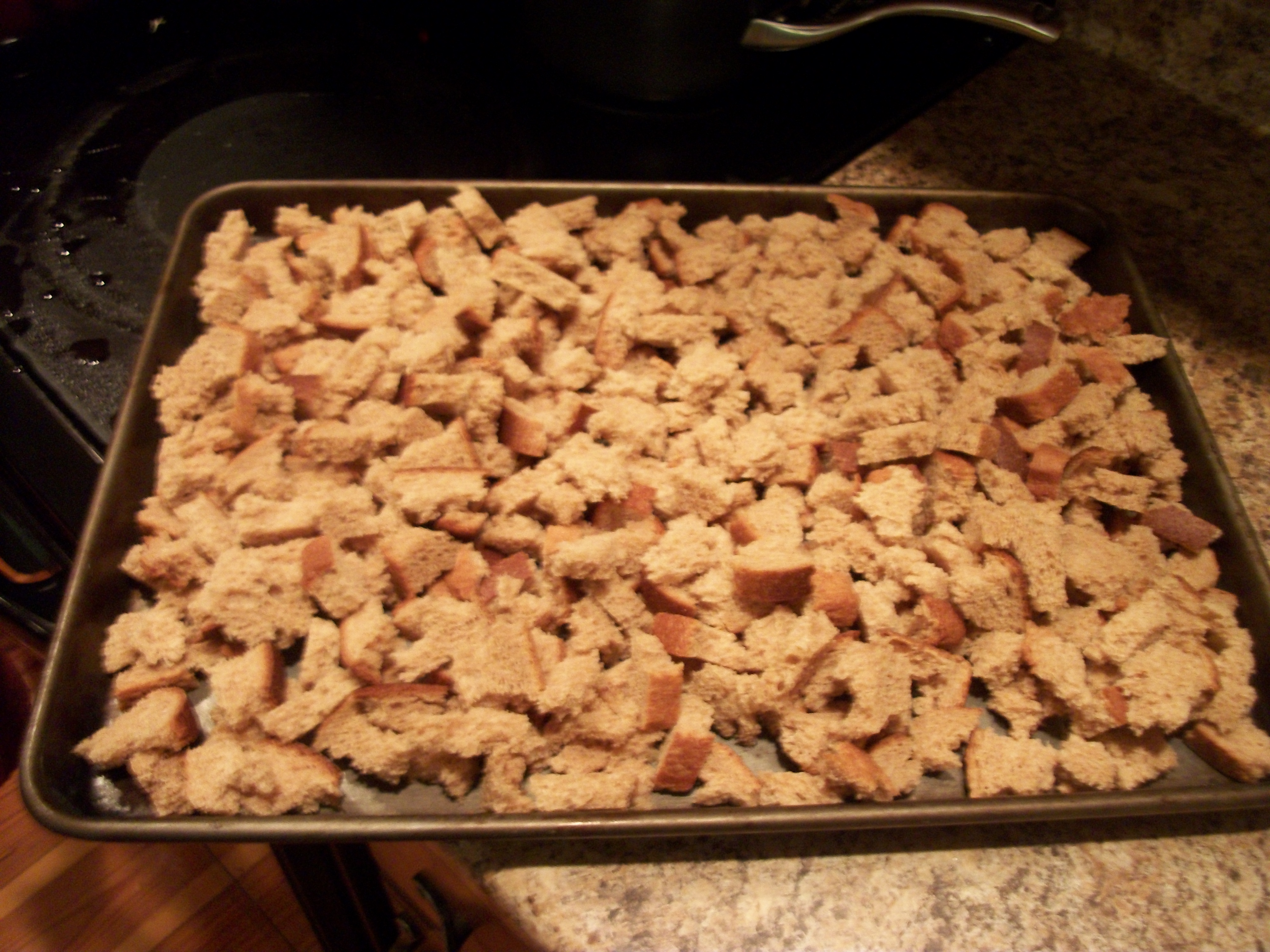
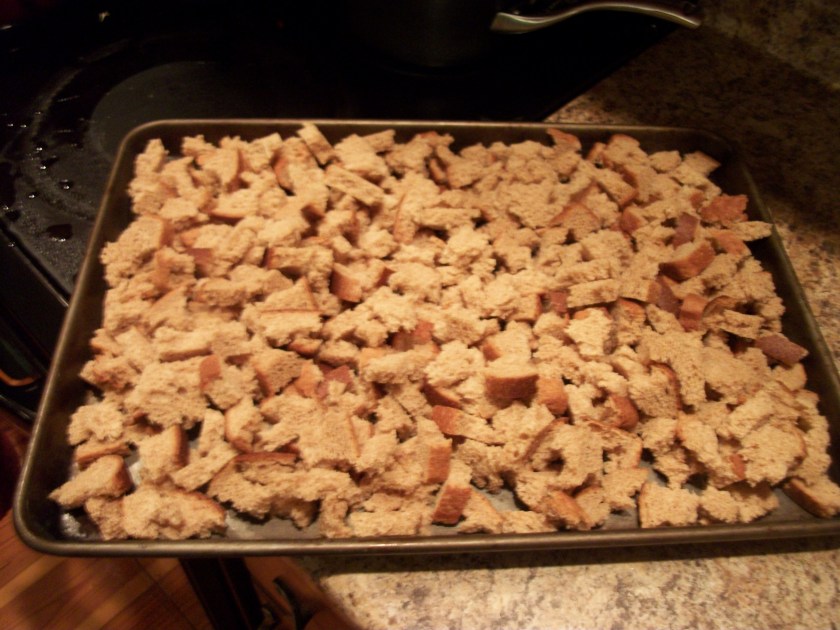
We start drying the wheat bread and cornbread at least four days before Thanksgiving day.  Tear a small loaf of really good wheat bread into small pieces and lay them on a flat pan to dry out.  I start the wheat bread first and the next day bake two pans of cornbread (no sugar please)–using a plain recipe on any cornmeal bag.  Don’t add too much baking powder–this year a batch called for 4 teaspoons–that’s too much.  Don’t add more than two.  If the wheat bread is slow drying, put it into the oven for the night with the oven light on.  If you can preheat a cast iron skillet in your oven for the cornbread, with some butter in the bottom, that makes really good crunchy cornbread for stuffing.

Here’s the torn wheat bread drying out:
Here are the rough ingredients–and this makes a HUGE pan of stuffing–plenty for our 20+ guests–with leftovers.  If I don’t have a huge crowd, I freeze a few large squares for later meals.

1 wheat bread

2 cornbread mixtures baked

Fresh sage to taste–yes, taste the stuffing as you go along when you’re mixing it, and a whole bunch of fresh Italian parsley chopped fine

Sea salt

2 pounds of fresh sausage

18 eggs

2 bunches of celery chopped fairly fine

1 BIG onion chopped fairly fine–1/4-inch pieces or less.  Two if you like onion.  You can tell if you’ve got enough in the mixture.

2 sticks of butter

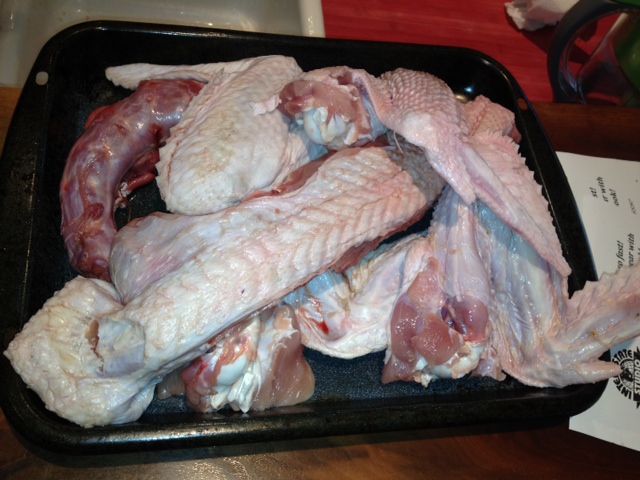
2 quarts of really good homemade turkey/chicken bone broth–we start this broth a few days ahead as well.  Use whatever organs, wings, etc., you can take from the turkey.  This year, Mike cut the turkey into parts to cook it, so I got some lovely bones for the stuffing and gravy stock.  Buy extra turkey or chicken parts if you need to in order to make a good stock.  You need lots of bones.  You can read how to make a good bone broth elsewhere on this blog.  Here’s a picture of the bones we used to make a BIG pot of stock for the dressing and the gravy:

DO NOT MIX dressing up ahead.  It will kill you.  Do not cook it hours ahead.  It will kill you if you leave it out for too long.  It takes about 45-6- minutes to cook a flat of stuffing–so mix it up and put it into the oven as the turkey comes out.

To mix, add all the eggs to all the above ingredients in a VERY BIG BOWL and start adding broth and mixing until everything begins to stick together a bit.  But, don’t get it too wet or it will be gummy.  Put it into pans with 2 to 3-inch sides–the shallower the pan the quicker the dressing cooks, which is not necessarily a good thing–put pats of butter over the top every few inches and cook at 350 degrees until it’s clearly done.

ENJOY!

Turkey Gravy

You need a really good bone broth!  Use can cut off the wings, use the neck, and the organs.  And, you can add extra turkey or chicken parts purchased separately.  Take out the organs (liver and gizzard) after about 30 minutes and chop them fine if you want giblet gravy.  Or, add them about 30 minutes before you want to strain the stock.  Add them back into the gravy at the last.  John’s mother also used the stringy meat from the long-cooked neck, which I love in the gravy.

The proportions are 5 cups of liquid to 1/2 cup each of butter and/or fat and flour.

Salt

The secret is to put the fat and flour in a heavy bottom pan and heat them slowly while stirring and stirring until the flour turns a lovely bisque/tan color.  Add the warmed stock slowly, whisking as you add so you don’t get lumps.  Cook gently until the gravy thickens to where you like it.  You can always thin it if you get it too thick.

The Turkey

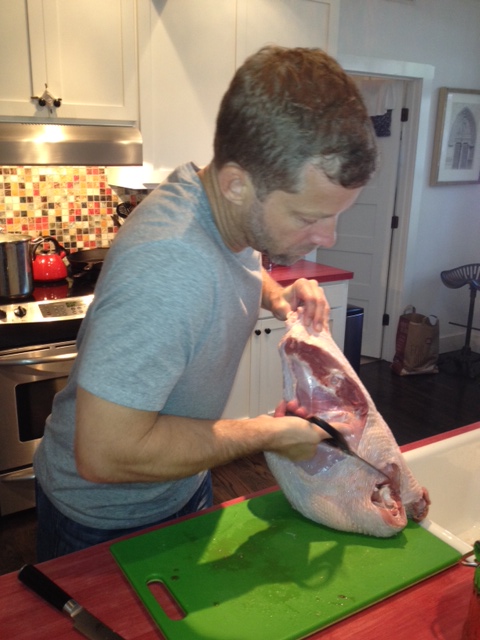
Cooking a turkey is really tricky.  It’s hard to get the legs/thighs done without overcooking the breast.  Mike has evolved a recipe where he removes the legs/thighs in one piece, bones them, and rolls and stuffs them with amazing stuffings that vary from year to year.  This year I tasted pate and chestnuts.  These boned, stuffed legs cook sitting in a rich vegetable broth that we later use for soup.
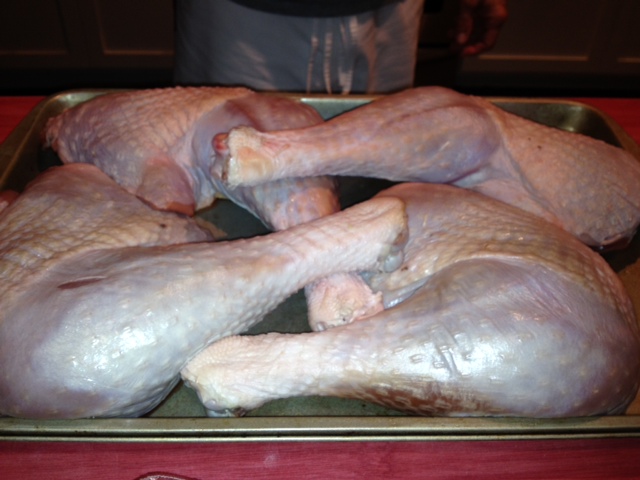
Mike cuts the breasts free and cooks them on his grill, which can heat like an oven.
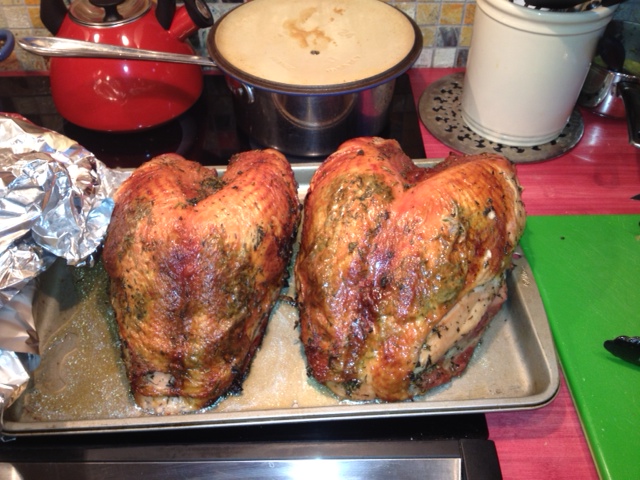
I didn’t get a picture of the cooked rolled legs, but here are the turkey breasts about to be carved.  The meat was very tender and moist:
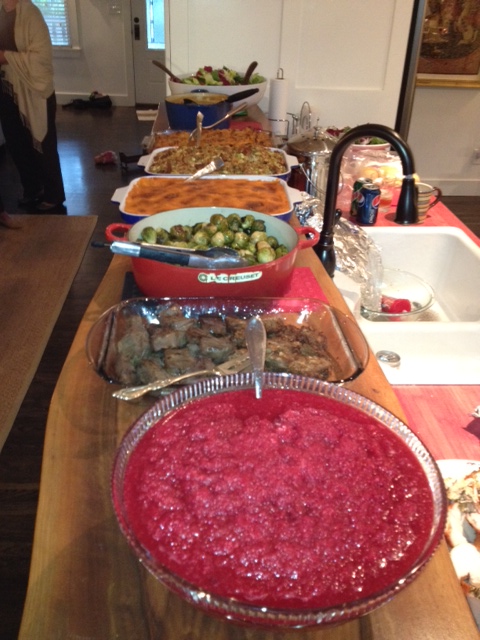
And, here’s the food starting to be lined up for serving:
I was having too much fun to slow down and take a picture of Tami’s beautiful table–which I now regret.  I should have gotten a shot of everyone seated too, but you know how that goes.  Food needs help getting to the line-up, and children need help with plates, and before you know it, the moment is missed.

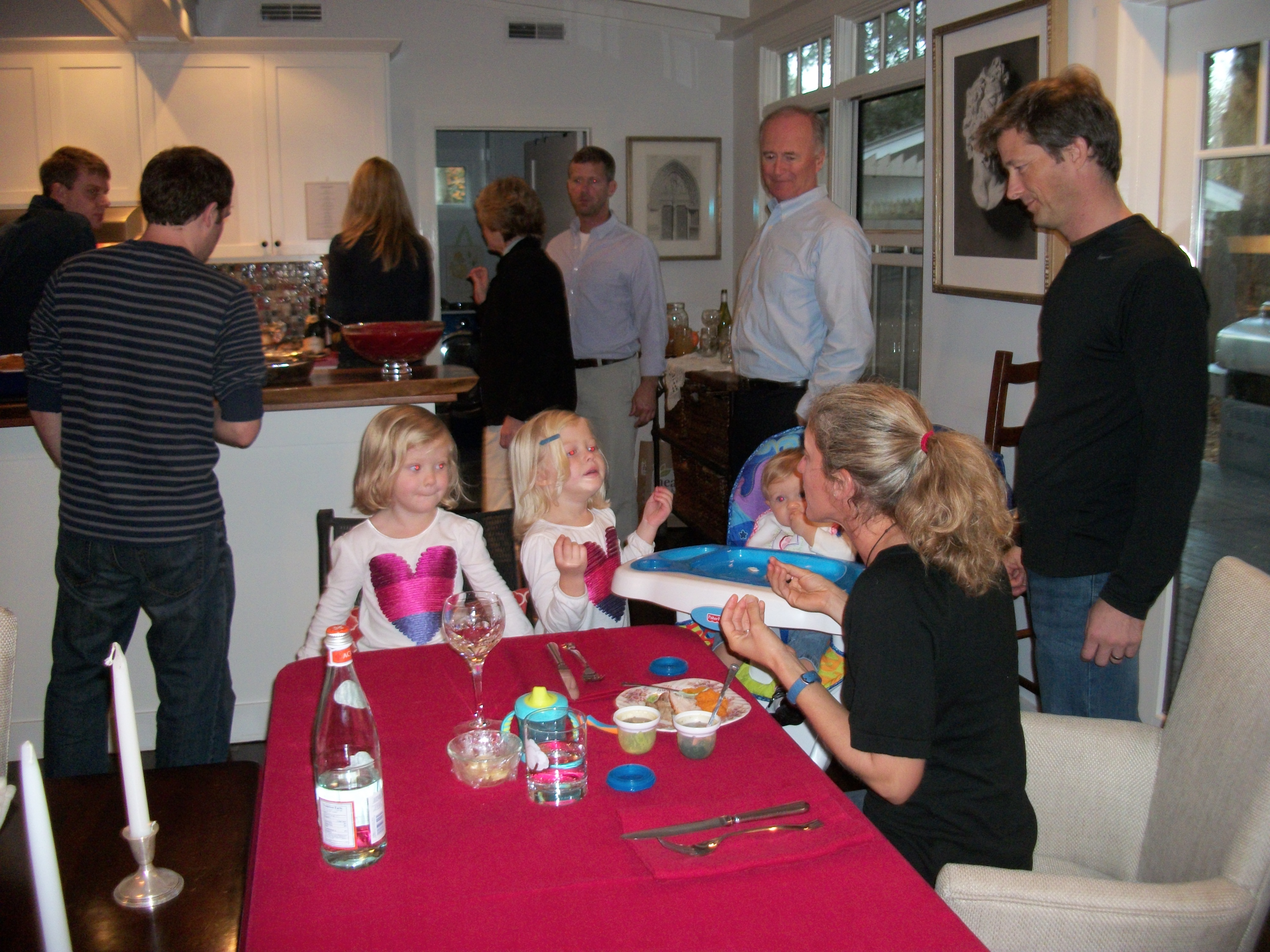
But, here’s one end of the table with Bryan, Corinne, and Ailey (who LOVES to sit in her high chair and eat), with Talula and Wilhelmina:

TURKEY LOVE to all, as Tami says!

Turkey Tracks: Pie Pumpkins and Pie

Turkey Tracks:  November 13, 2011

Pie Pumpkins and Pie

The best pie pumpkins are long–like a huge salami.  They’re dark green that starts to turn orange in patches–they turn orange when you cook them.

I usually get one from our CSA, Hope’s Edge.  And I buy a few more, roast them, and freeze the meat–for winter pies.  Organic, of course.

Just slice the pumpkins in half, scoop out the seeds, put them on a shallow pan that has some sides–the roasting pumpkins can give off juice–and roast them for at least an hour at 350 degrees.  You’ll know when they are done–they’ll smell delicious and will fork easily.  Let them cool, scoop out the meat, and freeze or make a pie.

It takes about 2 cups of pumpkin to make a 9 or 10-inch pie.  Each of these halves makes about two cups.  Convenient, huh?

My favorite recipe comes from NOURISHING TRADITIONS, by Sally Fallon and Dr. Mary Enig.

Start with a flakey pie crust of your choice.  (Use butter or really good lard–not any of those fake fats like vegetable lards or margarine.)

2 cups pumpkin

3 eggs–if small, use 4 eggs

3/4 cups rapadura–which is dried cane juice.  I also use organic sugar.  The rapadura has a stronger taste, but the pumpkin can take it.

1 tablespoon fresh grated ginger

1 teaspoon cinnamon

1/4 teaspoon each salt, powdered cloves, nutmeg

grated rind of lemon

1 cup piima cream, or creme fraiche–piima is a cultured cream.  You could also use sour cream.

2 tablespoons brandy

Mix everything together well, pour into your pie shell, and bake at 350 degrees for 35-45 minutes.  The time will depend on the size of your eggs and the liquid in your pumpkin.  I used 3 small eggs, and the pie took more like an hour to puff in the middle.  If it takes longer, cover the  pie with some parchment paper to prevent burning.  (Don’t use aluminum foil!  For anything!!)

 This pie is as light as a feather and absolutely delicious.

Serve with REAL whipped cream.

Turkey Tracks: Blueberry Jam

Turkey Tracks:  November 13, 2011

Blueberry Jam

Talula is coming for Christmas.

Talula loves blueberry and blackberry jam.

This year she’s going to get POPOVERS with her homemade jam.

Popovers are dead easy:

Put the following combination of flour, eggs, milk, and salt into a blender, blend it up, and pour the mixture into butter-greased TALL popover forms–filling each 3/4 full.  (If you don’t fill the form 3/4 full, the resulting popover is mostly air inside the crust, rather than having a middle that is still soft and yummy and altogether satisfying.)  I have two popover pans, each with 6 forms.  They look like big muffin tins–only each stands alone since the rising popover needs a lot of space around it.

This recipe is for about 9-10 popovers.  You can halve it, or add to it, for 12 popovers.  If you like cheese popovers, throw some cheese in–about a cup I’d say, for 6 popovers.

4 eggs, 2 cups of AP flour, 2 cups of milk, some salt.

For 12, I’m going to try 6 eggs, 3 cups each of flour and milk, and salt.

Easy, right!

Yes, it’s a white flour-based recipe, but I use really good eggs and our raw milk, so I think it’s ok to have popovers as a special treat.

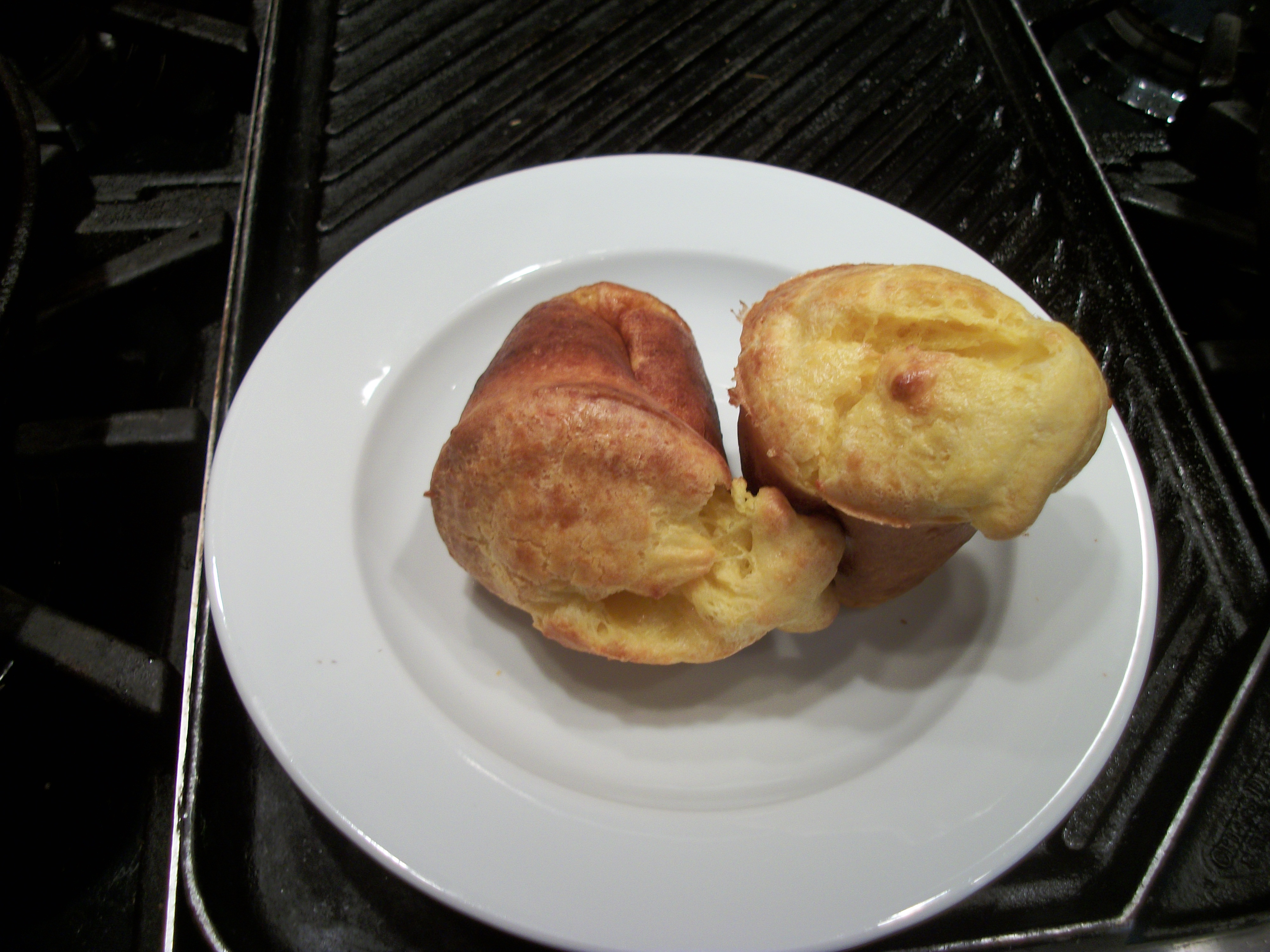
Here’s a picture of cold cheese popovers–which we ate with our dinner after having their mates for breakfast.   They do shrink a bit when cooling.  So, eat them HOT–and 2 of them with butter and jam is a filling breakfast.

As for the blackberry jam–there is one jar to spare before next summer, when there will be one more.  Talula comes in July, and the blackberries are ripe in August, so we have to hoard and parcel out what’s left of the jam on hand–especially since 2010 was very dry and as this year we didn’t get any blackberries as it was the year to cut back the patch and let it grow anew.a

As for blueberry jam, I’m all set for Talula–and her father, mother, brothers, and sister:

Making blueberry jam is easy.

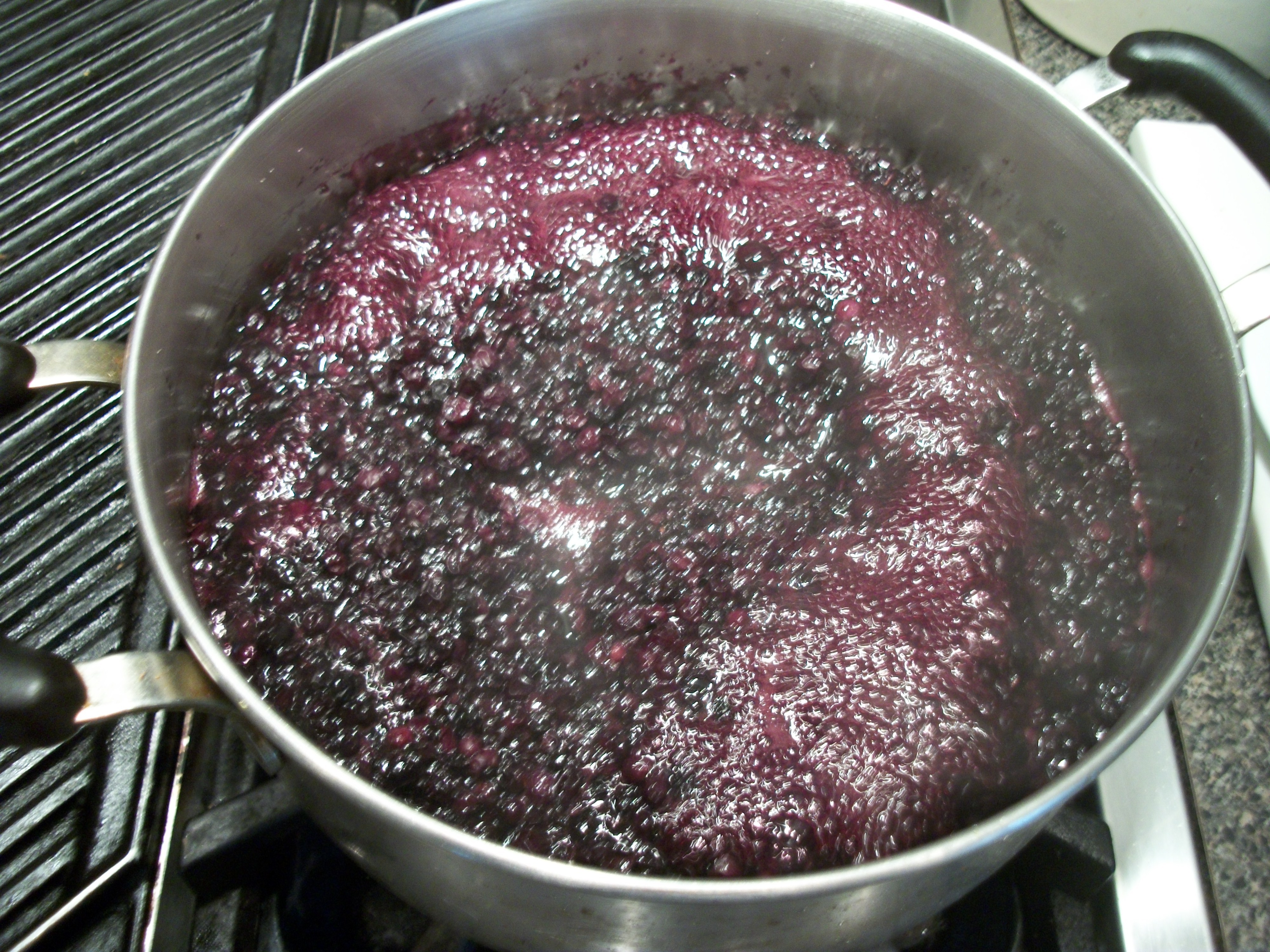
You just fill a heavy pan about 1/2 full of organic berries.  (We have the tiny, very flavorful Maine blueberries–and you can take “wild” out of that title since they are VERY cultivated.)  I use about a cup of sugar to 3-4 cups of berries, and I grate in the rind of one lemon for a batch this size.  Sometimes I add the juice too, but go slow as the mixture can get very lemony.  Taste the jam as you go along–if it isn’t sweet enough, add more sugar.  But, start with less since too much sugar really ruins the whole batch.

Then, you just cook it down until the juice begins to jell on the spoon you use to stir it with every now and then.  You can see that the mixture is bubbling pretty hard.  Let some of the juice dribble on a plate, let it cool, and you can tell if the juice is starting to thicken up.  You really don’t want blueberry jam to get too thick, so I fall off on the side of a looser jam that isn’t overly cooked to death.   (With blackberries, I am more particular and do use a candy thermometer–but that involves figuring out what the jam point is in your area, which involves how above sea level you are, and so forth.  Any good canning book–like the Ball Canning Book–can walk you through that exercise–and it is a good thing to do.)

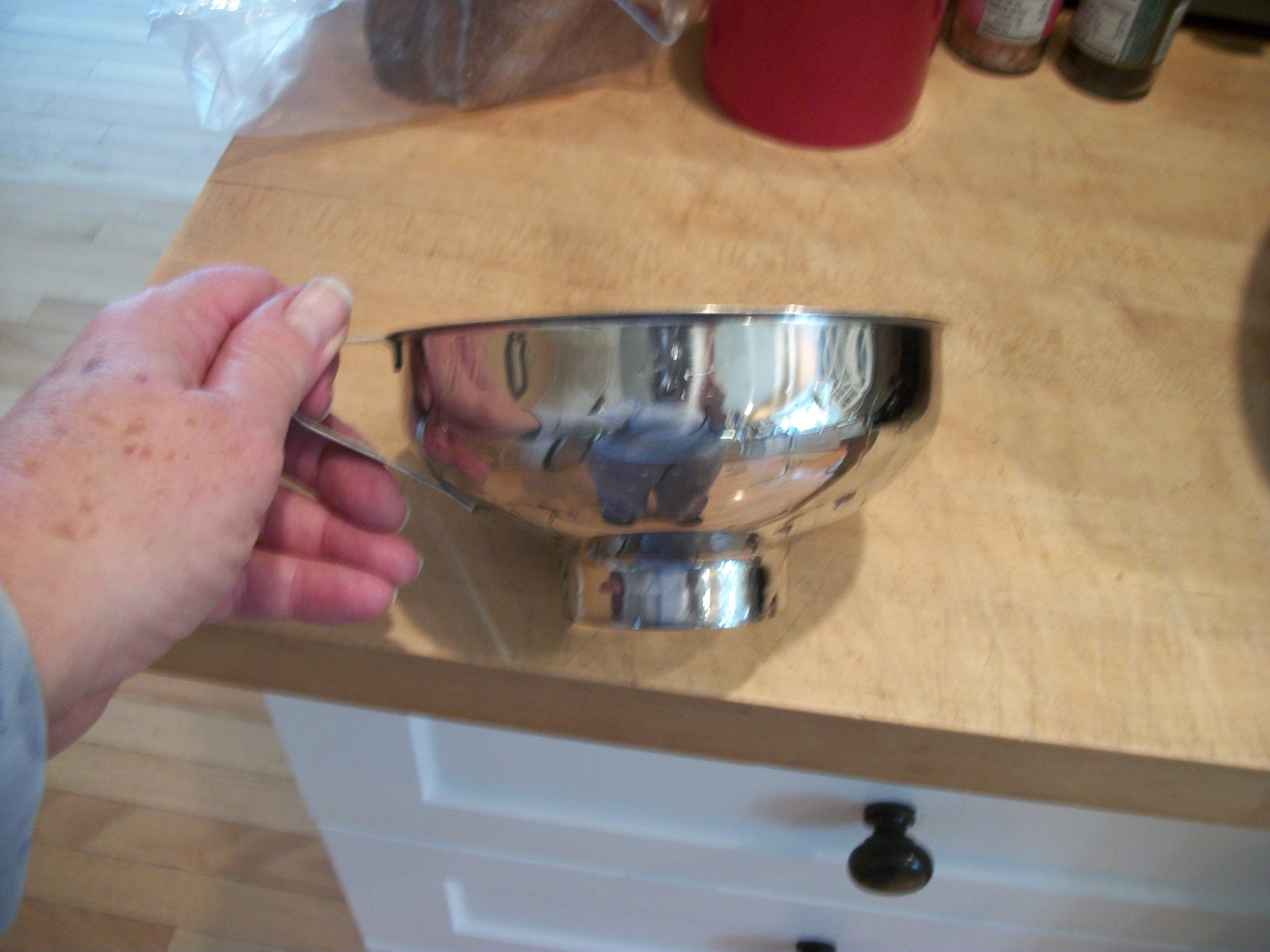
It really helps to have a canning funnel when you start to put the jam into clean Mason jars.  The wide mouth accepts a full ladle of hot jam, and the small bottom keeps it all going into the jar.  Here’s what one looks like:

 O

Once you start to make jams and jellies, it’s hard to go back to the store bought.  Most of them are so full of pectin that they taste like rubber.   If I’m going to eat that sugar, I at least want to have it accompanied by real fruit, not by fillers.

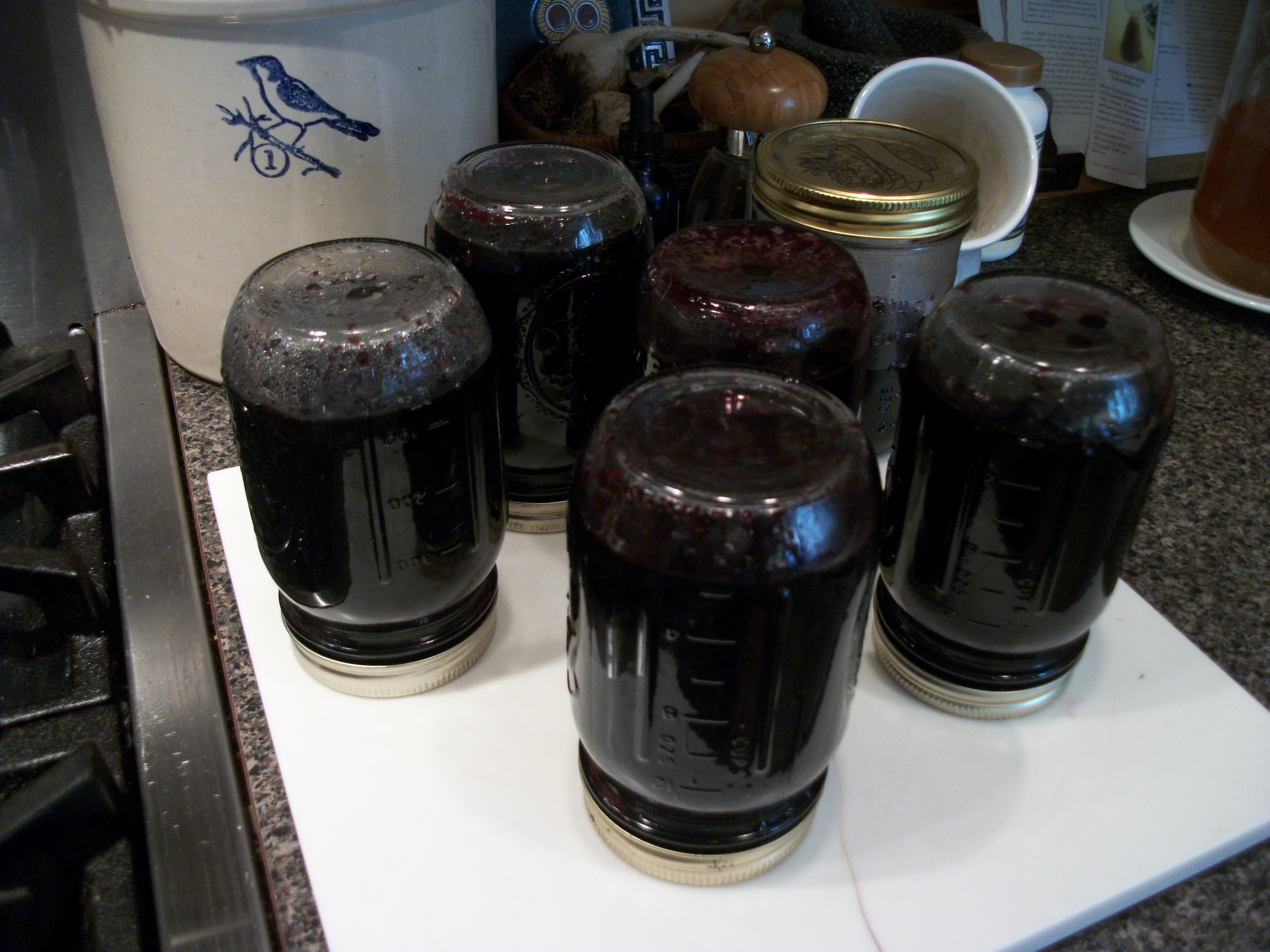
I put the hot jars upside down–which helps the top to form a vacuum–until they cool–as you can see from the picture.

Turkey Tracks: Marathons and Roasted Squash

Turkey Tracks:  October 31, 2011

Marathons and Roasted Squash

Tamara Enright ran the Marine Marathon yesterday–October 30, 2011.

For the second time.

Tami  said she was finished now.

I told her she’s run it again

She ran the marathon with Tara Derr Webb, and they had a nice girl visit in DC beforehand, which was especially nice as Tara has now moved to the Hudson Valley area of New York–to land where she can have more animals, more goats, and can grow things.  I believe chickens are also on the horizon.

Michael kept the children over the weekend:

Clearly they had fun.

Mike was aghast at the for-sale Halloween costumes and didn’t buy any.  He said they were over-the-top scary.  I heard words like blood, gore, and axes.

We never bought costumes when Mike and Bryan were little.  We made our own up.  More than once they went out in strips of sheets with splashes of ketchup tied around heads.  Or, sheets tied over their heads with eyes cut out.  Half the fun is making up your own costume.

As it was snowing here, I was cooking warm food:  roasted chicken and a seasonal favorite:  roasted squash, potatoes, green tomatoes, and onions with olive oil, LOTS of unpeeled garlic, and rosemary.  There is something wonderful about putting one of the dense, sweet squashes together with the last of the tart green tomatoes.  I only had three little ones left–so more would have been nice.  Here’s what the pan looked like on its way into the oven:

The squash is from a plant that volunteered itself in the bean row.  The potatoes are ours–grown in the blue buckets.  The rosemary is ours–I just moved the plants to a deeper part of the garden where the snowplow won’t get it and covered it with a bucket and lots of straw–we’ll see if it will winter over that way.  The onions and green tomatoes came from Hope’s Edge.

Basically, you just cut everything into the same size pieces–about 1 1/2 inches–drizzle with olive oil, sprinkle on an herb–we like rosemary on this one–salt and pepper–and bake at 375 about an hour–turning maybe once.  When the bits are starting to show brown spots, it’s done.  You can do it ahead and reheat it too.  The squash will cook faster than the potatoes, so make sure the potatoes are in small enough pieces.

I”m wondering if I can get the same tart/sweet flavor by using sweet potatoes or a sweet squash and some of my salted Meyer lemons…  I’ll get back to you on that one.

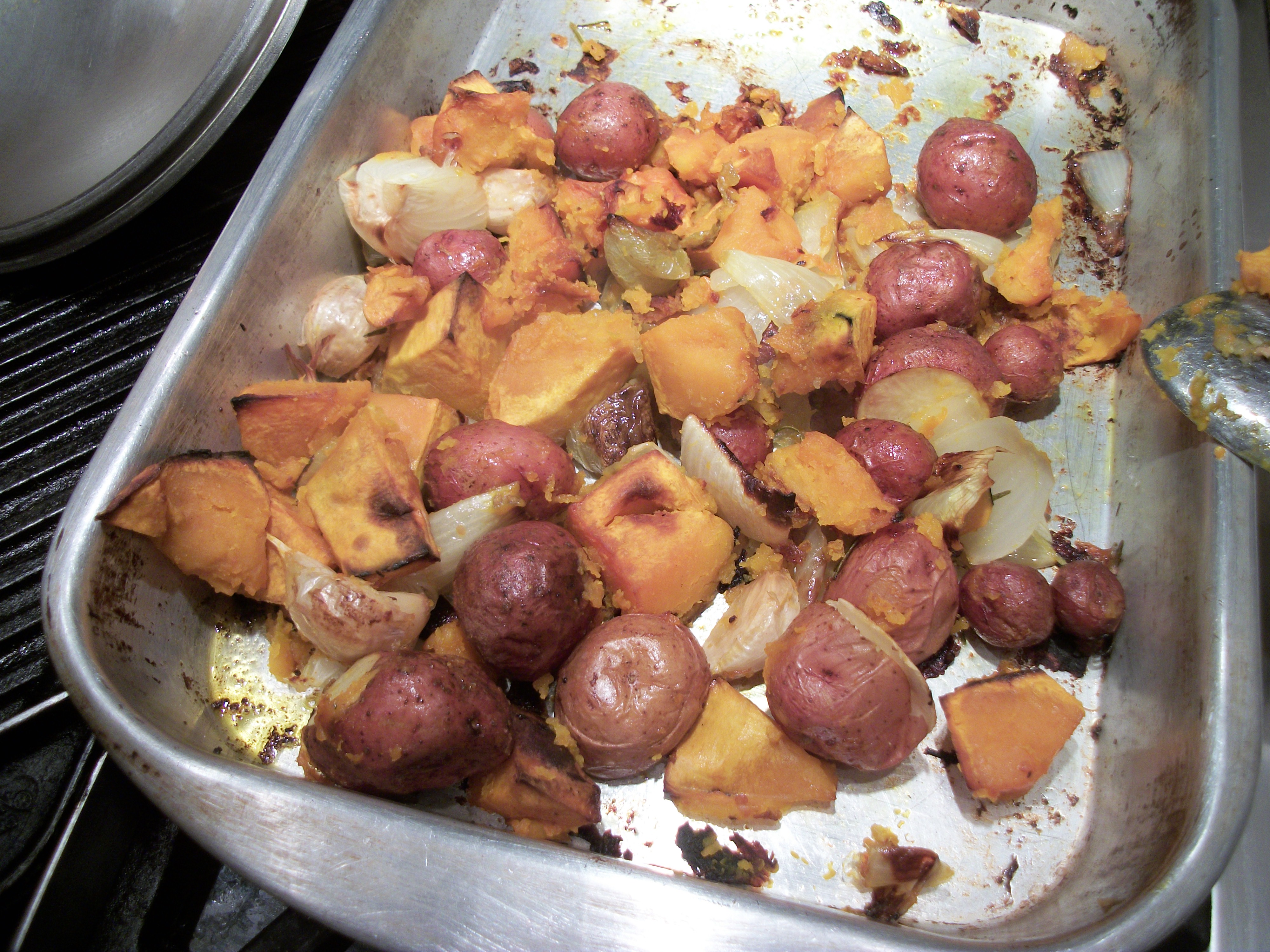
Here’s what it looks like done–I almost forgot to take a picture and did so after we had served our plates:

I love Blue Hubbard squash.  I tried to grow it this year, but it wasn’t a great year for squashes this year in Maine.  Too cool in August, which is usually really hot for us.

Blue Hubbard’s are HUGE. Back in the day, folks would cut into them and cut off what they wanted to cook that day.  The rest would hold in a cool room.  But I think I’ll cut it in half–friend Ronald suggested a saw, and I think he’s right–and just roast it all at once and freeze portions.  excuse the dishes drying in the background.  I put it next to a pineapple so you can see the relative nature of its size.  I’ll keep you posted on how the cooking goes…

Turkey Tracks: More on Juicing

Turkey Tracks:  October 31, 2011

More on Juicing

Well, I did it!

I bought a juicer.

I began to think more about how to access all of the nutrients in leafy greens in big quantities without adding stress to the body by overloading it with gobs of cellulose, which our bodies cannot process and which overload our whole digestive tracks.  We don’t have the right enzymes or the kind of fermenting stomachs that, say, cows have.  (You can read about overloading with fiber in my Mainely Tipping Points essays and more on juicing in the Turkey Tracks archive–where there are suggested combinations.)

I did a lot of research because I wanted a juicer that could handle leafy greens–kale, chard, spinach, collards, lettuce, parsley and other herbs.  The big, fast fruit juicers don’t handle greens well, if at all.  And, the more I research the more I note that too much fruit and fructose is really not good for us.  We are only adding enough fruit to sweeten the green juices–and it does not take much at all.  We’re easily only using a 1/4 to 1/3 fruit to vegetable ratio.

I got an Omega VRT 350 HD.  The HD stands for heavy duty.  There are TONS of videos on youtube showing how many juicers work and comparing juicers, and showing how the Omega in particular works.  Look for, especially, videos by John of Discount Juicers.  Here’s an example:   http://discountjuicers.com/omegavrt350.html.   It’s important to learn how to feed the machine (slowly and mix greens with harder items like cukes and carrots) and what you can put in with peels on (lemons, limes, cantaloupes, grapes), and what you need to peel (big citrus).

The Omega DOES handle greens really well.  It has an internal auger that gets all the juice out.  Because it’s slower, it gets out more nutrients.  The waste material is very dry.  (My compost the worm bin are very happy with the juicing debris.)  The Omega 350 is quiet, and it cleans up easily.

We’re now moving to using it twice a day:  in the morning for something like pineapple, carrot, and a little beet juice to stimulate digestive juices.  (Raw beet is very powerful, so start with small amounts.)  In the afternoon, we have a big green drink instead of afternoon tea.  One of our favorite mixtures is kale, cucumber, and a bit of apple or pear.  Throwing in a handful of fresh cranberries and/or a quarter lemon is nice too, especially as cranberries are in season now.  The lemon adds a clear sparkly taste and it chelates heavy metals.

We’re hooked.  The juice feels like silk going down.  You can feel the enzymes and nutrients.  I’m finding that I have little desire for other sweets these days.  And my body is showing that there is some amount of significant detoxing going on as well…

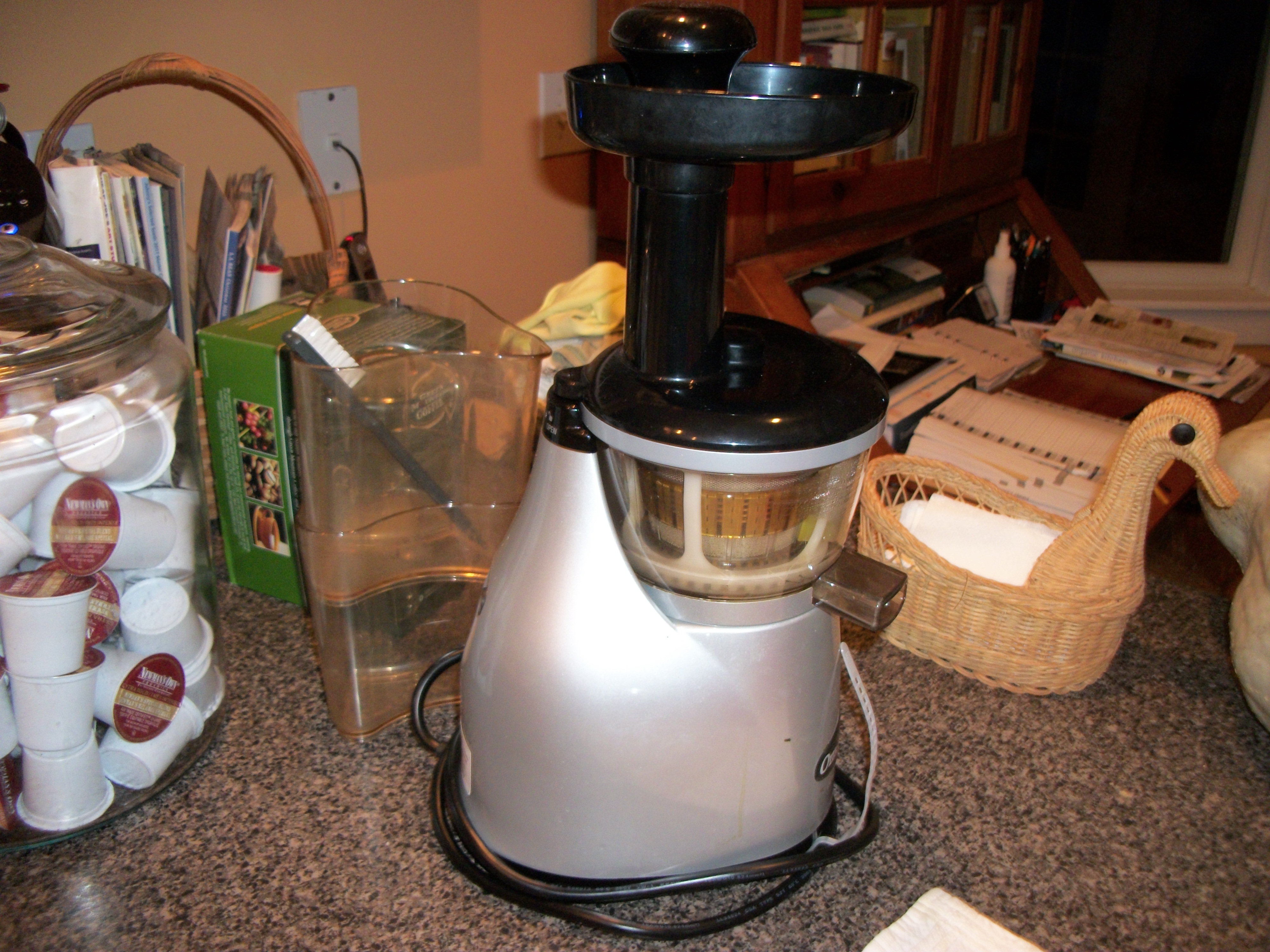
The Omega’s footprint is small.  Here’s a picture of it on my kitchen counter–I’ve put it next to other items so you can see size relationships.

I have not participated in giving Christmas gifts in years now as I think that whole exercise is a consumer nightmare.  But, after getting our juicer and seeing how it works, I gave one to each of my son’s families.  They are thrilled and are making good use of their juicers.  Bryan juiced collards the other day, which I had been afraid of trying, and he and Corinne said the juice was actually quite sweet.  So, on to collards.

Anyway, instead of spending a lot of money on yet more toys, clothes, games, etc., why not combine your gift giving into one, special gift that keeps on giving, keeps on giving good health–providing organic vegetables are used.

Give a juicer!