Turkey Tracks: On My Long Arm Machine

Turkey Tracks:  November 7, 2016

On My Long Arm

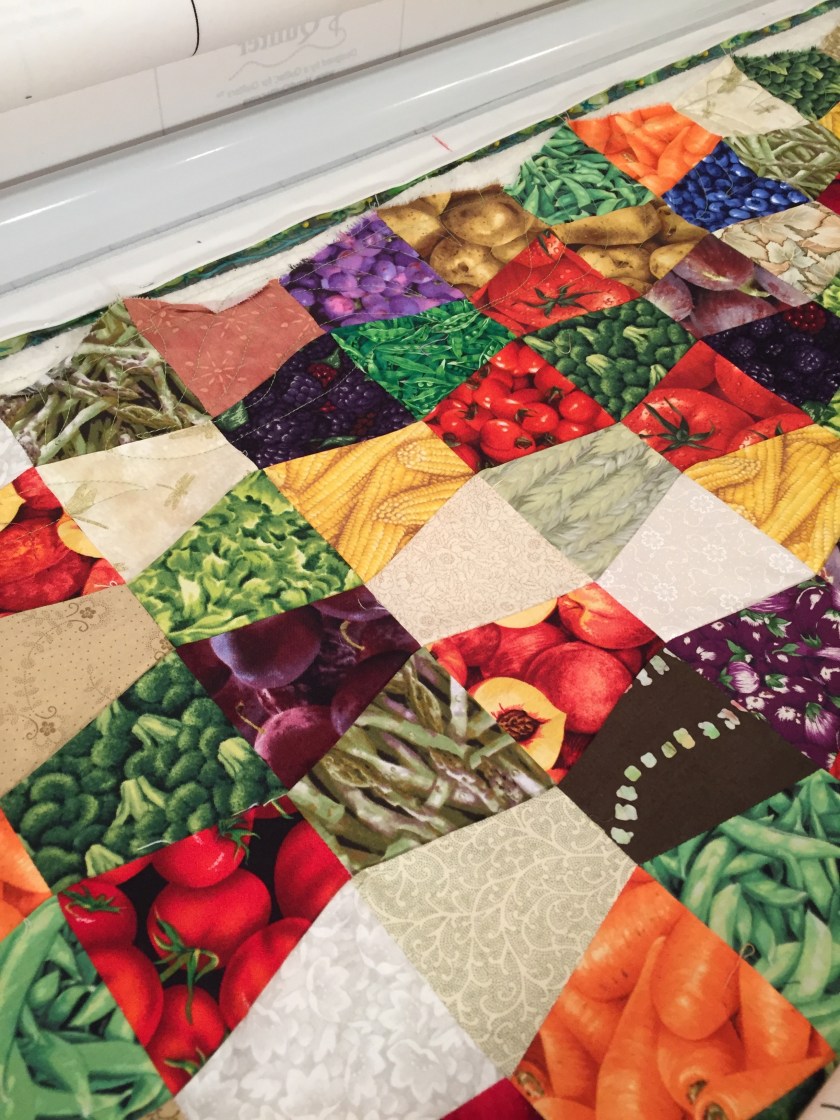
Here’s what is on my long arm machine today:

img_1673

img_1674

The tumbler block was the Bonnie Hunter leader/ender challenge for 2016–a challenge that runs from July to July.

This year’s challenge is the Broken Dishes block.

You can see Bonnie’s tumbler quilt and what she is doing with the new challenge on her blog.  Go to quiltville.com.

Bonnie’s tumbler is smaller, and I like it better in many ways.  I had a 3 1/2-inch template, so I used it with my 3 1/2-inch pre-cut strips–except for the veggie/fruit fabrics, which I have collected for a while and wanted to use.  This seemed a good project for them.

This quilt is on the long-arm lengthwise–which means fewer passes with the long arm and NOT having to fight backing seams with every pass.

I’m using a spring green thread, and that is nice.

Wait until you see the backing fabric!

Turkey Tracks: Creating Winter Culinary Assets

Turkey Tracks:  October 31, 2016

Creating Winter Culinary Assets

My kitchen smells like garlic, shallot, parsley, and lime juice.

It’s making me hungry!

It’s that time again–the time to clean out the garden and to do something with the last of the food crops.

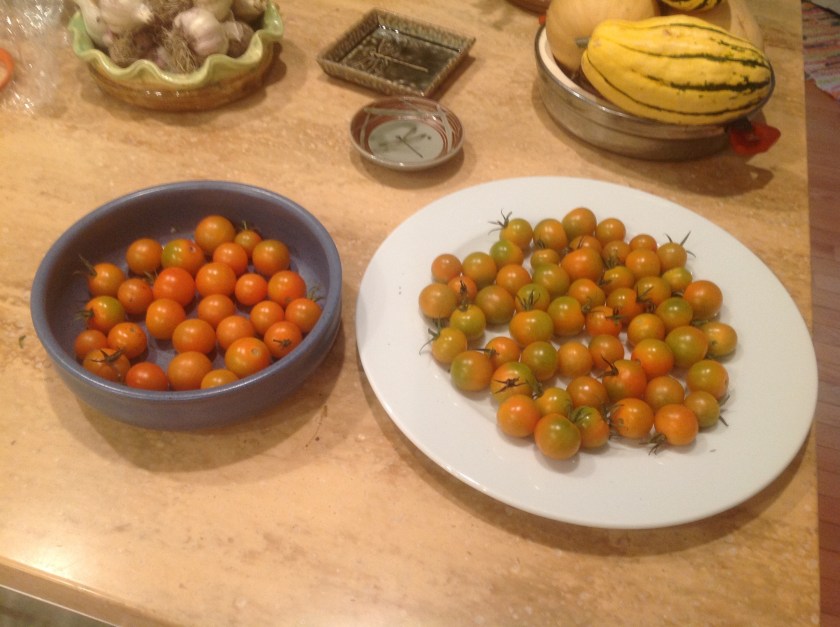
The cherry tomatoes were so bountiful this year–Sun Golds.  I was able to pick all the green tomatoes as I worked.

I had a huge bin of them, but I somehow did not take a picture.  With one thing and another, I did not get to lacto-fermenting them right away, and they starting to ripen on me.  I wound up having to pull out the dehydrator again to dry them as I cannot eat all of these before they start to go bad.
img_1085

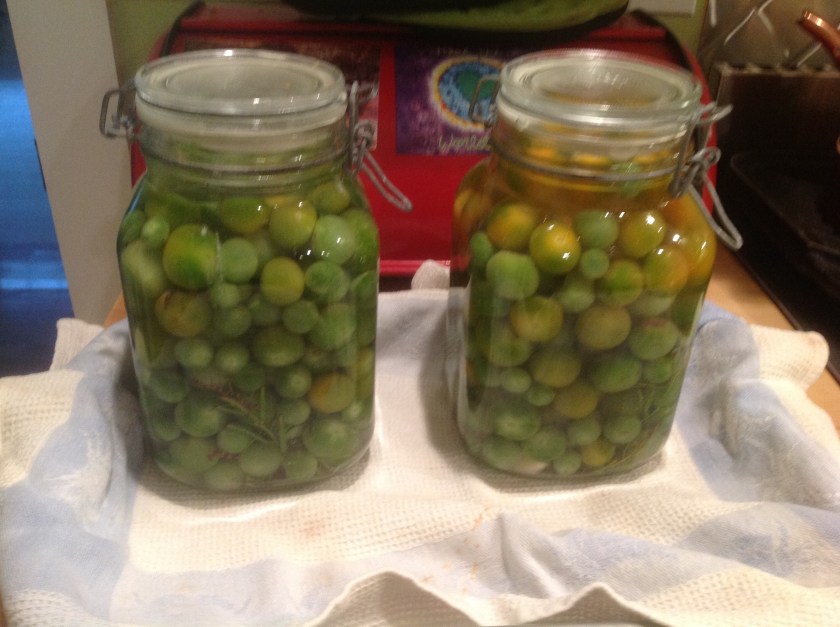
Here are the green ones, all jarred up and, hopefully, lacto-fermenting in their garlicky, herbed brine.
img_1084

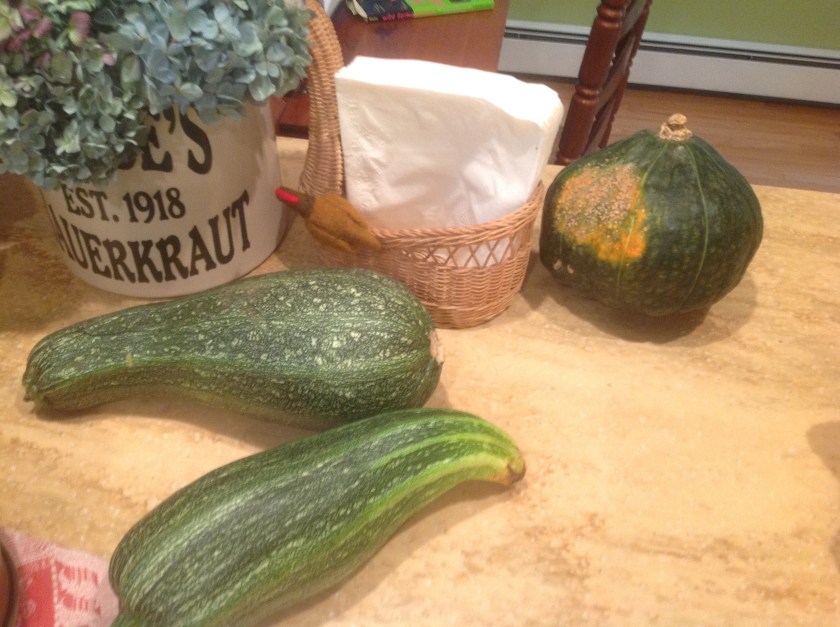
Look what I found in the zucchini plants!  I checked them all the time, but missed these two.  Into the dehydrator they went–cut into bite-size pieces that will be used in soups/stews over the winter.  The green squash next to the napkins is a Buttercup–it is dense and sweet.  I plan to roast the flesh with cut-up large green tomatoes, onion, garlic, little potatoes, rosemary, and olive oil.
img_1087

I love our winter squashes–but we did not get so many this year due to the drought.

The striped ones are Delicatas–which are candy sweet.  The tan ones are Butternuts and are mild.  They are happy in the warm kitchen.  The Delicatas won’t store as long as the Butternuts.

img_1086

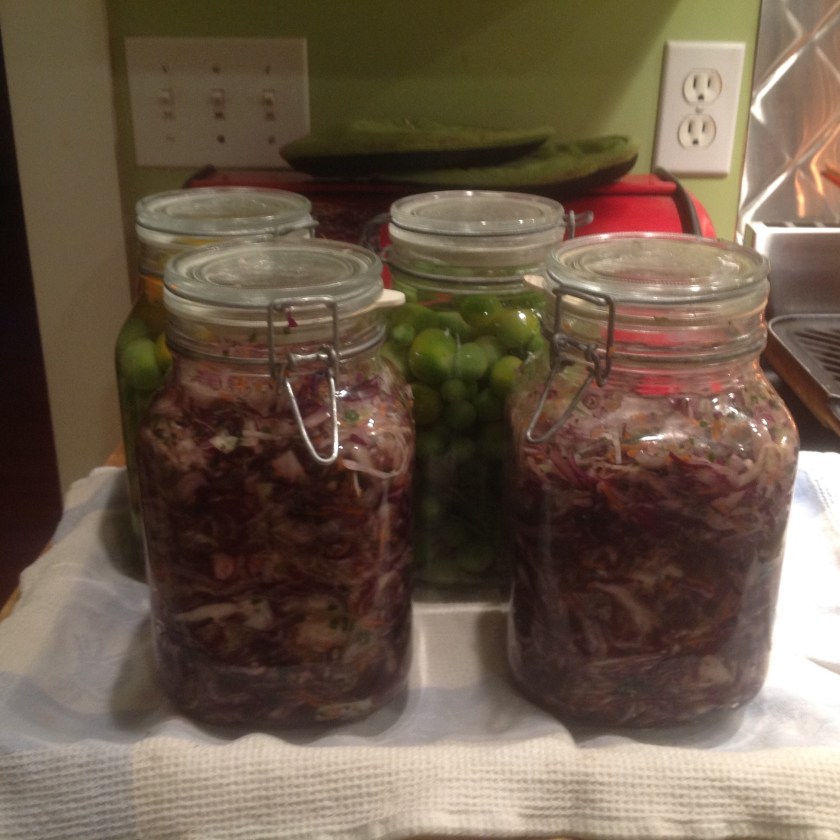
I processed the cabbage I bought for winter sauerkraut–which I use instead of lettuce sent in here from California, 18 days old and gassed and tasteless.
img_1088

You’ve seen other posts on lacto-fermented sauerkraut if you’ve followed this blog at all.  If not, you can search on sauerkraut to see the lovely ruby red color this mixture will turn.  I will probably make some carrot/turnip kraut before I am done.  It is delicious and turns a bright orange.

Here is a little video of what I am looking for to see if the mixtures are “booking”–my slang for fermenting properly.

Now, here’s the really fun thing that has upped ante on my lacto-fermenting goodies:

img_1075

What a great book!

I am still reading it, but have already tried some of the herb recipes.

I cut the parsley in the garden–the curly one yesterday, the Italian today–and used the interesting parsley recipe in the book, sans the hot pepper as I am allergic.

img_1092

I took off the leaves from the stems and discarded those.  I don’t wash any of these items–I just brush away any debris–as I want the organisms to stay put as they are part of the lacto-fermenting wild process.

Here’s yesterday’s haul.  I have two more from today.  The plastic bags contain water and will form a seal over the top of the mixtures, but will allow me to get to them to push them down and let the liquid rise to the top.

img_1089


There is a recipe for processing basil with this method–and it will keep for six months or more.

What about sage?  Rosemary?  Chives?  Tarragon?  MINT?

I may try mint tomorrow as I have a lot of it.

If this method works, I’ll try more herbs next fall.

For those of you who don’t know, lacto-fermented veggies are chock full of really good probiotics and are more powerful than the veggie/herb by itself.

Review: ‘The Miniaturist’ by Jessie Burton – Chicago Tribune

Review:  August 28, 2016

The Miniaturist

Jessie Burton

I listened to this book via the Maine State Library System’s library.

And I was spellbound much of the time.

This novel, as you can see from the quote below, is in the genre that takes a historical item (a painting, like “The Girl with the Pearl Earring,” or an object like the cabinet below) and weaves a fictional tale around it, employing a ton of research in the process.  And, as is true of most works of this kind, the tale tells you much more about issues in OUR time than it does with the effort to capture another world gone long ago.  As always, I will caution, the fictional overlay does violence to the people of another world.  We just bring with us our own culture no matter what; there is no such thing as totally objective “seeing” of another culture.

The review below also lists some of the weaknesses of the novel, with which I agree.  There are some too-neat threads tied off, some fairly unbelievable acts by a very young heroine, and so forth.

However, the language is lush and enjoyable and the time period certainly interesting–the height of the Dutch trading era where merchants travel the world, bringing back exotic treasures.

It’s a good read.

Jessie Burton, a British actor turned fiction writer, takes inspiration for her debut novel from a curiosity cabinet on display at the Rijksmuseum in Amsterdam. Built in the late 17th century, it was commissioned by Petronella Oortman, who wanted an exact replica of the luxury townhouse in which she lived in the center of this magnificent city.

Source: Review: ‘The Miniaturist’ by Jessie Burton – Chicago Tribune

Turkey Tracks: Sachet Spheres

Turkey Tracks:  August 19, 2016

Sachet Spheres

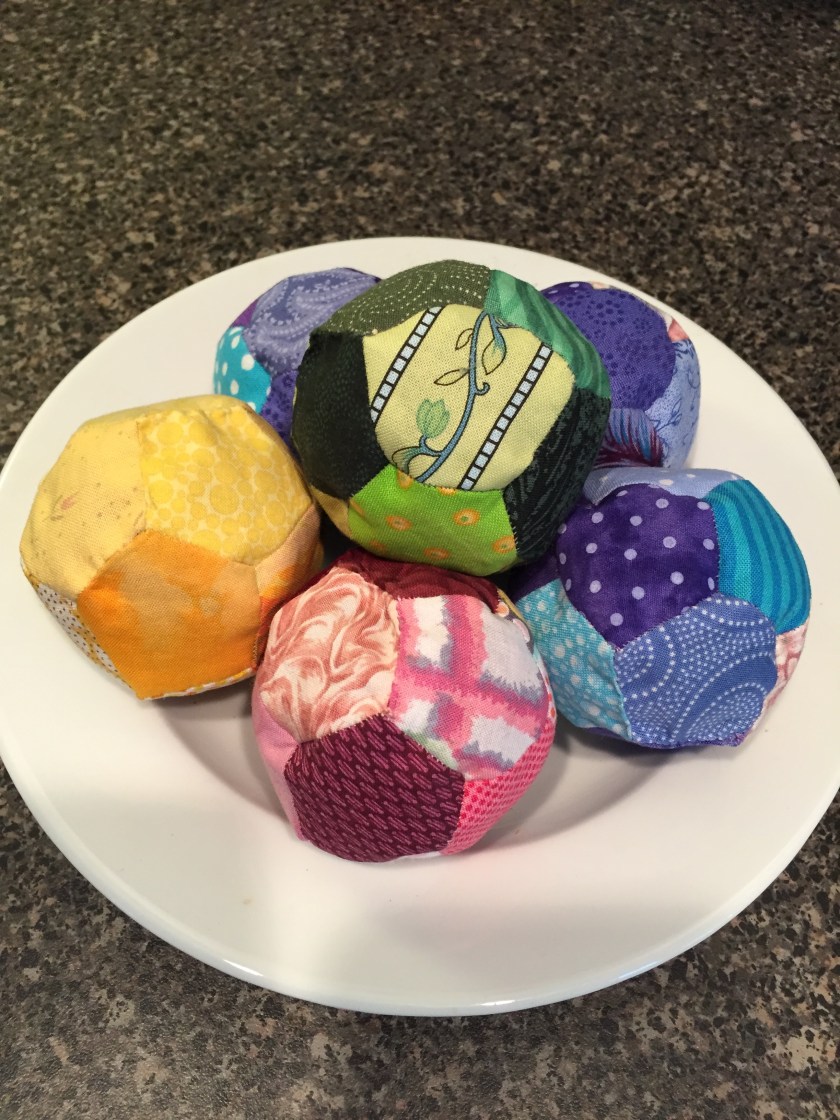
And then there were a bowl full–and another four given away:

IMG_1508

The purple ones are stuffed with lavender and are intensely smelly.

The green, balsam fir, also intensely smelly.

The rose, rose petals, faint but nice.

This yellow one is stuffed with calendula flowers.  Very faint smell.  I want to try one of the lemony herbs next, like lemon balm.

These little sachets are made with 1-inch pentagon English Paper Piecing–and the idea came from this book:

IMG_0805

Turkey Tracks: Lavender Sachets

Turkey Tracks:  July 22, 2016

Lavender Sachets

It WORKED!

On faith, I ordered a pound of organic dried lavender flowers, glued up the 1-inch pentagons, and started sewing.

It didn’t take anytime to make the little sphere, no time to stuff it, and a bit more time to sew the final seams–but I assume that part will get faster as I make MORE of them.

I’d also like to make some green ones with dried balsam, which is the quintessential smell of Maine.

AND, it would be fun to find some dried Rose Geranium, but so far no luck on that.  I might have to fall back on rose petals stuffed into rose-colored spheres.

The pattern came from ALL POINTS PATCHWORK, see below.

IMG_0805

Turkey Tracks: Hope’s Edge: My CSA

Turkey Tracks:  July 22, 2016

Hope’s Edge:  My CSA

Hope’s Edge CSA (Community Shared Agriculture) is in full swing now.

Going out there each Tuesday is one of the highlights of my week.

Last week, the road was lined with a wildflower in the Valerian family–which is also sometimes called “Wild Heliotrope,” which it is not.  It is, however, very fragrant.

IMG_1409


IMG_1410

I picked two quarts of strawberries that smelled and tasted like sweet perfume.  Delicious!

Farmer Tom was haying–and we were meant to have some hot, clear days in a row, so that was a good time to hay.

IMG_1411

I look for this bunch of wild flowers on the paved road every year.

IMG_1412

I think they are in the “fireweed” family.  I’d have to look them up again to be sure.


Turkey Tracks: Salt Water Bays and Alewives

Turkey Tracks:  June 10, 2016

Salt Water Bays and Alewives

I made a run down to Alewives Quilting in Damariscotta Mills, Maine, on Thursday.  Mary Sue Bishop went with me.

Mary had never been the back way into Damariscotta Mills that skirts around the edges of the salt water bay that rises up to meet Damariscotta Lake.  Here’s where folks built a fish ladder that now lets the alewives get into the lake to spawn.

It was a gorgeous day, and the fields were filled with flowers:  buttercups, white Marguerite Daisies, lupine in shades that range from purple to pinks to whites, are among spring’s offerings.

I stopped and took this little video.  Note how the wind is blowing the grass.  Truman Capote called this effect “the grass harp.”

Here are some still pics:

Mary riding shotgun.  We ran into each other in town on Wednesday, and we both had on spring green sweaters.  Today we both had on turquoise.  It’s funny the way friends can do this kind of thing.  We laughed over it.

IMG_1330

IMG_1331

I forget every spring how gorgeous the lupines are and how many of them are along the roadsides.

IMG_1333

Turkey Tracks: Funky Pumpkins In The “Parts Department”

Turkey Tracks:  June 1, 2016

Funky Pumpkins In the “Parts Department”

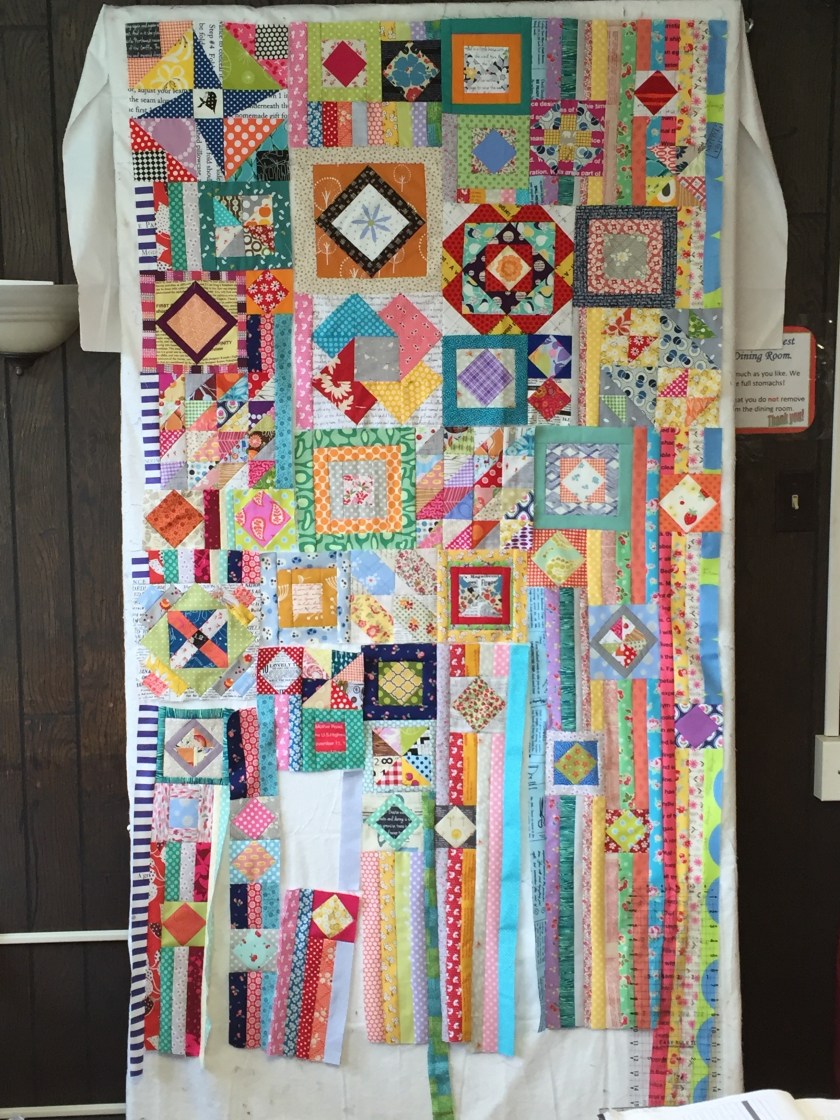
Several friends and I have undertaken this summer to make “parts department” blocks, the idea taken from Gwen Marston and Freddie Moran in their book COLLABORATIVE QUILTING –and to see if these blocks can be developed into a quilt for each of us.  I, of course, will also look to my Bonnie Hunter stash management system to see what I can use to make blocks.

This is an improvisational version of a round robin project in ways.

And this kind of improvisational quilt is coming out of the “modern” quilt movement.

Here’s one example in process, made by Becca Babb-Brott from a pattern (“Gypsy Wife”) by designer Jen Kingwell.

IMG_1154

Another would be to start with a medallion and build rows around it.

Or, to make a “row” quilt.

Who knows what will happen…

We specified low-volume fabrics and “brights” and “make at least multiples of four,” and left it at that.

The three others are working on funky house blocks, tree blocks, log cabins, star blocks and the like.

What would I do?

Well, this picture came across the screen of blocks Bonnie Hunter found forgotten in one of her quilt boxes.

20160524_115539[3]

Hmmmm, I thought.

I pulled out orange strips from the 1 1/2-inch bin, and then I thought maybe I’d try to draw a foundation piece pattern–after looking at foundation-

pieced pumpkin patterns in EQ7.

That was fun, and as you can tell from the next picture, the pattern evolved as I learned how what I had drawn might actually look when executed.

IMG_1286

I didn’t want to get too far from “funky” or too large, but I do like the rounded pumpkin top and the whimsical bottom strip and the placement of the pumpkin within the light fabrics rather than letting it run to the edge.  This block is 8 1/2 inches so will finish at 8.  That’s large for our project, but it can take a few large blocks I think.  And, we don’t have to use everything we get from each other.

These blocks will go into the “parts department” pile to be shared, and I have new-found respect for foundation-pieced designers.

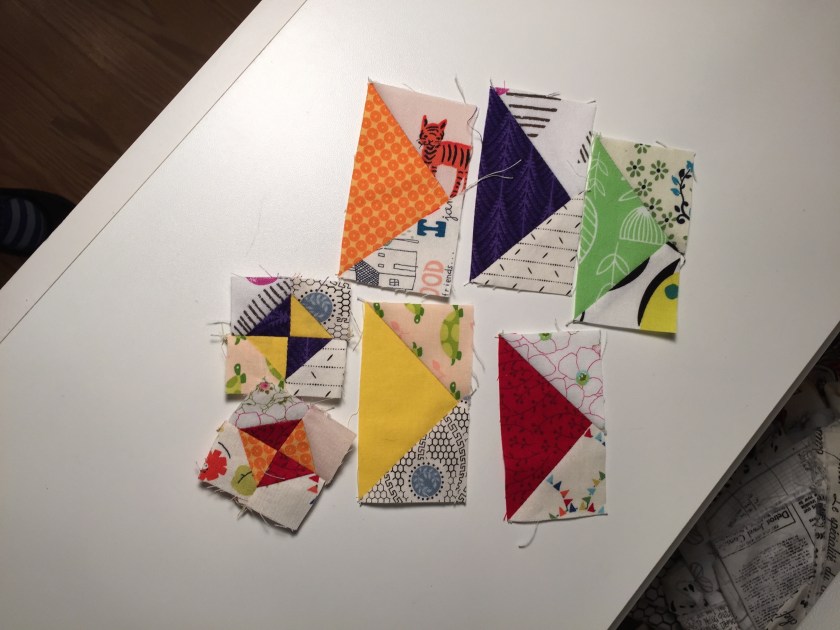
Here are some ideas made from fabrics I pulled from my “stash bins” of cut-up squares and rectangles.  These blocks are meant to be “filler” blocks.

Pinwheels, made by cutting 2 1/2-inch squares diagonally, resewing them, and sliver trimming them to 2 inches:

IMG_1296

Flying Geese made from 2 by 3 1/2 rectangles and 2-inch squares.  The little bitty 2-inch blocks are sewn from the trimmed triangles and sliver trimmed.  These tiny blocks could be surrounded by another layer of strips to make a slightly larger square.  Probably colored strips…

IMG_1303

This block is made from a 3 1/2-inch square by sewing 2 1/2 inch squares to the corners  (opposite corners first) and trimming out the excess–which also make small triangles.  Hmmm.  This small pinwheel could take some low-volume strips to enlarge the square and highlight the center too…

IMG_1299

The project is affording me a bit of play each day, a bit of rummaging through stash bins first.

We’ll see what happens…

Turkey Tracks: Chickie Babies Report

Turkey Tracks:  June 1, 2016

Chickie Babies Report

I went to see Rose a few days ago to have a coffee and visit with her and to see our baby chicks’ growth.

It had been about a week since I had last seen them.

They are getting SO BIG.  And Rose has them in the big hen house now–with a heat lamp when needed.

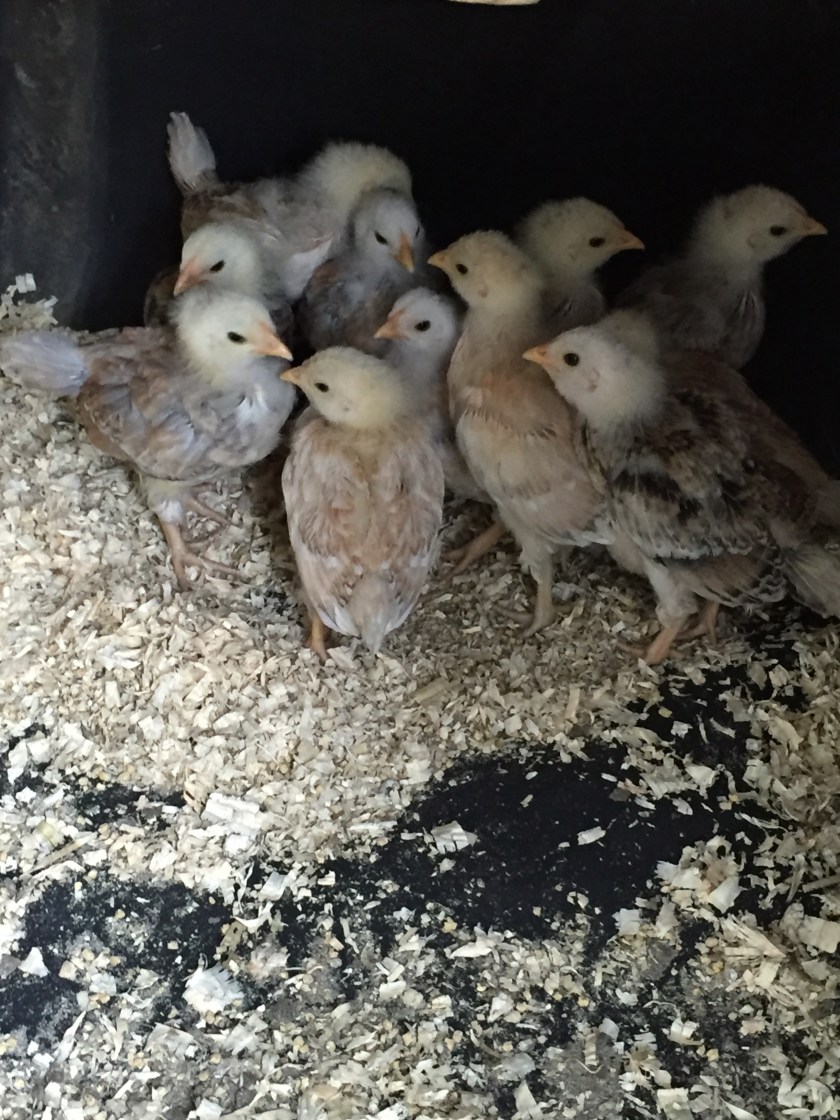
Remember, these are our special Blue Wheaten Americanas.  Can you tell which ones might be roosters yet?

IMG_1290

IMG_1292

We can’t…  Though we have some lively guessing going on.

I’m wondering if the ones with blacker wings might be???

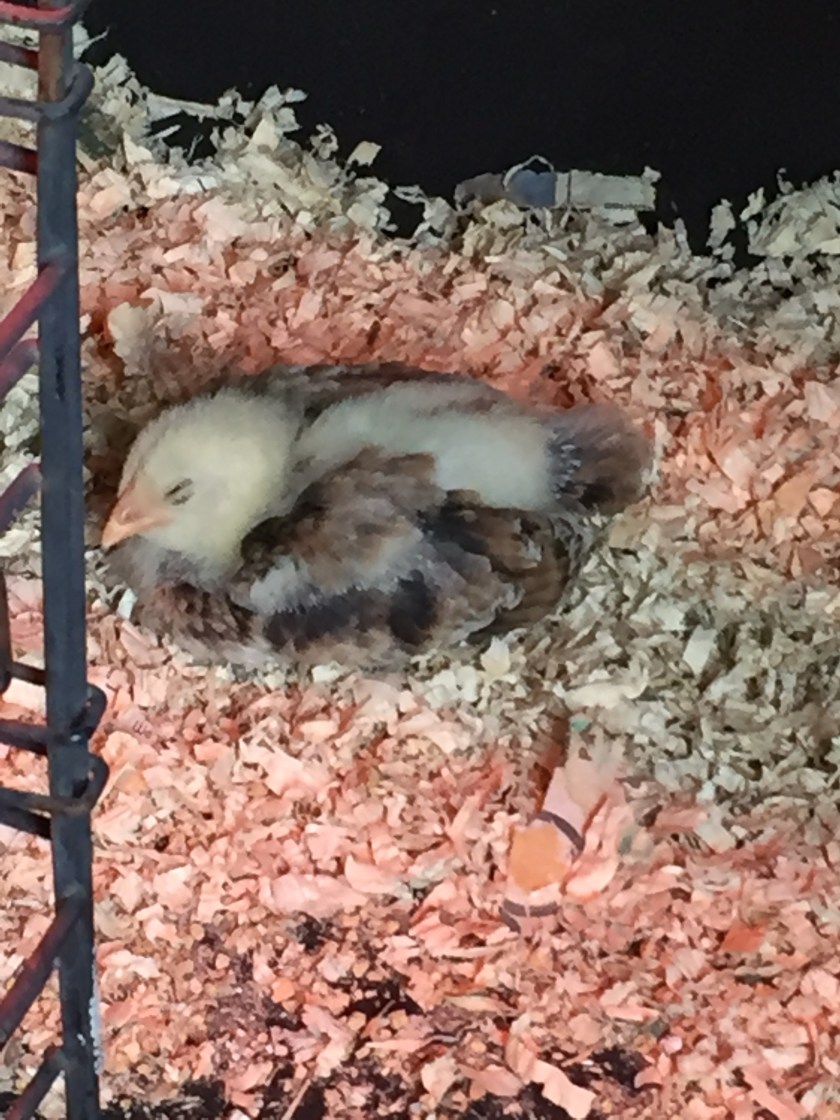
We are worried about this one.  S/he is away from the others and just does not look “right.”

IMG_1293

Rose picked up some adorable chicks that are meant to be hens the other day–excess ones the hardware store wanted to place.  They are two different breeds, and we can’t wait to see their feather colors when they grow up.  I forget their fancy names at the moment.  One of these will wind up being gold.  She’s in the front, to the left.  I think…  See the gold on her little face?

IMG_1288

It’s really hard to resist baby chicks.   And I miss my chickens’ antics and good humor.

Turkey Tracks: May is Makers’ Month: Busy Hands Quilts

Turkey Tracks:  May 30, 2016

May is Makers’ Month:

Busy Hands Quilt:  “Brick Cottage Lane”

I am always looking for patterns that will use the squares and rectangles I have cut from fabric left over from other quilts.

I am more inclined to buy a few patterns in May, in order to support some of the designers, many of which are young women with families and who are trying to make a living with their creativity.

This quilt pattern came through on a blogspot feed I get every day that throws up about 20 blogs in which their system thinks I might be interested.

“Brick Cottage Lane” by Myra of Busy Hands Quilts

IMG_0919

I love this pattern as it uses 2 by 3 1/2-inch rectangles.  It’s hard to find interesting patterns that use these rectangles.

If you go to Myra’s blog, scroll down to find this pattern.

Source: Busy Hands Quilts