Turkey Tracks: Knitting Class, Carrying Yarn Color

Turkey Tracks:   February 24, 2012

Knitting Class, Carrying Yarn Color

Once we got our yarn from Kelly Corbett’s Romney Ridge Farm, the next step in Giovanna’s and my “carrying color” project was to take Aloisia Pollack’s class and to buy her pattern.  So, she invited us to come to her home in Jefferson, Maine, which is located at the western top of Damariscotta Lake.  Off we went one fine morning a few weeks ago now.

Here’s the view from Aloisia’s front windows–her rental cabins (Sunset Cabins) lie in a string alongside the lake:

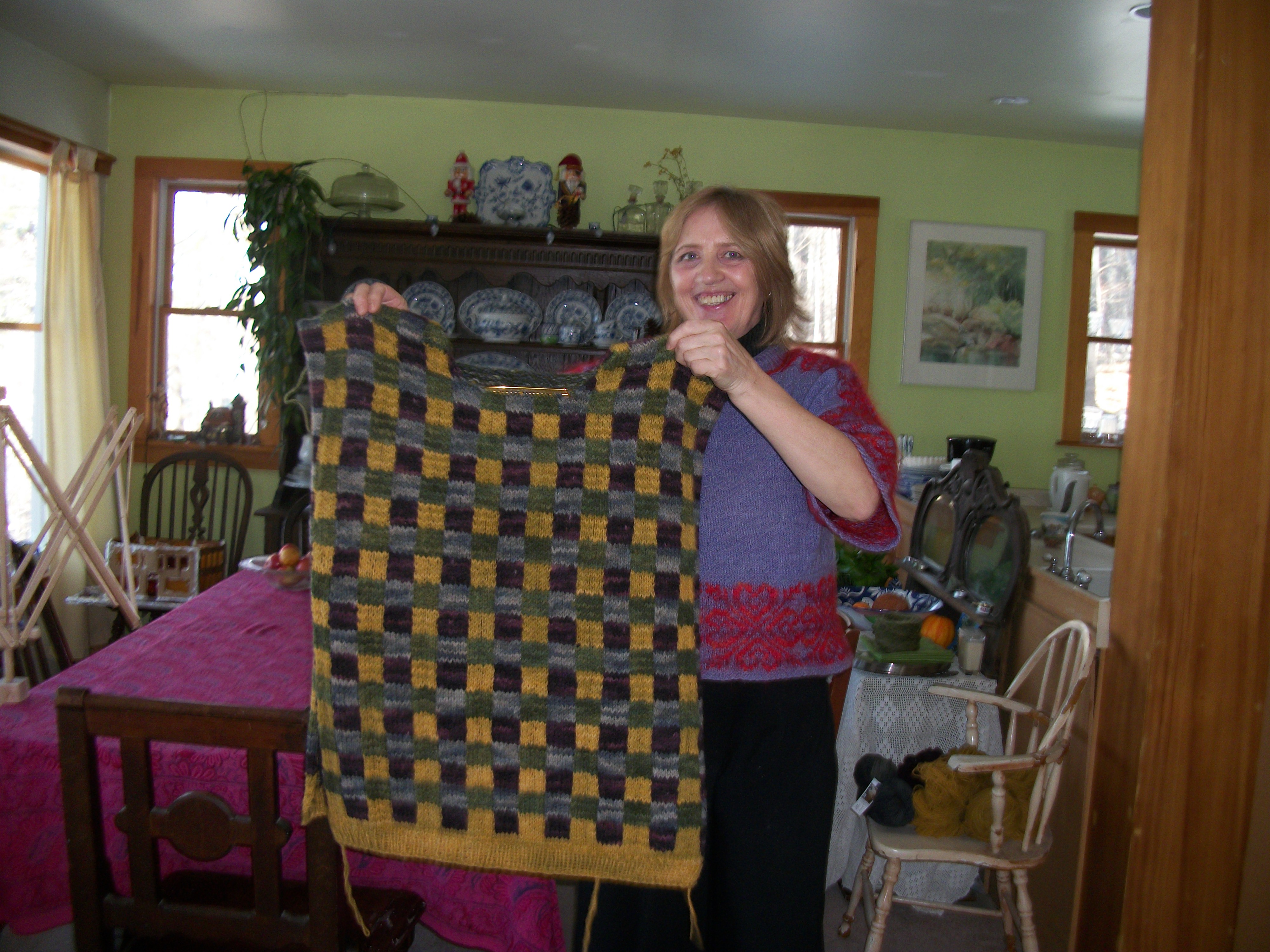
Here’s Aloisia with a sweater project that uses the “carrying color” technique.

To remind, here’s the sweater we’re trying to make, but using our own color choices:

As of Saturday, the 18th, here’s what Giovanna’s sweater looks like:

And, here’s mine.  I made the bottom bands one color and wider.  Since this band gets repeated at the top of the sleeves, I’m not sure I like the wider stripes…  Giovanna tells me that this kind of band is traditional in FairIsle sweaters.

And, Giovanna’s tension is looking better than mine.   Giovanna found a widget that fits over your forefinger that helps control the two yarns–in that it keeps them from tangling and twisting so much.  We got one for me in Belfast at Heavenly Socks, and it does help a lot.  You can see it dangling from my threads; it’s orange.

We both did wider ribbing than Aloisia’s pattern…  Perhaps my band will work with the longer ribbing…  And, I’m making a cardigan, not a pullover.

Giovanna and I are both still feeling like we have clumsy, slow fingers.  But, my knit row is now faster than my purl rows…   And, as we’re doing the sweater “in the round,” that slows down the process as well.

On the way home from Belfast, on Route 52 by Megunticook Lake, we saw an eagle in the middle of the road eating some road kill.  Giovanna stopped the car, and I got this picture after the eagle flew up into the trees.  Follow the two white birch’s up, and you’ll see him/her.

Turkey Tracks: Maine Sea Salt

Turkey Tracks:  February 24, 2012

Maine Sea Salt

I’ve been emailing with Stephen Cook of Maine Sea Salts, and he assures me that he does not heat his seawater in any way to make his salt.  The white color is because he is solar drying sea water that does not, itself, have coloring ingredients.   He told me that the colors in salt (grey, pink, black) come from the clay deposits where salt is harvested.

The url I saw that shows water being heated in large, wooden half-barrels dates back to the late 1990s.  He no longer uses that method.  He totally uses solar drying methods now.  Stephen is working toward getting that reference and picture removed from the internet.  I had a feeling that “old” internet entries was the problem, so I am happy to report that Maine Sea Salt will have all the many nutrients salt should have.

Go Stephen!

Turkey Tracks: Giovanna Winding Yarn Into Balls

Turkey Tracks:  February 18, 2012

Giovanna Winding Yarn Into Balls

Giovanna McCarthy is a master knitter.

She has knitting equipment I don’t have.

Giovanna, very sweetly, offered to wind my Romney Ridge yarn for me at her house.

Here’s Giovanna setting up a skein of yarn to be wound.

Here she is winding away–which was not as easy as she’s making it look as often, the yarn got tangled up and has to be sorted out.  It happens sometimes, she says.  See that red shawl back of her on the chair.  Boy is it spectacular!  She just finished making it.  I’ll do a separate entry for it.

Note the table back of Giovanna–what you can’t see clearly is the blocking pad she has where she can block a whole sweater.  There is a gorgeous Irish knit sweater drying over there.

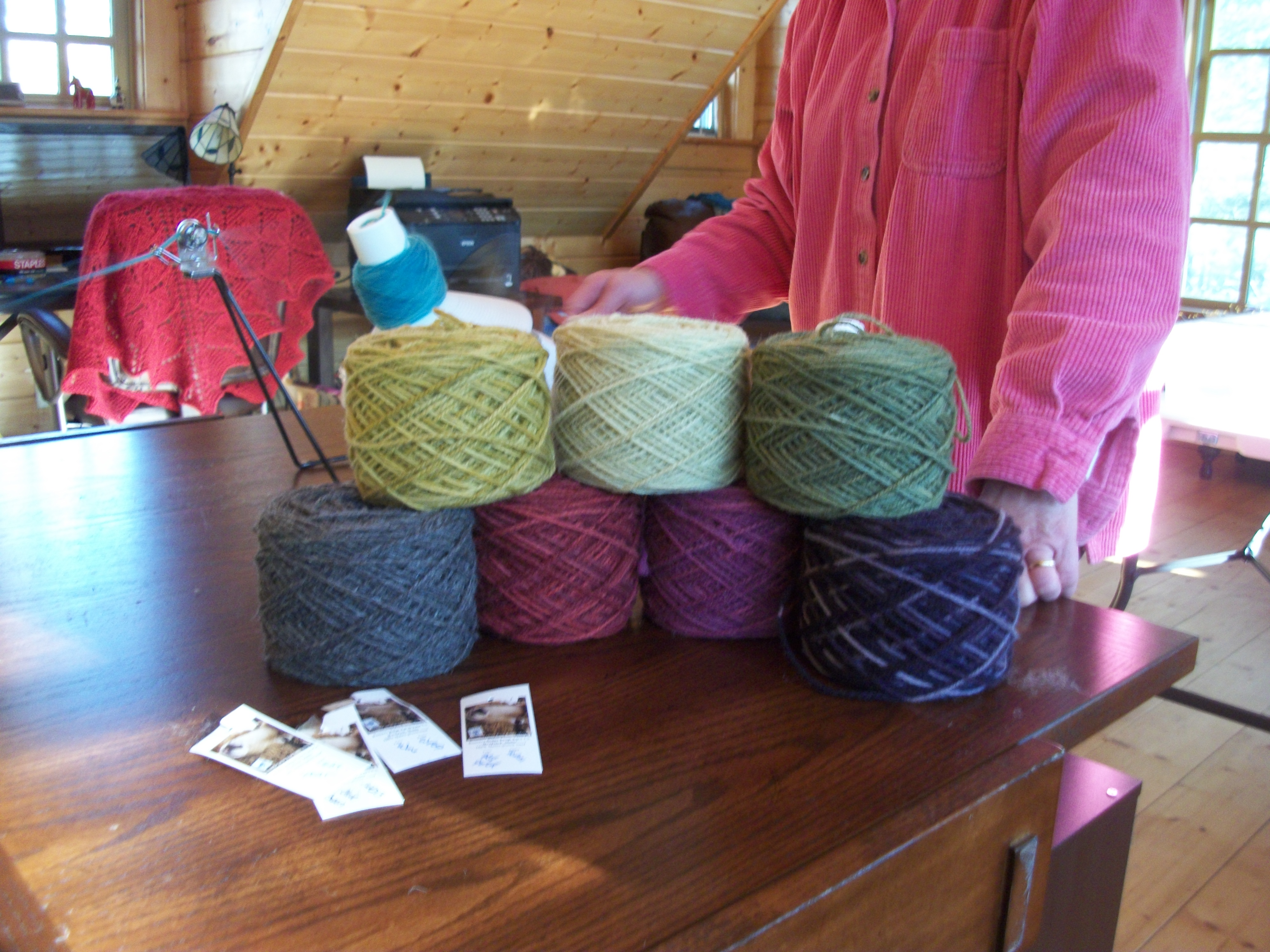
Here’s my yarn, all wound into balls and ready to go.  The greyish (it’s really more brown) yarn on the bottom left is the natural color of one of Kelly’s sheep.

Here’s Giovanna’s yarn all wound into balls–she chose more variegated versions than I did, but we both got a skein of the natural sheep yarn.

Next step:  Going to Aloisia Pollack’s house down in Jefferson, on Damariscotta Lake, for our lesson how to carry two colors.

Turkey Tracks: The Aurifil is Finally Gone

Turkey Tracks:  February 18, 2012

The Aurifil is Finally Gone

Here it is:  the –finally–empty Aurifil spool:

I must be the only quilter in the world who does not like Aurifil.

And, I don’t like it.

Yes, it lasts FOREVER.  It’s like the Energizer Bunny of quilting threads.  And, it doesn’t produce much lint.

I feel like I’m sewing with spider silk, though.  And, it isn’t very strong.  And, it does not “stick” to the cotton fabric in the way the Mettler I mostly use does.  It has a tendency to unravel at the edges of seams as a result–which is a HUGE pain when piecing blocks as they start to come undone at the edges as you handle them.

I bought this light grey Aurifil years ago when everyone raved about it.  So, in this moment of using up and reorganizing in the quilt room, I used up the Aurifil.

Thank heavens it’s gone!

Turkey Tracks: Raw Dog Food and Sojos

Turkey Tracks:  February 18, 2012

Raw Dog Food and Sojos

When I was a child visiting in Reynolds, Georgia, the home of my grandparents, no one gave the many fine bird dogs dried dog food.

They didn’t because commercial dried dog food had not yet been developed.

The dogs ate table scraps.

And they lived long and healthy lives.

I fed our first dogs dried dog food.  That’s what everyone did by the time I was 30.  Our beautiful pair of Springer Spaniels had chronic ear problems, chronic itching skin problems, and when they got old, massive flea problems.  By the time they died, the poor things were skin and bones and miserable.

After the springers, I started reading about feeding dogs raw foods.  And, remembering back to what my family used to feed dogs before dried dog food made feeding dogs “easy.”

Our rat terriers have never had dried dog food since they crossed the threshold of our house.  At 9 and 10 this spring, they both still play like puppies, their coats glisten, and they don’t have any grey starting on their faces.  The only vet bills I have had are for rabies shots; the occasional teeth cleaning mostly for Miss Reynolds Georgia, since she isn’t as diligent about chewing bones as Penolope is; and the heartworm medicine I give them ONLY in the spring and summer.  And, I space that out to about 45 or 50 days.

The digestive tracks of dogs are most like that of humans.

Would you eat dried dog food if you had a choice?

How would it seem to you if you constantly smelled delicious food cooking, but you never got any?

And, like humans, too many grains, or any at all for dogs, put too much stress on dogs’ bodies.

And, dogs don’t fare any better on chemical brews than humans do.

Our dogs eat, mostly, raw meat.  I am so lucky because I can get whole chickens–skin, bones, organs, everything–ground up for $1.49 a pound.  But, for years, and sometimes now, the two dogs ate a half-pound each of raw hamburger a day.  They also like whole chicken necks, skin and all.  I supplement with table scraps, yogurt, and fresh eggs from time to time.  Miss Reynolds Georgia loves roast chicken better than I do.

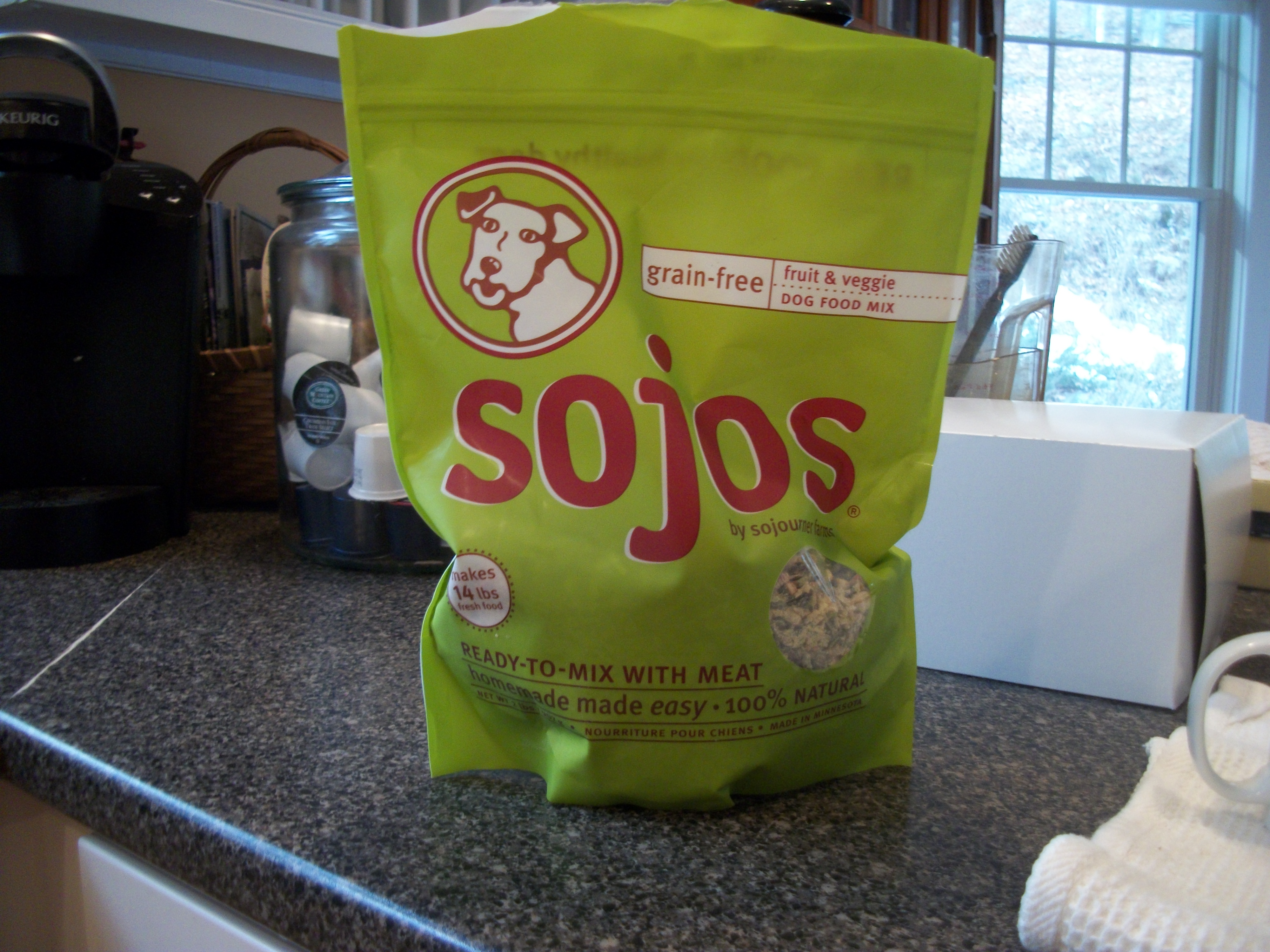
Recently, friend Patricia Shea showed me Sojos, which is a bag of dehydrated veggies that one mixes into the meat  with a bit of added water to dehydrated the mixture.  It’s full of mostly good things:  veggies, fruit, garlic, and so forth.  And, it smells fresh and clean and very nice.  It isn’t organic though, so I only use it when I just don’t have any cooked veggies in the house to give the girlies.


Vets and people who raise dogs and sell them are horrified when one mentions table scraps.  My holistic vet, however, knows raw food is better and is a strong advocate for it.  Remember that mainstream vets are taught that real food is bad for dogs.   Bless their hearts, they don’t know any better.  And, most of them think what they “know” is right and that they are doing good things.

But, never forget that the power of industry to inculcate unscientific nonsense so it can sell more products is awesome.  And, cynically speaking, vets do benefit from treating chronically sick dogs and from giving them a bunch of shots and “protective” medicines dogs don’t need and which wreck their immune systems.

The same pattern is likely true for human docs too.

Those of us who “remember” are getting older now.  Soon, no one will know that there was another way to live and another way to feed people and dogs and chickens and cows and so forth so that they all had abundant health.

PS:  If you are thinking of switching a dog to raw food, proceed very VERY slowly, and with the help of a holistic vet if you have one in your area.  Dogs on dried dog food lose the enzymes that will process real food, so you need to help them redevelop those enzymes.  It’s easier to switch a puppy over than it is an older dog…  But, it can be done.

Mainely Tipping Points 40: “The Battle to Save the Polish Countryside”

Mainely Tipping Points 40

“The Battle to Save the Polish Countryside”


Sir Julian Rose inherited Rose of Hardwick House in 1966, when he was 19 years old.  By 1975, at age 28, he began converting the farm to organic production.  In 1984 he moved to the farm full time and began what Wikipedia calls “an intense campaign to promote ecological food and farming in the face of the rapid rise of industrial agriculture.”  He has made numerous broadcasts on national radio and television and has written many articles, all of which call for the support of local and regional food economies rather than global ones. 

In November of 2000, Sir Julian Rose was invited by Jadwiga Lopata to come to Poland and co-direct The International Coalition to Protect the Polish Countryside (ICPPC), which she had founded.  Poland was trying to join the European Union, and Rose and Lopata knew that what Rose calls “the renowned biodiversity” of the Polish countryside soon would be under attack.  Rose has chronicled what ensued in a short article, “The Battle to Save the Polish Countryside,” which is widely available online, including at the Weston A. Price Foundation web site:  http://www.westonaprice.org/farm-a-ranch/the-battle-to-save-the-polish-countryside.    

Why should we care about Poland’s agricultural situation?  The answer is simple:  what is happening in Poland is also happening in Maine now and has already happened across large parts of the United States.  If we are aware of this economic pattern, which is so heavily supported by the political arena, we can each take steps to fight it.  What is at stake is nothing less than our freedom, since our freedom to choose clean, nutrient-dense foods that support our bodies, food that is grown by farmers we know, is being replaced by dirty, poisonous, fake foods that are making us sick while they are making the 1 percent richer. 

And we are sick.  Leigh Erin Connealy, MD, who runs a cancer center in California, said in a recent interview with Kevin Gianni in the online Healing Cancer World Summit that today, cancer is the number 1 killer and will strike one in two men and one in three women.  That’s a plague, isn’t it?  Our broken food system is part of what has gone wrong.

Rose wrote that he and Lapata addressed “the Brussels-based committee responsible for negotiating Poland’s agricultural terms of entry into the EU.”  No one on the committee was from Poland, though 22 percent of the Polish population was involved in agriculture, mostly on small farms.  Rose told the committee that in Britain and other EU countries, restructuring agriculture had “involved throwing the best farmers off the land and amalgamating their farms in to large scale monocultural operations designed to supply the predatory supermarket chains.” 

The committee’s chair countered by saying that the EU’s policy objectives involved ensuring “that farmers receive the same salary parity as white collar workers in the cities” and that the only way to accomplish this goal was to restructure and modernize Polish farms so that they could “compete with other countries’ agricultural economies and the global market.”  Thus, said the chairwoman, one million farmers would need to be shifted off the land and into city and service industry jobs that would improve their economic position.

 Rose countered by pointing out that as unemployment was running at 20 percent, he didn’t see how jobs could be provided for “another million farmers dumped on the streets of Warsaw.”  After a long silence, a committee member from Portugal noted that since her country had joined the EU, 60 percent of small farmers had left their land and that the EU didn’t care about small farmers.

 Rose and Lopata began trying to educate the Polish people about what EU restructuring would actually mean for them.  Rose described the changes in Britain to the Polish parliament:  restructuring had meant “the ripping up of 35,000 miles of hedge rows; the loss of 30 percent of native farmland bird species, 98 percent of species-rich hay meadows, thousands of tons of wind-and-water-eroded top-soil, and the loss from the land of about fifteen thousand farmers ever year, accompanied by a rapid decline in the quality of food.” 

I can tell you that in my lifetime, I have witnessed, around Reynolds, Georgia, the loss of the hedge rows and the loss of the quail that once lived in them.  I have seen the topsoil blowing off of the open fields.  And, seen deep fissures in the eroded land.  Worst of all, I have seen and smelled the toxic poisons sprayed onto the fields and the food growing in them.  I have seen the skull and cross bone signs posting those fields and come home smelling of noxious chemicals because I had walked past those fields—weeks after they had been sprayed.  And they want us to eat this food, to put this food into our bodies?

Poland joined the EU in 2004. And, the restructuring began.  Farmers who took the proffered agricultural subsidies and free advice found themselves, as did Rose himself before them, “filling out endless forms, filing maps, and measuring every last inch of your fields, tracks and farmsteads.  It meant applying for `passports’ for your cattle and ear tags for your sheep and pigs, resiting the slurry pit and putting stainless steel and washable tiles on the dairy walls, becoming versed in HAASP hygiene and sanitary rules and applying them where any food processing was to take place, and living under the threat of convictions and fines should one put a finger out of place or be late in supplying some official detail.”  What is being lost is “our independence and our freedom—the slow rural way of life shared by traditional farming communities throughout the world.”

 Behind the EU agricultural policies, writes Rose, were agribusinesses and seed corporations who wanted to “get their hands on “Poland’s relatively unspoiled work force and land resources.”  The newly passed EU regulatory policies helped. 

Among the “most vicious of anti-entrepreneurial weapons,” writes Rose, are the “sanitary and hygiene regulations” which are “enforced by national governments at the behest of the Common Agricultural Policy of the European Union.”  These “hidden weapons of mass farmer destruction” became the main tool for replacing small farmers with “monocultural money-making agribusiness.”

By 2005, writes Rose, or a mere one year later, “65 percent of regional milk and meat processing factories had been forced to close because they `failed’ (read:  couldn’t afford) to implement the prescribed sanitary standards.  Some 70 percent of small slaughterhouses have also suffered the same fate.  Farmers increasingly have nowhere to go to sell their cattle, sheep, pigs, and milk.”  And, with the destruction of this infrastructure, farmers are forced off the land. 

In Maine, the state government has rescinded a small farmer’s ability to raise and slaughter up to 1,000 chickens and sell them—despite the fact that no one has been made sick.  Small farmers can no longer share slaughtering equipment, a time-honored practice in rural America.   At local farmers’ markets, state government officials have attempted to stop farmers and venders from providing tastes of their foods, unless they can provide hot water for washing hands. 

And, the FDA stopped a local organic farmer from selling fresh-pressed cider at local stores or at the Maine Organic Farmers and Growers Association’s  (MOFGA) fall fair, even though, again, there had been no reports of illness.  (Oddly, unpasteurized cider can be taken across state lines as long as it is properly labeled, unlike raw milk.) 

Who got the MOFGA fair business?  A large grower who either pasteurizes or treats cider with ultraviolet light and who grows apples with Integrative Pest Management (IPM) practices, which means they pause before they go ahead and spray.

The sanitary and hygiene weapons, writes Rose, are now “scything their way through Romanian family farms, whose extraordinary diversity and peasant farming skills are a ready match for Poland’s.”  Rose predicted in 2008 that Turkey would soon be targeted.

This “global food economy,” writes Rose, is “the instrument of a relatively small number of very wealthy, transnational corporations.”   Rose lists Monsanto, Cargill, and their “fellow seed operatives Dupont, Pioneer, and Syngenta.”  What evolves is the patenting of seeds, so farmers have to buy new seeds each year, and the massive use of toxic agricultural chemicals that are killing the structure of the soil.   

Rose describes how the push to introduce GMO seeds into Poland has been relentless.  Under Prime Minister Jaroslaw Kaczynski, Poland tried to ban “the import and sale of GMO seeds and plants in Poland” and to ban GM animal feed by 2008.  As of 2010, this battle continues.  Industry harnessed support from agricultural professors and the media.  (Much of the Polish media is foreign owned, and industry makes huge contributions to academia).  And, the EU has stated that blanket banning of GMOs violates free-trade dictates.  

Meanwhile, Smithfield pigs are being raised on Polish soil and being fed Monsanto soy.  These pigs have flooded the market; their cheapness has undercut pigs raised by traditional pork farmers.  Further, with some of the US’s grain crops going to make biofuels, conventional feeds have become expensive.  So, GM soy and corn, once avoided in Europe, are now the “only cheap option available” in Poland.   

Poland still has one and a half million family farms.  These farmers could mount “a full blown peasants’ revolt to recapture the right to grow, eat and trade their superb farmhouse foods, thus freeing themselves from the increasing stranglehold that the bureaucratically perverse sanitary and hygiene regulations have imposed upon them.”

Rose writes, there are those “who are waking up to the stark choices that confront all of us:  capitulate to the forces of `total control’ or wrest back control of life and work to rejuvenate local communities to do the same.”   

Support your local farmers!   

Turkey Tracks: Tuesday is Clean Sheet Day

Turkey Tracks:  February 12, 2012

Tuesday is Clean Sheet Day

Or, wash day.

And the day we change sheets.

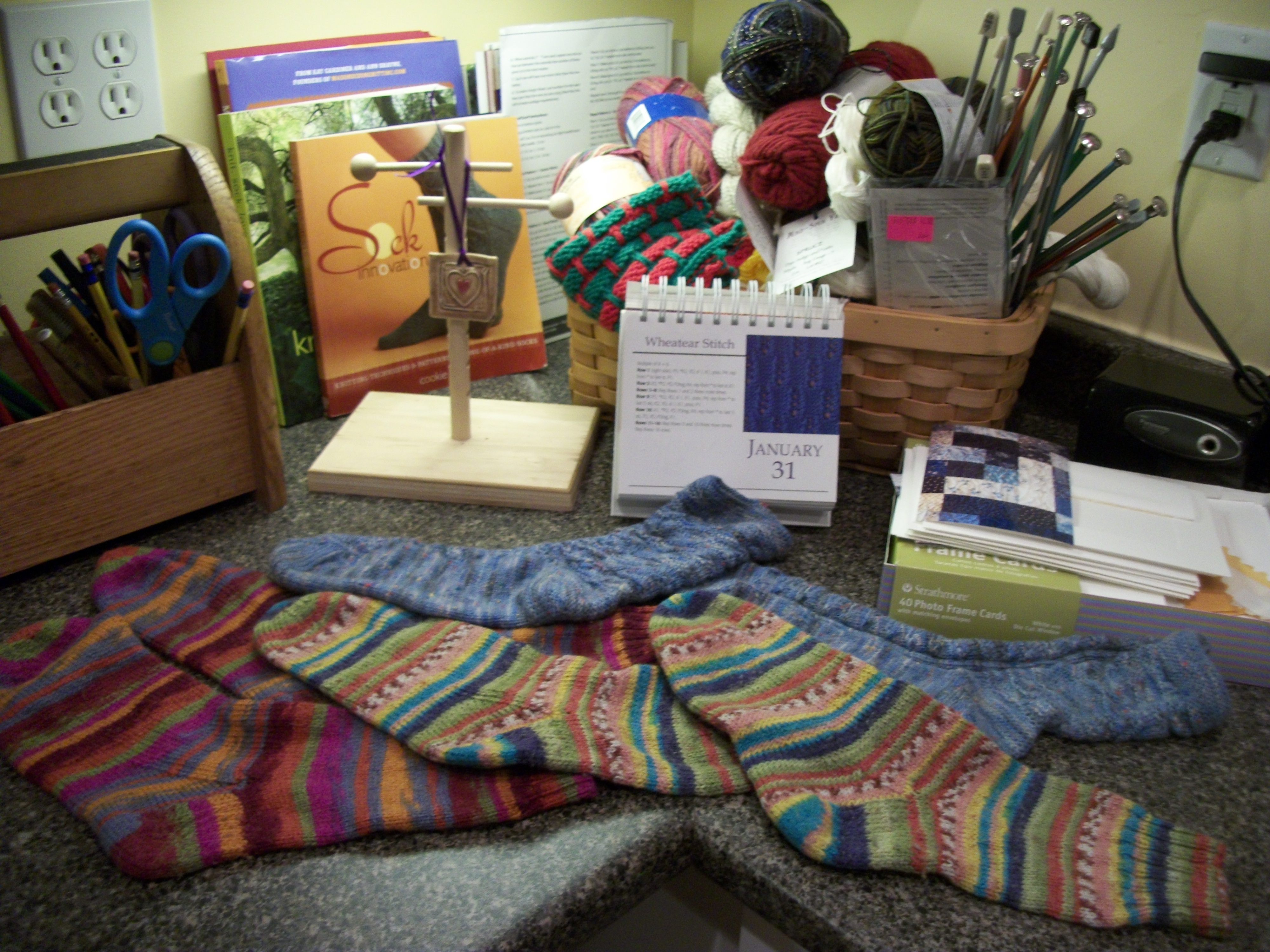
Last Tuesday I took this picture of the counter over the dryer.  I throw my wool socks on to the counter when they come out of the washer.  (Make sure your wool socks are washable!)  I can dry them in the dryer, but I never do as I have the notion that they will last longer if I don’t subject them to the dryer’s heat.

Anyway, all the colors seemed pretty to me lying all next to each other.

Turkey Tracks: “Nature the Greatest Show on Earth” Quilt

Turkey Tracks:  February 12, 2012

“Nature:  The Greatest Show on Earth” Quilt

Here’s this lively, happy  finished quilt:

Here’s a picture of a block close-up:

This block pattern is a very old one–and I have been unable to put a name to it.  It’s just always–there.  If anyone has a name for it, please let me know.

What’s different here is that I surrounded the block with a stripe and used a unifying corner stone.  Then I set the blocks on point.  The idea for using stripes, a unifying corner stone, and setting the blocks on point came from “Quilt Magazine,” Susan McDermott, and her remake of an older traditional quilt using these tatics.  The article was called “Old World Comfort.”  When I xeroxed the article so I could “play the magazine forward,” there were no dates on the pages.  My memory is that it appeared in the late fall/winter of 2011.  The magazine’s web site does not have any listings of what has been published when…so I was unable to find McDermott’s quilt reproduction again.

For over ten years I have been cutting leftover fabric that’s too small to fold into my stash into useable pieces.  The most versitile show up in this block:  3 1/2-inch squares, 2 by 3 1/2- inch rectangles, and 2-inch squares.  The 3 1/2-inch 9-patch you see in the above pic is from a quilt given to my niece, Kerry Enright, some years ago.  I had a few of those 9 patches leftover and just threw them into the bag of 3 1/2-inch squares.  And, for me, it’s fun to see all the pieces of quilts I have made over the years.  I can feel their good energy vibrating in this happy quilt.

What’s cool about this quilt, though, is the backing:


I absolutely love this fabric!  It’s called “June Bug.”  You may see some of it turn up in quilt blocks down the road, too…  I especially love the dragonfly which is my artist symbol.  I often use the term “Lovey Dragonfly” to sign a piece of artwork.

The name comes from the binding fabri , which has a round stamp scattered across it that says “Barnum and Bailey Circus:  The Greatest Show on Earth.”  I had been going to call the quilt “Nature Sings” since there is a lot of “nature” in the front blocks as well.  But, the Circus stamp chinched the name for me.

I quilted using an “antique rose” thread, which did not detract from the back and which “dumbed down” the red border on the front, and I used an all-over feather pattern pantograph.  (I really love pantographs!)

This quilt went with love and affection to my great niece and fellow artist, Fiona Whittle.

Turkey Tracks: “Fine China” Quilt

Turkey Tracks:  February 12, 2012

“Fine China Quilt”

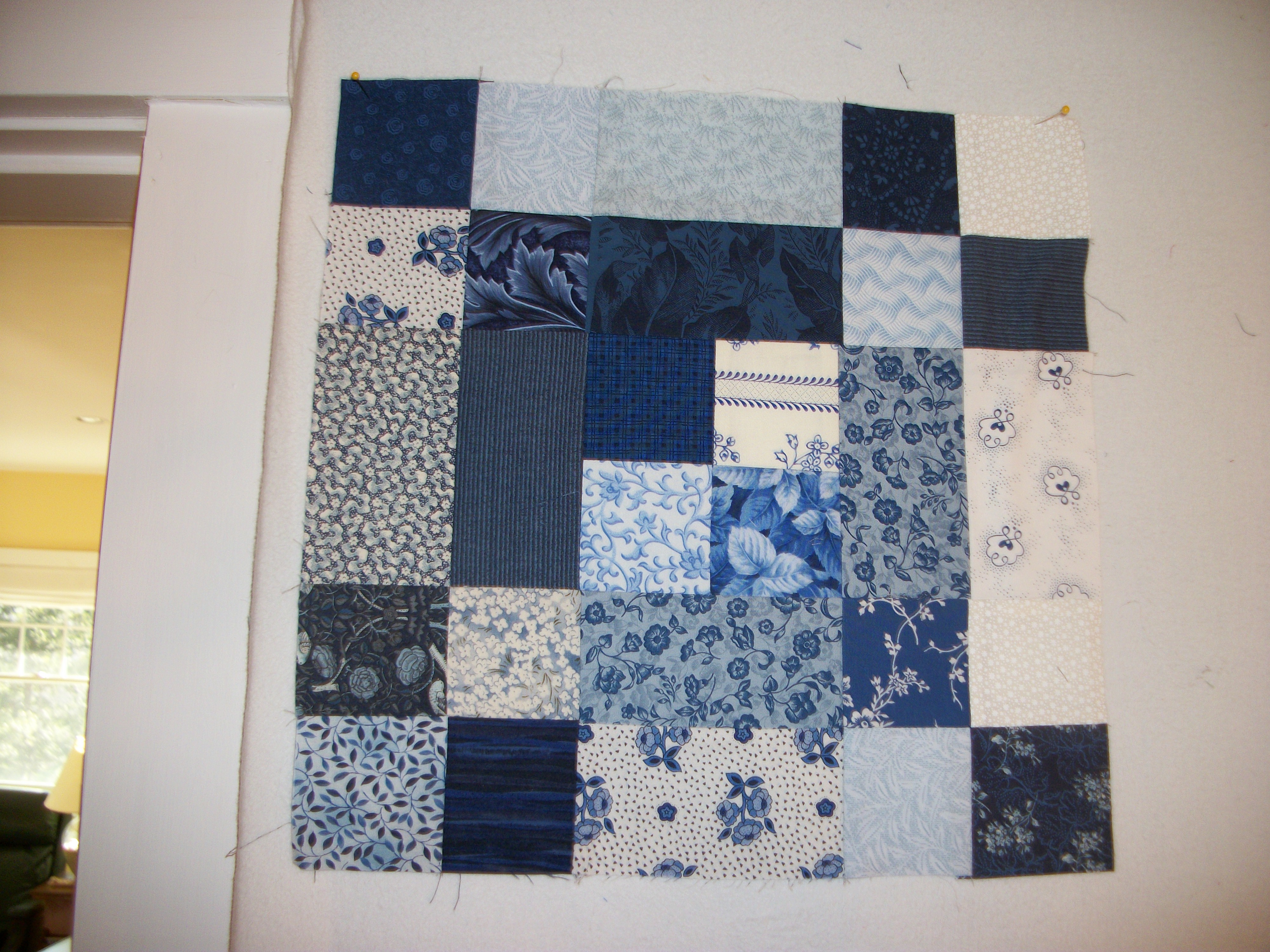
This quilt started out with a set of blue and white squares and rectangles.

Here’s the first block–made and placed tentatively on the design wall–four-square blocks alternated with rectangles:

 Here’s the finished quilt:

I alternated the placement of the rectangles on the second block–the first block has the four-patches to the outside; the second has the rectangles to the outside.  What results, still, are lines of light and dark blocks on diagonal lines up and down the quilt.  Since I have a lot of “medium” blues, the lines are not always as stark as if I were using starker darks and lights.

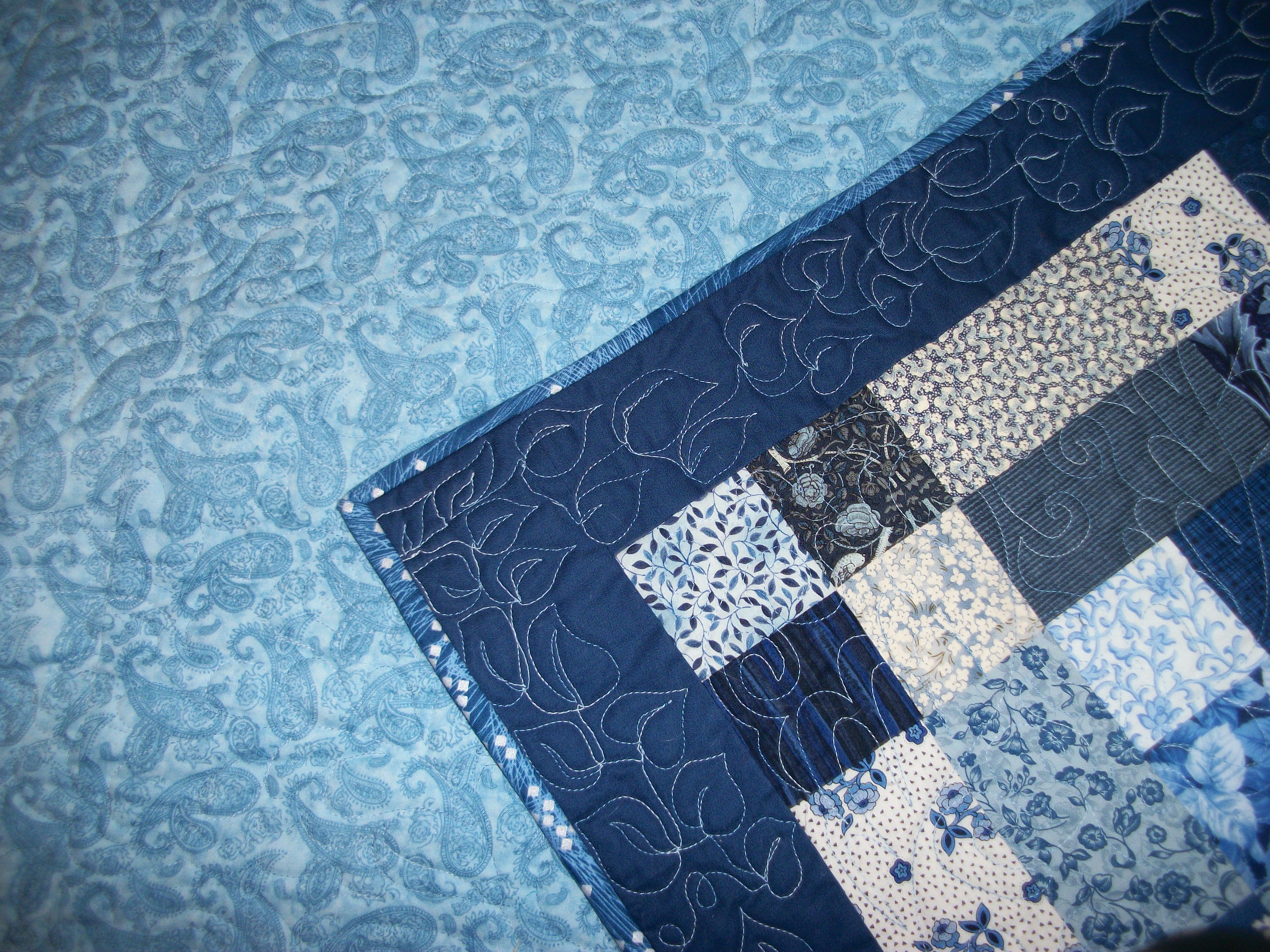
Here’s a close-up of the blocks, so you can see some of the beautiful feather and swirl quilting I did freehand on the long-arm:

John went with me down to Marge’s at Mainely Sewing to choose a backing.  He chose this paisley fabric, which we both thought was perfect, and I chose the binding fabric, which has a lot of visual interest:

This quilt went to Hannah Rheault Kreibich, first daughter of Willow Rheault Kreibich, who is the daughter of our neighbor Sarah Rheault, who is English.  The blue and white floral prints have always looked like English china to me.   But this name is a bit more complicated.  “Fine China” is what our grandsons thought they heard when their parents used real words to describe their younger sisters’ body parts.  Willow topped this story with a similar one from her family.  A son thought his mother had a “china.”  It all became very complicated when they went to a zoo and he saw a panda bear from “China.”  Too funny!  Thanks, Willow.

Turkey Tracks: Quilts, Quilts, Quilts: “Star Light, Star Bright”

Turkey Tracks:  February 12, 2012

Quilts, Quilts, Quilts:  “Star Light, Star Bright”

I’m still quilting like a madwoman.

And, having such a good time making creative use of 10 years of scrap fabric cut into useable pieces.

I sent off three quilts this week.

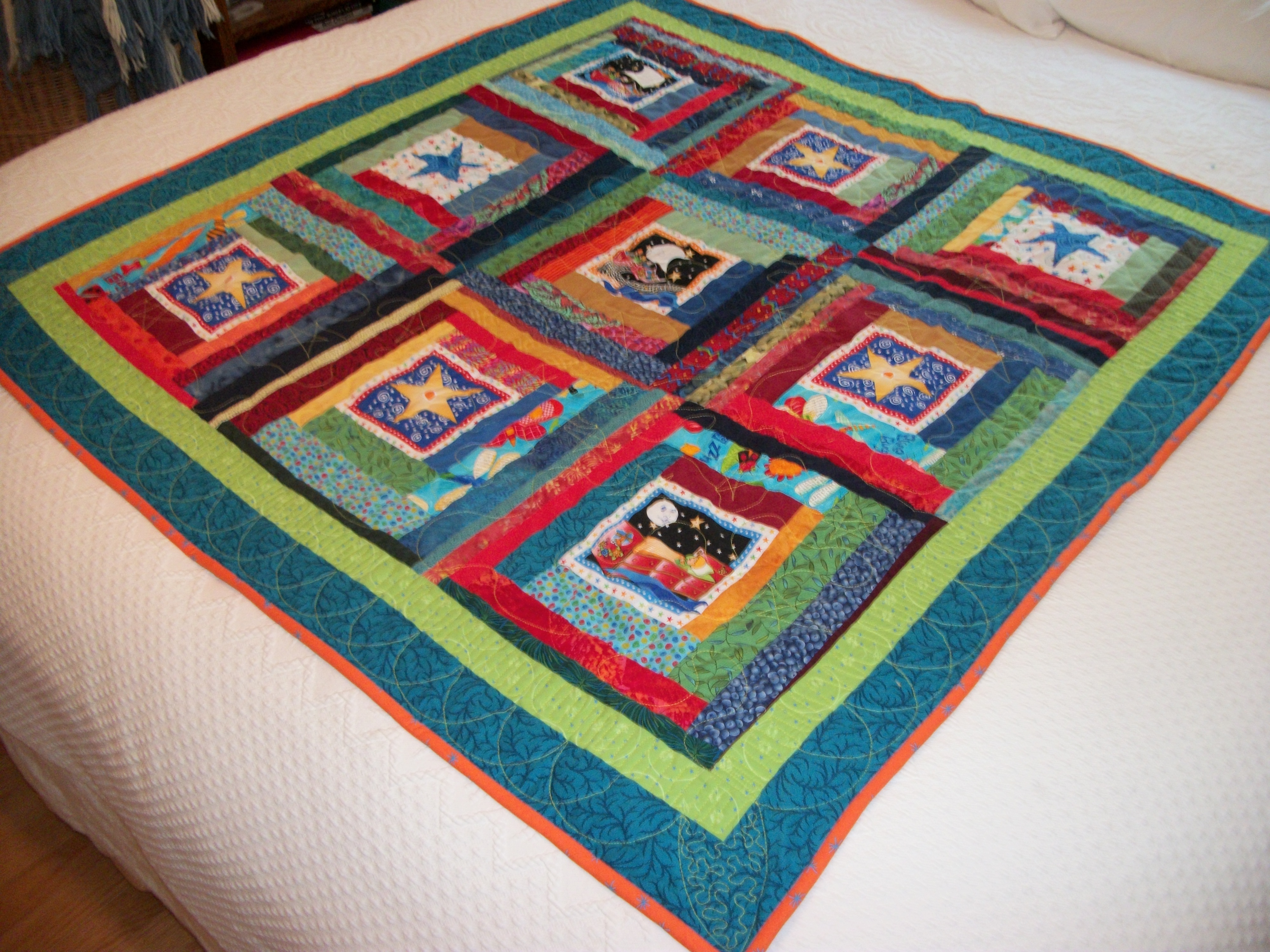
Here’s “Star Light, Star Bright”–a baby quilt made for a little boy–Meyer James Kelly–who will be born any minute now.  The bed gives you some size references.

 These blocks are in the “La, La Log Cabin” style, taught to Coastal Quilters by Rhea Butler of Alewives Quilting in Damariscotta, Maine.  For the centers, which are deliberately cut “wonky” so the block develops “wonky,” are a set of blocks from a Wynkin, Blikin, and Nod line of fabric that I used in another baby quilt.  I loved the blocks so much that I couldn’t bear to toss what was left.  I had to make two star blocks–I traced the star on a blue fabric, fused it to the star print, and blanket-stitched around it.

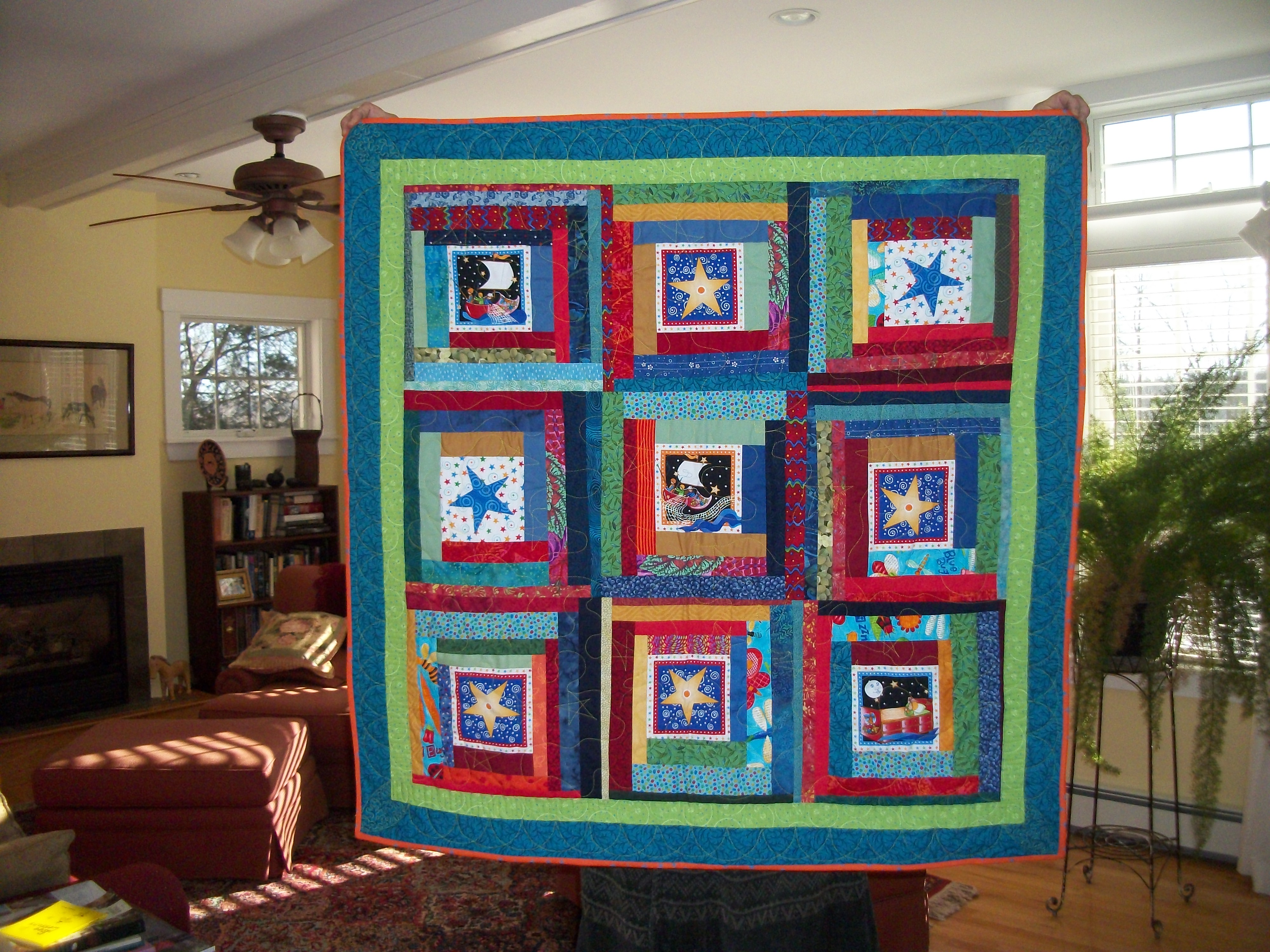
Here’s an upright view:

Here’s a close-up of one of the “Wynkin, Blinkin, and Nod ” blocks–there were different pictures in the blocks:

I quilted with a big meander pattern broken by stars–so it will be soft–and tried one of my curved templates in the border.

I love the orange binding with blue stars.  That fabric was a find.

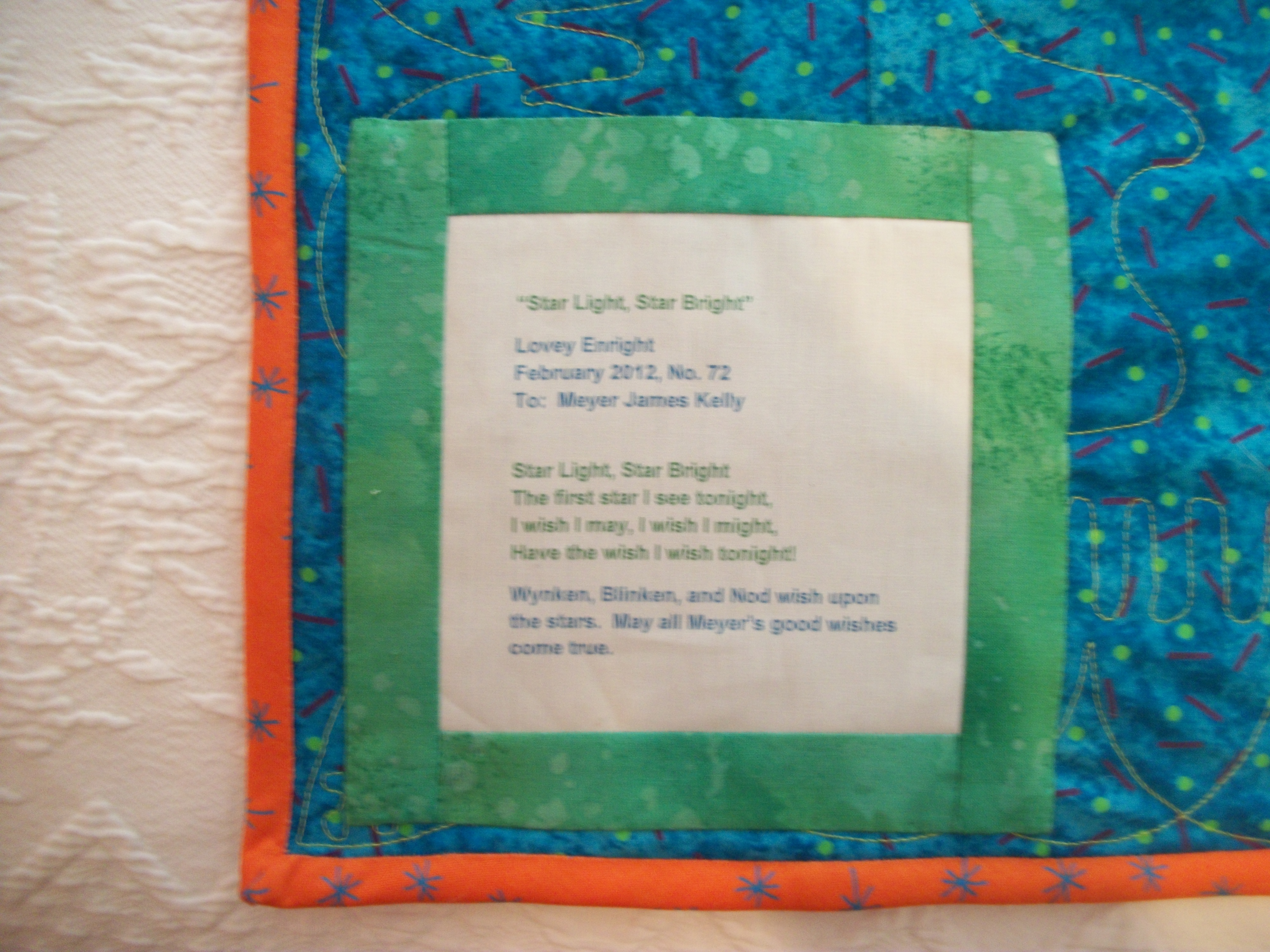
The backing is plain–and I’ve been printing labels and hand sewing them on to the back of the quilt.  I like it that I can put in little sayings, poems, how the quilt emerged for me, and so forth–even pictures!  You can see both backing and the label in this pic:

So fun!  So happy!