Interesting Information: The Corporate “Organic” Label is a Rip-Off

Interesting Information:  August 23, 2011

The Corporate “Organic” Label is a Rip-Off

About a week ago, my sister and I had a Facebook interchange about some “organic” yogurt purchased at a local grocery store in order to help her sick grandson–who had been running a high fever.  My sister hoped the probiotics in the yogurt would help build up her grandson’s immune system.

“That’s unlikely if it came from a commercial grocery store,” I said.  “It’s a fake food.”

What I didn’t say is that most of the probiotics listed on a label of commercial yogurt are probably no longer alive.  They get killed during the process of making the fake food.  (Look for a claim of “live” cultures.)  And I didn’t say that anything made from pasteurized milk is not a health food.  Or, that it should be avoided since it’s pretty much wasted calories in your body.   I’ve already said these things to myk sister many times, and she’s been very patient with me and my food ideas over the past few years.  The good news is that she’s talking about buying a cow share and about working with a local, organic farm in her area that sells milk, meat, eggs, and produce.

Pretty much all of the small “organic” companies have now been purchased by BIG CORPORATIONS.  And, in the name of both bigness and profit, they’ve corrupted almost everything that the term “organic” used to mean.

Stonyfield was the yogurt brand in question.  The carton pictures warm and fuzzy images of cows grazing on green fields.  Or, a pretty woman eating yogurt in a background of green fields and a red barn.

But, Stonyfield sold out to Group Danone, which also owns the “organic” brand, Brown Cow.  Group Danone also owns Dannon dairy products.

 Assuming the type of yogurt in question for my grand-nephew is whole milk plain yogurt, and not any of the fat-free or low-fat options–you need fat to process protein–AND assuming it was not one of the whole milk fruit-filled options (like white chocolate raspberry) which are full of sugars so that they are a dessert, not a health food for a sick child, the label shows that in addition to the probiotic cultures, the yogurt contains added pectin (a hidden source of fiber to thicken the yogurt–too much fiber can cause damage to your digestive system) and what has to be synthetic vitamin D3, which never operates in human bodies like the real D3 present in real foods.

What the label does NOT SHOW is that Stonyfield also adds powdered milk to its yogurt to thicken it up.  Powdered milk is highly processed so that the chemical strands are broken up, which creates all kinds of toxins.  (Don’t drink powdered ANYTHING.)

And, I’d want to have an objective third party to witness the pasturing of these Stonyfield cows because most commercial dairies, organic included, supplement with grains and god knows what else.  (One site I read today had a commenter telling how local “organic” cows on a farm on her road were being fed “organic” doughnuts.)  That’s just what happens when BIG BUSINESS exerts profit pressures and when dairy farms are being driven out of business in droves.

Back in 2006, BUSINESS WEEK used Stonyfield to illustrate what a tawdry thing the term “organic” has become in the hands of large corporations:  “The Organic Myth:  pastoral ideals are getting trampled as organic food goes mass market.”  It’s an article well worth reading since nothing has changed for the better since 2006:   http://www.businessweek.com/magazine/content/06_42/b4005001.htm.

The article almost immediately points out that Stonyfield’s organic farm is “long gone.”  Instead, “its main facility is a state-of-the-art industrial plant just off the airport strip in Londonderry, NH, where it handles milk from other farms.”  And, it blows the whistle on Stonyfield’s use of powdered milk and its attempts to have said powdered milk shipped to the US from New Zealand which is 9,000 miles away.

Dr. Joseph Mercola made a video after the article came out, and it’s worth viewing:   http://articles.mercola.com/sites/articles/archive/2006/10/12/you-are-being-ripped-off-by-much-of-the-organic-food-you-are-buying.aspx.   Mercola called it “You Are Being Ripped Off By Much Of The ‘Organic’ Food You Are Buying.”

Obviously, I agree with Dr. Mercola’s assessment.  Real organic food can’t be found in your local grocery store if it comes in a package.  And, that “organic” produce that you can sometimes find is being shipped here from places like Holland, Peru, Israel, Mexico, and China.  Besides the fact that this produce is tired out and lifeless, who knows how it has been grown.  Take a look at the German film OUR DAILY BREAD to see what I mean.  Most of this produce is being grown in hoop houses in peat packs stuffed with synthetic nutrients–all tended by technological equipment and lone, lonely people.  It’s not real food grown in nutrient-dense soil.  It hasn’t been harvested with joy by groups of people who will eat it together.  And you’re being charged premium prices for it.

You have to go out and find local, organic farmers in your own community and work out ways to get their food into your kitchen and into your body.  And, you have to eat seasonally as much as possible.  You can do it; there’s all kinds of help now to locate real farmers and organic food that will sustain your health and the health of those you love.  Start with the lists on the Weston A. Price Foundation and/or the ads in their quarterly journal, WISE TRADITIONS.  And, there’s all kinds of help to learn how to preserve some food from summer for the winter.

The CEO of Stonyfield sent Dr. Mercola a letter that attempts to explain Stonyfield’s “organic practices.”  You can find that letter on the same Mercola site as the video.  It’s really sad to read such a letter from someone who used to have an organic farm.   The denial and greed is shameful.  But that is what happens when corporations and capitalism are not tied to a set of values and ethics that support human rather than short-term profit.

Here’s a partial list of the once organic small businesses that are now “organic”:  Burt’s Bees, Tom’s of Maine, Odwalla, Naked Juice, Horizon Organic Dairy, The Organic Cow of Vermont, After the Fall, R.W. Knukdsen, Kashi, GardenBurger, Bear Naked, Back to Nature, Boca, Cascadian Farms, Health Valley, Arrowhead Mills, Green and Blacks Organic Chocolate, Dagoba Chocolate, Seeds of Change, Muir Glen, Alta Dena, White Wave/Silk, Westbrae, and Westsoy.

Buyer Beware!

Finally, make your own yogurt.  It’s dead easy–unless you’re working with ultra-pasteurized milk, which might not culture.  And, even yogurt made from pasteurized milk is better than the expensive fake stuff.  Heat your oven to 200 degrees.  Pour a half-gallon of whole milk into a large glass bowl.  Mix in two packages of Yogumet starter.  Put a plate over your bowl.  Turn the oven off, and put the bowl into the oven.  Let it sit over night.  In the morning you will have lovely yogurt.  Save about 1/4 cup for your next batch.  Sometimes it can take yogurt a bit longer.  Give it time; it won’t spoil.  Keep it in a warm place until it jells.
Turkey Tracks: Rugosa Rose Hip Jam

Turkey Tracks:  August 22, 2011

Rugosa Rose Hip Jam

I’ve been thinking about Rugosa Rose Hip Jam for the past…5 years or so.

When we moved to Maine, we bought a house on the side of a steep hill.  There’s an astonishing drop off–held in place by a large-boulder rock wall- to a small field below in the front yard, where our drainage field is located.   With visions of very young grandchildren tumbling down this death trap, we planted the slope with rugosa roses and bayberry.  Two years ago, we added another row of plants:  raspberries.

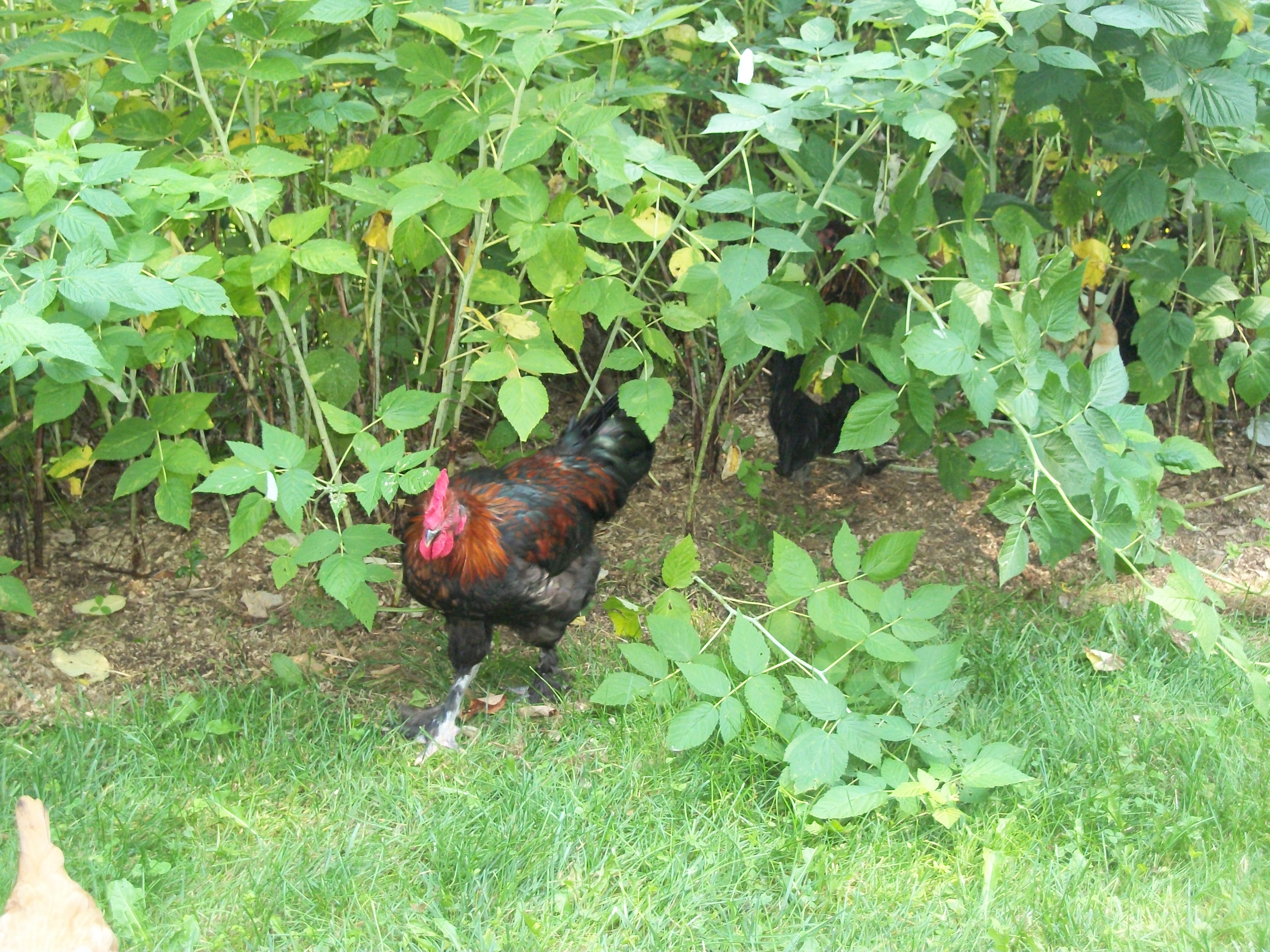
The whole slope is now impenetrable–we called it the chicken briar patch since the chickens love it so much.  They feel safe in there.  The raspberries are THRIVING on their attention, and since we’ve released the chickens from their summer pen, the June bug count has diminished significantly.

The rugosa’s hips began to catch my eye as the years passed.   For several years I thought one should wait until after the first frost as they’d be sweeter.  I read that in several places actually.  One year I collected the hips and dried them for winter nutritional teas–they’re full of vitamin C–but I never made any.  (I love my black tea with wild honey and real heavy cream too much.)  Also, it seemed to me that by the time the first frost came, the hips were all dried out and moldy looking.  Last year I got as far as finding information and recipes.

Did you know that roses are in the apple family?  I didn’t.

Here’s what some of the hips looked like on Sunday:

As you can see, a lot of them are as big as crab apples and are very red and ripe looking.   One simply must do SOMETHING with such luscious looking fruits.  So, I picked the ones that were ripe and refound the recipes.

Prepping the hips is VERY labor intensive.  You cut them in half and scrape out the seeds.  There are TONS of seeds.  I made cups of tea for John and me, and we sat outside and chatted while I prepped the hips.  It was a beautiful afternoon.

Here’s a picture of the prepped hips and the TONS of seeds and the very sharp paring knife with which I did not poke myself, though I came close a few times :

Penny joined us, as she usually does.  Miss Reynolds Georgia won’t give up her watch dog perch upstairs looking out the bedroom window.  She’s also sure it’s very dangerous outside the house–unless one is going to be taken for a ride in the car or if one has to pee:

I  cast the seeds out over the back hill/slope.  Who knows?  We have rugosas sprouting all over the place all the time here.

Rose Hip Jam

The next step is to put about an equal amount of water as one has hips and cook the two together until one has a mushy pulp.  That takes about 20-30 minutes.  I didn’t put enough water at first, and I noticed I was getting a kind of syrupy mixture.  Interesting.

Then, one has to decide what to do with the pulpy mixture.  I tried a food mill, but that didn’t work.  Too much thick pulp, too much loss.  I scraped everything into the Vita Mix, which is a very powerful blender/chopper, added a bit more water, and pulverized it all.  I had about 2 1/2 cups of pulp.

One then adds an equal amount of sugar, and I did (though I usually don’t) as I couldn’t imagine that this pulpy mass would taste nice.  I almost burned the mixture on the sides of the pans until I realized what was happening and scraped the sides down with a spatula.

Then, one cooks the mass until it begins to “jelly” according to directions.   Or, coats the spoon well.  The candy thermometer wasn’t especially helpful since the mass didn’t melt down like a berry jelly or jam does.   The mass began to coat the spoon and jell up on the plate, and it turned a deep pumpkin color that was lovely.  So, I jarred it up.

Here it is cooling:

I don’t know what I expected Rose Hip Jelly/Jam to taste like.  I had imagined a clearer jelly for one thing.  And, maybe a lemony, sharp taste, subdued by the sugar.

Well!  It’s delicious.  It tastes a lot like apple butter, but it’s different too.  There is, after all, a subtle lemony taste in there.  Both texture and color are like that of a roasted pumpkin, but not the taste.  I can definitely see using it as a cake filling, which one of the recipes suggests.  I really like it, actually, and would definitely use it on morning toast, or on oatmeal porridge, or during afternoon tea spread on something tea-like.

So, I’ll keep my eye on the hips that are still ripening and make another batch in weeks to come.

Turkey Tracks: Drying Sun Gold Cherry Tomatoes

Turkey Tracks:  August 22, 2011

Drying Sun Gold Cherry Tomatoes

Last year for my birthday on March 17th, Margaret Rauenhorst gifted me with a quart Mason jar full of dried cherry tomatoes.

March 17th is just about the time everyone up here in the snowy north (Maine) gets really hungry for green growing things, like dandelion greens sprouting as the snow recedes.  We become filled with anticipation for what summer gardens will bring, especially as the new seed catalogs with all their glorious pictures arrived back in January.

We inhaled Margaret’s dried cherry tomatoes, each the size of a penny and tasting like dense, chewy candy.  We mostly put them on salads, made with greens grown in my neighbor’s new hoop house–Susan McBride Richmond of Golden Brook Farm.

I determined on the spot to plant a lot of cherry tomatoes to dry for next winter.  My favorites are Sun Golds, which are, sadly, hybrid plants.  (I like to plant heritage seeds.)   And, right now, out in the garden they are ripening, each like a tiny gold sunspot hiding in the green tomato leaves.  The best way to eat them, bar none, is to pick them off the vine and eat them as you stand there in the sunshine.  Or, the rain.  Or, the dusk, Or the fog.  Or, whenever and however you pause to savor something delicious!

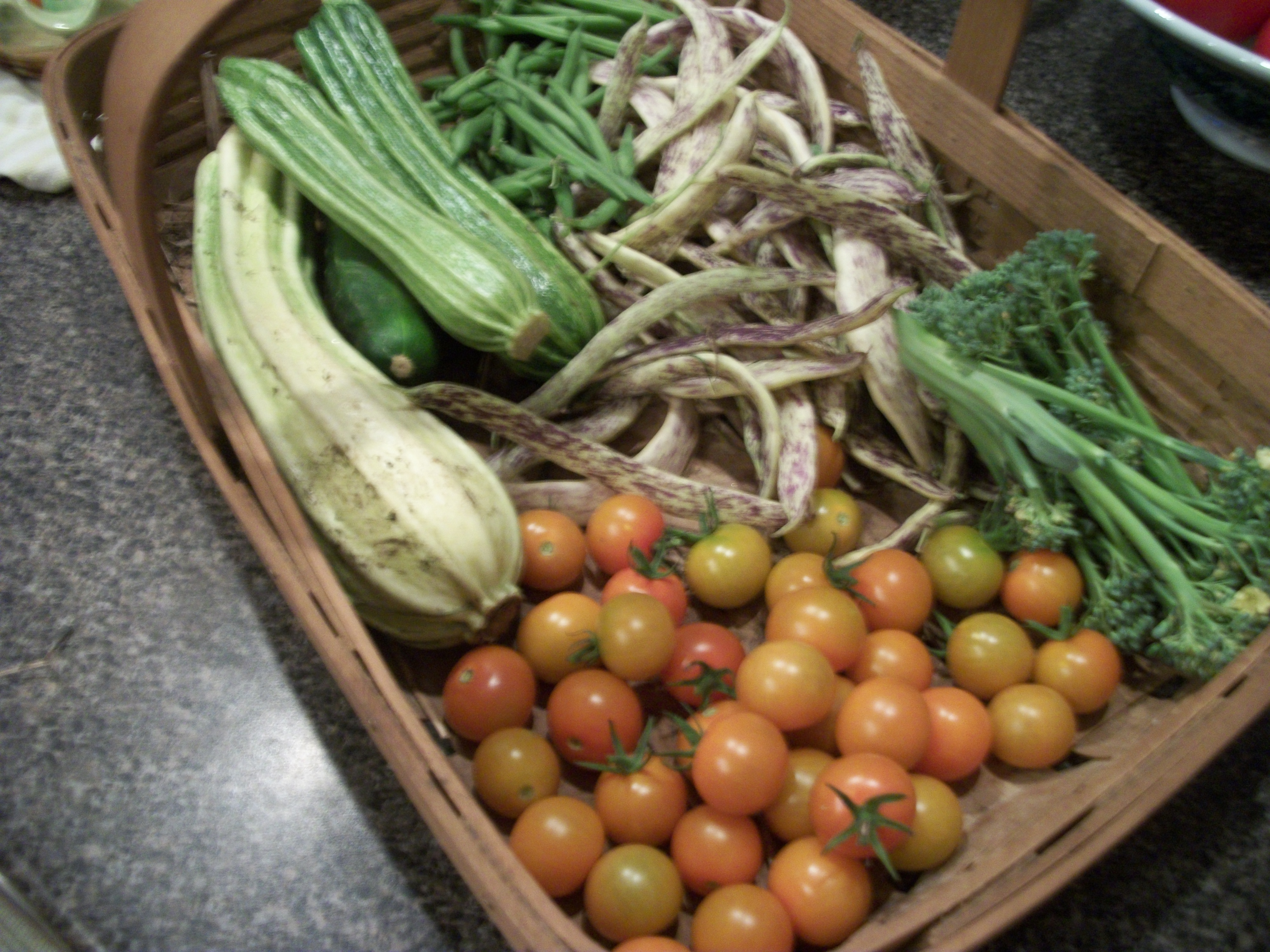
Here they are, filling up my harvesting/mushroom basket a few days ago.  They’re still a bit green, but will ripen to a deep gold color in the kitchen.  Cherry tomatoes are easy to grow and lend themselves to containers on an apartment balcony in a city.  They can be tucked away in an odd sunny corner of the yard, too.  (We had two days of rain, so we got a BIG zuke.)

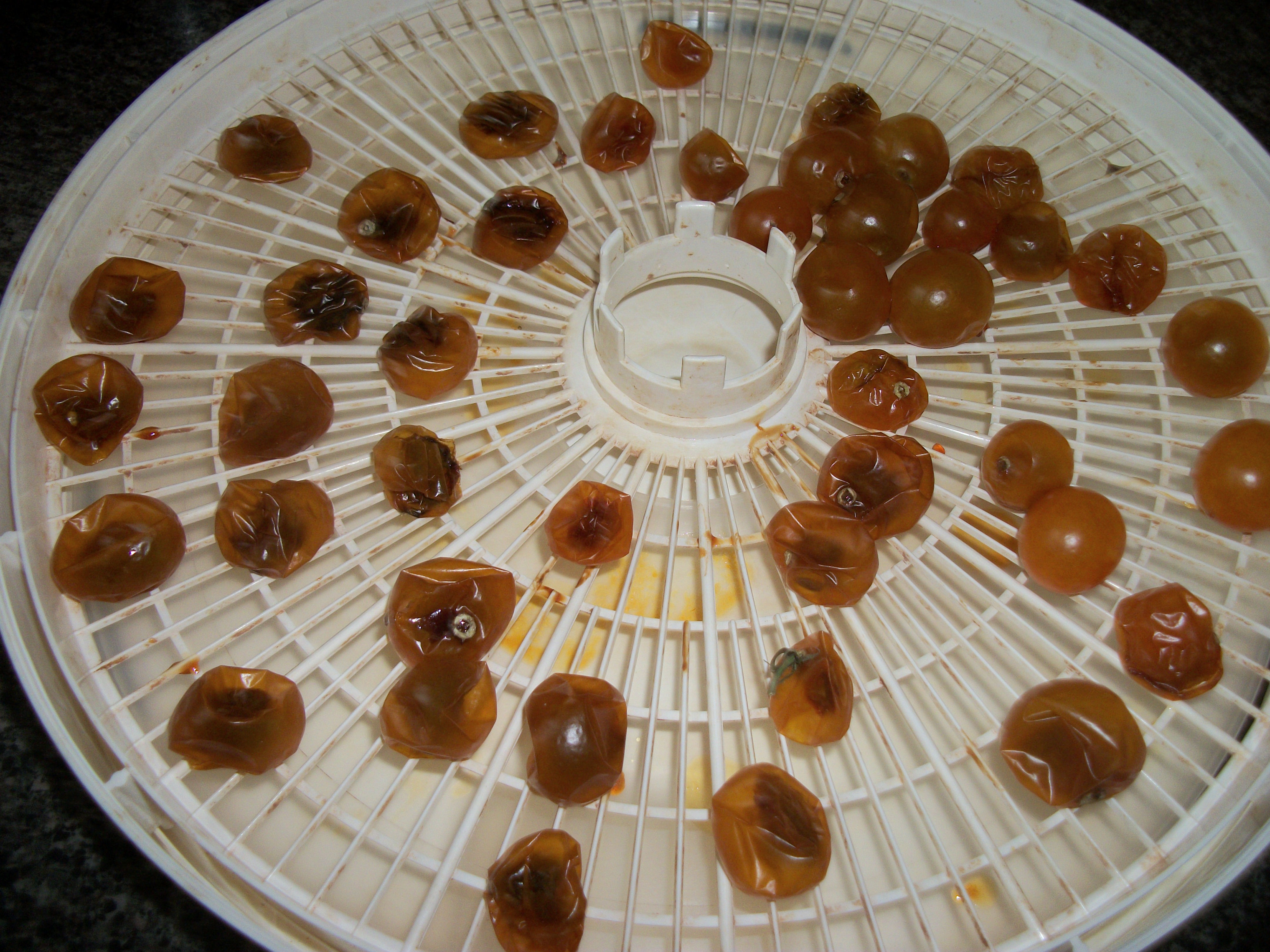
Drying them in the dehydrator has been a bit more involved than I had anticipated–in that it takes rather a long time for each one to dry out.  And, because they all ripen at differing times, I’ve been putting them in, one by one, rather than in whole groups.  In about 2 whole days and nights, I’ve only got about 10 dried enough to put in a Mason jar.  They’re somewhat sticky as they dry, and I don’t know if they will mold or not, so likely I’ll store them in the refrigerator so I don’t lose them–especially after all this energy has been expended!  Maybe I should be cutting them in half???

Here you can see my dehydrator working away with one tray inside.  (It came with…4 or 5 stackable trays and costs about $30.)  And, now, you can see the beautiful sunny gold of these tomatoes.

 And, now you can see what they look like drying inside the dyhydrator:

Aha!

I checked Barbara Kingsolver’s ANIMAL, VEGETABLE, MIRACLE, since I remembered a recipe in there for dried cherry tomatoes.  Camille Kingsolver does cut them in half and puts them skin side down on the tray.  And, here’s Camille Kingsolver’s recipe, found on page 295.  (For this or other recipes, you can go online to www.AnimalVegetableMiracle.com.)

 DRIED TOMATO PESTO

 Put the following ingredients in a food processor and process until smooth.  Add a little water if it seems sticky, but the mixture should be thick enough to spread on a slice of bread:

2 cups dried tomatoes, 1 cup coarsely chopped walnuts (crispy, please), 3/4 cup olive oil, 1/3 cut grated Parmesan cheese, 1/4 cup dried basil, 4 cloves garlic, 2 tablespoons balsamic or other good vinegar, 1/2 teaspoon salt.

BASIL OIL 

So, ok.  For the basil, I think I’d defrost and use some of my basil oil, taken from A YEAR IN MY KITCHEN, Skye Gyngell–which has been recently updated with American measurements (she’s British).  Basically, you put a LOT of basil in a food processor (3 bunches or more), 3-4 cloves of garlic, some salt, and start the processor.  Drizzle in olive oil until you have a smooth paste/sauce.  Freeze in those very small Mason jars (1/2 cup?) and enjoy all winter.  This oil is especially nice served alongside meat–grilled steak, roasted chicken, etc.

Interesting Information: My Cuisinart Rant

Interesting Information:  august 20, 2011

My Cuisinart Rant

Last summer, in the middle of making food processor ice cream–you just dump in heavy cream, frozen fruit, some arrowroot, and a bit of maple syrup or local UNHEATED honey–my Cuisinart food processor died.

My Cuisinart food processor was probably 30 years old.  It was heavy as lead, as solid as stacked bricks.  The motor didn’t go.  The plastic safety feature that slid into place to form the electrical connection broke.  There were no replacement parts to be found, which several internet searches showed.  And, John, who can miraculously fix things, could not figure out how to make the electrical connection work.

I use my food processor A LOT.  So, I ordered a new one, and I paid $252.73 for it.  I didn’t really think twice since I figured that the last one had lasted over 30 years, so I’d gotten my money’s worth.

The new one came.  It’s all bright and shiny black and chrome.  It only has two blades though.  My old one had more.  And, it’s got multiple-sized bowls, but I never use the little ones.  I cook BIG when I’m using the Cuisinart.  It has a retractable cord.

It’s a total piece of junk!  It’s got “bells and whistles,” but it has no power at all.

It lifts up like a feather as there’s no weight to it at all.

What my old one could do in seconds, this one can’t do at all.  Ever.  And something simple like the ice cream takes forever and there are always large pieces of frozen fruit left in the mix.

I’m writing this because I’m old enough to have had a really good food processor.   Many of you are a generation younger than me, and you don’t know what’s happened to too many American products.  Manufacturers have dumbed them down, but by bit, saving pennies and half-pennies along the way until what we have are expensive pieces of junk.  Like this Cuisinart food processor.

What has occurred is entirely logical.  It’s the inexorable process of Capitalism when it isn’t controlled by values and ethics.  Or, when a generation has passed, and people have forgotten how an appliance is supposed to work, so they buy what the market offers.

I still have my wedding-present (1966) hand-held mixer.  My daughter-in-law Tami’s melted down in less than 10 years.  It wasn’t an appliance she used often, so the usage time is even shorter actually.  My current GE refrigerator is also big and shiny and a total piece of junk.  It isn’t ten years old, but pieces of plastic inside of it are breaking off in chunks.

This process of degradation is present in many industries today.  Many of you don’t know what a real strawberry should taste like.  Or, a peach.  Or real food that isn’t so highly processed that it’s, now, totally fake.  Many of you don’t remember what it was like to go to a doctor who was actually interested in your health, had time for you, KNEW WHO YOU WERE,and didn’t just attempt to push a lot of drugs and invasive tests on you–drugs meant to deal with the fact that your food is no longer nourishing your health.

All of this degradation has just crept up on us until what we have now is a total mess.  The only thing I know to do is to try to create local community once more where you know where your food comes from.  And, maybe, to try to find appliances from Europe, where they apparently still make quality products that last.  Meanwhile, I’m stuck with the Cuisinart as I can’t justify spending any more $$$ on a food processor.

DON’T BUY THIS STUFF.  DON’T BY A CUISINART FOOD PROCESSOR.  DON’T BUY FAKE FOOD IN THE GROCERY STORE.

PS:  My Cuisinart toaster–bought recently–is also a piece of junk.

Turkey Tracks: “A Thousand Flowers” Comes Home

Turkey Tracks:  August 20, 2011

“A Thousand Flowers” Comes Home

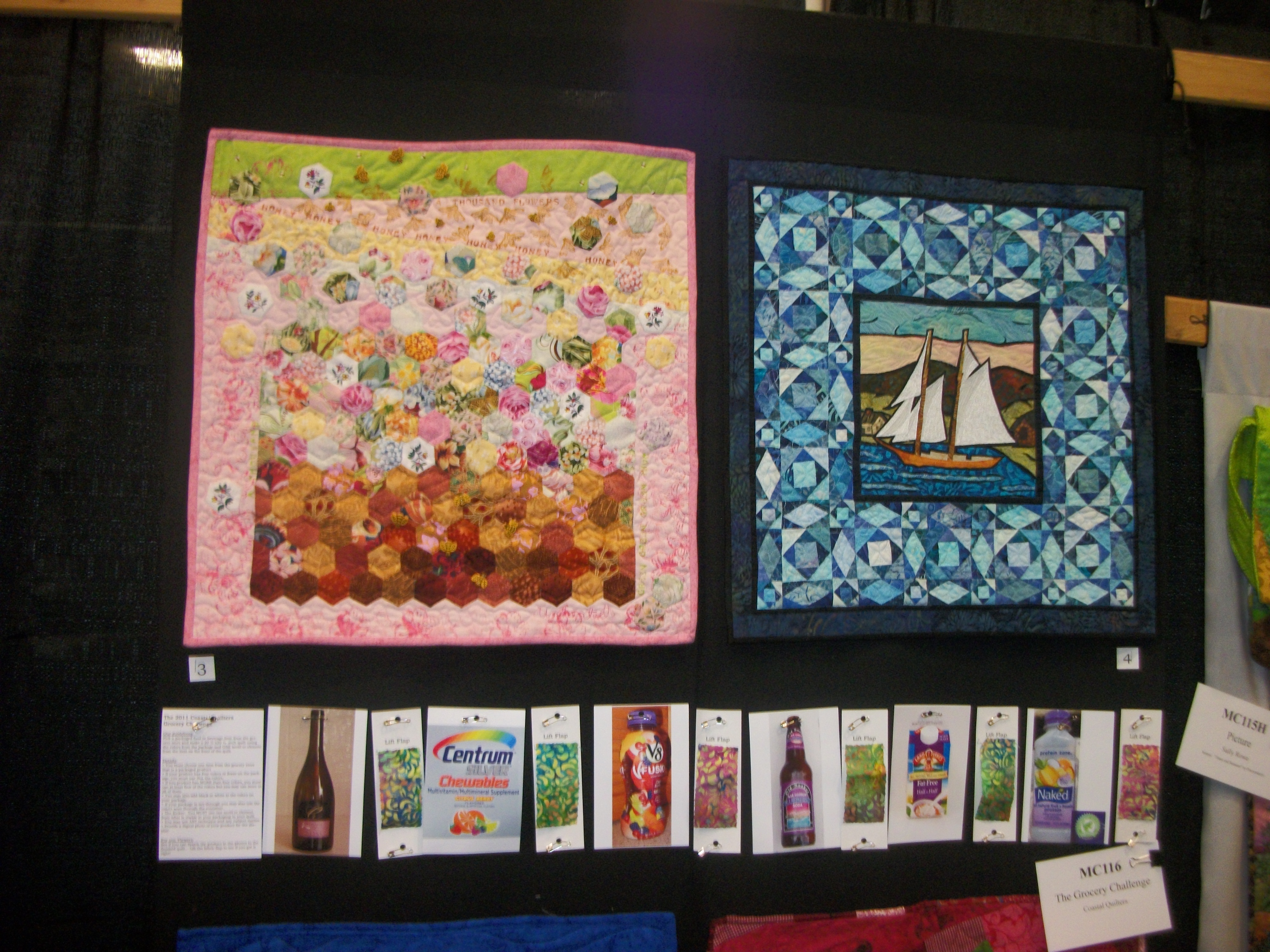
Here’s what our Coastal Quilters’ Grocery Store Challenge looked like hanging at the Pine Tree Quilters’ Guild show in Augusta, Maine, this past July.   You can see  my entry, “A Thousand Flowers”–it’s the third from the left, top row.  I wrote a blog entry on this quilt earlier, so you can take a look at that if you want to see a close-up.  On the right sidebar, search on quilts.  I used Green Hive Honey Farm as my food product–local UNHEATED honey which is made by bees from “A Thousand Flowers.”

Sarah Ann Smith staged this presentation with her usual flair.  Viewers were asked to try to identify which quilt represented what product from the grocery store.  Answers lay beneath the strips of fabric on the cards below.  Sarah is a nationally recognized quilt teacher and has a fabulous web site, which you can visit to see her amazing and exciting work:  http://www.sarahannsmith.com/index.php.  Sarah’s quilt is to the right of mine.

And, here’s “A Thousand Flowers” in the entryway to my quilt room.  Home at last.

Turkey Tracks: New Bread Pans

Turkey Tracks:  August 15, 2011

New Bread Pans

I’ve had some metal bread pans for many years now.  But, they had some sort of black coating, and it began to flake off.  Substantially flake off.  So, I tossed them into the trash.

I tried to use my glass pans, but the bread tended to stick to them, even though I liberally coated them with coconut oil.  Also, the crust just wasn’t the same.

I went online to King Arthur flour since their web site is excellent.  But, though the price was right ($15.95), their bread pan was a mixture of recycled steel and ALUMINUM.  King Arthur, what are you thinking???  Aluminum is TOXIC.  I’ve thrown out all my aluminum cook ware.  I didn’t have much, actually, as aluminum is very thin and light.  I like heavier pots and pans.  Besides, Tami made me throw out the last Asian steamer I had where the lightness was an asset.  It was time.

So, I started googling other kinds of bread pans and came up with cast iron pans that looked lovely and were already seasoned.  Here’s the web site:

http://www.campchef.com/cast-iron-bread-pan.html.  The pans came promptly and were also around $15.

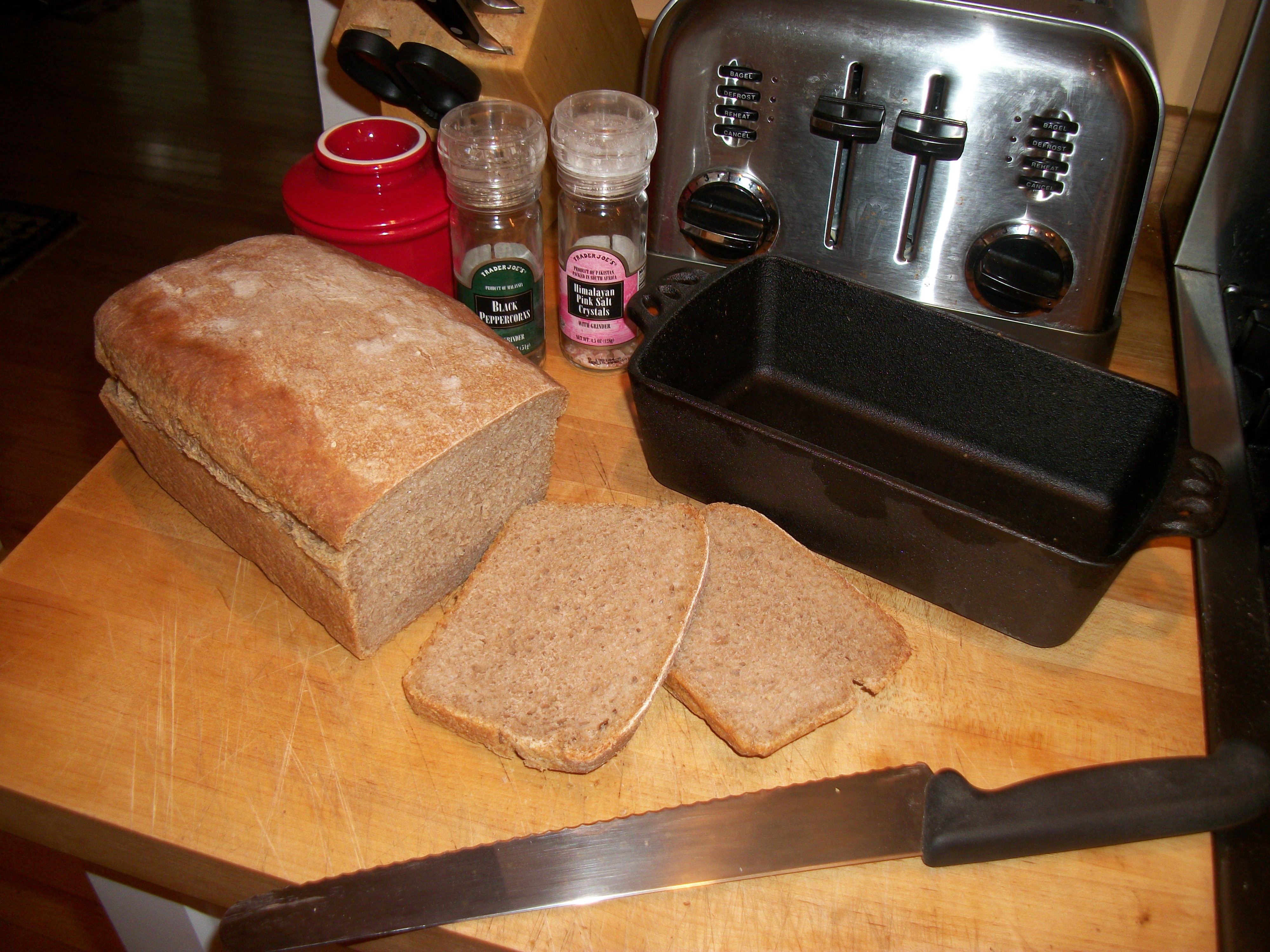
And, these pans baked beautifully!!!  Look at  that beautiful loaf of my wild yeast, sourdough bread!

Delicious!

Turkey Tracks: Pulling the Garlic

Turkey Tracks:  August 15, 2011

Pulling the Garlic

Garlic gets planted in the fall.  It’s a miracle to me that over the winter and the summer, one tiny clove grows into a whole bulb AND gives us a garlic scape just when the stored garlic is running out or has molded sometime in June.

I pulled our garlic Saturday.  It was a beautiful, sunshiny day, and I sat on the grass to trim off the bulbs and put the into a box.  They’re now in a single layer in three boxes in the garage attic, curing.  Soon the garage will smell like garlic.

Garlic is always listed as an immune system booster, so we eat LOTS of garlic.  It’s no accident that it can ward off a vampire since it is so powerful a protector of human health.

Here’s what a year’s supply of garlic for two people who have lots of guests looks like:

Here’s a close-up.  You can see that the stalks are quite spent now.  And you can see the flush of red under the coating of mud on the Russian Red bulbs.

Here’s a box full of fall and winter riches!

Garlic is super easy to grow and doesn’t take much space.  I amend my garden soil with chicken bedding, my kitchen compost, and worm castings in the fall.  In the spring I add whatever kitchen compost I’ve accumulated over the winter.  I cover my garden beds with straw, which breaks down over the winter, which adds more compost.  And, I add ground seaweed meal and azomite.  Garlic really likes azomite, and I do think it helps the garlic not to mold as winter stretches into early spring.

Here’s a picture of the size of the garlic bed this year.  It’s not large, as you can see.  It’s just that bare rectangle bounded by the kale and rock at the top, the La Ratte potatoes on the left, and the celery and lettuce below.

And, here’s a picture of the black, rich soil the worms make for us.  This batch is two years worth since we somehow didn’t empty the bin last fall.  I recover a batch of the worms to start again; the rest stay in the soil.  Or, go into the chickens, who have been working the garden since I turned them loose the other day.  The egg shells will get crushed up, and they add calcium back into the soil.

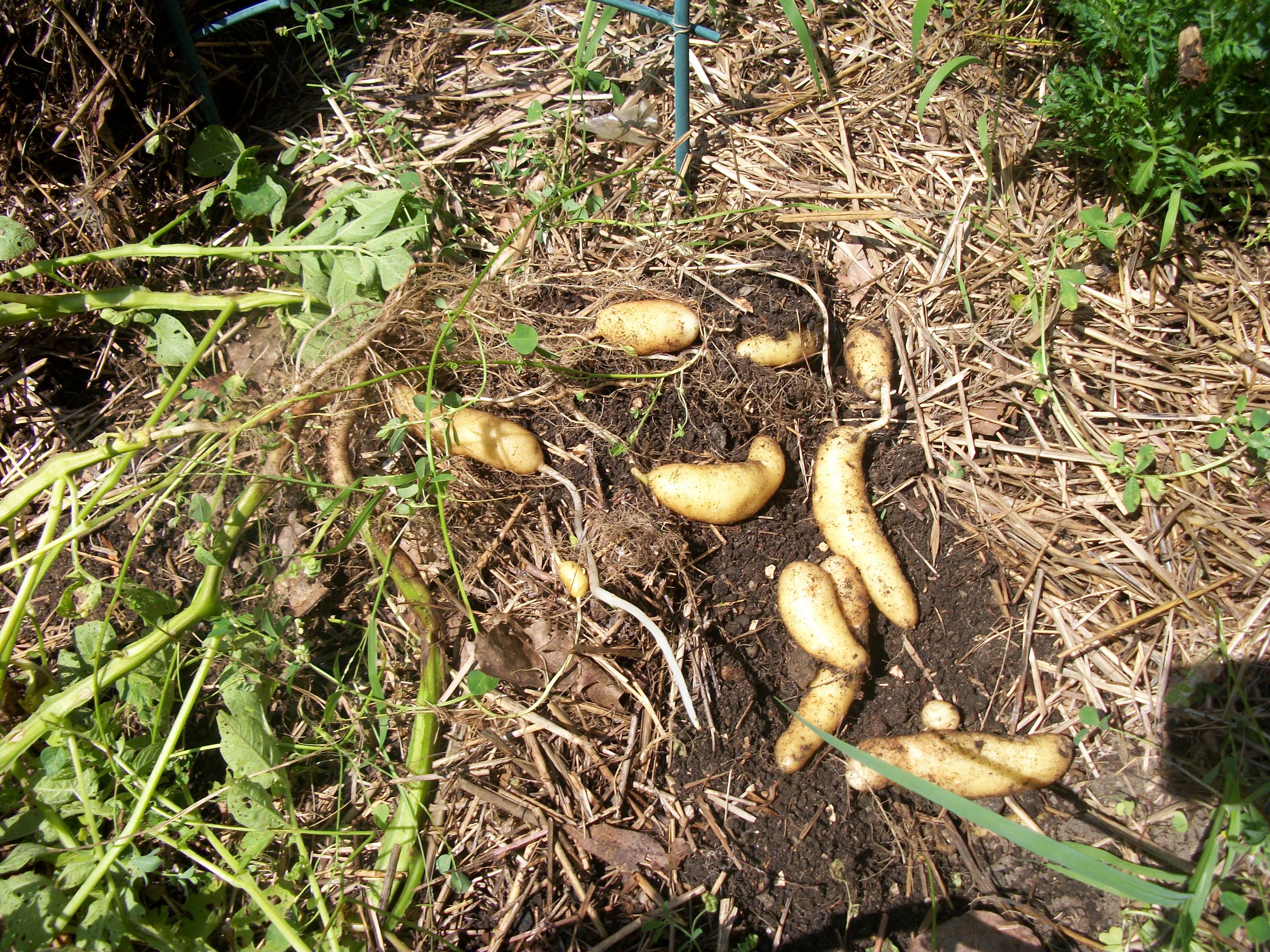
Speaking of La Ratte fingerling potatoes, I grabbled some for Saturday night dinner.  “Grabbled” is just a fancy word for digging some new potatoes before the green tops start showing yellow and falling over.  Here’s what they look like:

The one vine had about a dozen potatoes under it.  I boiled them in salted water, and they were heavenly:  nutty, buttery, and altogether wonderful.   We had them with grilled New  York strip steaks, Haricot Verte green beans from the garden, and a big, fresh salad with our lettuce, our green onions, and the first of the cukes and tomatoes we’re now getting–thanks to our CSA, Hope’s Edge.

Turkey Tracks: Ten Year Journals

Turkey Tracks:  August 15, 2011

Ten-Year  Journals

I’m on my second 10-year journal.

The first was a marvelous gift from my Falls Church, VA, neighbor Yoshi Hazen.

You’d be amazed at how useful these journals are for tracking down information you don’t want to forget.

And, for seeing what the weather was like in past years; or who visited when; or when it’s someone’s birthday (I put those on top of the page and highlight them with a marker); or when a repairman came last; or when someone married, had a baby, or…whatever.   You get the picture.

The first year we had chickens, I kept track of the number of eggs we got.  There were well over 900, and that’s with no laying in the short days/long nights part of the year.

It’s fun to see things like, yes, I guess the garlic is ready to be pulled since I pulled it on this day a year ago…

I keep it open on my desk and just jot down the key events first thing in the morning usually.  Or, sometime during the day.  Anyone could help keep it–like a child who is learning to write well, etc.  It could be a very fun family project.

I just ordered mine online and had no trouble finding a reasonably priced one.

Mainely Tipping Points 32: Fiber Menace

Tipping Points 32:  Fiber Menace

FIBER MENACE

One of the most striking things I’ve discovered while researching food and health issues over the past few years is how often strong personalities (usually males with a fervent belief system and either money or political power) drastically change what we think is healthy to eat.  Science refuting belief is ignored, obfuscated, or denied.  And, when industry becomes involved, the changes are permanently cemented into cultural truth.  Such is the case with our current practice of overeating fiber.   

Konstantin Monastyrsky, in FIBER MENACE:  THE TRUTH ABOUT FIBER’S ROLE IN DIET FAILURE, CONSTIPATION, HEMORRHOIDS, IRRITABLE BOWEL SYNDROME, ULCERATIVE COLITIS, CHROHN’S DISEASE, AND COLON CANCER (2008), identifyies Sylvester Graham (1794-1851) and John Harvey Kellogg (1852-1943) as agents of dietary change.  Graham, a Presbyterian minister who undoubtedly held the anti-body dictates of Calvinism, “prescribed a high-fiber vegetarian diet” to control lust” (1).  Graham believed men should not have sex until after they were 30 and then only once a month.  He believed white bread caused constipation and recommended “Graham” flour made from coarsely ground wheat.  Graham died alone, and Monastyrsky notes that Graham’s “abrasive, irritable personality” was likely a “manifestation of acute protein deficiency and unstable blood sugar” (1-2).

Kellogg, writes Monastyrsky, was a prominent physician, a celebrated surgeon, a successful entrepreneur, an author, a charitable man, and a health reformer.  Kellogg had a profound impact on the American diet since “he had the resources, the forum, the charisma, the conviction, and the authority to deliver his message over a long, long period of time and to lots and lots of people” (2).  Kellogg, like Graham, was obsessed with chastity and constipation.  He “never made love to his wife.”  To remedy masturbation, he “advocated circumcision without anesthetic for boys and mutilation of the clitoris with carbolic acid for girls.”  He believed constipation caused sexual desire as impacted stools stimulated the prostate gland or the vagina.  He proscribed a coarse vegetarian diet and bran and paraffin oil with every meal—which caused constant anal leakage along with the “decline of libido, functional impotence, and infertility” due to protein deficiencies.  Since he lived to be 91, Kellogg was likely “a typical hypocrite, who didn’t practice what he preached, sex or no sex” (2).

Kellogg’s namesake company is “still minting a fortune by peddling…sugared breakfast cereals fortified with fiber.”  In 2004 alone, the Kellogg Company spent over $3.5 billion just on ` promotional expenditures,’ “ so “no wonder fiber is still on everyone’s mind and in everyone’s stools….” (3).  And so, writes Monastyrsky, “if you believe that the introduction of fiber into the American diet came about as a result of thorough academic research, methodical clinical investigation, and penetrating peer reviews…it didn’t.  It’s actually based on profane sacrilege, fanatical misogynism, medieval prudishness, common quackery, crass commercialism, incomprehensible medical incompetence, and by the legal standards of today, negligence and malpractice” (3). 

There is, writes Monastyrsky, no scientific proof that high-fiber diets are healthy or aid constipation (13).  And a major text for gastroenterologists (ROME II) notes that “`there is little or no relationship between dietary fiber intake and whole gut transit time’ “ (114-115).

Indeed, there are reams of studies demonstrating that anything but “minor quantities of fiber from natural, unprocessed food” upsets the whole digestive chain in ways that leads to the problems listed in FIBER MENACE’s title (13).  Worse, many reputable studies show that high-fiber diets do not provide protection from the second largest cancer killer in the U.S.–colon cancer–and are probably a cause of it–information which has been largely ignored (180-187).  And, studies show that “carbohydrate intake…[is] positively associated with breast cancer risk.”  Yet, health authorities continue to insist that we eat more fiber, avoid meat and animal fat, eat more fruits and vegetables, and drink a lot of water (185).     

But, let’s back up for a moment.  Monastyrsky received medical training and a  pharmacology degree (1977) in Russia (Ukraine) before emigrating to the U.S. in 1978, where he embarked on a very successful career in technology, primarily on Wall Street.  Then, after years of eating a high-fiber vegetarian diet, he became very ill with diabetes, irritable bowel syndrome, constipation, hemorrhoidal disease, and anal fissures.  He returned to his medical training and research skills to heal himself and  learned that his life-threatening condition often takes decades to develop. 

According to Monastyrsky’s web site (www.gutsense.org), he is a certified nutritional consultant and an expert in forensic nutrition, a new field of science that investigates the connection between supposedly healthy foods and nutrition-related disorders, such as diabetes and obesity.  Treatment is through nutritional intervention.  He’s written two best-selling books in Russian and FIBER MENACE and GUT SENSE in English.  His work is highly respected by the Weston A. Price Foundation and is a fit with other work denouncing the overeating of carbs, the loss or lack of gut flora and fauna (disbacteriosis), and the need to eat nutrient-dense foods for health—such as Dr. Natasha Campbell-McBride’s GUT AND PSYCHOLOGY SYNDROME and Gary Taubes’ WHY WE GET FAT.

Monastyrsky explains the “evolutionary functions of each digestive organ” and notes that each organ specializes in a specific food group.  The mouth macerates and masticates flesh for we are “canine-wielding predators”; the stomach ferments and digests proteins; the duodenum (the first section of the small intestine) mixes chyme (a thick liquid without any solids that arrives from the stomach) with enzymes and absorbs water; the gallbladder uses bile to break down and assimilate fats; the jejunum and ileum (the last two sections of the small intestine) complete digestion of proteins, fats, and carbohydrates and absorb “their basic components (amino acids, fattly; acids, monosaccharides); and the large intestine recovers remaining water, nutrients and electrolytes, converts “liquid chyme to semi-solid stools,” and expels them (8-9). 

If this process is disturbed by an overabundance of indigestible fiber, the system struggles.  Malabsorption, where needed nutrients are not absorbed, occurs, which leads to malnutrition and disease.  Constipation and/or diarrhea occur, as does bloating and gas.  The stretched digestive system—a condition worsened by drinking water that makes fiber swell–begins to need more and more fiber to function.  The delicate tissues of the normally narrow anal canal are torn and scarred by too-large stools.  The lack of appropriate fats further compounds these disease conditions by causing stool impaction.  Intestines “bloated from inflammatory diseases caused by indigestible fiber” create hernias (28).       

Monastyrsky warns that a lot of fiber is hidden in fake processed foods under obscure names, like “cellulose, B-glucans, pectin, guar gum, cellulose gum, carrageen, agar-agar, hemicellulose, inulin, lignin, oligofructose, fructooligosaccharides, polydextrose, polylos, psyllium, resistant dextrin, resistant starch, and others.”  These factory made ingredients are derived from wood pulp, cotton, seaweed, husks, skins, seeds, tubers, and selected high-yield plants that aren’t suitable for human  consumption without extra processing” (18). 

So, what constitutes constipation?  Monastyrsky notes that mainstream medicine does not recognize constipation as the very serious condition that it is until it is too late and more extreme digestive conditions have developed.  If you’re not experiencing twice-daily easy and complete stools–Monastyrsky describes in detail what a healthy stool should look like using the UK’s Bristol Stool Form Scale—you might want to read FIBER MENACE. 

WARNING:  Monastyrsky warns that one must wean off fiber very gently or one will set off unintended consequences, like increased constipation.  To heal a damaged digestive tract, the GAPS diet, from GUT AND PSYCHOLOGY SYNDROME, is excellent—www.gapsdiet.com. 


Interesting Information: Pantry Intervention

Interesting Information:  Sarah Pope’s Pantry Intervention Video

Sarah Pope’s videos are available on the video tab of the Weston A. Price Foundation’s web site (www.westonapricefoundation.org)  AND on her own web site at http://thehealthyhomeeconomist.com.  But, here’s a quick link to her video on what should and should NOT be in your pantry:

http://www.westonaprice.org/beginner-videos/pantry-intervention-video-by-sarah-pope.

Sarah Pope’s videos are interesting both for beginners and for those of us who have been learning how to think about and cook nutrient dense foods for ourselves and for our families.  I’ve watched two of them now (the pantry intervention and on appropriate cookware), and I’m looking forward to viewing the rest and to spending some time on her web site, which looks excellent.

So, take a peek and let me know what you think.