Mainely Tipping Points 28: Why We Get Fat

Mainely Tipping Points 28:  WHY WE GET FAT


In WHY WE GET FAT (2011), Gary Taubes—a highly respected science researcher and writer, drives a scientific stake into the heart of the “calories in/calories out” paradigm that began developing in the 1950s and grew to become the medical orthodoxy we experience today.  Taubes explains the proven science behind why some people get fat—a question totally lost in the wilderness of the “energy balance” paradigm and its attendant low-fat/high carbohydrate diet.  The circular logic of this paradigm holds overweight people in a vicious, unscientific, damaging, deeply cultural  polarity:   either people of low character eat too much (gluttony) or exercise too little (sloth).  

Taubes traces the history of when research in nutrition and obesity “lost its way” and observes that these fields have “resisted all attempts” at correction.  Much understanding, Taubes writes, was lost after World War II with “the evaporation of the European community of scientists and physicians [particularly the Germans] that did the pioneering work” (ix).  Since that time, writes Taubes, “individuals involved in this research have not only wasted decades of time, effort, and money but have done incalculable damage….Their beliefs have remained impervious to an ever-growing body of evidence that refutes them while being embraced by public-health authorities and translated into precisely the wrong advice about what to eat and, more important, what not to eat if we want to maintain a healthy weight and live a long and healthy life” (ix). 

Taube’s earlier book GOOD CALORIES, BAD CALORIES (2008) is an extended, densely researched book written to start a conversation with “the experts.”  Taubes believes that it might take another lifetime to change this paradigm, but, meanwhile, he sees that the disease burden (obesity, diabetes, heart disease, and cancer) being created by eating the wrong foods is “overwhelming not only hundreds of millions of individuals but our health-care systems…” (x).  Taubes wrote WHY WE GET FAT so the lay person could understand what’s wrong and have the courage to take personal charge of his/her health rather than relying on “some of the misconceptions that pass for public-health and medical advice in this country” (xi).

So, why do some people get fat?  All real food, as compared to some of the chemical brews passed off as food today, is composed of fats, proteins, and/or carbohydrates.  In a nutshell, people have genetic tendencies toward fatness or thinness that combines with a hormonal chemical disorder caused by eating too many carbohydrates—which throws off the body’s ability to regulate fat accumulation appropriately in both fat and thin people. 

Here’s a gross simplification of Taube’s main explanation:  Fat accumulation is regulated by hormones, and the most important hormone is insulin.  Ideally, when our insulin levels are elevated, we accumulate fat in our fat tissue.  When insulin levels fall, fat is liberated from fat tissue and is burned for fuel.  However, easily digestible carbohydrates, like highly processed sugars and grains and starchy vegetables, make the body produce more insulin.  And, this insulin works to trap fat inside fat cells; it does not release them to burn for energy.  Thus, obesity is a hormonal imbalance, not a caloric imbalance.  Worse, this hormonal imbalance makes an overweight person hungrier because the body is growing larger, and it makes that person sedentary because all the food energy is being stored, not burned.  Gluttony and sloth are effects of this hormonal imbalance, not causes (10). 

Insulin, Taubes writes, works also with other hormones, like the sex hormones, and countless enzymes to partition fuel around the body.  This chemical process decides what food energy is burned, what is stored, and in which tissues it is stored (fat, muscle, liver).  An insulin disorder can partition a disproportionate amount of consumed calories into storage as fat, rather than having them used for energy by the muscles.  In lean people, the factors work to burn as fuel a disproportionate share of the consumed calories, which creates high energy levels (128).   

Some people, Taubes explains, develop insulin resistance, which means the body has to secrete higher and higher insulin levels in order to perform the same tasks—a “vicious cycle” intensified by eating easily digestible carbohydrates.  Next, these people start to manifest the precursor to heart disease, metabolic syndrome.  Body fat accumulates, especially around the waist; blood pressure rises; triglycerides levels rise; LDL cholesterol particles become small and dense; HDL cholesterol levels fall; and blood sugar becomes erratic (glucose intolerance).  Diabetes occurs when the pancreas can no longer secrete enough insulin to keep the body balanced.  And Alzheimer’s and most cancers are “associated with metabolic syndrome, obesity and diabetes” (195-198). 

Taubes’ subject is why we get fat, so he does not address the health effects on the lean, energetic person whose leanness is created by this hormonal disorder, which is, in turn, caused by eating too many of the wrong kinds of carbohydrates.  He does note that that as we age, our muscles become increasingly resistant to insulin and more energy gets partitioned into fat (130-131).   

There are generational components to these disorders.  Taubes notes that worldwide studies demonstrate that children born to a mother with hormonal imbalances that have created obesity are likely, also, to struggle with obesity.  The nutrients the mother’s body supplies to her baby affects his/her levels of glucose, which, in turn, affects the pancreas so that it develops more insulin-secreting cells, which, in turn, makes the baby fatter at birth.  These babies have a tendency both to oversecrete insulin and to become insulin-resistant (132).            

Exercise, Taubes demonstrates effectively, will not make one lose weight.  Indeed, for weight loss, exercise is counterproductive because it creates hunger (40-56).  And, undereating  does not work.  At some point one must return to eating normally, and the weight returns.  Taubes reports that the eight-year, billion-dollar National Institutes of Health initiative, the Women’s Health Initiative (WHI) of the 1990s, showed that a low-fat diet did not result in weight loss and “did not prevent heart disease, cancer, or anything else” (33-39). 

Taubes looks at many current studies, among them the 2007, two million dollar, government-funded A TO Z Weight Loss Study from Stanford University which compared four diets:  Atkins (low carbohydrate), LEARN (a traditional diet with 55-60 percent carbohydrates), Ornish (low fat), and the Zone diet.  The Atkins diet won, substantially and significantly, across the measured categories (weight loss, dropping triglyceride levels, dropping blood pressures, and improved cholesterol conditions)—prompting lead researcher Christopher Gardner, a twenty-five year vegetarian, to note that the results were, for him, a “`bitter pill to swallow’” (191-192). 

Taubes notes that Atkins diet participants were allowed to eat as much red meat and meat fat as they wanted (191-192).  And, that “since the 1960s, when it was first argued that animal products could be bad for our health because they contains saturated fat, nutritionists have typically refrained from pointing out that meat contains all the amino acids necessary for life, all the essential fats, and twelve of the thirteen essential vitamins in surprisingly large quantities.”  Meat, writes Taubes, “is a particularly concentrated source of vitamins A and E, and the entire complex of B vitamins.”  Indeed, “vitamins B12 and D are found only in animal products….”(176).

Vitamin C is the “one vitamin that is relatively scarce in animal products.”  But, “the more fattening carbohydrates we consume, the more of these vitamins we need.  We use B vitamins to metabolize glucose in our cells.  So, the more carbohydrates we consume, the more glucose we burn (instead of fatty acids), and the more B vitamins we need from our diets.”  When we eat carbohydrates, we “excrete vitamin C with our urine rather than retaining it” (176). 

Without carbohydrates in the diet, Taubes notes, “there’s every indication that we would get all the vitamin C we ever needed from animal products.”  Thus, Taubes concludes, “Carbohydrates are not required in a healthy human diet.”  And, “another way to say this (as proponents of carbohydrate restriction have) is that there is no such thing as an essential carbohydrate” (176).             

The solution to both obesity and leanness accompanied by excessive energy is actually pretty simple:  stop eating carbohydrates, especially the easily digestible ones, like, bread, pasta, potatoes, sweets, beer, fruit  juices, and sodas.  (I’d add cold breakfast cereals to this list.)  Taubes notes that before the 1960s, conventional wisdom recognized that these foods were “uniquely fattening.”  And, he notes that this message has been at the heart of an “unending string of often best-selling diet books” (11).  He also notes that “when physicians stopped believing it, a process that began in the 1960s and concluded in the late 1970s,” their change coincided “with the beginning of the current epidemics of obesity and diabetes” (150).     

Taubes does note that if the obesity has gone on too long, the body may not be able to reset its own chemistry (205).  And, that if one is taking medications to lower blood sugar or blood pressure, one should work closely with a doctor because following a low-carbohydrate diet lowers both so that a dangerous “double whammy” effect can occur (216). 

Taubes reproduces the Atkins-version diet used by Dr. Eric Westman of the Lifestyle Medicine Clinic at the Duke University Medical Center.  Westman has been working with this diet since 1998 (202).  And, Taubes points to four other doctors with similar clinical practices across the country (202).   

My only critique of this diet is that it allows artificial sweeteners and does not distinguish well between good fats and bad fats.  But, you can read Tipping Points 14 to understand how to sort those fats out for yourself.
Turkey Tracks: Katie Climbing Trees

Turkey Tracks:  March 13, 2011

Katie Climbing Trees

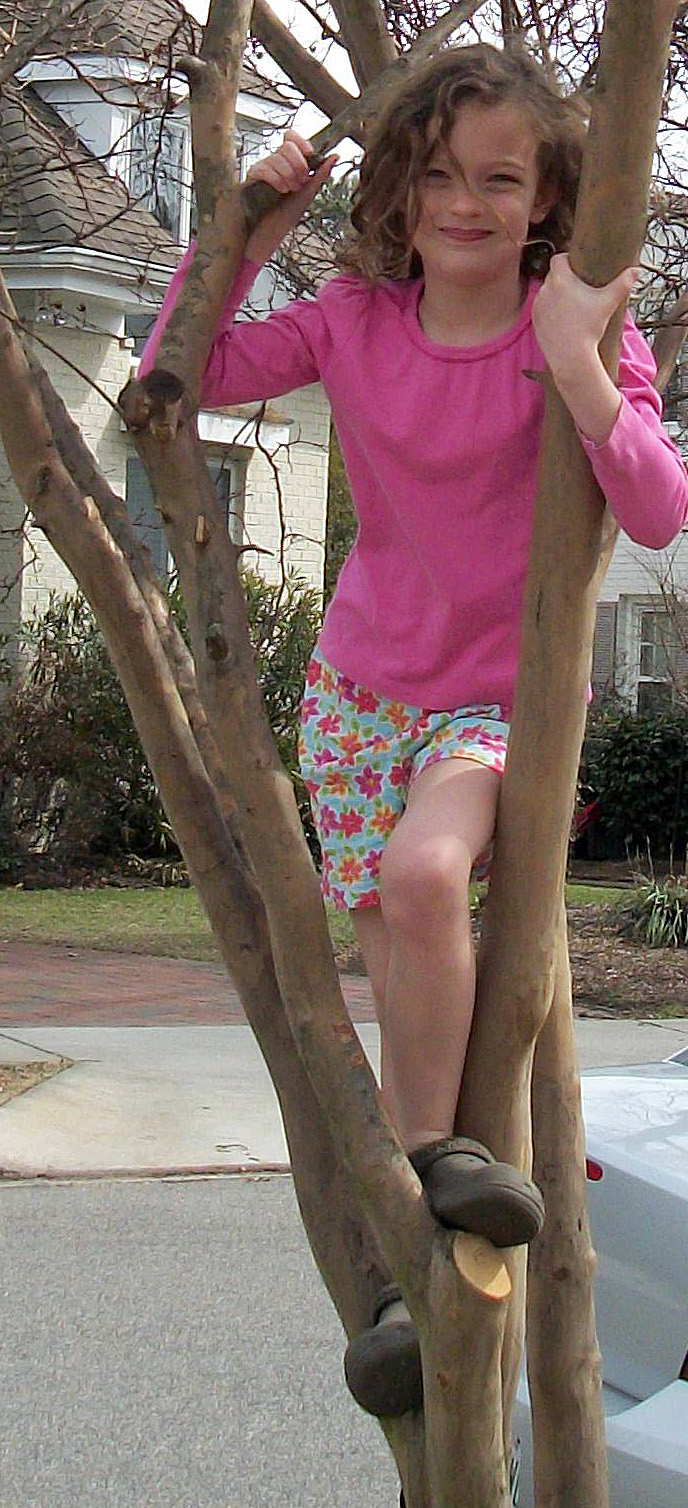
 When I went to visit my brother’s family on my recent trip to Williamsburg, his youngest daughter Katie met me as I got out of the car.  She came with big hugs.  Then, she climbed this tree.

Do you remember climbing trees when you were little?

Do you remember the feeling of accomplishment and power you felt?

How easy it is to forget such a simple pleasure.

It’s going to be so interesting to see what trees Katie climbs in the years to come.

Turkey Tracks: Williamsburg 2011

Turkey Tracks:  March 13, 2011

Williamsburg 2011

Every year for at least the past 10 years, this group of quilters has gathered in Williamsburg, Virginia, to spend a week with each other quilting, visiting, eating together, visiting local quilt shops, and attending the Mid-Atlantic Regional quilt show in, now, Norfolk.  (It started in Williamsburg in multiple hotels.)  Other quilters who live in the area also come to visit, to “show and tell,”  and to, perhaps, sew with us for a day or two.

This group started in the now-defunct Falls Church chapter of the Northern Virginia guild.  We were all members of the same “bee,” which was a way to break down the larger Falls Church chapter into smaller, more personal groups that could work together.  One member moved to Roanake, met a quilter there, and the two often come to join us.  But, not this year.      

Rosy Pilkerton, center, pink shirt, organizes us all.  She is a wizard with the time shares she owns, and this year, she had saved points for almost 10 years to have us stay in this HUGE, amazing apartment with FOUR huge bedrooms.  Thank you Rosy!  Your gift to us was so appreciated!  From the left:  Louisa, from Maine; Libia, from Mexico; Rosy, Carrie, and Denise from Northern Virginia.  This year we were missing one quilter, Caroline, whose uncaring boss called a weekend meeting, to which he did not ultimately show, which prevented her from coming.  (He insisted she be at work for this “important” meeting the next week.)  She was terribly missed, and if we could see him, we’d give him a piece of our minds!   

Each of us is uniquely different, and each of us is uniquely special.   We quilt in all different kinds of ways, and, over the years, I’ve learned much of what I know about quilting from these women.   It’s also interesting to see how one of our quilting styles or interests rubs off on others.  My love of clever children’s fabrics stems from watching Rosy make so many charming children’s quilts over the years.   

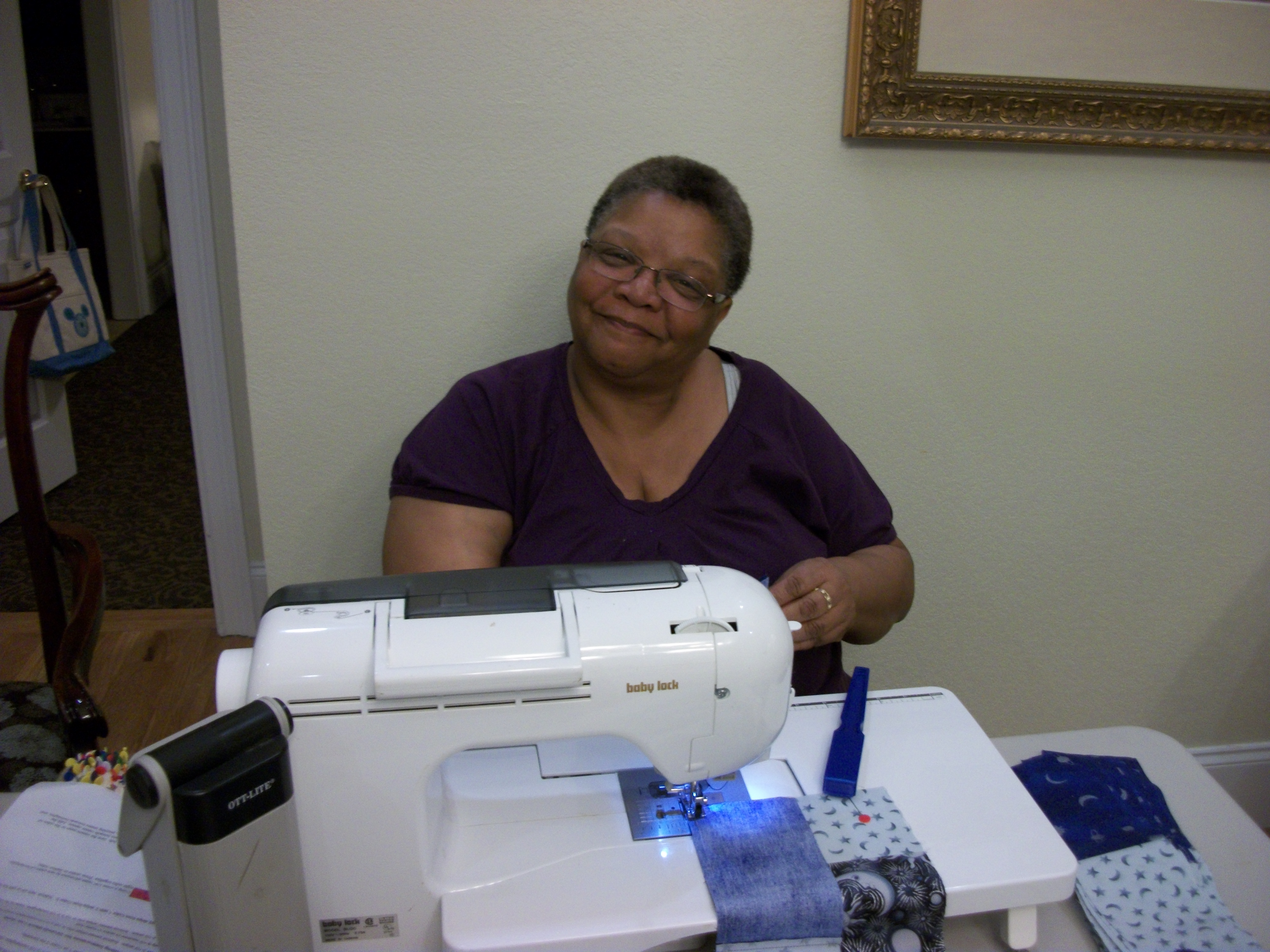
Since I fly into Norfolk from Maine and since Libia comes from Mexico City, Rosy, Carrie, and Denise organize and bring all our equipment.  Who brings what is now down to a science for them, and everything we need is there:  a cutting table, ironing boards and irons (two),  a portable design wall, rulers, rotary cutters, sewing tables, a box of food staples (salt, pepper, sugar, tea), and so forth.  Carrie always brings me a sewing machine, and Rosy brings me and Libia Ott lights.  This year Libia brought her featherweight from  Mexico.  I had only to bring my project fabrics and small items like scissors, pins, needles, threads, and so forth, which is getting harder with shrinking airline bag sizes and extra charges.  We all come with small gifts for each other as well, and that’s always a fun time.  You’ll walk away from your machine, and when you return, there will be something special there for you. 

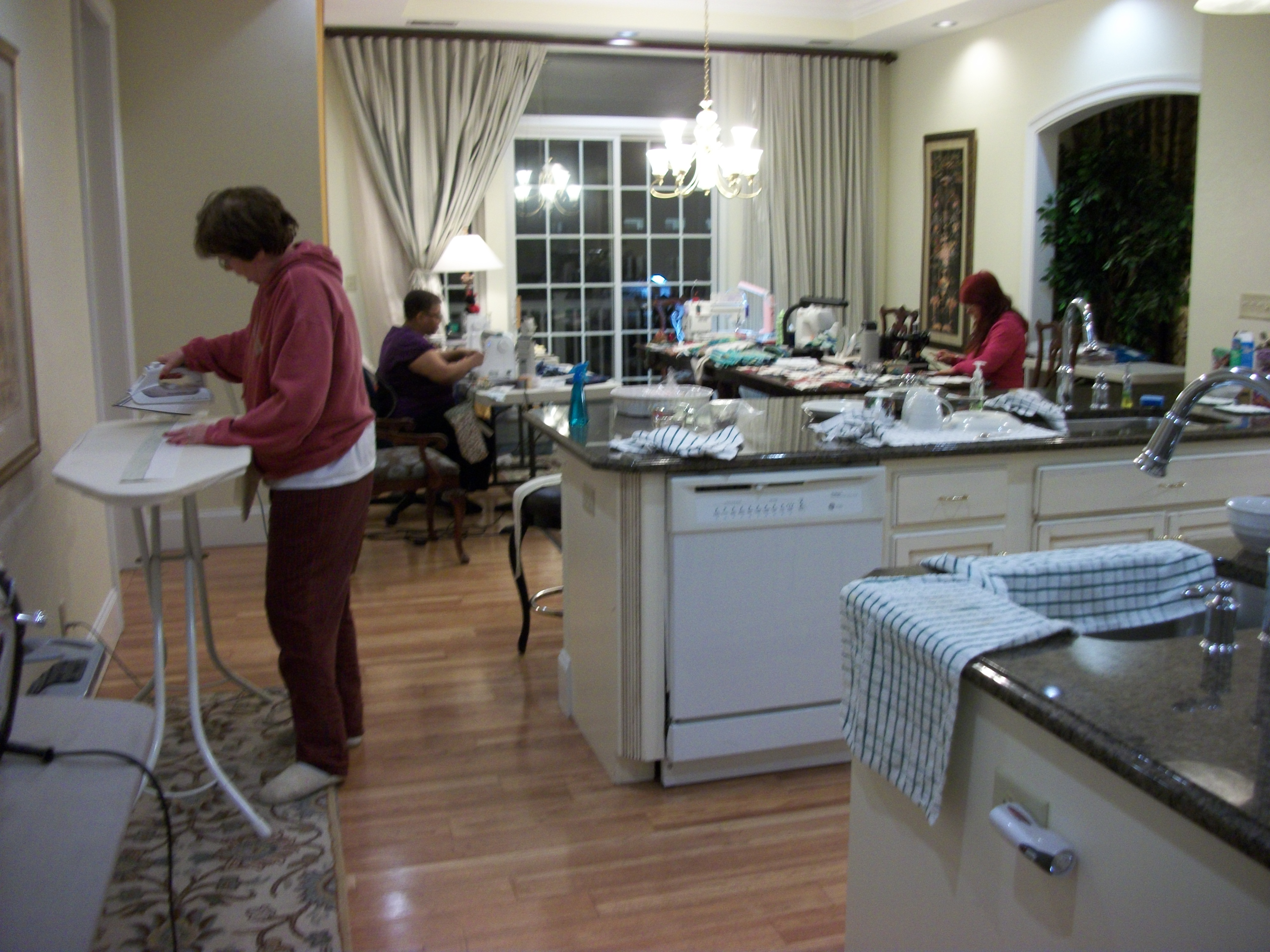
The first thing that happens is that we move around furniture so that we are all together in one room.  The dining room table is good for at least 2 sewing stations.  In this palatial palace, it was big enough for three.  Carrie and Denise set up in the tables next to the wall.  Denise brought fabrics for a large quilt that would be strip pieced.  She had to cut and sew a ton of strips, cut them, and sew more.   

 The cutting table is behind Libia–in front of sliding doors to a patio that overlooked a little pond.  It was warm enough on a few days to sit outside in the sun.  The living room and TV were in this room.   

And the ironing boards are along a wall in the kitchen. 

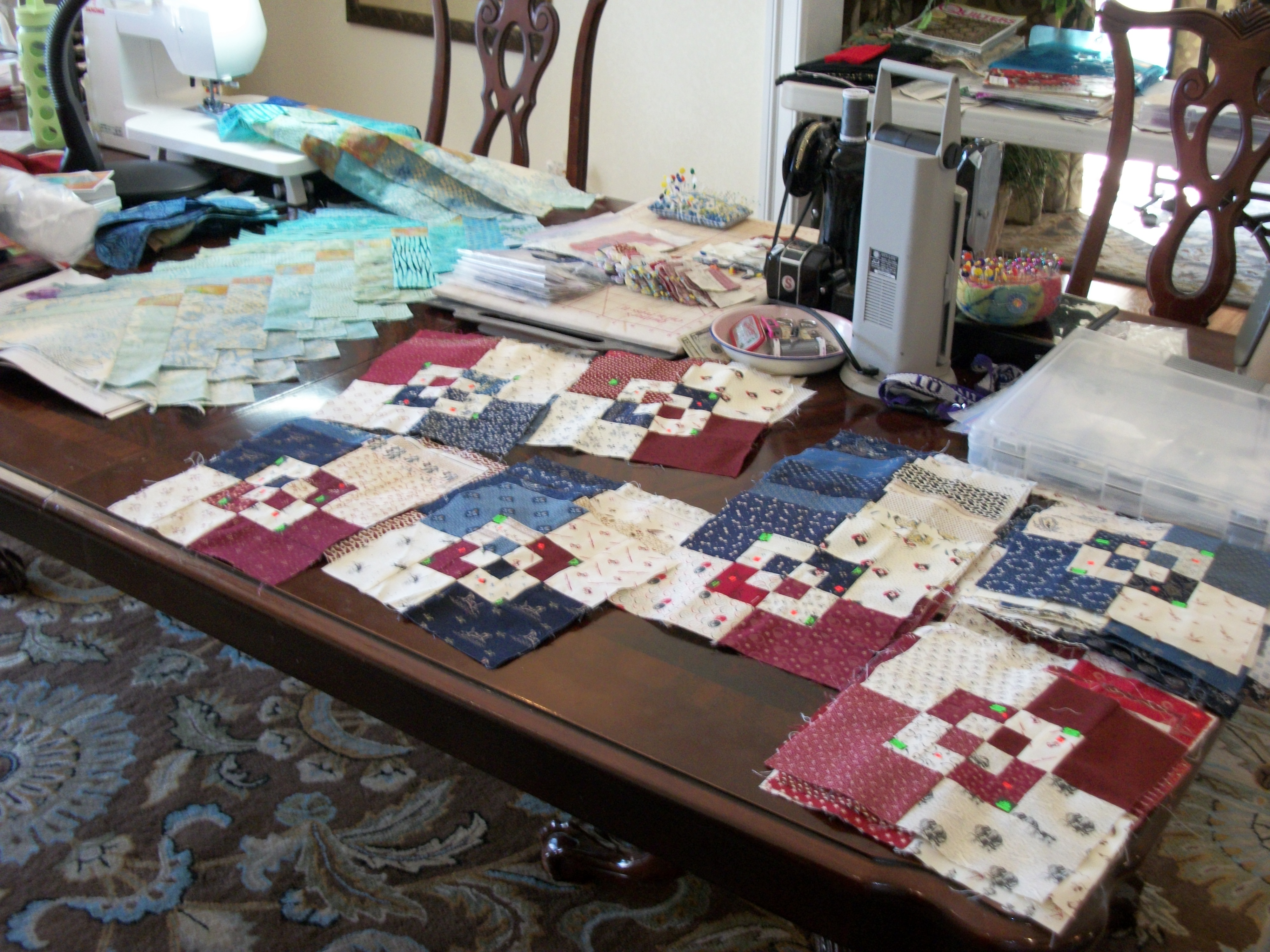
Here are some “works in progress”:

 Libia made TWO  twin-sized quilts from these tiny squares.  Here’s one of the tops finished:

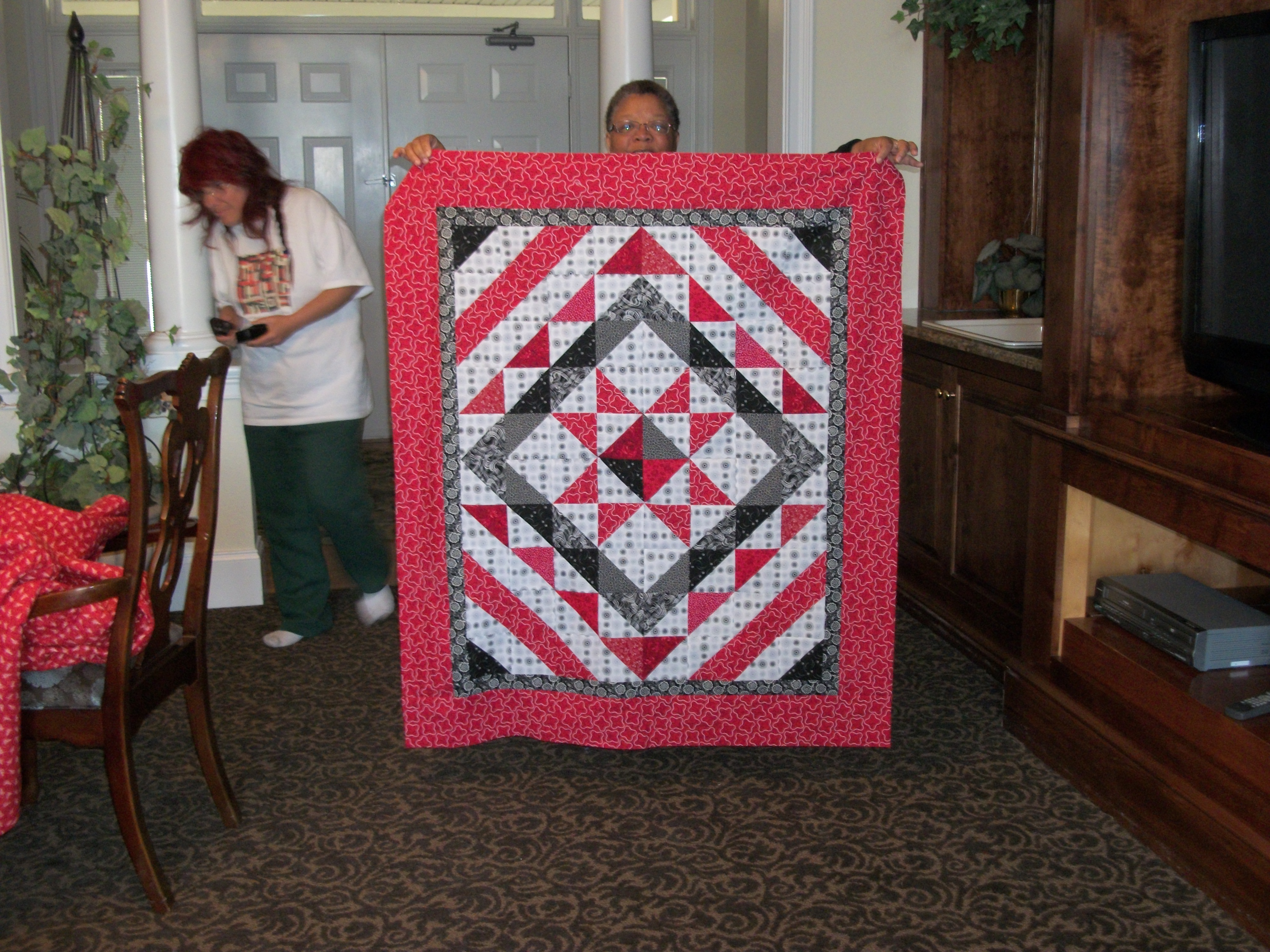
And here’s one of the quilt tops Carrie finished almost right away!  She made another BIG one and a new purse.  Carrie has a new long-arm too, and we watched a set of instructional videos together during the week. 

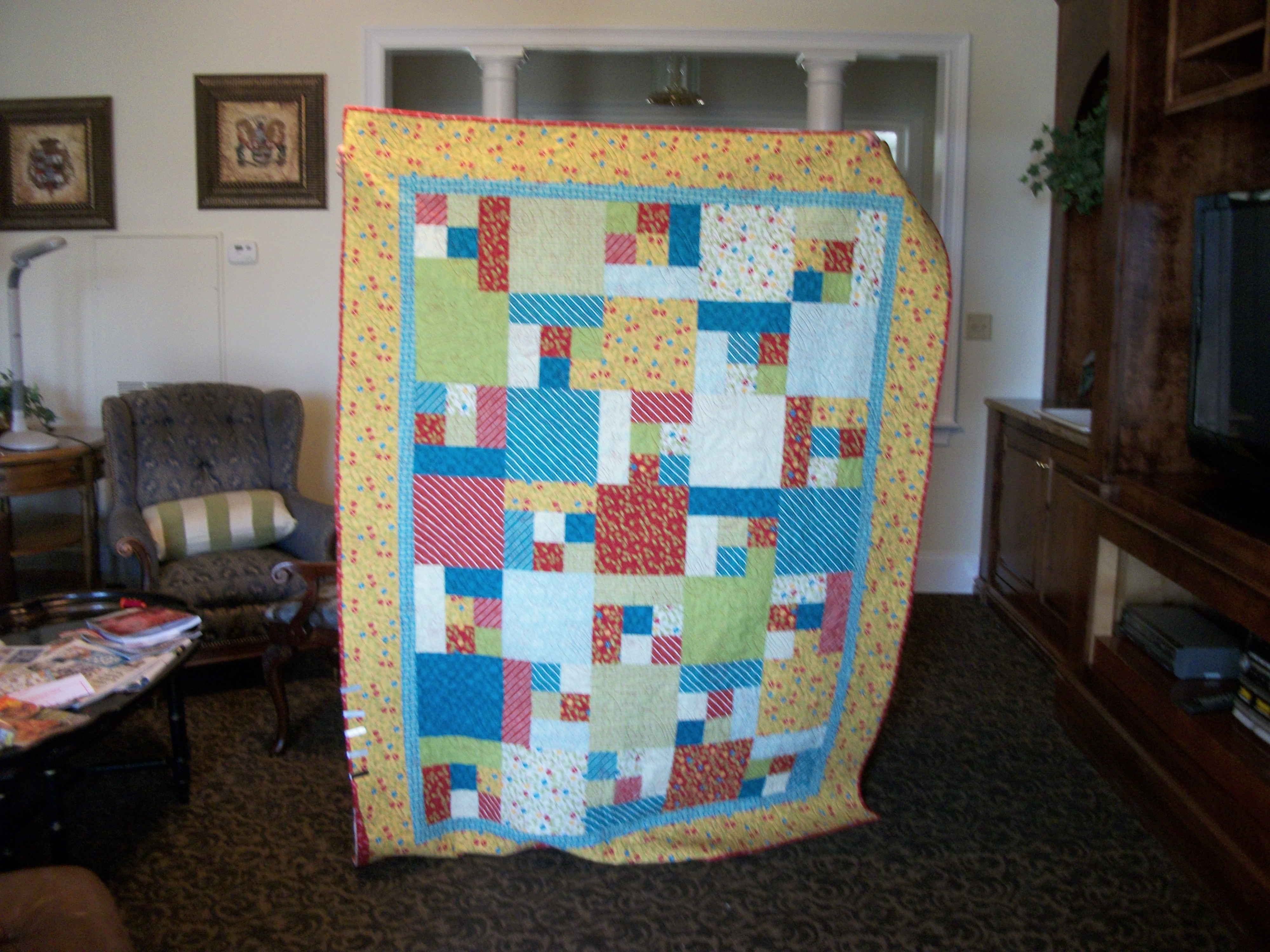
And, here’s a picture of a Christmas quilt with very unusual fabric that Rose was putting the binding on.  The back is a warm, red fabric. 

 Here’s my most favorite picture I took all week:

I miss them all already.   What a lovely week we had.

Turkey Tracks: Warm and Wonderful

Turkey Tracks:  March 13, 2011

Warm and Wonderful

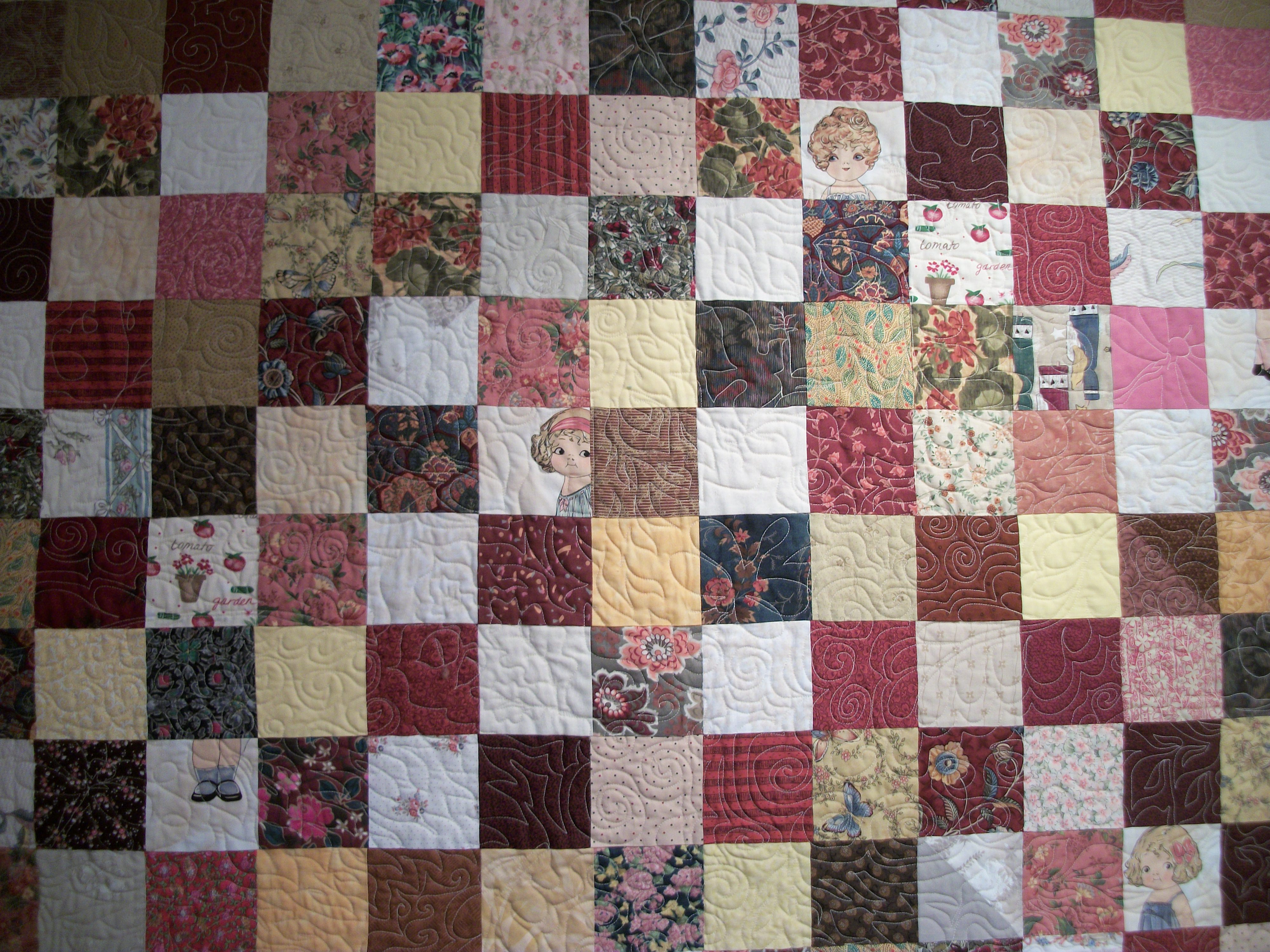
Here’s another scrappy quilt made wholly from my stash.  This one uses the 4-inch blocks, and can I tell you, I have at least enough bright ones left to make a whole other quilt! 

What I had fun with here is the placement of the paper doll blocks.  The first one was an accident; I was just using warm colored 4-inch squares roughly alternated with neutrals.  Linda McKinney passed through the quilt room one day and expressed delight with the faces and feet now scattered about the quilt.   So, I deliberately did more and placed them advantageously. 


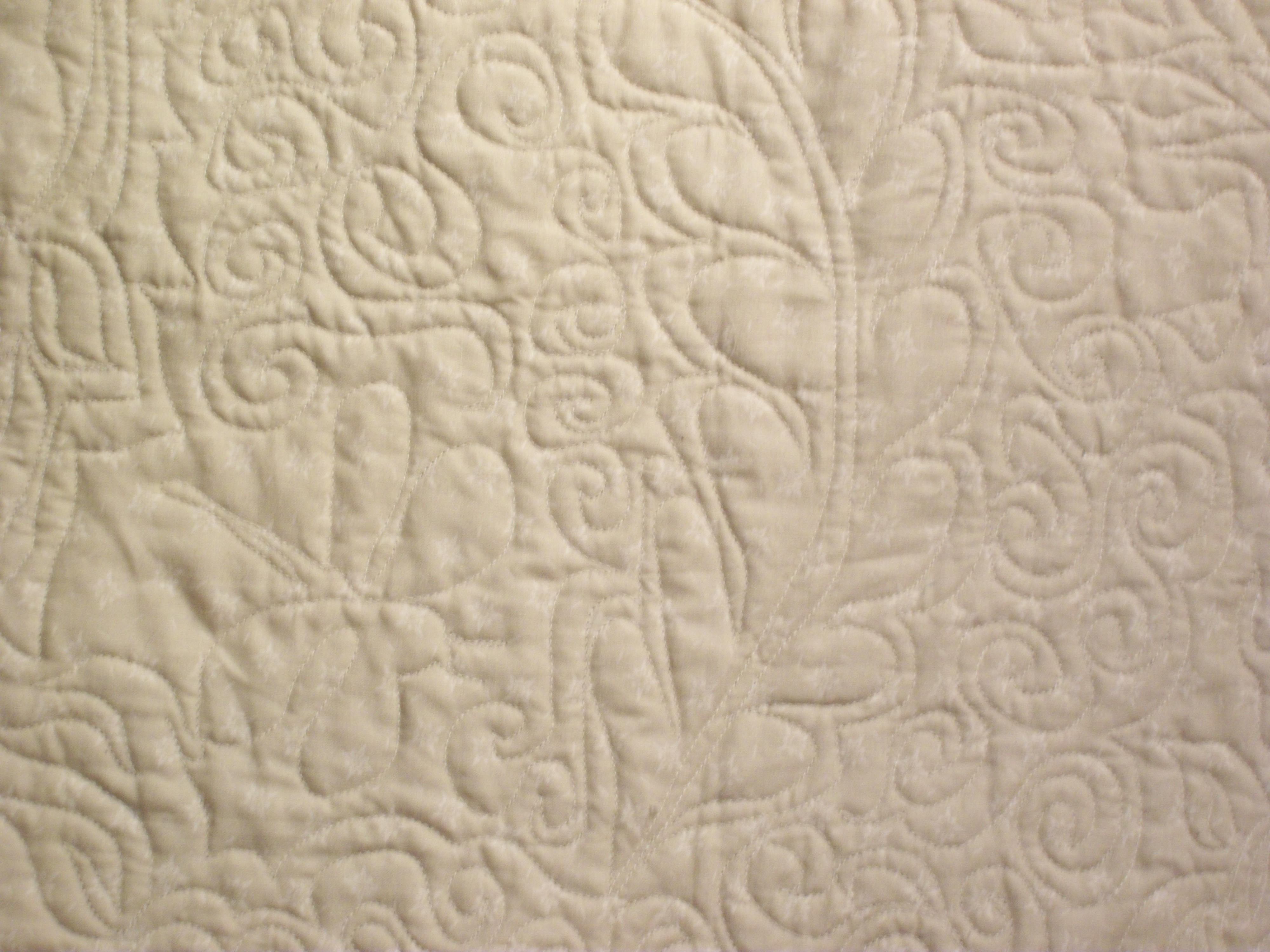
Here’s a close-up, so you can see some of the quilting.  I’ve learned to use stencils and pounce powder (or erasable chalk pencils) to trace in stencil lines and then to quilt them.  You can see a bird and a dragonfly, at least, in this picture.  And, I densely quilted.  This quilt is a lap size, about 56 x 72, and it took FOUR industrial-sized bobbins.  I used a commercial big-cone thread and had no problems with thread breakage.  Indeed, this is the first quilt I’ve done on Lucy with which I felt really at-ease.  

The backing is a warm beige that, it turned out, I had enough of to make the batting.   


Warm and Wonderful was made especially for someone special. 

Turkey Tracks: Spinner

Turkey Tracks:  March 13, 2011

Spinner

I’ve been on a mission to use up more of my stash fabrics.  After all, I loved them when I bought them.  And, it’s true that I still love most of them now.

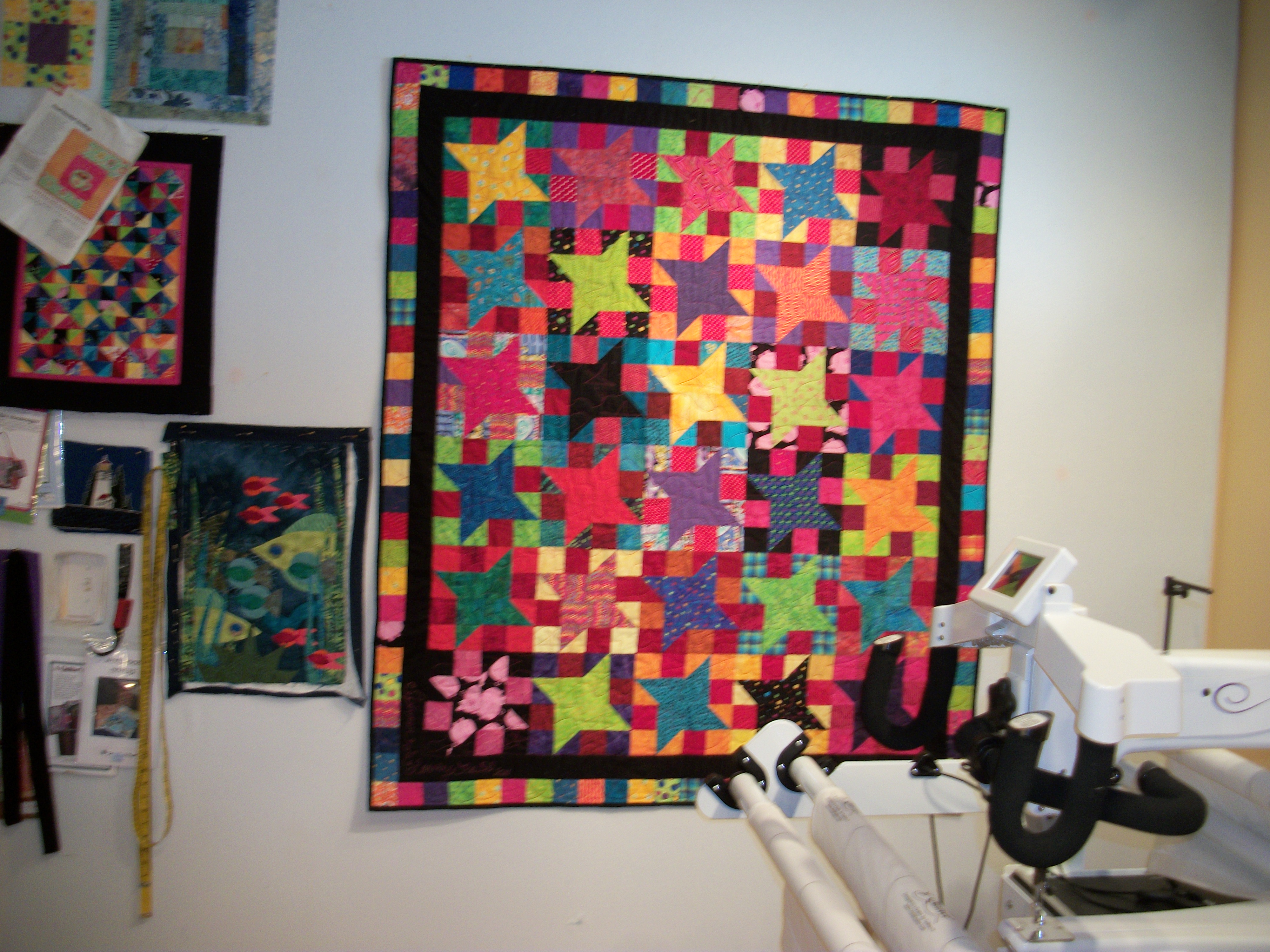
Whenever I finish a quilt, I cut small leftover pieces of fabric into the largest useable square I can, beginning with 6 inches and going down to 2 inches and 1 1/2 inch strips for log cabins.  Lately, though, especially after making this quilt, I’ve been cutting pieces into useable strips and not cutting further since this quilt needed a rectangle, not a square, so I had to cut those extra. 

The 8-inch “Spinner” block was designed by Bonnie Hunter and appeared in the March April 2010 (#132) issue of QUILTMAKER magazine.  Her idea is as you cut and sew other projects, you make a few of these blocks here and there, and soon, you’ll have enough for a quilt.  I found myself putting aside other projects and making all of these blocks uninterrupted.  They’re fairly addictive.     

What is helping control the quilt is the repeating red square within each block and across the quilt–a tactic Hunter recommends.  Here is a rather fuzzy picture since somehow very often I can’t seem to hold the camera still reliably.  But, note, also, the little quilt to the left, which was made from the small triangles that are cut off of Spinner’s large rectangle’s flip and sew method.  That small quilt is called “Essence,” since a friend who saw it on the design board said that it was the essence of the large quilt.  Essence is almost finished now, so will appear here soon no doubt.   


I quilted Spinner on Lucy the Long Arm, and I think it came out rather well.  I learned to use a round template on the outside borders.  I think I had old thread, however, and struggled with thread breaking a lot.  I got an additional thread spike that sits close to the take-up arm on the machine, so maybe that will help with the Mettler cottons I use for machine quilting on the domestic machine.   

 The pink pig backing, seen below, came when I realized Marge of Mainely Sewing in Nobleboro had some of this fabric left.  Remember that Karen Johnson,  The Community School student who learned to make a quilt with me last year, used it to back her quilt?  In fact, this quilt is very like Karen’s quilt, which probably shows how much I liked what she did.   You can see Karen’s quilt in the May 17, 2010, post called “Two Quilts.”  


Don’t know who it’s going to yet.

Turkey Tracks: Red Fish Quilt

Turkey Tracks:  March 13, 2011

Red Fish Quilt

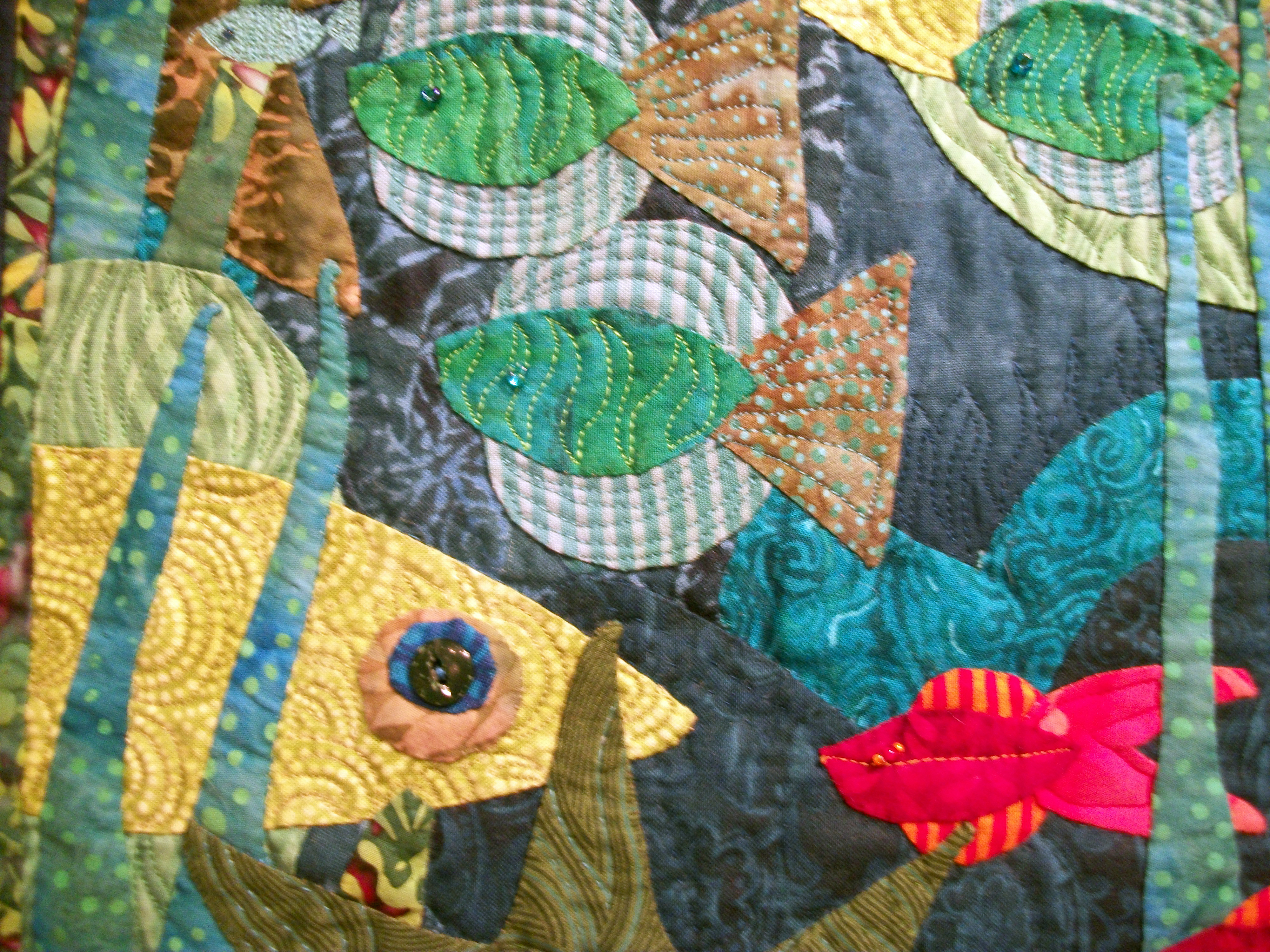
 I finished the Red Fish quilt.  I started it the summer of 2010 in a class with Jo Diggs at the Pine Tree Quilters’ Guild show. 

 Here it is:

 Each piece was hand appliqued onto the hand-dyed background fabric.  I hand quilted around each appliqued piece to make them stand out from the fabric.   I hand quilted the green fauna in the foreground bottom and the dark hillock at the bottom.  But, the hand quilting on applique shapes didn’t show up, and there were too many layers to do it easily.  So, as I machine piece well, I used that skill to get the final effects I wanted and to make the three thread painted little blue fish.   In retrospect, leaving the small fish’s fins and tails alone might have been a better choice…  I don’t think the quilt needs more beading than it has. 

There are more hours in this little quilt than I want to think about, and I’m glad it’s finished.  I have even more respect for Jo Diggs who makes BIG quilts using this method.  Take a moment and look at her gallery, and you’ll see what I mean:  http://www.jodiggs.com/jodiggs/Gallery.html.    

Here’s a very close-up view of a piece of the quilt. 

Turkey Tracks: Blowing My Nose in Style

Turkey Tracks:  March 13, 2011

Blowing My Nose in Style

On January 19, 2011, I wrote a post called “Cutting the Waste Stream and Detoxing the Kitchen.”  One of my issues of the past few years has been how to cut back on the amount of paper we use.  My use of paper towels, napkins, and, now that I think about it, toilet paper, seemed/seems excessive.  So, I’ve been searching for ways to cut back. 

Paper Towels:  I’m happy to report that our paper towel use is practically nonexistent.  So nonexistent that I can’t remember when I used one last.  Putting a bowl of cheap white (so I can see stains) wash cloths on the kitchen counter is working beautifully.  They can be used to where I would have once used paper towels.  (I do not use them to wipe out the cast iron skillet, but more on that in a minute.)  They can also be used inside a bag of lettuce or anything going into the refrigerator than needs a bit of drying.  I could also use them to drain bacon slices, though I’ve mostly just put the cooked slices on a plate.  Once cooled, they reabsorb the fat, and meat fat does not make you fat or hurt your heart, contrary to the low-fat ideology of the past 30-40 years.  As for cleaning the skillet, we pour off extra fat for the dogs and chickens, or for us sometimes, like saving bacon fat or using the glorious fat from a beef or lamb roast on toast the next day–all traditional practices lost over the past 40 years.  A swishing with hot water in the sink takes out the residue in the skillet, and drying the pan with a bit of heat preserves its all-important coating.

I also bought two washcloths for each of our bathrooms, put them under the sink, and use them to spot clean the bathroom.  (Our cleaning woman already uses rags and washcloths to clean the house–she brings them with her.)  That’s working well, too. 

All the washcloths just get thrown into the laundry every week.  If some are dirtier or greasier than others, they go into the pile of dish cloths, etc., that might need either a bit of clorox (winter) or line bleaching (summer). 

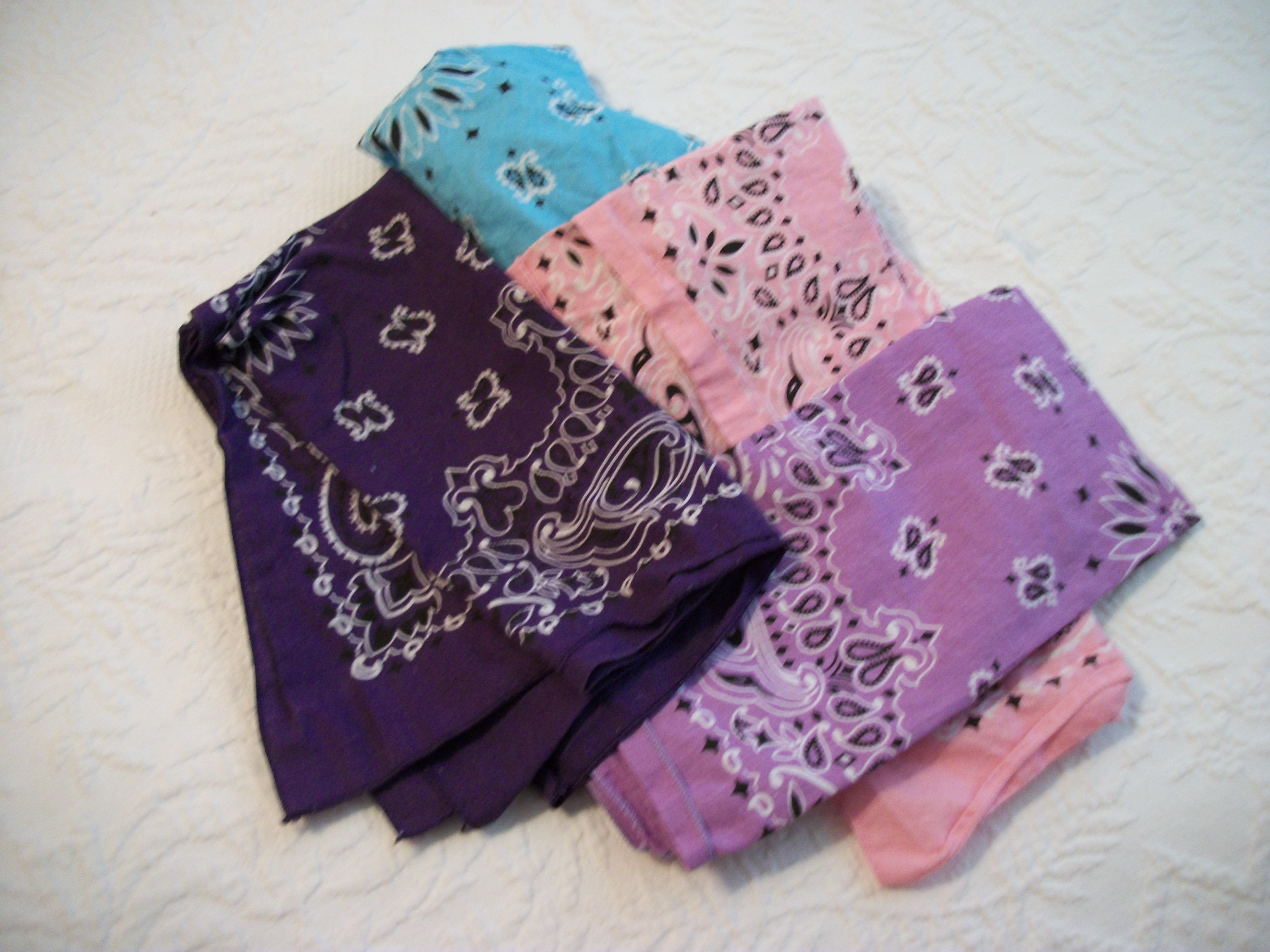
Paper Napkins:  We’ve been using our cloth napkins at the dinner table–and reusing them until they are demonstrably dirty.  Growing up, we did not wash cloth table napkins every day.  One had a set place at the table and reused one’s  napkin.  Not doing so saves on water, soap, and energy as well as NOT using paper napkins.  But, for me, who for most of my life has had a chronically runny nose (driven I now realize mostly by food allergies), paper napkins were needed as kleenex just wasn’t strong or thick enough.  So, one day this winter, we had lunch with old Tufts friends of  John’s, Jack and Barbara Moore, of the schooner Surprise, and Jack pulled out a BIG, sturdy, handkerchief from his pants pocket.  It was one of those colored bandanas like we now use to decorate the necks of dogs.  When I said “YES!” and explained my search, he told me he bought them at Reny’s (our local version of a mixed-bag kind of store) for under $2 each.  John and I went that same day and got some.  John got a manly navy blue, and I got these:


They were a little stiff at first, but are now, after several washings, soft as butter.  And, I love them!  They’re so much nicer than paper napkins, and they are so much bigger and sturdier than any of the white handkerchiefs I could find online.

Toilet Paper:   Well this issue is tougher, as Colin Beaven discovered when he started his “No Impact Man” blog and the press became obsessed with the family’s toilet habits.  (Beaven’s blog resulted in a book and a documentary.)  To backtrack, Colin, his wife, and their young daughter attempted to erase or to balance  their energy use footprint for one year, though they lived in New York City.  Toilet paper requires a lot of energy to produce, process in sewage, etc.   And, Beaven points out:  “More than half the world believes that washing their nether regions is far more hygienic than using toilet paper, a practice largely confined to our Western culture.”   I wasn’t surprised to read Beaven’s  information as a few years back, my book club had read Mohja Kahf’s THE GIRL IN THE TANGERINE SCARF:  A NOVEL, wherein the Muslim/American female protagonist does a whole riff on how Muslims view Americans as walking around with and sleeping with dirty nether regions.  Think about it. 

I tried, here at home, to wash rather than to wipe after reading Beaven’s book.  It’s not hard as long as you’re  next to the sink where you can put warm water into a container stored by the toilet.  It’s a bit awkward from lack of practice, of course.  And a container that pours is better than one that doesn’t.  It’s impossible in a public restroom or in someone else’s home.  You do need a container and a drying washcloth or towel–not items one carries around or that friends’ bathrooms supply.  In any case, it is MUCH cleaner, so the half of the world that washes rather than wipes is right about the cleanliness aspect of this issue.

Anyway, I’m pleased with how we’ve been able to curtail our paper use.  It’s a step in a needed direction, a step that refuses to be part of the extraction economy.  And a reminder that sometimes those who live in different cultures or who lived “back in the day” might have better practices than we do.        

Mainely Tipping Points 27: Sprouting Awareness, Growing Change

Mainely Tipping Points 27

SPROUTING AWARENESS:  GROWING CHANGE

 Up on Howe Hill, the paths around our house are banked by shoulder high snow.  Nevertheless, spring is coming.  Daylight is growing longer day by day and will bring an end to the quiet stillness of winter.  Sprouts will soon appear and will grow into a new covering for the earth and into new food for us to eat.  Babies will be born who will replace their parents eventually.  These seasonal cycles nourish the earth and its creatures endlessly. 

Sometimes, ideas that organize society, or paradigms, recede, like green life in winter. Now, the unsustainable market economy paradigm is breaking apart even as its proponents try to intensify their grip on it.  This paradigm is extractive, and we are running out of what can be extracted.  There are limits to what the earth can provide, and we have reached them.  There are only so many mountaintops that can be removed and dumped into valleys, only so many nutrients in the soil to be used before nature-dictated replenishment must occur, only so much oil and water to be pumped.

This exploitive paradigm is harming the earth and its creatures.  For instance, Greenpeace is circulating a petition claiming that this year one American will die every minute from cancer created by the known toxic chemicals allowed in so many of the products and foods we use or eat every day  (https://secure3.convio.net/gpeace/site/Advocacy?cmd=display&page=UserAction&id=787&s_src=taf&JServSessionIdr004=i4hx4u4rh1.app331a).  The President’s Cancer Panel released in April 2010 said 41 percent of people would be diagnosed with cancer in their lifetimes, that children are especially at risk, and that our degraded environment is a key factor (http://deainfo.nci.nih.gov/advisory/pcp/annualReports/index.htm).  Wiki answers says 50 percent of us will get cancer in our lifetime (http://wiki.answers.com/Q/How_many_people_get_cancer_in_their_lifetime).  And, Sandra Steingraber, in LIVING DOWNSTREAM, published in 1997, or 14 years ago, explained that the incidence of cancer in the United States rose 49.3 percent between 1950 and 1991 and that cancer was the leading cause of death for Americans aged thirty-five to sixty-four (40).  Cancer striking between 40 and 50 percent of the population can only be called an epidemic. 

But, what new paradigm could emerge?  We could take part in the sprouting of something wonderfully sustainable, if we, first, sprout awareness of this moment, and, then, act positively out of that awareness.  We could, as a community, become part of growing an Associative Economy paradigm based on 21st Century agrarian values that build and sustain healthy land, healthy community, a healthy economy, and healthy people.  Cooperation, not competition, is a hallmark of this new paradigm. 

Steven McFadden’s THE CALL OF THE LAND:  An Agrarian Primer for the 21st Century is a “sourcebook exploring positive pathways for food security, economic stability, environmental repair, and cultural renewal.”  McFadden lists and describes many of the individuals, organizations, and communities who are implementing models of how to live sustainably.  It’s comforting to realize that there are so many people “out there” who are working hard to make this new paradigm fully emerge.      

People are becoming Locavores, who buy food grown close to their homes; are turning their grass into vegetable gardens; are forming neighborhood cooperatives to share garden produce; are saving seeds; and are forming organizations to create change.  Communities across America are working to build regionally based, self-reliant food economies that include urban gardens, both public and private; Community Shared Agriculture (CSA) programs, including those which “share” products from multiple producers; food cooperatives, some of which are organized by farmers; school gardens and wholesome school lunch programs; land trusts that put willing young people on farms; and community commercial kitchens.  Counties across the country are creating self-reliant food systems within their borders; many of these are all organic.  In Maine, our regional coops and our small stores carrying local, often organic foods are, already, important hubs for this new paradigm as they are generating a local associative economy where farmers and consumers can meet daily on a common terrain.

McFadden, like Will Allen in THE WAR ON BUGS, addresses the justification myth created within the post World War II liaison of academia and agricultural and chemical corporations in order to foster industrial farming methods.  Termed the “green revolution,” this myth promised that it could feed the world and argued that small organic farms could not.  McFadden writes:  “But that argument has been proven wrong.  Nearly half the world’s food already comes from low-input farms of about one hectare (2.5 acres).  That scale can be worked efficiently and wisely, then progressively networked with modern technology.  Acre for acre, small, organic farms use less energy, create less pollution, offer more satisfying work, and produce more clean food from the land” (72).  McFadden notes that Iowa State University has established the nation’s first tenured organic agriculture faculty position and that some of the land grant schools are establishing sustainable agriculture programs (88).   

Paradigm change can begin with the choices we each make about what we eat.  Each choice we make is a vote.  We can vote for members of our own community, for access to clean food filled with nutrients, and for building community resilience that will support us in the, likely, difficult future we face.  Or, we can vote so that our dollars leave our community and enrich a few, already deep pockets.  We can vote for industrial food that is lacking nutrients, is grown with toxic chemicals, and that is tired and old from the polluting practice of being shipped across the country or across the world.  We are voting, then, for a splintered community where individuals have not built fully realized relationships with each other. 

Shannon Hayes, in RADICAL HOMEMAKERS, charts the historical progression that moved households from being centers of production standing alongside other such centers to being isolated units of consumption.  She discusses her family’s decision to not only question received cultural knowledge about how “to be” in the extractive economy, but to make changes that freed her family and gave it a more fully lived life—one with values strongly rooted in the health of the land.  She writes:  “What is our economy for?  Isn’t it supposed to serve everyone?  Are our families truly served by an economy where employees are overworked, where families do not have time to eat meals together, an economy that relentlessly gnaws at our dwindling ecological resources?  In David Korten’s words, a true, living economy `should be about making a living for everyone, rather than making a killing for a few lucky winners’“ (37).  (David Korten published AGENDA FOR A NEW ECONOMY in 2010 which is in my “to read” pile.) 

Shannon addresses the myth of local, organic food being unaffordable for any but the rich:  “…a farmers’ market meal made of roasted local pasture-raised chicken, baked potatoes and steamed broccoli cost less than four meals at Burger King, even when two of the meals came off the kiddie menu.  The Burger King meal had negligible nutritional value and was damaging to our health and planet.  The farmers’ market menu cost less, healed the earth, helped the local economy, was a source of bountiful nutrients for a family of four, and would leave ample leftovers for both a chicken salad and a rich chicken stock, which could then be the base for a wonderful soup.” (12).

McFadden, too, addresses this myth by quoting the legendary Vandana Shiva, physicist, environmental activist, and author:  “`The most important issue is to break the myth that safe, ecological, local, is a luxury only the rich can afford.  The planet cannot afford the additional burden of more carbon dioxide, more nitrogen oxide, more toxins in our food.  Our farmers cannot afford the economic burden of these useless toxic chemicals.  And our bodies cannot afford the bombardment of these chemicals anymore.’” (74)

Shannon makes a strong plea for restoring our lost democracy:  “When women and men choose to center their lives on their homes, creating strong family units and living in a way that honors our natural resources and local communities, they are doing more than dismantling the extractive economy and taking power away from the corporate plutocrats.  They are laying the foundation to re-democratize our society and heal our planet.  They are rebuilding the life-serving economy” (58). 

If you want to help build a sustainable, life-giving paradigm rooted in your local area, start with food.  First, insist on and buy local, organic food.  Consider joining a local CSA; shop at a local farmers’ market and at local stores carrying local food.  Second, begin asking for what you don’t find.  For me, it’s more local winter greens, please.  And, more winter farmers’ markets.  Third, buy foods in their seasons and learn to cook and to preserve some of them for the coming winter.  (Few things are as delicious in winter as tomato sauce spiked with garlic and basil, all taken from the garden on a hot August afternoon and cooked down in a bit of olive oil and frozen.)  Finally, every day, sit down and, together, eat the tasty, nourishing, clean food you have prepared.

Turkey Tracks: Alewives Visits Camden Quilters

Turkey Tracks:  February 17, 2011

Alewives Visits Camden Quilters

Rhea Butler and her mother, Barbara Neeson, came from Alewives quilt shop in Damariscotta Mills, (http://www.alewivesfabrics.com) for our February 12th meeting.  Barbara owns Alewives, and Rhea is the resident quilt artist and designer. 


 Rhea’s on the left, Barbara is in the middle, and CQ member Barb Melchiskey is on the right. 

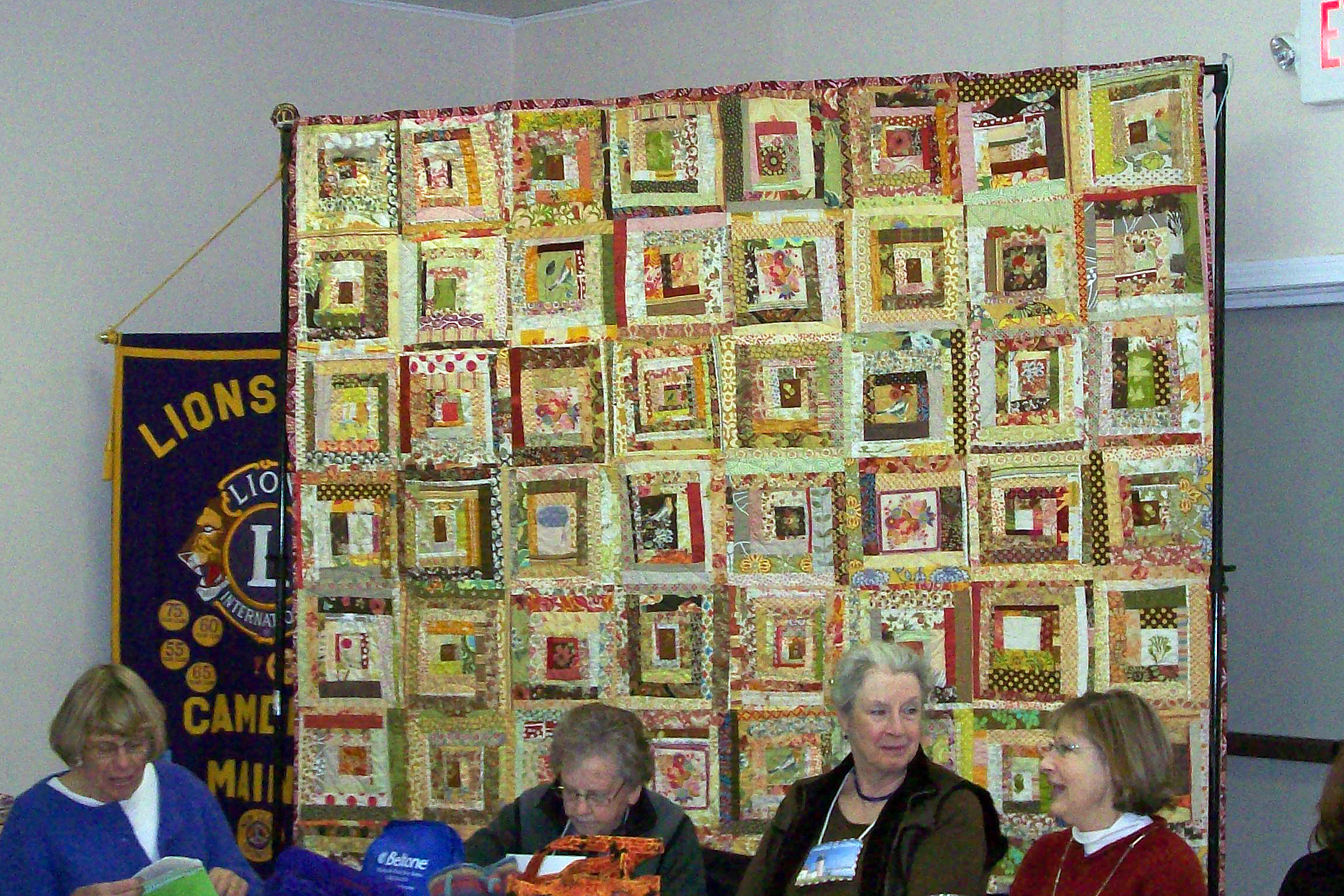
 Rhea taught us how to make her copyrighted “La La Log Cabin” block and quilt, which derives from a long history of improvisational quilting—which, for Rhea, includes such quilting as that of the Gee Bend quilters and Denise Schmidt of Bridgeport, CT.  This pattern is meant to be made from your stash fabrics, though you could certainly buy new fabrics as well.  Above, you see a soft blue/green version.

 Rhea loves color and starts her blocks with an overall sense of how she wants the finished quilt to look.  She wanted the big quilt she brought to demonstrate her La La Block to “glow,” and it did.  See?


Barb Melchiskey, Sylvia Lundevall, Eleanor Greenwood, and Patty Courtney.

Rhea used neutrals and added bits of red and green.  She tries to put interesting, clever, or meaningful fabrics into the center of her blocks.  She also loves to mix textures and to employ whimsical bits of cloth, such as the little colored dots on the edges of fabric selvages.  And she tears fabric into strips and roughly cuts centers with just sissors, which helps to give her blocks an interesting “off-center,” funky look.  Rhea used three harmonious fabrics in shades of yellow/gold for the backing, layered in from side to side in big swaths.  

 Rhea provided us with a free pattern for her block/quilt, which is typical of her and Barbara’s generosity.  We had a wonderful meeting with her, and I suspect many of our members will produce  La La Cabin quilts.  I know I will as I’m on a mission to use up more of my stash and will definitely make one.

 Rhea also keeps a lively, interesting blog:  http://alewivesgirl.blogspot.com.

Mainely Tipping Points 26: Strawberries in Winter

Mainely Tipping Points 26:  Strawberries in Winter

STRAWBERRIES IN WINTER

 It’s February, and in Maine, it’s bitter cold more often than not. We seek out heat and the warmth of the fiery color red.  Not surprisingly, along comes St. Valentine’s Day on the 14th—a day set by Pope Gelasius I in 496 AD to honor the martyred Roman Valentine, killed in 269 AD.  This once-Christian holiday was likely overlaid onto a Roman mid-February pagan fertility celebration marking the beginning of spring and of the year’s agricultural calendar.  The associative color red possibly derived from the use of sacrificial blood during the festivities.   

Many of us are longing for spring, and in these mid-February days, along come red, luscious looking strawberries.  These early heralds of “come spring” fruit are shipped to us here in the frozen north mostly from California, which grows “roughly 90 percent of all strawberries sold in the United States” (“Death by Strawberries,” change.org weekly, Nov. 29-December 6, 2010, http://www.askdepkewellness.com/2010/12/death-by-strawberries.html). 

The idea of chocolate-covered strawberries makes your mouth water, doesn’t it?  They’re the ultimate dessert for lovers in February.  But, before you eat them or feed them to your loved ones, consider some cautions.

First, industrially raised strawberries come to you drenched with toxic chemical residues.  Second, the Environmental Working Group (EWG) notes in its “dirty dozen” handout that rinsing “reduces but does not eliminate pesticides” (http://static.foodnews.org/pdf/EWG-shoppers-guide.pdf).  And, third, the 2008-2009 Annual Report of the ,President’s Cancer Panel links exposure to pesticides (including insecticides, herbicides, and fungicides) and fertilizers with the formation of cancer in humans.  The report notes that parental exposure to pesticides can impact children prior to conception, in utero, and during childhood (43). 

Strawberries are ranked third on the EWG’s 2010 Dirty Dozen list, which is formed after residue testing is completed by the U.S. Department of Agriculture (USDA) and the Food and Drug Administration (FDA).  EWG’s rankings reflect at least six factors, including the total amount of pesticide residues found  and the total amount of different pesticides used. 

Will Allen, in THE WAR ON BUGS (2008), notes that between 2000 and 2005, 97.3 percent of nectarines had pesticide residues, followed by 96.6 percent of peaches and 93.6 percent of apples.  Strawberries ranked fourth.  Peaches and apples, writes Allen, had up to 9 pesticides on a single fruit, and strawberries had up to 8 pesticides on single berries.  Apples had the most residues of all with up to 50 pesticides found on samples.  Strawberries had up to 38 pesticides (242). 

Allen also cautions that very few states have mandatory pesticide use reporting, so there is massive underreporting of the amount of pesticides on our food.  Because California does have a reporting requirement, Allen was able to determine that in 2004, California strawberry growers used just over 11 million pounds of pesticides on an estimated 33,200 acres, or 335.40 pounds per acre (243-244).

In 2004, notes Allen, strawberry growers in California used 184 different pesticides.  But, 80.6 percent of these pesticides were confined to six chemicals.  Four of these six chemicals accounted for 74.1 percent of use and are fumigants “designed to kill all soil life and are among the most dangerous pesticides.”  These four fumigants amounted to about 249 pounds per acre of use. 

Among these four fumigants is methyl bromide, or bromomethane, which was banned in 1987 by the Montreal Protocol because it depletes the ozone layer around earth.  In total, 196 states have ratified this international treaty; President Reagan signed it in 1987.

Yet, twenty-four years later, our government is still allowing strawberry growers, principally in California and Florida, to use methyl bromide under “critical use” exemptions.   According to Wikipedia, in 2004, over 7 million pounds of bromomethane were applied in California on tomatoes and strawberries, in ornamental shrub nurseries, and for the fumigation of ham/pork products” (http://en.wikipedia.org/wiki/Bromomethane).  The EPA is now accepting 2011 applications for 15 crops, to include “tomatoes, strawberries, peppers, cucurbits, orchard replants, and post-harvest uses (http://www.epa.gov/ozone/mbr/2010_nomination.html). 

According to the EPA, methyl bromide is “highly toxic,” especially for application workers.  Further, the EPA acknowledges that breathing it damages the lungs.  And, once inside the body, it can have a devastating neurological impact and can impact the thyroid and the male testes, which affects reproduction.  And guess what?  Though methyl bromide has been used agriculturally since the 1930s and though it has always been recognized as being highly toxic, the EPA doesn’t know whether or not it causes cancer (http://www.epa.gov/ttnatw01/hlthef/methylbr.html). 

Indeed, the President’s Cancer Panel notes that “approximately 40 chemicals classified by the International Agency for Research on Cancer (IARC) as known, probably, or possible human carcinogens, are used in EPA-registered pesticides now on the market” (45). 

Allen notes the following:  “Methyl bromide…causes mutations, tumors, and monstrous birth defects.  It is incredibly lethal in very small doses:  consequently very few of its victims survive.  Unlike the case for many other chemicals, pest resistance to methyl bromide has been low, with only a dozen or so organisms that have shown any tolerance to it after almost seventy years of continuous exposure.  This lack of resistance is clearly due to the fact that the chemical kills almost all of the members of a population and leaves few if any resistant survivors” (234). 

Allen demonstrates in THE WAR ON BUGS how the chemical industry replaces a discredited chemical with a new, largely untested chemical.  The EPA approved the fumigant methyl iodide, or iodomethane, in 2007 at 193 parts per billion (ppb).  At the time, fifty-four academic scientists and physicians, among them six Nobel laureates, wrote the EPA and asked for the chemical to be banned ((Jill U. Adams, “A Closer Look:  Pesticides in strawberry fields,” June 28, 2010, The Los Angeles Times, http://articles.latimes.com/2010/jun/28/health/la-he-closer-strawberries-pesticide-20100628; and “Death by Strawberries”).    

On December 20, 2010, the California Department of Pesticide Regulation (DPR) approved methyl iodide for use in strawberry fields, despite the fact that the eight-person independent scientific review panel the DPR appointed to review the chemical declared that it is highly toxic, that its use would expose large numbers of the public, and that it would be difficult to control” (Pesticide Action Network Action Alert, “Because PR can’t trump science, if you speak up,”   http://groups.yahoo.com/group/DeathofCommonSense/message/1351).  Additionally, methyl iodide is listed under California’s Proposition 65 as a carcinogen ((Julie Cart, “Farmworkers challenge approval of methyl iodide on strawberry fields,” The Los Angeles Times, January 3, 2011, http://latimesblogs.latimes.com/greenspace/2010/11/methyl-iodide-pesticide-cancer-california.html?cid=6a00d8341c630a53ef013489abc225970c).  The panel noted that methyl iodide can alter DNA and can contaminate groundwater.  And, the panel cautioned that the lack of research on the chemical should give the DPR pause and that tests on animals link methyl iodide to miscarriages, cognitive impairment and thyroid toxicity (Cart).   

The California DPR mandated 96 ppb, which is more than either the risk assessment scientists within the DPR or the panel recommended.  The DPR scientists settled on 0.8 ppb, and panel member Edward Loechler, a molecular biologist at Brandeis University in Boston, said “we all thought, if anything, it should be lower.”  Panel member Dr. Paul Blanc, head of the occupational and environmental medicine division at UC San Francisco said, “that’s not policy—that’s meddling with the science” (Adams). 

Adams noted that Susan Kegley, who consults for The Pesticide Action Network (PAN), pointed to a study released in June about the air in Sisquoc, California.  Levels of chloropicrine, a soil fumigant, were higher than either the EPA or the California DPR consider safe.  (Treated fields are covered immediately with tarps.) Kegley noted that the same thing could happen with methyl iodide. 

Shortly after the California DPR’s ruling, a group of environmental and community health organizations, representing agricultural workers, challenged the ruling in court on the grounds that it violates, among other laws, the California Environmental Quality Act, the California Birth Defects Prevention Act, and the Pesticide Contamination Prevention Act (Cart).

Strawberries, like all industrial monocrop cultures, are grown in sterile, toxic soil; are lacking nutrients; and will continue to require increasingly heavier toxic chemical loads. It is becoming abundantly clear that commerce has corrupted science and our regulatory mechanisms so that permitted chemical levels are harming humans—which is why the President’s Cancer Panel Report recommends reducing exposure to pesticides by choosing “food grown without pesticides or chemical fertilizers.”

Our own, local, organic strawberries, available in June and for most of the summer, seem more than worth the wait.