Interesting Information: Time’s June 12th Cover, “Eat Butter”

Interesting Information:  July 2014

“Don’t Blame Fat” by Bryan Walsh


Yes, Yes, Yes!

Bryan Walsh’s article on how eating good fats is NOT DANGEROUS appeared in the June 12th TIME magazine.

“Note that “Good” fats are not just any fats–they are saturated animal fats from animals raised in holistic environments where they eat what they are supposed to eat and unprocessed olive and coconut oil.  They are NOT HIGHLY PROCESSED VEGETABLE OR NUT OILS.  Think, especially, of butter, tallow, lard, duck fat, chicken fat, eggs from free-range chickens who are NOT fed soy, raw milk and raw milk products like yogurt, coconut oil, olive oil, organic avocado, and organic nuts and seeds that have been soaked in salt water and dried.

Time Cover, Butter – Google Search.

Friend Judith Valentine–a PhD nutritionist who trained in part under Dr. Mary Enig of The Weston A. Price Foundation (judithvalentine.com), saved the article for me.

What a joy it was to read.

The work of many of the people I’ve written about here on this blog was acknowledged–like Gary Taubes.  And Michael Pollen.  And the Duke Obesity Clinic docs.

Ancel Keyes, the father of the low-fat movement, was properly debunked.

The role of politics was traced.

The fact that it’s really difficult to get reputable science published if it “goes against the momentary grain” of BELIEF was demonstrated.

EAT REAL FOOD and OCCUPY YOUR KITCHEN!

Thank you TIME and Bryan Walsh.


Visit your library and read the article.


Books, Documentaries, Reviews: David Perlmutter, MD, with Kristin Loberg: Grain Brain

Books, Documentaries, Reviews:  May 15, 2014

Sylvia Onusic’s Review

of

David Perlmutter, MD, with Kristin Loberg

Grain Brain


First, Dr. Sylvia Onusic is a Board Certified and licensed nutritionist AND has a PhD in Public Health education.

Dr. Onusic reviewed Perlmutter and Loberg’s book Grain Brain in the Winter 2013 Wise Traditions, the journal of the Weston A. Price Foundation:  Grain Brain – Weston A Price Foundation.

Dr. Onusic gives the book a qualified “thumbs up,” and in the review surfaces the problems she finds within its pages–such as not addressing “the importance and role of healthy carbohydrates in the diet, especially those prepared in ways which enhance their nutrient absorption by soaking and fermenting.”  Or, addressing that “old forms of wheat such as spelt and kamut do not contain the high levels of gluten that modern hybrids do” and that fermenting grains can make them acceptable to those with gluten sensitivities.  Or, the importance of raw milk and its products.  Or, that he claims that DHA (docosahexaenoic acid) made from algae is a “source equal in value to cod liver oil.”  But DHA from algae is man-made, while cod liver oil is a natural source of DHA.  Additionally, algae DHA has a record of causing digestive upsets.  ANd he neglects to explain that while vitamin D is important, it needs to be used with vitamins A and K, as “all three are needed together.  (Cod liver oil contains all three.)

I was intrigued with the discussion of specific foods that “cross-react” with gluten (producing the same reaction).  They include coffee, chocolate, and non-gluten containing grains.  PEG, polyethylene glycol, found in many personal care products is also cross-reactive with gluten.  PEG is found in the gallon of bowel prep used for a colonoscopy and can cause “inflammation which shows up in the test results.”

Also interesting:  “Modern foods contain up to forty times more gluten than traditional grains, and modern gluten can be addictive.”

But, she also says the following:

Grain Brain is a good read packed with a great deal of knowledge related to reviews of the latest research in current nutrient brain-related issues, as well as good detail on gluten sensitivity, celiac disease, testing, cholesterol and fats, and hormones related to inflammation and obesity.  The book continues to enjoy phenomenal success on a number of New York Times best seller lists.

Caesareans and Breast Feeding and food sensitivities:

Research shows that babies born through caesarean section have a higher risk of developing ADHD because they miss out on the probiotic inoculation that babies normally receive when passing through the birth canal.  Breastfeeding is also important in that it may dampen later immune response to gluten and the development of food sensitivities.

Gluten sensitivity can be tested for at Cyrex Labs or Entero Labs.  (I used Entero.)


Turkey Tracks: The Traditional Food Movement Defined

Turkey Tracks:  May

The Traditional Food Movement Defined


Here’s another quote from Jennifer McGruther in her new cookbook, The Nourished Kitchen:

IMG_0255


A Traditional Foods Movement:

Traditional foods are the foods of our great-great grandmothers–the foods of gardens and of farms.  They represent a system of balance, emphasizing the value of meat and milk, grain and bean, vegetables and fruits.

There is a movement afoot to restore this way of eating The movement honors the connection between the foods that we eat, how we prepare these foods, and where they come from.  In this way, the traditional foods movement celebrates the connection between the farm that produces the food, the cook who prepares it, and the individuals who eat it.  Traditional foods is a system of connection, emphasizing support for time-honored ways in farming, cooking, and eating, and finding a place for fat and lean, animal and vegetable, raw and cooked.

Where other diets and philosophies of eating emphasize good and bad, black and white, a message of balance exists within the traditional foods movement.  Unlike vegan and vegetarian diets, which restrict animal foods, the traditional foods movement emphasizes their importance while encouraging the purchase of locally produced meats, milks, cheeses, and fats from grass-fed and pasture-raised animals.  Where the Paleo diet restricts grain, pulses, and dairy, the traditional foods movement embraces them, focusing not only on how the food is produced, but also on how it is prepared to maximize the nutrients it contains.  While the raw foods movement restricts cooked foods, the traditional foods movement embraces the, honoring the place of cooking as one of balance in partnership with raw foods, and fermented foods, too.

Emphasizing whole and minimally processed foods, the traditional foods movement calls you back to the kitchen, to real home cooking, and offers you an opportunity to weave the connections between the food on your table, the time you take to prepare it, and the farms that produce it (1-2)

AND:

Join a CSA.  Hold a community supper featuring wholesome, local foods.  Celebrate the beauty of your foodshed, and support local farmers practicing sustainable agriculture.  Support nutritional advocacy groups like the Weston A. Price Foundation and the Savory Institute, as well as the work of farmer and consumer rights organizations like the Farm-to-Consumer Legal Defense Fund (5)

I am old enough that I can tell you that the generation referenced here is not my great, great, but my grandparents.  I remember these food practices well, especially from my rural Georgia grandparents, as well as the fact that few were sick, cancer and heart disease were rare, and food allergies were not rampant like today.  Both my grandmothers lived long, fruitful lives.  They ate traditional foods.


IMG_0259

Interesting Information: Adequate Fat-soluble Vitamins (A, D, and K) Intake Is A Challenge Today

Interesting Information:  May 2, 2014

Adequate Fat-Soluble Vitamins (A, D, and K) Intake Is A Challenge Today


Here’s a sidebar entitled “The Challenge” from the Winter 2013 issue of the journal of The Weston A. Price Foundation’s journal, Wise Traditions (39):


Weston Price found that indigenous people consumed over 12,000 IU of fat-soluble vitamin A and over 1500 MG calcium in their diets on a daily basis.  In our experience these are amongst the most difficult elements to get enough of in an industrial diet, as well as in a non-industrial whole foods diet.

Some groups of people he studied ate little or no meat, but large quantities of raw or fermented milk and cream; others ate beans and grain and small amounts of animal products, including insects and dried shrimp and fish.

But no matter what the particulars of the diet, all had high levels of the fat-soluble vitamins A, D and K, as well as calcium.  Obtaining these from either the industrial diet or a small garden is the challenge of the modern age.

Food for thought…


Interesting Information: Thinking About Ancient Grains

Interesting Information:  May 1, 2014

Ancient Grains


I love grains.

Who doesn’t?

But I try not to eat very many of them because they cause all kinds of trouble–indigestion, stomach aches, creaky joints, and terrible diarrhea.  Clearly they were part of what went wrong with my system that caused me to start having allergic reactions to foods so that I was passing out in a split second whenever I encountered something my body decided was poison.  Clearly grains were a part of the “leaky gut” problem so prevalent in America today.

A few years back,  I had Entero Labs do a full fecal testing for gluten intolerance and genetic gluten issues.  I have a double copy of a “gluten intolerant” gene–which means that BOTH of my parents had it.  And, indeed, my dad died with dementia, probably caused by malabsorption issues–particularly of the B vitamins which are instrumental in mental health.

This genetic factor also means that ALL of my siblings have this gene.  One of my sisters had herself blood tested at a local hospital (which can often throw false negatives and depends on how the doctor orders what to be tested)–and she did show a gluten allergy.

She misses grains, too.

As noted on this blog before, grains are as addictive as crack cocaine (that’s only partly meant to be funny).  And my sister and I both slip in and out of eating “just a tiny bit” of grains.  She does not touch gluten.  I sometimes try.  But, the problem with gluten intolerance is that only the tiniest bit can cause inflammation and pain and digestive troubles once more.  And the other problem is that substituting other grains is not a great strategy either–as none of these grains is likely properly prepared.  Many are highly processed and useless in terms of nutrients.

So, with that in mind, I have to say I did enjoy Natalia Adarova’s  very interesting article in the Winter 2013 journal of The Weston A. Price Foundation, Wise Traditions:  “Northern Roots of the Ancient Grains” (32-36).

Adarova begins by discussing the ancient roots of humans’ consumption of grains in Russia/Eastern Europe and how powerfully represented the growing, harvesting, and cooking of grains figured in the local cultures.  For instance, Adarova notes that while  the commonly accepted dates for grain consumption by humans was 10,000 years agom evidence at the Kostenka paleolithic camp shows that “grains were already used in a very sophisticated manner some seventy thousand years ago as it is thought that Kostenka camp belongs to that period.”  But human consumption of grains predates even this particular camp:  “In fact, grains have probably been foraged since the dawn of Eurasian man, thought to appear three hundred to four hundred thousand years ago on the Eastern European plain–which interestingly coincides with the warmest interglacial period in the history of Earth” (33).

So, why are so many people–including me–having so much trouble with grains today?

I know already–and have written about these issues on this blog–that modern grain has been hybridized so that it contains new ingredients that mankind has not eaten before the early 1950s.  And, I know, too, from the work of Luise Light, which I have also written about here on this blog, that as a culture we eat way, way, way too many grains every day.  (Light’s panel of scientists recommend 2 to 3 servings, with 2 servings for women and 3 for very big men, and a serving being 1/2 cup, which translates to ONE piece of toast.)

But Adarova surfaces additional reasons why “modern” bread is a problem:

Modern bread sold at the stores can hardly be called “bread” at all.  A quickly risen product of the instant gratification age, made from genetically altered grains in order to yield higher and faster crops, grown in poor soils, stripped of any nutrients and full of harmful additives, is a far cry from the food that nurtured thousands of generations.

Ancient peoples fermented grains to remove phytic acid–which grains used to avoid being eaten and which prevent proper absorption of nutrients in humans:

Preparation of traditional Russian sourdough bread was a complicated art and science.  Dough had to be fermented only in oak barrels using a triple leavening process.  The dough was considered a living substance, almost a creature, hence during the leavening and baking it was prohibited to curse or act aggressively–an action thought to negatively affect the rising process.

Fermenting and sprouting both increase the nutrient load in the grain–and these ancient peoples used both methods.

And here’s new information I had not really considered before:  our modern diet of processed food does not properly feed our gut flora and fauna–which makes it really hard to digest bread/grains:

“An apple a day” is the new health recommendation picked up by the Russians, who in ancient ties normally reserved apples for cattle and horses in the bad harvest years; the older recommendation was “a glass of kefir a day.”  Besides genetics, which is an architectural blueprint, the second most important thing we inherit is our parents’ shared microflora.

Since ancient times Slavic people considered the abdomen as the epicenter of the mystery of life.  the word “abdomen” and “life” are synonyms in the Russian language.

Ancient Slavs knew that gut flora can either be your friend or your foe.  They knew that flora could be transferred and could quickly turn pathogenic if handled incorrectly.  Kissing strangers was prohibited and has never been used as a greeting.

Adarova notes that the “old rules” mandated that one eat animal fat with grains:  ” `You can not spoil kasha with too much gutter’ is an old Russian saying, hinting at the importance of this ingredient in grain consumption.  Russian sourdough was always consumed with a thick lalyer of butter, a widespread tradition in other parts of Europe as well.  Animal fats lubricate the gut protecting it from fiber damage while maximizing the absorption of fat-soluble nutrients” (36).

Finally Adarova points to the detoxifying effect of consuming clay and notes that a number of European bread recipes (Italy, Sweden) call for the addition of clay.  Apparently, ancient grain storage involved clay-lined and clay-sealed pits that kept grains viable for a hundred years.

Here’s the url if you want to read the whole of this very interesting article:   http://www.westonaprice.org/traditional-diets/northern-roots-of-the-ancient-grains


PS:  The nightly “news” I watched last night–to see our local weather–contained a story about how doctors were recommending MORE FIBER.  Please take a look at my Mainely Tipping Points essays on added fiber.  Too much fiber is a real problem and most of us get plenty of fiber already.  Too much fiber causes constipation…  And the types of fiber recommended are really hard on the body.
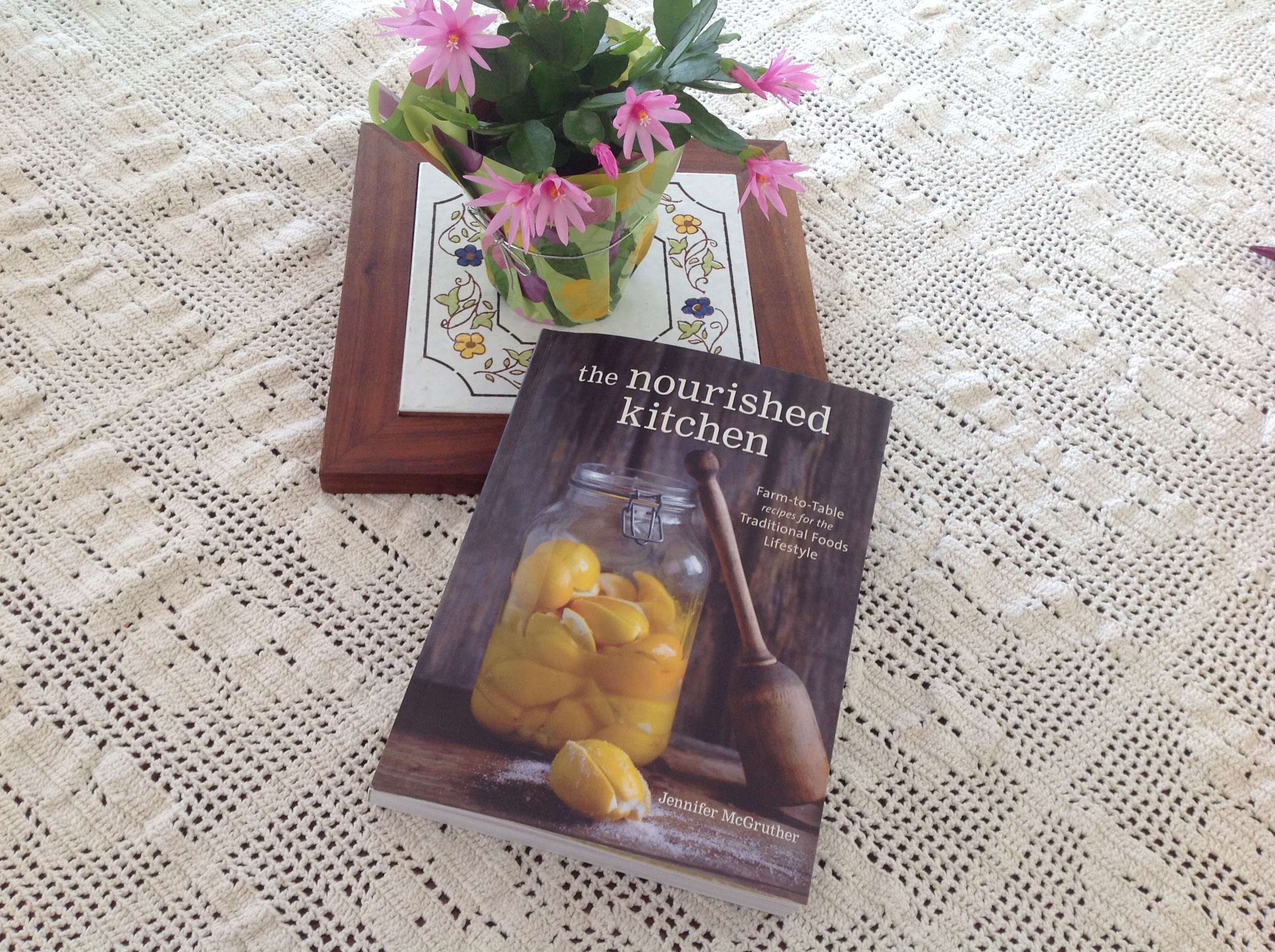


Books, Documentaries, Reviews: Jennifer McGruther’s THE NOURISHED KITCHEN

Books, Documentaries, Reviews:  April 29, 2014


The Nourished Kitchen

Jennifer McGruther


WOW!

Here’s a terrific new cookbook that’s playing off of Sally Fallon Morell and Dr. Mary Enig’s book Nourishing Traditions.  Morell and Enig are part of The Weston A. Price Foundation organization.


IMG_0255


My friend Rose Thomas, aka “Chicken Rose” to my family as there are others named Rose in my life, dropped by the other day for a cup of tea.  I told her that I had just gotten a really nice new cookbook, and as soon as I picked it up to show her, she said “I just got it too.  On my Kindle.”  But she had a lot of fun actually holding the book in her hands and said so.

So, it’s a book that’s “in the wind” on a number of whole-foods sites.

The author is from Colorado–in the mountains–and seems to have a kind of rural setting.  So there are discussions of foraging for strawberries, wild greens, and cooking wild game.  We might not be able to get elk, but we can get deer and rabbit here in Maine. And our berry gardens are superb.

There’s a terrific chapter on cooking and fermenting ancient grains.  And a resource section that tells where to buy them.

There’s an exciting chapter on fermented foods–with some exciting combinations of ingredients.

Indeed, what’s piquing my interest the most are the different combinations this cook is using in her every day foods.

The section on desserts have some healthy, interesting, delicious looking combinations.

This one is HIGHLY RECOMMENDED!

PS:  Those are salt-preserved Meyer lemons on the cover–an “asset” I keep in my refrigerator all the time.  I cover with a film of olive oil that is delicious drizzled over any kind of baked fish.  A  tablespoon of the chopped lemon and oil put into smashed potatoes with butter adds a delicious sparkle to the mixture.

Interesting Information: Mercola Post: Widely Used Antacids Can Cause Vitamin B12 Deficiency

Interesting Information:  February 5, 2014

Mercola Post:

Widely Used Antacids Can Cause Vitamin B12 Deficiency


Two observations:

1.  I think that the information Joseph Mercola puts out and his free web site is a real gift.  I do NOT agree with everything Mercola says, but DO think that he has amassed a really useful archive that should always be considered.  And the points where I disagree are small.  I think REAL fermented cod liver oil is far better than any fish oil, and I am not at all sure that a lot of raw food can be fully assimilated by our bodies.  And it’s clear that too much raw food, especially fruit, causes nutrient deficiencies and a lot of cavities.  These differences are where I would favor information and analysis on The Weston A. Price Foundation over Mercola, and the WAPF folks argue that cooked food often has nutrients that are more available to our bodies.  Having said that, I love a good salad and am not suggesting that ALL food should be cooked.

 If you want to read the Mercola/Weston A. Price Foundation debate on cod-liver/fish oil, the WAPF web site has it.

2.  I am fascinated by how often an issue arises in my life and in a few days, the universe throws up useful information about the issue.  Not even a week ago, I was in a discussion about the role of stomach acid in digestion.  And in came this Mercola post.

Mercola’s post here has some new information on why antacids are NOT a good idea.  Specifically, they set into place the depletion of vitamin B12.  Can I just say that if you are not processing or cannot process and use B12, you get dementia.  And I can tell you that that is exactly what happened to my father.

There is now a host of information about how wrong mainstream medicine is with regard to the treatment of GERD, or Acid Reflux.  It’s not caused by too much stomach acid, but by too little.  (I know that I have written about this issue more than once.)  And it does not matter WHY you have GERD or indigestion, the solution is still MORE stomach acid–except in some truly rare cases.  I keep Betaine HCL with Pepsin on hand for the rare occasions when something runs amuk in my body, and I feel I have indigestion.  You can buy it at any supplement store.


So, if you have indigestion of any kind, before you reach for an antacid, do your body a favor and read this Mercola post.  Then go to The Weston A. Price Foundation archive and google Acid Reflux.  Then try to figure out WHAT you ate that is causing you trouble–and err on the side of bone broths and clean foods that do not come in a box or can.

Widely Used Antacids Can Cause Vitamin B12 Deficiency.

And also bear in mind that doctors ONLY KNOW what they have been taught and most don’t have time or skills to research this issue.  The drug companies are the “teachers” here, and they are making a HUGE profit on these antacid drugs.

Books, Documentaries, Reviews: Sally Fallon Morell’s Thumbs Down Review of Robb Wolf’s THE PALEO SOLUTION

Books, Documentaries, Reviews:  January 28, 2014

Sally Fallon Morell’s Thumbs Down Review

of

Robb Wolf’s THE PALEO SOLUTION:  THE ORIGINAL HUMAN DIET


In the fall 2013, in Wise Traditions, the journal of The Weston A. Price Foundation, Sally Fallon Morell gives Robb Wolf’s version of the Paleo diet a THUMBS DOWN.

Why?

Here’s Morel’s summation:

The fact is, while The Paleo Solution diet contains plenty of meat, it is just another version of food puritanism–a diet so lean, dry and deficient that it is impossible to follow and bound to lead to health problems.  No “paleolithic” or traditional culture ever ate this way, and we shouldn’t either.”

One problem Morell has is that Wolf, while saying that saturated fat has been demonized, stresses monounsaturated fats and LEAN meat–which can lead to something called “rabbit starvation“–characterized by, writes Morell, “muscle wasting, lethargy, diarrhea and eventually death if one relied too heavily on lean game animals such as rabbits”–which is what Morell claims Wolf’s diet does.  

Morell notes that Artic explorer Vilhjalmur Stefansson, who described rabbit starvation, noted that “primative peoples never ate lean meat”:  “according to Stefansson, the diet of the Eskimo and North American Indian did not exceed 20 percent protein, with the remaining 80 percent of calories, as fat.”  (Wolf cites Stefansson’s work.)

Saturated fat is where the fat soluble vitamin A resides.  Morell writes:  “Our bodies need saturated fat in large amounts–to build cell membranes (which need to be at least 50 percent saturated to work properly) and to support hormone formation and the immune system.”

Morell notes that there are two major dangers with Wolf’s “Paleo” diet.  First, the  high protein content and the recommended 2,000 to 5,000 IU of Vitamin D daily can rapidly deplete vitamin A in the body–which sets in place a serious health situation.  Second, the deficiency of saturated fat combined with low consumption of carbohydrates means the body cannot use carbohydrates to compensate for the lack of saturated fats.

Morell claims that Wolf’s stance on grains and nuts/seeds is inconsistent.  Grains are not ok, but nuts/seeds are–based on Wolf’s understanding of the role of palmitic acid.  Yet both grains and nuts/seeds contain palmitic acid writes Morell.  And she undertakes a very nuanced discussion of palmitic acid that more or less refutes Wolf’s claims that it is dangerous.  (Recent research also refutes the connection of palmitic acid and heart disease.)

Nor can Morell find a problem with raw milk or dairy from raw milk–which Wolf forbids.  Morell sites a number of nomadic people who thrive on dairy–an argument I’ve always found persuasive.

Wolf claims lacto-fermented foods contain too much salt and are not worth the hassle–which I’m sure represents a misunderstanding of these super foods.

So….

I personally liked–as I wrote some time back–Wolf’s attempts at showing how nomadic paleo peoples fared better healthwise than settled agricultural peoples.  And, like Luise Light’s work, I think we are eating waaaayyyy too many grains every day.   And there may be a problem with modern wheat.  But there are a lot of other grains…  We do need to prepare them properly.

I like the focus Paleo Diets have put on eating traditionally–as many of the traditional foods have been demonized or lost.  Since moving to Maine and getting back in touch with traditional foods, I have held a place for saturated fats, raw dairy, fermented foods, and good meats in my diet.  I also eat a lot of vegetables, avoiding the starchier ones except as treats, and I have a genetic gluten intolerance gene, so do better avoiding gluten.  And when I eat too many gluten-free substitutes, my joints start hurting.

As I’ve written before, when a group starts to take a diet out of its context (macrobiotic, Mediterranean, Paleo), not all of the parts translate–and we just get an Americanized version that’s something new again.  What Wolf has done is to not really lose his fear of fat…

Morell takes on a client  Wolf describes:  Charlie, who is trying to follow Wolf’s diet, but is listless.  What does he need to eat?  Charlie is suffering from rabbit starvation on Wolf’s diet, writes Morell.  And,

The truth is, his diet is terrible.  Desperate for fats, his body craves sugar.  His paleo diet has depleted him of vitamin A, needed for mental function and the formation of stress and sex hormones.  Poor Charlie needs more than blackout curtains [for dark, to sleep]–he needs rich, nourishing foods including butter, cream, bone broths, properly prepared grains, organ meats and cod liver oil.  Raw whole milk before bedtime is a wonderful, soothing food to induce sleep.  Calcium and tryptophan in milk help the body manufacture sleep-inducing melatonin–but Wolf insists we can get all the calcium we need from vegetables and fruit.

There’s more, of course.  If you’re interested, you can read the review for yourself.

http://www.westonaprice.org/thumbs-down-reviews/the-paleo-solution-byrobb-wolf

Turkey Tracks: Learning to Love Liver: A Simple Chicken Liver Pate

Turkey Tracks:  January 28, 2014

Learning to Love Liver:  A Simple Chicken Liver Pate


I like the Radiant Life Company.

I order Green Pastures Fermented Cod Liver Oil from them on a regular basis.  It’s the ONLY cod liver oil that has not been overly processed and had its vitamins added back–making those oils a human concoction based on guesswork.

Anyway, the Radiant Life Company has a blog now that is putting up some good recipes.

I love liver!

But chicken livers are probably my favorite.  Maybe followed by lamb’s liver.  And then, cow liver.  The cow liver I cook with onions and bacon and add in swirls of cream at the end to help make a sauce.  It’s important not to overcook liver.

And chicken liver pate—-for me, it’s divine if made right.

Unfortunately, my generation is probably the last one that actually eats liver.  It’s been so demonized.  And that is a real loss as we are no longer eating nose to tail with animals.  We’re eating their muscle meat, a habit which has its own set of problems.  Liver is so chock full of good things for the human body.  But, of course, you want the livers of animals that have been pastured and grass fed, etc.

If all else fails, put dessicated liver tablets–found in any supplement store–into your diet.

But, take a chance and try this recipe and see if you don’t like it…

Radient Life Company:  Learning to Love Liver: A Simple Chicken Liver Pate.

http://blog.radiantlifecatalog.com/bid/69319/Learning-to-Love-Liver-A-Simple-Chicken-Liver-Pate

Interesting Information: 7.83 Hz, and Sleep in the Quiet Dark

Interesting Information:  December 8, 2013

7.83 Hz, and

Sleep in the Quiet Dark

I used to fuss at my younger son and his wife all the time about the sleep monitors they have in their babies rooms.  The older child, especially, is a very light sleeper.  To give her comfort, they also keep a night light on.

But I’ve given up.  And they do have to live their lives in their own way.

Nevertheless, like many of my generation who grew up without much technology, I’m worried about the overload of radiation in our world today–from cell phones, baby monitors, microwaves, wireless transmitters of all sorts (computers, Smart Meters, radios, etc.), the machines at the airports.  It’s a growing list.

I myself cannot sleep with lights on around me.  The fire alert contraption on the ceiling near my bedroom door–meant to show me where the door is in the case of fire–seems at night like a strobe light.  I covered it with several coverings of masking tape.  But I can still see it once my eyes get accustomed to the dark, and one of these days, I’m getting on a ladder and putting MORE tape over it.  The light from the clock or from the plug strip in my room or from the phone–I block or cover them up.  Then I get, blissfully, dark.  Then I have only the monthly full moon and the countless bright winter stars to thwart my sleep.

Am I nuts?

You can watch Resonance:  Beings of Frequency for free at https://vimeo.com/54189727 (James Russell and John K. Webster Directors, Patient Zero Productions).

And below you’ll find the review of this DVD from Tim Boyd in the Spring 2013 issue of Wise Traditions, the journal of The Weston A. Price Foundation.

Seems that 7.83 Hz is the resonant frequency of the earth–and as such is the frequency at which the alpha waves of our brains resonate.  If that frequency gets interfered with, ill health follows.  Reviewer Tim Boyd notes that if you put a cordless phone in a bee hive, the bees leave.

Be sure to read the paragraph on dark and wireless devices and melatonin production.

Resonance: Beings of Frequency PDF Print E-mail
Written by Tim Boyd
Tuesday, 23 April 2013 20:05
book-thumbupResonance: Beings of Frequency Directed by James Russell and John K. Webster Patient Zero Productions Available for free viewing at http://topdocumentaryfilms.com/resonance-beings-frequency/When you have a sphere within a sphere and an electromagnetic field, that arrangement creates a frequency. For at least a few centuries most of us have known that Earth is a sphere and it is surrounded by a larger sphere we call the ionosphere. Using that information, Winfried Otto Schumann calculated the resonant frequency of the earth as 7.83 Hz. I know what you’re thinking. Why would anyone care? It turns out that alpha waves generated by the human brain resonate at about that same frequency. It also turns out that when researchers constructed an underground bunker completely shielded from those waves and put test subjects in that bunker, they discovered that was bad for human health.

Other experiments with DNA in water showed that DNA strands communicate with each other at about the same frequency. Life in general seems to be tuned to 7.83 Hz. In our current era we are now adding an unprecedented amount of other electronic frequencies and noise to the environment. Between radio transmissions, cell phones and other wireless transmissions, it is becoming almost impossible to detect the Schumann resonance around big cities.

There is reason to believe this is having adverse effects on human and animal life. When cordless phones are put in a beehive, the bees don’t return. When natural electromagnetic fields are disrupted by things like cell phones or cell towers, birds and bees are no longer able to navigate. There may be other factors involved but this appears to be a significant factor in the decline of many species of birds and insects. In human populations, cancer clusters have been noted around cell phone towers.

Melatonin is a powerful antioxidant that regulates the immune system. It is produced by the pineal gland when it is dark. That is why you need to sleep in complete darkness to get the benefits of any melatonin. There is now evidence that melatonin production is disrupted by other forms of radiation besides visible light, particularly from wireless devices.

There have been a number of studies showing problems with cell phone radiation. There have also been many studies claiming that there is no problem. When you look at who carried out (or paid for) the studies showing no problem, it is obvious that the sponsor of the study had a vested interest in finding nothing. This video also points out that there is no effective government oversight or regulation of all the new phone technology. It is almost amusing when people are shocked by this fact. Large corporations control the governments of the western world. How much genuine regulation do you expect? All of this is more bad news for cell phone lovers. This one gets a thumbs UP.

This article appeared in Wise Traditions in Food, Farming and the Healing Arts, the quarterly magazine of the Weston A. Price Foundation, Spring 2013.