Turkey Tracks: Remembering Winter

Turkey Tracks:  August 21, 2013

Remembering Winter


Those of you who have read this blog for any length of time will know that in the midst of one season, I love to harken back to its opposite.

Friend Marsha Smith, a pioneer of Citizens for a Green Camden, sent me this picture of her adorable grandson, Devon, last winter.  And I saved it for just this moment when we are in the dog days of August.

Devon's frozen shirt

As an experiment last winter–probably around the time we had the blizzard which dumped up to five feet of snow on us, Devon hung out his t-shirt for a few minutes.

It froze solid–which you can tell by his expression that he loved.

Turkey Tracks: Gardens in the Watershed: Atkinson/Stich Successional Garden

Turkey Tracks:  August 21, 2013

Successional Garden of Bo Atkinson and Alda Stich

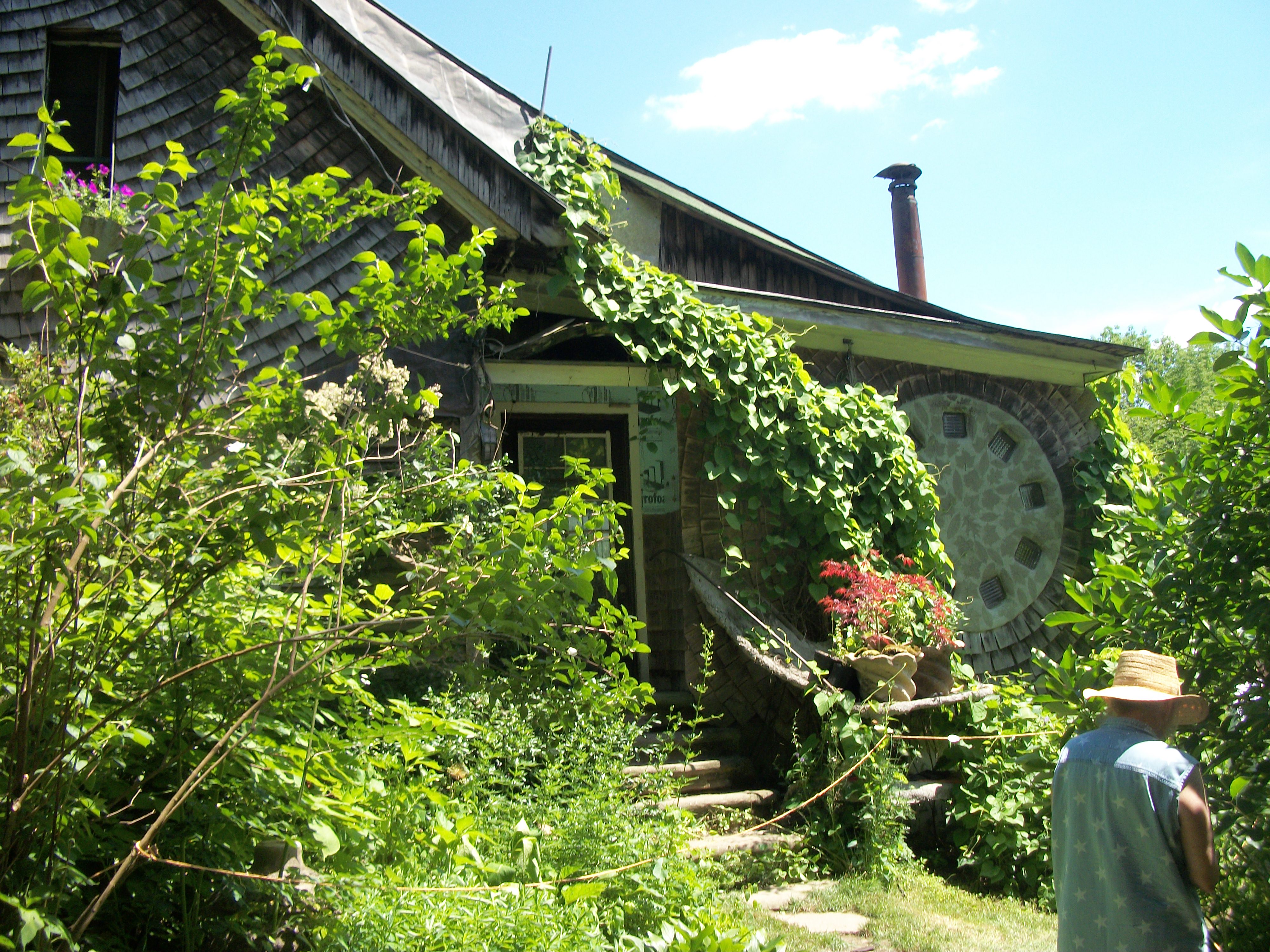
The Atkinson/Stich Successional Garden has been forty-two years in the making.  Bo builds the alternative structures and Alda creates the fragrant perennial flower collections–fields of them.   A friend told me Alda did all the flowers for one of her children’s wedding–and that they were lovely.  Alda pioneered regional sales of fragrant perennial flower collections.

Out on the road, Bo has put up a sign that attempts to explain his structures:

Atkinson-Stich 9

And here is the whimsical outer wall on the road through which the visitor passes:

Atkinson-Stich 2

I wish my grandchildren had been with me for this garden visit.  They, as I did, would have loved it:

Atkinson-Stich

Here’s the view of the house, which sits just beyond the wall:

Atkinson-Stich 3

I loved this curved woodwork.

And:

Atkinson-Stich 4

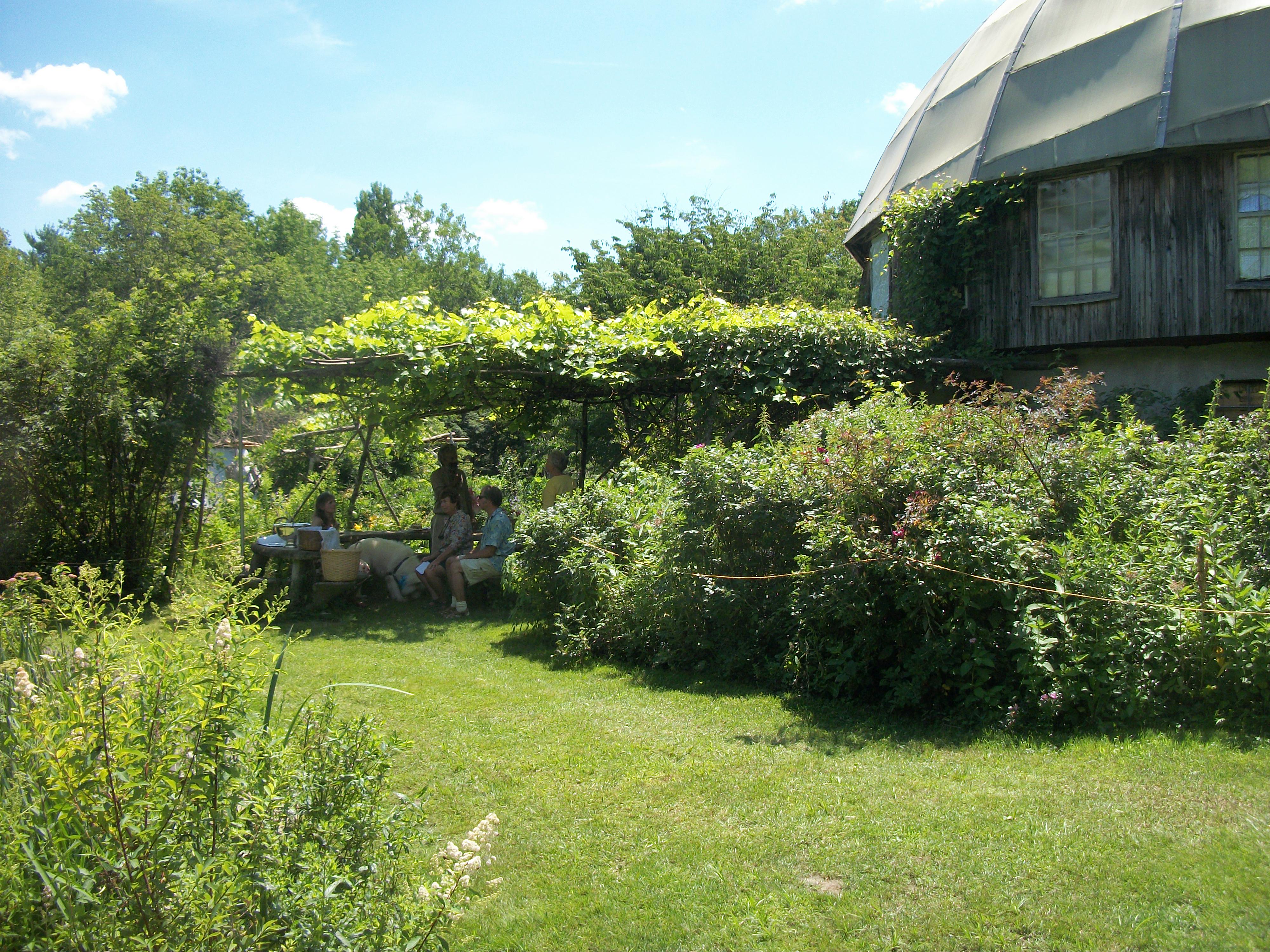
The back of the house has a grape-vine covered verandah that is cool and inviting–especially on the very hot day when we came to this garden.  People had gathered there to visit and enjoy one another.

Atkinson-Stich6

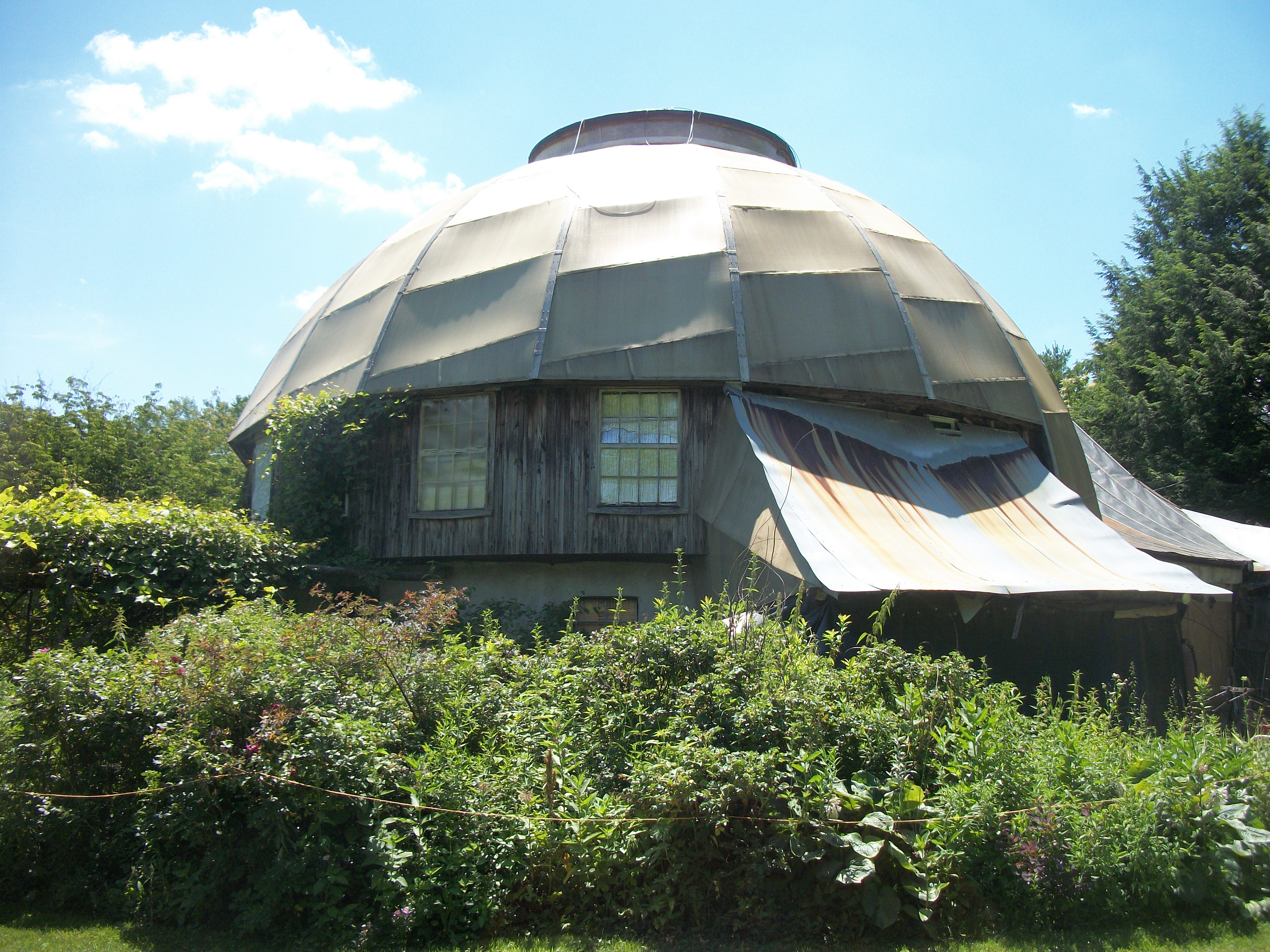
This garden is designed to work with nature, not against it.  And Bo’s structures attempt the same goal.  Here is the building to the right of the house where seedlings are nurtured and protected:

Stkinson-Stich 5


Both Bo and Alda work to encourage local bird, frog and beneficial insect habitats.  There was a small pond with an arching bridge that led to a structure on the left side of the property.  Paths snaked through Alda’s fields of flowers.  I left feeling that these folks were living in concert with their surroundings–and that whatever they did to the land were attempts to enhance its natural habits.

Turkey Tracks: Blackberry Jam

Turkey Tracks:  August 21, 2013

Blackberry Jam

When I was growing up, we spent some of every summer with my maternal grandmother, Louisa Phillips Bryan, in Reynolds, Georgia.

I’m sure my grandfather, Sydney Hoke Bryan, was also involved–he was a quiet rock that held the family together.  And he was deeply involved in growing food and in preserving food.  He had a large vegetable and flower garden “out on the farm”–and in the summer he went out there early and returned with huge baskets filled with vegetables and flowers.  One of my vivid memories is the two of them putting up tomatoes in an outdoor kitchen they fashioned in the back yard under a shed.  And, I remember hams hanging in the smoke house too.

But it was my grandmother who made the blackberry jam in the summers.   And, later, my mother.  But mother’s blackberry making was always limited by having wild blackberries nearby to pick.  We were tasked with picking blackberries in the summers–though most of the berries we picked landed up in cobblers for “dinner”–which was in the middle of the day.  Local children used to bring the blackberries they had picked to the house for sale, and that’s when my grandmother made jelly.  I have memories of cheesecloth to drains off the seeds and of melting wax for the lids…  And of discussions about whether to seed the jam/jelly or not.

I have access to a blackberry patch here in Maine–and it has been the greatest joy to pick them and to make jam.  And I am so grateful for the wonderful family who allow me to pick their berries.  What a gift!

Some years are better blackberry years than others.  And, it takes a lot of blackberries to make a jam.  One year we had blackberries, but there had been no rain, and the berries just didn’t have enough moisture to make good jam.  And every three or four years it’s a good idea to mow the patch to retard the overgrowth of other plants trying, also, to grow there.  Eventually they will crowd out a blackberry patch.  So when I make a batch of jam, I never know how far I will have to stretch it so as not to completely run out.

This year is a GREAT blackberry year.  And last Sunday, I picked about two gallons alongside friends Giovanna McCarthy and Margaret Rauenhorst.  I came home and made the jam while the berries were fresh.  I was down to my last jar–and that was dated 2010.

Blackberries

The first thing you need to know is that when you are picking blackberries, be sure to pick about one not-so-ripe mostly red berry (not a hard red one) for about every 30 or so berries.  The red berries have pectin in them that will make the jam jell.

Also, you want to make any jam or jelly in SMALL BATCHES.  I made two separate batches with these berries.

The other thing you need to know is what the jelling point is for your geographic area–and that’s info you can determine from either an internet search or from a Ball Canning Book.  At my house here in Maine, it’s 216 degrees.  Down in town, it may be a bit different.  Obviously you’ll need a candy thermometer unless you have a knack for telling when the batch is ready.  I don’t.

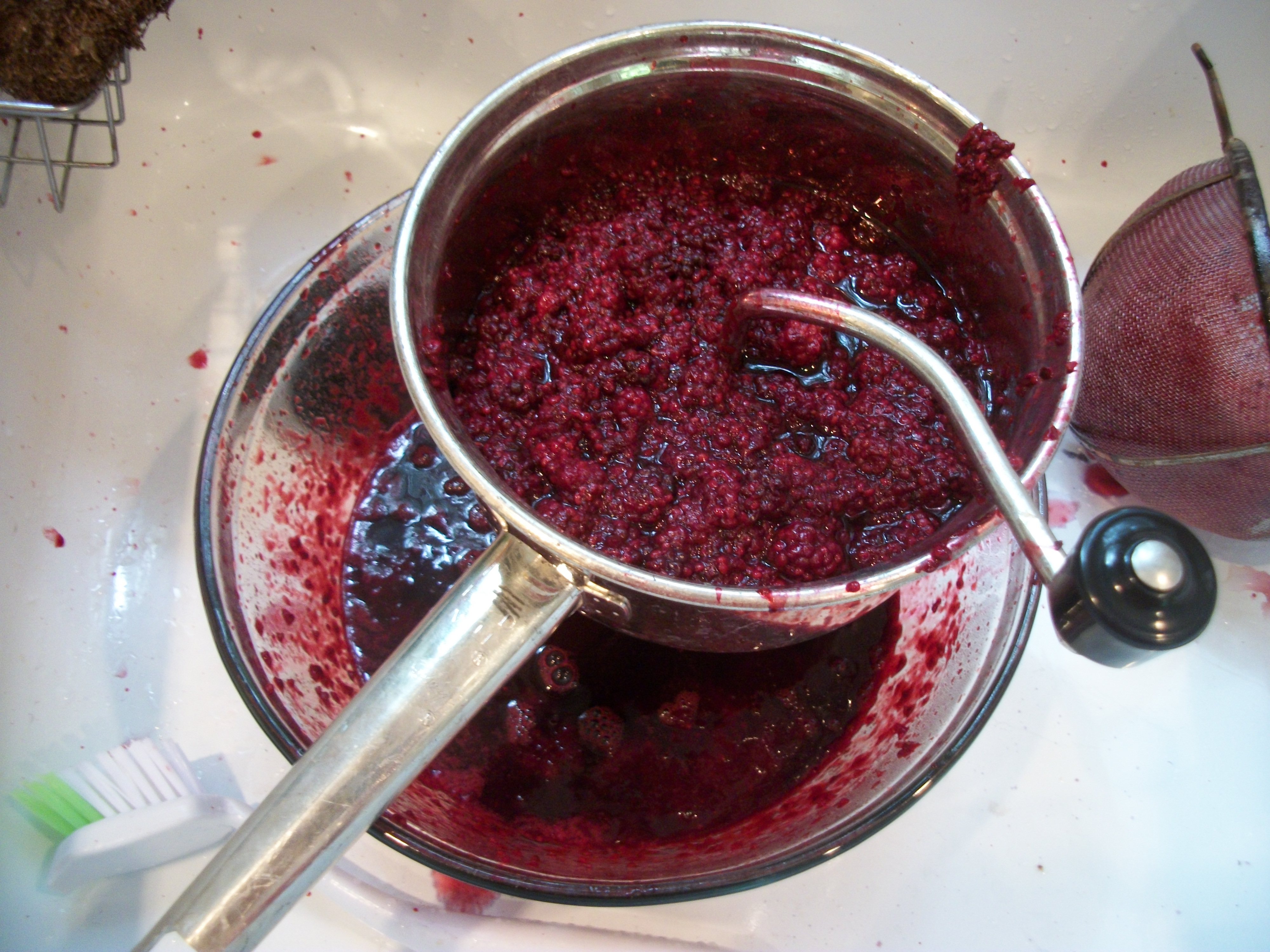
I put all of the berries into a pan, add about a 1/2 cup of water so they don’t burn on the bottom, and heat them to render the juice.

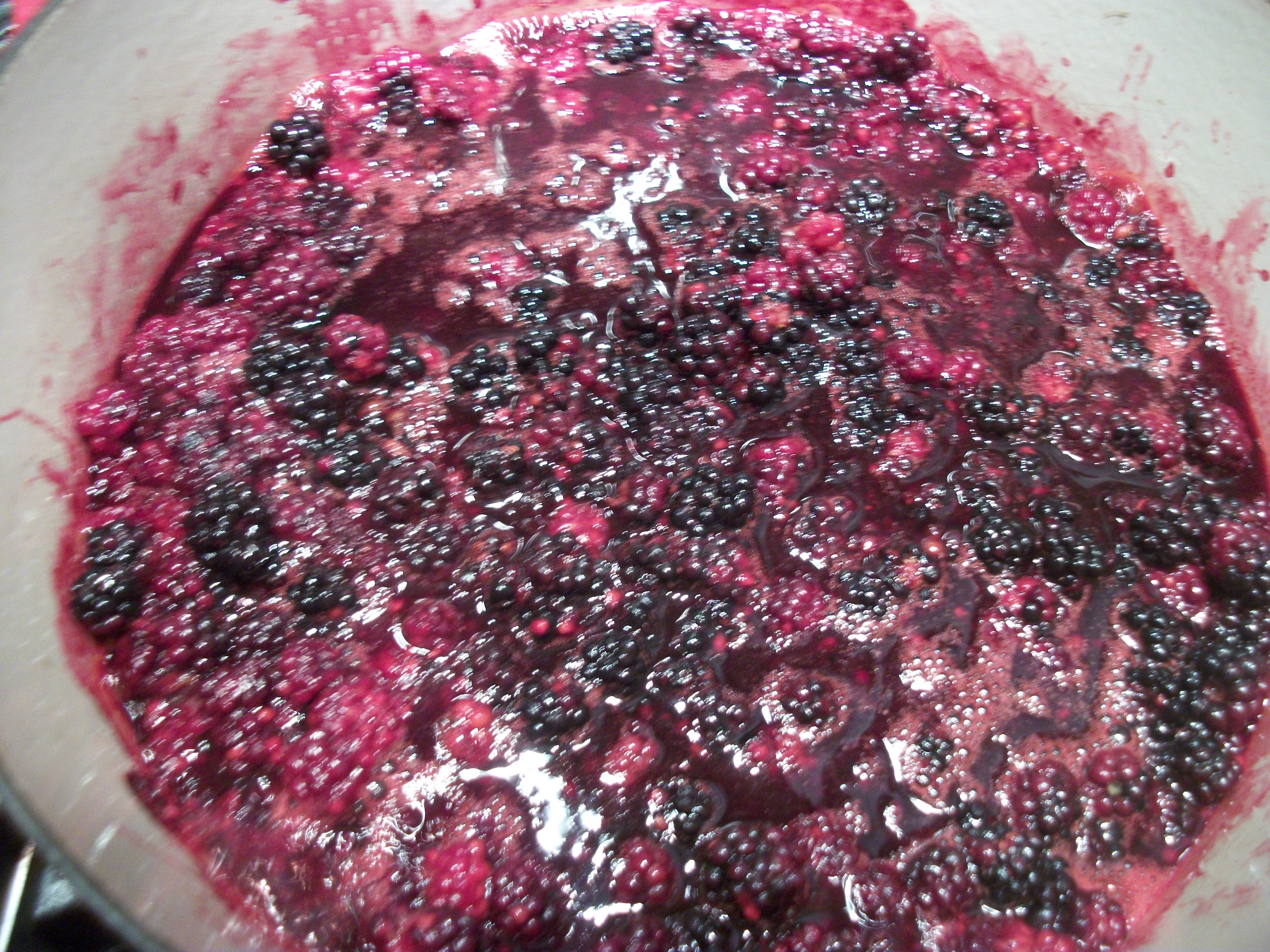
Here’s the pan of berries starting to heat up–note how he berries start to turn red.  I like to use my heavy Creuset pan–the cast iron holds heat so beautifully and evenly.  Use a heavy bottomed pan–not a thin one.   I smash them with a potato smasher to help the juice-rendering process along

Blackberries cooking

When the berries have cooked about five minutes, you need to decide if you want seeds or not.  I put the berries through a mill and remove the seeds–though I always have a few escapees.  Do this process in the sink as there is some inevitable spattering and you don’t want blackberry juice staining surfaces in your kitchen.
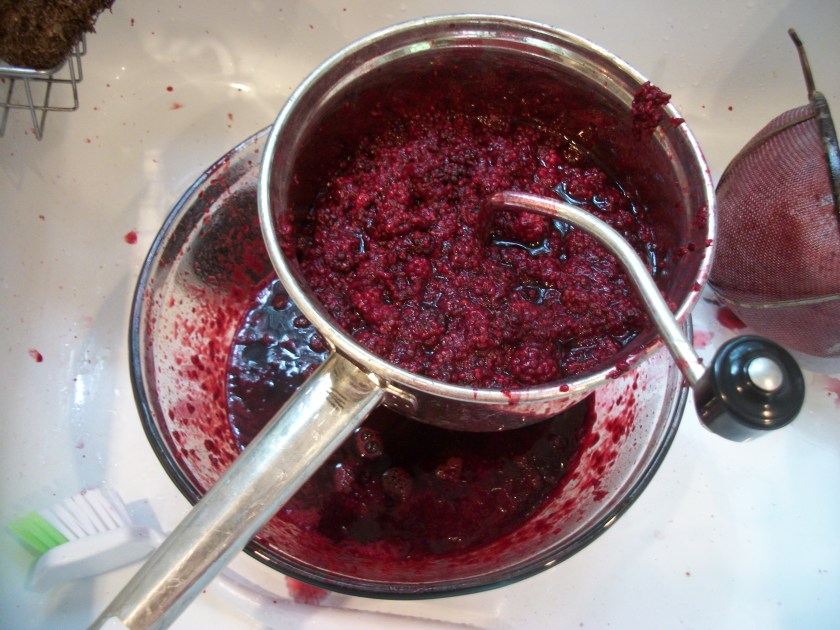
Deseeding blackberry jam

Put the juice back into the cleaned pan and add sugar. .  For about 9 cups of berries, I add 6 cups of sugar.  The recipes call for more, but this ratio works fine for me.  Here the rendered juice is really booking along.  It’s RED, isn’t it?  I don’t attempt to skim any of the foam at the top.
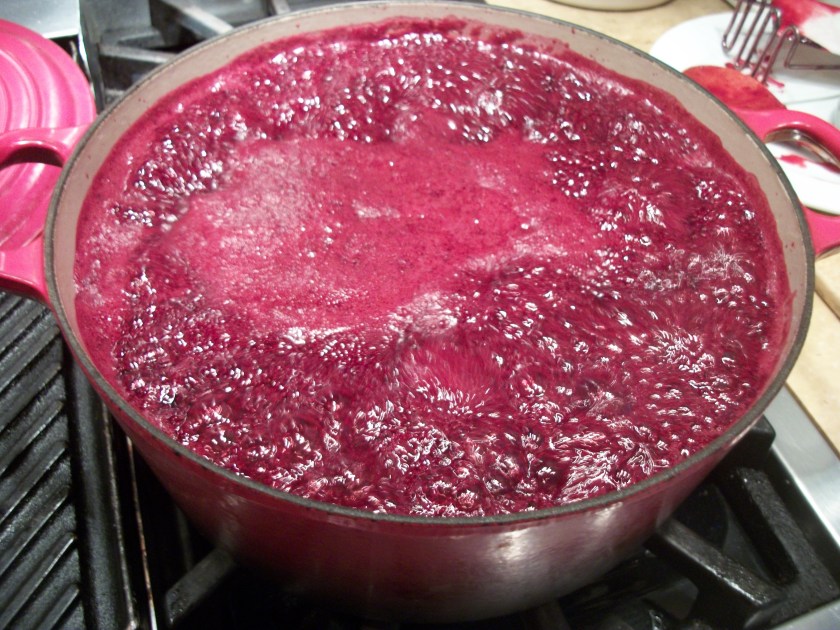
Blackberries cooking 2

Watch your heat–you want a steady boil at pretty high heat, but you don’t want the pan to overflow or the batch to burn.  DON’T LEAVE THE KITCHEN.  You will want to start testing for the jell point any time now.  You don’t want tough jam.

While the batch cooks, put your clean jars and caps in HOT water in a bowl in your sink–and arrange a space on your counter where you can fill your jars.  I have a large ladle that I use to dip up the jam.

I LOVE my large canning funnel.  It fits all jar sizes and makes filling the jars easy.
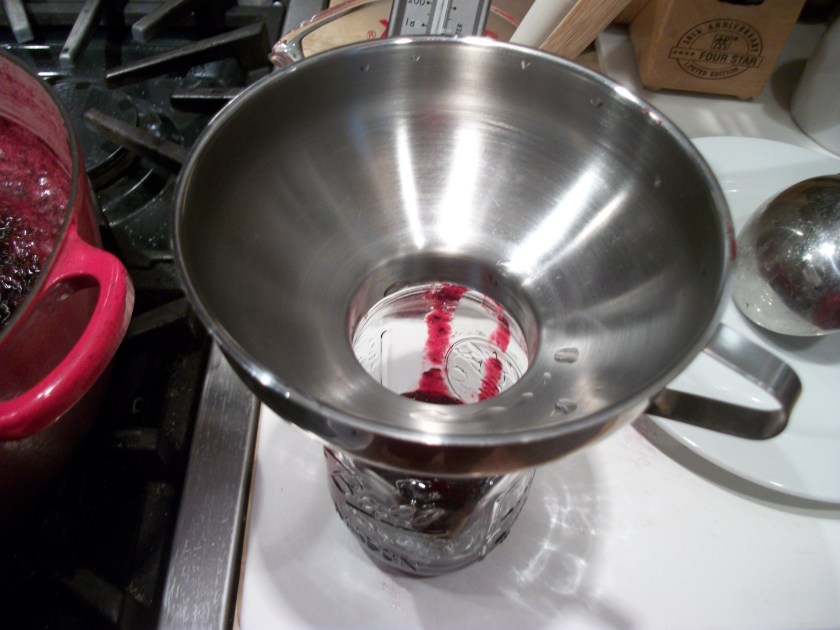
Canning funnel

Fill the jars, leaving about 1/2 inch clear.  I used to top the jam with melted paraffin wax, but I don’t do that anymore.  The jam keeps just fine without it.

Screw on the lids really tight and with a protective towel (they are HOT), turn each one upside down–which creates a nice vacuum seal on each jar.  Watch to make sure you don’t have a leaky one where the threads were just not tight enough.  Be careful picking up a leaky jar–the jelly is HOT.

Blackberry jam, Aug. 2013

Label the tops–using a year date, too.  I also make blueberry jam, so sometimes it’s hard to tell the difference between these two jams in the jars.

ENJOY!

Turkey Tracks: Black Trumpet Mushrooms

Turkey Tracks:  August 20, 2013

Black Trumpet Mushrooms

Mushrooming is something I really like to do.

And I have not been in the woods mushrooming much in the past two years.

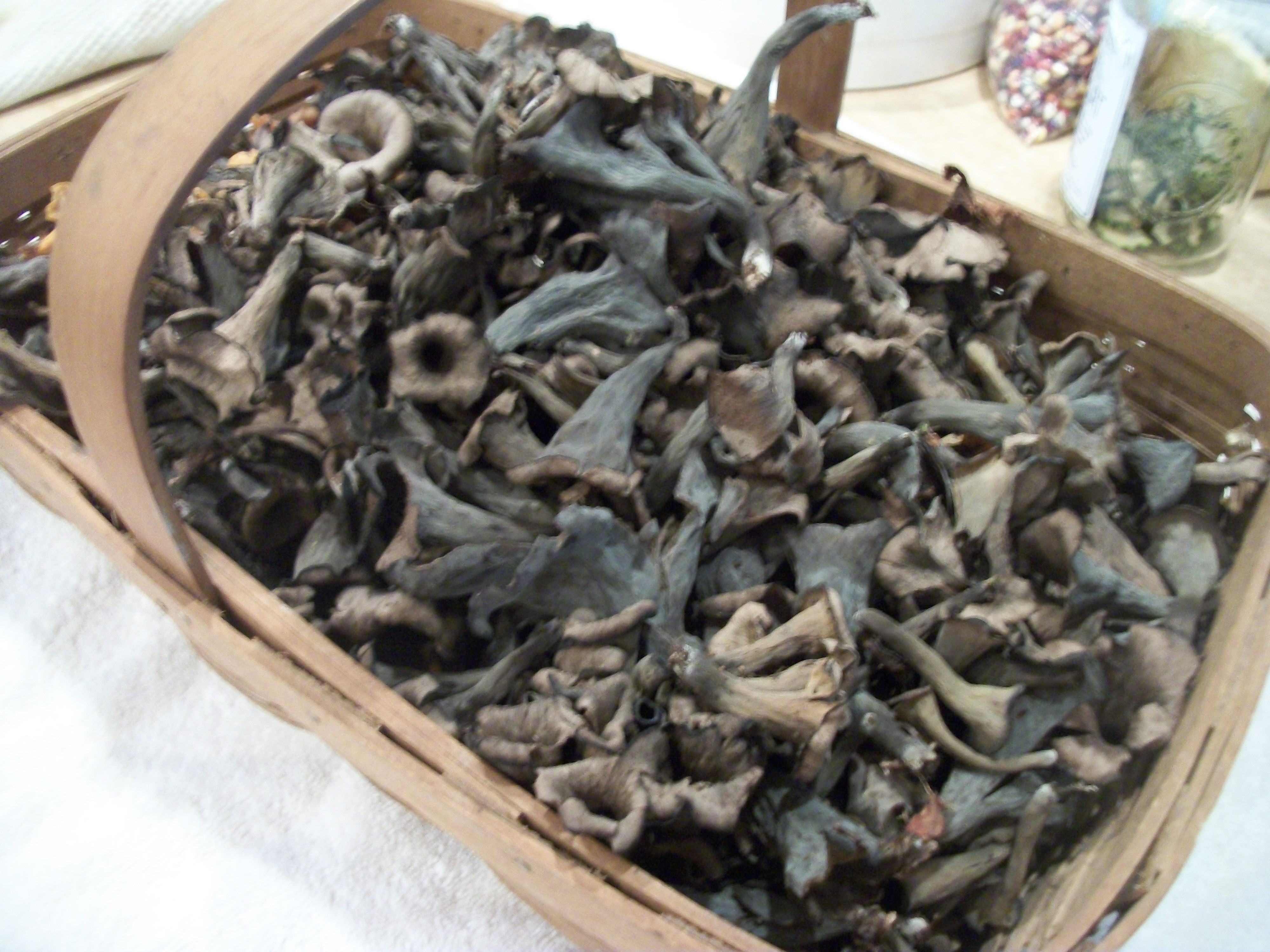
Here’s a whole basket of Black Trumpet mushrooms, some Golden Chanterelle mushrooms, and a few puffball mushrooms–all of which I found at the end of last week.  The puffballs are white and are lost in the basket in this picture.  There is no puffball that is poisonous, but I would not eat any mushroom that has grown in an area that has been sprayed with any kind of chemical.  So, avoid sprayed lawns and golf courses.


Black Trumpets, Aug 2013

I have a very nice video that I can’t get to upload–telling you how difficult these mushrooms are to see growing on the forest floor among the dried leaves of last year.  You don’t see the dark stems–what you see you see by looking straight down–and if you look at the tops of these mushrooms, you will see they appear as a light grey/brown.

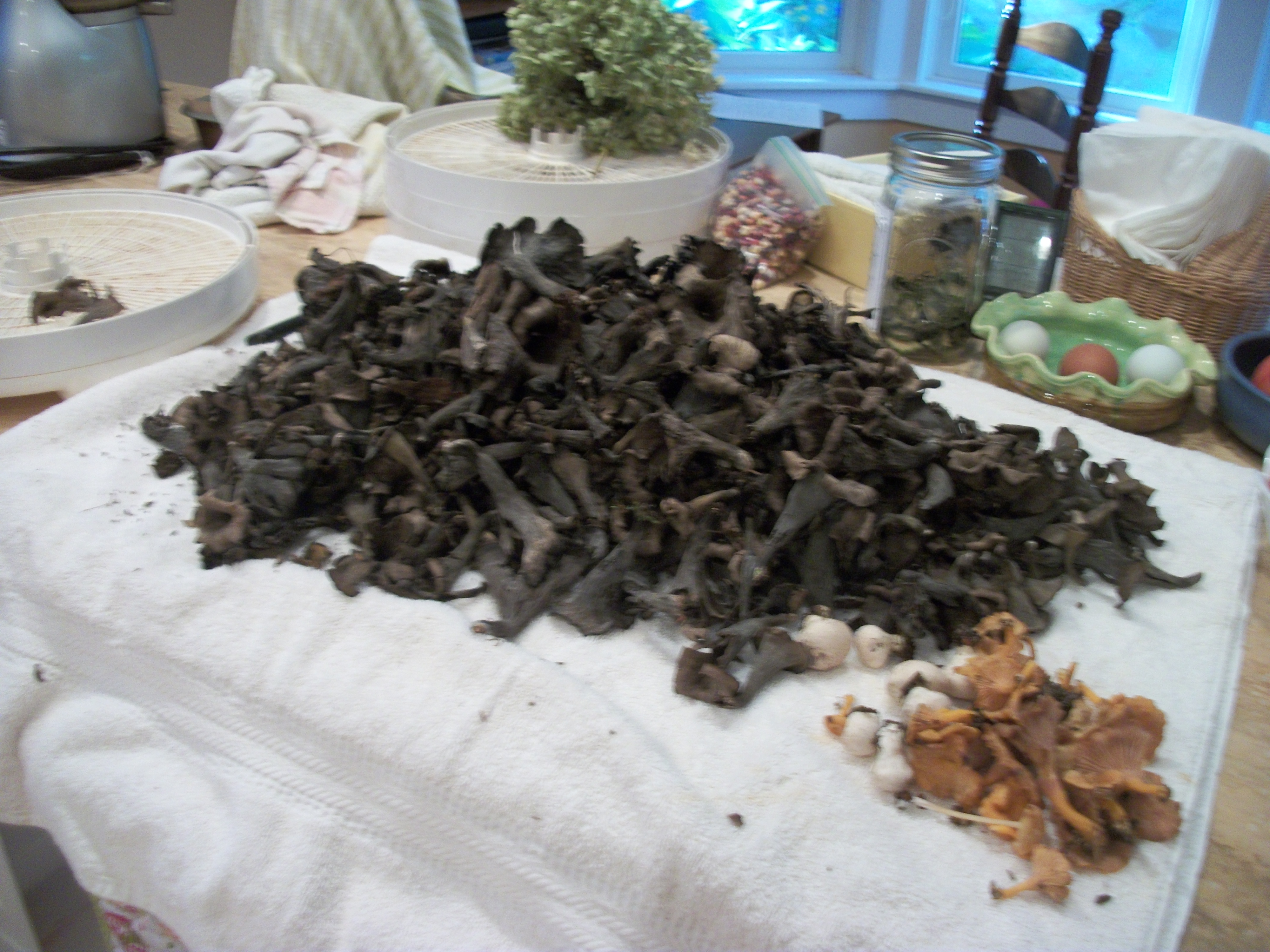
Here’s what the pile looks like on the kitchen counter.  Now you can see the puffballs.

Black Trumpets 2

The Golden Chanterelles smell like apricots–and all of these mushrooms are delicious sautéed in a little butter or duck fat and added to a cream sauce, scrambled eggs with a bit of cheese, and  soups and stews.

I cleaned the trumpets–you have to snip the ends, open them a bit, and scrape out any debris or critter that has lodged in the funnel.  Mostly they are pretty clean.

I dried all but a few of the trumpets and ate the rest with a rich lamb stock I had going in the kitchen.

Yummo!!!

Turkey Tracks: Pine Tree Quilting Guild Annual Show

Turkey Tracks:  August 20, 2013

Pine Tree Quilting Guild Annual Show

The grandsons and I visited the annual state quilt show together.

The boys like art shows pretty much.

But this was A LOT of art for them to take in, so we more or less whipped through many of the aisles at lightening speed.

They were interested in the judged quilts and who got what ribbons.

So was I–since the judging this year seemed more incoherent than ever before.

For instance, here’s a terrific quilt.

A third, really

The piecing is awesome.  The quilting was quite good as well.

But, it’s a third???

a third, really 2

A third?  Really?

Has any one of this year’s judges ever pieced a quilt like this one?

I wish I had taken more pictures of what disturbed me so much, but…

I do remember that there was one large bed quilt with a first place ribbon–yet it was copied from someone else’s pattern and it had been long-armed quilted with what was clearly a computer program.   Why would someone get 25 points for someone else’s design?  And a computer did the quilting.   What about people who can’t afford to have a computerized long-arm quilter quilt their tops?  Where’s the human error or serendipity of human art then?  Left out, I can tell you.

I loved this quilt:

No ribbon

No ribbon.  But this design is an original work of art.  Look at those cow expressions.  Aren’t they wonderful?  Not even an honorable mention…

Pine Tree’s judging is supposed to be about NOT comparing the quilts–but about judging each quilt on its own merits.  In that system, theoretically, everyone could get a blue ribbon if the work merited it.  But I saw so many really special, glorious quilts with no ribbon at all.  That’s so discouraging for quilters who submit to judging.

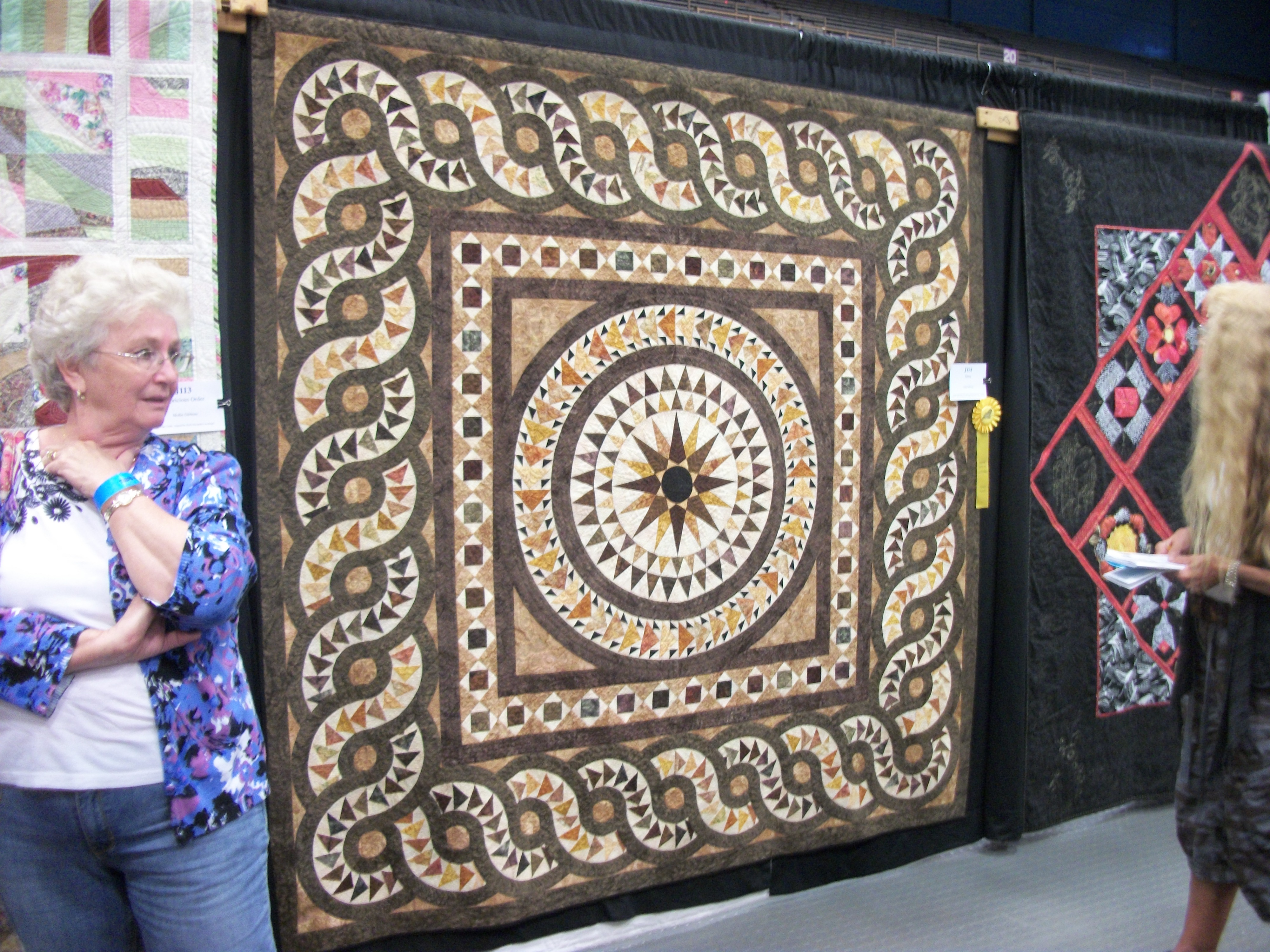
Here’s my favorite quilt:

My favorite quilt

And here’s a close-up:

My favorite quilt 2

It did not win “best of show,” but did win an “Exceptional Merit.”

My apologies to the winner of the “Best in Show” quilt, but it looked just like the winners of the past two or three years:  a small quilt with a geometric design and really, really good long-arm quilting.  Lots of intensive long-arm quilting.  But nothing outstanding in the quilt design really,

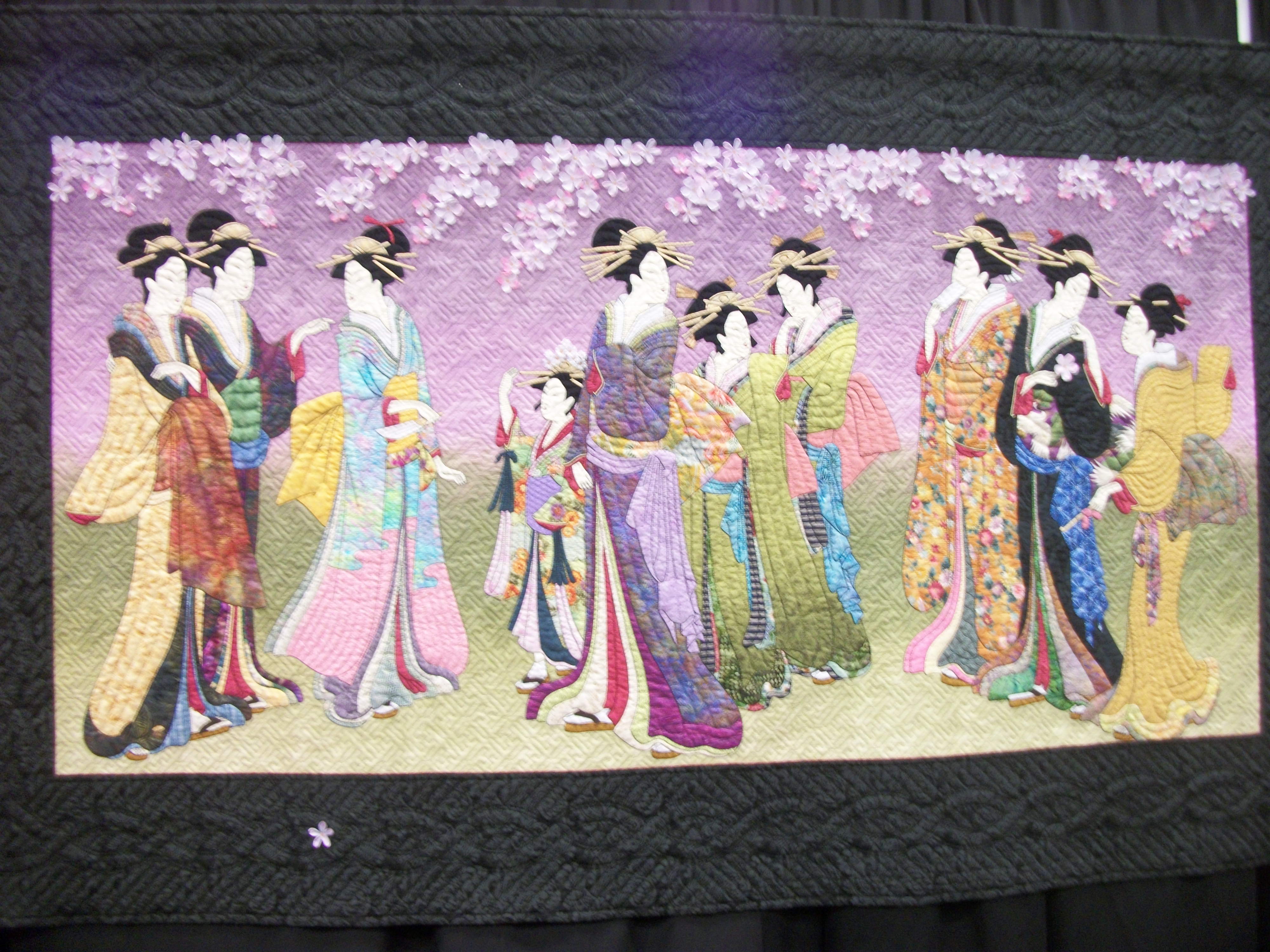
Surely a quilt is about more than the quilting?   This Japanese scene is about much more than long-arm quilting, for instance.

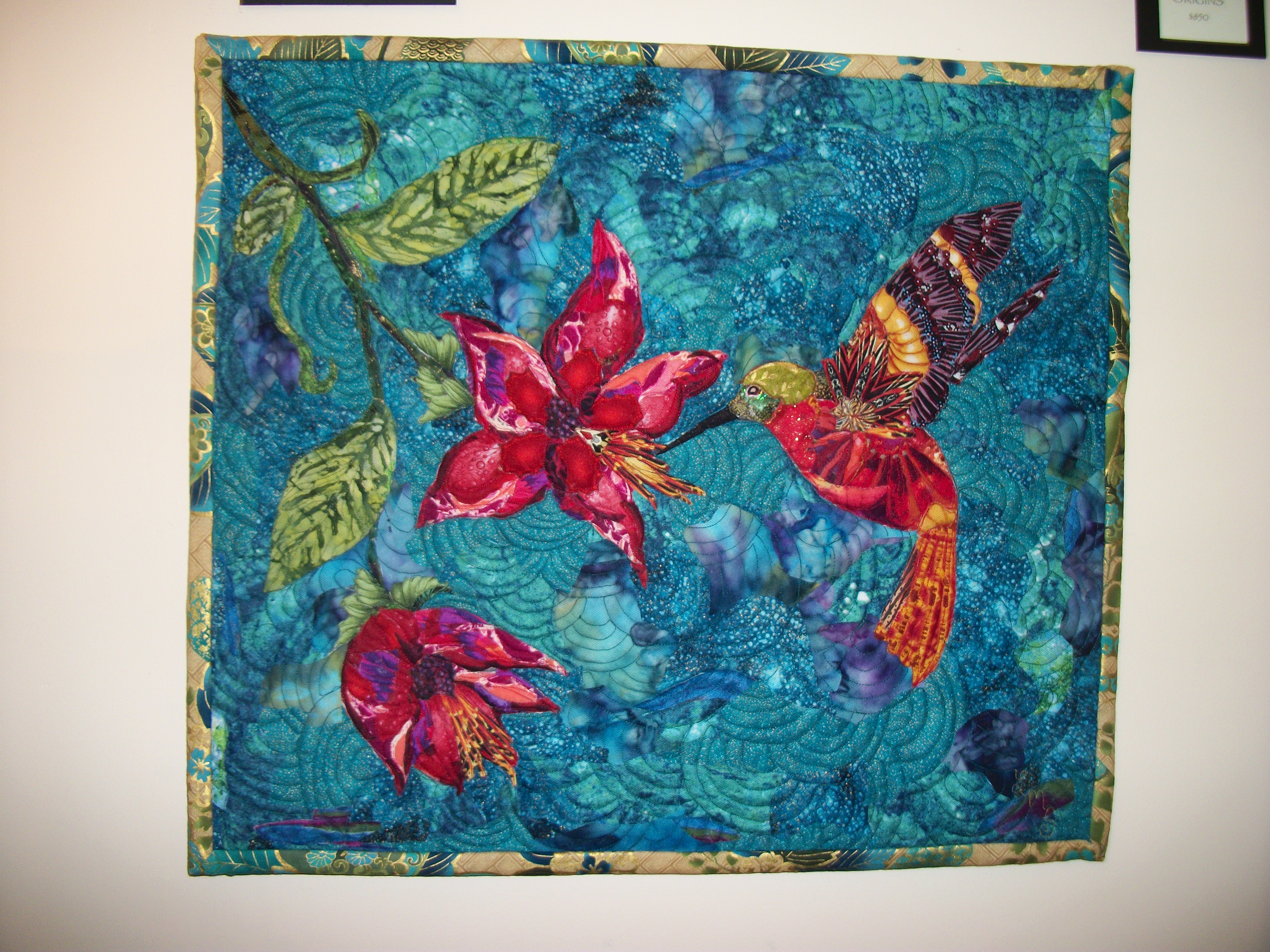
And this little quilt surely deserved something more than “honorable mention”:

Honarable mention

How many people could do such great collage work and combine colors so effectively.  The quilting was pretty great too.

Here’s the grandsons’ favorite quilt:

Boys favorite quilt, 2013

This quilt, as I recall, was made as a thank-you for someone.  What a fabulous thing to do.  I know this quilt will be treasured forever.  And maybe that’s what quilting is really all about too.  At least in part.

In recent years I have not made quilts that I felt should be judged.  As you know if you read this blog, I’ve been working on “Louisa’s Scrappy Project” to try to get my stash into some sort of intelligent order and to try not to waste fabric I already own.  I’ve been making big quilts for the most part–with the goal of giving each one I finish to family and friends.

I think that quilting has always been about BOTH making beautiful objects and making functional objects.  Sometimes both desires blend in one quilt.  So it hurts my heart when I see really outstanding works of beauty not getting the full credit they deserve.

Come on, Pine Tree.  The judging is ruining the show for many members.

Turkey Tracks: Monhegan Island with the Kiddos

Turkey Tracks:  August 14, 2013

Monhegan Island with the Kiddos

Here’s one of my favorite pics of the summer visit with my four oldest grandchildren and my son Michael and his wife Tami.

Lovey and kiddos, Aug. 2013

We were on the dock at Monhegan Island, which is over an hour away from the coast and departure town of Port Clyde (where The Russians are Coming was filmed.)  Monhegan Island is an artist colony and is a charming place to visit.

We spent two days and a night–and stayed at The Monhegan House, which has, also, a lovely dining room.  (The chef made a delicious chocolate cake for Maryann’s birthday.)

We celebrated Maryann Enright’s 73rd birthday–and remembered John Enright’s August 12th birthday.  John, Maryann, and I made this trip a few years back–before he got sick–with Bryan and Corinne Enright.

I sat on the porch and read and read and knitted and knitted–and watched folks come and go.  The others hiked and explored.  Monhegan has quite a few fairy houses–which enchants the children and their Great Aunt Maryann.


Interesting Information: Bacterium Resistance to Antibiotics in Meat

Interesting Information:  August 14, 2013

Bacterium Resistance to Antibiotics in Meat

I don’t buy meat in supermarkets.

It’s too dangerous these days.

And I quit buying ground turkey or chicken when I noticed some years back that the packages had been flavor “enhanced” with commercial products.  That’s a red flag for me that something is definitely wrong.

Here’s a little article that appeared in the Maine Organic Farmer & Gardener newsletter (June-August 2013, page 10).

The National Antimicrobial Resistance Monitoring System, an FDA, USDA and CDC program, found that more than half the 480 samples each of ground turkey, pork chops and ground beef collected from supermarkets in 2011 tested positive for a bacterium resistant to antibiotics.  The USDA says almost 80 percent of antibiotics sold in the United States are used in animal agriculture.  (“Report on U.S. Meat Sounds Alarm on resistant Bacteria,” by Stephanie Strom, The New York Times, April 16, 2013; www.nytimes.com/2013/04/17/business/report-on-us-meat-sounds-alarm-on-superbugs.html?_r=0).

The answer to this dilemma is NOT to quit eating meat in favor of a plant-based diet.  I’m hoping that I’m showing that plants come with pretty strong chemical packages that need to be mediated (and isn’t by most folks) and that plants are not nutrient dense.  AND, that appropriately raised meat is part of a holistic circuit on a farm and is good for us in that it contains all of the essential amino acids in the correct proportions that our body can use.  A good diet blends the foods available to us and, hopefully, we eat these foods in their established seasons.

Resistance to antibiotics is a very serious condition.  It means that we don’t have anything to stop the superbugs that we have created with our dirty meat farming practices.

I am encouraged with all the work being done on gut integrity–and the realization that wiping out all our gut flora and fauna with antibiotics creates even more serious illnesses–which occur in a cyclical way if antibiotic use is not curtailed.

It’s time to fall back on building strong immune systems folks…

As for meat–go out into the country surrounding your cities or suburbs and find some farmers who will raise clean, hopefully soy-free meat for you.  In the end, this practice is cheaper as illness is very expensive.

Turkey Tracks: Gardens in the Watershed: Garden of Linda and John Shepard

Turkey Tracks:  August 14, 2013

Gardens in the Watershed:  Garden of LInda and John Shepard

The Shepard garden is spectacular–bursting with colorful beds, smooth green lawn paths, fruit trees, and vegetable gardens.  The fields leading to the garden are filled with wildflowers–which have been spectacular this summer.

Shephard 2

Also important is the fact that Linda Shepard is a quilter with an established body of very fine work and a studio to showcase it.  You can just see Giovanna inside Linda’s studio.

Shepard 6

Linda’s quilts are featured and sold on her web site–and I encourage you to go there and take a look at her interesting, inventive body of work:  www.linda-shepard.com.

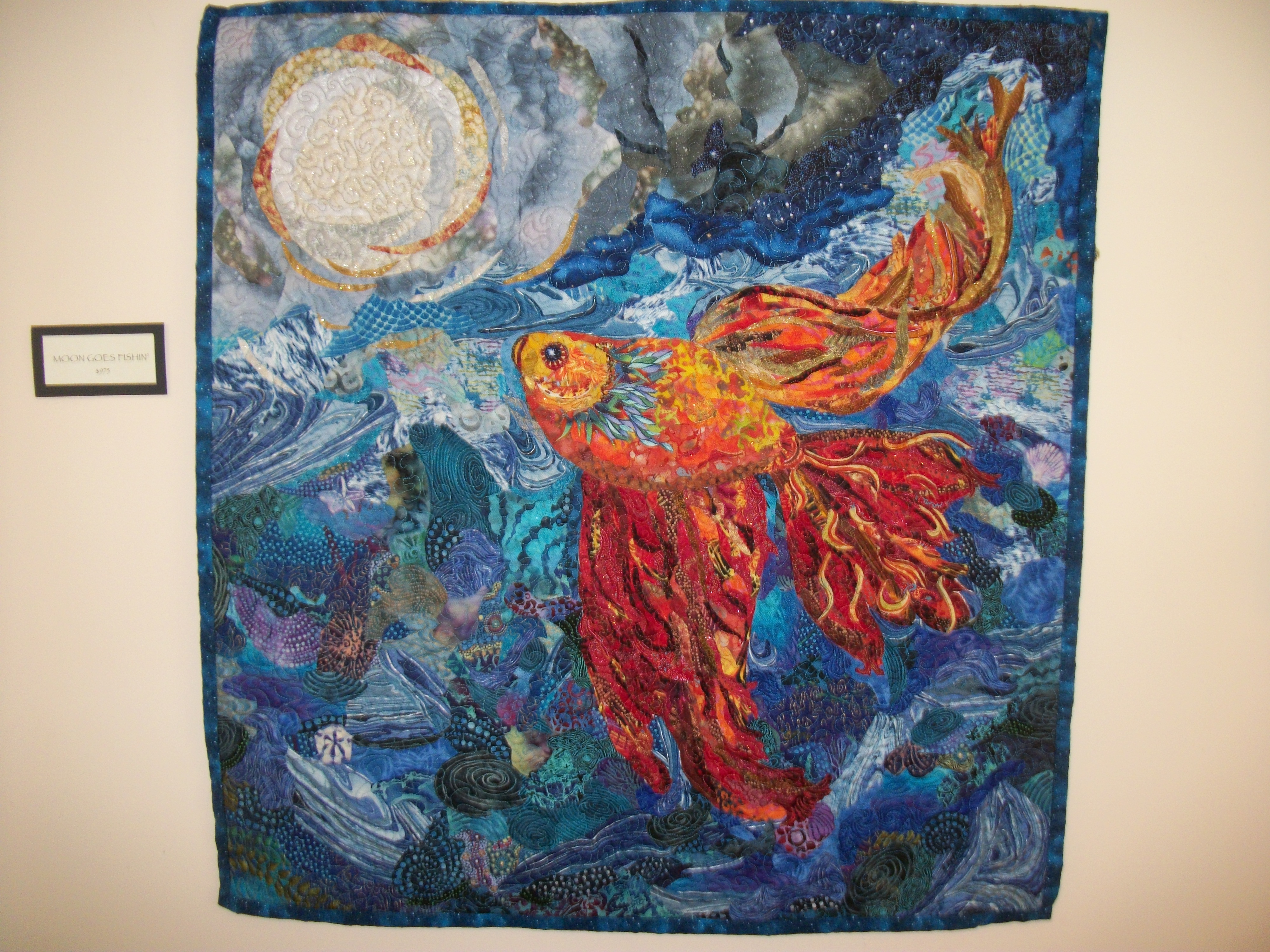
Meanwhile, here are a few of her quilts–though my pictures of them are not great:

Shepard 11

Shepard 10

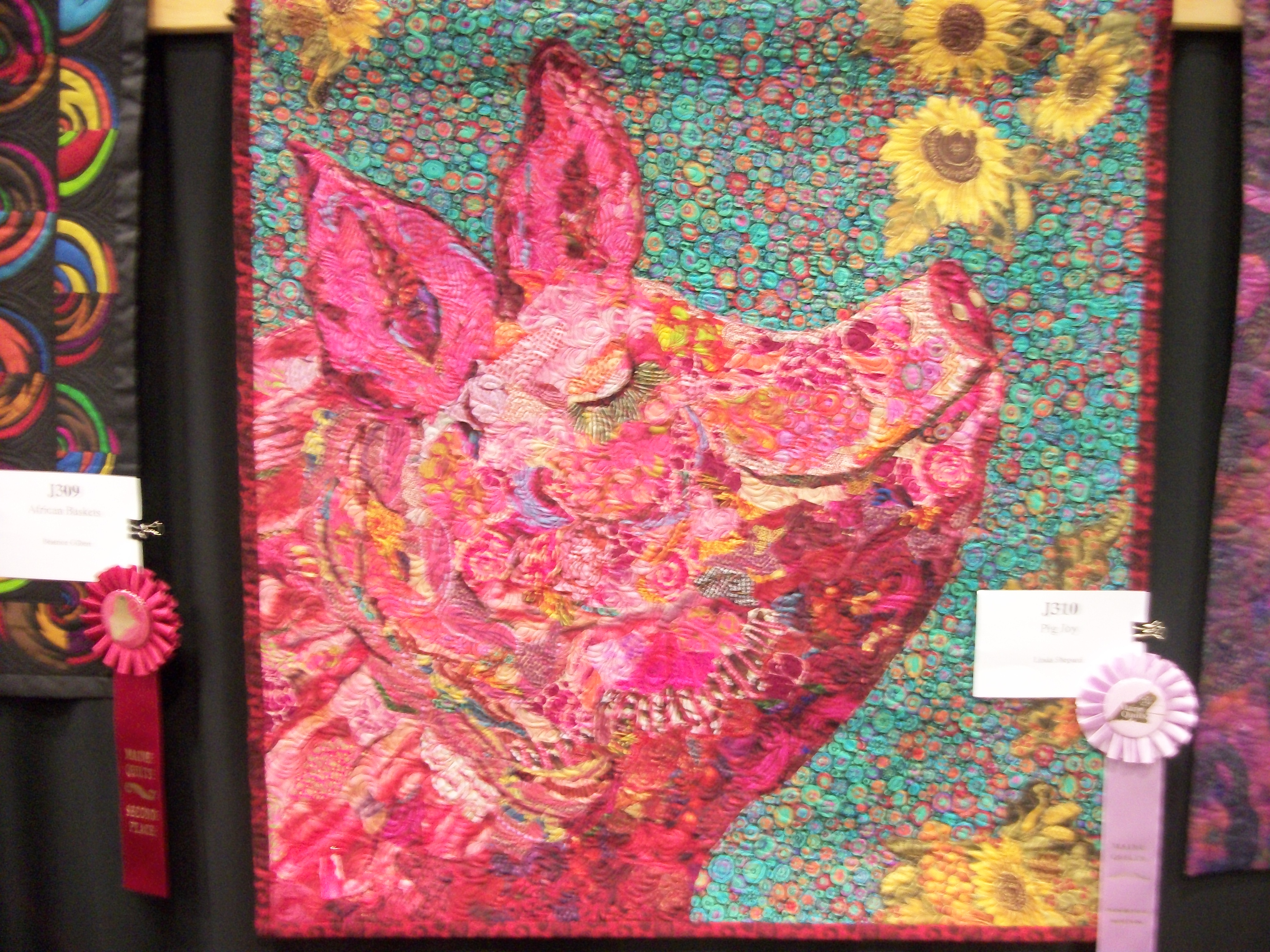
And one of my very favorites, a happy pig:

Honarable mention

Linda and John started their garden in 1984–at which time the backyard was overgrown and wild except for four old apple trees.  Artist LInda likes “the relaxed informality of country gardens” which includes contrasting heights and rampant color.  Here are some views:

Shepard 5

Shepard 4

And this pic of a very pink hydrangea!

Shepard 12

This garden is such a gift of beauty–it feels like the essence of summer with its riot of color, its buzzing bees, and its well-tended vegetables.

Turkey Tracks: Green Turtles Quilt

Turkey Tracks:  August 13, 2013

“Green Turtles” Quilt


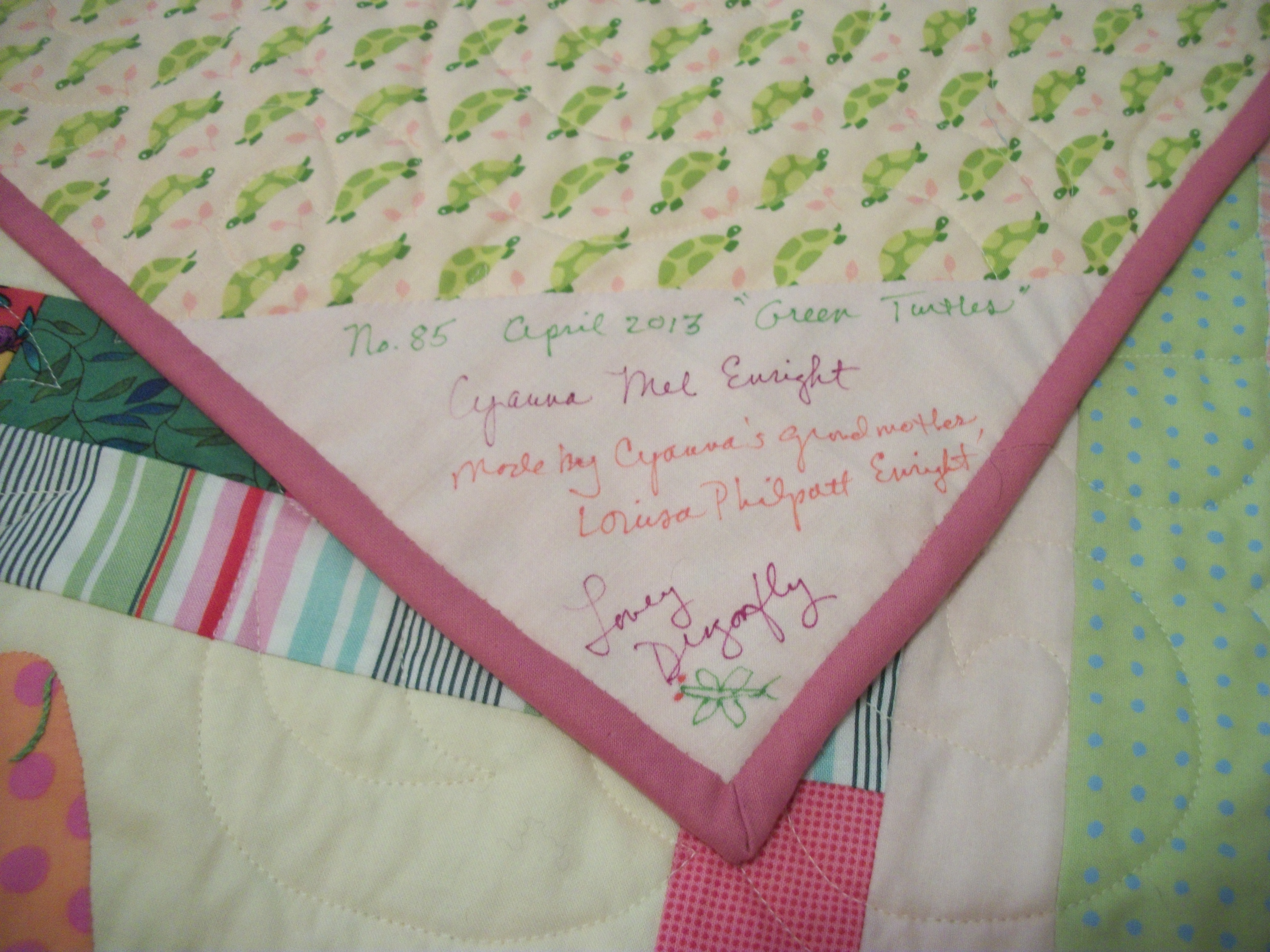
Just before Mike and my grandsons came in mid-July, I mailed my newest granddaughter, Cyanna Mel Enright, her baby quilt.

Called, “Green Turtles,” the pattern is from People, Places, and Quilts in Summerville, SC, which is just west of Charleston, SC.  They call the pattern “Happy Turtles”–and they are.

I hand appliqued the turtles and used scrappy fabrics for the borders.  I quilted with “Deb’s Swirls”–the medium version.


Green Turtles

In choosing scraps from my stash, I was reminded of other quilting projects.  Carrie and Fiona–you’ll see the pink plaid from Fiona’s baby quilt.  The stripe is from a purse project with Karen Johnson of The Community School.  Lucy Howser Stevens, one turtle is wearing the backing to your quilt of last year–the daisy floral on acid green.  There’s a fabric in here from my very first quilt, which went to JJ Viarella, who is now entering high school!!!  It’s the green on the bottom row, far right.  There is a blueberry fabric from my oldest grandchild’s baby quilt–Bowen Enright, who will be 10 in a few weeks.  And a green and pink floral/leaf that backed my niece’s quilt of last year–Mary Chandler Philpott.  And on it goes…

Here are some of the blocks:

Green Turtle block Green Turtle block 3

Green Turtle block 2

I love Bonnie Hunter’s method of putting on a label.  If you haven’t yet found Bonnie’s web site and blog, it’s http://quiltville.com.  She does a daily entry most days and highlights the work of her students all around the country–so sign up for her FB page as well.

The green turtle fabric came from People, Places, and Quilts on my April trip this year.   It seemed really fitting to find this fabric at the store that made the pattern.  The plain pink binding also came from my stash.

Green Turtles label

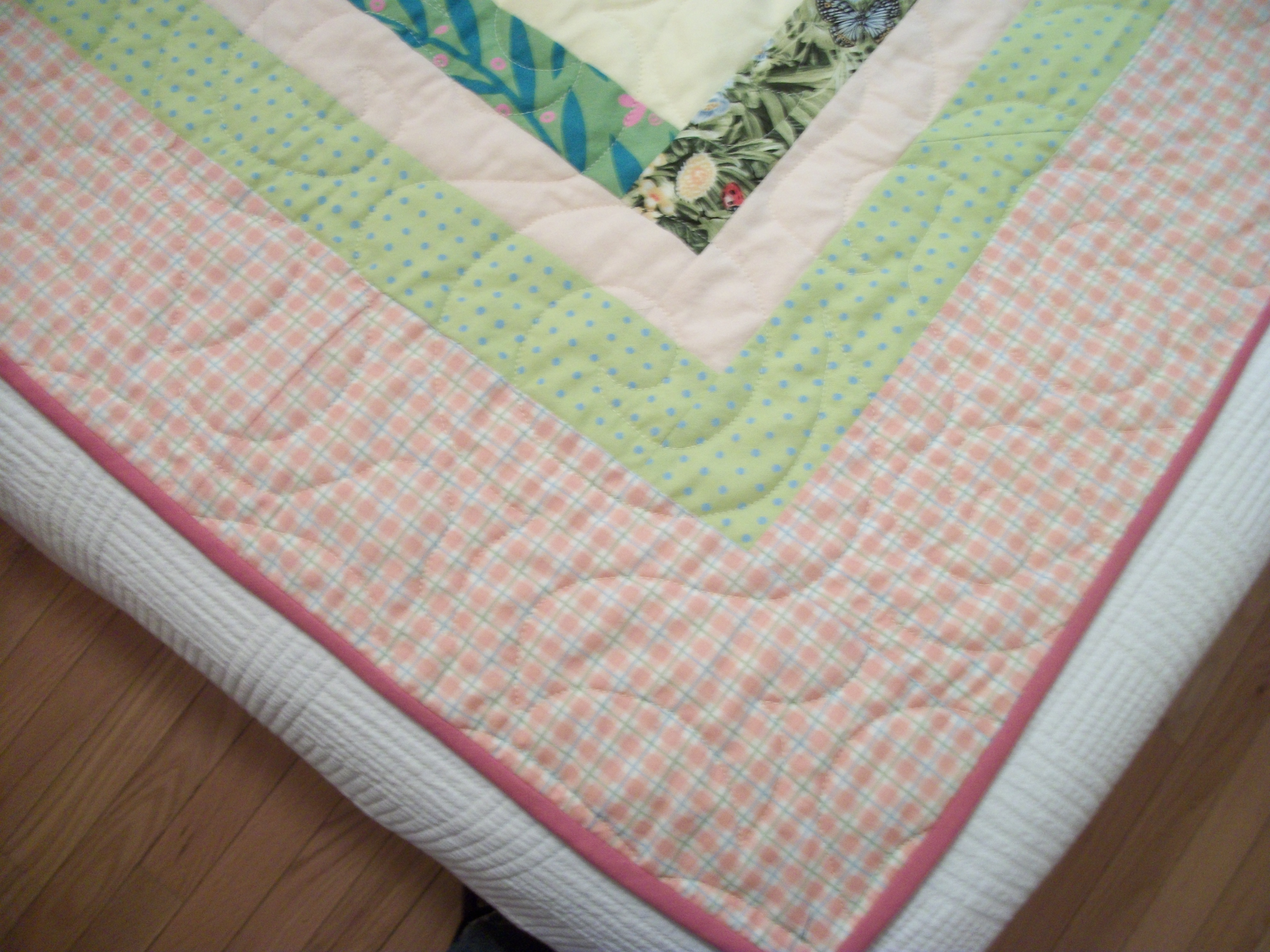
Here’s how the corner borders worked out.  I love the green and blue polka dot border.

Green Turtles borders

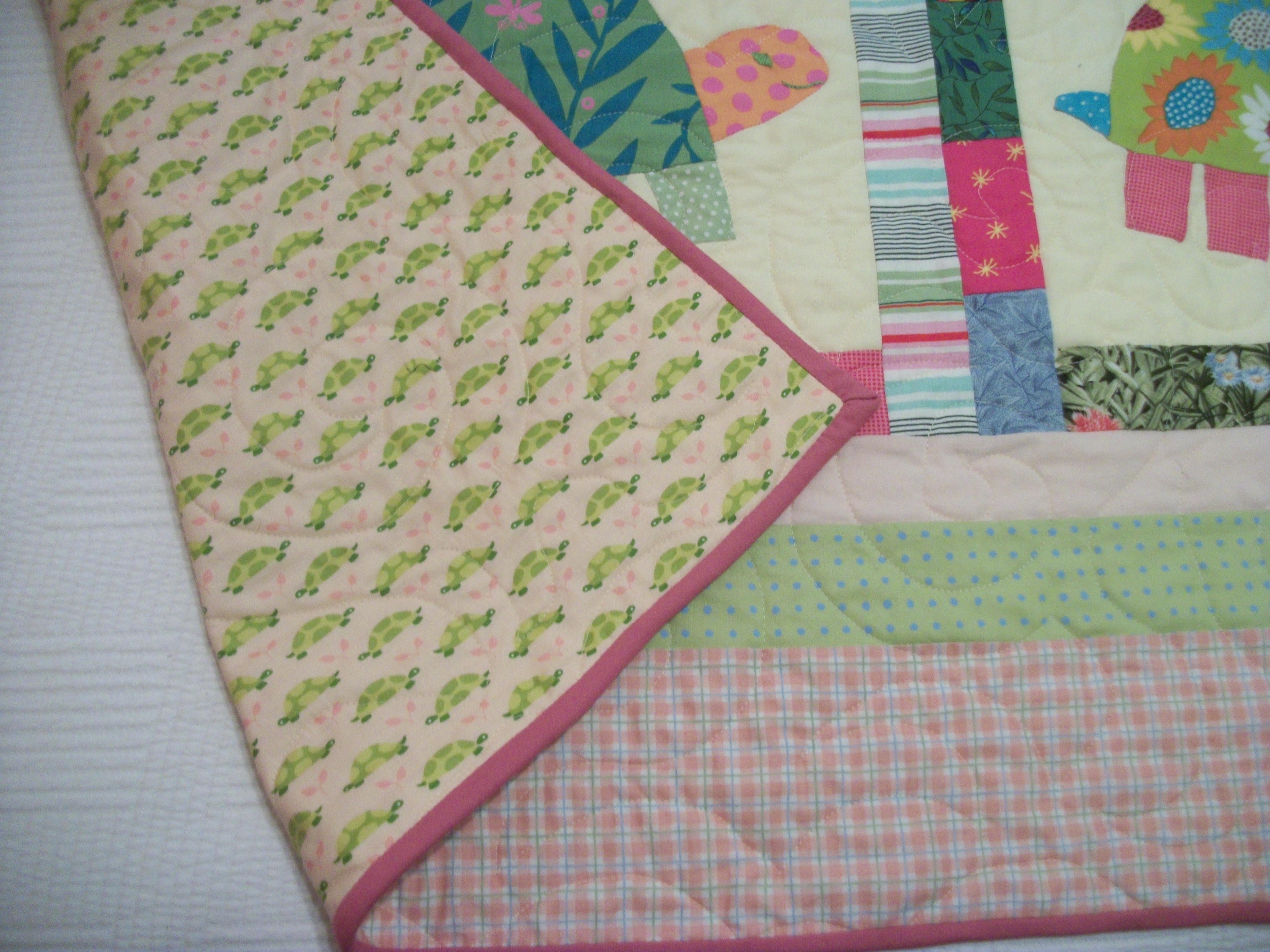
Here’s the backing and binding on the quilt top.

Green Turtles backing and binding

It’s a cute quilt, and I enjoyed the hand work.

Turkey Tracks: Gardens in the Wateshed: Fernwood Nursery Gardens

Trukey Tracks:  August 13, 2013

Gardens in the Watershed:  Fernwood Nursery Gardens

I’m starting my tenth year in Maine, and I’ve never been to the famous Fernwood Nursery until this garden tour, planned and hosted by The Georges River Land Trust.  Fernwood is owned by Rick and Denise Sawyer, so the site is their home as well as their business.

Fernwood specializes in shade tolerant plants. yes, but in native and woodland plants that are hardy to this area of Maine.  The Sawyers choose plants that do not need staking, spraying, or extra mulch to survive our climate.  They also produce their own cultivars and bring in plants from around the world that are hardy in this area.

They recently relocated, and I really like their new digs.  I found myself wishing that I had FLAT land where I could exhale and create beds and animal spaces like Rick and Denise Sawyer have created at Fernwood.  I loved everything I saw–and then some.  Such creativity, such delights for the eyes.

Again, Fernwood displays the Sawyers’ chosen life style:  their beds illustrate how their plants fit into the ecosystem in which they live and have created by choosing the plants that will thrive in the ecosystem.  They raise animals for food and fiber and organic vegetables.  They are providing for themselves and demonstrating how to do that.  Here’s a quote:  “Whether it is the wood we burn, animals we  raise, vegetables we grow, fiber we process, or soil we build, all contribute to our sense of connection to the earth.”

Here’s how the nursery is set up–this area lies at the entrance to the property.

Fernwood Gardens

And here are random shots as I moved deeper into this experience:

These kinds of wooden garden structures are a big thing in Maine:

Fernwood

Deep shade plants with garden sculptures–note the contrast of dark and light plants:

Fernwood 6

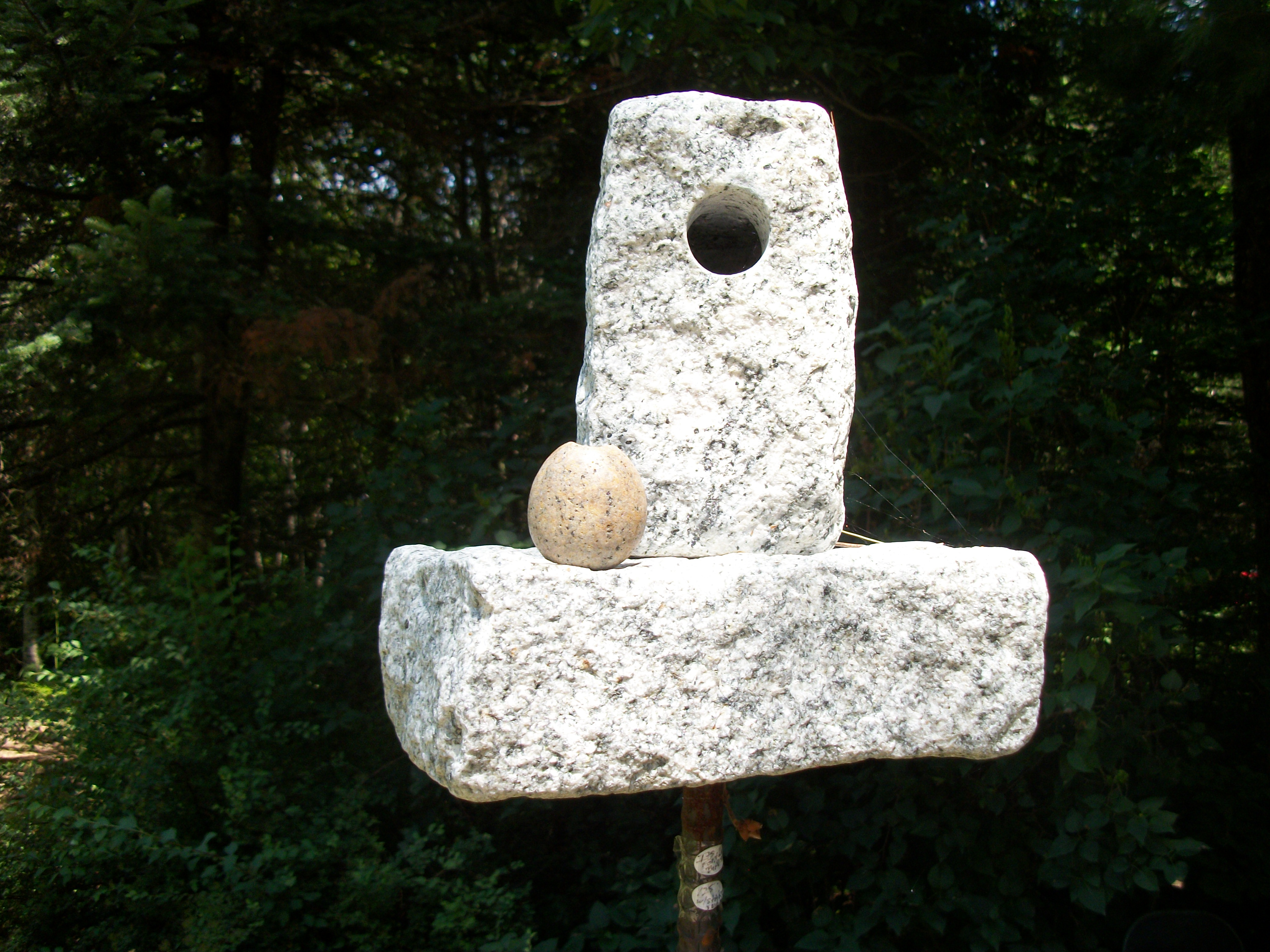
A stone garden sculpture:

Fernwood 5

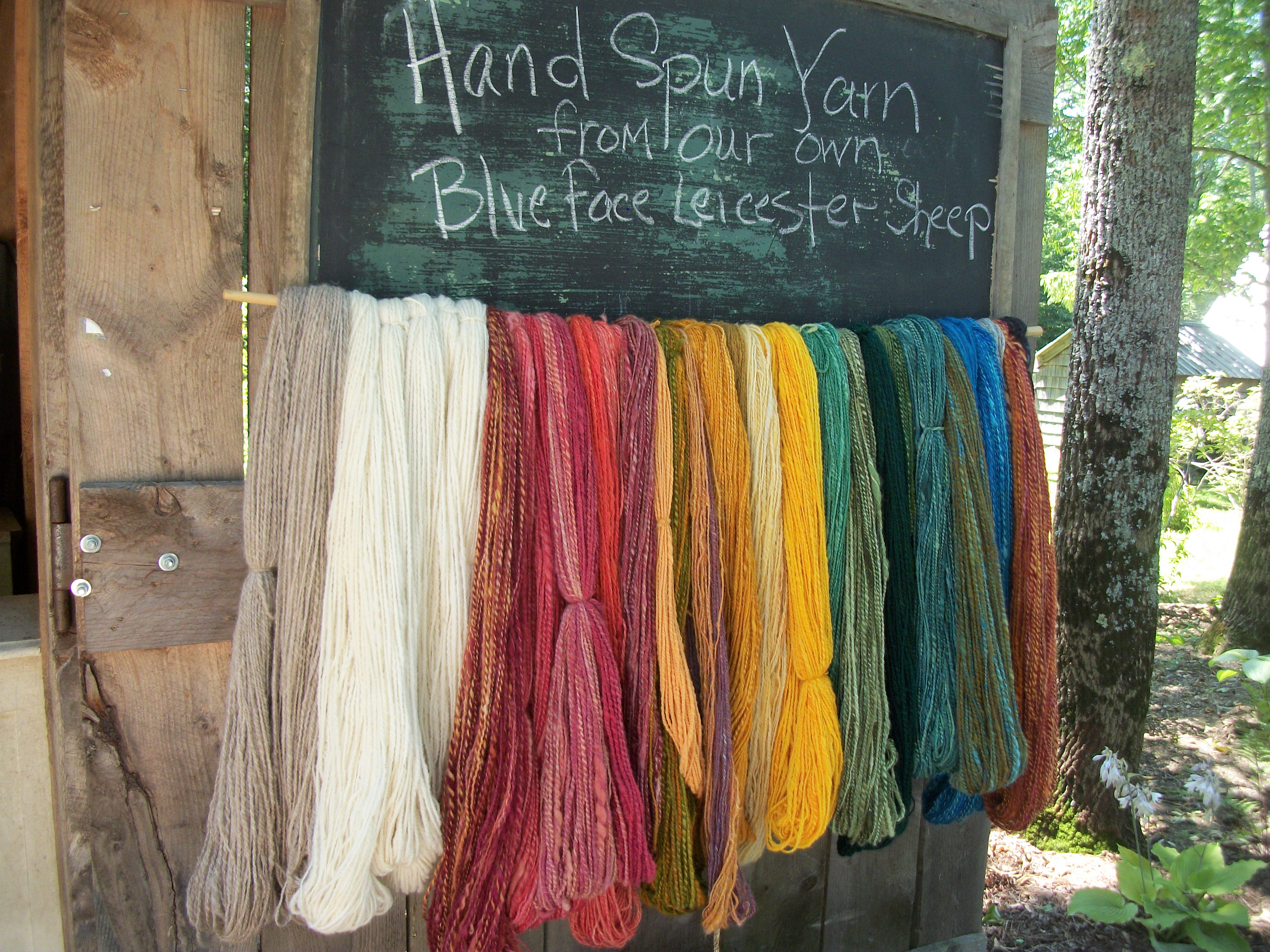
Near the center of the property the Sawyer died wool is displayed:

Fernwood 2

Here’s a close-up–which makes my fingers itch to knit…

Fernwood 3

An arched trellis leads towards the house and the home gardens:

Fernwood 7

Here’s the surprise just inside the trellis:

Fernwood 8

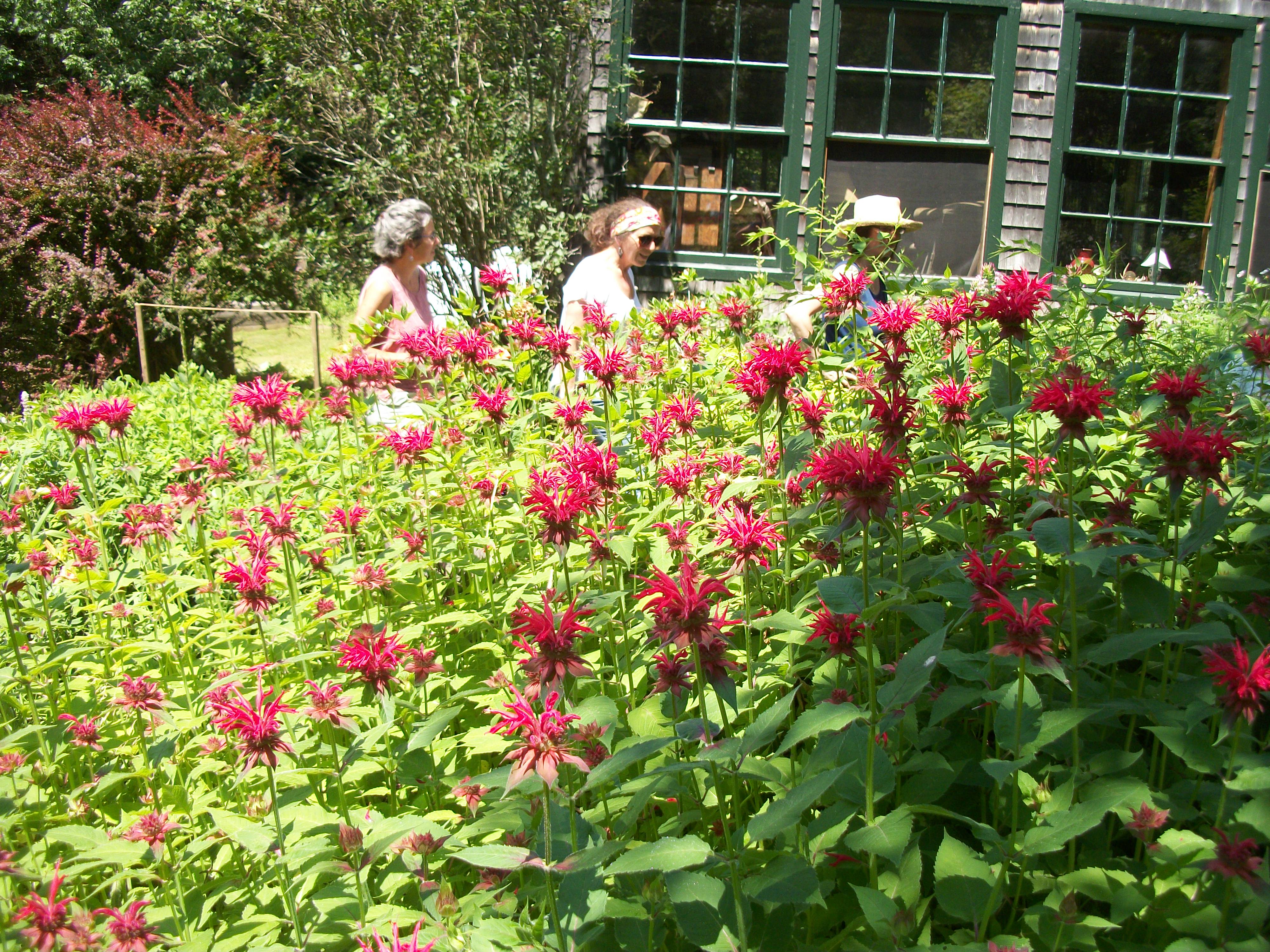
A stand of Bee Balm sits before the house:

Fernwood 9

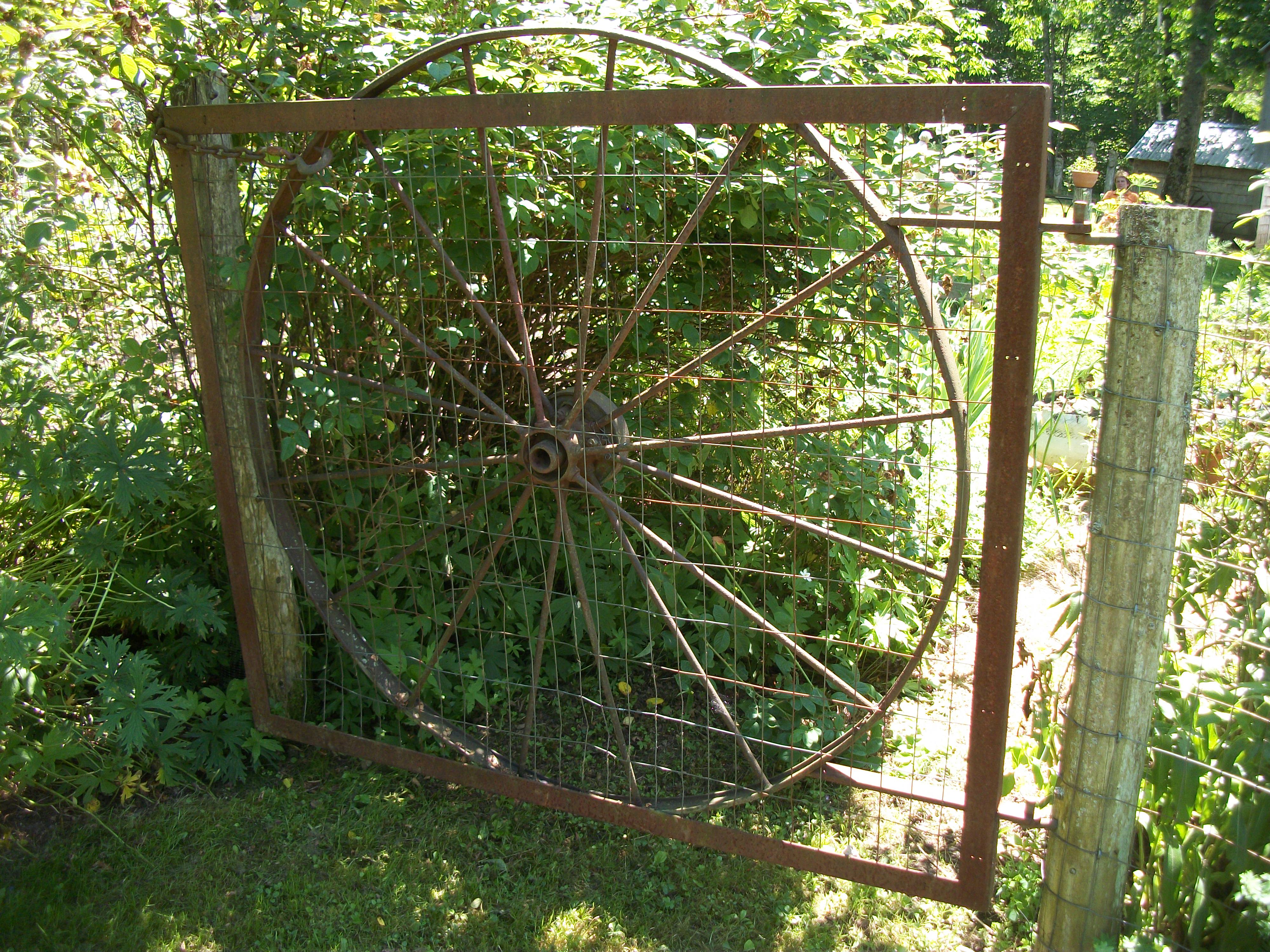
And a gate gives entrance to one of the vegetable gardens–I wish I had been taking pictures of beautiful old gates all along the way actually…

Fernwood 10

How’s this for a fabulous scarecrow?

Fernwood 13

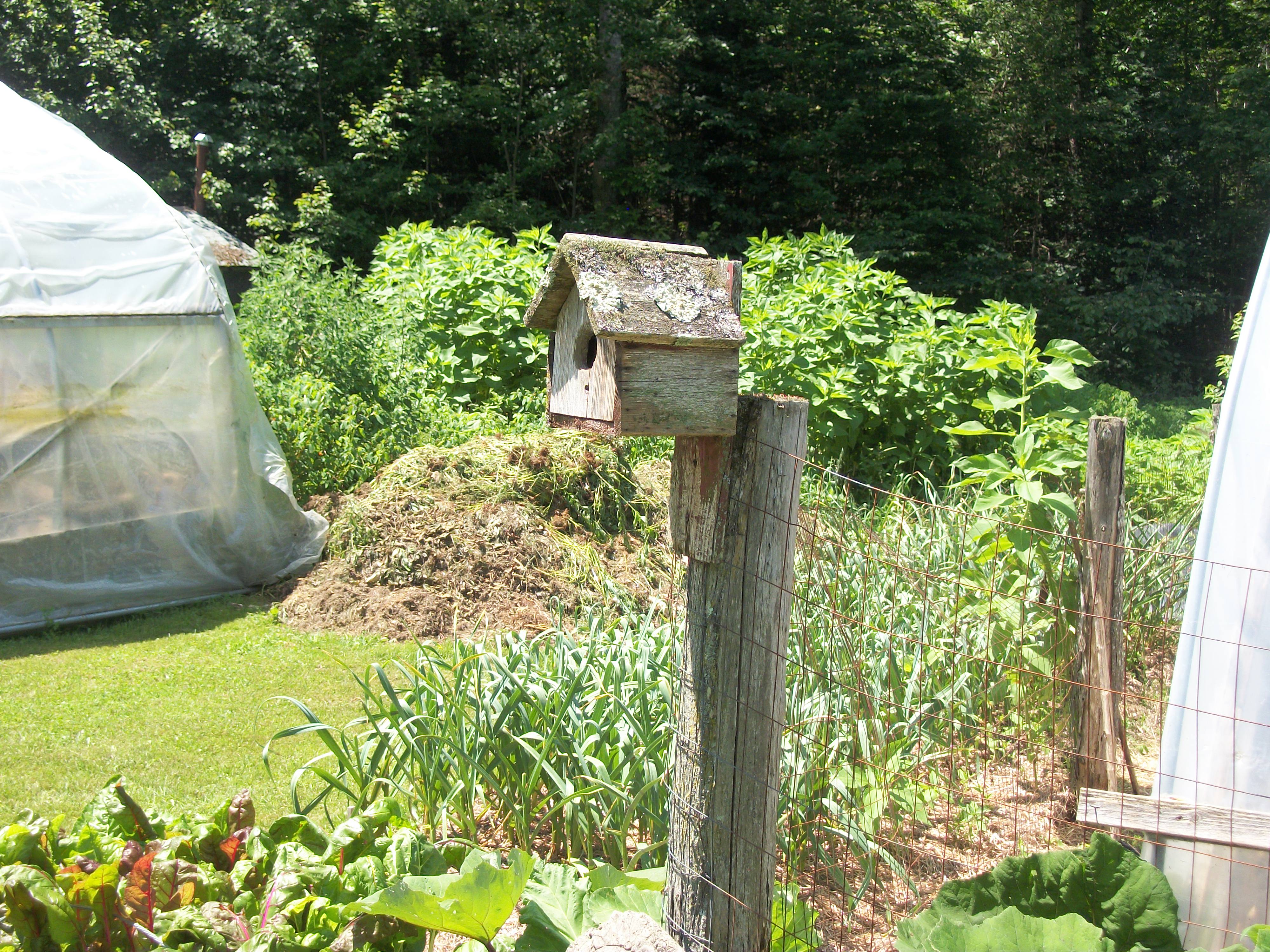
Bird houses punctuated the whole homestead:

Fernwood 11

My pictures of the chickens did not come out–and the pigs went into their house just as I tried to capture them with my camera.

But here’s a picture I liked a lot:

Fernwood 12

These figures carved from tree sections are seen frequently in Maine and always make me smile.

Fernwood and the Sawyers were an inspiration for me.