Turkey Tracks: Buzz Saw Block

Turkey Tracks:  January 16, 2015

Buzz Saw Block

Mary Sue Bishop and I recently saw a quilt made with a block that we recognized, but we could not come up with the name of it.

My old quilt bee in Virginia made me the sweetest quilt from this block with 1930s fabrics.  See?

IMG_0069


I love the piano key border…

IMG_0072

I came home and searched for the name until I found it.

I knew it was a cross kind of between a log cabin and a pineapple block.

Finally, I turned it over:  it’s a Buzz Saw block.  So I made one:

IMG_0066

This one finishes at 5 1/2 inches–and there are two oranges and two blues, so the whole unit here of four blocks would finish at 10 1/2 inches.

You start with a half-square light/dark triangle that gets cut into four equal strips.  Then one adds a solid strip to the dark-side end.  One must always cut with the same side down–in this case, the dark fabric always went to the bottom.  (If one cuts with the light side down, will that reverse the angle in the middle of each strip???)  (When they passed out spatial relations genes, I didn’t get any.)  Then you realign the strips to form the graduated color, or light, pattern.

Warning:  one tutorial I found started with a 10-inch block, which gets to 9 1/2 inches when you make the half-square triangle.  That’s not so easy to divide into four equal strips.  So….I dropped to an 8 1/2-inch block, which sews in at 8 inches, is easily cut into four equal strips which finish at 7 1/2.

Then to the 6 1/2 square, which finishes to 6, and then, 5 1/2.

The little art quilt we saw had smaller blocks:  we think 4 1/2 which would finish to 3 1/2…

The quilter had used a different setting–one which placed the lights side by side and made them rise and fall…

I wish now I’d taken a picture of it, and I will when I next visit that restaurant:  the River Grill, Damariscotta, Maine.

Meanwhile, I think I could use a fair amount of my stash with this block…

And make a fun quilt.
Turkey Tracks: Megan Brun’s Quilt-In-Progress

Turkey Tracks:  January 16, 2015

Megan Brun’s Quilt-In-Progress

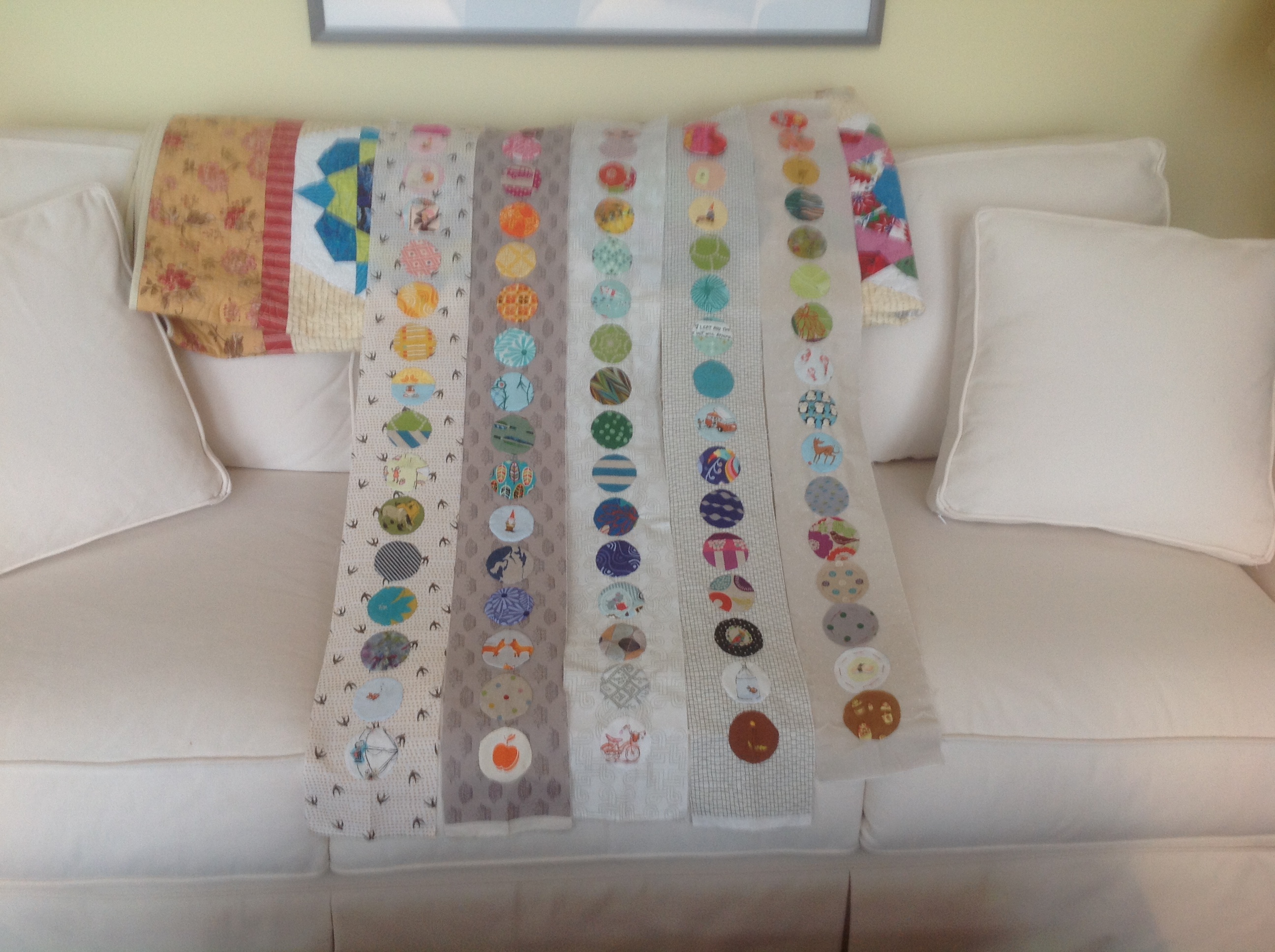
Megan came over this week for a breakfast, and afterwards, we sat and visited and worked on our hand-sewing projects.

I LOVE the quilt Megan is making.

She is making neutral panels with appliquéd circles:

IMG_0540


Here’s a close-up:

IMG_0541

As I understand this project, she will now add some half-as-long-panels with neutral circles.

The quilt is in the “modern” vein.  The panels will be only part of this queen-size quilt.  Megan plans to move out to other shapes, like big rectangles.

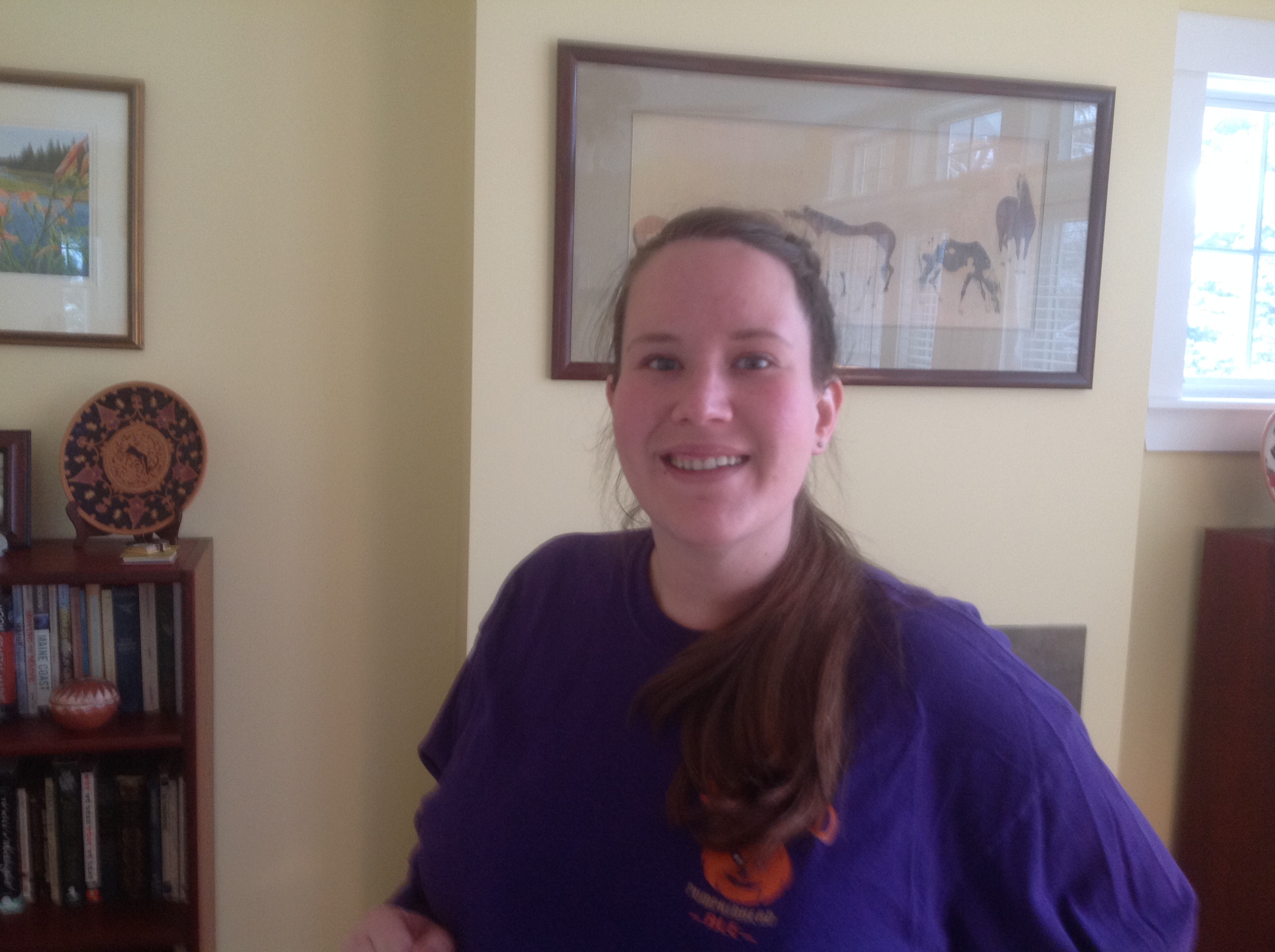
Here’s Megan:

IMG_0542

I will show you my hand project soon!  It’s getting borders now…


Turkey Tracks: Winter Flowers

Turkey Tracks:  January 13, 2015

Winter Flowers

It snowed all yesterday.  We didn’t get many inches–only about three–but it was a definite snow day.

IMG_0058

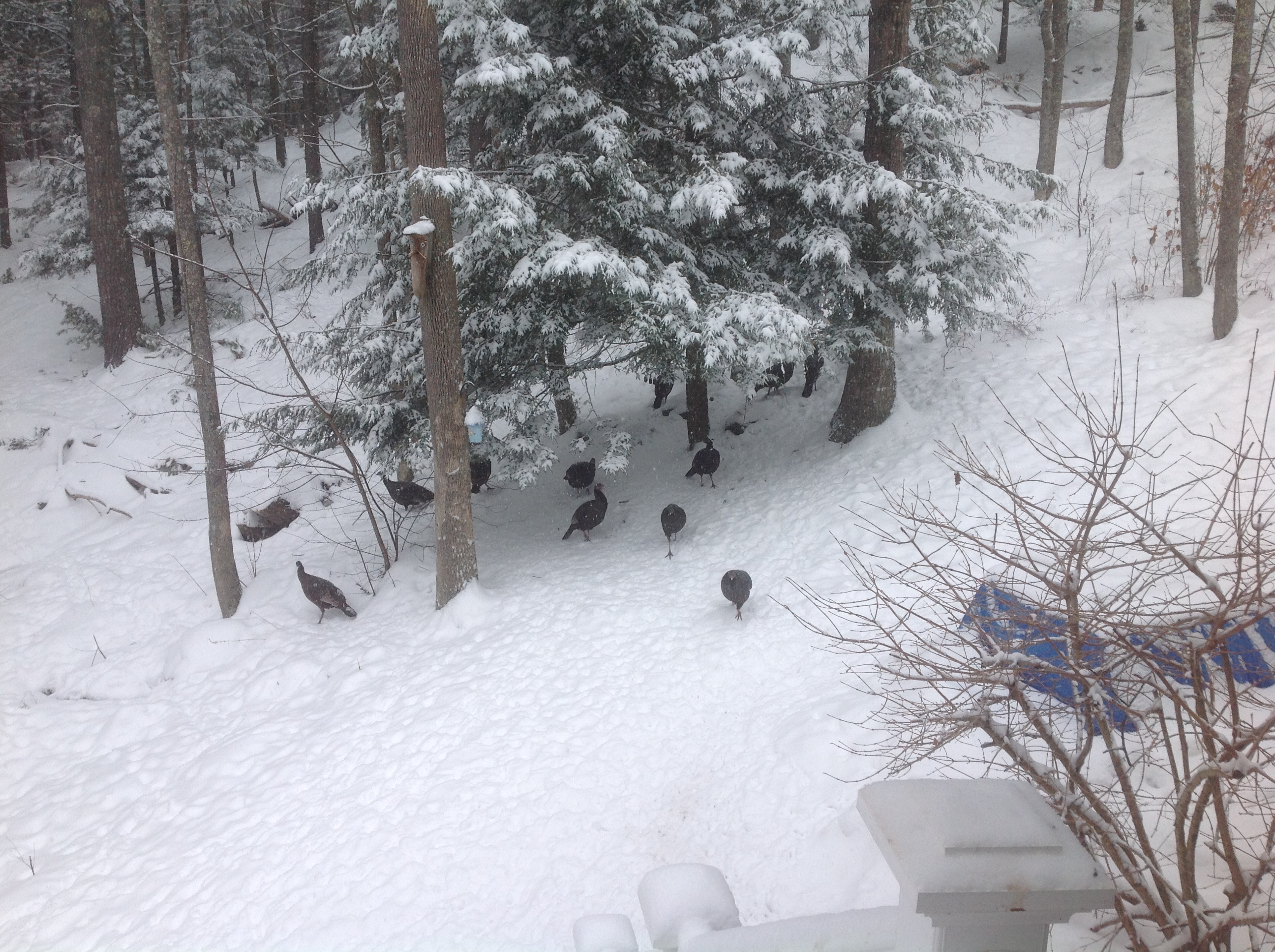
Some of the turkeys hung out beneath the big pines all day.  They were hunkered down, but when I opened the door started to come to me.

IMG_0538


In the kitchen, winter flowers are blooming and bringing lots of cheer:

IMG_0535

IMG_0536

Look at this exotic beauty of an amaryllis:

IMG_0537


More importantly, these blooming bulbs are not drenched with pesticides, as are commercial flowers.

Sad, but true…

Interesting Information: Bill Hyde: “The Real Cost Of Real Food”

Interesting Information:  January 13, 2015

“The Real Cost of Real Food”

When Bill Hyde, PhD, retired from academia, he and his wife bought a seven-acre farm outside of Denver, Colorado.

In the Summer 2014 issue of The Weston A. Price Foundation journal, Wise Traditions,” Hyde walks through what it takes to put one dozen eggs into someone’s hands.  He considers ALL of his expenses–which is something industrial egg providers do not do in order to price their eggs.  For one thing, industrial egg providers do not have to pay for the “soil, air, and water deterioration and pollution that their farm practices create.”  Nor for “remedying the health problems of farm workers and consumers caused by eating and contacting these so-called foods.”  Further, they get breaks through tax policies that favor them, and small real farmers do not.

Hyde’s list of BEFORE PROFIT expenses includes buying and raising the chick (5 or 6 months until they start to lay), shelter and a yard, mobile tractor, feed, utilities , labor, packaging of eggs, transportation, cost of land, and chicken supplies–all of which adds up to $11.52 for a dozen eggs.

Think how we use eggs today.  They’re so cheap and so available all the time (did you know chickens don’t ordinarily lay in the winter months??? or that they are SO NOT vegetarians) that we don’t value them AT ALL.  (Yes, I’m screaming at how we take eggs so for granted.)

But, but, these commercial eggs are OLD when you get them (45 days or more is ok with our government organizations), are made by hens fed inferior food, and made by hens that are terribly mistreated.  (I dare you to watch one of those videos of a commercial layer hen operation.)  That’s why the yolks of a commercial chicken are pale, pale, pale yellow–hardly distinguishable from the white.  A REAL egg yolk is bright pumpkin orange.

Again, as it cannot be said enough, REAL farmers who husband the land and their animals get very, very little support from our nation.  That’s US folks.  Hyde says the following:

Incidentally, I do not believe my situation is unique. In talking to a variety of small farmers, CSAs, and farm co-ops, I have not found one that did not (1) inherit their land, (2) receive grants, (3) use volunteer labor, (4) have a spouse or partner with a real job, or (5) have a day job themselves. While it shows resourcefulness to patch together whatever is necessary to keep a farm operating, my point is that I don’t think it constitutes a viable long-term model for feeding our nation real food.

 And they sure don’t get what the food should cost.

And that’s where a set of statistics is important to understand.  The United States has the lowest food costs in the world…  Today, the average food costs are between 7 and 8 percent of income.  In 1970, average food costs were between 17 and 22%.  As a young married, we were told to allow for 25% on average for food.  Meanwhile in 1970, health costs were from 3 to 7%.  Today they are from 16 to 17%.   Bad food that’s tainted, poisoned, and has no nutrients and fake foods that are artificially flavored and engineered to appeal to your taste buds are making us sick.

So, yes, pay more for real, clean food and pay less in medical costs.  And, taking a longer view, strive to leave a viable world for the next generations.  What we are presently doing is not sustainable.

The Real Cost Of Real Food | Weston A Price.

Turkey Tracks: Backing for Bonnie Huner’s Grand Illusion Mystery Quilt

Turkey Tracks:  January 13, 2015

Backing for Bonnie Hunter’s “Grand Illusion” Mystery Quilt

On Saturday I went to two different quilt shops looking for a contemporary fabric for Bonnie Hunter’s 2014 mystery quilt, “Grand Illusion.”

I used Bonnie’s colors–and here, again, is her version of this quilt–which is based on the colors Bonnie found at the famous Grand Hotel on Mackinac Island, MI:

IMG_0526

Here’s the backing I got:

IMG_0014


Light, contemporary, has the right colors…

And…FUN!

Turkey Tracks: “Piecing Heaven” Quilt

Turkey Tracks:  January 12, 2015

“Piecing Heaven” Quilt

My downstairs tv sitting room is a favorite place for the dogs.

And, for me.

An outside door sits at this room’s entryway, so the dogs tend to track in outside debris.  (People in Maine don’t wear their outside shoes inside.  Shoes are removed at the door.)

I have a doggie blanket on the couch–which just got recovered not too, too long ago.  But though the blanket does the protection job, it looks so shabby–as you can see below.

So, I decided to use scrappy quilts all over this room instead.  Not always spread out, but folded in key places.

Quilts that could be used, washed, and loved, loved to death.

Here’s the first one–made from my box of 2 1/2 inch strips:  “Piecing Heaven”–because I had so much fun making it.

IMG_0039


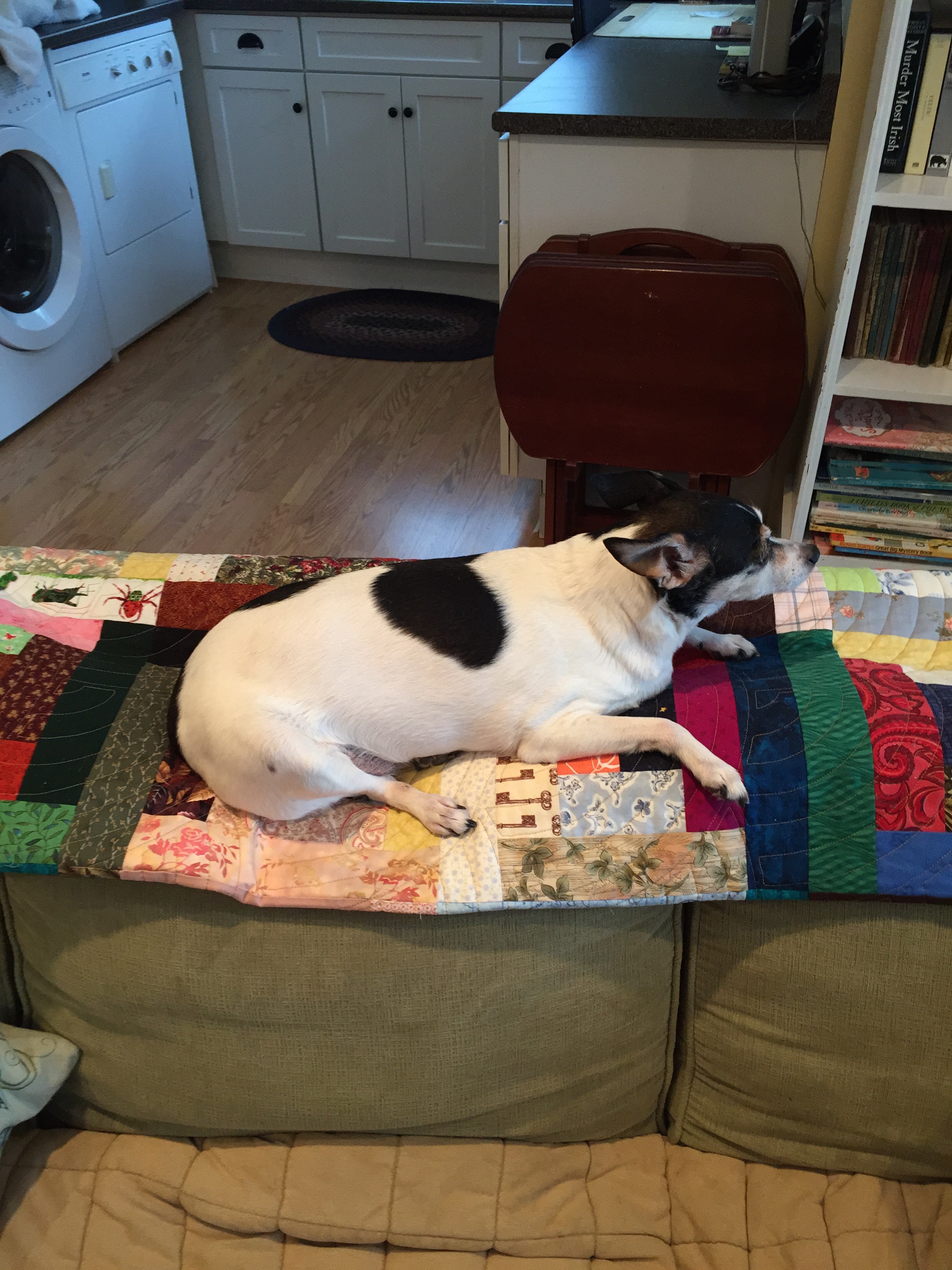
Here it is on the back of the couch.  Reynolds Georgia hangs out here a lot.  See how ratty the dog blanket looks?

IMG_0022


Here it is from the back:

IMG_0029


IMG_0026

Grandson Kelly picked out the backing fabric last summer, and I can’t wait for him to see it in this quilt.  Likely, if it holds up, this quilt will go to him at some point.

IMG_0054


I used a Bishop’s Fan groovy board and an old gold colored thread–which works fine in the quilt.  Love the Bishop’s Fan pattern.

IMG_0053


The center:

IMG_0049


A random piece…


IMG_0051


Here’s Gail Nicholson’s quilt on the orange chair–another favorite spot of Reynold’s.

IMG_0055


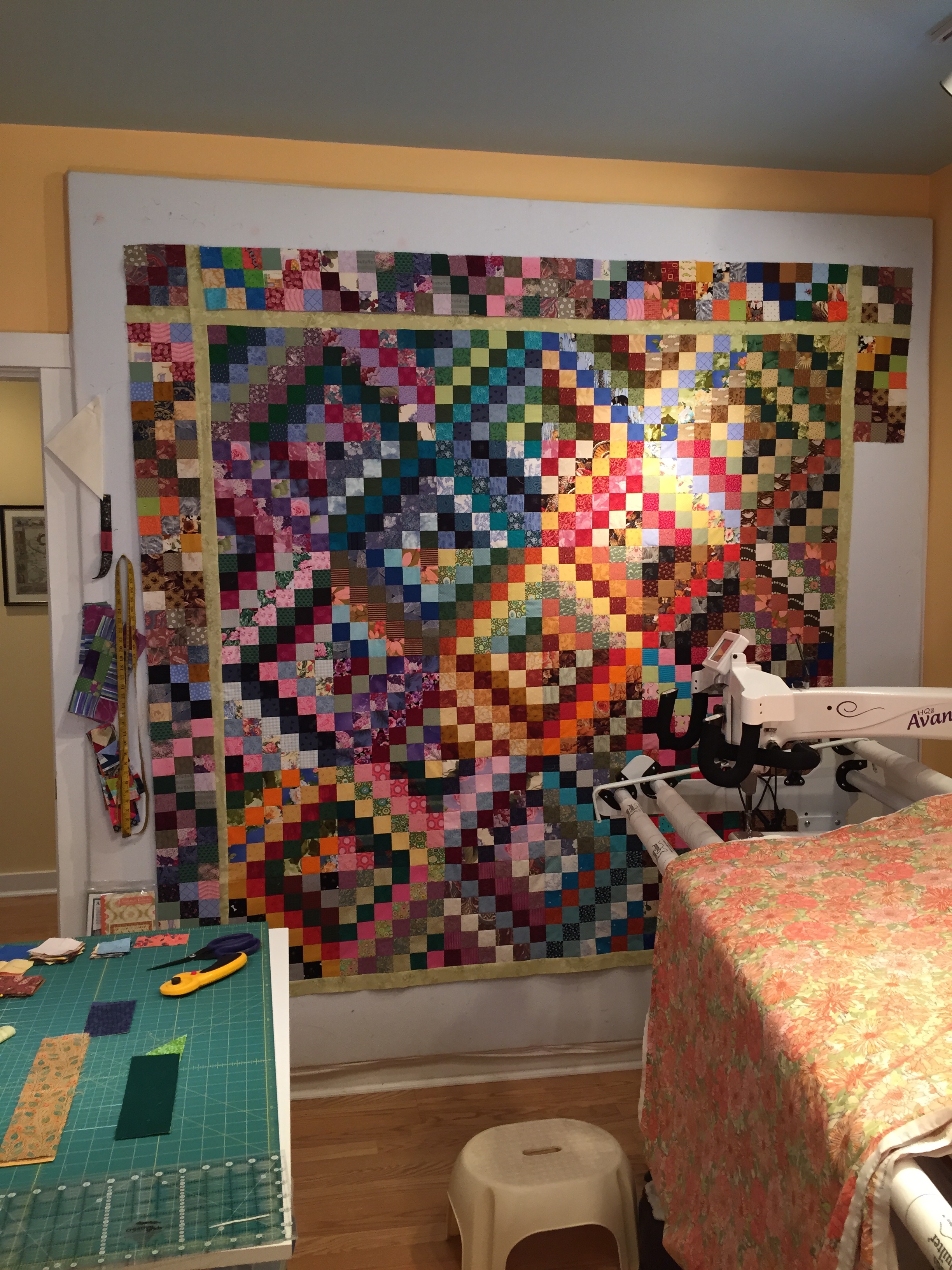
And, here’s the third quilt in this project–almost ready to come off the design wall.  I love how this quilt is coming out.  This is a Bonnie Hunter pattern, and the border idea is also on her blog:  “Scrappy Trip Around the World.”  Again, I’m using the 2 1/2=inch scrap strips to build this quilt.

IMG_0061


I got this backing fabric–on the long arm–at the Alewives (quilt shop) sale last weekend–40% off.  It will work fine, and the colors work in the big room.  With all the seams on the front, I wanted a solid backing.


Interesting Information: “Heavy Cell Phone Use Can Quadruple Your Risk of Brain Cancer”

Interesting Information:  January 12, 2015

Cell Phone Dangers

I LOVE LOVE LOVE my cell phone.

I love my cell phone in technicolor!

I have a new IPhone 6, and it’s linked/synched to my MAC and my ipad.   For the most part, whatever appears on one, appears on the others–with the exception of my Iphoto gallery, which does not seem to be also on my phone.  Probably because it would take up too much space.  But I can take a picture with my phone, and it appears on my MAC and ipad.  I can also see phone messages while upstairs (the phone stays downstairs for the most part) on the ipad, AND I CAN ANSWER that message on the ipad!

I’m even considering dropping my land line…which seems increasingly a duplication that isn’t so neat.

Except that I do talk to my sister and other family members for long calls.  A lot.

But, but, as is becoming increasingly clear (and as I’ve said before on this blog), cell phones are not safe.  Particularly for children.

The science is there.  But this cell phone thing is like cigarettes back in the day.  The science is being demonized and hidden and manipulated.  Because we all love our cell phones and because they are so, so profitable.

Mercola’s post the other day covers this topic with some sources for you to check out.

Heavy Cell Phone Use Can Quadruple Your Risk of Brain Cancer.

Do read it because there is a list of what you can do to help mitigate cell phone dangers.

And for heavens sake!!!!:  DON’T GIVE ONE TO A CHILD.  I don’t care how neat they are.  Here’s a quote from Mercola’s post:

As mentioned in the featured video, previous research has shown that those who begin using cell phones heavily before age 20 have four to five times more brain cancer by their late 20s, compared to those whose exposure is minimal.

Electromagnetic fields can and do make us sick.  I’m probably old enough to take the risk with brain cancer (70 this year).  But many of you are not.

Interesting Information: Table Salt vs. Sea Salt by Food Renegade

Interesting Information:  January 6, 2015

Table Salt vs. Sea Salt

I love salt.

Good salt.

Good salt is sea salt that has been air dried and that is, even, a moist grey in nature–like Brittany, France, salt, aka Celtic salt.

Up here in Maine, we can get really good locally dried salt.  Some of it is the moist grey variety.  Some is much whiter and dry.

Food Renegade recently did this blog entry on her recommendations for a good salt.

The one she likes is also one I buy when I can’t get our local salt.

Take a look?

Table Salt vs. Sea Salt | Food Renegade.

Also, I addressed our need for salt in one of the Mainely Tipping Points essays–No. 38.  There are other blog entries on salt myths.  If you are interested, use the search button and the word “salt.”

Also, also, you need to think about getting enough iodine if you are just using sea salt.  I supplement and eat a lot of seaweed products.

Interesting Information: Healthy Nation Coalition Letter

Interesting Information:  January 6, 2015

Healthy Nation Coalition Letter

I hope that my blog readers are recognizing that our government’s dietary recommendations have been and continue to be seriously flawed.  These recommendations are not made using the wealth of good science pointing to what we should be eating for human health.  These recommendations are being made for political and market (the good of industries) reasons.  The history of these guidelines and its outcome (rampant bad health and obesity) is both fascinating and sad.

Healthy Nation Coalition has sent a letter to government officials asking that these flawed guidelines, which are about to go even further in this wrong direction, be revamped.

Actually, nutritional advice needs to be taken out of the USDA and moved to an objective organization that has ONLY human health as its concern.

In any case, I hope that you are aware of this huge problem and that you will take a moment and read this letter as it’s instructive.

Healthy Nation Coalition Letter.

2014 in review

The WordPress.com stats helper monkeys prepared a 2014 annual report for this blog.

Here’s an excerpt:

The concert hall at the Sydney Opera House holds 2,700 people. This blog was viewed about 36,000 times in 2014. If it were a concert at Sydney Opera House, it would take about 13 sold-out performances for that many people to see it.

Click here to see the complete report.