Turkey Tracks: Winter Turkeys

Turkey Tracks:  December 30, 2013

Winter Turkeys

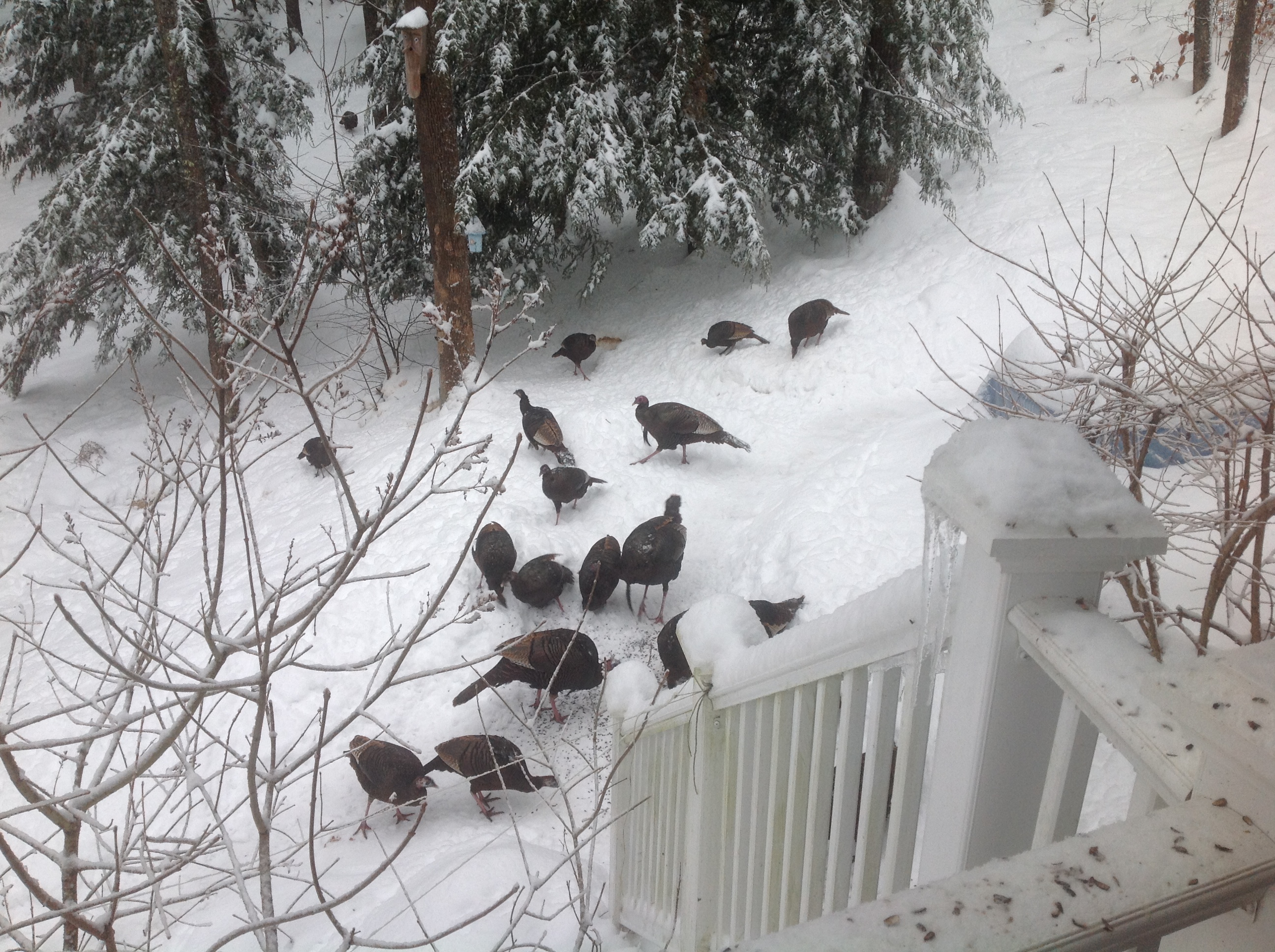
Turkeys are very present in my yard in the winter.

They’ve always been drawn to the tall pines to roost.   But, with the coming of the chickens, they started wintering with us.  They wait patiently until I discard chicken bedding under the pines alongside the creek.  Chickens “bill out” a lot of food into the bedding.  And, then, there is the matter of the chicken droppings–which are filled with protein and good bacteria.  It’s a fact that most city-dwellers don’t know, but most animals, including man, will eat the feces of other animals.  There are, of course, health claims made by men eating cow dung a few times a year…

And with weather like we’ve had recently, I often throw them some sunflower seeds or a bit of chicken scratch feed (corn, barley, etc.).

This band of turkeys is mixed male and female.  Altogether there are between 25 and 30.  It’s hard to count as they are always moving in and among the trees and up and down the hillside.

IMG_0071

I was able to get the video below of the turkeys after some days of them seeing me up close frequently.  It’s not the clearest video I took, but it shows a large male starting to display his gorgeous self.  He went on to strut around the snow yard for some 20 minutes or so.

I talk to the turkeys as much as I talk to the chickens in the winter.  Often, they answer.

Books, Documentaries, Reviews: THE BROTHERS, Stephen Kinzer

Books, Documentaries, Reviews:  December 29, 2013

THE BROTHERS

Stephen Kinzer

The Brothers is a devastating book.

It’s also a deeply “Cultural Studies” book, which is my academic area.  This book  describes a system of cultural power which allowed men who wielded their cultural power to keep the status quo in place–a status quo from which they benefited mightily.  And, again, I am drawn to the notion that there is no possibility of an actual democracy when systems of cultural power control information, government functions, and the legal apparatus in the way that they do.  The recent Supreme Court decision that allows corporations to be “people” is the culmination of this same kind of cultural power.

This book could probably only have been written 50 years after the events that it describes as the dust of history needed to settle fully.  If someone tried to write this book very much earlier–while the players were still alive–that person would likely have put him/herself in danger and at the very least would have been discredited, fired, demoted, banished–as that’s what happens when the powerful don’t like being exposed.  It still happens in America today–as I have described many times in this blog.  You betcha!

IMG_0065

We need to pay attention to the history this book details because we have not yet fully learned these lessons of history.  For instance, this morning the The New York Times reported that it is clear after its own extensive investigation of the Benghazi disaster that American intelligence and State Department people were so focused on Al Qaeda they missed entirely that local people were telling them to get out of Benghazi because the danger was local–home grown boys thought to be bought off with American aid started the Benghazi riots.

We made these same mistakes with the Soviet Union after World War II.  We, led by the Dulles brothers, created a monster enemy and then tacked onto this enemy a huge conspiracy theory–one that bore little connection to reality, but out of which we acted.  And, act we did, in the process fomenting murder, torture, and chaos across the world–all of which was unnecessary, secret, cruel, inhuman, stupid, and, yes, evil incarnate.  And all of which created genuine hatred and the “blowback” with which we live today.  The Dulles brothers, John Foster Dulles as Secretary of State and Allen Dulles as head of the CIA (which he built into an immense organization), along with President Dwight D. Eisenhower, led us into the mess we now find ourselves.

Here’s an illustrative quote from Kinzer:

During the late 1940s and early 1950s, many Americans projected the worst images of their World War II enemies, including the Nazi campaign of mass murder, onto Soviet Communism.  Americans were told, and came to believe, that Soviet leaders were actively plotting to overrun the world; that they would use any means to ensure victory; that their victory would mean the end of civilization and meaningful life; and that therefore they must be resisted by every means, no matter how distasteful (115).

Fear is a powerful motivator.  And in the hands of those who have an agenda…fear mongering is very effective.   My dad was military.  I grew up with sirens going off in the night and my dad rushing out of the house, dressing as he went.  We lay in our beds, waiting for the telephone call to tell us it was ok, just a drill.  I spent some time under school desks as well.  And, in long lines of cars practicing getting out of a city targeted by a nuclear bomb.  My family’s life was dedicated to “keeping America safe.”  Little did we know that our lives were being sacrificed so that a bunch of wealthy, privileged people could continue playing in their particular sand piles.  Or, that so we could continue to have all the riches we all take so much for granted–the resources of which came and come from many of the countries targeted by the Dulles brothers and their ilk.

Stalin was a monster.  There is no doubt about that.  But the Soviet Union had been wiped out during World War II.  And the actions of the United States–actions coming out of this projection of the Soviet Union as an enormous enemy to be feared, terrified the Soviets.  They, in turn, took compensatory actions.  But, over the years, some of their leaders reached out to the United States and were rebuffed at key moments by John Foster Dulles–who “saw” that their overtures were just plots to get us to lower our guard.

I always said that I would never vote for a military man for President of the United States, but that President Dwight D. Eisenhower seemed to be a pretty good president.

I take it all back.

Military men are trained to identify and seek out enemies and to neutralize them.  Eisenhower was no except it seems.  He was as motivated as the Dulles brothers by the specter they created of an evil Soviet Union with plans to spread communism over the whole world.  And while the Dulles brothers could present their world views to him,  Eisenhower had the power to grant them the power to try to depose and murder–yes murder–anyone they did not like.  Recent scholarship, explains Kinzer, thinks that Eisenhower used the Dulles brothers, not the other way around.

Together, these three men lied to the American people, repeatedly.  They secretly deposed NATIONALIST leaders trying to take back their countries from the nations that had colonized them and were sucking out all their rich resources.  These three men used the power and money of the United States to prevent democratically elected leaders from throwing out American corporations–which were making these men and others in their networks wealthy.  They called these nationalist, neutralist leaders “communists” and said that if they stayed in power, they would join with the Soviet Union in plots against the United States.  John Foster Dulles, in fact, was the coiner of the term “domino theory” which was used to drag us into the Vietnam War.   And the thing is, John Foster Dulles believed what he believed, and he got rid of anyone who tried to complicate his belief system with complexity, facts, or actual truth.

Kinzer describes in detail what occurred with six of the “monsters” the Dulles brothers created and sought to defeat:  Mohammad Mossadagh of Iran, President Sukarno of Indonesia, Jacobo Arbenz of Guatemala, Patrice Lumumba of the Congo, Ho Chi Minh of Vietnam, and Fidel Castro in Cuba.  All of these men were trying to be “neutralists” and to not become engaged with the battle lines drawn by the Cold War rhetoric that reduced the world to two ways of being:  capitalist and communist.  But the Dulles brothers and Eisenhower would not allow nations to be “neutral” if they could force them into the USA camp.

I read quite a bit about the shoddy history of Vietnam when I went back to school.  And I knew we installed a friendly Shah in Iran, but I did not know just how we did that and who we deposed.  I knew about the cesspool created in Cuba by American interests–from the mafia to American corporations.  I did not know so much about Sukarno and Indonesia.  And I am still sick at heart after reading about our role in Patrice Lumumba’s terrible death.  (The uranium that we used in the atomic bombs we dropped on Japan came from the Congo.)  What I like about this book is that Kinzer has put all of these events in one place, so readers can see the full extent of what was done in the name of the American people.

One piece of history I took away from this book is how alone the US was in its refusal to “see” nationalism and neutralism as an OK place to be.  With the possible exception of Germany, most European nations did not agree with the United States’s stark views about good and evil.  (John Foster Dulles supported, liked, and admired the Nazis long after other Americans had seen them for what they were.)  And Britain, often our staunch ally, refused to participate.  Churchill, in fact, loathed John Foster Dulles.  He thought Dulles a “narrow-minded ideologue and deplored his vivid denunciations of Communism.” Churchill noted after one of their meetings that Foster Dulles “`is the only case I know of a bull who carries his own china shop around with him’ ” (201).

In addition, Allen Dulles early on put CIA teams into fifteen countries in Europe that were charged with creating underground armies “that would be ready to rebel and spread terror in case of Soviet invasion or the election of leftist governments” (135).  Kinzer notes that the Swiss scholar Daniele Ganser “reported that in eight of the fifteen countries where the CIA shaped `stay-behind’ armies–Italy, Turkey, Germany, France, Spain, Portugal, Belgium, and Sweden–`links to terrorism have been either confirmed or claimed’ ” (136).   And the CIA Allan Dulles built had plenty of money and virtually no oversight beyond those men who agreed with what it was doing across the world–and that agreement was often formed by their own economic self interest or their need to be part of the cultural power structures.  (Does this sound a bit like the NSA thinking its ok to tap the phones of world leaders?)

The Dulles brothers were born into seats of power and wealth.  They also came from a family of Calvinist Christians who believed that they owned and understood all “truth”–and that they, and America, as all were “exceptional,” were tasked to be major players in the internal battle between good and evil–which is why they sought out “evil” to fight.  Again, John Foster Dulles was a smart man who was so wedded to his ideology that he became a very dumb man. He had no flexibility and could not “see” beyond his belief system.  He put all the complexities of the world into a simple good/bad world view.

But, Allen Dulles was quite different. Allen was a curious combination of someone who liked people, but seemed to have no empathy for them.  He was a womanizer of monumental proportions–and sought out women, wine, song, playing, debauchery, for his whole life.  At one point, he was sleeping with Henry Luce’s wife while Luce was sleeping with Allen’s girlfriend.  From the beginning, Allen was drawn to the secret, covert life he lived.  He was a danger junkie in many ways–if only from the safety of his office desk for much of his life.  He was not in any way a deep thinker–but a devious, cunning man who led his men into dirty, dirty tricks across the world in order to get his way.  One cannot read the saga of Patrice Lumumba without feeling enormously dirty oneself.  In the early CIA, Allen hired men like himself–men born into wealthy, powerful families who were bored.

The ends do not justify the means.

And I do not understand how anyone professing to be Christian can think that justifying the “means” is ok.

Kinzer’s book is an important corrective to the history that we have been taught and have told ourselves since World War II.

I think you should read it.

Kinzer is primarily a journalist, not a trained historian.  But here he is doing what good journalists should do:  inform, not entertain.  He is the author of All the Shah’s Men, Overthrow, and Bitter Fruit.  He served as the New York Times‘s bureau chief in Turkey, Germany, and Nicaragua and as the Boston Globe’s Latin America correspondent.  He is a visiting fellow at the Watson Institute for International Studies at Brown University, where he teaches in the international relations program.  He contributes to The New York Review of Books and is a columnist for The Guardian.
Turkey Tracks: God Bless the Generator!

Turkey Tracks:  December 27, 2013

God Bless the Generator!

It’s saved me before.  But this time it saved me BIG TIME!

It’s one thing to be without power in the summer when it’s warm.  It’s quite another to be without power and to have no other heat source, like a fireplace or a wood stove, with temps moving toward the teens.

The ice storm started Monday, December 23rd.  And the power went out late afternoon.  The Big Girl kicked in without a moment’s hesitation and ran for 24 hours.  We got power back in that same late afternoon time frame on Christmas Eve and kept it until 4 a.m. Christmas Day.  I know the time because Miss Reynolds Georgia woke me asking to go out, and the power went out just as we were tucking ourselves back into bed.  And, again, the generator ran flawlessly until power came back about 9 a.m. Christmas morning.

I had power, but no phone, internet, or tv.  Fortunately my cell phone worked and, sometimes, took in email.  But, not everyone has my cell number…

I was nervous about the amount of propane the generator was using, and by Christmas Day, my tanks were down to between 40 and 50%.  So I’m going to need a fill-up very soon now, and that’s in the works.

I have been such a beneficiary of so many kindnesses during this Christmas Ice Storm.  Our neighborhood checked back and forth frequently–“how are you,” “do you need anything,” “are you warm,” “the power trucks are on the hill…”  Chris Richmond, just above me on the right, stopped in personally to make sure I was ok.  And he and Susan–they own Golden Brook Farm–invited me for Christmas Dinner (which was fun and delicious).  I especially enjoyed spending time with the Richmond children.

Mark Anderson of Mark’s Appliance drove all the way up here from Warren to make sure I had enough propane when he couldn’t get me on the house phone.  He discovered an outside faucet that was slowly leaking and fixed it. That could have meant an inside burst pipe. And he will make sure that I actually get a propane fill up in the next few days.

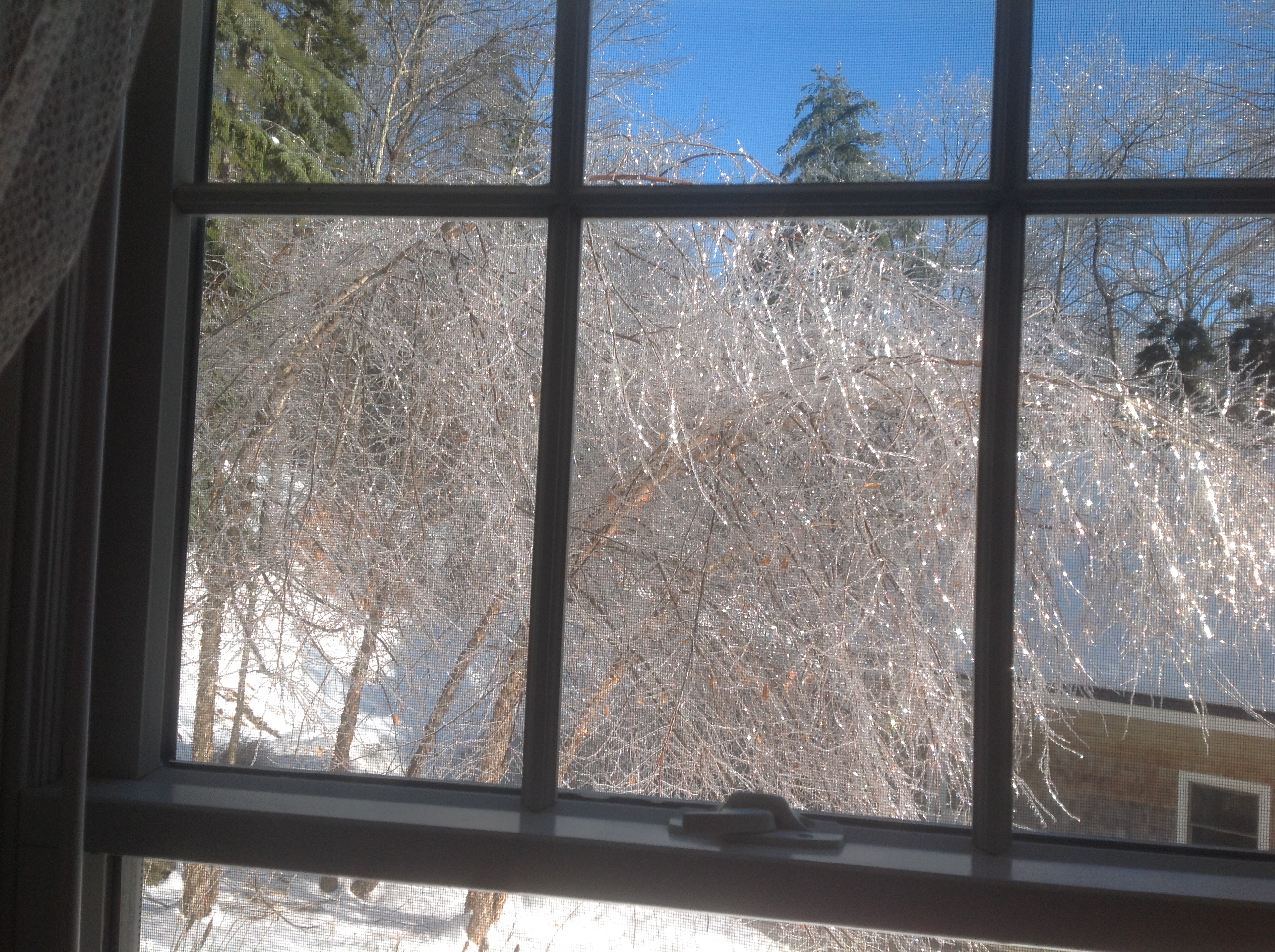
The ice is still with us.  Here’s a picture I took Christmas Day, and nothing has changed.

IMG_0058

When you see the bending of the trees, you understand how the weight of the ice breaks off branches and snaps trees as if they were match sticks.

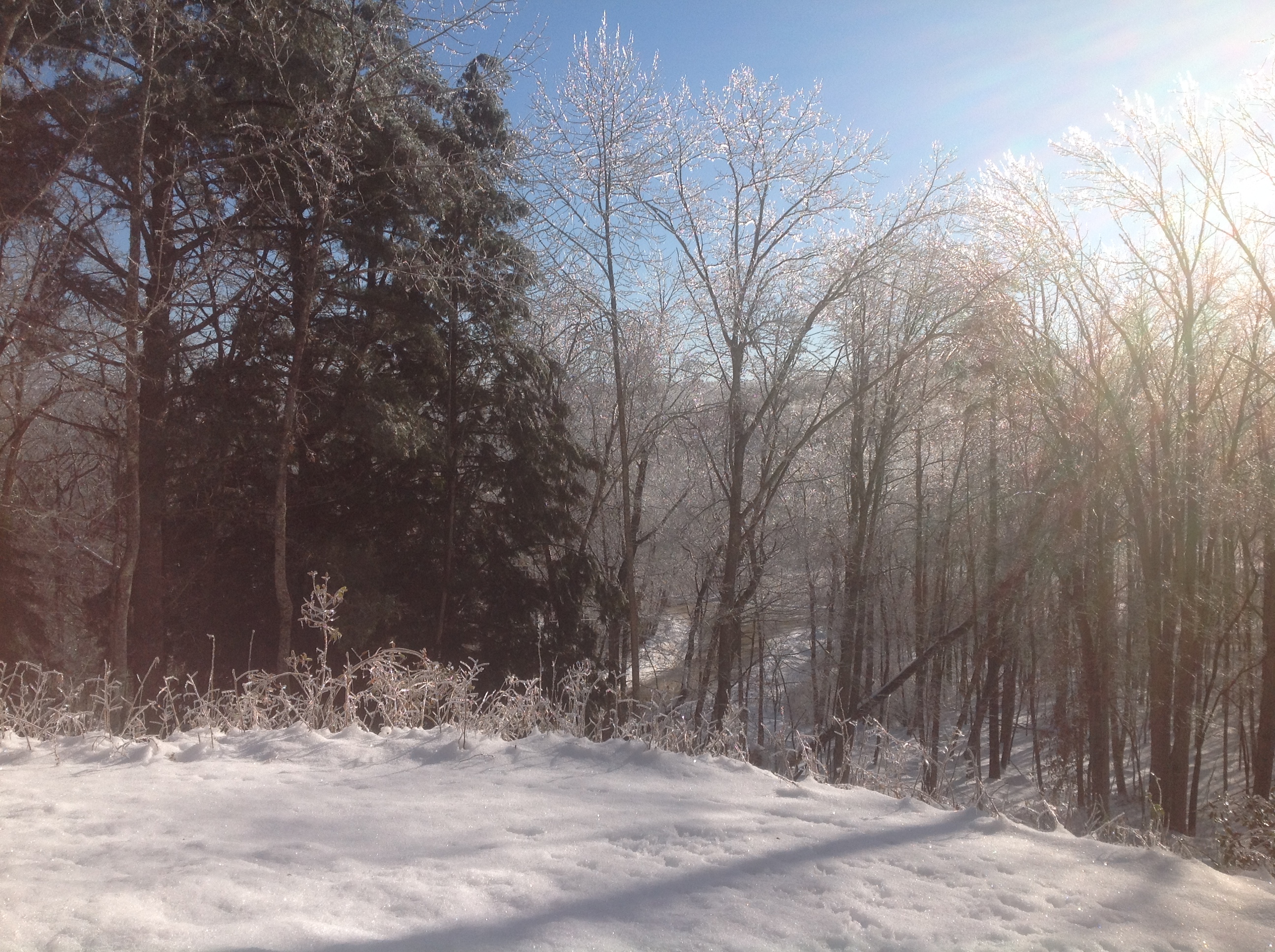
I tried to take pictures of the glitter when the sun hits the trees coated with ice–it all sparkles like spun sugar.  But you can’t get the sun backlighting the ice:  the picture comes out too dark.   So this picture gives you some idea of how everything, everything outside was and is covered with ice–which, except for the firs which present a darker surface in the sun, is not melting.

IMG_0055

It snowed most of yesterday–we got about 5 inches.  BUT, I got cable back this morning–and phones and internet.  AND today is Friday, so Bonnie Hunter has released her next clue.  I just printed it out, but have a quilt on Lucy the long arm and need to finish and bind it before I can work on Clue 5.

I am warm and happy.  It’s amazing how much we have come to depend on all of our technology…

December has been really challenging in Maine:  two back-to-back snow storms, each with about 2 feet of snow; an ice storm that did major damage–many people will not get power back until some time next week–right at Christmas; and snow all yesterday.  What will January and February be like???

Turkey Tracks: Coping with Ice and Quilting Clue No. 4

Turkey Tracks:  December 22, 2013

Coping with Ice

And

Quilting Clue No. Four

My sister Susan, down in Virginia Beach, Virginia, loves to follow the weather.  But, like me, she grew up with ice storms and has a healthy respect for them.

She called today to make sure I was carrying my cell phone when I went outside in the ice.  (I hadn’t been, and that was perhaps foolish).  Friend Giovanna McCarthy just wrote me to urge me to carry it when going out to the chickens, too.  So I promise to from now on.

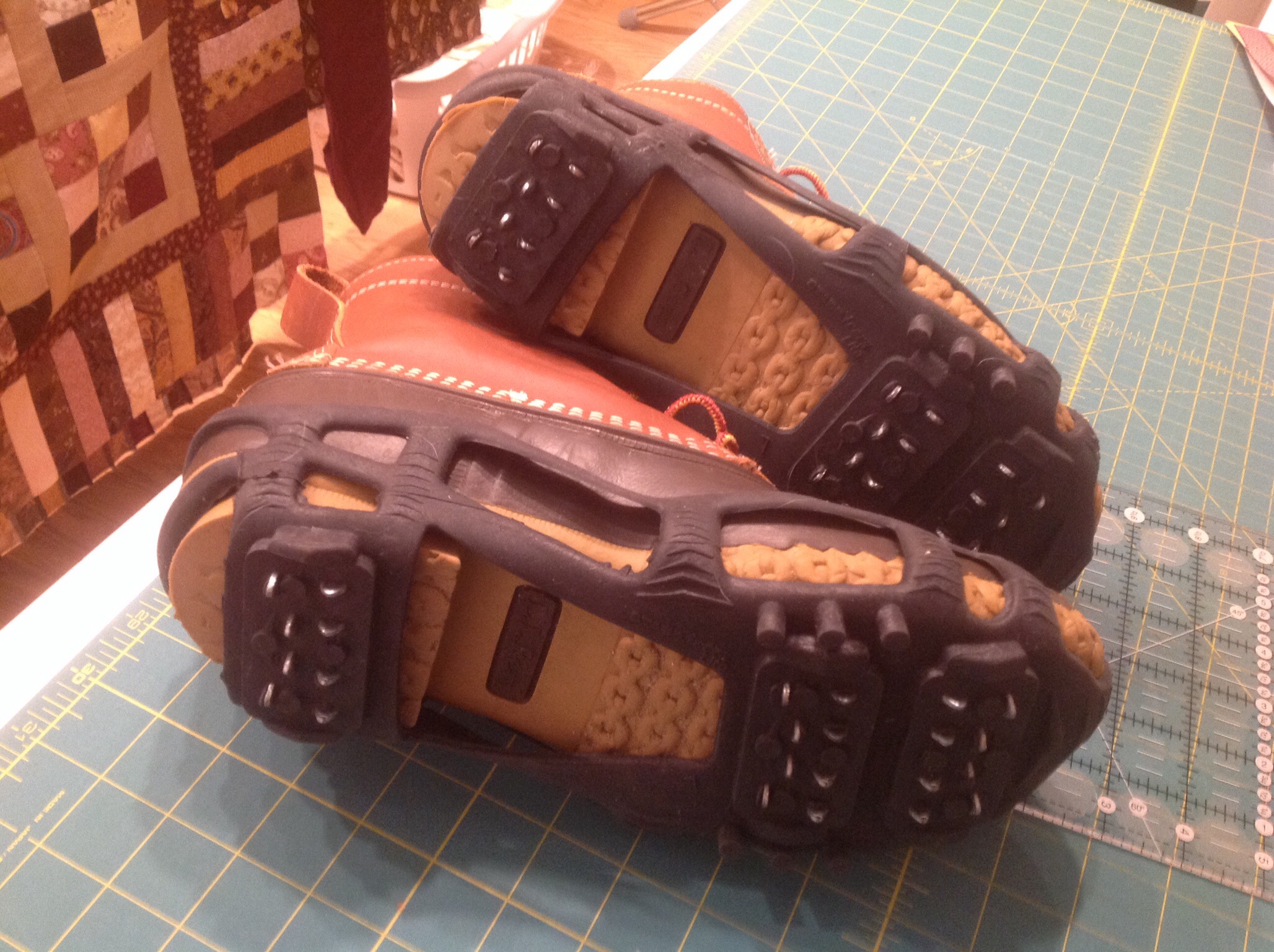
BUT, here’s the best protection of all:

image

With ice cleats on the boots, one doesn’t slide.  Or find oneself upside down on the ice.

I used the cleats and took along John’s cane for extra balance on a trip to the garage for chicken feed.  Not a single slip.  They are really great.  No wonder people use them for winter hiking.

I have two pairs of these really good kind with spikes on the bottom–so I put one pair on the LLBean boots and one pair on the chicken-muck-out-the-coop boots that live upstairs by the back door.

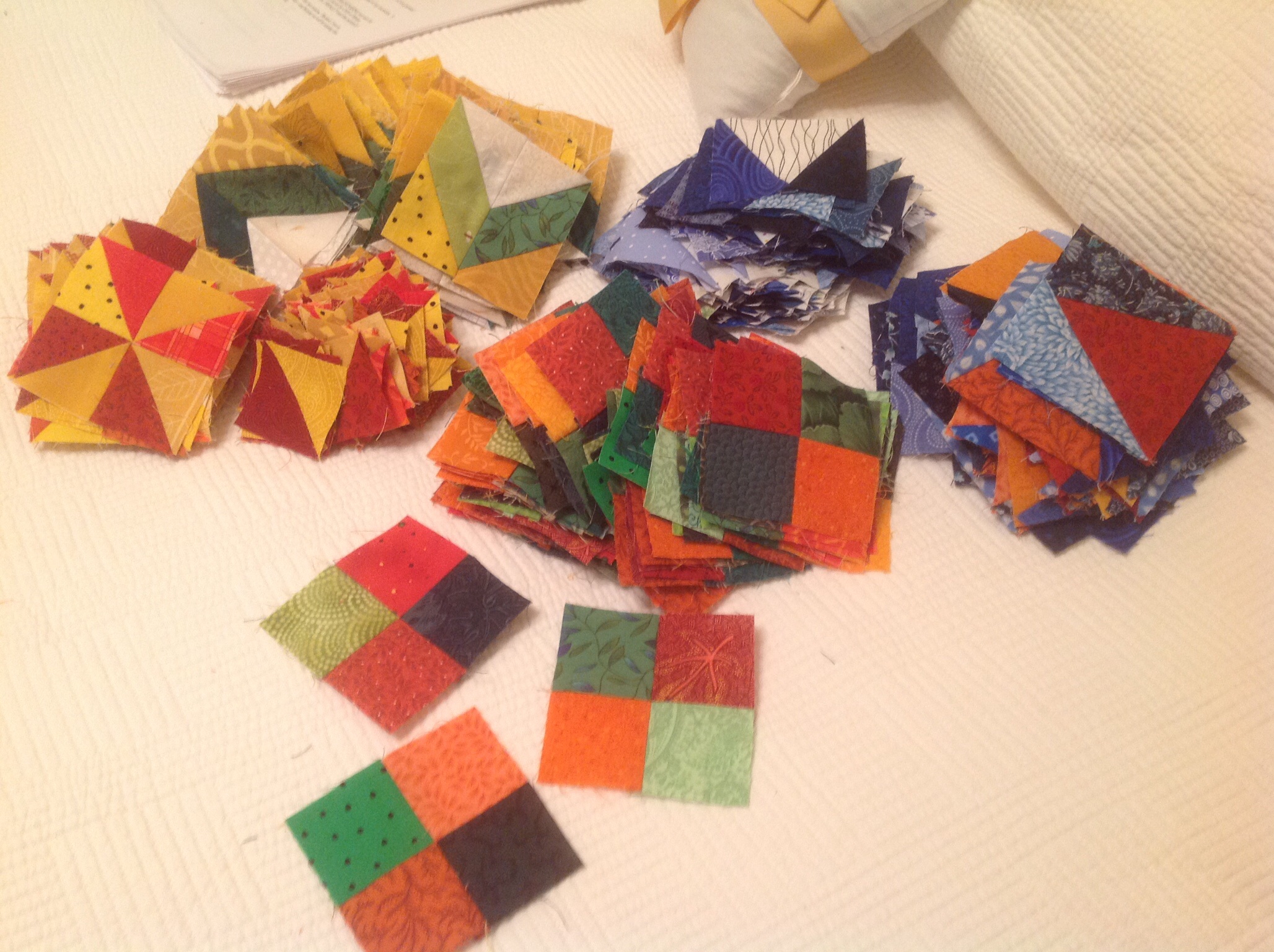
I finished Clue Four of the Bonnie Hunter 2013 Mystery Quilt–120 four-patches in orange and green:

image

So, the pile of finished units is growing.  And excitement about how the units will go into the quilt is also growing.

Now I will work on the other quilts  I have in progress and wait for next Friday’s Clue Number 5.


Turkey Tracks: Ice!

Turkey Tracks:  December 22, 2013

ICE!

This ice storm has been predicted for days now.

And sure enough, I woke this morning to a layer of ice on every surface that would hold it.  And the temps are hovering around 32 and slated to dip into the teens over the next few days.  Really cold weather means that the ice will hang around until we get a melt.

Here’s a not-so-good picture of ice on the trees:

image

The trees will bear this much ice without breaking.  The danger of power outages will come of the ice gets any thicker.  And that’s where the weather reports are unclear as everything depends on exactly where one lives and whether the rain is rain or icy rain.  The further west one lives, the more ice.  Very far west, there will be snow.

I crept out to the chicken coop this morning–throwing chicken scratch feed in front of me for traction.

The thin layer of ice coating everything is invisible, and it’s deeply treacherous.  So I crept along being very careful with each step.

This will be a sewing, blogging, reading day.  I roasted a huge chicken last night, so food is already done.  This will be a winter day where I will drift from one pleasurable project to another and count my blessings.

And Tom Jackson’s snow crew will come and put grit down on the driveway and the boardwalk to the house when the storm is over.

And thank heavens for the generator.  It’s this kind of ice storm I grew up with in the South and that I feared would come to Maine more frequently with a warming planet.

Interesting Information: Perspectives on Mammograms

Interesting Information:  December 22, 2013

Perspective on Mammograms

Beedy Parker sent me this article.  Beedy is one of the people I look to in this world for wisdom.

I hope you will take time to read this Orion Magazine piece by Jennifer Lunden, “Exposed.”  I especially hope you will if you are a woman and are still getting mammograms.  Lunden has down a really good job of tracing down the “pink” history of the breast cancer arena and of pointing to the most current research on this topic of mammograms and breast cancer.

Exposed | Orion Magazine.

I do not get mammograms any longer.  But, as always, YOU decide.

Books, Documentaries, Reviews: Reading THE GOLDFINCH, Donna Tartt

Books, Documentaries, Reviews:  December 21, 2013

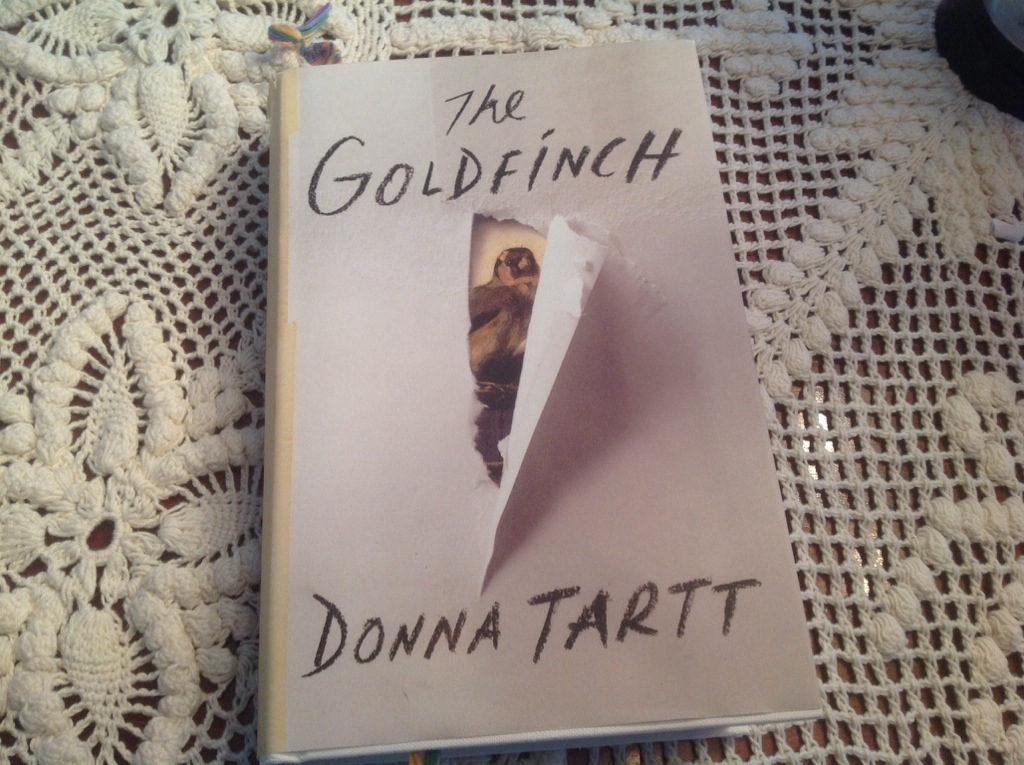
Reading THE GOLDFINCH

Donna Tartt

I read fiction mostly at night when I go to bed.

Last night I started THE GOLDFINCH.

20131221-110000.jpg

Theo Decker is the opening narrator.  At 13, he loses his mother in a sudden accident, which he survives.

Here’s a titillating paragraph near the opening of the novel:

“Oh, drat!”  cried my mother.  She fumbled in her bag for her umbrella–which was scarcely big enough for one person, let alone two.

And then it came down, cold sweeps of rain blowing in sideways, broad gusts tumbling in the treetops and flapping in the awnings across the street.  My mother was struggling to get the cranky little umbrella up, without much success.  People on the street and in the park were holding newspapers and briefcases over their heads, scurrying up the stairs to the portico of the museum, which was the only place on the street to get out of the rain.  And there was something festive and happy about the two of us, hurrying up the steps beneath the flimsy candy-striped umbrella, quick quick quick, for all the world as if we were escaping something terrible instead of running right into it.

This novel comes highly recommended and is included in those holiday reading lists for gift-giving or for your own pleasurable reading.  Besides, old friend June Derr says its good.

Turkey Tracks: “Earth” Quilt

Turkey Tracks:  December 20, 2013

“Earth” Quilt

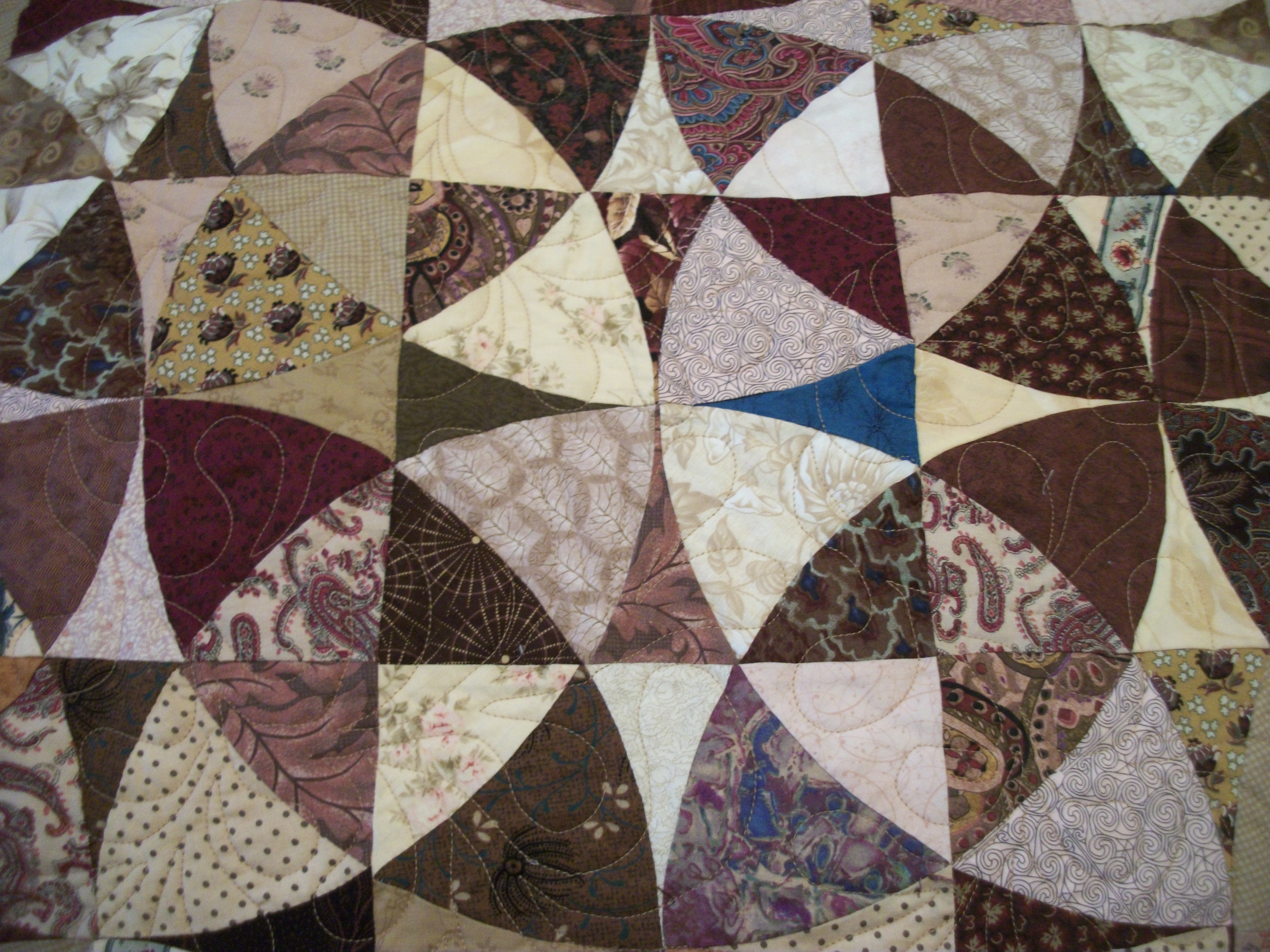
This picture is not the greatest picture I could have taken of this big, bold-hearted quilt.

It’s hard to get a good overall picture without two people to hold a big one like this aloft somewhere.

Earth 2

I hand-sewed about 2/3s of these blocks this past summer–which are known as Winding Ways or Wheel of Mystery blocks.  Then I discovered that they sew really well on the machine as well as the curves are not extreme.  It’s easy to cut four layers of fabric with the templates I have (you can order the set online–John Flynn makes one) and with a SMALLER rotary cutter–like the 45mm.

The dark/light blocks form big circles on the quilt–which I really love.  And I really love all the geometric shapes that show up as well.

Earth block

I put in bits of the blue you see–and those bits show up like little polka dots.  Or, pools of water scattered across the earth.  They sparkle across the quilt top’s surface.

It takes a “deep” stash–many fabrics collected for many years–to make a scrappy quilt like this one.

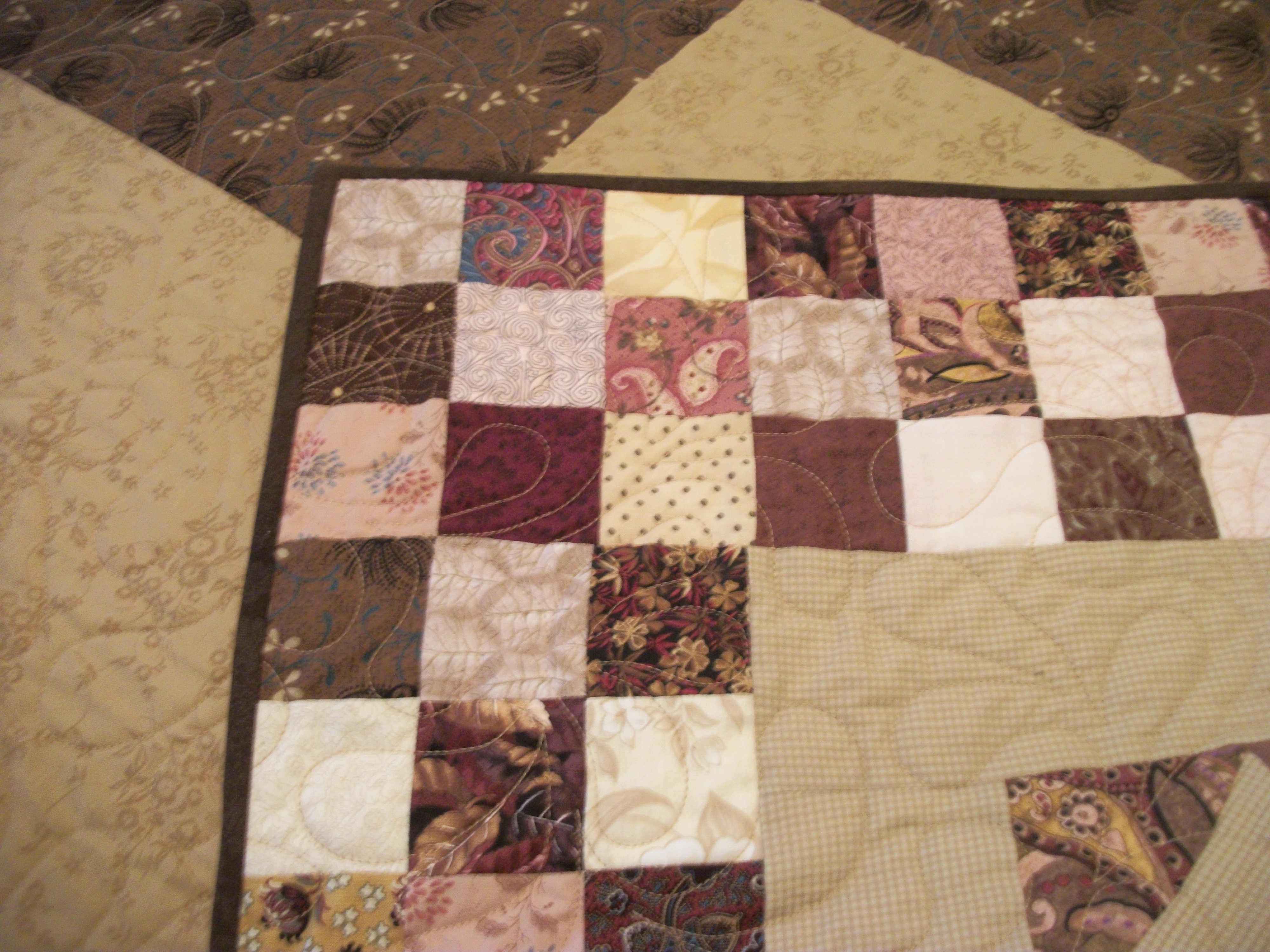
I pieced the backing–and like the way it came out:

Earth backing

I had the dark brown/teal print in the pile of fabric I used in this quilt.  And I cut 10 1/2-inch blocks from other pieces to make rows on the back–an idea which came from Bonnie Hunter’s books.  I also put in some random blocks left over from the front of the quilt.

I really like the border–which is vintage Bonnie Hunter:

Earth border with back

Here’s another view:

Earth border and binding

And I quilted overall with a feathery pantograph pattern I’ve used many times now:  “Simple Feathers” by Anne Bright.  (I love her patterns.)

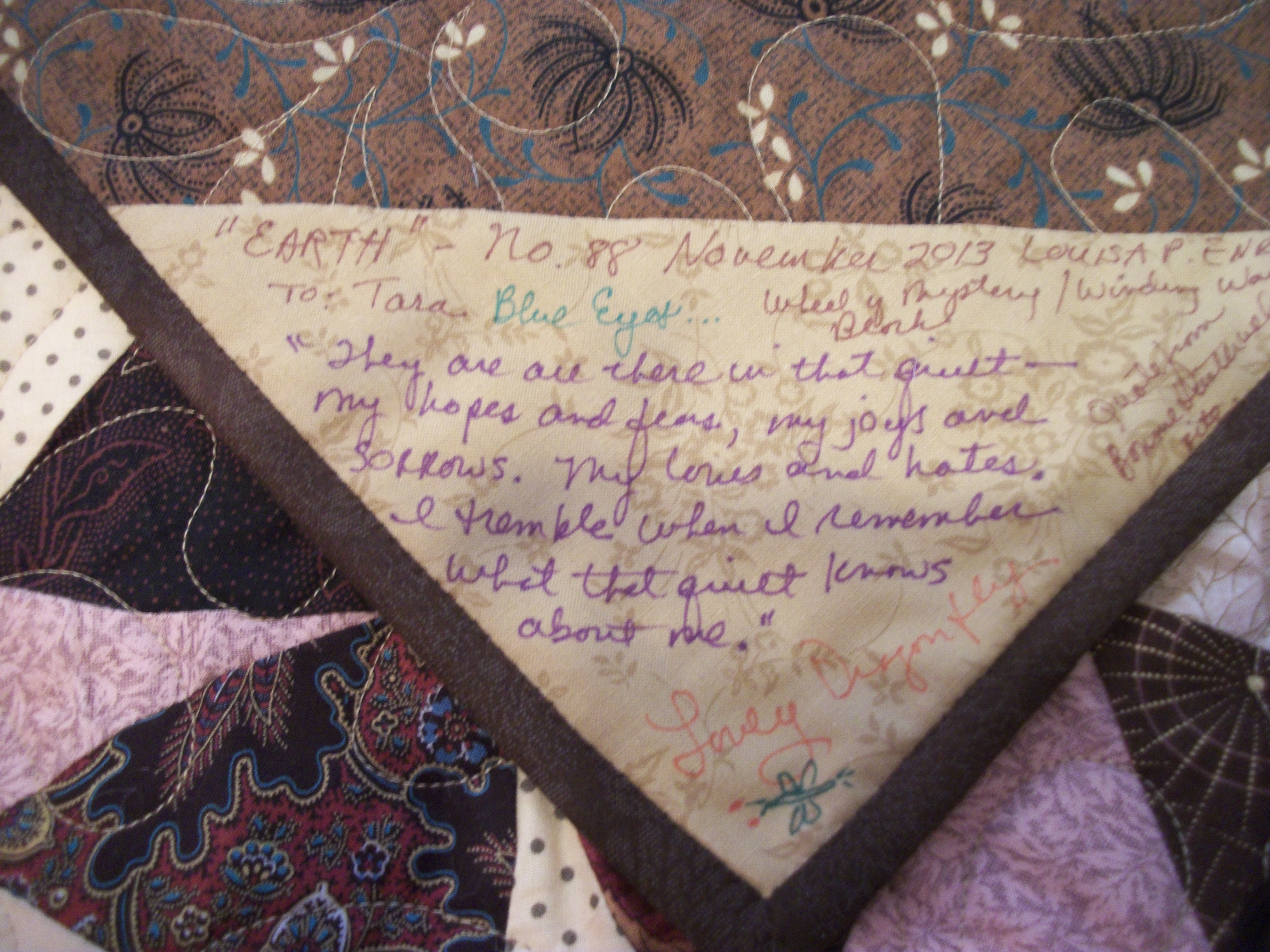
There is a lot of work, love, healing, and emotion in this quilt–more than most I do.   Here’s the label.  (The saying came from Bonnie Hunter’s web site quiltville.com.)

Earth label

This quilt was delivered TODAY to Tara Derr Webb, whose age fits between my two sons.  I have known her and loved her and worried with her and rejoiced with her since she was eight or nine years old.  Today is the day that Tara is cooking out of “the Farmbar” for the first time in Charleston, SC, where she and her husband Leighton own and operate a developing farm.  Tara is also a photographer, and you can see her work and pictures of Deux Peuces Farm (two fleas) and the Spartan trailer that is “the farmbar” on her web site:  www.thefarmbar26.com.

Turkey Tracks: Celtic Solstice Mystery Quilt: Clue Three Finished

Turkey Tracks:  December 20, 2014

Celtic Solstice Mystery Quilt

Clue Three Finished

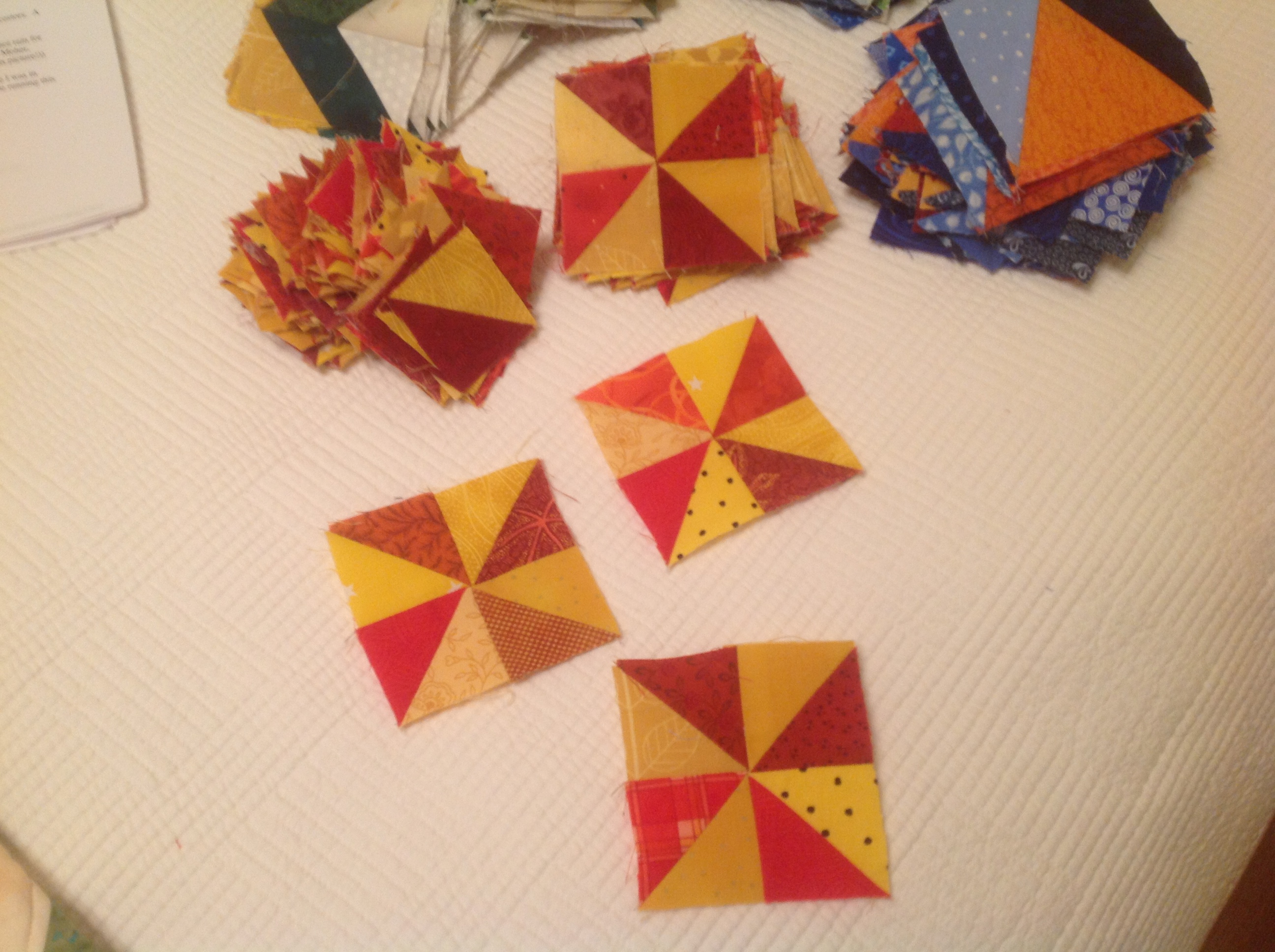
Clue Three was to create these orange and yellow pinwheels and half-square triangles.

Aren’t the pinwheels cute?

I am still chuckling because each measures perfectly, but I did a lot of unsewing.  The seam ripper is still hot.

Based on wisdom from the Facebook web site for this quilt, I changed my needle, used the single hold needle plate, and tried to be more consistent with feeding the units through the needle.

IMG_0037

So, now, these three sets of units are completed, and I am up-to-date and having fun.  AND, learning a lot.  Bonnie’s directions for each step are amazingly complete, and I am learning new rulers and basic things like “swirling” seams on the underside to mitigate bulk–a step I had forgotten completely lately.

IMG_0038

Clue FOUR came out this morning.  Four-patches with orange and green.

That should be simple.  But I thought the other units would be simple, too!

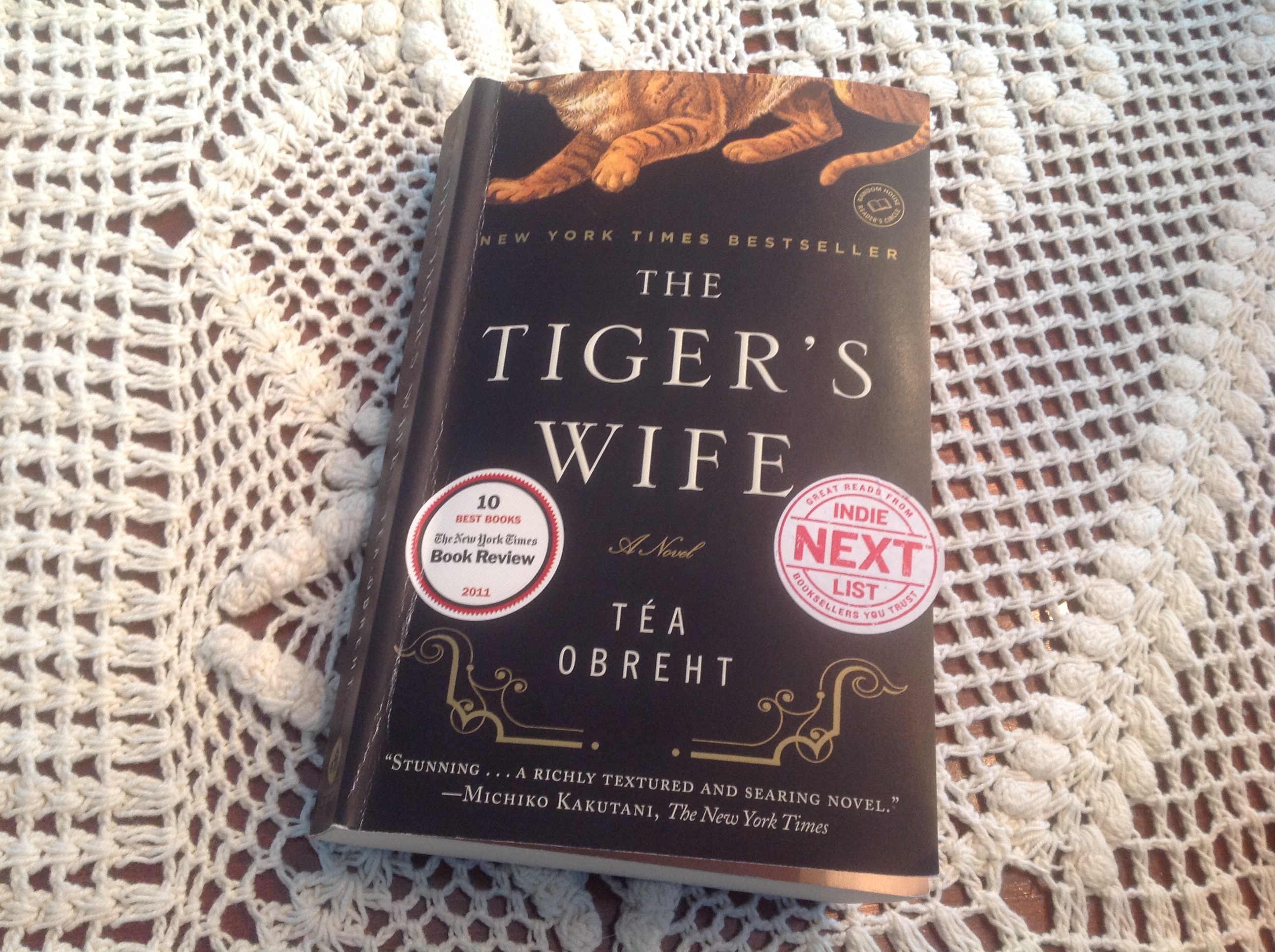
Books, Documentaries, Reviews: THE TIGER’S WIFE, Tea Obreht

Books, Documentaries, Reviews:  December 19, 2013

The Tiger’s Wife

Tea Obreht

I’ve read it twice now.

And loved it both times.

I read it first last year, after which I recommended it for our Book Club.

And I just finished it for the second time and found this second reading was even more enjoyable as I picked up on details and connections I had not seen as sharply as I did with the first reading.

IMG_0035

The novel begins in unnamed Balkan countries after one of a long series of wars has ended–think Christians vs. Muslims and Turks vs. Ottomans.  But the novel takes readers back to the war years–not with graphic descriptions of war, but with descriptions of how war affects populations in general.

The protagonist, Natalia, is a young woman, a doctor, who has grown up during the war.   And the story begins as she and a doctor friend, Zora, go into conquered territory (that used to be part of a whole) on a peaceful mission to inoculate school children in a remote village.  She hears on the way that her grandfather, who raised her, has followed her to, according to her grandmother, help her, has died in yet another remote and strange village–which turns out to be not so very far from the village where Natalia is presently.  But Natalia’s grandfather is very sick with cancer, which Natalia and he have hidden from his wife.  So, WHY has he left home?  And so it begins, the unraveling of the history of her grandfather’s life in all its complexity and its mysteries AND of Natalia’s life, which is still fairly new.  The journey Natalia makes is a coming of age journey for her.

The grandfather and the granddaughter are both doctors, the grandfather a famous, once-respected one in the old regime.  Natalia and her grandfather are wedded to science and rationality; yet their lives are both filled with stories, of narratives that defy a grounding in actual reality.  And the reader begins to understand that “stories” are how we explain what we don’t understand.   The “tiger” of the title functions in the intersection between the real and the explanatory narrative–much as the white whale did in Moby Dick, as more than one reviewer notes.  And the zoo that holds tigers and the elephant functions a metaphor as well, but I’m still thinking about what is involved.

Here’s a quote from the text:

He learned, too, that when confounded by the extremes of life–whether good or bad–people would turn first to superstition to find meaning, to stitch together unconnected events in order to understand what was happening.  He learned that, no matter how grave the secret, how imperative absolute silence, someone would always feel the urge to confess, and an unleashed secret was a terrible force.

Part of what resonates with me in this novel is how people behave when what they know and the cultural power they have is perceived to be threatened or is threatened.  Is that not what is at the bottom of much of our politics these days?  We now live in a multi-cultural society, and there is a lot of fear of “loss” on the part of those who have had cultural power and who are now having to share it.

All through the war, my grandfather had been living in hope.  The year before the bombing, Zora had managed to threaten and plead him into addressing the National Council of Doctors about recasting past relationships, resuming hospital collaboration across the new borders.  But now, in the country’s last hour, it was clear to him, as it was to me, that the cease-fire had provided the delusion of normalcy, but never peace.  When your fight is about unraveling–when it is about your name, the places to which your blood is anchored, the attachment of your name to some landmark or event–there is nothing but hate, and the long, slow progression of people who feed on it or are fed it, meticulously, by the ones who come before them.  Then the fight is endless, and comes in waves and waves, but always retains its capacity to surprise those who hope against it.

Natalia’s grandfather is well aware of the power of stories.  He creates a memory story with Natalia during the night he shares an experience with her that revolves around a rescued elephant coming to their local zoo.  It’s a magical scene that is powerfully written.  And he shared his own story of his experiences with “the deathless man.”  But she ferrets out his story of “The Tiger’s Wife” after he has died–a story that took place in the remote mountain village from which he came.

There are many other stories wound up in this tale.  Yet they are interconnected in many ways so that they form at least parts of a whole history–the parts Natalia needs to know to form her own whole story of understanding of her grandfather and, though that understanding, of why people often act the way they do.

I will keep my copy as a treasure.  And maybe in a few years will reread it again.

PS.  Obreht was born in Bosnia, but left there at age 7.