Interesting Information: Climate Change and the Media

Interesting Information:  September 10, 2012

Climate Change and the Media

YES! Magazine has an interesting article on climate change and the media in it’s Fall 2012 issue:  “Climate Change:  Tipping Point For News Coverage.”  First, Media Matters, a watchdog group, showed that in 2011, the media “spent more than twice as much time talking about Donald Trump as they did about climate change.”  And, the study states that “when they did discuss climate change, the major Sunday news shows (ABC’s This Week, CBS’s Face the Nation, NBC’s Meet the Press, and Fox News Sunday) consulted political and media figures–but not scientists.”

Indeed, “of those interviewed, 50 percent were political figures–including elected officials, strategists and advisers–and 45 percent were from the media.”

A recent poll by the Opinion ResearchCorporation “reveals that nearly 80 percent of Americans want to see more environmental news in mainstream media.”

This trend seemed set to continue until this past summer, 2012–which was filled with extreme weather events like the “destructive wildfires in Colorado.”  And, I would add, the drought that has seriously hurt grain and soy crops.

But, reports YES!, on July 10, the National Oceanic and Atmospheric Administration (NOAA) released its FIRST report “linking the likelihood of extreme weather events to human-made climate change.”

ABC news followed with a report showing “footage of hurricanes, tornadoes, and melting ice fields” and called the just-lived 12 months ” `the hottest 12 months we’ve eve lived through.’ “

So, why did/does the media ignore scientists and keep the fiction of climate warming as a hoax alive–when the only scientists still arguing that climate change is “normal” are being paid by the extraction industries?  First, to increase profits, most of the media has fired its researchers and its experts in many areas–including its science reporters.  Those experts have been supplanted by “talking head” stars, many of whom have no scientific credentials and have ideological agendas that benefit them personally.   Second, keeping a so-called battle, like the fake climate-change battle, alive sells papers and attracts ideological viewers.

Media has been colonized by capitalism.  Media is no longer about informing the public.  It’s about selling papers and attracting viewers.

This same YES! issue has an interesting statistic, which follows:

“Number of companies controlling 90 percent of the media, 1983:  50.

“Number of companies controlling 90 percent of the media, 2011:  6.

So, within the colonization of media, we also get monopoly formation–which is how so much of the available money today is sucked up by those at the tops of these organizations.

Do we really want  SIX organizations controlling all of our media?  Or our food?  Or most any of the industries you can name?

Competition dies in this kind of scenario.  And, so does truth.  And, so will our democracy, or what’s left of it.

Interesting Information: Infant Formula Contains Genetically Engineered Foods

Interesting Information:  September 9, 2012

Infant Formula Contains Genetically Engineered Foods

I’m recopying in full for you the following piece in the September/October 2012 issue of WELL BEING JOURNAL, page 6.

GE infant Formula and Baby Food

A report by the Institute for Responsible Technology (IRT), www.responsibletechnology.org, states that nearly all of the infant formula on the market (Gerber, Abbott Nutrition Labs, Mead Johnson, Walmart, Kellogg’s), including every one of the millions of bottles distributed free by the government, contains genetically engineered corn or soy, as well as milk from cows injected by bovine growth hormone.

The IRT notes that the FDA doesn’t conduct or require a single safety study on GMOs.  They allow Monsanto and other biotech companies to do their own safety tests.  IRT suggests that readers keep in mind that the FDA also assured the public that products such as DDT, PCBs and Agent Orange were perfectly safe long before these products were found to be unsafe and banned.  Today, companies can put GMOs into baby bottles, sippy cups, and breakfast cereal, without even telling the FDA or consumers.

IRT asserts that because of their less-developed immune systems and blood brain barrier, infants and  young children are more sensitive to toxins found in GMOs.  IRT states that diseases linked to GMOs in animal-feeding studies are skyrocketing among America’s children, and this can’t be a coincidence.  The young’s disorders include the same ones identified in GMO animal feeding studies by the physicians group, the American Academy of Environmental Medicine. Consider organically produced baby foods.

The Weston A. Price Foundation folks have some excellent recipes for making your own baby formula.  And, of course, you can make your own baby food quite easily.  You don’t need to buy baby food for your baby–feed them what you are eating, but mash it up fine.  And, remember, do not give babies grains/cereals until they get their big back teeth.  They do not have the enzymes to process them until their systems get more mature.


Turkey Tracks: BEDBUGS! THEY CAN HAPPEN TO YOU!

Turkey Tracks:  September 7, 2012

BEDBUGS!  THEY CAN HAPPEN TO YOU!

My mother had a horror of bedbugs.

She inherited that horror, of course, as she grew up before DDT mostly eradicated bedbugs by the 1950s.  She told a story about someone bringing an old table into Big House in Reynolds, Georgia, when she was a child.  My grandmother saw a bedbug on it and had the table taken immediately to the back yard and burned.

Mother and my Aunt Susan, many times, told how each week all the household laundry went out to the farm where it was boiled, hung on lines and bushes and fences to dry, ironed, and returned—spotlessly white and, now I realize since heat kills them, bedbug free.

Well, like a recurring nightmare, bedbugs are back and they’re back in force.  Now, they’re pesticide resistant, and these opportunistic hitchhikers are spreading like crazy since everyone is traveling so much more and so much wider in the world than ever before.  Acquiring bedbugs is a factor of being in the wrong place at the wrong time, not a factor of how clean or dirty your house might be.

I discovered them in our master bedroom three weeks ago when I went to change the sheets, which I do without fail every single week.  Their presence was signaled by what looked like a spray of black ink spots on our very pretty ecru-colored bed skirt.  On the underside, lay an adult, some smaller ones about the size of fleas, and my, to date, unmitigated horror.  This bed sits right next to a large, dry storage room under the eaves, where we stored our luggage.  We had been in the wrong place at the wrong time on our May/early June trips to Charleston, SC, and Essex, NY.  Both times we stayed in a hotel or an inn.  And, of course, our luggage rubbed up next to other luggage on all of our flights.    

If I can get bedbugs in my house, which I keep clean, which gets professionally cleaned every week, which isn’t cluttered, which is a place where “everything has a place” and where things are returned promptly to that place, which is a place where laundry is done promptly, you can too. 

So, what to do next?

Every web site I investigated cautioned against trying to deal with bedbugs yourself.  Any of you who read this blog at all know that I am categorically against spraying toxic poisons to kill bugs except in extreme circumstances—and then with the knowledge that the spray may be more harmful, long-term, than the bug you want to kill.  However, we did spray a few years back when carpenter ants in those same dry storage rooms under the eaves (there was a small leak in the roof and the wet wood drew them inside) were making 6-inch piles of sawdust every single day.  Three years later, we are still finding dead ant bodies that fall to the floor if they cross the toxic barrier.  And, for months and months afterwards, any time I spent in the room outside the dry storage room where the ants had been the worst resulted in dizziness, headaches, and nausea. 

Nevertheless, we felt we were between a rock and a hard place with the bedbugs.  They were spreading, clearly.  They were tucked into the outside seams of the mattress and the box springs in several places.  And, since I dragged laundry down two floors of stairs every week, we feared we might have spread them to the laundry room area and god knows where else. 

We called in Modern Pest Services, and we discussed options.  Doing a “green” heat treatment of the whole house (heaters and big fans) would have cost almost $4,000 and had no guarantee and did not put up any additional protection against further hitchhikers that may come in.  After a home inspection, we opted for the spray, and MPS sent us a pre-spray prep sheet that made us realize the full extent of the process of getting rid of bedbugs. 

The master bedroom and everything on that whole floor had to be completely stripped of anything that might harbor any part of the two-week life cycle of the bedbugs—from the hard-to-see translucent eggs and first nymphs to the adults, which can be about the size of your little fingernail.  (There are many good web sites with pictures and good information—so take a look so you’ll recognize them.  The adults look like wingless roaches.) 

Before the sprayer came, I had to strip, wash, and, most importantly, dry for at least 45 minutes in a hot dryer, everything I could.  Only heat kills bedbugs reliably.  We have feather beds on all the beds, and they don’t fit in our washer, so that meant dragging them to the local Laundromat and sitting for nearly two hours while they washed and dried.  Feather beds are big and bulky; they take up a huge amount of space in the car, and there is only one washer big enough for one of them at the Laundromat, so that meant many separate trips and lots and lots of money. 

The 11-year old washer had been acting up—not pumping out water properly—and it, of course, went almost right away.  (There’s some sort of cosmic law about machines or plumbing breaking when you need them to perform.)  So, that meant EVERYTHING had to go to the Laundromat.  All the bedding from five beds—the kiddos had just left.  The curtains from the master bedroom.  All the clothes in the drawers.  (We determined one day that John has at least a hundred pairs of socks that had to be heat treated and rematched.)  Shoes had to be dragged out of closets so the sprayer could get to the closet floor and to the four dry storage areas in the upper two bedrooms which are behind two of the closets.  All the luggage had to be taken down three floors to the garage—where they are awaiting treatment still on the garage’s second floor. 

All the treated clothes had to be put into plastic bins or bags so they would not be reinfected.  We had to vacate that master bedroom, of course, so we risked spreading the bedbugs to the middle floor and the guest bedroom.  One night I was so tired that I could not physically carry the plastic bins I had filled at the Laundromat from the car back into the house and drag them up two floors.  The next day, a friend came and carried them all back inside for me.  I am and will be eternally grateful to him.   

All the furniture had to be pulled out from the baseboards—which means intensive vacuuming behind everything.  (The vacuum bags get sealed and thrown away.)  All the pictures have to be removed so their backs can be sprayed.  (I stored all the hanging quilts.)  All electrical outlets have to be cleared and cords have to be removed from near baseboards.  The sprayers put a powder into every outlet as the bedbugs can and do travel along wires inside the walls—which is why they are so hard to eradicate in apartment buildings.  Every piece of furniture gets sprayed—beds, couches, chairs, baskets, whatever.  Bedbugs love cracks and crevices and try to live within close range of their food source:  you.

It takes the sprayer about two hours to spray our house and about four hours for everything to dry—which means you have to be out of the house for a minimum of six hours.  (They spray the foundations outside as well.)  When we returned, we had to put everything back in place—all the pulled out furniture, all the couch pillows, and so on and so on.  We have to do it all again next Monday, which is the second spraying—which comes two weeks after the first.  Any eggs that have escaped and any bedbugs that have possibly hatched and escaped being poisoned will be caught this go-round.  I think the spray renders the bedbugs unable to reproduce, but I have to check that for sure.

So far, I have tolerated the spray fairly well.  I am itching all over, especially on rainy days, and I have some breaking out on my skin, but so far, it’s an ok tradeoff to get rid of the bedbugs.   I have no idea about the long-term implications.  Only, anyone can bring in a new hitchhiker at any time—so we are instituting some controls from here on out—discussed below.

First, let me say that treating for bedbugs is not cheap.  The spraying is about $900 and occurs twice in the initial treatment and then quarterly for a year.  The Laundromat has been at least $150.  Trying to do all the drying and washing at home would take way too long, given the spraying schedule, even if the washer had not died.  We bought “encasement” covers for every single mattress and box spring—they keep the bedbugs in if you have them and out if you don’t.  All the web sites say to get good ones that will last at least two years without tearing and that have tiny-teeth zippers that the nymphs can’t get through.  (It does not work to just throw out the mattress and box springs as the bedbugs will reenter anything new from, for instance, the bed itself.)  We got Allerzip, which range from $80 each (Amazon.com if they have the right size) to $116 each on the bedbug sites.  We bought a dry steam sprayer that we can use to treat suitcases, small rugs, clothing, and anything else you want to steam clean:  $300, www.Vapamore.com.  I’m actually excited about the steam cleaner as it will get into places it’s hard to clean.     

Why am I telling you this horrible story?  Because I was totally clueless about this growing problem, and I’m hoping to help you prevent what occurred to us.

So, what can you do to prevent getting bedbugs?  Here are some suggestions in no particular order.

If you travel, take precautions.  Don’t bring luggage into a hotel room until you have stripped back the bedding and looked for bedbug evidence—you’re looking for small black tar-like dots.  Or, a white residue in the dresser drawers.  And, you can check online to see if the hotel/motel you’re using has had recent bedbug episodes—to be fair, most have.  If you find evidence, ask for a new room.

Don’t put your suitcase on the bed or on the floor.  Use the luggage rack.  Or, someone recently told me, put the suitcase in the tub. 

When you get home, unpack suitcase contents at the washer/dryer and put everything into either the washer (to be dried for 45 minutes after washing) or into the dryer. 

Don’t store the suitcase inside the house unless you treat it first:  steam clean it or, in hot climates, put it into a plastic bag and put it outside for a day or two.  Temps must get to the 140 degree range inside that bag, however.  Cold might not kill bedbugs—they can go dormant.  And, they can live over two years without feeding.

My sister is returning to using a hard suitcase, which isn’t a bad idea.  Duffle bags could be dried in a dryer.

Work out a procedure for guests. We’re going to give them a laundry basket into which they can put suitcase contents; we’re going to steam clean the suitcase; we’re going to store it in the garage in a plastic bag until time to pack again.  We’re going to be ruthless about this procedure.

Put encasement covers on all your mattresses and box springs.  They’re really quite nice.  They’re a silky material, not hard plastic.

Don’t bring used/secondhand clothing or furniture into the house without treating them first.  I’ve already heard from several people about people inheriting used sofas, for instance, and introducing bedbugs.

Keep things simple:  get rid of bed skirts and fabric that dangles on the floor.

Recognize that the old saying—“sleep tight and don’t let the bedbugs bite”—has a whole new meaning today.

Interesting Information: Dangerous Cross Reactivity: Soy/Peanuts

Interesting Information:  August 4, 2012

Dangerous Cross Reactivity:  Soy/Peanuts

This information on cross reactivity is from Kaayla Daniels, writing in WISE TRADITIONS, the journal of the Weston A. Price Foundation, summer 2012.  (Daniel’s book THE WHOLE SOY STORY is the work of someone who has the credentials to read and understand soy studies and the talent to explain the dangers of soy to us in ways we can understand easily, and I will write an essay on it soon.)

Here’s where you can read the article on cross reactivity in full:  http://www.westonaprice.org/soy-alert/the-soy-ling-of-america-second-hand-soy-from-animal-feeds.

The main article is about the amounts of soy showing up in the meat of animals fed a lot of soy and, of course, in eggs.  This has been a worry for me since I read THE WHOLE SOY STORY.  Soy is filled with all kinds of chemicals that are not healthy for people.  And, no, Asians don’t eat all that much soy.  Besides, soy tastes nasty, bitter, and no matter what industry has done, it has not been able to lick this problem or to prove that soy is healthy.  I don’t feed my chickens any soy, so our eggs are soy-free.  If you eat soy, limit it to small amounts of fermented soy:  miso, tempeh, and natto (which you are unlikely to like as it is an acquired taste.)  Tofu is NOT fermented.

The sidebar article, though, is the one I think you should read if you have a peanut allergy or a tree-nut allergy–because you might be subject to a dangerous, if not fatal, allergic reaction to any soy you might eat–and remember that industry is putting soy into everything it can and is padding meat (hamburger, hot dogs, roasted chickens, etc.), so you could eat soy without knowing it.  If you are eating fast food, you most certainly are eating soy.

The title of the sidebar article is “The Odwalla Chocolate Protein Monster:  The Little Known Soy/Peanut Allergy Connection.”

Back in April of this year, four consumers drank Odwalla’s Chocolate Protein Monster and had severe allergic reactions.  The product was recalled.  Contamination from peanuts was ruled out, so experts started looking at cross reactivity as the cause.  Soy and peanuts are members of the grain-legume botanical family, so people allergic to one are, Daniels writes, “often allergic to the other.”  The Odwalla drink contained soy protein.

Daniels writes that “severe reactions to soy were once rare.  Today they are increasingly common, and pose especially high risks to children already afflicted with peanut allergies.”  In 1999, four children in Sweden died of the soy/peanut link.  Other risk factors include “other food allergies, a family history of peanut or soy allergies, a diagnosis of asthma, rhinitis or eczema, and/or a family history of those diseases.”  Researchers “found it took only a tiny, almost indiscernible, amount of soy to create a severe and even life-threatening reaction in susceptible individuals.”  Worse, they found that “severe allergic reactions could happen suddenly and unexpectedly to people with no known soy allergies.”  The Swedish National Food Administration issued warnings.

Daniels laments the fact that Sweden’s warning has “not been publicized much in the U.S.  Indeed, the Soyfoods Association of North America–and even many allergy support groups–recommend soy nut butter and soy nuts for children allergic to peanuts and tree nuts.  As a result, few people have heard of the deadly soy/peanut connection, and numerous adverse reactions have been reported.”

Daniels chronicles several deaths to this cross reaction here in the U.S.

But, why is this severe reaction happening now?

Daniels answers:  “The main reason appears to be the increased number of allergenic proteins found in genetically modified (GMO) soy.”  Apparently, genetic engineering of soy has produced a soy allergen that is “41 percent identical to a known peanut allergen, ara h 3.”  This new allergen is “recognized by 44 percent of peanut allergic individuals.”  And, in the U.S., “90 percent of soy now contains these new proteins, chemicals and allergens.”  (I think almost 100 percent of the soy crop is now GMO–I have to check that fact.)

As soy ingredients are now in “60 percent of processed or packaged foods and nearly 100 percent of fast foods,” writes Daniels, not issuing a warning “is simply irresponsible.”  And, here’s a devastating piece of information:  “Not surprisingly, the reason appears to be the usual principle of profits over people.  According to Robyn O’Brien [AllergyKids website], “`Leading pediatric allergists and researchers have been funded by the agrichemical corporation responsible for engineering these proteins, chemicals and toxins into soy.'”

Note that soy has not yet been identified officially  in the Odwalla Chocolate Protein Monster case, so Daniels is asking that we all make a “concerted grassroots effort to share this information with as many people as possible.”

PLEASE SHARE THIS INFORMATION ON FACEBOOK OR ELSEWHERE.

PS:  Odwalla drinks are not really a health drink.  Their juices are pasteurized, so all the goodies are killed.  Mostly, you’re just drinking sugar and lots of it.  If you want to drink more veggie juices, get a good juicer.  I wrote about mine here on this blog.  Limit all fruit juices to the barest minimum–the sugar loads are just too great.  There are, surely, better sources of protein than an industry-produced Odwalla drink.

Interesting Information: How Much Sugar Are We Eating Today?

Interesting Information:  August 4, 2012

How Much Sugar Are We Eating Today?

Tim Boyd reviews DVDs in the Weston A. Price Foundation’s journal WISE TRADITIONS.  In the summer 2012 issue, which I’ve just finished reading, he reviewed a DVD by Nancy Appleton, PhD, called SWEET SUICIDE–HOW SUGAR IS DESTROYING THE HEALTH OF OUR SOCIETY, made with help from the Price-Pottenger Nutrition Foundation.  (Pottenger did, among other useful things, the famous study of cat health, based on what they were fed.)

Here’s a revealing quote–which answers the question in the title of this entry:

During George Washington’s time we consumed thirteen pounds per year per person on average.  During George Bush’s time we consumed one hundred fifty pounds per person per year.  The difference in cancer and degenerative disease rates during those times is clear.

Those figures would be AVERAGES–which means some of us are eating way more than 150 pounds!!!!! each year.

And, remember, these figures do NOT include the sugars you’re eating that derive from grains and all carbohydrates.  Remember that two slices of whole wheat toast is the daily limit for a woman in Luise Light’s recommendations for the 1980 USDA food guide (that got erased) AND on the Glycenic Index puts more sugar into your bloodstream than a Mars candy bar or a soda (which has about 16 teaspoons of sugar if I remember correctly)  , according to WHEAT BELLY.

So how much sugar are you eating?

I’m finding that my desire for sugar–even the raw honey I use to sweeten my tea–is drastically decreasing since I cut out wheat and most grains.  For whatever that’s worth…

Books, Documentaries, Reviews: COME SPRING

Books, Documentaries, Reviews:  July 30, 2012

COME SPRING

by

Ben Ames Williams

Friend Gail Nicholson realized one day a few months back that I had never read COME SPRING by Ben Ames Williams.  She appeared the very next day with a brand new copy for me.  I finished all 866 pages last week–published by the Union Historical Society–and enjoyed the read.

Ben Ames Williams wrote COME SPRING in 1940.  It’s a specific story of how in 1776 (the same year the Declaration of Independence was signed), the first settlers moved up the St. George River of what is now called mid-coast Maine, and cleared and settled land in an area now called Union, which is just above the coastal town of Thomaston and the next settled village up the river, Warren.

COME SPRING is a general story also of how settlers dug in, cleared land, and made a life all across New England.  Or, not, as not all settlers were successful.  Some didn’t have the temperament to be in what was wilderness for long periods of time; others just had bad luck–spouses who died, barns that burned, crops that failed, game that couldn’t be found in the winter, and so forth.  And COME SPRING is a story of how all of these people related to the ongoing Revolutionary War and, after the war ended, how newly formed civil organizations started making laws and levying taxes, when these early landowners had no hard money or paper money to give.

COME SPRING is also a love story–written by a man and with a woman heroine (Mima).  .  It’s the story of Mima’s love of the man she chose and for whom she waited, of her desire for a family with this man, and of her love and deep connection to the land she intended to work hard to settle and to hold in her family forever.  Mima is much more interested in intimately knowing her own surroundings then she is in outside political realities and forces, which she believes she can do nothing about and which just get everyone all upset when learning of them.

Settlers could use the river to travel back to the coast and civilization–except when the ice wasn’t firm.  Otherwise, they had to walk everywhere they went.  Early settlers were lucky to have a pair of oxen or a few chickens or some sheep which would mean wool for clothing.  Mostly all the clearing work was done without such help.  Several barn raisings are described in the story; it takes a lot of strong men to raise a barn, so such an occasion brought the community together for the day of the raising.

What’s fun, if you live in this area, is the name recognition–many of these original families are still here and place names taken from these first settlers abound.  Union’s quilt chapter is “Come Spring.”  There’s also a Union diner called “Come Spring.”  And, this summer, someone wrote a kind of short play taken from COME SPRING featuring some of the key characters that was read by people dressed in period clothes in the center of Union.  When spring came in this early Maine, green food returned as the snow melted, animal babies were born, crops could be planted, hope of survival could be renewed.

Union is also the home of today’s week-long Union Blueberry Fair in mid-August, which has 4-H contests, animal pulling contests of all kinds, farm demonstrations of all kinds, a midway, and harness racing where you can make $2, or more, bets.  We LOVE this fair and go every year.

When one of the main protagonists, Mima’s father, dies in 1816 at age 86, he is survived by, writes Williams, “six children, fifty-one grandchildren, eighty-five great-grandchildren, and five great-great-grandchildren.”  Only three of his children and fifteen of his grandchildren died before him.  These numbers were needed for survival in the wilderness, for creating a town, for moving on to create a nation that stretched from shore to shore.  These kinds of numbers make me pause to think about some of our current rhetoric of how long we’re all living.  We may be reaching this age, but are we reaching it with the same kind of health that Mima’s dad enjoyed?  He moved to the wilderness of  Maine when he was 45 years old.

Near the end of the book is this memorable passage from Mima’s mother, while holding Mima’s second newborn child.  Mima and Joel hav just realized that Mima’s parents still love each other in the same way that Mima and Joel do:

“I think sometimes getting old is like a candle burning down.  A young one grows up and the first thing he knows he’s in love and marrying; and you can see something new in his eyes, deep and strong.  That’s like a candle when first you light it, standing up so straight and white and slim and fine; and the flame’s real pretty to look at.

“But the candle burns on.  Maybe it melts crooked, but the flame stays just the same shape and brightness.  Maybe if the wind blows, the flame flutters some; but when the wind stops, the flame’s just the same again.  The candle keeps a-burning, and the tallow runs down the sides of it, and it gets all lumpy and out of shape like a woman after she’s had babies for twenty years, or a man that likes his victuals.

“But the flame still burns bright and pretty.  The candle gets shorter and stumpier till there ain’t hardly anything left of it; but the flame’s still there, burning bright, clear and brave and fine, right down to the very end.”

She met their eyes.  “That’s the way it is with the right kind of people,” she said.  “Rheumatism can cripple them and tie them upo in knots, or the outside of them can change other ways so you’d hardly know them to look at them.  But their insides don’t change.  The flame in them keeps burning clear and fine.  If you just look at the flame and not the candle, you’ll see it never does change–until one day the candle burns down, and all of a sudden the flame gets small and then it’s gone.”

Like all historical fiction, the story tells a reader much more about William’s 1940s than it does the 1780s.  Williams does use archival materials to write this novel.  There are several journals that derived from this area, for instance.  But the sentiments he overlays onto Mima et al are very much those of the 1940s–which is why historians view historical fiction with a skeptical eye and argue that this overlay does a kind of violence to the real people who lived those very real lives.  Nevertheless, it was fun for me to read what was of concern to Williams, what he wanted his characters to think and feel, and to compare how those values have shifted so enormously today–and not in good ways, I’d say.

So, thank you so much Gail!

Turkey Tracks: Dog House Chickies Update 2

Turkey Tracks:  July 28, 2012

Dog House Chickies Update 2

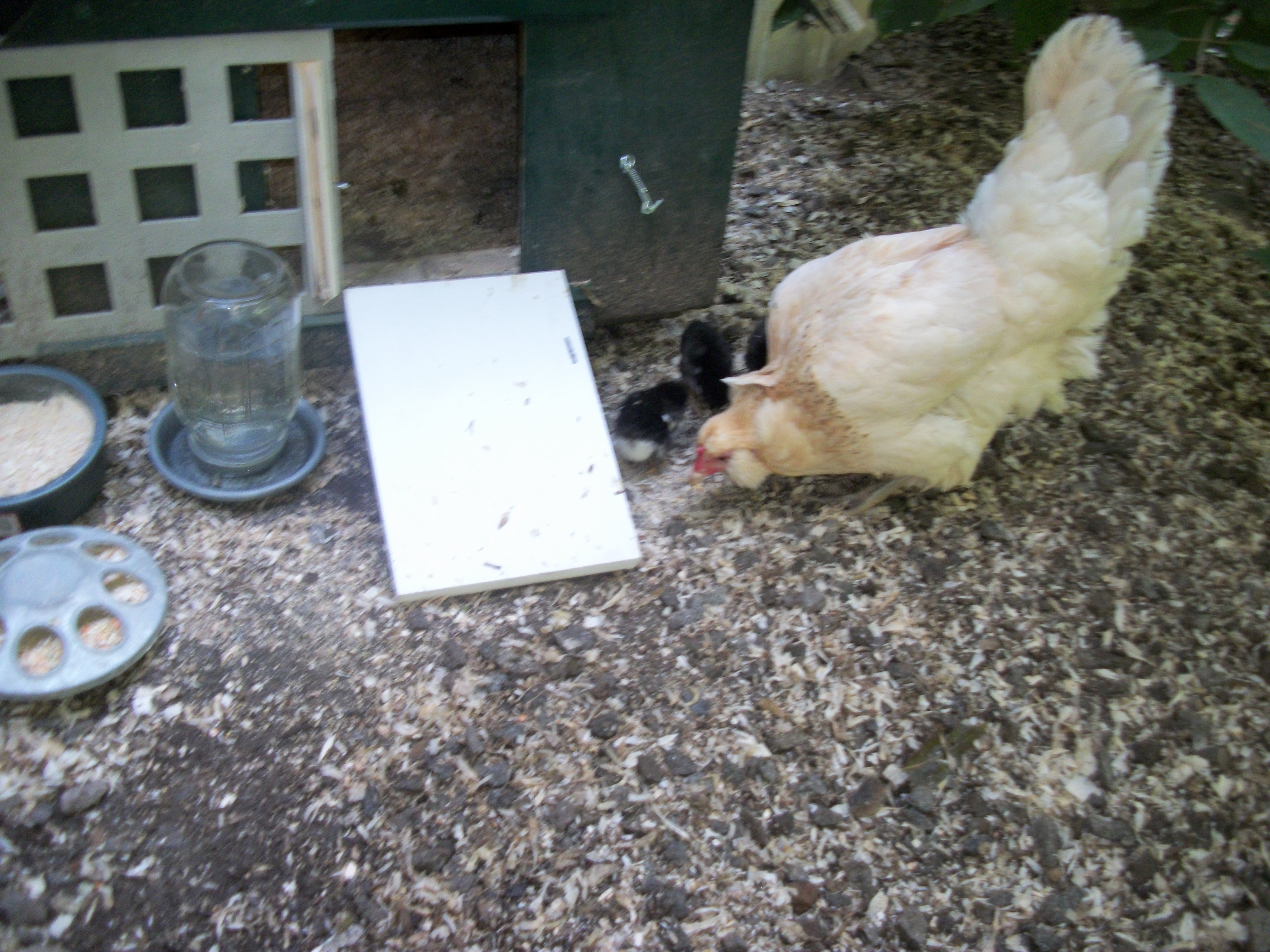
Mother hen Sally brought her babies out into the world early this morning.

When I unlocked the doghouse door, she came out immediately, then went back inside again to get her babies, and out they came, pouring through the door after her.

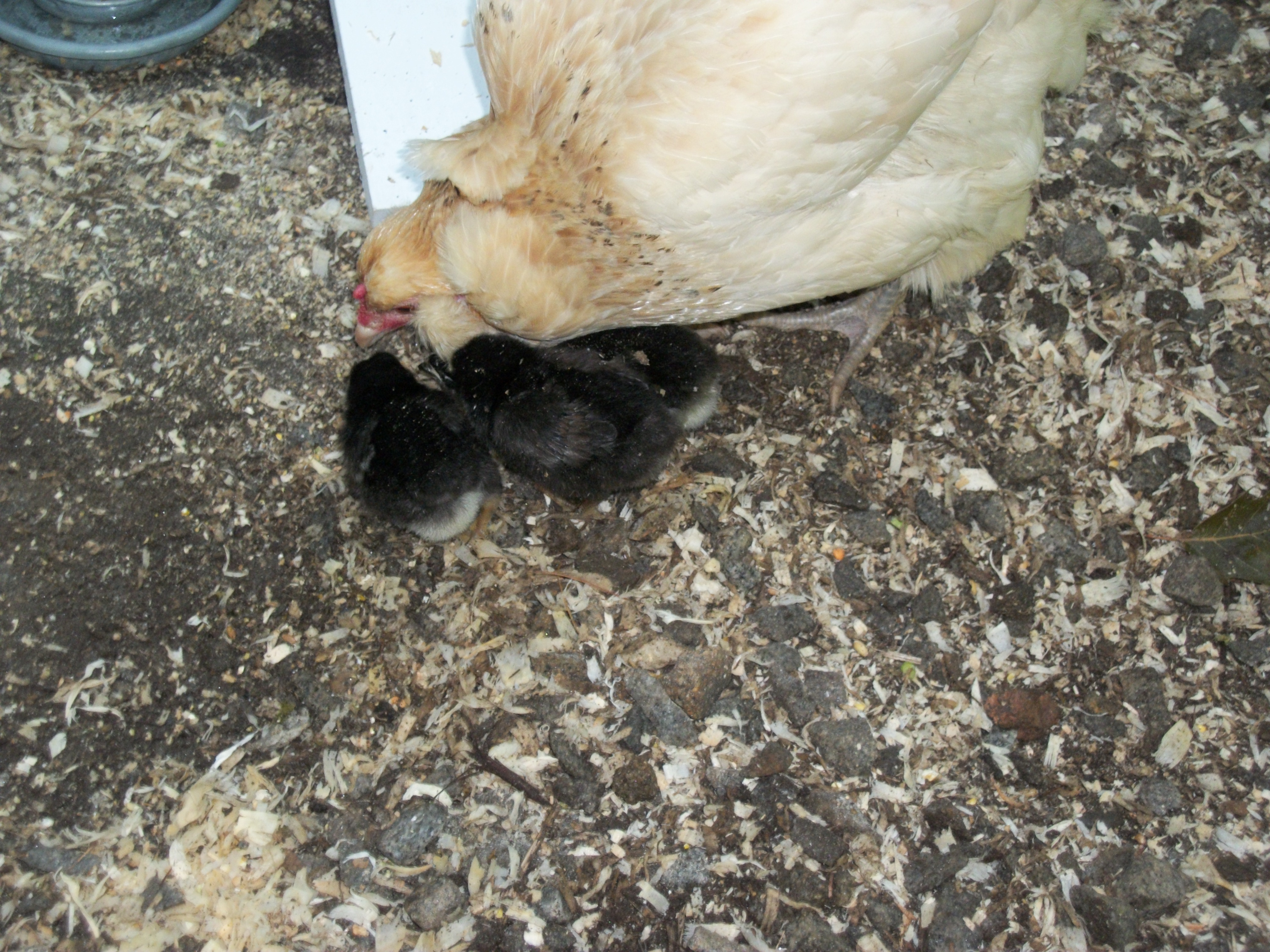
Three babies.  Two Americauna Wheaten/Copper Black Maran crosses and one CBM.  Sally and Cowboy and all the mothers batted 4 for 4 on this one as all four eggs hatched.

The fourth chick-the one who crawled away from her in the night and got too cold was on top of the food bowl this morning–dead but not stiff.  S/he must have lasted for the past two nights and one day.  And I think Sally stayed inside with him/her until it was clear s/he was dead.

Sally talks to the babies constantly.  She immediately began to scratch in the dirt and show them tiny somethings (??) to eat.  They run to her and eat the whatevers when she calls them.  Every so often, she takes them back to the doghouse for water and the ground-up feed I’ve made for them.  I need to put some Apple Cider Vinegar into their water now.  And, soon I’ll supplement with milk and scrambled eggs laced with garlic.

Those chicks came pouring out of the doghouse, but the lip is fairly tall.  I found a small ramp in the garage so they can return easily when they get ready to rest.

Sally’s definitely got them in school however–all the while chasing away an overenthusiastic chipmunk that’s plaguing them.  By noon, they are now scratching in the dirt themselves.  And they’ve learned that when she shrieks like a banshee and flashes her wings and spreads her tail out, they are to run to her and take cover.  Only, as I clipped her wings, she does not have full use of all her primary feathers as protection.  Clipping her wings didn’t work anyway.  She just hops to the fence top, balances, and goes over at will.

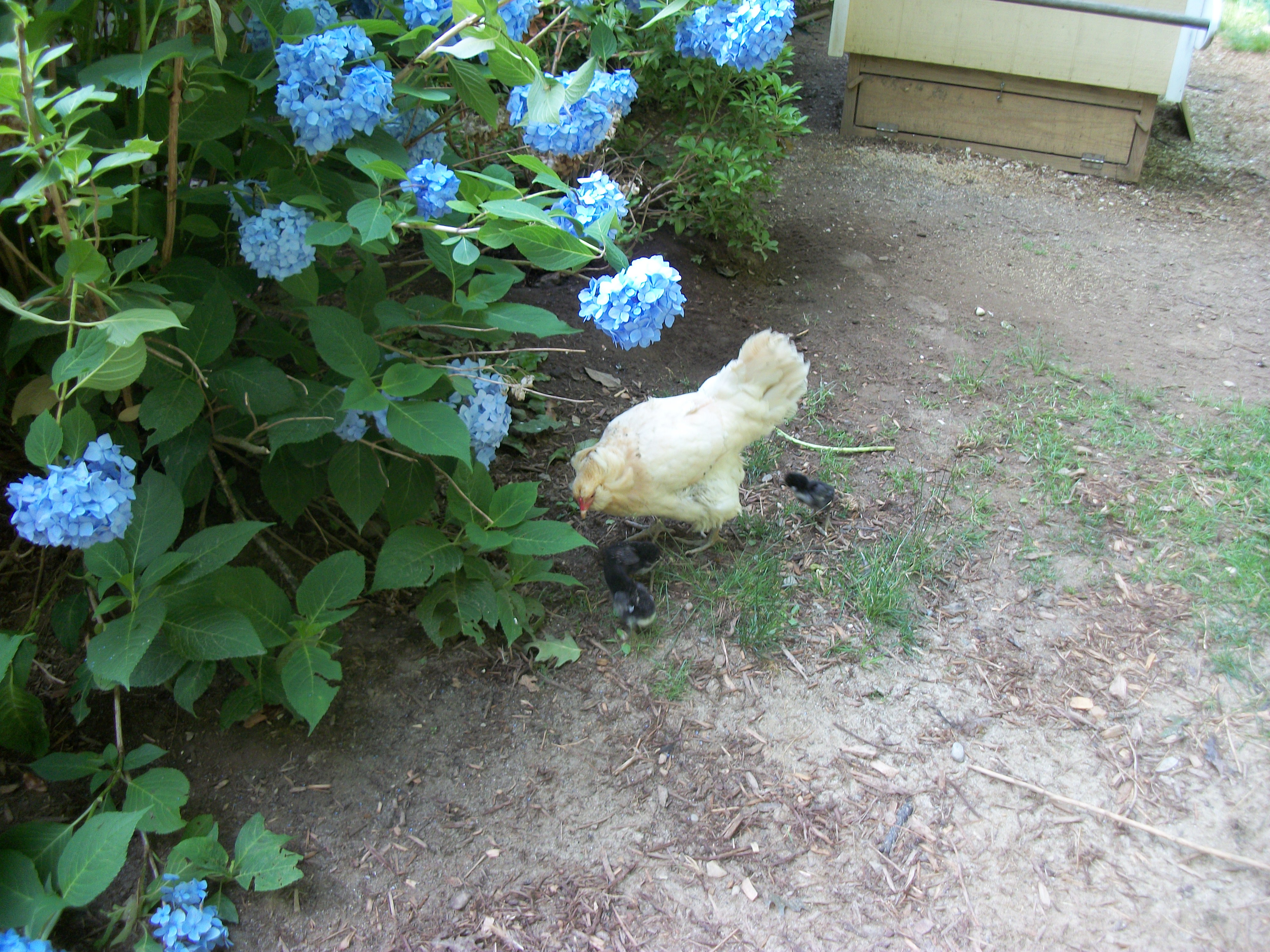
Gradually, they’ve moved away from the doghouse into other parts of the pen:

So where are the other hens and the rooster you might ask?

They have gone quite mad in the past few days.  There have been major fights among the hens and overwhelming emotions swirling around the whole pen.  Annie Chickie, the hen I raised, is one of the worst offenders.  There is absolutely no way I’d turn these crazy ladies loose with Sally and her chicks.  So for the moment, they are locked into the coop and cage.  And they are so NOT HAPPY about that.  So far this morning, I’ve brought them June bugs, fresh chard, milk and bread, and replenished their water.  They always have access to a mixture of organic whole grains and dried peas and lentils.  I give them some handfuls of millet most days as a scratch feed.

Friends  Ronald VonHeeswjik and Nicholas came to discuss how to manage this situation this morning.  We decided to leave the hens and rooster locked up for a day or two–the coop and cage are quite large actually–and to see if Sally gradually takes the chicks further afield.  She will sooner or later.  Once older, the chicks will be able to avoid the older hens.  And, if we need to move the doghouse to free the hens, we’ll do it at night when Sally and the chicks are inside.  I’ve figured a place to put them that they’ll like, that has cover, and that is shaded and cool.P

Pray for the babies to be HENS!

Books, Documentaries, Reviews: July 2012 Read Pile

Books, Documentaries, Reviews:  July 26, 2012

July 2012 Read Pile

Here’s my current read pile:

Actually, I’ve been working this one since May, when I took this picture.

I’ve finished THE AMERICAN WAY OF EATING, COME SPRING, and HERBAL RECIPES.  I’m going to start THE LOST LANGUAGE OF PLANTS next.

I’m also reading THE TIGER’S WIFE, Tea Obreht, which I’m really enjoying.  It was ranked one of the top ten books of 2011 by the NY Times.

John just finished IN THE GARDEN OF BEASTS, Erik Larsen, the memoir of Ambassador Dodd’s family in Hitler’s Germany, just before WWII, when the Nazi’s come to power.  He loved it, and half my book club has read it and did, too.  We read Larsen’s earlier book, THE DEVIL IN THE WHITE CITY, I think.  It was really good too.  It was about a serial killer operating in the time of the huge world fair held in Chicago, as I recall.

QUIET was a gift from John.  It’s about the special place introverts occupy in society.  He gave it to me because I am an full-blown introvert, and he’s a full-blown extrovert.

Interesting Information: First State-wide Ban on Plastic Bags

Interesting Information:  July 26 2012

First State-wide Ban on Plastic Bags

Hawaii is the first state to pass a state-wide ban on plastic bags, effective July 1, 2015.

YEAH!!  Go Hawaii!!

I hope all of you are NOT using store-used plastic or paper bags when shopping.  Both are environmental nightmares and about equal in terms of harm.  Get yourself some bags and take them with you when shopping–for ALL your shopping.  Start asking for your purchases to be put in your own bags everywhere you go.

I have been using bags for food purchases, but now I’m going to up the ante and start taking clean bags for all purchases.

There is a film that is referenced in the Mercola article I saw this morning:  BAG IT.

I found it on Netflix and could instantly download it on the Roku.  I’ll take a look at it soon, though I am so far behind on watching documentaries.  Sometimes the psychic burden of watching all that’s wrong with our world–there’s so much–is just too much, and I have to take a break.

Here’s the whole article if you want to read it:  http://articles.mercola.com/sites/articles/archive/2012/07/26/no-to-plastic-bags.aspx?e_cid=20120726_DNL_artNew_1

Turkey Tracks: Dog House Chicks Update

Turkey Tracks:  July 26, 2012

Dog House Chicks Update

It’s cool and overcast here in mid-coast Maine this morning.

I’m wearing jeans and a long-sleeved t-shirt, and my long, hot shower felt really good this morning.

We are all hoping for a steady rain as everything is really, really dry here.  My garlic is already turning brown, about a month too early.  As of noon, however, no rain.

Last night, I rescued the brown-egg chick, releasing her/him from her/his shell as s/he wasn’t getting anywhere and was drying out like the silver chick.  I think that these hatching eggs are supposed to stay under the hen and Sally is putting them in front of her.  I have to ask Rose what is normal…  I put the very weak and cold chick under Sally before I went to bed last night.

When I checked the doghouse early this morning, this last, large, Maran chick was not under Sally, but was right at the front door.  I thought s/he must surely be dead.  But when I picked up what I thought would be the carcass, it moved weakly.  S/he was so cold, but was still barely alive.  I tried to give it some water and forcibly placed it underneath Sally, but I don’t have much hope for this baby.

I thought about bringing it inside and getting out the heat lamp and a box.  But, I thinking that if the chicks don’t have the strength to get back under the mother hen, they won’t make it and will never be really right.  The time to rescue this chick would have been last night.

One of the other chicks was out and next to Sally, but the other three were clearly under her–though I have no idea if the little silvery chick is alive or not.  At least I know there are two healthy chicks.

While I was fixing the dog’s breakfast, I could hear the chicks peeping through the kitchen window.  Indeed, John and I could hear them in the living room while we had tea/coffee.  They are LOUD!  Refreshingly loud.