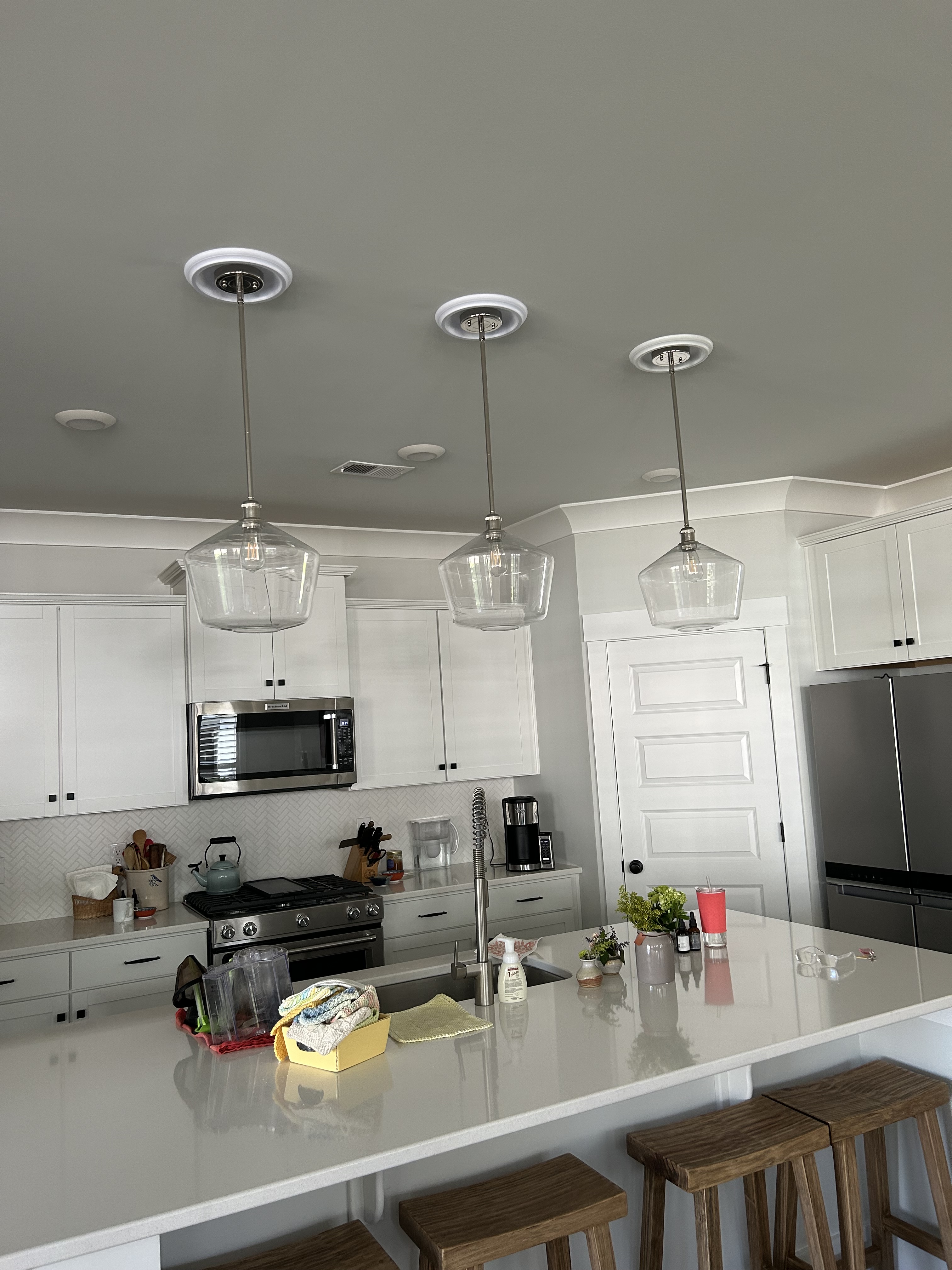
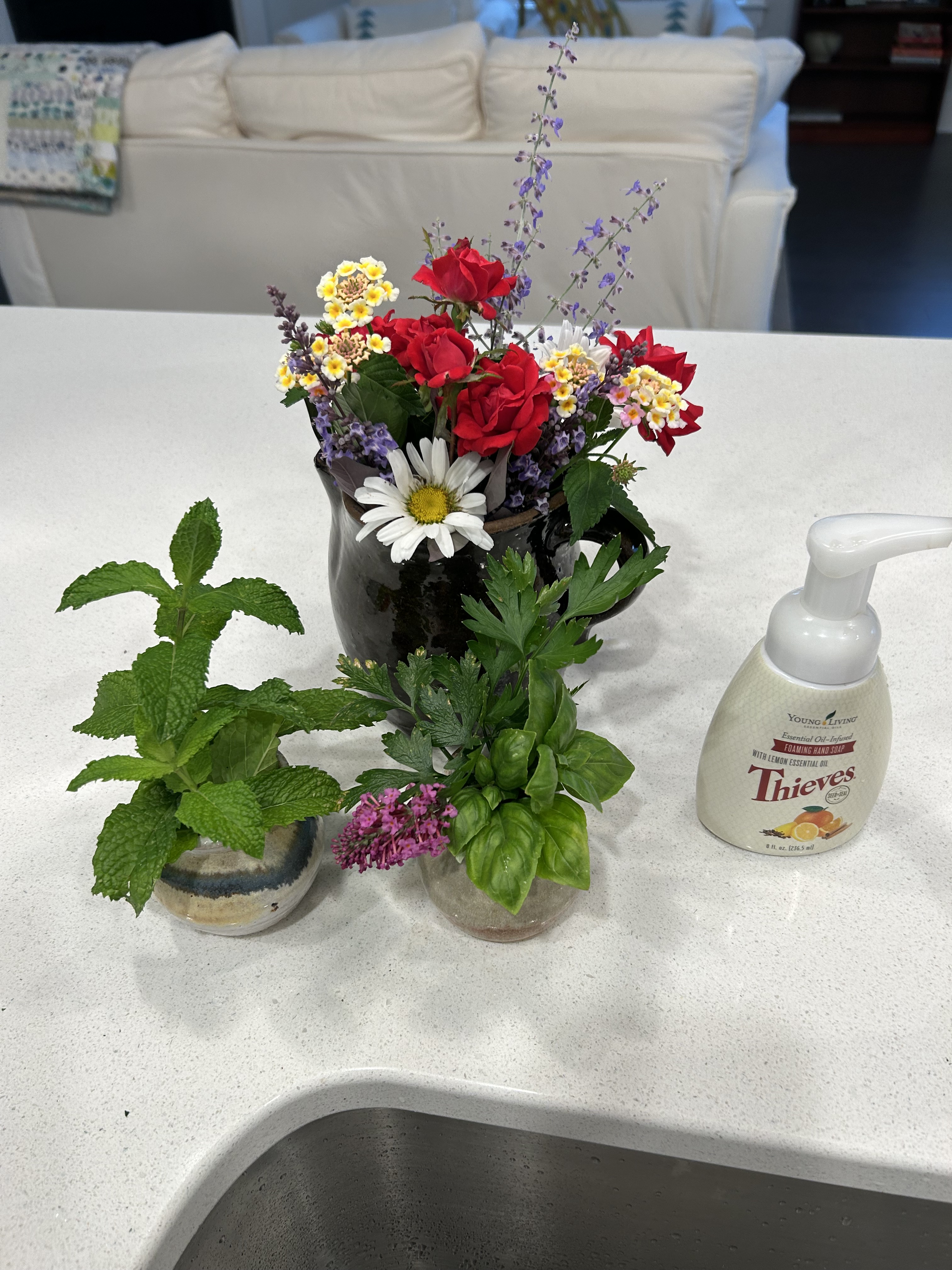
And today a painter is coming to paint the ceiling bases of these hanging lights over the kitchen bar. The bases are covering too-large holes in the ceiling. Painting them the color of the ceiling will help them recede and not stand out.
And after this fairly quick painting job is done, I’ll go pick up the raw milk and cream that I get every two weeks at Local Jo’s–and will deliver some to Mike’s family. I take a cooler with ice and frozen blocks in it to keep everything fresh and cold.
Then I’ll make my noonish dinner and will sew. It’s raining, so likely I’ll not be able to grill the two lamb chops I defrosted. Tomorrow: chicken salad with homemade mayo.
Alex is here mowing–between rain storms. The grass is now thick and happy–an apple green carpet that is soft and cushy underfoot. And it is growing like crazy. All the plants are also thriving.
Yesterday I got all the blocks I had set up on the half-square triangle quilt sewn together yesterday, and I’m loving what I’m seeing. I have not connected the 20-inch blocks themselves yet.
Now I’ll have to make a lot more of the units, and I have the sub-units (4-inch squares) set up to do that work via chain piecing. Plus I found a kind of pumpkin yellow orange for the sashing for the bottom left block. When all are done, I’ll have a top that is 60 by 60–and I’ll figure out what to do to take it out to the 70s range, width wise, and maybe 80s length wise.
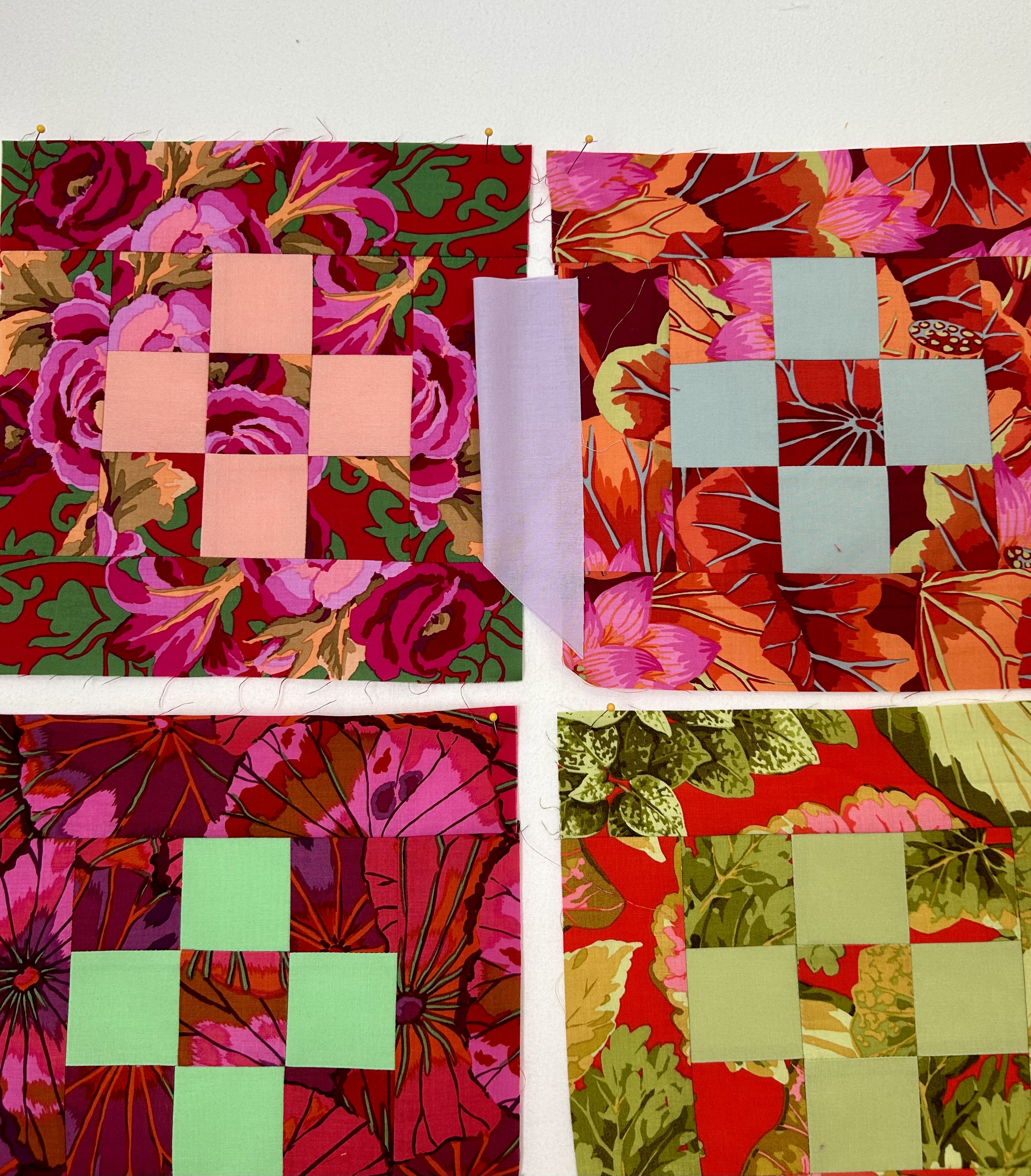
I’m going to use Kona Thistle for the sashing between the big red blocks.
It is soft and does not compete with the outrageous Kaffe Fasset prints, but will separate, gently, them. I may use it as the binding too.
Of course I won’t position two green centers next to each other when the time comes to finalize the layout.
The next group of Summer Camp mystery blocks drops tomorrow–so there’s that work for the weekend.
Girlie will be done next Friday. How nice is that?
On Saturday morning I was getting ready to make a Costco run, which involved an ice chest in Girlie car’s back hatch, and while backing out of the garage, I smashed the rear window as I had left the hatch door open, and it didn’t clear the low garage opening. In my Maine garage I would have gone right through with the hatch door open.
It is interesting that my RAV4, which warns me of all sorts of possible events while backing up, didn’t make a peep about the hatch door being open.
It was one of those totally stupid life moments. And it left me with tiny pieces of shattered glass all over the back of the garage, obvious damage to the back door, and a case of the shakes. And a loss of confidence. For sure.
So, let’s skip to today–Wednesday morning. Son Mike came right away with plastic and tape and soothing directions of what to do and what to expect. (Son Bryan was away with the family.)
USAA, on a Saturday, set the required insurance in place, organized the repair, and got me a rental car. Better Collision had an inspection spot ready for me on Monday, and I dropped off Girlie there and felt she was in good hands. There was additional drama as we got a really bad thunderstorm, which I tried to beat in getting Girlie to Better Collision, as we weren’t sure the plastic would be totally efficient, and I got caught in it just 5 minutes or less from finding the repair place. But Mike’s plastic seemed to hold until Better Collision could get her under cover.
Enterprise car rental picked me up at Better Collision, and I came home with a bright white Toyota Corolla, which I can drive until Girlie is fixed and which will stand out in parking lots. And the best news is that Better Collision called yesterday and, assuming parts are available, Girlie will be ready to go again some time Tuesday or Wednesday at the latest. And I can drop the rental car at Better Collision and Enterprise will pick it up there.
What has amazed me is that all these systems are so efficient and helpful. In all my years of driving, I’ve really never had an accident (knock on wood) that required this level of help. And I’d also like to say that there have been so many, many very nice people along the way who have helped me fix Girlie and to manage without her.
My nerves are another matter though! And my friends have been busy telling me of their car mishaps that they also classify as stupid moments that should not have happened. At least two friends have smashed hatch doors and the window backing out of a low garage. And, yes, that has made me feel much better. Accidents happen. And I think my own new rule will be NOT to open the back hatch door if I am leaving home unless it is OUTSIDE the garage.
To soothe my nerves and temporary loss of confidence in my sweet situation here, I’ve been sewing a lot since that Saturday morning. As always, quiet time in my studio restores me.
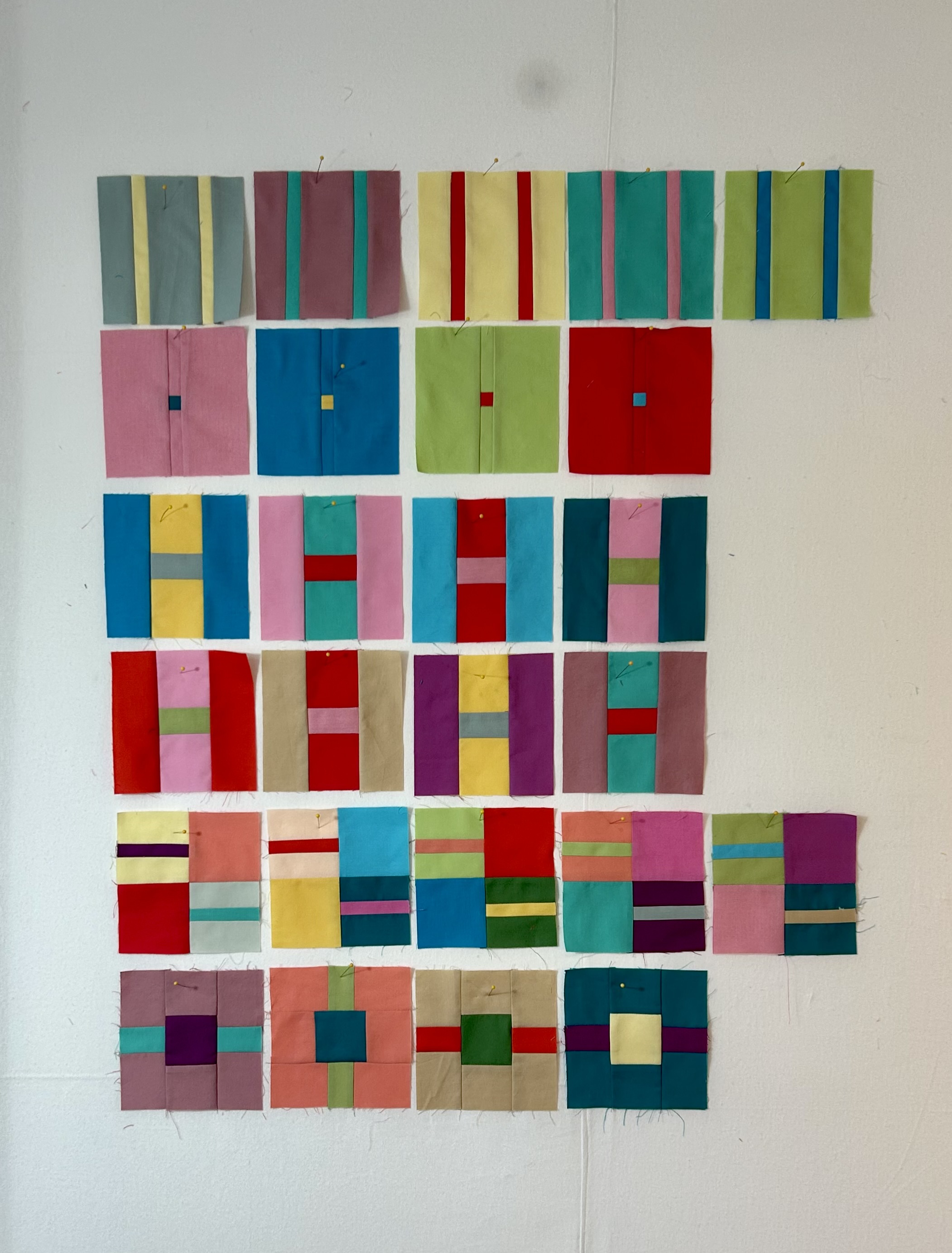
I’ve completed the second set of the Summer Camp mystery quilt (Modern Quilt Society) and am looking forward to the third round this Friday. These blocks are just so much fun. The blocks on the 3rd and 4th rows were made by cutting a set of blocks from the first set into two pieces and adding borders–a process I thought quite clever.
My backing/field fabric came yesterday, and I washed it last night. It’s a deep olive green and will be perfect. And the backing for the quilt from hell and its lighter batting came as well. The first of the 4 needed borders is almost done.
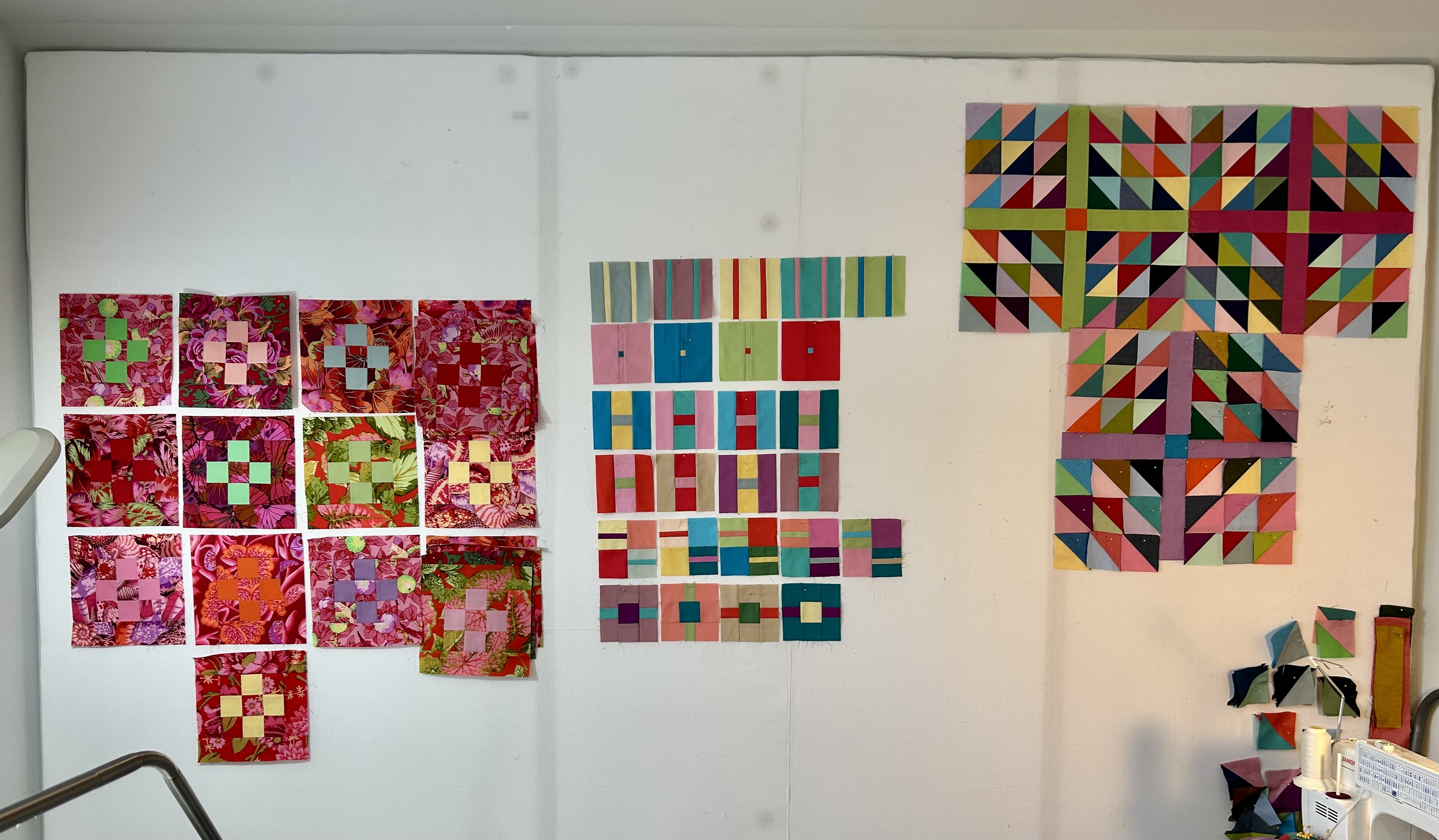
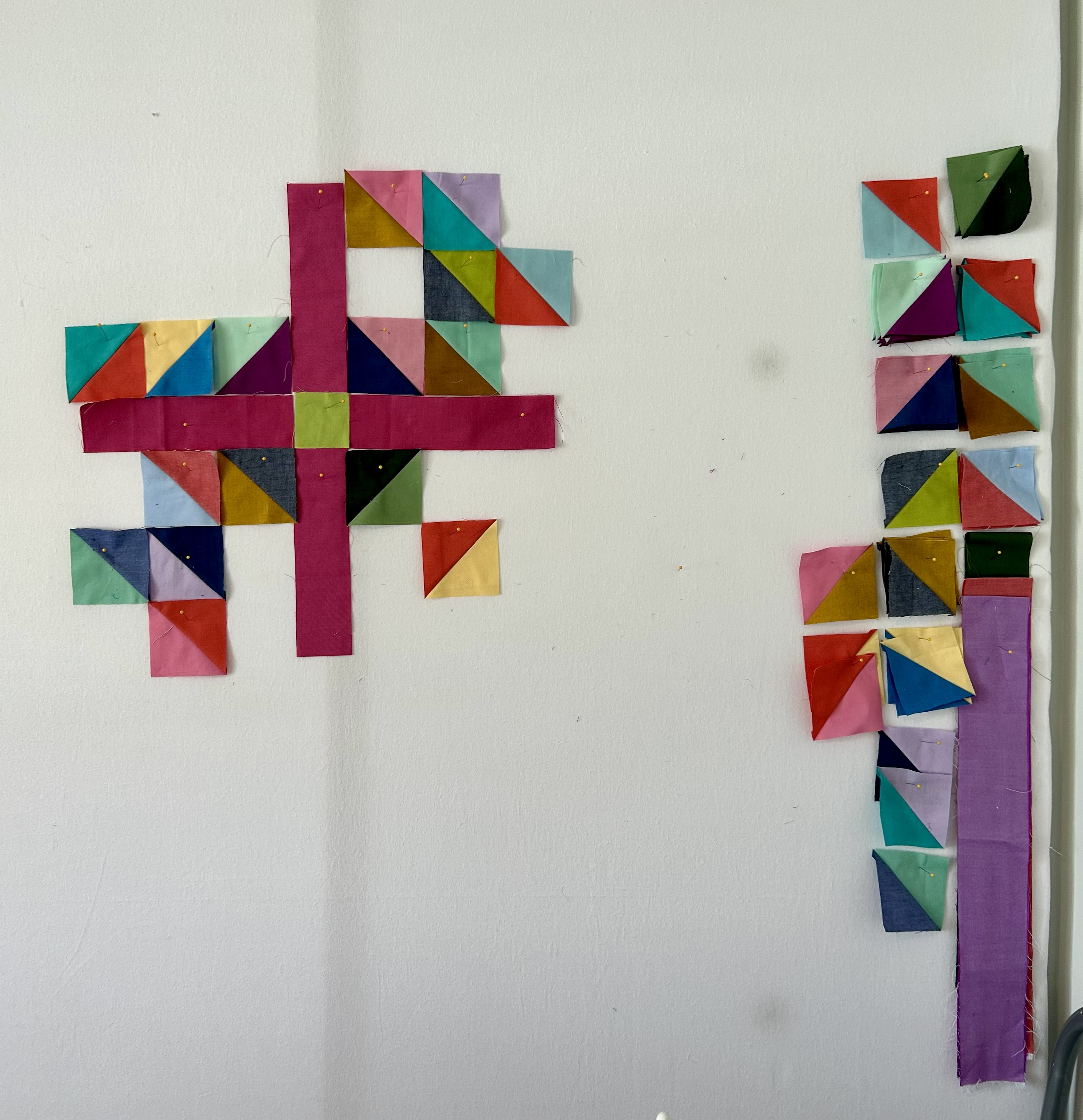
I’ve been sidetracked a bit with the half-square triangles made with solid scraps these past two days. OK, I’ve been side-tracked a lot. I am intrigued and engaged. Here’s where that project is as of this morning. I’m not going to use the dark green sashing I don’t think. I’ll put the aqua sashing in that spot. And there will be a third row. Then what? The blocks are 20 inches finished, and I’m loving how the secondary patterns are emerging. I’ll get the gold and light red sashing blocks sewn together today. But I also want this quilt to be more modern, so I may take the half-square units out on the top and sides in some way to be yet determined.
I took this picture of the design wall some time yesterday, so you can see the three projects I’m working on now. Then I stored the mystery quilt blocks. The red quilt blocks are stacked up together to make room on the design wall for the growing half-square triangle project–which is, by the way, eating up scraps like crazy.
I’m still wondering about the sashing color for the red quilt. I was thinking green, but I’m not sure. I don’t want it to remind of Christmas. I’ll try some other color choices later today. I don’t want pink. Maybe a soft lavender, like Kona thistle?
For now, before we get more rain, I need to take the rental car to the grocery store. I’m still not ready to make the Costco run though. But…soon.
Here’s the first set of blocks for the Modern Quilt Studio’s “Summer Camp Mystery Quilt”:
Each block has been measured and fiddled with if needed. The blocks in the 4th row, with the horizontal stripes, are used to make other blocks in the second set of block patterns, which I downloaded Friday. I did that work last night, and you’ll see them when I’ve finished the second set.
Each week we get a choice of eight blocks, divided into sets of two where each participant chooses one of the four pairs–so four blocks to make each week. But there are always multiple numbers of blocks to make for each choice–as you can see above.
So, now on to making the four blocks for this week.
When I moved to Maine, I encountered a strong bias toward healthy, clean local foods and homeopathic help when needed. Living in Maine changed my life.
One of the first books given to me by a dear friend was Sally Fallon Morell’s Nourishing Traditions. It really changed my life. Morell is one of the founders of The Weston A. Price Foundation, an organization that sells no products beyond books and information based on research, often done by scientists who have specialized in how food works in the human body.
Price was a dentist who traveled the world to find groups of healthy local people in order to identify why they were healthy. He judged “health,” in part, by the condition of their teeth. What each healthy group was eating was a primary question for Price. He learned these groups of people ate healthy, clean, WHOLE foods present in their particular environments. AND, he noted that when they started eating “modern” foods, they became malnourished and sick. He left a most interesting archive of his discoveries.
The Weston A. Price Foundation has a terrific web site that anyone can use to research a food or health question.
Sally Fallon Morell is a nutritional researcher in her own right. In the formation of the Weston A. Price organization, Morell worked with Dr. Mary Enig, an internationally recognized expert on how various fats work in the human body. Enig had published work that said that trans fats were dangerous for humans–in the era when industry was seeking to substitute plant fats for the animal fats humans have eaten for thousands of years. The industry went after Enig, and she lost all research money and never got more. A few decades later, “science” had to acknowledge that trans fats were indeed dangerous for humans. But note that this story illustrates how powerful industries work to create room for their own products: they demonize what they want to replace.
Here’s an article that came into my internet feed the other day. It is based on an interview with Morell. You might find some surprises here that run counter to popular belief.
It should be no surprise to anyone these days that media bombards us with countless claims about what is healthy for humans, much of which is a departure from what has supported humans for thousands of years and much of which is based on “science” supported by industry to “prove” their claims are true.
Living in Maine, with all its farms and clean foods, transported me back in memory to how I grew up. My father was military, and we moved frequently, but lots of time was also spent with my mother’s people in rural Georgia, with access to local foods from the family farm and gardens. Family members gathered food daily, and much time was spent on food preparation and eating together.
After exposure to Morell’s Nourishing Traditions, I promptly reverted to eating the kind of traditional my grandparents ate. And I’ve never turned back from that practice. It is serving me well in so many ways as at 78 I am healthy and strong and have boundless energy and a zest for life. My food is my medicine, and I don’t need anything concocted by industries that do not have my best interests at heart.
I couldn’t resist the adorable blocks being made in the Modern Quilt Studio’s “Modern Mystery Quiltalong Summer Camp” taking place now. The participants are full of helpful assists and have lots of good humor.
I’m crazy. I know. There are two quilts on my design wall already, the quilt from hell, and Traverse waiting to be hand quilted. But at the very least I’ll print out all the directions.
However… I already have my cutting table covered with solids, so why not? I kept telling myself I absolutely SHOULD NOT start another project, but I really liked what I was seeing online (I found this group on a Facebook page), and I walked away and walked back for two days before I realized I was already putting together a palette and watching videos.
You can go online and see what has tempted me so strongly. I really like this organization and did review its lively patterns and mystery quilt results that people have posted on FB. There is an Instagram account as well.
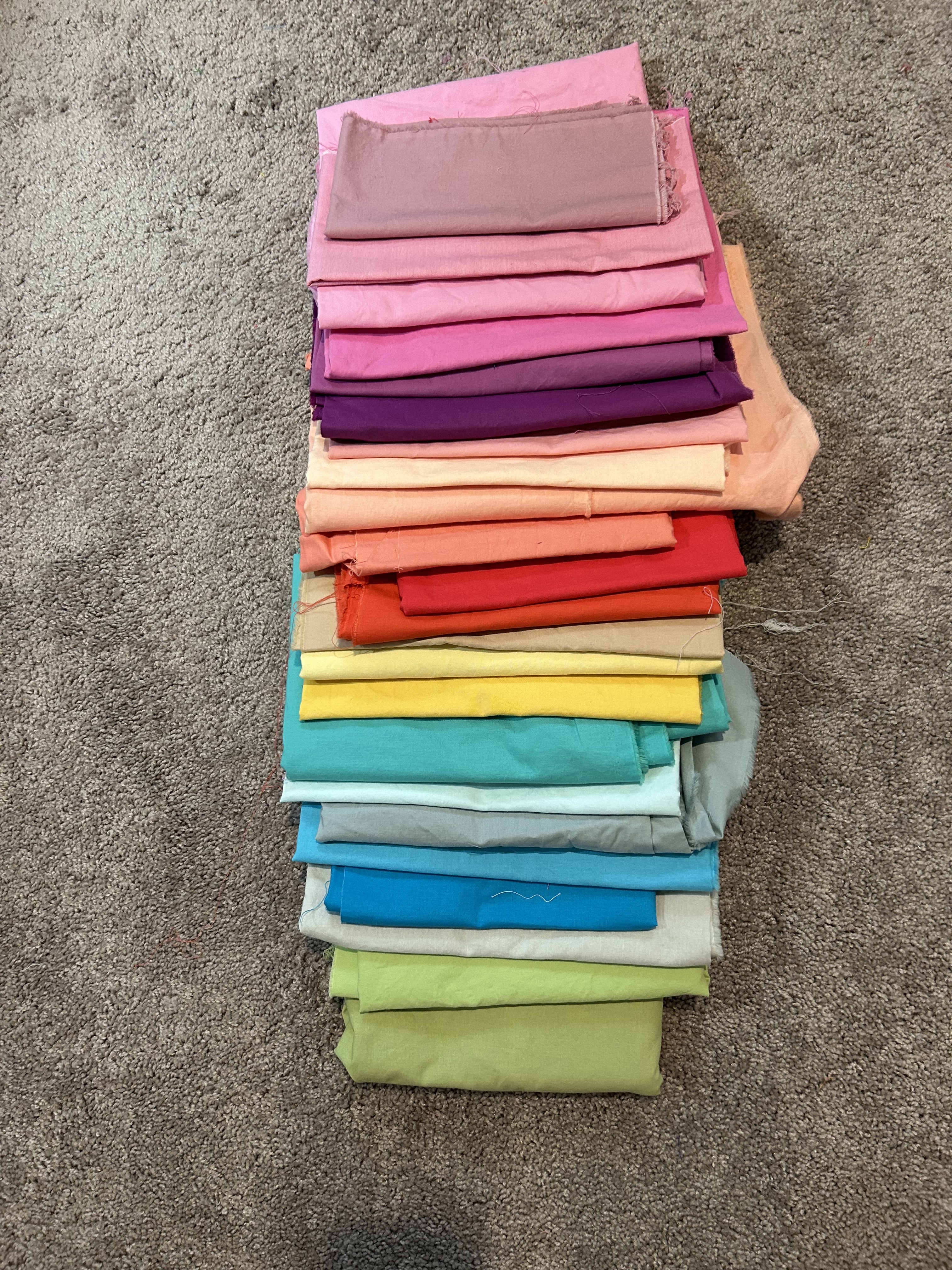
I have been working in solids for these past 4 or 5 years, as longtime readers know, so I have a solid stash of colors. Here’s the palette I’ve made for this project:
I’m going to remove the dark magenta from this palette as I’m going to use a dark olive green for what is called the “field” fabric that will surround the modern blocks (Kona Juniper 409). The magenta will not show up on a dark green. Per the helpful videos, I’ve included some duller, lighter fabrics that will make the brights shine in the quilt.
The cutting and sewing are easy–and the block load coming weekly now is doable, for sure. I’m already learning some new piecing methods–and it is always fun to get directions for various blocks to make. Out of the initial 8 blocks, one chooses 4 to make. These first blocks are what I was seeing as people made theirs and shared.
Crazy, yes. But happy too. And energized with my creative work.
Here’s a little bouquet I cut when I pruned and deadheaded the other day.
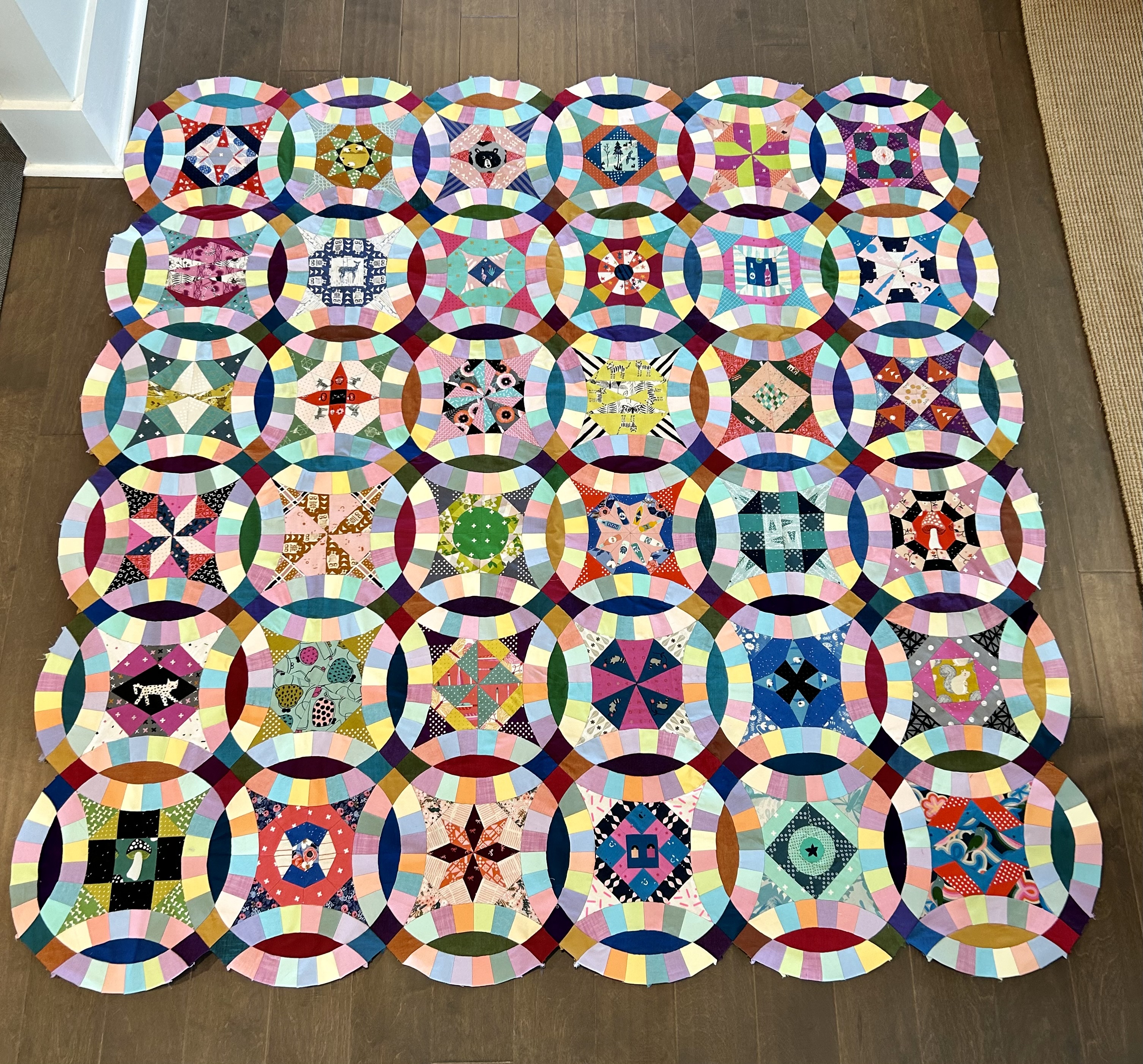
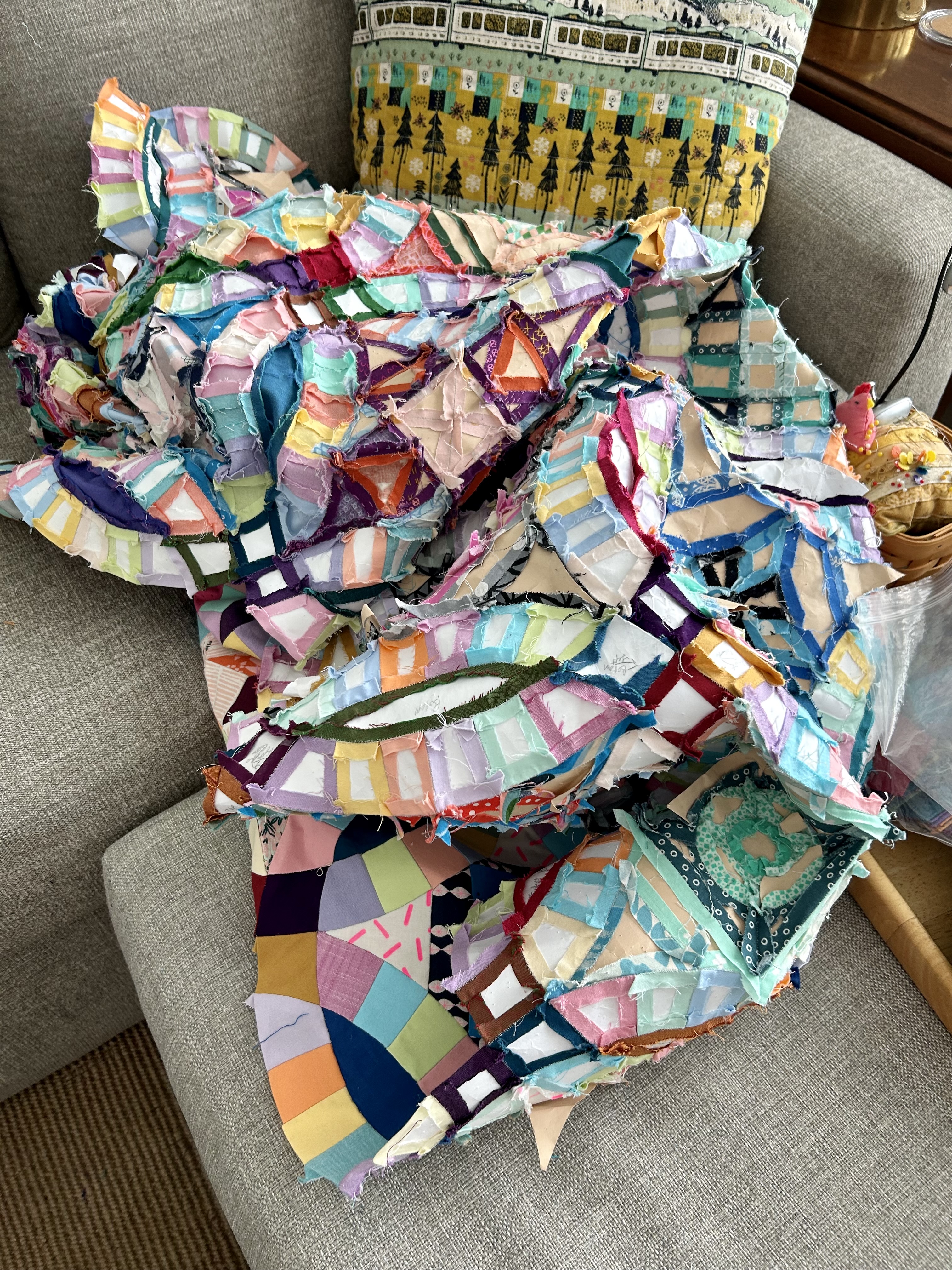
I started this English Paper Piecing project in June of 2018. That’s FIVE YEARS for heaven’s sake. There are SO MANY tiny pieces, and I have spent COUNTLESS hours prepping all the templates. Plus, sewing all the curves is so, so hard. I’ve used up a whole roll of artist tape along the way.
The block centers are all Cotton+Steel/Ruby Star Society. The rings are solid pastels, and the ring centers and the 4-patches between the rings are all dark solids. The outer border will square it off and is made of BIGGER (thank heavens!) pieces–all dark solids.
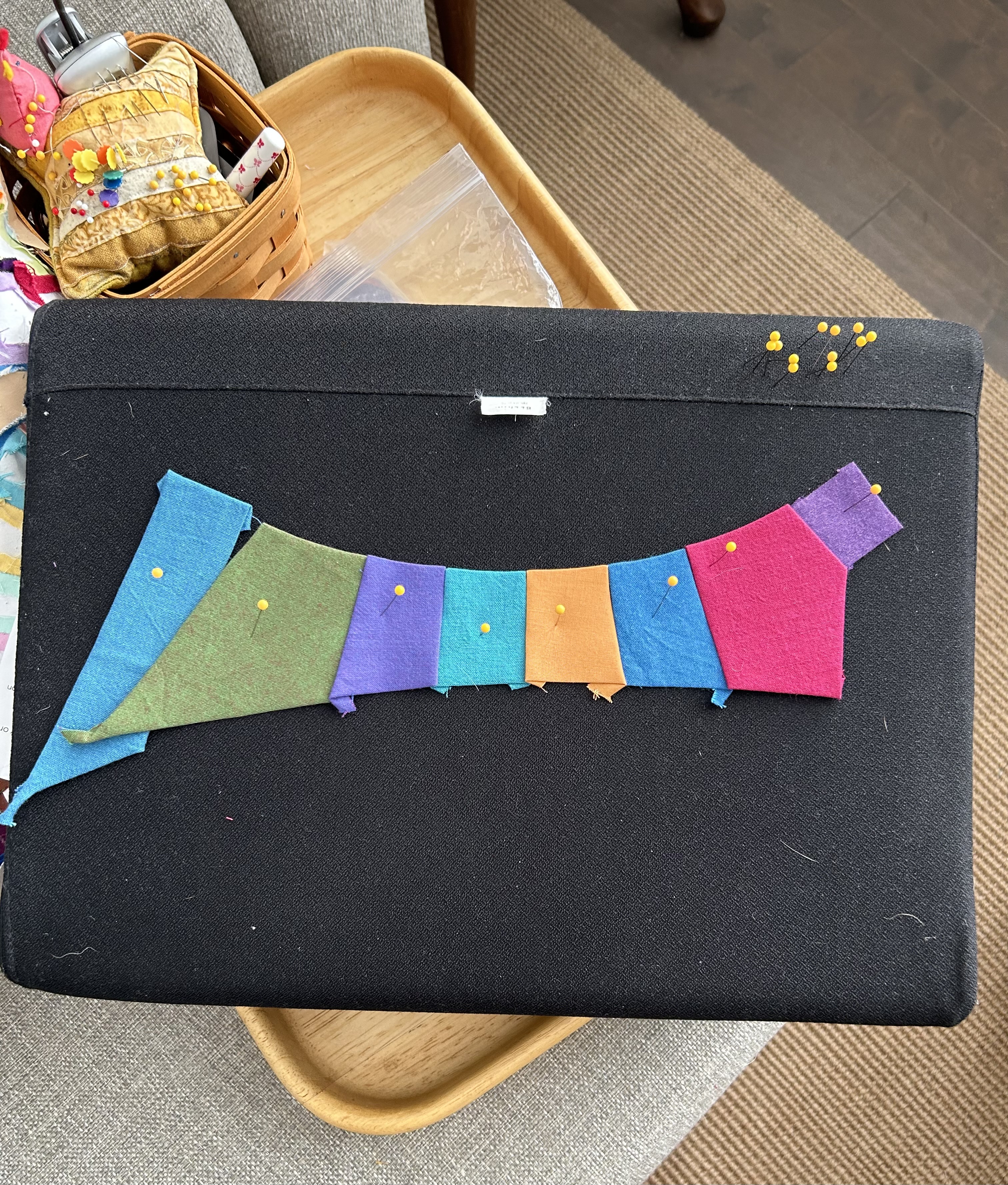
I got the two large pieces joined by Monday at some point and ironed the top. I spent a chunk of time late Monday and Tuesday cutting and making the border templates. Here’s an example of one of the border units–a corner piece. They will be turned so that that little square goes down into the quilt and will finish off the 4-patchess. So, yes, more curves to sew!!!
Here’s the real problem now. All those templates now have to come OUT of the quilt. I pulled out templates for hours yesterday and don’t feel like I made much of a dent. I’ll leave the templates around the edges until I sew in the borders–for stability.
The thumb nail on my right hand is so, so sore this morning. Tweezers to the rescue!
I might as well just settle back and listen to a book or tv as this part is going to take DAYS.
Meanwhile I had a LOVELY weekend with two granddaughters staying overnight Friday and Saturday. We kept busy, which included three swims in the pool to which I have access as part of my HOA. We visited, shopped (bead store for making a necklace and a bracelet), went to the library, cooked (a soup lesson here), watched tv, made popcorn, and in general had a lovely weekend. (This granddaughter weaves friendship bracelets with a kind of hard loom.)
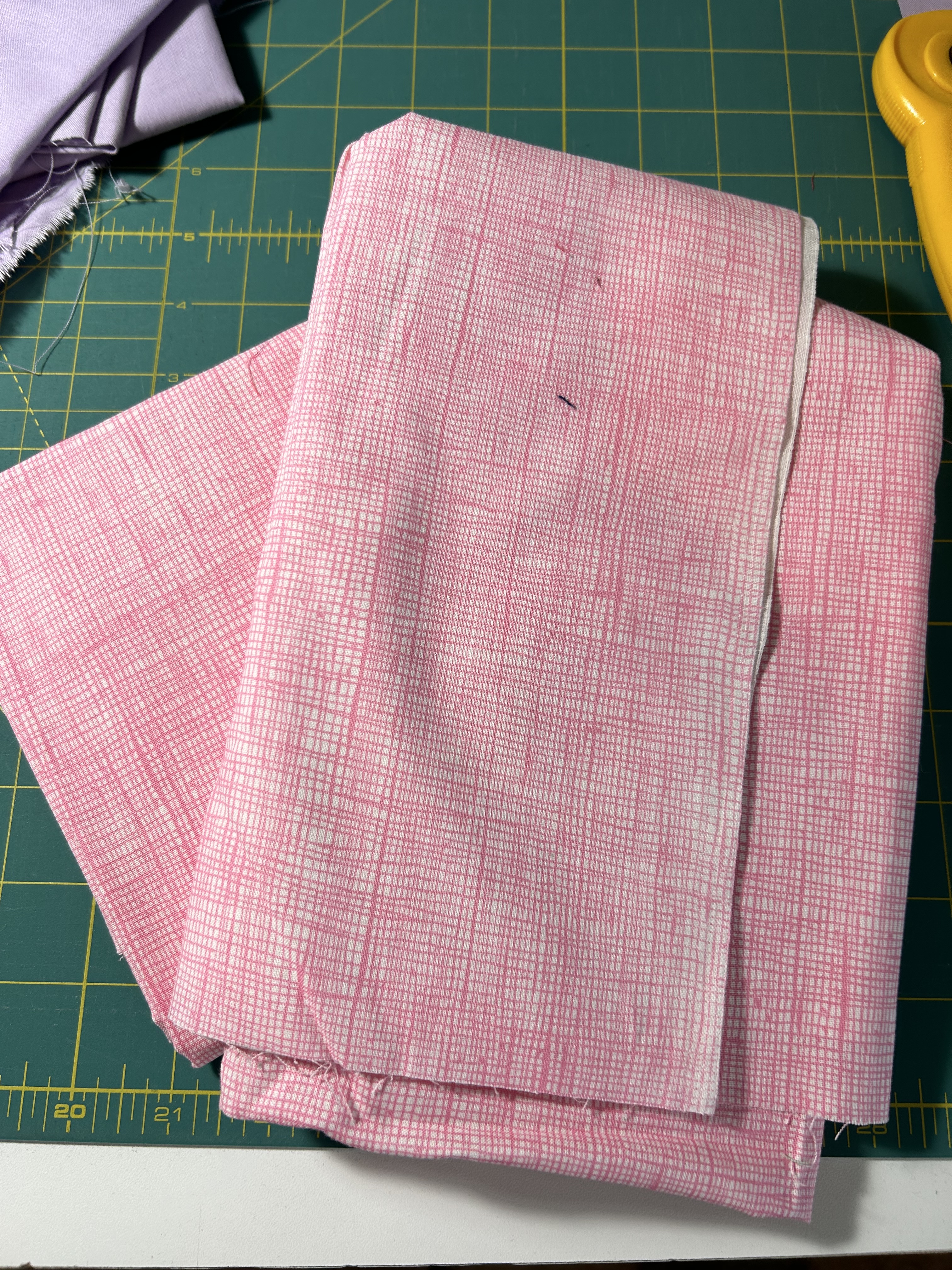
And, sale cotton fabric from Missouri Star arrived, and I’ll make a long tunic to go over leggings. It’s a new pattern that I’ve had for about a year and have just been too busy to make it. I am needing lighter clothes here in South Carolina.
Here’s the first post on what has turned out to be “the quilt from hell.”
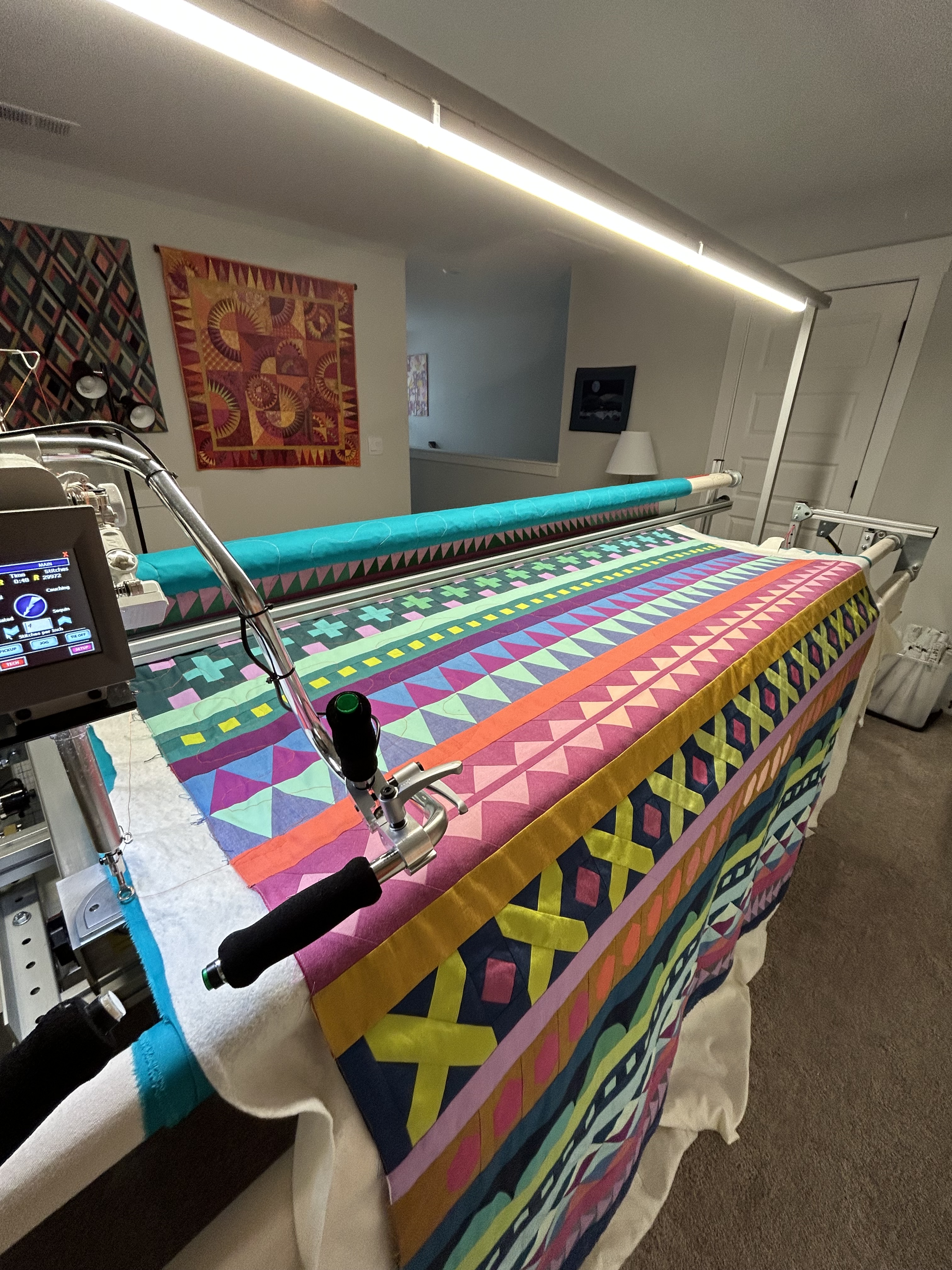
I put her on the longarm yesterday, after prepping and ironing her backing and trimming the batting. It took all afternoon, so no work happened on my two new projects that are filling up the design wall.
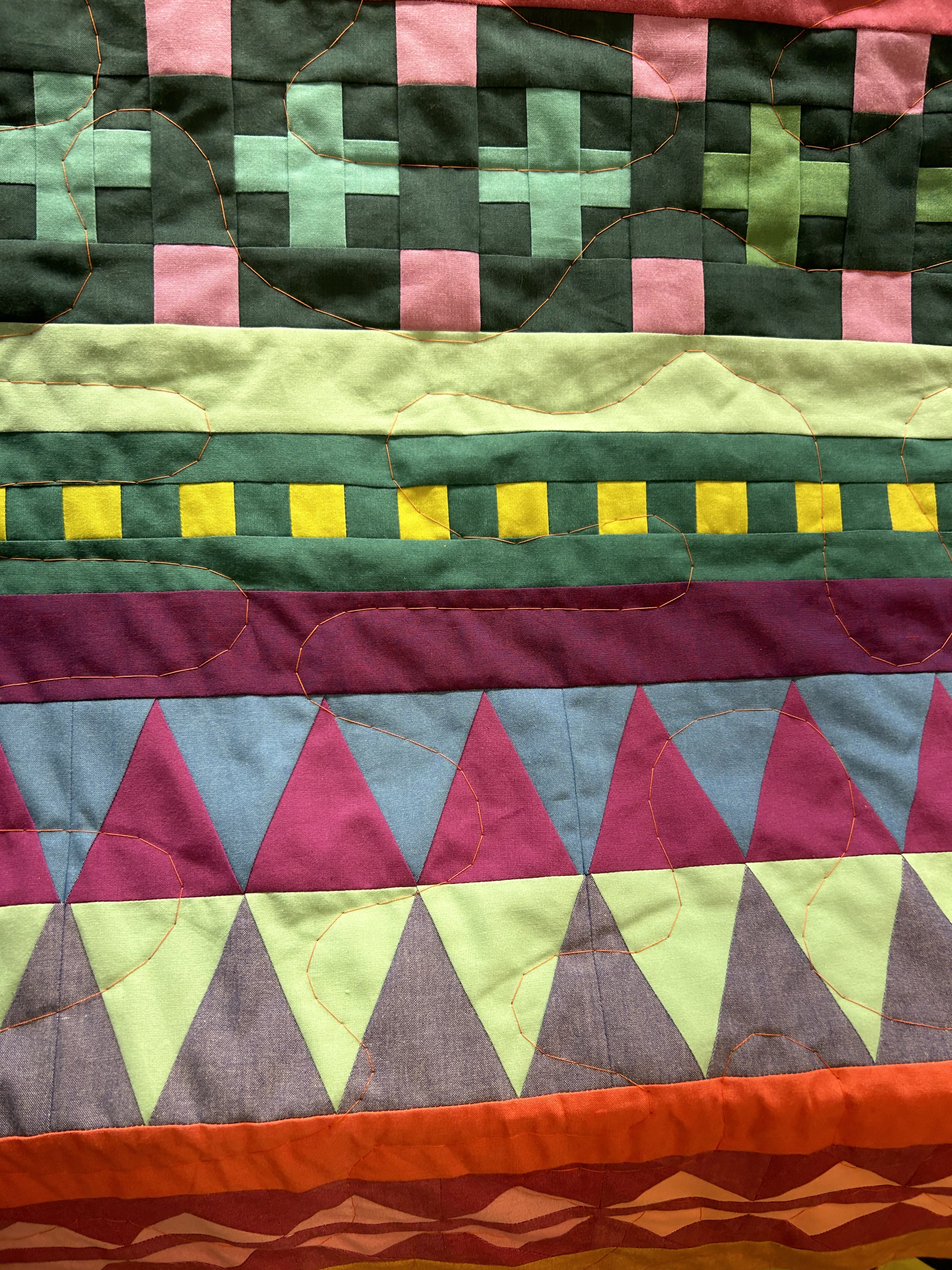
I can set my machine to a VERY big stitch. When I am longarm quilting a quilt, I follow this same process, but just baste down the edges as I go–so the longarm needle plate does not get caught in the fabric at the edge of the quilt. Believe me, that creates a terrible mess. And, sometimes, at least once for me, a hole in the quilt. For a regular quilt I just sew straight lines across the quilt, and I measure the distance of the sides to the quilt frame to make sure the quilt stays even on its backing and batting.
But with a quilt I want to hand quilt, I make big curvy swirls as they will really hold down the fabric. The top might look a little puffy, but trust me, it is tight to the backing and batting as that is the gift of the longarm basting.
Here she is–and remember the camera distorts…
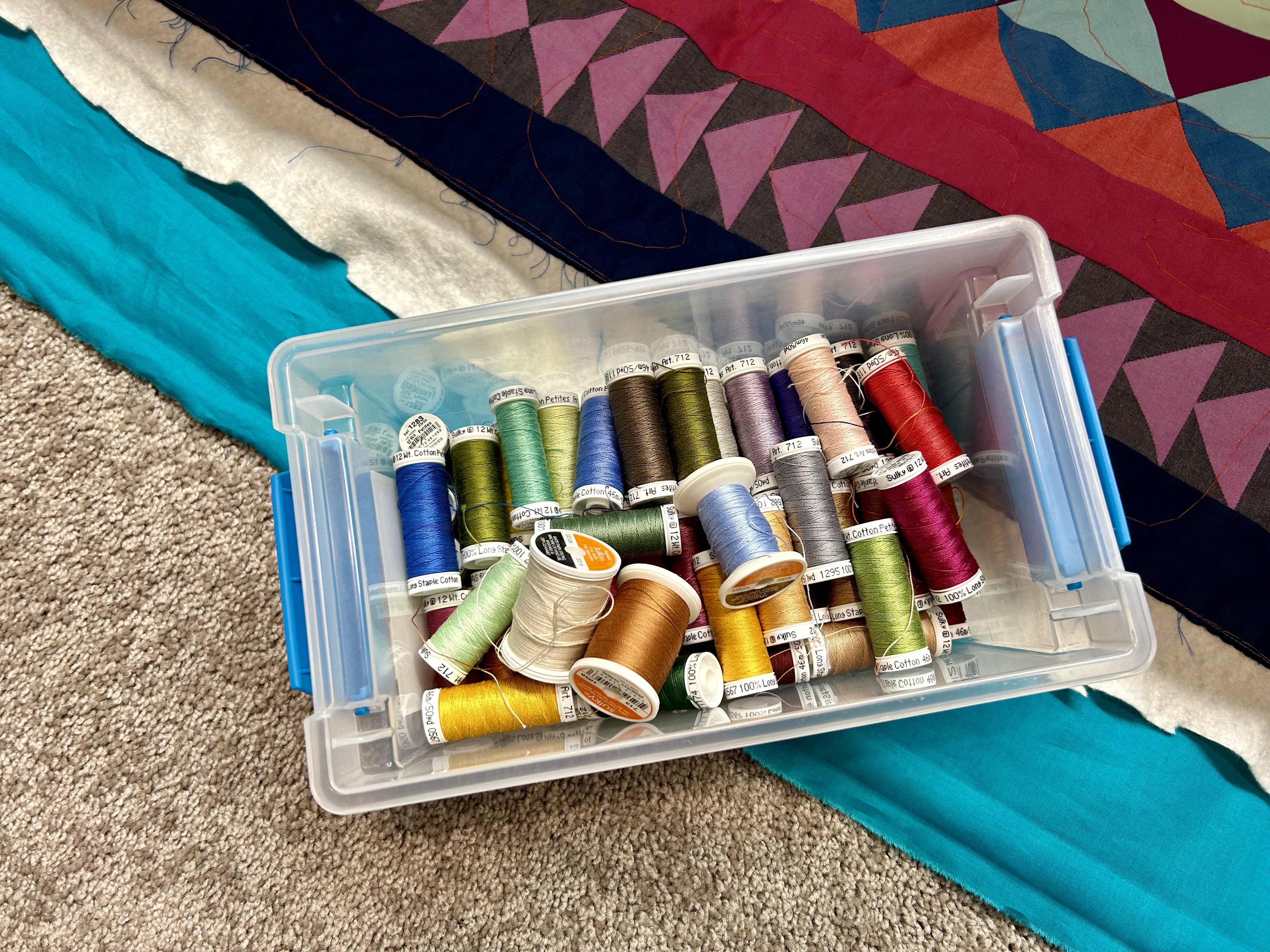
I have a whole little bin of Sulky 12-weight threads in so many lovely colors. And I want to use a lot of thread color in this quilt–probably to match the colors in the quilt. These are “little” spools that are very inexpensive at Red Rock Threads–under $3 each the last time I looked.
Tara Faughnan also likes Wonderful 12-weight “Spaghetti” threads, and she has a lovely package of them in her shop. I ordered it as I’d like to try the Wonderful 12-weight threads. Those two big spools are threads I’ve had for years, for decades actually, that I bought for a quilting project when I wanted a thick-thread look.
I won’t let myself start quilting this quilt, although my fingers are itching to start it, especially after taking Tara’s online class on hand quilting, where I got a much-needed refresher on hand quilting. I’m going to practice delayed gratification until I get the quilt from hell all together–and except for its borders, I’m close to that moment. Yeah!
I am no stranger to coastal weather as I lived near the Maine coast for almost 19 years.
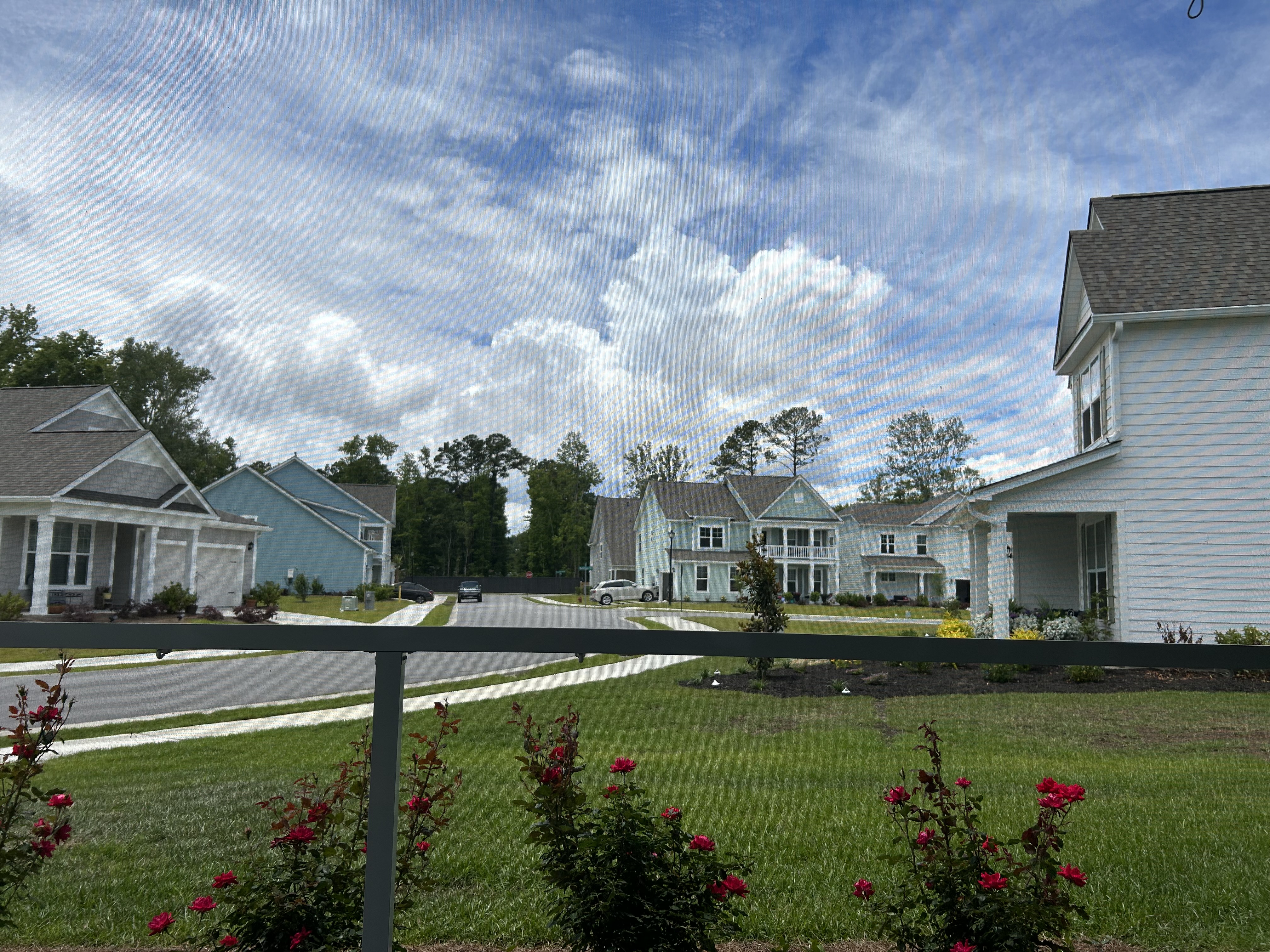
The clouds are always fascinating along a coast, and weather moves fast.
I like to eat my noon dinner in the “outdoor room” (screened porch), after which I enjoy an espresso and read a little. And I watch the clouds. (The porch screen distorts a bit.)
Weather boils up, for the most part, from the direction straight in front of my porch. And almost always these days, there is a very cool breeze that comes directly into my porch.
Summer heat in the south will still the wind on a lot of days. Even the ocean will become flat and smooth, except for the fringe of the waves at the water’s edge. But for now, our weather has just been delightful.
Traverse is waiting for me to put her on the longarm to baste her layers, but I’ve digressed to quilty playing for a bit.
Almost two decades ago I bought this kit from the now-closed Mainely Sewing quilt shop. Actually I bought TWO kits as I wanted to make a quilt that was wider than one kit allowed. The main fabrics are Kaffe Fasset RED florals.
The sashing is an Alexander Henry pattern from 2008. And it is fine, as is the above pattern. But why didn’t I make this project back in the day? I don’t really know. I do remember that I wanted to make a RED quilt.
But I’ve moved on and changed with my quilting–becoming much more interested in modern quilts and the modern traditional category–both of which are simpler and often very graphic. So, how to use these red floral fabrics? I’m determined to wipe out all the saved projects I have–and I’m moving right along on that effort.
First, the pink sashing went into the stash–and I pulled out solid scraps that needed to be used. And here is what is growing on the design wall.
The blocks finish at 10 inches. And I’ll use a solid for a narrow sashing. I won’t use borders–I’ll take the blocks out to the border and use the narrow sashing as a finish–with no corner stones. Maybe the binding will be one of the red florals? I have a hunk of one fabric that…strangely…is cut on a bias and it might work. Seven 10-inch blocks by 8 blocks would make a nice-size quilt.
I don’t know the sashing color yet. Maybe a lime green? There is a lot of bright green these fabrics.
Meanwhile, I’m also cutting and making half-square triangles from the solid scraps. And, playing with this idea, which would make a 20-inch block. Perhaps that rose sashing needs to be brighter? I saw a quilt Tara Faughnan made, using this kind of a block, and it is so fun. Her creativity knows no bounds. For sure. The squares on the right are for the next big block so I won’t repeat blocks in this first one.
Yesterday was a grilled lamb chop and roasted squash day–zucchini, yellow squash, sweet onion, carrots sliced thin, and fresh herbs from the garden. I should have added some garlic chopped fine too. Next time. ***I’ve learned from son Mike NOT to roast these tender squashes very long in the oven or they get mushy. Just 20 minutes in a hot oven. Then just broil them for a few minutes.
I can’t wait to get back to my studio upstairs today! But I have some errands to run first. And cooking for the day as well, though I have more of the squash mixture.
Tara Faughnan designed Traverse and Sewtopia hosted the project, which ran as a block-of-the-month project, starting early fall last year. I chose this version, made with Windham’s Artisan Cottons (shot cottons). Those fabrics…glow. As usual, when I work with Tara Faughnan, I learn so much. And I continue to love her design work.
Somehow I’ve never learned the trick of getting my cell phone NOT to distort a quilt picture so the bottoms always look like they are not as wide as the tops.
I took Tara Faughnan’s “on demand” online class about hand quilting last week. She pretty much hand quilts all of her work. (I don’t know how she has the necessary time, but like me with hand work at night, she finds hand quilting can sooth away one’s stresses.)
I’ve hand quilted for decades now, and in more recent years gravitated to thicker threads and bigger stitches. But in both methods, I’ve never been terribly good about getting my back stitches to be even like the front ones. Busy backing fabrics help hide that lack, but Tara pretty much works in all solids, and her quilt backs are as pretty as her fronts!
Can I just say I learned so much with this hand quilting update. Like me with these bigger threads, she does not use a hoop. And it was so good to see how she uses her hands and her thimble. I’ve learned a lot of new information about using the thicker threads I’ve grown to love for these projects; which of these threads work best; and which needles, thimbles, and thread conditioners work best. (I’ve gotten some new thimbles and a new thread conditioner which I love already.)
The other issue is what solid backings make hand quilting easier as they have a lighter base–so I ordered a Michael Miller Couture Cotton backing in a beautiful teal color. And I chose Dream Cotton’s lightest backing–Request.
So, yes, I’m going to hand quilt Traverse–after I put it on the longarm and baste it. And after I make myself finish the last row of the “quilt from hell,” join the two big pieces, and set up the final border, which will be much easier than all the curves in the quilt. And, yes, I’ll hand quilt it too when it is done.
Finally, one bunch of grocery store flowers fixed these two empty pots on the porch which were begging to be used. I could hardly walk past them as they were screaming at me…so loudly too.
And a friend brought me these lovely beauties Tuesday.
Grandson Kelly graduates high school today. The family is now gathering for that event.