Turkey Tracks: Cheryl Wixson’s Kitchen CSA

Turkey Tracks:  January 17, 2011

 Cheryl Wixson’s Kitchen CSA

We have a new CSA:  Cheryl Wixson’s Kitchen.

Cheryl is dedicated to making foods from locally grown, organic ingredients.  And, she’s associated with MOFGA–the Maine Organic Farmers’ and Growers’ Association.  I will get eight jars, each filled with something wonderful, as you can see below. 

I’m picking up our first order later today, I hope.  Driving to Belfast today to the COOP will depend on whether or not it stops snowing.  Not to worry though.  The COOP will hold the order until I get there.

Here’s a description of what I’ll be getting this month: 


CSA NEWSLETTER

JANUARY 2012

                                        WHAT’S IN YOUR SHARE THIS MONTH                                          


CRYSTAL SPRING MARINARA  Pasta & Pizza Sauce: Crystal Spring Community Farm is   a certified organic farm located in Brunswick.  The farm does a large summer CSA in the Portland and Brunswick area.  Seth Kroeck was one of the first farmers I visited when I started my work for MOFGA six years ago.  When Seth attended one of my Farm Food Safety workshops in early April last year, and told me that he would have some extra capacity in sweet bell peppers, we were really excited.  As it turns out, in addition to peppers, we were able to purchase sweet onions, jalapeño peppers, and Genovese basil.  Then one day, Seth called to see if we needed more tomatoes.  Seems that he had grown one variety in his hoop house that was quite prolific…we were fortunate to receive over 2000 pounds.  When cooking down these tomatoes, we decided to make them into a single variety sauce.  Crystal Spring Marinara is crafted in true Italian fashion.  The garlic is sautéed in olive oil until fragrant, and then the tomato puree, herbs and seasonings are cooked until the sauce becomes thick.  We love the fresh tomato taste of this sauce, and hope you will also!  And the good news is, next year, Seth will be growing even more food for us…we’re meeting soon to talk about varieties and quantities…go Maine farmers!

 PUTTANESCA  Pasta & Pizza Sauce:  We’re getting lots of feedback on this spicy, olive-laced sauce, and it appears to be a love-hate relationship.  Puttanesca is supposed to be hot and spicy, but some folks don’t care for that much kick.  If your family falls in this category, try using it as a pizza sauce, and spread it lightly over the dough.  The cheese on the pizza mellows the flavor of the sauce.  Or if you’d like, let us know, and we can swap it out for another variety.  Besides a sauce for pasta, Puttanesca goes great over chicken, and adds kick to black beans and beef.  For our vegetarian friends, try Puttanesca with portabello mushrooms…nice and meaty!

MARINATED BEAN SALAD: Looking for a serving of vegetables in a jar?  Marinated Bean salad fits the bill!  In this “pickled” vegetable creation, we use horticulture beans and yellow beans from Horsepower Farm in Penobscot, green beans from Peacemeal Farm in Dixmont, carrots from Snakeroot organic Farm, garlic from Green Garden Farm in St. Albans, onions from Crystal Spring Community Farm, and cauliflower from Kousky Farm.  The vegetables are cooked slightly in the brine, and then refrigerated overnight so the flavors can marry.  Then we return the mixture to the kettle, bring it to a boil, and bottle it.  I’ve been making this salad on a home basis for years, and my family loves it.  When I’m pressed for time, this is a quick and easy vegetable.  It also is great to take on a picnic, and makes a nice complement to bread and cheese. 

LIBERTY APPLESAUCE: The Liberty variety of apple is often cited as one of the best recently developed “disease-resistant” varieties grown in the Northeast.  It was developed in New York in 1978, and has a complex parentage that includes Rome Beauty, Jersey Black, McIntosh, Wealthy, and M. floribunda.  Wow!  Try keeping that lineage straight!  We find that it makes into a tart sauce, some may like to sweeten it a bit with maple syrup or sugar.  We eat it right from the jar, and cook with it.  Your Liberty apples were organically grown by Howard Wulf from Unity.  Howard’s orchards are works of art, and he is extremely interested in your feedback on his apple varieties.  Thanks to folks like Howard, we can enjoy apples in Maine year round.  Go Maine farmers!

BREAD & BUTTER PICKLES: Back by popular demand, some folks have told us they eat a whole jar of these pickles in one sitting!  This is the last of these classic pickles, but we will do lots more next year.  Can’t live without them?  Call the kitchen and get on the case list for next year.

WILD BLUEBERRY DRESSING: Maine organic wild blueberries are packed with antioxidants, vitamins and minerals…they are a super fruit!  Our wild blueberries come from the Blue Hill Berry Company.  Owners Nicolas Lindholm and his wife Ruth Fiske also grow certified organic vegetables on  Hackmatack Farm in Penobscot.  In this salad dressing and marinade, we cook organic wild blueberries with onions and extract a puree.  This puree is then slowly simmered with organic cider vinegar from Sewall Orchard, Rabbit Hill organic apple juice, and Kinney Farm organic maple syrup.  Wild Blueberry Dressing is vegan and fat free.  Mix it with olive oil to make a salad dressing, or use it straight from the bottle.  We like it on a Spinach, Goat Cheese and Fruit salad.  Marinate chicken or pork tenderloin in Wild Blueberry dressing, or for a treat, make Duck Breast with Wild Blueberry Dressing.  Be creative and please share your ideas with us!

JACK’S ORGANIC KETCHUP:  Our signature product, Jack’s Organic Ketchup is made exclusively from one tomato:  the Italian heirloom Principe Borghese.  These tiny, almost cherry-sized tomatoes, are high in natural sugars and are traditionally dried.  Our tomatoes were grown on Green Garden Farm in St. Albans by Allen Reynolds and Jose Vega.   It takes over two pounds of tomatoes to make one jar of sauce, and Allen and Jose will both attest to the fact that these little guys are not easy to pick!  Because the tomatoes are so high in natural sugar, we add very little sugar to the ketchup,  less than 5 grams per serving.  And yes President Reagan, Jack’s Organic Ketchup can qualify as a “vegetable”!  Try a meal of Cheryl’s Sloppy Joe’s made with Jack’s Organic Ketchup.

 JEN’S APPLE CRANBERRY JAM:  The inspiration for this jam comes from my sister Jen.  Early this fall, she gave us a box of bright, red cranberries harvested from Highland Farms of Troy, the farms she and her husband Stan own.   As we were cooking up a batch of sweet sixteen apples, the idea of  a jam that combined the tartness of cranberries with the sweetness of apples was born.  The texture of this jam, like our others, is smooth, almost like a butter.  We cook the fruit in the kettle, and then extract the seeds, skins and stems.  The extract is then returned to the kettle and slowly simmered with organic cane sugar.  As we don’t use pectin in our jams, the natural sugars and flavors of the fruit are much more intense.  We hope you enjoy Jen’s Jam!  Try it on dessert pizza, spooned over vanilla ice cream,  or in Orange Goat Cheese Danish.

.

Turkey Tracks: Happy New Year! Happy Quilting!

Turkey Tracks:  January 16, 2012

Happy New Year!

Happy Quilting!

Happy New Year!

This post is the first post of 2012.

The first two weeks of 2012 have been a period of intense creativity which has taken the form of quilting madness.  Thus, no computer work, no columns written, no blog posts, no fancy cooking.  Just quilting and maintenance tasks like laundry and feeding us and the animals.

I’ve noticed that I have a habit of reorganizing in the quilt room in January.  Two years ago I sorted books, moved the room around, and went through bins of supplies.  Last year I reorganized my stash–recoloring, refolding, pulling out small pieces, and so forth.  This year I went to scrappy heaven–after days of cutting up the unruly pile of fabrics that were not big enough to “file” in the stash.

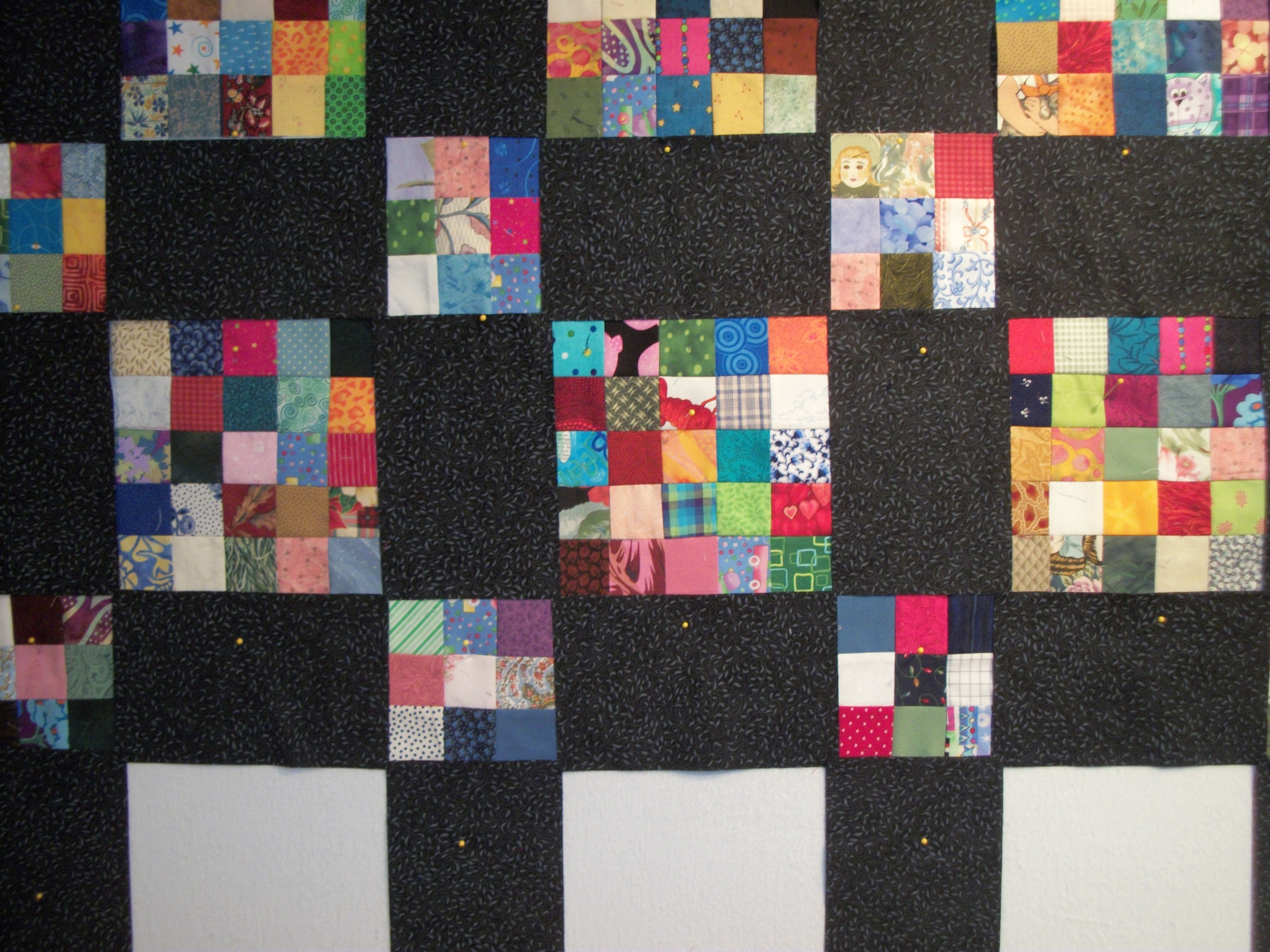
Since I first started quilting in earnest in 1999, I have been cutting up leftover scraps into what I thought might be useable future pieces–starting with the biggest square I could get–6 inches.  The sizes went down from there to 2-inch squares, to 3 1/2 by 2-inch rectangles, to  1 1/2 inch strips.  I now have BAGS of cut scraps, and this year, I pulled them out and started piecing, sorting, and piecing some more.  I’ve completely finished and quilted two quilts, have 2 other tops ready for backings that I need to purchase since I don’t have anything quite right in the stash, have a quilt pieced on the design wall, and can see 3 or 4 quilts still in the scraps which have now been sorted by color.

Along the way I’ve realized that from now on I’ll probably just cut 5-inch squares, 3 1/2-inch squares, 2-inch squares,  2 by 3 1/2-inch rectangles, and the 1 1/2-inch strips.  The 3 1/2-inch squares, 2-inch squares, and the rectangles can be combined in all sorts of ways to make interesting blocks.

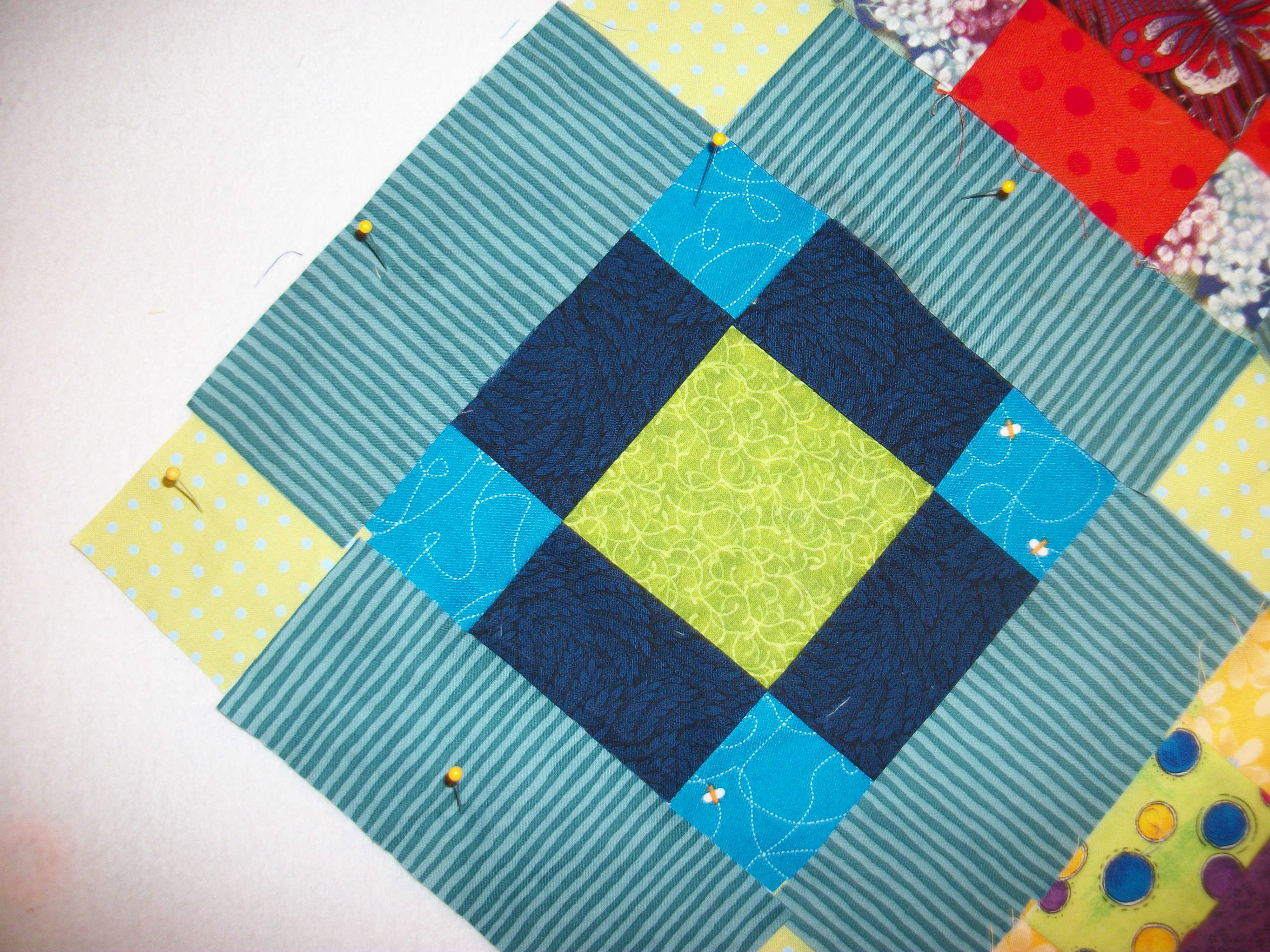
For instance, here’s a block made from this combo–set inside a striped fabric that helps control the wild blocks:

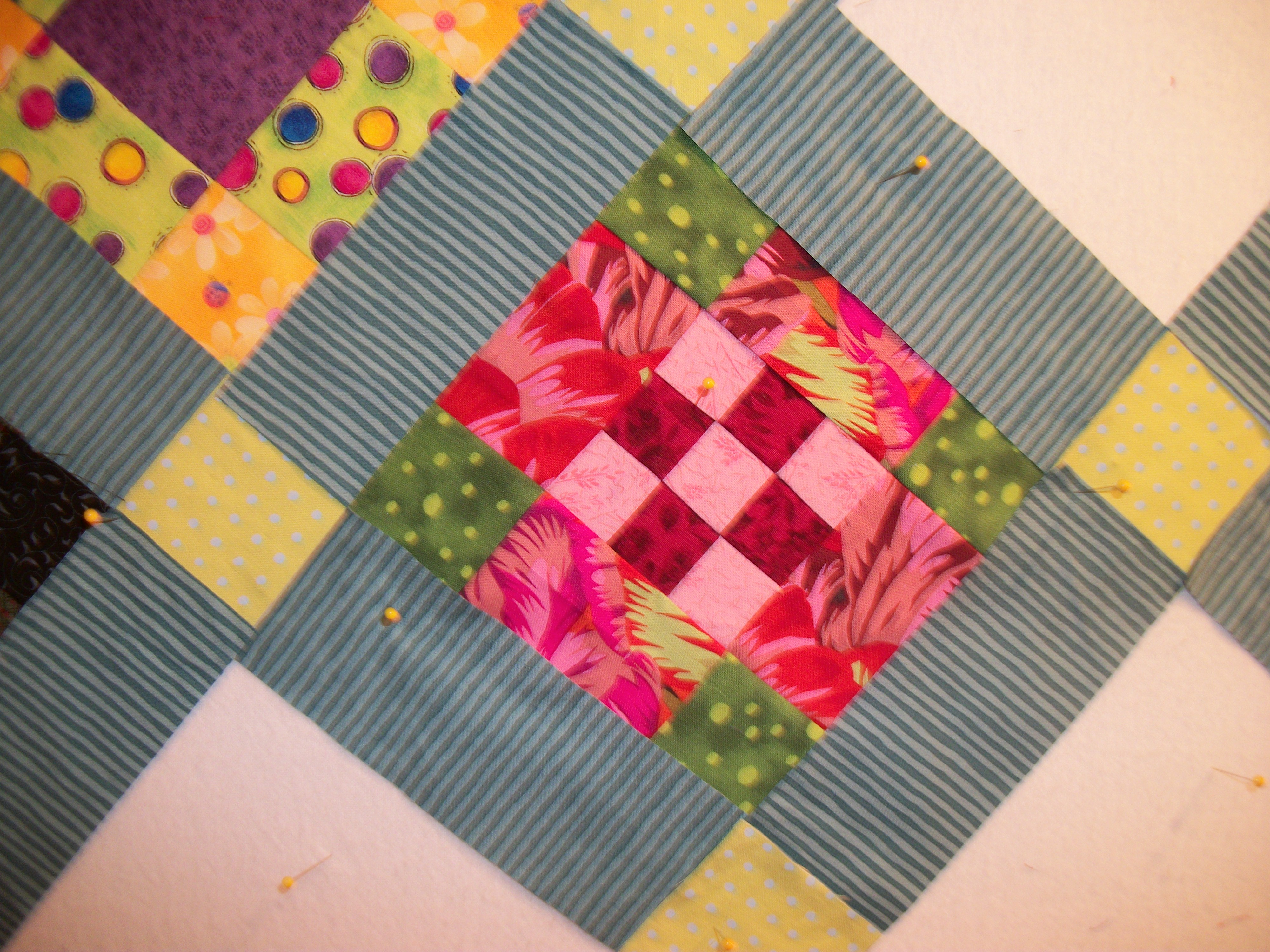
And I really love this one where the center is made with leftover 3 1/2-inch blocks from an earlier quilt:

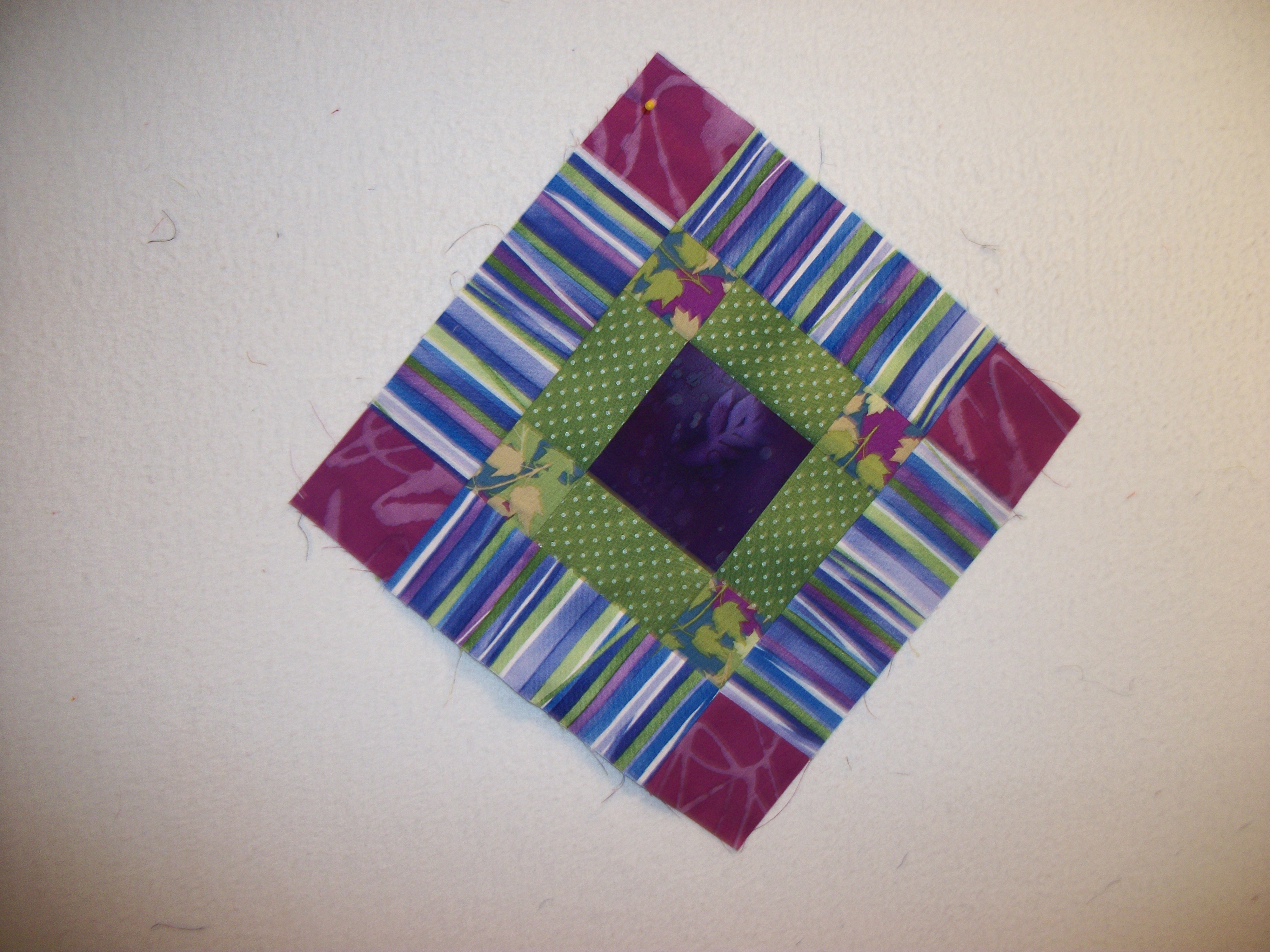
I first chose a different surrounding stripe, but it didn’t play nicely with all the blocks.  But, not to worry, I’ve got LOTS of purple, blue, and green fabrics in my stash–so here’s another quilt from the scraps that will be really pretty.

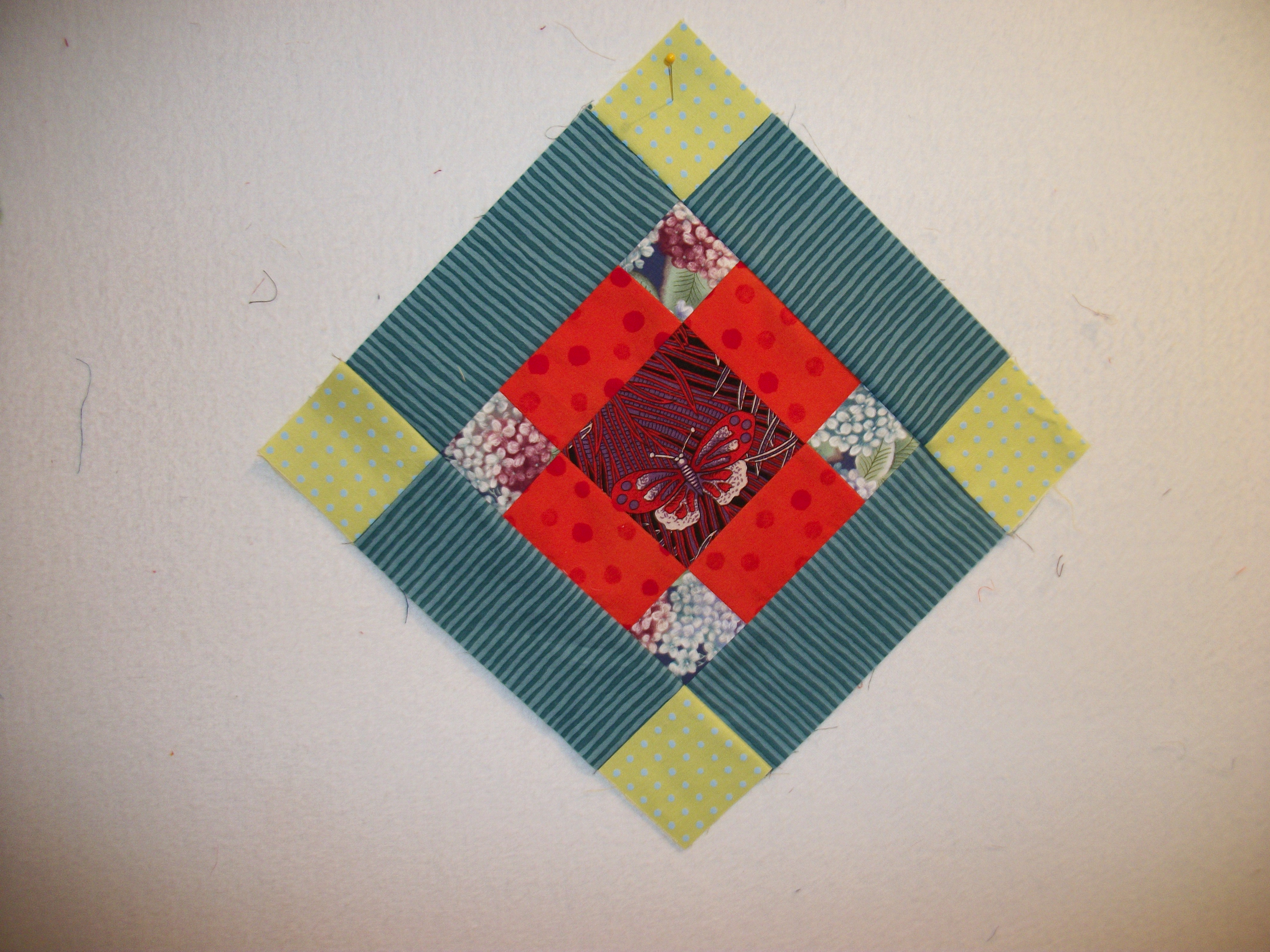
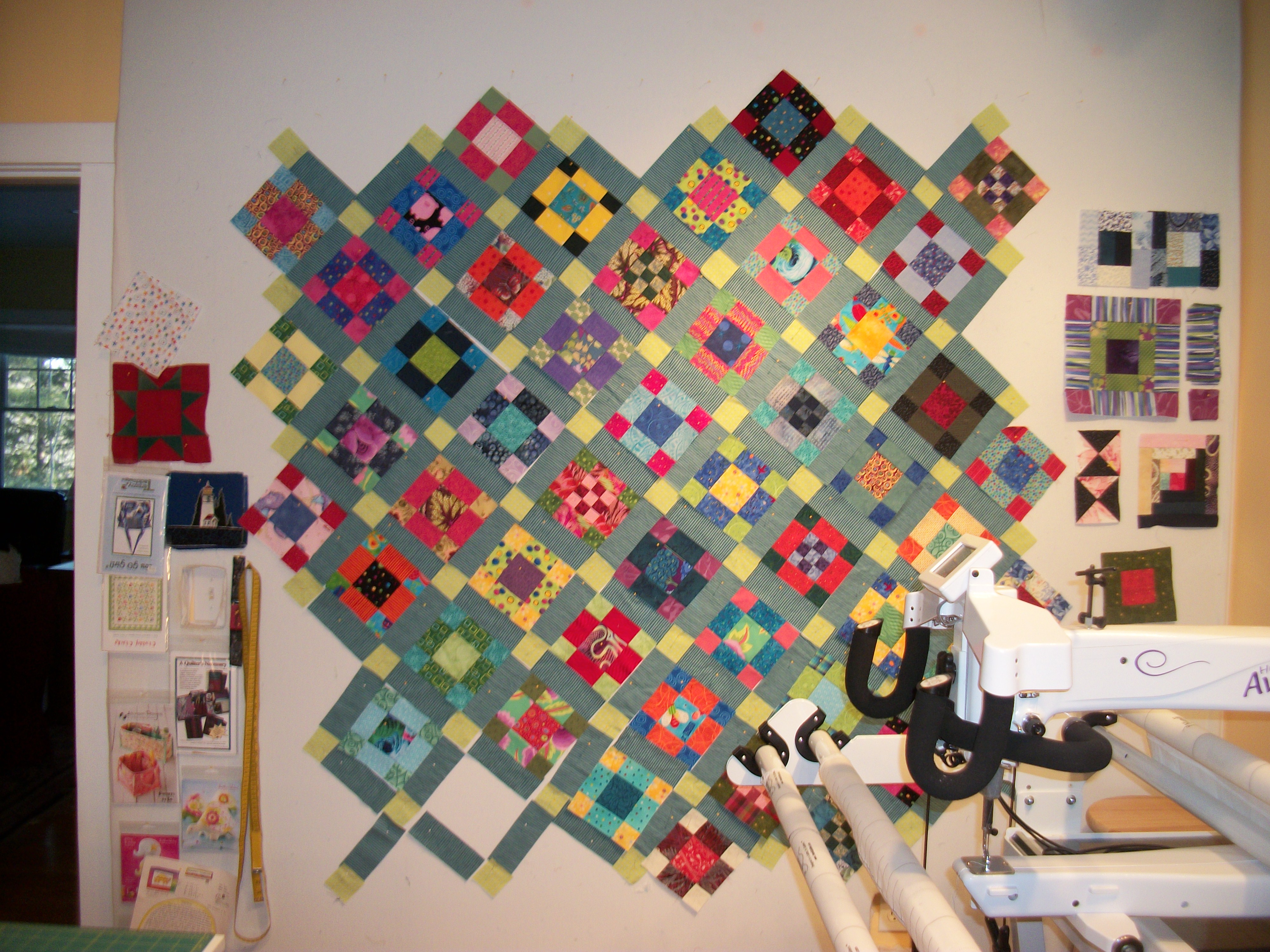
I particularly loved this block and started seeing them all set on-point:

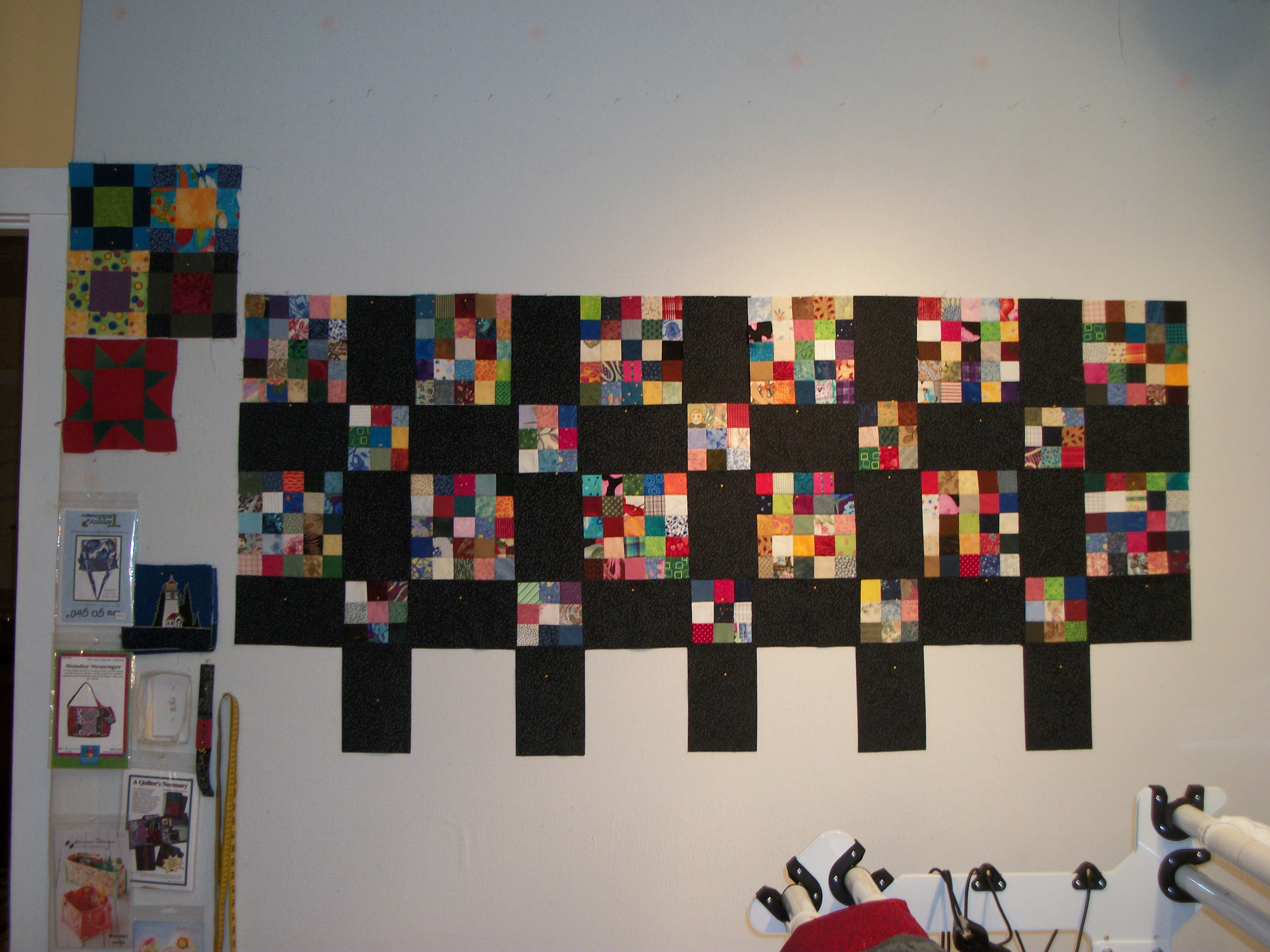
Here’s how this wild, colorful quilt is shaping up–the outer blocks will be trimmed just beyond their centers to square the whole thing up:

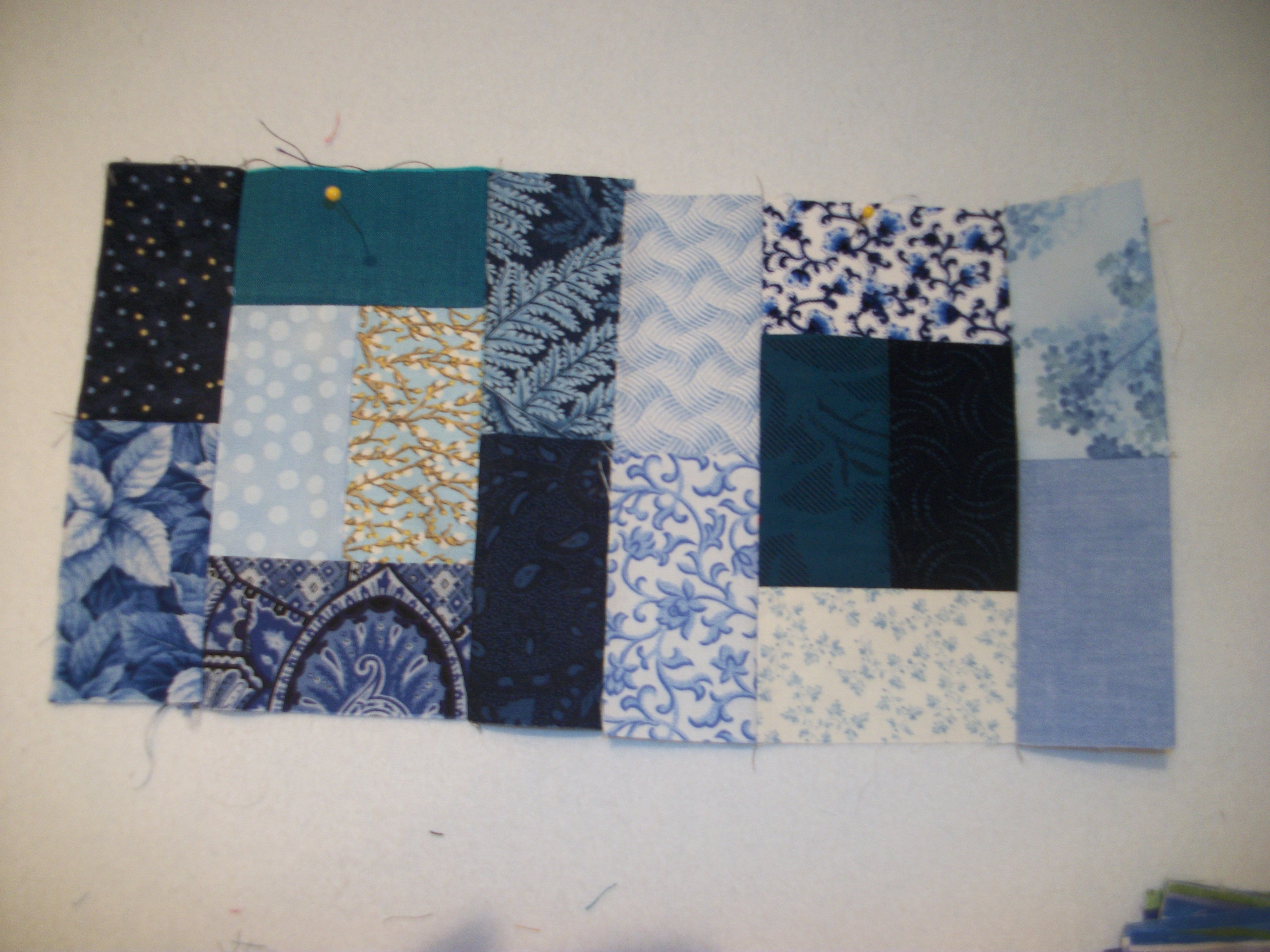
The rectangles alone can be used in all sorts of ways.  Here’s one example with blue rectangles and an alternating light and dark center/edge:

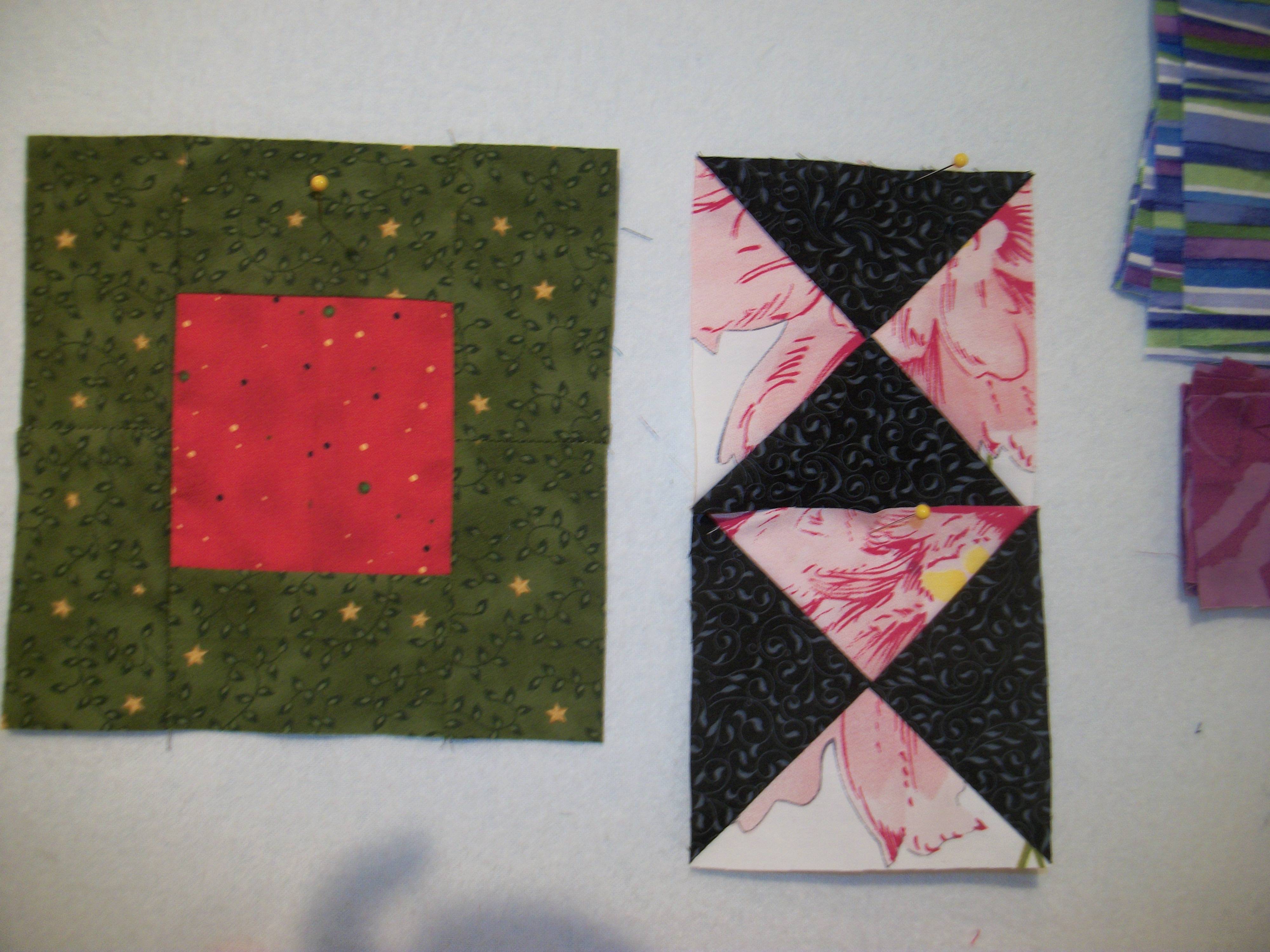
The center of this block can be either 2 rectangles or one 3 1/2-inch square.  The  pink and black blocks on the right are the Broken Dishes pattern made from 5-inch light and dark squares.  The 5-inch square finished to 4 inches trimmed.  (I always cut slightly larger for ANY half-square type block and trim to size since I have never in my life sewed perfectly enough to make the measurements come out correctly.)

One of the completed quilts is made from the BAGS of 2-inch squares.  I’ll show it and one made from 5-inch half-square triangle blocks separately in another post.  And another top is a La La Log Cabin version made from the 1 1/2-inch strips–also to be shown separately.  And there is a rather nice blue and white quilt made from leftover blue and white blocks from earlier projects–I have yet to take a picture of it.

And so, 2012 begins!!

Turkey Tracks: Ailey at Hominey Grill

Turkey Tracks:  December 7, 2011

Ailey at Hominey Grill

Hominey Grill in Charleston, SC, is the closest thing to my grandmother’s table that I’ve ever found.

Cooking of this sort is rapidly being lost I think, even in the south.

I want to pass on the love I have for this kind of food to my own grandchildren, so I take as many of them as I can to Homniney whenever I can.  (Thanks Tara Derr Webb for finding Hominey for me.)

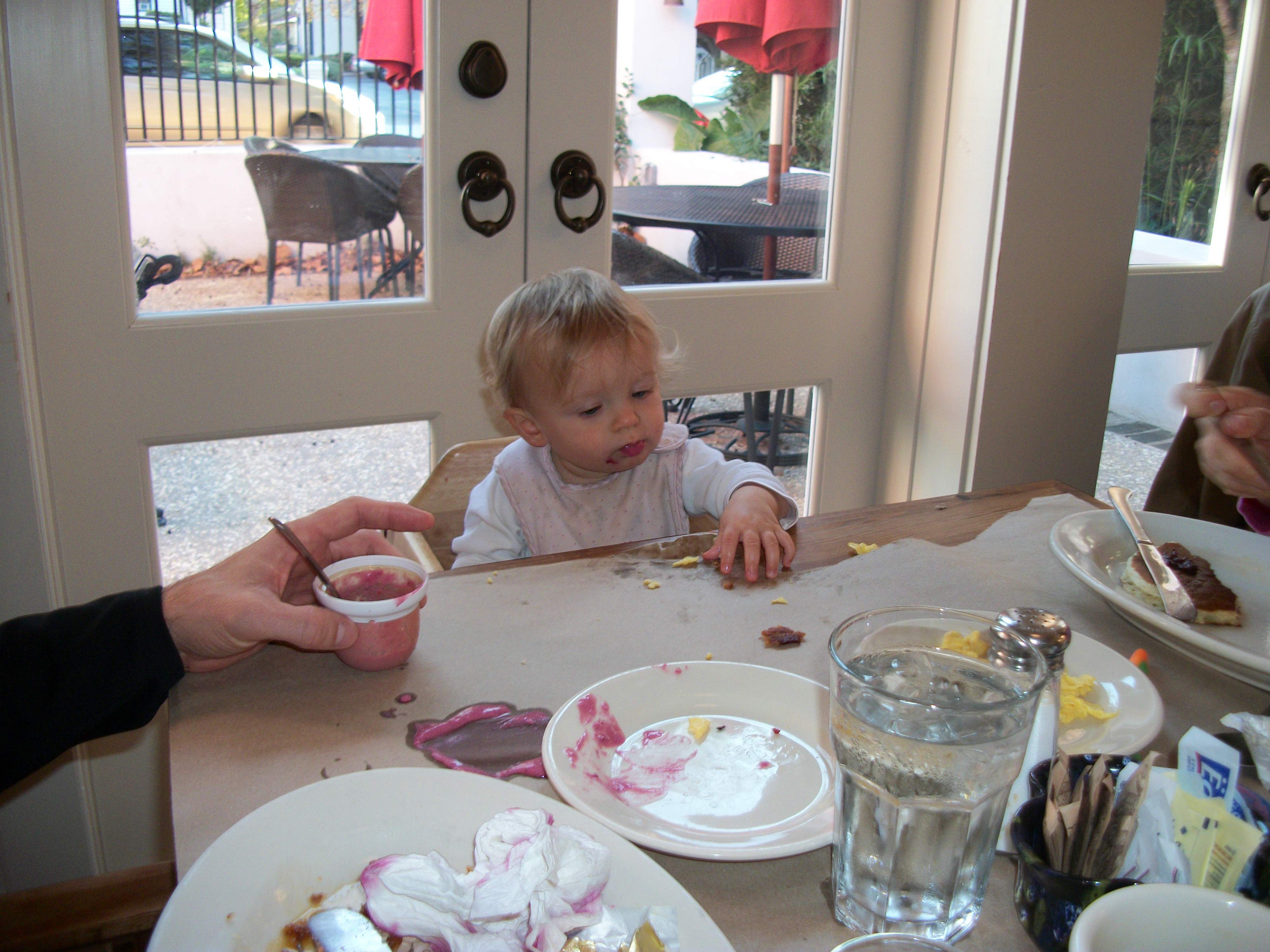
Here’s Ailey on her very first trip.  It was also Bryan and Corinne’s first trip.  We went for breakfast, which is terrific, but lunch serves the kind of food I remember eating at my grandmother’s.  (Tami and I went there on our “escape” day for lunch and ate too much to have dessert, which is awesome at Hominey’s.)

Ailey is eating her first scrambled egg.  She doesn’t get pancakes yet because babies don’t have the enzymes to digest grains until they get their molars, around two years of age.

In the following week, Tami and I took Talula and Wilhelmina, who are attending school two days a week, to Hominey for breakfast.  They are old hands now and truly love to go, which warms my heart.  Talula ate all three of her pancakes, all of her bacon, and half of mine.  The boys are furious with us!

Turkey Tracks: Ailey’s Pillow

Turkey Tracks:  December 7, 2011

Ailey’s Pillow

Tami is learning to sew.

She bought a used machine up here in Maine two summers ago–from Marge at Mainely Sewing.  Marge carries Janome and will help you get a used machine or trade up for you.  Tami’s Janome is a sturdy, beginning machine which will carry her a long way before she’s ready to upgrade–if she keeps sewing more than household repair, etc.  We got her a darning foot for free-motion quilting and a walking foot at People, Places, and Quilts–an outstanding quilt store, in Summerville, South Carolina–on our “escape” day this trip.

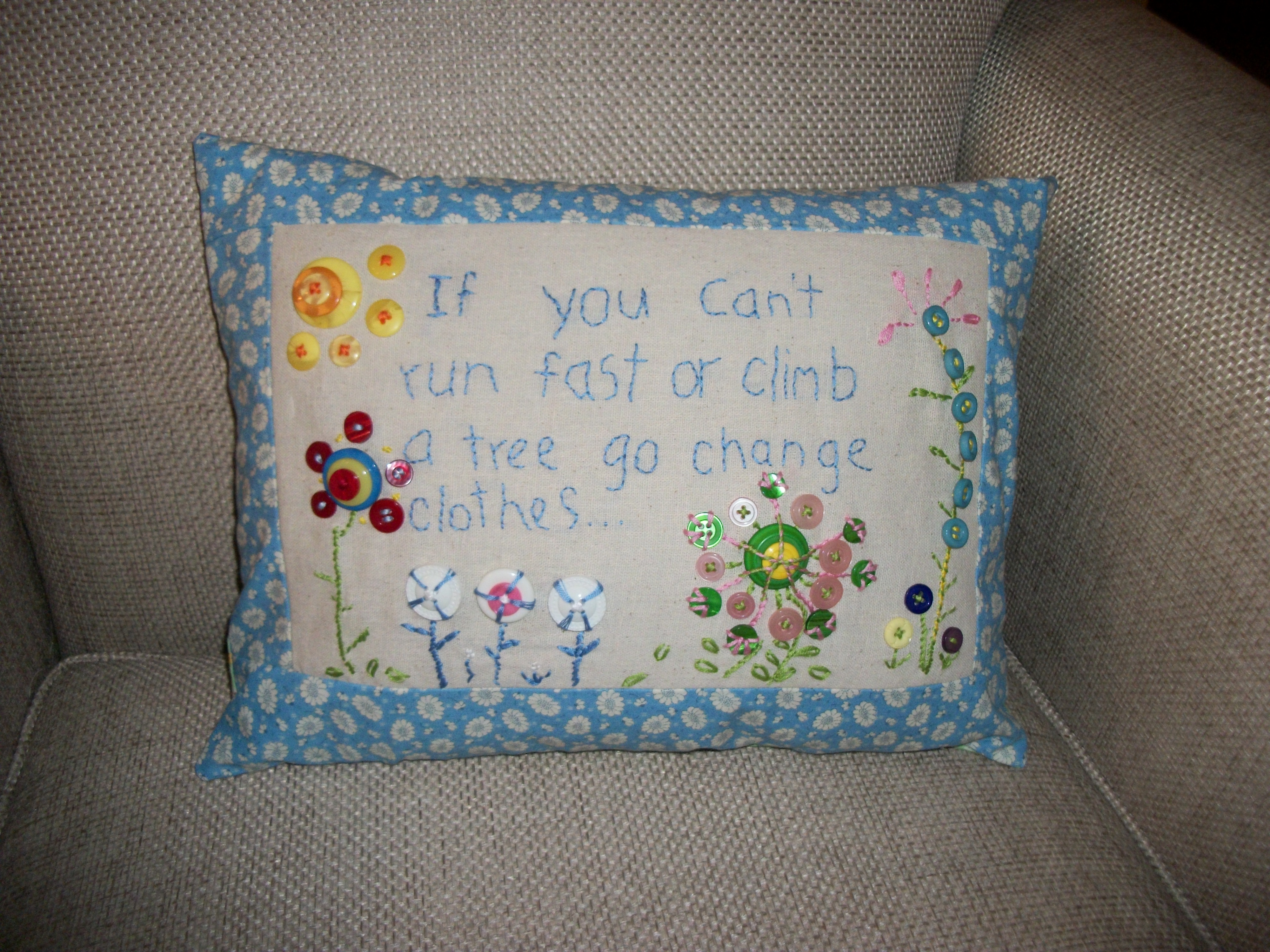
Here’s her first project:  a pillow for Ailey’s first birthday:

People, Places, and Quilts sells terrific kits for pillows and books filled with “sayings.”  The kits come with buttons, needles, and embroidery thread as well–and they are so much fun to use, as you can see.  Tami bought a selection of 1930s fabrics last year–for the sides and back of the pillows–but she needed some help to actually get started on a project.

Also, to see more of this kind of project, look at the Carol Boyer entries under the craft project section of this blog.

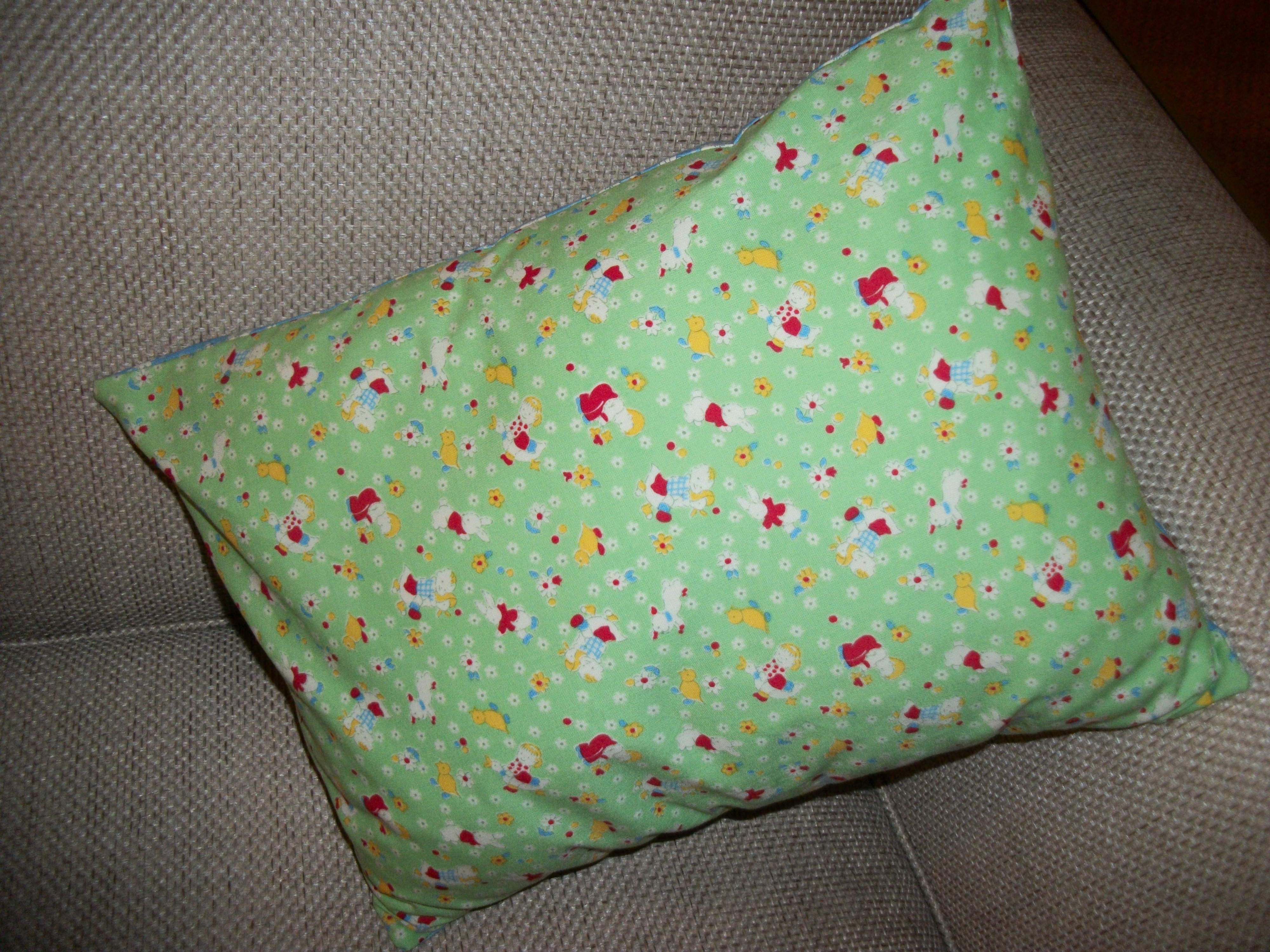
Here’s the back–a nice little 1930s print:

Here’s Tami closing up the stuffed pillow–the final step:

It’s so cute, this pillow!  Ailey will have this gift long after her childhood toys have disappeared.

I’ll be making some more pillows as well for gifts or for our Coastal Quilters’ auction next November.  I LOVE many of the sayings that People, Places, and Quilts have put into their books.

And, here’s the birthday girl, Miss Ailey, on the day of her first birthday:

Turkey Tracks: Thanksgiving Highlights

Turkey Tracks:  December 3, 2011

Well, here we are–past Thanksgiving and moving toward Christmas.  I’ve had some trouble with posting pictures to this blog–Wordpress made some technical changes that have flummoxed me, so I’m a bit behind.  Or, it’s that I’m away from home…  But, I did promise to post several of the family’s recipes and a few pics.  So, here goes.  You’ll find below the Bryan family’s famous Chocolate Chess Pie–updated and perfected by Bryan Enright–with a crust I love for all my pies–and recipes for our poultry dressing and gravy.

Mike and Tami hosted the gathering.  They have a long table and a long room that will fit the 20+ people gathering to celebrate.  Bryan and I cooked for two days at his house, while Mike cooked in his kitchen.  Prior to any cooking, however, there is the gathering up phase–which starts with collecting/finding recipes, planning menus, assigning cooking tasks, and gathering food.

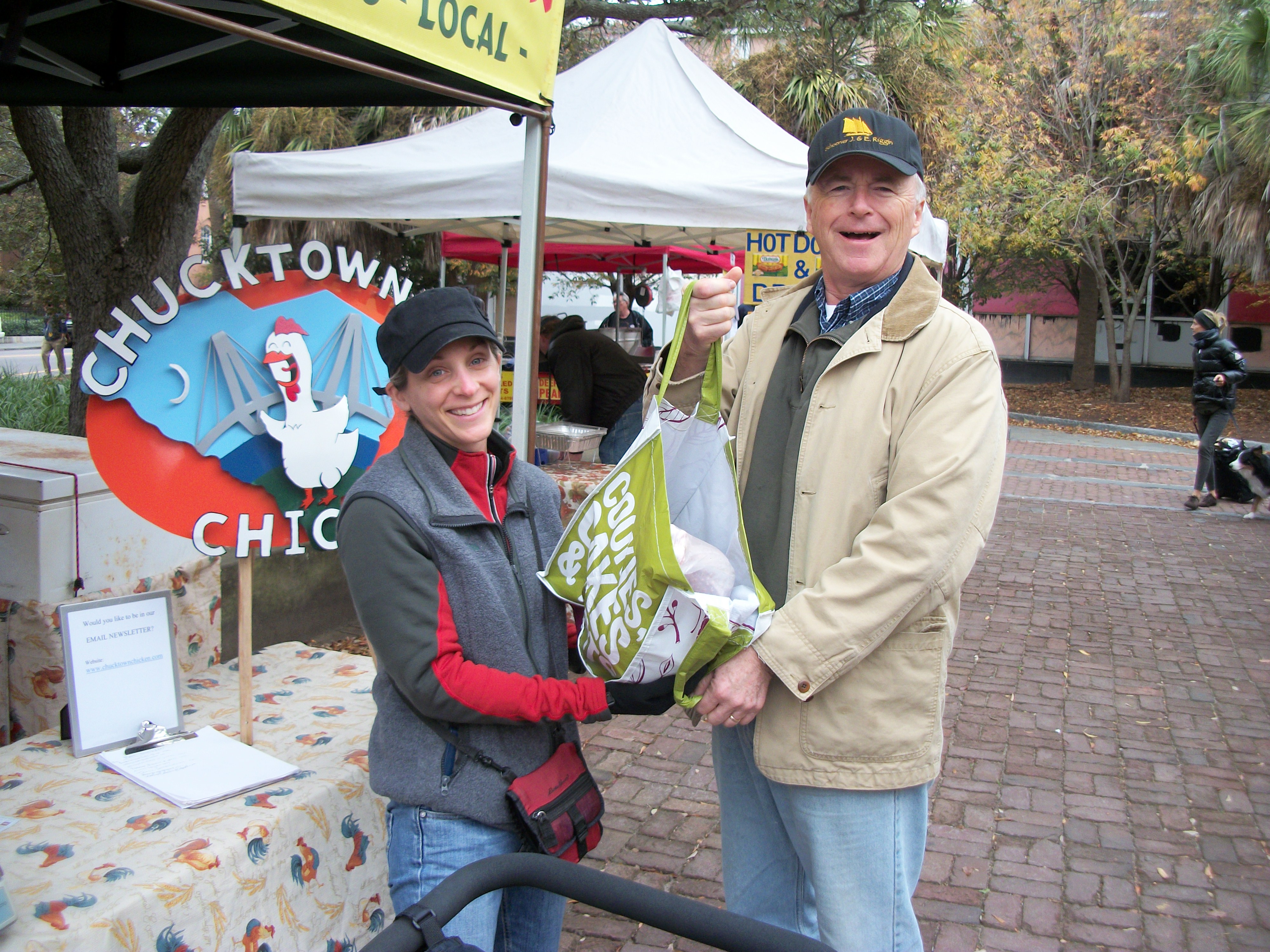
Corinne and I always hit the Charleston Farmers’ Market (5th best in the nation) the Saturday before Thanksgiving.  We picked up one of the two turkeys there, pie apples, and Brussel sprouts.  Corinne also bought a flat of kiwis, which grow abundantly in the Charleston area.

Part of the Farmers’ Market trip involves getting a big cup of coffee or tea at the market and chocolate croissants from a nearby bakery–called Macaroon something or other .  Here’s Kelly waiting for the croissants to be bagged.  He had never had them before, and he really liked them.  It was REALLY cold this morning, and Kelly, who spent the night with us at Bryan and Corinne’s, didn’t have a jacket, so we improvised.  Kelly was appalled that he had to wear a sweatshirt with Micky Mouse on it, but he went along, however reluctantly because he’s that kind of a kid.
Bryan and I made 5 pies, the stuffing, cranberry relish, and the Brussel sprouts.  Here’s a picture of the finished pies–two chocolate chess (recipe below), two pumpkin (recipe given in an earlier blog post), and an apple.  We will serve them with MOUNDS of REAL whipped cream:

PIE CRUST

My favorite recipe for pie crust comes from Deborah Madison’s LOCAL FLAVORS (387).  You can mix it by hand, but it is so very easy in a food processor.  It makes enough for two 9-inch pies, or one 10-inch double with crust, or one large galette.

2 1/4 cups all-purpose flour

1/2 tsp. sea salt

3/4 cup (1 1/2 sticks) plus 2 Tablespoons unsalted butter

1 egg yolk

1/2 teaspoon vinegar (I usually use apple cider)

scant 1/2 cup of ice water

Put the flour, salt, and butter into the food processor and pulse 4-5 times to break everything up.

Combine vinegar and egg yolk in a measuring cup, mix, and add iced water to make a SCANT 1/2 up.  You may not use all the liquid.

While pulsing, add water mixture in a slow stream until dough crumbs start to come together.  Don’t let them come into a full ball, but combine them into a ball with your hands, wrap, and refrigerate for at least 30 minutes.  These crusts freeze well, too.  Think of future quiches…

Divide into two equal parts for 2 pie bottoms, or cut one large and one smaller piece for the bottom and top of a covered pie.

I roll out pie pastry on a silicon mat.  Often, I use a piece of waxed paper for the top.  Without the mat, I use two sheets of wax paper.

BRYAN FAMILY CHOCOLATE CHESS PIE

“Chess” pies are a big dessert feature in the south.  There are chocolate ones, lemon ones, and so forth.  All of them are delicious!  I think our family pecan pie is also a version as it’s made with brown sugar rather than corn syrup.

Bryan Enright took the family recipe that we had been trying to double as pie pans have gotten bigger and modified it to perfection.  Here’s what he does for TWO 9-inch pies.  Believe me, you will want TWO pies.  You can always give one to a good friend.

Use GOOD butter and eggs and REALLY GOOD chocolate.  This year we used Schaffen Berger, and we could really tell the difference.

2 1/2 cups brown sugar

1 1/2 cups white sugar

dash salt

2 1/2 sticks of butter

5 eggs

1/2 egg shell filled with milk–TWICE

2 1/2 teaspoons vanilla

4 ounces chocolate

Melt the butter and the chocolate together on very low heat.

Mix dry ingredients together.

Add chocolate/butter and mix in well.  Add vanilla.

Add eggs and milk and mix.

Pour mixture into two shells and cook at 325 degrees fir 35 to 45 minutes.  The middle will puff slightly.  Don’t overbake; the pie should be a little shaky in the middle when done.

Serve with mounds of REAL WHIPPED CREAM.

ENRIGHT FAMILY TURKEY DRESSING

This dressing has evolved over the years.  The cornbread and sage came from my grandmother Philpott; the sausage came from John’s mother in Boston; and the celery and onion came from lots of places.

There are FOUR tricks to making good stuffing:  a good stock, really dry bread/cornbread, lots of eggs, and fresh sage.

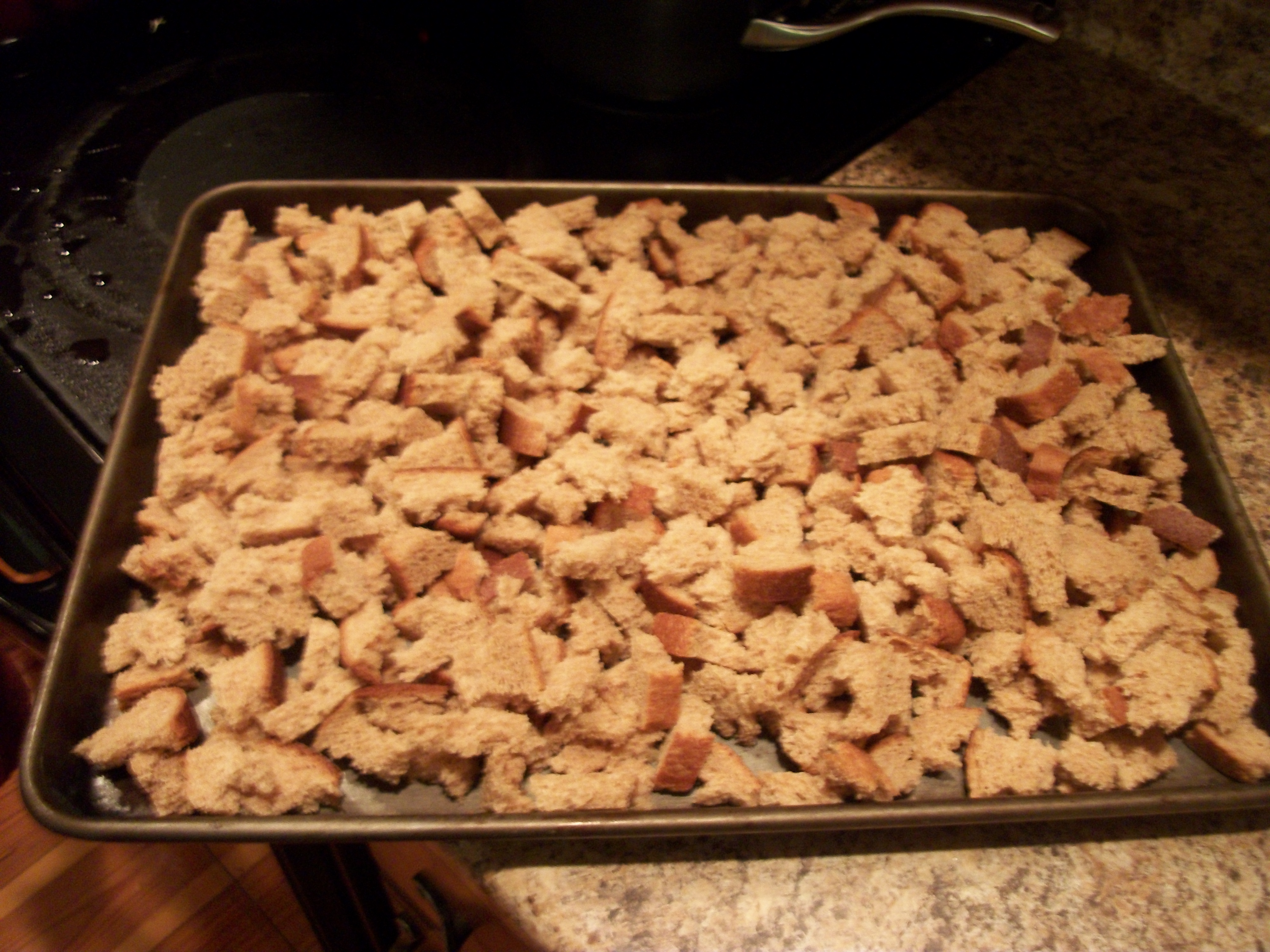
We start drying the wheat bread and cornbread at least four days before Thanksgiving day.  Tear a small loaf of really good wheat bread into small pieces and lay them on a flat pan to dry out.  I start the wheat bread first and the next day bake two pans of cornbread (no sugar please)–using a plain recipe on any cornmeal bag.  Don’t add too much baking powder–this year a batch called for 4 teaspoons–that’s too much.  Don’t add more than two.  If the wheat bread is slow drying, put it into the oven for the night with the oven light on.  If you can preheat a cast iron skillet in your oven for the cornbread, with some butter in the bottom, that makes really good crunchy cornbread for stuffing.

Here’s the torn wheat bread drying out:

Here are the rough ingredients–and this makes a HUGE pan of stuffing–plenty for our 20+ guests–with leftovers.  If I don’t have a huge crowd, I freeze a few large squares for later meals.

1 wheat bread

2 cornbread mixtures baked

Fresh sage to taste–yes, taste the stuffing as you go along when you’re mixing it, and a whole bunch of fresh Italian parsley chopped fine

Sea salt

2 pounds of fresh sausage

18 eggs

2 bunches of celery chopped fairly fine

1 BIG onion chopped fairly fine–1/4-inch pieces or less.  Two if you like onion.  You can tell if you’ve got enough in the mixture.

2 sticks of butter

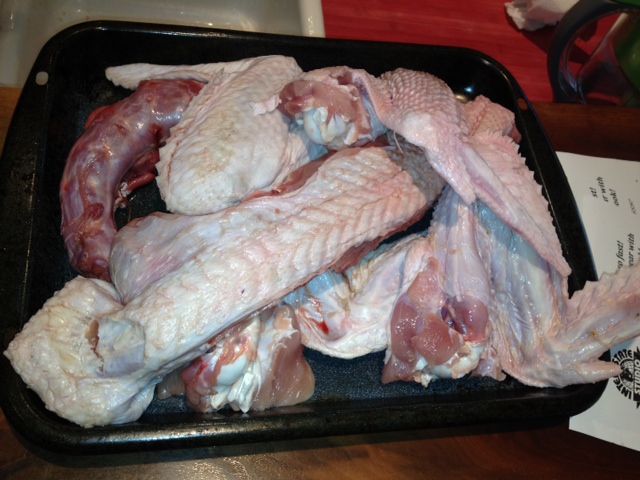
2 quarts of really good homemade turkey/chicken bone broth–we start this broth a few days ahead as well.  Use whatever organs, wings, etc., you can take from the turkey.  This year, Mike cut the turkey into parts to cook it, so I got some lovely bones for the stuffing and gravy stock.  Buy extra turkey or chicken parts if you need to in order to make a good stock.  You need lots of bones.  You can read how to make a good bone broth elsewhere on this blog.  Here’s a picture of the bones we used to make a BIG pot of stock for the dressing and the gravy:

DO NOT MIX dressing up ahead.  It will kill you.  Do not cook it hours ahead.  It will kill you if you leave it out for too long.  It takes about 45-6- minutes to cook a flat of stuffing–so mix it up and put it into the oven as the turkey comes out.

To mix, add all the eggs to all the above ingredients in a VERY BIG BOWL and start adding broth and mixing until everything begins to stick together a bit.  But, don’t get it too wet or it will be gummy.  Put it into pans with 2 to 3-inch sides–the shallower the pan the quicker the dressing cooks, which is not necessarily a good thing–put pats of butter over the top every few inches and cook at 350 degrees until it’s clearly done.

ENJOY!

Turkey Gravy

You need a really good bone broth!  Use can cut off the wings, use the neck, and the organs.  And, you can add extra turkey or chicken parts purchased separately.  Take out the organs (liver and gizzard) after about 30 minutes and chop them fine if you want giblet gravy.  Or, add them about 30 minutes before you want to strain the stock.  Add them back into the gravy at the last.  John’s mother also used the stringy meat from the long-cooked neck, which I love in the gravy.

The proportions are 5 cups of liquid to 1/2 cup each of butter and/or fat and flour.

Salt

The secret is to put the fat and flour in a heavy bottom pan and heat them slowly while stirring and stirring until the flour turns a lovely bisque/tan color.  Add the warmed stock slowly, whisking as you add so you don’t get lumps.  Cook gently until the gravy thickens to where you like it.  You can always thin it if you get it too thick.

The Turkey

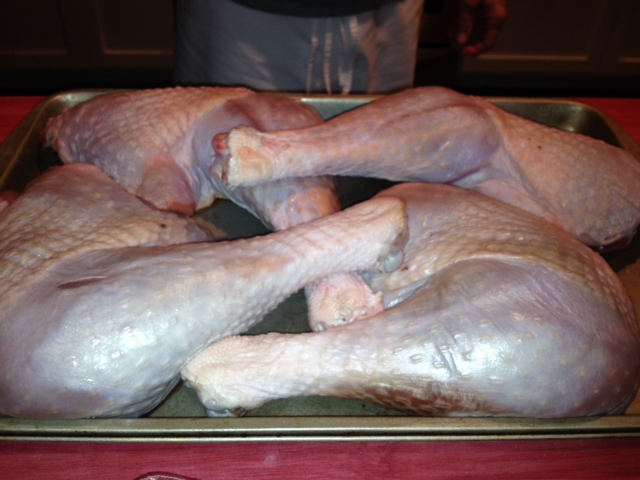
Cooking a turkey is really tricky.  It’s hard to get the legs/thighs done without overcooking the breast.  Mike has evolved a recipe where he removes the legs/thighs in one piece, bones them, and rolls and stuffs them with amazing stuffings that vary from year to year.  This year I tasted pate and chestnuts.  These boned, stuffed legs cook sitting in a rich vegetable broth that we later use for soup.

Mike cuts the breasts free and cooks them on his grill, which can heat like an oven.

I didn’t get a picture of the cooked rolled legs, but here are the turkey breasts about to be carved.  The meat was very tender and moist:

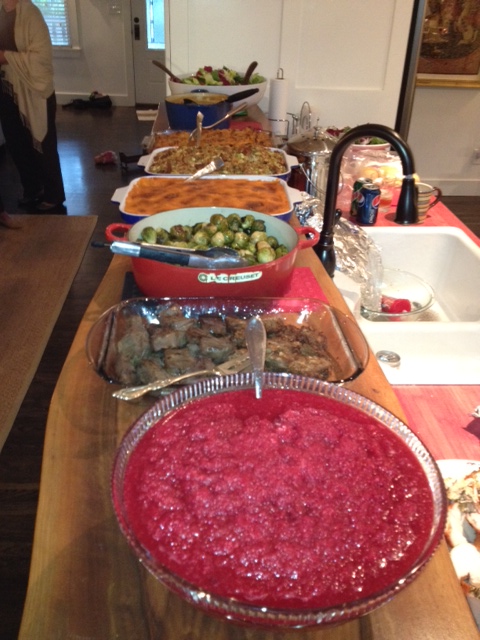
And, here’s the food starting to be lined up for serving:

I was having too much fun to slow down and take a picture of Tami’s beautiful table–which I now regret.  I should have gotten a shot of everyone seated too, but you know how that goes.  Food needs help getting to the line-up, and children need help with plates, and before you know it, the moment is missed.

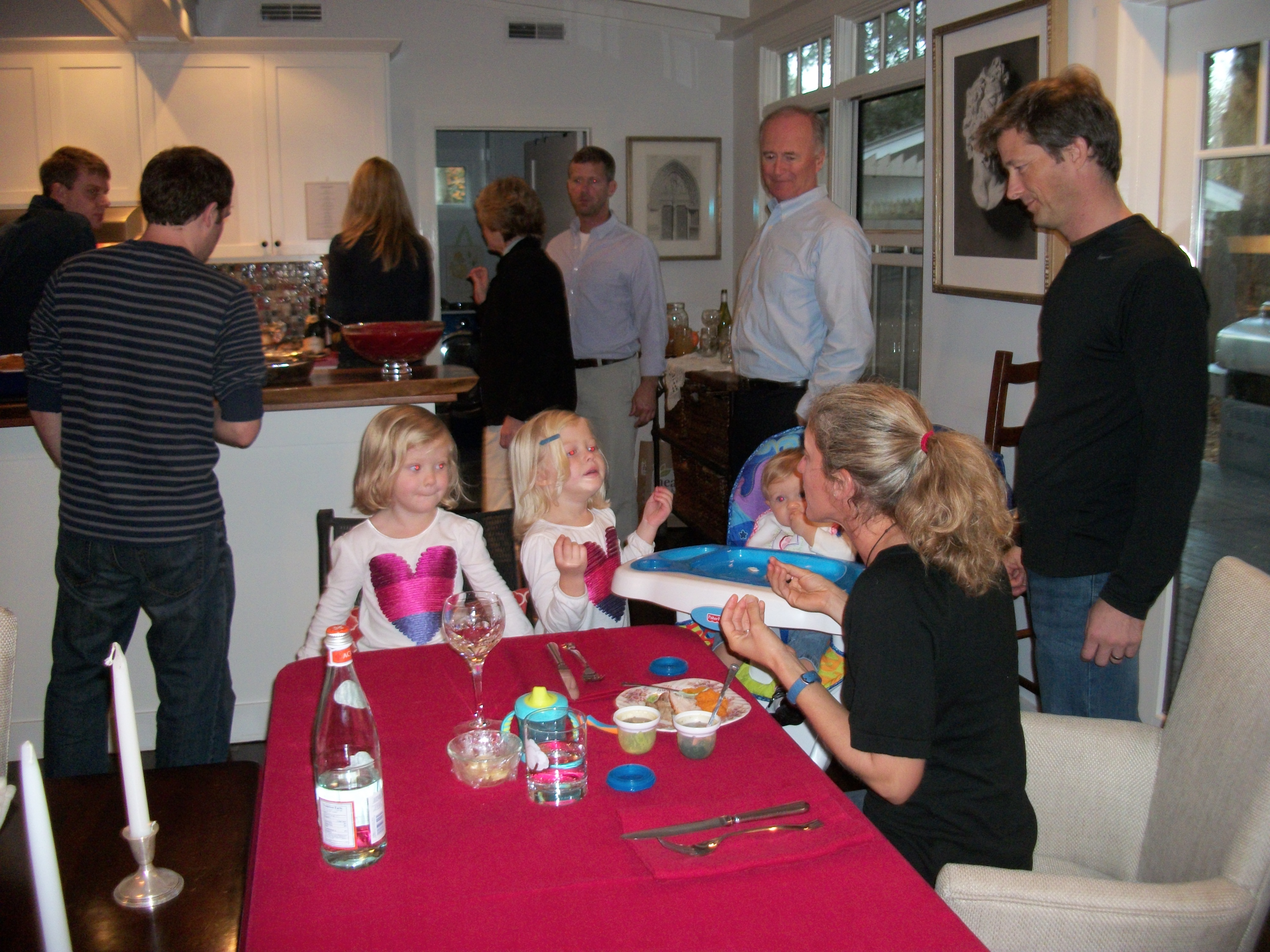
But, here’s one end of the table with Bryan, Corinne, and Ailey (who LOVES to sit in her high chair and eat), with Talula and Wilhelmina:

TURKEY LOVE to all, as Tami says!

Turkey Tracks: Lunch in Wiscasset

Turkey Tracks:  November 18, 2011

Lunch in Wiscasset

The day before we fly out of Portland, Maine, we usually drive the 2 hours south to Portland and spend the night in a Portland motel–where we leave our car during our trip.  The motel takes us to the airport the morning of our flight, and we don’t worry about mishaps getting to the airport and about not having a place to park in the airport parking garage.  We have time to poke around what used to be a Borders Book Store and which is now something called Books A Million, or BAM, and the Maine Mall.  We could, but have not yet, seen a movie.  And, we have dinner out.

We always start out around late morning and have lunch on the road.  This time we stopped in Wiscasset, which calls itself “the prettiest town in Maine.”  It IS a pretty town, and we enjoy spending an hour or so there.  This time we ate at Le Garage, which is at the end of the same street where the restaurant called Sarah’s sits.  Sarah’s, which has lovely fresh food, sits on a prominent corner in Wiscasset–across from Red’s Eats–an outdoor stand that is truly famous for its lobster rolls.  Sarah’s always has three huge vats of homemade soups and platters of homemade bread of many types–alongside many other menu choices–like fabulous pizza.  And, Sarah’s desserts are also fabulous!

Here’s John inside Le Garage:

Here’s the view from the restaurant windows out over the Sheepscot river.  Most of the lobster boats are now gone, and while we ate, we watched several lobstermen loading hauled traps onto their dockside trucks.

Le Garage is kind of a funny restaurant.  The menu reads really well, but the food that arrives is short of expectations.  For instance, my French Onion Soup had a delicious broth capped with a just-right size of toasted French bread that was coated with lovely melted cheeses.  But, the onions inside the soup had not been carmelized enough, so I was eating square pieces of onion, rather than slivers that should be nearly melting into the broth, that tasted undercooked and harsh.  The expensive dessert crepe, nearly $6, wasn’t tender and soft with a layer of ice cream inside.  Rather, it was as hard as a large, tasteless cannoli, and it was stuffed with way too much ice cream and smothered with a bought, nasty caramel sauce and fake whipped cream.  There’s really no excuse for faked whipped cream in Maine where we can get heavenly real, raw heavy whipping cream.  My salad lettuce was right out of a package–or it seemed that way–and the “lemonade” dressing had no oil in it and was tasteless.

My instinct is that Le Garage could be quite good with just a bit of a push into a more discerning direction.  Certainly, one feels its heart is in the right place…

The railroad tracks go right by the river, which would make for a scenic journey.  Here’s the view just outside Le Grange:

Books a Million, or BAM, is a big bookstore, much like the former Border’s.  Except its political section was so radically imbalanced that we opted not to buy anything in the store.  I’ve never seen so many far-right, highlyl charged texts in one place before.  No wonder large sections of the country are so intolerant of any other viewpoints if they are not exposed to any kind of balance in their reading materials!

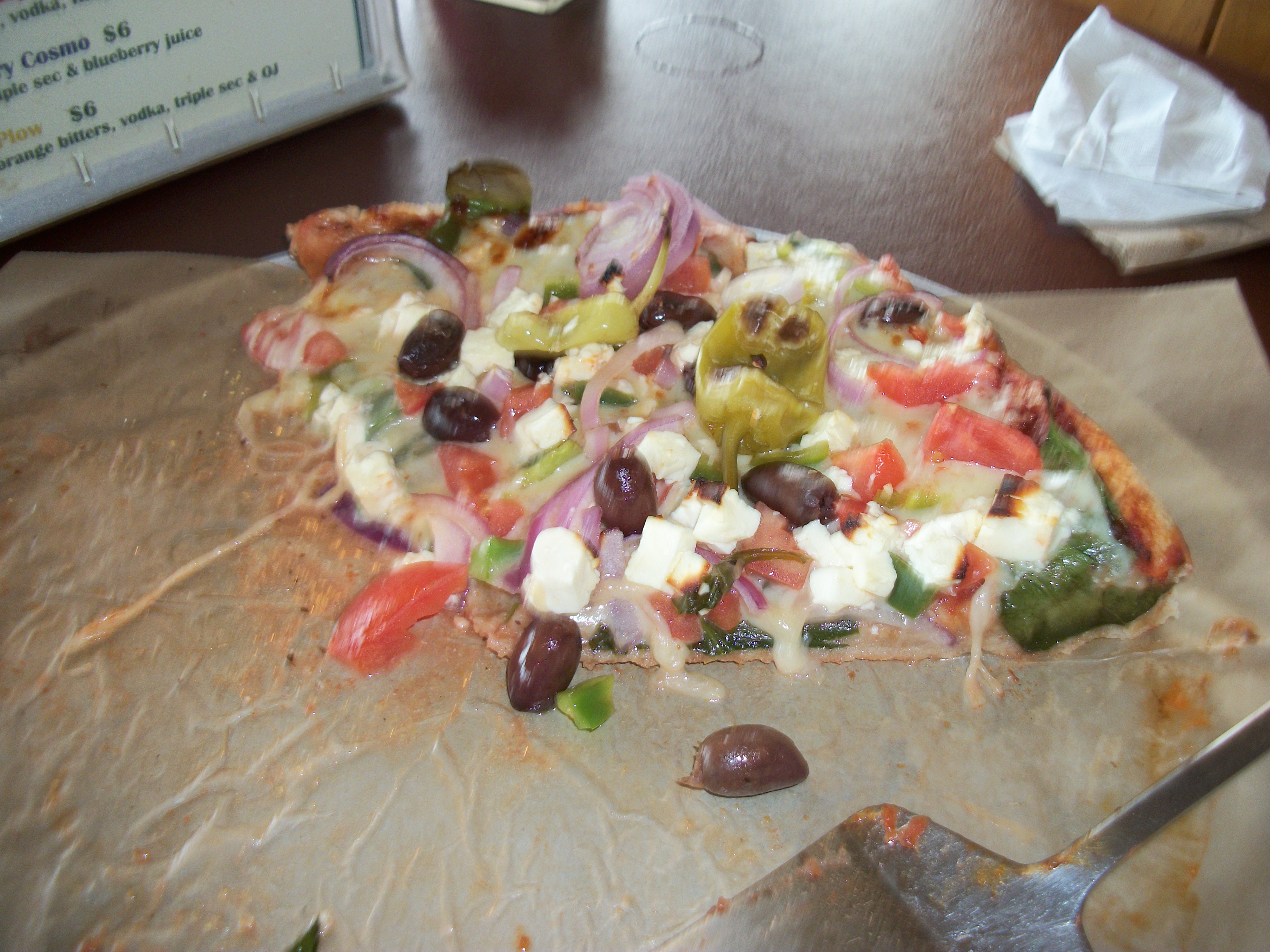
PS:  On our way home, we stopped in Sarah’s for pizza.  Here’s what we took home:

Turkey Tracks: Charleston Bound

Turkey Tracks:  November 15, 2011

Charleston Bound

Time has moved forward, and the day has come when we start leaving for Charleston.  We are anticipating a delicious visit with our two sons’ families.  I say start leaving because today we will drive to Portland, ME, which is 2 hours away, where we will stay in a local Comfort Inn very near the airport.  They will get us to the airport for our flight tomorrow and will keep our car while we are gone.  No worries that way.  No stressing about getting to the airport on time and about finding a parking spot when you’re on a short leash in terms of time.  We’ll poke about the mall, have dinner nearby, get a good night’s sleep, and enjoy having nothing to do but enjoy ourselves.  Isn’t that what a vacation is all about?

The house, dogs, and chickens will be in the capable hands of Jessica Pendleton–who now has two adorable children:  Mariah and Eli.

It has been a true pleasure to watch this young woman meet the right man, agree to raise his little girl, have a child of her own, move into their own house, and become a wonderful mother.  You go, Jessica!

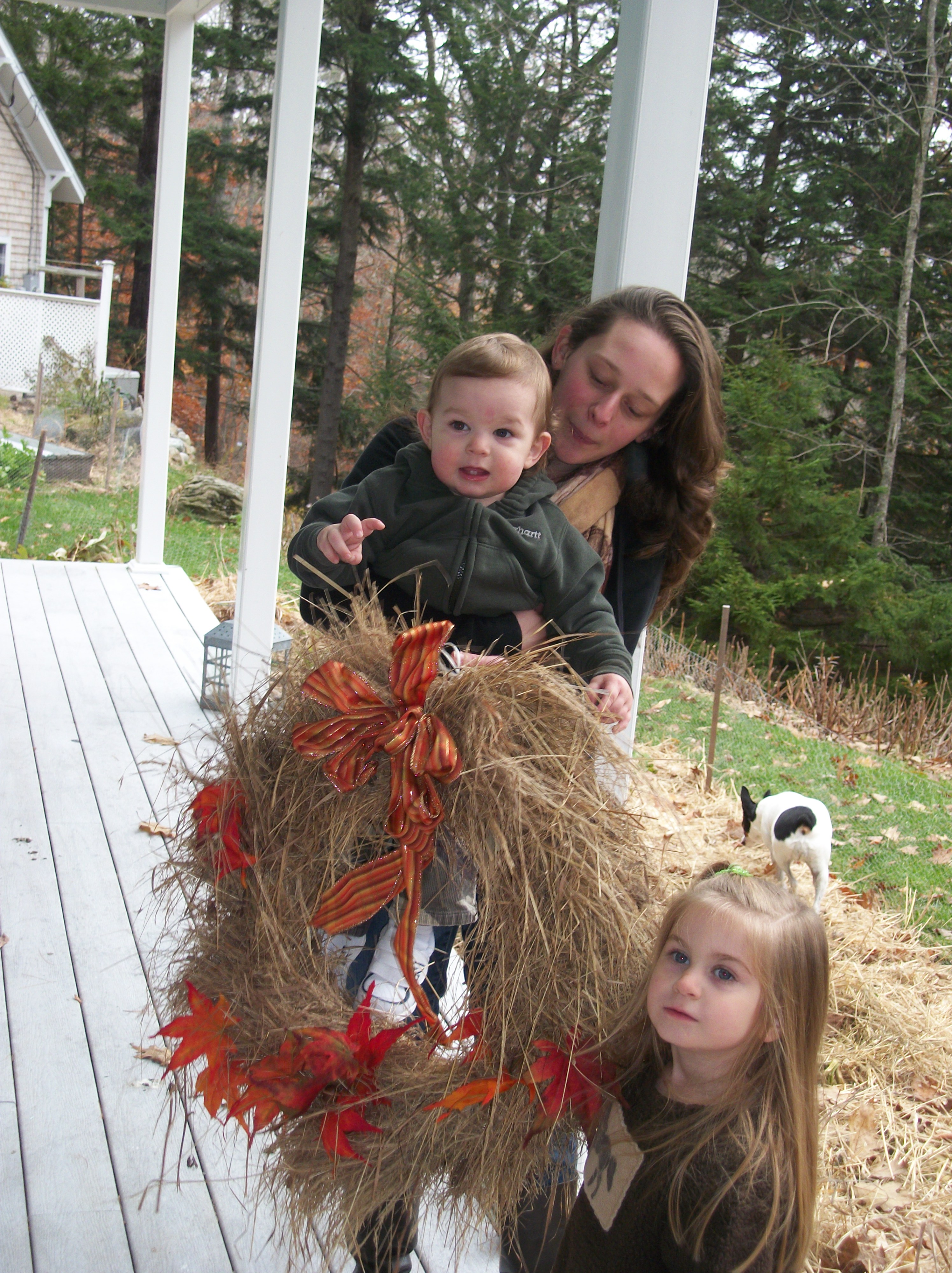
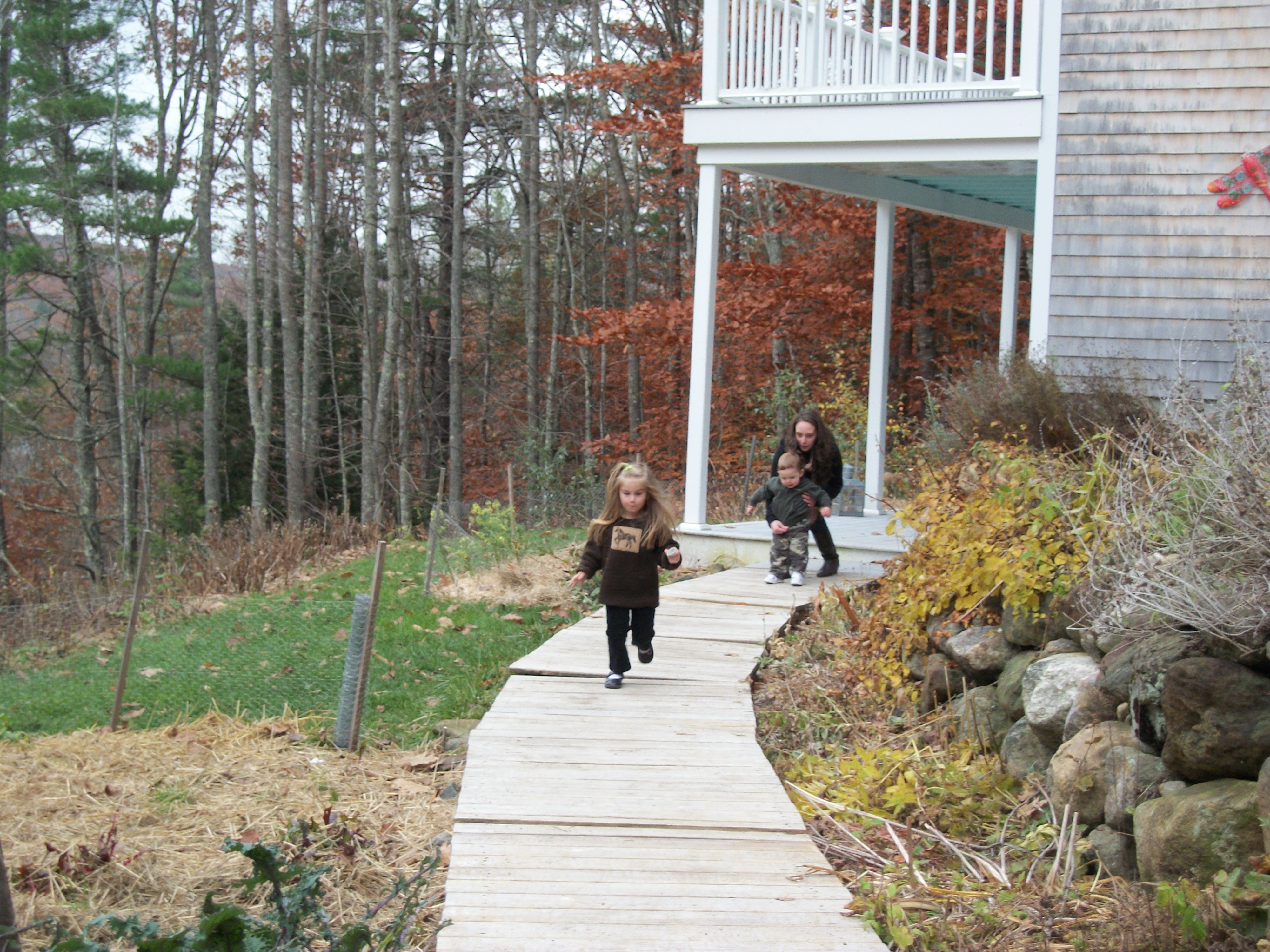
Here they are running the boardwalk:

Eli gradually worked up his courage to step over the cracks rather than crawl over them.

Here’s Mariah peeking around the corner of the house from the top of the bench that stores bird seed and chicken bedding:

She LIKES the chickens and is fascinated about getting eggs out of the chicken coop.

Here’s what I’m leaving behind–an in-progress quilt:

This quilt, which may be called “Two Bits,” is being made from the 2-inch blocks I’ve been cutting out for the past ten years.  Whenever I finishe a quilt, I take any small leftover pieces and cut them into the largest squares I can–up to 6 1/2 inches.  I now have two bags of 2-inch squares, so when I saw this idea for using them–I’ll do a proper citation when I finish, but I think the pattern was in American Patchwork and Quilting, and I know it was called “Mourning Glory”–after the type of heritage fabric.  Basically, black or white or tan can all operate as neutrals, and that’s what’s going on here.

Here’s a detail:

So, John is waiting downstairs, so I ‘ve got to close.  The computer is going to Charleston, so I’m sure I’ll post from there.

Turkey Tracks: Sun, Sea, Sand Quilt

Turkey Tracks:  November 15, 2011

Sun, Sea, Sand Quilt

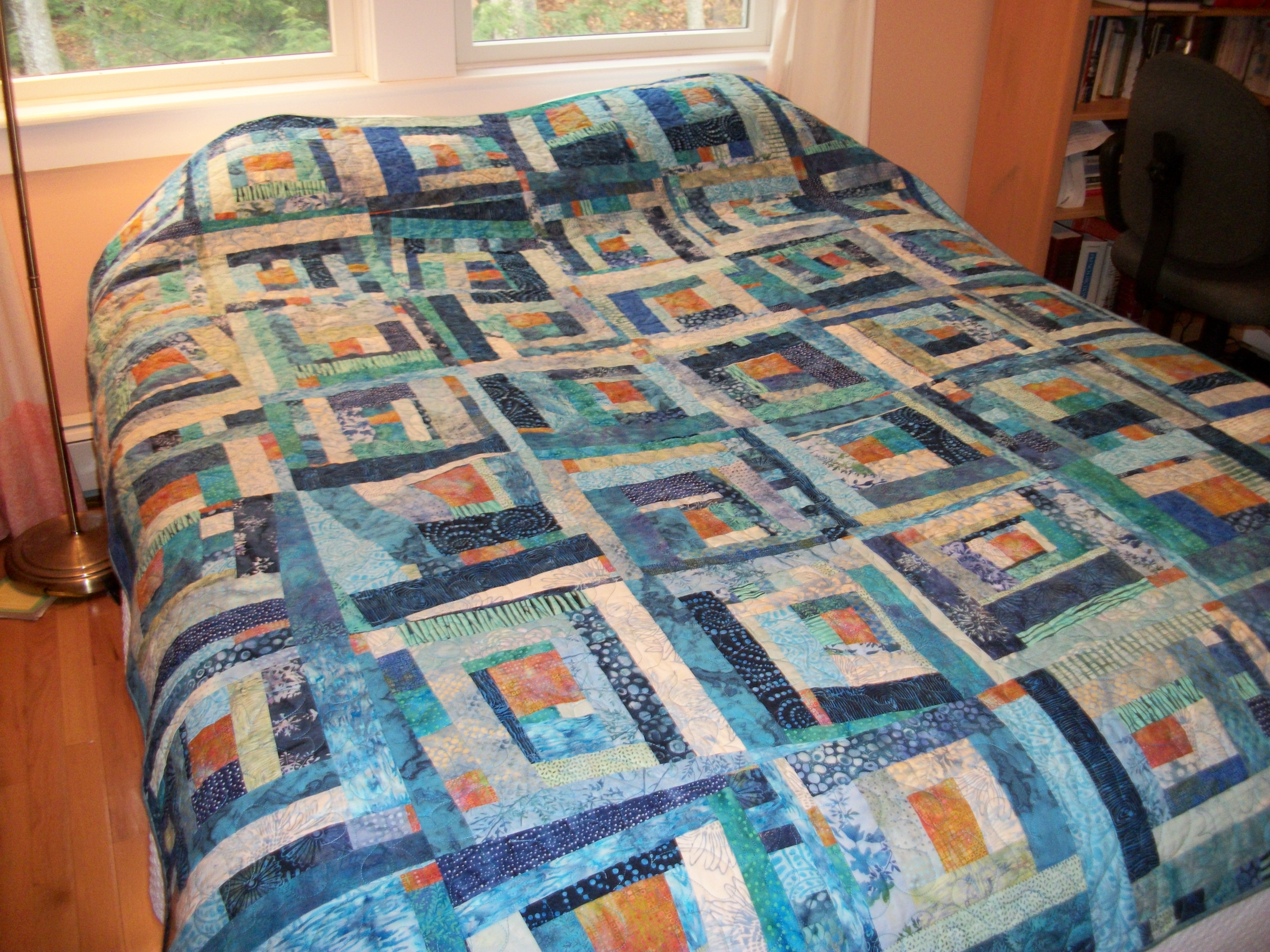
Well, here it is all finished–a La La Log Cabin method, as designed by Rhea Butler of Alewives Quilting in Damariscotta Mills, Maine.

Basically, you start with a funky center, build out, and trim up your blocks to a set size.  I trimmed these at 12 inches.

This kind of quilt is a fabulous way to knock back your stash–and I’m on a mission to do that these days.  For every quilt I plan and BUY, I’m trying to make–at least the tops–out of my stash–where many beautiful, beautiful fabrics reside.

This quilt is made entirely out of batiks.  I did buy the backing, which I loved at first sight.  But I got the fabric 20% off–thanks to a sale at Alewives!

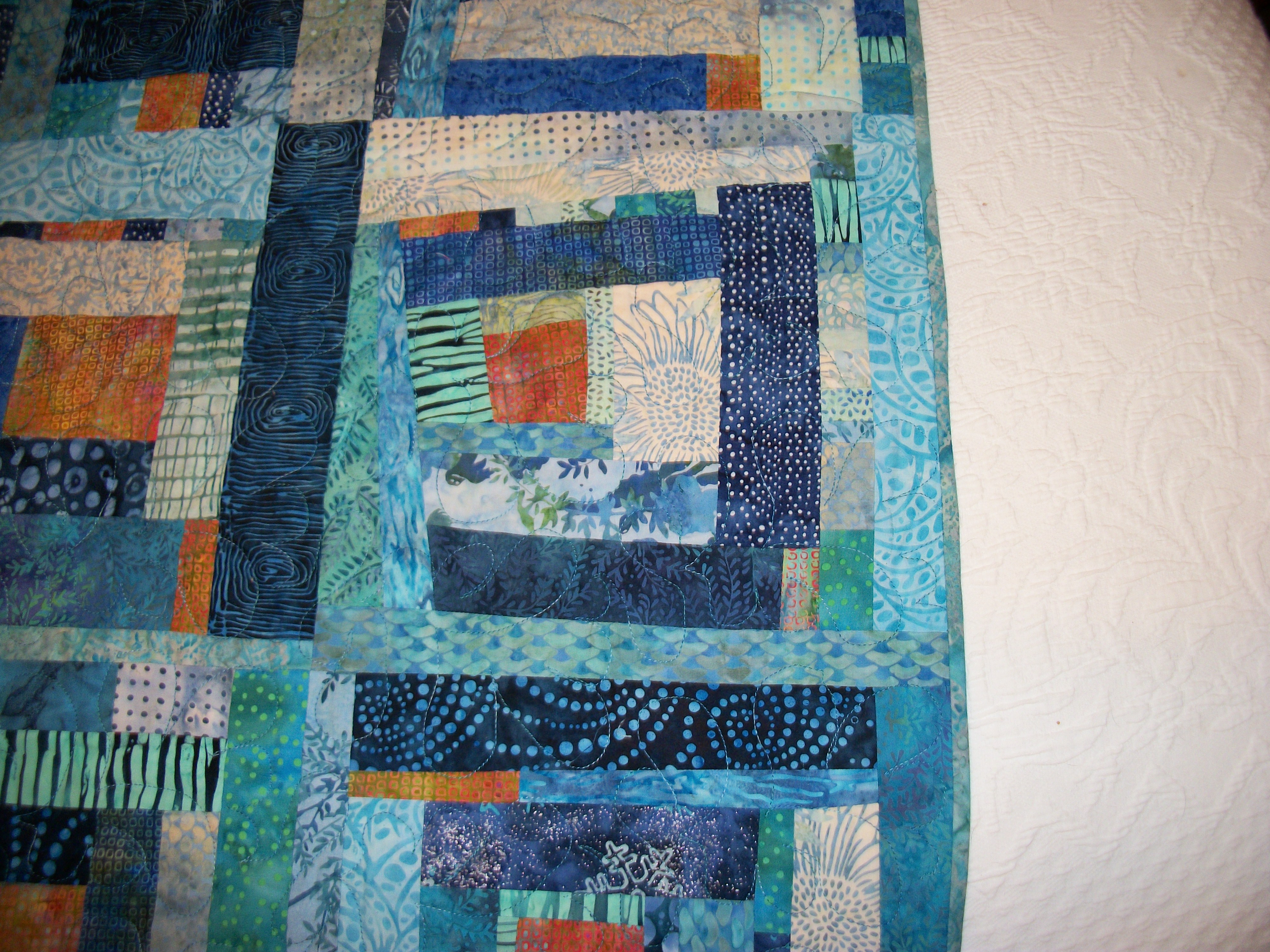
Note, too, the light binding.  I almost always finish with a dark binding, but this quilt seemed to want to just keep going and not be bound by a dark line…   It’s certainly full of good, good energy, isn’t it?

Here’s a close up of the binding effect:

Here’s a close-up detail:

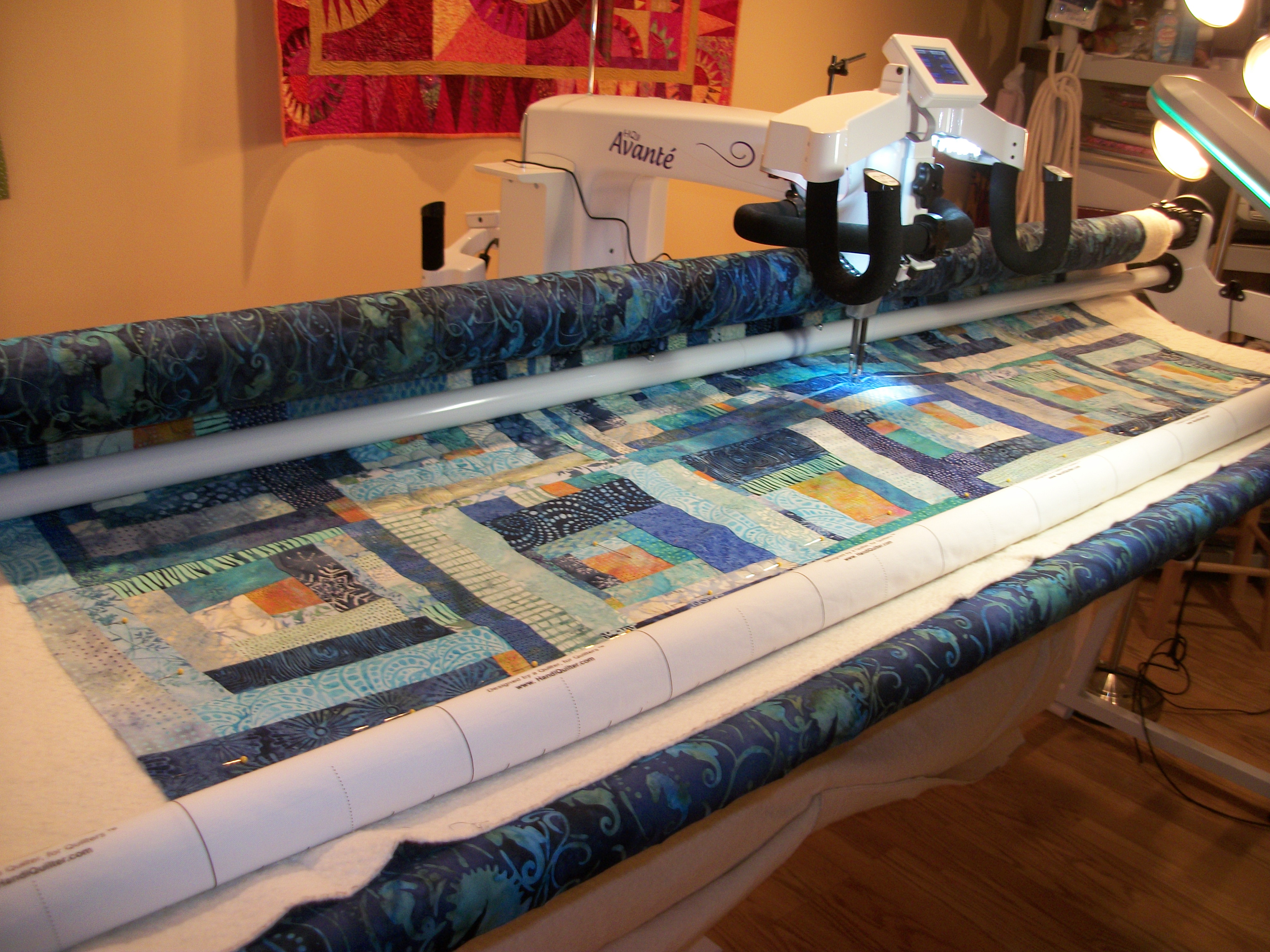
And, here’s what the long-arm looks like with a quilt loaded and being quilted:

One can quilt from the front of the machine–which one does if one is working with templates or one’s own designs.  If one is working from a paper pattern–called a pantograph–the quilting is done from the back of the machine.  One follows the pattern with a laser light beam.

I wanted a quilting pattern that was curvy, since there are so many straight lines in the quilt.

Lucy is a Handi-Quilter, Avante.  She has an 18-inch throat, which gives me lots of room for big patterns.  And, it means one doesn’t have to roll up the quilt so often.

I love this machine.  The learning curve has been awesome–and I’m only now feeling like I’m getting some bit of competency.  Working with a long-arm is very different from working with a domestic machine.  I still struggle with getting the tension to behave–but that’s a learning curve, too.  The bobbin adjustments are opposite a domestic machine, for one thing.  But, I learn nothing more than learning all about something new–so I’m quite happy.  And, of course, my ability to make LOTS of quilt tops–I LOVE TO PIECE–is getting fed every day.


Turkey Tracks: Pie Pumpkins and Pie

Turkey Tracks:  November 13, 2011

Pie Pumpkins and Pie

The best pie pumpkins are long–like a huge salami.  They’re dark green that starts to turn orange in patches–they turn orange when you cook them.

I usually get one from our CSA, Hope’s Edge.  And I buy a few more, roast them, and freeze the meat–for winter pies.  Organic, of course.

Just slice the pumpkins in half, scoop out the seeds, put them on a shallow pan that has some sides–the roasting pumpkins can give off juice–and roast them for at least an hour at 350 degrees.  You’ll know when they are done–they’ll smell delicious and will fork easily.  Let them cool, scoop out the meat, and freeze or make a pie.

It takes about 2 cups of pumpkin to make a 9 or 10-inch pie.  Each of these halves makes about two cups.  Convenient, huh?

My favorite recipe comes from NOURISHING TRADITIONS, by Sally Fallon and Dr. Mary Enig.

Start with a flakey pie crust of your choice.  (Use butter or really good lard–not any of those fake fats like vegetable lards or margarine.)

2 cups pumpkin

3 eggs–if small, use 4 eggs

3/4 cups rapadura–which is dried cane juice.  I also use organic sugar.  The rapadura has a stronger taste, but the pumpkin can take it.

1 tablespoon fresh grated ginger

1 teaspoon cinnamon

1/4 teaspoon each salt, powdered cloves, nutmeg

grated rind of lemon

1 cup piima cream, or creme fraiche–piima is a cultured cream.  You could also use sour cream.

2 tablespoons brandy

Mix everything together well, pour into your pie shell, and bake at 350 degrees for 35-45 minutes.  The time will depend on the size of your eggs and the liquid in your pumpkin.  I used 3 small eggs, and the pie took more like an hour to puff in the middle.  If it takes longer, cover the  pie with some parchment paper to prevent burning.  (Don’t use aluminum foil!  For anything!!)

 This pie is as light as a feather and absolutely delicious.

Serve with REAL whipped cream.

Turkey Tracks: Blueberry Jam

Turkey Tracks:  November 13, 2011

Blueberry Jam

Talula is coming for Christmas.

Talula loves blueberry and blackberry jam.

This year she’s going to get POPOVERS with her homemade jam.

Popovers are dead easy:

Put the following combination of flour, eggs, milk, and salt into a blender, blend it up, and pour the mixture into butter-greased TALL popover forms–filling each 3/4 full.  (If you don’t fill the form 3/4 full, the resulting popover is mostly air inside the crust, rather than having a middle that is still soft and yummy and altogether satisfying.)  I have two popover pans, each with 6 forms.  They look like big muffin tins–only each stands alone since the rising popover needs a lot of space around it.

This recipe is for about 9-10 popovers.  You can halve it, or add to it, for 12 popovers.  If you like cheese popovers, throw some cheese in–about a cup I’d say, for 6 popovers.

4 eggs, 2 cups of AP flour, 2 cups of milk, some salt.

For 12, I’m going to try 6 eggs, 3 cups each of flour and milk, and salt.

Easy, right!

Yes, it’s a white flour-based recipe, but I use really good eggs and our raw milk, so I think it’s ok to have popovers as a special treat.

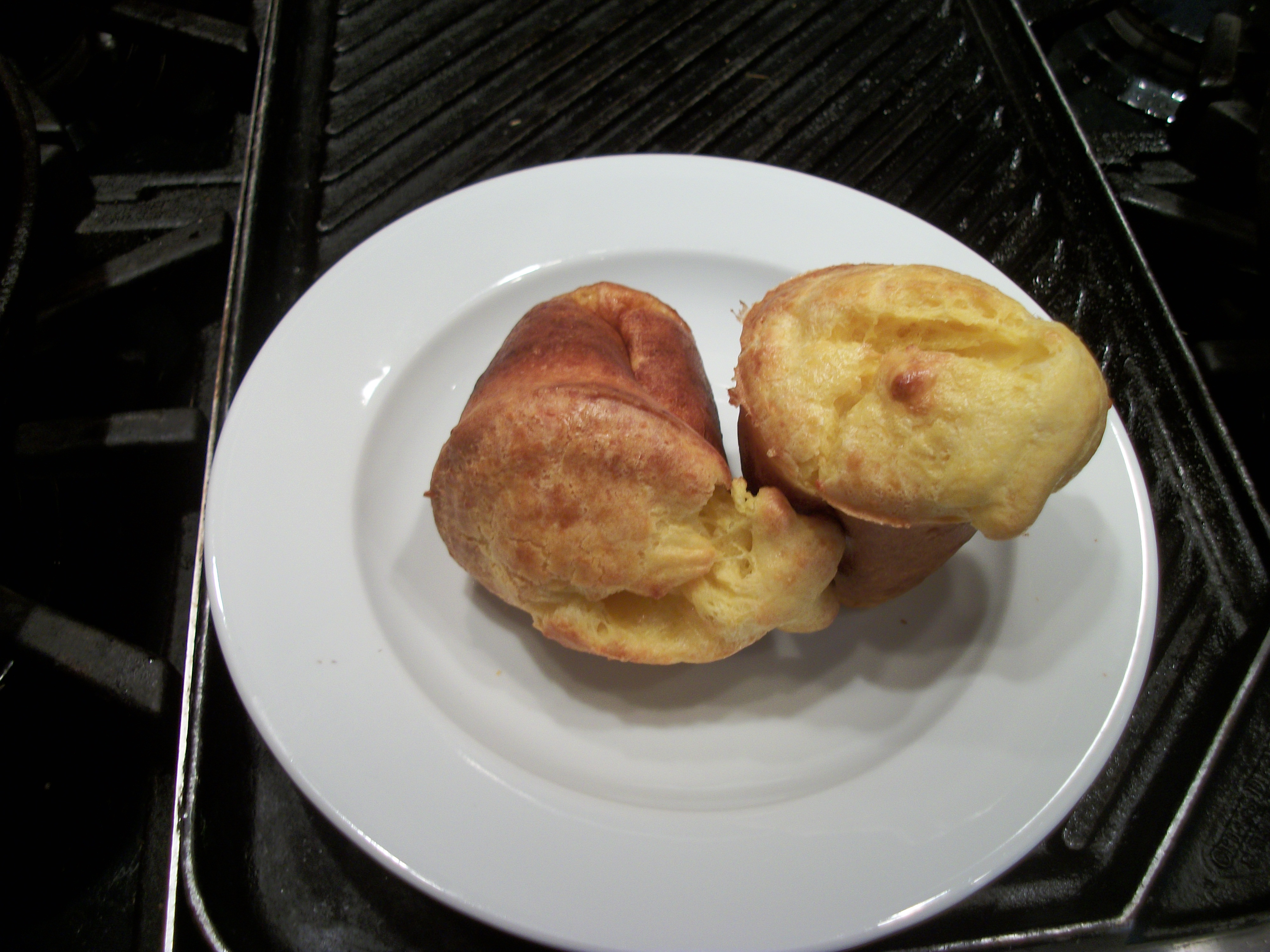
Here’s a picture of cold cheese popovers–which we ate with our dinner after having their mates for breakfast.   They do shrink a bit when cooling.  So, eat them HOT–and 2 of them with butter and jam is a filling breakfast.

As for the blackberry jam–there is one jar to spare before next summer, when there will be one more.  Talula comes in July, and the blackberries are ripe in August, so we have to hoard and parcel out what’s left of the jam on hand–especially since 2010 was very dry and as this year we didn’t get any blackberries as it was the year to cut back the patch and let it grow anew.a

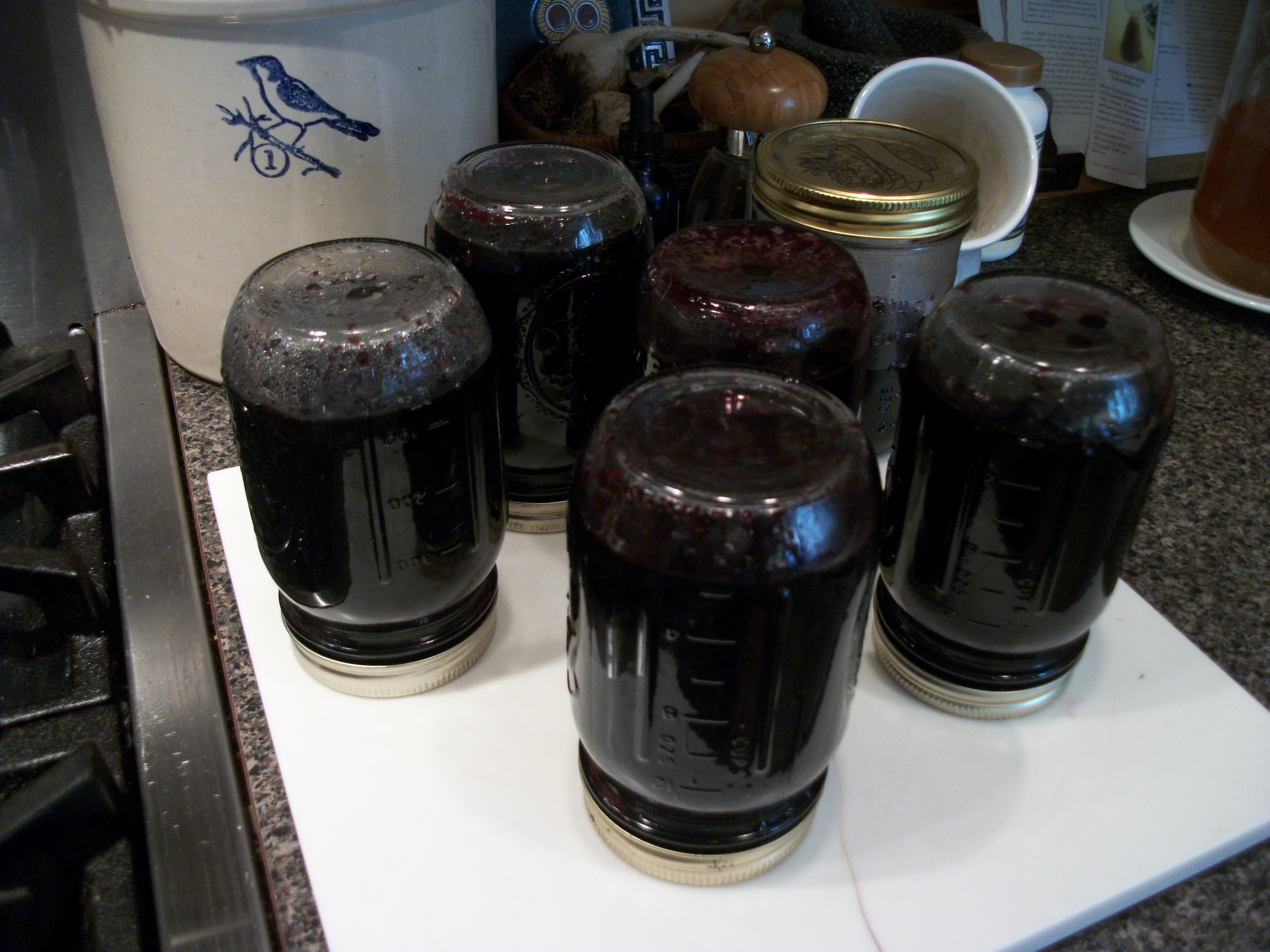
As for blueberry jam, I’m all set for Talula–and her father, mother, brothers, and sister:

Making blueberry jam is easy.

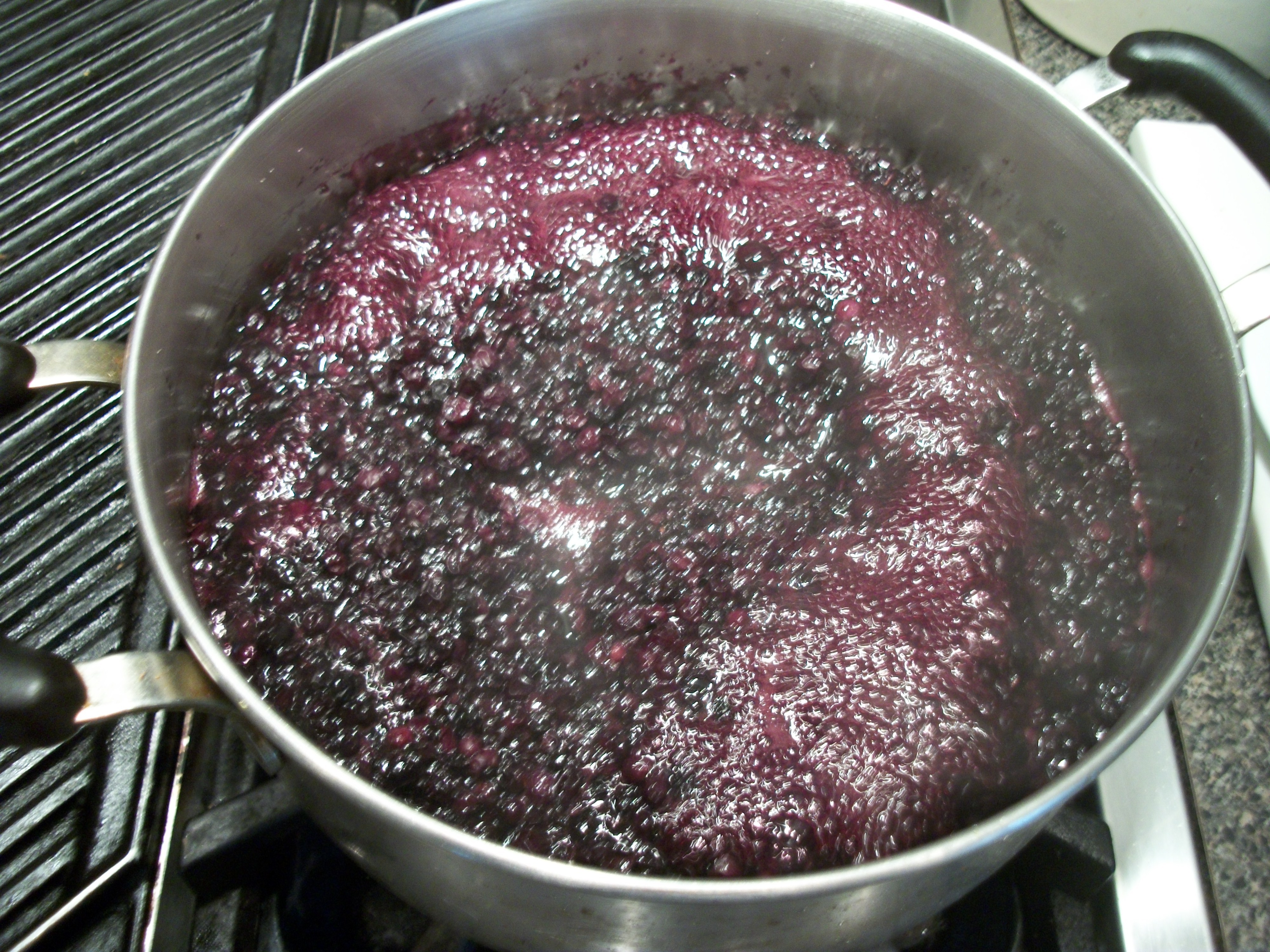
You just fill a heavy pan about 1/2 full of organic berries.  (We have the tiny, very flavorful Maine blueberries–and you can take “wild” out of that title since they are VERY cultivated.)  I use about a cup of sugar to 3-4 cups of berries, and I grate in the rind of one lemon for a batch this size.  Sometimes I add the juice too, but go slow as the mixture can get very lemony.  Taste the jam as you go along–if it isn’t sweet enough, add more sugar.  But, start with less since too much sugar really ruins the whole batch.

Then, you just cook it down until the juice begins to jell on the spoon you use to stir it with every now and then.  You can see that the mixture is bubbling pretty hard.  Let some of the juice dribble on a plate, let it cool, and you can tell if the juice is starting to thicken up.  You really don’t want blueberry jam to get too thick, so I fall off on the side of a looser jam that isn’t overly cooked to death.   (With blackberries, I am more particular and do use a candy thermometer–but that involves figuring out what the jam point is in your area, which involves how above sea level you are, and so forth.  Any good canning book–like the Ball Canning Book–can walk you through that exercise–and it is a good thing to do.)

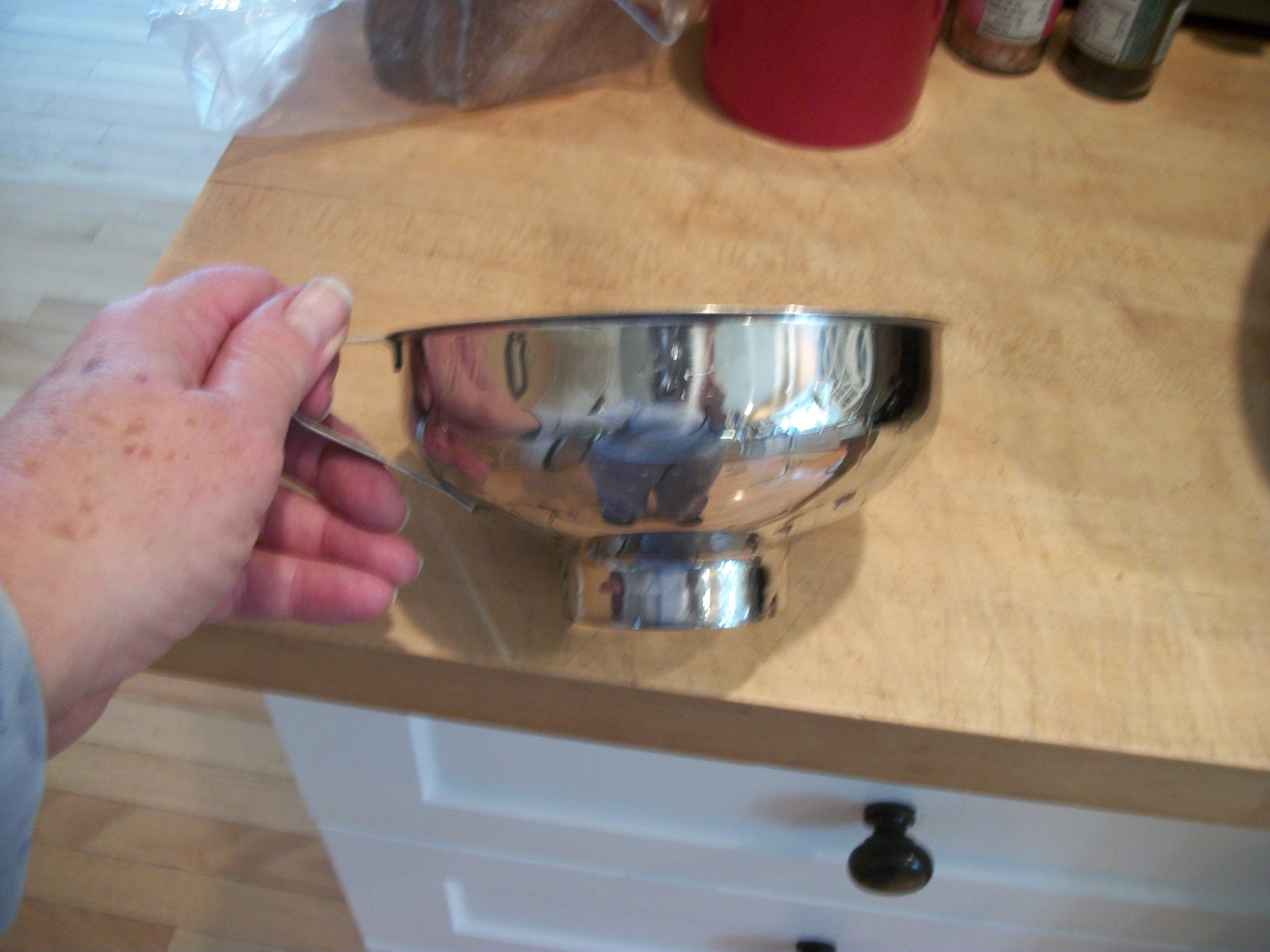
It really helps to have a canning funnel when you start to put the jam into clean Mason jars.  The wide mouth accepts a full ladle of hot jam, and the small bottom keeps it all going into the jar.  Here’s what one looks like:

 O

Once you start to make jams and jellies, it’s hard to go back to the store bought.  Most of them are so full of pectin that they taste like rubber.   If I’m going to eat that sugar, I at least want to have it accompanied by real fruit, not by fillers.

I put the hot jars upside down–which helps the top to form a vacuum–until they cool–as you can see from the picture.