Interesting Information: ‘Cancer Screening Has Never Saved Lives’ – BMJ Study Concludes

Interesting Information:  March 16, 2016

“Cancer Screening Has Never Saved Lives”

Here’s how the article begins:

Millions have marched for “cancer causes.” Millions more have been diagnosed “early” and now believe screening saved their lives. But a new study confirms something we have been reporting on since our inception: In most cases, screening not only has not “saved lives,” but actually increases your risk of dying.

First, what is The BMJ?

The BMJ (formerly the British Medical Journal) is an international peer reviewed medical journal and a fully online first publication. The website is updated daily with original articles, podcasts, videos, and blogs and organised into four main content streams—research, education, news and views, and campaigns. In addition, the site is fully searchable, with an archive back to 1840 and numerous topic collections on clinical and non-clinical subjects. Articles of relevance to specific countries and regions are grouped together on country portals.

My understanding is that medical claims of screening efficacy are based on yet another “medical math” con job.  Success is being measured by claimed reductions in a specific disease due to early discovery, not by overall mortality figures.  So, if I am understanding correctly, if someone is diagnosed and treated for disease X and dies from anything but that disease, that disease is not credited with the death.  Nor is the screening.  Nor are the treatments.  By looking at OVERALL death, a truer picture emerges.  Think about it, lots of folks die from conditions caused by screening methods, like cancer from too many x-rays.  When screenings are followed by cut, poison, burn treatments, many of which cause other diseases, other cancers, more death occurs.  But under the current system, the real death picture is not being captured.  Instead, something like pneumonia might be on the death certificate.  But, what caused the pneumonia?  What caused the eruption of other cancers?

Further, the major medical committees that review, say, mammographies and prostrate screenings, are saying these screenings are not reducing survival at all.  Rather, for much of the time, these screenings are leading to unnecessary and ineffective treatments.  Yet, up here in Maine, our newspapers are full of ads urging people to come and be screened.  Why?  Screenings make money not only in and of themselves, but in the treatments that follow.  Science is not involved here.  Or your health.  Money is.

Further still, the cancer industry has Americans by the throat–in that people all over the world are experiencing genuine cancer cures.  But that information, those cures, are not being recognized or utilized by the American cancer industry.  They are making far too much money to shift gears.  So, we are living with a rigged system.  And it’s killing us.

Here’s an abstract:

The claim that cancer screening saves lives is based on fewer deaths due to the target cancer. Vinay Prasad and colleagues argue that reductions in overall mortality should be the benchmark and call for higher standards of evidence for cancer screening

Despite growing appreciation of the harms of cancer screening,1 2 3 advocates still claim that it “saves lives.”4 This assertion rests, however, on reductions in disease specific mortality rather than overall mortality.

Using disease specific mortality as a proxy for overall mortality deprives people of information about their chief concern: reducing their risk of dying.5 6 Although some people may have personal reasons for wanting to avoid a specific diagnosis, the burden falls on providers to provide clear information about both disease specific and overall mortality and to ensure that the overall goal of healthcare—to improve quantity and quality of life—is not undermined.7

In this article we argue that overall mortality should be the benchmark against which screening is judged and discuss how to improve the evidence upon which screening rests.

Source: ‘Cancer Screening Has Never Saved Lives’ – BMJ Study Concludes

Turkey Tracks: “Crayon Crumbs Box” Quilt

Turkey Tracks:  March 16, 2016

Crayon Crumbs Box Quilt

I have been obsessed for much of the winter with making use of the small leftover pieces from my quilt projects.  These pieces are too small, for the most part, to cut into a 1 1/2-inch strip or a 2-inch block.  so, I started making 2 1/2 inch wide strips with the “crumbs” (as Bonnie Hunter calls them).  I use a flip and sew method–and trim from the back when I am done.

I used these strips as sashing for the cheddar version of Bonnie Hunter’s 2015 American Patchwork and Quilting Magazine‘s four-patch challenge.

My four-patch blocks came from my “parts department”–so named by Freddy Moran and Gwen Marston in their excellent book COLLABORATIVE QUILTING.  Remember that I spent a lot of time last summer making four-patches from my two-inch bin of squares–cut from leftovers from finished quilts.  I love this idea of having a “parts department.”  Bonnie Hunter also amasses and uses blocks from her quilt projects–like the small triangles one can salvage from making half-square triangles by laying a square over the corner of a rectangle or larger square (as with a snowball block), sewing from corner to corner, and trimming.  Bonnie Hunter uses a template to also mark a sewing line for this smaller triangle.  For more info, see her quiltville.com web site and click on tips/etc. at the top of the page.  Right now I’m getting about 400 2-inch half-square triangles from a snowball block project–using Bonnie’s method.  (They’re going into a border on that quilt.)

So, here is the finished quilt:

IMG_0844

Red-orange (or cheddar in quilting terms), teal blue/green, and violet magenta form a triad on the color wheel.

The backing and binding bring in the violet purple/magenta:

IMG_0850

You can see the quilting–an soft rose colored thread from Signature–on the border:

IMG_0848

The rose color “knocked back” the brightness just a bit.  I like it.

The pantograph is “Whirlwind” by Patricia Ritter.

Here are some pics of the quilt top–so you can see the way this block and the sashings work together.

IMG_0847

IMG_0846

And one showing a secondary pattern:

IMG_0852

I have loved every minute of this project!!!


Turkey Tracks: Making Applesauce Is Dead Easy

Turkey Tracks:  March 9, 2016

Making Applesauce is Dead Easy

I’ve had a bag of juicing apples bought in the fall and hanging around the refrigerator all winter.

Time to do something with them as they are starting to go bad.

Making applesauce is dead easy.

Dump the chunked apples, peel and all, into a heavy pot.

Add some water so the apples don’t burn.

You could cover the apples and let them render out slowly, but I was in a hurry.

I cooked them down pretty fast, and when they were soft, added a splash of maple syrup and a splash of some Fiore chocolate/cherry balsamic vinegar to the pot.  The vinegar, I hoped, would add an interesting layer of flavor.  It did.

When the apples are soft, drag out your “boat motor” emulsifier and run it through them.  Or use a food processor or a blender.

The good thing here is that all the fiber of the peels stays in this mix, but you don’t taste the peel.


IMG_0838

Here’s the applesauce and my boat motor.

IMG_0841

I’ve been using it as a topping for the gorgeous raw milk yogurt we get here in Maine.  My favorite comes from THE MILK HOUSE, a local business.  I top it with a tablespoon of fresh maple syrup and a handful of nuts that I’ve soaked in salt water and dried.  BEYOND YUMMY–and healthy!

Turkey Tracks: March Quilty Update

Turkey Tracks:  March 7, 2016

March Quilty Update

Well!

I’ve been distracted with all the political hoopla of late and suspect some of you have as well.

But the distraction has not prevented me from quilting.

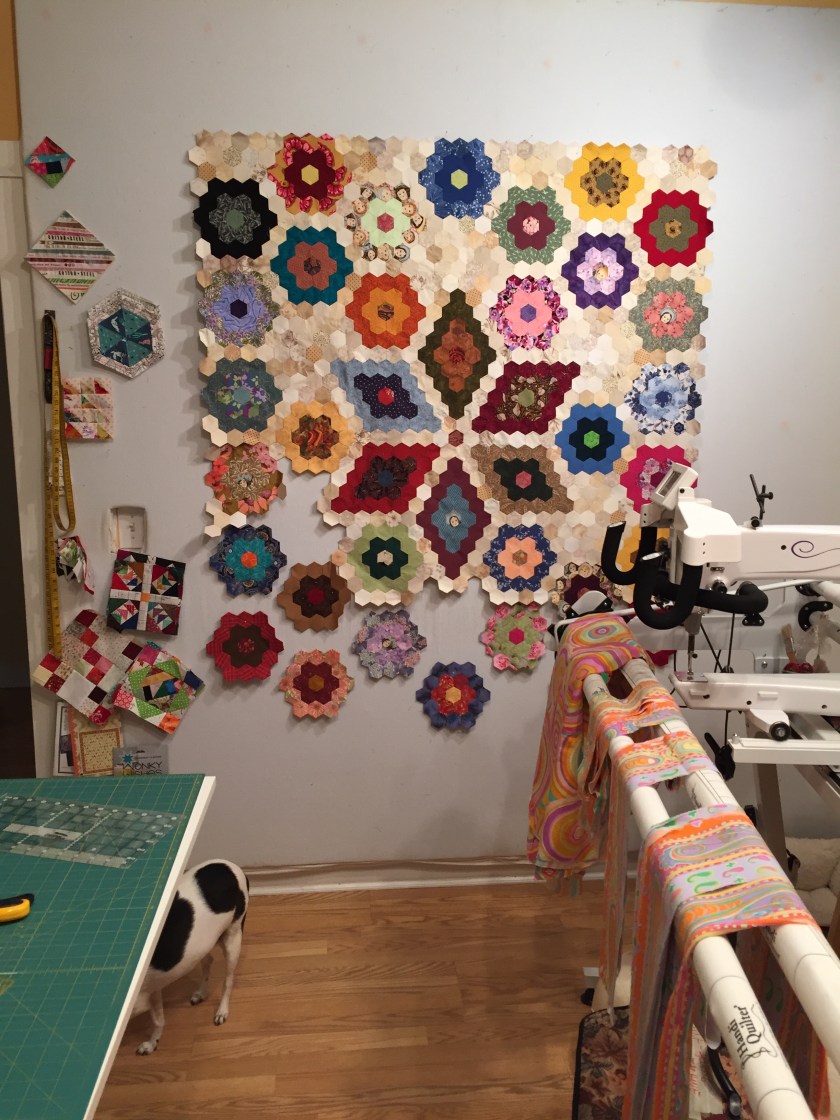
The “mother ship” is coming along.  Since this picture I’ve filled that hole on the left and am almost done with the right side piece that will fill below the red and purple flowers.

IMG_0959

This quilt is from Edyta Sitar’s Handfulls of Scraps.

“Crayon Box Crumbs” is on Lucy the long arm.  I’ll likely finish her up today.

IMG_0960

I’m liking the teal border a lot and will go out to a violet/purple binding.  Teal, violet/purple, and red orange are a “triad” on the color wheel.   (Thanks Janet K. for seeing I needed a border on this quilt.)

IMG_0961

And now there are FOUR of Bonnie Hunter’s Wild and Goosey blocks.

IMG_0950

Friend Becca Babb-Brott, who has an Etsy store, Sing Me A Song, helped me find a background fabric for these blocks–which will be set with a 3 1/2 inch wide sashing and as-yet -undetermined cornerstones.  Maybe the Wild and Goosey corner block or maybe a small nine-patch.  The sashing fabric is a pale grey tiny polka dot–which we think is in keeping with the black and white narrow sashing in these blocks.

What to do with more of the crumb bag–which seens to be breeding in the night?

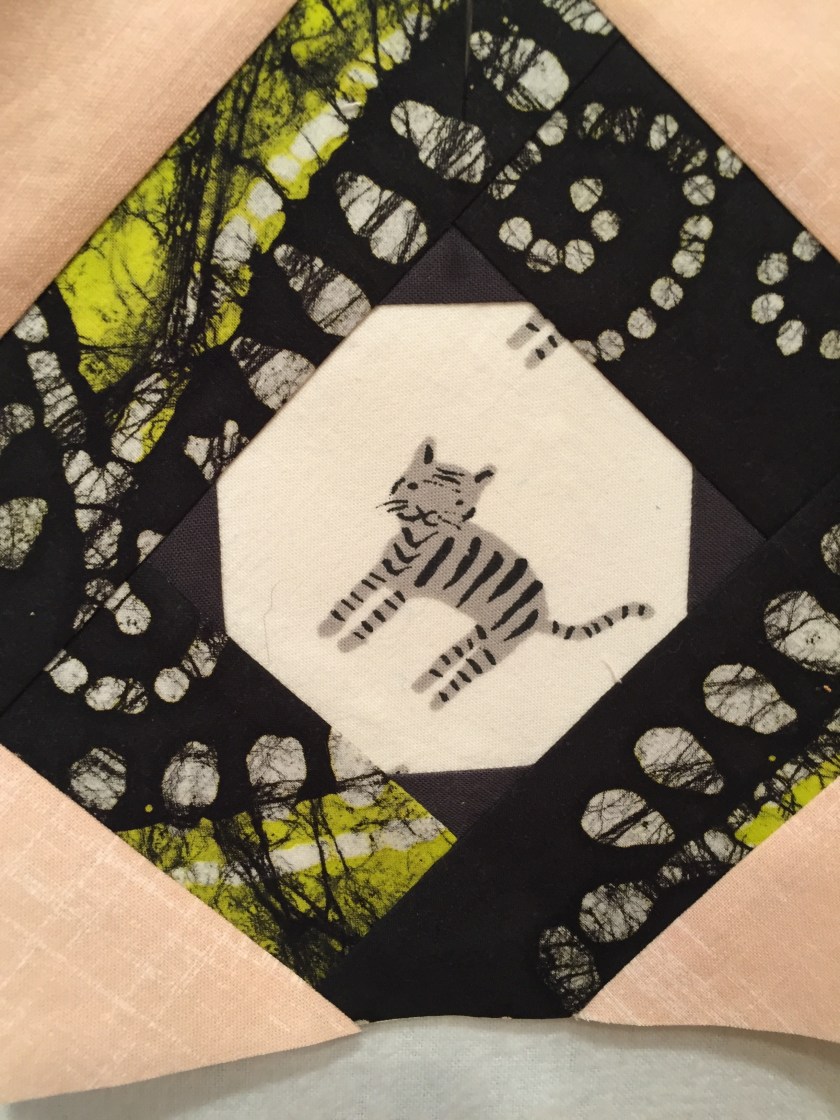
These blocks, which have 4-inch crumb centers:

IMG_0949

It’s easy to cut the surrounding “square” with the Companion Angle ruler.  Use the Easy Angle ruler for the half triangles.  Quick and easy and no loss of fabric or fiddling with tiny triangles with the flip and sew and trim method.

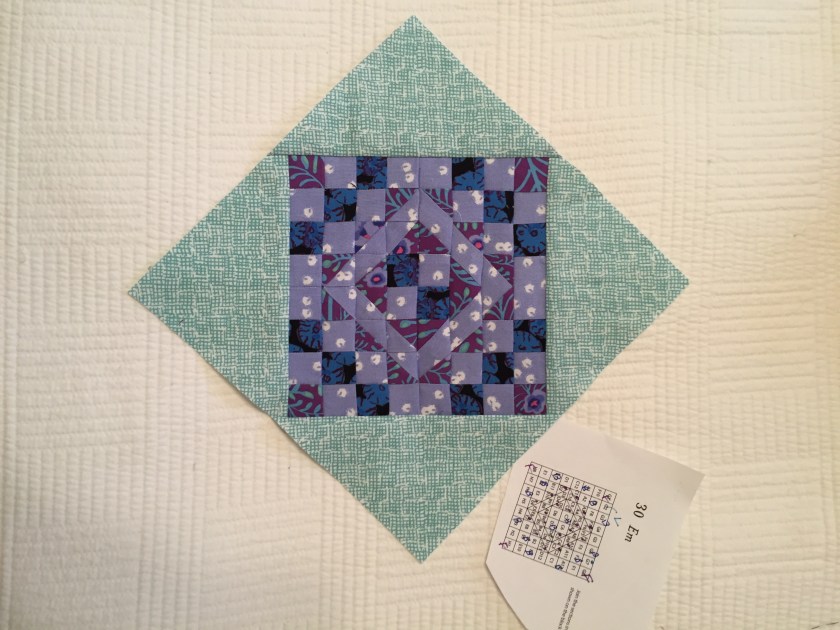
Becca and I chose a modern, mottled blue kind of fabric for the narrow sashings see in this block.  These blocks are inspired by a Bonnie Hunter quilt, “Nine in the Middle,” as seen in her book Adventures with Leaders and Enders.  Bonnie used a nine-patch where I am using the string/crumb center.

At some point about two weeks ago, I realized I would need at least 7 1/2 yards of fabric for the outer triangles for the Farmer’s Wives blocks and that the cream I was using wouldn’t be large enough.

Again, Becca helped me choose a new fabric–and I really love it.  The soft aqua/teal is just making ALL the blocks sing.  Having to take the triangles off of the 16 completed blocks went faster than I would have thought and was well worth the effort.  (Still struggling over how to set these blocks.)


IMG_0953

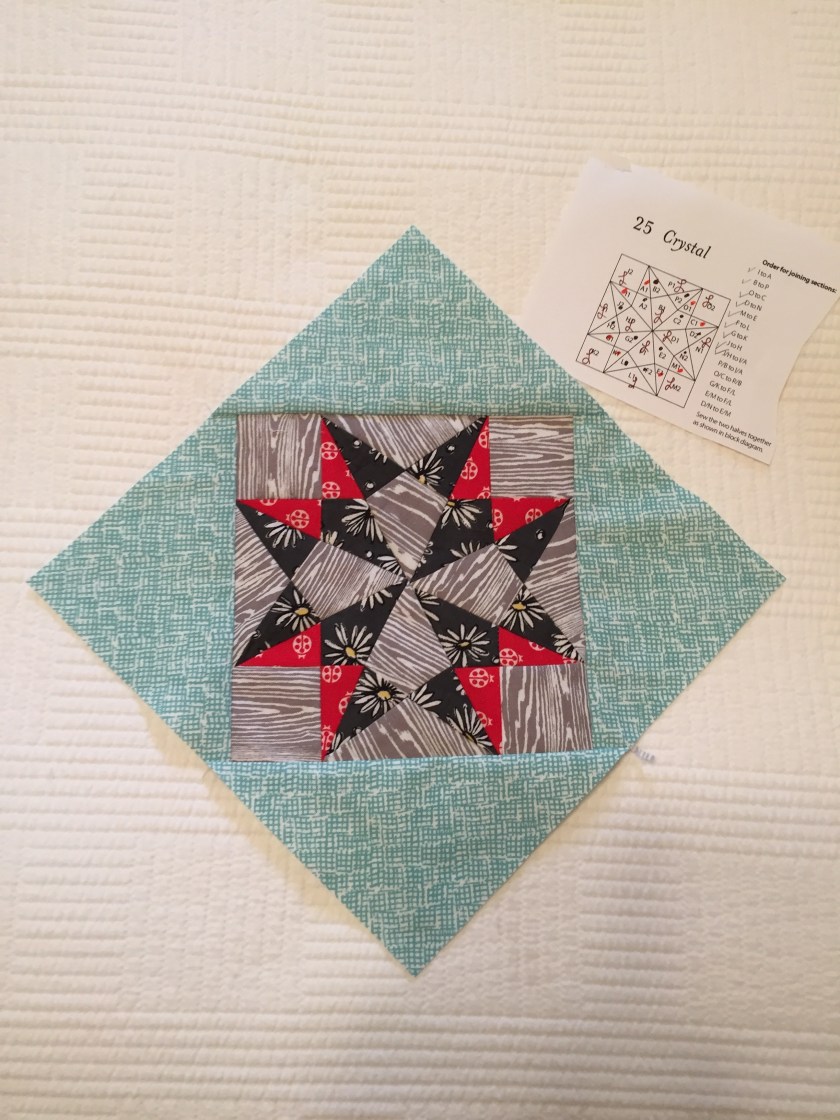
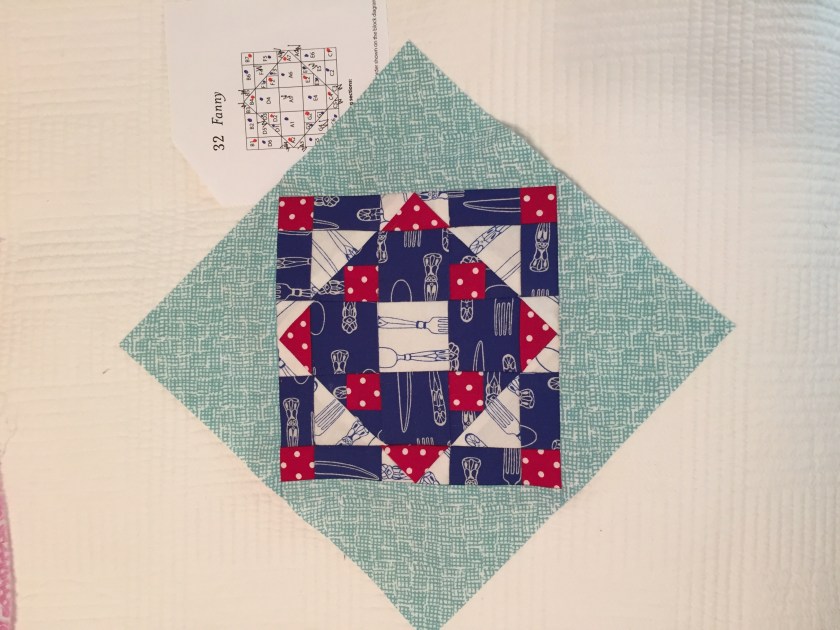
I’ve been working on the March allotment of 8 Farmer’s Wife blocks–we are trying for 9 a month to complete the 99 blocks.  Here are the ones I’ve completed so far:

Bride:

IMG_0956

Carol–the darks are a dark, soft charcoal grey:

IMG_0957

Carolina:

IMG_0958

And, two of Caroline as I did not like the first one so much–not enough contrast between two of the fabrids:

IMG_0963


IMG_0967

Granddaughter Mina’s quilt is taking place on the design wall.  Pics when more blocks are done.  AND I’ve got all the units done for a blue/neutral Jacob’s ladder quilt made from the blue/neutral four-patch project of last summer.

Interesting Information: 2015 Was Hottest Year in Historical Record, Scientists Say – The New York Times

Interesting Information:  February 26, 2016

2015, The Hottest Year on Record

Two of my neighbors now have installed solar panels on their roofs.

I’d LOVE to install solar panels.  It’s a long-held dream.

Yes, even up here in Maine, solar panels will work.

What’s stopping me is that my roof is about 14 or 15 years old, and I don’t want to install solar panels and then have to take them down for a new roof.

Apparently one can get a loan that is a “wash” with current energy bills.

But, maybe, this year I’ll start the conversation with a local solar company with a great reputation.

***

Meanwhile, here’s an article discussing the heat generated this past year.  There are some great statistics and good graphs AND a link to a “quick question and answer” document that’s interesting.  (Admission:  I don’t agree with the section on meat eating being a major cause of global warming.  The CAFO lots are a problem, but we should be grass-feeding cows anyway.  Meat is a major source of fat soluble vitamins and amino acids in forms that our body accepts.)

Source: 2015 Was Hottest Year in Historical Record, Scientists Say – The New York Times

Turkey Tracks: Carroll Rhodes Risk’s English Paper Piecing Project

Turkey Tracks:  February 25, 2016

Carroll Rhodes Risk’s English Paper Piecing Project

Carroll Rhodes Risk is a Bellevue High School, Bellevue, Nebraska, classmate.

She’s a quilter too!

She saw my blog posts on various English Paper Piecing projects–especially the exciting millefiori projects.

She’s working on tiny circles–and has promised to send along pics of her progress.

Here’s what she has now:

IMG_0813

IMG_0814

Aren’t these FUN!!!

(Thanks Carroll, for staying connected and for being a quilter.)

Turkey Tracks: Snow Day Quilting

Turkey Tracks:  February 24, 2016

Snow Day Quilting

It’s a kind of a snow day.

We had wet, slick snow early, followed by ice, followed now by rain–and temps are rising.

The Coastal Quilters Sit and Sew cancelled for this morning, wisely.  People come from far away here in rural Maine, and the early roads were not good.

I did get out for my haircut, but am now hunkered down with the pleasure of sewing to my heart’s content.

These 30 quilt blocks are ready to sew together:

IMG_0947

Is this wild or what?

Here’s a close-up:

IMG_0948

I have not decided about a small border yet.  It seems wild enough.  What do you think???

I have a great backing fabric for this quilt.

These are Bonnie Hunter’s block from the 2015 “American Patchwork and Quilting Magazine” four-patch challenge.

This is my second quilt using this block.  This one is set in cheddar fabric and surrounded by sashings made from my “crumb” bag.

(I don’t think the crumb bag is going down in size; I’m pretty sure those crumbs are breeding during the dark of night.  But I adore sewing them into something fun.)

I had to make fourteen more sashings, so I found my self organizing the crumbs into piles that stopped all the mindless pawing through off of them.)

I pulled off fabrics that I thought would work in Bonnie’s Wild and Goosey block:

IMG_0906

I now have TWO of these.  And I’m thinking they will make a third “bright” quilt for Bryan and Corinne’s youngest.  I’ll put up pics of the first two “brights” after they have been gifted.

I’ll use sashings to surround each block–maybe a bit wider than the cross sashing in the block’s middle.  It will be one fabric, not scrappy.  That will make these little blocks pop out nicely.

I AM PUTTING THE BINDING ON “ALLIETORE,” and it’s glorious.  Bonnie hit this one right out of the ball park.


Interesting Information: Blood Pressure Meds: Yes or No?

Interesting Information:  February 24, 2016

Blood Pressure Meds:   Yes or No?

In the past few weeks, I’ve run across a handful of friends who have mentioned that they are taking meds to lower their blood pressure.

I love it when the universe begins to send me information regarding something about which I have questions.

I’m reading the winter issue of WISE TRADITIONS, the Weston A. Price journal.  Inside there is a review of an audio CD by Dr. Donald K. Weber, DC called HEALTH 101 SIMPLIFIED, page 80.  (This issue is not yet online but will be eventually.)

Here’s a quote written by the reviewer:

Dr. Weber’s views on blood pressure are a little different from those of most other doctors.  He believes that your blood pressure is what it is supposed to be.  In other words, artificially adjusting it with drugs is not “correcting” anything.  Blood pressure is controlled by oxygen levels in the brain.  If the brain is not getting enough oxygen it raises the blood pressure until it does get enough oxygen.  Normal blood pressure is considered to be around 120 over 80, although the pharmaceutical companies would like to lower those figures so that they can make a whole lot more money selling their drugs to a lot more people.

The ratio of 120 over 80 is 3:2.  If your pressure is higher but is the same ratio (150 over 100, for example), then you are dehydrated, according to Dr. Weber.  I’m pretty sure there is not a drug in the world that cures dehyderation, but I’m not a doctor.  Weber also mentions that chemicals from things like processed lunch meat can raise blood pressure.

Many doctors seem to prefer prescribing expensive drugs to lower blood pressure.  Do they work?  Well, they lower pressure but they do that by weakening the heart.…The result is insufficient oxygen to the brain resulting in dizziness, light-headedness or even blackouts.  That is a known side-effect of blood pressure medication.  Over the long run, brain cells start dying when they don’t get enough oxygen.

My other go-to person with heart and other issues is Dr. Sherry A. Rogers.  She’s a big believer in the notion that we are all low in magnesium–which cause all sorts of heart problems and high blood pressure.  (She backs up everything she says with citations from leading studies and journals.)  She recommends an easy to find magnesium product, Natural Calm, taken twice a day.  She has a book on blood pressure, THE HIGH BLOOD PRESSURE HOAX, but here’s a quote from IS YOUR CADIOLOGIST KILLING YOU?

There are so many ways to lower and permanently CURE high blood pressure that it boggles the mind why we insist on merely bludgeoning it for the rest of our lives with drugs.  Especially drugs that guarantee you will require more drugs, while bringing on an avalanche of more side effects, symptoms and diseases (15).

Remember that docs do not get any nutritional training.  Most don’t begin to know how to use foods to CURE problems.  (Rogers says eating four stalks of celery a day will magically lower blood pressure.)  Docs are practitioners, not scientists or nutritionists.  They only know what those pesky drug companies are telling them about health problems.  They’ve lost the whole vocabulary of “CURE.”  They are now just managing illness–and contributing to it far to often.  AND, they have become “workers in the system,” in that if they do not follow the “standards of care,” they are driven out.  That’s how a strong market works to increase its market share.

So….

Before you buy into thinking you even have high blood pressure, get one of those inexpensive cuffs from the drug store and take your blood pressure over the course of a few days at different times over each day. Figure the ratio.  If it’s “high” or not 3:2, drink water and test again.

My late husband’s blood pressure zoomed so high in ANY doctor’s office that they would threaten to hospitalize him on the spot.  At home it was just fine.

I hope this little post gives you some information on this very serious subject and that you will investigate more before taking any medication.


Turkey Tracks: It Feels Like Spring: February 2016

Turkey Tracks:  February 22, 2016

It Feels Like Spring:  February 2016

Temps have soared up here in Maine.  In places over this week, some temps will be close to 60 degrees.

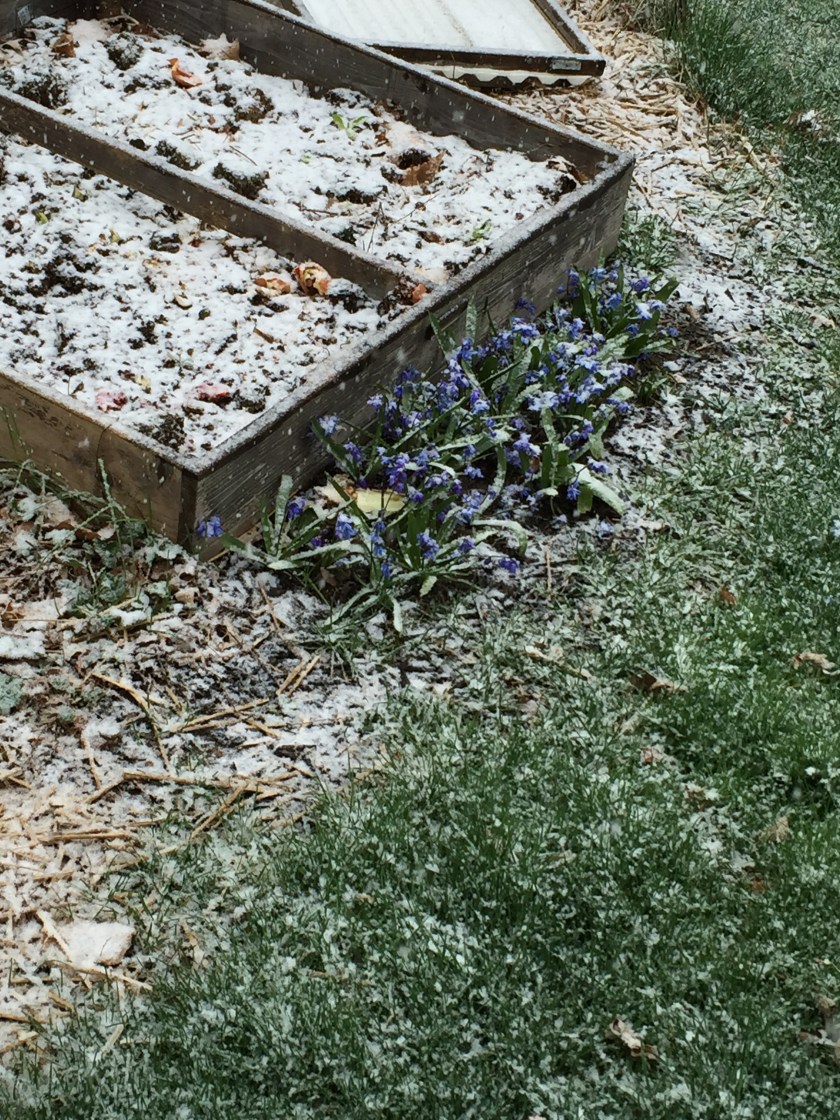
I have daffodils coming up through snow patches.

We are to get two days of rain again this week.

Is winter over?

Hard to tell.  We usually get some spring snows, even into April.  But it has just not been a cold, snowy winter this year.

I have been hard at work on so many quilt projects–each and every one a joy to produce.  And more on that later.

Yesterday I took down the Christmas wreath and installed this lovely thing:

IMG_0946

How fun is that???

IMG_0945

I have another bare branch wreath that I also love.  It lives in the garage in the winter.  I’ll find another spot for it for right now.  Or, rotate it “in” later in the year.


Interesting Information: Vaccines: Why Are So Many People Choosing Not to Vaccinate? | Vision Launch

Interesting Information:  Vaccines:  February 22, 2016

Why Are So Many People Choosing Not to Vaccinate?

This series of 12 essays pretty much covers the anti vaccine argument.  It is chock full of links to further educate–and of course the links are to reputable sources, studies, etc.

Be fully aware that the “story” you’ve been told in the media and in your doctors’ offices that this is “settled science” is far from the truth.  And, remember, that science should never be totally “settled.”  It must always be open to exploration and refinement.  Otherwise, it just morphs into belief system, not science.

You owe it to yourself and your family to read these essays.  The first essay addresses the “famous/infamous” vaccine skeptics.

A Comprehensive Review of Vaccines – Part 1 of 12 What is With All These Vaccine Skeptics?

Here’s a quote from the opening essay:

Most people have a difficult time understanding why any parent would choose not to vaccinate their children. After all, we have been assured by our doctors that clinical trials show that vaccines are safe and effective and that we need to vaccinate to protect everyone. So what’s the reason for these people to refuse vaccination for their children?

Unfortunately, the further we objectively researched the whole body of evidence surrounding vaccines, the more difficult we found it to come to the conclusion that vaccines are safe and effective. The truth is, there isn’t just one reason for vaccine skeptics to forgo vaccination. There are many.

Source: Why Are So Many People Choosing Not to Vaccinate? | Vision Launch