Books and Interesting Information: More on Michael Pollan’s COOKED

Books and Interesting Information:  January 22, 2015

More on Michael Pollan’s COOKED


IMG_0251

I think the most exciting part of this book for me was the section on fermentation, called “Earth.”  Fermentation undergirds so much of what we eat.  Here are a few foods that are fermented:  sourdough bread, beer/wine and other bubbly drinks, cheeses, fermented meats (like salami, for instance), all the lacto-fermented foods (like sauerkraut) and on and on.  Sandor Katz has a great list that is much, much longer than I am recalling here.

As an aside, the breakdown of Pollan’s organizational schema here is that sourdough bread falls under the “Air” section, not the “Earth” section, but it’s still a ferment…

The most exciting section of “Earth” for me was when Pollan writes about the excitement scientists who are studying the microbiome of the human body have at their recent discoveries.  Here’s how Pollan puts it:

The scientists working today on “microbial ecology” are as excited as any I’ve ever interviewed, convinced, as one of them put it, that they “stand on the verge of a paradigm shift in our understanding of health as well as our relationship to other species.”  And fermentation–as it unfolds both inside and outside the body–is at the heart of this new understanding (322)

Here’s the shift:

In the decades since Louis Pasteur founded microbiology, medical research has focused mainly on bacteria’s role in causing disease.  The bacteria that reside in and on our bodies were generally regarded as either harmless “commensals”–freeloaders, basically–or pathogens to be defended against.  Scientists tended to study these bugs one at a time, rather than as communities.  This was partly a deeply ingrained habit of reductive science, and partly a function of the available tools (322)

It is still astonishing to me how destructive this artifact of modernity–this focusing on parts rather than wholes–has been.  The hubris involved in acting without fully understanding how the whole functions, how the parts relate to each other as well as to the whole, blows my mind.  How can you know how something works if you can’t even see all its parts?  Pollan continues:

Scientists naturally focused their attention on the bacteria they could see, which meant the handful of individual bugs that could be cultured in a petri dish.  There, they found some good guys and some bad guys.  But the general stance toward the bacteria we had discovered all around us was shaped by metaphors of war, and in that war, antibiotics became the weapons of choice (322-323).

And, I want to add, pesticides, herbicides, and anything that kills what got deemed as an enemy by THE MARKET, which has happily sold us its products for years and years now without any regard to unintended consequences of NOT FULLY UNDERSTANDING THE FUNCTIONING OF THE WHOLE.  (Yes, I’m yelling because the consequences to humans, to our babies, to our earth are…nothing short of dire.)

Pollan continues:

But it turns out that the overwhelming majority of bacteria residing in the gut simply refuse to grow on a petri dish–a phenomenon now known among researchers as “the great plate anomalluy.”  Without realizing it, they were practicing what is sometimes called parking-lot science–named for the human tendency to search for lost keys under the streetlights not because that’s where we lost them but because that is where we can best see.  The petri dish was a streetlight.  But when, in the early 2000s, researchers developed genetic “batch” sequencing techniques allowing them to catalog all the DNA in a sample of soil, say, or seawater or feces, science suddenly acquired a broad and powerful beam of light that could illuminate the entire parking lot.  When it did, we discovered hundreds of new species in the human gukt doing all sorts of unexpected things (323).

We are, it seems, a kind of superorganism.  And our health depends on the health of the microbial species within us.

To their surprise, microbiologists discovered that none of every ten cells in our bodies belong not to us, but to these microbial species (most of them residents of our gut), and that 99 percent of the DNA we’re carrying around belongs to those microbes.  Some scientists, trained in evolutionary biology, began looking at the human individual in a humbling new light:  as a kind of superorganism, a community of several hundred coevolved and interdependent species.  War metaphors no longer made much sense.  So the microbiologists began borrowing new metaphors from the ecologists (323).

The survival of these microbes depends on our health, writes Pollan, “so they do all sorts of things to keep their host–us–alive and well.”  We can no longer think of ourselves as individuals, but as part of a community.  Look at the word microbiome itself:  micro  bio  me.  Kill the microbes, kill yourself.

These guys are really smart, as Pollan notes:

One theory is that, because microbes can evolve so much more rapidly than the “higher animals” they can respond with much greater speed and agility to changes int eh environment–to threats as well as opportunities.  Exquisitely reactive and fungible, bacteria can swap genes and pieces of DNA among themselves, picking t hem up and dropping them almost as if they were tools.  This capability is especially handy when a new toxin or food source appears in the environment.  The microbiota can swiftly find precisely the right gene needed to fight it–or eat it (325-326).

Feed your gut microbiome properly.  Lacto-fermented foods are a good start to restoring gut health.  There are recipes on this blog, and this food is easy to make and delicious.

Turkey Tracks: “Grand Illusion” Finished

February 21, 2015

“Grand Illusion” Finished

Here she is:  Bonnie Hunter’s 2014 Mystery Quilt, “Grand Illusion,” inspired by the Grand Hotel on Mackinac Island, Michigan.

You may recall that Bonnie gives out her colors in early November some time.  We all scramble around picking fabrics and getting ready to go.  Then she releases the first “clue”–which is the making of the quilt’s first set of units–on the Friday after Thanksgiving.  (Why on earth do they call that Friday “Black Friday”?)  After that, we are off and running at the pace that each of us can manage.  Some times we fall behind, some times we take months to finish the quilt, some times we finish it about a week after Bonnie releases her version–the “reveal”–sometime between Christmas and New Year’s.

I finished mine this week.  And I will say up front that I need better pictures of the whole quilt than I have.  I’ll get some at our next quilt meeting (we’ve had to cancel both the January and February meetings due to the Maine weather) when friends will hold her up for me.

IMG_0172

See the secondary pattern that forms around the turquoise square?  See the big blue star?  And the diamond that outlines it with the darker pinks?

Here’s the main block in my quilt–surrounded by the green/white/black sashings

:

IMG_0175


Here’s the very cool border.  ( I love how the yellow is working in this quilt.)

IMG_0173


Here’s the backing fabric–which I think is an INSPIRED choice for this very contemporary quilt.  I found the fabric at Fiddlehead in Belfast, Maine.

IMG_0174

Bluebirds, bicycles, and daisy’s–both in the bicycle basket and, larger, in the background.  The fabric also has a very French feel to it…

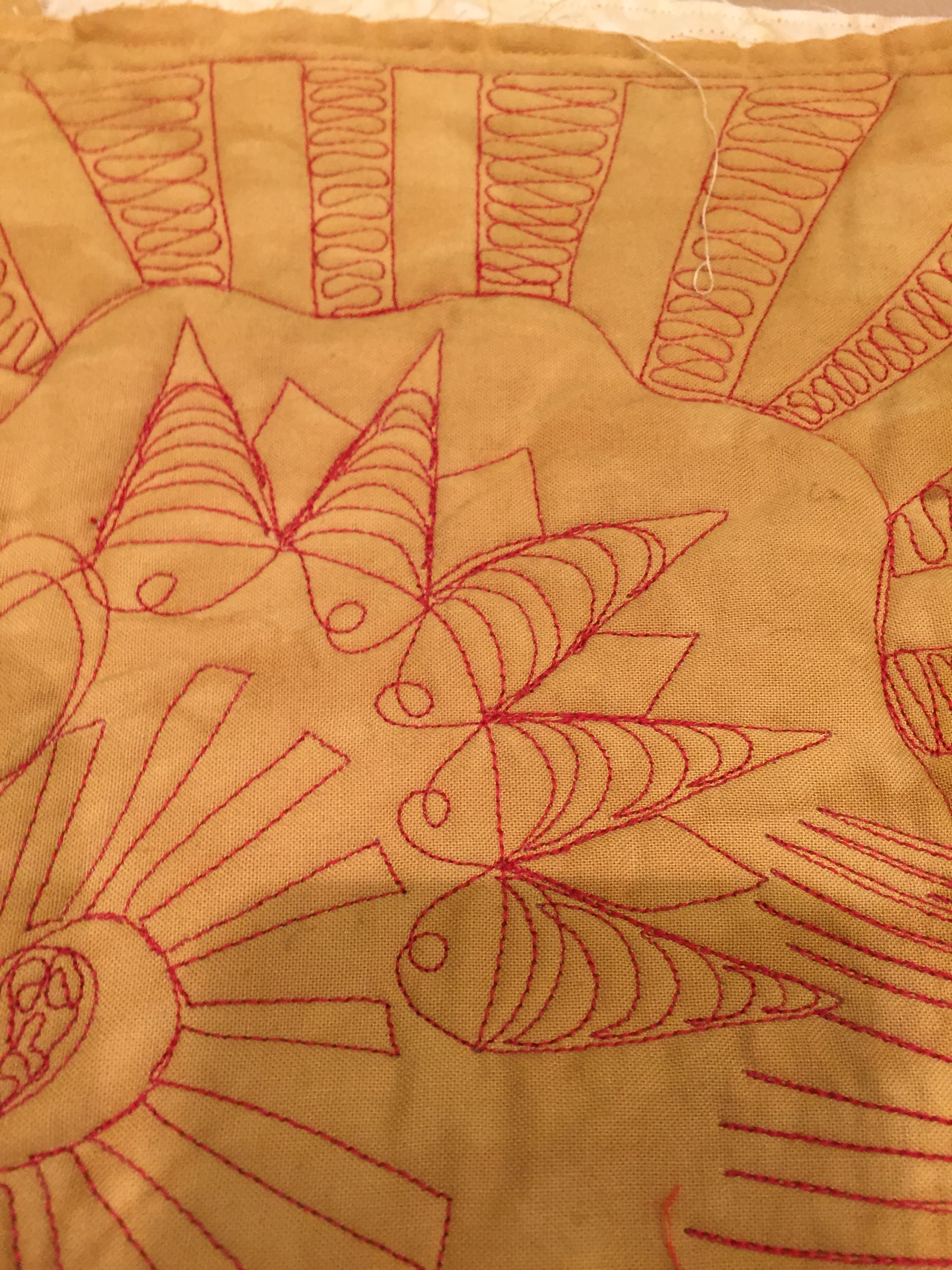
I quilted with a warm yellow, using a Daisy pantograph from Anne Bright called “He Loves Me” at 10 inches.

Here’s a view from the front of one daisy:

IMG_0176

And one from the back that as chance would have it, kind of overlays one of the white daisies:

IMG_0177

It’s an awfully cute quilt–especially for a teen age girl.

IMG_0178


(Wild-haired dolly will soon be going to her owner, who will be 2 in April and probably reeling from the shock of a new baby.)


Interesting Information: “Researchers Conclude Wireless Radiation Causes Cancer After Latest Scientific Findings Announced”

Interesting Information:  February 21, 2015

“Researchers Conclude Wireless Radiation Causes Cancer After Latest Scientific Findings Announced”

This press release shares that The National Association for Children and Safe Technology (NACST) has determined that wireless radiation is dangerous, especially for children.

NACST is asking that technology, especially in schools, be hardwired and not wireless.

It’s something to think about for homes as well…

Scientists and studies are named in the press release below:

Researchers Conclude Wireless Radiation Causes Cancer After Latest Scientific Findings Announced | PRLog.

Turkey Tracks: Streak of Lightening Quilt

February 20, 2015

Fun Fiber Projects in February

How’s that for alliteration?

And. oops, this one published before I wanted it to.  It was meant for tomorrow…

I finished Bonnie Hunter’s 2014  Mystery Quilt, “Grand Illusions,” and will show that on a separate blog post.  It’s a spectacular, exciting quilt and was so much fun to make.

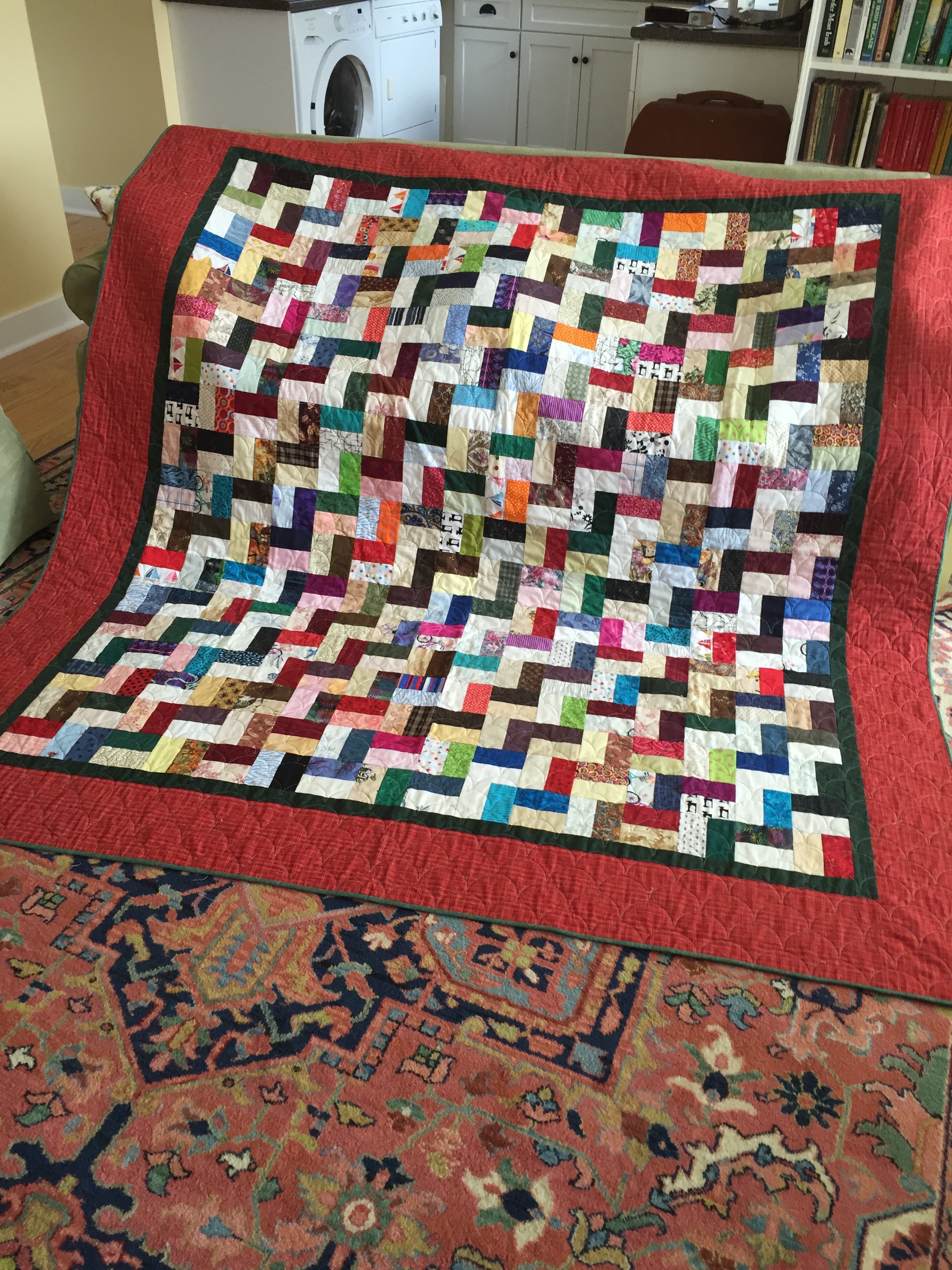
Look at this big red border!  This scrappy streak of lightening quilt top is done.  It will go on the long arm later today.  Remember that this quilt top has come entirely out of my stash and from the leftovers of two other scrappy quilts that I am using in my downstairs tv/sitting room.

IMG_0170


I’m working on another hand-sewing quilt:  octagons.

IMG_0180

I am playing around with the opposites on the color wheel.  This one is blue and orange.  Remember the Lucy Boston quilt I did was two more opposites:  red and green.

Here it is again:

IMG_0136

Purple and yellow may be hexies…

Who knows?

This year, American Patchwork and Quilting magazine has issued a challenge to make quilts with 4-patch blocks.  Bonnie Hunter is one of the quilters–and you can go to the magazine’s web page and get the complete list.  The current magazine has all sorts of gorgeous pictures as part of this challenge.  Remember last year that their challenge involved low-contrast quilts–or, “tone it down” is how I remember them phrasing the challenge.

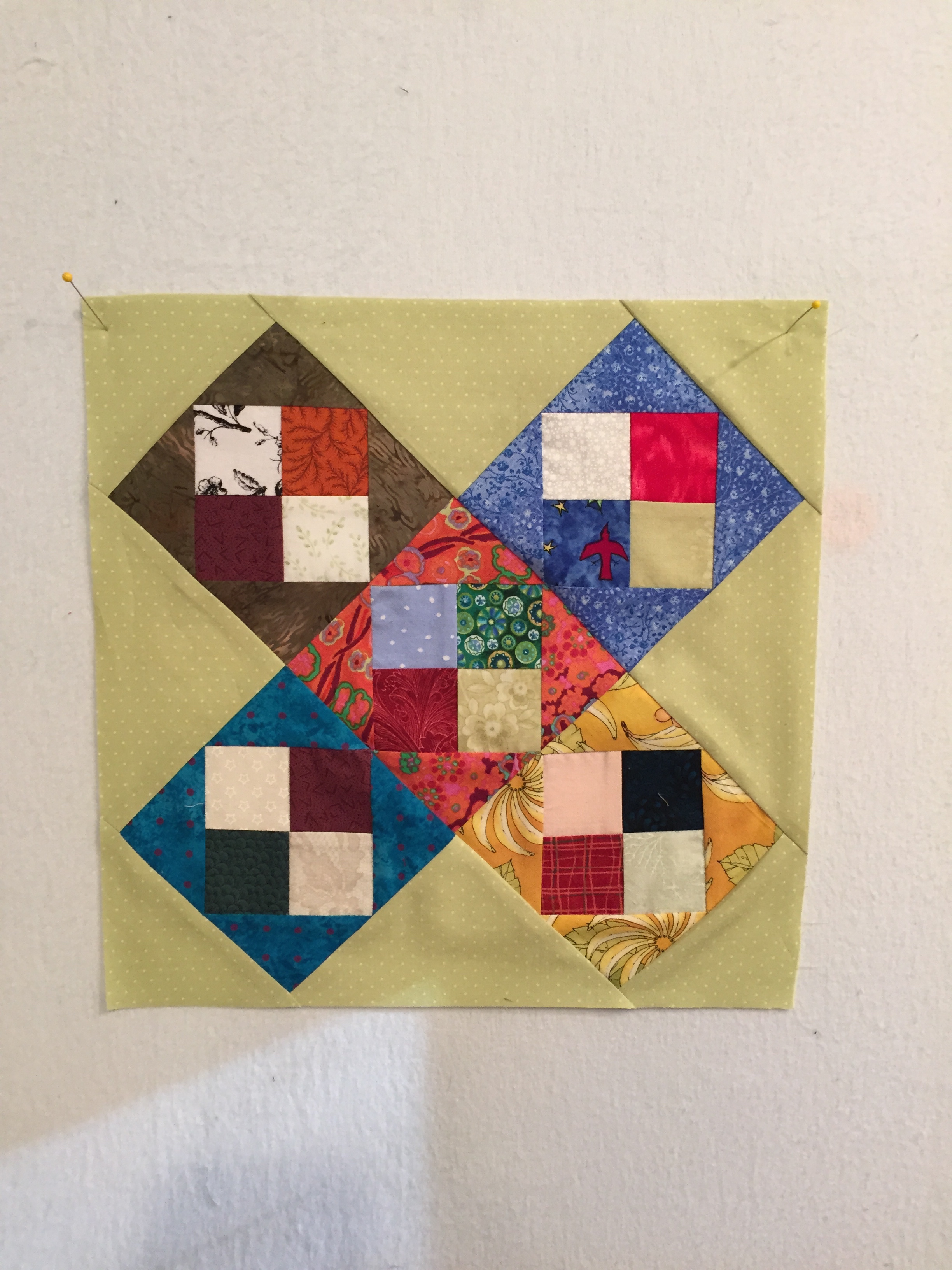
Anyway, Bonnie is doing something mysterious with this kind of block, put on-point, and which starts with 2-inch squares.  Here are two I have made, and I love them!

IMG_0185

Look at my 2-inch square box.  It definitely needs to be cleared out…

IMG_0186

So I will be making 4-patches of light and dark, regardless of what I do with them all.  Four-patches are endlessly useable.  So this will be a new leader/ender project.

I am also playing around with blocks for a low contrast quilt–in more of the Kaffe Fasset mold–color drenched, I hope.

IMG_0184

I didn’t want that central set of blocks to have any order to move your eye around…  Or to line it up–in the way alternating light/dark squares would do.

It’s a work in progress, and I am having fun playing.

You can see the backing for the streak of lightening quilt on the long arm…


Reviews: Blog: Big Hips. Open Eyes. Number Twenty

Reviews:  February 20, 2015

Tracy Rothchild Lynch’s

“Twenty”

Here’s a real treat for you:  Tracy Rothchild Lynch’s essay “Twenty.”

You may recall she is trying to spend this year writing about connections she’s making with people in her daily life.

She hit this one right out of the ball park in my humble estimation/opinion.

Big Hips. Open Eyes.: Twenty.

“Twenty One” isn’t bad either…

Big Hips. Open Eyes.

ENJOY!

Interesting Information: “Antiperspirants Can Make You Smell Worse”

Interesting Information:  February 20, 2015

“Antiperspirants Can Make You Smell Worse”

Like many of you, I suspect, I have been using a “natural,” aluminum-free deodorant for well over fifteen years now.  My current brand has been a Tom’s “long-lasting” product.

I’ve never had much body odor.

And I don’t sweat a whole lot, and I’m past the “hot flashes” stage.

So, about two years ago, I began to notice that at night when I woke up, I had really, really strong body odor under my arms.

And, for about two years, I’ve had some off and on swelling of the lymph nodes under my left arm.  (I worked with my local homeopath on this issue.  We’d clear it, but it would come back–especially in the winter.  Think layers of clothes, including lots of wool, and less showers.)

I LOVE sleeping in a cool bedroom with a lot of heavy cover on top.  I’ve been known to crack the bedroom window right at my head when the temps are in the 20s.  I crave the clean, clear, crisp Maine air–as long as there is enough cover.  But, at some point, the cover is too much, and I wake up sweating in my warm cocoon.   And, stinking…

It took me quite a while to connect the dots.  The Tom’s was causing the odor.  And, maybe the swelling.  And it was worse on the left side because I’m right-handed and was likely putting more of the deodorant under my left arm.

I stopped the Tom’s and went back to a very light dusting of some baking soda mixed with a bit of corn starch (which cuts the baking soda’s scratchiness).  I have this mixture in a small glass jar in the bathroom, put two fingers into it, and just lightly dust under my arms.  I don’t think I even have to do it every day…

The odor immediately stopped.

The swelling stopped and is gone.

For good measure, I stopped wearing a bra around the house, too.

(Saw a bit of a story on tv about young women wearing the most constrictive “body shapers” under their clothes and wanted to cry for them.  Back to the Victorian age…  And it all has to do with all this form-fitting clothing today where athletic clothes are now dressed up for every day.)

Within a few days, I got a Mercola post on the importance of our bodies’ surface microbiome and how important it is to good health.  (That’s a great example of synchronicity–which I’ll talk about in another post.) And you can read the Mercola below.  DO READ IT.

In addition, the post discusses the fact that we are washing away our bodies’ first line of defense when we use so many commercial soapy products every day.

For a long time now, when I shower, I don’t use soap.  I might take a loofah product and give my skin a scrub–it seems to like that stimulation.  But I don’t use soap unless I have gotten really dirty outside.

So many of these commercial products have really seriously bad chemicals in them–from cleansers to scent chemicals.  They dry our skin.  They kill the microbiome colonies.  They are just bad for us.  And, apparently, with the deodorant, they are causing odor, not curing it.

When I came back from Charleston on my last trip, I went for a haircut.  My hairdresser said “have you been swimming in a chlorine pool?  Your hair is so, so dry.”  I had been using a commercial shampoo rather than the baking soda/water “shampoo” and vinegar/water “conditioner.”  It took some weeks for my hair to get its gloss and shine back–a gloss and shine on which people comment.  Lesson learned.

Next time you are in a crowd, take a close look at the hair you see.  How many people have dry, lifeless hair?

Here’s a little quote from the Mercola article:

Science is clearly showing that your body’s microbiome plays a major role not just in your health, promoting or warding off skin diseases for example; it can also dramatically alter things like body odor. So, it’s really in your best interest to work with your microbiome, rather than against it. Doing so could help you avoid all sorts of chemical toxins that most people slather on themselves without thinking twice about what it’s doing to their microbiome, or their health.

Antiperspirants Can Make You Smell Worse.

Go through your cosmetic regime.  Read the labels.  Look for the parabens, the chemicals, and get rid of that stuff.  It’s expensive and dangerous.

I use unheated coconut oil as a moisturizer, Burt’s Bees “lipstick” sticks, baking soda/cornstarch deodorant, and a 1 to 4 baking soda/water ratio for shampoo and about the same with vinegar for a rinse.  I also use baking soda and sea salt as a toothpaste.  I “oil pull” coconut oil for teeth and gum health when I slow down to think about it.  If you want more scent, you can go to the essential oils for support.  Young Living oils are great, but you can find good ones in a health food store or a health food section of something like Whole Foods.

Good Luck!


Books, Documentaries, Reviews: Nina Siegal’s THE ANATOMY LESSON

Books:  February 15, 2015

THE ANATOMY LESSON

NINA SIEGAL

I just finished reading Nina Siegal’s THE ANATOMY LESSON.

IMG_0578

I have mixed emotions about it, but recommend it with some reservations.

It’s derivative, of course.  Picking a painting and creating a novel around it, as in THE GIRL WITH THE PEARL EARRING, apparently works quite well.

But, historical fiction ALWAYS ALREADY tells you more about what we, today/whenever, think than it does about the actual time.  And Siegal falls grandly into this trap with the invention of a young woman who, inexplicably to my way of thinking, loves the man who becomes the subject of the “anatomy lesson.”  Historical fiction ALWAYS ALREADY does a kind of violence to the people involved.  We cannot possibly know their thoughts and feelings.  We are too far removed and bring with us our own, deep cultural codes and behaviors.  This novel is judging that era by our modern codes:  for instance, the hanged man was himself abused, neglected, unloved, confused, and fell into thieving to survive.  Underneath he’s really ok.

Let’s stop for a moment and take a look at the painting itself–done by Rembrandt in 1632.

The Anatomy Lesson of Dr. Nicolaes Tulp – Wikipedia, the free encyclopedia.

When Lauren Hillenbrand wrote SEABISCUIT  and, later, UNBROKEN, she used a horse and a soldier to tell a much larger story about a particular time.  She didn’t need to veer into fiction to create fabulous works.  Siegal, though, muddies up this book with the romance between Flora and the condemned man (he is hanged) who becomes the subject of the “anatomy lesson.”

Having cautioned about historical fiction, I will say that Siegal DOES capture the flavor of this era–and that part of the book is most interesting.

For instance, people are digging into bodies to figure out how they work.  And, they are trying to find out if a tarnished soul (the man in the anatomy lesson is a thief) shows itself in organs that are vile in some way. The man in the painting is a real man:  Adriaen Adriaenszoon.  His body is covered with whipping scars, brands, and his right hand has been severed–all as punishments for thieving.  People of this era believed that if you punished the body sufficiently, you could change behavior.  (The theorist who did such a grand job of reminding us of these “other” times and their very different relationship to the human body was Michel Foucault in DISCIPLINE AND PUNISH.)


Rembrandt is commissioned by Dr. Nicolaes Tulp to paint this “the anatomy lesson,” which was conducted in Amersterdam by Dr. Nicolaes Tulp and which is attended by all the important people who can come (read men) and is followed by a lavish banquet.  There are political overtones to the event:  put on a successful  “lesson,” and you might get elected to be mayor of Amsterdam one day.  Each person in the painting also has paid Rembrandt to put him into the work.  This painting is very large–monumental some might say–and was meant to hang in the medical guild.

The painting becomes Rembrandt’s first really important painting.  And here is where Siegal’s story becomes interesting–for she muses on how Rembrandt decides to deviate from paintings of anatomy lessons previous to this event–which are graphic and display bodies with open chest cavaties, etc.  Rembrandt paints Adriaen fully restored–no scars, no stump with a missing hand.  The light in the picture is directed onto the whole, clean body, not on Dr. Tulp.  And, Siegal poses, this is the line between art and just painting what is there.

She’s probably right.  The analysis of the painting is interesting.  The descriptions of life in Amsterdam in 1632 is interesting, too.  And Siegal’s writing is lovely.


Interesting Information: “10 Banned Foods Americans Should Stop Eating”

Interesting Information:  February 15, 2015

10 Banned Foods Americans Should Stop Eating

Mercola Web Site Infographic


Shopping and eating gets more difficult every day.  We have to read all the labels, know the food issues, be careful about what we buy, feel sad and frustrated, etc., etc., etc.

It’s all just a mess.

But, here’s a good infographic from the Mercola web site.  At least it simplifies information a little.  Thanks, Julie Monahan for originally posting this information on Facebook.

10 Banned Foods Americans Should Stop Eating – Infographic.

Turkey Tracks: Inside the Chicken Coop February 2015

Turkey Tracks:  February 15, 2015

Inside the Chicken Coop:  February 2015

The sun just came out for a few minutes.

The wind gusts have stopped.

Blizzard 2 of 2015 veered 50 or so miles to the east, which made it mostly miss us in the Camden, Maine, area.

We got blowing snow with only about 4 to 5 inches accumulation and high winds.  The storm hit southern Maine and the Bar Harbor area north of us pretty hard though.

I took my chickens a bowl of warm food a bit ago.  Here’s a video of them inside the coop:

You can see that the bedding is really beat up.  I keep adding more, but I have no where to put old bedding at the moment.  Clean up of the cage/coop is going to be a tough job this spring.  The door to the left leads into their cage.  And you can also see that the frost bite on the roosters comb has almost healed.

This coop is getting really beat up.  I’m hoping Stephen Pennoyer will help me repair it this spring…

Or we will come up with a different kind of coop–maybe placed up against the side of the house…

IMG_0160


Here’s a pic of all the snow around and on the coop:

IMG_0165

And here are the eggs you just saw in the coop.  Aren’t they pretty?

IMG_0166

One (or more?) of the hens is occasionally laying a tiny egg.  I have not seen this before now.  I broke one open, and there was a tiny, tiny yellow yolk in the white inside.

IMG_0546

Interesting Information/Books: Tetyana Obukhanych’s THE VACCINE ILLUSION

Interesting Information and Books:  February 14, 2015

Tetyana Obukhanych’s

THE VACCINE ILLUSION:

How Vaccination Compromises Our Natural Immunity and What We Can Do To Regain Our Health

Yesterday’s post on vaccines sparked a spirited discussion on Facebook between two of my nieces.  I promised them–and have been intending to do so anyway–to post the links to Tetyana Obukhanych’s book THE VACCINE ILLUSION.

As I said yesterday, the news is full of vaccine stories lately, mostly around the recent measles outbreak.  These stories often uncritically repeat (mindlessly) the same old crop of myths.  Clearly, the media is not remotely doing good journalism.  Instead, as is the case these days, the media is creating sensation and fear, rather than trying to uncover and share the many, complicated facets of our current vaccine policy.  This situation, too, is how the market works.

For me, vaccine policy is a poster child for Cultural Studies work–my field.  Current vaccine policy is mostly all about the needs of the market–not about the needs of humans.  And plenty of well meaning, kind, caring folks are caught up in promulgating the current general vaccine knowledge.  But that knowledge is simplistic and terribly flawed.  There is a place for vaccines–especially if one is going to a foreign nation where diseases exist that are not in our ancestral template (as friend Meg Barclay puts it).  There may be a place for other kinds of vaccines as well.  But there are, also, genuine and terrible risks–which are being ignored.  Worse, there are many, many unintended consequences to vaccines that are not being thoughtfully explored.

That’s where Tetyana Obukhanych, a stone-cold scientist in immunology comes in.  (See her credentials below.) Her little book is clear, blessedly easy to read and understand, and cuts to the chase of what is wrong on a number of fronts.  She wrote it to help parents think about what to do about vaccines and is very clear that these are decisions parents have to make and with which they have to be willing to live.  She also blows the whistle on the box that the field of immunology finds itself enclosed–a box that will not allow for genuine exploration and discovery.

The biggest thing that needs to be discovered is exactly how naturally acquired immunity to diseases occurs.  (There is no money in the system for this work–which is, in my terms, another effect of the market at work.) Obukhanych argues, also, that we need to recognize that our current vaccine policy not only cannot simulate naturally acquired immunity, it only provides a short-term “fix”–leaving teenagers open to getting the “childhood” diseases when these diseases are more serious for them.  She argues, too, that the vaccine policy is creating the unintended consequence of disrupting the maternal imuno-protection of infants–which is why some are getting measles.  And, there is much, much more.  She discusses the history of the development of vaccines and explains that vaccines derive from flawed theory that has never been adequately tested.  She discusses the dangers of using aluminum in vaccines as alum is famous for producing allergic reactions (another unintended consequence) and may be a root cause of all the allergic reactions our children have today–1 in 13 children today has a serious food allergy.  Aluminum in vaccines can produce skin eruptions, esophagus problems, asthma, and anaphylactic shock (a blood reaction).  She also discusses the fact that vaccines target certain strains of a disease, but that diseases are biodiverse so that other strains get stronger as one strain is diverted.  I suppose it’s a bit like the superweeds and superbugs that have evolved in response to herbicides and pesticides.   

Here’s a quote from the book with Obukhanych’s credentials:

Tetyana Obukhanych earned her Ph.D. in Immunology at the Rockefeller University in New York, NY with her research dissertation focused on understanding immunologic memory, perceived by the mainstream biomedical establishment to be crucial to vaccination and immunity.

During her subsequent involvement in laboratory research as a postdoctoral fellow within leading biomedical institutions, such as Harvard Medical School and Stanford University School of Medicine, Dr. Obukhanych realized the flaws and limitations of current immunologic paradigms. Key to her realization was taking a broader look at scientific findings from many related disciplines, rather than confining her search, as customary in her professional circles, strictly to basic immunologic literature.

After parting with the mainstream biomedical establishment and dissolving her prior allegiance to its doctrines, Dr. Obukhanych continues her independent in-depth analysis of peer-reviewed scientific findings related to vaccination and natural mechanisms of immunity. Her aim is to bring a scientifically- substantiated and dogma-free perspective on vaccination and natural immuno-enhancing approaches to parents and health care practitioners involved in making vaccination decisions. Dr. Obukhanych has been a frequent guest speaker on natural immunity and vaccines and is available for private consultations to share her accumulated knowledge.

I hope that before you or your children get one more vaccine, that you read this book, which takes less than an hour.  And I hope that you share it.  Obukhanych is very, very brave to take on this issue.  And she is already being demonized.  (Remember this familiar pattern from the cigarette industry.)  Ask yourself WHO is denigrating Obukhanych’s work, what are their credentials, who is paying them or supporting the web site.  There are a number of so-called “scientific” web sites that are nothing more than shills for industry.  So, beware…

The Vaccine Illusion: How Vaccination Compromises Our Natural.