Interesting Information: The Good Life: The Movement that Changed Maine

Interesting Information:  May 4, 2014

The Good Life:  The Movement That Changed Maine


Friend Marsha Smith (founder of the immensely successful Citizens for a Green Camden group here in Camden, Maine) sent me this post at least two weeks ago.  I treated myself to reading it this morning.

Lo and behold, the little gem is not just about reading, it’s a very different kind of internet presentation to tell a story.

I knew many of you would enjoy this experience.

It will take you 20 to 30 minutes, depending on how involved you get with the text.  So ENJOY!

This site operates differently–just keep scrolling down, as instructed, and click on each chapter as it comes to you.


The Good Life: The movement that changed Maine.


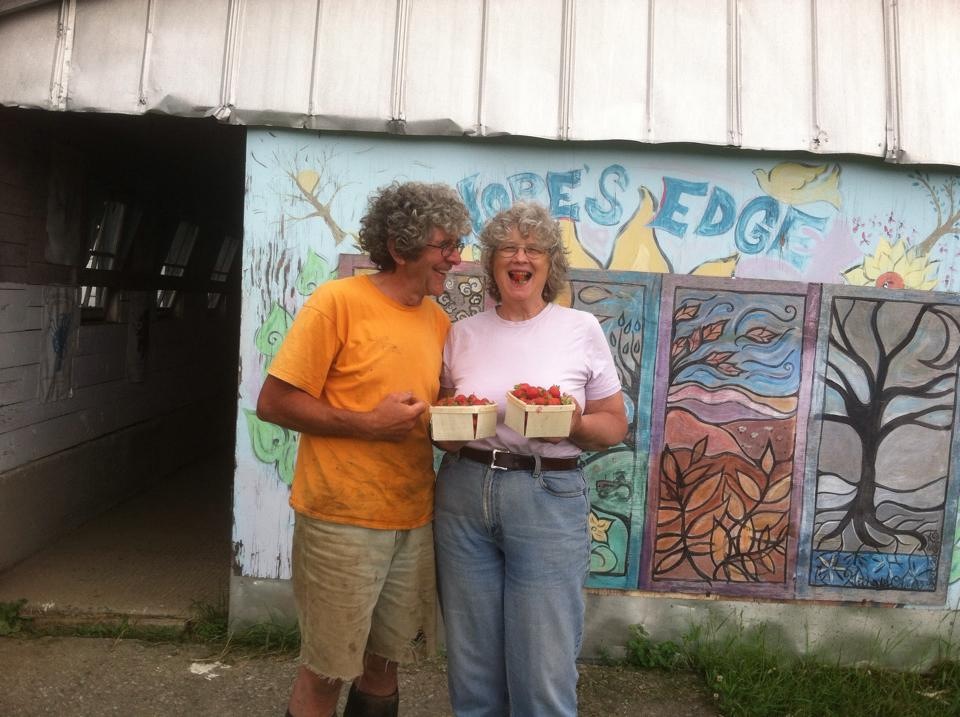
The story starts with Scott and Helen Nearing–who spawned a back-to-the-land movement back in the 1970s.  They, in turn, helped spawn Eliot and Sue Coleman’s work on an adjacent farm–now known as Four Seasons Farm.  Eliot Coleman went on to pioneer growing/harvesting greens/tomatoes/etc. in hoop houses in the middle of the Maine winter.  That marriage broke up, and Eliot Coleman is now married to the horticulturist Barbara Damrosch, who has written about food for The Washington Post for many years, has written numerous books, and is a mainstay of MOFGA–the Maine Organic Farmers and Growers Association.  I heard her speak a few years back and found her to be an engaging speaker.


Interesting Information: Adequate Fat-soluble Vitamins (A, D, and K) Intake Is A Challenge Today

Interesting Information:  May 2, 2014

Adequate Fat-Soluble Vitamins (A, D, and K) Intake Is A Challenge Today


Here’s a sidebar entitled “The Challenge” from the Winter 2013 issue of the journal of The Weston A. Price Foundation’s journal, Wise Traditions (39):


Weston Price found that indigenous people consumed over 12,000 IU of fat-soluble vitamin A and over 1500 MG calcium in their diets on a daily basis.  In our experience these are amongst the most difficult elements to get enough of in an industrial diet, as well as in a non-industrial whole foods diet.

Some groups of people he studied ate little or no meat, but large quantities of raw or fermented milk and cream; others ate beans and grain and small amounts of animal products, including insects and dried shrimp and fish.

But no matter what the particulars of the diet, all had high levels of the fat-soluble vitamins A, D and K, as well as calcium.  Obtaining these from either the industrial diet or a small garden is the challenge of the modern age.

Food for thought…


Interesting Information: Thinking About Ancient Grains

Interesting Information:  May 1, 2014

Ancient Grains


I love grains.

Who doesn’t?

But I try not to eat very many of them because they cause all kinds of trouble–indigestion, stomach aches, creaky joints, and terrible diarrhea.  Clearly they were part of what went wrong with my system that caused me to start having allergic reactions to foods so that I was passing out in a split second whenever I encountered something my body decided was poison.  Clearly grains were a part of the “leaky gut” problem so prevalent in America today.

A few years back,  I had Entero Labs do a full fecal testing for gluten intolerance and genetic gluten issues.  I have a double copy of a “gluten intolerant” gene–which means that BOTH of my parents had it.  And, indeed, my dad died with dementia, probably caused by malabsorption issues–particularly of the B vitamins which are instrumental in mental health.

This genetic factor also means that ALL of my siblings have this gene.  One of my sisters had herself blood tested at a local hospital (which can often throw false negatives and depends on how the doctor orders what to be tested)–and she did show a gluten allergy.

She misses grains, too.

As noted on this blog before, grains are as addictive as crack cocaine (that’s only partly meant to be funny).  And my sister and I both slip in and out of eating “just a tiny bit” of grains.  She does not touch gluten.  I sometimes try.  But, the problem with gluten intolerance is that only the tiniest bit can cause inflammation and pain and digestive troubles once more.  And the other problem is that substituting other grains is not a great strategy either–as none of these grains is likely properly prepared.  Many are highly processed and useless in terms of nutrients.

So, with that in mind, I have to say I did enjoy Natalia Adarova’s  very interesting article in the Winter 2013 journal of The Weston A. Price Foundation, Wise Traditions:  “Northern Roots of the Ancient Grains” (32-36).

Adarova begins by discussing the ancient roots of humans’ consumption of grains in Russia/Eastern Europe and how powerfully represented the growing, harvesting, and cooking of grains figured in the local cultures.  For instance, Adarova notes that while  the commonly accepted dates for grain consumption by humans was 10,000 years agom evidence at the Kostenka paleolithic camp shows that “grains were already used in a very sophisticated manner some seventy thousand years ago as it is thought that Kostenka camp belongs to that period.”  But human consumption of grains predates even this particular camp:  “In fact, grains have probably been foraged since the dawn of Eurasian man, thought to appear three hundred to four hundred thousand years ago on the Eastern European plain–which interestingly coincides with the warmest interglacial period in the history of Earth” (33).

So, why are so many people–including me–having so much trouble with grains today?

I know already–and have written about these issues on this blog–that modern grain has been hybridized so that it contains new ingredients that mankind has not eaten before the early 1950s.  And, I know, too, from the work of Luise Light, which I have also written about here on this blog, that as a culture we eat way, way, way too many grains every day.  (Light’s panel of scientists recommend 2 to 3 servings, with 2 servings for women and 3 for very big men, and a serving being 1/2 cup, which translates to ONE piece of toast.)

But Adarova surfaces additional reasons why “modern” bread is a problem:

Modern bread sold at the stores can hardly be called “bread” at all.  A quickly risen product of the instant gratification age, made from genetically altered grains in order to yield higher and faster crops, grown in poor soils, stripped of any nutrients and full of harmful additives, is a far cry from the food that nurtured thousands of generations.

Ancient peoples fermented grains to remove phytic acid–which grains used to avoid being eaten and which prevent proper absorption of nutrients in humans:

Preparation of traditional Russian sourdough bread was a complicated art and science.  Dough had to be fermented only in oak barrels using a triple leavening process.  The dough was considered a living substance, almost a creature, hence during the leavening and baking it was prohibited to curse or act aggressively–an action thought to negatively affect the rising process.

Fermenting and sprouting both increase the nutrient load in the grain–and these ancient peoples used both methods.

And here’s new information I had not really considered before:  our modern diet of processed food does not properly feed our gut flora and fauna–which makes it really hard to digest bread/grains:

“An apple a day” is the new health recommendation picked up by the Russians, who in ancient ties normally reserved apples for cattle and horses in the bad harvest years; the older recommendation was “a glass of kefir a day.”  Besides genetics, which is an architectural blueprint, the second most important thing we inherit is our parents’ shared microflora.

Since ancient times Slavic people considered the abdomen as the epicenter of the mystery of life.  the word “abdomen” and “life” are synonyms in the Russian language.

Ancient Slavs knew that gut flora can either be your friend or your foe.  They knew that flora could be transferred and could quickly turn pathogenic if handled incorrectly.  Kissing strangers was prohibited and has never been used as a greeting.

Adarova notes that the “old rules” mandated that one eat animal fat with grains:  ” `You can not spoil kasha with too much gutter’ is an old Russian saying, hinting at the importance of this ingredient in grain consumption.  Russian sourdough was always consumed with a thick lalyer of butter, a widespread tradition in other parts of Europe as well.  Animal fats lubricate the gut protecting it from fiber damage while maximizing the absorption of fat-soluble nutrients” (36).

Finally Adarova points to the detoxifying effect of consuming clay and notes that a number of European bread recipes (Italy, Sweden) call for the addition of clay.  Apparently, ancient grain storage involved clay-lined and clay-sealed pits that kept grains viable for a hundred years.

Here’s the url if you want to read the whole of this very interesting article:   http://www.westonaprice.org/traditional-diets/northern-roots-of-the-ancient-grains


PS:  The nightly “news” I watched last night–to see our local weather–contained a story about how doctors were recommending MORE FIBER.  Please take a look at my Mainely Tipping Points essays on added fiber.  Too much fiber is a real problem and most of us get plenty of fiber already.  Too much fiber causes constipation…  And the types of fiber recommended are really hard on the body.


Interesting Information: The Bee Cause Pollinates An Important Message

Interesting Information:  May 1, 2014

The Bee Cause


The Charleston City Paper, South Carolina, just did a really nice piece on DIL Tami Enright’s project:  The Bee Cause.

There is a lot of information in this article about this very successful project to preserve bees in Charleston.  And, about how connecting bees to children and learning and science is really working for everyone involved.

The Bee Cause Project pollinates an important message | Dirt | Charleston City Paper.

Books, Documentaries, Reviews: Jennifer McGruther’s THE NOURISHED KITCHEN

Books, Documentaries, Reviews:  April 29, 2014


The Nourished Kitchen

Jennifer McGruther


WOW!

Here’s a terrific new cookbook that’s playing off of Sally Fallon Morell and Dr. Mary Enig’s book Nourishing Traditions.  Morell and Enig are part of The Weston A. Price Foundation organization.


IMG_0255


My friend Rose Thomas, aka “Chicken Rose” to my family as there are others named Rose in my life, dropped by the other day for a cup of tea.  I told her that I had just gotten a really nice new cookbook, and as soon as I picked it up to show her, she said “I just got it too.  On my Kindle.”  But she had a lot of fun actually holding the book in her hands and said so.

So, it’s a book that’s “in the wind” on a number of whole-foods sites.

The author is from Colorado–in the mountains–and seems to have a kind of rural setting.  So there are discussions of foraging for strawberries, wild greens, and cooking wild game.  We might not be able to get elk, but we can get deer and rabbit here in Maine. And our berry gardens are superb.

There’s a terrific chapter on cooking and fermenting ancient grains.  And a resource section that tells where to buy them.

There’s an exciting chapter on fermented foods–with some exciting combinations of ingredients.

Indeed, what’s piquing my interest the most are the different combinations this cook is using in her every day foods.

The section on desserts have some healthy, interesting, delicious looking combinations.

This one is HIGHLY RECOMMENDED!

PS:  Those are salt-preserved Meyer lemons on the cover–an “asset” I keep in my refrigerator all the time.  I cover with a film of olive oil that is delicious drizzled over any kind of baked fish.  A  tablespoon of the chopped lemon and oil put into smashed potatoes with butter adds a delicious sparkle to the mixture.

Quilting Information: Andrea Brokenshire’s “Flora Bota’nica”

Quilting Information:  April 18, 2014

Flora Bota’nica


One of the special exhibits at the MQX show in New Hampshire last week was Andrea Brokenshire’s “Flora Bota’nica.”

100_3816

These quilts–and there were at least ten of them and I could have taken a picture of every single one–were spectacular.  I’ve seen a lot of quilts of flowers, but these are extraordinary.

Here’s one:

100_3815

Here’s another:

100_3814

You can see many more of these amazing quilts if you google “images for Andrea Brokenshire quilts.”

Enjoy!


Books, Documentaries, Reviews: Michael Pollan: COOKED

Books, Documentaries, Reviews:  April 26, 2014

COOKED

Michael Pollan


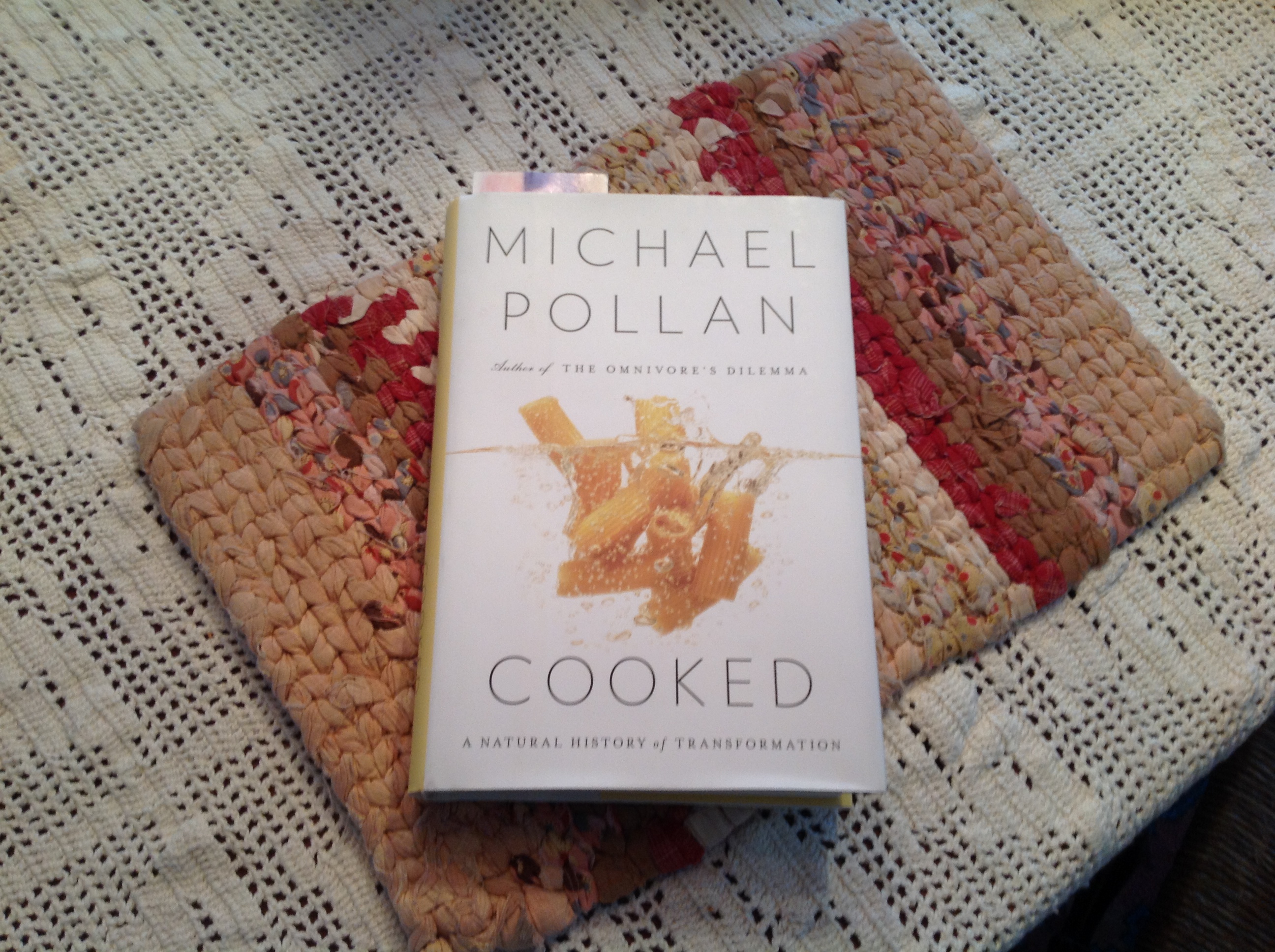
Friend Gina Caceci brought me Michael Pollan’s Cooked a bit ago…

IMG_0251

I’m only into the beginning pages, but am looking forward to reading more.

Pollan begins with describing what he calls the “cooking paradox”:

How is it that at the precise historical moment when Americans were abandoning the kitchen, handing over the preparation of most of our meals to the food industry, we began spending so much of our time thinking about food and watching other people cook it on television?  The less cooking were doing in our own lives, it seemed, the more that food and its vicarious preparation transfixed us (3).

Pollan goes on to note that “the amount of time spent preparing meals in American households has fallen by half since the mid-sixties, when I was watching my mom fix dinner, to a scant twenty-seven minutes a day” (3).

TWENTY SEVEN MINUTES A DAY!!

Cooking, Pollan notes, is magic:  “Even the most ordinary dish follows a satisfying arc of transformation, magically becoming something more than the sum of its ordinary parts.  And in almost every dish, you can find, besides the culinary ingredients, the ingredients of a story:  a beginning, a middle, and an end” (4).

And here’s a bit of philosophy that might explain the “cooking paradox”:

So maybe the reason we like to watch cooking on television and read about cooking in books is that there are things about cooking we really miss.  We might not feel we have the time or energy (or the knowledge) to do it ourselves every day, but we’re not prepared to see it disappear from our lives altogether.  If cooking is, as the anthropologists tell us, a defining human activity–the act with which culture begins, according to Claude Lévi-Strauss–then maybe we shouldn’t be surprised that watching its processes unfold would strike deep emotional chords (5).

Other anthropologists “have begun to take quite literally the idea that the invention of cooking might hold the evolutionary key to our humaness” (6).

A few years ago, a Harvard anthropologist and primatologist named Richard Wrangham published a fascinating book called Catching Fire, in which he argued that it was the discovery of cooking by our early ancestors–and not tool making or meat eating or language–that set us apart from the apes and made us human.  According to the “cooking hypothesis,” the advent of cooked food altered the course of human evolution.  By providing our forebears with a more energy-dense and easy-to-digest diet, it allowed our brains to grow bigger (brains being notorious energy guzzlers) and our guts to shrink.  It seems that raw food takes much more time and energy to chew and digest, which is why other primates our size carry around substantially larger digestive tracts and spend many more of their waking hours chewing–as much as six hours a day.

Cooking, in effect, took part of the work of chewing and digestion and performed it for us outside of the body, using outside sources of energy.  Also, since cooking detoxifies many potential sources of food, the new technology cracked open a treasure trove of calories unavailable to other animals.  Freed from the necessity of spending our days gathering large quantities of raw food and then chewing (and chewing) it, humans could now devote their time, and their metabolic resources, to other purposes, like creating a culture (6).

So, “if cooking is as central to human identity, biology, and culture as Wrangham suggests, it stands to reason that the decline of cooking in our time would have serious consequences for modern life, and so it has” (7).

I will leave you with this quote–which contains much “food for thought”:

The shared meal is no small thing.  It is a foundation of family life, the place where our children learn the art of conversation and acquire the habits of civilization:  sharing, listening, taking turns, navigating differences, arguing without offending.  What have been called the “cultural contradictions of capitalism”–its tendency to undermine the stabilizing social forms it depends on–are on vivid display today at the modern American dinner table, along with all the brightly colored packages that the food industry has managed to plant there (8).


Turkey Tracks: Spring Peepers

Turkey Tracks:  April 26, 2014

Spring Peepers


I’ve been really busy with spring projects and spring clean-up.

So you have not heard from me much this week.

The amazing Stephen Pennoyer has taken on many of the projects neglected for the past five years.  He is a meticulous carpenter and all-around building expert.  And he’s been the most wonderful gift in my life as he has taken on jobs that most people would shudder at doing–things like digging drainage ditches for underground pipes and digging big and deep holes to sink new fence posts in–all into earth covered with gravel and littered with land-fill stones.  Always, he is cheerful–no matter the frustration.  And, always, he figures out a way “to do it right.”  I’m “the helper” and am called on to hold posts steady.  Or, help lift something that needs more than two hands or just a big more carrying poundage.

I’ll start posting pictures as he finishes the many jobs we have underway.

Meanwhile, Melody Pendleton was here painting a big downstairs room.

And Riteway Rugs picked up the big Karastan downstairs.  It’s been over 11 years since it has been cleaned.

Those are only A FEW of the ongoing projects.

Meanwhile, I cleaned out (and repaired rusted out chicken wire) on the chicken coop and cage.  That always a HUGE spring job.

I am thankful that it’s a rainy day.  My body needs a rest…

* * *

The peepers–tiny, tiny frogs–have  had a terrible time this year.

First they emerged out of the icy mud only to have a serious refreeze.  Many of us were afraid they had been killed.

Here are some images:  Peepers image – Google Search.

And here is a video I did the other night so you could see how LOUD they are:

Turkey Tracks: Mid April Update

Turkey Tracks:  April 18, 2014

Mid April Update


I’ve had a busy few weeks, and it’s been fun.

First of all, Rosie, my Copper Black Maran has decided to lay her super dark brown eggs again.  Aren’t they pretty?

100_3829


Rosie is the last CBM I have.  Remember that we lost her rooster to the fox last spring…

CBMs are not great layers, but they are big, happy hens and very social.

It might be time to think about getting some more from Tom Culpepper in Georgia…

Along with the beef broth–which is on the blog post just before this one–I made a shredded veggie lacto-fermented mixture, as mine is all gone now.  I used cabbage, including a red one which will make the mixture such a lovely red in a few days, garlic, carrots, and a bunch of kale.   Here it is in the bowl, all kneaded until it is juicy and ready to load into jars:

100_3833

I have two kinds of jars I like to use–a regular old wide-mouth Mason jar and a fancier Fido jar with a bailer and rubber sealer.  I thought I’d have enough mixture for a half-gallon jar, but no.  Thus the quart jar:

100_3836

Here’s a little video of Pumpkin, my rooster, who is amazing with the hens.  You can hear him telling them to “come eat this food,” and if you watch carefully, you’ll see him pick up food and hold it up for them to see that it’s “ok.”


I make a run up to Belfast to the Belfast Coop every ten days or so.  The Coop carries the dog food I use:  raw ground WHOLE chicken–bones, skin, organs, the works.  The girls THRIVE on this food.  You’d never know to look at them that they are 11 and 12 years old.  Here’s what their good looks like:

100_3826

I have an old pair of boots that I bought for $10 at a kind of shoe-thrift store back in Virginia over 15 years ago.  They are my “chicken boots”–and survive ice and mud in rough weather.  I think I’ve gotten and will continue to get my money’s worth.  I’m still using heavy gloves when I go out for chicken duty morning and evening:

100_3821

Remember this rug I braided on the fashioned loom?  It’s still going strong…

The wild turkeys have broken up into small bands now.  I have one male who is hanging around with his band–probably because they are still feeding on discarded coop bedding and the odd treats I throw to the chickens.  At night he roosts in one of the pines just beyond the stream.  And he calls to me when I come out to lock up the chickens.

Here’s one video I took of him the other day.  He’s perpetually “puffed up” these days:

And one of him with some of his hens.  His tail is looking a bit ragged.  I heard two males fighting at dusk up on the hill last week–they seemed to be hitting heads/necks/wings.  Hard to tell :


Soon the hens will sit on eggs, and I will not see much of them until next winter–except for the odd crossing across a road here and there.

Turkey Tracks: Beef Bone Broth Today

Turkey Tracks:  April 17, 2014

Beef Bone Broth Today


This morning I started a beef bone broth.

A good bone broth is chock full of all sorts of minerals and fats that your body LOVES!

I started with beef bones, celery, onions (skin on if they are clean), carrots.  I cook them at about 400 until they are brown and toasty.  Stir once or twice.


100_3824


The white circle in the middle of the bone is the marrow–and that’s from where gelatin comes.  Gelatin is, again, chock full of nutrients that are good for you.

100_3825

Here’s what the bones look like after cooking:


DO NOT DISCARD THIS FAT IT IS REALLY, REALLY GOOD FOR YOU.  Good fat provides a constant, steady source of energy–unlike the energy from sugar which yo-yos you up and down and causes problems with your hormones, like how your insulin reacts.

Put the ENTIRE contents of this pan into a large pot and add water, something acid (a little wine or vinegar helps extract the minerals), and some salt.

Look at the lovely dark color of this broth:


I will simmer this broth for 12 to 24 hours.  Add water as needed.  Turn it off when you leave the house or when you go to bed.  It can sit overnight UNCOVERED in its pan overnight.  Just reheat in the morning and start simmering again.

When you’re ready, strain the broth.  I have a big strainer I like to use.  Throw away the bones and spent veggies.  DON’T GIVE COOKED BONES TO DOGS.

Use the broth, or freeze some of it.  Don’t fill a Ball Jar too full or it will split open in the freezer.  Leave plenty of room.

I’m going to make a hearty stew with this batch of broth–leeks, roasted tomato sauce from my stash, mushrooms, lamb stew meat, some dried tomatoes and zucchinis I dehydrated last summer, carrots–and that is as far as I have gotten in thinking about the stew today.