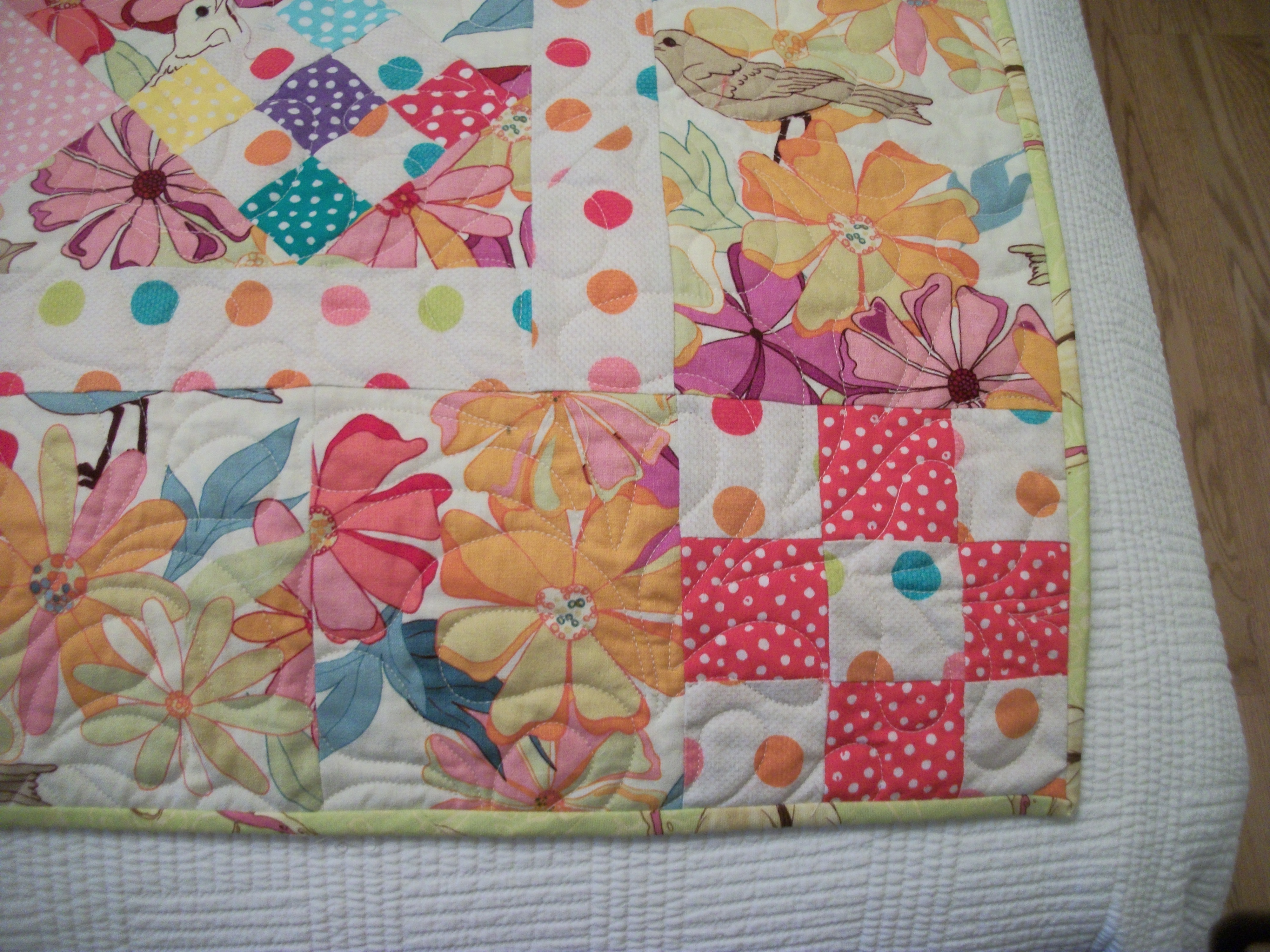
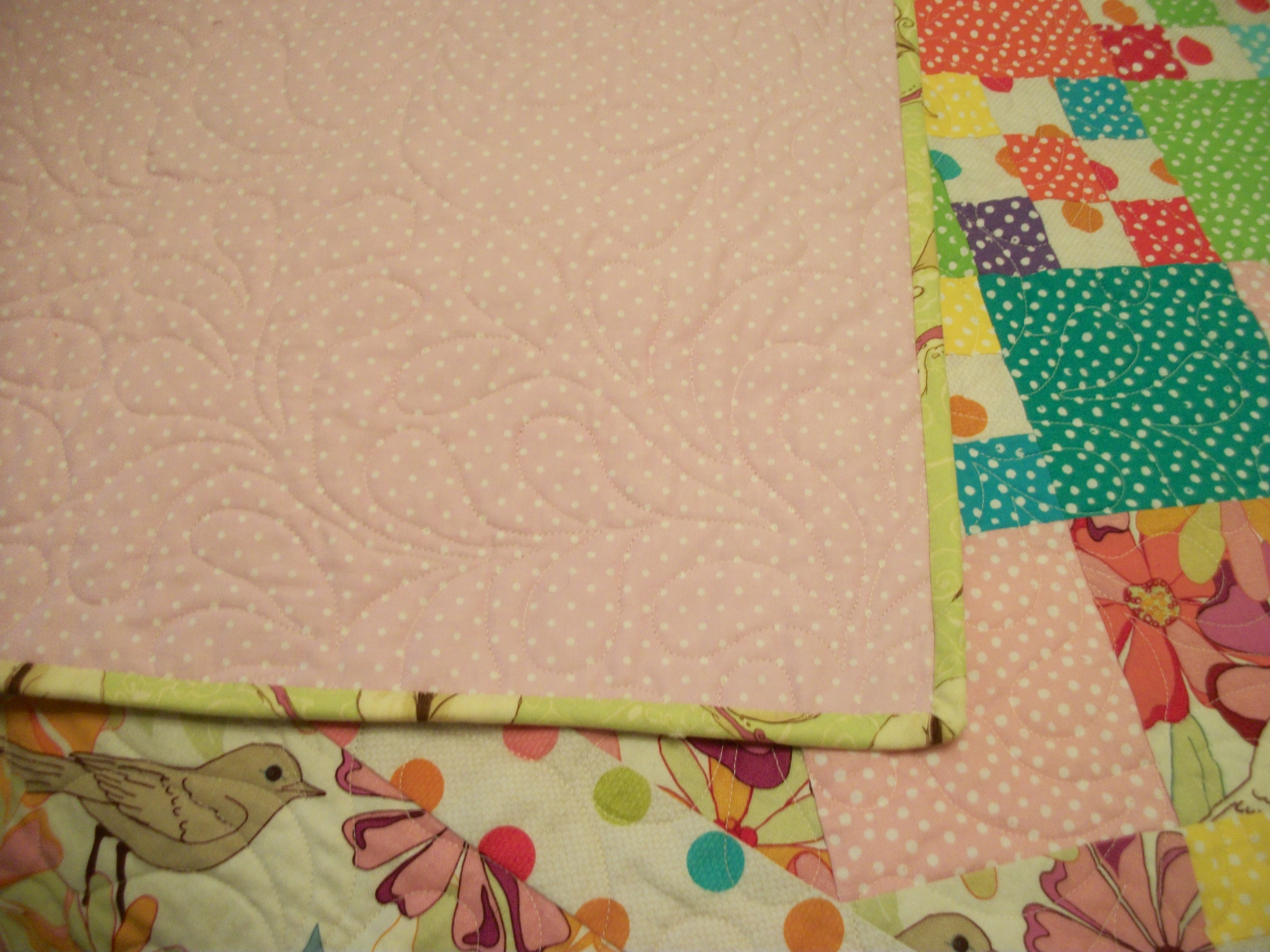
Turkey Tracks: Two Quilts Mailed

Turkey Tracks:  April 17, 2014

Two Quilts Mailed


Long years ago now I made a quilt for a family new baby boy–a quilt with a fish theme–that got lost in the mail.

Meanwhile, that baby now has a sister–and neither are babies any more.

So, this winter I set about making them each a long-overdue quilt–with a “fishy” theme.

These quilts are meant to be used, loved, washed, and used some more.

Here’s the boy’s quilt.  It’s called  “Seahorse Seas.”

100_3775

I quilted with Anne Bright’s “Ocean View” which has sea horses, shells, and sand dollars in the pattern.

See?

100_3776

Here’s a piece of the focus fabric:

100_3778

I mixed in some 9-patch blocks in coordinating fabrics:

100_3781

Here’s the front striped border and the binding out of the focus fabric:

100_3782

I like the backing rather a lot:

100_3779


* * *

The girl’s quilt is from a pattern by Joan Ford in her “Quilt Your Stash!”–a little magazine that I picked up in Portland some years ago.

Joan Ford stopped with the flying geese border–so I added the outer border, and I like it a lot.

This quilt is called “A…’s Pretty Fish”:

100_3785

The background is a deep navy blue.

Here’s more of that border–and the pantograph is “Circle of Life,” by Patricia E. Ritter–ordered from the Urban Elementz web site.

100_3789

Here are some fish:

100_3787

And, more fish:

100_3791

And another shot of that terrific flying fish border.  I think that border is what drew me to this quilt the most…

100_3792


The backing is a bright red floral…

100_3790


It’s always fun to mail off one quilt, let alone TWO!


Quilting Information: The Four Seasons Banners From Italy

Quilting Information:  April 17, 2014

THE FOUR SEASONS BANNERS FROM ITALY

An Exhibition Sponsored by Aurifil Thread, Milan, Italy

The recent Machine Quilters Expo (MQX) show in Manchester, New Hampshire, exhibited 70 quilted banners made by the Casa Patchwork & Quilting group that represented the four seasons.  The banners spread out over 40 feet of exhibit space. Each member was  given a palette to create their own banner–which is why the banners  “hang together” so nicely.

Here is a video that sweeps through the banners so you can see their impact:

Here are some close-ups of “winter.”

100_3810

“Spring”:

100_3807

“Summer”:

100_3804

“Summer” close up:

100_3805

“Fall”:

100_3802

And “Fall” close up:

100_3803

Aren’t they wonderful?

Books, Documentaries, Reviews: THE BOYS IN THE BOAT

Books, Documentaries, Reviews:  April 15, 2014

The Boys in the Boat

Daniel James Brown


Daniel James Brown’s book about the eight-man crew team that won the 1936 Olympics in Hitler’s Germany has been a pleasure to read.

IMG_0249

Like Laura Hildenbrand’s Seabiscuit, Brown’s book uses the story of the University of Washington’s crew teams to tell the wider story of that “dust bowl” era so filled with poverty.  And like Seabiscuit, who won against a big, glossy, stallion from the east, this crew team is not comprised of elite, East Coast young men, but the sons of loggers, fishermen, farmers, and blue-collar workers.  Most of these young men grew up poor and struggled to get purchase in a world filled with poverty and struggle.

This story is also about George Yeoman Pocock, who built, by hand, the 62-foot rowing shells used by most competitive teams in America.  Pocock emigrated from England, was the son of a boat builder, was a self-taught award-winning rower, and struggled to get purchase in American.  Nothing was handed to Pocock for free.

And, there is Al Ulbrickson, the University of Washington’s crew coach, who had been an award-winning rower at the University of Washington.

These men all have bottomless character, bottomless heart, and iron wills.  It is a pleasure to read about them–and about how they could not begin to win until they learned to work together, to work as a cohesive unit, to respect each other, to protect each other, to like each other’s differences.

Here’s a quote from George Pocock:

Every good rowing coach, in his own way, imparts to his men the kind of self-discipline required to achieve the ultimate from mind, heart, and body.  Which is why most ex-oarsmen will tell you they learned more fundamentally important lessons in the racing shell than in the classroom.

Here’s how Brown starts the book:

Competitive rowing is an undertaking of extraordinary beauty preceded by brutal punishment.  Unlike most sports, which draw primarily on particular muscle groups, rowing makes heavy and repeated use of virtually every muscle in the body….And rowing makes these muscular demands not at odd intervals but in rapid sequence, over a protracted period of time, repeatedly and without respite.

Rowing competitively, at some point in the race, I learned, becomes really painful.

Here’s a description of “the boys”–as seen by their freshman coach who goes on to coach at Harvard–Tom Bolles:

And it wasn’t just their physical prowess  He liked the character of these particular freshmen.  The boys who had made it this far were rugged and optimistic in a way that seemed emblematic of their western roots.  They were the genuine article, mostly the products of lumber towns, dairy farms, mining camps, fishing boats, and shipyards.  They looked, they walked, and they talked as if they had spent most of their lives out of doors.  Despite the hard times and their pinched circumstances, they smiled easily and openly.  They extended calloused hands eagerly to strangers.  They looked you in the eye, not as a challenge, but as an invitation.  They joshed you at the drop of a hat.  They looked at impediments and saw opportunities (94).

Brown chooses crew member Joe Rantz as the emotional heart of this book.  And it’s a good choice.  Joe’s mother dies when he’s about five, his father remarries, his stepmother rejects him, and he’s thrown on his own resources from about the age of ten.  Basically, he’s abandoned–and part of the drama of the story is that Joe has to learn to trust his crew mates.  How many five-year olds today would be put on a train in Washington state and make the journey to the East Coast on his own?

And, then there is the story of Henry Penn Burke, chairman of the U.S. Olympic Rowing Committee–and the chairman of and a major fundraiser for the Pennsylvania Athletic Club in Philadelphia–who, when the Penn team comes in second to the Washington team, announces that there is no money to send the Washington team to the Olympics, but that the Penn team has money and will be happy to take the place of the Washington team.

Heroically, the folks back in Washington–many of whom are dirt poor–manage to raise the $5000 needed to send the team to Germany.  And they do it in two days.  Small contributions come in until there is enough.

No wonder westerners were skeptical of the eastern elites…

It’s a good, interesting read.


Quilting Information: Flickr: Jessica’s Quilting Studio’s Photostream

Quilting Information:  April 15, 2014

Jessica Jones’ Quilting Studio Quilts

Well, here’s a treat for you.

I am just back from attending the Machine Quilters’ Expo (MQX) in Manchester, New Hampshire–where I attended three classes.  One of those classes was with DeLoa Jones–who taught at the Maine state quilt show, Pine Tree Quilters’ Guild, last summer.  DeLoa’s lecture included quilts her daughter Jessica has quilted.

Those quilts are available for you to see–and they are truly wonderful–and you will get many ideas for your own quilting.  Take a look:   Flickr: Jessica’s Quilting Studio’s Photostream.

You can access Jessica’s site by googling Jessica’s Quilting Studio.


Here’s more information on Jessica–copied from her web site–sorry about the wonky fonts.

Jessica Jones studied art and design at Central Michigan University. During summer break, she helped with her mother, DeLoa Jones’ longarm quilting business and fell in love with the art of machine quilting. She started her own longarm business in 2002 and, in the relatively short time since, has quilted over 4000 customer quilts. Jessica quilts for clients from all over the country and many of her customers have won prizes for the quilts she has masterfully quilted.

Also an instructor, Jessica has shared her quilting talents and expertise with students, nationally, and also in her home area of Phoenix, AZ. Her quilts have appeared in numerous quilting books and magazines, and frequently grace the pages of Quilting Celebrations. Jessica has also appeared on Quilting Celebrations with Patrick Lose on QNNtv.


Interesting Information: Skin in the Game

Interesting Information:  April 7, 2014

Skin in the Game


We all have skin in the game of life.  Literally.  Our own skin.

Our skin is our largest organ–a fact I’ve seen many times, but I like the way John Moody, in “The Clothing Conundrum:  Safe, Warm, Winter Dressing,” writes about our skin (Wise Traditions, Winter 2013, 47-49).

An adult’s skin averages “twenty-two square feet in surface area and [weighs] eight pounds.

Our skin is our first line of defense “against a host of dangers.”  And, “the body also uses our skin as an important pathway to eliminate certain toxins, but at the same time, it thus also becomes an easy way of access for many toxins to gain entry into our body.”

Warning:  “This entry pathway may be even more dangerous than others, such as inhalation or ingestion, since toxins that enter through the skin bypass the digestive and respiratory tracks and the defenses these systems employ.”

“For instance, studies have shown that our skin possibly absorbs more chlorine in a five to ten minute hot shower than in drinking five to ten glasses of chlorinated water!”

AND:

“When you use personal care products (make-up, deodorants, etc.), the chemicals in those products can show up in the bloodstream less than sixty seconds after being applied to the skin.”

“A 2008 study by the Environmental Working Group looked at twenty teenage girls and found sixteen chemicals with potentially harmful health effects in blood and urine samples from their personal care products.”

Moody goes on to discuss how modern clothing is coated with chemicals that are known toxins and how we wash clothes in another whole set of toxins.  And, he makes a case for using traditional fibers that are free from toxins, which is food for thought.  He notes that hemp is a great natural fiber, but has been banned by many states as it is related to marijuana–even though it is NOT marijuana–which has been a boon to industries that fabricate cloth from chemicals.  You can read the whole article if you like: http://www.westonaprice.org/health-issues/the-clothing-conundrum-safe-warm-winter-dressing.

* * *

I saw an ad on television last night for a product to treat acne.  The ad depicted a young man with truly terrible acne.  And, of course I wondered two things:  what chemicals are involved in the ad’s product and what is this young man eating and/or to what is he being exposed.

We should not have to fix a problem that starts inside us by slathering on a chemical product from the outside.

When you see sores on the skin, it’s a sign that the body is trying to detox itself.

So, our skin is always already “in the game.”  Every day.

Turkey Tracks: April Update

Turkey Tracks:  April 7, 2014

April Update


We are finally getting some warm weather, and near me, the Megunticook River is thawing out fast.  I was a little shocked when I went by Megunticook Lake Sunday on my way to see Rose Thomas as the Lake is still pretty frozen.  This view is from the top of Barrett Cove, looking north.  (This lake is 15 miles around and filled with interesting islands and “necks” that jut out into the water.)

100_3800

The ice looks bluer towards the middle though, suggesting thinness.

Chickie Diva Queenie has been healed up for some time.  I have only been waiting for the night temps to get warm enough to risk her in the coop.  She can’t take any more frostbite probably ever in her life.

She did not seem unhappy in her kitchen box, but on a bright sunny day last week, I put her outside.  She prowled the yard, scratching and digging, but not getting near the other chickens, who did not seem to notice her.  That night, she came to the back door and when I opened it, she came right in, and hopped in her box.

The next day, I put her out again, and she wanted to come right back inside.  I had planned to clean out the coop, so I gathered up the buckets and the shovel and started to work.

What followed was shocking!

The chickens found her and immediately attacked her.  Even the rooster.  They weren’t trying to dominate her.  They were trying to kill her.

I rescued her from where she had wedged herself behind the sandbox and the house wall.  Her comb was torn again, and she had wounds on her feet again.  She was dazed and stunned and so happy to be put back into her box.

I consulted with the chicken whisperer Rose Thomas, and we formulated a plan to integrate her into Rose’s flock, which is larger and far less territorial.

So, on Sunday, I took her to Rose.

Rose’s chicken house is a lot bigger than my little coop, and there are MANY egg boxes.  Diva Queenie put herself into one and seemed quite happy.


100_3798

Rose has three roosters at the moment–Guy, the father of my rooster Pumpkin; the brother of Pumpkin; and Merlin, a guina rooster who is ferocious.

Rose distracted her flock by throwing them some scratch feed to them while we put Queenie into the chicken house.


100_3799


I called Rose this morning.  Queenie is just fine and is out in the yard with the rest of the flock.

* * *

Look at these–I have 12 out of 15 done and have another one half done now.

IMG_0241

Here’s a close-up of one:

IMG_0239

This large “hexie” is made from the kite shape you can see with the dark blue.  I first saw a quilt made with these medallions at Alewives, a quilt shop in Damariscotta Mills, Maine.  The hexies get linked by big diamonds, and the pattern comes from the book Material Obsession 2 by Kathy Doughty and Sarah Fielke.  Other blog entries here show their TWO quilt versions using this block.  Rhea Butler made the quilt at Alewives.

I’ve finished the red/green quilt, which remains nameless so far.  It’s loaded on the long arm.  It’s pretty big–I used 7 yards of fabric for the backing–a Kaffe Fasset I bought on sale about a year ago.  And I had to piece a column of about 20 inches to get enough width for the long arm–which was fine as I used up a lot of orphan blocks.  I really draw the line at buying 9 yards of fabric for a quilt backing when I’m only missing ten or so inches.  With the long-arm, I need about 5 extra inches of width on the sides, but I could always put on a temporary outside border that would come off when the quilting was done as well.

IMG_0242

I  am going down to Manchester, New Hampshire, with Gail Galloway Nicholson this week to the big MQX show (Machine Quilters Expo)–where we will both take some classes.  I am taking both pantograph and free-motion quilting classes for the long arm.  So…it seems to make sense to wait until I get home to quilt this quilt.  The pantograph class may change how I currently quilt with a pantograph.  Also I ordered a different green quilting thread as I did not like the color I thought I would use.  Funny how that happens…

So, here’s my current project:

IMG_0245

I am sewing together colorful 5-inch blocks from my stash.  I will put a 3-inch border on this grid and use it to cut out “Lil Twister” blocks.  Here’s a clue of what I am talking about:


Lil Twister block images – Google Search.


Canton Village Quilt Works has a very nice tutorial on how to use the Lil Twister tool.


Blog Readers’ Quilts and Quilting Information: Bonnie Hunter’s NEW BOOK is out

Blog Reader’s Quilts and Quilting Information:  April 4, 2014

BONNIE HUNTER’S NEW BOOK IS OUT!

MORE ADVENTURES WITH LEADERS & ENDERS


It came yesterday!

I had been haunting the mail box all week.

So, I made a cup of tea and sat down to ENJOY leafing through the pages:

IMG_0236

AND, the book is a treasure.

You can see the quilts in the book for yourself in the url below:

Quiltville’s Quips & Snips!!: More Adventures With Leaders & Enders! Pre-Order Time!.

Books, Documentaries, Reviews: Renata Adler, PITCH DARK review

Books, Documentaries, Reviews:  March 31, 2014

Renata Adler’s PITCH DARK


I promised I’d “let you know” what I thought about Renata Adler’s novel Pitch Dark,  published in 1983.

IMG_0204

You may recall in an earlier blog post that I’d heard this novel recommended during a pre-New Year’s “Best Books of 2013” NPR program.

This novel is a very “modern” novel–in that it is challenging the very form of the novel itself.

You may recall that I also wrote recently about Jeffrey Eugenides’s novel The Marriage Plot, wherein Eugenides attempts to forge a novel that does not fall back on the “marriage plot” since with divorce, women are no longer tied to marriages they want to abandon.

IMG_0208

But Renata Adler moves light years beyond the still-entertaining story of The Marriage Plot.  Adler does not have a plot at all.  This “novel” consists of a series of vignettes that are not even loosely held together and that are all mixed up in time.  There is no narrative flow.

Is it interesting?

Yes, some of the vignettes are.  And she does circle back to at least one so the reader gets some sense of the final outcome.  And I think she circled back to show just how deep the moral abyss can be in modern society.

I enjoyed the protagonists musings on social and historical events and on how some of our systems work.  These musings certainly provoke one to think a bit more deeply.

But, I do think Muriel Sparks, who wrote the Afterward, is correct:

This, I think is the vision of life reflected in Miss Adler’s fiction.  Nothing evolves, nothing derives.  Effects do not result from causes.  Episodes are recorded without any connection with each other.  Fortunately, they are fascinating episodes.

So, what happens to the moral fabric of society is one can no longer be certain that certain desired effects stem from causes, that if one does bad things they will be punished in some way?  Truthfully, bad people are not always punished.  Some of them make and enjoy a great deal of money.  And good can come out of bad, as we clearly see in Donna Tartt’s THE GOLDFINCH, also discussed on this blog.  What happens if we are all more adrift in society than we ever thought?  What happens if some of us are “disciplined subjects” and follow the rules, but others don’t.  And, prosper.

This novel is not for everyone.  It’s not an easy, enjoyable read with a pleasant narrative that takes us away from ourselves.  No, rather, it focuses on truths and questions most of us would rather avoid because there isn’t anything we can do about them at all.  And that’s not going to change in a modern world where people are so detached from one another, where a community is not viewing the actions of its individual members with an eye toward protecting the health of the community.


Interesting Information: How Foxes Hunt in Snow

Interesting Information:  April 1, 2014

How Foxes Hunt in Snow

Remember the blog post on how dogs often turn and turn in circles before stopping to defecate?

And, that they statistically meaningfully line up on the north/south polar axis?

Well, here’s more to that story.  It seems foxes can detect mice beneath three feet of snow by sensing the same kind of polar magnetic pulls/energy that the dogs use to “line up” in a way that gets their prey.

Fascinating!

The included video demonstrates just how foxes get a mouse that has burrowed deep into the snow:

Enjoy.

Microwave News | Inordinate Love of Foxes.

Interesting Information and Books, Documentaries, Reviews: Education Uprising — YES! Magazine

Interesting Information AND

Books, Documentaries, Reviews:  March 31, 2014

Education Uprising

YES! Magazine


The spring 2014 issue of YES! Magazine is all about the current state of education in the United States:  EDUCATION UPRISING.

I hope that all parents and grandparents will go online and read the education articles because our public education system is being systematically destroyed.

The good news is that people all over the country “get” what is happening–and why–and are leading successful protests for change.

I will be highlighting some of the stories in this blog post, but here is the url to this free magazine:

Education Uprising — YES! Magazine.


* * *

There are TWO pieces of information that you might want to know that happened in my life:

I wrote my PhD (Cultural Studies) dissertation on the school choice movement–FOR SALE:  SCHOOLS/STUDENTS:  THE SCHOOL-CHOICE MOVEMENT:  AN EFFECT OF NEOLIBERALISM’S PASSIVE REVOLUTION (2002).  I researched this topic deeply for five years and it was crystal clear that “school choice” (vouchers/charters) was not about what’s best for children or offered a way to improve education, but was about the market wanting to colonize schools so they could get at the money pot that funds it.  At the time of my dissertation–ten years or more ago now, this pot of money was bigger than the military budget.  Today this pot is about $600 billion from the federal government alone–as Dean Paton notes in “The Myth Behind Public School Failure,” discussed below.

My sister taught first and second grades in an inner-city Norfolk, Virginia, school that had been deemed a “failing” school until about eighteen months ago.  In the several years before she retired, she was tasked with testing 6 and 7-year olds over FIFTY PERCENT of the entire teaching time of the school year–which she felt was cruel and ineffective.  She was tasked in her final years to teach with a programmed plan that she felt had little success with her children. When experts came to view her classroom, she was touted as a “master teacher” numerous times.

So, it was with real joy that I read the first story in the YES! issue on taking back education:  Dean Paton’s “The Myth Behind Public School Failure.”  BECAUSE Paton “got it.”  Here’s the url:

The Myth Behind Public School Failure by Dean Paton — YES! Magazine.

Paton traces the origins of the myth that American schools have ever been failing–as I did in my dissertation.  Sure, there are schools or districts (usually very poor) that could be said to be “failing,” but IN GENERAL, American schools before NO CHILD LEFT BEHIND were doing a quantifiably (yep, that means via data and math) good job.  The document making claims of failure, “A Nation At Risk,” famously, was, as Paton notes, “remarkably free of facts and solid data.”

The strategy to PRIVATIZE public schools has always already been to pick them off one by one by deeming them FAILING–and along the way a HUGE testing market emerged that created the tests that said a school was failing.  (In 2012, Pearson PLC, “the curriculum and testing juggernaut,” made more than $1 billion, writes Paton.)   Then the teachers got targeted as being responsible for the “failure.”  What got produced was a “manufactured catastrophe,” or what Paton notes Naomi Klein calls “`disaster capitalism.’ ”   

Teachers used to be valued community members, and in order for the market to colonize the schools and get to the pot of money, they had to demonize the teachers.  So, those trying to privatize the schools (or the misguided people who got caught up in this whole business) started proposing that teachers be rated according to their test scores–regardless of the reality of the students in their classrooms.  But, Badass Teachers Association (BAT) co-founder Priscilla Sanstead’s Twitter banner says the following in the article listed below about the Seattle teachers who boycotted the MAP test:

Rating a teacher in a school with high poverty based on their student test data is like rating a dentist who works in Candyland based on their patient tooth decay data.

The turning point for change may have come in 2012 when “then-Texas Education Commissioner Robert Scott” said publicly “that high-stakes exams are a `perversion.’ ”  Following Scott, in January 2013, teachers at Seattle’s Garfield High School “announced they would refuse to give their students the Measures of Academic Progress Test–the MAP test.”  The administration threatened them, but, ultimately, backed down.  And this boycott triggered a nation-wide backlash against high-stakes testing and the current NO CHILD LEFT BEHIND policies that have reduced education to educational bulimia ingested and disgorged on tests.

In “Pencils Down:  How One School Sparked a Nationwide Rebellion Against a Test-Obsessed Education System, Diane Brooks tells the story of how Seattle’s Garfield High School teachers decided to and did boycott the MAP tests.  Here’s the url to this fascinating story:  

These Seattle Teachers Boycotted Standardized Testing—and Sparked a Nationwide Movement by Diane Brooks — YES! Magazine.

So, how are students now being assessed?  

Brooks notes that schools opting out of high-stakes testing are looking to “the New York Performance Standards Consortium, a coalition of 28 high schools across the state…[that] track student progress with performance-based assessments. Rather than take standardized tests, students do in-depth research and papers; learn to think, problem-solve, and critique; and orally present their projects.”  This approach “not only provides more effective student assessment, but also emphasizes critical-thinking skills over rote learning.”  

And, here’s a link to the article about how Diane Ravitch, an architect of NO CHILD LEFT BEHIND, is saying she was wrong, she made a mistake, it does not work:

Architect of Bush Administration’s No Child Left Behind Law: “I Was Wrong” by Scott Nine — YES! Magazine.

 In “The Best Way to Learn About a Tree,” David Sobel notes that KINDERGARTEN used to mean “children in the garden.”  Now, though, high-stakes testing has reached all the way down to Kindergarten, which is now “the new first grade.”  As a result, these children are spending more and more time indoors as kindergarten teachers “are required to focus on a narrowing range of literacy and math skills”  Sobel quotes David McKay Wilson, a journalist who writes in the Harvard Education Letter that studies show that `some kindergarteners spend up to six times as much time on those topics and on testing and test prep than they do in free play or `choice time.’ ”  Additionally, “teachers are required to use scripted curricula that give them little opportunity to create lessons in response to students’ interests.”

So, what’s at stake here?  “The efforts to force reading lessons and high-stakes testing on ever younger children could actually hamper them later in life by depriving them of a chance to learn through play.”

The article goes on to list some really exciting kindergarten programs where children actually learn in gardens/forest/nature.

You Can’t Bounce Off the Walls If There Are No Walls: Outdoor Schools Make Kids Happier—and Smarter by David Sobel — YES! Magazine.

There are MANY other wonderful, thought-provoking articles in this issue.  Some deal with the harm done by current zero tolerance policies in schools today–which are often exercised without any real understanding of what a student is juggling.  The Restorative Justice program is described in detail, for instance.  Start with this article:

Discipline With Dignity: Oakland Classrooms Try Healing Instead of Punishment by Fania Davis — YES! Magazine.

There are more stories in this issue.  Of course there are.

But these can get you started.