Interesting Information: The Worth of Bananas

Interesting Information:  March 24, 2014

The Worth of Bananas


A friend was here recently, and she was SHOCKED that I rarely eat a banana.

“What about potassium?” she said.

“Well,” I said, “bananas being a good source for potassium is mostly food industry hype and does not take into account the down side of eating bananas.”

“What???”

One medium banana of the type in our stores has 450/mg of potassium–and a whole lot of starchy carbohydrates that aren’t much good for anything.  (Highly colored bananas in other parts of the world carry a better nutrient load than the yellow banana to which we have standardized–an incredible loss of diversity through monocrop cultures run by industry.)  I don’t know about you, but I’d like to lose another 20 pounds, and I can’t do that by eating useless, starchy carbs.

And there are better food sources for potassium:

Flounder (6 ounces) has 996.

Winter squash (1 cup cooked) has 946.

One medium white potato has 844.

Salmon (6 ounces fresh) has 756.

Cod (6 ounces) has 690.

Parsnips (1 cup cooked) has between 573 to 758.

Avocado (1/2 medium) has 602.

Asparagus (1 cup lightly cooked( has 558.

Orange juice freshly squeezed (1 cup) 496 and collard greens (1 cup cooked) 468

Broccoli (1 cup) comes just below banana at 440.

Other sources are chicken, sweet potato, celery, and tuna.

(I left out the dried fruits as they aren’t especially good for you even if they have good doses of potassium.)

Potassium is a mineral that works as an electrolyte that carries “tiny electrical charges throughout the body, and especially ensures the proper functioning of the heart,” according to Rachel Albert, B.A., in “Charging Up With Potassium” in Well Being Journal, Jan/Feb 2013 (35-37).  (I love Rachel Albert’s The Garden of Eating–it has wonderful recipes and a plan for how to manage to always have really good food available in your home by cooking multiple dishes at once and adding to them as you go along in the week.)

Potassium deficiency “may include fatigue, weakness, irritability, loss of muscle strength, muscle cramps or spasms (charley horses), swollen ankles, general edema, and recurring headaches that come at the same tie each day” (35).

Albert writes that “potassium and sodium play a tug of war across the cell walls in your body, with the delicate balance of your body chemistry at stake.  So, when the sodium concentration is high, potassium is literally stolen from your body.  It is leached from your tissues, poured into your blood stream, then dumped into your urine and excreted.  Conversely, when the potassium content outweighs sodium, your body is able to release and let go of excess sodium and water.  Potassium in its natural state acts as a mild diuretic and can counteract hypertension, which is more common among individuals and ethnic groups who consume few potassium-rich goods (37).  In hot weather, Albert notes, we need more potassium as we sweat potassium levels out of our bodies.

The more I read about our bodies, the more I am realizing how delicate the chemical balances can be.  I often have muscle cramps–especially after I eat some chocolate, I’ve noticed.  Or, when I hike.  And I know that my potassium can get too low–from a blood test the last time (March 2013) I had a bad food allergy attack.  The minute I take a potassium tablet, the cramps stop.

BUT, this article is the first time I’ve made an association between potassium and salt.  I eat and LOVE a LOT of salt–sea salt.  So maybe I’ll cut back a bit.  Salt is not the demon it has been made out to be for years–I’ve written about that on this blog–but I often put even more salt on foods before tasting them.  So…time for a bit of a change.  Perhaps I’ve been throwing off this potassium/salt balance in my body.


Turkey Tracks: Georgeanne Davis’s “Purely Pancakes” Can Be Gluten Free

Turkey Tracks:  March 24, 2014

Georgeanne Davis’s “Purely Pancakes” Can Be Gluten Free


Update:  Since I posted this blog entry, I’ve come to realize that ricotta cheese is even nicer in the pancakes.  It’s dryer.  AND, you don’t need to whip egg whites.  I just mix up all the ingredients and fry up the pancakes.  Whipping the egg whites makes the pancakes almost too light…


I got back from Virginia on a Monday two weeks ago, and the next day set out to retrieve  neighbor Sarah Rheault from the Owl’s Head Airport in Rockland.

I got there a few minutes early and idly picked up last week’s copy of THE FREE PRESS.

Georgeanne Davis’s column on pancakes caught my eye, and I confess, I extracted that page from the rest of the paper.  After all, it was old by now…

I was drawn to the recipe for Cottage Cheese Pancakes, but thought the Potato Latkes and Asian-Style Pancakes looked good too.   All of these recipes could be made gluten free without much ado I thought.

* * *

So, this morning I made the Cottage Cheese Pancakes–and boy was I happy!!!  They were light, fluffy, and totally delicious and garnished with Margaret Rauenhorst’s maple syrup, local raw butter, and served alongside some bacon.  (I used the bacon fat to grease the pancake pan.)

I HALVED the recipe and used coconut flour instead of wheat flour.  I think I could have used brown rice flour or, even, the gluten free local pancake mix I keep on hand–Fiddler’s Green Fiddle Cakes.  Next time I’m going to try the brown rice flour, just to see.  HALVING the recipe gave me enough pancakes for two people, easy.

For the Asian pancakes, I think I’d use coconut, for the oil and either the brown rice flour or the pancake mix for the flour.  I think coconut flour works ok in small lots rather than a whole cup size…  That’s just me though…

* * *

It’s two hours later, and my tummy still feels warm and happy.  What’s not to like about 3 eggs, cottage cheese, butter, and bacon for breakfast?  Lots of good protein and fats.  Also, apparently real maple syrup has a lot of good minerals in it.  Who knew?  I’ll reheat the three/four remaining pancakes for breakfast tomorrow…  In the oven as I gave away my microwave some years ago.

Here’s the column from THE FREE PRESS, March 6th (17):


Home & Garden: Purely Pancakes

by Georgeanne Davis

Call them crepes, latkes, blintzes or just plain pancakes. All are appropriate fare on Shrove Tuesday, also known as Pancake Tuesday and more familiarly known as Mardi Gras, which occurred earlier this week. Mardi Gras, literally “Fat Tuesday,” is known for its hedonistic celebrations and elaborate parades, especially in New Orleans in the U.S. and Rio’s Carnival. Mardi Gras is in fact the final day of lush living for Catholics before Lent begins on Ash Wednesday. Traditionally, at midnight on Shrove Tuesday, the Lenten fast of 40 days begins.

Why pancakes? Starting back in medieval times, pancakes were a way to use up milk, fats and eggs, which were forbidden during the fasting period. Today’s pancakes can be topped with a melting lake of butter or cloud of whipped cream, but they can also be primarily made up of vegetables – perfectly in keeping with leaner Lenten fare. One of our family’s favorite all-time pancake recipes contains no fat. Cottage cheese pancakes, originally from the “Tassajara Bread Book,” the kitchen bible of the back-to-the-land movement in the 1970s, are still unbeatable for any meal of the day.

Cottage Cheese Pancakes à la Tassajara 

6 eggs

6 Tbsp. flour

1⁄4 tsp. salt

2 cups cottage cheese (nonfat, low-fat or full-fat)

Separate eggs. Beat egg whites until stiff and set aside. Mix yolks with flour, salt, and cottage cheese, then gently fold the egg whites into this mixture. Fry like regular pancakes on a lightly greased skillet. Serve topped with applesauce, jam, or just enjoy plain with a swipe of butter.

Potato pancakes, or latkes, make a perfect last-minute supper or brunch fare. Starchier potatoes are usually preferred for latkes, but we like to use Yukon Golds or our own Nicolas. Sweet potatoes work well, too.

Potato Latkes

1 pound potatoes

1⁄2 cup finely chopped onion

1 large egg, lightly beaten

1⁄2 tsp. salt

1⁄2 cup olive oil

Preheat oven to 250°. Peel potatoes and coarsely grate by hand, transferring them to a large bowl of cold water as you grate them. Soak potatoes for a few minutes after the last batch is added to water, then drain well in a colander. Spread grated potatoes and onion on a kitchen towel, gather it up and twist towel tightly to wring out as much liquid as possible. Transfer potato mixture to a bowl and stir in egg and salt. Heat oil in a heavy skillet over moderately high heat until hot but not smoking. Ladle two tablespoons potato mixture per latke into skillet, spreading into three-inch rounds with a fork. Reduce heat and cook until undersides are browned, about 5 minutes. Turn latkes over and cook about 5 minutes more. Transfer to paper towels to drain and season with salt. Add more oil to skillet as needed. Keep latkes warm on a wire rack set in a shallow baking pan in oven. Latkes can be made ahead and reheated on a rack set over a baking sheet in a 350° oven for about 5 minutes. Serve with applesauce and sour cream.

Another savory pancake is Asian in origin, found in Japan, Korea and China. Hold the syrup and use the accompanying dipping sauce for these.

Asian-Style Pancakes

2 cups flour

2 eggs, lightly beaten

1 tablespoon vegetable oil, plus more as needed 

5 scallions, cut into 3-inch lengths and sliced lengthwise

1 medium carrot, peeled and grated

1 small yellow or green squash, grated

Dipping sauce:

1 tablespoon rice or white vinegar

3 tablespoons soy sauce

1 teaspoon sugar

In a medium bowl, mix flour, eggs and oil with 1-1⁄2 cups water until a smooth batter is formed. Stir in scallions, carrots and squash. Place an 8-inch skillet over medium-high heat, then coat bottom with oil. Ladle in about a quarter of the batter and spread it out evenly into a circle. Turn heat to medium and cook until bottom is browned, about three minutes, then flip and cook for another two minutes. Repeat with remaining batter. Drain pancakes on paper towels. In a small bowl, mix together vinegar, soy sauce and sugar. Cut pancakes into small triangles and serve with dipping sauce.


Interesting Information: ZZZ Wraps

Interesting Information:  March 23, 2014

ZZZ Wraps

Here’s what I hope will be a very fun product–given to me by DIL Tami Enright, who is Director of The Bee Cause in South Carolina–a project of The Savannah Bee Company.

This bees’ wax soaked fabric can seal a bowl or wrap a sandwich.

I can’t wait to try it.

IMG_0211

Here’s what it looks like unfolded.

IMG_0212

It came from Mama Bee Hive,  http://www.mamabeehive.com/index.php.  But the present web site does not list this product.  Perhaps a phone call to them if you are interested?

So I have no idea what it costs.  Apparently one just washes off the cloth and lets it dry and reuses.

I’ll report back after use…

Books, Documentaries, Reviews: Jeffrey Eugenides, THE MARRIAGE PLOT

Books, Documentaries, Reviews:  March 23, 2014

The Marriage Plot

Jeffrey Eugenides

I really enjoyed this novel.

IMG_0208


The setting is Brown University (mostly flashbacks) and the year or so after the three main characters graduate and are trying to get on their feet.

Madeleine loves to read and has majored in Literature.  She loves Leonard, who is brilliant but is just coming to grips with pretty severe mental illness–extreme manic/depressive swings.  Mitchell loves Madeleine and is seriously trying to work out how to live a life of meaning and purpose which may or may not include Madeleine.

Here’s a quote that can orient you a bit:

Her junior year, Madeleine had taken an honors seminar called The Marriage Plot:  Selected Novels of Austen, Eliot, and James.  The class was taught by K. McCall Saunders….a seventy-nine-year-old New Englander….In Saunders’s opinion the novel had reached its apogee with the marriage plot and had never recovered from its disappearance.  In the days when success in life had depended on marriage, and marriage had depended on money, novelists had had a subject to write about.  The great epics sang of war, the novel of marriage.  Sexual equality, good for women, had been bad for the novel.  And divorce had undone it completely.  What would it matter whom Emma married if she could file for separation later?  How would Isabel Archer’s marriage to Gilbert Osmond have been affected by the existence of a prenup?  As far as Saunders was concerned, marriage didn’t mean much anymore, and neither did the novel.  Where could you find the marriage plot nowadays?  You couldn’t.  You had to read historical fiction.  You had to read non-Western novels involving traditional societies.  Afghani novels, Indian novels.  You had to go, literarily speaking, back in time (21-22).

Madeleine’s senior thesis involves the marriage plot in Victorian novels.

Yet, she marries Leonard, knowing he is very ill.  She had walked out on him after he had egregiously insulted her some weeks before graduation, and, perhaps she felt responsible for the hospitalization that followed and for the next year when he is on so many medications that he can hardly function.  Perhaps she was motivated by feeling that he loved her after all–a kind of “I got my man.”  Perhaps she thought she could help cure him–the ancient nurturing role for women.  Who knows?  But it is a “marriage plot” of sorts, isn’t it?  So is Eugenides trying to write a novel about marriage that is still valid?

Mitchell carries Madeleine in his imagination and his desires as his “ideal” woman–which is another form of  the Western marriage plot, one that involves “winning” the woman, loving her forever, ideal marriage, and so on and on.  After graduation, he travels the world, including India, and begins to sort out romance and culture from reality.  He writes Madeleine from India imploring her not to marry Leonard and suggesting they both go back to school and live together.  He will study theology; she will study Victorian novels or whatever she wants.

How does it all end up?

I won’t tell…

Warning:  there is a lot of philosophical discussion about the meaning of life, modern notions of deconstruction, etc., all of which is pertinent and interesting in a college class setting, but which may be off-putting to some readers.  Indeed, I think it was to some reviewers, which is kind of sad, actually.

Turkey Tracks: A Knitted Sock Story

Turkey Tracks:  March 21, 2014

A Knitted Sock Story

At least six years ago–maybe longer–my Virginia quilting group, which meets every year in Williamsburg for a week, wanted to make socks.

I had probably been making the first socks I was learning to make the previous year.  I was using bigger needles, size 3, Lion Brand sock yarn, and their free pattern–which makes a heavy sock best for boots.  (I now use size 1’s, and the sock is finer.)

So, I rounded up yarn and needles and Lion’s brand yarn and gave those interested a set.

Rosie Pilkerton started a pair of socks with this yarn.

IMG_0203

The next year, Rosie brought back her sock, which was almost done.  But, the needles had been too big for her gauge, and the sock was too big and stretchy.   We were all afraid she would not have enough yarn to finish a second sock as well.

“Rosie, you have to start over with smaller needles.”

“Your mean, rip it out????   No way!!!”

The following year, Rosie brought the sock back and we had the same conversation.

Then, I missed three years as John was too sick for me to leave him with dogs and chickens.

This year, just after we had all settled in, out came the sock.  And I repeated the remedy for this sock problem.

“No way!!!!!” said Rosie.

But this year, Caroline Razeq, who had gone on to make other socks, picked up the sock, handed me the loose end to wind, and with Rosie moaning beside us, we undid the sock.  Along the way, I kept promising that I would fix it for her.  As we unknitted the sock, the adage “you break it, you own it” played in my head.

So, I put aside the sock project I had brought with me and started reknitting Rosie’s socks.  I just mailed the completed socks to Rosie (it was her birthday too!) the other day.  I had located some of my yarn that would work to complete the toe, but I did have enough of the Lion’s yarn to complete both socks.  That’s usually the way–it never looks like you will have enough yarn, but you do.

And that felt pretty good–to be able to fix something for an old and valued friend who will likely not knit another pair of socks ever in her life.  Though, I should add, she knits scarves with intricate patterns that are beautiful.  And I should also add that socks are not difficult to make, they just look daunting.

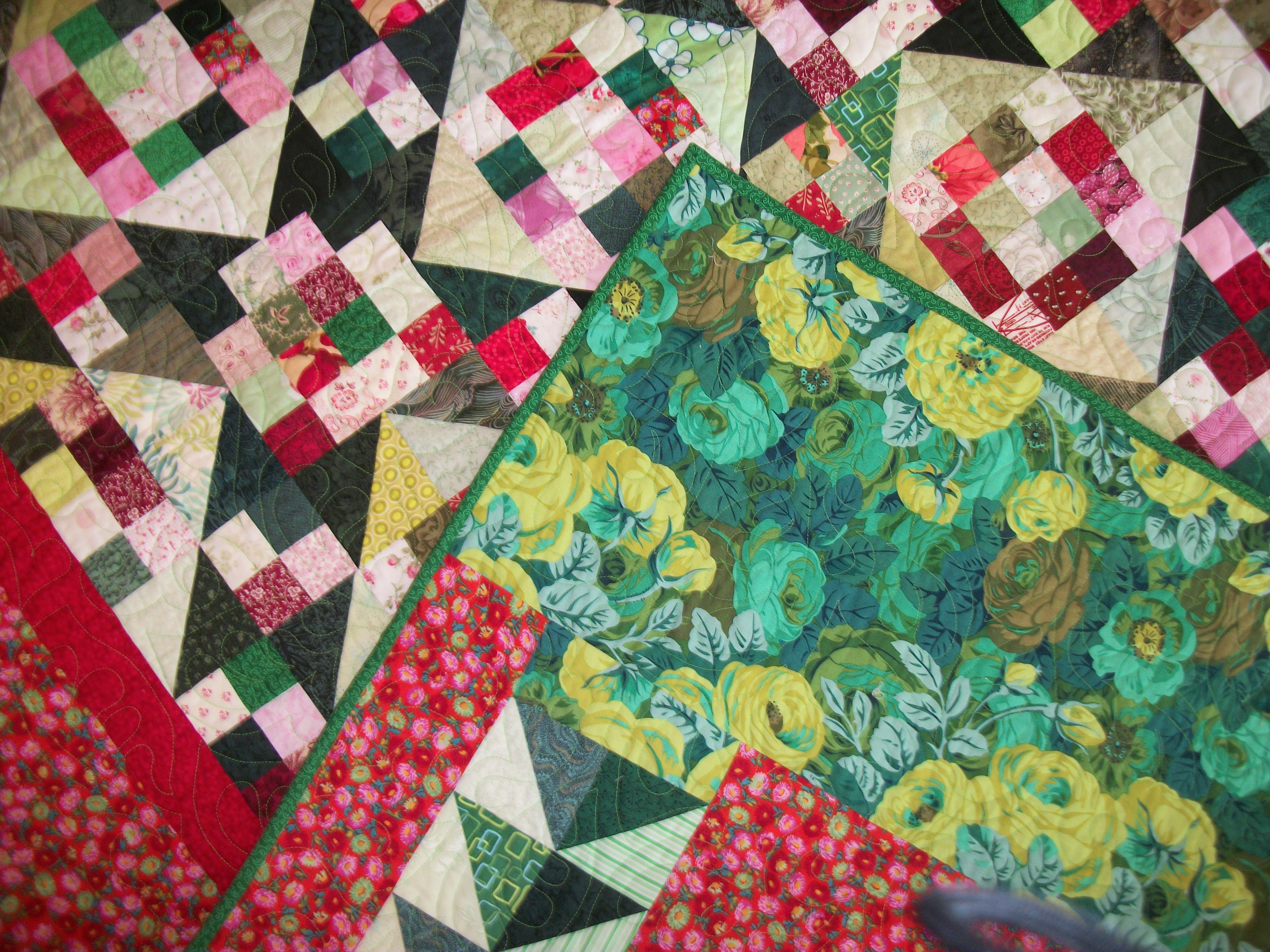
Meanwhile, Caroline had two pairs of socks with toe errors.  She had sewn them together going up and down rather than side to side.  And we had to rip one back to the point where she decreased to get the toe right.  But, here they are–all fixed and, hopefully, being worn now:

IMG_0189


Caroline is now working on a dark green pair which will be very pretty.

She’s ready now for a good sock book–I recommended Charlene Schurch’s Sensational Knitted Socks, which I have really enjoyed and highly recommend.


Turkey Tracks: Settings for String-quilt Blocks

Turkey Tracks:  March 20, 2014

Settings for String-quilt Blocks

Remember my pile of 100 plus string-quilt blocks made during my quilting retreat?

image

I’ve been looking at different settings for these blocks.  Here’s an interesting one from a quilter whose name I have totally lost on Bonnie Hunter’s Open Studio Facebook site–and I apologize for that as she designed this setting.

IMG_0202

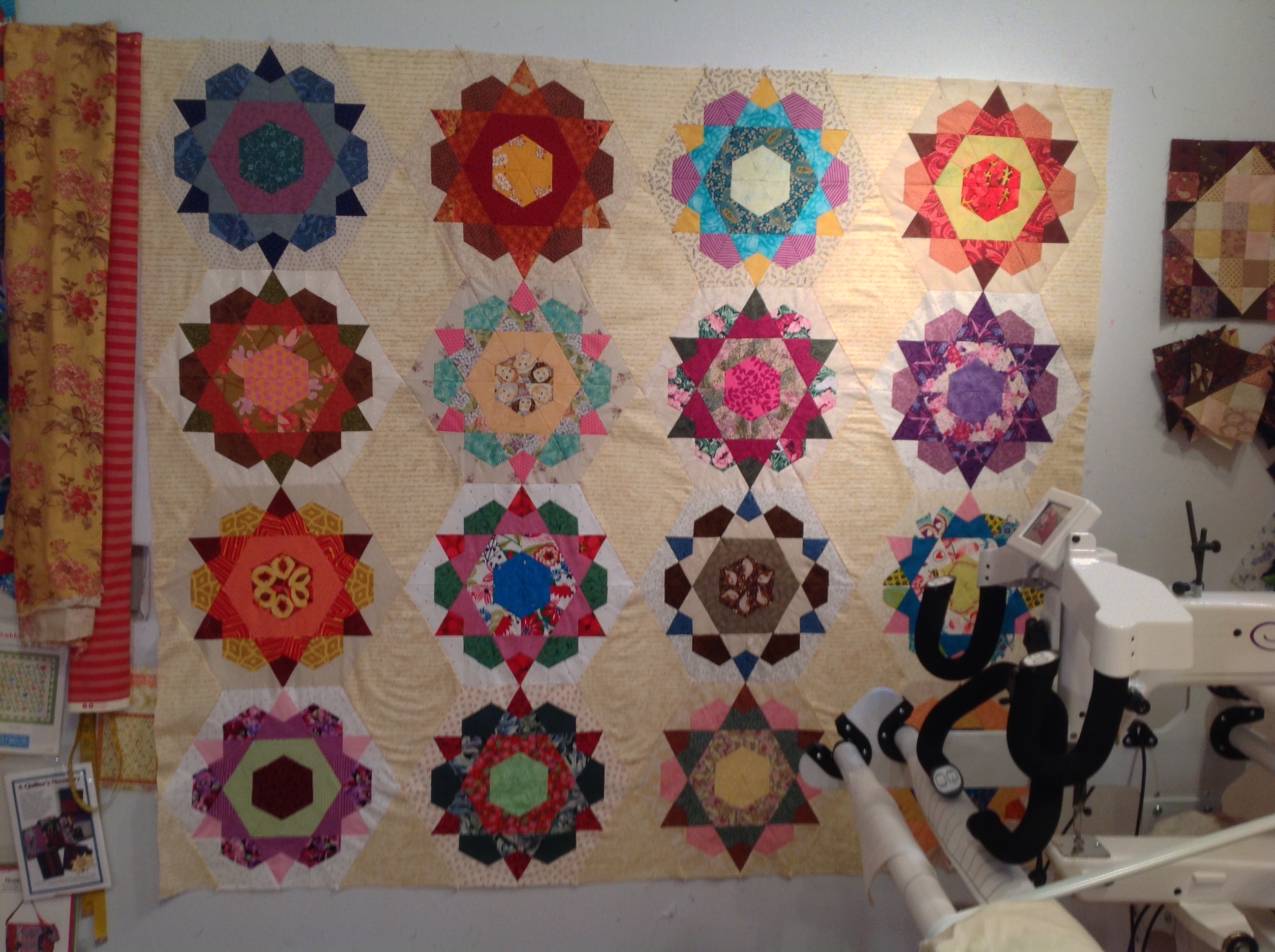
There’s a ton of work in this setting, but it’s making a terrific quilt.  I think I’m going to do something a bit different though….  I’m playing around with some sort of double lattice with cornerstones made with very bright colors–like aqua, fern green, orange, red…

Rosie Pilkerton was working on a different version of a string quilt–one that makes it’s own lattice as you leave a set width of your underlying fabric foundation square (the pale yellow here) free and start your strings on either side of that central diagonal stripe:

IMG_0201

VERY nice, Rosie.

Interesting Information: Misunderstandings About “Good” and “Bad” Cholesteral

Interesting Information:  March 21, 2014

Misunderstandings About “Good” and “Bad” Cholesterol

Within the past week, two family members have had questions about “good” and “bad” cholesterol and WHAT causes heart disease.  One has been on a statin for three years now–much to my horror as you will see why if you keep reading–to lower LDL cholesterol.  The other thought saturated fats led to the plaques that can block arteries and that the plaque was formed from the “bad” LDL cholesterol which must be lowered for health.  The latter understanding is both incomplete and flawed in that saturated fats are not the culprit and undamaged LDL cholesterol is not even…cholesterol…so lowering what is called LDL cholesterol is not going to work and is going to make you sick as you will not be getting the nutrients you need.  In addition, Seneff explains in detail how statins destroy your muscles, including your heart muscle.

I’ve written about Stephanie Seneff’s article “Cholesterol:  The Essential Molecule–And the Adverse Effects and Overuse of Statins” in Mainely Tipping Points 37, available on this blog.  This comprehensive article appeared in Well Being Journal, Nov/Dec, and is not free.   Seneff, based at MIT, is doing some amazing bench science research at the cellular level, and I like her work a lot.  Her web site lists her credentials, papers, talks, etc., if you want to take a look:  http://people.csail.mit.edu/seneff/.  Or just google her name.  Much of her work is free to you, so you can find parts of the information in the above article scattered across her papers or in shortened forms.  In addition, the Joseph Mercola web site has a nice video of an interview with Seneff about statins:  http://articles.mercola.com/sites/articles/archive/2012/02/11/dr-stephanie-seneff-interview-on-statins.aspx.  (There are other interviews on Mercola with Seneff as well as her main concern is the lack of cholesterol sulfate in our bodies today. Or, sulfur, which used to come from the soil, but which, thanks to commercial farming, is no longer available in the soil in the quantities we need.)

ANYWAY, Seneff’s explanation of HDL (called the “good” cholesterol) and LDL (the “bad” cholesterol) calls into question these simplistic and erroneous labels.  These terms were coined to sell you–and your doctors–the notion that you need to take a statin to lower your LDL cholesterol.  I’ve read Seneff’s explanation from other researchers, but her explanations in this article are very comprehensive and are easy to understand.  

Seneff’s conclusion about statins is also easy to understand:

I have been driven by the need to understand how a drug that interferes with the synthesis of cholesterol, a nutrient that is essential to human life, could possibly have a positive impact on health.  I have finally been rewarded with an explanation for an apparent positive benefit of statins that I can believe, but one that soundly refutes the idea that statins are protective.  I will, in fact, make the bold claim that nobody qualifies for statin therapy, and that statin drugs can best be described as toxins (13).

So, here’s Seneff’s discussion of LDL, HDL, and Fructose:

We have been trained by our physicians to worry about elevated serum levels of low density lipoprotein (LDL), with respect to heart disease.  LDL is not a type of cholesterol, but rather can be viewed as a container that transports fats, cholesterol, vitamin D, and fat-soluble anti-oxidants to all the tissues of the body.  Because they are not water-soluble, these nutrients must be packaged up and transported inside LDL particles in the blood stream.  If you interfere with the production of LDL, you will reduce the bioavailability of all these nutrients to your body’s cells.

The outer shell of an LDL particle is made up mainly of lipoproteins and cholesterol.  The lipoproteins contain proteins on the outside of the shell and lipids (fats) in the interior layer.  If the outer shell is deficient in cholesterol, the fats in the lipoproteins become more vulnerable to attack by oxygen, every present in the blood stream.  LDL particles also contain a special protein called “apoB” that enables LDL to deliver its goods to cells in need.  ApoB is vulnerable to attack by glucose and other blood sugars, especially fructose.  Diabetes results in an increased concentration of sugar in the blood, which further compromises the LDL particles by gumming up apoB.  Oxidized and glycated LDL particles [glycation is when a sugar molecule combines with a protein or fat molecule, degrading it] become less efficient in delivering their contents to the cells.  Thus they stick around longer in the blood stream, and the measured serum LDL level goes up.

Worse than that, once LDL particles have finally delivered their contents, they become small dense LDL particles, remnants that would ordinarily be returned to the liver to be broken down and recycled.  But the attached sugars [through glycation] interfere with this process as well, so the task of breaking them down is assumed instead by macrophages in the artery wall and else where in the body, through a unique scavenger operation.  The macrophages are especially skilled to extract cholesterol from damaged LDL particles and insert it into HDL particles.  Small dense LDL particles become trapped in the artery wall so that the macrophages can salvage and recycle their contents, and this is the basic source of atherosclerosis.  HDL particles are the so-called good cholesterol, and the amount of cholesterol in HDL particles is the lipid metric with the strongest correlation with heart disease, where less cholesterol is associated with increased risk.  So the macrophages in the plaque are actually performing a very useful role in increasing the amount of HDL cholesterol and reducing the amount of small dense LDL.

The LDL particles are produced by the liver, which synthesizes cholesterol to insert into their shells, as well as into their contents.  The liver is also responsible for breaking down fructose and converting it into fat (Collison et al., 2009).  Fructose is ten times more active than glucose at glycating proteins, and is therefore very dangerous in the blood serum (Seneff et al., 2011).  When you eat a lot of fructose (such as the high fructose corn syrup present in lost of processed foods and carbonated beverages), the liver is burdened with getting the fructose out of the blood and converting it to fat, and it therefore can not keep up with cholesterol supply.  As I said before, the fats can not be safely transported if there is not enough cholesterol.  The liver has to ship out all that fat produced from the fructose, so it produces low quality LDL particles, containing insufficient protective cholesterol .  So you end up with a really bad situation where the LDL particles are especially vulnerable to attack, and attacking sugars are readily available to do their damage (15-16).

SO THE REAL CULPRIT IN HEART DISEASE IS TOO MUCH SUGAR, ESPECIALLY FRUCTOSE SUGARS.

What to eat:

Cut way back on fructose–found in processed foods and in FRUITS.  Grains also turn into sugars in the body.  Really, if it’s in a box, a can, or a package in the grocery store–or in the middle aisles–don’t eat it.

Spend time outdoors and let the sun shine on your skin as that produces useable cholesterol sulfate.  Strenuous exercise helps clear your body of excess sugars.

Eat foods that are good sources of lactate:  sour cream and cultured products like yogurt and kefir, preferably made from raw milk.

Eat foods rich in cholesterol sulfate:  GOOD eggs (NOT the ones from vegetarian chickens), liver, oysters, onions, garlic, cabbage family, GOOD meats–in other words, clean, nutrient-dense whole foods.

Books, Documentaries, Reviews: Renata Adler’s PITCH DARK

Books, Documentaries, Reviews:  March 20, 2014

Renata Adler’s PITCH DARK

I’m reading a very different kind of a book:

IMG_0204


I heard about it recommended on one of those NPR programs just before Christmas–the best of the best books of the year.

Only, this book was published in 1983.  Adler was a staff writer for The New Yorker for 40 years or so–and comes with an impressive list of credentials (Bryn Mawr, Harvard, the Sorbonne, Law degree from Yale and an honorary doctoral law degree from Georgetown) and of fiction and nonfiction books.  The recommender said he had recently reread Pitch Dark and thought it a classic in some way.

The book is very modern, very spare–and is written in a kind of stream of consciousness where it takes the reader a few pages to figure out what’s going on–a love affair with a married man.

At first the text is distancing, even off-putting.  But then one runs across a nugget of observation that just pulls one right in.  Many observations concern the nature of the thing we call “love”–and the observations are not confined to the failing relationship at all or even to people–though the ones I’ll cite below are about the relationship:

He knew that she had left him when she began to smoke again….Years ago, he had smoked, but not when they met.  So she stopped, as people do when they are in love  Take up cigarettes, or give them up, or change brands.  As people do to be at one at least in this.  Long after that, she began to smoke again (8).

And:

You can rely too much, my love, on the unspoken things.  And the wry smile.  I have that smile myself, and I’ve learned the silence, too, over the years.  Along with the expressions, like No notion and Of necessity.  What happens though, when it is all unsaid, is that you wake up one morning, no, it’s more like late one afternoon, and it’s not just unsaid, it’s gone.  That’s all.  Just gone.  I remember this word, that look, that small inflection, after all this time.  I used to hold them, trust them, read them like a rune.  Like a sign that there was a house, a billet, a civilization where we were.  I look back and I think I was just there all alone.  Collecting wisps and signs.  Like a spinster who did know a young man once and who imagines ever since that she lost a fiancé in the war  Or an old fellow who, having spent months long ago in uniform at some dreary outpost no where near any country where there was a front, remembers buddies he never had, dying beside him in battles he was never in (9).

And:

Sometimes he loved her, sometimes he was just amused and touched by the degree to which she loved him.  Sometimes he was bored by her love and felt it as a burden.  Sometimes his sense of himself was enhanced, sometimes diminished by it.  But he had come to take the extent of her love as given, and, as such, he lost interest in it.  She may have given him this certainty too early, and not just out of genuine attachment.  One falls out of gradations of love and despair after all, every few days, or months, or minutes.  With courtesy, then, and also for the sake, for the sake of the long rhythms, she kept the façade in place and steady, unaffected by every nuance of caring and not caring.  He distrusted her sometimes, but on the wrong grounds.  He thought of her as light with the truth, and lawless.  And she, who was not in other ways dishonest, who was in fact honorable in his ways and in others, was perhaps dishonest in this:  that not to risk losing him, or for whatever other reason, she concealed, no, she did not insist that he see, certain important facets of her nature.  She pretended, though with her particular form of nervous energy she was not always able to pretend this, that she was more content than she was, that her love for him was more constant than, within the limits that he set, it could be (12).

Interesting.

I’ll let you know the outcome of the read…


Turkey Tracks: The Best Cup of Coffee Ever!

Turkey Tracks:  March 20, 2014

The Best Cup of Coffee Ever!


I don’t drink coffee in the morning.  I’m mostly a tea drinker.

But, I love a good cup of coffee after lunch or dinner–as a special treat.  And, bad as they are for you–bad, dead milk and too much sugar–I am almost always tempted by lattes.  Vanilla lattes.  Mocha lattes with real whipped cream.  Fortunately, actually getting one happens only when I travel or off and on in the winter.

So, when I was recently in Virginia, my niece Meg Challand, made me a cup of after-dinner coffee using a cone-shaped porcelain drip affair with a filter inside.

Oh my!  It was the best cup of coffee I’ve every had in my life.  Smooth and sweet–with no bitter taste at all.

So, guess what sister Susan sent me yesterday for my birthday???

IMG_0205


I have just enjoyed the BEST cup of coffee since the one Meg made me.

And mine has local, raw unheated honey and local, thick, gorgeous raw cream from Jersey cows–which is full of good fat and lots of fat-soluble vitamins (A, D, K) crucial for health.

I am spoiled beyond belief!

PS:  You do NOT want one of the cheap plastic drippers as plastic off-gases chemicals.  And there is something called a “pour over” stand that allows you to see how much coffee has dripped into your cup.  Online, the ones I found are incomprehensibly expensive given that they are just a few pieces of wood or a pre-formed plastic.  So, I’ll look locally in our kitchen stores for something.  Or ask a local carpenter to make me one…

Books, Documentaries, Reviews: Toxic Hot Seat Movie

Books, Documentaries, Reviews:  March 20, 2014

TOXIC HOT SEAT


The documentary Toxic Hot Seat is going to be shown FREE at the Strand Theater in Rockland, Maine, on Sunday, March 30th, at 2 p.m.

Maine’s own Hannah Pingree, former state congresswoman and now a young mother, is featured in the documentary.  Hannah Pingree has been instrumental in getting the information in the documentary to the public–which has been largely unaware of how the chemical industry has used fire safety as an excuse to douse so many of our products (furniture, rugs, clothing, etc.) with highly flammable and poisonous chemicals.

Ms. Pingree was raised and lives on a pristine coastal Maine sland.  When she participated in a “body burden” analysis about ten years ago, she was shocked to discover how many chemicals were present in her body.  One of the participants of this study, MOFGA’s beloved Russell Libbey, died last year of cancer, many years before he should have died.  (MOFGA is the Maine Organic Farmers’ and Growers’ Association, and it hosts a yearly fair, the Common Ground Fair, each year in late September.)

I hope that many of you will be able to see this documentary in your own communities and will stop buying products saturated with these chemicals–if you can find them.

Take a look at the trailer and read the information:  Toxic Hot Seat Movie.

Know, too, that this situation is another of what I am now calling a “kool aid” circuit–based on the notion that a group of people followed a charismatic leader into the jungle and willingly drank the poison he gave them.  This fire retardant issue is such a circuit since an entity (in this case the chemical industry) knowingly manufactured, publicized, and used bad information in order to sell a product for you to use.  Often, and it’s true in this case, “safety” is the mechanism being used to promote lethal practices that harm people and that have NO reputable science behind them.  So, yes, there is a conspiracy here.  Here’s a quote from the web site about this documentary:

Set against the backdrop of the award-winning 2012 Chicago Tribune investigative series “Playing With Fire,” TOXIC HOT SEAT threads together an intricate story of manipulation that details how Big Tobacco skillfully convinced fire safety officials to back a standard that, in effect, requires all furniture to be filled with toxic flame retardants. The film continues to untangle how the chemical companies obscure the risks to public health and misrepresent chemical safety data by paying “experts” to alarm legislators and the public about the deadly risk of removing chemical flame retardants from our homes.

AGAIN, know that you CANNOT depend upon the government regulatory agencies to protect you from what industry is doing in this country.

You have got to investigate and act for yourself–and that is where I am trying to help all of us understand where real science exists and where the notion of it is being misused.