My Supplements and Health Helpers

Turkey Tracks and Interesting Information: February 22, 2022

My Supplements and Health Helpers

I hesitated to share the information in this post for some time, but I’m going to share it today.

I will be 77 in mid-March, and except for the mast cell disorder with its histamine intolerance reactions, over which I have likely had no control in terms of how it started, I am really healthy. I don’t take any Big Pharma medicines, I eat a very healthy and clean diet and cook for myself, and I’ve done a pretty good job of eliminating stress from my life. I am physically pretty active: I help clean my house, I do most of my own garden work and all the mowing on this challenging property I own, and in good weather, I do daily outdoor events with AC doggie.

So, I thought I’d share my health practices.

I currently take these supplements. Mercola’s products ARE more expensive, but they are clean (no magnesium sterate fillers which can eliminate one’s uptake of needed nutrients) and are made from clean ingredients found in nature and not chemical concoctions in labs. What is not pictured here is the melatonin I take at night—not so much to sleep, but because I’ve read numerous studies from mainstream medicine now that melatonin is a really good supplement to prevent and/or manage the covid virus.

Most of this collection of supplements is recommended to help prevent illnesses, including covid. Some are specific to me—see below.
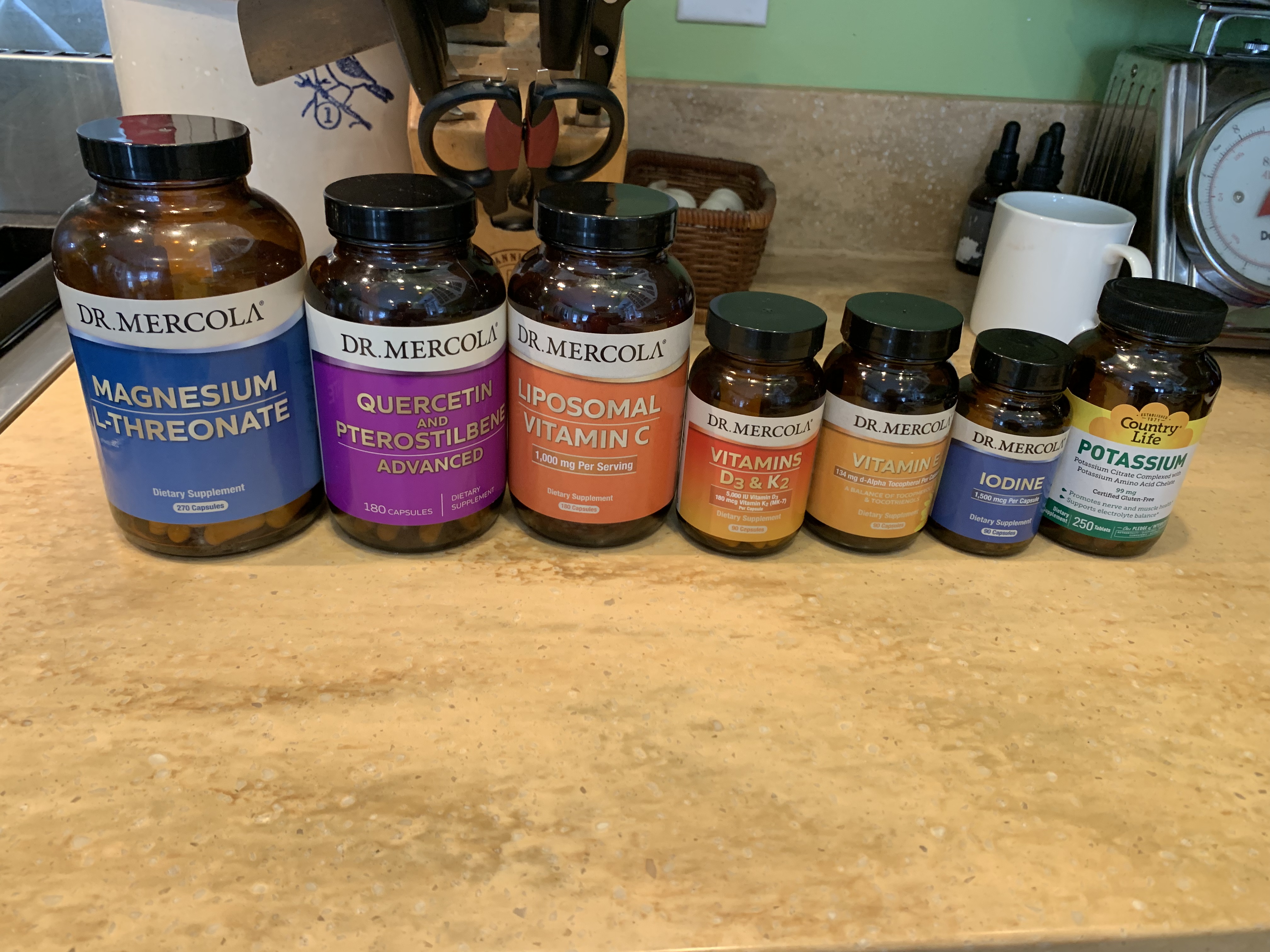
Too many Americans are deficient in magnesium and vitamin D3. And, Zinc. So those three are important. I can’t take Zinc; it makes me throw up, and the Quercetin helps balance mast cell reactions to triggers and is a stand-in for Zinc. I added iodine recently because I was not sure, with my diet, that I was getting enough. I do have added energy these days, so adding iodine has been good I think. Vitamin C, especially in winter, is an important addition—and one that helps the immune system. I can’t eat citrus, so I take the C except for summer—though I read recently that red bell peppers have more vitamin C than some fruits. I eat a lot of salt combined with herbs as I can’t do most spices—and salt washes potassium out of one’s system, especially, apparently mine, as I’ve turned up deficient during one trip to the hospital when I passed out. If I have leg cramps, I now know that the balance between potassium and magnesium is ”off.” Usually adding potassium fixes that, but sometimes more magnesium is needed. Too much magnesium can cause diarrhea, so that can be a delicate balance. Human bodies are so much more complicated than many realize I think.

I have worked with a local homeopath for 15+ years now. She keeps me healthy and has corrected a lot of constitutional problems I have, like the poison ivy that would systemically go all over my body and would cause great weeping patches of oozing sores until stopped with a steroid. I don’t get poison ivy any more. And I have not had a cold in well over a decade now.

My homeopath has been using these plant-based tinctures for several years now—and she changes them up for me as needed. One takes just a few drops a day. During the past two covid years, this is what I have been taking: Blackthorn and Sea Buckthorn are the anti-virals, among other immune system boosters; Hazel helps the liver and lungs and resolves inflammation; olive helps the cardiovascular system and also helps with any inflammation.

Here’s a quote about these gemmotherapies: ”Vital Extract is the gemmotherapy line produced exclusively for Lauren Hubele, LLC by Plant Extrakt of Cluj, Romania, Europe’s leading production facility for homeopathy and gemmotherapy. Vital Extract Gemmotherapy is backed by the most extensive and most current research in Europe and offers the widest selection of products available in America.”

The back story is that Romania couldn’t afford a western-democracy style of medicine so developed these products for their citizens. And the claim is that they are working well.

https://store.laurenhubele.com/pages/about

My homeopath also uses traditional homopathic remedies. I have a medicine kit of these remedies, so if I have an issue after talking to my homeopath, they are immediately available to me. I also have many, many packets of remedies my homeopath has provided that are not in this kit. Some target the histamine issues I have.

If you buy remedies in a local store, you would look for the blue container shown at the bottom of the picture. Arnica Montana is a vital remedy to have on hand for any time you have an injury. It works wonders to prevent bleeding and bruising.

Here’s what the remedies look like—3 of them are a dose. Don’t touch then with your fingers as that can put skin oil on them that might slow them down. If there is an acute problem, like an injury, you would repeat doses in short intervals of something like 15 minutes. But, except for Arnica probably, here’s where you need help from a homeopath. And, if you live in a state that does not allow them, know that you can find a good homeopath and work with them via zoom meetings.

In recent years I have added Young Living Essential oil products—and I have a membership with them so I can order at reduced prices. I have gradually switched to their cleaning, hand soap, shampoo, and lipstick products as well. If you are interested, there will be someone near you who sells them. I am not interested in starting a business, but I will order products for my friends at the prices I get.

All this winter, I’ve kept this little bottle of oregano on my kitchen window sill. If I wake up feeling ”stuffy,” one sniff clears my entire head and throat in short order. Oregano is a ”hot” oil, so be careful and don’t sniff too hard or you’ll feel like your nose is burning. Go gently. Ditto the peppermint oil that I love so much. I read somewhere that Oregano oil can kill pathogens in your nose and throat. I don’t know. I just know when I use it, all stuffiness goes away immediately for the entire rest of the day.

Here’s a view of a cabinet in my kitchen. I keep lavender very nearby as if I burn myself, it can stop the burning pain immediately. Copaiba is also good for injuries. Longevity is for AC doggie—there are claims it keeps ticks and fleas away. I can’t eat citrus, but I can use the citrus oils sparingly to flavor foods without problems it seems. They are especially lovely, for me, added to olive oil for a salad and soups/stews. They carry a big punch of flavor. The Vitality line is meant to be orally used—like adding drops of lemon oil to water as a treat.
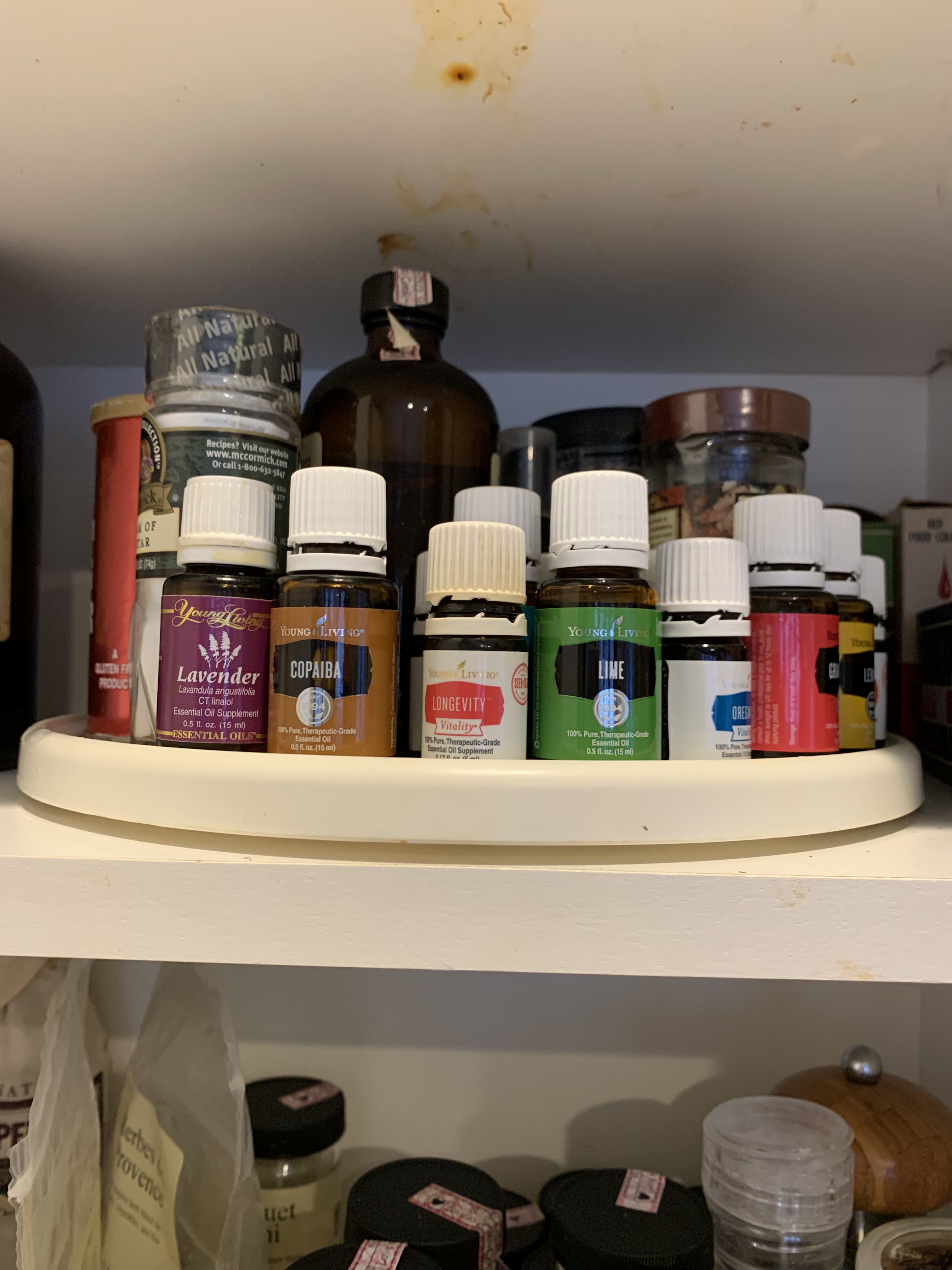
I also use a cold diffuser for these oils and now have one in the kitchen and one downstairs. They eliminate cooking and doggie and just stale-air odors all over the house. There are claims made that many of the oils are medicinal and cleansing as well. I don’t doubt it.

Here’s my desk cabinet with oils I particularly like in the upstairs diffuser. The downstairs one has different needs, but I have a cabinet of beloved oils down there too.

I do know that the tree oils ARE medicinal and have been used by native people for centuries as healing compounds. One can mix these oils in a diffuser, like using 3 of the tree oils. Or, something like lavender and lemon. The possibilities are endless.

I also use wool dryer balls in my clothes dryer, and I often sprinkle a favorite oil on a few of them to make my clothes smell extra special. Smelling oils also puts them into your body where they can do their good work.

This whole journey is definitely one sparked by living in (mostly) rural Maine—where I am close to the earth, small farms, clean food, the Maine forest, and people who are making this journey with me. I didn’t acquire all of these products overnight. It took two decades.

I am so grateful for this time I’ve had in Maine.

It’s Snowing

Turkey Tracks: February 19, 2022

It’s Snowing!

I’ve been busy!

My taxes have been rounded up and delivered to the people who do them.

That yearly job is always a good time to do some review. Under things learned, I realized that since last April 24, I have not spent more than $100 on gas for Girlie the car. On that happy note, I took her to the car wash as she was BEYOND filthy. The inside still is—which is a car piece that comes with winter in Maine, especially if one has an active dog. I have great seat covers and good floor mats, so it’s all good. Just dirty.

The squirrels are still in the ceiling—and my guru for that problem has been down with covid. He will get here when he’s feeling better to see if they have found a new way into the house. That won’t be too long as he is on the mend.

Last weekend was the annual “National” Toboggan Competition—an event much cherished in this town. We have had some rainy weather in the low 50s leading up to the event—alongside days of single digit temps. BUT, here’s what my beloved athletic field looks like now after cars got parked on it in warm, muddy weather when the ground is SO NOT FROZEN.

There are BIG SWATHS all across the field now—and they will have to be fixed before any of the groups who use them all spring and summer can use them again. Meanwhile, those of us (more than the town realizes I think) who use the field all winter are finding it a miserable, wet, muddy mess.

The field is too damaged to let a dog run on it or for the many people who walk around it in the winter for exercise. Just looking at these pictures makes my heart hurt.

Meanwhile, I also heard that one of the toboggans in the competition went into…waist-deep water…when the ice broke.

Hello. Our climate is changing—has changed—here in Maine. I am starting my 18th year here. I can clearly see that our winters are milder and that we have a lot of rain rather than a lot of snow. The past two years have seen much warmer, wetter trends in all the seasons we have.

I wrote a letter to the town manager. I don’t think cars should be parked on this field in the future. The $$$$ gathered for parking will not be as great as the needed repairs—which will also take time in the spring as grass does not sprout until temps get above 65.

I didn’t mention in the letter the unexpected dip one of the toboggans took. I hope someone else is thinking about that problem.

OK, whining rant is now over. Except I could add that AC doggie now has blisters on his two front paws from running on the parking area over at Barrett’s Cove. I’m using Young Living’s Mendwell, made for dog injuries, on his feet. It must feel good to him as he comes running when I get out the little bottle.

I mailed two quilts this past week. When they land I’ll show the pictures.

Our days are longer and brighter now. The seasonal wheel is turning, however slowly.

A Chicken Soup Version

Turkey Tracks: February 8, 2022

A Chicken Soup Version

Remember the chicken carcasses and bones I’ve been freezing?

I have two now, plus some chicken bones added in from other meals. It’s time to make chicken soup, so I defrosted the bones last night.

*Note that I cook by method, so just read the whole recipe, then if you must, create a list of what you need or would like.

Today dawned with icy slush and rain, so the trip I was going to make to get some chicken thighs to add to this soup will not happen—especially after my morning police call (to see if I’m ok) said ”Stay Home today.” And when I ventured out to the garage, I saw why: 2 inches of slushy ice rested on the driveway. It will freeze later, and…oh my.

So, I’ll make the soup from what I have here in the house. First, cover the bones with water, add some salt, bring everything to a bubbling hot, turn down to a simmer for at least 40 minutes. (You could also add savory veggies at this point, but I’m in a hurry as today is also cleaning/laundry day, and my veggie supply is limited. Note that after cooking you would discard these savory veggies.)

Yes, those are the giblets wrapped in paper—which I had to remove. But look at all the lovely fat coming out of the bones. Skim as needed.

Meanwhile, assemble the veggies you want to have in the soup. Here’s what I had on hand. I’m eating the rainbow today! The radicchio is going in as it needs to be eaten, and I thought its bitter taste would add some interest. I later added in some frozen corn too. I’m finding in winter I would rather have these organic frozen veggies than the tired veggies shipped in her from the other side of the world. I wish I had some celery though, especially with a chicken-based soup.

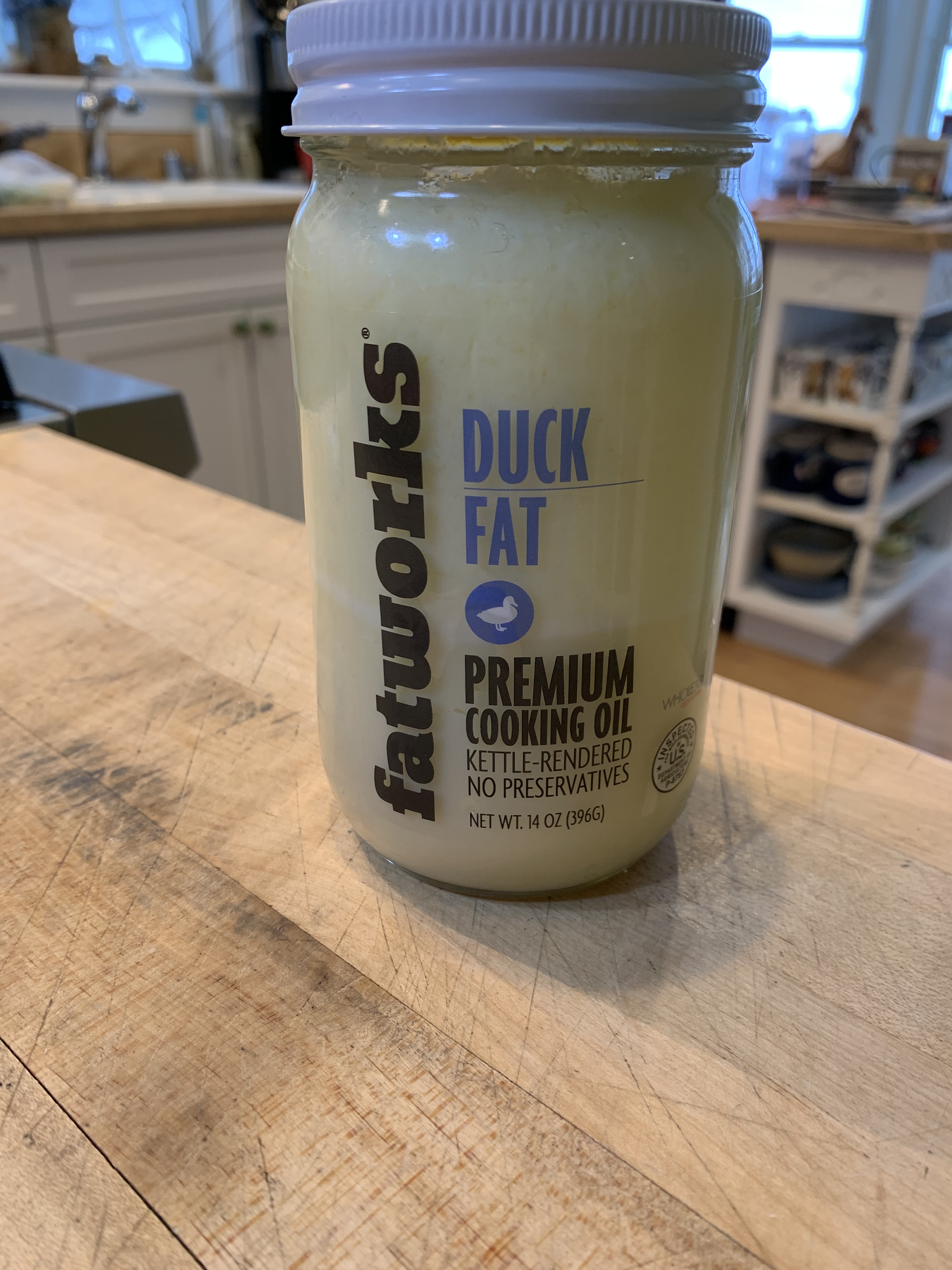
I will saute these in the duck fat I keep on hand. And I will use a big dollop, probably about 1/4 cup, as I do not want my veggies to burn in the pan. And based on a lot of research I believe clean animal fats are really good for you. (See Mary Enig and the Weston A. Price Foundation for more information.) Except for really good olive oil and coconut oil and red palm oil, I avoid the plant-based oils. I cut the greens off the 3 leeks before I took this picture. More on leeks down the page.

Leeks are in the allium family—along with all the onion and garlic vegetables. This family provides us rich sources of the sulfur that has been so depleted in soils. And sulfur is crucial to good health. Some cannot tolerate the allium family—if you can’t, you likely know that by now. (If you are interested in the sulfur issue, go to Stefanie Seneff’s web page for more info—she runs a research team out of MIT.)

Leeks can have some dirt in the end toward the upper green stem—so take a close at the inner layers of the stem so you can rinse out the dirt. Or, put the cut bits into a strainer and wash the dirt off there. Don’t be afraid of getting some dirt into the mix if you see some on the cut leeks in your pan. Remove and rinse the offending piece then. Actually, there are lots of goodies in dirt, and too many of us don’t get these critters anymore, which is why swimming in ”wild water” is a good idea. I cut mine in half and ruffle the green end to check for dirt. If the dirt isn’t gritty, which I don’t want, I don’t get too picky.

No dirt here:

AC is well aware of everything I do at all times.

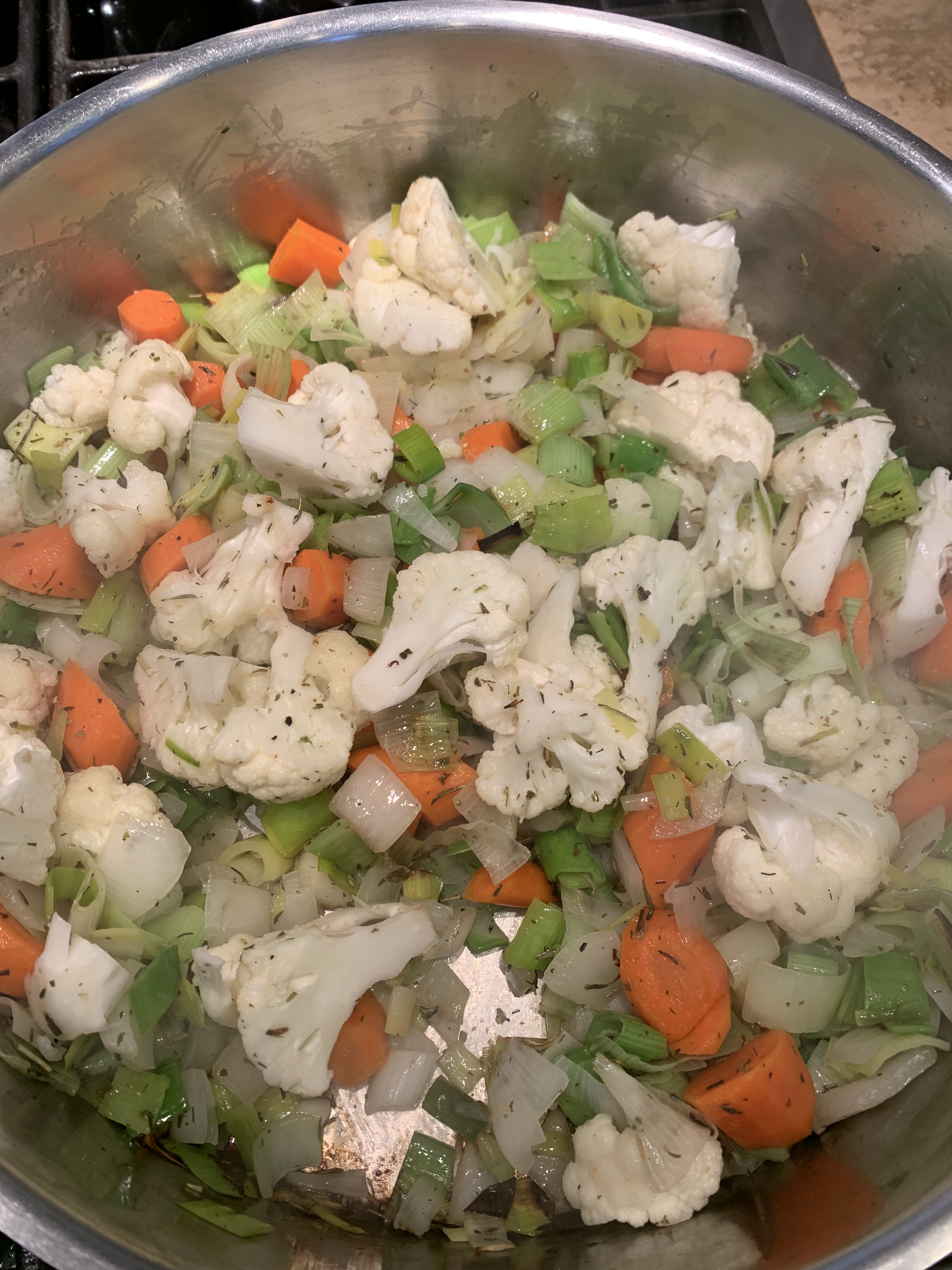
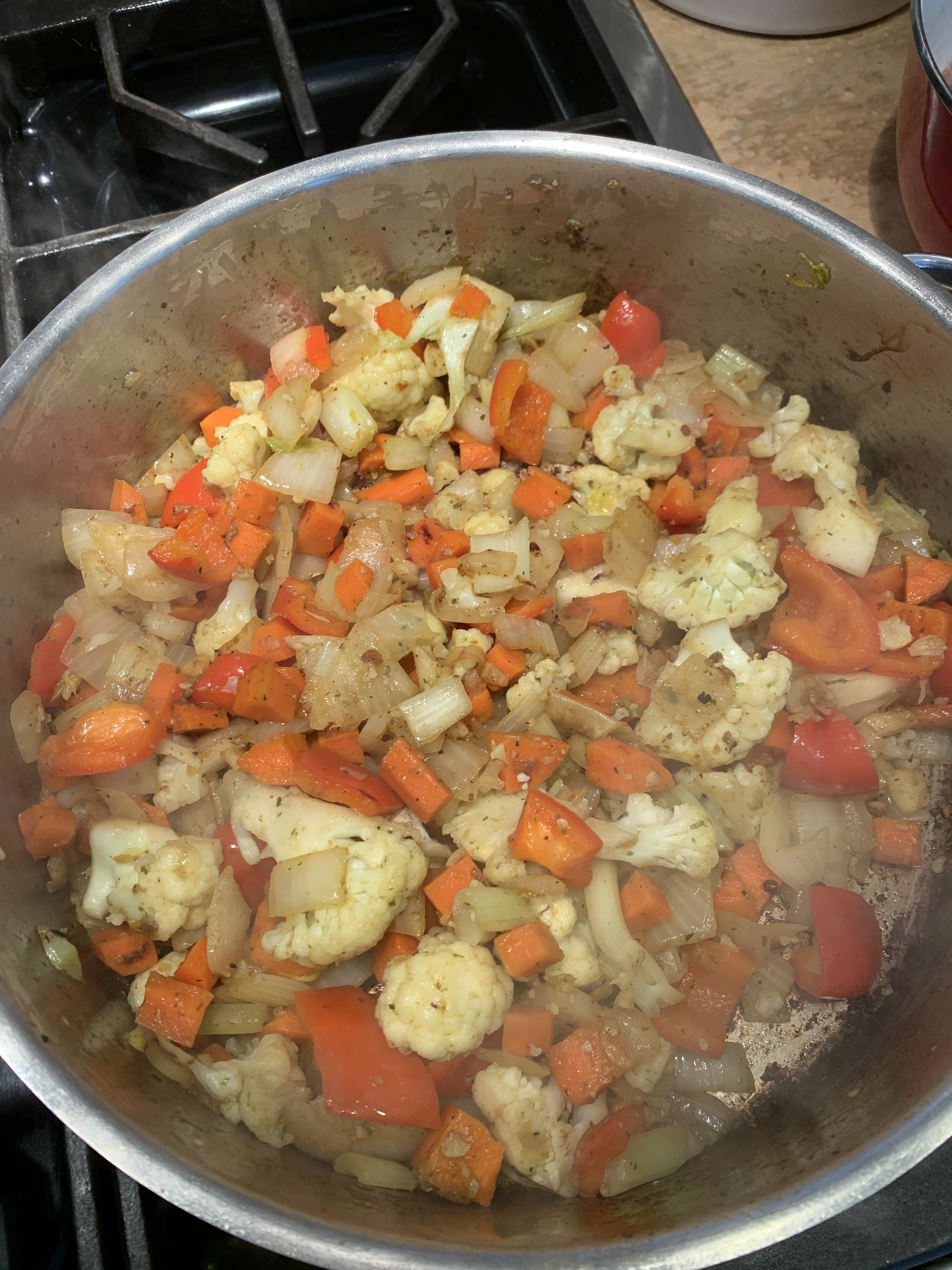
With these veggies, I want to saute the veggies that need more cooking first (leeks, onion, garlic, carrots, cauliflower), and then add in the more tender veggies—in this case the cabbage, the yellow squash, the red pepper, and the radicchio. Frozen veggies go in last. Remember to cook down the veggies, without burning, until they start to turn golden and ”grunge” is forming in the pan. Then start adding in the more delicate veggies, turning and stirring until they, too, sweat out and melt down. Last, in a cooking whim, I added about 1 1/4 cups of short grain brown rice and turned it around in the hot veggies for a bit—just to give it some flavor too. Too much rice, and the mixture will become thick and lose its liquid—just add more water after all is cooked.

Here I added some ladles of broth to stop the cooking and to get all the good grunge loose in the pan. A big ladle like this one is a go-to tool in my kitchen.

I strained off my broth. Look at the beautiful color, even after only 40 minutes of simmering. And the trip to the garage was to put the kitchen garbage in the bins out there. Chicken bones will smell in a few hours.

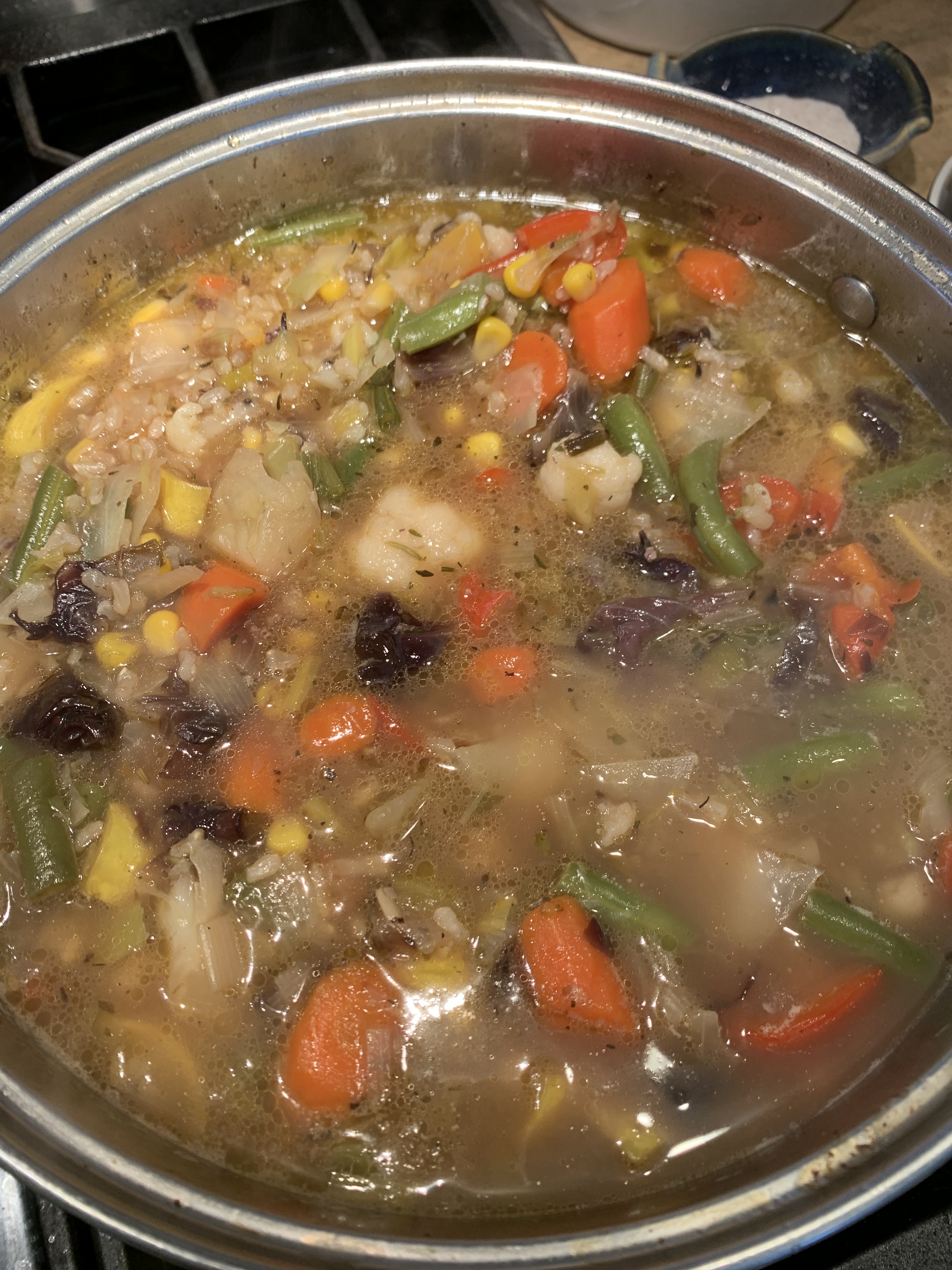
I now clean my pot and put all the ingredients into it, including the frozen green beans and corn.

Bring the pot up to a simmer so the rice cooks—taste as you go along—it will take about 25 minutes to cook rice. Otherwise, simmer until the carrots are soft—that doesn’t take long. DON’T COOK TOO FAST OR TOO HOT. Taste to check on the herb and salt levels. If you wanted to use fresh herbs, here’s where you would add them.

When the rice is done, the soup is done. So, ladle up yourself a bowl and enjoy!

Tomorrow I’ll probably buy some boned chicken (I would prefer thighs) and add it to the soup. So I’ll just refrigerate the pot of soup when it cools. To this basic soup, you can also add a bit of cream. Or, an egg yolk beaten into a bit of some hot soup in your soup bowl to give a velvety smooth texture and lovely taste. Then add more soup. Added cheese is nice. Without the rice, putting hot soup over noodles is nice.

I could go on…

“Whirlygigs” Has Landed

Turkey Tracks: February 7, 2022

“Whirlygigs” Has Landed

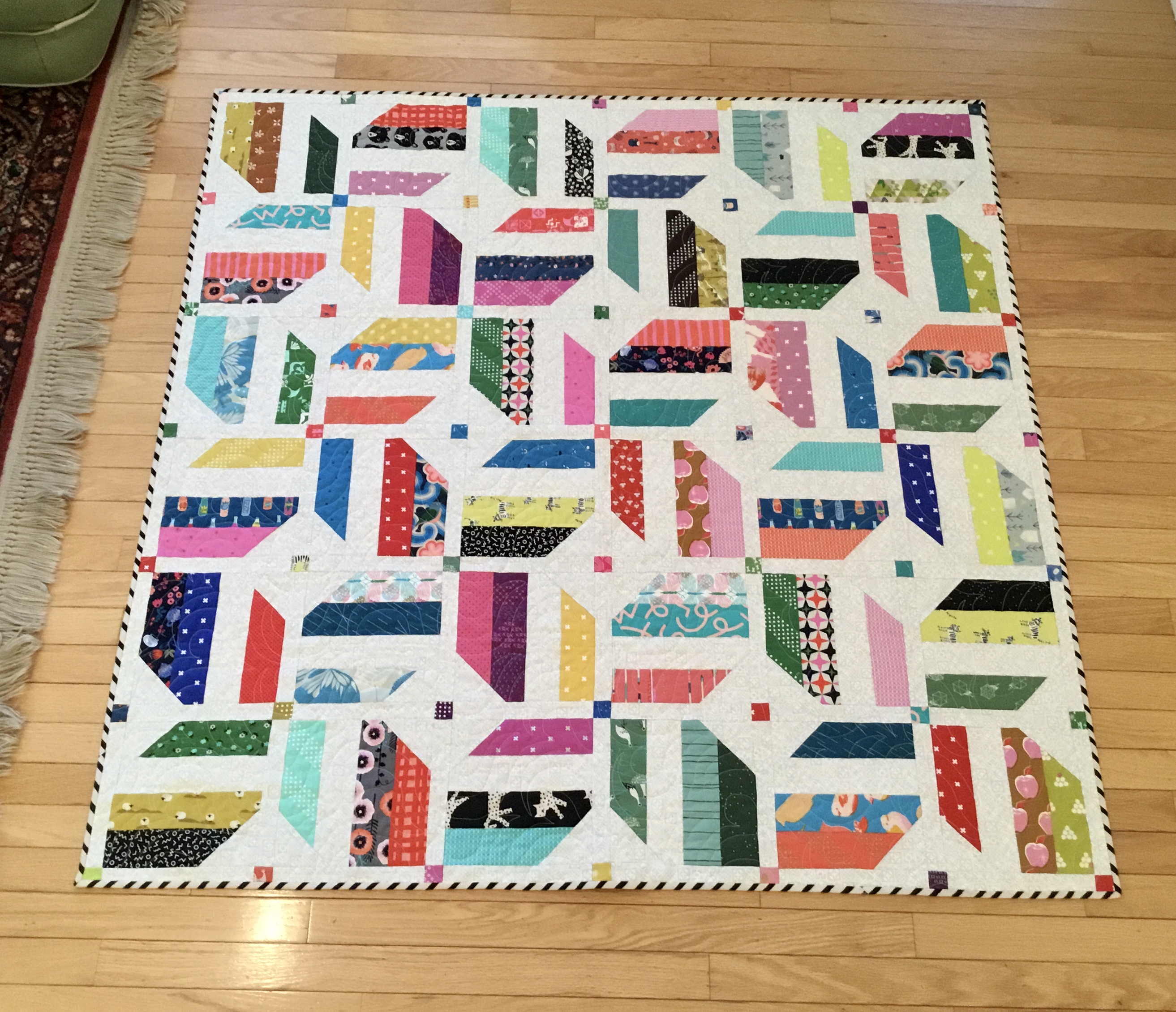
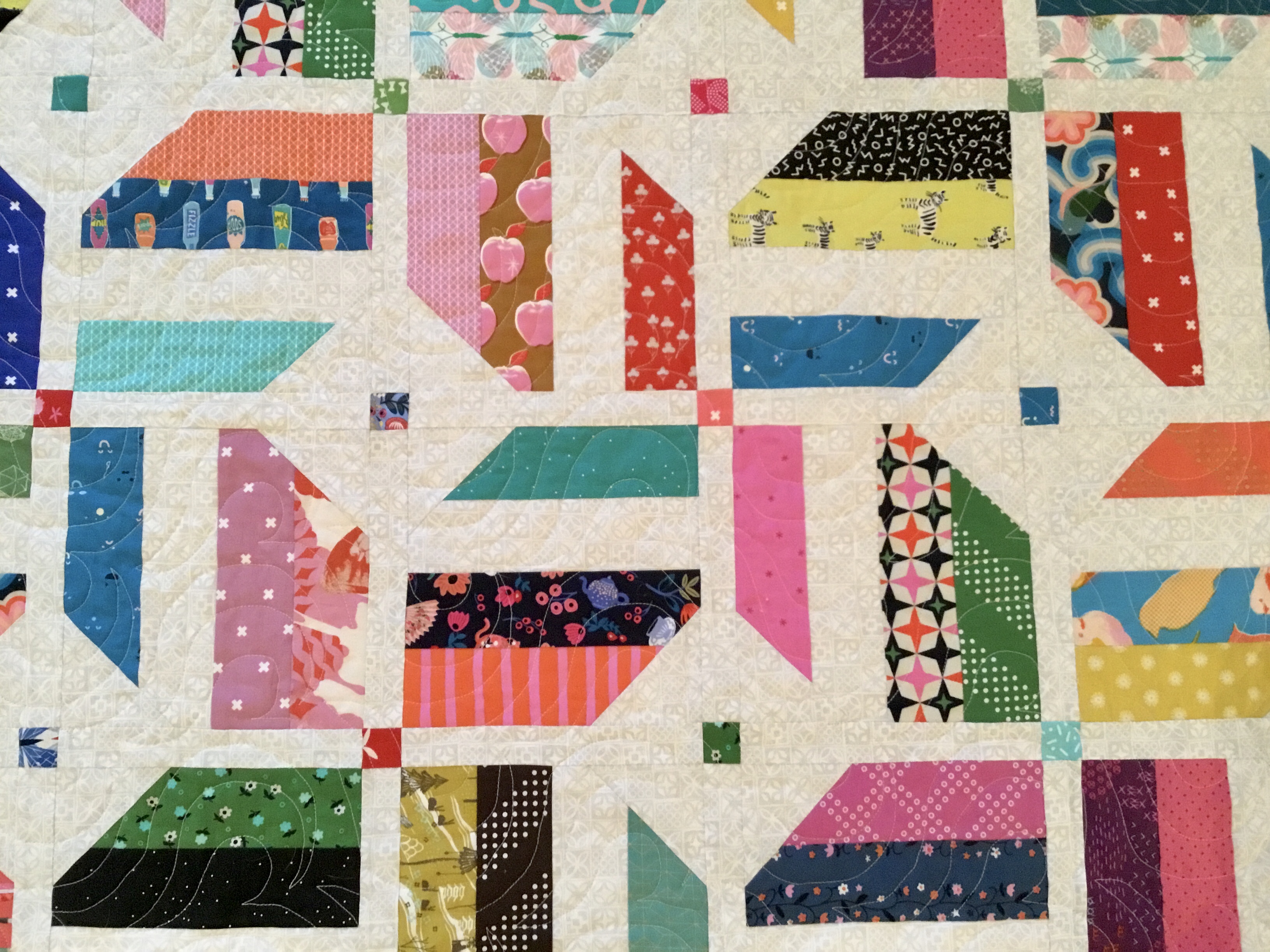
I love this modern pattern. There are so many geometric shapes involved—and each catches your eye differently. Wendy Sheppard is the designer, and I got the pattern from Simply Moderne magazine, No. 26.

The fabrics are all Cotton+Steel/Ruby Star Society—collected into a stash over the years.

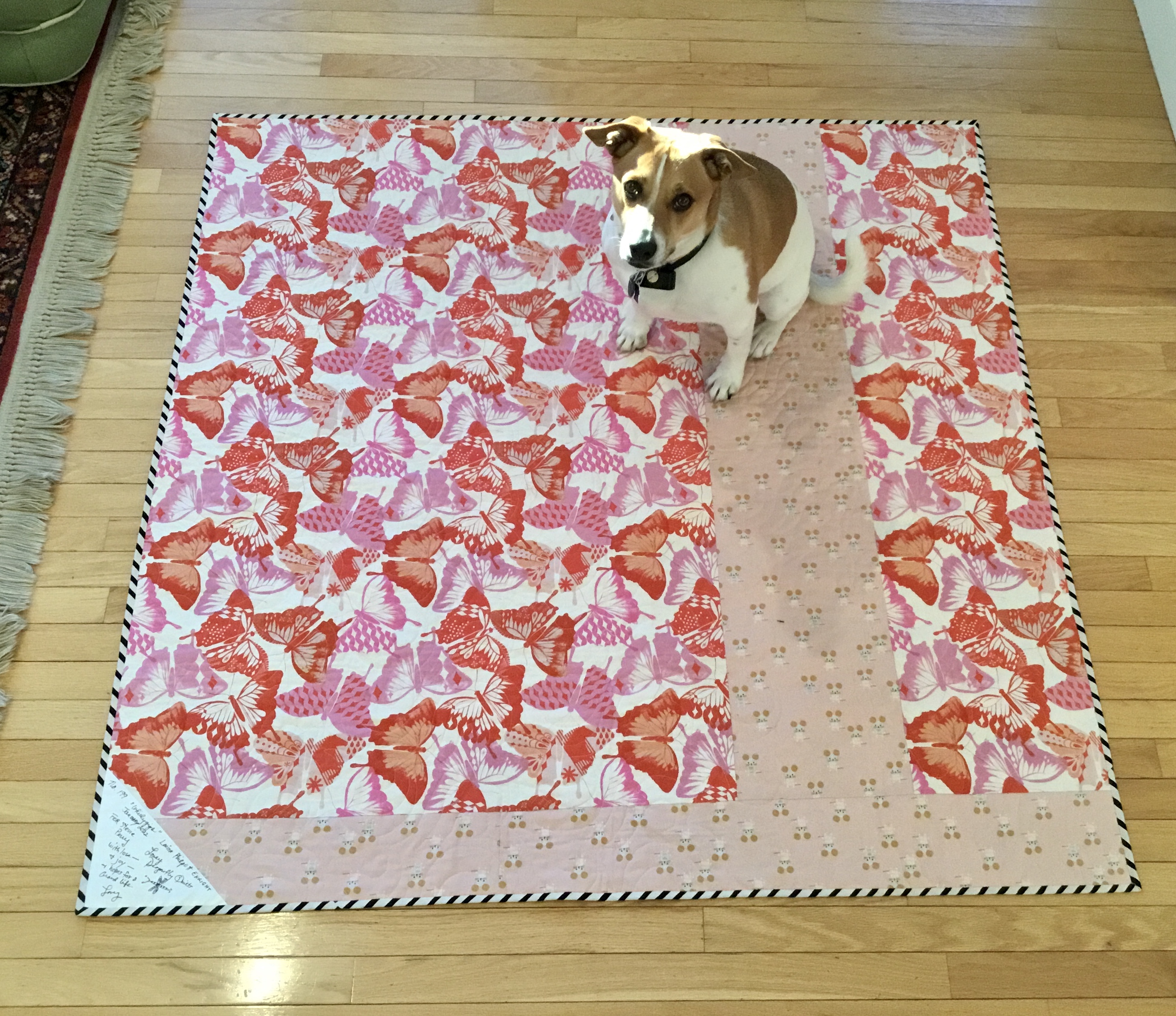
I pieced the backing and had enough of the stripe for binding cut on the bias.

AC likes quilts.

The quilting isn’t showing up so well in these pics, but it’s the Bayside pantograph and a ”parchment” colored thread.

I told the new parents of the baby girl for which this quilt was made that this quilt is meant to be used, thrown up on, dragged around, spit up on, and washed and washed as needed.

I hope baby girl attaches herself to all the color and pattern interest along the way.

But one never knows…

Rare Steller’s Sea Eagle in Maine

Turkey Tracks: February 6, 2022

Rare Steller’s Sea Eagle in Maine

Friend Gina Caceci from Falls Church, Virginia, where I used to live, sent me a newspaper clipping yesterday (from WAPO) about a rare HUGE sea eagle from Asia appearing on the New England coast. The Steller’s Sea Eagle is now off the coast of Maine in the Boothbay area, having first been sighted further south.

This eagle’s natural habitat is northeastern Asia, which includes Russia and Japan. It is named for German naturalist Georg Wilhelm Steller. There are only a few thousand of these birds in the world now.

If you google, you can get a lot of stories and pictures, but I found these two: one with a video and one with lots of pictures that people here have taken. This bird is drawing big crowds as even non-birders are trying to see it. The bird does seem to be moving gradually north.

This bird is HUGE: the wing span is nearly 8 feet. It dwarfs our local Bald Eagles as it is twice as heavy. No one yet knows the sex. It has an ample food supply off the New England coast (fish and DUCKS), and the climate is quite similar to its native habitat. No one knows why it has ventured so far from its home grounds, but naturalists say birds going on ”bird walkabouts” is not unusual. Some even return to places they have found year after year.

This link has a lot of pictures.

Thanks so much, Gina, for this very interesting information.

Knitted Work Using Fabric Selvages

Turkey Tracks: February 4, 2022

Knitted Work Using Fabric Selvages

It is a really ICKY day here today—raw and wet and icy.

It’s a great day to stay home and sew. And I have that lovely and healthy soup to eat. I added in some cooked broccoli yesterday. Today maybe I’ll add some cream or cheese.

Northeast Wildlife came yesterday and closed and wired all the places up high on the roof where the flying squirrels got in—along with any place where they might try to enter. There may be some bat entries too, but we’ll deal with that in the spring as that requires caulking entry places. The squirrel solution is elegant—there are traps places in the entry holes that allow egress but not entry. Meanwhile, all my bird feeders went home with Northeast Wildlife.

Margaret-Elaine, a local quilty friend here, commented on yesterday’s post by noting the placemat upon which my bowl of soup sat. She thought I had woven it with, I think, the old-fashioned hand-weaving looms I have—and I have made a lot of rugs and placemats with the two sizes I have. The frame is rectangular and has nails at the top and the bottom where one strings the ”woof” base.

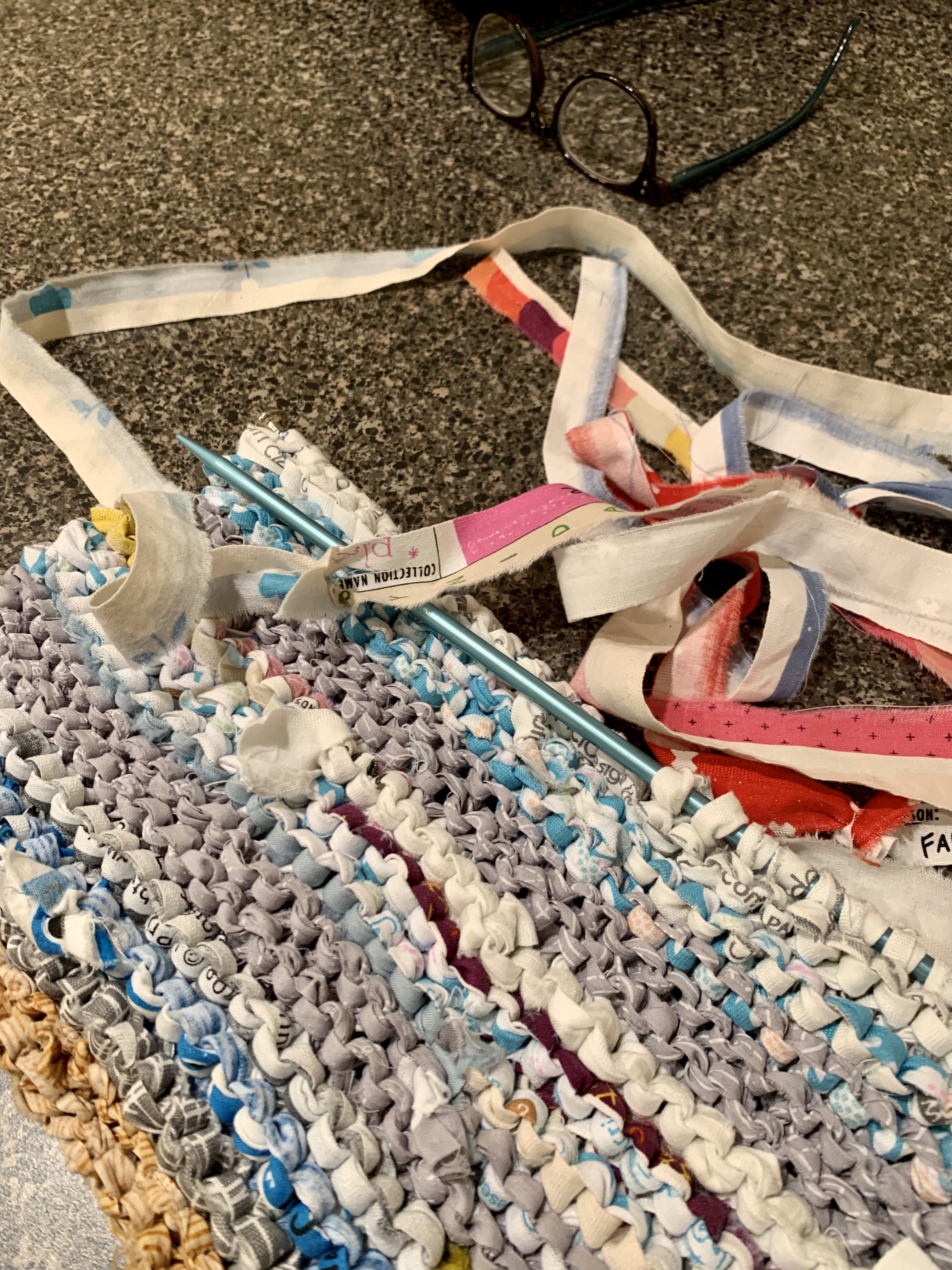
But these placemats have been made by knitting (garter stitch) the selvages from quilting fabrics.

When I get a long enough strand, I just add it into the ongoing project. The pieces are linked together by making slits in each end one wants to attach and looping them through the ”mother” ongoing strip. You can see the linking knot in the picture. It works better to keep the ongoing strand length to 2-3 feet as it twists as one works. And it is easy to add a new strand when needed. If it is short, it just takes a little time to ”update” the project.

I like using selvages as they don’t shed like cut fabric would. I have wondered about using the looms to make something with these selvages, but that requires A LOT of strips AND one has to lay in a base on the hand loom around which one plaits the added strips—so one has both the woof and weave parts. This knitting method is already pretty thick.

I have saved my “warm” selvages (orange, red, pink, etc.) as I think I have one more selvage quilt in me. I do like them. I gave away all the cool and black/white/grey selvages. After I make the ”warm” selvage quilt, I’ll be done I think.

For this current selvage-knitting project, when I get a big enough central piece, I’m going to stop there, pick up stitches along one side, and create another “patch” or ”block.” And then, when I’m done there, I’ll stop and move to another side. It might take…years. LOL.

Here are some of my selvage quilts: a ”cool” one and a star one.

Have a great day everyone!

What To Do With the Roasted Lamb Shoulder?

Turkey Tracks: February 3, 2022

What To Do With the Roasted Lamb Shoulder?

Soup, is what one could do.

Start by putting the shoulder into a pot and covering it with water—and let it simmer until you think all the ”good” has been extracted from the meat. I can’t do that for long as long-cooked bone broths (12 to 24 hours) acquire too many histamines for me to eat. So I simmered the roast for 40 minutes while I prepped the veggies and some ground lamb for the soup. Skim the broth as needed.

I sautéed the ground lamb in beef tallow and assembled some ORGANIC frozen veggies I had on hand. The ground lamb is local and came from Hope’s Edge farm. I get a whole lamb every year.

Next, I cut up and sautéed in beef tallow a bunch of other veggies I had on hand in the meat pan—which I didn’t have to wipe clean—sometimes you have to if anything has burned in the pan: onions, garlic, carrots, red bell pepper, some cauliflower, some celery. Add in some herbs. And, of course, salt.

You want to sweat out these veggies, turning them frequently, until they begin to turn golden. Do not burn then, but you want some of the brown ”grunge” that forms in the pan as you cook them down. Be patient, and don’t cook the veggies on heat that is too, too hot.

At the above point, I added some liquid from the pot of broth so I’d get all the goodies in this frying pan into the soup. You could add the meat back at this point too.

At this point I moved what was in the frying pan into a larger pot and added in all the frozen veggies. Heat until the soup is all hot and bubbly.

Then make yourself a bowl of soup.

It doesn’t take all that long at all to make a soup or stew like this one.

I froze a portion for a meal at another time.

And that left me with two lunches and two dinners at a minimum—but there will be more.

Remember that you can add things to the soup that make it taste a bit different: heavy cream, a bit of cheese on the top, or the bottom of the bowl, that will melt down into the soup, more herbs, and so on.

We are getting another storm tonight—an ice storm likely—so it’s nice that I have these meals all cooked. I have done all my weekly chores, so I will have lots of time to sew today and tomorrow—which is good as I have…sewing projects. For sure.

Playing With The Cotton+Steel/Ruby Star Society Stash

Turkey Tracks: February 2, 2022

Playing With the Cotton+Steel/Ruby Star Society Stash

I’ve had so much fun making this quilt. It’s a ”Pot-Pourri” of Cotton+Steel/Ruby Star Society fabrics—all in my stash.

It’s ”eye candy” for a child I think. And for me, apparently.

It’s been quilted now, and the binding is on and getting sewn down at night. Can I just say it is yummy to have on one’s lap. And this one is meant to be dragged around and loved and washed and USED.

Here’s the backing—again pieced from my stash. I lost the bottom green strip in the quilting. It’s ok.

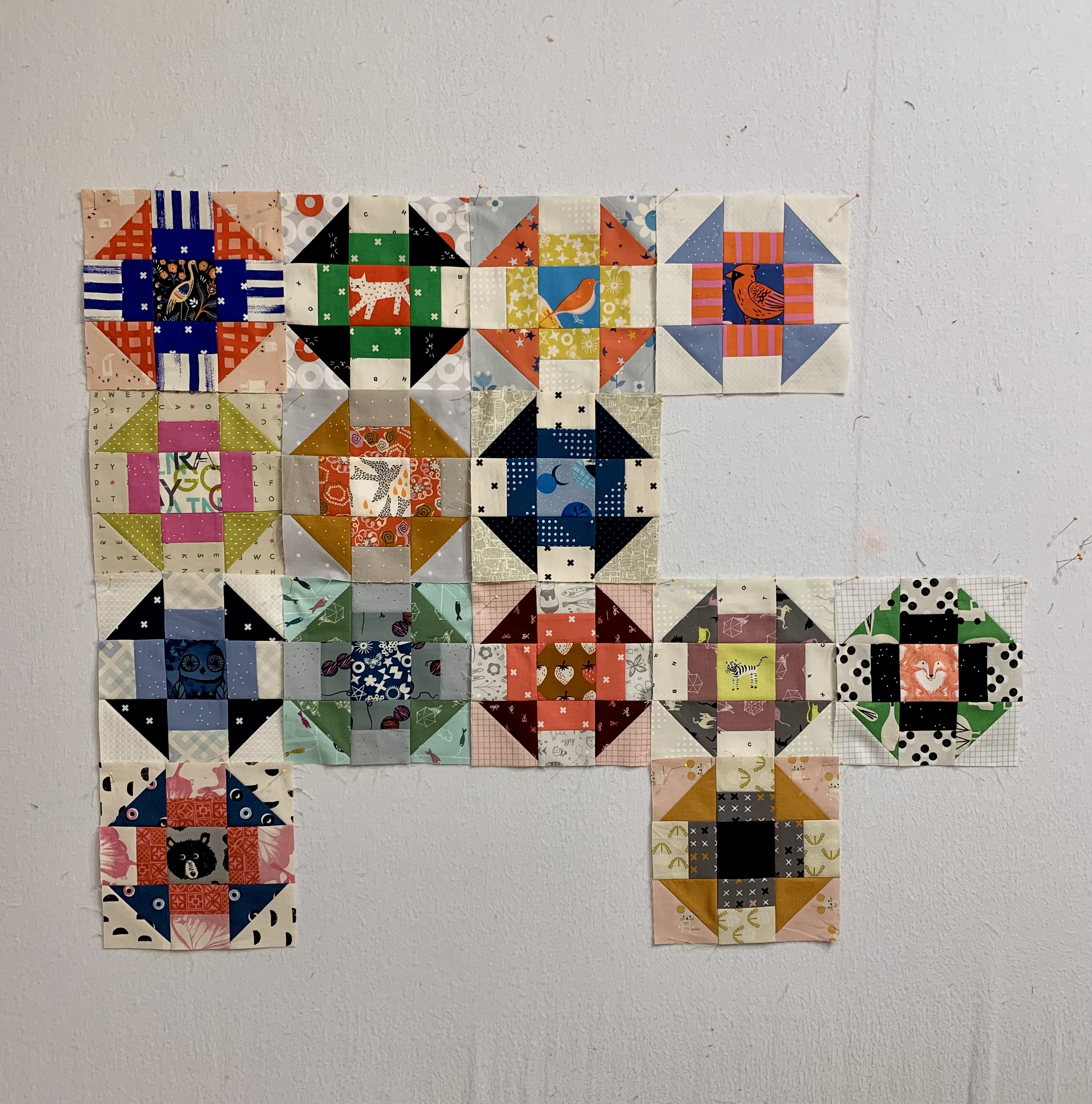
AND I’m making a baby quilt with the Churn Dash block, which still ranks as my favorite. OK, the Radient Beauty block is also a favorite.

I started these blocks before Bonnie Hunter launched into making them as well. I was inspired by her making then ”scrappy” though. And I’m wondering how she will set hers.

I like they way these blocks look butted up to each other. The secondary pattern is interesting. BUT, one would have to plan to sew the seams so they will nest—so that is hard with scrappy blocks that get moved around before finding their permanent homes.

So, I am setting mine with narrow sashings and corner stones. I have no idea about what binding will work.

Today and tomorrow will be RAINY—on top of 18+ inches of snow. And on Friday, our temps will drop again and we will get more snow.

It is winter.

All my cleaning/laundry jobs are done for the week. There is some cooking to do today. What I thought was a small leg of lamb was actually a shoulder piece—which I realized after I roasted it yesterday and after trying to slice off the meat around the central bone—so there will be a broth made today to be used in a soup or stew. And maybe I’ll take a ride in the car so AC can get out for a bit. He’s not getting nearly enough exercise.

I mailed a baby quilt yesterday. So, more on that quilt after it arrives at its forever home.

The Storm is Over

Turkey Tracks: January 30, 2020

The Storm is Over

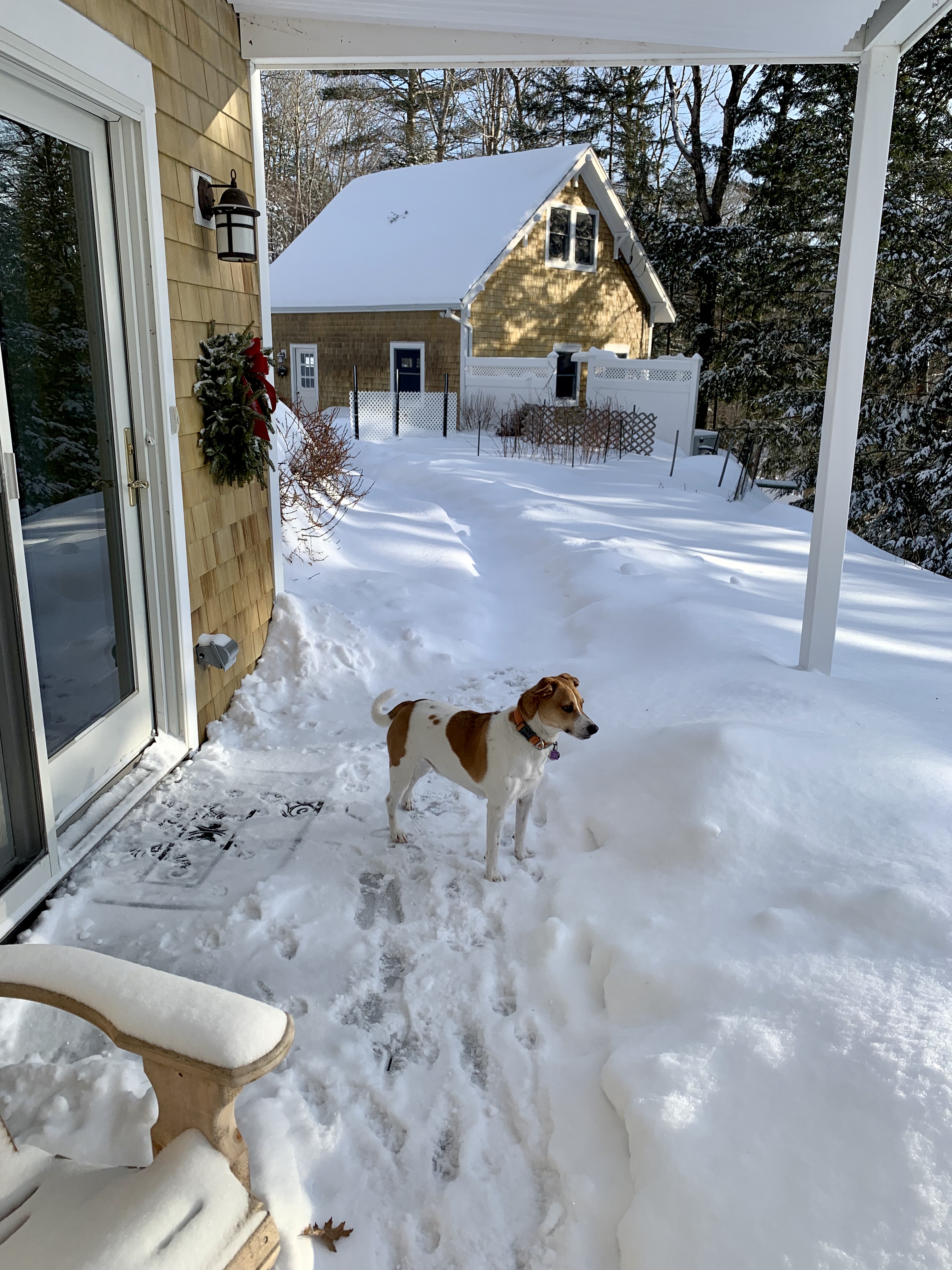
Today dawned sunny—the storm is gone.  It’s 10 degrees.  The snow is light and fluffy, so fairly easy to shovel.  But there is a lot of it—at least 18 inches up here on the hill, but the drifts are deeper of course. And light snow sticks to one’s boots and gloves.

I waded out twice yesterday, snow shovel in hand, to clear the generator, but never lost power. Out by the garage, the drifts were deep enough that I need the shovel for balance.

The storm was meant to be worse in the night, with high winds, but by the time I did the last generator check before bed, local radar showed that the worst had passed us by here on the coast. The darker snow bands were to our west.

AC refused to go out for a long time yesterday until I put on a coat, boots, etc., and went with him.  He didn’t like the high wind. Or peeing in deep snow.

Now, on this sunny, bright morning, I’m enjoying a cup of coffee and waiting for the plow/shovel guys to come.  I need to get the kitchen door open—it got snow stuck around it when I was out there shoveling—there is a kind of wind tunnel that comes off the roof just over that door that dumps snow onto the deck—just outside the door.  I was able to bully that door closed enough to lock it last night (which makes the seals better), but it needs to be cleaned off this morning so it will properly close.

There is something about a big snow storm that makes me feel so alive—especially when I go out into it for a bit.

Nor’Easter Blizzard and Sewing Day

Turkey Tracks: January 29, 2022

Nor’Easter Blizzard and Sewing Day

I’ve been waiting for a BIG snow day.

And here it is.

AC doggie is properly impressed. Other than his morning very quick pee, he’s refusing to go out.

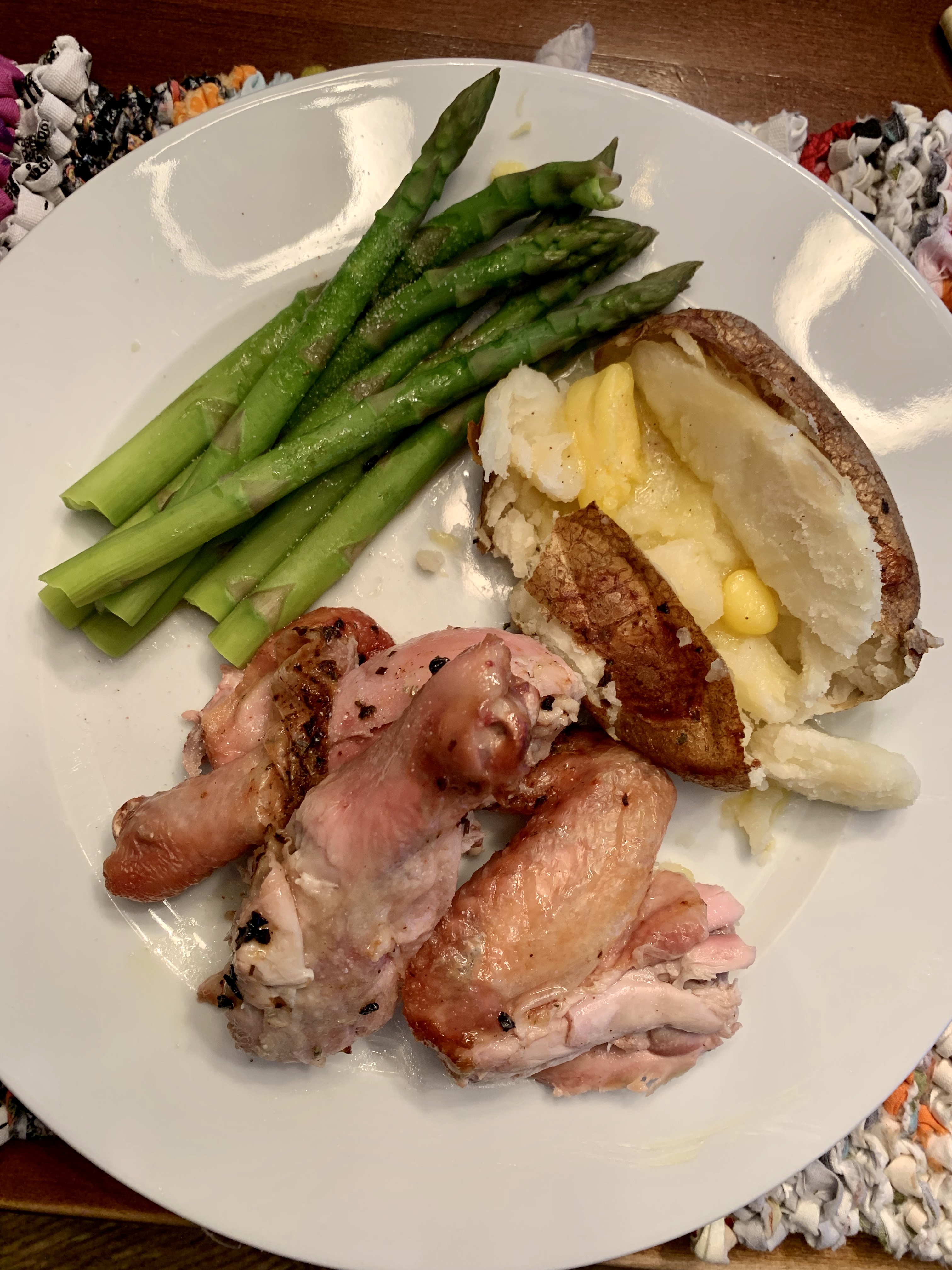
I rounded up yummy food for the day: a chicken which I spatchcocked this morning, some fresh asparagus, some baking potatoes, and a Granny Smith apple which I’ll have for whatever I eat as a light meal tonight.

My favorite chicken parts are the drumsticks and the wings, followed by the thighs.

I’ve been eating my big meal in the early afternoon and having a heavy ”snack” which includes fruit around 7 pm. That feels pretty good for winter.

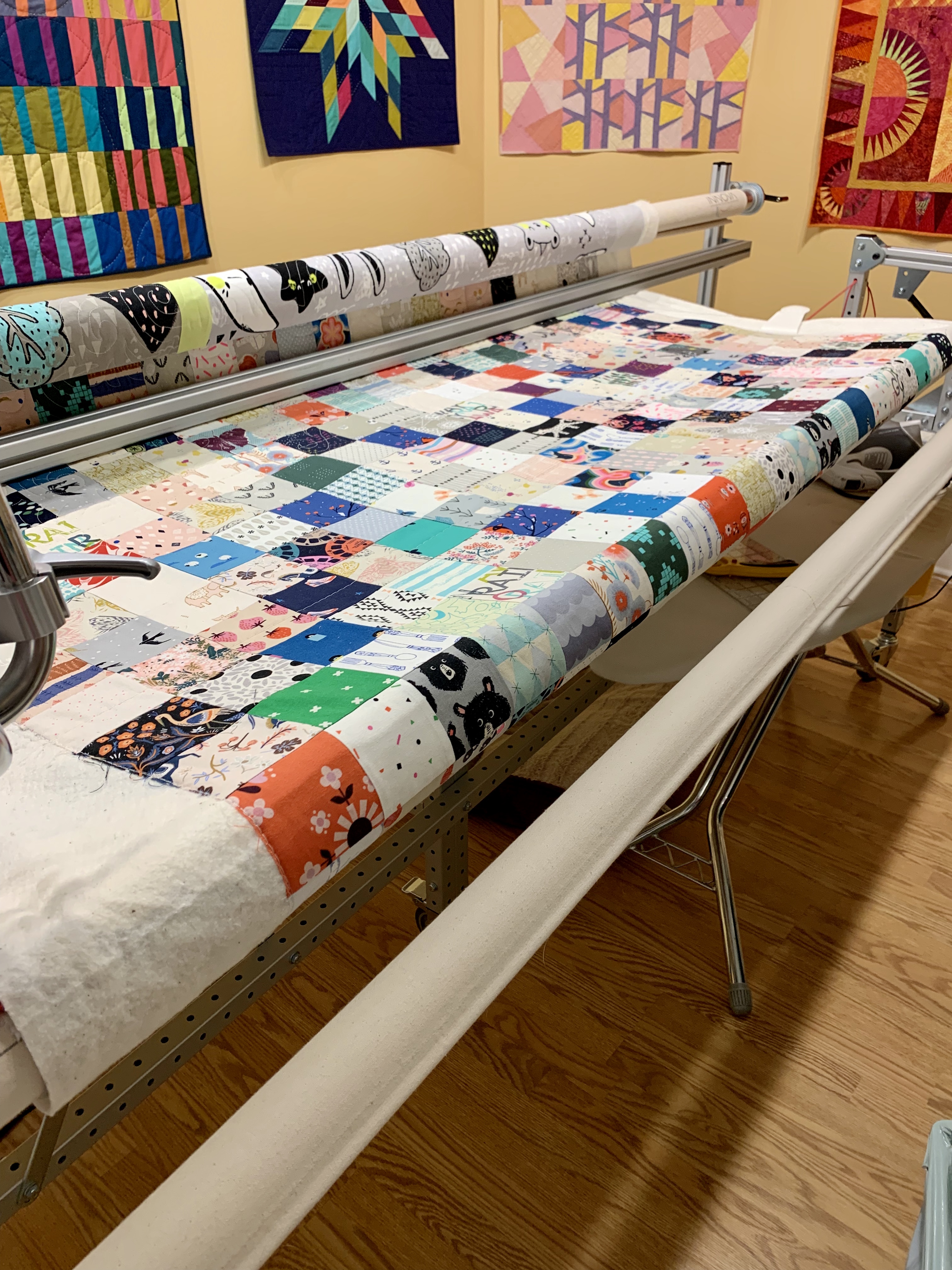
In anticipation of the storm, I put a quilt that’s been waiting on the longarm—and I hope to finish and get it off this afternoon. Then I can trim and bind. An existing quilt only has one night or two left for its binding, so I’ll night sewing all ready to go.

I’ll write more about this quilt in another post.

Now, an update on the flying squirrels presently living between my lower and middle floors—in the ceiling area. A solution is in process—and it is pretty elegant in my opinion. These critters come and go off and on day and night. Trap doors will be set where they are getting in—and they will let them out, but not back in. All the places they can get in will be off-limits via metal screening. There are lots of places where they could attempt to get in—but those places will be protected against them. My wildlife person (Ray) says they will effectively be gone in about one day once this work is done. They will move on to another habitat.

BTW, a ”colony,” like what I have can be 20 to 30 individuals. Oh my.

I have also taken down all the bird feeders. And here is why, other than not wanting the squirrels to stay around my area. Ray saw BIG tracks in the snow—right up near the house. He thinks they are likely from a coyote. And two nights ago, AC went ballistic about something being in his yard. I had a hard time getting him to come back to me—as he was sure we were being invaded by something really dangerous. A coyote? His barking and fierceness was way different than when he chases off the deer.

So, in essence, feeding the birds has set up a situation where coyote is maybe coming to hunt around my house.

How long would it take a coyote to work up the courage to eat AC? He’s definitely a tender morsel.

So, no more feeding birds. Or the squirrels that also gather.