Books, Documentaries, Reviews: Denise Minger’s DEATH BY FOOD PYRAMID

Books, Documentaries, Reviews AND Interesting Information:  March 26, 2014

Death By Food Pyramid:

How Shoddy Science, Sketchy Politics and Shady Special Interests Ruined Your Health…

…and How to Reclaim It

Denise Minger


Denise Minger’s book is a very useful book in so many ways and is, in my not-always-so-humble opinion, a really good addition to the ongoing discussion about food knowledge, food history, and food safety.

IMG_0060

Minger, as you may recall from earlier posts on this blog, is the young woman who took on T. Colin Campbell’s The China Study by digging deep into his research data and showing that, likely, because his belief system about veganism was so strong that he missed what the data was telling him.  Indeed, in the middle of the movie lauding vegetarianism and veganism, Forks Over Knives, the Chinese doctors Campbell worked with in China announced that health seemed to be determined by “meat and vegetables.”

In addition, Minger has an absolutely wicked sense of humor.  But, more importantly, she has a kind of research worldview that looks objectively at what happened and what is, not what gets driven by belief system so that it becomes “truth” when it isn’t.  Despite the grim title, Minger ends her book with a powerful plan of attack on how to win back, as Chris Masterjohn notes in his forward to the book, “the right to a healthy future.”

Minger begins the book with the tale of her 16 to 17th year of living after falling prey to a raw food diet comprised mostly of fruit.  A trip to the dentist revealed SIXTEEN cavities and the dentist’s observation that he had never seen ” `teeth like this on someone so young’ ” (5)  Later she realized that her “teeth had likely fallen victim to a deficiency of fat-soluble vitamins” (5).  Those are the crucial vitamins that live, you know, IN MEAT FAT.  And here’s an example of a typical Minger bit of humor:  “Although the doctor insisted I’d had low levels of iron and vitamin B12, my most deadly deficiency, I would later learn, was in critical thinking” (5).

Here’s another:

Contrary to popular belief, America’s dietary guidelines aren’t the magnum opuses of high-ranking scientists, cerebral cortexes pulsating in the moonlight as they solve the mysteries of human nutrition.  What reaches our ears has been squeezed, tortured, reshaped, paid off, and defiled by a phenomenal number of sources.  And as my own story proves, the USDA’s wisdom, pyramid and beyond, isn’t the only source of misguided health information out there.  But it is some the most pervasive, the most coddled by the food industry, the most sheltered from criticism, and–as a consequence–the most hazardous to public health (7).

Like I have done in the Mainely Tipping Points Essays, Minger goes back to the history of the USDA Food Pyramid and surfaces the swarmy political history of the early 1980s where Luise Light, hired by the USDA to come up with a good food guide, puts together a team of eminent scientists and nutritionists–only to find their recommendations (especially about grain consumption) undercut and overturned by industry shills in the upper regions of the USDA.  (Science-based food policy needs to be removed from the USDA–their interests are in conflict.)  She goes on to identify other players in how our farm policy got so far off track–if one is trying to grow healthy food.  And, how political theater instituted policies out of belief system (with help from the industries who would profit), so that we wound up with the deadly one-size-fits-all low-saturated fat, high-carb diet that is advocated today.  Look around you to see how well that’s all working for a lot of us.  In any case, Minger does a good job of pulling together the important highlights of this history in a readable, interesting form.

One of the arguments Minger makes is that the current “one-size-fits-all” USDA dietary information is “rubbish.”  (The same should be said for one-size-fits-all medicine, school curriculums, and on and on.)  Minger goes to some length to show that we do not all relate to foods in the same way.  We have genetic differences that control how our bodies take up, or don’t, the nutrients in foods–which explains why some folks can tolerate a vegetarian or vegan diet better than others.  Like me, a vegetarian diet made Chris Masterjohn profoundly ill.  (I am still trying to recover from my vegetarian years.)  But all of us likely know people who don’t eat meat or, even, nutrient dense foods, and they are not visibly sick, have reasonable amounts of energy, and so forth.

But, who should one trust?  To answer that question, Minger notes that “our understanding of diet and health is still too young for anyone to have all the answers.”  So, she writes, “Anyone who’s certain they’re right about everything in nutrition is almost definitely wrong.”  And we should not confuse “certainty” with “an evidence-backed opinion that seem reasonably correct.”  Look for people who keep an open mind and who are willing to “consider and integrate new information.”  None of us should be so certain that we lock all the doors.  Rather “a well-reasoned argument with a dash of humility is an open” door (53).

Minger also cautions that despite their white coats, “doctors tend to be some of the least educated health professionals on matters of nutrition.” Doctors don’t, too often, get their ideas on nutrition from “nutrition journals or other scientific literature, but from profit-driven industries with products to push” (57).

To buttress how to find the “well-reasoned argument,” Minger explains at some length how to vet the myriad number of studies out there claiming to hold truth.  She walks readers through what to look for in a study and what to throw into the nearest trash can.  I personally think that we all need to understand what comprises a genuine, useful study and what is fake science.  Of course she takes on the issue of causation versus the simple correlation that pervades much of today’s government, media, and industry hype about “food science.”  I can’t reproduce this whole section of the book for you, but I can urge you to read it so you can begin to understand how to vet information for yourself.  Just because something comes from a place like Harvard does not mean it has any value whatsoever.  One has to look at the nature of the study and WHO HAS FUNDED IT.  Minger also looks at what’s wrong (or what has been misreported) with the key BIG studies, like the longitudinal Framingham Heart Study–which was never able to prove the high cholesterol, dietary saturated fat, and heart disease theory.  Moreover, “multiple papers spawned by Framingham also link low cholesterol levels with greater risk of cancer….” (146).  And it is fascinating to me that in the news recently is the revelation that a blood test that measures lipids (fats) in the blood is 90% accurate as a prediction for Alzeimers:  LOW lipid levels point toward getting or having Alzeimers.

One really important section of the book walks through the history of Ancel Keyes and the lipid (fat) hypothesis.  Unknown to me was the fact that a competing theory was circulating at the same time arguing that sugar was the leading cause of heart disease.  Since sugar lost this battle in the political arena, the name of the scientist, John Yudkin, also got lost.  Other scientists adopted one or the other theory, but the real problem (and what turns out to be a problem with many of the studies) is that trying to blame illness on one single macronutrient does not consider the bigger, more complicated picture.  (Trying to understand the complicated “whole” of things by viewing one of its parts is the curse of modernity AND the producer of bad science.)  I think it was useful to see Keyes and Yudkin within the CONTEXT of their times–an analysis which makes Keyes less of a “demon” who left out information that didn’t fit his hypothesis and more of a scientist who just tried to simplify a cause (fat) too much.

Of course Minger addresses the rise of the use of trans fats and the PUFAs (polyunsaturated fatty acids) with high Omega 6 levels and chronic illness.  And she notes how major organizations like the American Heart Association (AHA) produce studies recommending the PUFAs that are written by people from industry.  For instance, William Harris the author of such a paper for the AHA “received significant funding from the bioengineering giant Monsanto, in addition to serving as a consultant for them.”  Monsanta is pioneering currently a GMO soybean supposedly enhanced with Omega 3’s while also providing Omega 6 (177-178).

Minger discusses the “modern Trinity” of diets (Paleo, Mediterranean, and Whole Foods/Plant-Based)–showing in the process where these diets deviate from their origins.  Modern Paleo, for instance, calls for the use of lean meats and low fat intakes, though ancient peoples ate a lot of animal fat and gave lean muscle meat to their dogs.  Paleo peoples also likely included some legumes and grains in their diets.  And some ate a lot of dairy.   The original Mediterranean diet was adopted from the island of Crete.  Yet those folks fasted almost 180 days a year for religious reasons and foraged for a lot of wild greens seasonally.  The success of the plant-based diet is unclear as it is always compared to SAD, the Standard American Diet, and not to either Paleo or the Mediterranean diet.  This diet needs longitudinal study as to the impact of the lack of fat-soluble vitamins and other nutrients on fertility and bone development, among other things.  It would be wise to note as well that there is no known primitive culture that has lived for some generations entirely on a plant-based diet.

Where do these diets intersect?  They ALL EXCLUDE  industrially processed vegetable oils; refined grains and sugar; “chemical preservatives and lab-produced anythings”; and “nearly any creation coming in a crinkly tinfoil package, a microwavable tray, or a McDonald’s takeout bag.”  They ALL INCLUDE tubers, low-glycemic fruit, and all non-starchy vegetables (225).

There is a lovely discussion of the work of Weston A. Price, who searched the world for healthy groups of people, to see what kinds of food they ate to produce optimal human health.  Minger highlights many of Price’s groups and concludes that while eating patterns could vary enormously, what they all had in common was the presence of nutrient dense foods.

Minger’s takaway:

Eliminate or drastically reduce intake of refined grains, refined sugars, and high-omega-6 vegetable oils.

Secure a source of the precious fat-soluble vitamins.

Stock your diet with nutrient-dense foods.

When choosing animal foods, limit muscle meat and favor “nose to tail” eating.  (Yes, that means the organs, like the liver and bone marrow which is full of gelatin.)

Respect your genetics.(Some of us thrive on high-fat, low-carb diets and others of us do better on a high-starch diet and it all has to do with genetics that dictate how we process fats and starches.)

Acknowledge that health is about a lot more than what you put in your mouth.

Above all else, stay anchored in your own truth–as long as you have not become ensnared in a “psychological trap that prevents you from following your body’s instincts.”  Remember, “you are not low-carb, or lowfat, or plant-based…” (242-243).

Again, Minger’s book is very useful.  I highly recommend it for a no-nonsense detangling of what we do and don’t know about food.


Blog Readers’ Quilts and Quilting Information: The Missouri Star Quilt Company

Blog Readers’ Quilts and Quilting Information:  March 26, 2014

The Missouri Star Quilt Company


Here’s a treat for quilters:  The Missouri Star Quilt Company web site url:  Missouri Star Quilt Co. – Best Selection of Pre-Cut Quilting Fabrics on the Web!.

There are MANY great “how-to” videos on this cheerful and fun web site.

I just finished watching the ones on the Lil Twister ruler/template and found them really helpful.

Here’s what some  “twister” blocks/quilts  look like:     Twister quilt images – Google Search.

One fun thing I learned with these videos is that you lay out squares–say the 5-inch squares I’ve been throwing into a box–sew them together in rows, put on a border, and use the Lil Twister template to start cutting out the twister blocks that you sew together (right away) to keep them in order.  There is a lot of waste, but apparently you can use this waste by taking the next smaller twister template and cutting out more blocks.

I’ll let you know how this process works…

Since you KNOW I have those 5-inch blocks lined up in rows on a bed–since the design wall is full of the red and green quilt.  I’ve got about ten more blocks to make for it.  No pressure.  Nope…

I do love a new project when it’s running around in my head and imagination.


Books, Documentaries, Reviews: A. S. Byatt’s THE GAME

Books, Documentaries, Reviews:  March 25, 2014

A. S. Byatt’s The Game

I just finished A. S. Byatt’s The Game on audio download from the Maine library system and thought some of it delicious.  Some of it, though, was tedious.

The delicious part is that it is the story of two estranged sisters who started off life playing an imaginary “game” with each other–and here are obvious references to the Brontës.  BUT, Byatt’s sister in real life is the also-famous British writer Margaret Drabble–and they are completely estranged.  So, there is some effort going on here to think about that failed relationship.  Perhaps the “why” of it.

51I5bDR94sL._SY344_PJlook-inside-v2,TopRight,1,0_SH20_BO1,204,203,200_

I will say that this is a “literary” novel, but if you know and love Byatt’s other works, like Possession, or the more recent The Children’s Book, or Angels and Insects, you know there is always a lively interest in science, Darwin, the natural world, and philosophies involving how one might live a meaningful life–driven by adoption/rejection of parts of her family’s Quakerism at least in part.  And I can only explain what has been called “drama” by understanding that Byatt is trying to explain one sister’s actions through the notion that she has a mental disturbance that causes her to reject relationships of all sorts.

Here’s an url with a nice synopsis of The Game:

http://www.complete-review.com/reviews/byattas/thegame.htm

And a history of Byatt’s work, prizes, history, etc.

A. S. Byatt – Wikipedia, the free encyclopedia.

Turkey Tracks: The Red and Green Quilt Is Taking Shape

Turkey Tracks:  March 25, 2014

The Red and Green Quilt Is Taking Shape


Looky, looky:

IMG_0220


I’m loving the interesting secondary patterns that are forming.

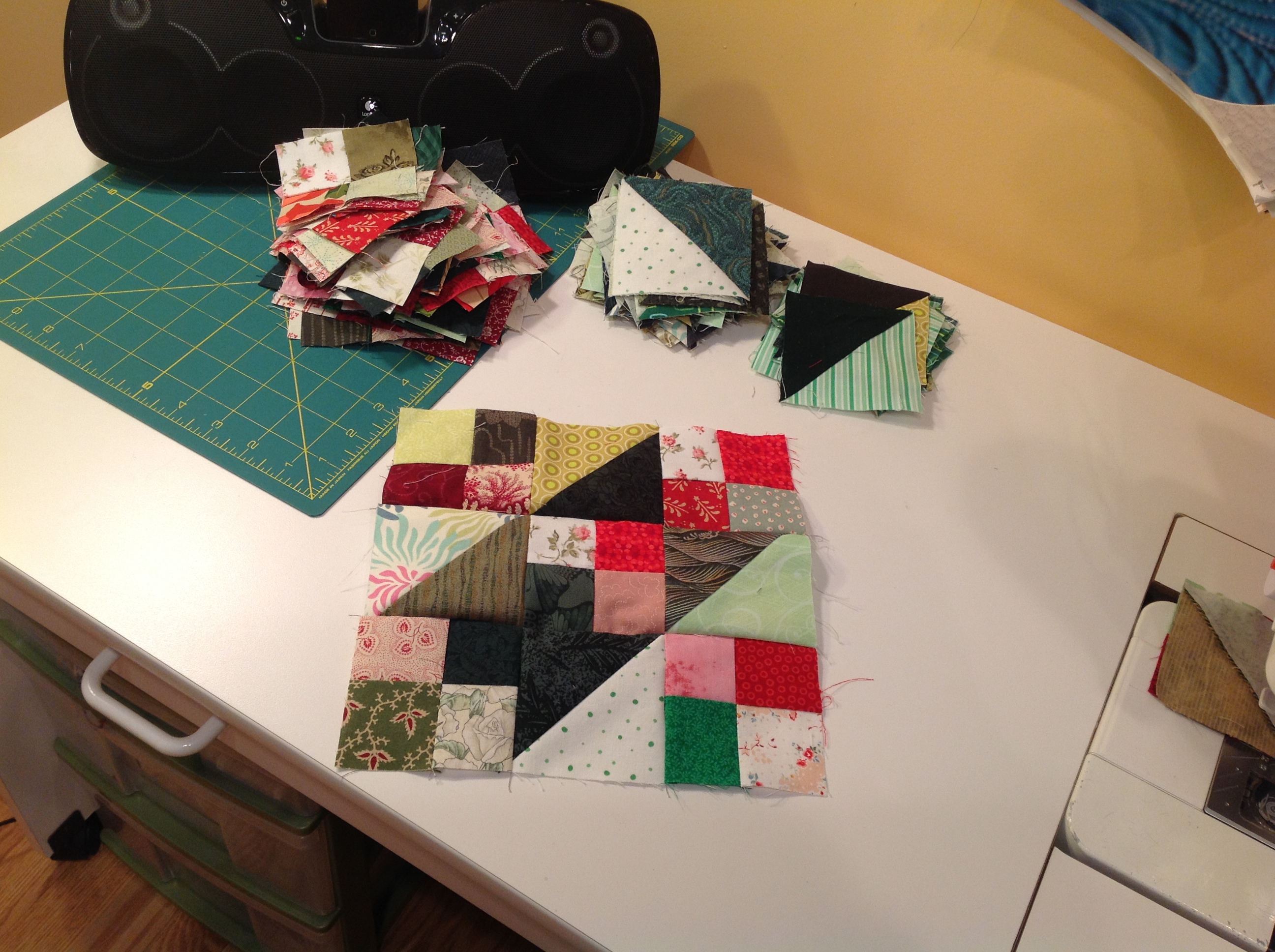
This quilt started as a “leader/ender” project–an idea pioneered by Bonnie Hunter as a method to work on two quilts at once.  Basically, when you get to a point while sewing where you might cut your thread, you feed a “leader/ender” block through the machine instead.  So, for some time I sewed together dark and light green half-square triangles cut from my 3 1/2-inch strips–until I had sooooo many of them.  Then I fed through four-patches of light and dark reds and greens from the two-inch strips. This quilt is being made entirely from my stash that I cut up this summer.

The block is a “Contrary Wife” block–and was inspired by Bonnie Hunter’s “Blue Ridge Beauty” quilt, which I made in green shades last year.  (It remains one of my very favorite quilts in the whole world.)  I think I had a lot of light/dark green half-square triangles started so just continued to make this quilt.  I’ve wanted to make a red/green quilt for some time.

IMG_0223


You MUST have the light square in the upper left corner when you put this block together for the light and dark rows to line up within the lattice pattern.

I’ll do some borders, of course.  Probably a dark red thin border at first–and maybe a wider bright red border next.  Who knows?  The fabrics will come out of my stash.

Interesting Information: Best Known Peer-Reviewed Medical Journal–THE LANCET–Officially Classifies Fluoride As A Neurotoxin

Interesting Information:  March 25, 2014

Best Known Peer-Reviewed Medical–THE LANCET—

Officially Classifies Fluoride As A Neurotoxin


Well, this story floated into my email this morning from Health Freedom Alliance.

Thank heavens, I thought.  Hope has emerged again.

Here’s the url:

Health Freedom Alliance » Success! Best Known Peer-Reviewed Medical Journal Officially Classifies Fluoride As A Neurotoxin.

And here’s the url from The Lancet itself:  http://www.thelancet.com/journals/laneur/article/PIIS1474-4422(13)70278-3/abstract


Fluoride harms developing brains–among many other damages that it does.  There is plenty of science now showing that one to one cause and effect.

Here’s a quote from The Lancet abstract, which Health Freedom Alliance reproduced–and for heaven’s sake, don’t miss the reference to the  neurotoxicity of methyl mercury, which is “common in vaccines”:

“Neurodevelopmental disabilities, including autism, attention-deficit hyperactivity disorder, dyslexia and other cognitive impairments, affect millions of children worldwide, and some diagnoses seem to be increasing in frequency. Industrial chemicals that injure the developing brain are among the known causes for this rise in prevalence. In 2006, we did a systematic review and identified five industrial chemicals as developmental neurotoxicants: lead, methyl mercury (common in vaccines), polychlorinated biphenyls, arsenic and toluene. Since 2006, epidemiological studies have documented six additional developmental neurotoxicants – manganese, fluoride, chlorpyrifos, dichlorodiphenyltrichloroethane, tetrachloroethylene, and the polybrominated dihenyl ethers. We postulate that even more neurotoxicants remain undiscovered. To control the pandemic of developmental neurotoxicity, we propose a global prevention strategy. Untested chemicals should not be presumed to be safe to brain development, and chemicals in existing use and all new chemicals must therefore be tested for developmental neurotoxicity. To coordinate these efforts and to accelerate translation of science into prevention, we propose the urgent formation of a new international clearinghouse”(1)

Here’s another quote from the Health Freedom Alliance posting:

“In point of fact, fluoride causes more human cancer deaths than any other chemical. When you have power you don’t have to tell the truth. That’s a rule that’s been working in this world for generations. There are a great many people who don’t tell the truth when they are in power in administrative positions. Fluoride amounts to public murder on a grand scale. It is some of the most conclusive scientific and biological evidence that I have come across in my 50 years in the field of cancer research.” (2)  – Dr. Dean Burk, Biochemist, Founder of Biotin, and Former Chief Chemist at the National Cancer Institute of Health.


I put three essays about the danger of putting fluoride into our water system on the blog a few years back–Mainely Tipping Points Essays, 34 to 36–using the text THE CASE AGAINST FLUORIDE:  HOW HAZARDOUS WASTE ENDED UP IN OUR DRINKING WATER AND THE BAD SCIENCE AND POWERFUL POLITICS THAT KEEP IT THERE (2010), Paul Connett, PhD, James Beck, MD, PhD, and H.S. Micklem, DPhil,   In the essays, I cite the formidable credentials of these three authors–all of whom are now senior scientists.

Here’s an excerpt from what I wrote regarding who is tasked with responsibility for the safety of fluoride in our water:


Astonishingly, Connett et al report that no federal agency accepts responsibility for the safety of fluoridation.

The Food and Drug Administration (FDA) has never approved fluoride for ingestion and rates fluoride as an “unapproved drug”—which is why it can mandate the toothpaste warning.  Nor has the FDA subjected fluoride to rigorous randomized clinical trials for either its effectiveness or its long-term safety (270).

At the Center for Disease Control (CDC), only the Oral Health Division (OHD) is involved with fluoridation, and the OHD is staffed largely by dental personnel.  In 2008, Connett et al note, not one of the 29 staff members had scientific degrees qualifying them to assess the toxicity of fluoride, yet this division aggressively promotes fluoridation throughout the United States (23-24).

The Environmental Protection Agency (EPA) has an indirect role in that it regulates safe standards for all “contaminants” in drinking water.  In 2002, as it is legally required to do every 10 years, the EPA asked the National Research Council (NRC) to review the current 4 ppm (parts per million) Maximum Contaminant Level (MCL) standard.  The NRC appointed a 12-member panel that, the authors state, was “the most balanced ever appointed in the United States to do any kind of review on fluoride” 137).  This panel issued its 507-page report in March 2006, in which it declared that the seemingly low-level 4 ppm maximum standard was not protective of health (25).

The ADA [American Dental Association] declared the NRC report irrelevant to water fluoridation on the day it was released—claiming erroneously that the panel only reviewed water fluoridation of 4 ppm.  The panel, in fact, “examined several studies that found adverse effects at levels less than 2 ppm” (138).

The CDC followed six days later with the same conclusion.  To date, write the authors, the CDC has produced “no comprehensive analysis to support its claim.”  And “it’s hard to believe that in six days Oral Health Division personnel could have read and digested the report, let alone its over 1,100 references” (140).

Ironically, in 1999, the CDC “finally conceded what many dental researchers had been reporting over the previous two decades:  Fluoride’s predominant mechanism of action was topical, not systemic.  In other words, if fluoride works at all, it does so via direct exposure to the outside of the tooth and not from inside the body” (13).  So, write Connett et al, to continue “the practice of forcing people to ingest fluoride has become even more absurd (269-270).

BUT, even the ADA, in fine print on its web site, warns against feeding baby with formula mixed with tap water because the fluoride levels are too high for infants.

YOU CANNOT CONTROL THE DOSE OF THIS TOXIC MATERIAL WHEN YOU PUT IT IN THE WATER–and that affects infants, the elderly, the infirm, and anyone who drinks a lot of water.

What is particularly GALLING to me is that putting fluoride into our water has always been a POLITICAL DECISION–not a scientific one–which is totally demonstrated by Connett et al in their book.

What is doubly particularly GALLING is that the most recent scientific review, as stated above, commissioned by the EPA and carried out by the National Research Council, raised at least a dozen red flags about the efficacy of fluoride at all and the use of fluoride in the water.  Yet our public health officials, who get their information from the big health organizations–most of whom have gotten themselves way out on a shaky legal limb with regard to fluoride–have clearly NOT READ for themselves recent information on fluoride, to include the recent NRC study.

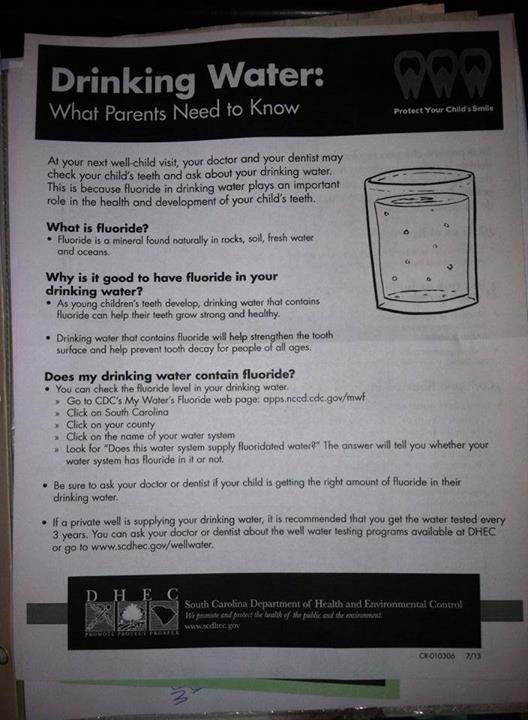
So there’s a “kool aid” loop in place here that is not taking into account any current science.  So, here’s what gets sent home to parents via the school system:

IMG_0197

(Thanks niece Nancy Howser, herself the mother of two young boys, one of whom has already suffered a broken leg bone.)

AND, when a local jurisdiction gets a referendum on fluoride, the local public health officials, including MDs and dentists, come out of the woodwork supporting fluoride and throwing around their “health” credentials.  This behavior happened in Damariscotta a few years back–and it was clear that not one of these folks had read the most recent EPS/NRC report.  And we all must remember that doctors and dentists are PRACTITIONERS, not scientists, and public health officials know only what they have been taught and that if they deviate from what they have been taught, they can lose their jobs.

So, cheers to The Lancet!

Interesting Information: The Worth of Bananas

Interesting Information:  March 24, 2014

The Worth of Bananas


A friend was here recently, and she was SHOCKED that I rarely eat a banana.

“What about potassium?” she said.

“Well,” I said, “bananas being a good source for potassium is mostly food industry hype and does not take into account the down side of eating bananas.”

“What???”

One medium banana of the type in our stores has 450/mg of potassium–and a whole lot of starchy carbohydrates that aren’t much good for anything.  (Highly colored bananas in other parts of the world carry a better nutrient load than the yellow banana to which we have standardized–an incredible loss of diversity through monocrop cultures run by industry.)  I don’t know about you, but I’d like to lose another 20 pounds, and I can’t do that by eating useless, starchy carbs.

And there are better food sources for potassium:

Flounder (6 ounces) has 996.

Winter squash (1 cup cooked) has 946.

One medium white potato has 844.

Salmon (6 ounces fresh) has 756.

Cod (6 ounces) has 690.

Parsnips (1 cup cooked) has between 573 to 758.

Avocado (1/2 medium) has 602.

Asparagus (1 cup lightly cooked( has 558.

Orange juice freshly squeezed (1 cup) 496 and collard greens (1 cup cooked) 468

Broccoli (1 cup) comes just below banana at 440.

Other sources are chicken, sweet potato, celery, and tuna.

(I left out the dried fruits as they aren’t especially good for you even if they have good doses of potassium.)

Potassium is a mineral that works as an electrolyte that carries “tiny electrical charges throughout the body, and especially ensures the proper functioning of the heart,” according to Rachel Albert, B.A., in “Charging Up With Potassium” in Well Being Journal, Jan/Feb 2013 (35-37).  (I love Rachel Albert’s The Garden of Eating–it has wonderful recipes and a plan for how to manage to always have really good food available in your home by cooking multiple dishes at once and adding to them as you go along in the week.)

Potassium deficiency “may include fatigue, weakness, irritability, loss of muscle strength, muscle cramps or spasms (charley horses), swollen ankles, general edema, and recurring headaches that come at the same tie each day” (35).

Albert writes that “potassium and sodium play a tug of war across the cell walls in your body, with the delicate balance of your body chemistry at stake.  So, when the sodium concentration is high, potassium is literally stolen from your body.  It is leached from your tissues, poured into your blood stream, then dumped into your urine and excreted.  Conversely, when the potassium content outweighs sodium, your body is able to release and let go of excess sodium and water.  Potassium in its natural state acts as a mild diuretic and can counteract hypertension, which is more common among individuals and ethnic groups who consume few potassium-rich goods (37).  In hot weather, Albert notes, we need more potassium as we sweat potassium levels out of our bodies.

The more I read about our bodies, the more I am realizing how delicate the chemical balances can be.  I often have muscle cramps–especially after I eat some chocolate, I’ve noticed.  Or, when I hike.  And I know that my potassium can get too low–from a blood test the last time (March 2013) I had a bad food allergy attack.  The minute I take a potassium tablet, the cramps stop.

BUT, this article is the first time I’ve made an association between potassium and salt.  I eat and LOVE a LOT of salt–sea salt.  So maybe I’ll cut back a bit.  Salt is not the demon it has been made out to be for years–I’ve written about that on this blog–but I often put even more salt on foods before tasting them.  So…time for a bit of a change.  Perhaps I’ve been throwing off this potassium/salt balance in my body.


Turkey Tracks: Georgeanne Davis’s “Purely Pancakes” Can Be Gluten Free

Turkey Tracks:  March 24, 2014

Georgeanne Davis’s “Purely Pancakes” Can Be Gluten Free


Update:  Since I posted this blog entry, I’ve come to realize that ricotta cheese is even nicer in the pancakes.  It’s dryer.  AND, you don’t need to whip egg whites.  I just mix up all the ingredients and fry up the pancakes.  Whipping the egg whites makes the pancakes almost too light…


I got back from Virginia on a Monday two weeks ago, and the next day set out to retrieve  neighbor Sarah Rheault from the Owl’s Head Airport in Rockland.

I got there a few minutes early and idly picked up last week’s copy of THE FREE PRESS.

Georgeanne Davis’s column on pancakes caught my eye, and I confess, I extracted that page from the rest of the paper.  After all, it was old by now…

I was drawn to the recipe for Cottage Cheese Pancakes, but thought the Potato Latkes and Asian-Style Pancakes looked good too.   All of these recipes could be made gluten free without much ado I thought.

* * *

So, this morning I made the Cottage Cheese Pancakes–and boy was I happy!!!  They were light, fluffy, and totally delicious and garnished with Margaret Rauenhorst’s maple syrup, local raw butter, and served alongside some bacon.  (I used the bacon fat to grease the pancake pan.)

I HALVED the recipe and used coconut flour instead of wheat flour.  I think I could have used brown rice flour or, even, the gluten free local pancake mix I keep on hand–Fiddler’s Green Fiddle Cakes.  Next time I’m going to try the brown rice flour, just to see.  HALVING the recipe gave me enough pancakes for two people, easy.

For the Asian pancakes, I think I’d use coconut, for the oil and either the brown rice flour or the pancake mix for the flour.  I think coconut flour works ok in small lots rather than a whole cup size…  That’s just me though…

* * *

It’s two hours later, and my tummy still feels warm and happy.  What’s not to like about 3 eggs, cottage cheese, butter, and bacon for breakfast?  Lots of good protein and fats.  Also, apparently real maple syrup has a lot of good minerals in it.  Who knew?  I’ll reheat the three/four remaining pancakes for breakfast tomorrow…  In the oven as I gave away my microwave some years ago.

Here’s the column from THE FREE PRESS, March 6th (17):


Home & Garden: Purely Pancakes

by Georgeanne Davis

Call them crepes, latkes, blintzes or just plain pancakes. All are appropriate fare on Shrove Tuesday, also known as Pancake Tuesday and more familiarly known as Mardi Gras, which occurred earlier this week. Mardi Gras, literally “Fat Tuesday,” is known for its hedonistic celebrations and elaborate parades, especially in New Orleans in the U.S. and Rio’s Carnival. Mardi Gras is in fact the final day of lush living for Catholics before Lent begins on Ash Wednesday. Traditionally, at midnight on Shrove Tuesday, the Lenten fast of 40 days begins.

Why pancakes? Starting back in medieval times, pancakes were a way to use up milk, fats and eggs, which were forbidden during the fasting period. Today’s pancakes can be topped with a melting lake of butter or cloud of whipped cream, but they can also be primarily made up of vegetables – perfectly in keeping with leaner Lenten fare. One of our family’s favorite all-time pancake recipes contains no fat. Cottage cheese pancakes, originally from the “Tassajara Bread Book,” the kitchen bible of the back-to-the-land movement in the 1970s, are still unbeatable for any meal of the day.

Cottage Cheese Pancakes à la Tassajara 

6 eggs

6 Tbsp. flour

1⁄4 tsp. salt

2 cups cottage cheese (nonfat, low-fat or full-fat)

Separate eggs. Beat egg whites until stiff and set aside. Mix yolks with flour, salt, and cottage cheese, then gently fold the egg whites into this mixture. Fry like regular pancakes on a lightly greased skillet. Serve topped with applesauce, jam, or just enjoy plain with a swipe of butter.

Potato pancakes, or latkes, make a perfect last-minute supper or brunch fare. Starchier potatoes are usually preferred for latkes, but we like to use Yukon Golds or our own Nicolas. Sweet potatoes work well, too.

Potato Latkes

1 pound potatoes

1⁄2 cup finely chopped onion

1 large egg, lightly beaten

1⁄2 tsp. salt

1⁄2 cup olive oil

Preheat oven to 250°. Peel potatoes and coarsely grate by hand, transferring them to a large bowl of cold water as you grate them. Soak potatoes for a few minutes after the last batch is added to water, then drain well in a colander. Spread grated potatoes and onion on a kitchen towel, gather it up and twist towel tightly to wring out as much liquid as possible. Transfer potato mixture to a bowl and stir in egg and salt. Heat oil in a heavy skillet over moderately high heat until hot but not smoking. Ladle two tablespoons potato mixture per latke into skillet, spreading into three-inch rounds with a fork. Reduce heat and cook until undersides are browned, about 5 minutes. Turn latkes over and cook about 5 minutes more. Transfer to paper towels to drain and season with salt. Add more oil to skillet as needed. Keep latkes warm on a wire rack set in a shallow baking pan in oven. Latkes can be made ahead and reheated on a rack set over a baking sheet in a 350° oven for about 5 minutes. Serve with applesauce and sour cream.

Another savory pancake is Asian in origin, found in Japan, Korea and China. Hold the syrup and use the accompanying dipping sauce for these.

Asian-Style Pancakes

2 cups flour

2 eggs, lightly beaten

1 tablespoon vegetable oil, plus more as needed 

5 scallions, cut into 3-inch lengths and sliced lengthwise

1 medium carrot, peeled and grated

1 small yellow or green squash, grated

Dipping sauce:

1 tablespoon rice or white vinegar

3 tablespoons soy sauce

1 teaspoon sugar

In a medium bowl, mix flour, eggs and oil with 1-1⁄2 cups water until a smooth batter is formed. Stir in scallions, carrots and squash. Place an 8-inch skillet over medium-high heat, then coat bottom with oil. Ladle in about a quarter of the batter and spread it out evenly into a circle. Turn heat to medium and cook until bottom is browned, about three minutes, then flip and cook for another two minutes. Repeat with remaining batter. Drain pancakes on paper towels. In a small bowl, mix together vinegar, soy sauce and sugar. Cut pancakes into small triangles and serve with dipping sauce.


Interesting Information: ZZZ Wraps

Interesting Information:  March 23, 2014

ZZZ Wraps

Here’s what I hope will be a very fun product–given to me by DIL Tami Enright, who is Director of The Bee Cause in South Carolina–a project of The Savannah Bee Company.

This bees’ wax soaked fabric can seal a bowl or wrap a sandwich.

I can’t wait to try it.

IMG_0211

Here’s what it looks like unfolded.

IMG_0212

It came from Mama Bee Hive,  http://www.mamabeehive.com/index.php.  But the present web site does not list this product.  Perhaps a phone call to them if you are interested?

So I have no idea what it costs.  Apparently one just washes off the cloth and lets it dry and reuses.

I’ll report back after use…

Books, Documentaries, Reviews: Jeffrey Eugenides, THE MARRIAGE PLOT

Books, Documentaries, Reviews:  March 23, 2014

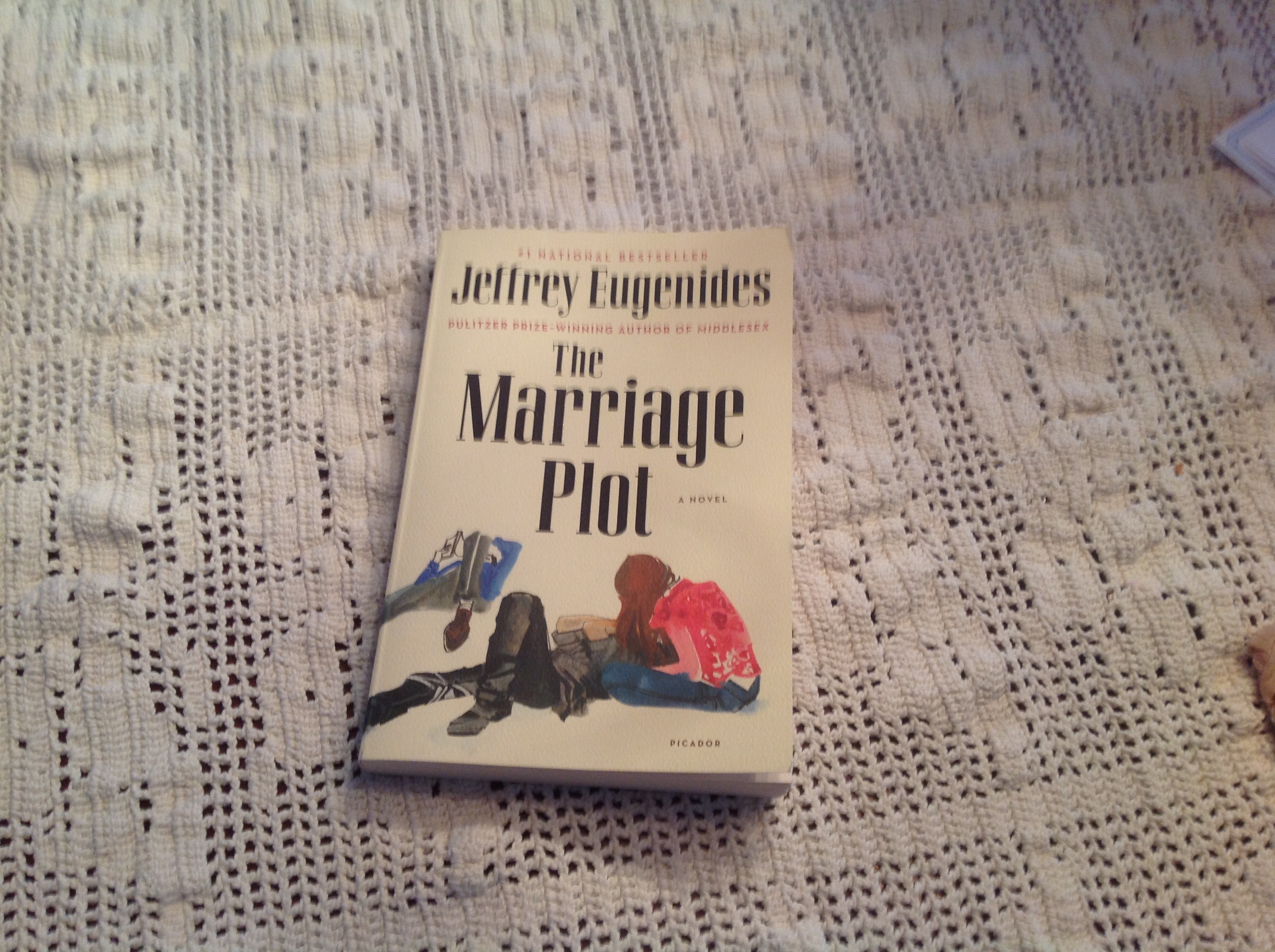
The Marriage Plot

Jeffrey Eugenides

I really enjoyed this novel.

IMG_0208


The setting is Brown University (mostly flashbacks) and the year or so after the three main characters graduate and are trying to get on their feet.

Madeleine loves to read and has majored in Literature.  She loves Leonard, who is brilliant but is just coming to grips with pretty severe mental illness–extreme manic/depressive swings.  Mitchell loves Madeleine and is seriously trying to work out how to live a life of meaning and purpose which may or may not include Madeleine.

Here’s a quote that can orient you a bit:

Her junior year, Madeleine had taken an honors seminar called The Marriage Plot:  Selected Novels of Austen, Eliot, and James.  The class was taught by K. McCall Saunders….a seventy-nine-year-old New Englander….In Saunders’s opinion the novel had reached its apogee with the marriage plot and had never recovered from its disappearance.  In the days when success in life had depended on marriage, and marriage had depended on money, novelists had had a subject to write about.  The great epics sang of war, the novel of marriage.  Sexual equality, good for women, had been bad for the novel.  And divorce had undone it completely.  What would it matter whom Emma married if she could file for separation later?  How would Isabel Archer’s marriage to Gilbert Osmond have been affected by the existence of a prenup?  As far as Saunders was concerned, marriage didn’t mean much anymore, and neither did the novel.  Where could you find the marriage plot nowadays?  You couldn’t.  You had to read historical fiction.  You had to read non-Western novels involving traditional societies.  Afghani novels, Indian novels.  You had to go, literarily speaking, back in time (21-22).

Madeleine’s senior thesis involves the marriage plot in Victorian novels.

Yet, she marries Leonard, knowing he is very ill.  She had walked out on him after he had egregiously insulted her some weeks before graduation, and, perhaps she felt responsible for the hospitalization that followed and for the next year when he is on so many medications that he can hardly function.  Perhaps she was motivated by feeling that he loved her after all–a kind of “I got my man.”  Perhaps she thought she could help cure him–the ancient nurturing role for women.  Who knows?  But it is a “marriage plot” of sorts, isn’t it?  So is Eugenides trying to write a novel about marriage that is still valid?

Mitchell carries Madeleine in his imagination and his desires as his “ideal” woman–which is another form of  the Western marriage plot, one that involves “winning” the woman, loving her forever, ideal marriage, and so on and on.  After graduation, he travels the world, including India, and begins to sort out romance and culture from reality.  He writes Madeleine from India imploring her not to marry Leonard and suggesting they both go back to school and live together.  He will study theology; she will study Victorian novels or whatever she wants.

How does it all end up?

I won’t tell…

Warning:  there is a lot of philosophical discussion about the meaning of life, modern notions of deconstruction, etc., all of which is pertinent and interesting in a college class setting, but which may be off-putting to some readers.  Indeed, I think it was to some reviewers, which is kind of sad, actually.

Turkey Tracks: A Knitted Sock Story

Turkey Tracks:  March 21, 2014

A Knitted Sock Story

At least six years ago–maybe longer–my Virginia quilting group, which meets every year in Williamsburg for a week, wanted to make socks.

I had probably been making the first socks I was learning to make the previous year.  I was using bigger needles, size 3, Lion Brand sock yarn, and their free pattern–which makes a heavy sock best for boots.  (I now use size 1’s, and the sock is finer.)

So, I rounded up yarn and needles and Lion’s brand yarn and gave those interested a set.

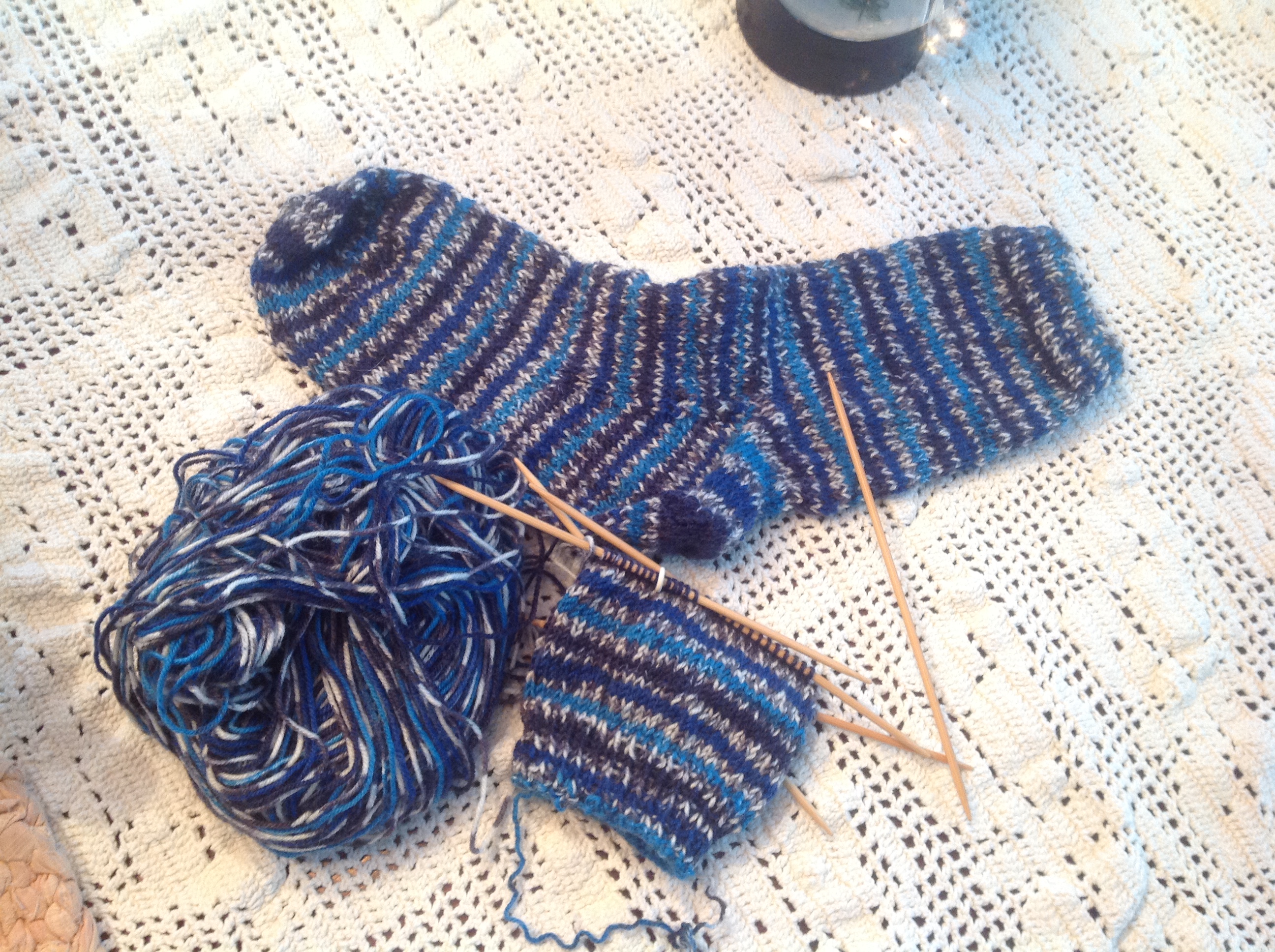
Rosie Pilkerton started a pair of socks with this yarn.

IMG_0203

The next year, Rosie brought back her sock, which was almost done.  But, the needles had been too big for her gauge, and the sock was too big and stretchy.   We were all afraid she would not have enough yarn to finish a second sock as well.

“Rosie, you have to start over with smaller needles.”

“Your mean, rip it out????   No way!!!”

The following year, Rosie brought the sock back and we had the same conversation.

Then, I missed three years as John was too sick for me to leave him with dogs and chickens.

This year, just after we had all settled in, out came the sock.  And I repeated the remedy for this sock problem.

“No way!!!!!” said Rosie.

But this year, Caroline Razeq, who had gone on to make other socks, picked up the sock, handed me the loose end to wind, and with Rosie moaning beside us, we undid the sock.  Along the way, I kept promising that I would fix it for her.  As we unknitted the sock, the adage “you break it, you own it” played in my head.

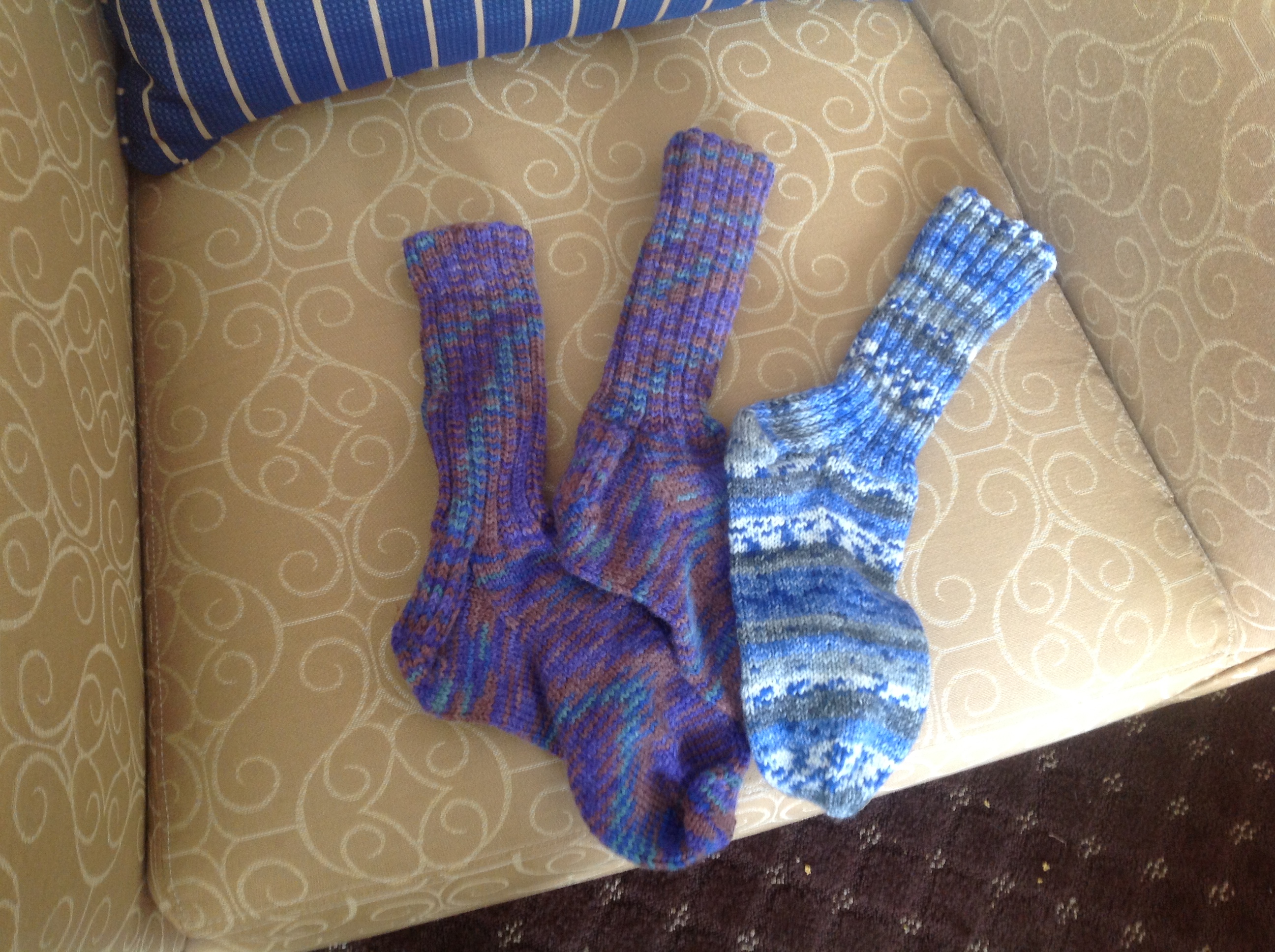
So, I put aside the sock project I had brought with me and started reknitting Rosie’s socks.  I just mailed the completed socks to Rosie (it was her birthday too!) the other day.  I had located some of my yarn that would work to complete the toe, but I did have enough of the Lion’s yarn to complete both socks.  That’s usually the way–it never looks like you will have enough yarn, but you do.

And that felt pretty good–to be able to fix something for an old and valued friend who will likely not knit another pair of socks ever in her life.  Though, I should add, she knits scarves with intricate patterns that are beautiful.  And I should also add that socks are not difficult to make, they just look daunting.

Meanwhile, Caroline had two pairs of socks with toe errors.  She had sewn them together going up and down rather than side to side.  And we had to rip one back to the point where she decreased to get the toe right.  But, here they are–all fixed and, hopefully, being worn now:

IMG_0189


Caroline is now working on a dark green pair which will be very pretty.

She’s ready now for a good sock book–I recommended Charlene Schurch’s Sensational Knitted Socks, which I have really enjoyed and highly recommend.