Turkey Tracks: Talula Is an Artist

Turkey Tracks:  May 23, 2013

Talula is An Artist

I really love the fact that my four older grandchildren are exposed to learning how to create art.

I am so glad that their schools recognize how important creative expression is when it takes the form of art created with the hands, with paint and glue and messiness, not just with the heart and mind, such as is true with words.

Talula, though, has been an artist for some time.  She’ll be seven in September, but for years now she has had the practice of getting up early to draw, color, and create.  When she comes to Maine and is “on vacation,” she spends a lot of time making art.  I put up a table for her and try to keep the house supplied with paper, crayons, colored pencils, and so forth.  They all love to make art, but Talula NEEDS to make art.  It’s going to be be really interesting to see where this need to create art takes Talula in the years to come.

I always ask Talula to show me her recent art when I visit her in Charleston.

Here’s the best of what she showed me this last trip:

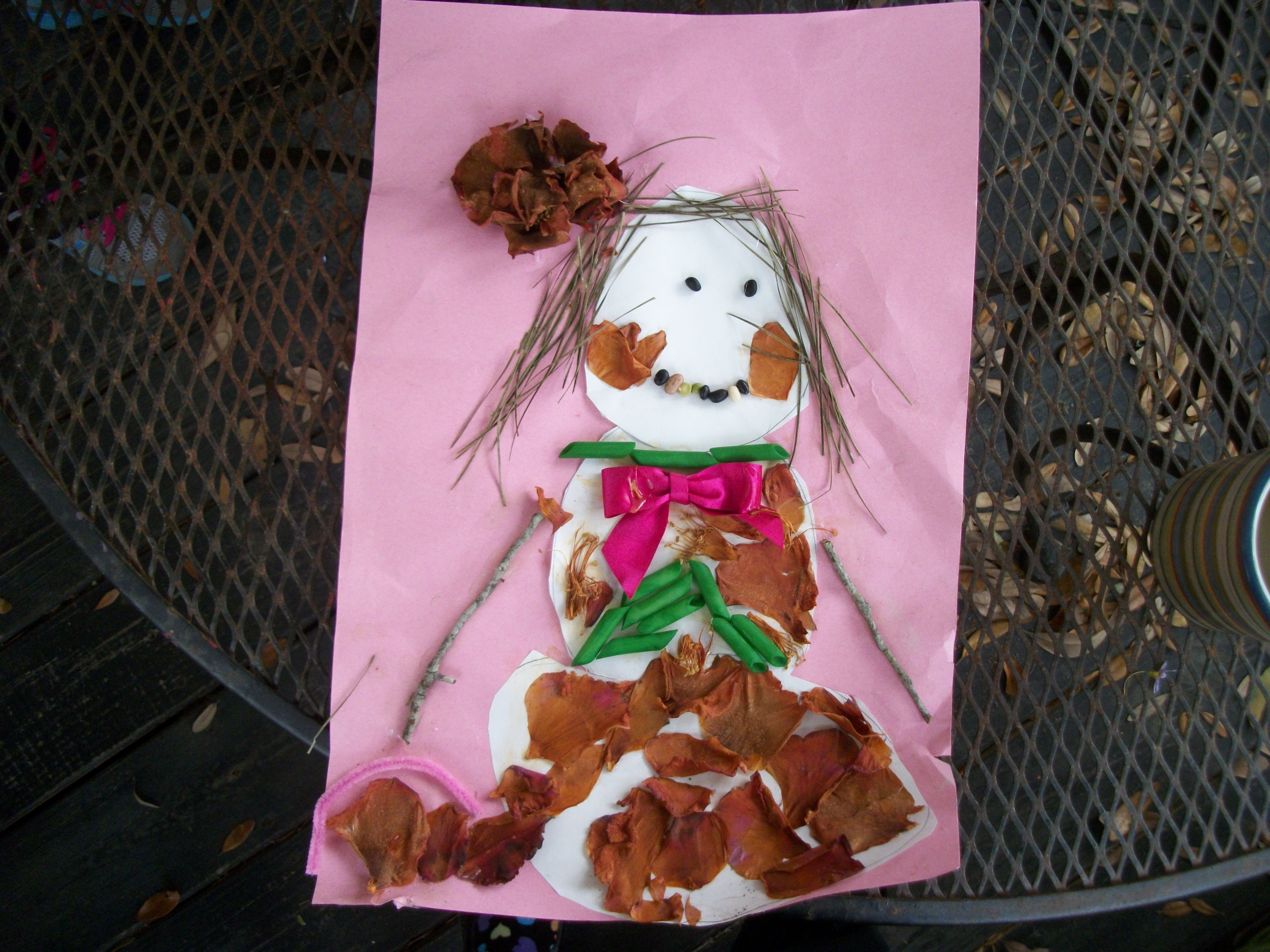
Talula made “the girl” with rose petals, pine straw, sticks, beans, a ribbon, and pasta.  This girl has a new form from earlier “girls”–she is stockier and does not have the long neck Talula usually draws.

Talula and her art

Here’s maybe a better picture:

Talula's girl

She has two other  motifs I’ve seen her doing for the past few years.  A girl with a pony-tail hairdo and a colorful rainbow.

Talula's girl 2

Here, I think her use of background color–and her patience with putting it all in–is interesting.

This girl can often have a long, skinny neck with bands of color and texture.  I have one of those on my quilt-room wall and would like to make a quilt version of it for her birthday.  (The road to hell is paved with good intentions.)

Here’s the iconic rainbow she does–which I like because, again, it shows she’s not afraid of color.  And, the rainbow is about something that she’s imprinted on herself artistically.  Like the long-necked girl.

Talula's rainbow

She made a rainbow on Tara Derr Webb’s ipad (53 Paper App, which is fabulous) when she heard John had died:

Lula drawing

I have saved it.

Interesting Information: Portland, Oregan, Citizens Reject Fluoride

Interesting Information:  May 23, 2013

Portland, Oregon, Citizens Reject Fluoride

For the FOURTH time since 1956 Portland, Oregon, citizens have rejected adding fluoride to their water supply.  This time, by a 60-40 percent margin.  And, despite “public health experts” support of the proposal to add fluoride to the water.

Who are these “public experts”?  Are they local doctors?  Are they public health officials?

One thing these “experts” are NOT is people who have read the most recent government report assessing the use of fluoride in the water.  That report raises all kinds of warning flags about putting fluoride in the public water systems.  And they are NOT people who are aware that even the American Dental Association is telling people not to use fluoridated public water in baby formula because the dose is much to great for infants.  There isn’t a geriatric association to warn senior citizens with health issues not to drink fluoridated public water as the dose is likely too great for them.

Let’s step back a moment and remember that “public health experts” who are MDs and those trained as public health officials are NOT scientists.  MDs and dentists are PRACTITIONERS, not scientists.  They are not trained to vet the array of scientific studies about fluoride (or lots of other thorny health issues, like, for instance, vaccines or what to eat).  They know only what they have been taught or have been told.  Give them wrong information, and they are, as much as you and I, caught in a bad information loop that is not based on any reputable science.  And like most people who are working long hours, they do not have time to do extensive, deep research anyway.

Let’s also note that it is absolutely irresponsible for these “public health experts” people to publicly support something like putting fluoride into the water–a dangerous chemical whose dosage cannot be controlled–without first doing RECENT research, which would include AT LEAST looking at the most recent government report, which was done by a panel with the kinds of credentials that ensure that panel members know how to vet the evidence.

SCIENTISTS are, thus, telling us that fluoride in the water is dangerous and that it does not prevent cavities.  The correlation between diet and cavities is stronger than the correlation between fluoride and cavity prevention.  Remember, anyway, that correlation is NOT CAUSATION.  Causation has to be proved, and with fluoride, it NEVER HAS BEEN PROVED.  If you have cavities, you are likely eating too much sugar or have other malabsorption issues going on.  (Remember that all those grains these same “public health experts” have us eating turn right into sugar in your body.)  And, I’m beginning to realize that cavities can actually be healed with a good diet of nutrient-dense foods.  How’s that for a surprise?

There is a good book about fluoride from three scientists who know how to vet the evidence.

Tim Boyd reviewed THE CASE AGAINST FLUORIDE:  HOW HAZARDOUS WASTE ENDED UP IN OUR DRINKING WATER AND THE BAD SCIENCE AND POWERFUL POLITICS THAT KEEP IT THERE, by Paul Connett, PhD, James Beck, MD, PhD, and H.S. Micklem, DPhil, in the spring 2011  WAPF journal, “Wise Traditions.”  Boyd noted the authors’ statement that the pea-sized dab of toothpaste contains as much fluoride as one glass of fluoridated water.  Boyd asked if adults call the Poison Control Center after drinking the recommended eight glasses of
water per day since they would have exceeded EPA’s daily safety dose for fluoride.

Don’t have time to read the book?  That’s ok, because I read it for you.  I have three essays on this blog summarizing the main evidence and the authors’ arguments:  Mainely Tipping Points Essays, Nos. 34, 35, 36.

Here’s the url for the NY Times article about the Portland vote:

http://www.nytimes.com/2013/05/23/us/oregon-fluoride-measure-in-portland-is-defeated.html?_r=1&

GO PORTLAND!!!

Turkey Tracks: Worms in My Basement

Turkey Tracks:  May 21, 2013

Worms in My Basement

I have worms in my basement.

Vermiculture Worms.

They eat my garbage.

Actually, they eat the mold my garbage makes at it…ages.

They don’t smell.

They have likes and dislikes.  They are not crazy about citrus.

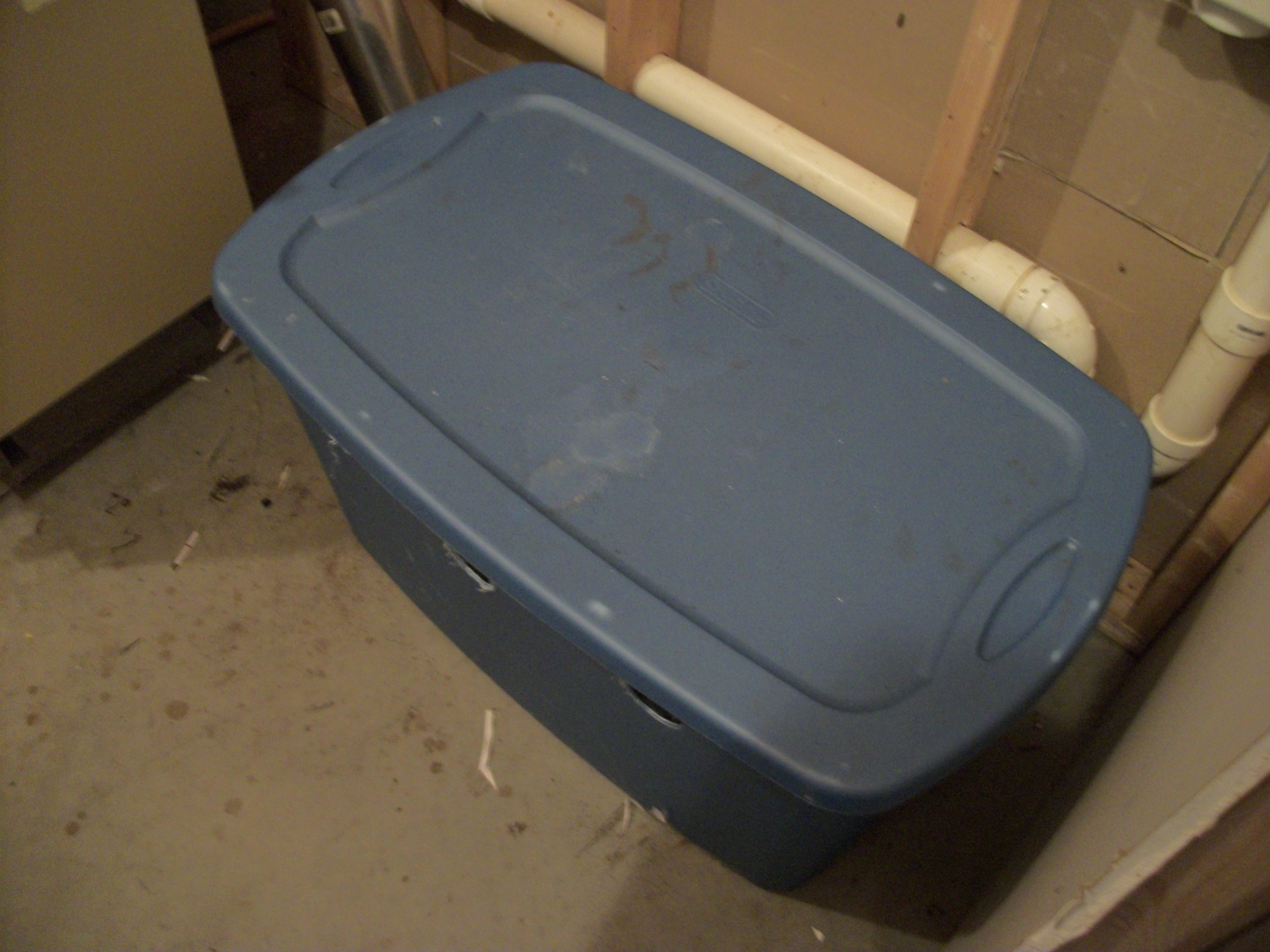
They live in this box in the utility room:

Worm box

It’s warm in the utility room.  They like warmth.  See the vent holes on the sides of the box.  Screens taped on the inside keep the worms from exploring more of their habitat.

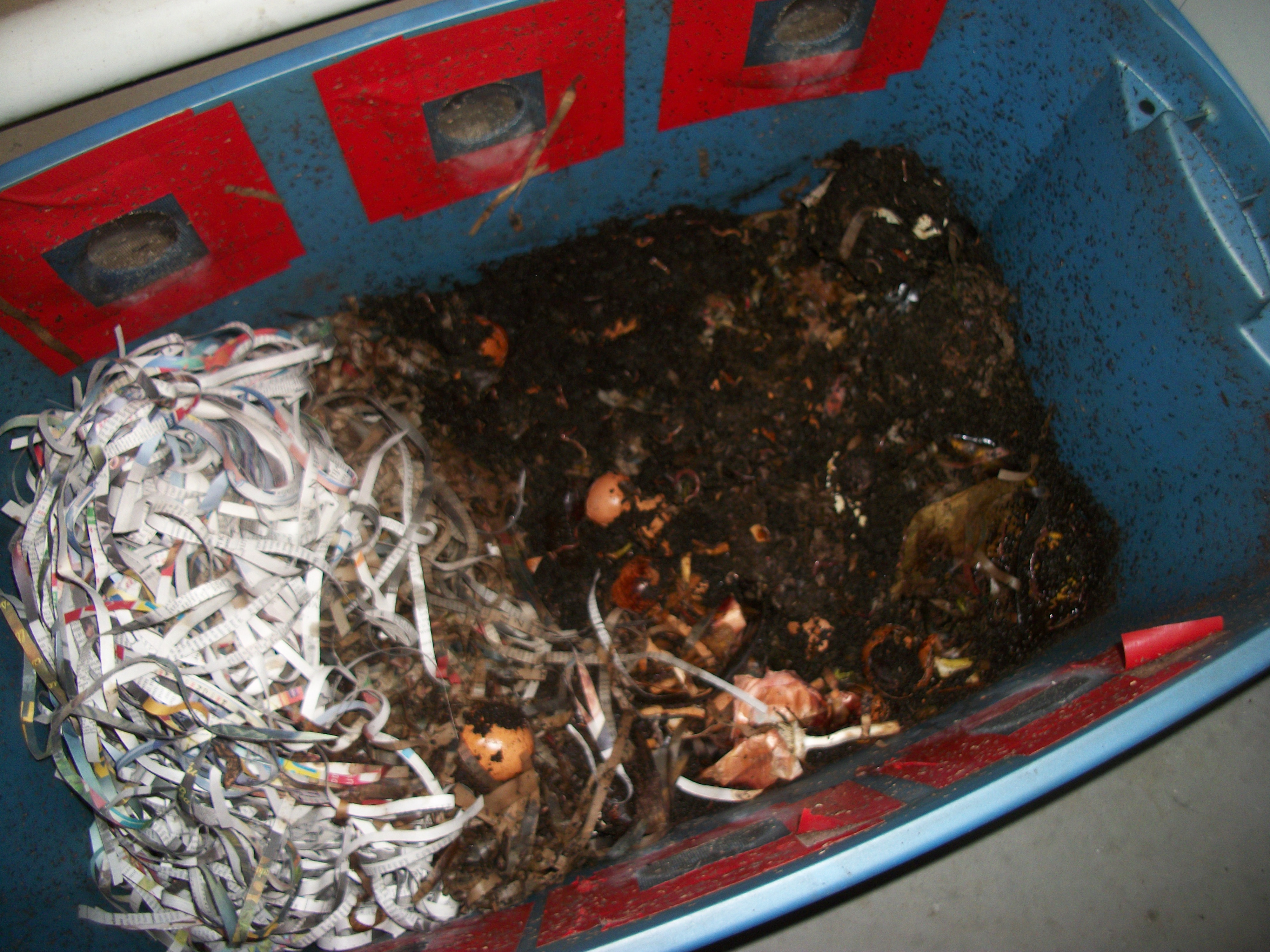
Here’s what the inside of the box looks like:

Worm box inside

You can see they’ve disposed of all their food except for some stray egg shells.

See the black dirt?  The worms make all that dirt.  Worm dirt sells for about $17 a bag.  It’s black gold.

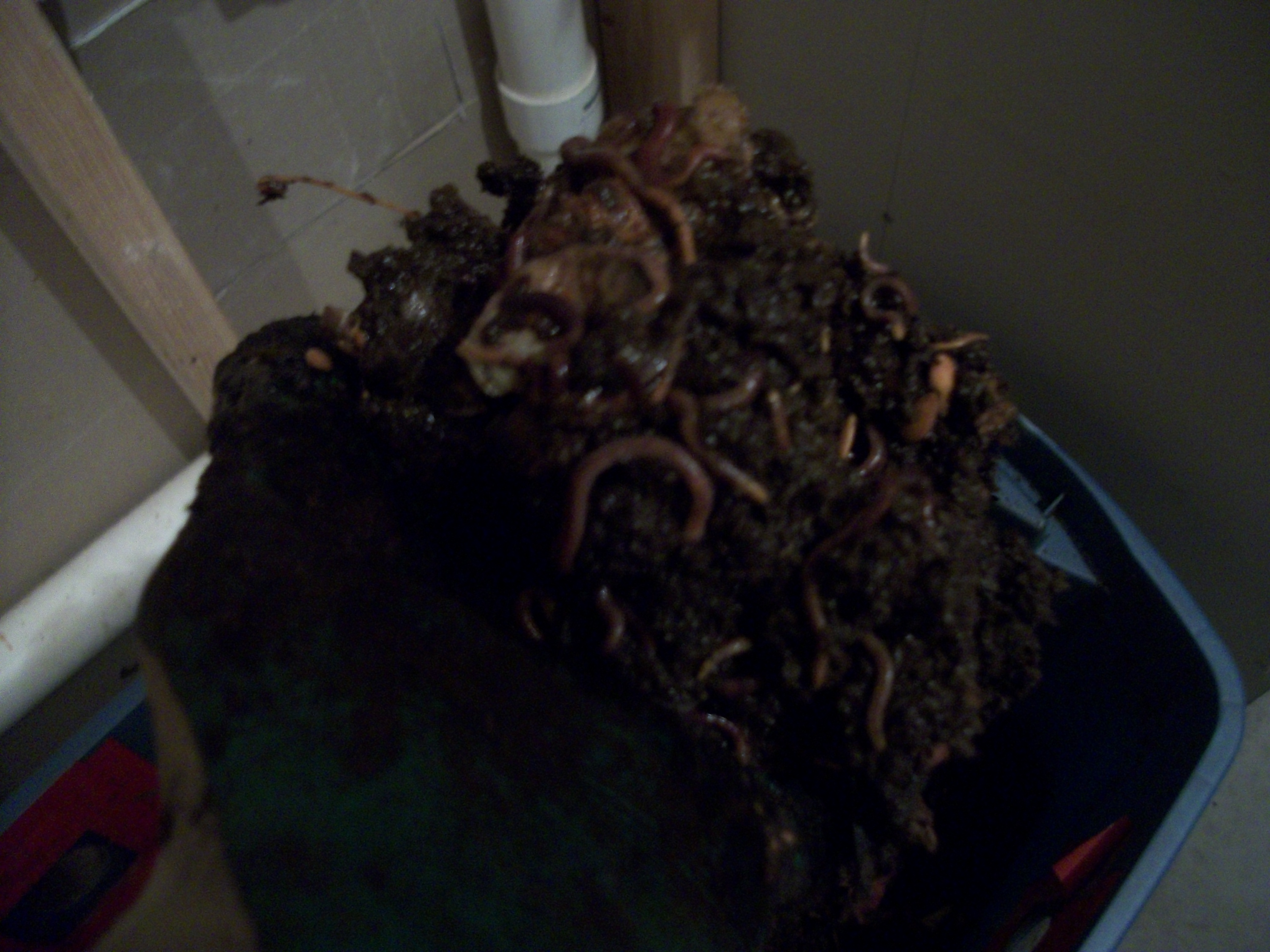
Here’s a close-up of the worms in their black gold:

Worms and their dirt

The chickens LOVE to get a handful of worms thrown to them.

I cover the worms with a layer of shredded paper.  I keep a shredder in the office, and sometimes I shred newspapers if the supply of shredded paper runs low.  I got a decent shredder last year after trying to manage a small, cheap one for some years.  When it broke, I upgraded slightly, and I think that’s been a good trade-off as I’m not putting a whole lot of paper into the waste stream.

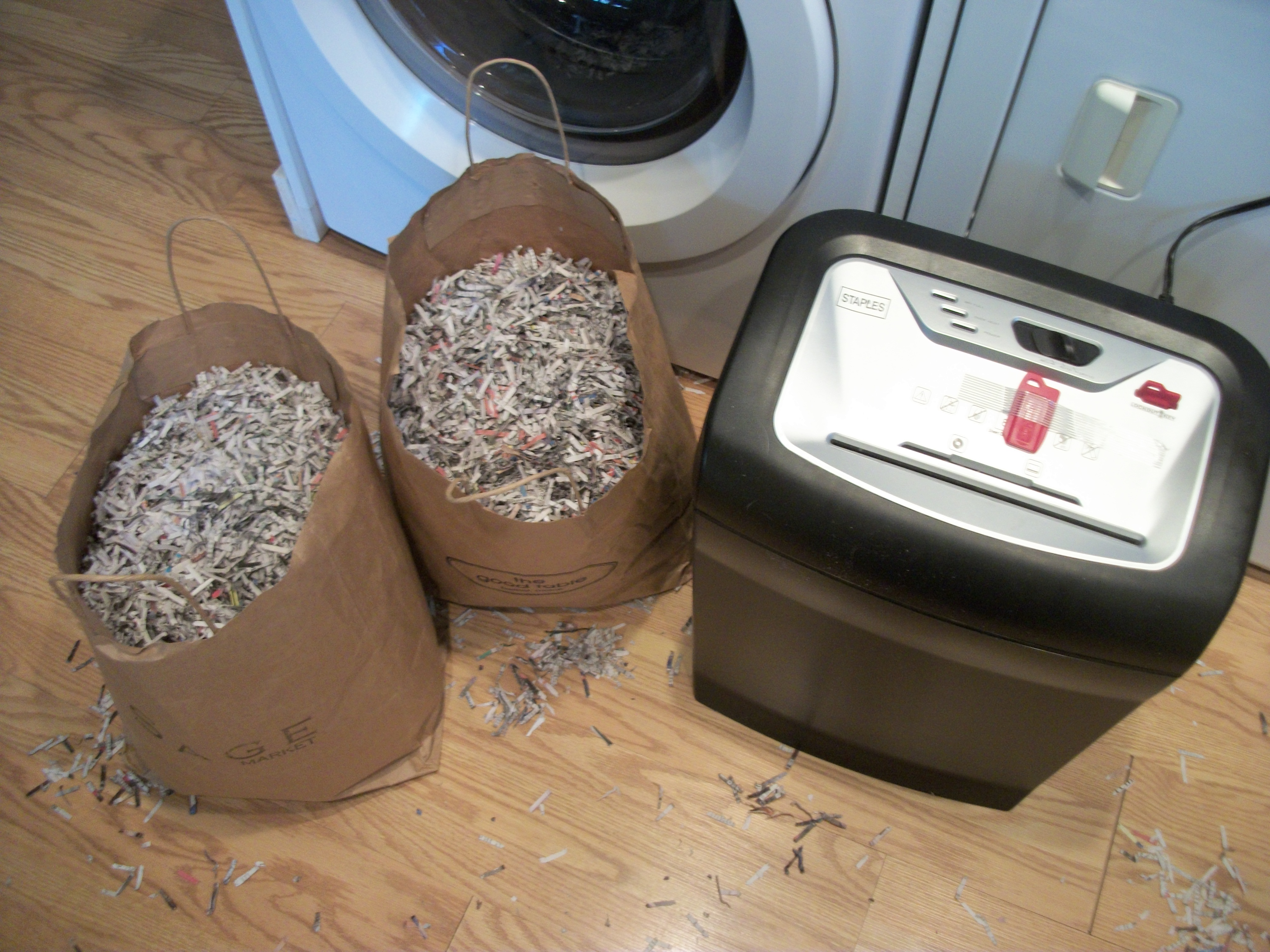
The new shredder cross-cuts the paper, which means it dissolves quicker:

Worms, paper shredded fine

Here’s the new shredder and TWO bags of shredded paper–all made with no fuss, no jamming, no cuss words…

Worms, paper shredding

In the summer, I empty the worm bin onto a tarp.  The worms retreat to the bottom of the pile, and I skim off the black gold and put it into the garden.  The chickens LOVE to help with this task.  I round up some worms to go back into the box and feed them and cover them up again.  The rest of the worms go into the veggie garden.  These worms live near the surface, so they don’t survive in a really cold winter.  I think they might winter over in a milder winter however.  At the very least, they aerate the soil and add in protein.

Vermiculture worms are very different from outdoor Maine worms.  Those guys can be as long and as thick as a small snake.  Vermiculture worms are reddish, smaller, and thinner.

I like having worms in the basement on a cold, snowy day when I don’t want to plow through drifts to get to the compost bins that live back of the garage.

Whatever the reason, I like having the worms in the basement.

PS:  there are many web sites about vermiculture.

Interesting Information: Osteoporosis Cure

Interesting Information:  May 21, 2013

Osteoporosis Cure

I’m behind in my reading and reporting.

Blame it on the inherited ipad where I am playing “Word” with kin, friends, and at least one former highschool classmate.  It will keep my brain active, right?  And it allows me to stay connected in a whole new way, right?  I hope so, as I love language and words and am learning so many new ones.

I finished the winter 2012 WISE TRADITIONS, the journal of The Weston A. Price Foundation, the other day.  There is always such good information in it, and it’s free on-line to any reader.  (I get a hard copy because I write all over the pages taking side notes, making comments, circling important information, and so forth.)  This issue is on the importance of fat-soluble vitamins–and I will write more on that tomorrow.   Remember that I am reading so I can report back to you and if you want to read more, you can follow in my footsteps and go to the texts I surface for you.

A letter called “Geriatric Rickets” caught my eye, written by Philip Ridley of London, UK.  His mother suffered from osteoporosis–a disease he believes (as I do) that is caused by malnutrition from the diet his (and our) health practitioners have been pushing for the past forty years or so–low-fat, high-sugar, high-carb intake.

First, Ridley’s mother stopped taking the osteoporosis drugs “given for free in the U.K. on the National Health Service.”  Ridley notes that

these drugs operate by inhibiting osteoclasts and stimulating osteoblasts.  The former break down old bone cells and the latter build new bone cells.  The problem with meddling in this process is that strong bones require the renewal of old bone cells with new bone cells.  The drugs therefore increase brittleness and they also do nothing about the malnutrition that causes weak bones in the first place.”

Ridley also notes that “women at the final stages of geriatric rickets are given an infusion of these toxic drugs directly into the marrow.  I have heard from families that this is the most painful treatment.”

Ridley’s mother CURED her osteoporosis by eating “bone broths, sourdough bread [fermented foods], butter, soaking of beans and grains, raw grass-fed Guernsey milk, two Royal Blend high-vitamin butter oil and fermented cod liver oil capsules per day, liver and bacon once a week, and an herbal remedy for strong bones.”  Ridley’s mother “had always had grass-fed meat, wild fish, and fresh vegetables, but lacked the fat-soluble vitamins as a result of following the lowfat diet since it was introduced into Britain in 1983, when skimmed milk first came available.”

Ridley and his mother spent “the last decade since her diagnosis waiting for the horrid, inevitable broken hip or back bone.”  But, Ridley reports that her last bone density test showed that she no longer needed to be followed for osteoporosis.  Her diet had healed her bones.

Ridley also notes that the only nutritional supplement  given for osteoporosis in the UK is calcium tablets.  But, calcium given this way “simply calcifies the soft tissues in combination with the low fat diet they promote.”  When people ask Ridley how to strengthen bones he says “eat bones.”

Ridley dams the way doctors and Big Pharma work together to put women on drugs–and what he says is true in America as well:

Geriatric rickets is becoming a silent, worsening epidemic amongst women because the bone density tests kick in for all at around sixty-five years of age, and, much like the cholesterol levels that lead to statin prescriptions, the triggers for bone density treatment are manipulated to catch the greatest number of customers for the drug companies.”

AND:

Doctors in the NHS also get performance-related pay based on the number of women tested and the number of women who test negative who hare placed on the drugs.  Most women nowadays will, as a result of lowfat diets, suffer low bone density, so a vast number of women are now being put on these toxic drugs, yet they could all be saved anguish if we would only call osteoporosis what it is and treat it accordingly.

That would be “geriatric rickets.”

Ridley also notes that “routine bone density tests most likely also cause cancer because they use radiation.”

I could add that when I came to Maine, I had arthritis in my right hip and terrible back pain.  I know my bones are much stronger now as a result of how I eat.  My gums don’t bleed when I go to the dentist.  And I’ve (knock on wood) had no new cavities–a sure sign of malnutrition.  I refuse to get any more bone density tests.  Or, mammograms, for that matter.  And I’m not going to go through the airport x-ray machines any more either.

I also have well water, which means I am no longer getting any fluoride.  For about two years after we came to Maine, I could hardly sleep at night from the pains in my bones.  I was restless and twisted and turned.  I just plain hurt.  I think it was the fluoride coming out of  my bones–and fluoride has been shown to make bones brittle, not strong.  There are a number of essays on this blog addressing the fluoride–which is one of the biggest scams in our lives today.  There isn’t any science behind adding it to the water and a LOT of science showing how dangerous it is.  Anyway, I don’t have these pains any more, and I can feel such an improvement in the health of my bones.

Here’s the whole letter if you want to read it:  http://www.westonaprice.org/letters/letters-winter-2012.

Turkey Tracks: Golden Brook Farm

Turkey Tracks:  May 20, 2013

Golden Brook Farm

Old friend and former neighbor Gina Caceci visited last weekend, and I think we talked nonstop for three days.  It was so good to see her.

One of the things we did was to go up Howe Hill to Golden Brook Farm to get some spring greens–which are filling Susan McBride Richmond’s hoop houses now.

These spring greens are the best spring tonic I know.

Susan and her husband Chris added two more BIG hoop houses this year, and no one is more delighted than me.  I have so loved watching Susan and Chris, little by little, work on their house, their barns, and their land.  Truly, Golden Brook Farm is a real farm, selling beautiful produce, eggs, and seasonal turkeys.

Here are two of the four hoop houses.  Eliot Coleman of Maine pioneered the ability to grow food year round in Maine’s winter in these hoop houses.  That book is, I think, FOUR SEASONS GARDENING.  You can’t sprout seed in the darkest winter months, but you can plant fall crops and harvest and eat them all winter long–with the help of interior coverings.  The back hoop house is the newest one and was installed just a few weeks ago.

Golden Brook Farm hoop houses

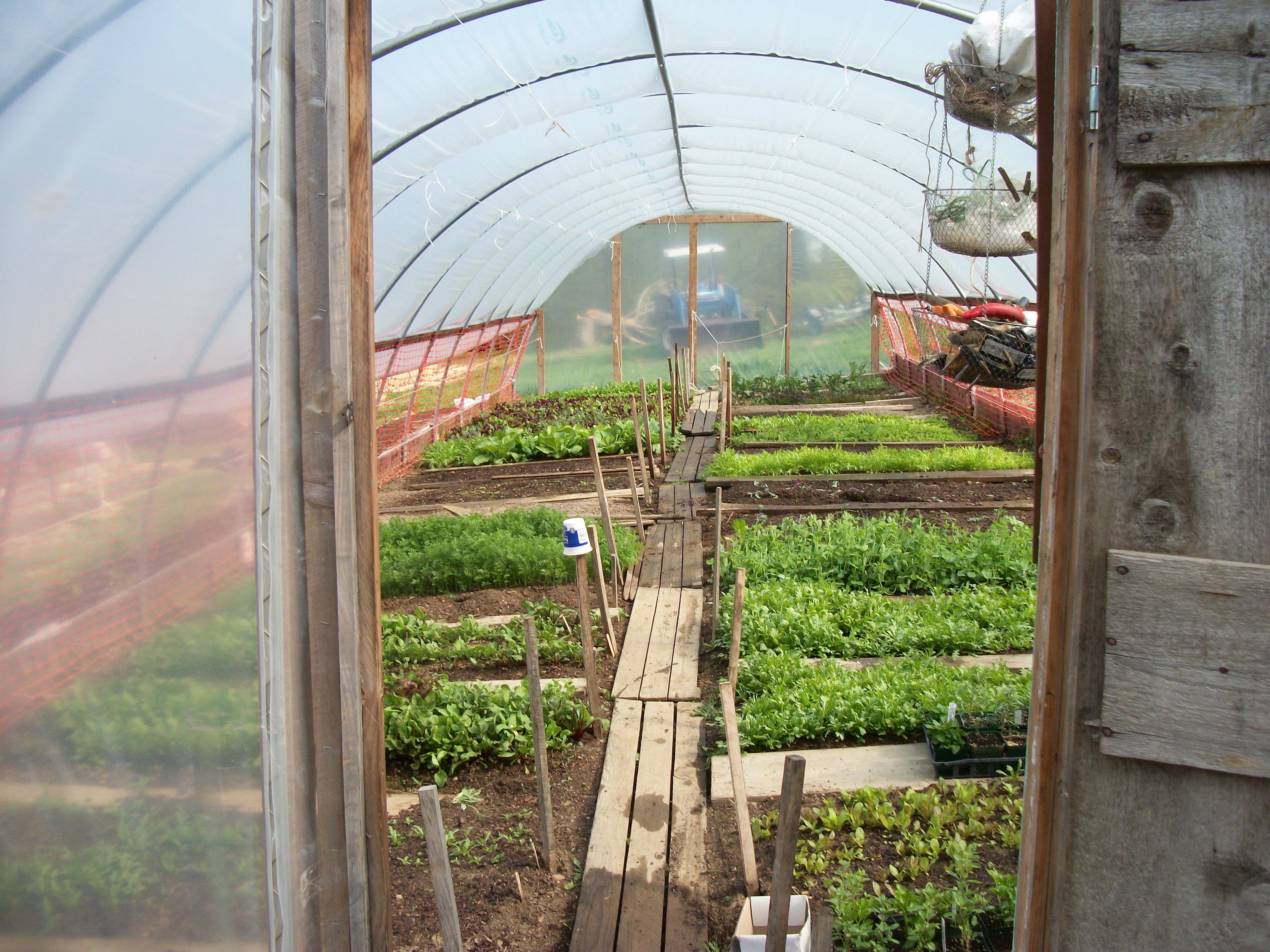
Here’s what the inside of a working hoop house can look like.

Inside Susan's Hoop House

Look at this lush planting of pea shoots–a favorite spring green in Maine:

Hoop House Planting bed 1

Or, this one–a kind of cabbage:

Hoop House Planting Bed 2

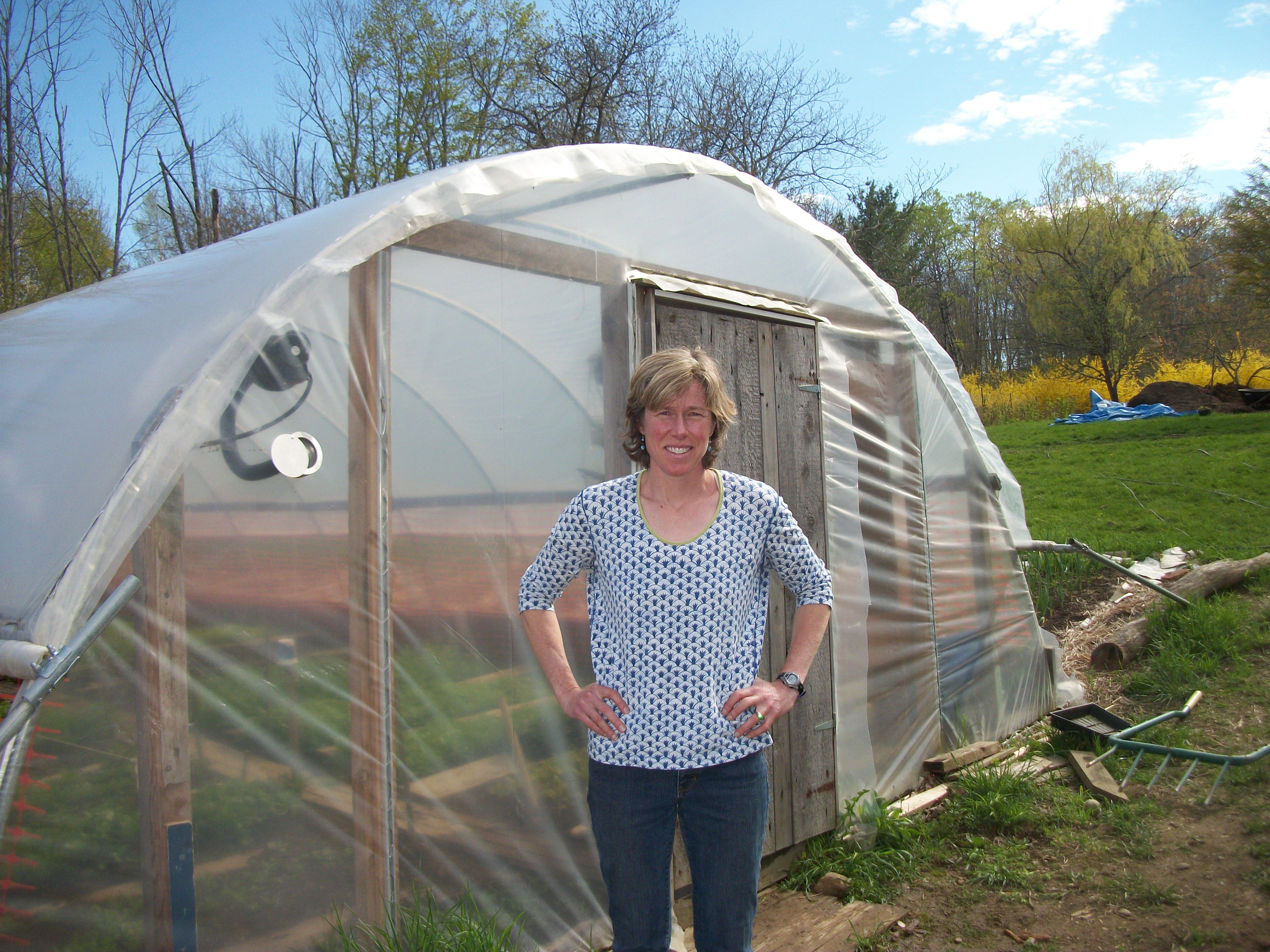
Here’s Susan herself.

Susan McBride Richmond

One day last summer I walked into one of these hoop houses that was filled with ripe tomatoes, basil, and other herbs.  I have remembered the rich heady smell for all this past long winter.  Warmed ripe tomatoes, basil, and herbs…  What a treat.

I planted Sun Gold cherry tomatoes myself and augmented with cherry tomatoes from Susan’s crop.  I cut them in half and dry them and have them all winter for salads or just to eat.  They’re so sweet they taste like chewy candy.

Think what you might be able to do in YOUR yard with even a much smaller hoop house.  They come in all sizes, and some are on sliders so they can be moved to new dirt while the old dirt recovers.  You can often find used ones.

Here’s a picture of the back side of the forsythia hedge that lines the road outside the farm.  It’s spectacular, even from the back side.  Forsythia in Maine lasts for weeks and glows against the sky or with the light on it.  We know spring has truly come when the forsythia blooms.

Forsythia Hedge

Interesting Information: Is Vitamin Water Healthy?

Interesting Information:  May 20, 2013

Is Vitamin Water Healthy?

My niece Nancy Howser Gardner is passionately interested in healthy food and healthy practices, and it’s been really fun to watch her growing in her knowledge and in her conviction about what is best for her family.

She posted a web site about a month ago that listed and compared unhealthy drinks.  I tried to find it again and turned over lots of lists of “ten unhealthy drinks,” but not the one Nan posted.

I wasn’t surprised by the cream-based chocolate/coffee drinks.

I was surprised by three others, however.

The list said that 36 grams of sugar is a desirable daily limit of sugar.

VITAMIN WATER, touted as a healthy drink, has 32 grams of sugar.  One drink.

SoBe Green Tea has 51 grams!!!

And Minute Maid Lemonade has 67.5 grams of sugar, which is the equivalent of 16 sugar cubes.

I wonder if the sugar form is High Fructose Corn Syrup?

And what kind of vitamins are in the water?  Likely they are synthetic, cheap versions of what you should be getting from your food.

Takeaway:  If the food industry is telling you they’ve made something for you to eat or drink that is a healthy choice, send up the red warning flags and start reading the label.

Turkey Tracks: Rainy Day!

Turkey Tracks:  May 20, 2013

Rainy Day!

Finally, a rainy day!

My apologies for not posting sooner, but I have been OUTSIDE for days in this glorious spring, putting the garden back into order.

I’ve been in a planting frenzy, actually, and have really needed this rainy day.  With the generous and kind help of David Hannan, many tasks have been completed:  putting up the chicken fence and the vegetable garden fence, bringing out all the outdoor furniture from the top of the garage, putting away the boarding walk, rebuilding the rock wall on the drive where the snow plow folks couldn’t see where the rocks were, bringing out all of the container pots (I think there are at least 25) and filling them with dirt and planting them, mulching, mowing, weeding, pruning, edging, seeding, and planting a now-shady bed with shade plants and, in the sunny part, an herb garden that I hope will be more permanent.

Electrician David Dodge came and fixed the back outdoor plug and installed a new plug at the front door–which will make mowing with an electric mower and a LONG cord much easier.  And once he showed me how to take out the prong-plug expensive halogen bulbs in an under-the-counter kitchen light, I got new bulbs and replaced them.  I’m afraid I had to touch the bulbs though–the oils from your fingers can make them blow–but they were too tiny and slippery to grip and get into the two out of four right holes.   Anyway, right now, it’s working.

I’ll take pictures soon.  Meanwhile, here’s how the green scrappy quilt is coming along.  I’ve been quilting in the late afternoon through the early evening, and that’s been so relaxing.  This quilt is a green copy of Bonnie Hunter’s “Blue Ridge Beauty,” in her book LEADERS AND ENDERS.   I’m calling my version “Camden Hills Beauty,” and right now, the trees on the Camden Hills are so fluffy and are so many greens that I know this quilt is well-named.  The block is a traditional Jacob’s Ladder block, but I love Bonnie’s method of combining color with neutrals.  I used light greens, but Bonnie uses true “neutrals” in her quilts and just mixes them all up.  I LOVE this quilt!

Camden Hills Beauty top taking shape

Here’s a close-up of some of the blocks.  You can see I’ve mixed in some color–bits of pink and orange.  I like the way they are working in the quilt.

Camden Hills Beauty blocks

I started sewing together rows in the last few days–and realized I need 14 rows, not 12!!!  So, it’s back to piecing more blocks.  But that’s ok as I’m really enjoying this project.  AND, my green stash is diminishing, diminishing–which is a lovely feeling of usefulness.

At night, in front of the tv, I’ve been appliqueing the “Green Turtles” quilt turtles for new granddaughter Cyanna.  I am on the eighth turtle–of nine.  So as soon as I get the Camden Hills quilt off the design wall, up will go the Green Turtles.  You can see some of the blocks on the left side of the first picture.

The 14 rows will mean the quilt will have the DARK line predominant, which is better visually I think.

Turkey Tracks: Pea Soup Fog

Turkey Tracks:  May 13, 2013

Pea Soup Fog

Friend and old neighbor (Falls Church, VA,where I lived for nearly 40 years) Gina Caceci visited this weekend.  It was so great to see her.  And I let her get out of here without getting one single picture of her.  But, I think we talked nonstop for three days.  And did a little driving around to see the sights.

We had “soft” days while she was here–and they were badly needed.  It has been soooo dry here, with fire warnings and “no burning” allowed for weeks now.

May and June can be quite foggy on the coast, and we’ve had a fog bank sitting on the coast for about a week now.  I have always been fascinated with how the fog can move in and out, like a slowly flapping curtain in the wind.   Sometimes as you are driving along the coast road, the fog will start to come across the road, moving in with long, white fingers.  And sometimes it’s really dense, so that visibility is only a hundred feet or so.  That would be called a “pea soup” fog, and that’s what we’ve had off and on for two weeks now.

I tried to get some pictures.  Here’s Camden Harbor–can you see the island at the mouth of the harbor?  Beyond is a solid white bank where you can’t see a thing.  And there are islands and boats all out there in the white.

Camden Harbor, Pea Soup Fog

To contrast, here’s a picture I took of Rockland Harbor one day last week.  There is nothing so blue as Maine water when the sun is shining.  See the light house at the end of the breakwater?  That breakwater is a mile long, and people walk it for fun.  The white balls in the water are boat moorings, so you can see that boats are not yet back in the water in any force.

Rockland harbor and lighthouse

Here’s a video of Rockport harbor in the pea soup fog:

And, here’s another, which features lobster traps being staged for use.  I love the lone dorry (I think that’s right) tied up to the float.

I love the “soft” days of spring.  I don’t know how to describe our Maine woods in spring except to say that tree tops look “fluffy” and soft with the emerging green leaves–that spring green that is probably my favorite color.  I didn’t get a good picture this year of a lone tree with the green leaves against the blue sky.  Those leaves are like lace clusters.  And, I suspect, the moment has passed for the year.

Here’s a picture of a budding tree draping over the Camden Library amphitheater entrance.  The picture I took of the library itself came out wonky.  I probably had a wrong setting by accident.  I’ll get one soon.  Our library is gorgeous and has gorgeous views of the harbor.

Camden Library Ampitheater Entrance

This picture of our Main Street, taken from the northern end of town, just below the library, is nice.  See the church steeple and the trees of the village green at the south end of the street.  Camden is a beautiful little New England town.  But we are surrounded by little towns that are each beautiful and special.

Main Street from the library

 So, happy spring everyone!

Turkey Tracks: “Blossom,” the wedding quilt

Turkey Tracks:  May 13, 2013

“Blossom,” the wedding quilt

Daughter-in-law Tamara Kelly Enright and I wanted to make bride Ashley Malphrus (now White) a wedding quilt.  The wedding was April 21, 2013, and it was gorgeous.  The ceremony was held with one of the low country rivers as a backdrop–green lawns, big house, big white tent.  It was lovely.  Ashley and her mother, Allison Malphrus, had thought of so many thoughtful, sweet touches all during the wedding.  I’m always in awe of that kind of thoughtfulness as I’m not good at it.

Last Thanksgiving, Tami and I picked out contemporary, colorful Kaffe Fasset fabrics–and Mainely Quilting shopowner Marge Hallowell cut us a big array of the Kaffe Fasset prints.  With a “layer cake” design, one starts with a 10-inch square (in our case), cuts off four borders, which leaves a central square.   Different borders are put onto different squares, and the result–after using these bright modern prints–is a very contemporary, colorful quilt.

I finished hand sewing the binding just before the wedding and mailed the quilt to Tami.  It’s BIG, and I didn’t want to carry it on the plane.  Tami and I delivered it the Friday before the wedding, as I didn’t want to have it at the wedding tent.  I also wanted to explain that the quilt is an heirloom quilt, to be used and loved, but also to be cherished in the way of being a little careful with it.

Here’s “Blossom”–and it’s not a great picture of it.  But you can see how big it is.

Blossom 1

Here’s some blocks close up.  I quilted it with a bright pink thread, and that is wonderful on both the back and the front.   I used a “Sweet Pea” pantograph, but both sides are busy enough that you don’t really see the pattern.  It will catch Ashley, some day, when the light falls just right on the quilt.  I did the best job ever on the quilting.

Blossom block

Here’s the backing and binding–so you can see how they play with the blocks:

Blossom backing and binding 2

And here’s what “Blossom” might look like folded on the foot of a bed:

Blossom at foot of bed 2

The name “Blossom” describes the quilt, yes, but it’s also meant to wish, for Ashley, that she blossoms with her marriage, that her marriage blossoms, that the blossoming creates fruit, that in turn, blossoms, and on and on and on…

Interesting Information: Bees, Bees, Bees

Interesting Information:  May 8, 2013

Bees, Bees, Bees

April in Charleston, SC, where my two sons live with their families, is a very busy month for bees.

Tamara Kelly Enright is a beekeeper.

She has two hives in her yard and is teaching her children how to care for them.  She helps manage ten other hives with Tara Derr Webb at Deux Peuces Farm in Awendaw, SC.  And she supervises two hives at a local school for rescued children, where learning how to care for bees is part of their emotional development via a deep connection to nature.  She is deeply involved in placing demonstration bee hives into local schools–a practice started and funded by the Savannah Bee Company.

Tami and Kelly suited up one sunny Sunday afternoon to check the two bee hives in her yard.

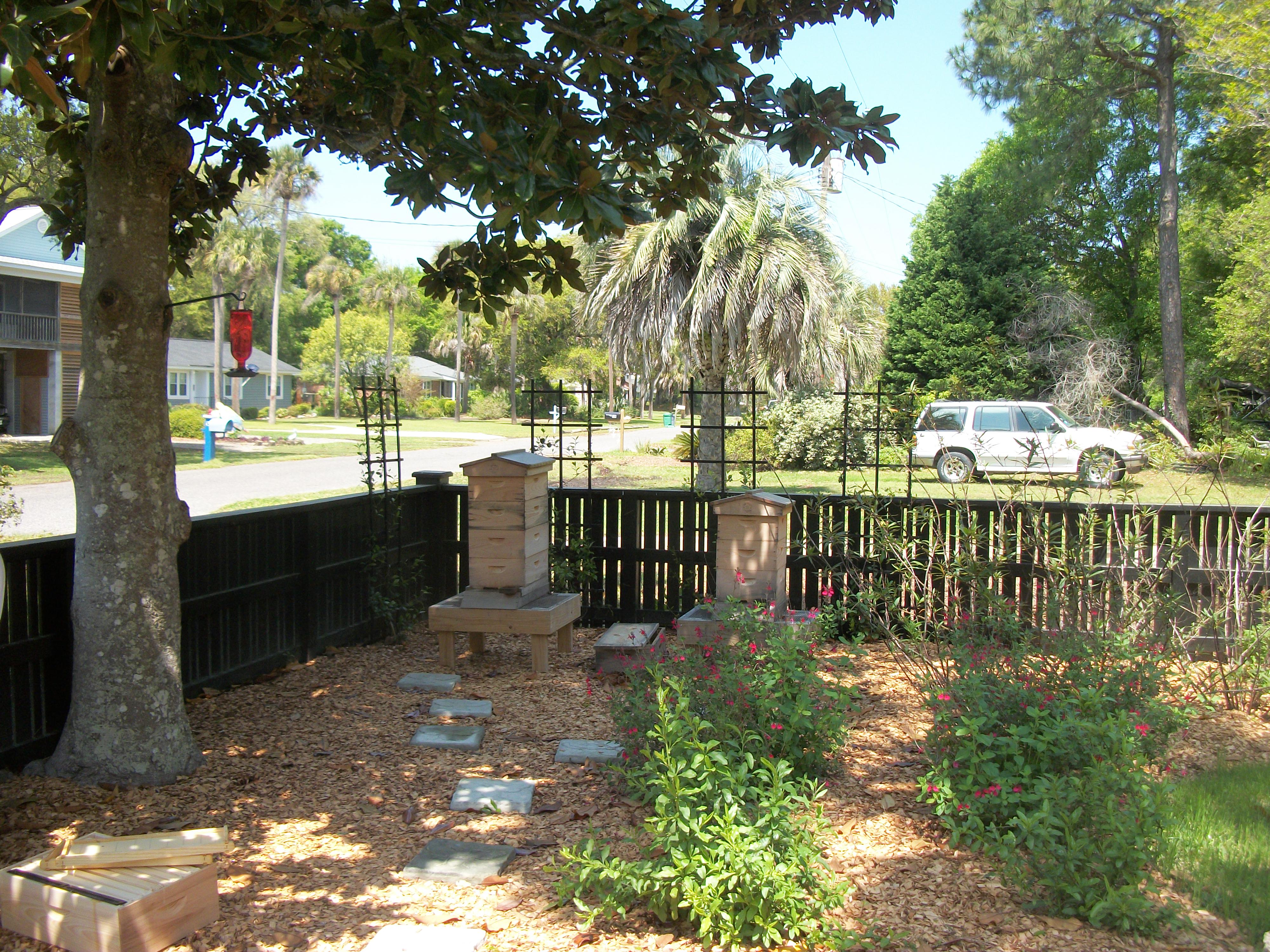
Here are the hives, tucked into a corner of the yard.  Tami has planted jasmine on the lattices behind the hives, which the bees are going to love.

Bees, Two Hives

Here’s a video of Tami and Kelly telling you what they are going to do:

Here are Tami and Kelly opening the bee hive.  They have to break the insert loose–it is sealed by the bees with a waxy substance called propolis–which has amazing healing properties.

Bees, opening the hive

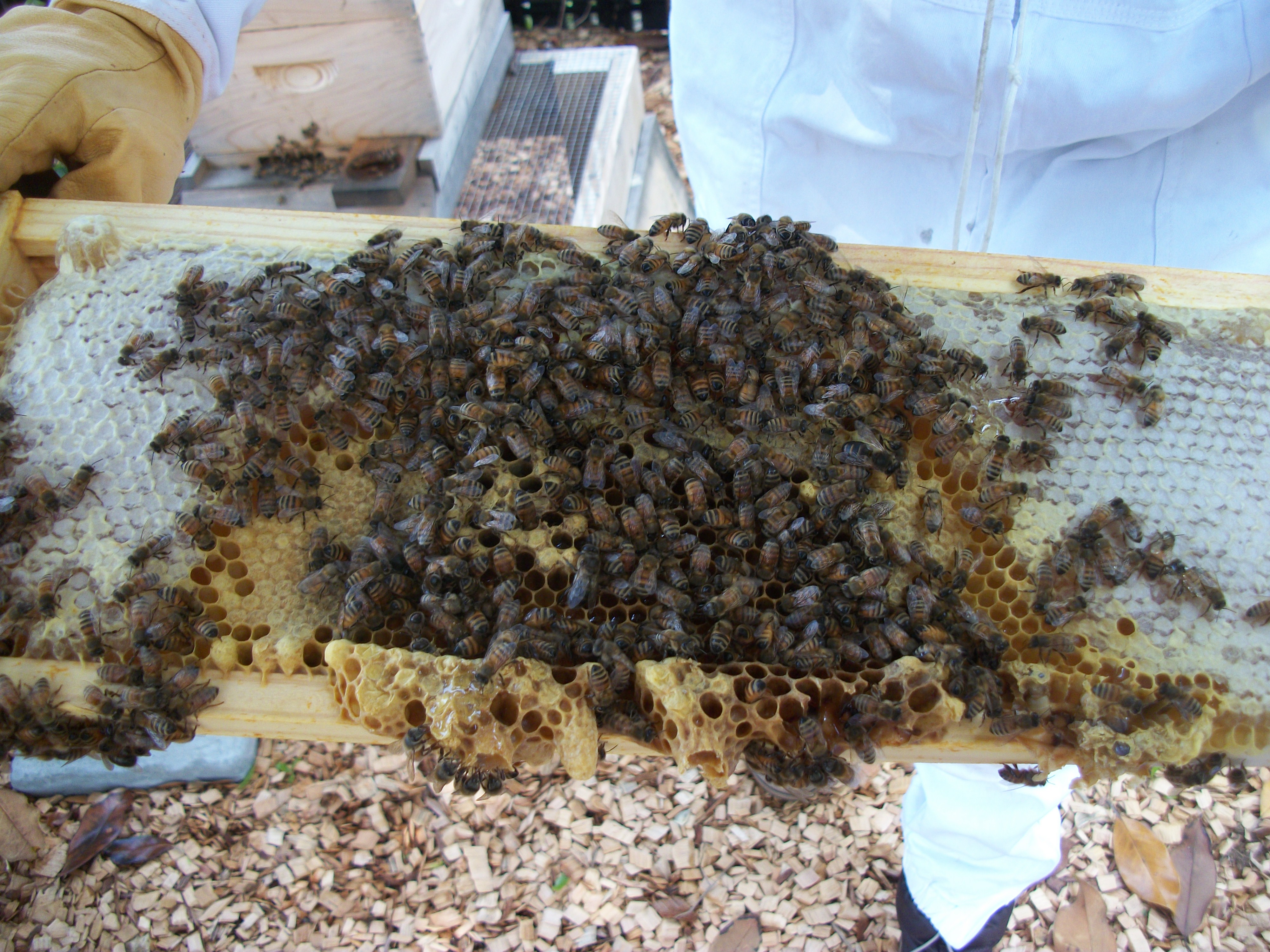
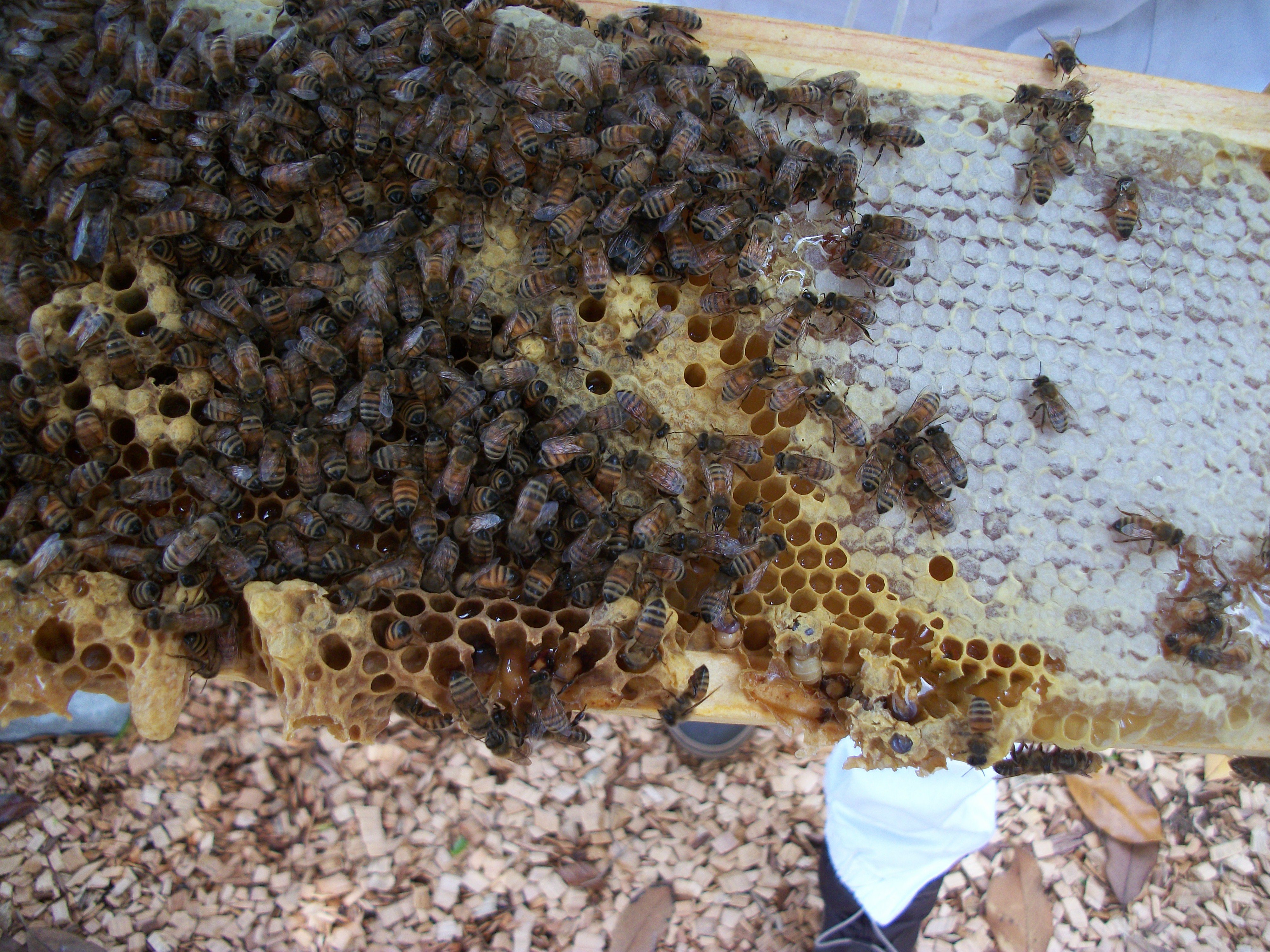
Here’s a close-up of one of the inserts.  You can see the waxed cells and the “brood,” which are the cells holding baby bees and developing bees in the foreground.  The second picture shows the brood even better.

bees up close

You can see the cells with baby bees hatching in the center front of this picture.

bees up close 2

Here’s another video up close so you can see what it feels like to work inside the hive and its panels:

During the time I was in Charleston, Tami rescued two swarms of bees.  One swarm came from one of the demonstration hives in Talula and Mina’s school.  The school staff sent out a call for help to local beekeepers, and Tami went and rescued the hive.  She brought it home and used it to repopulate one of the ten hives on Deux Peuces Farm–which had lost three queens–rendering three of the hives inoperable.

The second swarm Tami rescued landed up next to a local pool.  The pool people were going to call an exterminator, but agreed to let Tami come at night and get the swarm, which she did.

A friend told me today that he just heard that America alone has lost over 43% of their bee population.  I don’t know if that figure is correct, but I do know that it is a very serious problem for our food supply.  Yet we continue to allow chemicals to be used that kill bees.  The European Union, while I was in Charleston, banned one of the greatest offender chemicals for two years to see if it helped preserve the bees.